

ISO 11873:2005
(Main)Hardmetals — Determination of sulfur and carbon contents in cobalt metal powders — Infrared detection method
General Information
- Abstract
ISO 11873:2005 specifies the method to be used for the determination of sulfur and carbon in cobalt metal powders in the range of 0,001 % (m/m) to 0,1 % (m/m) by combustion in oxygen and infrared (IR)-detection of carbon dioxide (CO2) and sulfur dioxide (SO2).
- Status
- Published
- Publication Date
- 28-Feb-2005
- Technical Committee
- ISO/TC 119/SC 4 - Sampling and testing methods for hardmetals
- Drafting Committee
- ISO/TC 119/SC 4 - Sampling and testing methods for hardmetals
- Current Stage
- 9093 - International Standard confirmed
- Start Date
- 12-Dec-2025
- Completion Date
- 29-Aug-2026


ISO 11873:2005 Overview
ISO 11873:2005 is an international standard established by the International Organization for Standardization (ISO) that defines a precise method for determining sulfur and carbon contents in cobalt metal powders. This method utilizes combustion in oxygen followed by infrared (IR) detection of combustion gases-carbon dioxide (CO2) and sulfur dioxide (SO2)-to measure sulfur and carbon levels accurately. The standard covers sulfur and carbon contents in the range of 0.001% to 0.1% by mass, ensuring high-sensitivity analysis critical for the quality control of cobalt powders used in hardmetal applications.
This standard supports manufacturers and testing laboratories in maintaining consistent quality and compliance with global benchmarks for cobalt powders, which play an essential role in producing durable hardmetals.
Key Topics Covered
Scope and Application
ISO 11873:2005 specifies a method suitable for quantifying low sulfur and carbon levels in cobalt powders, a key raw material in hardmetal production.Testing Methodology
The procedure involves weighting a precise sample size (typically 0.5 to 1.5 grams), mixing with tungsten granules and iron chips as combustion aids, combusting the sample in an oxygen atmosphere, and detecting combustion products via infrared sensors.Calibration and Validation
The standard emphasizes rigorous calibration using blank tests and certified reference materials to guarantee analytical accuracy. It mandates repeatability within defined tolerance ranges for reliable results.Result Expression and Reporting
Results are calculated as the mass fraction of sulfur and carbon and reported to three decimal places (0.001%). The test report requires detailed documentation including sample identification, test results, deviations, and adherence to the standard.Quality Reagents
Use of highest purity oxygen and specific particle sizes for combustion aids is critical to prevent contamination and ensure precise measurements.
Practical Applications
Hardmetal Manufacturing
Precise measurement of sulfur and carbon contents in cobalt powders influences the physical characteristics and performance of hardmetals used in cutting tools, wear-resistant parts, and industrial machinery.Quality Control Laboratories
Testing facilities benefit from ISO 11873:2005 by implementing a standardized, internationally recognized method ensuring consistent and reproducible elemental analysis results.Material Certification
Suppliers and purchasers of cobalt metal powders rely on this standard to verify the compliance of raw materials with specifications, supporting traceability and reliability in the supply chain.Research and Development
Advanced material research involving cobalt-based hardmetals uses the infrared detection method to assess powder purity and optimize formulations for enhanced hardness and durability.
Related Standards
ISO 5725
This standard on the accuracy (trueness and precision) of measurement methods complements ISO 11873:2005 by providing guidelines to ensure valid and reliable test results.ISO/TC 119
The technical committee responsible for powder metallurgy standards, including sampling and testing methods related to hardmetals characterized by cobalt powders.Other Elemental Analysis Standards
Standards detailing methods for determining impurities like oxygen, nitrogen, and hydrogen in powders, which often form part of an integrated analysis protocol in materials testing.
By adhering to ISO 11873:2005, industries engaged in hardmetal production and cobalt powder analysis can guarantee high-fidelity sulfur and carbon measurement utilizing infrared detection methods. This standard fosters quality assurance, regulatory compliance, and global harmonization of testing protocols for critical raw materials in metallurgical applications.
Get Certified
Connect with accredited certification bodies for this standard

Element Materials Technology
Materials testing and product certification.

Inštitut za kovinske materiale in tehnologije
Institute of Metals and Technology. Materials testing, metallurgical analysis, NDT.
Sponsored listings
Frequently Asked Questions
ISO 11873:2005 is a standard published by the International Organization for Standardization (ISO). Its full title is "Hardmetals — Determination of sulfur and carbon contents in cobalt metal powders — Infrared detection method". This standard covers: ISO 11873:2005 specifies the method to be used for the determination of sulfur and carbon in cobalt metal powders in the range of 0,001 % (m/m) to 0,1 % (m/m) by combustion in oxygen and infrared (IR)-detection of carbon dioxide (CO2) and sulfur dioxide (SO2).
ISO 11873:2005 specifies the method to be used for the determination of sulfur and carbon in cobalt metal powders in the range of 0,001 % (m/m) to 0,1 % (m/m) by combustion in oxygen and infrared (IR)-detection of carbon dioxide (CO2) and sulfur dioxide (SO2).
ISO 11873:2005 is classified under the following ICS (International Classification for Standards) categories: 77.160 - Powder metallurgy. The ICS classification helps identify the subject area and facilitates finding related standards.
ISO 11873:2005 is available in PDF format for immediate download after purchase. The document can be added to your cart and obtained through the secure checkout process. Digital delivery ensures instant access to the complete standard document.
Standards Content (Sample)
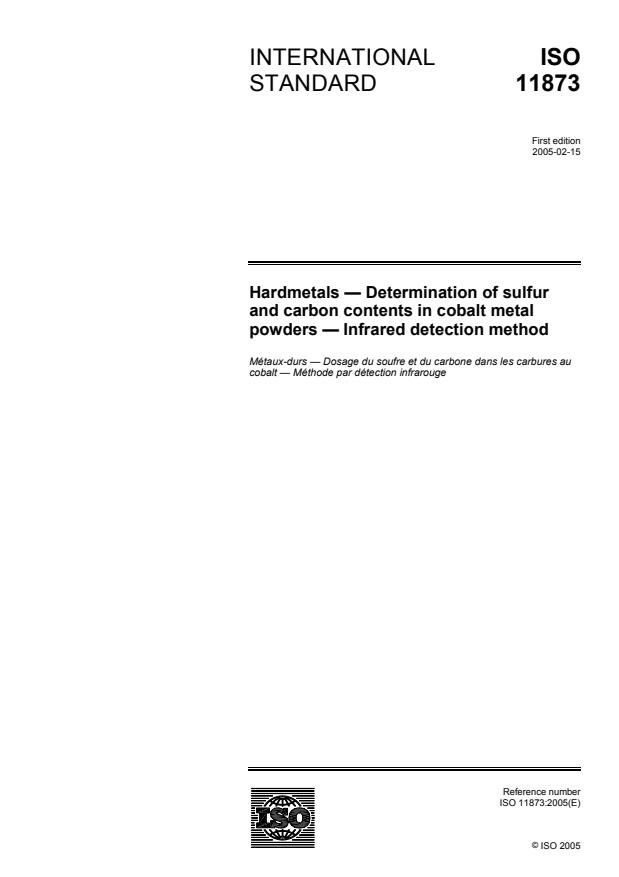
INTERNATIONAL ISO
STANDARD 11873
First edition
2005-02-15
Hardmetals — Determination of sulfur
and carbon contents in cobalt metal
powders — Infrared detection method
Métaux-durs — Dosage du soufre et du carbone dans les carbures au
cobalt — Méthode par détection infrarouge
Reference number
©
ISO 2005
PDF disclaimer
This PDF file may contain embedded typefaces. In accordance with Adobe's licensing policy, this file may be printed or viewed but
shall not be edited unless the typefaces which are embedded are licensed to and installed on the computer performing the editing. In
downloading this file, parties accept therein the responsibility of not infringing Adobe's licensing policy. The ISO Central Secretariat
accepts no liability in this area.
Adobe is a trademark of Adobe Systems Incorporated.
Details of the software products used to create this PDF file can be found in the General Info relative to the file; the PDF-creation
parameters were optimized for printing. Every care has been taken to ensure that the file is suitable for use by ISO member bodies. In
the unlikely event that a problem relating to it is found, please inform the Central Secretariat at the address given below.
© ISO 2005
The reproduction of the terms and definitions contained in this International Standard is permitted in teaching manuals, instruction
booklets, technical publications and journals for strictly educational or implementation purposes. The conditions for such reproduction are:
that no modifications are made to the terms and definitions; that such reproduction is not permitted for dictionaries or similar publications
offered for sale; and that this International Standard is referenced as the source document.
With the sole exceptions noted above, no other part of this publication may be reproduced or utilized in any form or by any means,
electronic or mechanical, including photocopying and microfilm, without permission in writing from either ISO at the address below or
ISO's member body in the country of the requester.
ISO copyright office
Case postale 56 • CH-1211 Geneva 20
Tel. + 41 22 749 01 11
Fax + 41 22 749 09 47
E-mail copyright@iso.org
Web www.iso.org
Published in Switzerland
ii © ISO 2005 – All rights reserved
Foreword
ISO (the International Organization for Standardization) is a worldwide federation of national standards bodies
(ISO member bodies). The work of preparing International Standards is normally carried out through ISO
technical committees. Each member body interested in a subject for which a technical committee has been
established has the right to be represented on that committee. International organizations, governmental and
non-governmental, in liaison with ISO, also take part in the work. ISO collaborates closely with the
International Electrotechnical Commission (IEC) on all matters of electrotechnical standardization.
International Standards are drafted in accordance with the rules given in the ISO/IEC Directives, Part 2.
The main task of technical committees is to prepare International Standards. Draft International Standards
adopted by the technical committees are circulated to the member bodies for voting. Publication as an
International Standard requires approval by at least 75 % of the member bodies casting a vote.
Attention is drawn to the possibility that some of the elements of this document may be the subject of patent
rights. ISO shall not be held respon
...