

ISO 7554-2:2026
(Main)Surgical instruments — Terms, measuring methods and test methods — Part 2: Methods for determination of basic measures
- Abstract
This document specifies methods for the determination of basic measurements of surgical standard instruments. This document does not apply to instruments for use on the central nervous system and on the central cardiovascular system. NOTE Instruments for use on the central nervous system and on the central cardiovascular system are measured differently due to complex geometries which are adapted to the human anatomy.
- Status
- Published
- Publication Date
- 18-Jun-2026
- Technical Committee
- ISO/TC 170 - Surgical instruments
- Drafting Committee
- ISO/TC 170 - Surgical instruments
- Current Stage
- 6060 - International Standard published - 60 Publication
- Start Date
- 19-Jun-2026
- Due Date
- 14-Dec-2025
- Completion Date
- 14-Dec-2025
ISO 7554-2:2026 is an ISO standard that specifies methods for determining the basic measures of surgical standard instruments. It is written for people who measure, inspect, specify, or compare instrument dimensions, so they can use the same rules for length, width, thickness, and penetration depth. It does not apply to instruments for use on the central nervous system or the central cardiovascular system, which are measured differently because of their complex anatomy-adapted geometry.
What does ISO 7554-2:2026 specify?
ISO 7554-2:2026 sets out how to measure basic dimensions of surgical standard instruments and how to handle a few common exceptions. The document is organized around general length measurement rules in Clause 4 and then special rules for particular dimensions and instrument types.
| Part | What it covers |
|---|---|
| Clause 1 | Scope |
| Clause 2 | Normative references |
| Clause 3 | Terms and definitions |
| Clause 4 | Measuring methods |
| 4.1 | Fundamentals for measurement of lengths |
| 4.2 | Rules and exceptions |
| Annex A | Tools for converting customary units |
The scope keeps the document focused on standard surgical instruments, and the annex gives conversion help for users who still work with customary units.
What are the key requirements of ISO 7554-2:2026?
ISO 7554-2:2026 is mainly about measuring dimensions in a repeatable way. The practical point is that the same instrument should give the same result regardless of who measures it, provided the same orientation and closed position are used.
Measuring length
- Clause 4.1 says length measurements are taken parallel to the reference axis. In practice, this means the instrument must be aligned the same way every time so length figures can be compared.
- Clause 4.1 also requires the working end to be completely closed during length measurement. For instruments with a lock, latch, or interlock/ratchet, that means fully locked; for instruments without locking devices, the jaw parts surfaces must be in contact according to ISO 7554-3, or the handle must be closed all the way to the stop.
- Clause 4.2.1 gives special rules for families of instruments and bent designs. For family instruments, length is measured in the unbent state; for bent devices, the total length is measured before the working end is bent; for instruments available with one bend only, the bend is included. This matters when comparing different versions of the same instrument type.
- Table 1 adds type-specific instructions for length measurement. For some forceps and retractors, the document specifies whether the forceps are closed, whether the working ends are in contact, or whether the measurement runs parallel to the working end. That helps avoid measuring different features on different product types.
Measuring joint, jaw and penetration dimensions
- Clause 4.2.2 says joint width is measured parallel to the joint. This gives a consistent way to check the width of the hinge area.
- Clause 4.2.3 says joint thickness is measured parallel to the rivet or screw, or next to a raised head screw. This matters when the fastening shape affects the reading.
- Clause 4.2.4 says jaw width is measured at a distance of 3 mm from the tip. That keeps the measurement point fixed and avoids variation from tip shape.
- Clause 4.2.5 says penetration depth for retractors, valves and hooks is measured from the inner surface. Table 2 adds instrument-specific guidance, including laminectomy punches, so users know how to treat the closed state when calculating shaft length.
What terms does ISO 7554-2:2026 define?
ISO 7554-2:2026 uses the terms and definitions from ISO 7554-1. The measuring clauses rely on a small set of recurring terms:
- Reference axis - the line used to align length measurements.
- Working end - the part that must be fully closed when measuring length.
- Lock, latch, interlock/ratchet - closing devices that determine when an instrument counts as fully closed.
- Joint width - the width measured at the joint area.
- Joint thickness - the thickness measured alongside the rivet or screw.
- Jaw width - the width measured at a fixed distance from the tip.
- Penetration depth - the depth measured from the inner surface for certain instrument types.
Who uses ISO 7554-2:2026?
ISO 7554-2:2026 is used by surgical instrument manufacturers, quality teams, inspection personnel, and test laboratories. They use it to measure products the same way across design checks, incoming inspection, product verification, and dimensional documentation.
Buyers and specifiers can also use it when they need to compare quoted dimensions against a consistent measuring method. That is especially useful when instruments have bends, locks, or shape-dependent features that can otherwise be measured in more than one way.
Which standards are used with ISO 7554-2:2026?
ISO 7554-2:2026 normatively refers to ISO 7554-1, which supplies the vocabulary used for the terms and definitions in this part. It also points to ISO 7554-3 when describing the closed condition for instruments without locking devices, because the jaw parts surfaces must meet the requirements in that part.
What does the ISO 7554-2:2026 document contain?
ISO 7554-2:2026 contains the general measuring rules, several figures, and two instruction tables that turn the methods into usable procedures. Figure 1 shows the reference axis for length measurement, while Figures 2 to 5 show how to measure joint width, joint thickness, jaw width, and penetration depth.
Table 1 gives instrument-specific length instructions, and Table 2 gives instrument-specific penetration-depth instructions. Annex A provides conversion tables for customary units, including charrière, gauge, and inches, so users can work between customary and metric dimensions without guessing.
Get Certified
Connect with accredited certification bodies for this standard

BSI Group
BSI (British Standards Institution) is the business standards company that helps organizations make excellence a habit.

TÜV Rheinland
TÜV Rheinland is a leading international provider of technical services.

TÜV SÜD
TÜV SÜD is a trusted partner of choice for safety, security and sustainability solutions.
Sponsored listings
Frequently Asked Questions
ISO 7554-2:2026 is a standard published by the International Organization for Standardization (ISO). Its full title is "Surgical instruments — Terms, measuring methods and test methods — Part 2: Methods for determination of basic measures". This standard covers: This document specifies methods for the determination of basic measurements of surgical standard instruments. This document does not apply to instruments for use on the central nervous system and on the central cardiovascular system. NOTE Instruments for use on the central nervous system and on the central cardiovascular system are measured differently due to complex geometries which are adapted to the human anatomy.
This document specifies methods for the determination of basic measurements of surgical standard instruments. This document does not apply to instruments for use on the central nervous system and on the central cardiovascular system. NOTE Instruments for use on the central nervous system and on the central cardiovascular system are measured differently due to complex geometries which are adapted to the human anatomy.
ISO 7554-2:2026 is classified under the following ICS (International Classification for Standards) categories: 11.040.30 - Surgical instruments and materials. The ICS classification helps identify the subject area and facilitates finding related standards.
ISO 7554-2:2026 is available in PDF format for immediate download after purchase. The document can be added to your cart and obtained through the secure checkout process. Digital delivery ensures instant access to the complete standard document.
Standards Content (Sample)
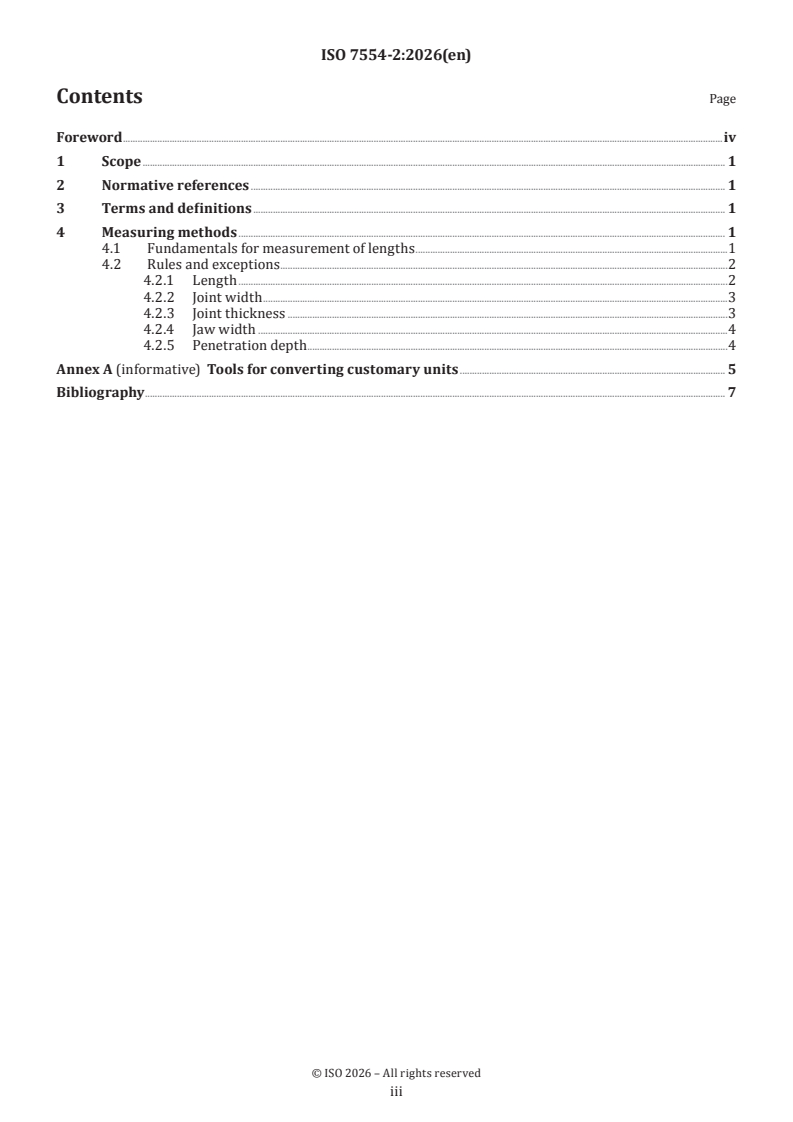
Contents
- 1 Scope
- 2 Normative references
- 3 Terms and definitions
- 4 Measuring methods
- 4.1 Fundamentals for measurement of lengths
- 4.2 Rules and exceptions
- Annex A
- Bibliography
1 Scope
This document specifies methods for the determination of basic measurements of surgical standard instruments. This document does not apply to instruments for use on the central nervous system and on the central cardiovascular system.
NOTE Instruments for use on the central nervous system and on the central cardiovascular system are measured differently due to complex geometries which are adapted to the human anatomy.
2 Normative references
The following documents are referred to in the text in such a way that some or all of their content constitutes requirements of this document. For dated references, only the edition cited applies. For undated references, the latest edition of the referenced document (including any amendments) applies. 1) ISO 7554-1, Surgical instruments — Terms, measuring methods and tests — Part 1: Vocabulary
3 Terms and definitions
1) For the purposes of this document, the terms and definitions given in ISO 7554-1 apply. ISO and IEC maintain terminology databases for use in standardization at the following addresses:
- ISO Online browsing platform: available at https:// www .iso .org/ obp
- IEC Electropedia: available at https:// www .electropedia .org/
4 Measuring methods
4.1 Fundamentals for measurement of lengths
The measurement of lengths shall be carried out in parallel to the reference axis and in the position where the working end is completely closed. For instruments with a lock, latch or interlock/ratchet, the working end is completely closed when the instrument is fully locked. For instruments without locking devices, the working end is completely closed when the jaw parts surfaces are in contact according to their requirements (see ISO 7554-3) or when the handle is closed all the way to the stop. Figure 1 illustrates an example of the reference axis that is used when measuring lengths.
NOTE Annex A provides tables for converting customary units.
1) Under preparation. Stage at the time of publication: ISO/FDIS 7554-1.
ISO 7554-2:2026(en) Key 1 reference axis Figure 1 — Example for reference axis for measurement of lengths
...