


ISO/IEC 10021-10:1998
(Main)Information technology — Message Handling Systems (MHS) — Part 10: MHS routing
Information technology — Message Handling Systems (MHS) — Part 10: MHS routing
Technologies de l'information — Systèmes de messagerie (MHS) — Partie 10: Routage MHS
General Information
- Status
- Withdrawn
- Publication Date
- 02-Sep-1998
- Withdrawal Date
- 02-Sep-1998
- Current Stage
- 9599 - Withdrawal of International Standard
- Start Date
- 16-Nov-2000
- Completion Date
- 14-Feb-2026
Relations
- Effective Date
- 15-Apr-2008

Get Certified
Connect with accredited certification bodies for this standard

BSI Group
BSI (British Standards Institution) is the business standards company that helps organizations make excellence a habit.

NYCE
Mexican standards and certification body.
Sponsored listings
Frequently Asked Questions
ISO/IEC 10021-10:1998 is a standard published by the International Organization for Standardization (ISO). Its full title is "Information technology — Message Handling Systems (MHS) — Part 10: MHS routing". This standard covers: Information technology — Message Handling Systems (MHS) — Part 10: MHS routing
Information technology — Message Handling Systems (MHS) — Part 10: MHS routing
ISO/IEC 10021-10:1998 is classified under the following ICS (International Classification for Standards) categories: 35.240.20 - IT applications in office work. The ICS classification helps identify the subject area and facilitates finding related standards.
ISO/IEC 10021-10:1998 has the following relationships with other standards: It is inter standard links to ISO/IEC 10021-10:1999. Understanding these relationships helps ensure you are using the most current and applicable version of the standard.
ISO/IEC 10021-10:1998 is available in PDF format for immediate download after purchase. The document can be added to your cart and obtained through the secure checkout process. Digital delivery ensures instant access to the complete standard document.
Standards Content (Sample)
INTERNATIONAL ISO/IEC
STANDARD 10021-10
First edition
1998-09-01
Information technology — Message
Handling Systems (MHS) —
Part 10:
MHS routing
Technologies de l'information — Systèmes de messagerie (MHS) —
Partie 10: Routage MHS
Reference number
B C
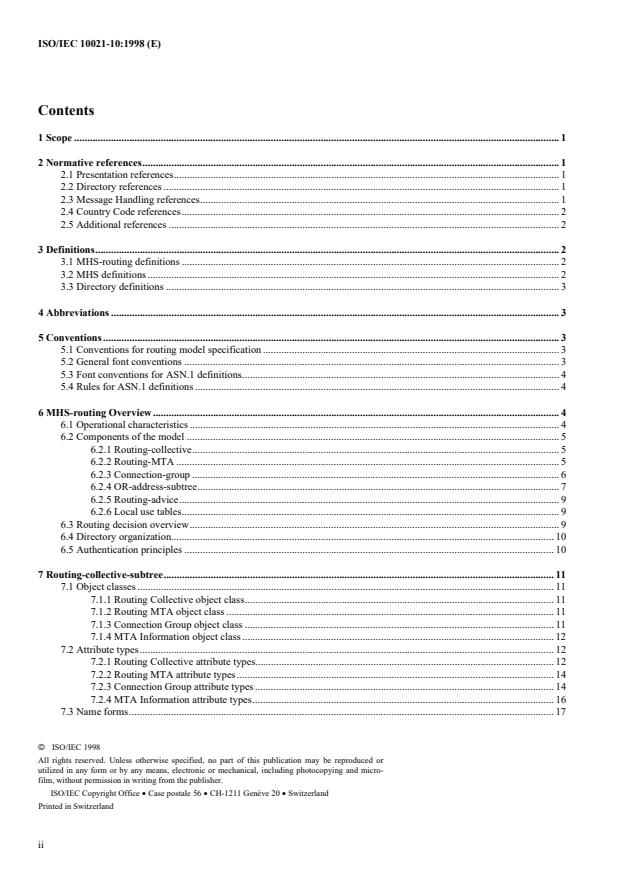
Contents
1 Scope . 1
2 Normative references. 1
2.1 Presentation references. 1
2.2 Directory references . 1
2.3 Message Handling references. 1
2.4 Country Code references. 2
2.5 Additional references . 2
3 Definitions. 2
3.1 MHS-routing definitions . 2
3.2 MHS definitions . 2
3.3 Directory definitions . 3
4 Abbreviations . 3
5 Conventions . 3
5.1 Conventions for routing model specification . 3
5.2 General font conventions . 3
5.3 Font conventions for ASN.1 definitions. 4
5.4 Rules for ASN.1 definitions . 4
6 MHS-routing Overview. 4
6.1 Operational characteristics . 4
6.2 Components of the model . 5
6.2.1 Routing-collective. 5
6.2.2 Routing-MTA . 5
6.2.3 Connection-group . 6
6.2.4 OR-address-subtree. 7
6.2.5 Routing-advice. 9
6.2.6 Local use tables. 9
6.3 Routing decision overview. 9
6.4 Directory organization. 10
6.5 Authentication principles . 10
7 Routing-collective-subtree. 11
7.1 Object classes . 11
7.1.1 Routing Collective object class. 11
7.1.2 Routing MTA object class . 11
7.1.3 Connection Group object class . 11
7.1.4 MTA Information object class. 12
7.2 Attribute types. 12
7.2.1 Routing Collective attribute types. 12
7.2.2 Routing MTA attribute types. 14
7.2.3 Connection Group attribute types . 14
7.2.4 MTA Information attribute types. 16
7.3 Name forms. 17
© ISO/IEC 1998
All rights reserved. Unless otherwise specified, no part of this publication may be reproduced or
utilized in any form or by any means, electronic or mechanical, including photocopying and micro-
film, without permission in writing from the publisher.
ISO/IEC Copyright Office • Case postale 56 • CH-1211 Genève 20 • Switzerland
Printed in Switzerland
ii
© ISO/IEC ISO/IEC 10021-10:1998 (E)
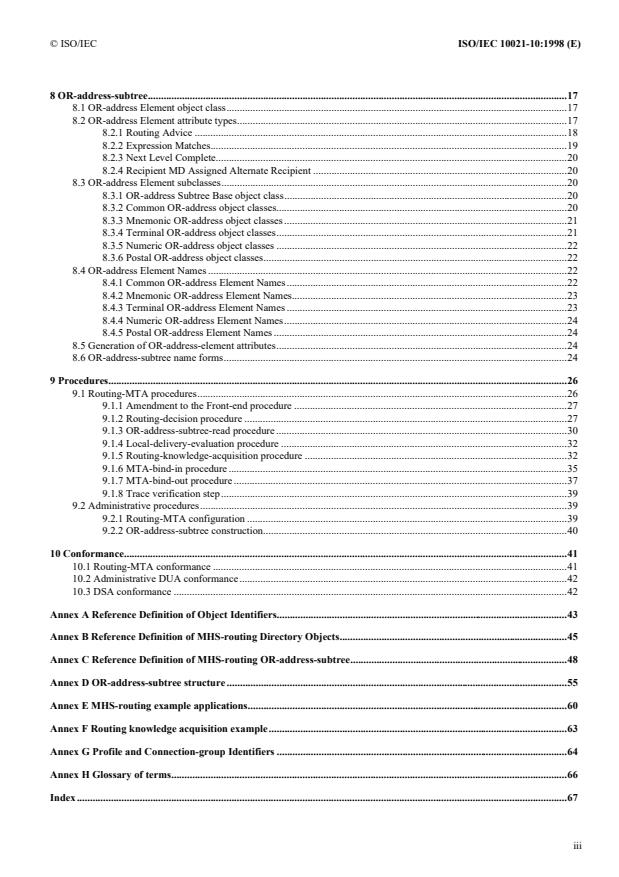
8 OR-address-subtree.17
8.1 OR-address Element object class.17
8.2 OR-address Element attribute types.17
8.2.1 Routing Advice .18
8.2.2 Expression Matches.19
8.2.3 Next Level Complete.20
8.2.4 Recipient MD Assigned Alternate Recipient .20
8.3 OR-address Element subclasses.20
8.3.1 OR-address Subtree Base object class.20
8.3.2 Common OR-address object classes.20
8.3.3 Mnemonic OR-address object classes .21
8.3.4 Terminal OR-address object classes.21
8.3.5 Numeric OR-address object classes .22
8.3.6 Postal OR-address object classes.22
8.4 OR-address Element Names .22
8.4.1 Common OR-address Element Names.22
8.4.2 Mnemonic OR-address Element Names.23
8.4.3 Terminal OR-address Element Names .23
8.4.4 Numeric OR-address Element Names.24
8.4.5 Postal OR-address Element Names .24
8.5 Generation of OR-address-element attributes.24
8.6 OR-address-subtree name forms.24
9 Procedures.26
9.1 Routing-MTA procedures.26
9.1.1 Amendment to the Front-end procedure .27
9.1.2 Routing-decision procedure .27
9.1.3 OR-address-subtree-read procedure .30
9.1.4 Local-delivery-evaluation procedure .32
9.1.5 Routing-knowledge-acquisition procedure .32
9.1.6 MTA-bind-in procedure .35
9.1.7 MTA-bind-out procedure .37
9.1.8 Trace verification step.39
9.2 Administrative procedures.39
9.2.1 Routing-MTA configuration .39
9.2.2 OR-address-subtree construction.40
10 Conformance.41
10.1 Routing-MTA conformance .41
10.2 Administrative DUA conformance.42
10.3 DSA conformance .42
Annex A Reference Definition of Object Identifiers.43
Annex B Reference Definition of MHS-routing Directory Objects.45
Annex C Reference Definition of MHS-routing OR-address-subtree.48
Annex D OR-address-subtree structure .55
Annex E MHS-routing example applications.60
Annex F Routing knowledge acquisition example.63
Annex G Profile and Connection-group Identifiers .64
Annex H Glossary of terms.66
Index .67
iii
Foreword
ISO (the International Organization for Standardization) and IEC (the International
Electrotechnical Commission) form the specialized system for worldwide standardization.
National bodies that are members of ISO or IEC participate in the development of International
Standards through technical committees established by the respective organization to deal with
particular fields of technical activity. ISO and IEC technical committees collaborate in fields of
mutual interest. Other international organizations, governmental and non-governmental, in
liaison with ISO and IEC, also take part in the work.
In the field of information technology, ISO and IEC have established a joint technical
committee, ISO/IEC JTC 1. Draft International Standards adopted by the joint technical
committee are circulated to national bodies for voting. Publication as an International Standard
requires approval by at least 75% of the national bodies casting a vote.
International Standard ISO/IEC 10021-10 was prepared by Joint Technical Committee
ISO/IEC JTC 1, Information technology, Subcommittee SC 18, Document processing and
related communication
.
ISO/IEC 10021 consists of the following parts, under the general title Information technology -
Message Handling Systems (MHS):
– Part 1: System and service overview
– Part 2: Overall architecture
– Part 3: Abstract Service Definition Conventions
– Part 4: Message Transfer System: Abstract service definition and procedures
– Part 5: Message Store: Abstract service definition
– Part 6: Protocol specifications
– Part 7: Interpersonal messaging system
– Part 8: Electronic data interchange messaging service
– Part 9: Electronic data interchange messaging system
– Part 10: MHS routing
Annexes A to D form an integral part of this part of ISO/IEC 10021. Annexes E to H are for
information only.
iv
© ISO/IEC ISO/IEC 10021-10:1998 (E)
Introduction
This part of ISO/IEC 10021 is one of a number of parts of ISO/IEC 10021 defining Message
Handling in a distributed open systems environment.
Message Handling provides for the exchange of messages between users on a store-and-
forward basis. A message submitted by one user (the originator) is transferred through the
message-transfer-system (MTS) and delivered to one or more other users (the recipients).
This part of ISO/IEC 10021 defines a method for routing messages through the Message
Handling System (MHS).
v
_________________________________________________________________________________________________
INTERNATIONAL STANDARD © ISO/IEC ISO/IEC 10021-10:1998 (E)
_________________________________________________________________________________________________
Information technology –
Message Handling Systems (MHS) –
Part 10: MHS routing
1 Scope
This part of ISO/IEC 10021 specifies the means by which messages are routed through the MHS, and supplements the
procedures defined in 14.3 of ISO/IEC 10021-4.
Other parts of ISO/IEC 10021 define other aspects of the MHS. ITU-T Rec. F.400/X.400 | ISO/IEC 10021-1 defines the
user-oriented services provided by the MHS. ITU-T Rec. X.402 | ISO/IEC 10021-2 provides an architectural overview of
the MHS. ITU-T Rec. X.411 | ISO/IEC 10021-4 defines the abstract-service of the Message Transfer System.
2 Normative references
The following standards contain provisions which, through reference in this text, constitute provisions of this part of
ISO/IEC 10021. At the time of publication, the editions indicated were valid. All standards are subject to revision, and
parties to agreements based on this part of ISO/IEC 10021 are encouraged to investigate the possibility of applying the
most recent editions of the standards indicated below. Members of IEC and ISO maintain registers of currently valid
International Standards.
2.1 Presentation references
This part of ISO/IEC 10021 cites the following Presentation specifications:
— ITU-T Recommendation X.680 (1994) | ISO/IEC 8824-1: 1995, Information technology - Abstract Syntax
Notation One (ASN.1): Specification of basic notation.
— ITU-T Recommendation X.681 (1994) | ISO/IEC 8824-2: 1995, Information technology - Abstract Syntax
Notation One (ASN.1): Information object specification.
2.2 Directory references
This part of ISO/IEC 10021 cites the following Directory specifications:
1)
— ITU-T Recommendation X.500 (1997) | ISO/IEC 9594-1: — , Information technology —Open Systems
Interconnection —The Directory: Overview of Concepts, Models, and Services.
1),
— ITU-T Recommendation X.501 (1997) | ISO/IEC 9594-2: — Information technology —Open Systems
Interconnection —The Directory: Models.
1)
— ITU-T Recommendation X.520 (1997) | ISO/IEC 9594-6: — , Information technology —Open Systems
Interconnection —The Directory: Selected attribute types.
1)
— ITU-T Recommendation X.521 (1997) | ISO/IEC 9594-7: — , Information technology —Open Systems
Interconnection —The Directory: Selected object classes.
2.3 Message Handling references
This part of ISO/IEC 10021 cites the following Message Handling System specifications:
— ITU-T Recommendation F.400/X.400 (1996), Message handling services: Message handling system and
service overview.
1)
ISO/IEC 10021-1: — , Information technology — Message Handling Systems (MHS) — Part 1: System and
service overview.
1)
To be published
— ITU-T Recommendation X.402 (1995) | ISO/IEC 10021-2: 1996, Information technology — Message
Handling Systems (MHS): Overall architecture.
— ITU-T Recommendation X.411 (1995) | ISO/IEC 10021-4: 1997, Information technology — Message
Handling Systems (MHS): Message transfer system: Abstract service definition and procedures.
2.4 Country Code references
This part of ISO/IEC 10021 cites the following Country Code specifications:
— ISO 3166-1: 1997, Codes for the representation of names of countries and their subdivisions — Part 1:
Country codes.
— CCITT Recommendation X.121 (1996), International number plan for public data networks.
2.5 Additional references
This part of ISO/IEC 10021 cites the following specification:
— ISO/IEC 9945-2: 1993, Information technology — Portable Operating System Interface (POSIX) — Part 2:
Shell and Utilities.
3 Definitions
For the purposes of this part of ISO/IEC 10021, the following definitions apply.
3.1 MHS-routing definitions
this part of ISO/IEC 10021
The following terms are defined in clauses 6 and 7 of :
— connection-group
— entry-connection-group
— enumerated connection-group
— indirect-exit-connection-group
— key-routing-collective
— local-exit-connection-group
— local-use-tables
— MHS-routing
— next-MTA
— OR-address-element
— OR-address-subtree
— routing-advice
— routing-collective
— routing-collective-subtree
— routing-MTA
— transit-exit-connection-group
— unenumerated connection-group
A glossary of these terms appears in Annex H.
3.2 MHS definitions
The following terms are defined in ITU-T Rec. X.402 | ISO/IEC 10021-2:
— Administration Management Domain (ADMD)
— Management Domain (MD)
— Message Handling System (MHS)
— Message Transfer Agent (MTA)
© ISO/IEC ISO/IEC 10021-10:1998 (E)
— Message Transfer System (MTS)
— Originator/recipient Address (OR-address)
— Private Management Domain (PRMD)
— Reliable Transfer Service Element (RTSE)
For the purposes of this part of ISO/IEC 10021, the term message, where used unqualified, refers generically to a
message, probe, or report.
3.3 Directory definitions
The following terms are defined in ITU-T Rec. X.501 | ISO/IEC 9594-2:
— Directory Information Tree (DIT)
— Directory System Agent (DSA)
— Directory User Agent (DUA)
— Relative Distinguished Name (RDN)
4 Abbreviations
The abbreviations used in this part of ISO/IEC 10021 are defined in ITU-T Rec. X.402 | ISO/IEC 10021-2, and ITU-T
Rec. X.501 | ISO/IEC 9594-2 (see 3.2 and 3.3), except for the following.
— ACSE Association Control Service Element (ITU-T Rec. X.217 | ISO/IEC 8649)
— APS Asynchronous Protocol Specification (ITU-T Rec.X.445)
— IP Internet Protocol
— LAN Local Area Network
— PSAP Presentation Service Access Point (ISO/IEC 7498-3)
— WAN Wide Area Network
— X.25 A packet-switched network conforming to ITU-T Rec. X.25
5 Conventions
This part of ISO/IEC 10021 uses the descriptive conventions listed below.
5.1 Conventions for routing model specification
This part of ISO/IEC 10021 uses the following ASN.1-based descriptive conventions for the indicated purposes:
a) To define the data types and values for MHS-routing, ASN.1 itself.
b) To define the Directory entries for MHS-routing, the OBJECT-CLASS, ATTRIBUTE, NAME-FORM,
STRUCTURE-RULE, and MATCHING-RULE information object classes of ITU-T Rec. X.501 | ISO/IEC
9594-2.
Whenever this part of ISO/IEC 10021 describes a class of data structure having components, each component is
categorized as one of the following grades:
a) Mandatory (M): A mandatory component shall be present in every instance of the class.
b) Optional (O): An optional component may be present in an instance of the class at the discretion of the
object (e.g. user) supplying that instance.
c) (C): A conditional component shall be present in an instance of the class as specified by this
Conditional
part of ISO/IEC 10021.
5.2 General font conventions
Throughout this part of ISO/IEC 10021, terms are rendered in when defined. Terms that are proper nouns are
bold
capitalized, generic terms are not. Multi-word generic terms are hyphenated. Italic font is used for ASN.1 identifiers
defined in other International Standards.
5.3 Font conventions for ASN.1 definitions
Throughout this part of ISO/IEC 10021, ASN.1 definitions appear in fixed-pitch font (of this Type) to highlight the
difference between normal text and ASN.1 definitions. The font used for ASN.1 definitions is smaller than that used for
normal text.
5.4 Rules for ASN.1 definitions
ASN.1 definitions appear both in the body of this part of ISO/IEC 10021 to aid the exposition, and again, formally, in
annexes for reference. If a difference is found between the ASN.1 used in the exposition and that formally defined in the
corresponding annex, a specification error is indicated.
6 MHS-routing Overview
The purpose of a Message Handling System (MHS) is to enable users to exchange messages on a store-and-forward basis.
A message submitted on behalf of one user, the originator, is conveyed by the Message Transfer System (MTS) and
subsequently delivered to the agents of one or more additional users, the recipients. The MTS comprises a collection of
Message Transfer Agents (MTAs), which are highly distributed, and a message may traverse a number of MTAs on the
journey from its originator to its recipient.
In MHS, the originator does not specify a path through the MTS to reach a recipient, but simply specifies a recipient OR-
name (from which the OR-address is obtained). It is the responsibility of each MTA to determine the next MTA to which
the message should be transferred to progress its journey to its recipient. Routing is thus the process of selecting, given an
OR-address, the MTA to which the message should next be transferred.
The other parts of ISO/IEC 10021 specify the services provided by MHS, and the protocols used to transfer messages
within the MTS. The means by which an MTA determines an appropriate route that will convey a message to its recipient
is the subject of this part of ISO/IEC 10021. The various mechanisms defined herein which enable MTAs to make this
determination constitute MHS-routing.
The path taken between an originator and recipient may vary on different occasions, since there will in general be a
number of possible paths between them, and factors such as congestion and availability may influence route selection.
MTAs acquire routing information by accessing Directory entries whose maintenance is the responsibility of an MHS
administrator. These entries model the various properties of the MHS that are relevant to routing. However, MHS-routing
does not depend on the provision of a fully interconnected Directory.
6.1 Operational characteristics
MHS-routing has the following operational characteristics:
a) In MHS-routing, the OR-address name-space is decoupled from the constraints of hardware organization
(e.g. the assignment of users to particular machines, or the ability of groups of machines to interconnect).
This is in contrast with routing strategies that use OR-address pattern-matching methods to make routing
decisions, which constrain an MHS administrator’s choice in the allocation of OR-addresses to users, and
require users to change their OR-addresses whenever their MTA changes.
OR-addresses are intended to reflect the organizational hierarchy, and to use only as many levels of OR-
address element as is required to achieve this. However, many organizations have staff distributed over
multiple locations (where staff will necessarily use a local MTA), or have multiple messaging systems in use
(e.g. mainframe-based, integrated office automation systems, and PC LAN email systems) where staff in any
one department are arbitrarily allocated to different systems. Separating the OR-address hierarchy from the
physical topology allows for the assignment to users of addresses which are compact and related to their
organizational role, regardless of their physical location.
b) MHS-routing supports the range of connection densities possible among MTAs. One extreme is where all
MTAs are connected to a common network and any MTA can connect to any other (e.g. a public wide-area
network). At the other extreme an administrator specifies precisely which MTA pairs are able to
communicate, as if the MTAs were connected by individual cables, regardless of the actual connection
method.
Some MHS installations restrict the topology (e.g. by performing all routing through a central switch MTA),
because of the management cost in maintaining routing information, even when all the MTAs concerned are
connected to a LAN or WAN and could, in principle, exchange messages directly. However, moving to the
fully connected possibility may be undesirable for some organizations, due to concerns of security and cost
optimization.
c) MHS-routing permits varying degrees of autonomy and segregation in the management of an MHS system.
Many organizations will have the overall MHS managed by a central IT unit, with the management of
individual system components devolved to local administrators. Often, the MHS management hierarchy will
© ISO/IEC ISO/IEC 10021-10:1998 (E)
be different from the organizational hierarchy. Typically, the MHS management reflects geographical
locality, while the users are organized into geographically dispersed business units. In MHS-routing, this
practice is accommodated by the use of two separate hierarchies for these two aspects of MHS organization.
d) MHS-routing accommodates a range of routing problem sizes, from an organization managing two or three
MTAs, up to a PRMD operating hundreds or thousands of MTAs. An organization might organize only its
internal connectivity, using ADMDs or specific bilateral agreements for all external connectivity, or it might
join a more open community which publishes routing information in the Directory and allows for the open
exchange of messages across a common network infrastructure.
e) MHS-routing does not constrain the choice of routing policies available to an organization. It provides a
framework for the management of relevant routing information such that a range of routing strategies may be
implemented.
f) MHS-routing provides a balanced trade-off in terms of cost/efficiency. Any scheme which relies on access to
the Directory is likely to be slower to execute than one based purely on local tables held in the MTA.
However, the Directory-based approach should provide the MTA with a better quality of information and so
improve overall efficiency by the determination of optimal routes. For example, in a large PRMD it may
often be infeasible to provide each MTA with customised tables listing every address in the domain, and
consequently messages will take multiple hops towards their destination, passing through central MTAs that
hold the tables. When Directory-based MHS-routing is used, the processing required at the originating MTA
is greater, but is likely to identify a direct route and so enable transfer of the message in a single step.
The use of MHS-routing also leads to a more scalable architecture, allowing for medium-capacity MTAs to
be distributed throughout the network rather than depending on a small number of MTAs to perform central
message switching. This scalable approach reduces the risks associated with a single point of failure on the
network.
6.2 Components of the model
The different types of information stored in the Directory represent the modelling objects used to represent the MHS. Use
of Directory access-control is not required for the operation of MHS-routing, but it may be employed where it is required
to limit visibility to browsers of the Directory. Equally, information may be stored in a private DIT that has no connection
to the outside world - there is no assumption that a fully interconnected Directory is available. However some routing
policies, particularly those of an unrestricted nature, would benefit from a fully interconnected Directory.
6.2.1 Routing-collective
A is a collection of one or more MTAs, under common management, which has collective
routing-collective
responsibility for a portion of the OR-address name-space, and is capable of routing a message to any MTA managed
within the collective. Therefore a routing-collective represents the management structure of some part of the MHS in the
context of routing. By grouping together MTAs under common management control, the routing-collective provides
abstraction (the internal structure of the routing-collective may be concealed from external MTAs) and is useful in limiting
the scope of the information that MTAs need to hold.
The smallest instance of a routing-collective is a single MTA, and indeed each MTA is itself defined as a routing-
collective. The largest instance of a routing-collective will typically be a Management Domain. While a routing-collective
which comprises several PRMDs is not precluded, it is unusual for such PRMDs to be under genuinely common
management control; the more typical case of loose confederations of PRMDs may be handled by other mechanisms.
Routing-collectives are structured in a hierarchical manner, with the number of levels chosen to suit the organization in
question. Small MDs, or MDs of a very uniform nature under the complete control of a central IT management unit, will
require only a two-level hierarchy. The MD is one routing-collective and contains all the MTAs (each of which is itself a
routing-collective). More complex MDs will normally require a third level of routing-collective perhaps to group together
all of the MTAs at a given location, or all those belonging to each department.
Each complete hierarchy of routing-collectives is represented by a DIT subtree, the routing-collective-subtree, which
models their hierarchical relationships. All routing-collectives within a routing-collective subtree co-operate with one
another in performing MHS-routing.
Each routing-collective has an entry in the Directory that indicates the connection-groups (see 6.2.3) by which a message
may be transferred into the routing-collective, and those by which a message may be transferred out of the routing-
collective.
6.2.2 Routing-MTA
A routing-MTA is an MTA that participates in MHS-routing as defined in this part of ISO/IEC 10021. By definition, a
routing-MTA is the smallest instance of a routing-collective and occupies the lowest level in the routing-collective
hierarchy, i.e. it appears as a leaf of the routing-collective subtree.
routing-MTA routing-MTA
The is provided, by local configuration, with its Directory name (a routing-collective name)
and credentials which enable it to read that Directory entry. All other information necessary for MHS-routing may be
acquired from the Directory. As an implementation choice, this information may be retrieved at initialisation, or may be
retrieved dynamically as required. For the purposes of exposition, the former approach is assumed. The caching of
information acquired from the Directory may be necessary for efficient implementation, but is beyond the scope of this
part of ISO/IEC 10021.
NOTE 1 – Implementors should be aware that out-of-date cached information can lead to routing loops and sub-optimal route choices.
While procedures are specified to resolve routing loops, cache refreshing should also be performed at regular intervals.
A routing-MTA Directory entry indicates the one or more OR-address-subtrees which the routing-MTA’s administrator
has chosen to reflect the routing policy of this MTA, and also indicates the Directory name of the MHS Message Transfer
Agent entry for this MTA (see A.1.3 of ITU-T Rec. X.402 | ISO/IEC 10021-2).
In order to fulfil its function, a routing-MTA must acquaint itself with knowledge of the other routing-collectives in its
routing-collective-subtree. The minimum knowledge required for a routing-MTA to achieve this is discovered by
collecting information from a specific subset of the routing-collectives in its routing-collective-subtree. These key-
routing-collectives are defined as follows:
— the siblings of the routing-collective;
— the siblings of each of the routing-collective’s superior routing-collectives.
NOTE 2 – While knowledge of a routing-collective’s key-routing-collectives is required for the operation of MHS-routing, this
information is not recorded explicitly in any Directory entry since it differs for every routing-collective, and may readily be
discovered by inspection.
The reason for this definition of key-routing-collectives may be understood as follows. By the definition of routing-
collective, a routing-MTA must be able to route a message to any of the other MTAs in each routing-collective of which it
is a member; the practical effect is that the routing-MTA must be able to act on routing information that instructs it to
transfer a message to one of the routing-collectives in the same routing-collective-subtree. Hence a simplistic definition of
key-routing-collectives would include all of the routing-collectives in this tree. However, this gives more information than
is strictly required. Plainly, the routing-MTA does not need to consider itself as a destination; similarly, an instruction to
transfer the message to one of the routing-MTA's superior routing-collectives is meaningless (since the message has
already arrived in that routing-collective), so these are not considered as key-routing-collectives. One of the purposes of
having more than one level of routing-collective hierarchy is that a routing-MTA does not need to be aware of the internal
structure of routing-collectives in distant parts of the routing-collective-subtree. Hence if one routing-collective is
considered to be a key-routing-collective, its subordinates do not need to be. Excluding these unnecessary elements leaves
the definition which has been adopted.
X
A B
C
A.1 A.2 A.3 B.1 B.2 B.3 C.1 C.2 C.3
C.3.1 C.3.2
Figure 1 - Example of a routing-collective-subtree
Figure 1 illustrates the hierarchical relationships in a routing-collective-subtree. The routing-collective at the base of the
subtree, X, has three immediate subordinate routing-collectives, A, B, and C. In turn, A, B, and C each contain three
immediate subordinate routing-collectives. In the case of A and B, these routing-collectives are also routing-MTAs. In the
case of C, C.1 and C.2 are routing-MTAs, while C.3 is a routing-collective containing two routing-MTAs. The names of
the routing-MTAs are enclosed in boxes. For the routing-MTA B.3, the key-routing-collectives are B.1, B.2, A, and C.
6.2.3 Connection-group
A connection-group is a group of connections over which messages may be directly exchanged between members of a
set of MTAs, using a specific MHS transfer protocol over a common network. It therefore represents the topology of the
All MTAs in a connection-group have a network technology and
MHS, i.e., how the MTAs are physically interconnected.
a message transfer Application Context in common, and have administrative approval to interwork.
© ISO/IEC ISO/IEC 10021-10:1998 (E)
connection-group
A is represented by specifying its member MTAs. A connection may be created between every pair of
these MTAs. The Directory entry that represents a connection-group may also indicate the specific message transfer
protocol used.
The simplest type of connection-group has just two members: this represents a conventional pair of MTAs that have been
configured to communicate with one another. Larger sets may be constructed for convenience. If a number of MTAs are
connected to a LAN or WAN, such that connections are permitted between any pair of them, they may all be assigned to a
single connection-group, rather than to multiple groups that represent all the individual connections possible.
Connection-groups are of two types, enumerated and unenumerated. An enumerated connection-group is identified by
Directory name, and has an associated list of member MTAs, as described above. An unenumerated connection-group
is also identified by Directory name, and is typically associated with a network infrastructure such as a public or private
wide-area network (e.g. X.25 or IP). Its membership is defined by self-declaration. The administrator who makes a local
decision to configure an MTA into such a group is implicitly declaring that the MTA will accept connections from any
other MTA on the same network, without prior agreement between MTA administrators.
Each routing-collective classifies the connection-groups available to it as follows:
a) an entry-connection-group is one that may be used to transfer messages into the routing-collective.
b) an exit-connection-group is one that may be used to transfer messages out of the routing-collective.
Two types of exit-connection-groups are distinguished: a transit-exit-connection-group is one that may be
used to transfer a message out of the routing-collective, regardless of origin; a local-exit-connection-group
is one that may be used to transfer a message out of the routing-collective, but is available only for messages
originated, or redirected, or DL-expanded within the routing-collective.
A given connection-group may be classified as both an entry- and exit-connection-group.
An indirect-exit-connection-group is an exit-connection-group which is not directly available to a routing-collective, but
is available through one of its key-routing-collectives.
The connection-groups available to a routing-collective which is not a routing-MTA (i.e. does not occupy a leaf node in a
routing-collective-subtree), correspond to connection-groups available to one or more of its subordinate routing-
collectives. However, they are not necessarily the complete union of all such subordinate routing-collectives, since, as a
matter of policy, a subordinate routing-collective may confine access to one of its connection-groups to itself and its
subordinates.
Optionally, a security-context may be defined for a connection-group to govern the interactions permitted between
members of that connection-group.
Figure 2 gives an alternative representation of the routing-collectives illustrated in Figure 1, and shows their connection-
groups. The connection-groups CG1, 2, 4 and 5 are shown by indicating every individual connection within routing-
collective X. Additional members of CG3 and CG6 exist within neighbouring routing-collectives.
6.2.4 OR-address-subtree
An OR-address-subtree is a Directory subtree which models a part of the OR-address name-space and associates routing-
advice (see 6.2.5) with names within that name-space.
Directory attributes and object classes are defined corresponding to each element of the OR-address, such that a Directory
name may be constructed by treating each OR-address element as an RDN, and assembling these RDNs in a prescribed
order to form the Directory name. If entries were created in the Directory corresponding to all of the valid OR-addresses,
this would create a subtree of the DIT corresponding to the whole OR-address name-space.
Since it is infeasible to place all routing information in a single Directory subtree (this would assume a fully
interconnected Directory, a fully interconnected MHS, and that all users of Directory-based routing are prepared to reveal
their comp
...
Questions, Comments and Discussion
Ask us and Technical Secretary will try to provide an answer. You can facilitate discussion about the standard in here.
Loading comments...