

ISO/IEC 10021-1:2003
(Main)Information technology — Message Handling Systems (MHS) — Part 1: System and service overview
General Information
- Abstract
ISO/IEC 10021-1:2003 defines the overall system and service of an MHS and serves as a general overview of MHS. Other aspects of Message Handling Systems and Services are defined in other parts of ISO/IEC 10021. The structure of ISO/IEC 10021 (all parts) defining the Message Handling System and Services is given in Table 1. The technical aspects of MHS are defined in other parts of ISO/IEC 10021. The overall system architecture of MHS is defined in ISO/IEC 10021-2:1996.
- Status
- Published
- Publication Date
- 23-Nov-2003
- Current Stage
- 9093 - International Standard confirmed
- Start Date
- 05-Jan-2009
- Completion Date
- 29-Aug-2026


Overview
ISO/IEC 10021-1:2003 - "Information technology - Message Handling Systems (MHS) - Part 1: System and service overview" provides a high-level, authoritative summary of Message Handling Systems (MHS). This part defines the overall system and services of MHS, serving as the general introduction and roadmap for the rest of the ISO/IEC 10021 series. It is technically aligned with ITU‑T Recommendation F.400/X.400 (1999) and supersedes earlier editions.
Key topics and technical focus
ISO/IEC 10021-1 does not specify protocol-level detail but covers essential topics and requirements that underpin MHS design and deployment:
- Functional model of MHS - conceptual components and how message handling functions are organized.
- Structure of messages - high-level message composition and payload concepts.
- Message Store and Message Transfer Service (MTS) - roles, submission/delivery flows, transfer and notification behaviours.
- Interpersonal Messaging (IPM) Service - IPM functional model, message structure and notifications.
- Naming, addressing and directory use - directory names, OR-names/addresses, and MHS integration with directory services.
- Distribution lists - properties, expansion, nesting, delivery and recursion control.
- Specialized access - interworking with physical delivery services (telex, facsimile) and public/non-registered access models.
- Security capabilities - threat classification (access/inter-message/intra-message/data store), security model and management considerations.
- Conversion and intercommunication - high-level guidance for conversion between services and interoperation between MH/PD services.
- Elements of service - classification and description of service elements and optional facilities.
Practical applications and users
ISO/IEC 10021-1 is intended for professionals who design, specify or procure messaging solutions and interoperability frameworks:
- Systems architects and solution designers defining enterprise messaging architectures.
- Vendors building MHS-compliant messaging servers, message stores, and user agents.
- IT managers and integrators evaluating interoperability, directory integration, or secure messaging requirements.
- Standards writers and compliance teams referencing the MHS service model when aligning products to ISO/IEC 10021 and related ITU‑T recommendations.
- Organizations implementing EDI messaging or needing structured message-store and transfer semantics.
Related standards
- ISO/IEC 10021 series (notable parts): Part 2 (Overall architecture), Part 4 (MTS abstract service), Part 5 (Message store), Part 6 (Protocol specifications), Part 7 (IPM), Part 8 (EDI messaging).
- ITU‑T Recommendation F.400/X.400 - technical alignment and interworking reference.
Keywords: ISO/IEC 10021-1, Message Handling Systems, MHS, message store, message transfer service, IPM, X.400, messaging architecture, directory services, secure messaging, distribution lists.
Relations
- Effective Date
- 15-Apr-2008
- Effective Date
- 15-Apr-2008
- Effective Date
- 15-Apr-2008
- Effective Date
- 15-Apr-2008
- Effective Date
- 15-Apr-2008
- Effective Date
- 15-Apr-2008
- Effective Date
- 15-Apr-2008
- Effective Date
- 15-Apr-2008
- Effective Date
- 15-Apr-2008
Get Certified
Connect with accredited certification bodies for this standard

BSI Group
BSI (British Standards Institution) is the business standards company that helps organizations make excellence a habit.

NYCE
Mexican standards and certification body.
Sponsored listings
Frequently Asked Questions
ISO/IEC 10021-1:2003 is a standard published by the International Organization for Standardization (ISO). Its full title is "Information technology — Message Handling Systems (MHS) — Part 1: System and service overview". This standard covers: ISO/IEC 10021-1:2003 defines the overall system and service of an MHS and serves as a general overview of MHS. Other aspects of Message Handling Systems and Services are defined in other parts of ISO/IEC 10021. The structure of ISO/IEC 10021 (all parts) defining the Message Handling System and Services is given in Table 1. The technical aspects of MHS are defined in other parts of ISO/IEC 10021. The overall system architecture of MHS is defined in ISO/IEC 10021-2:1996.
ISO/IEC 10021-1:2003 defines the overall system and service of an MHS and serves as a general overview of MHS. Other aspects of Message Handling Systems and Services are defined in other parts of ISO/IEC 10021. The structure of ISO/IEC 10021 (all parts) defining the Message Handling System and Services is given in Table 1. The technical aspects of MHS are defined in other parts of ISO/IEC 10021. The overall system architecture of MHS is defined in ISO/IEC 10021-2:1996.
ISO/IEC 10021-1:2003 is classified under the following ICS (International Classification for Standards) categories: 35.240.20 - IT applications in office work. The ICS classification helps identify the subject area and facilitates finding related standards.
ISO/IEC 10021-1:2003 has the following relationships with other standards: It is inter standard links to ISO/IEC 10021-1:1990/Cor 5:1992, ISO/IEC 10021-1:1990, ISO/IEC 10021-1:1990/Cor 6:1994, ISO/IEC 10021-1:1990/Cor 2:1991, ISO/IEC 10021-1:1990/Amd 1:1994, ISO/IEC 10021-1:1990/Cor 7:1994, ISO/IEC 10021-1:1990/Cor 3:1992, ISO/IEC 10021-1:1990/Cor 4:1992, ISO/IEC 10021-1:1990/Cor 1:1991. Understanding these relationships helps ensure you are using the most current and applicable version of the standard.
ISO/IEC 10021-1:2003 is available in PDF format for immediate download after purchase. The document can be added to your cart and obtained through the secure checkout process. Digital delivery ensures instant access to the complete standard document.
Standards Content (Sample)
INTERNATIONAL ISO/IEC
STANDARD 10021-1
Second edition
2003-11-15
Information technology — Message
Handling Systems (MHS)
Part 1:
System and service overview
Technologies de l'information — Systèmes de messagerie (MHS)
Partie 1: Présentation générale du système et des services
Reference number
©
ISO/IEC 2003
PDF disclaimer
This PDF file may contain embedded typefaces. In accordance with Adobe's licensing policy, this file may be printed or viewed but
shall not be edited unless the typefaces which are embedded are licensed to and installed on the computer performing the editing. In
downloading this file, parties accept therein the responsibility of not infringing Adobe's licensing policy. The ISO Central Secretariat
accepts no liability in this area.
Adobe is a trademark of Adobe Systems Incorporated.
Details of the software products used to create this PDF file can be found in the General Info relative to the file; the PDF-creation
parameters were optimized for printing. Every care has been taken to ensure that the file is suitable for use by ISO member bodies. In
the unlikely event that a problem relating to it is found, please inform the Central Secretariat at the address given below.
© ISO/IEC 2003
All rights reserved. Unless otherwise specified, no part of this publication may be reproduced or utilized in any form or by any means,
electronic or mechanical, including photocopying and microfilm, without permission in writing from either ISO at the address below or
ISO's member body in the country of the requester.
ISO copyright office
Case postale 56 • CH-1211 Geneva 20
Tel. + 41 22 749 01 11
Fax + 41 22 749 09 47
E-mail copyright@iso.org
Web www.iso.org
Published in Switzerland
ii © ISO/IEC 2003 — All rights reserved
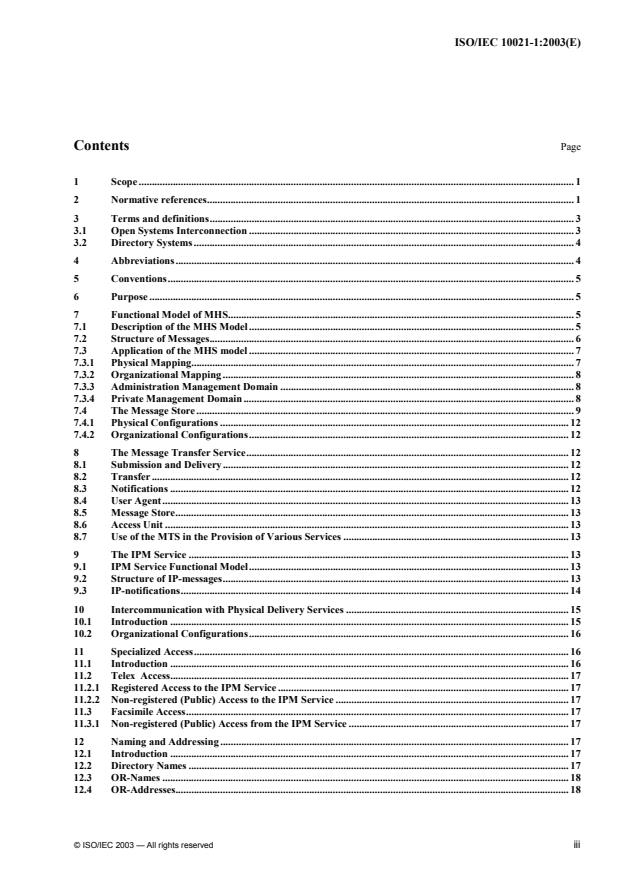
Contents Page
1 Scope . 1
2 Normative references. 1
3 Terms and definitions. 3
3.1 Open Systems Interconnection . 3
3.2 Directory Systems . 4
4 Abbreviations . 4
5 Conventions. 5
6 Purpose . 5
7 Functional Model of MHS. 5
7.1 Description of the MHS Model . 5
7.2 Structure of Messages. 6
7.3 Application of the MHS model . 7
7.3.1 Physical Mapping. 7
7.3.2 Organizational Mapping . 8
7.3.3 Administration Management Domain . 8
7.3.4 Private Management Domain . 8
7.4 The Message Store . 9
7.4.1 Physical Configurations . 12
7.4.2 Organizational Configurations. 12
8 The Message Transfer Service. 12
8.1 Submission and Delivery. 12
8.2 Transfer . 12
8.3 Notifications . 12
8.4 User Agent. 13
8.5 Message Store. 13
8.6 Access Unit . 13
8.7 Use of the MTS in the Provision of Various Services . 13
9 The IPM Service . 13
9.1 IPM Service Functional Model. 13
9.2 Structure of IP-messages. 13
9.3 IP-notifications. 14
10 Intercommunication with Physical Delivery Services . 15
10.1 Introduction . 15
10.2 Organizational Configurations. 16
11 Specialized Access. 16
11.1 Introduction . 16
11.2 Telex Access. 17
11.2.1 Registered Access to the IPM Service . 17
11.2.2 Non-registered (Public) Access to the IPM Service . 17
11.3 Facsimile Access. 17
11.3.1 Non-registered (Public) Access from the IPM Service . 17
12 Naming and Addressing . 17
12.1 Introduction . 17
12.2 Directory Names . 17
12.3 OR-Names . 18
12.4 OR-Addresses. 18
© ISO/IEC 2003 — All rights reserved iii
13 MHS Use of Directory.18
13.1 Introduction.18
13.2 Functional Model .19
13.3 Physical Configurations.19
14 Distribution Lists in MHS .20
14.1 Introduction.20
14.2 Properties of a DL .20
14.3 Submission .21
14.4 DL Use of a Directory .21
14.5 DL Expansion .21
14.6 Nesting.21
14.7 Recursion Control .21
14.8 Delivery .21
14.9 Routing Loop Control.21
14.10 Notifications.22
14.11 DL Handling Policy.22
15 Security Capabilities of MHS.22
15.1 Introduction.22
15.2 MHS Security Threats .22
15.2.1 Access Threats .22
15.2.2 Inter-Message Threats .22
15.2.3 Intra-Message Threats.23
15.2.4 Data Store Threats .23
15.3 Security Model.23
15.3.1 Secure Access Management and Administration .23
15.3.2 Secure Messaging .23
15.4 MHS Security Capabilities .24
15.5 Security Management .25
15.6 MHS Security Dependencies .26
15.7 IPM Security.26
16 Conversion in MHS.27
17 Clause 17 of the corresponding ITU-T Recommendation is not part of this International Standard.28
18 Elements of Service – Purpose .28
19 Elements of service – Classification .31
19.1 Purpose of Classification .31
19.2 Basic Message Transfer Service.32
19.3 MT Service Optional User Facilities.32
19.4 Base MH/PD Service Intercommunication .34
19.5 Optional User Facilities for MH/PD Service Intercommunication.34
19.6 Base Message Store .34
19.7 MS Optional User Facilities.35
19.8 Basic Interpersonal Messaging Service .35
19.9 IPM Service Optional User Facilities .36
Annex A (informative) Glossary of Terms .40
Annex B (informative) Definitions Of Elements Of Service .55
Annex C (informative) Elements of service changes from 1992 .80
Annex D (informative) Differences between ISO/IEC 10021-1 and ITU-T Recommendation X.400 .82
iv © ISO/IEC 2003 — All rights reserved
Foreword
ISO (the International Organization for Standardization) and IEC (the International Electrotechnical Commission) form
the specialized system for worldwide standardization. National bodies that are members of ISO or IEC participate in the
development of International Standards through technical committees established by the respective organization to deal
with particular fields of technical activity. ISO and IEC technical committees collaborate in fields of mutual interest.
Other international organizations, governmental and non-governmental, in liaison with ISO and IEC, also take part in the
work. In the field of information technology, ISO and IEC have established a joint technical committee, ISO/IEC JTC 1.
International Standards are drafted in accordance with the rules given in the ISO/IEC Directives, Part 2.
The main task of the joint technical committee is to prepare International Standards. Draft International Standards
adopted by the joint technical committee are circulated to national bodies for voting. Publication as an International
Standard requires approval by at least 75 % of the national bodies casting a vote.
Attention is drawn to the possibility that some of the elements of this document may be the subject of patent rights. ISO
and IEC shall not be held responsible for identifying any or all such patent rights.
ISO/IEC 10021-1 was prepared by Joint Technical Committee ISO/IEC JTC 1, Information technology, Subcommittee
SC 6, Telecommunications and information exchange between systems.
This part of ISO/IEC 10021 is technically aligned with ITU-T Recommendation F.400/X.400 (1999) but is not published
as identical text.
This second edition cancels and replaces the first edition (ISO/IEC 10021-1:1990), which has been technically revised. It
also incorporates Technical Corrigenda 1 to 7 and consolidates Amendment 1:1994.
ISO/IEC 10021 consists of the following parts, under the general title Information technology — Message Handling
Systems (MHS):
Part 1: System and service overview
Part 2: Overall architecture
Part 4: Message transfer system — Abstract service definition and procedures
Part 5: Message store: Abstract service definition
Part 6: Protocol specifications
Part 7: Interpersonal messaging system
Part 8: Electronic Data Interchange Messaging Service
Part 9: Electronic Data Interchange Messaging System
Part 10: MHS routing
Part 11: MHS Routing — Guide for messaging systems managers [Technical Report]
© ISO/IEC 2003 — All rights reserved v
Introduction
This document is one of a set of Recommendations | International Standards for Message Handling. The entire set
provides a comprehensive specification for a Message Handling System (MHS) comprising any number of co-operating
open systems.
Message Handling Systems and Services enable users to exchange messages on a store-and-forward basis. A message
submitted by one user, the originator, is conveyed by the Message Transfer System (MTS), the principal component of a
larger Message Handling System (MHS), and is subsequently delivered to one or more additional users, the message's
recipients.
An MHS comprises a variety of interconnected functional entities. Message Transfer Agents (MTAs) co-operate to
perform the store-and-forward message transfer function. Message Stores (MSs) provide storage for messages and enable
their submission, retrieval and management. User Agents (UAs) help users access MHS. Access Units (AUs) provide
links to other communication systems and Services of various kinds (e.g., Telematic Services, Postal Services).
This part of ISO/IEC 10021 specifies the overall system and service description of Message Handling capabilities.
vi © ISO/IEC 2003 — All rights reserved
INTERNATIONAL STANDARD ISO/IEC 10021-1:2003(E)
Information technology — Message Handling Systems (MHS) —
Part 1:
System and service overview
1 Scope
This part of ISO/IEC 10021 defines the overall system and service of an MHS and serves as a general overview of MHS.
Other aspects of Message Handling Systems and Services are defined in other parts of ISO/IEC 10021. The structure of
ISO/IEC 10021 (all parts) defining the Message Handling System and Services is shown in Table 1.
The technical aspects of MHS are defined in other parts of ISO/IEC 10021. The overall system architecture of MHS is
defined in ISO/IEC 10021-2:2003.
2 Normative references
The following referenced documents are indispensable for the application of this document. For dated references, only
the edition cited applies. For undated references, the latest edition of the referenced document (including any
amendments) applies.
ISO/IEC 7498-1:1994, Information technology – Open Systems Interconnection – Basic Reference Model: The Basic
Model
ISO/IEC 8649:1996, Information technology – Open Systems Interconnection – Service definition for the Association
Control Service Element
ISO/IEC 8824-1:1998, Information technology – Abstract Syntax Notation One (ASN.1): Specification of basic notation
ISO/IEC 8825-1:1998, Information technology – ASN.1 encoding rules: Specification of Basic Encoding Rules (BER),
Canonical Encoding Rules (CER) and Distinguished Encoding Rules (DER)
ISO/IEC 9066-1:1989, Information processing systems – Text communication – Reliable Transfer – Part 1: Model and
service definition
ISO/IEC 13712-1:1995, Information technology – Remote Operations: Concepts, model and notation
ISO/IEC 9594 (all parts), Information technology – Open Systems Interconnection – The Directory
ISO/IEC 10021-2:2003, Information technology – Message Handling Systems (MHS) – Part 2: Overall architecture
ISO/IEC 10021-4:2003, Information technology – Message Handling Systems (MHS) – Part 4: Message transfer system:
Abstract service definition and procedures
ISO/IEC 10021-5:1999, Information technology – Message Handling Systems (MHS) – Part 5: Message store: Abstract
service definition
ISO/IEC 10021-6:2003, Information technology – Message Handling Systems (MHS) – Part 6: Protocol specifications
© ISO/IEC 2003 — All rights reserved 1
ISO/IEC 10021-7:2003, Information technology – Message Handling Systems (MHS) – Part 7: Interpersonal messaging
system
ISO/IEC 10021-8:1999, Information technology – Message Handling Systems (MHS) – Part 8: Electronic Data
Interchange Messaging Service
ISO/IEC 10021-9:1999, Information technology – Message Handling Systems (MHS) – Part 9: Electronic Data
Interchange Messaging System
ISO/IEC 10021-10:1999, Information technology – Message Handling Systems (MHS) – Part 10: MHS routing
ISO/IEC 10021-11:1999, Information technology – Message Handling Systems (MHS) – Part 11: MHS Routing – Guide
for messaging systems managers
ISO/IEC 11588-1:1996, Information technology – Message Handling Systems (MHS) management – Part 1: Model and
architecture
ISO/IEC 11588-3:1997, Information technology – Message Handling Systems (MHS) management – Part 3: Logging
information.
ISO/IEC 11588-8:1997, Information technology – Message Handling Systems (MHS) management – Part 8: Message
Transfer Agent management.
CCITT Recommendation F.423:1992, Message handling services: Intercommunication between the interpersonal
messaging service and the telefax service
CCITT Recommendation F.440:1992, Message handling services: The voice messaging service
CCITT Recommendation T.330:1988, Telematic access to interpersonal messaging system
CCITT Recommendation X.408 (1988), Message handling systems: Encoded information type conversion rules
CCITT Recommendation X.440 (1992), Message handling systems: Voice messaging system
2 © ISO/IEC 2003 — All rights reserved
Table 1 – Structure of MHS Standards
Short title Joint MHS Joint support ITU-T only
ISO/IEC ITU-T ISO/IEC ITU-T System Service
MHS: System and service overview 10021-1 X.400 F.400
MHS: Overall architecture 10021-2 X.402
MHS: Encoded information type conversion rules
X.408
MHS: MTS: Abstract service definition and 10021-4 X.411
procedures
MHS: MS: Abstract -service definition 10021-5 X.413
MHS: Protocol specifications 10021-6 X.419
MHS: Interpersonal messaging system 10021-7 X.420
Telematic Access to IPMS
MHS: EDI messaging service 10021-8 F.435 T.330
MHS: EDI messaging system 10021-9 X.435
MHS: Voice messaging service
MHS: Voice messaging system F.440
MHS: Routing 10021-10 X.412 X.440
MHS: Routing: Guide for Messaging System 10021-11 X.404
Managers
MHS: Naming and addressing for public F.401
MH services
MHS: The public message transfer service
F.410
MHS: Intercommunication with public physical
F.415
delivery services
MHS: The public IPM service
F.420
MHS: Intercommunication between IPM
F.421
service and Telex
MHS: Intercommunication between IPM service
F.423
and Telefax
OSI: Basic Reference Model 7498-1 X.200
OSI: Specification of Abstract Syntax Notation One 8824-1 X.680
(ASN.1)
OSI: Specification of Basic Encoding Rules for
8825-1 X.690
Abstract Syntax Notation One (ASN.1)
OSI: Association Control: Service Definition 8649 X.217
OSI: Association Control: Protocol Specification 8650-1 X.227
OSI: Reliable Transfer: Model and service definition 9066-1 X.218
OSI: Reliable Transfer: Protocol Specification 9066-2 X.228
OSI: Remote Operations: Concepts, Model & 13712-1 X.880
Notation
OSI: Remote Operations: Service Definition 13712-2 X.881
OSI: Remote Operations: Protocol Specification 13712-3 X.882
3 Terms and definitions
For the purposes of this document, the terms and definitions given in Annex A and the following apply.
3.1 Open Systems Interconnection
This part of ISO/IEC 10021 makes use of the following terms defined in ISO/IEC 7498-1:
a) Application Layer;
b) application-process;
c) Open Systems Interconnection;
d) OSI Reference Model.
© ISO/IEC 2003 — All rights reserved 3
3.2 Directory Systems
This part of ISO/IEC 10021 makes use of the following terms defined in ISO/IEC 9594-1:
a) directory entry;
b) directory system agent;
c) Directory System;
d) directory user agent.
This part of ISO/IEC 10021 makes use of the following terms defined in ISO/IEC 9594-2:
e) attribute;
f) group;
g) name.
4 Abbreviations
A Additional
ADMD Administration Management Domain
AU Access Unit
CA Contractual Agreement
DL Distribution List
DSA Directory System Agent
DUA Directory User Agent
E Essential
EDI Electronic Data Interchange
EIT Encoded Information Type
I/O Input/Output
IP Interpersonal
IPM Interpersonal Messaging
IPMS Interpersonal Messaging System
MD Management Domain
MH Message Handling
MHS Message Handling System
MS Message Store
MT Message Transfer
MTA Message Transfer Agent
MTS Message Transfer System
N/A Not applicable
OR Originator/Recipient
OSI Open Systems Interconnection
PD Physical Delivery
PDAU Physical Delivery Access Unit
PDS Physical Delivery System
PM Per-message
PR Per-recipient
PRMD Private Management Domain
4 © ISO/IEC 2003 — All rights reserved
PTLXAU Public Telex Access Unit
RPOA Recognized Private Operating Agency
TLMA Telematic Agent
TLXAU Telex Access Unit
UA User Agent
5 Conventions
In this Standard, the expression “Administration” is used to indicate a telecommunication Administration, a recognized
private operating agency, and, in the case of intercommunication with Public Delivery Service, a Postal Administration.
6 Purpose
This part of ISO/IEC 10021 is one of a set of Recommendations which describes the system model and elements of
service of the Message Handling System (MHS) and Services. This part of ISO/IEC 10021 overviews the capabilities of
an MHS that are used for the provision of MH Services to enable users to exchange messages on a store-and-forward
basis.
The message handling system is designed in accordance with the principles of the Reference Model of Open Systems
Interconnection (OSI Reference Model) (ISO/IEC 7498-1) and uses the Presentation Layer Services and Services offered
by other, more general, Application Service Elements. An MHS can be constructed using any network fitting in the scope
of OSI. The Message Transfer Service provided by the MTS is application independent. An example of a standardized
application is the IPM service. End systems can use the MT Service for specific applications that are defined bilaterally.
Elements of Service are the service features provided through the Application Processes. The Elements of Service are
considered to be components of the services provided to users and are either elements of a basic service or they are
optional user facilities, classified either as essential optional user facilities, or as additional optional user facilities.
7 Functional Model of MHS
The MHS functional model serves as a tool to aid in the development of International Standards for MHS, and aids in
describing the basic concepts that can be depicted graphically. It comprises several different functional components that
work together to provide MH services. The model can be applied to a number of different physical and organizational
configurations.
7.1 Description of the MHS Model
A functional view of the MHS model is shown in Figure 1. In this model, a user is either a person or a computer process.
Users are either direct users (i.e. engage in message handling by direct use of MHS), or are indirect users [i.e. engage in
message handling through another communication system (e.g. a physical delivery system) that is linked to MHS]. A
user is referred to as either an originator (when sending a message) or a recipient (when receiving a message). Message
Handling Elements of Service define the set of message types and the capabilities that enable an originator to transfer
messages of those types to one or more recipients.
An originator prepares messages with the assistance of his User Agent. A User Agent (UA) is an application process that
interacts with the Message Transfer System (MTS) or a Message Store (MS), to submit messages on behalf of a single
user. The MTS delivers the messages submitted to it, to one or more recipient UAs, Access Units (AUs), or MSs, and can
return notifications to the originator. Functions performed solely by the UA and not standardized as part of the message
handling Elements of Service are called local functions. A UA can accept delivery of messages directly from the MTS, or
it can use the capabilities of an MS to receive delivered messages for subsequent retrieval by the UA.
The MTS comprises a number of Message Transfer Agents (MTAs). Operating together, in a store-and-forward manner,
the MTAs transfer messages and deliver them to the intended recipients.
© ISO/IEC 2003 — All rights reserved 5
Access by indirect users of MHS is accomplished by AUs. Delivery to indirect users of MHS is accomplished by AUs,
such as in the case of physical delivery, by the Physical Delivery Access Unit (PDAU).
The Message Store (MS) is an optional general purpose capability of MHS that acts as an intermediary between the UA
and the MTA. The MS is depicted in the MHS Functional Model as shown in Figure 1. The MS is a functional entity
whose primary purpose is to store delivered, and, optionally, submitted messages and permit their retrieval by the
MS-user (UA). The MS also allows for submission from, and alerting to the MS-user.
The collection of UAs, MSs, AUs and MTAs is called the Message Handling System (MHS).
7.2 Structure of Messages
The basic structure of messages conveyed by the MTS is shown in Figure 2. A message is made up of an envelope and a
content. The envelope carries information that is used by the MTS when transferring the message within the MTS. The
content is the piece of information that the originating UA wishes to be delivered to one or more recipient UAs. The
MTS neither modifies nor examines the content, except for conversion (see clause 16).
User Other telematic services User
MHS
AU
MTS
MTA
User UA
MTA MTA MS UA User
User UA
MTA
PDAU
*1
Physical Delivery
User User
Services
T0102780-93/d01
* 1) Message input from PDS to MHS is not currently possible. Flow from PD services to the PDAU shown is for the purpose of
notifications.
Figure 1 – MHS Functional Model
6 © ISO/IEC 2003 — All rights reserved
+
Envelope
Content
Figure 2 – Basic Message Structure
7.3 Application of the MHS model
7.3.1 Physical Mapping
Users access UAs for message processing purposes, for example, to create, present, or file messages. A user can interact
with a UA via an input/output (I/O) device or process (e.g. keyboard, display, printer etc.). A UA can be implemented as
a (set of) computer process(es) in an intelligent terminal.
A UA and MTA can be co-located in the same system, or a UA/MS can be implemented in physically separate systems.
In the first case the UA accesses the MT Elements of Service by interacting directly with the MTA in the same system. In
the second case, the UA/MS will communicate with the MTA via standardized protocols specified for MHS. It is also
possible for an MTA to be implemented in a system without UAs or MSs.
Some possible physical configurations are shown in Figures 3 and 4. The different physical systems can be connected by
means of dedicated lines or switched network connections.
UA UA
I/O device I/O device
MTA
Processing system
Figure 3 – Co-resident UA and MTA
UA
I/O device
MS MTA MTA
UA
"Intelligent" Processing
Processing system
terminal system
Figure 4 – Stand-alone UA and Co-resident MS/MTA and UA/MTA
© ISO/IEC 2003 — All rights reserved 7
7.3.2 Organizational Mapping
An Administration or organization can play various roles in providing Message Handling Services. An organization in
this context can be a company or a non-commercial enterprise.
The collection of at least one MTA, zero or more UAs, zero or more MSs, and zero or more AUs constitutes a
Management Domain (MD). An MD provides Message Handling Services in accordance with the classification of
Elements of Service as described in clause 19. A Management Domain may be classified as either an Administration
Management Domain (ADMD) or a Private Management Domain (PRMD) with the definitions given in Annex A. The
relationship between Management Domains is shown in Figure 5.
7.3.3 Administration Management Domain
In one country, one or more ADMDs can exist. An ADMD is characterized by its provision of relaying functions
between other Management Domains and the provision of the Message Transfer Service for the applications provided
within the ADMD.
An Administration can provide access for its users to the ADMD in one or more of the following ways:
– user to Administration provided UA;
– private UA to Administration MTA;
– private UA to Administration MS;
– private MTA to Administration MTA;
– user to Administration provided AU.
See also the examples of configurations shown in Figures 3 and 4.
Administration provided UAs can exist as part of an intelligent terminal that the user can use to access MHS. They can
also exist as part of Administration resident equipment being part of MHS, in which case the user obtains access to the
UA via an I/O device.
In the case of a private UA, the user has a private stand-alone UA which interacts with the Administration provided MTA
or MS, using submission, delivery and retrieval functions. A private, stand-alone UA can be associated with one or more
MDs, provided that the required naming conventions are preserved.
A private MTA as part of a PRMD can access one or more ADMDs in a country, following national regulations.
Access can also be provided by Administration provided AUs described in clauses 10 and 11.
7.3.4 Private Management Domain
An organization other than an Administration can have one or more MTA(s), and zero or more UAs, AUs and MSs
forming a PRMD which can interact with an ADMD or other PRMD on an MD-to-MD (MTA-to-MTA) basis. A PRMD
is characterized by the provision of messaging functions within that Management Domain.
A PRMD can have access to one or more ADMDs as shown in Figure 5. However, in the case of a specific interaction
between a PRMD and an ADMD (such as when a message is transferred between MDs), the PRMD is considered to be
associated only with that ADMD. A PRMD may act as a relay to other MDs if national regulations and bilateral
agreements permit.
As a national matter, the name of a PRMD can be either nationally unique or relative to the associated ADMD. If a
PRMD is associated with more than one ADMD, the PRMD can have more than one name.
See Annex G of ISO/IEC 10021-2 for guidance in the case of multinational PRMDs.
8 © ISO/IEC 2003 — All rights reserved
7.4 The Message Store
Remote UAs can be implemented on a wide variety of equipment, including personal computers of varying capabilities.
The MS service can complement a remote UA by providing continuously available storage and delivery services on
behalf of a user, for example.
One MS acts on behalf of only one user, i.e. it does not provide a common or shared MS capability to several users. See
also PRMD 3 of Figure 5.
The MS will store delivered messages and reports. As an option it may also store submitted messages, submitted probes,
and draft messages. The MS may also keep a history of messages by storing extracts of previously and currently stored
messages in logs. Messages may be grouped in a user-defined and potentially hierarchical structure.
The MS retrieval capability provides users who subscribe to an MS with basic message retrieval capabilities potentially
applicable to all information held by the MS. Figure 6 shows the delivery, and subsequent retrieval of messages that are
delivered to an MS, and the submission of messages via the MS.
When a user subscribes to an MS, all messages destined for the user are delivered to the MS only. The MS-user, if on
line, may receive Alerts that announce the delivery of certain messages to the MS. Messages delivered to an MS are
considered delivered from the MTS perspective.
The basic MS is independent of application specific services (see 8.7) and may store messages with all types of content,
the type of content being dependent on the type of service. However, it may provide additional capabilities depending on
the type of content.
When an MS-user submits a message, the MS conveys the submission request to the MTS and reports the outcome
returned by the MTS to the MS-user. If requested by the MS-user, the MS may expand the message by forwarding parts
of delivered or submitted messages that are currently stored in the MS before conveying the submission to the MTS. The
MS may also store a copy of the message submitted to the MTS if the submission is successful. The MS service allows
the user to transfer a message to the MS for storage as a draft message. The draft message may subsequently be retrieved,
or the MS may include its body-parts in a message submitted to the MTS when requested in a message submitted by the
MS-user.
The MS-user may be provided with the capability to request the MS service to forward selected messages automatically
upon delivery. The MS may also provide automatic deletion of messages after a user specified period of time, or when
the message expires, or when the message is rendered obsolete by another message.
The MS may automatically attach information to a previously submitted message concerning its delivery or non-delivery.
The MS may also generate content-specific notifications, acknowledging receipt or acceptance when requested by the
user or when the user has retrieved the message.
The elements of service describing the features of the MS are defined in Annex B and classified in clause 19. Users are
provided with the capability based on various criteria, to get counts and lists of messages, to fetch messages, and to delete
messages, currently held in the MS.
Figure 7 depicts a simplified model of the information types stored in the MS, and the functions the MS fulfils.
The scope of the MS services defined in CCITT Recommendation F.400 (1988) and (1992) | ISO/IEC 10021-1:1990 was
mainly limited to the storage of delivered messages and reports and their subsequent retrieval by the MS-user. The 1994
version of this part of ISO/IEC 10021 defines new extensions to provide a broader range of service facilities. These
enhanced facilities particularly apply in those environments where the MS is used as a personal data base to store,
retrieve, modify, and classify a user’s messages, often with frequent and long-lasting interaction between the MS-user
and MS. Examples of such environments might be found in local area networks, or in environments where the user
employs different User Agent implementations at different locations to access one MS. In other environments where the
MS is used mainly as a temporary storage system, to take delivery of messages and reports and provide for their retrieval
by infrequent and short-lasting interactions, these enhanced facilities may not be required. In this latter case, some
enhanced facilities may be provided locally by the MS-user itself.
© ISO/IEC 2003 — All rights reserved 9
ADMD 1 ADMD 3
UA UA MTA MTA MS
MTA
UA
ADMD 2
MS
PRMD 3
MTA
UA MTA UA
MTA
PRMD 1 PRMD 2
UA
UA MTA MTA
MTA UA
UA MS UA MS
UA UA MTA
UA UA
MS MS
PRMD 4
UA UA
MTA
UA MS
MTA MTA
UA
UA UA UA MS
Country A
PRMD 5
UA
Country B
NOTE 1 – This diagram gives examples of possible interconnections. It does not attempt to identify all possible configurations. This
International Standard places no restrictions on interconnections between MDs, although these may be the subject of regulatory
agreements within and between countries.
NOTE 2 – PRMD 1 has connections to two ADMDs within country A;
– PRMD 2 spans a country border, and has connections to an ADMD in each country;
– PRMD 3 has multiple connections to ADMD 3;
– PRMD 4 is only connected to other MDs by relaying through PRMD 1;
– PRMD 5 has connections to other PRMDs, both within the same country (to PRMD 3) and internationally (to PRMD 1).
NOTE 3 – The lines between MTAs represent logical connections, which implies that the MTAs have the ability to establish
associations between themselves when required, using supporting OSI layers over any physical medium.
NOTE 4 – Th
...