

ISO/IEC 10175-3:2000
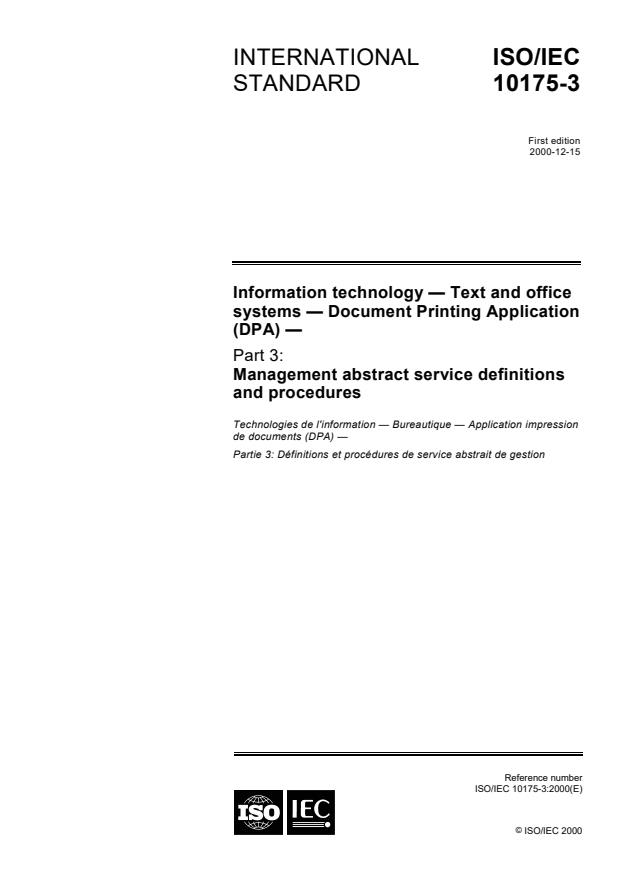
(Main)Information technology — Text and office systems — Document Printing Application (DPA) — Part 3: Management abstract service definitions and procedures
General Information
- Abstract
The Document Printing Application is one component of a coordinated set of facilities and standards needed to satisfy the printing requirements of the modern distributed office. Together, the capabilities provided can enable users to create and produce high-quality office documents in a consistent and unambiguous manner within a distributed open systems environment. The Document Printing Application Standard (ISO/IEC 10175) consists of three parts: Part 1: Abstract service definitions and procedures Part 2: Protocol specification Part 3: Management abstract service definition and procedures This part of ISO/IEC 10175 extends the facilities specified in ISO/IEC 10175-1 by adding the capability for administrators and operators to manage and control printers, print servers and all other print objects; in addition, this part specifies additional capabilities for a print client to control a print job. The text and specifications contained in this part of ISO/IEC 10175 are derived from IEEE 1387.4 (POSIX) - System Administration Part 4 - Printing Interfaces. In particular, this part of ISO/IEC 10175: - specifies additional administrative functions and services that may be provided by Document Printing Application servers; - specifies the Document Printing Application abstract service for the additional administrative functions using the principles established by the Abstract Service Definition Conventions (ISO/IEC 10021-3); - specifies the requirements for conformance with the Document Printing Application for these additional administrative functions. See clause 1 of ISO/IEC 10175-1 for a more extensive description of the Document Printing Application.
- Status
- Published
- Publication Date
- 29-Nov-2000
- Current Stage
- 9093 - International Standard confirmed
- Start Date
- 15-Sep-2005
- Completion Date
- 29-Aug-2026
Overview
ISO/IEC 10175-3:2000 - "Information technology - Text and office systems - Document Printing Application (DPA) - Part 3: Management abstract service definitions and procedures" - is an essential international standard developed by ISO and IEC to address document printing management requirements in distributed office environments. As part of the broader ISO/IEC 10175 family, this standard extends the functional scope established in Part 1 by defining management abstract services. These services empower administrators and operators to manage and control printers, print servers, and related print objects efficiently and consistently within open systems.
Key Topics
ISO/IEC 10175-3 covers several core topics relevant to the management of distributed document printing applications:
- Abstract Management Services: Specifies functional definitions for administrative services, including how to control, enable, disable, clean, pause, resume, and set various print objects and servers.
- Administrative Operations: Details abstract operations such as creating or deleting print objects, resetting printers or servers, and tracing printer or server activities.
- Object Classes: Defines object classes such as printers (physical and logical) and print servers, and describes how management operations apply to each.
- Access Control and Authorization: Addresses the typical requirement that only authorized administrators or operators may perform sensitive management functions.
- Conformance Requirements: Outlines what is required for systems to claim conformance with the management aspects of the DPA standard.
Applications
ISO/IEC 10175-3:2000 finds practical application in a wide range of organizational and technical scenarios, including:
- Centralized Printer Administration: Facilitates efficient management of multiple printers and print servers across an enterprise, reducing downtime and streamlining maintenance.
- Distributed Office Environments: Supports document printing needs in open systems where print services are spread across various networked locations.
- Automated Print Job Control: Enables print clients and administrators to manipulate job queues, restart or resubmit jobs, and manage printer states remotely.
- Print Resource Management: Assists IT staff in configuring, enabling, disabling, or deleting printers and servers according to organizational policies.
- Audit and Troubleshooting: The tracing and logging features, as specified, provide valuable data for analyzing print system behavior, diagnosing issues, and maintaining print service quality.
By implementing these standardized management operations, organizations promote interoperability, consistency, and reliability within their print infrastructures.
Related Standards
ISO/IEC 10175-3:2000 is closely associated with several other international standards:
- ISO/IEC 10175-1: Provides the abstract service definition and baseline procedures for document printing applications.
- ISO/IEC 10175-2: Specifies the protocol aspects for DPA, complementing the service definitions found in Part 1 and Part 3.
- IEEE 1387.4 (POSIX): The content in Part 3 is derived in part from this standard, particularly regarding system administration and printing interfaces.
- ISO/IEC 10021-3: Establishes conventions for abstract service definitions used throughout DPA standards.
- ISO/IEC 7498 Series, ISO/IEC 8824/8825: Provide foundational models and encoding rules that support interoperability in open systems.
Practical Value
Implementing the guidance from ISO/IEC 10175-3 provides significant practical value:
- Promotes Vendor-Neutral Print Management: Ensures organizations can mix-and-match hardware and software from different suppliers in distributed office settings.
- Ensures Consistency and Reliability: Standard operations reduce ambiguity and help maintain service quality across diverse environments.
- Enables Scalable Administration: Through well-defined management procedures, enterprises can scale their print infrastructure easily and securely.
Organizations looking to achieve efficient, standards-based document printing management in distributed environments will benefit greatly from adherence to ISO/IEC 10175-3:2000.
Get Certified
Connect with accredited certification bodies for this standard

BSI Group
BSI (British Standards Institution) is the business standards company that helps organizations make excellence a habit.

NYCE
Mexican standards and certification body.
Sponsored listings
Frequently Asked Questions
ISO/IEC 10175-3:2000 is a standard published by the International Organization for Standardization (ISO). Its full title is "Information technology — Text and office systems — Document Printing Application (DPA) — Part 3: Management abstract service definitions and procedures". This standard covers: The Document Printing Application is one component of a coordinated set of facilities and standards needed to satisfy the printing requirements of the modern distributed office. Together, the capabilities provided can enable users to create and produce high-quality office documents in a consistent and unambiguous manner within a distributed open systems environment. The Document Printing Application Standard (ISO/IEC 10175) consists of three parts: Part 1: Abstract service definitions and procedures Part 2: Protocol specification Part 3: Management abstract service definition and procedures This part of ISO/IEC 10175 extends the facilities specified in ISO/IEC 10175-1 by adding the capability for administrators and operators to manage and control printers, print servers and all other print objects; in addition, this part specifies additional capabilities for a print client to control a print job. The text and specifications contained in this part of ISO/IEC 10175 are derived from IEEE 1387.4 (POSIX) - System Administration Part 4 - Printing Interfaces. In particular, this part of ISO/IEC 10175: - specifies additional administrative functions and services that may be provided by Document Printing Application servers; - specifies the Document Printing Application abstract service for the additional administrative functions using the principles established by the Abstract Service Definition Conventions (ISO/IEC 10021-3); - specifies the requirements for conformance with the Document Printing Application for these additional administrative functions. See clause 1 of ISO/IEC 10175-1 for a more extensive description of the Document Printing Application.
The Document Printing Application is one component of a coordinated set of facilities and standards needed to satisfy the printing requirements of the modern distributed office. Together, the capabilities provided can enable users to create and produce high-quality office documents in a consistent and unambiguous manner within a distributed open systems environment. The Document Printing Application Standard (ISO/IEC 10175) consists of three parts: Part 1: Abstract service definitions and procedures Part 2: Protocol specification Part 3: Management abstract service definition and procedures This part of ISO/IEC 10175 extends the facilities specified in ISO/IEC 10175-1 by adding the capability for administrators and operators to manage and control printers, print servers and all other print objects; in addition, this part specifies additional capabilities for a print client to control a print job. The text and specifications contained in this part of ISO/IEC 10175 are derived from IEEE 1387.4 (POSIX) - System Administration Part 4 - Printing Interfaces. In particular, this part of ISO/IEC 10175: - specifies additional administrative functions and services that may be provided by Document Printing Application servers; - specifies the Document Printing Application abstract service for the additional administrative functions using the principles established by the Abstract Service Definition Conventions (ISO/IEC 10021-3); - specifies the requirements for conformance with the Document Printing Application for these additional administrative functions. See clause 1 of ISO/IEC 10175-1 for a more extensive description of the Document Printing Application.
ISO/IEC 10175-3:2000 is classified under the following ICS (International Classification for Standards) categories: 35.240.20 - IT applications in office work. The ICS classification helps identify the subject area and facilitates finding related standards.
ISO/IEC 10175-3:2000 is available in PDF format for immediate download after purchase. The document can be added to your cart and obtained through the secure checkout process. Digital delivery ensures instant access to the complete standard document.
Standards Content (Sample)
INTERNATIONAL ISO/IEC
STANDARD 10175-3
First edition
2000-12-15
Information technology — Text and office
systems — Document Printing Application
(DPA) —
Part 3:
Management abstract service definitions
and procedures
Technologies de l'information — Bureautique — Application impression
de documents (DPA) —
Partie 3: Définitions et procédures de service abstrait de gestion
Reference number
©
ISO/IEC 2000
PDF disclaimer
This PDF file may contain embedded typefaces. In accordance with Adobe's licensing policy, this file may be printed or viewed but shall not
be edited unless the typefaces which are embedded are licensed to and installed on the computer performing the editing. In downloading this
file, parties accept therein the responsibility of not infringing Adobe's licensing policy. The ISO Central Secretariat accepts no liability in this
area.
Adobe is a trademark of Adobe Systems Incorporated.
Details of the software products used to create this PDF file can be found in the General Info relative to the file; the PDF-creation parameters
were optimized for printing. Every care has been taken to ensure that the file is suitable for use by ISO member bodies. In the unlikely event
that a problem relating to it is found, please inform the Central Secretariat at the address given below.
© ISO/IEC 2000
All rights reserved. Unless otherwise specified, no part of this publication may be reproduced or utilized in any form or by any means, electronic
or mechanical, including photocopying and microfilm, without permission in writing from either ISO at the address below or ISO's member body
in the country of the requester.
ISO copyright office
Case postale 56 � CH-1211 Geneva 20
Tel. + 41 22 749 01 11
Fax + 41 22 749 09 47
E-mail copyright@iso.ch
Web www.iso.ch
Printed in Switzerland
ii © ISO/IEC 2000 – All rights reserved
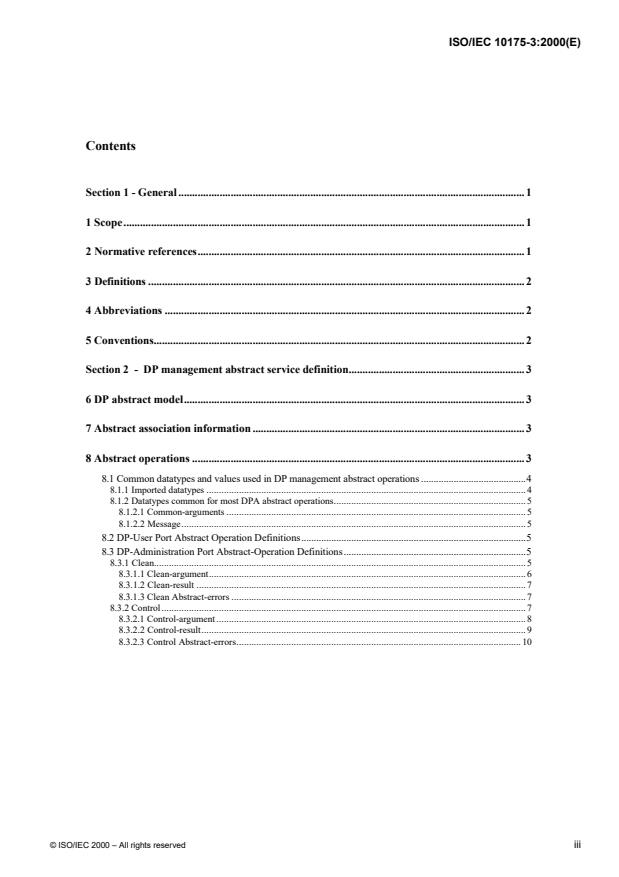
Contents
Section 1 - General . 1
1 Scope. 1
2 Normative references. 1
3 Definitions . 2
4 Abbreviations . 2
5 Conventions. 2
Section 2 - DP management abstract service definition. 3
6 DP abstract model. 3
7 Abstract association information . 3
8 Abstract operations . 3
................................ ................................ ................................ ................................4
................................ ................................ .............5
................................ ................................ ................................ ........................5
8.1.2.2 Message . . . . .5
8.3.1 Clean . . . . .5
8.3.1.1 Clean-argument . . . .6
8.3.1.2 Clean-result . . . . .7
8.3.1.3 Clean Abstract-errors . . . .7
8.3.2 Control . . . . .7
................................ ................................ ................................ ............................8
8.3.2.2 Control-result . . . . .9
8.3.2.3 Control Abstract-errors . . . .10
© ISO/IEC 2000 – All rights reserved iii
8.3.2.1 Control-argument
................................ ................................ ......... 8.3 DP-Administration Port Abstract-Operation Definitions
................................ ................................ .......................... 8.2 DP-User Port Abstract Operation Definitions
8.1.2.1 Common-arguments
8.1.2 Datatypes common for most DPA abstract operations
8.1.1 Imported datatypes
................................ .......... 8.1 Common datatypes and values used in DP management abstract operations
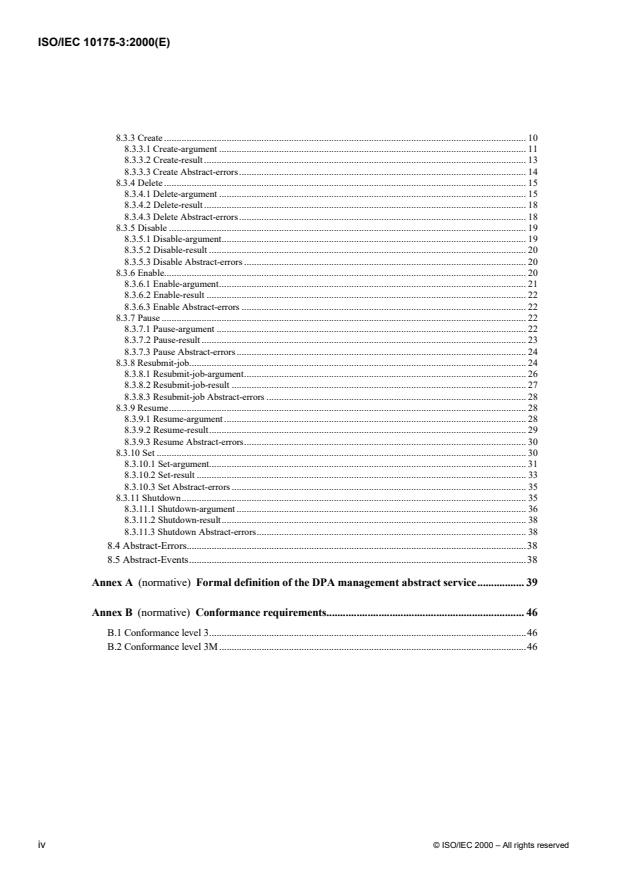
8.3.3 Create . . . . .10
8.3.3.1 Create-argument . . . .11
8.3.3.2 Create-result . . . .13
8.3.3.3 Create Abstract-errors . . . .14
8.3.4 Delete . . . . .15
8.3.4.1 Delete-argument . . . .15
8.3.4.2 Delete-result . . . .18
8.3.4.3 Delete Abstract-errors . . . .18
8.3.5 Disable . . . . .19
8.3.5.1 Disable-argument . . . .19
8.3.5.2 Disable-result . . . .20
8.3.5.3 Disable Abstract-errors . . . .20
8.3.6 Enable . . . . .20
8.3.6.1 Enable-argument . . . .21
8.3.6.2 Enable-result . . . .22
8.3.6.3 Enable Abstract-errors . . . .22
8.3.7 Pause . . . . .22
8.3.7.1 Pause-argument . . . .22
8.3.7.2 Pause-result . . . . .23
8.3.7.3 Pause Abstract-errors . . . .24
8.3.8 Resubmit-job . . . . .24
................................ ................................ ................................ .................26
8.3.8.2 Resubmit-job-result . . . .27
8.3.8.3 Resubmit-job Abstract-errors . . . .28
8.3.9 Resume . . . . .28
8.3.9.1 Resume-argument . . . .28
8.3.9.2 Resume-result . . . .29
8.3.9.3 Resume Abstract-errors . . . .30
8.3.10 Set . . . . .30
8.3.10.1 Set-argument . . . .31
8.3.10.2 Set-result . . . . .33
8.3.10.3 Set Abstract-errors . . . .35
8.3.11 Shutdown . . . . .35
................................ ................................ ................................ ....................36
8.3.11.2 Shutdown-result . . . .38
8.3.11.3 Shutdown Abstract-errors . . . .38
8.4 Abstract-Errors 38
Annex A Formal definition of the DPA management abstract service. 39
Annex B Conformance requirements. 46
iv © ISO/IEC 2000 – All rights reserved
................................ ................................ ................................ ........................... B.2 Conformance level 3M
................................ ................................ ................................ ............................... B.1 Conformance level 3
(normative)
(normative)
................................ ................................ ................................ ................................ ....... 8.5 Abstract-Events
................................ ................................ ................................ ................................ ........
8.3.11.1 Shutdown-argument
8.3.8.1 Resubmit-job-argument
Foreword
ISO (the International Organization for Standardization) and IEC (the International Electrotechnical Commission)
form the specialized system for worldwide standardization. National bodies that are members of ISO or IEC
participate in the development of International Standards through technical committees established by the
respective organization to deal with particular fields of technical activity. ISO and IEC technical committees
collaborate in fields of mutual interest. Other international organizations, governmental and non-governmental, in
liaison with ISO and IEC, also take part in the work.
International Standards are drafted in accordance with the rules given in the ISO/IEC Directives, Part 3.
In the field of information technology, ISO and IEC have established a joint technical committee, ISO/IEC JTC 1.
Draft International Standards adopted by the joint technical committee are circulated to national bodies for voting.
Publication as an International Standard requires approval by at least 75 % of the national bodies casting a vote.
Attention is drawn to the possibility that some of the elements of this part of ISO/IEC 10175 may be the subject of
patent rights. ISO and IEC shall not be held responsible for identifying any or all such patent rights.
International Standard ISO/IEC 10175-3 was prepared by Joint Technical Committee ISO/IEC JTC 1, Information
technology, Subcommittee SC 6, Telecommunications and information exchange between systems.
ISO/IEC 10175 consists of the following parts, under the general title Information technology — Test and office
systems — Document Printing Application (DPA):
� Part 1: Abstract service definition and procedures
� Part 2: Protocol specification
� Part 3: Management abstract service definitions and procedures
Annexes A and B form a normative part of this part of ISO/IEC 10175.
© ISO/IEC 2000 – All rights reserved v
INTERNATIONAL STANDARD ISO/IEC 10175-3:2000(E)
Information technology — Text and office systems —
Document Printing Application (DPA) —
Part 3:
Management abstract service definitions and procedures
Section 1 - General
1 Scope
The Document Printing Application is one component of a coordinated set of facilities and standards needed to
satisfy the printing requirements of the modern distributed office. Together, the capabilities provided can enable
users to create and produce high-quality office documents in a consistent and unambiguous manner within a
distributed open systems environment.
itions and procedures
Management abstract service definition and procedures
This part of ISO/IEC 10175 extends the facilities specified in ISO/IEC 10175-1 by adding the capability for
administrators and operators to manage and control printers, print servers and all other print objects; in addition, this
part specifies additional capabilities for a print client to control a print job. The text and specifications contained in
this part of ISO/IEC 10175 are derived from IEEE 1387.4 (POSIX) - System Administration Part 4 - Printing
-specifies additional administrative functions an d services that may be provided by Document Printing
-specifies the Document Printing Application abstract service for the additional administrative functions
-specifies the requirements for conformance with the Document Printing Application for these additional
administrative functions.
2 Normative references
The following normative documents contain provisions which, through reference in this text, constitute provisions of
this part of ISO/IEC 10175. For dated references, subsequent amendments to, or revisions of, any of these publications
do not apply. However, parties to agreements based on this part of ISO/IEC 10175 are encouraged to investigate the
possibility of applying the most recent editions of the normative documents indicated below. For undated references,
the latest edition of the normative document referred to applies. Members of ISO and IEC maintain registers of
currently valid International Standards.
© ISO/IEC 2000 – All rights reserved 1
See clause 1 of ISO/IEC 10175-1 for a more extensive description of the Document Printing Application.
using the principles established by the Abstract Service Definition Conventions (ISO/IEC 10021-3);
Application servers;
Interfaces. In particular, this part of ISO/IEC 10175:
Part 3:
Protocol specification Part 2:
Abstract service defin Part 1:
The Document Printing Application Standard (ISO/IEC 10175) consists of three parts:
Information technology - Open Systems Interconnection -
Basic Reference Model: The Basic Model.
Information processing systems - Open Systems Interconnection -
Basic Reference Model - Part 2: Security Architecture.
Information technology - Open Systems Interconnection - Specification of Abstract
Syntax Notation One (ASN.1).
Information technology - Open Systems Interconnection - Specification of Basic
Encoding Rules for Abstract Syntax Notation One (ASN.1).
Information technology - Text Communication - Message-Oriented Text Interchange
Systems (MOTIS) - Part 3: Abstract Service Definition Conventions.
1-16, Information technology - Text and office systems - Document Printing Application (DPA) -
Part 1: Abstract service definition and procedures.
IEEE 1387.4 / D9, Draft Standard for Information Technology - POSIX System Administration -
Part 4: Printing Interfaces, IEEE, March 1998.
3 Definitions
4 Abbreviations
5 Conventions
2 © ISO/IEC 2000 – All rights reserved
For the purposes of this part of ISO/IEC 10175, the conventions given in ISO/IEC 10175-1 apply.
For the purposes of this part of ISO/IEC 10175, the abbreviations given in ISO/IEC 10175-1 apply.
For the purposes of this part of ISO/IEC 10175, the definitions given in ISO/IEC 10175-1 apply.
: 199 75 ISO/IEC 10
ISO/IEC 10021-3: 1990,
ISO/IEC 8825: 1990,
ISO/IEC 8824: 1990,
ISO/IEC 7498-2: 1989,
ISO/IEC 7498-1: 1994,
Section 2 - DP management abstract service definition
6 DP abstract model
For the purposes of this part of ISO/IEC 10175, the DP abstract model given in ISO/IEC 10175-1 , clause 6, applies.
The abstract operations defined in this part of ISO/IEC 10175 are all accessed through the DP-Administration port.
7 Abstract association information
For the purposes of this part of ISO/IEC 10175, the abstract association information given in ISO/IEC 10175-1,
clause 7, applies; no additional requirements exist for this part of ISO/IEC 10175.
8 Abstract operations
a) Clean
b)
Create
d) Delete
e) Disable
Enable
Pause
h)
i)
j) Set
k)
Normally only an appropriately authorized administrator may use the above operations. However, this is a site
and/or enterprise-specific policy decision, not mandated by this International Standard. Also, see the text of 8.3.8,
ResubmitJob, for a possible exception.
The table below lists each of the above abstract-operations and all of the abstract-operations of ISO-IEC 10175-1,
and indicates the object classes on which they operate.
server printer all others
logical physical
CancelJob1
Clean3
Control3
Create3
Delete3
Disable3
Enable3
InterruptJob1
ListObjectAttributes1
© ISO/IEC 2000 – All rights reserved 3
yes yes yes yes yes yes
yes*
yes yes yes
yes yes yes
yes yes yes unspecified yes yes
yes yes yes unspecified
yes yes
yes yes
yes*
document job DPA Part abstract-operation
Shutdown
Resume
ResubmitJob
g)
f)
c)
Control
This clause defines the following abstract-operations:
ModifyJob1
Pause3
PauseJob1
Print1
PromoteJob1
ResubmitJob3
Resume3
ResumeJob1
Set3
Shutdown3
NOTES
1*object-class argument element to specify the class of the object-instance
( object-identification). However, many of the operations of ISO/IEC 10175-1 do not since they only operate on a
single class, the job. Operations that do not utilize an object-class argument element are marked with an asterisk (*) in
2 In POSIX, multiple object instances may be specified, either as an explicit list of individual object instances, as an
DPA abstract-operations may only be applied to a single specific object-instance at a time. Thus the print client must
invoke a separate DPA operation for each object-instance. But if the use of wildcard characters is supported by the
print client and print server, the print client may invoke the specified abstract-operation on all objects of the specified
object-class
3 The Clean, Shutdown and Print operations may operate asynchronously; i.e., these operations need not complete
immediately before returning to the client, based on the state of the relevant object. All other DPA abstract-operations
8.1 Common datatypes and values used in DP management abstract operations
8.1.1 Imported datatypes
Attribute,
AttributeError,
PrinterError,
UpdateError
DistinguishedNameString.
Message
4 © ISO/IEC 2000 – All rights reserved
JobIdentifier,
From ISO/IEC 10175-1.Annex C:
ServiceError,
SelectionError,
SecurityError,
AccessError,
ObjectIdentification,
ModifyOperator
JobAttrModification,
CommonArguments,
AttributeId,
From ISO/IEC 10175-1.Annex B:
This part of ISO/IEC 10175 imports and uses the following datatypes defined in ISO/IEC 10175-1:
operate synchronously.
whose name matches the wildcard expansion. Support for wildcards is an implementation option.
object instance that may contain wildcard characters, e.g. an asterisk (*), or as a combination of both methods. However,
the above table.
or
Most abstract-operations utilize an
impl. option yes
yes yes yes yes yes yes
yes*
yes yes
impl. option yes yes yes
yes*
yes*
yes*
yes yes
yes*
In addition, the abstract-operations defined in this part of ISO/IEC 10175 employ the abstract service macros
8.1.2 Datatypes common for most DPA abstract operations
8.1.2.1 Common-arguments
The argument of each of the abstract-operations defined in this part of ISO/IEC 10175 includes an optional element
CommonArguments, imported from ISO/IEC 10175-1 Annex C, as indicated in 8.1.1, above. See 8.1.2 in
ISO/IEC 10175-1 for specifications of the attributes that may be included in an instance of the CommonArguments
8.1.2.2 Message
The argument of each of the abstract-operations defined in this part of ISO/IEC 10175 includes an optional element
Message, imported from ISO/IEC 10175-1 Annex C, as indicated in 8.1.1, above. When a client specifies a
Message element in one of the abstract-operations defined in this part of ISO/IEC 10175, the server shall treat it in
the manner specified in this subclause.
The server shall attach the specified message to the object-instance identified in the operation. The message string
shall be a human-readable message which can be retrieved later by using the ListObjectAttributes operation.
If messages are specified in one locale and retrieved in another, a variety of results may occur depending on the
message specification from the client locale and at the server locale. See the table below for different possible
results to message at the server. See 8.1.2.3 in ISO/IEC 10175-1 for a description of operation-locale.
message at the server locale is:
message from the client locale is:
message at server remains message at server remains the message at server remains the
message at server becomes the message at server changes to message at server changes to
message at server becomes the message at server changes to message at server remains the
8.2 DP-User Port Abstract Operation Definitions
There are no DP-User Port abstract-operations defined in this part of ISO/IEC 10175.
8.3 DP-Administration Port Abstract-Operation Definitions
Clients may use the abstract-operations described in the following subclauses to administer and control the flow of
print-jobs through printers, and to administer and control print objects. Specific print server implementations may
limit usage of one or more of these abstract-operations to administrators with sufficient access rights, and/or may
vary the facilities provided by a given abstract-operation depending upon the access rights assigned to the individual
administrators served by the print server.
8.3.1 Clean
This abstract-operation allows an administrator to remove all jobs from the specified print server or printer.
(Removal of jobs from logical printers is an implementation option.) When the Clean operation is invoked by an
administrator with appropriate privileges, the server shall:
a) If the object is enabled, reject the abstract-operation and report an inappropriate-object-state
© ISO/IEC 2000 – All rights reserved 5
AccessError; otherwise,
NULL string the NULL string NULL string
NULL string
the client non-NULL string the client non-NULL string client non-NULL string
non-NULL string
NULL string non-NULL string unspecified
unspecified
if
NULL string non-NULL string unspecified
if
of type
type.
of type
ABSTRACT-ERROR and ABSTRACT-OPERATION, defined in ISO/IEC 10021-3.
b) If the object is a physical printer, pause the printer to stop the printer from producing output (see Pause
operation),
Remove all jobs contained in or scheduled for that object,
d) Restore the state of the object to what it was when the execution of the Clean operation began.
The server shall remove jobs that are being printed on the physical printer at the time the Clean operation is invoked
in a manner that is consistent with the behavior of the Delete operation.
This operation may operate asynchronously; i.e., this operation need not complete immediately before returning,
based on the state of the object.
Clean ::= ABSTRACT-OPERATION
ARGUMENT CleanArgument
RESULT CleanResult
ERRORS { AccessError,
SecurityError,
ServiceError }
8.3.1.1 Clean-argument
CleanArgument ::= SEQUENCE {
object-class [0] OBJECT IDENTIFIER,
-- id-oc-server, id-oc-printer
object-instance [1] ObjectIdentification,
-- choice depends on object class
message [2] Message OPTIONAL,
common-arguments [3] CommonArguments OPTIONAL }
The following argument elements shall be supported by the server:
object-class
This argument element shall specify the object class of the object-instance. The object-class argument element
id-oc-printer id-oc-server.
object-instance
This argument element shall specify the object-instance based on the value of the object-class argument element.
The administrator shall specify one object-instance value associated with the object-class.
For each supported object-class, the server shall remove all jobs from the object specified by the object-instance
identified by the ObjectIdentification element.
A print server shall either accept or reject a request to clean an object-instance. The print server shall return any
attribute warnings or abstract-errors to the print client.
object-instance
object-class ObjectIdentification object-instance Values
element
id-oc-printer simple-name Printer name representing a physical printer.
The behavior of the Clean operation on a job that is
6 © ISO/IEC 2000 – All rights reserved
Specification
shall take one of the following forms: Each
or shall be one of the following values:
The argument of this abstract-operation is formally defined as follows:
site and/or enterprise-specific policy decision, not mandated by this International Standard.
NOTE - Normally only an appropriately authorized administrator may clean a printer or server object. However, this is a
This abstract-operation is formally defined as follows:
c)
currently printing shall be consistent with the behavior
Delete on currently printing jobs. See
8.3.4 for a description of the Delete operation.
Use of the Clean operation for a logical printer is
supported.
NOTE 1 - As an example, if the printer is a
physical printer, a server implementation shall
delete all jobs that are currently printing on the
specified physical printer, i.e. jobs that have their
printers-assigned attribute set to the physical
implementation shall reject the operation and
return a clean-logical-printer-unsupported
ServiceError.
id-oc-server simple-name Server name.
Cleaning a print server shall cause all jobs to be
removed (deleted) that have been submitted to it (to
any of its supported printers). Therefore, all print jobs
on all printers supported by the specified server shall
Clean
job that is currently printing shall be consistent with
the behavior of the Delete operation on currently
printing jobs. See 8.3.4 for a description of the Delete
operation.
NOTE 2 - As an example, a
shall delete all jobs that it contains, including jobs
that are currently being printed on a physical
message
See 8.1.2.
common-arguments
CommonArguments
8.3.1.2 Clean-result
CleanResult ::= SEQUENCE {
object-status [0] SET OF Attribute OPTIONAL }
The server may return object-status attributes of the cleaned object.
8.3.1.3 Clean Abstract-errors
If the request fails, the server shall return one of the listed abstract-errors. The circumstances under which the
server will return a particular abstract-error are defined in 8.4 of
8.3.2 Control
This abstract-operation allows an administrator to perform a variety of operations on the specified print server or
printer. The operations argument element contains an attribute for each operation to be performed by the Control
operation. The operations that are currently supported by the Control operation are reset and tracing.
© ISO/IEC 2000 – All rights reserved 7
-1. ISO/IEC 10175
The result of this abstract-operation is formally defined as follows:
type. See 8.1.2 in ISO/IEC 10175-1 for a description of the
printer.
server implementation
on a operation be removed. The behavior of the
printer. If the printer is a logical printer, the server
not
operation of the
Control ::= ABSTRACT-OPERATION
ARGUMENT ControlArgument
RESULT ControlResult
ERRORS { AccessError,
SecurityError,
ServiceError }
Control operation. However, this is a
8.3.2.1 Control-argument
ControlArgument ::= SEQUENCE {
object-class [0] OBJECT IDENTIFIER,
-- id-oc-server, id-oc-printer
object-instance [1] ObjectIdentification,
-- choice depends on object class
message [2] Message OPTIONAL,
operations [3] SEQUENCE OF Attribute,
-- operands and parameters
-- Current operations: reset and trace
common-arguments [4] CommonArguments OPTIONAL }
The following argument elements shall be supported by the server:
object-class
This argument element shall specify the object class of the object-instance. The object-class argument element
id-oc-printer id-oc-server.
object-instance
This argument element shall specify the object-instance based on the value of the object-class argument element.
The administrator shall specify one object-instance value associated with the object-class.
object-class, the server shall perform the Control operation defined by the operations argument
element on the object specified by the object-instance identified by the ObjectIdentification element.
A print server shall either accept or reject a Control operation request on the object-instance. The print server
shall return any attribute warnings or abstract-errors to the print client.
object-instance
object-class ObjectIdentification object-instance Values
element
id-oc-printer simple-name Printer name representing a physical printer.
The behavior of the Control operation depends on the
operations argument element, which may be one or
· reset: The server shall reset the physical printer
according to the value of the reset attribute. The
server may perform either a cold start ( id-val-
reset-power-cycle), a warm start ( id-val-reset-
to-nvram), or a reset to factory default conditions
(id-val-reset-to-factory-default). Support for id-
8 © ISO/IEC 2000 – All rights reserved
more of the following attributes:
Specification
shall take one of the following forms: Each
For each supported
or shall be one of the following values:
The argument of this abstract-operation is formally defined as follows:
site and/or enterprise-specific policy decision, not mandated by this International Standard.
NOTE - Normally only an appropriately authorized administrator may invoke the
This abstract-operation is formally defined as follows:
val-reset-to-factory-default is an
implementation option.
· trace-enable: The server shall enable tracing for
the physical printer if the trace-enable attribute
is TRUE, and shall disable tracing if the or trace-
enable attribute is FALSE.
Use of the Control operation for a logical printer is
not supported.
id-oc-server simple-name Server name.
The behavior of the Control operation depends on the
operations argument element, which may be one or
· reset: The server shall reset itself according to
the value of the reset attribute. The server may
perform either a cold start ( id-val-reset-power-
cycle), a warm start ( id-val-reset-to-nvram), or a
reset to factory default conditions ( id-val-reset-
to-factory-default). Support for id-val-reset-to-
factory-default is an implementation option.
· trace-enable: The server shall enable tracing for
itself if the trace-enable attribute is TRUE, and
shall disable tracing if the or trace-enable
attribute is FALSE.
message
See 8.1.2.
operations
This argument element shall specify the attributes and values that describe the specific Control operation to be
applied to the object-instance. The operations that are currently supported by the Control operation are described
· reset:This operation resets the printer or print server at one of the following levels:
id-val-reset-power-cycle for a cold start, id-val-reset-to-nvram for a warm start, or
id-val-reset-to-factory-default
NOTE - For jobs that are being printed on the physical printer at the time the Control operation is invoked
reset
· trace-enable:This operation enables tracing when the value of trace-enable is TRUE and
disables tracing when the value of trace-enable is FALSE. When tracing is
enabled, the printer or print server logs its execution activity to a file.
common-arguments
CommonArguments
8.3.2.2 Control-result
ControlResult ::= SEQUENCE {
object-status [0] SET OF Attribute OPTIONAL }
The server may return object-status attributes of the cleaned object.
© ISO/IEC 2000 – All rights reserved 9
The result of this abstract-operation is formally defined as follows:
type. See 8.1.2 in ISO/IEC 10175-1 for a description of the
attribute, the results are unspecified. with the
for a reset to factory default conditions.
by the following attributes:
more of the following attributes:
8.3.2.3 Control Abstract-errors
If the request fails, the server shall return one of the listed abstract-errors. The circumstances under which the
server will return a particular abstract-error are defined in 8.4 of
8.3.3 Create
This abstract-operation allows an administrator to create a printing object and set its attributes to the values
specified within the argument elements. The object-class argument element shall indicate the class of the object.
The server shall create the specified object instance as an object of the specified object-class. When the Create
operation is invoked by an administrator with appropriate privileges, the server shall perform the following actions:
a) The server shall initialize the newly created object with the attributes specified by the object-
attributes argument element. This has the same effect as issuing an equivalent Set operation. Note
however, that some attributes may be settable with the Create operation, but may be restricted from
further modification with the Set operation. See the Set operation description and the restrictions on
attribute modification in 8.3.10. If the copy-from argument element is specified, the server creates a
copy of the object specified by the copy-from argument element, and the attributes specified by the
object-attributes argument element are applied subsequently.
b) If the specified object already exists and the force-creation argument element is set to FALSE, the
print server shall return the object-already-exists SelectionError for this operation. If the force-
creation argument element is set to TRUE, the print server shall immediately delete the existing
object and shall create the new object. If the printer is not able to immediately complete the deletion of
the existing object due to the state of the printer, the server shall rename the existing object so that the
object-instance created by the Create operation shall be permanent; the object is persistent, lasting
d) When an object-instance of class id-oc-printer is created, the server shall place it in the idle state
with the enabled attribute set to FALSE so print jobs cannot be accepted by the new printer. The
administrator may then invoke the Enable operation to place the printer object in the idle state with the
enabled attribute set to TRUE.
e) The server shall create an entry for the newly created object-instance in the name service, if such an
entry is required by the server implementation.
This argument element shall cause the newly created object-instance to be a copy of the object specified by the
copy-from argument element. Create operation shall not operate on jobs or documents. It is implementation-
defined whether the Create operation can cause the server to create print servers and how this is accomplished.
Print servers may also be created by methods outside the scope of this International Standard . The Create operation
shall operate on all other supported object classes.
Create ::=ABSTRACT-OPERATION
ARGUMENT CreateArgument
RESULT CreateResult
ERRORS { AccessError,
SecurityError,
SelectionError,
ServiceError }
NOTE - Normally only an appropriately authorized administrator may create an object. However, this is a site and/or
10 © ISO/IEC 2000 – All rights reserved
enterprise-specific policy decision, not mandated by this International Standard.
This abstract-operation is formally defined as follows:
The
across re-initialization of the print system, or any of its components.
An c)
creation of the new object can complete.
-1. ISO/IEC 10175
8.3.3.1 Create-argument
CreateArgument ::= SEQUENCE {
object-class [0] OBJECT IDENTIFIER, -- id-oc-xxx
-- any id-oc-xxx, excluding job and document
object-instance [1] ObjectIdentification,
-- instance identifier depends on class
message [2] Message OPTIONAL,
copy-from [3] ObjectIdentification OPTIONAL,
-- initial value object (IVO)
force-creation [4] BOOLEAN DEFAULT FALSE,
-- recreate if necessary
object-attributes [5] SET OF Attribute OPTIONAL,
-- attributes of new object instance
common-arguments [6] CommonArguments OPTIONAL }
The following argument elements shall be supported by the server:
object-class
This argument element shall specify the object class of the object-instance to be created. The server
implementation shall support a specific conformance level, as described in Annex E of ISO/IEC 10175 , and that
conformance level will determine the object classes and the attributes that the server supports, as a minimum.
object-instance
This argument element shall specify the object-instance based on the value of the object-class argument element.
The administrator shall specify one object-instance value associated with the object-class.
If the specified object-class is supported, the server shall create the object specified by the object-instance
identified by the ObjectIdentification element.
A print server shall either accept or reject a request to create an object-instance. The print server shall return any
attribute warnings or abstract-errors to the print client.
object-instance
object-class ObjectIdentification object-instance Values
element
id-oc-printer simple-name Printer name representing a logical or physical printer.
If a printer object is created with the same name as a
previously existing printer object which had jobs
submitted to it, the new printer object shall also have
those jobs submitted to it. Since the printer is created
in the idle state with the enabled attribute set to
FALSE, when the user issues a Enable operation on
the newly (re)created printer, that printer shall begin
printing the jobs that were submitted to it.
id-oc-server simple-name Server name.
The server shall create a new server object in an
unspecified manner. The ability to create a server
object is implementation-defined.
id-oc-initial-value-document name-or-oid Initial-value-document name. Contains the attributes
of the document class that the server may default when
© ISO/IEC 2000 – All rights reserved 11
constructing a document object.
Specification
shall take one of the following forms: Each
-1
The argument of this abstract-operation is formally defined as follows:
id-oc-initial-value-job name-or-oid Initial-value-job name. Contains the attributes of the
job class that the server may default when constructing
a job object.
id-oc-auxiliary-sheet name-or-oid Start sheet, end sheet, separator sheet name.
id-oc-auxiliary-sheet-package name-or-oid Predefined package of start sheets, end sheets, and
separator sheets referenced by a single name.
id-oc-delivery-method object-identifier Delivery method identifier; such as for print job
output.
id-oc-finishing name-or-oid Finishing method name; such as stapling, folding, or
binding.
id-oc-font font-reference Font name.
id-oc-imposition name-or-oid
id-oc-medium name-or-oid Media name; such as iso-a4-white or north-american-
letter.
id-oc-output object-identifier Output method identifier; such as sorting or collating.
id-oc-resource name-or-oid
id-oc-resource-context name-or-oid Resource context name; encapsulate details about the
server's environment that, when used with a resource
name, uniquely identifies a resource in the
environment of that server.
id-oc-scheduler object-identifier Scheduler name; determines the order in which jobs
are sent to physical printer.
id-oc-transfer-method object-identifier Transfer method identifier; such as ftam, with-
request, or push-by-client.
message
See 8.1.2.
copy-from
This argument element shall cause the newly created object-instance to be a copy of the object specified by the
copy-from argument element. Attributes contained in that object shall be copied into the newly created object. The
The syntax and interpretation of the specified value is dependent on the object-class argument element in the same
manner as object-instance.
If the optional server-name component of the name is omitted, the server shall interpret the value of the copy-from
argument element as the name of an object on the same server as the object being created. If the optional server-
name component of the name is included, the server shall request a list of the attributes of the copy-from-object-
instance from the specified server and initialize the newly created object with those attributes. The ability of a
server to copy an object from another server is an implementation option. A conforming server implementation not
supporting this feature shall return an unsupported-parameter-value ServiceError when the administrator
specifies a server-name that is not identical to the name of the server on which the object is being created.
force-creation
This argument element specifies whether or not the server shall be allowed to create a new print object when an
object with the specified nam
...