


ISO/TS 21364-22:2021
(Main)Domestic gas cooking appliances — Safety — Part 22: Particular requirements for ovens and compartment grills
Domestic gas cooking appliances — Safety — Part 22: Particular requirements for ovens and compartment grills
This document specifies particular requirements for safety, construction and materials of domestic gas ovens and compartment grills. For general requirements for safety, construction and materials of gas ovens and compartment grills, ISO/TS 21364-1:2021 applies. This document covers the following gas cooking appliances: — ovens with natural or forced convection; — pyrolytic-self-cleaning ovens and pyrolytic-self-cleaning compartment grills; — compartment grills being built-in, table top or part of a cooking range. — oven accessories It does not cover gas ovens and compartment grills intended for outdoor use and/or commercial use as well as electrical heated elements as part of the appliance. It does also not cover appliances with automatic burner control systems. NOTE 1 For requirements of electrical safety refer to the IEC60335 standards series. NOTE 2 Attention is drawn to the fact that — for appliances intended to be used in vehicles or on board ships or aircraft, additional requirements may be necessary; — in many countries additional requirements are specified by the national health authorities, the national water supply authorities and similar authorities. This document does not cover requirements relating to gas cylinders, their pressure regulators and their connections. This document does not cover requirements for gas installation.
Appareils de cuisson domestiques utilisant les combustibles gazeux — Sécurité — Partie 22: Exigences particulières pour les fours et compartiments de grillage
Le présent document spécifie les exigences particulières relatives à la sécurité, à la construction et aux matériaux des fours domestiques à gaz et des compartiments de grillage. Pour les exigences générales de sécurité, de construction et de matériaux des fours à gaz et des compartiments de grillage, la norme l’ISO/TS 21364-1:2021 s’applique. Le présent document couvre les appareils de cuisson à gaz suivants: — fours à convection naturelle ou forcée; — fours à pyrolyse et compartiments de grillage à pyrolyse; — compartiments de grillage encastrés, faisant partie d’un appareil de cuisson ou à poser sur table; — accessoires de four. Toutefois, il ne couvre pas les fours à gaz et les compartiments de grillage destinés à une utilisation en extérieur et/ou commerciale, ainsi que les éléments chauffés électriquement faisant partie de l’appareil. Elle ne couvre pas non plus les appareils avec systèmes automatiques de commande de brûleur. NOTE 1 Pour les exigences relatives à la sécurité électrique, se référer aux normes de la série IEC 60335. NOTE 2 L'attention est attirée sur le fait que: — pour les appareils destinés à une utilisation dans des véhicules ou à bord de bateaux ou aéronefs, des exigences supplémentaires peuvent être nécessaires; — dans de nombreux pays, des exigences supplémentaires sont spécifiées par les autorités sanitaires nationales, les services nationaux de distribution d’eau et les autorités similaires. Le présent document ne couvre pas les exigences relatives aux bouteilles à gaz, à leurs régulateurs de pression ou à leurs raccords. Le présent document ne couvre pas les exigences relatives à l’installation de gaz.
Plinski kuhalni aparati za gospodinjstvo - Varnost - 22. del: Posebne zahteve za pečice in žare
General Information
Relations
Standards Content (Sample)
TECHNICAL ISO/TS
SPECIFICATION 21364-22
First edition
2021-05
Domestic gas cooking appliances —
Safety —
Part 22:
Particular requirements for ovens and
compartment grills
Appareils de cuisson domestiques utilisant les combustibles gazeux —
Sécurité —
Partie 22: Exigences particulières pour les fours et compartiments de
grillage
Reference number
©
ISO 2021
© ISO 2021
All rights reserved. Unless otherwise specified, or required in the context of its implementation, no part of this publication may
be reproduced or utilized otherwise in any form or by any means, electronic or mechanical, including photocopying, or posting
on the internet or an intranet, without prior written permission. Permission can be requested from either ISO at the address
below or ISO’s member body in the country of the requester.
ISO copyright office
CP 401 • Ch. de Blandonnet 8
CH-1214 Vernier, Geneva
Phone: +41 22 749 01 11
Email: copyright@iso.org
Website: www.iso.org
Published in Switzerland
ii © ISO 2021 – All rights reserved
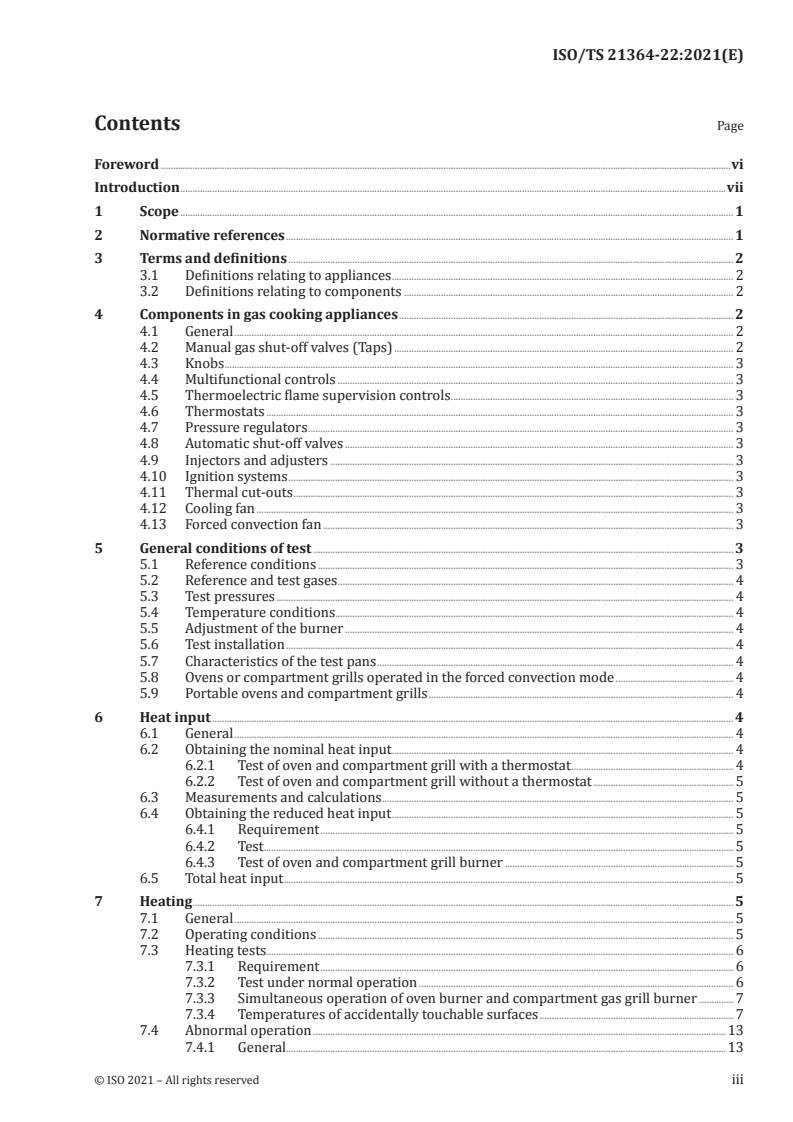
Contents Page
Foreword .vi
Introduction .vii
1 Scope . 1
2 Normative references . 1
3 Terms and definitions . 2
3.1 Definitions relating to appliances . 2
3.2 Definitions relating to components . 2
4 Components in gas cooking appliances . 2
4.1 General . 2
4.2 Manual gas shut-off valves (Taps) . 2
4.3 Knobs . 3
4.4 Multifunctional controls . 3
4.5 Thermoelectric flame supervision controls . 3
4.6 Thermostats . 3
4.7 Pressure regulators . 3
4.8 Automatic shut-off valves . 3
4.9 Injectors and adjusters . 3
4.10 Ignition systems . 3
4.11 Thermal cut-outs . 3
4.12 Cooling fan . 3
4.13 Forced convection fan . 3
5 General conditions of test . 3
5.1 Reference conditions . 3
5.2 Reference and test gases . 4
5.3 Test pressures . 4
5.4 Temperature conditions . 4
5.5 Adjustment of the burner . 4
5.6 Test installation . 4
5.7 Characteristics of the test pans . 4
5.8 Ovens or compartment grills operated in the forced convection mode . 4
5.9 Portable ovens and compartment grills . 4
6 Heat input . 4
6.1 General . 4
6.2 Obtaining the nominal heat input . . 4
6.2.1 Test of oven and compartment grill with a thermostat . 4
6.2.2 Test of oven and compartment grill without a thermostat . 5
6.3 Measurements and calculations . 5
6.4 Obtaining the reduced heat input . 5
6.4.1 Requirement . 5
6.4.2 Test . 5
6.4.3 Test of oven and compartment grill burner . 5
6.5 Total heat input . 5
7 Heating . 5
7.1 General . 5
7.2 Operating conditions . 5
7.3 Heating tests. 6
7.3.1 Requirement . 6
7.3.2 Test under normal operation . 6
7.3.3 Simultaneous operation of oven burner and compartment gas grill burner . 7
7.3.4 Temperatures of accidentally touchable surfaces . 7
7.4 Abnormal operation .13
7.4.1 General.13
7.4.2 Blocking of the cooling fan .13
7.4.3 Failure of the thermostat .14
7.4.4 Temperature of components in abnormal forced convection mode .14
8 Combustion .14
8.1 Measurement of all burners simultaneously .14
8.2 Blocked combustion products outlet .15
8.3 Analysis of the combustion products .15
8.4 Ovens and compartment grills .15
8.4.1 General.15
8.4.2 Combustion with reference gas .15
8.4.3 Combustion with limit gas .15
8.4.4 Simultaneous operation of oven and a compartment grill burner .15
8.4.5 Combustion with fluctuation of the electrical supply .16
8.4.6 Combustion under abnormal operation .16
8.5 Forced convection ovens or compartment grills .17
8.5.1 General.17
8.5.2 Abnormal forced convection mode of forced convection ovens or
compartment grills .17
9 Ignition, cross-lighting and flame stability .17
9.1 General .17
9.2 Movement of oven/grill door or cabinet door .17
9.3 Oven and compartment grill burner .17
9.3.1 General.17
9.3.2 Cold conditions .18
9.3.3 Hot conditions .19
9.4 Forced convection ovens or compartment grills .19
9.4.1 General.19
9.4.2 Abnormal operation of forced convection ovens or compartment grills .19
9.5 Simultaneous operation of the oven burner and a compartment grill burner .19
9.5.1 General.19
9.5.2 Cold conditions .20
9.5.3 Hot conditions .21
9.5.4 Movement of oven door or cabinet door during simultaneous operation .22
9.6 Ignition test of pyrolytic-self-cleaning oven and compartment grills .22
9.6.1 Requirement .22
9.6.2 Test .22
10 Accumulation of unburnt gas and leak tightness .22
10.1 Accumulation of unburnt gas .22
10.2 Leakage .22
10.3 Leak tightness of the appliance .22
10.4 Spillage of un-burnt gas inside the appliance .22
10.4.1 Requirement .23
10.4.2 Test .23
10.4.3 Accumulation of unburnt LPG .23
11 Construction .23
11.1 General .23
11.2 Materials .23
11.3 Gas inlet connections .23
11.4 Conversion to different gases .23
11.5 Pull forces of knobs for manual gas shut-off valves (taps) . .23
11.6 Appliances that enable the user to program the start or the end of the cooking cycle .23
11.7 Compartment for one gas cylinder .23
11.8 Touch controls .23
11.9 Door lock at high temperature .24
11.9.1 Requirement .24
11.9.2 Test .24
iv © ISO 2021 – All rights reserved
11.10 Appliances having pyrolytic-self-cleaning ovens and compartment grills .24
11.10.1 Door locking means for pyrolytic-self-cleaning oven and compartment grills .24
11.10.2 Temperature limiting means for pyrolytic-self-cleaning ovens and
compartment grills .24
11.10.3 Vapour combustion or flash-out during the pyrolytic-self-cleaning cycle .25
11.10.4 Flue gas temperatures of pyrolytic-self-cleaning ovens and compartment grills 25
11.11 Ignition with an external lighter .26
12 Mechanical strength .26
12.1 Parts made of glass and glass-ceramic .26
12.1.1 General.26
12.1.2 Spring hammer test .26
12.1.3 Punch test.27
12.1.4 Appliance door .27
12.2 Appliance body of freestanding appliances .27
12.2.1 Requirement .27
12.2.2 Test .27
12.3 Oven door strength.27
12.3.1 Requirement .27
12.3.2 Test .27
12.4 Tilting of freestanding ovens and compartment grills .28
12.4.1 Tilting .28
12.4.2 Tilting under special conditions .28
12.5 Strength and stability of oven and grill accessories .29
12.5.1 Requirement .29
12.5.2 Test .29
12.6 Portable ovens and compartment grills .29
12.6.1 General.29
12.6.2 Tilting of portable ovens and compartment grills .29
13 Electrical safety .30
14 Marking and instructions .30
14.1 Marking .30
14.1.1 Marking on the appliance .30
14.2 Instructions .30
Annex A (informative) National deviations in various countries .31
Foreword
ISO (the International Organization for Standardization) is a worldwide federation of national standards
bodies (ISO member bodies). The work of preparing International Standards is normally carried out
through ISO technical committees. Each member body interested in a subject for which a technical
committee has been established has the right to be represented on that committee. International
organizations, governmental and non-governmental, in liaison with ISO, also take part in the work.
ISO collaborates closely with the International Electrotechnical Commission (IEC) on all matters of
electrotechnical standardization.
The procedures used to develop this document and those intended for its further maintenance are
described in the ISO/IEC Directives, Part 1. In particular the different approval criteria needed for the
different types of ISO documents should be noted. This document was drafted in accordance with the
editorial rules of the ISO/IEC Directives, Part 2 (see www .iso .org/ directives).
Attention is drawn to the possibility that some of the elements of this document may be the subject of
patent rights. ISO shall not be held responsible for identifying any or all such patent rights. Details of
any patent rights identified during the development of the document will be in the Introduction and/or
on the ISO list of patent declarations received (see www .iso .org/ patents).
Any trade name used in this document is information given for the convenience of users and does not
constitute an endorsement.
For an explanation on the voluntary nature of standards, the meaning of ISO specific terms and
expressions related to conformity assessment, as well as information about ISO's adherence to the
World Trade Organization (WTO) principles in the Technical Barriers to Trade (TBT) see the following
URL: www .iso .org/ iso/ foreword .html.
This document was prepared by Technical Committee ISO/TC 291, Domestic gas cooking appliances.
A list of all parts in the ISO 21364 series can be found on the ISO website.
Any feedback or questions on this document should be directed to the user’s national standards body. A
complete listing of these bodies can be found at www .iso .org/ members .html.
vi © ISO 2021 – All rights reserved
Introduction
This document provides general requirements for safety of domestic gas cooking appliances.
This document can also be applied, so far as is reasonable, to appliances not mentioned in this
specific standard and to appliances designed on the basis of new principles, in which case additional
requirements may be necessary.
Where no specific document for an appliance exists, the appliance can be tested according to this
document and further tests which take into account the intended use.
Gas burning appliances using fuel gases need to withstand the type of gas which is specified. Other ISO
technical committees, e.g. ISO/TC 193, Natural gas, deal with the testing and properties of fuel gases.
Note that, due to the differing properties of fuel gas depending on its source/region of origin, certain
differences in regulations exist at present in different regions; some of these differences are presented
in Annex A.
This document covers type testing.
This document series is structured as follows:
ISO 21364 Domestic gas cooking appliances – Safety
— Part 1: General requirements
— Part 21: Particular requirements for hobs, surface grills and griddles
— Part 22: Particular requirements for ovens and compartment grills
This document is to be used in conjunction with ISO/TS 21364-1:2021.
This document is designed to be used in combination with ISO 21364-1. Together, they establish the
full requirements as they apply to the product covered by this document. Where needed, this document
adapts ISO 21364-1 by stating in the corresponding clause:
- “with the following modification”;
- “with the following addition”;
- “is replaced by the following”;
or
- “is not applicable”.
In order to identify specific requirements that are particular to this document, that are not already
covered by ISO 21364-1, this document may contain clauses or subclauses that are additional to the
structure of ISO 21364-1.
To ensure global relevance of this document, the differing requirements resulting from practical
experience and installation practices in various regions of the world have been taken into account. The
variations in basic infrastructure associated with appliances have also been recognized, some of which
are addressed in ISO/TS 21364-1:2021, Annex E and ISO/TS 21364-22:2021, Annex A. This document
intends to provide a basic framework of requirements that recognize these differences.
TECHNICAL SPECIFICATION ISO/TS 21364-22:2021(E)
Domestic gas cooking appliances — Safety —
Part 22:
Particular requirements for ovens and compartment grills
1 Scope
This document specifies particular requirements for safety, construction and materials of domestic gas
ovens and compartment grills. For general requirements for safety, construction and materials of gas
ovens and compartment grills, ISO/TS 21364-1:2021 applies.
This document covers the following gas cooking appliances:
— ovens with natural or forced convection;
— pyrolytic-self-cleaning ovens and pyrolytic-self-cleaning compartment grills;
— compartment grills
being built-in, table top or part of a cooking range.
— oven accessories
It does not cover gas ovens and compartment grills intended for outdoor use and/or commercial use
as well as electrical heated elements as part of the appliance. It does also not cover appliances with
automatic burner control systems.
NOTE 1 For requirements of electrical safety refer to the IEC60335 standards series.
NOTE 2 Attention is drawn to the fact that
— for appliances intended to be used in vehicles or on board ships or aircraft, additional requirements may be
necessary;
— in many countries additional requirements are specified by the national health authorities, the national
water supply authorities and similar authorities.
This document does not cover requirements relating to gas cylinders, their pressure regulators and
their connections.
This document does not cover requirements for gas installation.
2 Normative references
The following documents are referred to in the text in such a way that some or all of their content
constitutes requirements of this document. For dated references, only the edition cited applies. For
undated references, the latest edition of the referenced document (including any amendments) applies.
ISO 3864-1:2011, Graphical symbols — Safety colours and safety signs — Part 1: Design principles for
safety signs and safety markings
ISO/TS 21364-1:2021, Domestic gas cooking appliances – Safety- Part 1: General requirements
ISO/TS 21364-21:2021, Domestic gas cooking appliances – Safety – Part 21: Particular requirements for
gas hobs, gas grills and gas griddles
IEC 60335-2-102:2017, Household and similar electrical appliances — Safety — Part 2-102: Particular
requirements for gas, oil and solid-fuel burning appliances having electrical connections
IEC 60417, Graphical symbols for use on equipment
IEC 60584-1:2013, Thermocouples - Part 1: EMF specifications and tolerances
IEC 61032:1997, Protection of persons and equipment by enclosures – Probes for verification
3 Terms and definitions
For the purposes of this document, the terms and definitions of ISO/TS 21364-1:2021 apply with the
following additions.
ISO and IEC maintain terminological databases for use in standardization at the following addresses:
— ISO Online browsing platform: available at https:// www .iso .org/ obp
— IEC Electropedia: available at http:// www .electropedia .org/
3.1 Definitions relating to appliances
3.1.1
pyrolytic self-cleaning oven
oven in which cooking deposits are removed by heating the oven to a temperature exceeding 350 °C
[SOURCE: IEC 60335-2-6:2014, 3.105]
3.1.2
cooking surface
horizontal surface of the hob section
3.1.3
forced convection mode
heating mode for appliances equipped with a fan intended to assist the transmission of heat by creating
a forced circulation of air or products of combustion
Note 1 to entry: This fan is not intended to supply combustion air.
3.2 Definitions relating to components
3.2.1
evacuation duct
device for transporting combustion products out of the appliance
4 Components in gas cooking appliances
Clause 4 of ISO/TS 21364-1:2021 applies.
4.1 General
ISO/TS 21364-1:2021, 4.1 applies.
4.2 Manual gas shut-off valves (Taps)
ISO/TS 21364-1:2021, 4.2 applies.
2 © ISO 2021 – All rights reserved
4.3 Knobs
ISO/TS 21364-1:2021, 4.3 applies.
4.4 Multifunctional controls
ISO/TS 21364-1:2021, 4.4 applies.
4.5 Thermoelectric flame supervision controls
ISO/TS 21364-1:2021, 4.5 applies.
4.6 Thermostats
ISO/TS 21364-1:2021, 4.6 applies.
4.7 Pressure regulators
ISO/TS 21364-1:2021, 4.7 applies.
4.8 Automatic shut-off valves
ISO/TS 21364-1:2021, 4.8 applies.
4.9 Injectors and adjusters
ISO/TS 21364-1:2021, 4.9 applies.
4.10 Ignition systems
ISO/TS 21364-1:2021, 4.10 applies.
4.11 Thermal cut-outs
ISO/TS 21364-1:2021, 4.11 applies.
4.12 Cooling fan
A motor of a cooling fan shall conform with the requirements of IEC 60335-2-102:2017.
If the appliance has a cooling fan, the fan shall operate automatically.
4.13 Forced convection fan
The motor of a forced convection fan shall conform with the requirements of IEC 60335-2-102:2017.
5 General conditions of test
Clause 5 of ISO/TS 21364-1:2021 applies.
5.1 Reference conditions
ISO/TS 21364-1:2021, 5.1 applies.
5.2 Reference and test gases
ISO/TS 21364-1:2021, 5.2 applies.
5.3 Test pressures
ISO/TS 21364-1:2021, 5.3 applies.
5.4 Temperature conditions
ISO/TS 21364-1:2021, 5.4 applies.
5.5 Adjustment of the burner
ISO/TS 21364-1:2021, 5.5 applies.
5.6 Test installation
ISO/TS 21364-1:2021, 5.6 applies.
5.7 Characteristics of the test pans
ISO/TS 21364-1:2021, 5.7 applies.
5.8 Ovens or compartment grills operated in the forced convection mode
Ovens and compartment grills that can be operated in the forced convection mode are tested in the
same way as ovens or grills operated with natural convection but operated in the forced convection
mode.
5.9 Portable ovens and compartment grills
Portable ovens and compartment grills are tested according to all the applicable clauses for ovens and
compartment grills with the exception of 7.3.2.4, 12.2, 12.3, 12.4 and 12.5.
6 Heat input
Clause 6 of ISO/TS 21364-1:2021 applies.
6.1 General
ISO/TS 21364-1:2021, 6.1 applies.
6.2 Obtaining the nominal heat input
ISO/TS 21364-1:2021, 6.2 applies, with the following additions.
6.2.1 Test of oven and compartment grill with a thermostat
The burner of an appliance with thermostat is tested under the following conditions:
— the burner is ignited and operated with the thermostat at full rate at normal pressure and with the
door closed or open to avoid cycling of the thermostat;
— measuring begins from ignition. For analogue meters, measuring terminates when the highest
number of complete revolutions have been made before the end of the fifth minute. The test shall be
finished before the thermostat starts cycling.
4 © ISO 2021 – All rights reserved
Then the heat input is calculated under reference conditions according to ISO/TS 21364-1:2021, 6.3.
6.2.2 Test of oven and compartment grill without a thermostat
The burner of an appliance without a thermostat is tested under the following conditions:
— with the appliance at ambient temperature, the burner is ignited and operated at full rate at normal
pressure for 10 min;
— measurement starts at the end of the tenth minute and finishes at the latest at the end of the
thirteenth minute, with a minimum measurement time of one minute or when the highest number
of complete revolutions of the meter have been made before the end of the thirteenth minute. For
analogue meters, the measurement shall be taken over at least one complete revolution.
Then the heat input is calculated under reference conditions according to ISO/TS 21364-1:2021, 6.3.
6.3 Measurements and calculations
ISO/TS 21364-1:2021, 6.3 applies.
6.4 Obtaining the reduced heat input
ISO/TS 21364-1:2021, 6.4 applies with the following additions.
6.4.1 Requirement
ISO/TS 21364-1:2021, 6.4.1 applies.
6.4.2 Test
ISO/TS 21364-1:2021, 6.4.2 applies.
6.4.3 Test of oven and compartment grill burner
The reduced heat input shall be measured after the nominal heat input at the same conditions with
the oven door closed and the gas control is changed to reduced rate. For appliances with thermostatic
regulation, the measurement shall be done after 30 minutes, with a minimum measurement time of one
minute. If using analogue meters, measurements shall be taken over at least one complete revolution of
the analogue meter.
6.5 Total heat input
ISO/TS 21364-1:2021, 6.5 applies.
7 Heating
Clause 7 of ISO/TS 21364-1:2021 applies with the following additions:
7.1 General
ISO/TS 21364-1:2021, 7.1 applies.
7.2 Operating conditions
ISO/TS 21364-1:2021, 7.2 applies.
7.3 Heating tests
ISO/TS 21364-1:2021, 7.3 applies.
7.3.1 Requirement
ISO/TS 21364-1:2021, 7.3.1 applies.
7.3.2 Test under normal operation
ISO/TS 21364-1:2021, 7.3.2 applies.
7.3.2.1 General
ISO/TS 21364-1:2021, 7.3.2.1 applies.
7.3.2.2 Hob burner
ISO/TS 21364-1:2021, 7.3.2.2 applies.
7.3.2.3 Electric hob elements
ISO/TS 21364-1:2021, 7.3.2.3 applies.
7.3.2.4 Oven burner
ISO/TS 21364-1:2021, 7.3.2.4 applies.
7.3.2.5 Electric oven
ISO/TS 21364-1:2021, 7.3.2.5 applies.
7.3.2.6 Gas compartment grill
ISO/TS 21364-1:2021, 7.3.2.6 applies.
7.3.2.7 Electric compartment grill
ISO/TS 21364-1:2021, 7.3.2.7 applies.
7.3.2.8 Gas griddle
ISO/TS 21364-1:2021, 7.3.2.8 applies.
7.3.2.9 Electric griddle
ISO/TS 21364-1:2021, 7.3.2.9 applies.
7.3.2.10 Gas surface grill
ISO/TS 21364-1:2021, 7.3.2.10 applies.
7.3.2.11 Electric surface grill
ISO/TS 21364-1:2021, 7.3.2.11 applies.
6 © ISO 2021 – All rights reserved
7.3.2.12 Gas warming drawer
ISO/TS 21364-1:2021, 7.3.2.12 applies.
7.3.2.13 Electric warming drawer
ISO/TS 21364-1:2021, 7.3.2.13 applies.
7.3.2.14 Ovens or compartment grills operated in the forced convection mode
Ovens and compartment grills that can be operated in the forced convection mode are tested in the
same way as ovens or grills with natural convection (see ISO/TS 21364-1:2021, 7.3.2.4 and 7.3.2.6), but
with an average temperature of 210 °C instead of 230 °C at the centre of the compartment.
7.3.3 Simultaneous operation of oven burner and compartment gas grill burner
7.3.3.1 Requirement 1
At the end of Test 1 below, the temperature rise of accessible touchable surfaces shall meet the values
indicated in 7.3.4.2.1, Table 1.
7.3.3.2 Test 1
The oven burner is operated at an average temperature of 200 °C in the centre of the oven. This
temperature is maintained. The grill burner is operated at full rate.
After 1 h of operation the temperatures are measured. For this test the measurement procedure of
7.3.4.2.2 applies.
7.3.3.3 Requirement 2
At the end of Test 2 below, the temperature rise shall meet the values indicated in ISO/TS 21364-1:2021,
7.3.1, Table 4.
7.3.3.4 Test 2
After Test 1 the oven burner and gas grill burner that can be operated simultaneously are supplied
with reference gas according to the corresponding Table in ISO/TS 21364-1:2021, Annex A at normal
pressure. Hob burners, if any, are not operated.
The oven burner is operated up to an average temperature of 230 °C in the centre of the oven. This
temperature is maintained, if this temperature cannot be obtained the control is set to full rate. The
grill burner is operated at full rate.
After 1 h of operation or after the burner was shut off by an overheating safety device, if any, the
temperatures are measured.
7.3.4 Temperatures of accidentally touchable surfaces
7.3.4.1 General
During the accidentally touchable surfaces temperature tests, if the front and side surfaces are flat,
temperature rises are measured using the probe of Figure 1 or any other measuring device giving the
same results. For non-flat surfaces fine wire thermocouples are used.
The probe is applied with a force of (4 ± 1) N to the surface in such a way that the best possible contact
between the probe and the surface is ensured. The temperature is read after stabilization of the
measuring device.
The probe can be held in place using a laboratory stand clamp or similar device.
Dimensions in millimetres
Key
1 adhesive
2 thermocouple wires diameter 0,3 to IEC 60584-1:2013 type K (chrome alumel)
3 handle arrangement permitting contact force of (4 ± 1) N, length (100 ± 2)
4 polycarbonate tube, inside diameter 3, outside diameter 5
5 tinned copper disc diameter 5, 0,5 thick
Figure 1 — Surface temperature probe
7.3.4.2 Temperatures of accidentally touchable surfaces of ovens and compartment grills
7.3.4.2.1 Requirement
During the test below, the temperature rise of accidentally touchable surfaces shall not exceed the
values specified in Table 1.
Table 1 — Temperature rise limits for accessible surfaces
d
Surface Temperature rise
K
Front surfaces of oven Other surfaces
doors
Metal and painted metal 45 60
c
Coated met
...
SPÉCIFICATION ISO/TS
TECHNIQUE 21364-22
Première édition
2021-05
Appareils de cuisson domestiques
utilisant les combustibles gazeux —
Sécurité —
Partie 22:
Exigences particulières pour les fours
et compartiments de grillage
Domestic gas cooking appliances — Safety —
Part 22: Particular requirements for ovens and compartment grills
Numéro de référence
©
ISO 2021
DOCUMENT PROTÉGÉ PAR COPYRIGHT
© ISO 2021
Tous droits réservés. Sauf prescription différente ou nécessité dans le contexte de sa mise en œuvre, aucune partie de cette
publication ne peut être reproduite ni utilisée sous quelque forme que ce soit et par aucun procédé, électronique ou mécanique,
y compris la photocopie, ou la diffusion sur l’internet ou sur un intranet, sans autorisation écrite préalable. Une autorisation peut
être demandée à l’ISO à l’adresse ci-après ou au comité membre de l’ISO dans le pays du demandeur.
ISO copyright office
Case postale 401 • Ch. de Blandonnet 8
CH-1214 Vernier, Genève
Tél.: +41 22 749 01 11
E-mail: copyright@iso.org
Web: www.iso.org
Publié en Suisse
ii © ISO 2021 – Tous droits réservés
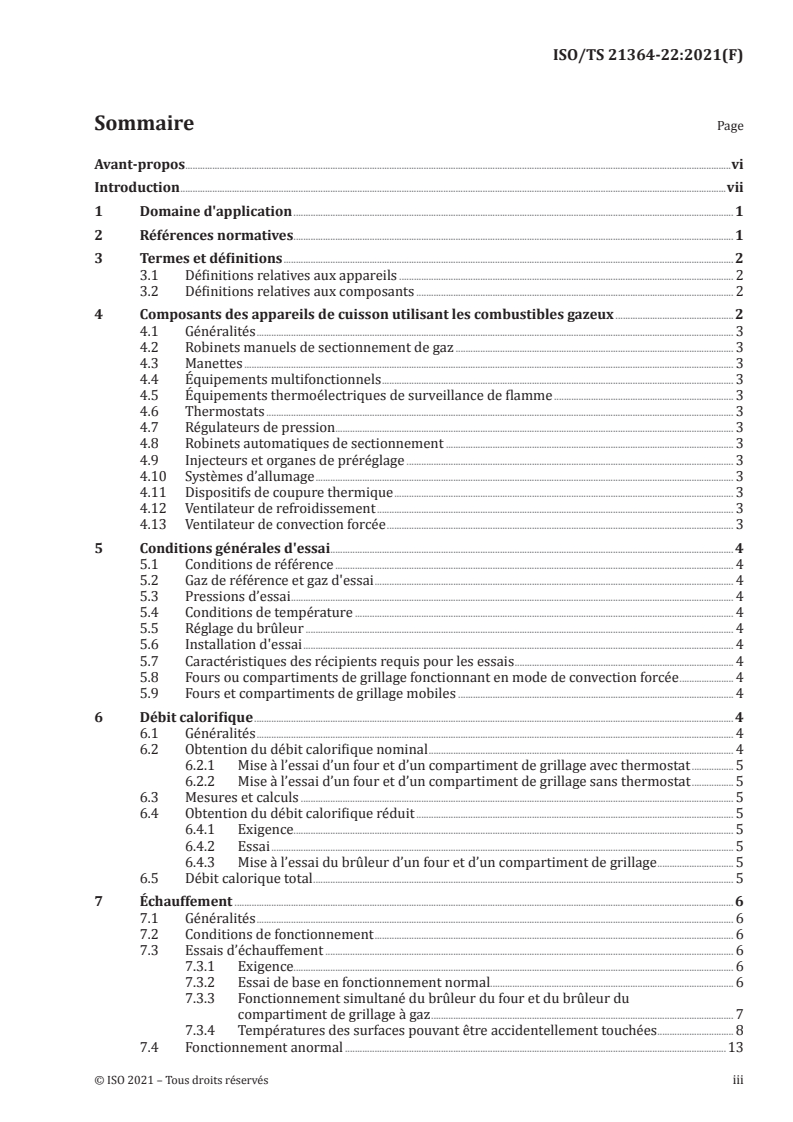
Sommaire Page
Avant-propos .vi
Introduction .vii
1 Domaine d'application . 1
2 Références normatives . 1
3 Termes et définitions . 2
3.1 Définitions relatives aux appareils . 2
3.2 Définitions relatives aux composants . 2
4 Composants des appareils de cuisson utilisant les combustibles gazeux .2
4.1 Généralités . 3
4.2 Robinets manuels de sectionnement de gaz . 3
4.3 Manettes . 3
4.4 Équipements multifonctionnels . 3
4.5 Équipements thermoélectriques de surveillance de flamme . 3
4.6 Thermostats . 3
4.7 Régulateurs de pression. 3
4.8 Robinets automatiques de sectionnement . 3
4.9 Injecteurs et organes de préréglage . 3
4.10 Systèmes d’allumage . 3
4.11 Dispositifs de coupure thermique . 3
4.12 Ventilateur de refroidissement . 3
4.13 Ventilateur de convection forcée . 3
5 Conditions générales d'essai . 4
5.1 Conditions de référence . 4
5.2 Gaz de référence et gaz d'essai . 4
5.3 Pressions d’essai . 4
5.4 Conditions de température . 4
5.5 Réglage du brûleur . 4
5.6 Installation d'essai . 4
5.7 Caractéristiques des récipients requis pour les essais . 4
5.8 Fours ou compartiments de grillage fonctionnant en mode de convection forcée . 4
5.9 Fours et compartiments de grillage mobiles . 4
6 Débit calorifique . 4
6.1 Généralités . 4
6.2 Obtention du débit calorifique nominal . 4
6.2.1 Mise à l’essai d’un four et d’un compartiment de grillage avec thermostat . 5
6.2.2 Mise à l’essai d’un four et d’un compartiment de grillage sans thermostat . 5
6.3 Mesures et calculs . 5
6.4 Obtention du débit calorifique réduit . 5
6.4.1 Exigence. 5
6.4.2 Essai . 5
6.4.3 Mise à l’essai du brûleur d’un four et d’un compartiment de grillage . 5
6.5 Débit calorique total . 5
7 Échauffement . 6
7.1 Généralités . 6
7.2 Conditions de fonctionnement . 6
7.3 Essais d’échauffement . 6
7.3.1 Exigence. 6
7.3.2 Essai de base en fonctionnement normal. 6
7.3.3 Fonctionnement simultané du brûleur du four et du brûleur du
compartiment de grillage à gaz . 7
7.3.4 Températures des surfaces pouvant être accidentellement touchées . 8
7.4 Fonctionnement anormal .13
7.4.1 Généralités .13
7.4.2 Blocage du ventilateur de refroidissement .13
7.4.3 Défaillance du thermostat.14
7.4.4 Température des composants en mode de convection forcée anormal .14
8 Combustion .14
8.1 Mesurage de tous les brûleurs fonctionnant simultanément .15
8.2 Orifice de sortie des produits de combustion bloqué .15
8.3 Analyse des produits de combustion .15
8.4 Fours et compartiments de grillage .15
8.4.1 Généralités .15
8.4.2 Combustion avec le gaz de référence .15
8.4.3 Combustion avec le gaz limite .15
8.4.4 Fonctionnement simultané du four et d’un brûleur du compartiment de
grillage .16
8.4.5 Combustion avec fluctuation de l'alimentation électrique .16
8.4.6 Combustion lors d'un fonctionnement anormal .16
8.5 Fours ou compartiments de grillage à convection forcée .17
8.5.1 Généralités .17
8.5.2 Mode de convection forcée anormal des fours ou compartiments de
grillage à convection forcée .17
9 Allumage, interallumage, stabilité des flammes .17
9.1 Généralités .17
9.2 Mouvement de la porte du four/gril ou de la porte du meuble .17
9.3 Four et brûleur de compartiment de grillage .18
9.3.1 Généralités .18
9.3.2 Conditions à froid .18
9.3.3 Conditions à chaud .19
9.4 Fours ou compartiments de grillage à convection forcée .19
9.4.1 Généralités .19
9.4.2 Fonctionnement anormal des fours ou compartiments de grillage à
convection forcée . .19
9.5 Fonctionnement simultané du brûleur de four et d’un brûleur du compartiment de
grillage .20
9.5.1 Généralités .20
9.5.2 Conditions à froid .20
9.5.3 Conditions à chaud .21
9.5.4 Mouvement de la porte du four ou de la porte du meuble en cas de
fonctionnement simultané .22
9.6 Essai d’allumage de four et de compartiments de grillage auto nettoyant à pyrolyse . .22
9.6.1 Exigence.22
9.6.2 Essai .22
10 Accumulation de gaz non brûlés et étanchéité .23
10.1 Accumulation de gaz non brûlé .23
10.2 Étanchéité .23
10.3 Étanchéité de l’appareil .23
10.4 Écoulement de gaz non brûlé à l’intérieur de l’appareil .23
10.4.1 Exigence.23
10.4.2 Essai .23
10.4.3 Accumulation de GPL non brûlé .23
11 Construction .23
11.1 Généralités .23
11.2 Matériaux .23
11.3 Raccord d'alimentation de gaz .23
11.4 Adaptation aux différents gaz .24
11.5 Forces de traction des manettes pour les robinets manuels de sectionnement de gaz .24
iv © ISO 2021 – Tous droits réservés
11.6 Appareils permettant à l’utilisateur de programmer le démarrage ou la fin du cycle
de cuisson .24
11.7 Logement pour une bouteille de gaz .24
11.8 Touches sensitives .24
11.9 Verrouillage de la porte à haute température .24
11.9.1 Exigence.24
11.9.2 Essai .24
11.10 Essai des fours et des compartiments de grillage à pyrolyse .24
11.10.1 Dispositifs de verrouillage de porte des fours et des compartiments de
grillage à pyrolyse .24
11.10.2 Dispositifs de limitation de la température des fours et des
compartiments de grillage à pyrolyse .25
11.10.3 Combustion ou émission de vapeur pendant le cycle de nettoyage par pyrolyse 25
11.10.4 Température des gaz de combustion des fours et des compartiments de
grillage à pyrolyse .26
11.11 Allumage à l’aide d’un système d’allumage extérieur .27
12 Résistance mécanique .27
12.1 Verre et vitrocéramique .27
12.1.1 Généralités .27
12.1.2 Essais au marteau à ressort .27
12.1.3 Essais au poinçon .27
12.1.4 Porte de l’appareil .27
12.2 Corps des appareils isolés .28
12.2.1 Exigence.28
12.2.2 Essai .28
12.3 Robustesse de la porte du four . .28
12.3.1 Exigence.28
12.3.2 Essai .28
12.4 Basculement des fours et des compartiments de grillage isolés .28
12.4.1 Basculement .28
12.4.2 Basculement dans des conditions particulières .29
12.5 Robustesse et stabilité des accessoires de four et de gril .29
12.5.1 Exigence.29
12.5.2 Essai .29
12.6 Fours et compartiments de grillage mobiles .30
12.6.1 Généralités .30
12.6.2 Basculement des fours et des compartiments de grillage mobiles .30
13 Sécurité électrique .30
14 Marquage et instructions .30
14.1 Marquage .30
14.1.1 Marquage sur l’appareil .31
14.2 Instructions .31
Annexe A (informative) Divergences nationales pour divers pays.32
Avant-propos
L'ISO (Organisation internationale de normalisation) est une fédération mondiale d'organismes
nationaux de normalisation (comités membres de l'ISO). L'élaboration des Normes internationales est
en général confiée aux comités techniques de l'ISO. Chaque comité membre intéressé par une étude
a le droit de faire partie du comité technique créé à cet effet. Les organisations internationales,
gouvernementales et non gouvernementales, en liaison avec l'ISO participent également aux travaux.
L'ISO collabore étroitement avec la Commission électrotechnique internationale (IEC) en ce qui
concerne la normalisation électrotechnique.
Les procédures utilisées pour élaborer le présent document et celles destinées à sa mise à jour sont
décrites dans les Directives ISO/IEC, Partie 1. Il convient, en particulier, de prendre note des différents
critères d'approbation requis pour les différents types de documents ISO. Le présent document a été
rédigé conformément aux règles de rédaction données dans les Directives ISO/IEC, Partie 2 (voir www
.iso .org/ directives).
L'attention est attirée sur le fait que certains des éléments du présent document peuvent faire l'objet de
droits de propriété intellectuelle ou de droits analogues. L'ISO ne saurait être tenue pour responsable
de ne pas avoir identifié de tels droits de propriété et averti de leur existence. Les détails concernant
les références aux droits de propriété intellectuelle ou autres droits analogues identifiés lors de
l'élaboration du document sont indiqués dans l'Introduction et/ou dans la liste des déclarations de
brevets reçues par l'ISO (voir www .iso .org/ brevets).
Les appellations commerciales éventuellement mentionnées dans le présent document sont données
pour information, par souci de commodité, à l’intention des utilisateurs et ne sauraient constituer un
engagement.
Pour une explication de la nature volontaire des normes, la signification des termes et expressions
spécifiques de l'ISO liés à l'évaluation de la conformité, ou pour toute information au sujet de l'adhésion
de l'ISO aux principes de l’Organisation mondiale du commerce (OMC) concernant les obstacles
techniques au commerce (OTC), voir www .iso .org/ avant -propos.
Le présent document a été élaboré par le comité technique ISO/TC 291, Appareils de cuisson domestiques
utilisant les combustibles gazeux.
Une liste de toutes les parties de la série ISO 21364 se trouve sur le site web de l'ISO.
Il convient que l’utilisateur adresse tout retour d’information ou toute question concernant le présent
document à l’organisme national de normalisation de son pays. Une liste exhaustive desdits organismes
se trouve à l’adresse www .iso .org/ fr/ members .html.
vi © ISO 2021 – Tous droits réservés
Introduction
Le présent document fournit des exigences générales pour la sécurité des appareils de cuisson
domestiques utilisant des combustibles gazeux.
Le présent document peut aussi être appliqué, dans la mesure du raisonnable, à des appareils non
traités par cette norme particulière et à des appareils conçus sur la base de principes nouveaux, auquel
cas des exigences supplémentaires peuvent être nécessaires.
Lorsqu’il n’existe pas de document spécifique pour un appareil, celui-ci peut être soumis à essai
conformément au présent document et à des essais complémentaires tenant compte de l’usage auquel il
est destiné.
Les appareils à gaz utilisant des combustibles gazeux doivent supporter le type de gaz spécifié. D’autres
comités techniques de l’ISO, par exemple l’ISO/TC 193, gaz naturel, traitent des essais et des propriétés
des gaz combustibles.
Il convient de noter qu'en raison des changements de propriétés du gaz combustible en fonction de sa
source/région d'origine, il existe actuellement certaines différences entre les réglementations dans
différentes régions; certaines de ces différences sont présentées à l’Annexe A.
Le présent document couvre les essais de type.
La présente série de documents est structurée de la manière suivante:
ISO 21364, Appareils de cuisson domestiques utilisant les combustibles gazeux — Sécurité
— Partie 1: Exigences générales;
— Partie 21: Règles particulières pour les tables de cuisson à gaz, grils à gaz et grils par contact à gaz;
— Partie 22: Exigences particulières pour les fours et compartiments de grillage.
Le présent document doit être utilisée conjointement avec l’ISO/TS 21364-1:2021.
Le présent document est prévu d’être utilisé conjointement avec l’ISO/TS 21364-1:2021. Ensemble, ils
établissent l’ensemble des exigences qui s'applique au produit couvert par ce document. Le cas échéant,
ce document adapte l'ISO 21364-1 en indiquant dans l'article correspondant:
— «avec la modification suivante»;
— «avec l'ajout suivant»;
— «est remplacé par»;
ou
— «n'est pas applicable».
Afin d'identifier les exigences spécifiques qui sont particulières au présent document, qui ne sont pas
déjà couvertes par l'ISO 21364-1, ce document peut contenir des paragraphes ou sous-paragraphe qui
s'ajoutent à la structure de l'ISO 21364-1.
Pour assurer la pertinence globale de ce document, les exigences différentes résultant de l'expérience
pratique et des pratiques d'installation dans diverses régions du monde ont été prises en compte.
Les variations de l'infrastructure de base associées aux appareils ont également été reconnues, dont
certaines sont traitées dans l’ISO/TS 21364-1:2021, Annexe E et l’ISO/TS 21364-1:2021, Annexe A. Le
présent document vise à fournir un cadre de base d'exigences qui reconnaissent ces différences.
SPÉCIFICATION TECHNIQUE ISO/TS 21364-22:2021(F)
Appareils de cuisson domestiques utilisant les
combustibles gazeux — Sécurité —
Partie 22:
Exigences particulières pour les fours et compartiments de
grillage
1 Domaine d'application
Le présent document spécifie les exigences particulières relatives à la sécurité, à la construction et aux
matériaux des fours domestiques à gaz et des compartiments de grillage. Pour les exigences générales
de sécurité, de construction et de matériaux des fours à gaz et des compartiments de grillage, la norme
l’ISO/TS 21364-1:2021 s’applique.
Le présent document couvre les appareils de cuisson à gaz suivants:
— fours à convection naturelle ou forcée;
— fours à pyrolyse et compartiments de grillage à pyrolyse;
— compartiments de grillage
encastrés, faisant partie d’un appareil de cuisson ou à poser sur table;
— accessoires de four.
Toutefois, il ne couvre pas les fours à gaz et les compartiments de grillage destinés à une utilisation en
extérieur et/ou commerciale, ainsi que les éléments chauffés électriquement faisant partie de l’appareil.
Elle ne couvre pas non plus les appareils avec systèmes automatiques de commande de brûleur.
NOTE 1 Pour les exigences relatives à la sécurité électrique, se référer aux normes de la série IEC 60335.
NOTE 2 L'attention est attirée sur le fait que:
— pour les appareils destinés à une utilisation dans des véhicules ou à bord de bateaux ou aéronefs, des exigences
supplémentaires peuvent être nécessaires;
— dans de nombreux pays, des exigences supplémentaires sont spécifiées par les autorités sanitaires nationales,
les services nationaux de distribution d’eau et les autorités similaires.
Le présent document ne couvre pas les exigences relatives aux bouteilles à gaz, à leurs régulateurs de
pression ou à leurs raccords.
Le présent document ne couvre pas les exigences relatives à l’installation de gaz.
2 Références normatives
Les documents suivants cités dans le texte constituent, pour tout ou partie de leur contenu, des
exigences du présent document. Pour les références datées, seule l'édition citée s'applique. Pour les
références non datées, la dernière édition du document de référence s'applique (y compris les éventuels
amendements).
ISO 3864-1:2011, Symboles graphiques — Couleurs de sécurité et signaux de sécurité — Partie 1: Principes
de conception pour les signaux de sécurité et les marquages de sécurité
ISO/TS 21364-1:2021, Appareils de cuisson domestiques utilisant les combustibles gazeux — Sécurité —
Partie 1: Exigences générales
ISO/TS 21364-21:2021, Appareils de cuisson domestiques utilisant les combustibles gazeux — Sécurité —
Partie 21: Règles particulières pour les tables de cuisson à gaz, grils à gaz et grils par contact à gaz
IEC 60335-2-102:2017, Appareils électrodomestiques et analogues — Sécurité — Partie 2-102: Règles
particulières pour les appareils à combustion au gaz, au mazout et à combustible solide comportant des
raccordements électriques
IEC 60417, Symboles graphiques utilisables sur le matériel
IEC 60584-1:2013, Couples thermoélectriques — Partie 1: Spécifications et tolérances en matière de FEM
IEC 61032:1997, Protection des personnes et des matériels par les enveloppes — Calibres d’essai pour la
vérification
3 Termes et définitions
Pour les besoins du présent document, les termes et définitions donnés dans l’ISO/TS 21364-1:2021
ainsi que les suivants s'appliquent.
L’ISO et l’IEC tiennent à jour des bases de données terminologiques destinées à être utilisées en
normalisation, consultables aux adresses suivantes:
— ISO Online browsing platform: disponible à l’adresse https:// www .iso .org/ obp
— IEC Electropedia: disponible à l’adresse http:// www .electropedia .org/
3.1 Définitions relatives aux appareils
3.1.1
four autonettoyant par pyrolyse
four dans lequel les dépôts de cuisson sont enlevés par chauffage du four à une température supérieure
à 350 °C
[SOURCE: IEC 60335-2-6:2014, 3.105]
3.1.2
surface de cuisson
surface horizontale de la section de table de cuisson
3.1.3
mode de convection forcée
mode de chauffage pour les appareils équipés d'un ventilateur destiné à augmenter la transmission de
la chaleur en créant une circulation forcée de l'air ou des produits de combustion; ce ventilateur n'est
pas destiné à la fourniture de l'air de combustion
3.2 Définitions relatives aux composants
3.2.1
conduit d’évacuation
dispositif servant à transporter les produits de combustion en dehors de l’appareil
4 Composants des appareils de cuisson utilisant les combustibles gazeux
Le paragraphe 4 de l’ISO/TS 21364-1:2021 s'applique.
2 © ISO 2021 – Tous droits réservés
4.1 Généralités
Le 4.1 de l’ISO/TS 21364-1:2021 s'applique.
4.2 Robinets manuels de sectionnement de gaz
Le 4.2 de l’ISO/TS 21364-1:2021 s'applique.
4.3 Manettes
Le 4.3 de l’ISO/TS 21364-1:2021 s'applique.
4.4 Équipements multifonctionnels
Le 4.4 de l’ISO/TS 21364-1:2021 s'applique.
4.5 Équipements thermoélectriques de surveillance de flamme
Le 4.5 de l’ISO/TS 21364-1:2021 s'applique.
4.6 Thermostats
Le 4.6 de l’ISO/TS 21364-1:2021 s'applique.
4.7 Régulateurs de pression
Le 4.7 de l’ISO/TS 21364-1:2021 s'applique.
4.8 Robinets automatiques de sectionnement
Le 4.8 de l’ISO/TS 21364-1:2021 s'applique.
4.9 Injecteurs et organes de préréglage
Le 4.9 de l’ISO/TS 21364-1:2021 s'applique.
4.10 Systèmes d’allumage
Le 4.10 de l’ISO/TS 21364-1:2021 s'applique.
4.11 Dispositifs de coupure thermique
Le 4.11 de l’ISO/TS 21364-1:2021 s'applique.
4.12 Ventilateur de refroidissement
Un moteur de ventilateur de refroidissement doit respecter les exigences de l’IEC 60335-2-102:2017.
Si l’appareil est muni d'un ventilateur de refroidissement, celui-ci doit fonctionner de façon automatique.
4.13 Ventilateur de convection forcée
Le moteur d’un ventilateur de convection forcée doit respecter les exigences de l’IEC 60335-2-102:2017.
5 Conditions générales d'essai
Le paragraphe 5 de l’ISO/TS 21364-1:2021 s'applique.
5.1 Conditions de référence
Le 5.1 de l’ISO/TS 21364-1:2021 s'applique.
5.2 Gaz de référence et gaz d'essai
Le 5.2 de l’ISO/TS 21364-1:2021 s'applique.
5.3 Pressions d’essai
Le 5.3 de l’ISO/TS 21364-1:2021 s'applique.
5.4 Conditions de température
Le 5.4 de l’ISO/TS 21364-1:2021 s'applique.
5.5 Réglage du brûleur
Le 5.5 de l’ISO/TS 21364-1:2021 s'applique.
5.6 Installation d'essai
Le 5.6 de l’ISO/TS 21364-1:2021 s'applique.
5.7 Caractéristiques des récipients requis pour les essais
Le 5.7 de l’ISO/TS 21364-1:2021 s'applique.
5.8 Fours ou compartiments de grillage fonctionnant en mode de convection forcée
Les fours et les compartiments de grillage qui peuvent fonctionner en mode de convection forcée
sont soumis à essai de la même façon que les fours ou grils à convection naturelle, mais sont mis en
fonctionnement en mode de convection forcée.
5.9 Fours et compartiments de grillage mobiles
Les fours et les compartiments de grillage mobiles sont soumis à essai conformément à l’ensemble des
articles et des paragraphes applicables pour les fours et les compartiments de grillage à l’exception des
suivants 7.3.4.2, 12.2, 12.3, 12.4 et 12.5.
6 Débit calorifique
Le paragraphe 6 de l’ISO/TS 21364-1:2021 s'applique.
6.1 Généralités
Le 6.1 de l’ISO/TS 21364-1:2021 s'applique.
6.2 Obtention du débit calorifique nominal
Le paragraphe 6.2 de l’ISO/TS 21364-1:2021 s'applique, avec les ajouts suivants:
4 © ISO 2021 – Tous droits réservés
6.2.1 Mise à l’essai d’un four et d’un compartiment de grillage avec thermostat
Le brûleur d'un appareil muni d’un thermostat est soumis à essai dans les conditions suivantes:
— le brûleur est allumé et mis en fonctionnement avec le thermostat réglé à plein débit à la pression
normale et avec la porte fermée ou ouverte pour éviter le fonctionnement du thermostat;
— la mesure commence dès l'allumage. Pour les compteurs analogiques, la mesure se termine lorsque
le plus grand nombre de révolutions complètes a été effectué avant la fin de la cinquième minute.
L’essai doit être terminé avant que le thermostat ne commence à fonctionner.
Le débit calorifique nominal est ensuite calculé dans les conditions de référence conformément à
l’ISO/TS 21364-1:2021, 6.3.
6.2.2 Mise à l’essai d’un four et d’un compartiment de grillage sans thermostat
Le brûleur d'un appareil dépourvu de thermostat est soumis à essai dans les conditions suivantes:
— l'appareil étant à température ambiante, le brûleur est allumé et fonctionne à plein débit et à pression
normale pendant 10 minutes;
— le mesurage commence à la fin de la dixième minute, et se termine au plus tard à la fin de la treizième
minute, avec une durée de mesurage minimale d’une minute. Pour les compteurs analogiques, le
mesurage doit être effectué après au moins une révolution complète du compteur analogique.
Le débit calorifique nominal est ensuite calculé dans les conditions de référence conformément à
l’ISO/TS 21364-1:2021, 6.3.
6.3 Mesures et calculs
Le 6.3 de l’ISO/TS 21364-1:2021 s'applique.
6.4 Obtention du débit calorifique réduit
Le paragraphe 6.4 de l’ISO/TS 21364-1:2021 s'applique, avec les ajouts suivants.
6.4.1 Exigence
Le 6.4.1 de l’ISO/TS 21364-1:2021 s'applique.
6.4.2 Essai
Le 6.4.2 de l’ISO/TS 21364-1:2021 s'applique.
6.4.3 Mise à l’essai du brûleur d’un four et d’un compartiment de grillage
Le débit calorifique réduit doit être mesuré après le débit calorifique nominal dans les mêmes conditions,
avec la porte du four fermée et l’organe de commande du gaz en position de débit réduit. Pour les
appareils à régulation thermostatique, le mesurage doit être effectué après 30 minutes, avec une durée
de mesurage minimale d’une minute. Si des compteurs analogiques sont utilisés, les mesurages doivent
être effectués après au moins une révolution complète du compteur analogique.
6.5 Débit calorique total
Le 6.5 de l’ISO/TS 21364-1:2021 s'applique.
7 Échauffement
Le paragraphe 7 de l’ISO/TS 21364-1:2021 s'applique, avec les ajouts suivants:
7.1 Généralités
Le 7.1 de l’ISO/TS 21364-1:2021 s'applique.
7.2 Conditions de fonctionnement
Le 7.2 de l’ISO/TS 21364-1:2021 s'applique.
7.3 Essais d’échauffement
Le 7.3 de l’ISO/TS 21364-1:2021 s'applique.
7.3.1 Exigence
Le 7.3.1 de l’ISO/TS 21364-1:2021 s'applique.
7.3.2 Essai de base en fonctionnement normal
Le 7.3.2 de l’ISO/TS 21364-1:2021 s'applique.
7.3.2.1 Généralité
Le 7.3.2.1 de l’ISO/TS 21364-1:2021 s'applique.
7.3.2.2 Brûleurs de table de cuisson
Le 7.3.2.2 de l’ISO/TS 21364-1:2021 s'applique.
7.3.2.3 Éléments de table de cuisson électrique
Le 7.3.2.3 de l’ISO/TS 21364-1:2021 s'applique.
7.3.2.4 Brûleurs de four
Le 7.3.2.4 de l’ISO/TS 21364-1:2021 s'applique.
7.3.2.5 Fours électriques
Le 7.3.2.5 de l’ISO/TS 21364-1:2021 s'applique.
7.3.2.6 Compartiment de grillage à combustible gazeux
Le 7.3.2.6 de l’ISO/TS 21364-1:2021 s'applique.
7.3.2.7 Compartiment de grillage électrique
Le 7.3.2.7 de l’ISO/TS 21364-1:2021 s'applique.
7.3.2.8 Grils par contact à combustible gazeux
Le 7.3.2.8 de l’ISO/TS 21364-1:2021 s'applique.
6 © ISO 2021 – Tous droits réservés
7.3.2.9 Grils par contact électriques
Le 7.3.2.9 de l’ISO/TS 21364-1:2021 s'applique.
7.3.2.10 Grils de surface à combustible gazeux
Le 7.3.2.10 de l’ISO/TS 21364-1:2021 s'applique.
7.3.2.11 Grils de surface électriques
Le 7.3.2.11 de l’ISO/TS 21364-1:2021 s'applique.
7.3.2.12 Tiroirs chauffants à combustible gazeux
Le 7.3.2.12 de l’ISO/TS 21364-1:2021 s'applique.
7.3.2.13 Tiroirs chauffants électriques
Le 7.3.2.13 de l’ISO/TS 213
...
SLOVENSKI STANDARD
oSIST ISO/DIS 21364-22:2020
01-marec-2020
Plinski kuhalni aparati za gospodinjstvo - Varnost - 22. del: Posebne zahteve za
pečice in žare
Domestic gas cooking appliances - Safety - Part 22: Particular requirements for ovens
and compartment grills
Titre manque - Partie 22: Titre manque
Ta slovenski standard je istoveten z: ISO/DIS 21364-22:2020
ICS:
97.040.20 Štedilniki, delovni pulti, Cooking ranges, working
pečice in podobni aparati tables, ovens and similar
appliances
oSIST ISO/DIS 21364-22:2020 en,fr,de
2003-01.Slovenski inštitut za standardizacijo. Razmnoževanje celote ali delov tega standarda ni dovoljeno.
oSIST ISO/DIS 21364-22:2020
oSIST ISO/DIS 21364-22:2020
DRAFT INTERNATIONAL STANDARD
ISO/DIS 21364-22
ISO/TC 291 Secretariat: DIN
Voting begins on: Voting terminates on:
2020-01-30 2020-04-23
Domestic gas cooking appliances — Safety —
Part 22:
Particular requirements for ovens and compartment grills
ICS: 97.040.20
THIS DOCUMENT IS A DRAFT CIRCULATED
FOR COMMENT AND APPROVAL. IT IS
THEREFORE SUBJECT TO CHANGE AND MAY
NOT BE REFERRED TO AS AN INTERNATIONAL
STANDARD UNTIL PUBLISHED AS SUCH.
IN ADDITION TO THEIR EVALUATION AS
BEING ACCEPTABLE FOR INDUSTRIAL,
This document is circulated as received from the committee secretariat.
TECHNOLOGICAL, COMMERCIAL AND
USER PURPOSES, DRAFT INTERNATIONAL
STANDARDS MAY ON OCCASION HAVE TO
BE CONSIDERED IN THE LIGHT OF THEIR
POTENTIAL TO BECOME STANDARDS TO
WHICH REFERENCE MAY BE MADE IN
Reference number
NATIONAL REGULATIONS.
ISO/DIS 21364-22:2020(E)
RECIPIENTS OF THIS DRAFT ARE INVITED
TO SUBMIT, WITH THEIR COMMENTS,
NOTIFICATION OF ANY RELEVANT PATENT
RIGHTS OF WHICH THEY ARE AWARE AND TO
©
PROVIDE SUPPORTING DOCUMENTATION. ISO 2020
oSIST ISO/DIS 21364-22:2020
ISO/DIS 21364-22:2020(E)
© ISO 2020
All rights reserved. Unless otherwise specified, or required in the context of its implementation, no part of this publication may
be reproduced or utilized otherwise in any form or by any means, electronic or mechanical, including photocopying, or posting
on the internet or an intranet, without prior written permission. Permission can be requested from either ISO at the address
below or ISO’s member body in the country of the requester.
ISO copyright office
CP 401 • Ch. de Blandonnet 8
CH-1214 Vernier, Geneva
Phone: +41 22 749 01 11
Fax: +41 22 749 09 47
Email: copyright@iso.org
Website: www.iso.org
Published in Switzerland
ii © ISO 2020 – All rights reserved
oSIST ISO/DIS 21364-22:2020
ISO/DIS 21364-22:2020(E)
Contents Page
Foreword .v
Introduction .vi
1 Scope . 1
2 Normative references . 1
3 Terms and definitions . 2
4 Components in gas cooking appliances . 2
4.101 Cooling fan . 2
4.102 Forced convection fan . 2
5 General conditions of test . 2
5.101 Ovens or compartment grills operated in the forced convection mode . 3
5.102 Portable ovens and compartment grills . 3
6 Heat input . 3
6.2 Obtaining the nominal heat input . . 3
6.2.101 Test of oven and compartment grill with a thermostat . 3
6.2.102 Test of oven and compartment grill without a thermostat . 3
6.4 Obtaining the reduced heat input . 3
6.4.101 Test of oven and compartment grill burner . 3
7 Heating . 4
7.3 Heating tests. 4
7.3.1 Basic test under normal operation. 4
7.3.101 Simultaneous operation of oven burner and compartment gas grill burner . 4
7.3.102 Temperatures of accidentally touchable surfaces . 4
7.4 Abnormal operation .10
7.4.101 General.10
7.4.102 Blocking of the cooling fan .10
7.4.103 Failure of the thermostat .11
7.4.104 Temperature of components in abnormal forced convection mode .11
8 Combustion .11
8.101 Ovens and compartment grills .12
8.101.1 General.12
8.101.2 Combustion with reference gas .12
8.101.3 Combustion with limit gas .12
8.101.4 Simultaneous operation of oven and a compartment grill burner .12
8.101.5 Combustion with fluctuation of the electrical supply .12
8.101.6 Combustion under abnormal operation .13
8.102 Forced convection ovens or compartment grills .14
8.102.1 General.14
8.102.2 Abnormal forced convection mode of forced convection ovens or
compartment grills .14
9 Ignition, cross-lighting and flame stability .14
9.101 Oven and compartment grill burner .14
9.101.1 General.14
9.101.2 Cold conditions .14
9.101.3 Hot conditions .15
9.102 Forced convection ovens or compartment grills .15
9.102.1 General.15
9.102.2 Abnormal operation of forced convection ovens or compartment grills .16
9.103 Simultaneous operation of the oven burner and a compartment grill burner .16
9.103.1 General.16
9.103.2 Cold conditions .16
9.103.3 Hot conditions .17
oSIST ISO/DIS 21364-22:2020
ISO/DIS 21364-22:2020(E)
9.103.4 Movement of oven door or cabinet door by simultaneous operation .18
9.104 Ignition test of pyrolytic oven and compartment grills .18
9.104.1 Requirement .18
9.104.2 Test .18
10 Accumulation of unburnt gas and leak tightness .18
10.4 Spillage of un-burnt gas inside the appliance .18
10.4.101 .
Accumulation of unburned LPG .19
11 Construction .19
11.101 Door lock at high temperature .19
11.102 Tests for pyrolytic ovens and compartment grills .19
11.102.1 .
Door locking means for pyrolytic oven and compartment grills .19
11.102.2 .
Temperature limiting means for pyrolytic ovens and compartment grills .19
11.102.3 .
Vapour combustion or flash-out during the pyrolytic cleaning cycle .20
11.102.4 .
Flue gas temperatures of pyrolytic ovens and compartment grills .20
11.103 Ignition with an external lighter .21
12 Mechanical strength .21
12.1 Glass and glass-ceramic .21
12.1.101 .
Appliance door .21
12.101 Appliance body of freestanding appliances .22
12.101.1 .
Requirement .22
12.101.2 .
Test .22
12.102 Oven door strength.22
12.102.1 .
Requirement .22
12.102.2 .
Test .22
12.103 Tilting of freestanding ovens and compartment grills .22
12.103.1 .
Tilting .22
12.103.2 .
Tilting under special conditions .23
12.104 Strength and stability of oven and grill accessories .23
12.104.1 .
Requirement .23
12.104.2 .
Test .23
12.105 Portable ovens and compartment grills .24
12.105.1 .
General.24
12.105.2 .
Tilting of portable ovens and compartment grills .24
13 Electrical safety .24
14 Marking and instructions .24
Bibliography .28
iv © ISO 2020 – All rights reserved
oSIST ISO/DIS 21364-22:2020
ISO/DIS 21364-22:2020(E)
Foreword
ISO (the International Organization for Standardization) is a worldwide federation of national standards
bodies (ISO member bodies). The work of preparing International Standards is normally carried out
through ISO technical committees. Each member body interested in a subject for which a technical
committee has been established has the right to be represented on that committee. International
organizations, governmental and non-governmental, in liaison with ISO, also take part in the work.
ISO collaborates closely with the International Electrotechnical Commission (IEC) on all matters of
electrotechnical standardization.
The procedures used to develop this document and those intended for its further maintenance are
described in the ISO/IEC Directives, Part 1. In particular the different approval criteria needed for the
different types of ISO documents should be noted. This document was drafted in accordance with the
editorial rules of the ISO/IEC Directives, Part 2 (see www .iso .org/ directives).
Attention is drawn to the possibility that some of the elements of this document may be the subject of
patent rights. ISO shall not be held responsible for identifying any or all such patent rights. Details of
any patent rights identified during the development of the document will be in the Introduction and/or
on the ISO list of patent declarations received (see www .iso .org/ patents).
Any trade name used in this document is information given for the convenience of users and does not
constitute an endorsement.
For an explanation on the voluntary nature of standards, the meaning of ISO specific terms and
expressions related to conformity assessment, as well as information about ISO's adherence to the
World Trade Organization (WTO) principles in the Technical Barriers to Trade (TBT) see the following
URL: www .iso .org/ iso/ foreword .html.
This document was prepared by Technical Committee ISO/TC 291, Domestic gas cooking appliances.
A list of all parts in the ISO 21364 series can be found on the ISO website.
oSIST ISO/DIS 21364-22:2020
ISO/DIS 21364-22:2020(E)
Introduction
This International Standard provides general requirements for safety of domestic gas cooking
appliances.
This International Standard can also be applied, so far as is reasonable, to appliances not mentioned in
this specific standard and to appliances designed on the basis of new principles, in which case additional
requirements may be necessary.
Where no specific International Standard for an appliance exists, the appliance can be tested according
to this International Standard and further tests which take into account the intended use.
Gas burning appliances using fuel gases need to withstand the type of gas which is specified. Other ISO
technical committees, e.g. ISO/TC 193, Natural gas, deal with the testing and properties of fuel gases.
Note that, due to the differing properties of fuel gas depending on its source/region of origin, certain
differences in regulations exist at present in different regions; some of these differences are presented
in Annex E.
This International Standard covers type testing.
This International Standard series is structured as follows:
ISO 21364 Domestic gas cooking appliances – Safety
— Part 1: General requirements
— Part 21: Particular requirements for gas hobs, gas grills and gas griddles
— Part 22: Particular requirements for ovens and compartment grills
This Part 22 is to be used in conjunction with ISO/DIS 21364-1:2019.
This Part 22 supplements or modifies the corresponding clauses in ISO/DIS 21364-1:2019, so as to convert
that publication into the ISO standard: Particular requirements for ovens and compartment grills.
When a particular subclause of ISO/DIS 21364-1:2019 is not mentioned in this Part 2, that subclause
applies as far as is reasonable. When this standard states “Addition”, “Modification” or “Replacement”,
the relevant text in ISO/DIS 21364-1:2019 is to be adapted accordingly.
NOTE The following numbering system is used:
— subclauses, tables and figures that are numbered starting from 101 are additional to those in
ISO/DIS 21364-1:2019;
— unless notes are in a new subclause or involve notes in Part 1, they are numbered starting from 101, including
those in a replaced clause or subclause;
vi © ISO 2020 – All rights reserved
oSIST ISO/DIS 21364-22:2020
DRAFT INTERNATIONAL STANDARD ISO/DIS 21364-22:2020(E)
Domestic gas cooking appliances — Safety —
Part 22:
Particular requirements for ovens and compartment grills
1 Scope
This Part of ISO 21364 specifies particular requirements for safety, construction and materials of
domestic gas ovens and compartment grills. For general requirements for safety, construction and
materials of gas ovens and compartment grills the Standard ISO/DIS 21364-1:2019 applies.
This Part covers the following gas cooking appliances:
— ovens with natural or forced convection;
— pyrolytic ovens and pyrolytic compartment grills;
— compartment grills
being built-in, part of a cooking appliance or table top.
— oven accessories
It does not cover gas ovens and compartment grills intended for outdoor use and/or commercial use
as well as electrical heated elements as part of the appliance. It does also not cover appliances with
automatic burner control systems.
NOTE 1 For requirements of electrical safety refer to the IEC standards.
NOTE 2 Attention is drawn to the fact that
— for appliances intended to be used in vehicles or on board ships or aircraft, additional requirements may be
necessary;
— in many countries additional requirements are specified by the national health authorities, the national water
supply authorities and similar authorities.
This International Standard does not cover requirements for gas installation.
2 Normative references
The following documents are referred to in the text in such a way that some or all of their content
constitutes requirements of this document. For dated references, only the edition cited applies. For
undated references, the latest edition of the referenced document (including any amendments) applies.
ISO 3864-1:2011, Graphical symbols — Safety colours and safety signs — Part 1: Design principles for
safety signs and safety markings
ISO 21364-1:20xx, Domestic gas cooking appliances – Safety- Part 1: General requirements
ISO 21364-21:20xx, Domestic gas cooking appliances – Safety – Part 21: Particular requirements for gas
hobs, gas grills and gas griddles
IEC 60335-2-102:2017, Household and similar electrical appliances — Safety — Part 2-102: Particular
requirements for gas, oil and solid-fuel burning appliances having electrical connections
oSIST ISO/DIS 21364-22:2020
ISO/DIS 21364-22:2020(E)
IEC 60417, Graphical symbols for use on equipment
IEC 60584-1:2013, Thermocouples - Part 1: EMF specifications and tolerances
IEC 61032:1997, Protection of persons and equipment by enclosures – Probes for verification
3 Terms and definitions
For the purposes of this document, the terms and definitions given in ISO/DIS 21364-1:2019 apply with
the following additions.
ISO and IEC maintain terminological databases for use in standardization at the following addresses:
— IEC Electropedia: available at http:// www .electropedia .org/
— ISO Online browsing platform: available at https:// www .iso .org/ obp
3.1 Definitions relating to appliances
3.1.101
pyrolytic self-cleaning oven
oven in which cooking deposits are removed by heating the oven to a temperature exceeding 350 °C
[SOURCE: IEC 60335-2-6:2014, 3.105]
3.1.102
cooking surface
horizontal surface of the hob section
3.1.103
forced convection mode
heating mode for appliances equipped with a fan intended to assist the transmission of heat by creating
a forced circulation of air or products of combustion; this fan is not intended to supply combustion air
3.3 Definitions relating to components
3.3.101
evacuation duct
device for transporting combustion products out of the appliance
4 Components in gas cooking appliances
This clause of ISO/DIS 21364-1:2019 applies with the following additions.
4.101 Cooling fan
A motor of a cooling fan shall comply with the requirements of IEC 60335-2-102:2017.
If the appliance has a cooling fan, the fan shall operate automatically.
4.102 Forced convection fan
The motor of a forced convection fan shall comply with the requirements of IEC 60335-2-102:2017.
5 General conditions of test
This clause of ISO/DIS 21364-1:2019 applies with the following additions.
2 © ISO 2020 – All rights reserved
oSIST ISO/DIS 21364-22:2020
ISO/DIS 21364-22:2020(E)
5.101 Ovens or compartment grills operated in the forced convection mode
Ovens and compartment grills that can be operated in the forced convection mode are tested in the same
way as ovens or grills operated with natural convection, but operated in the forced convection mode.
5.102 Portable ovens and compartment grills
Portable ovens and compartment grills are tested according to all the applicable clauses for ovens and
compartment grills with the exception of 7.3.102.2, 12.101, 12.102, 12.103 and 12.104.
6 Heat input
This clause of ISO/DIS 21364-1:2019 applies with the following additions.
6.2 Obtaining the nominal heat input
This clause of ISO/DIS 21364-1:2019 applies with the following additions.
6.2.101 Test of oven and compartment grill with a thermostat
The burner of an appliance with thermostat is tested under the following conditions:
— the burner is ignited and operated with the thermostat at full rate at normal pressure and with the
door closed or open to avoid cycling of the thermostat;
— measuring begins from ignition. For analogue meters, measuring terminates when the highest
number of complete revolutions have been made before the end of the fifth minute. The test shall be
finished before the thermostat starts cycling.
Then the heat input is calculated under reference conditions according to ISO/DIS 21364-1:2019, 6.3.
6.2.102 Test of oven and compartment grill without a thermostat
The burner of an appliance without thermostat is tested under the following conditions:
— with the appliance at ambient temperature, the burner is ignited and operated at full rate at normal
pressure for 10 min;
— measurement starts at the end of the tenth minute and finishes at the latest at the end of the
thirteenth minute, with a minimum measurement time of one minute. For analogue meters, the
measurement shall be taken over at least one complete revolution of the analogue meter.
Then the heat input is calculated under reference conditions according to ISO/DIS 21364-1:2019, 6.3.
6.4 Obtaining the reduced heat input
This clause of ISO/DIS 21364-1:2019 applies with the following additions.
6.4.101 Test of oven and compartment grill burner
The reduced heat input shall be measured after the nominal heat input at the same conditions with
the oven door closed and the gas control is changed to reduced rate. For appliances with thermostatic
regulation, the measurement shall be done after 30 minutes, with a minimum measurement time of one
minute. If using analogue meters, measurements shall be taken over at least one complete revolution of
the analogue meter.
oSIST ISO/DIS 21364-22:2020
ISO/DIS 21364-22:2020(E)
7 Heating
This clause of ISO/DIS 21364-1:2019 applies with the following additions.
7.3 Heating tests
7.3.1 Basic test under normal operation
This clause of ISO/DIS 21364-1:2019 applies with the following additions.
7.3.1.101 Ovens or compartment grills operated in the forced convection mode
Ovens and compartment grills that can be operated in the forced convection mode are tested in the
same way as ovens or grills with natural convection (see ISO/DIS 21364-1:2019, 7.3.1.4 and 7.3.1.6), but
with an average temperature of 210 °C instead of 230 °C at the centre of the compartment.
7.3.101 Simultaneous operation of oven burner and compartment gas grill burner
7.3.101.1 Requirement 1
The temperatures shall meet the values indicated in ISO/DIS 21364-1:2019, 7.3.2, Table 4.
7.3.101.2 Test 1
Oven burner and gas grill burner that can be operated simultaneously are supplied with reference
gas according to the corresponding table in ISO/DIS 21364-1:2019, Annex A at normal pressure. Hob
burners, if any, are not operated.
The oven burner is operated up to an average temperature of 230 °C in the centre of the oven. This
temperature is maintained, if this temperature cannot be obtained the control is set to full rate. The
grill burner is operated at full rate.
After 1 h of operation or after the burner was shut off by an overheating safety device, if any, the
temperatures are measured.
7.3.101.3 Requirement 2
The temperatures shall meet the values indicated in 7.3.102.2, Table 101.
7.3.101.4 Test 2
After Test 1 the oven burner is operated at an average temperature of 200 °C in the centre of the oven.
This temperature is maintained. The grill burner is operated at full rate.
After 1 h of operation the temperatures are measured (see 7.3.102.1).
7.3.102 Temperatures of accidentally touchable surfaces
7.3.102.1 General
During the following tests, if the front and side surfaces are flat, temperature rises are measured using
the probe of Figure 101 or any other measuring device giving the same results. For non-flat surfaces
fine wire thermocouples are used.
The probe is applied with a force of (4 ± 1) N to the surface in such a way that the best possible contact
between the probe and the surface is ensured. The temperature is read after stabilization of the
measuring device.
4 © ISO 2020 – All rights reserved
oSIST ISO/DIS 21364-22:2020
ISO/DIS 21364-22:2020(E)
The probe can be held in place using a laboratory stand clamp or similar device.
Dimensions in millimetres
Key
1 adhesive
2 thermocouple wires diameter 0,3 to IEC 60584-1:2013 type K (chrome alumel)
3 handle arrangement permitting contact force of (4 ± 1) N, length (100 ± 2)
4 polycarbonate tube, inside diameter 3, outside diameter 5
5 tinned copper disc diameter 5, 0,5 thick
Figure 101 — Surface temperature probe
7.3.102.2 Temperatures of accidentally touchable surfaces of ovens and compartment grills
7.3.102.2.1 Requirement
During the test below, the temperature rise of surfaces shall not exceed the values specified in Table 101.
7.3.102.2.2 Test
Ovens and compartment grills shall be adjusted as specified in ISO/DIS 21364-1:2019, 5.5 and
installed according to ISO/DIS 21364-1:2019, 5.6. Freestanding appliances shall be installed with a
rear panel only. The appliance is supplied with each reference gas at normal pressure according to the
corresponding table in ISO/DIS 21364-1:2019, Annex A.
All burners that can be operated at the same time in normal use are switched on. Hobs, griddles and
surface grills, if any, are operated in accordance with ISO/DIS 21364-1:2019, 7.3.1.2, 7.3.1.8 and 7.3.1.10.
Warming drawers and similar compartments, if any, are operated with the controls adjusted to the
highest setting. All appliances, other than compartment grills, are operated for 60 min.
Ovens are operated without accessories. Only a grid shelf with a thermocouple is positioned on the
shelf support closest to the vertical centre of the oven. The temperature in the centre of the oven is
maintained at (200 ± 4) °C.
Compartment grill burner are operated for 30 min. Grill burner having means to reduce the heat input
are operated for 15 min with their controls adjusted to the highest setting and then for 15 min at a
setting which reduces it to half of the nominal heat input.
Grills provided with a rotating spit are also operated with the spit rotating for 60 min. If the oven has
a rotating spit, the duration of the test is 60 min, with the controls set to give the most unfavourable
conditions specified in the instructions for use and maintenance. The measurements are only carried
out on surfaces for which temperature rise limits for the front surface of oven doors apply.
oSIST ISO/DIS 21364-22:2020
ISO/DIS 21364-22:2020(E)
If the oven has a compartment grill and the instructions for use and maintenance state that for grilling
the door should be closed, the test is repeated but with the oven operating in the grilling mode with the
controls set according to the instructions for use and maintenance.
If the oven door is protected by a guard, the temperature rise limits in Table 101, specified for the front
surface of oven door, apply to the guard. If the guard is a detachable guard, the temperature rise limits
in Table 101, specified for other surfaces, apply to parts of the oven door protected by the guard.
Temperature rises are not measured on:
— surfaces that are inaccessible to a 75 mm diameter probe having a hemispherical end, unless they
are protected by a detachable guard;
— surfaces that are within 25 mm below or above the level of the cooking surface of hobs, surface grills
and griddles (Figure 102);
— small parts such as oven vents, hinges and trims where the width of the accessible surface is less
than 10 mm;
— surfaces within 10 mm of the edge of the oven door;
— pan supports
— surfaces facing the top surface cooking section, such as backguards of the appliance, and vertical
top section extensions.
Key
1 pan
2 pan support
3 surface grill or griddle
4 cooking surface
5 worktop
Figure 102 — Cooking surface of hobs, surface grills and griddles
Table 101 — Temperature rise limits for accessible surfaces
d
Surface Temperature rise
K
Front surfaces of oven Other surfaces
doors
Metal and painted metal 45 60
a
The temperature rise limit of 100 K also applies for plastic material having a metal finish of thickness less than 0,1 mm.
b
When the thickness of the plastic coating does not exceed 0,4 mm, the temperature rise limits of the supporting
material apply
c
Metal is considered coated when a coating having a minimum thickness of 90 μm made by enamel or non-substantially
plastic coating is used
d The temperature rise of parts of pyrolytic ovens, operating under cleaning conditions regardless
of height above the floor, are 20 K in excess of the temperature rise specified for other surfaces
6 © ISO 2020 – All rights reserved
oSIST ISO/DIS 21364-22:2020
ISO/DIS 21364-22:2020(E)
Table 101 (continued)
d
Surface Temperature rise
K
Front surfaces of oven Other surfaces
doors
c
Coated metal 50 65
Glass and ceramic 60 80
a
Plastic having a thickness exceeding 80 100
b
0,4 mm
a
The temperature rise limit of 100 K also applies for plastic material having a metal finish of thickness less than 0,1 mm.
b
When the thickness of the plastic coating does not exceed 0,4 mm, the temperature rise limits of the supporting
material apply
c
Metal is considered coated when a coating having a minimum thickness of 90 μm made by enamel or non-substantially
plastic coating is used
d The temperature rise of parts of pyrolytic ovens, operating under cleaning conditions regardless
of height above the floor, are 20 K in excess of the temperature rise specified for other surfaces
7.3.102.3 Temperatures of accidentally touchable surfaces of forced convection ovens and
compartment grills
Ovens and compartment grills that can be operated in the forced convection mode are tested in the
same way as ovens or grills with natural convection, but with an average temperature of 180°C at the
centre of the compartment.
7.3.102.4 Temperatures of accidentally touchable surfaces of pyrolytic ovens and
compartment grills
7.3.102.4.1 Requirement
The contact temperatures of the exterior surfaces of an appliance provided with self-cleaning oven or
self-cleaning grill feature shall not exceed those specified in 7.3.102, Table 101 and ISO/DIS 21364-1:2019,
7.3.2, Table 4 (except the temperatures for knobs and grips) when the appliance is operated in the self-
cleaning mode.
Burn hazard potential shall be determined on all surfaces specified in 7.3.102.2 Table 101 and
ISO/DIS 21364-1:2019, 7.3.2, Table 4. If no top surface is provided, this surface is considered to extend
152 mm above the top edge of the compartment door(s).
During the test for pyrolytic ovens, the temperature rise of the surface of knobs and grips shall not
exceed the following values:
— metal 55 K
— porcelain or vitreous material 65 K
— moulded material, rubber or wood 80 K
The temperature rises of knobs and grips associated with functions that cannot be performed during
the cleaning operation are not determined.
7.3.102.4.2 Test
The manufacturer shall specify the temperature and duration of the self-cleaning mode.
Prior to conducting this test, the appliance shall be adjusted to obtain the self-cleaning temperature.
oSIST ISO/DIS 21364-22:2020
ISO/DIS 21364-22:2020(E)
This test shall be conducted according to 7.3.102 and ISO/DIS 21364-1:2019, 7.3.1 except that the oven(s)
temperature shall be the self-cleaning temperature.
If the appliance includes two compartments, a non-self-cleaning compartment shall remain inoperative
during the test. Two self-cleaning compartments shall be operated simultaneously, if the controls
permit such operation. If the controls do not permit simultaneous operation of the two self-cleaning
compartments, individual tests shall be conducted on each compartment.
The appliance shall be operated through the longest cleaning cycle attainable by using the control
system or until all contact temperatures of the exterior surfaces to be measured are constant,
whichever results in the shorter operating time. Points of expected maximum contact temperature
shall be monitored throughout the duration of the self-cleaning mode.
7.3.102.5 Temperatures of accidentally touchable surfaces of a portable table-top oven or
compartment grill
7.3.102.5.1 Requirement
During the following test, the temperature rise of surfaces shall not exceed the values specified in
Table 102.
7.3.102.5.2 Test
The portable table-top oven or compartment grill is placed as specified in ISO/DIS 21364-1:2019,
5.6.4 and is supplied with reference gas at normal pressure according to the corresponding Table of
ISO/DIS 21364-1:2019, Annex A.
The appliance is operated without accessories, with the exception of a grid with the thermocouple for
measuring the centre temperature of the compartment.
For an oven with a thermostat, the control is positioned in order to obtain an average temperature of
200 °C at the centre of the compartment.
For an oven without a thermostat, the control is set to the highest position until a temperature of about
200 °C is obtained at the centre of the compartment. The control is then set to the position allowing a
temperature of 200 °C to be maintained.
Ovens are operated until steady conditions are established or for 60 min, whichever is shorter.
The grill burner is operated for 30 min. A grill burner with means to reduce the heat input is operated
for 15 min with the control adjusted to full rate position and then for 15 min at a setting which reduces
it to half of the nominal heat input.
If for a compartment grill the instructions for use and maintenance state that for grilling the door
shall be closed, the test is performed with the controls set according to the instructions for use and
maintenance.
If the appliance is provided with a rotating spit, it is operated with the spit rotating for 60 min. The
controls are set to give the most unfavourable conditions specified in the instructions for use and
maintenance. The measurements are only carried out on surfaces for which temperature rise limits for
the front surface of the appliance door apply.
Temperature rises are not measured on the follow
...
Questions, Comments and Discussion
Ask us and Technical Secretary will try to provide an answer. You can facilitate discussion about the standard in here.
Loading comments...