


ISO/FDIS 10583
(Main)Aerospace fluid systems — Test methods for fitting on tube assemblies
Aerospace fluid systems — Test methods for fitting on tube assemblies
The test methods specified apply to fitting assemblies used in aircraft fluid systems in the pressure and temperature ranges covered by pressure classes B, D and E, and temperature types I, II and III of ISO 6771. Applies each time that it is referred to in a procurement specification or other definition document which contain the pass/fail criteria for these tests.
Circuits de fluides pour l'aérospatiale — Méthodes d'essai pour les raccords sur les assemblages de tubes
General Information
- Status
- Not Published
- Technical Committee
- ISO/TC 20/SC 10 - Aerospace fluid systems and components
- Drafting Committee
- ISO/TC 20/SC 10/WG 6 - Couplings for rigid pipe
- Current Stage
- 5020 - FDIS ballot initiated: 2 months. Proof sent to secretariat
- Start Date
- 16-Feb-2026
- Completion Date
- 16-Feb-2026
Relations
- Effective Date
- 18-Nov-2023
Overview
ISO/FDIS 10583:2026 – Aerospace Fluid Systems: Test Methods for Fitting on Tube Assemblies defines standardized test methods for qualifying fittings used on tube assemblies in aircraft fluid systems. This ISO standard is applicable across a range of pressure classes (B, D, E) and temperature types (I, II, III) as defined by ISO 6771. These test methods are referenced in procurement specifications or other pertinent documents that contain pass/fail criteria and are essential for ensuring flight safety and reliability in aerospace applications.
Adherence to ISO/FDIS 10583 ensures that fitting assemblies meet stringent performance requirements under extreme aircraft operating conditions, supporting overall system integrity, safety, and compliance for aerospace manufacturers and suppliers.
Key Topics
- Scope of Application: Applies to fittings on tube assemblies used in critical aircraft fluid systems, such as hydraulic, fuel, or pneumatic lines, within specified ISO 6771 pressure and temperature ranges.
- Qualification Procedures: Covers a comprehensive suite of standardized tests, each targeting a specific performance characteristic essential for safety and durability:
- Proof pressure test
- Pneumatic pressure test
- Impulse test
- Hydrostatic burst pressure test
- Flexure test
- Stress corrosion test
- Re-use capability
- Tensile test
- Thermal shock test
- Fire test
- Test Specimens and Fluids: Specifies guidelines for the selection of test specimens and appropriate test fluids (petroleum-based, synthetic, silicate ester, water, air, or nitrogen) according to the system type and test category.
- Quality and Inspection: Details procedures for conformity assessment, ensuring fitting components are inspected using standardized methods and tools.
Applications
- Aircraft Manufacturing & Maintenance: Ensures that tubing and fitting assemblies used in fluid systems are qualified under realistic, rigorous conditions, including high-pressure cycles, temperature extremes, and potential exposure to fire or corrosive agents.
- Safety and Reliability Assurance: Supports risk reduction by verifying that fittings maintain structural integrity, leak-tightness, resistance to corrosion, and durability throughout their service life, even after repeated installations or exposure to adverse conditions.
- Procurement and Compliance: Forms a foundation for sourcing, specifying, and accepting tubing assemblies in procurement contracts, with standardized pass/fail test criteria referenced by OEMs, suppliers, and regulatory agencies.
- System Integration and Retrofit: Facilitates the integration of qualified fluid fittings in new or existing aerospace systems, supporting ongoing compliance with evolving safety standards.
Related Standards
Implementing ISO/FDIS 10583 is often performed alongside related ISO aerospace standards, ensuring comprehensive and compatible testing and qualification across fluid system components:
- ISO 6771 – Aerospace fluid systems and components – Pressure and temperature classifications
(Defines relevant pressure classes and temperature types for applicability.) - ISO 2685 – Aircraft – Environmental test procedure for airborne equipment – Resistance to fire in designated fire zones
(Referenced for fire test procedures.) - ISO 6772 – Aerospace – Fluid systems – Impulse testing of hydraulic hose, tubing, and fitting assemblies
- ISO 6773 – Aerospace – Fluid systems – Thermal shock testing of piping and fittings
- ISO 7137 – Aircraft – Environmental conditions and test procedures for airborne equipment
- ISO 7257 – Aircraft – Hydraulic tubing joints and fittings – Rotary flexure test
- ISO 9538 – Aerospace series – Hydraulic tubing joints and fittings – Planar flexure test
Adhering to ISO/FDIS 10583 and its referenced standards helps ensure consistent performance verification, regulatory compliance, and enhanced safety in aerospace fluid system applications.
Buy Documents
ISO/FDIS 10583 - Aerospace fluid systems — Test methods for fitting on tube assemblies Released:2. 02. 2026
REDLINE ISO/FDIS 10583 - Aerospace fluid systems — Test methods for fitting on tube assemblies Released:2. 02. 2026
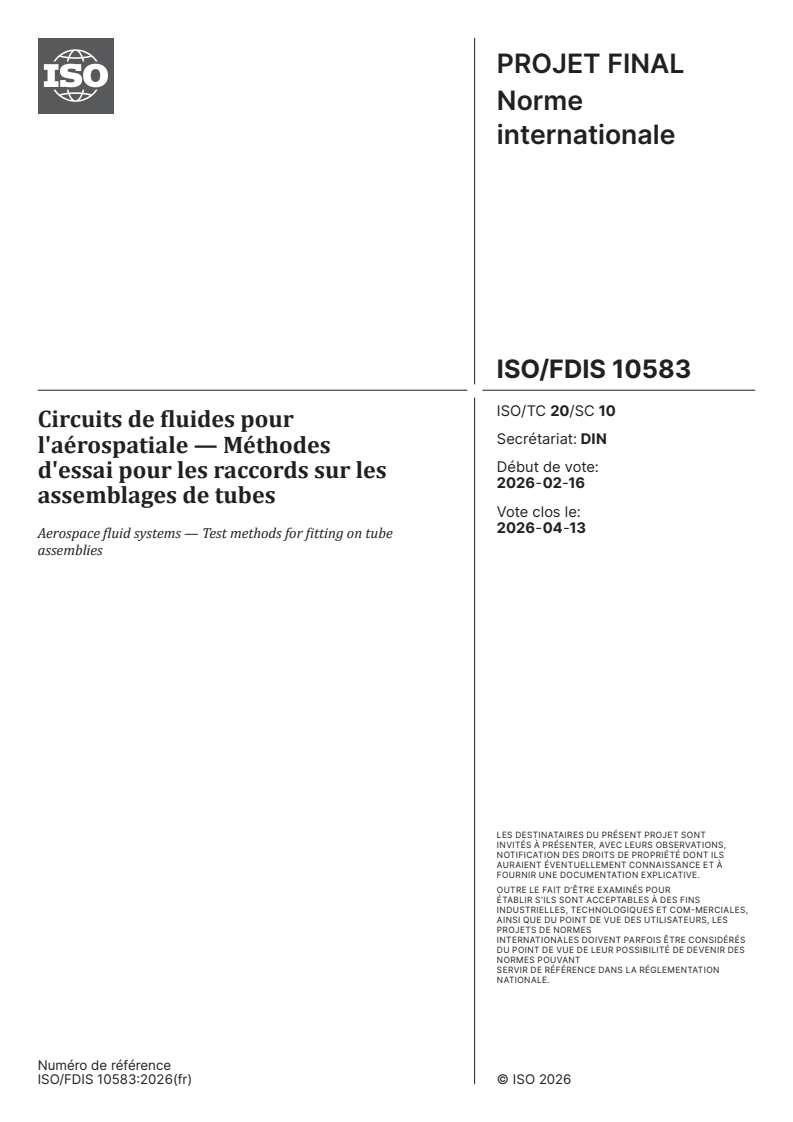
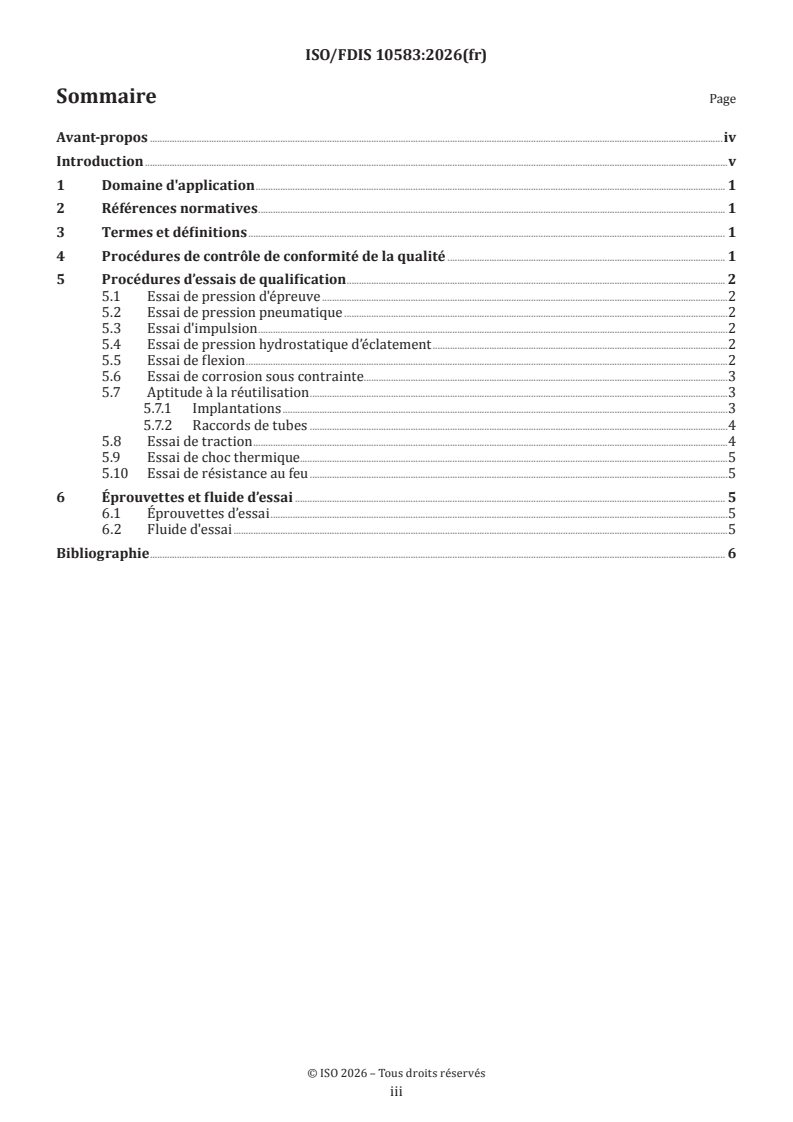
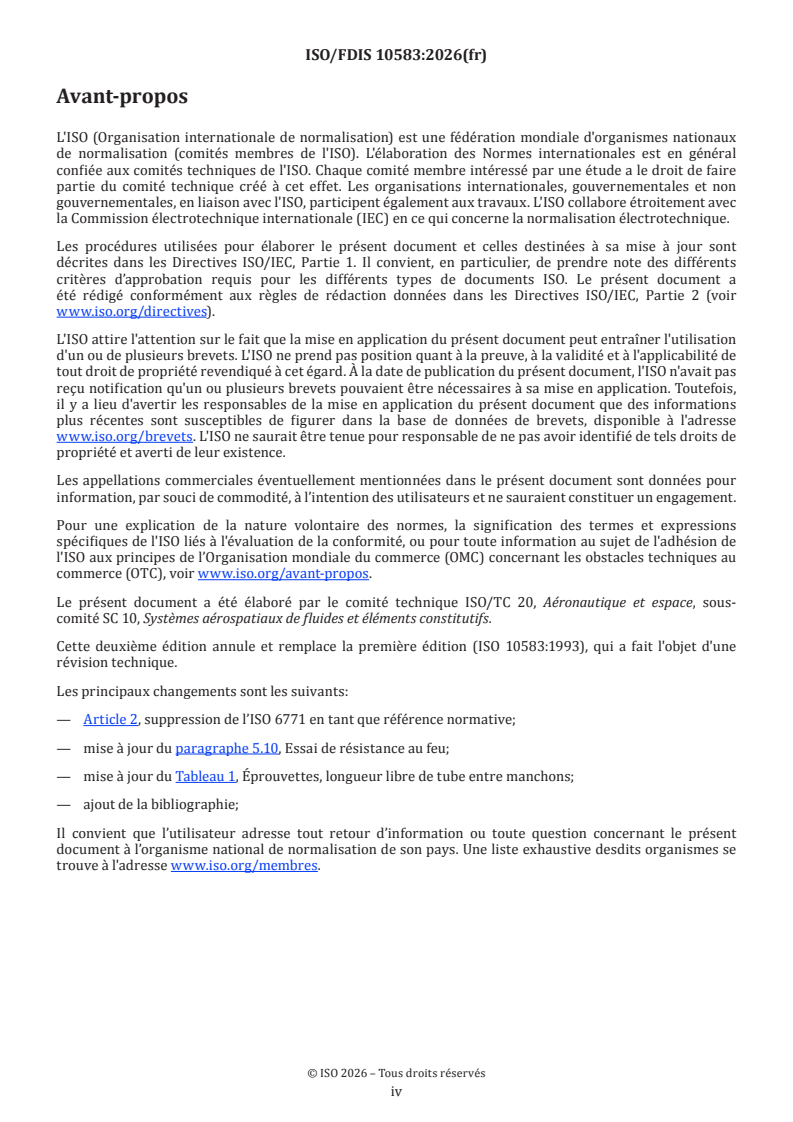
ISO/FDIS 10583 - Circuits de fluides pour l'aérospatiale — Méthodes d'essai pour les raccords sur les assemblages de tubes
Get Certified
Connect with accredited certification bodies for this standard

DEKRA North America
DEKRA certification services in North America.

Eagle Registrations Inc.
American certification body for aerospace and defense.

Element Materials Technology
Materials testing and product certification.
Sponsored listings
Frequently Asked Questions
ISO/FDIS 10583 is a draft published by the International Organization for Standardization (ISO). Its full title is "Aerospace fluid systems — Test methods for fitting on tube assemblies". This standard covers: The test methods specified apply to fitting assemblies used in aircraft fluid systems in the pressure and temperature ranges covered by pressure classes B, D and E, and temperature types I, II and III of ISO 6771. Applies each time that it is referred to in a procurement specification or other definition document which contain the pass/fail criteria for these tests.
The test methods specified apply to fitting assemblies used in aircraft fluid systems in the pressure and temperature ranges covered by pressure classes B, D and E, and temperature types I, II and III of ISO 6771. Applies each time that it is referred to in a procurement specification or other definition document which contain the pass/fail criteria for these tests.
ISO/FDIS 10583 is classified under the following ICS (International Classification for Standards) categories: 49.080 - Aerospace fluid systems and components. The ICS classification helps identify the subject area and facilitates finding related standards.
ISO/FDIS 10583 has the following relationships with other standards: It is inter standard links to ISO 10583:1993. Understanding these relationships helps ensure you are using the most current and applicable version of the standard.
ISO/FDIS 10583 is available in PDF format for immediate download after purchase. The document can be added to your cart and obtained through the secure checkout process. Digital delivery ensures instant access to the complete standard document.
Standards Content (Sample)
FINAL DRAFT
International
Standard
ISO/TC 20/SC 10
Aerospace fluid systems — Test
Secretariat: DIN
methods for fitting on tube
Voting begins on:
assemblies
2026-02-16
Voting terminates on:
2026-04-13
RECIPIENTS OF THIS DRAFT ARE INVITED TO SUBMIT,
WITH THEIR COMMENTS, NOTIFICATION OF ANY
RELEVANT PATENT RIGHTS OF WHICH THEY ARE AWARE
AND TO PROVIDE SUPPOR TING DOCUMENTATION.
IN ADDITION TO THEIR EVALUATION AS
BEING ACCEPTABLE FOR INDUSTRIAL, TECHNO
LOGICAL, COMMERCIAL AND USER PURPOSES, DRAFT
INTERNATIONAL STANDARDS MAY ON OCCASION HAVE
TO BE CONSIDERED IN THE LIGHT OF THEIR POTENTIAL
TO BECOME STAN DARDS TO WHICH REFERENCE MAY BE
MADE IN NATIONAL REGULATIONS.
Reference number
FINAL DRAFT
International
Standard
ISO/TC 20/SC 10
Aerospace fluid systems — Test
Secretariat: DIN
methods for fitting on tube
Voting begins on:
assemblies
Voting terminates on:
RECIPIENTS OF THIS DRAFT ARE INVITED TO SUBMIT,
WITH THEIR COMMENTS, NOTIFICATION OF ANY
RELEVANT PATENT RIGHTS OF WHICH THEY ARE AWARE
AND TO PROVIDE SUPPOR TING DOCUMENTATION.
© ISO 2026
IN ADDITION TO THEIR EVALUATION AS
All rights reserved. Unless otherwise specified, or required in the context of its implementation, no part of this publication may
BEING ACCEPTABLE FOR INDUSTRIAL, TECHNO
LOGICAL, COMMERCIAL AND USER PURPOSES, DRAFT
be reproduced or utilized otherwise in any form or by any means, electronic or mechanical, including photocopying, or posting on
INTERNATIONAL STANDARDS MAY ON OCCASION HAVE
the internet or an intranet, without prior written permission. Permission can be requested from either ISO at the address below
TO BE CONSIDERED IN THE LIGHT OF THEIR POTENTIAL
or ISO’s member body in the country of the requester.
TO BECOME STAN DARDS TO WHICH REFERENCE MAY BE
MADE IN NATIONAL REGULATIONS.
ISO copyright office
CP 401 • Ch. de Blandonnet 8
CH-1214 Vernier, Geneva
Phone: +41 22 749 01 11
Email: copyright@iso.org
Website: www.iso.org
Published in Switzerland Reference number
ii
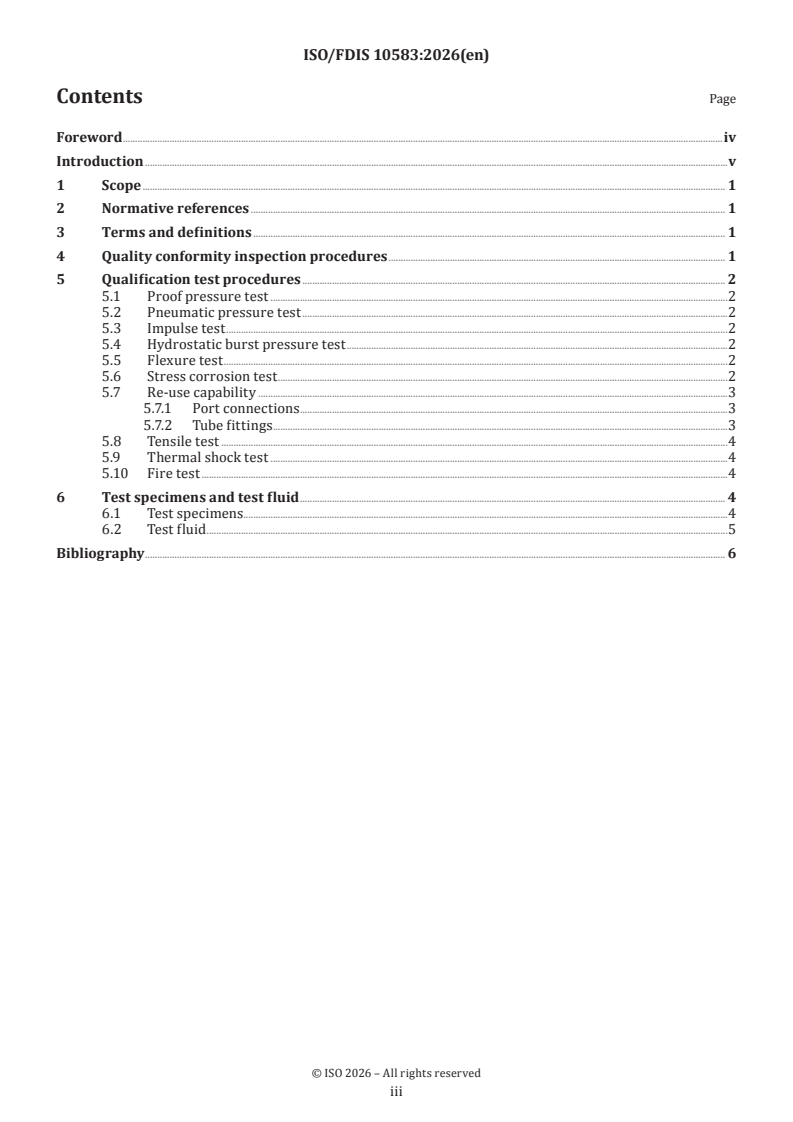
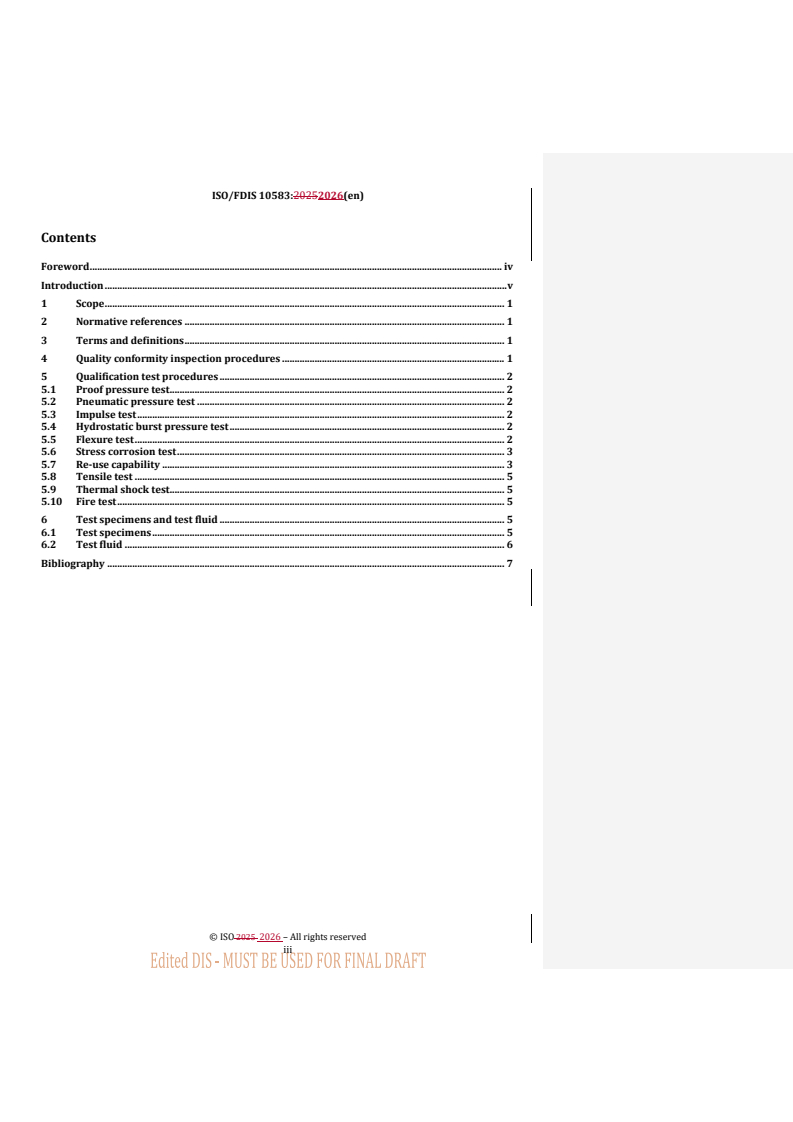
Contents Page
Foreword .iv
Introduction .v
1 Scope . 1
2 Normative references . 1
3 Terms and definitions . 1
4 Quality conformity inspection procedures . 1
5 Qualification test procedures . 2
5.1 Proof pressure test .2
5.2 Pneumatic pressure test .2
5.3 Impulse test .2
5.4 Hydrostatic burst pressure test .2
5.5 Flexure test .2
5.6 Stress corrosion test .2
5.7 Re-use capability .3
5.7.1 Port connections .3
5.7.2 Tube fittings .3
5.8 Tensile test .4
5.9 Thermal shock test .4
5.10 Fire test .4
6 Test specimens and test fluid . 4
6.1 Test specimens.4
6.2 Test fluid .5
Bibliography . 6
iii
Foreword
ISO (the International Organization for Standardization) is a worldwide federation of national standards
bodies (ISO member bodies). The work of preparing International Standards is normally carried out through
ISO technical committees. Each member body interested in a subject for which a technical committee
has been established has the right to be represented on that committee. International organizations,
governmental and non-governmental, in liaison with ISO, also take part in the work. ISO collaborates closely
with the International Electrotechnical Commission (IEC) on all matters of electrotechnical standardization.
The procedures used to develop this document and those intended for its further maintenance are described
in the ISO/IEC Directives, Part 1. In particular, the different approval criteria needed for the different types
of ISO document should be noted. This document was drafted in accordance with the editorial rules of the
ISO/IEC Directives, Part 2 (see www.iso.org/directives).
ISO draws attention to the possibility that the implementation of this document may involve the use of (a)
patent(s). ISO takes no position concerning the evidence, validity or applicability of any claimed patent
rights in respect thereof. As of the date of publication of this document, ISO had not received notice of (a)
patent(s) which may be required to implement this document. However, implementers are cautioned that
this may not represent the latest information, which may be obtained from the patent database available at
www.iso.org/patents. ISO shall not be held responsible for identifying any or all such patent rights.
Any trade name used in this document is information given for the convenience of users and does not
constitute an endorsement.
For an explanation of the voluntary nature of standards, the meaning of ISO specific terms and expressions
related to conformity assessment, as well as information about ISO's adherence to the World Trade
Organization (WTO) principles in the Technical Barriers to Trade (TBT), see www.iso.org/iso/foreword.html.
This document was prepared by Technical Committee ISO/TC 20, Aircraft and space vehicles, Subcommittee
SC 10, Aerospace fluid systems and components.
This second edition cancels and replaces the first edition (ISO 10583:1993), which has been technically
revised.
The main changes are as follows:
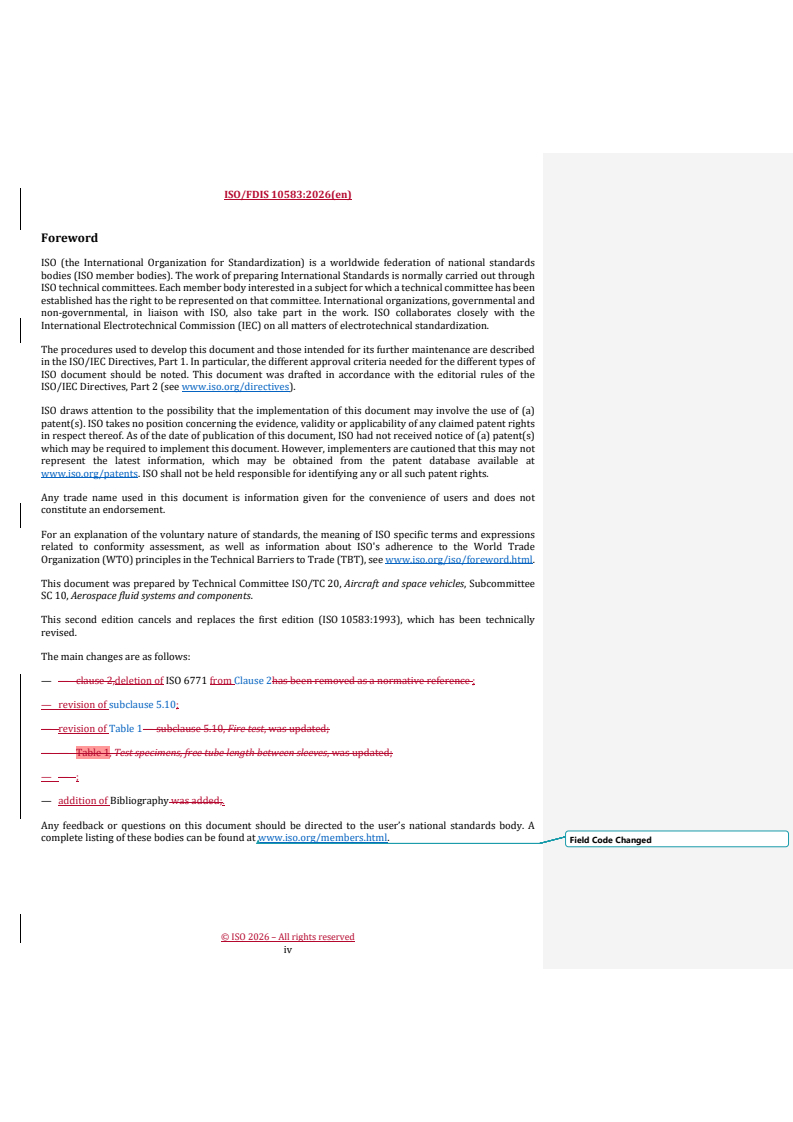
— deletion of ISO 6771 from Clause 2;
— revision of subclause 5.10;
— revision of Table 1;
— addition of Bibliography;
Any feedback or questions on this document should be directed to the user’s national standards body. A
complete listing of these bodies can be found at www.iso.org/members.html.
iv
Introduction
The intention of this document is to standardize test methods for the qualification of fittings on tube
assemblies used in aircraft fluid systems. The tests are intended to simulate the most strenuous demands
encountered in aircraft. These test methods are relevant for fittings on tube assemblies which are used in
systems where a malfunction would affect the safety of flight.
v
FINAL DRAFT International Standard ISO/FDIS 10583:2026(en)
Ae
...
ISO /TC 20/SC 10
Secretariat: DIN
Date: 2025-11-262026-02-02
Aerospace fluid systems — Test methods for fitting on tube
assemblies
FDIS stage
All rights reserved. Unless otherwise specified, or required in the context of its implementation, no part of this publication
may be reproduced or utilized otherwise in any form or by any means, electronic or mechanical, including photocopying,
or posting on the internet or an intranet, without prior written permission. Permission can be requested from either
ISO at the address below or ISO’s member body in the country of the requester.
ISO copyright office
CP 401 • Ch. de Blandonnet 8
CH-1214 Vernier, Geneva
Phone: + 41 22 749 01 11
Fax: +41 22 749 09 47
EmailE-mail: copyright@iso.org
Website: www.iso.org
Published in Switzerland
ii
Contents
Foreword . iv
Introduction . v
1 Scope . 1
2 Normative references . 1
3 Terms and definitions . 1
4 Quality conformity inspection procedures . 1
5 Qualification test procedures . 2
5.1 Proof pressure test . 2
5.2 Pneumatic pressure test . 2
5.3 Impulse test . 2
5.4 Hydrostatic burst pressure test . 2
5.5 Flexure test . 2
5.6 Stress corrosion test . 3
5.7 Re-use capability . 3
5.8 Tensile test . 5
5.9 Thermal shock test. 5
5.10 Fire test . 5
6 Test specimens and test fluid . 5
6.1 Test specimens . 5
6.2 Test fluid . 6
Bibliography . 7
iii
Foreword
ISO (the International Organization for Standardization) is a worldwide federation of national standards
bodies (ISO member bodies). The work of preparing International Standards is normally carried out through
ISO technical committees. Each member body interested in a subject for which a technical committee has been
established has the right to be represented on that committee. International organizations, governmental and
non-governmental, in liaison with ISO, also take part in the work. ISO collaborates closely with the
International Electrotechnical Commission (IEC) on all matters of electrotechnical standardization.
The procedures used to develop this document and those intended for its further maintenance are described
in the ISO/IEC Directives, Part 1. In particular, the different approval criteria needed for the different types of
ISO document should be noted. This document was drafted in accordance with the editorial rules of the
ISO/IEC Directives, Part 2 (see www.iso.org/directives).
ISO draws attention to the possibility that the implementation of this document may involve the use of (a)
patent(s). ISO takes no position concerning the evidence, validity or applicability of any claimed patent rights
in respect thereof. As of the date of publication of this document, ISO had not received notice of (a) patent(s)
which may be required to implement this document. However, implementers are cautioned that this may not
represent the latest information, which may be obtained from the patent database available at
www.iso.org/patents. ISO shall not be held responsible for identifying any or all such patent rights.
Any trade name used in this document is information given for the convenience of users and does not
constitute an endorsement.
For an explanation of the voluntary nature of standards, the meaning of ISO specific terms and expressions
related to conformity assessment, as well as information about ISO's adherence to the World Trade
Organization (WTO) principles in the Technical Barriers to Trade (TBT), see www.iso.org/iso/foreword.html.
This document was prepared by Technical Committee ISO/TC 20, Aircraft and space vehicles, Subcommittee
SC 10, Aerospace fluid systems and components.
This second edition cancels and replaces the first edition (ISO 10583:1993), which has been technically
revised.
The main changes are as follows:
— — clause 2,deletion of ISO 6771 from Clause 2has been removed as a normative reference ;
— revision of subclause 5.10;
— revision of Table 1— subclause 5.10, Fire test, was updated;
— — Table 1, Test specimens, free tube length between sleeves, was updated;
— — ;
— addition of Bibliography was added;.
Any feedback or questions on this document should be directed to the user’s national standards body. A
complete listing of these bodies can be found at www.iso.org/members.html.
Field Code Changed
iv
Introduction
ThisThe intention of this document has been preparedis to standardize the test methods for the qualification
of fittingfittings on tube assemblies used in aircraft fluid systems. The tests are intended to simulate the most
strenuous demands encountered in aircraft. These test methods are relevant for fittingfittings on tube
assemblies which are used in systems where a malfunction would affect the safety of flight.
v
DRAFT International Standard ISO/FDIS 10583:2025(en)
Aerospace fluid systems — Test methods for fitting on tube
assemblies
1 Scope
This document specifies test methods for fitting assemblies used in aircraft fluid systems in the pressure and
temperature ranges covered by pressure from classes B, to K, and temperature types I, II and III of ISO 6771.
ItThis document applies each time that it is referred to in a procurement specification or other definition
document which containcontains the pass/ and fail criteria for these tests.
2 Normative references
The following documents are referred to in the text in such a way that some or all of their content constitutes
requirements of this document. For dated references, only the edition cited applies. For undated references,
the latest edition of the referenced document (including any amendments) applies.
ISO 2685, Aircraft — Environmental test procedure for airborne equipment — Resistance to fire in designated
fire zones
ISO 6772, Aerospace — Fluid systems — Impulse testing of hydraulic hose, tubing and fitting assemblies
ISO 6773, Aerospace — Fluid systems — Thermal shock testing of piping and fittings
ISO 7137, Aircraft — Environmental conditions and test procedures for airborne equipment
ISO 7257, Aircraft — Hydraulic tubing joints and fittings — Rotary flexure test
ISO 9538, Aerospace series — Hydraulic tubing joints
...
PROJET FINAL
Norme
internationale
ISO/TC 20/SC 10
Circuits de fluides pour
Secrétariat: DIN
l'aérospatiale — Méthodes
Début de vote:
d'essai pour les raccords sur les
2026-02-16
assemblages de tubes
Vote clos le:
2026-04-13
Aerospace fluid systems — Test methods for fitting on tube
assemblies
LES DESTINATAIRES DU PRÉSENT PROJET SONT
INVITÉS À PRÉSENTER, AVEC LEURS OBSERVATIONS,
NOTIFICATION DES DROITS DE PROPRIÉTÉ DONT ILS
AURAIENT ÉVENTUELLEMENT CONNAISSANCE ET À
FOURNIR UNE DOCUMENTATION EXPLICATIVE.
OUTRE LE FAIT D’ÊTRE EXAMINÉS POUR
ÉTABLIR S’ILS SONT ACCEPTABLES À DES FINS
INDUSTRIELLES, TECHNOLOGIQUES ET COM-MERCIALES,
AINSI QUE DU POINT DE VUE DES UTILISATEURS, LES
PROJETS DE NORMES
INTERNATIONALES DOIVENT PARFOIS ÊTRE CONSIDÉRÉS
DU POINT DE VUE DE LEUR POSSI BILITÉ DE DEVENIR DES
NORMES POUVANT
SERVIR DE RÉFÉRENCE DANS LA RÉGLEMENTATION
NATIONALE.
Numéro de référence
PROJET FINAL
Norme
internationale
ISO/TC 20/SC 10
Circuits de fluides pour
Secrétariat: DIN
l'aérospatiale — Méthodes
Début de vote:
d'essai pour les raccords sur les
2026-02-16
assemblages de tubes
Vote clos le:
2026-04-13
Aerospace fluid systems — Test methods for fitting on tube
assemblies
LES DESTINATAIRES DU PRÉSENT PROJET SONT
INVITÉS À PRÉSENTER, AVEC LEURS OBSERVATIONS,
NOTIFICATION DES DROITS DE PROPRIÉTÉ DONT ILS
AURAIENT ÉVENTUELLEMENT CONNAISSANCE ET À
FOURNIR UNE DOCUMENTATION EXPLICATIVE.
DOCUMENT PROTÉGÉ PAR COPYRIGHT
OUTRE LE FAIT D’ÊTRE EXAMINÉS POUR
ÉTABLIR S’ILS SONT ACCEPTABLES À DES FINS
© ISO 2026 INDUSTRIELLES, TECHNOLOGIQUES ET COM-MERCIALES,
AINSI QUE DU POINT DE VUE DES UTILISATEURS, LES
Tous droits réservés. Sauf prescription différente ou nécessité dans le contexte de sa mise en œuvre, aucune partie de cette
PROJETS DE NORMES
INTERNATIONALES DOIVENT PARFOIS ÊTRE CONSIDÉRÉS
publication ne peut être reproduite ni utilisée sous quelque forme que ce soit et par aucun procédé, électronique ou mécanique,
DU POINT DE VUE DE LEUR POSSI BILITÉ DE DEVENIR DES
y compris la photocopie, ou la diffusion sur l’internet ou sur un intranet, sans autorisation écrite préalable. Une autorisation peut
NORMES POUVANT
être demandée à l’ISO à l’adresse ci-après ou au comité membre de l’ISO dans le pays du demandeur.
SERVIR DE RÉFÉRENCE DANS LA RÉGLEMENTATION
NATIONALE.
ISO copyright office
Case postale 401 • Ch. de Blandonnet 8
CH-1214 Vernier, Genève
Tél.: +41 22 749 01 11
E-mail: copyright@iso.org
Web: www.iso.org
Publié en Suisse Numéro de référence
ii
Sommaire Page
Avant-propos .iv
Introduction .v
1 Domaine d'application . 1
2 Références normatives . 1
3 Termes et définitions . 1
4 Procédures de contrôle de conformité de la qualité . 1
5 Procédures d’essais de qualification . 2
5.1 Essai de pression d'épreuve .2
5.2 Essai de pression pneumatique .2
5.3 Essai d'impulsion .2
5.4 Essai de pression hydrostatique d’éclatement .2
5.5 Essai de flexion .2
5.6 Essai de corrosion sous contrainte . .3
5.7 Aptitude à la réutilisation .3
5.7.1 Implantations .3
5.7.2 Raccords de tubes .4
5.8 Essai de traction .4
5.9 Essai de choc thermique.5
5.10 Essai de résistance au feu .5
6 Éprouvettes et fluide d’essai . 5
6.1 Éprouvettes d’essai .5
6.2 Fluide d'essai .5
Bibliographie . 6
iii
Avant-propos
L'ISO (Organisation internationale de normalisation) est une fédération mondiale d'organismes nationaux
de normalisation (comités membres de l'ISO). L'élaboration des Normes internationales est en général
confiée aux comités techniques de l'ISO. Chaque comité membre intéressé par une étude a le droit de faire
partie du comité technique créé à cet effet. Les organisations internationales, gouvernementales et non
gouvernementales, en liaison avec l'ISO, participent également aux travaux. L'ISO collabore étroitement avec
la Commission électrotechnique internationale (IEC) en ce qui concerne la normalisation électrotechnique.
Les procédures utilisées pour élaborer le présent document et celles destinées à sa mise à jour sont
décrites dans les Directives ISO/IEC, Partie 1. Il convient, en particulier, de prendre note des différents
critères d’approbation requis pour les différents types de documents ISO. Le présent document a
été rédigé conformément aux règles de rédaction données dans les Directives ISO/IEC, Partie 2 (voir
www.iso.org/directives).
L'ISO attire l'attention sur le fait que la mise en application du présent document peut entraîner l'utilisation
d'un ou de plusieurs brevets. L'ISO ne prend pas position quant à la preuve, à la validité et à l'applicabilité de
tout droit de propriété revendiqué à cet égard. À la date de publication du présent document, l'ISO n'avait pas
reçu notification qu'un ou plusieurs brevets pouvaient être nécessaires à sa mise en application. Toutefois,
il y a lieu d'avertir les responsables de la mise en application du présent document que des informations
plus récentes sont susceptibles de figurer dans la base de données de brevets, disponible à l'adresse
www.iso.org/brevets. L'ISO ne saurait être tenue pour responsable de ne pas avoir identifié de tels droits de
propriété et averti de leur existence.
Les appellations commerciales éventuellement mentionnées dans le présent document sont données pour
information, par souci de commodité, à l’intention des utilisateurs et ne sauraient constituer un engagement.
Pour une explication de la nature volontaire des normes, la signification des termes et expressions
spécifiques de l'ISO liés à l'évaluation de la conformité, ou pour toute information au sujet de l'adhésion de
l'ISO aux principes de l’Organisation mondiale du commerce (OMC) concernant les obstacles techniques au
commerce (OTC), voir www.iso.org/avant-propos.
Le présent document a été élaboré par le comité technique ISO/TC 20, Aéronautique et espace, sous-
comité SC 10, Systèmes aérospatiaux de fluides et éléments constitutifs.
Cette deuxième édition annule et remplace la première édition (ISO 10583:1993), qui a fait l'objet d'une
révision technique.
Les principaux changements sont les suivants:
— Article 2, suppression de l’ISO 6771 en tant que référence normative;
— mise à jour du paragraphe 5.10, Essai de résistance au feu;
— mise à jour du Tableau 1, Éprouvettes, longueur libre de tube entre manchons;
— ajout de la bibliographie;
Il convient que l’utilisateur adresse tout retour d’information ou toute question concernant le présent
document à l’organisme national de normalisation de son pays. Une liste exhaustive desdits organismes se
trouve à l'adresse www.iso.org/membres.
iv
Introduction
Le présent document a été élaboré pour normaliser les méthodes d’essai pour la qualification des raccords sur
les assemblages de tubes utilisés dans les circuits de fluides des aéronefs. Les essais sont destinés à simuler
les conditions les plus exigeantes rencontrées dans les aéronefs. Ces méthodes d'essai sont pertinentes pour
les raccords sur les assemblages de tubes utilisés dans les circuits où tout dysfonctionnement peut être
préjudiciable à la sécurité du vol.
v
PROJET FINAL Norme internationale ISO/FDIS 10583:2026(fr)
Circuits de fluides pour l'aérospatiale — Méthodes d'essai
pour les raccords sur les assemblages de tubes
1 Domaine d'application
Le présent document spécifie les méthodes d'essai pour les assemblages de raccordement utilisés dans les
circuits de fluides des aéronefs dans les plages de pression et de température couvertes par les classes de
pression B à K et les types de température I, II et II
...
Questions, Comments and Discussion
Ask us and Technical Secretary will try to provide an answer. You can facilitate discussion about the standard in here.
Loading comments...