

ISO 18487-1:2025
(Main)Aerospace series — Titanium tube for 35 MPa operating pressure — Part 1: Inch series
General Information
- Abstract
This document is applicable to seamless tubing of circular cross-section made from titanium alloy and intended for use primarily in systems with system operating pressure of 35 MPa (5 080 psi) (Pressure Class J), but usage is not limited to such applications.
- Status
- Published
- Publication Date
- 01-Jul-2025
- Technical Committee
- ISO/TC 20/SC 10 - Aerospace fluid systems and components
- Drafting Committee
- ISO/TC 20/SC 10/WG 3 - Tubing and tube retaining devices
- Current Stage
- 6060 - International Standard published
- Start Date
- 02-Jul-2025
- Due Date
- 19-May-2026
- Completion Date
- 02-Jul-2025
Overview
ISO 18487-1:2025 - "Aerospace series - Titanium tube for 35 MPa operating pressure - Part 1: Inch series" is an international standard that specifies technical requirements for seamless circular titanium-alloy tubing intended primarily for aerospace systems with a design operating pressure of 35 MPa (5 080 psi) (Pressure Class J). Published in 2025 (second edition), the standard harmonizes dimensions, material composition, mechanical properties and test methods for inch-series tubing while presenting dimensions in SI units with inch equivalents for industry convenience.
Key topics and technical requirements
- Scope and sizing: Applies to seamless titanium tubing of circular cross-section; nominal sizes are the aerospace “inch series” (document uses SI units with inch equivalents).
- Chemical composition: Limits and reporting requirements for key elements (Al, V, Fe, O, N, H, C, Y, Ti). Analytical methods referenced include ASTM E1447, ASTM E1409, ASTM E1941 and ASTM E2371.
- Melting practice: Multiple melts required; inert gas flooding mandatory; vacuum arc remelting (VAR) required for second and subsequent melts; open-air furnace melting prohibited.
- Heat treatment: Cold-worked and stress-relieved in vacuum or inert atmosphere at a minimum of 370 °C for at least 30 minutes; rotary straightening after final heat treatment is not permitted.
- Mechanical properties: Tensile testing at 15 °C (longitudinal direction), with specified tensile strength, proof stress and elongation ranges depending on diameter. Test methods per EN 2002‑001 / ASTM E8 and sample gauge lengths specified.
- Microstructure and inspection: Microscopic examination (≥400×) of longitudinal and transverse sections; grain size and contractile strain ratio (CSR) requirements; ultrasonic inspection and other non‑destructive tests referenced (EN 3718, AMS 2634).
- Forming and service tests: Requirements and procedures for flaring, bending, flattening, deformation-under-pressure, impulse pressure fatigue testing (including proof and pressure impulse tests), and burst/ultimate testing.
- Quality assurance and delivery: Batch testing rules, marking, packing and conformity documentation. Dimensional tolerances to ISO 12573; surface texture references updated to ISO 21920‑2.
Practical applications and users
- Who uses it: Aircraft and spacecraft designers, hydraulic system engineers, tubing manufacturers, procurement/specification teams, quality assurance and testing laboratories, and MRO organizations.
- Typical applications: High-pressure hydraulic and fluid systems in aircraft and space vehicles where reliable, lightweight, corrosion‑resistant titanium tubing is required at 35 MPa operating pressure (actuation systems, flight controls, landing gear hydraulics, fuel and pressurization lines).
Related standards
Relevant references include ISO 8575:2024 (hydraulic system tubing), ISO 12573 (tolerances - inch series), ISO 21920‑2 (surface texture), ISO 6772 (impulse testing), and several ASTM/EN test method standards cited in the document. These should be consulted together with ISO 18487-1:2025 for full specification and test protocols.
Relations
- Effective Date
- 07-Jan-2025
Get Certified
Connect with accredited certification bodies for this standard

BUREAU VERITAS Certification Germany
Bureau Veritas certification in Germany.

Element Materials Technology
Materials testing and product certification.

AQMS Ltd.
AQMS provides ISO certification to SMEs across the UK.
Sponsored listings
Frequently Asked Questions
ISO 18487-1:2025 is a standard published by the International Organization for Standardization (ISO). Its full title is "Aerospace series — Titanium tube for 35 MPa operating pressure — Part 1: Inch series". This standard covers: This document is applicable to seamless tubing of circular cross-section made from titanium alloy and intended for use primarily in systems with system operating pressure of 35 MPa (5 080 psi) (Pressure Class J), but usage is not limited to such applications.
This document is applicable to seamless tubing of circular cross-section made from titanium alloy and intended for use primarily in systems with system operating pressure of 35 MPa (5 080 psi) (Pressure Class J), but usage is not limited to such applications.
ISO 18487-1:2025 is classified under the following ICS (International Classification for Standards) categories: 49.080 - Aerospace fluid systems and components. The ICS classification helps identify the subject area and facilitates finding related standards.
ISO 18487-1:2025 has the following relationships with other standards: It is inter standard links to ISO 18487-1:2017. Understanding these relationships helps ensure you are using the most current and applicable version of the standard.
ISO 18487-1:2025 is available in PDF format for immediate download after purchase. The document can be added to your cart and obtained through the secure checkout process. Digital delivery ensures instant access to the complete standard document.
Standards Content (Sample)
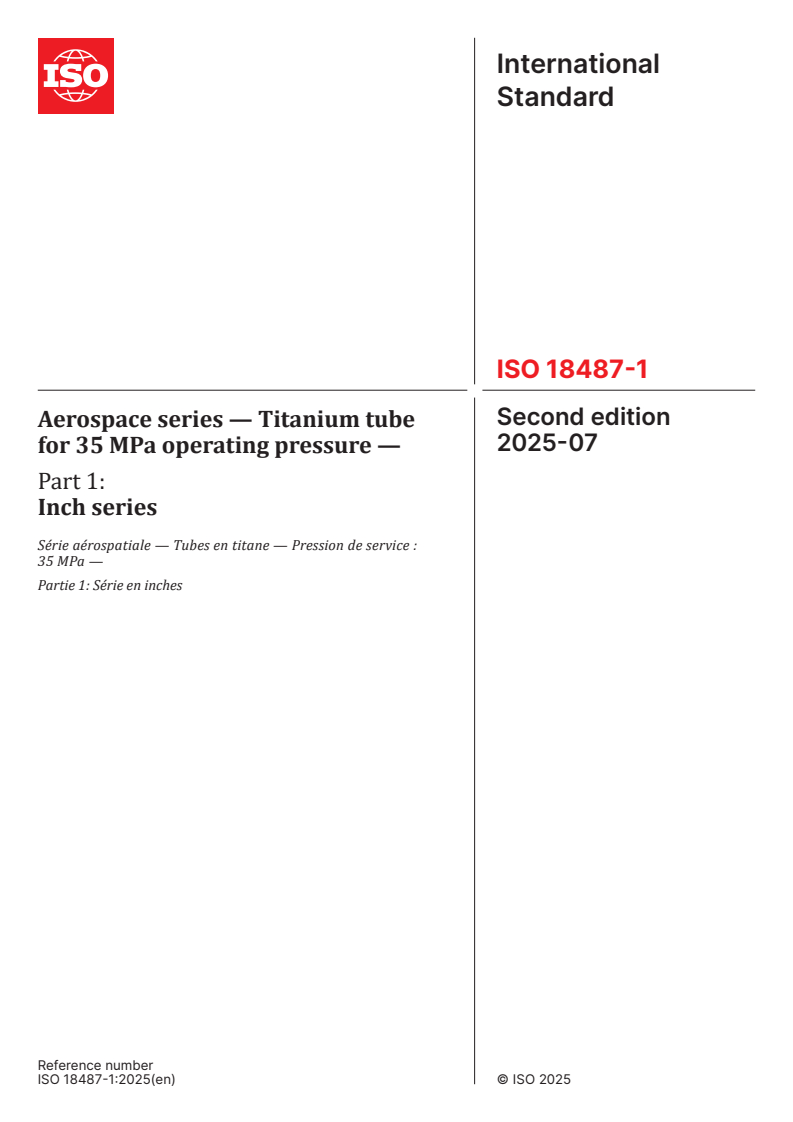
International
Standard
ISO 18487-1
Second edition
Aerospace series — Titanium tube
2025-07
for 35 MPa operating pressure —
Part 1:
Inch series
Série aérospatiale — Tubes en titane — Pression de service :
35 MPa —
Partie 1: Série en inches
Reference number
© ISO 2025
All rights reserved. Unless otherwise specified, or required in the context of its implementation, no part of this publication may
be reproduced or utilized otherwise in any form or by any means, electronic or mechanical, including photocopying, or posting on
the internet or an intranet, without prior written permission. Permission can be requested from either ISO at the address below
or ISO’s member body in the country of the requester.
ISO copyright office
CP 401 • Ch. de Blandonnet 8
CH-1214 Vernier, Geneva
Phone: +41 22 749 01 11
Email: copyright@iso.org
Website: www.iso.org
Published in Switzerland
ii
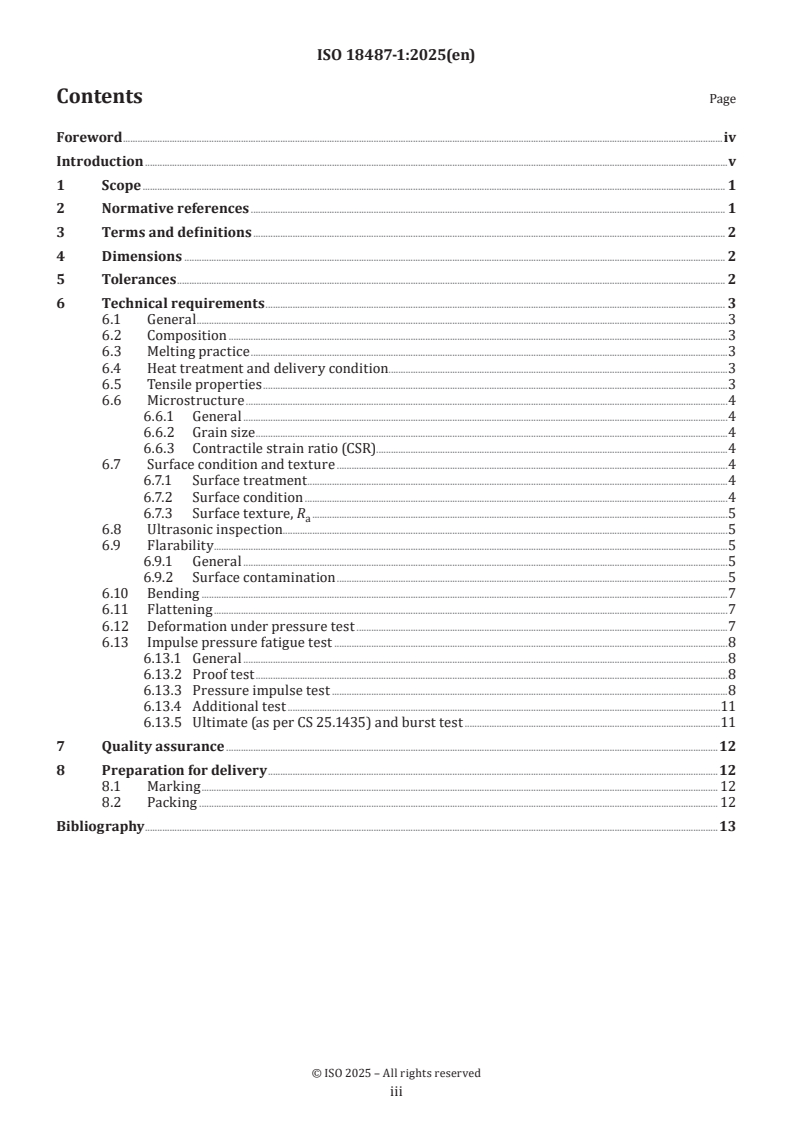
Contents Page
Foreword .iv
Introduction .v
1 Scope . 1
2 Normative references . 1
3 Terms and definitions . 2
4 Dimensions . 2
5 Tolerances . 2
6 Technical requirements . 3
6.1 General .3
6.2 Composition .3
6.3 Melting practice .3
6.4 Heat treatment and delivery condition.3
6.5 Tensile properties .3
6.6 Microstructure .4
6.6.1 General .4
6.6.2 Grain size .4
6.6.3 Contractile strain ratio (CSR).4
6.7 Surface condition and texture .4
6.7.1 Surface treatment .4
6.7.2 Surface condition .4
6.7.3 Surface texture, R .5
a
6.8 Ultrasonic inspection.5
6.9 Flarability . .5
6.9.1 General .5
6.9.2 Surface contamination .5
6.10 Bending .7
6.11 Flattening .7
6.12 Deformation under pressure test .7
6.13 Impulse pressure fatigue test .8
6.13.1 General .8
6.13.2 Proof test .8
6.13.3 Pressure impulse test .8
6.13.4 Additional test .11
6.13.5 Ultimate (as per CS 25.1435) and burst test .11
7 Quality assurance .12
8 Preparation for delivery .12
8.1 Marking . 12
8.2 Packing . 12
Bibliography .13
iii
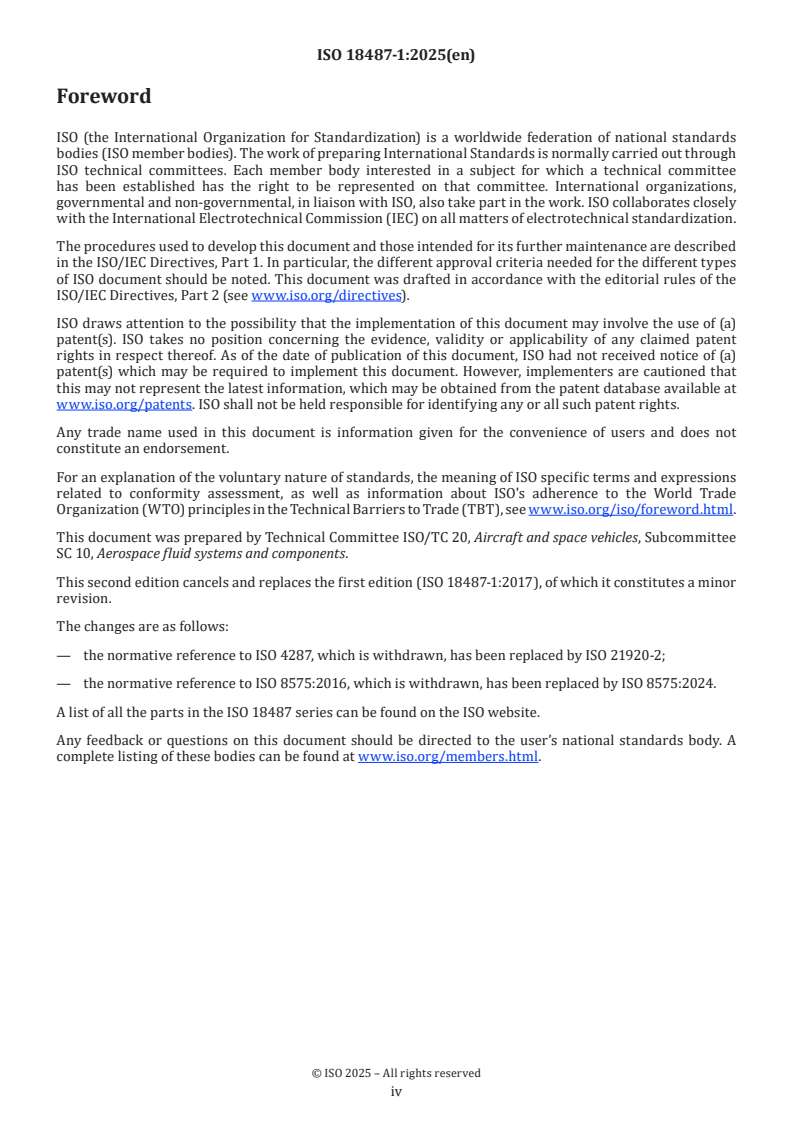
Foreword
ISO (the International Organization for Standardization) is a worldwide federation of national standards
bodies (ISO member bodies). The work of preparing International Standards is normally carried out through
ISO technical committees. Each member body interested in a subject for which a technical committee
has been established has the right to be represented on that committee. International organizations,
governmental and non-governmental, in liaison with ISO, also take part in the work. ISO collaborates closely
with the International Electrotechnical Commission (IEC) on all matters of electrotechnical standardization.
The procedures used to develop this document and those intended for its further maintenance are described
in the ISO/IEC Directives, Part 1. In particular, the different approval criteria needed for the different types
of ISO document should be noted. This document was drafted in accordance with the editorial rules of the
ISO/IEC Directives, Part 2 (see www.iso.org/directives).
ISO draws attention to the possibility that the implementation of this document may involve the use of (a)
patent(s). ISO takes no position concerning the evidence, validity or applicability of any claimed patent
rights in respect thereof. As of the date of publication of this document, ISO had not received notice of (a)
patent(s) which may be required to implement this document. However, implementers are cautioned that
this may not represent the latest information, which may be obtained from the patent database available at
www.iso.org/patents. ISO shall not be held responsible for identifying any or all such patent rights.
Any trade name used in this document is information given for the convenience of users and does not
constitute an endorsement.
For an explanation of the voluntary nature of standards, the meaning of ISO specific terms and expressions
related to conformity assessment, as well as information about ISO's adherence to the World Trade
Organization (WTO) principles in the Technical Barriers to Trade (TBT), see www.iso.org/iso/foreword.html.
This document was prepared by Technical Committee ISO/TC 20, Aircraft and space vehicles, Subcommittee
SC 10, Aerospace fluid systems and components.
This second edition cancels and replaces the first edition (ISO 18487-1:2017), of which it constitutes a minor
revision.
The changes are as follows:
— the normative reference to ISO 4287, which is withdrawn, has been replaced by ISO 21920-2;
— the normative reference to ISO 8575:2016, which is withdrawn, has been replaced by ISO 8575:2024.
A list of all the parts in the ISO 18487 series can be found on the ISO website.
Any feedback or questions on this document should be directed to the user’s national standards body. A
complete listing of these bodies can be found at www.iso.org/members.html.
iv
Introduction
This document is intended to harmonize the technical requirements for titanium tubes used in aerospace
with design operating pressure of 35 MPa.
It is noted that, while ISO standards should normally refer only to SI units, large segments of the aerospace
industry refer to other measurement systems as a matter of common working practice. The mention of “inch
series” in the title of this document reflects this. It recognizes the fact that the nominal sizes referred to
in the document, which are in common use in the aerospace industry, were originally defined in terms of
fractional inches.
Although the tube sizes were originally defined, and are frequently referred to, in terms of non-SI units, all
dimensions used in this document are in SI units with inch units given in addition for the convenience of
those users more familiar with these.
It is further noted that the standard ISO decimal symbol “,” (comma) is not used as common working practice
for inch dimensions. A decimal point is used in the inch dimensions in this document as in many other
aerospace standards.
NOTE The use of non-SI units and the decimal point in this document does not constitute general acceptance of
measurement systems other than SI within International Standards.
v
International Standard ISO 18487-1:2025(en)
Aerospace series — Titanium tube for 35 MPa operating
pressure —
Part 1:
Inch series
1 Scope
This document is applicable to seamless tubing of circular cross-section made from titanium alloy and
intended for use primarily in systems with system operating pressure of 35 MPa (5 080 psi) (Pressure Class
J), but usage is not limited to such applications.
2 Normative references
The following documents are referred to in the text in such a way that some or all of their content constitutes
requirements of this document. For dated references, only the edition cited applies. For undated references,
the latest edition of the referenced document (including any amendments) applies.
ISO 21920-2, Geometrical product specifications (GPS) — Surface texture: Profile — Part 2: Terms, definitions
and surface texture parameters
ISO 6772, Aerospace — Fluid systems — Impulse testing of hydraulic hose, tubing and fitting assemblies
ISO 8492, Metallic materials — Tube — Flattening test
ISO 8575:2024, Aerospace series — Fluid systems — Hydraulic system tubing
ISO 10583, Aerospace fluid systems — Test methods for tube/fitting assemblies
ISO 12573, Aircraft — Tubing tolerances — Inch series
EN 2003-010, Aerospace series — Titanium and titanium alloys — Test methods — Part 010: Sampling for
determination of hydrogen content
EN 3718, Aerospace series — Test method for metallic materials — Ultrasonic inspection of tubes
AS 4076, Contractile strain ratio testing of titanium hydraulic tubing
AMS 2634, Ultrasonic inspection, thin wall metal tubing superseding
ASTM E112, Standard test methods for determining average grain size
ASTM E1409, Standard test method for determination of oxygen and nitrogen in titanium and titanium alloys by
inert gas fusion
ASTM E1941, Standard test method for determination of carbon in refractory and reactive metals and their
alloys by combustion analysis
ASTM E1447, Standard test method for determination of hydrogen in titanium and titanium alloys by the inert
gas fusion thermal conductivity/infrared detection method
ASTM E2371, St
...