


ISO 8605:2001
(Main)Textile-glass-reinforced plastics — Sheet moulding compound (SMC) — Basis for a specification
Textile-glass-reinforced plastics — Sheet moulding compound (SMC) — Basis for a specification
Plastiques renforcés au verre textile — Mats préimprégnés SMC — Base de spécification
La présente Norme internationale établit une base de spécification des mats préimprégnés dits SIVIC (Shoot Moulding Compound) qui figurent parmi les différents types de produits préimprégnés, destinés par moulage à chaud à la réalisation de pièces diverses en matériaux composites. La présente Norme internationale est applicable uniquement aux mats préimprégnés dont le seul (ou le principal) renfort est constitué de verre textile. Il est à noter que la notion de mat préimprégné couvre des produits qui peuvent être complexes et, de ce fait, s'éloignent parfois de la définition de «mat» donnée dans l'ISO 472.
General Information
- Status
- Withdrawn
- Publication Date
- 30-May-2001
- Technical Committee
- ISO/TC 61/SC 13 - Composites and reinforcement fibres
- Drafting Committee
- ISO/TC 61/SC 13/WG 2 - Laminates and moulding compounds
- Current Stage
- 9599 - Withdrawal of International Standard
- Start Date
- 01-Mar-2024
- Completion Date
- 14-Feb-2026
Relations
- Effective Date
- 06-Jun-2022
- Effective Date
- 15-Apr-2008
Buy Documents

ISO 8605:2001 - Textile-glass-reinforced plastics -- Sheet moulding compound (SMC) -- Basis for a specification


ISO 8605:2001 - Plastiques renforcés au verre textile -- Mats préimprégnés SMC -- Base de spécification
Get Certified
Connect with accredited certification bodies for this standard

Smithers Quality Assessments
US management systems and product certification.

DIN CERTCO
DIN Group product certification.
Sponsored listings
Frequently Asked Questions
ISO 8605:2001 is a standard published by the International Organization for Standardization (ISO). Its full title is "Textile-glass-reinforced plastics — Sheet moulding compound (SMC) — Basis for a specification". This standard covers: La présente Norme internationale établit une base de spécification des mats préimprégnés dits SIVIC (Shoot Moulding Compound) qui figurent parmi les différents types de produits préimprégnés, destinés par moulage à chaud à la réalisation de pièces diverses en matériaux composites. La présente Norme internationale est applicable uniquement aux mats préimprégnés dont le seul (ou le principal) renfort est constitué de verre textile. Il est à noter que la notion de mat préimprégné couvre des produits qui peuvent être complexes et, de ce fait, s'éloignent parfois de la définition de «mat» donnée dans l'ISO 472.
La présente Norme internationale établit une base de spécification des mats préimprégnés dits SIVIC (Shoot Moulding Compound) qui figurent parmi les différents types de produits préimprégnés, destinés par moulage à chaud à la réalisation de pièces diverses en matériaux composites. La présente Norme internationale est applicable uniquement aux mats préimprégnés dont le seul (ou le principal) renfort est constitué de verre textile. Il est à noter que la notion de mat préimprégné couvre des produits qui peuvent être complexes et, de ce fait, s'éloignent parfois de la définition de «mat» donnée dans l'ISO 472.
ISO 8605:2001 is classified under the following ICS (International Classification for Standards) categories: 83.120 - Reinforced plastics. The ICS classification helps identify the subject area and facilitates finding related standards.
ISO 8605:2001 has the following relationships with other standards: It is inter standard links to ISO 8605:2024, ISO 8605:1989. Understanding these relationships helps ensure you are using the most current and applicable version of the standard.
ISO 8605:2001 is available in PDF format for immediate download after purchase. The document can be added to your cart and obtained through the secure checkout process. Digital delivery ensures instant access to the complete standard document.
Standards Content (Sample)
INTERNATIONAL ISO
STANDARD 8605
Second edition
2001-06-01
Textile-glass-reinforced plastics — Sheet
moulding compound (SMC) — Basis for a
specification
Plastiques renforcés au verre textile — Mats préimprégnés SMC — Base
de spécification
Reference number
©
ISO 2001
PDF disclaimer
This PDF file may contain embedded typefaces. In accordance with Adobe's licensing policy, this file may be printed or viewed but shall not
be edited unless the typefaces which are embedded are licensed to and installed on the computer performing the editing. In downloading this
file, parties accept therein the responsibility of not infringing Adobe's licensing policy. The ISO Central Secretariat accepts no liability in this
area.
Adobe is a trademark of Adobe Systems Incorporated.
Details of the software products used to create this PDF file can be found in the General Info relative to the file; the PDF-creation parameters
were optimized for printing. Every care has been taken to ensure that the file is suitable for use by ISO member bodies. In the unlikely event
that a problem relating to it is found, please inform the Central Secretariat at the address given below.
All rights reserved. Unless otherwise specified, no part of this publication may be reproduced or utilized in any form or by any means, electronic
or mechanical, including photocopying and microfilm, without permission in writing from either ISO at the address below or ISO's member body
in the country of the requester.
ISO copyright office
Case postale 56 � CH-1211 Geneva 20
Tel. + 41 22 749 01 11
Fax + 41 22 749 09 47
E-mail copyright@iso.ch
Web www.iso.ch
Printed in Switzerland
ii © ISO 2001 – All rights reserved
Contents Page
Foreword.iv
1 Scope .1
2 Normative references .1
3 Term and definition .3
4 Classification of SMC .3
5 Properties .6
6 Sampling.8
7 Shelf life .8
8 Packing, packaging and labelling .8
Foreword
ISO (the International Organization for Standardization) is a worldwide federation of national standards bodies (ISO
member bodies). The work of preparing International Standards is normally carried out through ISO technical
committees. Each member body interested in a subject for which a technical committee has been established has
the right to be represented on that committee. International organizations, governmental and non-governmental, in
liaison with ISO, also take part in the work. ISO collaborates closely with the International Electrotechnical
Commission (IEC) on all matters of electrotechnical standardization.
International Standards are drafted in accordance with the rules given in the ISO/IEC Directives, Part 3.
Draft International Standards adopted by the technical committees are circulated to the member bodies for voting.
Publication as an International Standard requires approval by at least 75 % of the member bodies casting a vote.
Attention is drawn to the possibility that some of the elements of this International Standard may be the subject of
patent rights. ISO shall not be held responsible for identifying any or all such patent rights.
International Standard ISO 8605 was prepared by Technical Committee ISO/TC 61, Plastics, Subcommittee SC 13,
Composites and reinforcement fibres.
This second edition cancels and replaces the first edition (ISO 8605:1989), in which the lists of methods for
determining the properties of SMC have been revised.
iv © ISO 2001 – All rights reserved
INTERNATIONAL STANDARD ISO 8605:2001(E)
Textile-glass-reinforced plastics — Sheet moulding compound
(SMC) — Basis for a specification
1 Scope
This International Standard establishes a basis for a specification for sheet moulding compound (SMC) used in the
production of composite parts by hot moulding.
It applies only to sheet moulding compound having glass fibres as the sole or main reinforcement.
It should be noted that the term sheet moulding compound covers products which can be complex mixtures and
which may differ from the definition of “mat”giveninISO472.
2 Normative references
The following normative documents contain provisions which, through reference in this text, constitute provisions of
this International Standard. For dated references, subsequent amendments to, or revisions of, any of these
publications do not apply. However, parties to agreements based on this International Standard are encouraged to
investigate the possibility of applying the most recent editions of the normative documents indicated below. For
undated references, the latest edition of the normative document referred to applies. Members of ISO and IEC
maintain registers of currently valid International Standards.
ISO 62:1999, Plastics — Determination of water absorption.
1)
ISO 75-2:— , Plastics — Determination of temperature of deflection under load — Part 2: Plastics and ebonite.
ISO 179-1:2000, Plastics — Determination of Charpy impact properties — Part 1: Non-instrumented impact test.
ISO 179-2:1997, Plastics — Determination of Charpy impact properties — Part 2: Instrumented impact test.
ISO 180:2000, Plastics — Determination of Izod impact strength.
ISO 291:1997, Plastics — Standard atmospheres for conditioning and testing.
ISO 472:1999, Plastics — Vocabulary.
ISO 527-4:1997, Plastics — Determination of tensile properties — Part 4: Test conditions for isotropic and
orthotropic fibre-reinforced plastic composites.
ISO 1172:1996, Textile-glass-reinforced plastics — Prepregs, moulding compounds and laminates —
Determination of the textile-glass and mineral-filler content — Calcination methods.
2)
ISO 1183-1:— , Plastics — Methods for determining the density of non-cellular plastics — Part 1: Immersion
method, liquid pyknometer method and titration method.
1) To be published. (Revision of ISO 75-2:1993)
2) To be published. (Revision, in parts, of ISO 1183:1987)
3)
ISO 1183-2:— , Plastics — Methods for determining the density of non-cellular plastics — Part 2: Density gradient
column method.
ISO 1183-3:1999, Plastics — Methods for determining the density of non-cellular plastics — Part 3: Gas
pyknometer method.
ISO 1268 (all parts), Fibre-reinforced plastics — Methods of producing test plates.
ISO 1886:1990, Reinforcement fibres — Sampling plans applicable to received batches.
ISO 2577:1984, Plastics — Thermosetting moulding materials — Determination of shrinkage.
ISO 3672-1:2000, Plastics — Unsaturated-polyester resins (UP-R) — Part 1: Designation system.
ISO 3673-1:1996, Plastics — Epoxy resins — Part 1: Designation.
ISO 9782:1993, Plastics — Reinforced moulding compounds and prepregs — Determination of apparent volatile-
matter content.
ISO 10352:1997, Fibre-reinforced plastics — Moulding compounds and prepregs — Determination of mass per unit
area.
ISO 11667:1997, Fibre-reinforced plastics — Moulding compounds and prepregs — Determination of resin,
reinforced-fibre and mineral-filler content — Dissolution methods.
ISO 12114:1997, Fibre-reinforced plastics — Thermosetting moulding compounds and prepregs — Determination
of cure characteristics.
ISO 12115:1997, Fibre-reinforced plastics — Thermosetting moulding compounds and prepregs — Determination
of flowability, maturation and shelf life.
ISO 14125:1998, Fibre-reinforced plastic composites — Determination of flexural properties.
ISO 14126:1999, Fibre-reinforced plastic composites — Determination of compressive properties in the in-plane
direction.
ISO 14130:1997, Fibre-reinforced plastic composites — Determination of apparent interlaminar shear strength by
short-beam method.
IEC 60093:1980, Methods of test for volume resistivity and surface resistivity of solid electrical insulating materials.
IEC 60112:1979, Method for determining the comparative and the proof tracking indices of solid insulating
materials under moist conditions.
IEC 60243 (all parts), Electrical strength of insulating materials — Test methods.
IEC 60250:1969, Recommended methods for the determination of the permittivity and dielectric dissipation factor of
electrical insulating materials at power, audio and radio frequencies including metre wavelengths.
IEC 60695-2-12:2000, Fire hazard testing — Part 2-12: Glowing/hot-wire based test methods — Glow-wire
flammability test method for materials.
3) To be published. (Revision, in parts, of ISO 1183:1987)
2 © ISO 2001 – All rights reserved
3 Term and definition
For the purposes of this International Standard, the following term and definition apply.
3.1
sheet moulding compound
SMC
a homogeneous mixture of resin and chopped and/or unchopped reinforcement, with or without fillers, produced in
sheet form in thicknesses generally between 1 mm and 25 mm, and capable of being cured by moulding under
heat and pressure
NOTE Additives may be added to the mixture to obtain an SMC with specific properties.
4 Classification of SMC
4.1 General
A large number of combinations of resin systems, reinforcements, additives and fillers are necessary in order to
manufacture a wide variety of different types of moulded part, each of which requires a well-defined composition to
give it its particular
� shape;
� mechanical properties;
� electrical properties;
� surface finish.
In view of this large number of possible combinations, two systems of classification are proposed:
� the first one based on the composition;
� the second one based on the shrinkage.
4.2 Classification based on composition
4.2.1 Resin (matrix)
Various types of resin can be used, such as:
� unsaturated-polyester resin (UP);
� epoxy resin (EP);
� polyurethane resin (PUR);
� vinyl ester resin (VE);
� phenolic resin (P).
For a description of the resin concerned, refer to the relevant International Standard (for polyester resins, see
ISO 3672-1; for epoxy resins, see ISO 3673-1).
4.2.2 Reinforcement(s)
4.2.2.1 Form
Although this International Standard covers only glass reinforcements, other types may nevertheless be used
together with the main (glass) reinforcement.
The glass reinforcement generally takes the form of chopped
...
NORME ISO
INTERNATIONALE 8605
Deuxième édition
2001-06-01
Plastiques renforcés au verre textile —
Mats préimprégnés SMC — Base de
spécification
Textile-glass-reinforced plastics — Sheet moulding compound (SMC) —
Basis for a specification
Numéro de référence
©
ISO 2001
PDF – Exonération de responsabilité
Le présent fichier PDF peut contenir des polices de caractères intégrées. Conformément aux conditions de licence d'Adobe, ce fichier peut
être imprimé ou visualisé, mais ne doit pas être modifiéà moins que l'ordinateur employéà cet effet ne bénéficie d'une licence autorisant
l'utilisation de ces polices et que celles-ci y soient installées. Lors du téléchargement de ce fichier, les parties concernées acceptent de fait la
responsabilité de ne pas enfreindre les conditions de licence d'Adobe. Le Secrétariat central de l'ISO décline toute responsabilité en la
matière.
Adobe est une marque déposée d'Adobe Systems Incorporated.
Les détails relatifs aux produits logiciels utilisés pour la créationduprésent fichier PDF sont disponibles dans la rubrique General Info du
fichier; les paramètres de création PDF ont été optimisés pour l'impression. Toutes les mesures ont été prises pour garantir l'exploitation de
ce fichier par les comités membres de l'ISO. Dans le cas peu probable où surviendrait un problème d'utilisation, veuillez en informer le
Secrétariat central à l'adresse donnée ci-dessous.
Droits de reproduction réservés. Sauf prescription différente, aucune partie de cette publication ne peut être reproduite ni utilisée sous quelque
forme que ce soit et par aucun procédé, électronique ou mécanique, y compris la photocopie et les microfilms, sans l'accord écrit de l’ISO à
l’adresse ci-aprèsouducomité membre de l’ISO dans le pays du demandeur.
ISO copyright office
Case postale 56 � CH-1211 Geneva 20
Tel. + 41 22 749 01 11
Fax. + 41 22 749 09 47
E-mail copyright@iso.ch
Web www.iso.ch
Imprimé en Suisse
ii © ISO 2001 – Tous droits réservés
Sommaire Page
Avant-propos.iv
1 Domaine d'application.1
2Références normatives .1
3Termesetdéfinitions.3
4 Classification des mats préimprégnés SMC.3
5Caractéristiques.6
6 Échantillonnage .8
7Durée limite de stockage .8
8Présentation, emballage et étiquetage .8
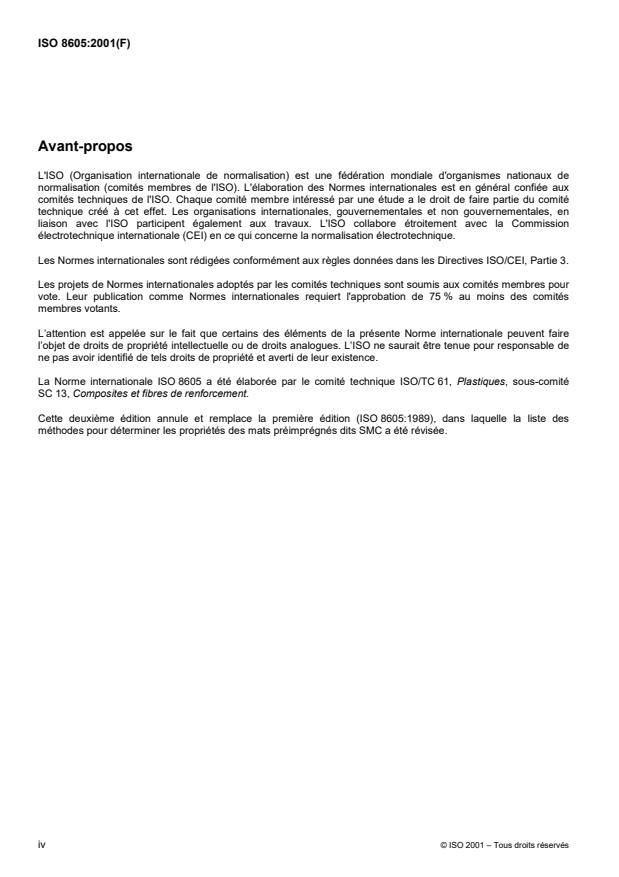
Avant-propos
L'ISO (Organisation internationale de normalisation) est une fédération mondiale d'organismes nationaux de
normalisation (comités membres de l'ISO). L'élaboration des Normes internationales est en général confiéeaux
comités techniques de l'ISO. Chaque comité membre intéressé par une étude aledroit de fairepartie ducomité
technique créé à cet effet. Les organisations internationales, gouvernementales et non gouvernementales, en
liaison avec l'ISO participent également aux travaux. L'ISO collabore étroitement avec la Commission
électrotechnique internationale (CEI) en ce qui concerne la normalisation électrotechnique.
Les Normes internationales sont rédigées conformément aux règles données dans les Directives ISO/CEI, Partie 3.
Les projets de Normes internationales adoptés par les comités techniques sont soumis aux comités membres pour
vote. Leur publication comme Normes internationales requiert l'approbation de 75 % au moins des comités
membres votants.
L’attention est appelée sur le fait que certains des éléments delaprésente Norme internationale peuvent faire
l’objet de droits de propriété intellectuelle ou de droits analogues. L’ISO ne saurait être tenue pour responsable de
ne pas avoir identifié de tels droits de propriété et averti de leur existence.
La Norme internationale ISO 8605 a étéélaborée par le comité technique ISO/TC 61, Plastiques, sous-comité
SC 13, Composites et fibres de renforcement.
Cette deuxième édition annule et remplace la première édition (ISO 8605:1989), dans laquelle la liste des
méthodes pour déterminer les propriétés des mats préimprégnésditsSMC a été révisée.
iv © ISO 2001 – Tous droits réservés
NORME INTERNATIONALE ISO 8605:2001(F)
Plastiques renforcés au verre textile — Mats préimprégnésSMC —
Base de spécification
1 Domaine d'application
La présente Norme internationale établit une base de spécification des mats préimprégnés dits SMC (Sheet
Moulding Compound) qui figurent parmi les différents types de produits préimprégnés, destinés par moulage à
chaud à la réalisation de pièces diverses en matériaux composites.
La présente Norme internationale est applicable uniquement aux mats préimprégnés dont le seul (ou le principal)
renfort est constitué de verre textile.
Il est à noter que la notion de mat préimprégné couvre des produits qui peuvent être complexes et, de ce fait,
s’éloignent parfois de la définition de «mat» donnée dans l’ISO 472.
2Références normatives
Les documents normatifs suivants contiennent des dispositions qui, par suite de la référence qui y est faite,
constituent des dispositions valables pour la présente Norme internationale. Pour les références datées, les
amendements ultérieurs ou les révisions de ces publications ne s’appliquent pas. Toutefois, les parties prenantes
aux accords fondés sur la présente Norme internationale sont invitées à rechercher la possibilité d'appliquer les
éditions les plus récentes des documents normatifs indiqués ci-après. Pour les références non datées, la dernière
édition du document normatif en référence s’applique. Les membres de l'ISO et de la CEI possèdent le registre des
Normes internationales en vigueur.
ISO 62:1999, Plastiques — Déterminationdel’absorption d’eau.
1)
ISO 75-2: , Plastiques — Déterminationde latempérature de fléchissement sous charge — Partie 2: Plastiques et
ébonite.
ISO 179-1:2000, Plastiques — Détermination des caractéristiques au choc Charpy — Partie 1: Essai de choc non
instrumenté.
ISO 179-2:1997, Plastiques — Détermination des caractéristiques au choc Charpy — Partie 2: Essai de choc
instrumenté.
ISO 180:2000, Plastiques — Déterminationdelarésistance au choc Izod.
ISO 291:1997, Plastiques — Atmosphères normales de conditionnement et d’essai.
ISO 472:1999, Plastiques — Vocabulaire.
ISO 527-4:1997, Plastiques — Détermination des propriétésen traction — Partie 4: Conditions d’essai pour les
composites plastiques renforcés de fibres isotropes et orthotropes.
1) À publier. (Révision de l'ISO 75-2:1993)
ISO 1172:1996, Plastiques renforcés de verre textile — Préimprégnés, compositions de moulage et stratifiés —
Détermination des taux de verre textile et de charge minérale — Méthodes par calcination.
2)
ISO 1183-1:— , Plastiques — Méthodes de détermination de la masse volumique des plastiques non
alvéolaires — Partie 1: Méthode par immersion, méthode du pycnomètreenmilieuliquideet méthode par titrage.
2)
ISO 1183-2:— , Plastiques — Méthodes de détermination de la masse volumique des plastiques non alvéolaires
— Partie 2: Méthode de la colonne à gradient de masse volumique.
ISO 1183-3 :1999, Plastiques — Méthodes pour déterminer la masse volumique des plastiques non alvéolaires —
Partie3: Méthode utilisant un pycnomètre à gaz.
ISO 1268 (toutes les parties), Plastiques renforcésdefibres — Méthodes de fabrication de plaques d'essai.
ISO 1886:1990, Fibres de renfort — Méthodes d'échantillonnage pour le contrôle de réception de lots.
ISO 2577:1984, Plastiques — Matières à mouler thermodurcissables — Détermination du retrait.
ISO 3672-1:2000, Plastiques — Résines de polyesters non saturés(UP-R) — Partie 1: Système de désignation.
ISO 3673-1:1996, Plastiques — Résines époxydes — Partie 1: Désignation.
ISO 9782 :1993, Plastiques renforcés — Compositions pour moulage et préimprégnés — Détermination de la
teneur apparente en matières volatiles.
ISO 10352:1997, Plastiques renforcés — Préimprégnés — Détermination de la masse surfacique.
ISO 11667:1997, Plastiques renforcésde fibres — Préimprégnés et compositions de moulage — Détermination
des taux de résine, de fibre de renfort et de charge minérale — Méthodes par dissolution.
ISO 12114:1997, Plastiques renforcésde fibres — Compositions de moulage thermodurcissables et
préimprégnés — Détermination des caractéristiques de durcissement.
ISO 12115:1997, Plastiques renforcésde fibres — Compositions de moulages thermodurcissables et
préimprégnés — Détermination de la fluidité, de la maturation et de la duréedevie.
ISO 14125:1998, Composites plastiques renforcésdefibres — Détermination des propriétésdeflexion.
ISO 14126:1999, Composites plastiques renforcésde fibres — Détermination des caractéristiques en compression
dans le plan.
ISO 14130:1997, Composites plastiques renforcésde fibres — Déterminationdelarésistance au cisaillement
interlaminaire apparent par essai de flexion sur appuis rapprochés.
CEI 60093:1980, Méthodes pour la mesure de la résistivité transversaleetdelarésistivité superficielle des
matériaux isolants électriques solides.
CEI 60112:1979, Méthode pour déterminer des indices de résistance et de tenue au cheminement des matériaux
isolants solides dans des conditions humides.
CEI 60243 (toutes les parties), Rigidité diélectrique des matériaux isolants — Méthodes d'essai.
CEI 60250:1969, Méthodes recommandées pour la déterminationdelapermittivité et du facteur de dissipation des
isolants électriques aux fréquences industrielles, audibles et radioélectriques (ondes métriques comprises).
CEI 60695-2-12:2000, Essais relatifs aux risques du feu — Partie 2-12: Essai au fil incandescent/chauffant —
Méthode d'essai d'inflammabilité sur matériaux.
2) À publier. (Révision, en parties, de l’ISO 1183:1987)
2 © ISO 2001 – Tous droits réservés
3 Termes et définitions
Pour les besoins de la présente Norme internationale, le terme et la définition suivants s'appliquent.
3.1
mat préimprégné (SMC)
mélange à mouler, relativement homogène, de résines et de fibres de renfort coupées ou non, avec ou sans
charges, sous forme de feuille d’une épaisseur généralement comprises entre 1 mm et 25 mm. Il peut être réticulé
au moulage sous l’action de la chaleur et de la pression
NOTE Certains additifs peuvent être ajoutésau mélange pour obtenir des performances spécifiques du mat préimprégné
SMC.
4 Classification des mats préimprégnésSMC
4.1 Généralités
Il existe un grand nombre de combinaisons dans les systèmes de résines, le ou les renforts, les additifs et les
charges, afin de permettre la fabrication de nombreux types de pièces moulées dont:
� la forme;
� la résistance mécanique;
� les propriétés électriques;
� l’état de surface;
qui requièrent des compositions bien définies.
Compte tenu des multiples possibilités de choix pour la formulation d’un mat préimprégné SMC, deux systèmes de
classification sont proposés:
� le premier, basé sur la composition;
� le second, basésur letaux deretrait.
4.2 Classification basée sur la composition
4.2.1 Résine (matrice)
Différents types de résines peuvent être utilisés, notamment:
� résine de polyester insaturé (UP);
� résine époxyde (EP);
� résine polyuréthanne (PUR);
� résine vinylester (VE);
� résine phénolique (P).
Pour la description de la résine concernée, se référer à la Norme internationale correspondante. Pour les résines
polyesters, voir l'ISO 3672-1; pour les résines époxydes, voir l'ISO 3673-1.
4.2.2 Renfort(s)
4.2.2.1 Formes
La présente Norme internationale considère en principe les renfort
...
Questions, Comments and Discussion
Ask us and Technical Secretary will try to provide an answer. You can facilitate discussion about the standard in here.
Loading comments...