

ISO 1802:1992
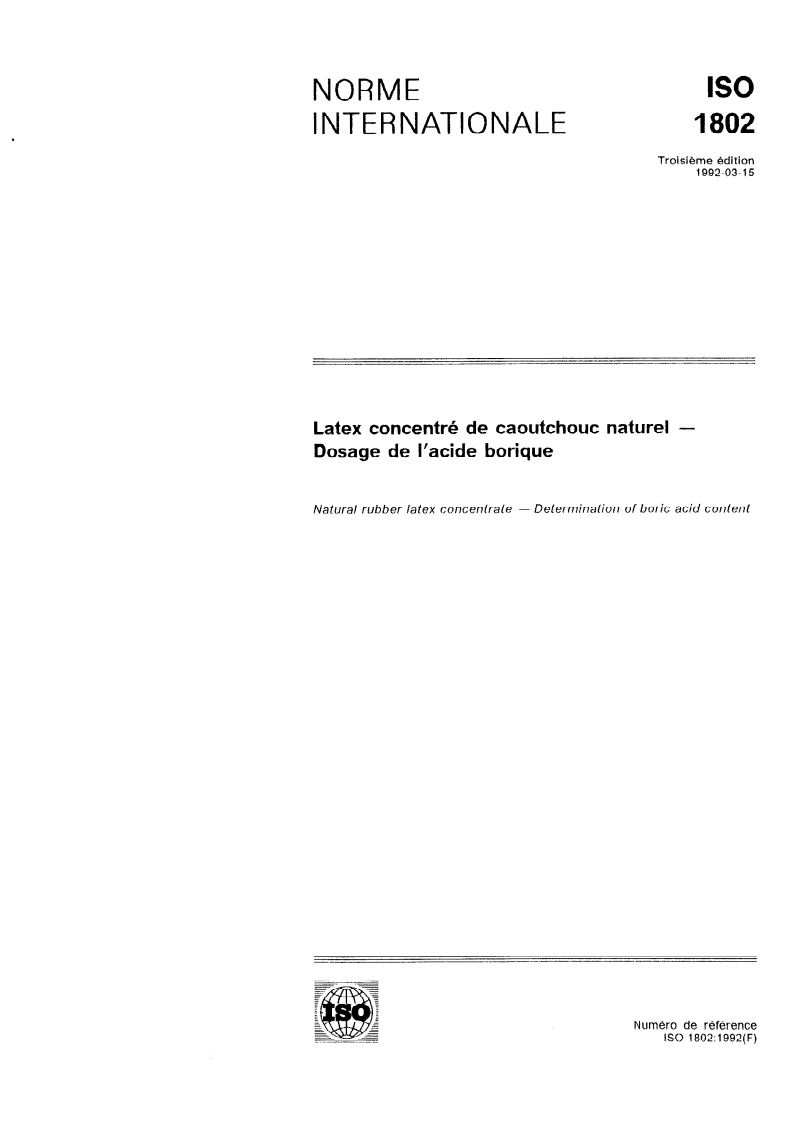
(Main)Natural rubber latex concentrate — Determination of boric acid content
General Information
- Abstract
Describes the principle, the reagents, the apparatus, the procedure, the expression of results and the contents of the test report.
- Status
- Published
- Publication Date
- 07-Mar-1992
- Drafting Committee
- ISO/TC 45/SC 3/WG 2 - Latex
- Current Stage
- 9093 - International Standard confirmed
- Start Date
- 05-Jun-2026
- Completion Date
- 29-Aug-2026
Buy Documents
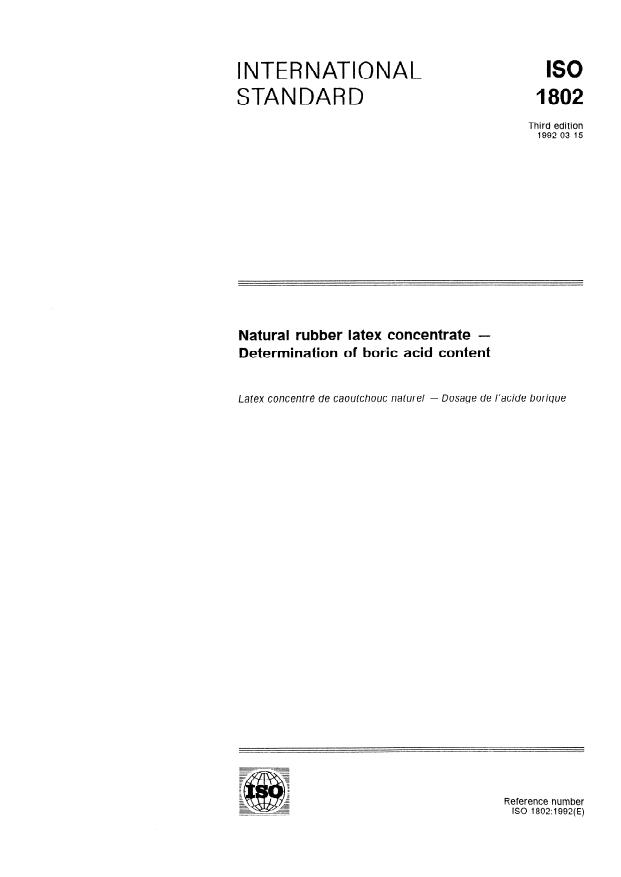
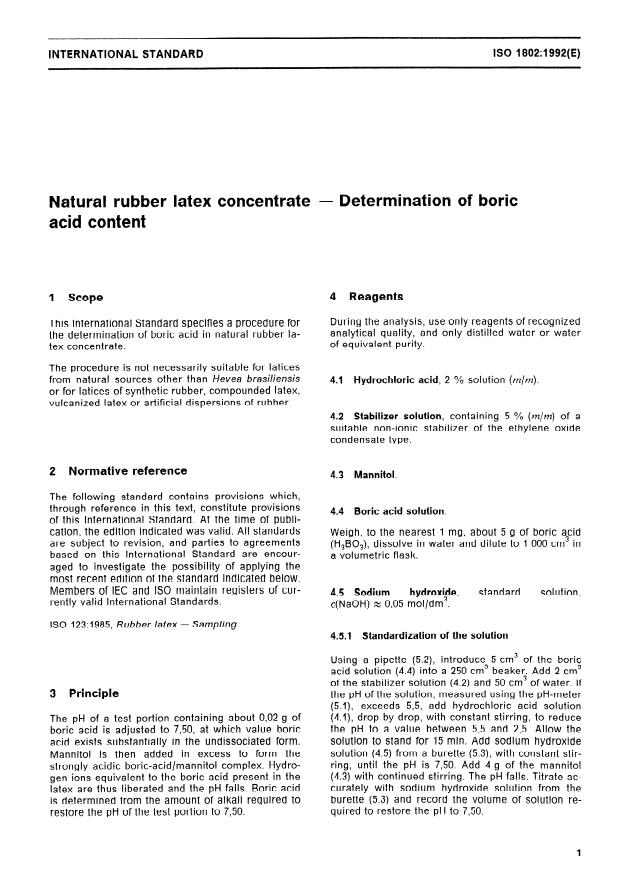
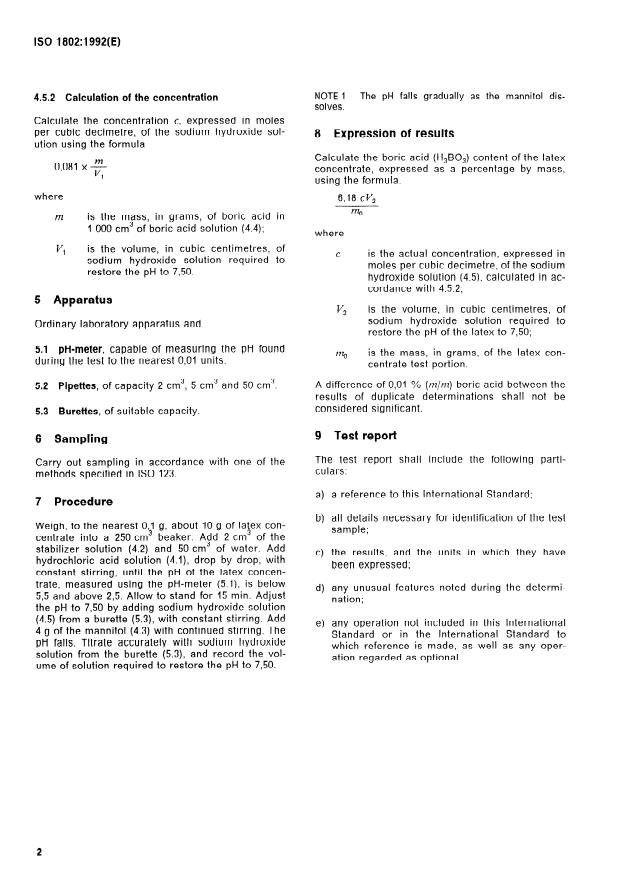
ISO 1802:1992 - Natural rubber latex concentrate -- Determination of boric acid content
ISO 1802:1992 - Natural rubber latex concentrate — Determination of boric acid content/8/1992
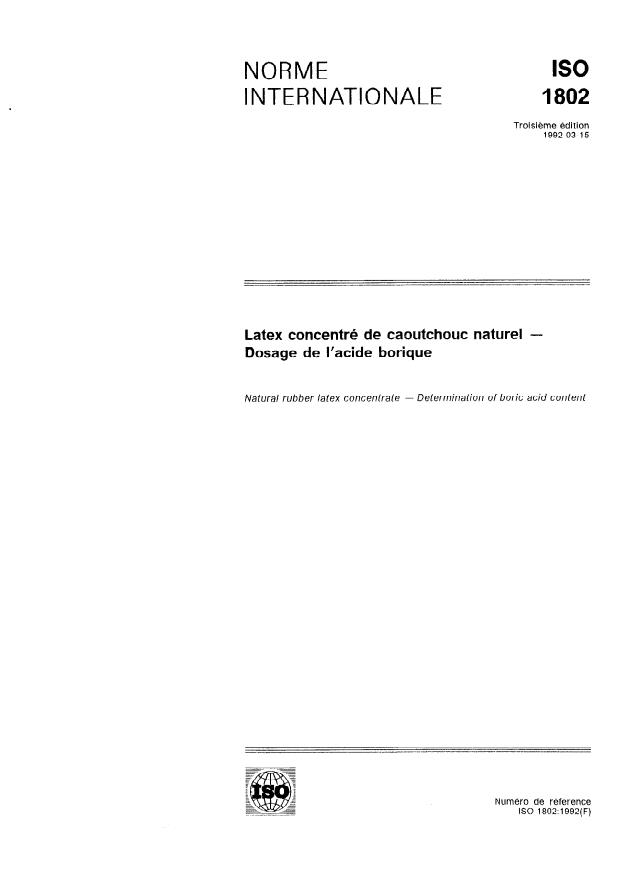
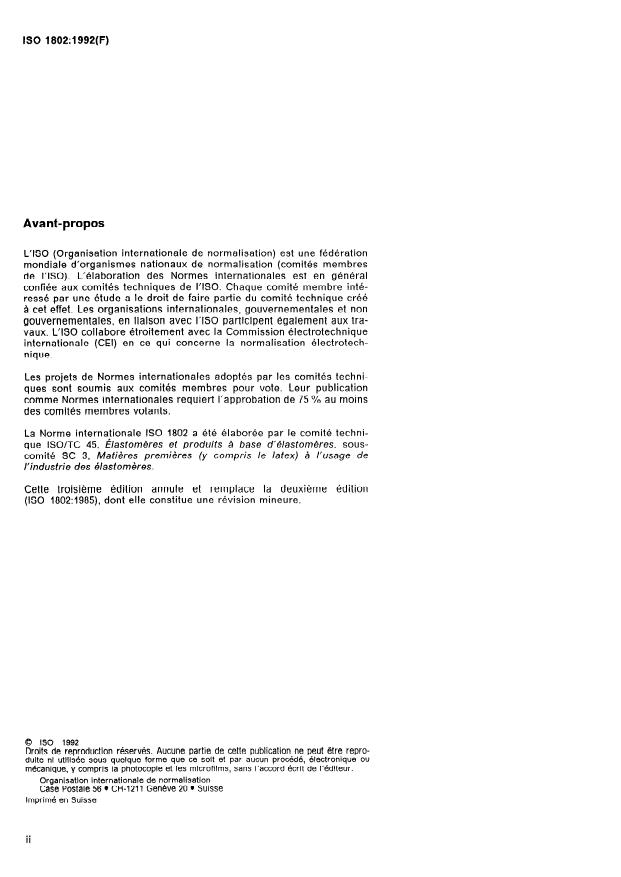
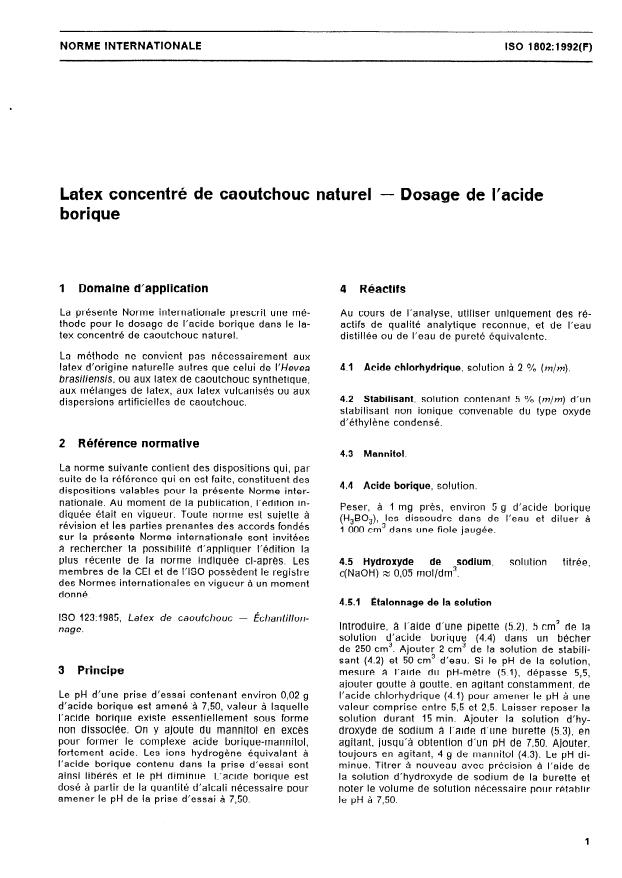
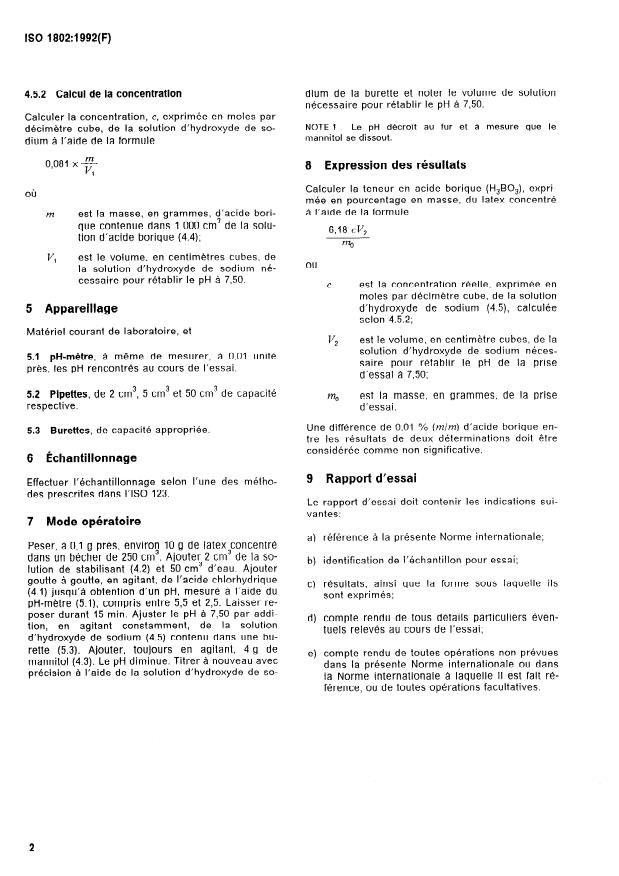
ISO 1802:1992 - Latex concentré de caoutchouc naturel -- Dosage de l'acide borique
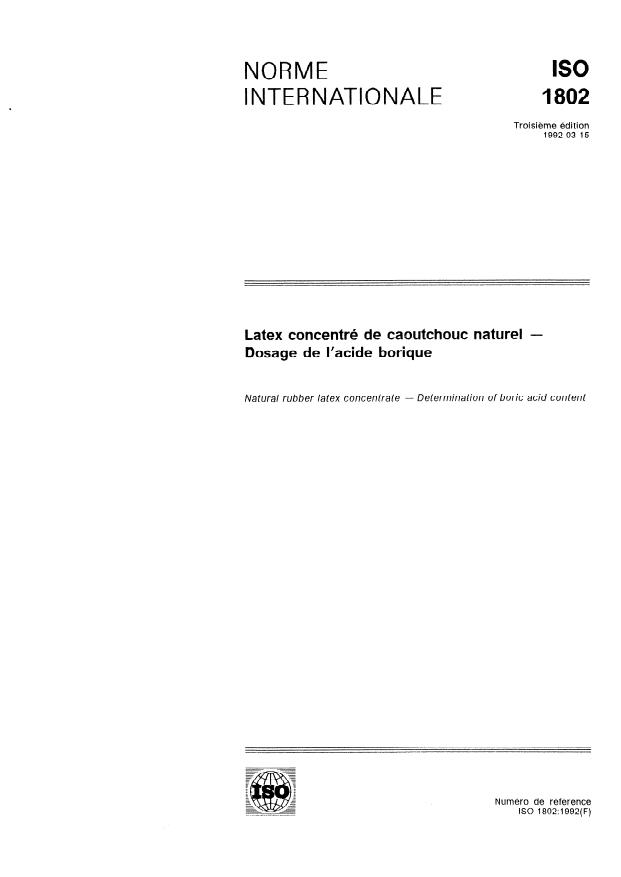
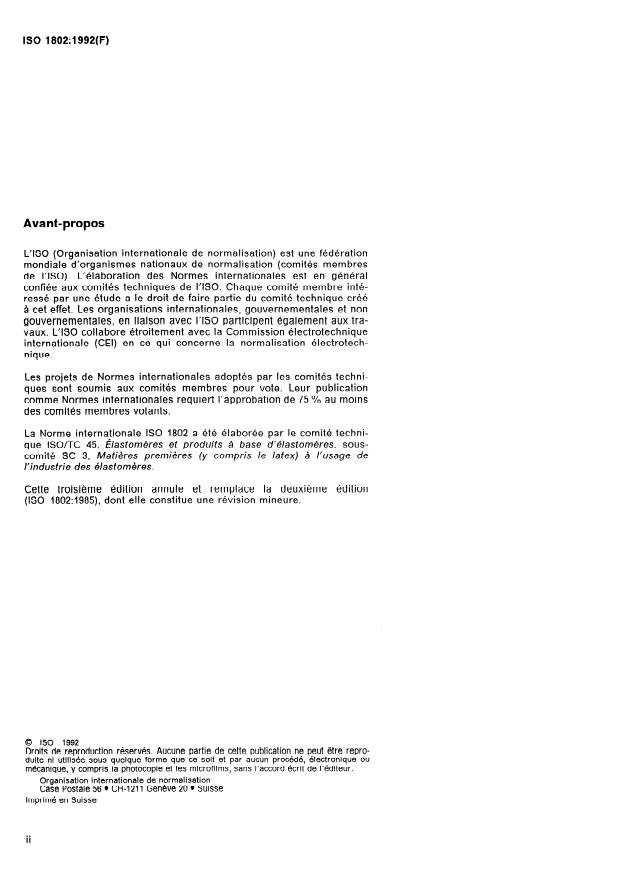
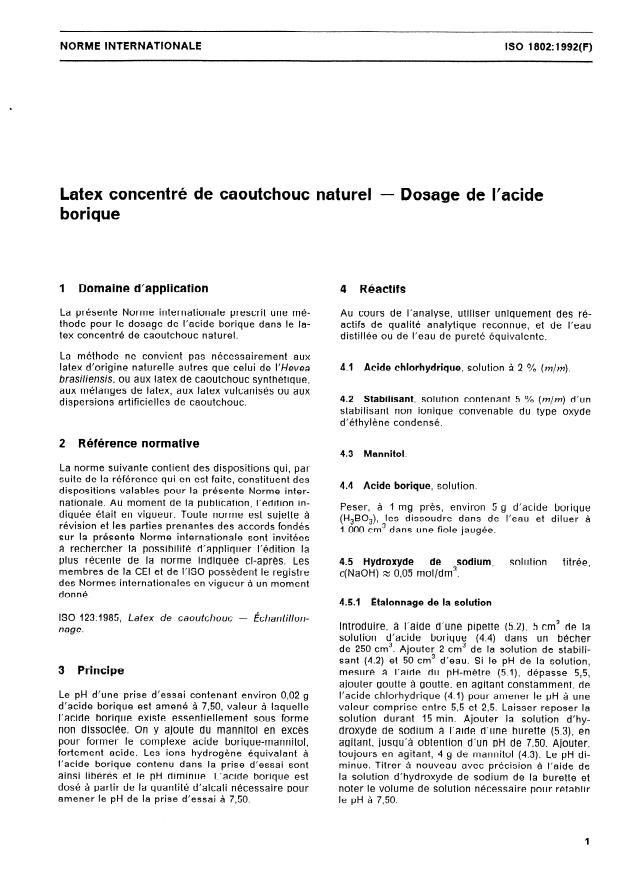
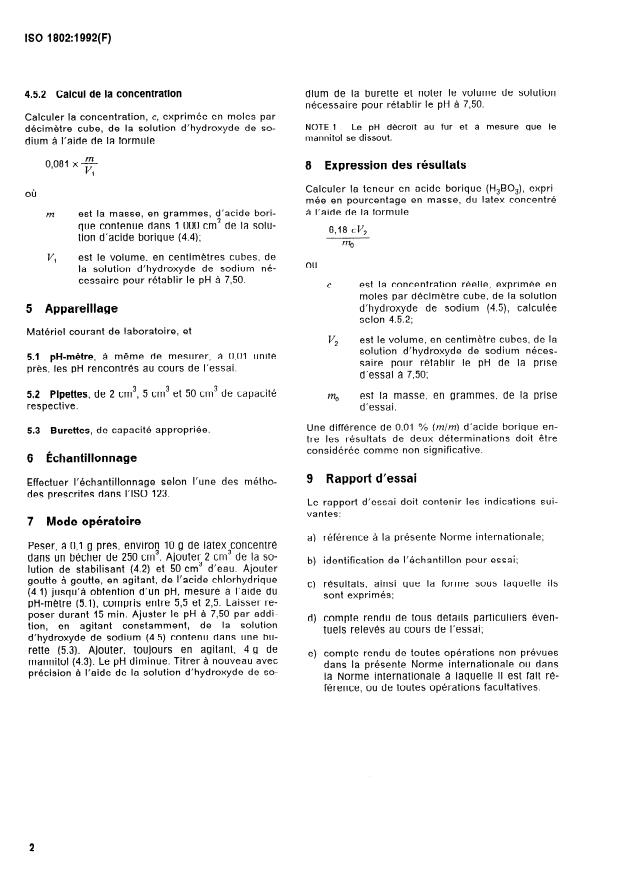
ISO 1802:1992 - Latex concentré de caoutchouc naturel -- Dosage de l'acide borique
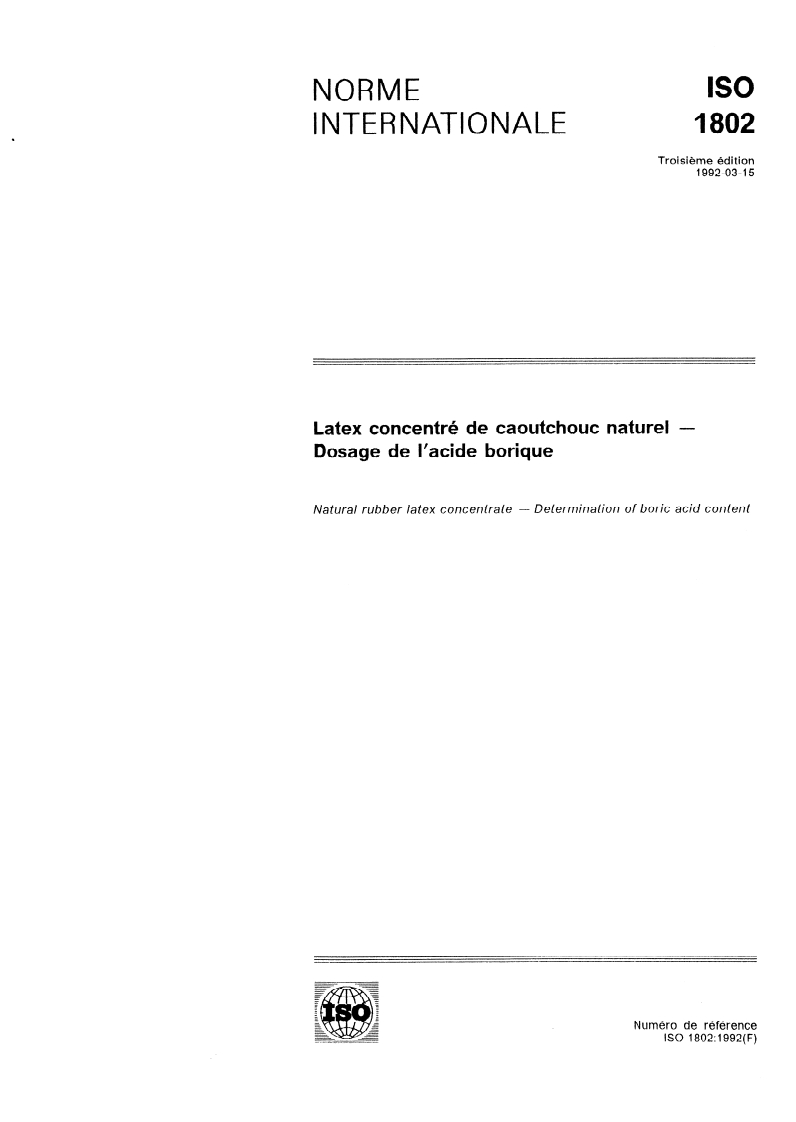
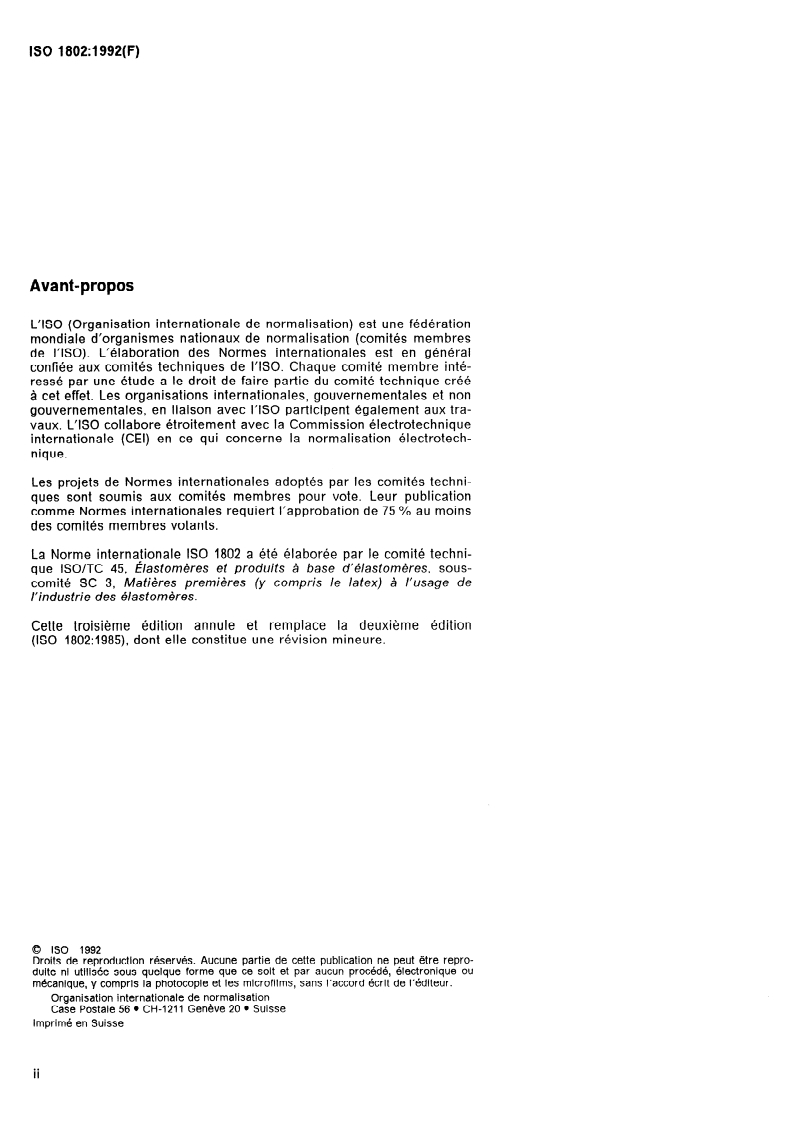
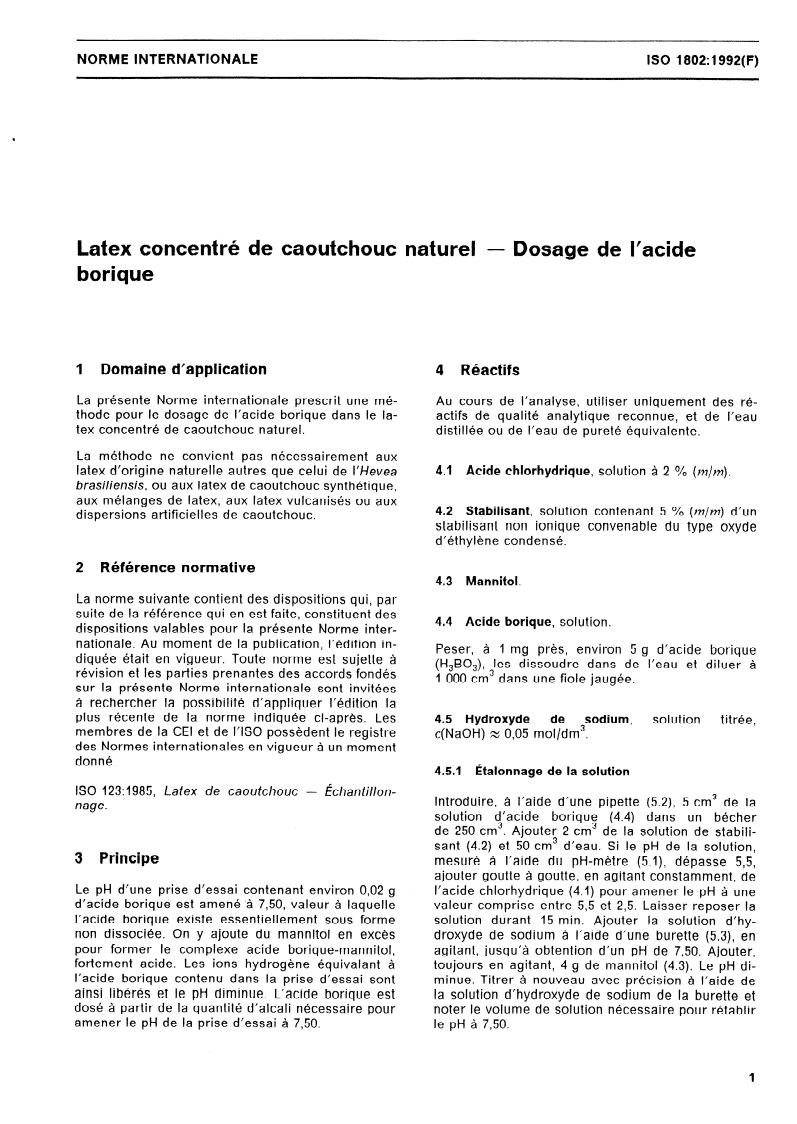
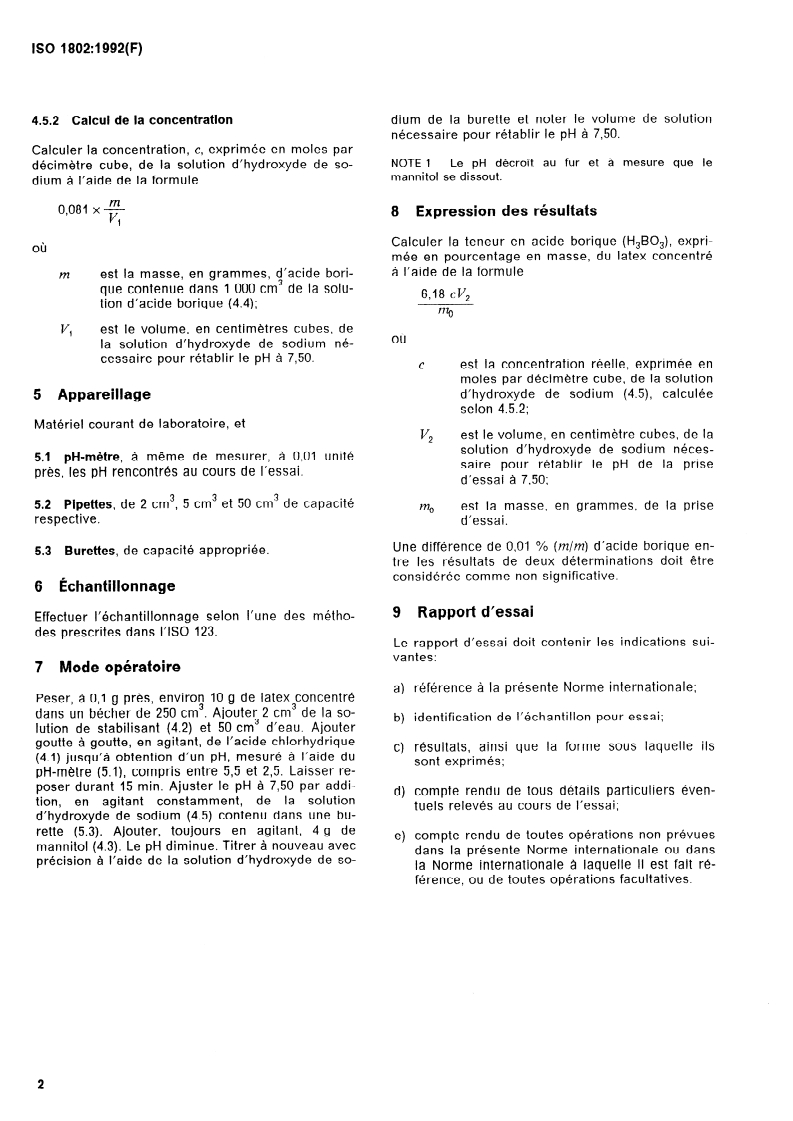
ISO 1802:1992 - Latex concentré de caoutchouc naturel — Dosage de l'acide borique/8/1992
ISO 1802:1992 - Latex concentré de caoutchouc naturel — Dosage de l'acide borique/8/1992
Overview
ISO 1802:1992 specifies a standardized method for determining the boric acid content in natural rubber latex concentrate. This International Standard provides a precise analytical procedure, including the necessary reagents, apparatus, and step-by-step testing methodology to ensure accurate and reproducible results. It is essential for maintaining quality control in the rubber industry, particularly for products derived from Hevea brasiliensis latex concentrate.
This third edition of ISO 1802 replaces the earlier 1985 version, incorporating minor revisions while maintaining the original scope. The method outlined is tailored specifically for natural rubber latex concentrate and may not be suitable for synthetic latexes or compounded and vulcanized latex products.
Key Topics
Principle of the Test
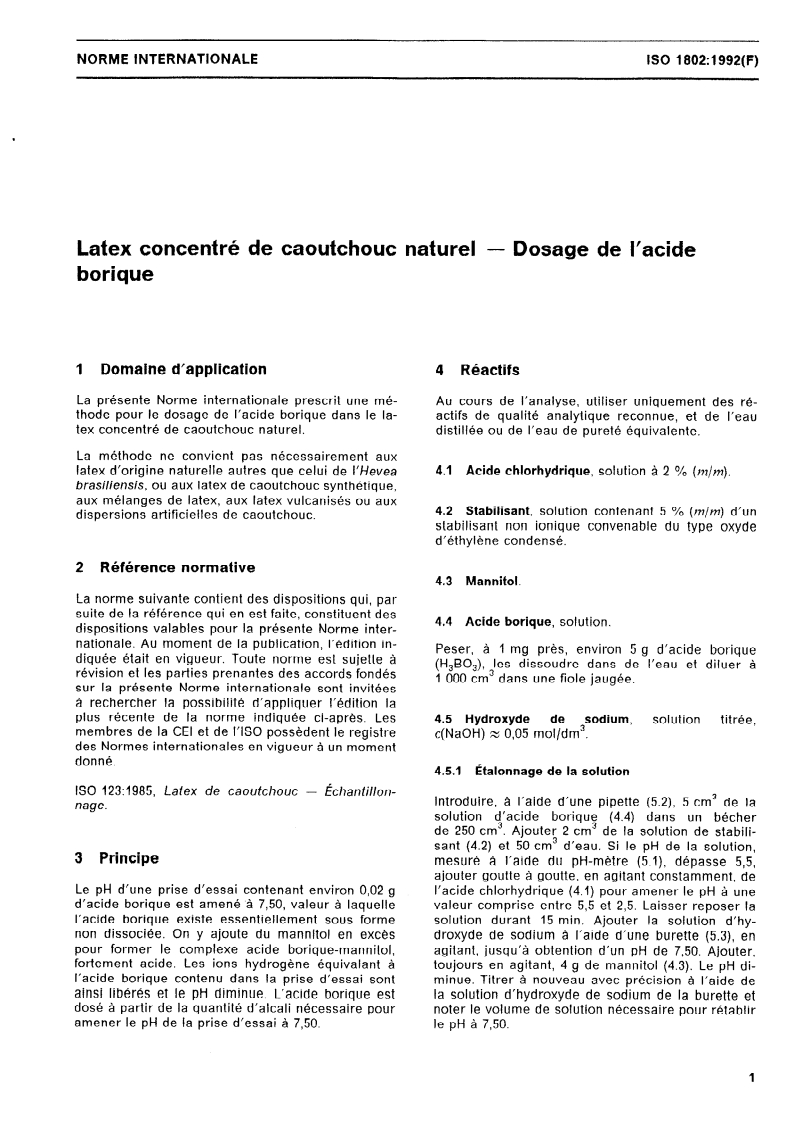
The procedure relies on adjusting the pH of a latex test portion to isolate boric acid in its undissociated form. Mannitol is added to form a boric acid-mannitol complex, releasing hydrogen ions proportional to the boric acid content. The liberated hydrogen ions cause a pH drop, which is then titrated with sodium hydroxide to restore pH to 7.5, quantifying the boric acid present.Reagents Required
- Hydrochloric acid (2% m/m)
- A stabilizer solution (5% of a non-ionic ethylene oxide condensate type)
- Mannitol powder
- Standard boric acid solution for calibration
- Standard sodium hydroxide solution (~0.05 mol/dm³), standardized prior to use
- Distilled or equivalent purity water
Apparatus Needed
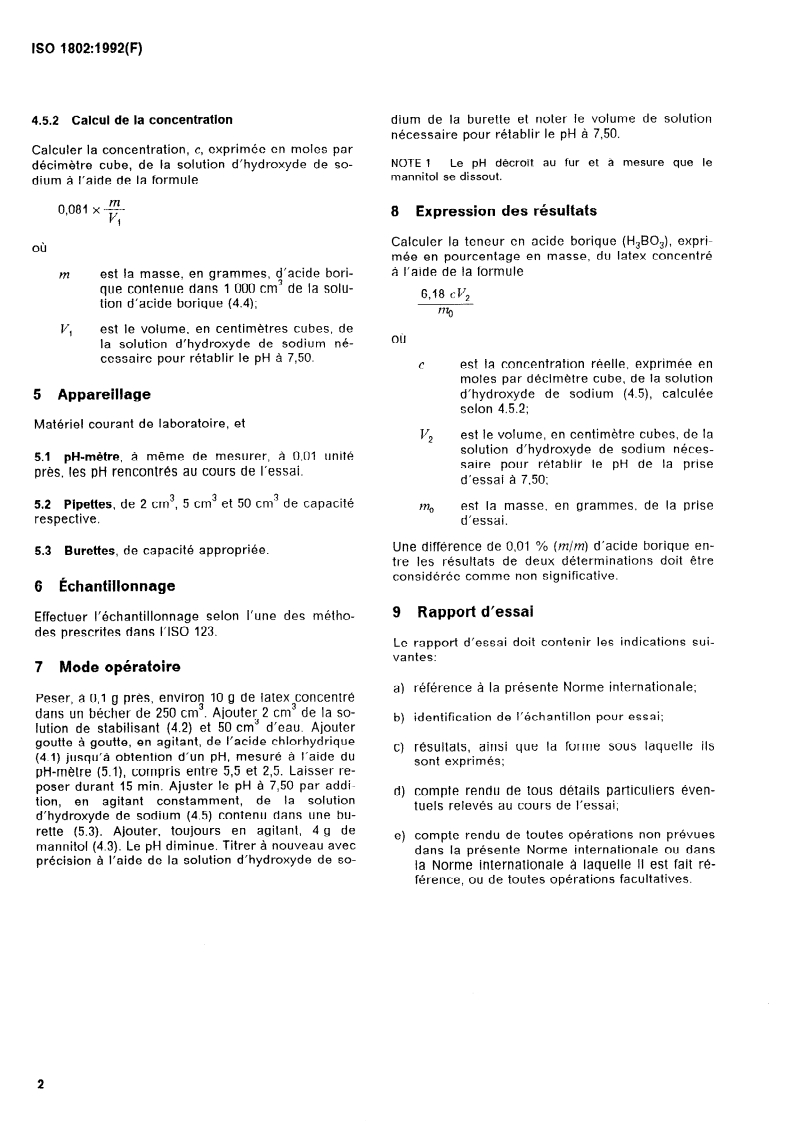
- pH-meter capable of ±0.01 unit accuracy
- Pipettes (2 cm³, 5 cm³, 50 cm³)
- Burettes suitable for titration
Sampling and Preparation
Sampling must follow ISO 123 to ensure representativeness of the latex concentrate. Typically, a measured 10 g portion of latex is used for the analysis after dilution and stabilization.Calculation and Reporting
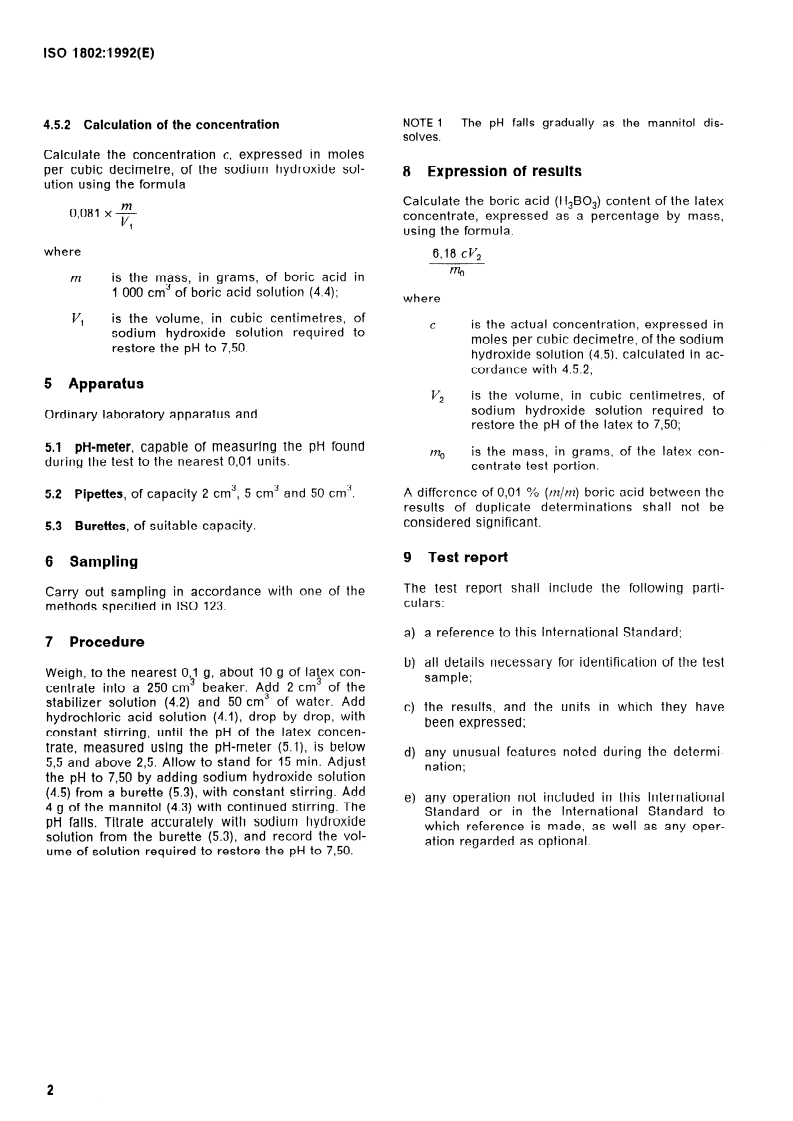
The boric acid content is calculated based on the volume of sodium hydroxide titrated, the standard sodium hydroxide concentration, sample mass, and calibration data. Results are expressed as a percentage by mass. The test report must include the standard reference, sample identification, results with units, any unusual observations, and information on deviations or optional steps taken.
Applications
Quality Control in Rubber Manufacturing
Monitoring boric acid in natural rubber latex concentrate is critical for ensuring the stability and performance of latex products. Boric acid acts as a preservative and stabilizer, influencing shelf life and processing characteristics.Regulatory Compliance and Safety
Adhering to ISO 1802 helps manufacturers comply with international standards governing chemical content in latex, promoting safer products for industrial and consumer use.Research and Development
Precise boric acid quantification supports product formulation improvements and innovation in natural rubber latex processing.
Related Standards
ISO 123:1985 – Rubber Latex Sampling
Provides methods for collecting representative samples of rubber latex, essential for accurate analysis per ISO 1802.Other relevant ISO standards on rubber and latex testing published by Technical Committee ISO/TC 45.
This International Standard is a valuable resource for laboratories and industries involved in natural rubber latex testing, ensuring consistent, reliable determination of boric acid content to maintain product quality and compliance. Keywords: ISO 1802, boric acid determination, natural rubber latex, latex concentrate analysis, pH titration method, rubber industry standards, chemical analysis latex.
Relations
- Effective Date
- 15-Apr-2008
- Effective Date
- 15-Apr-2008
Buy Documents
ISO 1802:1992 - Natural rubber latex concentrate -- Determination of boric acid content
ISO 1802:1992 - Natural rubber latex concentrate — Determination of boric acid content/8/1992
ISO 1802:1992 - Latex concentré de caoutchouc naturel -- Dosage de l'acide borique
ISO 1802:1992 - Latex concentré de caoutchouc naturel -- Dosage de l'acide borique
ISO 1802:1992 - Latex concentré de caoutchouc naturel — Dosage de l'acide borique/8/1992
ISO 1802:1992 - Latex concentré de caoutchouc naturel — Dosage de l'acide borique/8/1992
Get Certified
Connect with accredited certification bodies for this standard

DIN CERTCO
DIN Group product certification.

Smithers Quality Assessments
US management systems and product certification.
Sponsored listings
Frequently Asked Questions
ISO 1802:1992 is a standard published by the International Organization for Standardization (ISO). Its full title is "Natural rubber latex concentrate — Determination of boric acid content". This standard covers: Describes the principle, the reagents, the apparatus, the procedure, the expression of results and the contents of the test report.
Describes the principle, the reagents, the apparatus, the procedure, the expression of results and the contents of the test report.
ISO 1802:1992 is classified under the following ICS (International Classification for Standards) categories: 83.040.10 - Latex and raw rubber. The ICS classification helps identify the subject area and facilitates finding related standards.
ISO 1802:1992 has the following relationships with other standards: It is inter standard links to ISO 1802:1974, ISO 1802:1985. Understanding these relationships helps ensure you are using the most current and applicable version of the standard.
ISO 1802:1992 is available in PDF format for immediate download after purchase. The document can be added to your cart and obtained through the secure checkout process. Digital delivery ensures instant access to the complete standard document.
Standards Content (Sample)
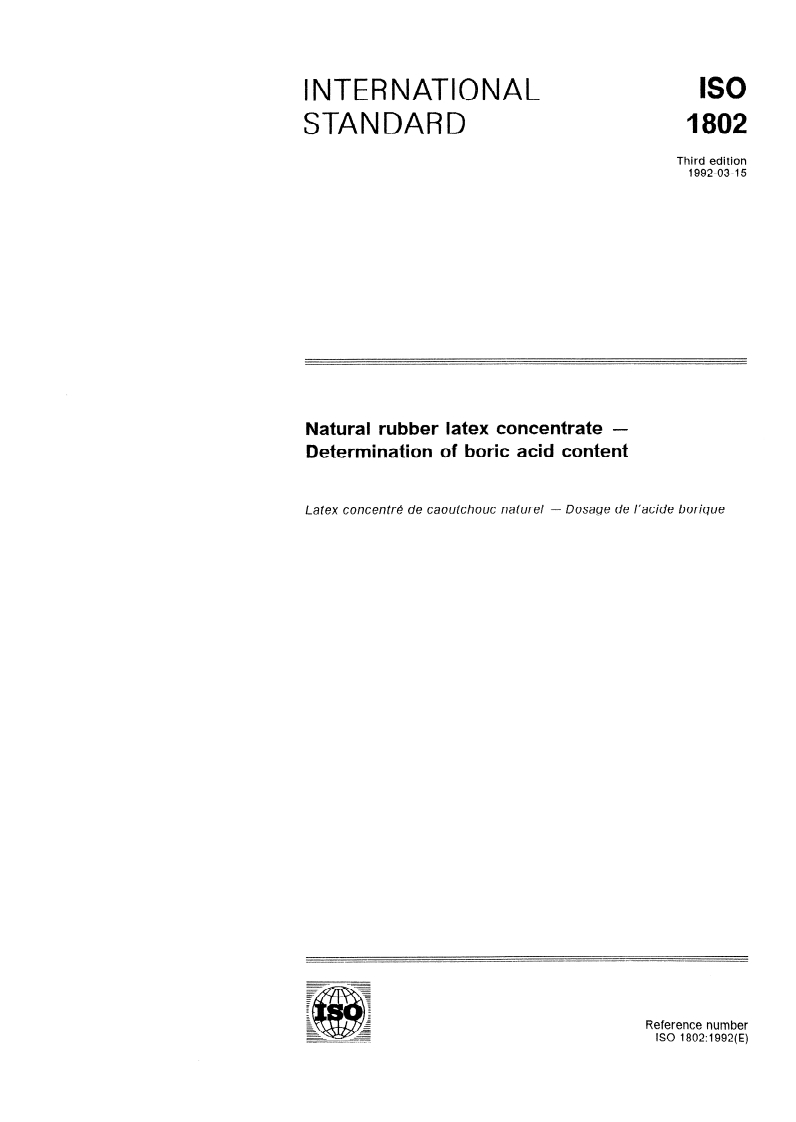
INTERNATIONAL
STANDARD 1802
Third edi tion
1992-03-15
-
Natura1 rubber Iatex concentrate -
Determination of boric acid content
Latex concentre de caoutchouc natur-el - Dosage de I’acide borique
------ -----
--
-- --
Reference number
--
ISO 1802: 1992(E)
P-7.7-7
Foreword
ISO (the international Organization for Standardization) is a woridwide
federation of national Standards bodies (ISO member bodies). The work
of preparing International Standards is normally carried out through ISO
technical committees. Esch member body interested in a subject for
which a technicai committee has been established has the right to be
international organizations, govern-
represented on that committee.
mental and non-governmentai, in iiaison with ISO, also take part in the
work. ISO coiiaborates cioseiy with the International Electrotechnical
Commission (IEC) on all matters of eiectrotechnicai standardization.
Draft international Standards adopted by the technicai committees are
circuiated to the member bodies for voting. Pubiication as an Inter-
national Standard requires approval by at least 75 % of the member
bodies casting a vote.
International Standard ISO 1802 was prepared by Technical Committee
lSO/TC 45, Rubber and rubber products, Sub-Committee SC 3, Raw ma-
terials (including latex) for use in fhe rubber industry.
This third edition canceis and replaces the second edition
(ISO 1802:1985), of which it constitutes a minor revision.
0 ISO 1992
All rights reserved. No part of this publication may be reproduced or utilized in any form
or by any means, electronie or mechanical, including photocopying and microfilm, without
Permission in writing from the publisher.
International Organization for Standardization
Case Postale 56 l CH-121 1 Geneve 20 * Switzerland
Prlnted in Switzerland
ii
--------~ --- - - ~
INTERNATIONAL STANDARD
Natura1 rubber latex concentrate - Determination of boric
acid content
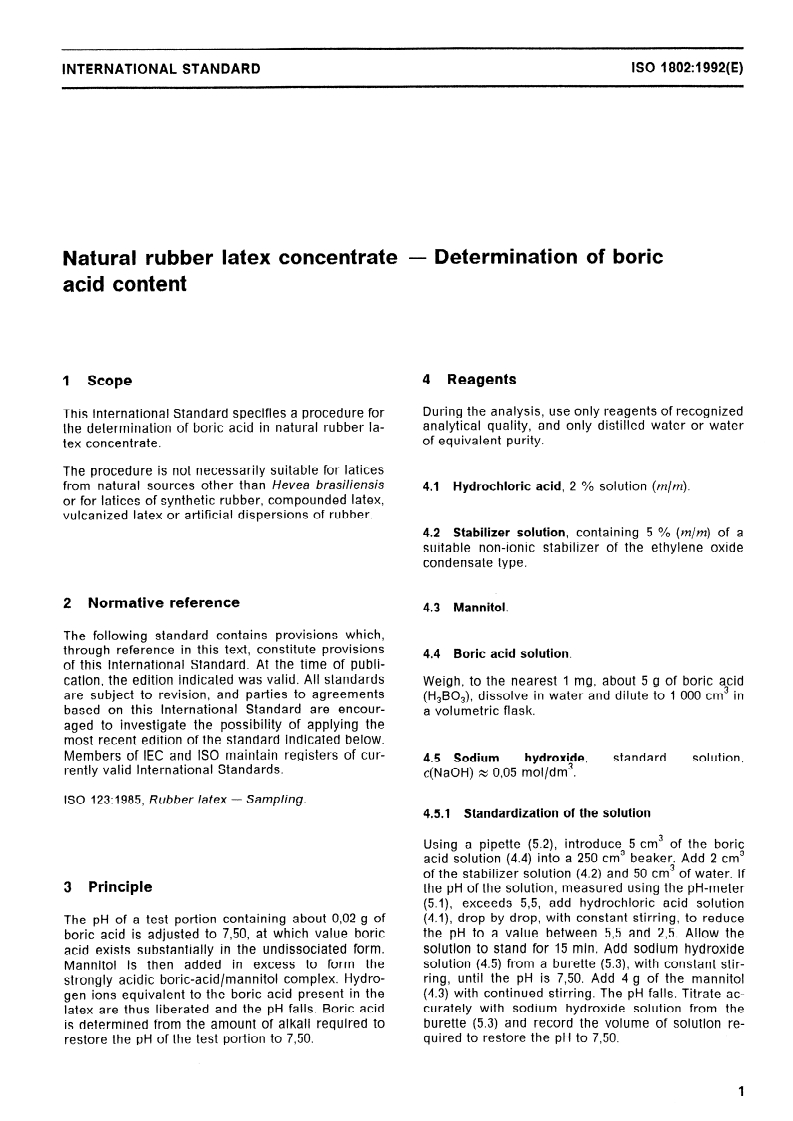
4 Reagents
1 Scope
During the analysis, use only reagents of recognized
This International Standard specifies a procedure for
analytical quality, and only distilled water or water
the determination of boric acid in natura1 rubber la-
of equivalent purity.
tex concentrate.
The procedure is not necessarily suitable for latices
from natura1 sources other than Hevea brasiliensis
4.1 Hydrochlorit acid, 2 % Solution (m/m).
or for latices of synthetic rubber, compounded latex,
vulcanized latex or artificial dispersions of rubber.
4.2 Stabilizer solution, containing 5 % (m/m) of a
suitable non-ionic stabilizer of the ethylene Oxide
condensate type.
2 Normative reference
4.3 Mannitol.
The following Standard contains provisions which,
through reference in this text, constitute provisions
4.4 Boric acid Solution.
of this International Standard. At the time of publi-
cation, the edition indicated was valid. All Standards
Weigh, to the nearest 1 mg, about 5 g of boric acid
are subject to revision, and Parties to agreements
(H,BO,), dissolve in water and dilute to 1 000 cm3 in
based on this International Standard are encour- a volumetric flask.
aged to investigate the possibility of applying the
most recent edition of the Standard indicated below.
Members of IEC and ISO maintain registers of cur-
4.5 Sodium hydroxide, Standard solution,
rently valid International Standards.
c(NaOH) ;v 0,05 mol/dm3.
ISO -123:1985, Rubber latex - Sampling.
4.5.1 Standardization of the solution
Using a pipette (5.2), introduce 5 cm’ of the boric
0 n
acid Solution (4.4) into a 250 crnj beaker. Add 2 cm’
of the stabilizer Solution (4.2) and 50 cm3 of water. If
3 Principle the pH of the Solution, measured using the pH-meter
(59, exceeds 5,5, add hydrochloric acid Solution
(4.1), drop by drop, with constant stirring, to reduce
The pH of a test Portion containing about 0,02 g of
the pH to a value between 5,5
...
INTERNATIONAL
STANDARD 1802
Third edi tion
1992-03-15
-
Natura1 rubber Iatex concentrate -
Determination of boric acid content
Latex concentre de caoutchouc natur-el - Dosage de I’acide borique
------ -----
--
-- --
Reference number
--
ISO 1802: 1992(E)
P-7.7-7
Foreword
ISO (the international Organization for Standardization) is a woridwide
federation of national Standards bodies (ISO member bodies). The work
of preparing International Standards is normally carried out through ISO
technical committees. Esch member body interested in a subject for
which a technicai committee has been established has the right to be
international organizations, govern-
represented on that committee.
mental and non-governmentai, in iiaison with ISO, also take part in the
work. ISO coiiaborates cioseiy with the International Electrotechnical
Commission (IEC) on all matters of eiectrotechnicai standardization.
Draft international Standards adopted by the technicai committees are
circuiated to the member bodies for voting. Pubiication as an Inter-
national Standard requires approval by at least 75 % of the member
bodies casting a vote.
International Standard ISO 1802 was prepared by Technical Committee
lSO/TC 45, Rubber and rubber products, Sub-Committee SC 3, Raw ma-
terials (including latex) for use in fhe rubber industry.
This third edition canceis and replaces the second edition
(ISO 1802:1985), of which it constitutes a minor revision.
0 ISO 1992
All rights reserved. No part of this publication may be reproduced or utilized in any form
or by any means, electronie or mechanical, including photocopying and microfilm, without
Permission in writing from the publisher.
International Organization for Standardization
Case Postale 56 l CH-121 1 Geneve 20 * Switzerland
Prlnted in Switzerland
ii
--------~ --- - - ~
INTERNATIONAL STANDARD
Natura1 rubber latex concentrate - Determination of boric
acid content
4 Reagents
1 Scope
During the analysis, use only reagents of recognized
This International Standard specifies a procedure for
analytical quality, and only distilled water or water
the determination of boric acid in natura1 rubber la-
of equivalent purity.
tex concentrate.
The procedure is not necessarily suitable for latices
from natura1 sources other than Hevea brasiliensis
4.1 Hydrochlorit acid, 2 % Solution (m/m).
or for latices of synthetic rubber, compounded latex,
vulcanized latex or artificial dispersions of rubber.
4.2 Stabilizer solution, containing 5 % (m/m) of a
suitable non-ionic stabilizer of the ethylene Oxide
condensate type.
2 Normative reference
4.3 Mannitol.
The following Standard contains provisions which,
through reference in this text, constitute provisions
4.4 Boric acid Solution.
of this International Standard. At the time of publi-
cation, the edition indicated was valid. All Standards
Weigh, to the nearest 1 mg, about 5 g of boric acid
are subject to revision, and Parties to agreements
(H,BO,), dissolve in water and dilute to 1 000 cm3 in
based on this International Standard are encour- a volumetric flask.
aged to investigate the possibility of applying the
most recent edition of the Standard indicated below.
Members of IEC and ISO maintain registers of cur-
4.5 Sodium hydroxide, Standard solution,
rently valid International Standards.
c(NaOH) ;v 0,05 mol/dm3.
ISO -123:1985, Rubber latex - Sampling.
4.5.1 Standardization of the solution
Using a pipette (5.2), introduce 5 cm’ of the boric
0 n
acid Solution (4.4) into a 250 crnj beaker. Add 2 cm’
of the stabilizer Solution (4.2) and 50 cm3 of water. If
3 Principle the pH of the Solution, measured using the pH-meter
(59, exceeds 5,5, add hydrochloric acid Solution
(4.1), drop by drop, with constant stirring, to reduce
The pH of a test Portion containing about 0,02 g of
the pH to a value between 5,5
...
ISO
NORME
INTERNATIONALE
Troisième édition
1992-03-l 5
Latex concentré de caoutchouc naturel -
Dosage de l’acide borique
Nafural rubber latex concentrate - Determination of boric acid content
Numéro de référence
Avant-propos
L’ISO (Organisation internationale de normalisation) est une fédération
mondiale d’organismes nationaux de normalisation (comités membres
de I’ISO). L’élaboration des Normes internationales est en général
confiée aux comités techniques de I’ISO. Chaque comité membre inté-
ressé par une étude a le droit de faire partie du comité technique créé
à cet effet. Les organisations internationales, gouvernementales et non
gouvernementales, en liaison avec I’ISO participent également aux tra-
vaux. L’ISO collabore étroitement avec la Commission électrotechnique
internationale (CEI) en ce qui concerne la normalisation électrotech-
nique.
Les projets de Normes internationales adoptés par les comités techni-
ques sont soumis aux comités membres pour vote. Leur publication
comme Normes internationales requiert l’approbation de 75 % au moins
des comités membres votants.
La Norme internationale ISO 1802 a été élaborée par le comité techni-
que lSO/TC 45, Élastomères et produits à base d’élastomères, sous-
comité SC 3, Matières premières (y compris le latex) à l’usage de
I’industrie des élastomères.
Cette troisième édition annule et remplace la deuxième édition
(ISO 1802:1985), dont elle constitue une révision mineure.
0 ISO 1992
Droits de reproduction réservés. Aucune partie de cette publication ne peut être repro-
duite ni utilisée sous quelque forme que ce soit et par aucun procédé, électronique ou
mécanique, y compris la photocopie et les microfilms, sans l’accord écrit de l’éditeur.
Organisation internationale de normalisation
Case Postale 56 l CH-121 1 Genève 20 l Suisse
imprimé en Suisse
ii
NORME INTERNATIONALE
.
Latex concentré de caoutchouc naturel - Dosage de l’acide
borique
1 Domaine d’application 4 Réactifs
La présente Norme internationale prescrit une mé- Au cours de l’analyse, utiliser uniquement des ré-
actifs de qualité analytique reconnue, et de l’eau
thode pour le dosage de l’acide borique dans le la-
distillée ou de l’eau de pureté équivalente.
tex concentré de caoutchouc naturel.
La méthode ne convient pas nécessairement aux
4.1 Acide chlorhydrique, solution à 2 % (r~z/m)
latex d’origine naturelle autres que celui de l’hrevea
brasiliensis, ou aux latex de caoutchouc synthétique,
aux mélanges de latex, aux latex vulcanisés ou aux
4.2 Stabilisant, solution contenant 5 % (m/m) d’un
dispersions artificielles de caoutchouc.
stabilisant non ionique convenable du type oxyde
d’éthylène condensé.
2 Référence normative
4.3 Mannitol
La norme suivante contient des dispositions qui, par
suite de la référence qui en est faite, constituent des
4.4 Acide borique, solution
dispositions valables pour la présente Norme inter-
nationale. Au moment de la publication, l’édition in-
Peser, à 1 mg près, environ 5 g d’acide borique
diquée était en vigueur. Toute norme est sujette à
(H,BO,), les dissoudre dans de l’eau et diluer à
révision et les parties prenantes des accords fondés
? 000 cm3 dans une fiole jaugée.
sur la présente Norme internationale sont invitées
à rechercher la possibilité d’appliquer l’édition la
plus récente de la norme indiquée ci-après. Les
4.5 Hydroxyde de sodium, solution titrée,
membres de la CEI et de I’ISO possèdent le registre c(NaOH) z 0,05 mol/dm3.
des Normes internationales en vigueur à un moment
donné.
4.5.1 Étalonnage de la solution
ISO 123:1985, Latex de caoutchouc - Échantillon-
Introduire, à l’aide d’une pipette (5.2), 5 cm3 de la
nage.
solution d’acide borique (4.4) dans un bécher
de 250 cm3. Ajouter 2 cm3 de la solution de stabili-
sant (4.2) et 50 cm3 d’eau. Si le pH de la solution,
3 Principe mesuré à l’aide du pH-mètre (5.1), dépasse 5,5,
ajouter goutte à goutte, en agitant constamment, de
Le pH d’une prise d’essai contenant environ 0,02 g l’acide chlorhydrique (4.1) pour amener le
...
ISO
NORME
INTERNATIONALE
Troisième édition
1992-03-l 5
Latex concentré de caoutchouc naturel -
Dosage de l’acide borique
Nafural rubber latex concentrate - Determination of boric acid content
Numéro de référence
Avant-propos
L’ISO (Organisation internationale de normalisation) est une fédération
mondiale d’organismes nationaux de normalisation (comités membres
de I’ISO). L’élaboration des Normes internationales est en général
confiée aux comités techniques de I’ISO. Chaque comité membre inté-
ressé par une étude a le droit de faire partie du comité technique créé
à cet effet. Les organisations internationales, gouvernementales et non
gouvernementales, en liaison avec I’ISO participent également aux tra-
vaux. L’ISO collabore étroitement avec la Commission électrotechnique
internationale (CEI) en ce qui concerne la normalisation électrotech-
nique.
Les projets de Normes internationales adoptés par les comités techni-
ques sont soumis aux comités membres pour vote. Leur publication
comme Normes internationales requiert l’approbation de 75 % au moins
des comités membres votants.
La Norme internationale ISO 1802 a été élaborée par le comité techni-
que lSO/TC 45, Élastomères et produits à base d’élastomères, sous-
comité SC 3, Matières premières (y compris le latex) à l’usage de
I’industrie des élastomères.
Cette troisième édition annule et remplace la deuxième édition
(ISO 1802:1985), dont elle constitue une révision mineure.
0 ISO 1992
Droits de reproduction réservés. Aucune partie de cette publication ne peut être repro-
duite ni utilisée sous quelque forme que ce soit et par aucun procédé, électronique ou
mécanique, y compris la photocopie et les microfilms, sans l’accord écrit de l’éditeur.
Organisation internationale de normalisation
Case Postale 56 l CH-121 1 Genève 20 l Suisse
imprimé en Suisse
ii
NORME INTERNATIONALE
.
Latex concentré de caoutchouc naturel - Dosage de l’acide
borique
1 Domaine d’application 4 Réactifs
La présente Norme internationale prescrit une mé- Au cours de l’analyse, utiliser uniquement des ré-
actifs de qualité analytique reconnue, et de l’eau
thode pour le dosage de l’acide borique dans le la-
distillée ou de l’eau de pureté équivalente.
tex concentré de caoutchouc naturel.
La méthode ne convient pas nécessairement aux
4.1 Acide chlorhydrique, solution à 2 % (r~z/m)
latex d’origine naturelle autres que celui de l’hrevea
brasiliensis, ou aux latex de caoutchouc synthétique,
aux mélanges de latex, aux latex vulcanisés ou aux
4.2 Stabilisant, solution contenant 5 % (m/m) d’un
dispersions artificielles de caoutchouc.
stabilisant non ionique convenable du type oxyde
d’éthylène condensé.
2 Référence normative
4.3 Mannitol
La norme suivante contient des dispositions qui, par
suite de la référence qui en est faite, constituent des
4.4 Acide borique, solution
dispositions valables pour la présente Norme inter-
nationale. Au moment de la publication, l’édition in-
Peser, à 1 mg près, environ 5 g d’acide borique
diquée était en vigueur. Toute norme est sujette à
(H,BO,), les dissoudre dans de l’eau et diluer à
révision et les parties prenantes des accords fondés
? 000 cm3 dans une fiole jaugée.
sur la présente Norme internationale sont invitées
à rechercher la possibilité d’appliquer l’édition la
plus récente de la norme indiquée ci-après. Les
4.5 Hydroxyde de sodium, solution titrée,
membres de la CEI et de I’ISO possèdent le registre c(NaOH) z 0,05 mol/dm3.
des Normes internationales en vigueur à un moment
donné.
4.5.1 Étalonnage de la solution
ISO 123:1985, Latex de caoutchouc - Échantillon-
Introduire, à l’aide d’une pipette (5.2), 5 cm3 de la
nage.
solution d’acide borique (4.4) dans un bécher
de 250 cm3. Ajouter 2 cm3 de la solution de stabili-
sant (4.2) et 50 cm3 d’eau. Si le pH de la solution,
3 Principe mesuré à l’aide du pH-mètre (5.1), dépasse 5,5,
ajouter goutte à goutte, en agitant constamment, de
Le pH d’une prise d’essai contenant environ 0,02 g l’acide chlorhydrique (4.1) pour amener le
...
ISO
NORME
INTERNATIONALE
Troisième édition
1992-03-l 5
Latex concentré de caoutchouc naturel -
Dosage de l’acide borique
Nafural rubber latex concentrate - Determination of boric acid content
Numéro de référence
Avant-propos
L’ISO (Organisation internationale de normalisation) est une fédération
mondiale d’organismes nationaux de normalisation (comités membres
de I’ISO). L’élaboration des Normes internationales est en général
confiée aux comités techniques de I’ISO. Chaque comité membre inté-
ressé par une étude a le droit de faire partie du comité technique créé
à cet effet. Les organisations internationales, gouvernementales et non
gouvernementales, en liaison avec I’ISO participent également aux tra-
vaux. L’ISO collabore étroitement avec la Commission électrotechnique
internationale (CEI) en ce qui concerne la normalisation électrotech-
nique.
Les projets de Normes internationales adoptés par les comités techni-
ques sont soumis aux comités membres pour vote. Leur publication
comme Normes internationales requiert l’approbation de 75 % au moins
des comités membres votants.
La Norme internationale ISO 1802 a été élaborée par le comité techni-
que lSO/TC 45, Élastomères et produits à base d’élastomères, sous-
comité SC 3, Matières premières (y compris le latex) à l’usage de
I’industrie des élastomères.
Cette troisième édition annule et remplace la deuxième édition
(ISO 1802:1985), dont elle constitue une révision mineure.
0 ISO 1992
Droits de reproduction réservés. Aucune partie de cette publication ne peut être repro-
duite ni utilisée sous quelque forme que ce soit et par aucun procédé, électronique ou
mécanique, y compris la photocopie et les microfilms, sans l’accord écrit de l’éditeur.
Organisation internationale de normalisation
Case Postale 56 l CH-121 1 Genève 20 l Suisse
imprimé en Suisse
ii
NORME INTERNATIONALE
.
Latex concentré de caoutchouc naturel - Dosage de l’acide
borique
1 Domaine d’application 4 Réactifs
La présente Norme internationale prescrit une mé- Au cours de l’analyse, utiliser uniquement des ré-
actifs de qualité analytique reconnue, et de l’eau
thode pour le dosage de l’acide borique dans le la-
distillée ou de l’eau de pureté équivalente.
tex concentré de caoutchouc naturel.
La méthode ne convient pas nécessairement aux
4.1 Acide chlorhydrique, solution à 2 % (r~z/m)
latex d’origine naturelle autres que celui de l’hrevea
brasiliensis, ou aux latex de caoutchouc synthétique,
aux mélanges de latex, aux latex vulcanisés ou aux
4.2 Stabilisant, solution contenant 5 % (m/m) d’un
dispersions artificielles de caoutchouc.
stabilisant non ionique convenable du type oxyde
d’éthylène condensé.
2 Référence normative
4.3 Mannitol
La norme suivante contient des dispositions qui, par
suite de la référence qui en est faite, constituent des
4.4 Acide borique, solution
dispositions valables pour la présente Norme inter-
nationale. Au moment de la publication, l’édition in-
Peser, à 1 mg près, environ 5 g d’acide borique
diquée était en vigueur. Toute norme est sujette à
(H,BO,), les dissoudre dans de l’eau et diluer à
révision et les parties prenantes des accords fondés
? 000 cm3 dans une fiole jaugée.
sur la présente Norme internationale sont invitées
à rechercher la possibilité d’appliquer l’édition la
plus récente de la norme indiquée ci-après. Les
4.5 Hydroxyde de sodium, solution titrée,
membres de la CEI et de I’ISO possèdent le registre c(NaOH) z 0,05 mol/dm3.
des Normes internationales en vigueur à un moment
donné.
4.5.1 Étalonnage de la solution
ISO 123:1985, Latex de caoutchouc - Échantillon-
Introduire, à l’aide d’une pipette (5.2), 5 cm3 de la
nage.
solution d’acide borique (4.4) dans un bécher
de 250 cm3. Ajouter 2 cm3 de la solution de stabili-
sant (4.2) et 50 cm3 d’eau. Si le pH de la solution,
3 Principe mesuré à l’aide du pH-mètre (5.1), dépasse 5,5,
ajouter goutte à goutte, en agitant constamment, de
Le pH d’une prise d’essai contenant environ 0,02 g l’acide chlorhydrique (4.1) pour amener le
...
ISO
NORME
INTERNATIONALE
Troisième édition
1992-03-l 5
Latex concentré de caoutchouc naturel -
Dosage de l’acide borique
Nafural rubber latex concentrate - Determination of boric acid content
Numéro de référence
Avant-propos
L’ISO (Organisation internationale de normalisation) est une fédération
mondiale d’organismes nationaux de normalisation (comités membres
de I’ISO). L’élaboration des Normes internationales est en général
confiée aux comités techniques de I’ISO. Chaque comité membre inté-
ressé par une étude a le droit de faire partie du comité technique créé
à cet effet. Les organisations internationales, gouvernementales et non
gouvernementales, en liaison avec I’ISO participent également aux tra-
vaux. L’ISO collabore étroitement avec la Commission électrotechnique
internationale (CEI) en ce qui concerne la normalisation électrotech-
nique.
Les projets de Normes internationales adoptés par les comités techni-
ques sont soumis aux comités membres pour vote. Leur publication
comme Normes internationales requiert l’approbation de 75 % au moins
des comités membres votants.
La Norme internationale ISO 1802 a été élaborée par le comité techni-
que lSO/TC 45, Élastomères et produits à base d’élastomères, sous-
comité SC 3, Matières premières (y compris le latex) à l’usage de
I’industrie des élastomères.
Cette troisième édition annule et remplace la deuxième édition
(ISO 1802:1985), dont elle constitue une révision mineure.
0 ISO 1992
Droits de reproduction réservés. Aucune partie de cette publication ne peut être repro-
duite ni utilisée sous quelque forme que ce soit et par aucun procédé, électronique ou
mécanique, y compris la photocopie et les microfilms, sans l’accord écrit de l’éditeur.
Organisation internationale de normalisation
Case Postale 56 l CH-121 1 Genève 20 l Suisse
imprimé en Suisse
ii
NORME INTERNATIONALE
.
Latex concentré de caoutchouc naturel - Dosage de l’acide
borique
1 Domaine d’application 4 Réactifs
La présente Norme internationale prescrit une mé- Au cours de l’analyse, utiliser uniquement des ré-
actifs de qualité analytique reconnue, et de l’eau
thode pour le dosage de l’acide borique dans le la-
distillée ou de l’eau de pureté équivalente.
tex concentré de caoutchouc naturel.
La méthode ne convient pas nécessairement aux
4.1 Acide chlorhydrique, solution à 2 % (r~z/m)
latex d’origine naturelle autres que celui de l’hrevea
brasiliensis, ou aux latex de caoutchouc synthétique,
aux mélanges de latex, aux latex vulcanisés ou aux
4.2 Stabilisant, solution contenant 5 % (m/m) d’un
dispersions artificielles de caoutchouc.
stabilisant non ionique convenable du type oxyde
d’éthylène condensé.
2 Référence normative
4.3 Mannitol
La norme suivante contient des dispositions qui, par
suite de la référence qui en est faite, constituent des
4.4 Acide borique, solution
dispositions valables pour la présente Norme inter-
nationale. Au moment de la publication, l’édition in-
Peser, à 1 mg près, environ 5 g d’acide borique
diquée était en vigueur. Toute norme est sujette à
(H,BO,), les dissoudre dans de l’eau et diluer à
révision et les parties prenantes des accords fondés
? 000 cm3 dans une fiole jaugée.
sur la présente Norme internationale sont invitées
à rechercher la possibilité d’appliquer l’édition la
plus récente de la norme indiquée ci-après. Les
4.5 Hydroxyde de sodium, solution titrée,
membres de la CEI et de I’ISO possèdent le registre c(NaOH) z 0,05 mol/dm3.
des Normes internationales en vigueur à un moment
donné.
4.5.1 Étalonnage de la solution
ISO 123:1985, Latex de caoutchouc - Échantillon-
Introduire, à l’aide d’une pipette (5.2), 5 cm3 de la
nage.
solution d’acide borique (4.4) dans un bécher
de 250 cm3. Ajouter 2 cm3 de la solution de stabili-
sant (4.2) et 50 cm3 d’eau. Si le pH de la solution,
3 Principe mesuré à l’aide du pH-mètre (5.1), dépasse 5,5,
ajouter goutte à goutte, en agitant constamment, de
Le pH d’une prise d’essai contenant environ 0,02 g l’acide chlorhydrique (4.1) pour amener le
...