


ISO/TR 8646:1985
(Main)Explanatory notes on ISO 281/1-1977
Explanatory notes on ISO 281/1-1977
Gives supplementary background information regarding the derivation of formulae and factors given in ISO 282/1.
Notes explicatives sur l'ISO 281/1-1977
Zapisek razlag k standardu ISO 281/1-1977
General Information
- Status
- Withdrawn
- Publication Date
- 13-Feb-1985
- Withdrawal Date
- 13-Feb-1985
- Technical Committee
- ISO/TC 4/SC 8 - Load ratings and life
- Drafting Committee
- ISO/TC 4/SC 8 - Load ratings and life
- Current Stage
- 9599 - Withdrawal of International Standard
- Start Date
- 24-Nov-2008
- Completion Date
- 14-Feb-2026
Relations
- Effective Date
- 18-Dec-2008
- Effective Date
- 15-Apr-2008
Buy Documents


ISO/TR 8646:1985 - Explanatory notes on ISO 281/1-1977

ISO/TR 8646:1985 - Notes explicatives sur l'ISO 281/1-1977

ISO/TR 8646:1985 - Notes explicatives sur l'ISO 281/1-1977
Frequently Asked Questions
ISO/TR 8646:1985 is a technical report published by the International Organization for Standardization (ISO). Its full title is "Explanatory notes on ISO 281/1-1977". This standard covers: Gives supplementary background information regarding the derivation of formulae and factors given in ISO 282/1.
Gives supplementary background information regarding the derivation of formulae and factors given in ISO 282/1.
ISO/TR 8646:1985 is classified under the following ICS (International Classification for Standards) categories: 21.100.20 - Rolling bearings. The ICS classification helps identify the subject area and facilitates finding related standards.
ISO/TR 8646:1985 has the following relationships with other standards: It is inter standard links to ISO/TR 1281-2:2008, ISO/TR 1281-1:2008. Understanding these relationships helps ensure you are using the most current and applicable version of the standard.
ISO/TR 8646:1985 is available in PDF format for immediate download after purchase. The document can be added to your cart and obtained through the secure checkout process. Digital delivery ensures instant access to the complete standard document.
Standards Content (Sample)
SLOVENSKI STANDARD
01-julij-2001
Zapisek razlag k standardu ISO 281/1-1977
Explanatory notes on ISO 281/1-1977
Notes explicatives sur l'ISO 281/1-1977
Ta slovenski standard je istoveten z: ISO/TR 8646:1985
ICS:
21.100.20 Kotalni ležaji Rolling bearings
2003-01.Slovenski inštitut za standardizacijo. Razmnoževanje celote ali delov tega standarda ni dovoljeno.
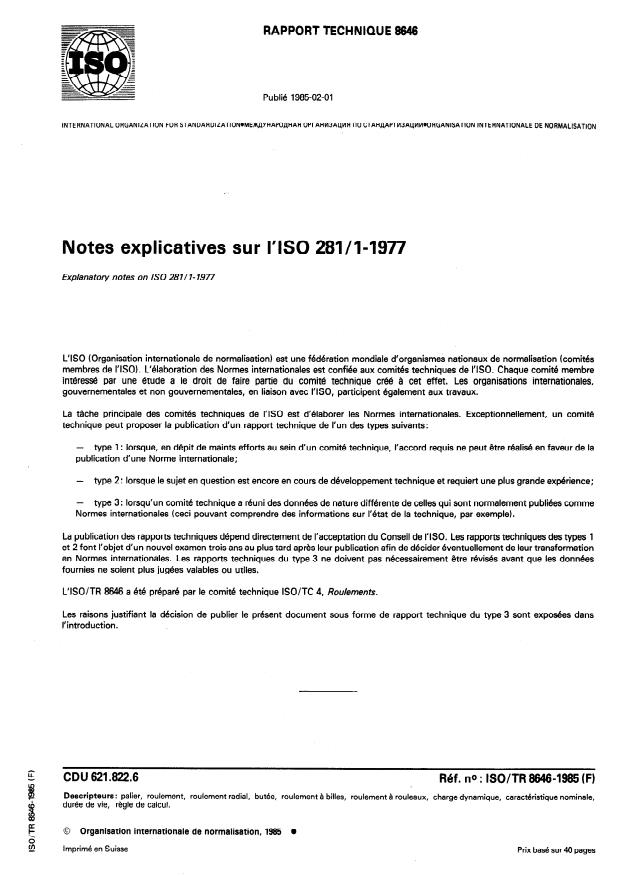
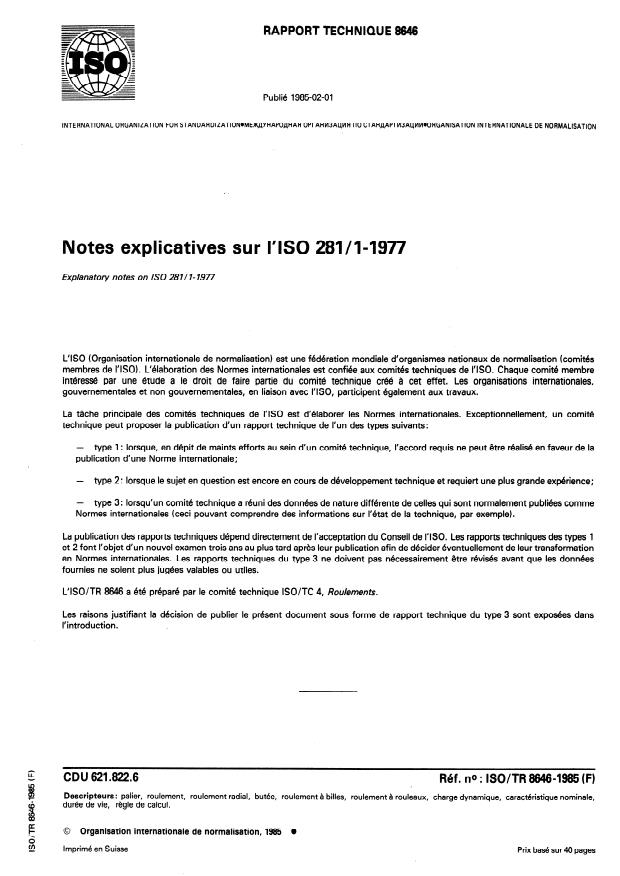
Published 1985-02-01
INTERNATIONAL ORGANIZATION FOR STANDARDIZATION.ME)I(~YHAPO~HAR OPI-AHM3AUMR l-l0 CTAH~APTkl3A~MVI.ORGANlSATlON INTERNATIONALE DE NORMALISATION
Explanatory notes on ISO 281/1-1977
Notes explicatives SW /‘ISO 287/ 7- 7977
ISO (the International Organization for Standardization) is a worldwide federation of national Standards bodies (ISO member bodies).
The work of preparing International Standards is normally carried out through ISO technical committees. Esch member body
interested in a subject for which a technical committee has been established has the right to be represented on that committee.
International organizations, governmental and non-governmental, in liaison with ISO, also take part in the work.
The main task of ISO technical committees is to prepare International Standards. In exceptional circumstances a technical committee
may propose the publication of a technical report of one of the following types :
-
type 1, when the necessary support within the technical committee cannot be obtained for the publication of an International
Standard, despite repeated efforts;
-
type 2, when the subject is still under technical development requiring wider exposure;
-
type 3, when a technical committee has collected data of a different kind from that which is normally published as an
International Standard (“state of the art”, for example).
Technical reports are accepted for publication directly by ISO Council. Technical reports types 1 and 2 are subject to review within
three years of publication, to decide if they tan be transformed into International Standards. Technical reports type 3 do not
necessarily have to be reviewed until the data they provide is considered no longer valid or useful.
ISO/TR 8646 was prepared by Technical Committee ISO/TC 4, Rolling bearhgs.
The reasons which led to the decision to publish this document in the form of a technical report type 3 are explained in the
Introduction.
UDC 621.822.6
Ref. No. ISO/TR 86464985 (E)
v-
Descriptors : bearings, rolling bearings, radial bearings, thrust bearings, ball bearings, roller bearings, dynamic loads, ratings, life (durability),
&
8 rules of calculation.
0 International Organkation for Standardkation, 1985 l
Printed in Switzerland
Price based on 40 pages
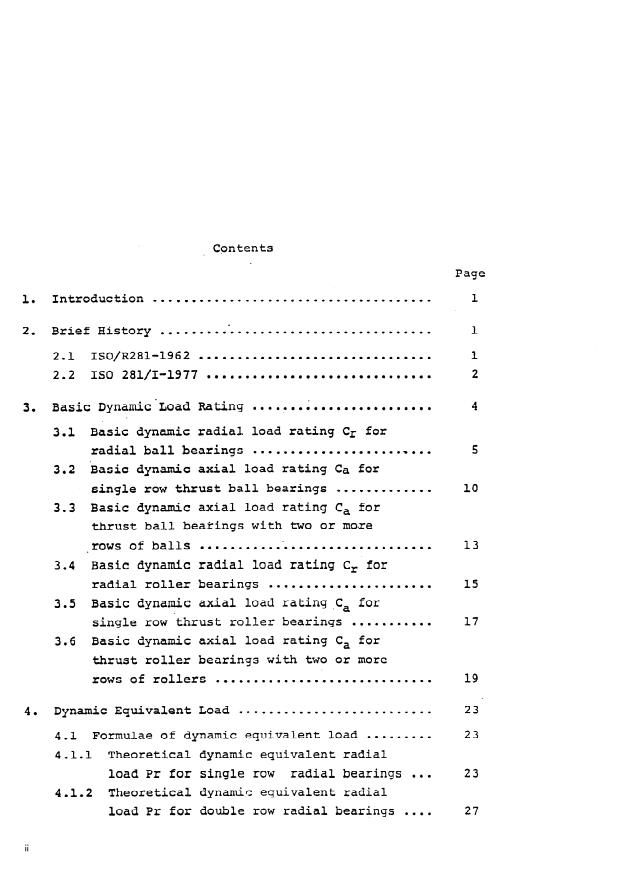
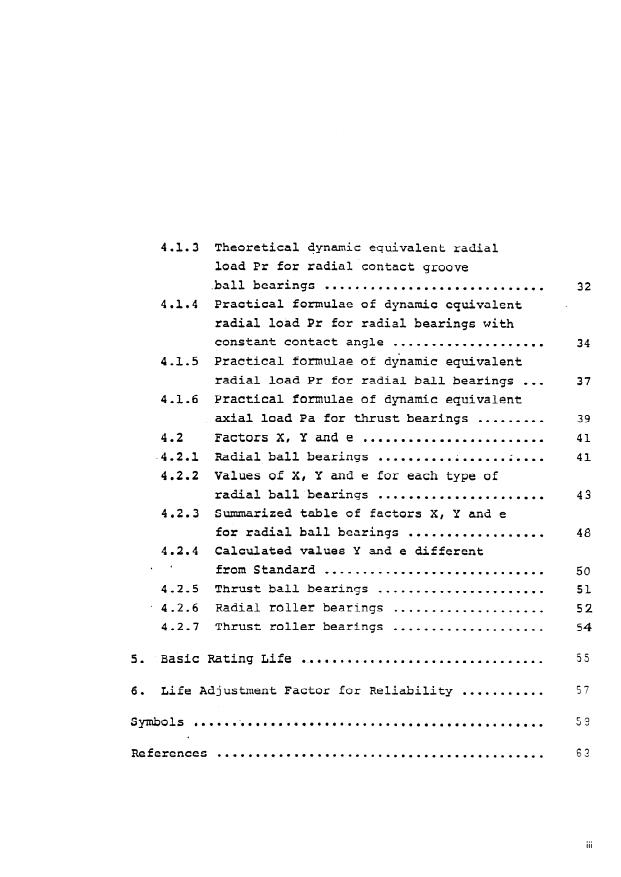
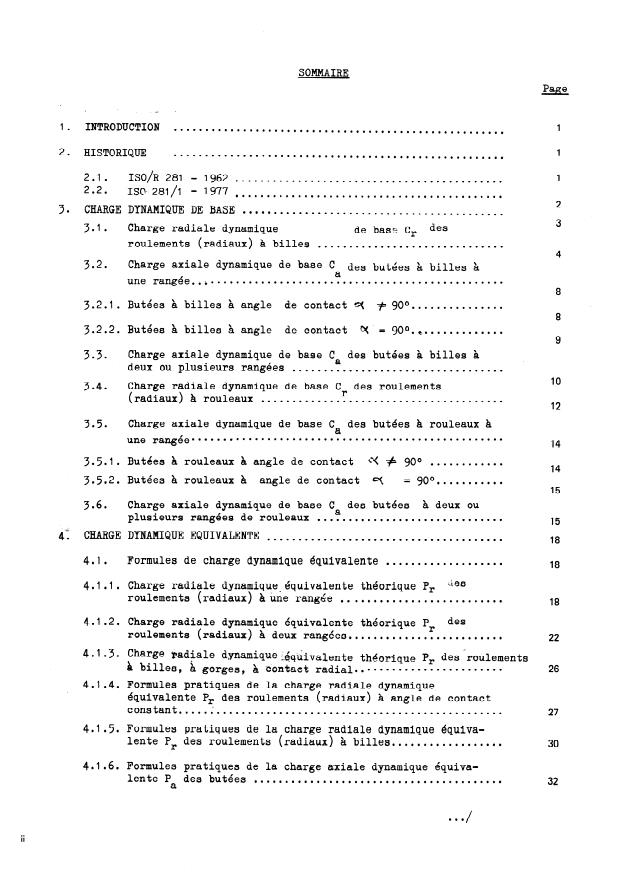
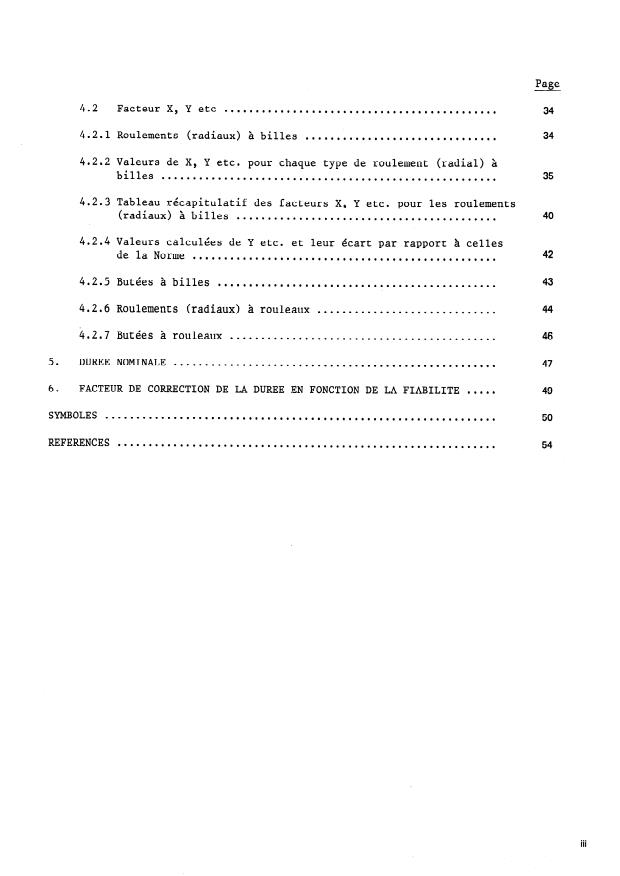
Contents
Page
1 0 Introduction moomoooooo~o~oooeo~ooooeo~o~ooe~~~oeo
.
~o~o~o~o~m.~*o~*eoooooooooooo~*ooooo
2 0 Brief History
l Oooo8mm~e~~0~o~~~~~oooa~mm*ooo
201 ISQ/R281-1962
l ~~0ooo~ooo~oooo~o~oooommeooo~
2.2 ISO 281/1-1977
.
.o.o**oooooooooo0ooeoooa
Basic Dynamic'Load Rating
3 0
Basic dynamic radial load rating Cr for
3.1
l oo~oe~oo*o~~ooeee~ow~o~
radial ball bearings
Basic dynamic axial Xoad rating Ca for
3.2
l oooooor*roo~
Single row thrust ball bearings
3m3 Basic dynamic axial load rating Ca for
thrust ball beaiings with two or moxe
.
~O~oooooo~o*oo~ooooooo~omom*og~
rows of balls
Basic dynamic radial load rating Cr for
3.4
1s
l ~~~o*~oo~0ommrm*mo*oe
radial roller bearings
3.5 Basic dynatic axial load rating.C, for
l oommooo*o*
Single row thrust roller beaxings
3.6 Basic dynamic axial load rating Ca for
thrust roller bearings with two or more
l o~omomom~o~*ooo~oooommm~oomo
rows of xollers
l ~~o*om*oomommomoooooomom~
Dynamit Equivalent Load
4 0
l m**emm*m
4.1 Formulae of dynamic equivalent load
4.1.1 Theoretical dynamic equivalent radial
l 0 m 23
load Pr for Single TOW radial bearings
4 l l .2 Theoretical dynamic equivalent radial
l l l l
Load Pr for double row radial bearinqs
4.1.3 Theoretical dynamk equivalent radial
.
load Pr fsr radial contact groove
,ball bearings
~o*o.oeoooo~o~ooo~ooooo~oo~~ 32
4.1.4 Practical formulae of dynamic equivalent
radial load Pr for radial bearings with
constant contact angle om*m***~****meo*emom
4.1.5 Practical fomulae of dynamic equivalent
radial load Pr fox radial ball bearings l ** 37
4.1.6 Pxactical formulae of dynamic equivalent
axial load Pa fox Wust bearings l ea****m* 39
4.2 Factors X, Y and P •o*mo~~ooo~~o~~~oo*o~~~~ 41
.
e4.2.1 Radial ball bearings l or*ao-•oom*~m~ooaoao* 41
Values of X, Y and e fcx each type of
4.2.2
radial ball'bearings
l o***~*e~aa~oomoo*~~oa 43
4e2.3 Sunmarized table of factors X, Y and e
for radial ball bearings l ~m~*~~~*mmoooeam~ 48
4.2.4 Calculated values Y and e different
*
.
from Standard l aomooeoomaao~oooooooo~~~ooo~
Thrust ball bearings l mo*~m~a*amo~~oo0ooo~o 51
4.2.5
Radial toller bearings l mm*m****m~oooo*oom~
* 4*2*6 52
roller beaxings
4.2.7 Thrust l aoeoaoooo~a*oooooom 54
'Ba&c Rating Life l .* l Q 0 * l 0 0 l •~~mm~mmo*~~ma*~~dmemo
5 0
6 0 Life Adjustment Factor for Reliability l e~oo*~*m*e
Symbols l ~~***~~*eam~a~e~*m~memm l *m*eemmm*eemm*o •*ooo~
References emoo~gmaoo*o0*0or*~ooo l *o~oooe**~*omoo~~ooo
. . .
Ill
This page intentionally left blank
ISCVTR 86464985 El
This 1C"eehnixxl Report give
backgrs~una ixrfor-
the derivatioPz o,f ans fac%ors
iven
g bearings - Dyn.atie Boa93 ratirng% and
.
: calculation lTEehQC%S 0
0 Brief Ristoq
2.1 ISO/R281-P962
A first scussion un an %ntgrnational Level of the question
sf standardizing ealcubation methoda far Load rat&gs of
rolling bearings
cmk place at the 1934 conference of the
Ititernational Federation sf
t e National Standardizing
Asssciations (XSA) 4
When fSA f-ne1 unference in
1939 no prog~ess had been However, in its 1945 report
cul ,the state Q
rolling beairang standardkzation, tfme XSA 4
ecretariat included prsposals fa,- d&5nPk3on af concepts
beirigg fmdamental for load
rating and Life ca%cuHatHon
Standards e This repo.rt was uted in, $949 as document
ISO/TC (SecretaxiaL-1) lp and &h- definit9sns it csntafned
in essence thcwe given in IZXI 28r/I for the concepts
"Life" and ('Krasis dywmic laad rating",
In 1946# a>n tkz i.witk0xive g3f tluz Anti-FrictitPn
earing
Manufacturers JQxxxxiation (AFEE~A), N~w
orks dlscussions
sf lsad ratPng and %ife &alculation Standards were started
llxf?tmeen earing industriEas in ULLA. and Sweben.
Chiefly
cm the basis sf resulks of scientbfic invectigations by G, -
erg- and A* almgren 8 p ZLk&zd in 1947 [l.]*, m AFBMA
s tandard ""Method crt' Evaluating Load Ratings sf Amular Ea.ll.
was werke-d out ans
Bear%ngStg Hished im 1949, Qn the
Same basis, -b%he meptlber body of Sweckm preserated in F&,, 1950
a first proposai ta ISO, YXm
Rating of Ball Bearings”, doc.
ISO/TC 4psc 1 (Sweden-111,
* fipures im bracket25 indkeste Qotexature nzferences in IkferencesD
ISO/TR 86464985 (El
In view of results of further zesearch, of a mdification of
ad of the interest also in
the mBMJ4 Standard in 1950,
roller bearing rating Standards, +he mmiber body of Sweden
submitteä in 1951 a modified praposal for rating of ball
beaxings, doc. ISO/TC 4/SC 1 (Sweden-6)' 20, as weil as a
proposal for rating of roller bearings, doc, ISO/TC 4/SC 1
(Sweden-7) 21,
Laad rating and life calculation methods were tkn studied
by Iso/Tc 4, ISO/TC 4/SC 1 and ISO/TC 4/WG 3 at eleven
different meetings durigg 1951 - 1959* An additional Paper
by Lundberg-Plamgren published in 1952 [2] was of-considerable
kerving as a major basis for the sections regarding
-et
roller bearing rating.
-
The framework for the*Recomendation was settled at TC 4/
.
At the time, deliberation of the draft
WC 3 meeting in 1956.
for revision of AFBMA Standards was concluded in U.S.A. and
Itwas proposed to the
ASA B3 approved the revised Standard,
meeting by U.S.A. axxd discussed in detail, together with the
WG3 proposal was
At the meting,
Secretariat's pkoposal.
. -
,p&pared which adopted many partsof the U.S,Ae proposal,
.
TC 4 N145) based on the WG
' In 1957, Draft Proposal (doc.
At the next year's WG3 meetingr this
proposal was issued.
Draft Proposal was investigated in detail, and at the follow-
the adoption of TC 4 N145, with some Manor
ing TC4 meeting,
was concluded. Then, Draft ISO Recomnendation
amrnendments,
l
No 278 as TC 4 N188 was issued in 1959, and ISO/R281 was
accepted by ISO Council in 1962.
.
2.2 SS0 281/1-1977
In 1964 the member body of Sweden suggested that, in view of
the development of improved bearing steels, the time had come
ISO/TR 86464985 (EI
to review R281 and submitted a proposal, ISO/TC 4/WG3 (Sweden-
at this time WG3 was not in favour of a
1) 9. Htxqever,
revisionm
TC 4 folIowed a Suggestion by the
111.1969, on the other band,
+ member body of Japan (doc, TC 4“‘N627) and reconstituted its
WG3, giving it the task of revising R281.
The AFBMA load
rating working group had at this time started to werk on a
revised Standard,
and the nmher body of U.S.A. submitted
the Draft AFBMA Standard "Load ratings and fatigue fifg for
ball bearings" for consideration,
ISO/TC 4/WG3 (USA+) 11,
in 1970 and "Load ratings and fatigue life for roller
bearings", ISO/TC!4/WG3 (USA-3) 19, in 1971,
In 1972, TC 4/WG3 was reorganized and became - : TC 4/SC8,
.
This proposal was investigated in detail at tie five meetings
during 1971 - 1974. The final proposal, Third Draft Proposal
(dOCm TC 4/SC 8 NZ3) R with SOXIE
I'*- .~Wdll’L~ntS, Was cir’culated as
.
Draft. %tarnational. Standard in 1976 and ISO 281/1 was accepted
_ -
by ISO Council in 1977.
The major part of this International Standard constitutes a
re-edition of R281, the substance of which was only very
slightly modified. However 8 based mainly on Amexican investi-
gations during the 196O's, a mw clause was added, dealing
with adjustment of rating life for reliability other than 90%
and fox material and operating conditions,
Furthermore, supplementary background information regarding
the derivation qf formulae and factors given j.n 1~0 281/1 was
pr.~~iminari.ly as ISO 281/II Explanatory Notes
ta be published,
TC 4fSC 8 and TC 4. decided to publish it as
-In 1979, however,
e
Technical Report.
.
ISO/TR 86464985 (E)
3 l
Basic Dvnami.c Load Ratine’
The background of basic dynamic load. xatings aecording $0
the Standard ISO 281 of xolling bearings is in the Lun
and Palmgren papers listed as references [IJ alad [
The formulae for calcuIation sf basic dynamic load ratiwgs
of rolling bearings develop from a pswer equation that CZZSII
be written as foIlows:
en -
l oo*ome**mommm~~~a~~
(3-1)
S
4k T*
where S = prubability of surtivab
maximm orthogonal subsurface shear stress
ZO"
N = ntzmber of stress applications to a Point on
the raceway
V = volume representative of the S+~SS
c
ration
zo= depth of the maximum ortiogonal subsu~face
shear stress
.c,h = exponents determined experinentally
e. = measure of Pife scatter, i-e, WePbulI Slops
determined experimentally.
For "Point" contact conditions (ball bearings) it is aszxmed
that the volume (V) representative of the stress axxentra-
tion in equation (3-l) is proportional to major axis of the
projected contact eilipse (2a), the circumference of the
raceway (2) and the deptfi (2,) of the-.matimum orthogonal.
subsurface shear stress (po):
Substituting (3-22) into relationship (3-i):
ISO/TR 86464985 (El
" Line " contact was considered by Lundberg and Palmgren to be
approached under conditions where the major axis of the cal-
culated Hertz contact eilipse is 1,5 times the effective
roller contact length:
2a = 1,5 L
l am~~m~~~~rno~e~e~*~*~~~*~~~~*~~e
(3-J)
we
In addition,
b/a should be small enough to permit the intro-
duction of the limit value of
ab for b/a approaching 0:
XI
(3-5)
ab =
(for notation see 3.1).
.
3.1 Basic dynamic radial load ratinc$, for radial ball
bearinqs
From the Hertz9 s thecxy,
the maximum orthogonal subsurface
shear stress z. and tfle depth zo
tan be expressed in terms
of a radial load Fr, i.e.
a maximum rolling element load
Qmax or a maximum contact stress amax and dimensions for the
contact area between *a rolling element and the raceways,
The relationships are given as follows:
70=
T %lax,
20 =
5 bt
1) l/*
et
T =
*t(L+l) t
5 =(
t + 1)(2t - l)W*r
3Q ]1/3
a =p[---
b
E,U
1/3
b
= v[---
E,Q
ISO/TR 86464985 (EI
maximum contact stress
where
Ornax =
-
-
t auxiliary Parameter
=
semimajor axis of the pxojected contact eilipse
a
-
-
semiminor axis of the projected contact eilipse
b
C
een a rolling element and the
normal forte betw
Q
.
raceways
.
modulus of elasticity
Eo =
=
curvature sum
CP
auxiliary quantities introduced by Hertz,
tJ,v =
for a given rolling bearing-to, a, it and zo
Consequently,
tan be expressed in terms of bearing geometry, &d and
l
revolutions. The xelationship (3-3) is changed to an equation l
Inserting a
by inserting a constant of proportionality.
and a specific
10 )
specific number of revolutions (e.g.
the equation is solved for a rolling
reliabi-lity (e.g. 0,9).,
element load for basic dynamic load rating which is designated
.
to Point kntact rofling bearings introducing-a constant of
proportionality Al:
.
1,59c+1,41h-5,82
c-h+2
2r
1,3
Qc =
3e
.3e A1 2r-Dw
2c+h-2
c 1
4 c-h+2 0,s c-h+2
(Ity) c-h+* *
2c+h-5 3e
omm**m*~.m*
(3-W
x: (c;so)c-h+i 45 c-h+2 z - c-h+2 -
rolling element load for the basic dynamic Load
where Qc =
.
xating of the bearing
= ball diameter
QW
= Dsosa/DPW
Y
D pw= pittih diameter of ball set
= nominal contact angle
a
z = number of balls per mw.
multiplicati3n symhol.)
( x is used as
ISO/TR 86464985 (EI
The basic dynamic radial load 'rating Cl of a rotating ring
.
is given as follows:
= Qc~Zcos~J~ = 0,407Qc1Zcosa, ;
Cl 'e*--m**m* '
(3-7)
.
The basic dynamic radial load xating C2 of a stationaq.
ring is given as follows:
.-
= Qc2Zcusui$ = 0,389Qc2Zcosa
c2 l *.m*.---
r. (3-8)
*where Qcl = rolling e3.ement Load for the basic dynamic load
rating Of a ring rotating relative to tfie applied a
load
= rolling element load for the basic dynamic load
Q2 c
rating of a ring stationary relative to the
applied Load
= radial load integral (see table 4-l)
= JrW,W
Jr .
“*Jl(O,S) = factor relating mean equivalek Load
Jl
OR a rotating ring to Qmax
(see
table 4-1)
= factor relating mean equivalent load
J2 = J2(0,5)
.
on a stationary ring to Qmax
(see
table 4-l).
The relationship among Cr
for an entire radial ball bearing,
Cl and C2 is expressed in terms of the product Iaw of
probability as follows:
Substituting equations (3-7),
(3-8) and (3-6) into equation
the basic dynamic radial load rating (3, for an entire
(3-W 8
ISO/TR 8646-1985 (EI
ball bearing is expressed as follorqs:
l,%k+r,4lh-5,82.
c-h+2
qJ Zr (l-4
c, - 0,41
Al
2~i.il
Zc+h-G 3e W
I-if
bc-h+Z o,5c-h+2
f,,59c+~,42h+3eS,82
c-h+2
)
c-h-3e+2 2c+il-3
C-h-1
c-h+2 2 c-h+2 c-h+2
aa*m*-e*e*o-• (3-10)
~1 (i cosa)
DW
where Al = proportionality constant determined experimentally
= Cross-sectional raceway groove ra&iuS of.inner ring
ri
= cros's-sectional racevday groove radius of outer ring
re
= ntmber of rows of balls,
i
Here, a contact angle a, number of rslling e.kments (bdls)
On the other
2 and the diameter I& depend on bearing design-
hand, the ratios of raceyday groove radii ri and re to a half
diameter of a rolbing element (ball) D&2 and y=&~cosa/D~~
therefore it is convenient iri practice
are not dimensional,
t'hat the val.ue for the fixt three lines in the xight side of
J
equation (3-10) is designated as a factor fe.
Consequ@Ently,
c-II-3~2 2c+h-5
c-h-l
a
c-h+2 z c-h+2 c-h+2 '
w *.* 0 0 8 (3-11)
= e,(icosa) .
D,
G
ISO/TR 86464985 (EI
With radial ball bearings we must consider the faults
in bearings resulting from the manufacturing,
and a reduc-
tion factor X is introduced to reduce the value for a basic
dynamic radial load rating for radial ball bearings from
its theoretical value,
and it is convenient to contain the
factor X in the factor fc.
The value for the factor X is
determined experimentally. .
Csnsequently the factor f, is given as follows-
~,S!k+1,4lh-5,82
c-h+2
OT41 (1-y)
1,3
f
c = Ii,41x
2c+h-2
3e
3e
4c-h+2 (IJ piz
c-h+2
. _
t WY)
c-h+2
xt y
t
/
‘W
ri 25.4&
c-h+2
X . 1-b 1.04(-x--
.
r@ 2ri-b
i I
Based on the original experimental work by Lundberg and
Palmgren with ball bearings the following vaI.ues were assigned
to the experimental cxnstants in the load rating equations:
e
= 10/9
c‘ I
31/3
L
h 0
v3
substituting the numerical values into equatisn (3-11) gives
the following, however,
a sufficient number of test results
ISO/TR 8646-1985 (EI
arc only available for s
ff bal.lsre i,e, up tzc~ a di
et.,
of about 25 nun, and ti-igrs~~ shcw that the hoad rating may be
taken as being proportional to Dwlp a
In the case sf lare;er
,
balls the lsad rating appears to increase wen IDCXCZ sl~~~by
in relation to the ball diameter, and blp4 c;mn be aasum&
.
where b > 25,4 mm:
0,7&&&8
= fc(icosa)
Cr i 25,4 rm), ,,,(3-13)
(
= 3,647fJi.cssa) b4 (99 > 2s,4 m),
*6KJ3-14)
Cr
.
. 9:
0,41
. f, -= 0,089Al x, 0,41x
Values for fc 0x1 tkable f in IS
arc cxikulated frc"m
sub'stituting raceway groave radius awd reduction factor
hich
arc given in table 3-l into equation (3-%5),
ne value for 0,089~~ is 98,0665 to calcula-te Cr in !Jiew"i:ons.
3.2 Basic dynamic axial load ratin 9_le row
thrust ball, bearings
3 -2.1 Thrust ball bearine with eontact 'angle 'a # 90"
Similarly according to 3& for
rust ball bearings w&h
.
.
contact angle CL # 90%
c-h- 1 C-+h-%CfF+4?
2c+h-5
Ca = fc(cosa)c-h+2 taaa Z
c-h-+2 c-h+2 a, ee+*o-
For msst thrust ball bearings the theoretlCa% VZ&KZ of a
IO
ISO/TR 8646-1985 (EI
basic dynamic axial Load ratifig must be reduced on the basis .
sf unequal distribution of load among the rollinq elements
in addition to the reduction factor X which is introduced in
radial ball bearing load ratings,
This reductlon factor is
design%te'ti as n l
Consequently,
the factor f, is given as foIlows:
,
lg59c+I,41h-5,82 3
.
0,41
c-h+2
(l-Y)
c-h+2
%
c”
Y
An 2c+h-2
3e
3e
.
, c-h+2 o,5c-h+2
c-h+2 :
(l+y)
.
1,59c+1,41h+3e-5,82
3,.
c-h+2
- c-h+2
8~~~ooo~~~*rn~e
(3-17)
Substituting experimental constants e = 10/9, c = 31/3 and
h = 7/3 into equations (3-16) and (3-17) R however, consider-
ing the effect of ball size similarly,
0 7
Ca = fc(coscr)
t tancr Z2/31&+8
* (Dw g 25,4mm),-m (3-18)
09'9
Ca = 3,647fc(cosa)
tancs Z2'3D lF4
(Dw B 2S,knm),,w.(3-19)
W
P
.
-3/10
0741 /l-y 1772
!Z x *Gr-D w)
\X& 2riwDi
a1 J
-+y
L
.
sbmmmmmemmmmmmmmmmmmm*
(3-20)
.
ISO/TR 86464985 0
98,0665 to calculake C, in Newt:ons.
The value for 0,089Al is
on the right ccdumn of table 3 0, ISO 281/1
Values for f,
arc calculated Erom substituting raceway groewe radius and
reduction factor which are given in table 3-1 into equation
(3-20).
.
3.2.2 Thrust ball bearinqs with contact anqle CY = 90°
for thrust ball. bearings with
Simiiarly according to 3&
contact angle a = 90°:
.
*
2c+h-5
c-h-3e+2
= fc z c-h++ kc-h+2 ,
(3-21)
e~o*m**oe*mo**mwm~
Ca
d
0,41 3
-
c-h+2
2ri
1,3
=
Y
An
3e A1 [ 2ri-Dw 1
2c+h-2
p-h+,2 .o p-h+2
e-h+2
- c-h+2
(3-22)
,*o*-
x
,L
b which y = DM+w.
experimental constants e = 10/9, c = 31/3 and
Substituting
(3-21) and (3-22) p however, considering
ecpations
= 7/3 into
h
the effect of ball size similarly:
(3-23)
mawm*m*o*
(D < 25,4mm), -
= fc~2/3&1,8
Ca
(3-24)
0 0 m l e 0 0 * i
(D > 25,4mm) t
= 3,647fcZ2'3D&4
Ca
b
0,41 Yo,3
fc =
0 ,o 89J+l (&q)
-3/10
2r,-D,, 0,41
(3-25)
Y
=e i+d
( ri 2r J 3 10/3 1
ISO/TR 86464985 (EI
The value for 0,089Al is 98,0665.to calculate Ca in Newtons,
Values for fc on the left ~~hnn of table 3 in ISO 281/I
are calculated from substituting raceway groove radius and
reduction factor which are given in table 3-1 into equation
(3-X).
3*3 Basic dynamic axial load rating Ca for thrust ball bearinqs
with two or more rows of balls
According to the product law of probability, relationships
between the basic axial load rating of an enti.re thmst ball
'bearing and of both the rotating and stationq washers
are given as follows:
_'
.
c-h+2
c-h+2
-Cq
Cak =
Cal; 3
+ Ca2k"
1 ~~o*~~
c 8 (3-26)
.
.
Qc- sincr Zk
calk =
*---D-*~~~~~**mm
(2-27)
ca2k = Qc2 sina zk,
*
1. *
---
c-h-9-2
c-h+2
+ Ca2 3
F ~e~e~o.*
(3-28)
n .
= Qcl Sha c zk
Cal
Kzq /
*.*~*~~e*m~
-(3-29) .,
*
n
.
= Qc2 Si-na XE1 zk
C2 a
.
=
where Ca
= basic dynamic axial Load rating as a row k of
.
an entire thrust ball bearing
= basic dynamic axial load rating as a row k of
Calk
the rotating washer of an entir& 'thrust ball
bearing
ISO/TR 8646-1985 (E)
= basic dynamic axial load rating as a row k of
Ca2k
stationa?y washer of an entire thrust ball
bearing
=
basic dynamic axial load rating of an entire
C
a
thrust ball bearing
= basic dynamic axial load rating of the rotating
.
Cl a
washer of an entire thrust ball beaking
= basic dynamiC axial load rating of the stationary
c2 a
washer of an entire timst ball bearing
i
number of balls as a row k.
%
.
(3-27) and (3-26) into equa-
Substituting equations (3-29) I
and rearrangement of equation (3-28) gives:
tion (3-28),
. .
c-h+2
c-h+2
e-
U-
c-h+2
-‘3+(Qc2sina F Zk)
&)
. Qdsina ;
(
bl
k=l
n
C
c-h-t-2
a*
--
n A
s
IE1 =k
. c-h+2
qL@q-=~ -L2
n
c-h+2 1
kil .
- kfl %
--
. 3
ac
c-h+2
-cx
Substituting experimental constan't:s c = 31/3 and h = 7/3,
(21 + 22 + 23 + ‘.--.--. + Zn)
Ca =
-3/10
Zn IO/3
Zl 10/3+ 22 10/3+ 23 10/3+
+---
l 0 -
.
x ( >
-
( )
Can
( )
L )
c a 3
w 1
Cal
(3-30)
l *m*
***o*
ISO/TR 8646-1985 (EI
The load ratings Cal, Ca*, Ca3, .-. - C
for the rows
an
with zl, z2, z l 0 0 0 P Z
I . n balls'are calculated from the
appropriate Single row thrust ball bearing formula in 3.2.
3.4 Basic dynamic radial load rating C for radial roller
r
bearings
procedure similar to that used to obtain equation (3-10)
BY a
for Point contact in 3.1,
but applying (3-4) and (305)~ the
basic dynamic radial load rating of radial roller bearings
(line contact) is obtained :
c+h-3
c-h+1
(1-y) cazi.
= 0,37 7
Cr Bl
Y
c+h-1
2e
2e
ph+lo p-h+1
(l+y)c;h+l
x [ 1+ [l,04~:;;>=~z:~3} =-Ypi
c-h-1 c-h-2e+l
. c+h-3
c-h+1 2
c-h+1 c-h+1
x+ (flwecosa)
he
=
where B proportional constant determined experixentally
=
Y Dw@=a/Dpw
mean roller diameter
b e, =
‘a ,= nominal contact angle
=
D
pitch diametew of roller set
PW
effective txmtact length of rdler
?we =
i =
number of r6ws of rollers
c
z
number of rollers per row.'
Here,
a contact angle a,
number of rollexs 2, the mean
diameter DweI
and the effective contact length he depcnd
ISO/TR 86464985 (EI
On the other band, y = Dw&osa/Dpw is
On bearing design,
therefore it is convenient in practice that the
not dimensional,
value for the first two lines in the right Side sf equation
(3-31) ,is designated as a factor fc.
Consequentlyr
c-h-Z&+1 c+h-3
c-h-1
c-h+1 z c-h+1 D c-h+1
e-m* (3-32)
Cr Lf f&+cQsa)
we
.
For the basic dynamic radial load rating for radial roller
bearings adjustments are made to take account of stress
edge loading) and of the use of a con-
concentration (e.g.
stant instead of a varying life formula exponent (see
Adjustment for stress concentration is a reduc-
clause 5).
tion factor 71 and for exponent Variation a factor v 8
It is convenient to contain both factors - which are deter-
mined experimentally - in the factor fcJ which consequently
is given as follows:
c+h-3
c-h+1
c-h+1
1 (1-Y)
Y
f
* ,377xv c+h-l
2e
C 2e
c-h+1
p-h+10 p-h+1
ww
c+h+2e-3 -
.[,tp,o4(~~ c-h+1 lC ~+)-c+. --* (3-33)
the constaats c and h are determined
.
The We-ibd.1 slope e,
Based on the original experimental werk by
experimentally.
Lundberg and Palmgren with ball beaxings and &bsequent
verification tests with spherical, cyI.indrical and tapered l
roller bearings the following values were assigned to the
experimental constants in the rating equations:
/T-R 86464985 (E)
"
.
1-Y 1434/%08
eeee** (3-35)
TTy- J
e-h- 1
c-h-2e+b
e+h-3
c-h+1
e-n+1
f, cIi$qecosa>
taria z c-h+1 6)
a== *
Q
W@,
***9-*0:dQ-*~~e (3-36)
cxr thru~t r~~P%er bearingr; -irkxe tbesretical value of a basic
d>7nabftic axia%
Load ratinq must. be reduced CXI the basis sf
ISO/TR 86464985 (EI
unequal distribution of load among the rolling elements in
addition to the reduction factor X which is introduced in
radial roller bearing load ratings. This reduction factor
.
is designated' as TI-
Consequently the factor f, is given as follows:
cih-3
1 B (l-y)c-h*' c-h+i
f
= xvq
Y
C cih-1 * 2e 2e
.
2c-h+10 p-h+1 c-h+1
.
- U+yl
c+h+2e-3. c-h+1 2
- _~ -
c-h+1 2 -c-h+1
x (3-37)
*
.
.
Substituting experimental constants e = 9/8, c =31/3 and
L)
h
v3 f
i.
" ,.
_ c-
-
29/27
w
v9
C tana 2 D l o~eee.e (3-38)
= fc(hecosa)
we
a
y2/9 (i-u) 2hgf27 1+ i-y\ 143floa 912 -219
= O,483B+nJ
f
C
l+y,
(l+y) LD
[ 0 1 1
o~~ee~~eo,o***e (3-39)
The v&.ue for 0,483Bl is 55i,13373 to calculate Ca in Newtons.
Values for f, on the xight column of table 7 in ISO 281/1
arc calculated from stistituting reduction factors which are
given in +ahle 3-2 into equation (3-39).
3.5.2 Thrust roller bearings with contact anqle Q = 90°
Extension 0f 3-l gives:
ISO/TR 8646-1985 (E)
c-h-1 c-h-2e+l
c+h-3
= fche-h+l z c-h+1 4yec-h+l,
l --000ar.m.
(3-40)
ca
2 2
c-h+1 2-c-h+l
f
a -Zoos
e /3-h}
BlY
= xvn c+h--l1 2e
2cmh+10 5c-h+P -
t
Substituting experimental constants e = 9/8, c = 31/3 and
h = 7/3,
29/27
7/923/4
c, =
•-~o.ooom~m~*m~*~~~~
8 (3-42)
fcIwe Dwe
c
2/9
f, = 0,41BlAv~~y e
•-oo*aoo~~oo*o~a*o~~*~*~~~
(3-43) .
The vaI,ue for 0,41+ is 472,45388 to cakulate Ca in NeWtonso J d
'
l Values for f, on the left column of table 7 in ISO 281/1
are caleulated from substituting reduction factors which
arc given in table 3-2 into equation (3-43).
3.6 Basic dynamic axial load ratiny Ca for timst roller
beaxinqs witk two QE more rows of rollers
According to thk product law of probability, relationships
between the basic dynamic axial load rating of an entire
thrust roller bearing and of both the rotating and stationary
washers are given as follows: __
c-h+1
c-h+1 2
2 -c-h+1
'
-mm*m*mm (3-44) *
ck a -e ca2k 8
%lk =
Qclsin~~k&e~l
•~mamm~*~*.
(3-45)
Ca2k =
Qc2sin-k&&
/
ISO/TR 86464985 0
whercz C!& = basie
2aA entire
.
. basic dyn ic axial lcaad rating as
%lk=
washer sf an entixe
t%ne rotatin
bearing
basic dynatic zxcieil hcmd rati,ng
C,2k==
the statissnh~ washer of s!ii.n entire til.r~xt .,
roller bearing
c basic dynmic axial 3,~~Sl radimsg af zr~ e~ltfrs
a =
thrust roller bearix9g
basix dynm~c dtxi
=a a* =
washer sf an en$%
basie dyna~hz axl.
c a 2
washer OB" Xi {~~yyp~
L,fi.r~ )J#3~~~~yQq
z rl,
n er of rOl%exs as " lI!lxYd k9
k
Substituting equations [3=47), $3-45) and (3-
1 inta %!ixpaa-
tion (3-46) o and rearrangement of equati@n (3
ISO/TR 86464985 (EI
c-h+1
c-h-f-l 2
n
n
-. -2+(Qc2Sina~~,Z~~=~~21 -c-h+l
(Qclsina c Zk&q&)
n - k=l
=:
r
C
a = c ZkZwek
c-h+1
k=l
BP
( ; Zk$,&) 2
. a
.
bt=1
.
2 c-h+1 2
c-hl
_c-h-+~ -- --
n
c-h+1
c-h-t-1
[c (Qcina Z&qP~~~in~.Z&& 2
= k~~Zk~,t e
c-h+1
&&k)---
Substituting experimental constants c = 31/3 and h = 713,
ca =
(ZlLtyel + z2he2 + z3&e3 + ----e + Z+~en)
b
- . .
- * : x [ (Zgy) “‘+(*) 9/2+( Zgy23) 9/2+ ) - - pl.!.‘*) 9/2]-y
l O~***mmmmmm*mmm (3-48)
The Load ratings, C,I, ~~2, ca3, rmmmrf
C
an for the rows with
23 f rromrf
Zl f 22 Zn rollers of lengths bei, +2, I;we3,
f
l m**mf heq are calculated from the approoriate Single row
thrust ro&r bearing formula in 3.3.
a
ISO/TR 8646-1985 (EI
- Raceway groove radius and reduction factor
TABLE 3-1
for ball bearings
Reduction
TABLE No. in
factor
Bearing type
ISO 28111
/
L
ball bearings
Double row radial.contact
0 ,52DW
groove ball bearings
TAXE 1
f
I t
Single and double row
self-aligning ball
bearings
.
:
.
TABLE 3
on tablcs 1 and 3 in ISO 281/1 are calculated
NOTE - Values for f,
from substituting raceway groove radius and reduction factor
in the above t&le 3-1 into equations (3~15)~ (3-20) and (3-25
respectively l
Reduction factor for roller bearings
TABLE 3-2 -
.
Reduction factor
a
TABLE No. in /
Bearing tyle
ISO 281/1 Jl
XV
-
L
-
Radial roller bearings 0,83
TABLE 5
L
L
0,73 l-O,15 sirm
Thrust xoller beaxings
TAE3LE 7
c
on kbales 5 and 7 in ISO 281/1 arc calculated
NOTE - Values for fc
factor in the above table 3-2
from substituting reduction
(3-39) and (4-3) respectively.
into equations (3-351,
ISO/TR 86464985 (EI
4 l Dynamit Equivdent Load
4.1 Formulae sf dynamic eauivalent Load
.4.1.1 Theoretical dynamic equivalent radial Load Pr for
single row radial bearinqs .
If the indices 1 and 2 arc assigned to the ring which
rotates relative to the direction of load and the stationary
.
ring respectively,
then the mean values of the rolling
element loads which are decisive for a Single row radial
"
. bearing ringk life axe given by equations:
Ft
J
Fa
1. JI
Ql c =
Q=x Jl = 2 CQS~ J
=
2 sina Ja 8
r
mmo*oo*
(4-U
Qc~ = Qmax 32 = 2 E& $$ = 2 LT,, $$
J
where
maximum rolling element Load
Qmax =
= factor relating Qcl to Qmax
Jl
= factor relating Qc2 to Qmax
J2
= radial load
Fr
= axial load
Fa
= radial load integral
Jr
= axial load integral
Ja
z
= number of xolling elements
a
= nominal contact angle.
Radial and axial load integrais are given by following equations:
c
+eo
= Jr (E) = &
Jr fl -z( l-cos p) 1 %*spd $Q,
- ?o
o-o-
(4-2)
= Ja(c) = &
n -E(l-cosp)]t dF
Ja
= 3/2 for Point contact
where t
.
.
= 1,l for line contact
d
= one half of the loaded arc
QO .
= Parameter indicating the width of the loaded Zone
E
in the bearing.
Introducing the notation
‘
*Pu
s
1 1
cosp) 1 %l # l meem(L’*e (4-3)
[l (1
Jk;s) t
23 2E:
-9,
= 5(9/2;3), ~2 = JZ(C) = J(5;10/3j,
= JlW
Jl
(4-4) .7
= J(9/2;4), J2 = J2k) = J(S;9/2 ) -*
= Jl(e)
Jl
.
for Point and line contact respectively,
If Pr1 and Pr2 are the dynamk equivalent radial loads for the
then with radial displacement of the rings
respective rings,
(e=O.S)
Pr2 52(0,5)
Pr1 Jl.(0,5)
**eo. (4-5)
Qcl =
Z casa J&l,5).' .Qc2 = 2 COSOI Jr(o,%
J2(0,5) and Jr(0,5) arc given in
where the values J1(0,5) I
table 4-l.
From equations (4-l), (4-5) and
W
W
= Prl)
+ (pr2)w
(% (
C2
cr Cl
is obtained
1-e (4-6)
W w Jr(O,s)
w
C 51
Pr J2
cr
t=
J
cota = ) + k2 J2(0,5+
Cl J1(0,5) Ja
Fa
ISO/TR 8646-1985 (EI
= basic dynamic radial load rating
where Cr
= basic dynamic radial load rating of a rotating ring
Cl
= basic dynamic radial load rating of a stationary rincr
C
=exponent in life formula,
w
= pe (P
e== Weibull dope)
TABLE 4-1 - Values for Jr(O,5), Ja(O,5), Jp(O,S)
J2(0,5) and w
rot% bearing mw bearing
--
0,2453 0,4906 0,2369
0,309o 0 Cl,2932
0,6495 0,7577 0,6044 0,7244
0,6744 0,7867 0,629s 0,7543
-
W
0,794 0,808
0,378 0,648 0,392 0,654
0,364 $623 0,376 0,628
--l
1,041
1,038
0,371 0,635 0,384 0,641
.
180/47
I
I
i .
1,714 1,669
ISO/TR 86464985 (E)
For radial displacement of the bearing rings (E=O .5) and fixed
basic dynamic load rating for inner
-outer ring load (Cl=Ci,
f *,
C2"cet basic dynamic load rating for outer ring) from
ring,
.
equation (4-6) is found
.
JdO 5)
-
Pr = Fr = ba(OlS) Fa cota
m-0 0,794) Fa. cota l omo~oe*~.o**
= (0,822 (4-7)
.
for Point and line contact respectively.
a For C=O,S and fixed inner ring load (Cl=vt&, C~=Ctiv)~
. -
it is found
-~ooaoeoooo~ (4-U
= VFr ~**~~,o*a*oo**m*o~*m~~*a*~o
PS
.
where V is the rotation factor,
The factor V varies between 120,044 and 1-+0,038 for Point and
In ISO 281/1, the rotation factor
line zontact respectively.
V has been deleted.
The value of 1,2 for the ratation factor V was
NOTE -
. given in ISO/R281 for radial bearings except
self-aligning ball. bearings as safety factor.
For axial displacement of the bearing rings (~4 and fixed
outer ring load (Cl=Ci, Q=Ce),
Ci) Jr (075)
i = l *a-o*a*a
(4-W
P YF Y
fl(
S EL*
Ce J1(0,5) =Otaa
.
The factor fl(g) varies between 1 and I/v = J1(0,5)/32(0,5).
Introducing as a good approximation the geometrical mean
value l/fi between these two values (see table 4-l),
ISO/TR 86464985 (EI
Jr(O ,5)
-
-
Y cota.
l l *mm**~~*e*ooo0omm*
(4-10)
JJ1(0,5) l J2(o,5)
For non self-aligning bearings consideration must be given
to the ef fett of the manufacturing precision on the factor y,
The value of Y given in equation (4-10) is corrected by the
.
reduction factor no
Y = Y/q. l ~~oo*mo***~oooo~o*ooo~~~o~~o~oo*~~o
1 (4-11)
For combined loads, equation (4-6) gives related values of
.
and Fa cota/Pr corresponding to the curves given in
F,/PL
.
figure 4-1 for the limiting cases Cl/C!2= 0 and C~/C~S 0.
The Points A represent ~=0,5,
that is radial displacement
.
of the bearing rings.
For these Points,
Fa = l --- 1,26) Fr tana
(1,22
l ~*m~*o~~mooommom
(4-12)
for Point and line contact respectiveiy.
4m1.2 Theoretical dynamic equivalent radial load Pr for
l
double row radial beawinqs
.
For double row radial bearings,
the i'ndices 1 and II are
assigned to the respective rows.
The determining f actors
for life of the rotating and' stationary rings are the mean
values
= Jl QmaxIf *m-m-mmm**o*m (4-13)
Ql C Q2
C = J2 QmaxP.
Iso/TR 8646-1985 El
. ’
where
w
QmaxlI tJ
= J1(qlW + ( i J1(+lW t
QmaxI 1
$=;; )wJ2k=) "]'.
3 = J2(EI)W + (
without internal cleatiances,
For a bearing
= 1 for Ef < 1,
EX + 9
~*oa~o**~*m**~*~*, (4-15)
-0 fox EI31. .
ISO/TR 86464985 (EI
-rd
N
\
G+
\
\
\
‘\-
\
\*
‘\
\
\
nJ 0 00
W Ft N 0
4 )r m
T- 6 0 0 ö
ISOITR 86464985 (E)
If we introduce the values of Jr, Ja, J1 and +for double
.
then the equivaient bearing Load is obtained
row bearings,
-
from the same equation (4-6) for Single cow bearings.
Jl(O,S) are here the values valid for
Jr&%, Ja&%,
&
=
= 0,s (see table 4-l).
1 QI
The bent curves given in figure 4-2 arc found for the Limiting
.
cases Q/Q=O and C~/CL= 0.
Both rows are loaded if ~1 < 1, that is if
l
(4-16)
-0• 1,91) Fr tana m*wwwmwmm~mewm*~ao
Fa < (1,67
.
for Point and line contact respectively.
Only one YOW is loaded if Fa is greater than -at value,
In that case the life for double row bearings tan be cal-
culated from the theory of Single row bearings as weil as
i.
from the theory of double row bearings.
- If Pr1 is the equivalent radial load.for the loaded ZZC)W
considered as a Single row bearing and ?r is the eq&vaIent
Load for the double row bearing,
Pr
= .ik = 9-w*
FFy CI
Figures 4-1 and 4-2 are calculated 6x1 the assumption of a
Figures 4-1(a) and 4-2 (a) are also
constant contact angle,
approximately applicable to angular contact groove ball,
bearings, if cot& is determined from the following formula-
ISO/TR 8646-1985 El
Fa
CQSU
3/2 3/2
m-m-m (4-18)
(
9 T-T&=
l COS -
which denends on the modulus
“C” is a compression constant,
of elasticity and the confonnity Zr/hr,-where r j.s a cross-
sectional raceway groove radius and Dw is ball diameter-
.
4.1.3 Theoreticql dynamic eqtivalent radial load Pr for
radial contact qroove ball bearings
Figure 4-3 is applicable to radial cuntact groove ball
The curve AC has been determined from equation
l bearings.
(4-6) a.nd approximate formula
1 3/8 Fa 1/4 o*mm (4-19)
3/8
--
tana' s
2r/D,-1 2c > 1 > (
2E' JaiZD&
t
and gives the functional relationship betideen Fr/Pr and
is the contact angle calculateä from
Fa cota'/Pr, where Q'
the following fomula (11
Fa 1/4
l (4-20)
m~~*~~~~~oom~mrn
tana' =
( >
izDw"
This formula is obtained from formula (4-19) for a centric
&=w and J = 1.
axial load Fa and F,'O, i.e.
a
.
ISO/TR 8646-1985 (EI
I
A
I
l
/
i
Fa cotd
Pr
FIGURE 4-3 -
Dynamit equivalent load Pr for
radial contact groove ball bearings
ISO/TR 86464985 (E)
4.1.4 Practical formufae of dynarnic equivalent radial fsad pr
for radial bearinqs with constant contact angle
From a practical Standpoint it is preferable ts xeplace the
theoretical curves in figures 4-1 and 4-2 by broken lines
AlBC for sisigle row bearings and ABC for double row bearings
in figure 4-4.
b
-f-
La
cotg/ YI
Fa cota
FIGURE 4-4 - Dynamit equivalent radial load for radial
.
bearings with constant contact angle OL
The equation for the straight line AlB in figure 4-4 is
Therefore, for F,/Fr < ctana, WZ have
w 0 l l *o~*m*-*--*m*e
ee*w*wwweewew*ow. w e w (4-21)
%I = =r
.
ISO/TR 8646-1985 (EI
and the straight line passing through the Points B (5, 1)
and C (a, o) is given by
Fr/Pr1 - 1 1
Fa cota/Px~ - c = a-- 5 w
From this equation, for Fa/Fr ) Eta&
we have
a
Pr1 = (1 - a, Fr + 2=
cota Fa
a
rr XlFr + YlFa
where
= =
X 1
tana,
(4-22)
l - 01
-ä
Therefore, from the equation (4-11)
Jr(U
E
(LI
X I-J-., “‘-
Jl%s) Jz(O,S) 7 ‘m
Jr(O,5)cata 1
Y
1=
wo,51 +(0,5) : .
For the double mw bearings,
the equation for the straight
.
line AB is
Fr/Pq - b l-b
Fa cotcr/PrI = 5 l
From this,
ISO/TR 8646-1985 (EI
Therefore, for ~a/Fr < ctana we find
=
i- l/w
= Fr + (2”l/w-i) '5" Fa
Pr =
WI
s XjFr + Y3Fa -
*em. (4-23)
.
where
.
-
($4/W 1
=
LI -l,, cota.
f
X3 y3
4~22) which represents straight
from the equation (
Further,
-1ine BC, we find for Fa/Fr > Ctana
.
21-l/w
l'l/"y Fa
~~-l/wp,
CI
= XlFr + 2
Pr
- X2Fr + YZFa
=
. .
where
pmy
= +/w
m
Y
X 8
Xl 2=
table 4-2 shows the formulae of dynamic
Integrating the above,
equivalent load Pr for radial bearing with constant contact
angle and of factors X and Yo
Formulae of dynamic equivalent load and
TABLE 4-2 -
of factors for radial beaxings with constant
contact angle a
Single row bearfngs
Double mw bearings
.a
* X3Fr + Y3Fa
Pr = Fr
Pi - XlF, + YIFa :
Py = X2Fr + Y2Fa.
t
I-l/w
Radial load factor X
yx1." YZ/Yl = 2
and
'axial load factor Y
e e = ttana.
4.1.5 Practical formulae of dynamic equivalent radial Load Pr
for radial ball bearings
the contact angle of radial ball bearings varies
Generally,
withthe load, but table 4-2 tan be approximately applicable
to angular contact.groove ball bearings, if a is replaced by
contact angle at
under the axial load Fa given by the
equation (4-18) m
There fore, according table 4-1, .
x = 1 - 084 5, Y f -6 4 cota',
1 1
3-
rl
x2 = 1,625 XI, Y = 1,625 Yl, **~*~~~~* (4-25)
Y =rr Om5 cota' -
X = 18 3
ISO/TR 86464985 (E)
For Single row and double row radial contact groove ball
the theoretical curve in figure 4-3 is replaced by
bearings,
the broken line AlBC in figure 4-5.
a
Fa cotd
.
Pr
- Dynamit equivalent radial Load for
FIGURE 4-s
radial contact groove ball Searings
Fos this type of bearings,
=
- 0,4; #
Xl = X2
i (),4 y, (4-26)
I
y2
Y1
=
3=
0 l
X 1 Y
I
3 3
the contact angle tan be
For self-aligning ball bearings,
*
considered as independent of the load (cr' = a), and also
ISO/TR 8646-1985 (El
4.1.6 Pxactical for.mulae of dynamic equivalent axial load Pa
for thrust bearinqs
The radial and axial load factors Xa and Y, for Single and
double direction bearings witha# 90* arc obtained on t&
basis of the fomulae of dynamic equivalent radial load Pr
for single row and double row radiai bearings, respectively,
That is, for Single direction bearings, when F,/F= > +na, l
YlP, = Pr = XIFr + QFa*
SO
Xl
pa = y1 Fr + Fa
.
s XalFx + YalFa
.
c
~~~~m**m~rn~*rne~-m*mm*~*
(4-27)
f
where
I
.
l
Xal
=X1/Ylr Y,l=l ,
and for double direction bearings, when Fa/Fr z+ &tana, also
_ then
2 Fr + Fr
pa = y2
s Xa& + Ya2Fa
~em~~mm~*mmmmmo~om~*-m~
(4-28)
where
Xa2 J
= ‘2iY2f Ya2 = 1,
Fuxther, when Fa/Fr 6 ctana ?,*, approximately
Y2P, = Pr = X3F, + Y3Fa,
ISO/TR 86464985 EI
.
therefore
3 F, + 3 F,
Pa = y
2 Y2
= Xa3 Fr * Ya3 Fa
.
~~*o-***~o~m*~om**
(4-29)
where
-r
Xa3 = X3/Yp Ya3 = Y3/+
J
table 4-3 Shows the formulae of dy-
Integrating the abwer
.
nmic equivalent load Pa for thrust bearings and of factors
Xa and Ya.
TABLE 4-3 - Formulae of dynamic equivalent laad and *
.
of factors for thrust bearings
Single direction Double direction
b-rings
bearings
I
Pa * X,3F? + Ya3Fa
FdFr e e
L
Formulae
Fa/Fr > e Pa = X,lFr + YalFa
= &2% + Ya2Fa
pa
I
Radial lo&d factor Xa X,l = Xi/R
X& = Q/Q
...
Published 1985-02-01
INTERNATIONAL ORGANIZATION FOR STANDARDIZATION.ME)I(~YHAPO~HAR OPI-AHM3AUMR l-l0 CTAH~APTkl3A~MVI.ORGANlSATlON INTERNATIONALE DE NORMALISATION
Explanatory notes on ISO 281/1-1977
Notes explicatives SW /‘ISO 287/ 7- 7977
ISO (the International Organization for Standardization) is a worldwide federation of national Standards bodies (ISO member bodies).
The work of preparing International Standards is normally carried out through ISO technical committees. Esch member body
interested in a subject for which a technical committee has been established has the right to be represented on that committee.
International organizations, governmental and non-governmental, in liaison with ISO, also take part in the work.
The main task of ISO technical committees is to prepare International Standards. In exceptional circumstances a technical committee
may propose the publication of a technical report of one of the following types :
-
type 1, when the necessary support within the technical committee cannot be obtained for the publication of an International
Standard, despite repeated efforts;
-
type 2, when the subject is still under technical development requiring wider exposure;
-
type 3, when a technical committee has collected data of a different kind from that which is normally published as an
International Standard (“state of the art”, for example).
Technical reports are accepted for publication directly by ISO Council. Technical reports types 1 and 2 are subject to review within
three years of publication, to decide if they tan be transformed into International Standards. Technical reports type 3 do not
necessarily have to be reviewed until the data they provide is considered no longer valid or useful.
ISO/TR 8646 was prepared by Technical Committee ISO/TC 4, Rolling bearhgs.
The reasons which led to the decision to publish this document in the form of a technical report type 3 are explained in the
Introduction.
UDC 621.822.6
Ref. No. ISO/TR 86464985 (E)
v-
Descriptors : bearings, rolling bearings, radial bearings, thrust bearings, ball bearings, roller bearings, dynamic loads, ratings, life (durability),
&
8 rules of calculation.
0 International Organkation for Standardkation, 1985 l
Printed in Switzerland
Price based on 40 pages
Contents
Page
1 0 Introduction moomoooooo~o~oooeo~ooooeo~o~ooe~~~oeo
.
~o~o~o~o~m.~*o~*eoooooooooooo~*ooooo
2 0 Brief History
l Oooo8mm~e~~0~o~~~~~oooa~mm*ooo
201 ISQ/R281-1962
l ~~0ooo~ooo~oooo~o~oooommeooo~
2.2 ISO 281/1-1977
.
.o.o**oooooooooo0ooeoooa
Basic Dynamic'Load Rating
3 0
Basic dynamic radial load rating Cr for
3.1
l oo~oe~oo*o~~ooeee~ow~o~
radial ball bearings
Basic dynamic axial Xoad rating Ca for
3.2
l oooooor*roo~
Single row thrust ball bearings
3m3 Basic dynamic axial load rating Ca for
thrust ball beaiings with two or moxe
.
~O~oooooo~o*oo~ooooooo~omom*og~
rows of balls
Basic dynamic radial load rating Cr for
3.4
1s
l ~~~o*~oo~0ommrm*mo*oe
radial roller bearings
3.5 Basic dynatic axial load rating.C, for
l oommooo*o*
Single row thrust roller beaxings
3.6 Basic dynamic axial load rating Ca for
thrust roller bearings with two or more
l o~omomom~o~*ooo~oooommm~oomo
rows of xollers
l ~~o*om*oomommomoooooomom~
Dynamit Equivalent Load
4 0
l m**emm*m
4.1 Formulae of dynamic equivalent load
4.1.1 Theoretical dynamic equivalent radial
l 0 m 23
load Pr for Single TOW radial bearings
4 l l .2 Theoretical dynamic equivalent radial
l l l l
Load Pr for double row radial bearinqs
4.1.3 Theoretical dynamk equivalent radial
.
load Pr fsr radial contact groove
,ball bearings
~o*o.oeoooo~o~ooo~ooooo~oo~~ 32
4.1.4 Practical formulae of dynamic equivalent
radial load Pr for radial bearings with
constant contact angle om*m***~****meo*emom
4.1.5 Practical fomulae of dynamic equivalent
radial load Pr fox radial ball bearings l ** 37
4.1.6 Pxactical formulae of dynamic equivalent
axial load Pa fox Wust bearings l ea****m* 39
4.2 Factors X, Y and P •o*mo~~ooo~~o~~~oo*o~~~~ 41
.
e4.2.1 Radial ball bearings l or*ao-•oom*~m~ooaoao* 41
Values of X, Y and e fcx each type of
4.2.2
radial ball'bearings
l o***~*e~aa~oomoo*~~oa 43
4e2.3 Sunmarized table of factors X, Y and e
for radial ball bearings l ~m~*~~~*mmoooeam~ 48
4.2.4 Calculated values Y and e different
*
.
from Standard l aomooeoomaao~oooooooo~~~ooo~
Thrust ball bearings l mo*~m~a*amo~~oo0ooo~o 51
4.2.5
Radial toller bearings l mm*m****m~oooo*oom~
* 4*2*6 52
roller beaxings
4.2.7 Thrust l aoeoaoooo~a*oooooom 54
'Ba&c Rating Life l .* l Q 0 * l 0 0 l •~~mm~mmo*~~ma*~~dmemo
5 0
6 0 Life Adjustment Factor for Reliability l e~oo*~*m*e
Symbols l ~~***~~*eam~a~e~*m~memm l *m*eemmm*eemm*o •*ooo~
References emoo~gmaoo*o0*0or*~ooo l *o~oooe**~*omoo~~ooo
. . .
Ill
This page intentionally left blank
ISCVTR 86464985 El
This 1C"eehnixxl Report give
backgrs~una ixrfor-
the derivatioPz o,f ans fac%ors
iven
g bearings - Dyn.atie Boa93 ratirng% and
.
: calculation lTEehQC%S 0
0 Brief Ristoq
2.1 ISO/R281-P962
A first scussion un an %ntgrnational Level of the question
sf standardizing ealcubation methoda far Load rat&gs of
rolling bearings
cmk place at the 1934 conference of the
Ititernational Federation sf
t e National Standardizing
Asssciations (XSA) 4
When fSA f-ne1 unference in
1939 no prog~ess had been However, in its 1945 report
cul ,the state Q
rolling beairang standardkzation, tfme XSA 4
ecretariat included prsposals fa,- d&5nPk3on af concepts
beirigg fmdamental for load
rating and Life ca%cuHatHon
Standards e This repo.rt was uted in, $949 as document
ISO/TC (SecretaxiaL-1) lp and &h- definit9sns it csntafned
in essence thcwe given in IZXI 28r/I for the concepts
"Life" and ('Krasis dywmic laad rating",
In 1946# a>n tkz i.witk0xive g3f tluz Anti-FrictitPn
earing
Manufacturers JQxxxxiation (AFEE~A), N~w
orks dlscussions
sf lsad ratPng and %ife &alculation Standards were started
llxf?tmeen earing industriEas in ULLA. and Sweben.
Chiefly
cm the basis sf resulks of scientbfic invectigations by G, -
erg- and A* almgren 8 p ZLk&zd in 1947 [l.]*, m AFBMA
s tandard ""Method crt' Evaluating Load Ratings sf Amular Ea.ll.
was werke-d out ans
Bear%ngStg Hished im 1949, Qn the
Same basis, -b%he meptlber body of Sweckm preserated in F&,, 1950
a first proposai ta ISO, YXm
Rating of Ball Bearings”, doc.
ISO/TC 4psc 1 (Sweden-111,
* fipures im bracket25 indkeste Qotexature nzferences in IkferencesD
ISO/TR 86464985 (El
In view of results of further zesearch, of a mdification of
ad of the interest also in
the mBMJ4 Standard in 1950,
roller bearing rating Standards, +he mmiber body of Sweden
submitteä in 1951 a modified praposal for rating of ball
beaxings, doc. ISO/TC 4/SC 1 (Sweden-6)' 20, as weil as a
proposal for rating of roller bearings, doc, ISO/TC 4/SC 1
(Sweden-7) 21,
Laad rating and life calculation methods were tkn studied
by Iso/Tc 4, ISO/TC 4/SC 1 and ISO/TC 4/WG 3 at eleven
different meetings durigg 1951 - 1959* An additional Paper
by Lundberg-Plamgren published in 1952 [2] was of-considerable
kerving as a major basis for the sections regarding
-et
roller bearing rating.
-
The framework for the*Recomendation was settled at TC 4/
.
At the time, deliberation of the draft
WC 3 meeting in 1956.
for revision of AFBMA Standards was concluded in U.S.A. and
Itwas proposed to the
ASA B3 approved the revised Standard,
meeting by U.S.A. axxd discussed in detail, together with the
WG3 proposal was
At the meting,
Secretariat's pkoposal.
. -
,p&pared which adopted many partsof the U.S,Ae proposal,
.
TC 4 N145) based on the WG
' In 1957, Draft Proposal (doc.
At the next year's WG3 meetingr this
proposal was issued.
Draft Proposal was investigated in detail, and at the follow-
the adoption of TC 4 N145, with some Manor
ing TC4 meeting,
was concluded. Then, Draft ISO Recomnendation
amrnendments,
l
No 278 as TC 4 N188 was issued in 1959, and ISO/R281 was
accepted by ISO Council in 1962.
.
2.2 SS0 281/1-1977
In 1964 the member body of Sweden suggested that, in view of
the development of improved bearing steels, the time had come
ISO/TR 86464985 (EI
to review R281 and submitted a proposal, ISO/TC 4/WG3 (Sweden-
at this time WG3 was not in favour of a
1) 9. Htxqever,
revisionm
TC 4 folIowed a Suggestion by the
111.1969, on the other band,
+ member body of Japan (doc, TC 4“‘N627) and reconstituted its
WG3, giving it the task of revising R281.
The AFBMA load
rating working group had at this time started to werk on a
revised Standard,
and the nmher body of U.S.A. submitted
the Draft AFBMA Standard "Load ratings and fatigue fifg for
ball bearings" for consideration,
ISO/TC 4/WG3 (USA+) 11,
in 1970 and "Load ratings and fatigue life for roller
bearings", ISO/TC!4/WG3 (USA-3) 19, in 1971,
In 1972, TC 4/WG3 was reorganized and became - : TC 4/SC8,
.
This proposal was investigated in detail at tie five meetings
during 1971 - 1974. The final proposal, Third Draft Proposal
(dOCm TC 4/SC 8 NZ3) R with SOXIE
I'*- .~Wdll’L~ntS, Was cir’culated as
.
Draft. %tarnational. Standard in 1976 and ISO 281/1 was accepted
_ -
by ISO Council in 1977.
The major part of this International Standard constitutes a
re-edition of R281, the substance of which was only very
slightly modified. However 8 based mainly on Amexican investi-
gations during the 196O's, a mw clause was added, dealing
with adjustment of rating life for reliability other than 90%
and fox material and operating conditions,
Furthermore, supplementary background information regarding
the derivation qf formulae and factors given j.n 1~0 281/1 was
pr.~~iminari.ly as ISO 281/II Explanatory Notes
ta be published,
TC 4fSC 8 and TC 4. decided to publish it as
-In 1979, however,
e
Technical Report.
.
ISO/TR 86464985 (E)
3 l
Basic Dvnami.c Load Ratine’
The background of basic dynamic load. xatings aecording $0
the Standard ISO 281 of xolling bearings is in the Lun
and Palmgren papers listed as references [IJ alad [
The formulae for calcuIation sf basic dynamic load ratiwgs
of rolling bearings develop from a pswer equation that CZZSII
be written as foIlows:
en -
l oo*ome**mommm~~~a~~
(3-1)
S
4k T*
where S = prubability of surtivab
maximm orthogonal subsurface shear stress
ZO"
N = ntzmber of stress applications to a Point on
the raceway
V = volume representative of the S+~SS
c
ration
zo= depth of the maximum ortiogonal subsu~face
shear stress
.c,h = exponents determined experinentally
e. = measure of Pife scatter, i-e, WePbulI Slops
determined experimentally.
For "Point" contact conditions (ball bearings) it is aszxmed
that the volume (V) representative of the stress axxentra-
tion in equation (3-l) is proportional to major axis of the
projected contact eilipse (2a), the circumference of the
raceway (2) and the deptfi (2,) of the-.matimum orthogonal.
subsurface shear stress (po):
Substituting (3-22) into relationship (3-i):
ISO/TR 86464985 (El
" Line " contact was considered by Lundberg and Palmgren to be
approached under conditions where the major axis of the cal-
culated Hertz contact eilipse is 1,5 times the effective
roller contact length:
2a = 1,5 L
l am~~m~~~~rno~e~e~*~*~~~*~~~~*~~e
(3-J)
we
In addition,
b/a should be small enough to permit the intro-
duction of the limit value of
ab for b/a approaching 0:
XI
(3-5)
ab =
(for notation see 3.1).
.
3.1 Basic dynamic radial load ratinc$, for radial ball
bearinqs
From the Hertz9 s thecxy,
the maximum orthogonal subsurface
shear stress z. and tfle depth zo
tan be expressed in terms
of a radial load Fr, i.e.
a maximum rolling element load
Qmax or a maximum contact stress amax and dimensions for the
contact area between *a rolling element and the raceways,
The relationships are given as follows:
70=
T %lax,
20 =
5 bt
1) l/*
et
T =
*t(L+l) t
5 =(
t + 1)(2t - l)W*r
3Q ]1/3
a =p[---
b
E,U
1/3
b
= v[---
E,Q
ISO/TR 86464985 (EI
maximum contact stress
where
Ornax =
-
-
t auxiliary Parameter
=
semimajor axis of the pxojected contact eilipse
a
-
-
semiminor axis of the projected contact eilipse
b
C
een a rolling element and the
normal forte betw
Q
.
raceways
.
modulus of elasticity
Eo =
=
curvature sum
CP
auxiliary quantities introduced by Hertz,
tJ,v =
for a given rolling bearing-to, a, it and zo
Consequently,
tan be expressed in terms of bearing geometry, &d and
l
revolutions. The xelationship (3-3) is changed to an equation l
Inserting a
by inserting a constant of proportionality.
and a specific
10 )
specific number of revolutions (e.g.
the equation is solved for a rolling
reliabi-lity (e.g. 0,9).,
element load for basic dynamic load rating which is designated
.
to Point kntact rofling bearings introducing-a constant of
proportionality Al:
.
1,59c+1,41h-5,82
c-h+2
2r
1,3
Qc =
3e
.3e A1 2r-Dw
2c+h-2
c 1
4 c-h+2 0,s c-h+2
(Ity) c-h+* *
2c+h-5 3e
omm**m*~.m*
(3-W
x: (c;so)c-h+i 45 c-h+2 z - c-h+2 -
rolling element load for the basic dynamic Load
where Qc =
.
xating of the bearing
= ball diameter
QW
= Dsosa/DPW
Y
D pw= pittih diameter of ball set
= nominal contact angle
a
z = number of balls per mw.
multiplicati3n symhol.)
( x is used as
ISO/TR 86464985 (EI
The basic dynamic radial load 'rating Cl of a rotating ring
.
is given as follows:
= Qc~Zcos~J~ = 0,407Qc1Zcosa, ;
Cl 'e*--m**m* '
(3-7)
.
The basic dynamic radial load xating C2 of a stationaq.
ring is given as follows:
.-
= Qc2Zcusui$ = 0,389Qc2Zcosa
c2 l *.m*.---
r. (3-8)
*where Qcl = rolling e3.ement Load for the basic dynamic load
rating Of a ring rotating relative to tfie applied a
load
= rolling element load for the basic dynamic load
Q2 c
rating of a ring stationary relative to the
applied Load
= radial load integral (see table 4-l)
= JrW,W
Jr .
“*Jl(O,S) = factor relating mean equivalek Load
Jl
OR a rotating ring to Qmax
(see
table 4-1)
= factor relating mean equivalent load
J2 = J2(0,5)
.
on a stationary ring to Qmax
(see
table 4-l).
The relationship among Cr
for an entire radial ball bearing,
Cl and C2 is expressed in terms of the product Iaw of
probability as follows:
Substituting equations (3-7),
(3-8) and (3-6) into equation
the basic dynamic radial load rating (3, for an entire
(3-W 8
ISO/TR 8646-1985 (EI
ball bearing is expressed as follorqs:
l,%k+r,4lh-5,82.
c-h+2
qJ Zr (l-4
c, - 0,41
Al
2~i.il
Zc+h-G 3e W
I-if
bc-h+Z o,5c-h+2
f,,59c+~,42h+3eS,82
c-h+2
)
c-h-3e+2 2c+il-3
C-h-1
c-h+2 2 c-h+2 c-h+2
aa*m*-e*e*o-• (3-10)
~1 (i cosa)
DW
where Al = proportionality constant determined experimentally
= Cross-sectional raceway groove ra&iuS of.inner ring
ri
= cros's-sectional racevday groove radius of outer ring
re
= ntmber of rows of balls,
i
Here, a contact angle a, number of rslling e.kments (bdls)
On the other
2 and the diameter I& depend on bearing design-
hand, the ratios of raceyday groove radii ri and re to a half
diameter of a rolbing element (ball) D&2 and y=&~cosa/D~~
therefore it is convenient iri practice
are not dimensional,
t'hat the val.ue for the fixt three lines in the xight side of
J
equation (3-10) is designated as a factor fe.
Consequ@Ently,
c-II-3~2 2c+h-5
c-h-l
a
c-h+2 z c-h+2 c-h+2 '
w *.* 0 0 8 (3-11)
= e,(icosa) .
D,
G
ISO/TR 86464985 (EI
With radial ball bearings we must consider the faults
in bearings resulting from the manufacturing,
and a reduc-
tion factor X is introduced to reduce the value for a basic
dynamic radial load rating for radial ball bearings from
its theoretical value,
and it is convenient to contain the
factor X in the factor fc.
The value for the factor X is
determined experimentally. .
Csnsequently the factor f, is given as follows-
~,S!k+1,4lh-5,82
c-h+2
OT41 (1-y)
1,3
f
c = Ii,41x
2c+h-2
3e
3e
4c-h+2 (IJ piz
c-h+2
. _
t WY)
c-h+2
xt y
t
/
‘W
ri 25.4&
c-h+2
X . 1-b 1.04(-x--
.
r@ 2ri-b
i I
Based on the original experimental work by Lundberg and
Palmgren with ball bearings the following vaI.ues were assigned
to the experimental cxnstants in the load rating equations:
e
= 10/9
c‘ I
31/3
L
h 0
v3
substituting the numerical values into equatisn (3-11) gives
the following, however,
a sufficient number of test results
ISO/TR 8646-1985 (EI
arc only available for s
ff bal.lsre i,e, up tzc~ a di
et.,
of about 25 nun, and ti-igrs~~ shcw that the hoad rating may be
taken as being proportional to Dwlp a
In the case sf lare;er
,
balls the lsad rating appears to increase wen IDCXCZ sl~~~by
in relation to the ball diameter, and blp4 c;mn be aasum&
.
where b > 25,4 mm:
0,7&&&8
= fc(icosa)
Cr i 25,4 rm), ,,,(3-13)
(
= 3,647fJi.cssa) b4 (99 > 2s,4 m),
*6KJ3-14)
Cr
.
. 9:
0,41
. f, -= 0,089Al x, 0,41x
Values for fc 0x1 tkable f in IS
arc cxikulated frc"m
sub'stituting raceway groave radius awd reduction factor
hich
arc given in table 3-l into equation (3-%5),
ne value for 0,089~~ is 98,0665 to calcula-te Cr in !Jiew"i:ons.
3.2 Basic dynamic axial load ratin 9_le row
thrust ball, bearings
3 -2.1 Thrust ball bearine with eontact 'angle 'a # 90"
Similarly according to 3& for
rust ball bearings w&h
.
.
contact angle CL # 90%
c-h- 1 C-+h-%CfF+4?
2c+h-5
Ca = fc(cosa)c-h+2 taaa Z
c-h-+2 c-h+2 a, ee+*o-
For msst thrust ball bearings the theoretlCa% VZ&KZ of a
IO
ISO/TR 8646-1985 (EI
basic dynamic axial Load ratifig must be reduced on the basis .
sf unequal distribution of load among the rollinq elements
in addition to the reduction factor X which is introduced in
radial ball bearing load ratings,
This reductlon factor is
design%te'ti as n l
Consequently,
the factor f, is given as foIlows:
,
lg59c+I,41h-5,82 3
.
0,41
c-h+2
(l-Y)
c-h+2
%
c”
Y
An 2c+h-2
3e
3e
.
, c-h+2 o,5c-h+2
c-h+2 :
(l+y)
.
1,59c+1,41h+3e-5,82
3,.
c-h+2
- c-h+2
8~~~ooo~~~*rn~e
(3-17)
Substituting experimental constants e = 10/9, c = 31/3 and
h = 7/3 into equations (3-16) and (3-17) R however, consider-
ing the effect of ball size similarly,
0 7
Ca = fc(coscr)
t tancr Z2/31&+8
* (Dw g 25,4mm),-m (3-18)
09'9
Ca = 3,647fc(cosa)
tancs Z2'3D lF4
(Dw B 2S,knm),,w.(3-19)
W
P
.
-3/10
0741 /l-y 1772
!Z x *Gr-D w)
\X& 2riwDi
a1 J
-+y
L
.
sbmmmmmemmmmmmmmmmmmm*
(3-20)
.
ISO/TR 86464985 0
98,0665 to calculake C, in Newt:ons.
The value for 0,089Al is
on the right ccdumn of table 3 0, ISO 281/1
Values for f,
arc calculated Erom substituting raceway groewe radius and
reduction factor which are given in table 3-1 into equation
(3-20).
.
3.2.2 Thrust ball bearinqs with contact anqle CY = 90°
for thrust ball. bearings with
Simiiarly according to 3&
contact angle a = 90°:
.
*
2c+h-5
c-h-3e+2
= fc z c-h++ kc-h+2 ,
(3-21)
e~o*m**oe*mo**mwm~
Ca
d
0,41 3
-
c-h+2
2ri
1,3
=
Y
An
3e A1 [ 2ri-Dw 1
2c+h-2
p-h+,2 .o p-h+2
e-h+2
- c-h+2
(3-22)
,*o*-
x
,L
b which y = DM+w.
experimental constants e = 10/9, c = 31/3 and
Substituting
(3-21) and (3-22) p however, considering
ecpations
= 7/3 into
h
the effect of ball size similarly:
(3-23)
mawm*m*o*
(D < 25,4mm), -
= fc~2/3&1,8
Ca
(3-24)
0 0 m l e 0 0 * i
(D > 25,4mm) t
= 3,647fcZ2'3D&4
Ca
b
0,41 Yo,3
fc =
0 ,o 89J+l (&q)
-3/10
2r,-D,, 0,41
(3-25)
Y
=e i+d
( ri 2r J 3 10/3 1
ISO/TR 86464985 (EI
The value for 0,089Al is 98,0665.to calculate Ca in Newtons,
Values for fc on the left ~~hnn of table 3 in ISO 281/I
are calculated from substituting raceway groove radius and
reduction factor which are given in table 3-1 into equation
(3-X).
3*3 Basic dynamic axial load rating Ca for thrust ball bearinqs
with two or more rows of balls
According to the product law of probability, relationships
between the basic axial load rating of an enti.re thmst ball
'bearing and of both the rotating and stationq washers
are given as follows:
_'
.
c-h+2
c-h+2
-Cq
Cak =
Cal; 3
+ Ca2k"
1 ~~o*~~
c 8 (3-26)
.
.
Qc- sincr Zk
calk =
*---D-*~~~~~**mm
(2-27)
ca2k = Qc2 sina zk,
*
1. *
---
c-h-9-2
c-h+2
+ Ca2 3
F ~e~e~o.*
(3-28)
n .
= Qcl Sha c zk
Cal
Kzq /
*.*~*~~e*m~
-(3-29) .,
*
n
.
= Qc2 Si-na XE1 zk
C2 a
.
=
where Ca
= basic dynamic axial Load rating as a row k of
.
an entire thrust ball bearing
= basic dynamic axial load rating as a row k of
Calk
the rotating washer of an entir& 'thrust ball
bearing
ISO/TR 8646-1985 (E)
= basic dynamic axial load rating as a row k of
Ca2k
stationa?y washer of an entire thrust ball
bearing
=
basic dynamic axial load rating of an entire
C
a
thrust ball bearing
= basic dynamic axial load rating of the rotating
.
Cl a
washer of an entire thrust ball beaking
= basic dynamiC axial load rating of the stationary
c2 a
washer of an entire timst ball bearing
i
number of balls as a row k.
%
.
(3-27) and (3-26) into equa-
Substituting equations (3-29) I
and rearrangement of equation (3-28) gives:
tion (3-28),
. .
c-h+2
c-h+2
e-
U-
c-h+2
-‘3+(Qc2sina F Zk)
&)
. Qdsina ;
(
bl
k=l
n
C
c-h-t-2
a*
--
n A
s
IE1 =k
. c-h+2
qL@q-=~ -L2
n
c-h+2 1
kil .
- kfl %
--
. 3
ac
c-h+2
-cx
Substituting experimental constan't:s c = 31/3 and h = 7/3,
(21 + 22 + 23 + ‘.--.--. + Zn)
Ca =
-3/10
Zn IO/3
Zl 10/3+ 22 10/3+ 23 10/3+
+---
l 0 -
.
x ( >
-
( )
Can
( )
L )
c a 3
w 1
Cal
(3-30)
l *m*
***o*
ISO/TR 8646-1985 (EI
The load ratings Cal, Ca*, Ca3, .-. - C
for the rows
an
with zl, z2, z l 0 0 0 P Z
I . n balls'are calculated from the
appropriate Single row thrust ball bearing formula in 3.2.
3.4 Basic dynamic radial load rating C for radial roller
r
bearings
procedure similar to that used to obtain equation (3-10)
BY a
for Point contact in 3.1,
but applying (3-4) and (305)~ the
basic dynamic radial load rating of radial roller bearings
(line contact) is obtained :
c+h-3
c-h+1
(1-y) cazi.
= 0,37 7
Cr Bl
Y
c+h-1
2e
2e
ph+lo p-h+1
(l+y)c;h+l
x [ 1+ [l,04~:;;>=~z:~3} =-Ypi
c-h-1 c-h-2e+l
. c+h-3
c-h+1 2
c-h+1 c-h+1
x+ (flwecosa)
he
=
where B proportional constant determined experixentally
=
Y Dw@=a/Dpw
mean roller diameter
b e, =
‘a ,= nominal contact angle
=
D
pitch diametew of roller set
PW
effective txmtact length of rdler
?we =
i =
number of r6ws of rollers
c
z
number of rollers per row.'
Here,
a contact angle a,
number of rollexs 2, the mean
diameter DweI
and the effective contact length he depcnd
ISO/TR 86464985 (EI
On the other band, y = Dw&osa/Dpw is
On bearing design,
therefore it is convenient in practice that the
not dimensional,
value for the first two lines in the right Side sf equation
(3-31) ,is designated as a factor fc.
Consequentlyr
c-h-Z&+1 c+h-3
c-h-1
c-h+1 z c-h+1 D c-h+1
e-m* (3-32)
Cr Lf f&+cQsa)
we
.
For the basic dynamic radial load rating for radial roller
bearings adjustments are made to take account of stress
edge loading) and of the use of a con-
concentration (e.g.
stant instead of a varying life formula exponent (see
Adjustment for stress concentration is a reduc-
clause 5).
tion factor 71 and for exponent Variation a factor v 8
It is convenient to contain both factors - which are deter-
mined experimentally - in the factor fcJ which consequently
is given as follows:
c+h-3
c-h+1
c-h+1
1 (1-Y)
Y
f
* ,377xv c+h-l
2e
C 2e
c-h+1
p-h+10 p-h+1
ww
c+h+2e-3 -
.[,tp,o4(~~ c-h+1 lC ~+)-c+. --* (3-33)
the constaats c and h are determined
.
The We-ibd.1 slope e,
Based on the original experimental werk by
experimentally.
Lundberg and Palmgren with ball beaxings and &bsequent
verification tests with spherical, cyI.indrical and tapered l
roller bearings the following values were assigned to the
experimental constants in the rating equations:
/T-R 86464985 (E)
"
.
1-Y 1434/%08
eeee** (3-35)
TTy- J
e-h- 1
c-h-2e+b
e+h-3
c-h+1
e-n+1
f, cIi$qecosa>
taria z c-h+1 6)
a== *
Q
W@,
***9-*0:dQ-*~~e (3-36)
cxr thru~t r~~P%er bearingr; -irkxe tbesretical value of a basic
d>7nabftic axia%
Load ratinq must. be reduced CXI the basis sf
ISO/TR 86464985 (EI
unequal distribution of load among the rolling elements in
addition to the reduction factor X which is introduced in
radial roller bearing load ratings. This reduction factor
.
is designated' as TI-
Consequently the factor f, is given as follows:
cih-3
1 B (l-y)c-h*' c-h+i
f
= xvq
Y
C cih-1 * 2e 2e
.
2c-h+10 p-h+1 c-h+1
.
- U+yl
c+h+2e-3. c-h+1 2
- _~ -
c-h+1 2 -c-h+1
x (3-37)
*
.
.
Substituting experimental constants e = 9/8, c =31/3 and
L)
h
v3 f
i.
" ,.
_ c-
-
29/27
w
v9
C tana 2 D l o~eee.e (3-38)
= fc(hecosa)
we
a
y2/9 (i-u) 2hgf27 1+ i-y\ 143floa 912 -219
= O,483B+nJ
f
C
l+y,
(l+y) LD
[ 0 1 1
o~~ee~~eo,o***e (3-39)
The v&.ue for 0,483Bl is 55i,13373 to calculate Ca in Newtons.
Values for f, on the xight column of table 7 in ISO 281/1
arc calculated from stistituting reduction factors which are
given in +ahle 3-2 into equation (3-39).
3.5.2 Thrust roller bearings with contact anqle Q = 90°
Extension 0f 3-l gives:
ISO/TR 8646-1985 (E)
c-h-1 c-h-2e+l
c+h-3
= fche-h+l z c-h+1 4yec-h+l,
l --000ar.m.
(3-40)
ca
2 2
c-h+1 2-c-h+l
f
a -Zoos
e /3-h}
BlY
= xvn c+h--l1 2e
2cmh+10 5c-h+P -
t
Substituting experimental constants e = 9/8, c = 31/3 and
h = 7/3,
29/27
7/923/4
c, =
•-~o.ooom~m~*m~*~~~~
8 (3-42)
fcIwe Dwe
c
2/9
f, = 0,41BlAv~~y e
•-oo*aoo~~oo*o~a*o~~*~*~~~
(3-43) .
The vaI,ue for 0,41+ is 472,45388 to cakulate Ca in NeWtonso J d
'
l Values for f, on the left column of table 7 in ISO 281/1
are caleulated from substituting reduction factors which
arc given in table 3-2 into equation (3-43).
3.6 Basic dynamic axial load ratiny Ca for timst roller
beaxinqs witk two QE more rows of rollers
According to thk product law of probability, relationships
between the basic dynamic axial load rating of an entire
thrust roller bearing and of both the rotating and stationary
washers are given as follows: __
c-h+1
c-h+1 2
2 -c-h+1
'
-mm*m*mm (3-44) *
ck a -e ca2k 8
%lk =
Qclsin~~k&e~l
•~mamm~*~*.
(3-45)
Ca2k =
Qc2sin-k&&
/
ISO/TR 86464985 0
whercz C!& = basie
2aA entire
.
. basic dyn ic axial lcaad rating as
%lk=
washer sf an entixe
t%ne rotatin
bearing
basic dynatic zxcieil hcmd rati,ng
C,2k==
the statissnh~ washer of s!ii.n entire til.r~xt .,
roller bearing
c basic dynmic axial 3,~~Sl radimsg af zr~ e~ltfrs
a =
thrust roller bearix9g
basix dynm~c dtxi
=a a* =
washer sf an en$%
basie dyna~hz axl.
c a 2
washer OB" Xi {~~yyp~
L,fi.r~ )J#3~~~~yQq
z rl,
n er of rOl%exs as " lI!lxYd k9
k
Substituting equations [3=47), $3-45) and (3-
1 inta %!ixpaa-
tion (3-46) o and rearrangement of equati@n (3
ISO/TR 86464985 (EI
c-h+1
c-h-f-l 2
n
n
-. -2+(Qc2Sina~~,Z~~=~~21 -c-h+l
(Qclsina c Zk&q&)
n - k=l
=:
r
C
a = c ZkZwek
c-h+1
k=l
BP
( ; Zk$,&) 2
. a
.
bt=1
.
2 c-h+1 2
c-hl
_c-h-+~ -- --
n
c-h+1
c-h-t-1
[c (Qcina Z&qP~~~in~.Z&& 2
= k~~Zk~,t e
c-h+1
&&k)---
Substituting experimental constants c = 31/3 and h = 713,
ca =
(ZlLtyel + z2he2 + z3&e3 + ----e + Z+~en)
b
- . .
- * : x [ (Zgy) “‘+(*) 9/2+( Zgy23) 9/2+ ) - - pl.!.‘*) 9/2]-y
l O~***mmmmmm*mmm (3-48)
The Load ratings, C,I, ~~2, ca3, rmmmrf
C
an for the rows with
23 f rromrf
Zl f 22 Zn rollers of lengths bei, +2, I;we3,
f
l m**mf heq are calculated from the approoriate Single row
thrust ro&r bearing formula in 3.3.
a
ISO/TR 8646-1985 (EI
- Raceway groove radius and reduction factor
TABLE 3-1
for ball bearings
Reduction
TABLE No. in
factor
Bearing type
ISO 28111
/
L
ball bearings
Double row radial.contact
0 ,52DW
groove ball bearings
TAXE 1
f
I t
Single and double row
self-aligning ball
bearings
.
:
.
TABLE 3
on tablcs 1 and 3 in ISO 281/1 are calculated
NOTE - Values for f,
from substituting raceway groove radius and reduction factor
in the above t&le 3-1 into equations (3~15)~ (3-20) and (3-25
respectively l
Reduction factor for roller bearings
TABLE 3-2 -
.
Reduction factor
a
TABLE No. in /
Bearing tyle
ISO 281/1 Jl
XV
-
L
-
Radial roller bearings 0,83
TABLE 5
L
L
0,73 l-O,15 sirm
Thrust xoller beaxings
TAE3LE 7
c
on kbales 5 and 7 in ISO 281/1 arc calculated
NOTE - Values for fc
factor in the above table 3-2
from substituting reduction
(3-39) and (4-3) respectively.
into equations (3-351,
ISO/TR 86464985 (EI
4 l Dynamit Equivdent Load
4.1 Formulae sf dynamic eauivalent Load
.4.1.1 Theoretical dynamic equivalent radial Load Pr for
single row radial bearinqs .
If the indices 1 and 2 arc assigned to the ring which
rotates relative to the direction of load and the stationary
.
ring respectively,
then the mean values of the rolling
element loads which are decisive for a Single row radial
"
. bearing ringk life axe given by equations:
Ft
J
Fa
1. JI
Ql c =
Q=x Jl = 2 CQS~ J
=
2 sina Ja 8
r
mmo*oo*
(4-U
Qc~ = Qmax 32 = 2 E& $$ = 2 LT,, $$
J
where
maximum rolling element Load
Qmax =
= factor relating Qcl to Qmax
Jl
= factor relating Qc2 to Qmax
J2
= radial load
Fr
= axial load
Fa
= radial load integral
Jr
= axial load integral
Ja
z
= number of xolling elements
a
= nominal contact angle.
Radial and axial load integrais are given by following equations:
c
+eo
= Jr (E) = &
Jr fl -z( l-cos p) 1 %*spd $Q,
- ?o
o-o-
(4-2)
= Ja(c) = &
n -E(l-cosp)]t dF
Ja
= 3/2 for Point contact
where t
.
.
= 1,l for line contact
d
= one half of the loaded arc
QO .
= Parameter indicating the width of the loaded Zone
E
in the bearing.
Introducing the notation
‘
*Pu
s
1 1
cosp) 1 %l # l meem(L’*e (4-3)
[l (1
Jk;s) t
23 2E:
-9,
= 5(9/2;3), ~2 = JZ(C) = J(5;10/3j,
= JlW
Jl
(4-4) .7
= J(9/2;4), J2 = J2k) = J(S;9/2 ) -*
= Jl(e)
Jl
.
for Point and line contact respectively,
If Pr1 and Pr2 are the dynamk equivalent radial loads for the
then with radial displacement of the rings
respective rings,
(e=O.S)
Pr2 52(0,5)
Pr1 Jl.(0,5)
**eo. (4-5)
Qcl =
Z casa J&l,5).' .Qc2 = 2 COSOI Jr(o,%
J2(0,5) and Jr(0,5) arc given in
where the values J1(0,5) I
table 4-l.
From equations (4-l), (4-5) and
W
W
= Prl)
+ (pr2)w
(% (
C2
cr Cl
is obtained
1-e (4-6)
W w Jr(O,s)
w
C 51
Pr J2
cr
t=
J
cota = ) + k2 J2(0,5+
Cl J1(0,5) Ja
Fa
ISO/TR 8646-1985 (EI
= basic dynamic radial load rating
where Cr
= basic dynamic radial load rating of a rotating ring
Cl
= basic dynamic radial load rating of a stationary rincr
C
=exponent in life formula,
w
= pe (P
e== Weibull dope)
TABLE 4-1 - Values for Jr(O,5), Ja(O,5), Jp(O,S)
J2(0,5) and w
rot% bearing mw bearing
--
0,2453 0,4906 0,2369
0,309o 0 Cl,2932
0,6495 0,7577 0,6044 0,7244
0,6744 0,7867 0,629s 0,7543
-
W
0,794 0,808
0,378 0,648 0,392 0,654
0,364 $623 0,376 0,628
--l
1,041
1,038
0,371 0,635 0,384 0,641
.
180/47
I
I
i .
1,714 1,669
ISO/TR 86464985 (E)
For radial displacement of the bearing rings (E=O .5) and fixed
basic dynamic load rating for inner
-outer ring load (Cl=Ci,
f *,
C2"cet basic dynamic load rating for outer ring) from
ring,
.
equation (4-6) is found
.
JdO 5)
-
Pr = Fr = ba(OlS) Fa cota
m-0 0,794) Fa. cota l omo~oe*~.o**
= (0,822 (4-7)
.
for Point and line contact respectively.
a For C=O,S and fixed inner ring load (Cl=vt&, C~=Ctiv)~
. -
it is
...
Publié 1985-02-01
INTERNATIONAL ORGANIZATION FOR STANDARDIZATIONWvlE)I(~YHAPO~HAR OPTAHM3Al@lR Il0 CTAH~APTM3ALpWWORGANISATlON INTERNATIONALE DE NORMALISATION
Notes explicatives sur NS0 28111-1977
Explanatory notes on /SO 28V I- 1977
L’ISO (Organisation internationale de normalisation) est une fédération mondiale d’organismes nationaux de normalisation (comités
membres de I’ISO). L’élaboration des Normes internationales est confiée aux comités techniques de I’ISO. Chaque comité membre
intéressé par une étude a le droit de faire partie du comité technique créé à cet effet. Les organisations internationales,
gouvernementales et non gouvernementales, en liaison avec I’ISO, participent également aux travaux.
La tâche principale des comités techniques de I’ISO est d’élaborer les Normes internationales. Exceptionnellement, un comité
technique peut proposer la publication d’un rapport technique de l’un des types suivants:
- type 1: lorsque, en dépit de maints efforts au sein d’un comité technique, l’accord requis ne peut être réalise en faveur de la
publication d’une Norme internationale;
- type 2: lorsque le sujet en question est encore en cours de développement technique et requiert une plus grande expérience;
- type 3: lorsqu’un comité technique a réuni des données de nature différente de celles qui sont normalement publiees comme
Normes internationales (ceci pouvant comprendre des informations sur l’état de la technique, par exemple).
La publication des rapports techniques dépend directement de l’acceptation du Conseil de I’ISO. Les rapports techniques des types 1
et 2 font l’objet d’un nouvel examen trois ans au plus tard après leur publication afin de décider éventuellement de leur transformation
en Normes internationales. Les rapports techniques du type 3 ne doivent pas nécessairement être révises avant que les données
fournies ne soient plus jugées valables ou utiles.
L’ISO/TR 8646 a été préparé par le comité technique ISO/TC 4, Roulements.
Les raisons justifiant la décision de publier le présent document sous forme de rapport technique du type 3 sont exposées dans
l’introduction.
CDU 621 l 22.6
Rbf. no : ISO/TR 86464985 (FI
Descripteurs : palier, roulement, roulement radial, butée, roulement à billes, roulement à rouleaux, charge dynamique, caractéristique nominale,
durée de vie, règle de calcul.
0 Organisation internationale de normalisation, 1985 0
Imprimé en Suisse
Prix basé sur 40 pages
SOMMAIRE
Page
1 l INTRODUCTION l ~ooo.
. . . . . . . . . .~. . . . . .e.m .e.*.e.e
l HISTORIQUE l ~~ob*~~bbbbeo~ . . . l . . .* l *ee*~*bb*e*eeeb~
l ob*o***bee
2.1
ISO/R 281 - 1962 l *.o.~.*. . . . . . .*.
2.2’
l
I!X?!- 281/1 - 1977
l .~.~~.~*.*. l *~~~bb~be*o* bbbbbb~~e
l CHARGE DYNAMIQUE DE BASE l ~e*~bbbbebbbob~bbbb.
3 l eoeoob****e*bb .a.
l l Charge radiale dynamique de basv C, des
3 1
roulements (radiaux) B billes l b*e*bm bbee**e*~eb~mbe~~~*e~ee
l l Charge axiale dynamique de base C des butées à billes a
a
ee~*~bb**e*o~eee**~*bobboe*~~m**~*b~*bebe*ebb~*~*~
une rangée
3.2.1. Butées à billes à angle de contact q ~gOOe.~.~.~.ee.~.
3.2.2. Butées a billes à angle de contact ,W= gOo l @eeeeeeeeeeeee
Charge axiale dynamique de base C des butées à billes à
l l
a
deux ou plusieurs rangées l ~**eeoeeebbee*be**beeooo*eobb**ee
Charge radiale dynamique de base C des roulements
0 .
r
(radiaux) à rouleaux l *e**~*beoo~o*eeb*bobe~eebe~*~bbo*b*eee
Charge axiale dynamique de base C des butées à rouleaux à
. l
3 5
a
ee~~~~~e*ee***b*beeeeee*eebbe~eeeeo*~eeeebbbo~beee
une rangée
l b~o~beebbee
3.5.1. Butées à rouleaux à angle de contact k% # 900
= goo.
3.5.2. Butées a rouleaux à angle de contact 00
Charge axiale dynamique de base C des butées à deux ou
l .
plusieurs rangées de rouleaux l mebeboe~beobbeboee*e*bebeeeee a
':' CHARGE DYNAMIQUE EQUIVALENTE
4 l ee*eeebee*eeeeeeeeeee~eeoeebb*ebbeeee
l e*eee*eo**e*eeeeee
l l Formules de charge dynamique équivalente
4 1
4.1.1. Charge radiale dynamique équivalente théorique Pr &s
l eeeeeb*e***eb*b*e**beee
roulements (radiaux) à une rangde . .
4.1.2. Charge radiale dynamique équivalente théorique Pr des
roulements (radiaux) à deux rangées l eb*~bebbe*e**b**eee*o*e~
4.1.3. Charge kdiale dynamique +&ivalente théorique Pr des-roulements
bee**bee
k billes, & gorges, & contact radialee~~~~~e~~e~~~~~
4.1.4. Formules pratiques de la charge radiale dynamique
équivalente Pr des roulements (radiaux) à angle de contact
COIWt8Zlte.L.e.e.e. boeeb*** bbbe~e*bb*eoob~*e~*~~
4.1.5. Formules pratiques de la charge radiale dynamique équiva-
lente Pr des roulements (radiaux) à billese.e.eee
4.1.6. Formules pratiques de la charge axiale dynamique équiva-
lente P des butées l bbee~eee*bebebebbbebeeb*eebb****b~eoeoe
a
l ee
/
Page
4e2 Facteur X, Y etc l eeebbbb~b~e~bbb~b~bbbbbe~ebbbee~eeeeeeb~ebe
4.2.1 Roulements (radiaux) à billes 34
l bbebbbbbebe**e*bbebeeebeebbbbb
4.242 Valeurs de X, Y etc. pour chaque type de roulement (radial) à
billes b**bbebe*e**beboe*bbebbmbbbb
l eeebeb*beeobebobbeebeeebe
4.2.3 Tableau récapitulatif des facteurs X, Y etc. pour les roulements
(radiaux) à billes l *bbb*bbbb*b*bbbboebeeebeeeebebebbebbbeeoe 40
4.2.4 Valeurs calculées de Y etc,
et leur écart par rapport à celles
de la Norme bbee***bb***bee*e*bbeebbebbbe*bebbeeeeeeeebebbbe*
4.2.5 Butées à billes 43
beeebebe*beebbbbbeeeb*eeb**obebbbbo*bb*bbb**b
4.2.6 Roulements (radiaux) à rouleaux 44
bbbbebbeeeeeebbeebebbbee**ee*
4.2. J Butées
à rouleaux l bebob*be*eeeb*eb*ebbebbbeebebebbbb*bb*beee 46
5 DUREE NOMINALE eeee*ee*ebbeeee*ee*eee*beebb*bebbebobeeeeeeee*bebeeb
6 l FACTEUR DE CORRECTION DE LA DUREE EN FONCTION DE LA FIABILITE
bebee 49
SYMBOLES eebeeeebebbbee**eebbbbeeeebeebebbebeebebbb*eebebbbbbeb**ebbbb**
REFERENCES eobebbbe*eebe*beeeebee*eeebbeebeb*eebb*bbeeeeb*eeeeeebebbbbb*
Page blanche
ISO/TR 86464985 (FI
1 - INTRODUCTION
,1,1.
Le présent rapport technique donne un certain nombre d'informations sur
la manière dont ont ét6 définis les formules et facteurs donnbs dans
I'ISO 281/1 - Roulements - Charges dynamiques de base et duree nominale -
lère Parti.e : Méthodesde calcul,
2 - HISTORIQUl$
- ISO/R 281 - 1962
2.1
La première discussion de niveau international portant sur la normalisation
des méthodes de calcul des charges de base des roulements eut lieu en
1934 lors de la conférence de la Federation Internationale des Associationa
Nationales de normalisation ( ISA). Lorsque YISA tint sa dernière rkunion,
intervenu. Pourtant, dans son
en 1939, aucun progrès n'était encore
rapport de l'année 1945 sur l'état de la normalisation dans le domaine des
roulements, le Secrdtariat de VISA 4 incluait des propositions de ddfini-
tion de concepts fondamentaux pour les normes de calcul de chargesde base et
de duree. Ce rapport fut diffusé en 1949 sous la réfdrence ISO/TC 4
les définitions qu'il contenait 6tant en substance celles
(Secrétariat-l) 1,
que reprend VIS0 281/1 sous les termes de "durde I' et de "charge dynamique
de base ".
Les discussions sur les normes de calcul de durée et de charges de base,
reprisent en 1946 entre les spkialistes américains et suedois h l'initiative
de PAFBMA - Anti-Friction Bearing Manufacturers Association (NEW YORK).
Une norme MBu intitU&Y
Method of Evaluating load ratings of annular bal1
bearings )t fut elaborée sur la base principalement des résultats des
recherches scientifiques effectudes par G. LUNDBERG et A.'PALMGREN et
Cette norme fut publiée en 1949. Partant de la même{
parues en 1947 I:l] +.
source le Comité membre suédois soumit en février 1950 une premibre propo-
sition & 1'ISO ( dot. ISO/TC 4/SC 1 (Suède-l) 1) intitulée "Charges de base
des roulements B billes *?.
Compte tenu des recherches nouvelles,
de la révision de la norme AFBMA'en
1950 et également de l'intérêt pour les normes de calcul des roulements à
rouleaux, le Comité membre suédois présenta,
en 1951, une proposition modi-
fiée de calcul des roulements à billes (dot. ISO/TC 4/SC 1 (Suède - 6) 20)
puis une proposition de calcul. des roulements à rouleaux (dot. ISO/TC 4/SC 1
(Suède - 7) 21).
Ces méthodes de calcul furent étudiées par l'ISO/TC 4, le TC 4/SC 1 et le
TC 4/GT 3 lors de 11 réunions différentes s'étalant entre 1951 et 1959. Vint
s'ajouter à ces documents une etude le LUNDBERG -
PALMGREN publiée en 1952 [2]
qui eut un retentissement considérable sur l'élaboration des chapitres relatifs
au calcul des roulements à ~o~~kaux,
* Les chiffres entre crochety reiivoient A la bibliographie du chapitre
“Héf’6renwx3 ” l
ISO/TR 86464985 (FI
Le cadre de la recommandation î'ut arrêté définitivement par VISO/TC 4/GT 3
lors de sa reunion de 1956. A la même bpoque, les ETATS-UNIS avaient fini
de réviser les normes AFBMA et le Coml.iti ASA B.3avait approuvé le document
révis& Cette norme fut présentéeen réunion par les ETATS-UNIS et discutee
en détail en même temps que la proposition du Secrétariat. Lors de la
rdunion le G’1’ 3 prépara une prtiposition qui reprenait de nombreuses parties
de la propos tion americaine.
L’avant projetissude cette proposition de groupe de travail (dot. TC 4 N 145)
parut en 1957. Il fut examiné en détail par le GT 3 lors de sa réunion de
l’annh suivante et adopté k la réunion suivante du TC 4 avec quelques amen-
dements mineurs.
Le projet de Recommandation ISO n 0 278 fut publié en 1959 '(TC 4-N 188)
et accepté en 1962 par le Conseil de VIS0 comme RecommandatiQn ISO/R 281.
2.2 - ISO 281/1 -197'7
9 cona'iderant &?am&ioration des
En 1964 le Comité membre suddois suggera que
aciers pour roulements, il était temps de reviser VISO/R 281. La SUEDE soumit
une proposition ISO/TC 4/GT 3 (Suède - 1) 9 mais A 1'6poque le GT 3 ne se
déclara pas en faveur d'une telle rhislon.
En 1969 cependant le TC 4 suivit la suggestion du Comit&miembre du JAPON
oc. TC 4 N 627) de reconstituer le CT 3 et de lui donner pour tâche de réviser
(d
1'ISO/R 281. Le groupe AFBMA de calcul des charges de base avait également à
l’époque repris les travaux pour réviser la norme et en 1970 le Comité m.embre
americain soumit un projet de norme AFBMA intitule "Load ratings and fatigue
life for bal1 bearings '*
(dot. ISO/TC 4/GT 3 (WA - 1 ) Il), suivi en 1971
d'uneautre projet 8 cynd fatigue life for roller bearinga Iv
oc. ISO/TC 4/GT 3 (USA- 3) .
(d
En 1972, le statut du CT 3 fut modifié et le groupe devint sous-comite TC 4/SC8.
Le projet fut examiné en détail au cours de cinq réunions s'etalant entre '
1971 et 1974 et le projet final (3bme avant-projet TC 4/SC 8 N 23) fut diffus6
avec quelques modifications sous forme de projet de norme internationale en
19% En 1977 la norme ISO 281/t était acceptée par le Conseil de l’fso,
, <
La majeure partie de cette norme internationale constitue une reddition de la
recommandation R 281 dont le fond n'est que trbs peu modifie. Un nouveau
chapitre a cependant été ajouté, résultat de recherches américaines des anndes
1960 et qui traite de la correction B apporter A la durbe si la fiabilité est
supérieure à
90$ ou poui tenir compte des matdriaux et des conditions de
fonctionnement.
Des informations complémentaires relatives A la maniere dont sont déterminés les
formules et facteurs de PIS0 281 /l devaient être publiées comme 2ème partj.c?
. ,
de 1'ISO 281 SOUS forme de notes explicatives.
,
En 1979 toutefois le TC 4/X 8 et
le TC 4 dkzidèrent de les y&I.ic?y
SOUS la forme d’un rapport technique.
ISO/TR 86464985 (FI
3 - CHARGE. DYNAMIQUE DE BASE
.*
Les calcula de charges dynamiques de base de la norme ISO 281 sur les
roulements sont fondés sur les ouvrages de LUNDBERG et PALMGREN mentionnéa
en notas (1) et (2).
Les formules de calcul des charges dynamiques de base des roulements
dkivent de l’dquation suivante :
où s
= probabilité de survie
composante orthogonale de la contrainte maximale de
2‘0 =
cisaillement sous la surface
N = nombre d'applications de la contrainte en un point donné du
chemin de roulement
V volume représentatif de la concentration des contraintes
z =
profondeur de la composante orthogonale de la contrainte
maximale de cisaillement sous la surface
c,h = exposants détermin& experimentalement
e = mesure de la disper8ion de la durée, c'est-&-dire 1 pente
de la courbe de WEIBULL, determinée expérimentalement.
Dans lea conditions de contact
" onctuel" (roulements k billes) on prend
comme hypothèse que le vo.lume
(V représentatif de la concentration des
P
contraintes dans l'equation %J)e& proportionnel au grand axe de
(
l'ellipse de contact projetée (2 a)$ la circonference du chemin de roule-
ment (1) et A la profondeur (z ) de la composante othogonale de la contrainte
maximale de cisaillement sous ?a surface
( t,>
D'ou, si l'on introduit ( 3 - 2) dans la relation (,3- 1)
LUNDBEHG et PALMGREN ont considéré qu'on pouvait admettre un contact
lorsque le grand axe de l'ellipse de contact calculée
"linéaire tt
(ellipse de IZertz) était de 1,5 fois, la longueur effective de contact
du rouleau.
l m*wmm (3-4)
l
l mmmmmmmm
2a we wwwwbb**@**we*mm
= 1,s L
ISO/TR 86464985 (F)
En outre b/a doit être suffisamment petit pour permettre d'introduire la
valeur-limite de a# pour b/a tendant vers 0 :
m
l l l l l
l **mm*om*mmm l l l l l l l l 0 l (3-5)
ab = - l
7r
EoCp
(pour les notations, se reporter à 3.t)
D'après la théorie de Hertz la composante orthogonale de la contrainte
maximale de cisaillement sous la surface z et sa profondeur z. peuvent
maximale
se rattacher g une charge radiale Fr, t'es?-b-dire une charge
et
sur lQ5lément roulant Q ou une contrainte maximale de contact CT
max
aux dimensions de la max Zone de contact entre un élément
Les relations correspondantes s'expriment comme
roulant et les chetins l
suit :
-
-_
= T omax
20 =
5b
1q2
Ut
i
T
2t(S + 1)
,
c =-(
t + 1) (2t - l)lP
3Q ]1/3
a =p[-
E&P .
1/3
b = v[-
E,u
:Où = Contrainte.maximale de cotitact
Qmax
t
= pam3iAtre au%iliaire:-L-
.
a = demi $rand~~~'de~l*ellipse de contact $wojet&
.
b = demi petit-axe,Ae i'ell%pse -de c6ntacWJ proj&ée __
.
Q = force -normale entre lbibhent roul&nt eC les chemins
= grandeurs atmiliaim introduitw par S&ert%
\ _
PrV
l l l
/
ISO/TR 86464985 (F)
En consfSquence, pour un roulement donn& c ,a, 1 et a peuvent s'exprimer
'
en fonction de la géométrie du roulement, de la ' charge et du nombre
de toursA Lo relation ( 3 - 3) se chang t3 en dquation si l'on y introduit une
cons tante de proportionnalité a
En suppssant un nombre détermind de tours ( par exemple 10 ) et une fiabilit6
également déterminbe ( par ex. O,g), l'équation peut être résolue pour une
charge sur l’élément roulant correspondant B la charge dynamique de base sur
le roulemerrt ç
Pour un contact ponctuel e-t en dé&gnant par A, la constante de proportionnalit&
cette charge s'exprime par :
1,59c+1,41h-S,82
.
0,41 c-h+2
1 2
t ed
)3
A
3e
Qc =
3e
2c+h-;
4 c-h+2 0,s c-h+2
c
3e
2c+h-5
4 (3-6)
c-h+2
c-hi2
E-h+2
x:
Qc
= *charge 8ur l%lément'roulant correspondant 8 la charge
Où
.
.
dynamique de base du roulement
.
.
diametre de biU.e
D, =
= Dwcosa/Dpw
Y
= diamètre primitif
D
-
FW
a = angle nominal de contact
2 = nombre de billes par rangde.
La charge radiale dynamique de base Cl d'une bague tournante s'obtient comme suit z
.
= Qclzcosa$$ = O,407Q&cosa
l mmommmmo
Cl 0 (3-7)
.
La charge radiale dynamique de base C,. -~Punir bague,fixéWobtient comme suit :
.
.I
= Q~2Zcosa~ = 0,389Qc2Zcosa .
c2
l l 0
/
(X est utilisé pour représenter le symbole de la multiplication)
ISO/TR 86464985 (FI
où ‘. Q charge sur l'elément roulant correspondant a la charge dynamique
cl =
de base d’une bague tournante par rapport h la charge appliquée
charge sur ltélémant roulant correspondant a la charge dynamique
Q
c2 =
de base d'une bague 'fixe
par rapport k la charge appliquée
J = intégrale de la charge radiale (voir tableau 4-j)
=E Jr b,5)
r
J = facteur rapportant B Q
= J, (9,5) la charge moyenne equivalente
max
sur une bague tournante par rapport B la charge appliquée
(voir tableau 4-1).
J = facteur rapportant a Q,,,
= J2 (095) la charge moyenne équivalente
sur une bague fixe par rapport a la charge appliquée
(voir tableau 4-1)
La relation entre C
“charge dynamique de base M pour un roulement(radial)g
r
billes complet,C, et C2 s'exprime selon la loi
du produit des probabilites :
c-h+2
c-h+2,
3-l
Si l'on remplace les termes de l'equation ( 3 - 9) par leur valeur donnée aux
équations ( 3- 7) 9
(3 - 8) et f 3 - 6) ,la charge radiale dynamique de base
C d'un roulement & billes complet s'exprime de la façon suivante :
r
c-h+2
1,3 0,41 (l-y)
‘r = *p41 2c+h-2 3e 3e
(~++ix
4c-h+2 o $7X
Y
1,59c+1,41h+3e5,82
c-h+2
c-h+2
441 I-Y
.
* x 1 L,O4
.
( 1+y
>
l
[jt
.
2c+?l-3
c-h-3e+2
c-h-1
c-ht2 z c-h+2 c-h+2
o-10)
a~*~~~om*oe-.
xl (i c-u)
- %
où A =
constante de proportionalite déterminée expérimentalement
r, = rayon de courbure du chemin de roulement de la bague intérieure
( en section transversale)
2=
r rayon de courbure du chemin de roulement de la bague extérieure
e
(en section transversale).
=
i nombre de rangéesde billes.
l 0 l
/
ISO/TR 86464985 (FI
Dam le cas considérb l'angle de contact ~1:
9 le nombre d'éléments roulants
(billes) 2 et le diamétre D dépendent de la conception du roulement. Par
W
ailleurs le rapport des rayons de courbure r. et r au demi-diam8tre de
l'élément roulant (bille) DJ2 et y= Dw co&/Dpi sont des grandeurs sans
dimension. Il est donc commode dans la pratique de remplacer les trois prkniéres
lignes du membre droit de l'équation 1 3 - 10) par un facteur f
C
D'où :
c-h-l
c-h-3e+2
2c+h-5
= fc(ic~~~~C-h+2 2 C-h+2 45 C-h+2 . '
Cr . 0.0 00 l
(3-11) _
Dans le cas de roulement (radiaux) k billes il faut considerer les défauts
pouvant résulter de la fabrication et introduire un facteur de correctionA
qui réduit la valeur théorique de la charge radiale dynamique de base du
il est pratique également d'inclure le facteur & dans le
roulement ;
la valeur de ce facteur & étant determinée exp&rimentalement.
facteur f
c'
Le facteur f devient ainsi:
C
, 1,59c+l,41h-5,82
0,41
c-h+2
1,3
2rr
(1-Y)
f, = 0,41X
A
2c+h-2
3e
2ri-95
3e
1 3
.
qc-h+2 0 +z
c-h+2
t
N-W
.
. .
c-h-î-2
xi y
I
c-h+2
A la suite des premiers travaux expérimentaux de LUNDBIC& et
PALHGREN sur les rou&.eMnts & billes,les valeurs suivantes ont ét6 attribuées aux
constantes expérimentalea des equations de calcul de charge :
=
e
10/9
=
C
31/3
h=
Si l'on remplace ces termes par leur valeur numérique dans l'équation ( 3 - 11)
on peut calculer C .
r
l l l
/
ISO/TR 86464985 (F)
On voit que la charge de base est proportionnelle à D lP8 Toutefois, les
résultats d'essai concernent essentiellement les wpetites billes, c'est-à-dire
jusqu%.un diamètre d'environ 25 mm. Dans le cas de billes plus grosses la
charge de base semble augmenter bien plus lentement avec le diametre de bille. et
on peut admettre la proportionalité à D 194
lorsque D > 25,4 mm. :
W W
0,7&3~1,8
(% ; 25,4 ram) ,**(3-13)
= f, (icosa)
CE
\
o,722/3~1,4 (b > 2S,4 mm) **,(3-14)
= 3,647f,(icasa)
%
0,41 yO,3(l-y)1,39
.
6,089Al; 0,41X
. f, -=
* -
Les valeurs de f du tableau 1 de PIS0 281/1 sont calculees d'après l'équation
+ (3-15) où ' l'on a remplacé les rayons de courbure et le facteur de correction
par les valeurs données au tableau 3-1.
La valeur de 0,089 A, pour calculer C en newtons est 98,066s.
r
3.2.1. Butées à billes à angle de contacttZ&gOO
---------~~~~~~~~~-~ --------~~~~~~~~ ---w.
De même qu'en 3.1, pour les butées à billes à angle de contact&: # gOo :
c-h-3e-Q Zc+h-5
c-h-1
= &(COS~)~-h+2 tance Z c-h+2 95 c-h+2 œœœœœ(3-161
Ca
Dans la plupart des cas,
la valeur theorique de la charge axiale dynamique de base
doit être reduite pour tenir compte de la répartition non uniforme de la charge
entre les éléments roulants et ce en sus du facteur de correction A déjà prévu pour
les roulements (radiaux) à billes. Ce f
t
ac eur de correction supplémentaire est ici
c%signé par f
Le facteur f s'écrit en conséquence :
C
.
1,59c+l,41h-5,82
. c-h+2
0,41
c-h+2
(1-Y)
1,3
Y
f
3e
C=
3e
xn k+h-2
.
C_h+2
x-h+2 o,5c-h+2
(I*l
1,59c+l,4Lh+3e-55,82
c-h+2
0 l l
/
ISO/TR 86464985 (FI
En remplaçant dans les équations ( 3 - 16) et (3 - 17) les constantes expérimentales
par leur valeur e = 1 O/g, c = 31/3 et h =
7/3 et en tenant compte $ nouveau de
l’effet de la dimension des billes, on obtient :
l
OJtana 22/3 1,8
(m < 25,4md ,--(3-18)
Ca = fc(cosa) D,
tana z213n 'y4 (m > 25,411~d ,--(3-X9)
= 3,647f,(cosa)
Ca W
0,41 yCJ(l-y)1939
2r
fc =
0 ,O=mXTi (&)w)
U+y) u3
(3-20)
La valeur de 0,089 A, pour calculer C en nentons est de 98,066s. Les valeurs de f
a C
de la colonne de droite du tableau 3 de PIS0 281/1 sont calculées d'aprés
l'équation ( 3 - 20) où l'on a remplacé les rayons de courbure et le facteur de
correction par leur valeur donnbe au tableau 3-l.
Butées à billes à angle de contact *= 900
3.2.2.
De même qu'en 3.1,pour les butées h billes à angle de contact a= 9Oo :
.
.
c-h-3e+2 2c+h-5
= fc z c-h+2* bc-h+2 ,
•~,~~m~a~m*~*~m~*~ (3-21) l
ca
.
i,î 2ri oy41 c-h+2
Y
Al
2c+h-2 3e 1
2ri-Dw
qc-h+.2 l o SM+2
t
.
c-h+2
‘-c-h+2
(3-22). -
**o-e
\
.
En remplaçant dans les équations ( 3 - 21) et ( 3-22) les constantes exp&imentales
par leur valeur e = lO/g t c = 31/3 et h = 7/3 et en considérant toujours l’effet de
la dimension des billes, on obtient 1:
ISO/TR 8646=1985(F)
La valeur de 0,089 A pour calculer C en nentons est de 98,066s. Les valeurs de
f de la colonne de auche du tableaua de PIS0 281/1 sont calculées d'aprbs
b
C
l'équation ( 3 - 25) où 1' on a remplacé les rayons de courbure et le facteur de
correction par leur valeur donnée au tableau 3-I
des butées h bille8 & deux ou plusieura rangha
Charge axiale dynamique de bass C
0 l
--œCII,-œœ-rc-rr---rrœœ-œœrrœœrrœœ---- u~œœ~œœœœœœ~~œœœœœœœ~œœœœœœœœœ~œ~œœ~œœœœ~œœ~œ~œ
&
la relation entre la charge axiale de
Selon la loi du produit deer probabilit68,
base d'une butée à billes complète et celle des rondelles respectivement tournante et
f$xe, s*ét;ctbli,t comme suit :
_.-_ - ._- ---. r -
--.- e-w
c-h+2 e-h+2 -cq ,-
3 .
+ (3-26)
m~mmmm
ca2kr- 8
%k = Calk 3
c
.
.
/
*
= Qc1 sina Zk
Cdlk
#
.
(2-27)
*mmmm**mmo'e-*m-
= Qc2 Sina zk,
, '
Ca2k
œ.-
c-h+2 c-h+2
c-h+2
Cal- 3 ' (3-28)
+ c,2- 3 mmmmm**e
Ca l
n .
,
Qc1 sina K
Cal =
..( 3-29 )
*-
a
n
=
Qc2 sina $Il
ca2
=
Charge axiale dynamique de base relative g la rangée k
où
Qc =
.
d'une but& h Mllea complète
Charge axiale dynamique de base relative à la rangée k de la
%lk =
rondelle tournante d’une butée B billescompl8te
. 0 .
/
ISO/TR 86464985 (F)
Charge axiale dynamique de base relative 8 la rangée k
=a2k = ’
de la rondelle fixe * b d'une butée & billes-complète
Charge axiale dynamique de base de la butée à billes
c
a = complète
t=
Charge axiale dynamique de.base de la rondelle tournante
cl a
.
de la butée b billes complète
Charge axiale dynamique de base de’18 rondelle fixe
c2 a =
de la butée & billeseompl&te
c
Nombre de billes de la rangée k
%
.
En introduisant dans l>équation ( 3-28) les équations ( y-29), (Y-27) et (3.26),
on obtient finalement:
c-h+2 c-M-2 3
a.- --
C-bS2
-3+(Qc2sina i Zk)
Qdsina ; zk)
(
ISl I%=l
c-h+2
--
puis en remplagant les constante8 exp6riaentales par leur vageur
cT.o.35/3 e-t
* & + ;$&j \ -
' 1 .-
I
Zn 10/3 -3/10
OO* + ( - 1 : 1,
x r t 21 ) 10/3+ ( caz 22 ) 10/3+ ( 23 1 10/3,
cal . C3 a Cari
(3-30)
m**e*œœ*‘,
ISO/TR 86464985 (FI
Les charges de base Cal t Ca2 ) C l *eo,e c des rangées avec
an
a3'
l *. z
2,' 229 ZJ’ n billes se calculent a l'aide de la formule valable
pour les butées a une seule rangée de billes, donnée en 3.2
On obtient la charge radiale dynamique de base des roulements (radiaux) à
rouleaux ( a contact linéaire) par une procédure similaire à celle de
l'équation ( 3 -
10) pour un contact
ponctuel (cf 3.1
) mais à Faide des
équations
(3-4,Pet ( 3-5) :
C+h-3
c-h+1
.
c-h+1
(1-y)
=r = ’ S377 C+h-1 ’ Bl Y
2e
2e
*c'h+lo p-h+1
(l+y)==
c+h+2e-3 c-h+1 2
.
2 ch+
x [l+ {1,04&) c-h+1
r
c-h-2e+l * C+h-3
c-h-1
a w
c-h+1
c-h+1 z c-h+1
xi (iLweCOSd
Dwe
i
B
c conhante de .proportionnalité déterminée expérimentalement
\
= Dwec~sa/Dpw
Y
=tA&bdtre moyen dU rouleau
Dw
el
a ,=
angle. nominal-de contact
z
rno~bre de rouleaux par rang&,
L'angle de contacta 9 le nombre de rouleaux 2, le diametre moyen Dwe- et la
dépendent de la conception du roulement. Par
longueur effective de contact L
we
est une grandeur sans dimension. Il est donc
ailleurs y = D COS~(/ D
we
PW
,
commode de remplacer les deux premièreslignes du membre de droite de l'équation
( 3 - 31) par un facteur f l
C
D.'où :
C+h-3
c c-h-1 c-h-Z&+1
c-h+1
c-h+1 z c-h+1 D
mm-m (3-32)
= fc( i&,cosa)
. We’
=r
.
l e 0
/
ISO/TR 8646-1985 (FI
l)\-ins .l.~i prwtiyuc il convient de -fai.re certains ajustements tenant compte
de la concentration des contraixteu ( ex.charge de bord) et pour utiliser un
exposant cwwtsfit et non pus wwid:h d~.ns, 1 s formule de durée ( voir chap.5).
L’ajustement tenant compte de la concentration des contraintes s’effectue a
l’aide du facteur de correction A et celui de la variation de l’exposant a
l’aide d’un facteur 9 . de rassembler ces deux facteurs qui sont
Il est cormod~
~11 sein du facteur fc qui devient en conséquence :
déterminth eqhimentalemen t o
c-h+1
= 0,377b =+h
f Y
c
c-ht-1
(l+Y)
c+h+2e-3
LI-
c-h+1
c-h+1
(3-33)
a
l+ 1,04/X’
x
b-y1
iI c
I,a pente de la courbe de Weibull, e,
et les constantes c et h se déterminent par
voie expérimentale. A la suite des premiera-travaux expérimentaux de LUNDBEHG
et PALMGREN sur les roulements à billes et de vérifications ultérieures effectuées
sur des roulements i!i rouleaux sphériques,
cylindriques ou coniques, les valeurs
suivantes ont été attribuées aux constantes expérimentales des équations :
e= ’
9/8
=
c Y/3
h = 713 /
Si l'on remplace ces constantes par leur valeur e = 9/8, c = 31/3 et h = 7/3
dans les équations ( 3 - 32) et ( 3: - 33), on obtient :
29/27
mg/4
(3-34)
= fc( il,,cosa) *ooeaoaoooa--
Cr Dwe
ym (1-y) 29/27
= 0,483B1 x 0,377x’J
fC
U+y) v4
. x [ l+C 1,o4($y43/~O*] gq -2/g. i. (3-35)
en newtons est 551,13373. Les valeurs de
i,a valeur de 0,483 B1 pour calculer C
r
f donnbea au tableau 5 de 1’ISO 281/1 sont calculées à l’aide de l’équation
C
( 3 - 35) où le facteur de correctj.on est remplacé par sa valeur donnée au
tableau 3.2.
ISO/TR 86464985 (FI
l l Charge axiale dynamique de base C des butées à rouleaux a une rangée
.
a
Butées à rouleaux à angle de contact* # 900
3.5.1.
--.
* ‘t
’
c-h-2e+l C+h-3
?AI-1
tana z -c-h+1 Dw -c-h+1
C
= fc(Lpq&osqc-h+l
.
a
e,
oœ œœe (3-36)
Pour les butées h rouleaux une réduction de la valeur théorique de la charge
axiale dynamique de base est nécessaire pour tenir compte de la répartition non
wflarme de la charge entre les éléments roulants et ce en sus du facteur de
correction k déjà prévu pour les roulements (radiaux) 2~ billes.
Ce facteur de
correction est désigné par*q :
Le facteur f s'exprime donc comme
suit :
C
C+h-3
1 c-h+1
f
c = xw
Y
C+h-l - 2e
D
p'h+lo p-h&
.
c+h+2e-3-_ c-h+l,
c-h+1 -c-h+1
œœœoœ
(3-37) -
.
Si l'on remplace dans l'équation les constantes expérimentales DBr leur
- -
l
o&wr e = 9/8, c-= 31/3 et h -= 713,
on obtient :
. .
D 29/27
7/9 3/4
C = f, (Lw,coscr) tana 2 œ*œœœœ*œ (3-38)
#
we
a
. .
y2/g(l-y)2bg~27 ;-y)143/106 9/2 -2/9
f = 0,483B1Xvr(
C
(l+y) u4 +Y
1 1
(3-39)
œmœœoœoœ*,œœœ*œ
La valeur de 0,483 B pour calculer Ca
en newtons est 551 J3373. Les valeurs
de f données dans-
i! a colonne de droite du tableau 7 de 1'ISO 281/1 sont
où le facteur de correction estremplacé
calklées h l'aide'de l'équation ( 3-39)
.par sa valeur donnée au-tableau 3-2.
l eee
/
-.-_--
3.5.2. - Butée& rouleaux & anale de contact OCI = 900
Par extension de 3.1 on a :
.
c-h-l c-h-2e+l
C+h-3
a fch,C-h+l z c-h+1 bec-h+le
l oo~*momom*
(3-40)
ca
2 2
c-h+1 2-c-h+l
f
- ommm0 (3I41)
c
%Y
= xvri c+h l1 2e
2c-h;l o ph+l -
.
\ Si l'on remplace dans l'équation les constantes expérimentales par leur
valeur 'ie = ) c= 31/3 et h = 7/3,on obtient :
9/8
.
.
en:newtons est* 472,45388. -Le&
4 La valeur de
Os41B1 pour c&uler Ca
valeurs de T données dans la colonne de gauche du’tabh4w 7- de ltISO 28l/l
sont calculé%s à l'aide de l%quation (3-43) où le facteur de correction est
remplacé par sa valeur "donnéë 'au -tableau 3-L
Charge axiale dynamique de base CB des butées à deux OU plUSif%l~S rang&?8
l 0
- .
de rouleaux . - - l -
a
Suivant la loi du produit des probabilités+ rapport entre le charge axiale
dynamique de base-d’une butée h rouleaux com@lète et celle dea rondelles
respectivement tournante et fixe s'exprime comme sui% 3
c-h+1 c-h+1 2
--
2 -c-h+1
a*œm-mmm (3-44) l
ck a = Calk 2
* ca2k 1
.
c
C,lk =
QclsinaZk&&,
-.
l mmmm*m*m-*- (3-45)
Ca2k =
Qc2si-khek
/
c-h+1 c-h+l
W
-.
2 2. - c-h+1
C e (3-46)
+ ca2
a= cal
= Qclsim F l
ca1
k=l =k%tek
#
ISO/TR 86464985 (FI
s
c
Gharge axk1.e dywrni o,ue de base relative à la rangée k
où
i3.k
d’une but& à ,ouII~~~x complète
%Lk= Charge axial c tiyri;Amique de base relative à la rangée k
de la rondcll u twrnute d’une butée à rouleaüx complète
Charge axiale dyzlumique de base relative & la rangée k
%2k=
tixe d'une butée & rouleaux complète
de ronde1 .I.c
Charge axiale dynamique de base de lti butée èt rouleaux
C
a =
complète
i
Charge axiale dy.namique de base de la rondelle tournante' de
Cal
.
1s butée à -rouIeaux complète
=
Charge axiale dynamique de base CI~ la rondelle fixe de la
c 2
a
butée à rouleaux complète
Nombre dG rouleaux de la rangée k
z
k
( 3-45) et
En iutroduisant dans l'equbiun ( J-46) les équations (+47),
on obtientfinak~e~it :
(3-44L
.
2 c-h-t-1
c-h+1 c-h+L ---Y-- -
c-h+1 2 c-h-+lt
n
.II
[I (Qepina Zkbks'2+(Q sina.Z&& 2 . 1
c
‘khe k c
= k=l
k=l
l-
.
cxpérimeatales par leur valeur: c = 31 /J t--J t;
en remplaçant les cons t;arAtrs
et,
2, ,.
des rangées avec Z, 9 22 )
Les churge~3 de base Ca, 9 Cc,, y C ., , . ; ; . C
an
CAL 5
a>
se calculent avec la
% r-xM.e~ux de longueur LMP1, I,,de3, L,,,? ,. L
t-’ -3
b
' wen
n
rangée de rouleaux donnée en 3.3.
formule applicable aux butées h une
Tal.11 ::!au JZJ - Rtiy9ns d6 courbure
et facteurs de oa&rection pour
rouiement à billes .
Rayon de courbure
Facteurs de
No dis tMbleau
Type de roulement
correction
dans 1’ISO 281/1
re x I n
ri I
.
Kouléments à une rangée UC~
billes,à gorges,& contuct radial
Tableau 1
Roulements à une ou deux rangéeb ’
o,52Dw
de billes, à gorges, h contact
radial
Roulements à deux rangées de
/
0,52Dw
billeY,& gorges,& contact
*'
.
Rouhments à rotule sur une ou
w
0,53Dw O,+l)q,
deux rangées de bllles
I I
!
L
Roulements séparables h contact
0,95
radial à une rangée de billes
0,5*Dw
9 1 I 1 I
v .
Tubl~l~ 3 Butees à billes 0,535Dw 0,90 121”Q
‘
.
/
NOTE - La wleur de f des tabl
eaux 1 et 3 de PIS0 281/1 est calcul& en
remplaçant dan: les équations ( 3-15)) (y-20) et (y-25) les rayons de
couhure
et les facteurs de correction par leur valeur respective donnée
dans le tableau 3- .1 ci- dessus.
.
Facteurs de correction pour roulements h rouleaux
TABLEAU ' 3-2 -
.
No de tableau dans 1
Fa&euade correction
,
Type de rwh?m~n t 1
1'ISO 281/ï
7l
XV
l
-t
œ
.
Tableau 5 Roklements(.radhux) h rouleaux 0,83
Y ,
0,73 1-O ,15 sina
Tcibleau 7 Butées h rouleaux
!
e A
-
NOTE -
La valeur de f des iabl ea.ux 5 et 7 de PIS0 281/1 est calculée en
remplaçant dans ?es équkions
( j-351, (3-39) et (4-3 ) les rayons de
courbure et les facteura de correction par leur valeur respective donnée
.
darIL; 3e tableau 3-2 Ci-dessers.
ISO/TR 86464985 FI
‘4. CHARGE DYNAMIQUE EQUIVALENTE l
4.1 Formules de charge dynamique equivalente
charge-radiale dynamique équivalente théoriguEP,-.&E rou&eents
. 4-1.1
b-0. ------III- --L-III-I --I-----e m -a- -
badiauxJ à une ran&e
--a B-e--- -
Si l'on attribue respectivement a la bague tournant par rapport & la
- direction de la~kharge et a la bague fixe les indices -1 et 2, les valeurs
valeurs déterminantes pour la durée
moyennes decharges sur éléments roulants,
des bagues de roulements (radiaux) à une-seule rangée, sont.-données par les
_
équations -:
où roulant
Charge maximale sur elément,s
Qmax =
fSL6tC~r. rapport~t.~&~' à Qm,,
= - * L '
,' ' \, :z.
Jl
à Qh;x
-facteur rapportant Q,2 _
L
- -
J2
Fr =
charge radiale
Fa =
charge tixi-ale
Jr =
intégrale de ch&?ge?adiale
Ja =
_r in.tégrale de charge kiale
=
nombre d%lements roulants ,
=
a
- angle de contact nominal
Les intégrales de charger radiale *et axiale aont données par les équations
.
suivantes :
+pO
= Jr (d --
Jr -~(1-c0sp)1%*&,
fi
27r
-‘s
-0
+90
= Ja(c) = &
-&(~COS~) 1' dç'
[1
Ja
J
-90
ISO/TR 86464985 (FI
=
pour un contact ponctuel
t
3/2
où
.
.
= 1,l
pour un contact linéaire
.
= moitié de l'arc de charge
QO
.
E
= paramètre caractéristique de la grandeur‘ de la aone chargée
Si l'on introduit la notation .
J,
+Pc) ” 1
s
2E - COS çd
J(t;s) = 1~ il - (1 1 td91
-90
Jl = J+) = J(9/2;3), J2 = J2(d = J(f;w&
00 (4-4) .:
c J(9/2;4), J2 = J2(d = J(s;9/2 )
= Jl(E)
Jl
.
pour un contact ponctuel et linéaire selon le cas . et si PSrl et Pr* sont
.
.
. .
c
.
les charges radiales dynamiques équivalentes de chacune des bagues, on a,
pour un déplacement purement radial des bagues ( e = 0,5) :
Pr2. 52(0,5)
Pr1 31(0,5)
m*œo- (4-5)
Qc1 =
2 cosa J=(O$)-' .Qc2 = 2 cosiz Jr(0,5)
,
où les valeurs Jl(O,S), J2(0,5) et Jr(O,S) ; sont données aÜ
.
tableau&1,
A partir des équations ( 4-l), (4-5) et avec
W
(E-1
r -
-)w + (gqW
tp )
.
cr - Cl
On obtient : l
w
Pr c Jl w c
c
F, cota =
‘cf Jl(O,S)) + k2 J2(0,5))
l 0 l
/
cf- = -
charge padiale dynamique de base
où
i
charge radiale dynamique de base d'une bague tournante
Cl
=
C
charge radiale dynamique de base d'une bague fixe
W
= pe (P= exposant de la formule de durée,
e-
pente de la courbe de WEIBULL).
TABLEAU 4-1 - Valeurs de
Jr(0,5) 8 Ja(O,S) 8 'J1(0,5)
. 52(0,5) et w
Contact mixt& '
ontact ponctuel Contact linéaire
.
/
I
I
Roulement
81- p2 /
' rangée : y- Pan&s
,
0,2453 0,4906
0,2369 0,4739
-Ja(O,s) 1 0,2782 0 0,309o 1 0
. I
0,562s
Jl(O,S) 0,692s 0,6044 0,7244
0,587s 0,7233
J2@,5) 0,629s
Jr(o,% /Ja(O,% 0,822 -
0,808
Jr(O,Sm~(o,s) I 0,407 0,661 0,654
0,392 _
Jr(O,S)/J2@,5) 0,389 0,633 0,376 _ 0,628
,
1,044
J2(0,5)/Jl(O,S) 1,038
0,398 0,647
J,(O,J)
0,371 0,635 0,384 0,641
r/J1(o~5)oJ2(095) (~0~40) i--O&)
*
/
W 10/3
I
21-l/w
1,625
1,669
.
. l l
/
ISO/TR 86464985 (F)
En cas de dép.la,t f-went puremwl rwiS.LI Qt=s bagues de roulement ( e = 03) et
chsrge fixe
pour Uri 2 sur 1 a kxqw cxt&ieure (C, = ‘C, 9 charge dynamique de
b~33 3ur 3 A b?i@N intérieuw, U. c= ir ,,,CLLrge dynamique de base surla bague
extéA.eurts) à Prtir de lt&~&ior~ r 4 *- ‘6), on obtient :
l oœ***~*oe**o
=a (0,822 --- 0,794) Fa cota (4-7)
.
pour un contact *ponctuel et lirk3i.w respectivement. .
ci /v 1
la bague intérieure (Cl= vC, 9 C2 =
soit ~ZZO,~ et une charge fixe YUJ
c
.
où V est le fscteur de, rotation,
Le facteur V varie entre 1 -t- 0,044 et 1 + 0,038 pour les contacts ponctuel et
linéaire respectivement. D&& Xl30 281/1 ce facteur de rotation n’apparaît plus,
Une valeur de 1;2 avait éte’ donnée par sécurité au facteur de
NOTE -
rotation V d:ins 1 ‘ISO/R 281 pour les roulements (radiaux) autres
.
* que les ro\xl.ements h rotule sur billes.
En cas de déplacement purement axial des bagues de roulement ( C=@)et pour une
charge fixe sur la bagua wt&j.ewe .( C, = Ci 9 C2 = C ) on obtient :
e
1 = Jl(O,S)/J2(0,5).
Le facteur
varie wtrle --~-.bc
fl( et WV
Si l’on prend comme bonne.
qq:r~x i rrrati on la moyenne geomé trique
l/fi des
dehx vakurs ) ( voir tableau J-4 ) + :
l . .,
ISO/TR 8646-1985 (FI
il faut tenir compte de l'effet
Dans le cas des roulements non a rotule,
de la précision de fabrication sur le facteur Y.
La valeur de Y donnée en ( 4-10) est corrigée a l'aide du facteur '1
6) donne les valeurs relatives
Dans le cas de charges combinees, l'equation ( 4 -
deF /P etF cotd/m- correspondant aux courbes de la figure 4 -1 pour les
r a r
r
cas limites C,/C25Z 0 et C2/C,- 0.
Les points A représentent f, = 0,s c'est-a-dire un déplacement purement radial
des bagues,Pour ces points :
pour contacts ponctuel et linéaire respectivement,
4.1.2. - Charge radiale dynamique équivalente théorique P $es roulements
r
(radiaux) à deux rangées
Pour les roulements (radiaux)9 deux rangées on attribue respectivement
Les facteurs déterminants de la durée
les indices 1 et II k chacune des rangées.
des bagues tournanteN et fixe sont les valeurs moyennes :
(4-13)
l ******e**œmm
".Jl QmaxIf Qc2 = J2 QmaxIL
Ql
C
où
(4-14)
W
iz
Qmaxlz w
J = Q("I)w + (Q@ ) J,(ca)
Pour un roulement sans jeu interne :
10 7
98 08 9
06 06
L 9
t CL
,
I
/
I
04 B
I 9
04 9
!’
/
a’
/
/
/
/
/
I
02 9
J
/
/
/
I
Fa coton
. pr
(b)' Contact linéaire
(a) Ahtact ponctuel
FIGURE
4-l Chargod)ma"miq_ùe -équivalente P r -des roulements (radiaux) à une rangée, h angle de.
c
con*kW&r);ryp(ta.~t~q
ISO/TR 86464985 (F)
Si 1’0n .ir?trcjdu;i.t; les valeur9 de Jk, Ja, J, et, 52 pour les roulements h
dmx rtmgées , Ici charge 6quivalentc YU le roulement se détermine à partir de
la même Equation ( 4-6) que pour les roulements B une seule rangée.
sont i ci. les valeurs correspondant à E I = GI= 0,5
Jr b,5), Ja (W), J, b,5)
Les wurbes données h la figum J-2
s’obtiennent dans les cas limites
Les deux rangées sont chargkessi Lie 1 ) c’est-à-dire si
pour contacts ponctuel et linéaire respectivement.
IJne oeule rang& est chargée si E’ est supbrieur h cette valeur. Dans ce cas,
on peut calculer la durée de&roulcmentiB deux rangées aussi bien sur le principe
de la durée des roulements à une seule rangée que sur celui: de la durée des
roulements 23 deux rangées.
est la charge radiale équivulente de la rangée chargée considérée comme
Si Pr1
un roulement B une seule rangée et 3i. P-r
est la charge équivalente du roulement h
Jeux rangées :
.
Pr
*l-l/W
SL
Ey
CI
sont etablies dans l’hypothèse d’un angle de contact
Les figures ( 4-1) et (4-2)
Les figures 4-l (a) et 4-2 (a) 8ont aussi approximativement applicables
constant.
aux roulements 8 billes, h gorges, 8~ contact oblique sicot0(’ est déterminée par
la formule suivante :
Fa
cosa
3/2 w
mmeœm
(4-18)
(
9 1
lcOsa~ - z
I
/
*
/
/
/
/
Il\
n
. Fa cota
z Fa &a
pu
l
,
Pr1
l
I
i
Contact linéaire
(a)' Contact ponctuel
b)
Charge dynamique équivalente P
des. roulements(radiaux) 31
FIGURE 4-2 -
r
\
deux rangées,
à angle de contact cons'tant bf
c
.
.
ISO/TR 86464985 (FI
.
4.1.3. Charge radiale dynamique équivalente théorique P des roulements à
r
billes, h gorges, 8 contact radial
La figure 4-3 s'applique aux roulements & billes,& gorges, à contact radial. La
courbe AC a été déterminée à partir de l'équation (4-6) et de la formule
approchée :
-
2c (4-19)
1 1 3/8 Fa mmœm
1/4
w-
tana’ =
>
c > (
2r/Dw-1 2E:’ JaiZDdz
Elle donne la relation fonctionnelle entre F / P et F cet d'/P
r r
où d' est l'angle de contact calculé par la formule a
suivante
r LIJ:
1/4
tan& =
-0.-*--****mm-m
( (4-20)
2)
Cette formule s'obtient b partir de la formule (4-19) pour une charge axiale
M l
centrée F et une charge radiale F = 0, c'est-b-dire -
E = et J = 1.
N
a
r a
!
i
\
i
I
I
I
.
v
20 c
190,
.c Fa cotd
Pf
FIGURE 4-3
- Charge dynamique équivalente Pr des roulements & billes,
r
B gorgE?s; contact radial
.
. . l
/
ISO/TR 86464985 (FI
Formules pratiqussde la charge radiale dynamise équivalente Pr
4.1.4.
-w--w---- -m-M -------L---II. ---w-----e-
--w- w-m ----w---w-
des roulements iradiauxj
à angle de contact constant
-----1>----m-m-w
------w --w-w -------1)--------------
D'un point de vue
il est préférable de remplacer les courbes
théoriques des figures
et (4-Z?) par les lignes brisées AIBC,
pour
roulements & une rangée et ABC pour roulements à deux rangées
(cf. fig. 4-4)
b
r
Fa cota
.
Pr1
Charge radiale ëquiwlente dynamique $k& roulements
FIGURE 4-4 -
(radiaux) à angle de contact constant d
L'équation de la droite A,B de la figure 4-24 est :
Fr/Prx = le
.
a l a
/
ISO/TR 86464985 FI
L'équation de la droite passant par les points B (f 9 l)et C (a, 0)
est donnée pw : a
.
Fr/Pr1 - 1
D'après cette équation
9 POUr*Fa/Fr > St&,
on a
.
.
.
.
Pr1 = (1 -
a, Fr + A cota
Fa
a
.
E XlFr + YlFa
où
.
= I
X 1
1 tana
(4-22)
1 ml
-a= a
donc, suivant l'équation ($-1<1) .: * i
Jr(O,S) 5
X I=l-
- J2&5) 5 l -
Pour les roulements à deux rangées, l'équation de la droite AB. est
FgLEz&&=l;b .
D'où
b - 1) Fa.cota
PLI =
F+t b'
.
-.
ISO/TR 8646485 (FI
.
i
Et donc pour . Fa/Fr < &ana
=
.
l- l/w 1) cota Fa
a
Pr = 2 P~I = Fr + (2
F
s XjFr + Y3Fa a
’ ~rnrn.0 (4-23)
.
;.
OU
x3 = 1,. Y3 = ( 21-1’w-l) 15 cota’
. .
.
Par ailleurs,à partir de l%quat;ian ( 4-22) qui représente la
-
.
droite BC, on trouve pour Fa/Fr ) ctana
.
Pr = 21-1’wPq = 21-1’wXlFr + 21-11wy1Fa
. .
où
:
.
m 21-m = 2"f/Wy
X Y
.
Xl
A partir de là, on obtient &LU tableau"472 les formules de la charge
'
'dyna&que équivalente Pr d
es roulements (radiaux) k angle-de contact
PI .
.
constant et celles des ?'acteurs X et Y.
.
* l 0
/
ISO/TR 8646-1985 (F)
&y.4 1. f?r)lf+flfi23 i$ r;f i~l,iX.
Rm. I ;:mf+fl ts i;x une ra?ri,g4eL
-y-e yQw-w$j
e
Fa/& 6 e Pr - Fr = X3Fr + Y3Fa
Formu~x~ r
Fa/Fi: > e
Pi = XlF= + YIFa : Pr = X2Fx + Y2Fa
I
l-i/w
Jr(0 3
Facteur de charge x
X
45 x*/x1. = Y2/p1 = 2
1-l
radiale
JJ1C0,5) l J2(%5) r)
et =l
X3
Jr(O,S)Cota 1
m I- l
1(21-1'w-l)cota
Facteur de charge y
Y1 - Y3
dJ1(0,5) .J2(0
n 5
axiale
.
e
e - ctana
4.315
En général, l'angle de contact des roulements (rtcaiaux) à billes varie avec la
...
Publié 1985-02-01
INTERNATIONAL ORGANIZATION FOR STANDARDIZATIONWvlE)I(~YHAPO~HAR OPTAHM3Al@lR Il0 CTAH~APTM3ALpWWORGANISATlON INTERNATIONALE DE NORMALISATION
Notes explicatives sur NS0 28111-1977
Explanatory notes on /SO 28V I- 1977
L’ISO (Organisation internationale de normalisation) est une fédération mondiale d’organismes nationaux de normalisation (comités
membres de I’ISO). L’élaboration des Normes internationales est confiée aux comités techniques de I’ISO. Chaque comité membre
intéressé par une étude a le droit de faire partie du comité technique créé à cet effet. Les organisations internationales,
gouvernementales et non gouvernementales, en liaison avec I’ISO, participent également aux travaux.
La tâche principale des comités techniques de I’ISO est d’élaborer les Normes internationales. Exceptionnellement, un comité
technique peut proposer la publication d’un rapport technique de l’un des types suivants:
- type 1: lorsque, en dépit de maints efforts au sein d’un comité technique, l’accord requis ne peut être réalise en faveur de la
publication d’une Norme internationale;
- type 2: lorsque le sujet en question est encore en cours de développement technique et requiert une plus grande expérience;
- type 3: lorsqu’un comité technique a réuni des données de nature différente de celles qui sont normalement publiees comme
Normes internationales (ceci pouvant comprendre des informations sur l’état de la technique, par exemple).
La publication des rapports techniques dépend directement de l’acceptation du Conseil de I’ISO. Les rapports techniques des types 1
et 2 font l’objet d’un nouvel examen trois ans au plus tard après leur publication afin de décider éventuellement de leur transformation
en Normes internationales. Les rapports techniques du type 3 ne doivent pas nécessairement être révises avant que les données
fournies ne soient plus jugées valables ou utiles.
L’ISO/TR 8646 a été préparé par le comité technique ISO/TC 4, Roulements.
Les raisons justifiant la décision de publier le présent document sous forme de rapport technique du type 3 sont exposées dans
l’introduction.
CDU 621 l 22.6
Rbf. no : ISO/TR 86464985 (FI
Descripteurs : palier, roulement, roulement radial, butée, roulement à billes, roulement à rouleaux, charge dynamique, caractéristique nominale,
durée de vie, règle de calcul.
0 Organisation internationale de normalisation, 1985 0
Imprimé en Suisse
Prix basé sur 40 pages
SOMMAIRE
Page
1 l INTRODUCTION l ~ooo.
. . . . . . . . . .~. . . . . .e.m .e.*.e.e
l HISTORIQUE l ~~ob*~~bbbbeo~ . . . l . . .* l *ee*~*bb*e*eeeb~
l ob*o***bee
2.1
ISO/R 281 - 1962 l *.o.~.*. . . . . . .*.
2.2’
l
I!X?!- 281/1 - 1977
l .~.~~.~*.*. l *~~~bb~be*o* bbbbbb~~e
l CHARGE DYNAMIQUE DE BASE l ~e*~bbbbebbbob~bbbb.
3 l eoeoob****e*bb .a.
l l Charge radiale dynamique de basv C, des
3 1
roulements (radiaux) B billes l b*e*bm bbee**e*~eb~mbe~~~*e~ee
l l Charge axiale dynamique de base C des butées à billes a
a
ee~*~bb**e*o~eee**~*bobboe*~~m**~*b~*bebe*ebb~*~*~
une rangée
3.2.1. Butées à billes à angle de contact q ~gOOe.~.~.~.ee.~.
3.2.2. Butées a billes à angle de contact ,W= gOo l @eeeeeeeeeeeee
Charge axiale dynamique de base C des butées à billes à
l l
a
deux ou plusieurs rangées l ~**eeoeeebbee*be**beeooo*eobb**ee
Charge radiale dynamique de base C des roulements
0 .
r
(radiaux) à rouleaux l *e**~*beoo~o*eeb*bobe~eebe~*~bbo*b*eee
Charge axiale dynamique de base C des butées à rouleaux à
. l
3 5
a
ee~~~~~e*ee***b*beeeeee*eebbe~eeeeo*~eeeebbbo~beee
une rangée
l b~o~beebbee
3.5.1. Butées à rouleaux à angle de contact k% # 900
= goo.
3.5.2. Butées a rouleaux à angle de contact 00
Charge axiale dynamique de base C des butées à deux ou
l .
plusieurs rangées de rouleaux l mebeboe~beobbeboee*e*bebeeeee a
':' CHARGE DYNAMIQUE EQUIVALENTE
4 l ee*eeebee*eeeeeeeeeee~eeoeebb*ebbeeee
l e*eee*eo**e*eeeeee
l l Formules de charge dynamique équivalente
4 1
4.1.1. Charge radiale dynamique équivalente théorique Pr &s
l eeeeeb*e***eb*b*e**beee
roulements (radiaux) à une rangde . .
4.1.2. Charge radiale dynamique équivalente théorique Pr des
roulements (radiaux) à deux rangées l eb*~bebbe*e**b**eee*o*e~
4.1.3. Charge kdiale dynamique +&ivalente théorique Pr des-roulements
bee**bee
k billes, & gorges, & contact radialee~~~~~e~~e~~~~~
4.1.4. Formules pratiques de la charge radiale dynamique
équivalente Pr des roulements (radiaux) à angle de contact
COIWt8Zlte.L.e.e.e. boeeb*** bbbe~e*bb*eoob~*e~*~~
4.1.5. Formules pratiques de la charge radiale dynamique équiva-
lente Pr des roulements (radiaux) à billese.e.eee
4.1.6. Formules pratiques de la charge axiale dynamique équiva-
lente P des butées l bbee~eee*bebebebbbebeeb*eebb****b~eoeoe
a
l ee
/
Page
4e2 Facteur X, Y etc l eeebbbb~b~e~bbb~b~bbbbbe~ebbbee~eeeeeeb~ebe
4.2.1 Roulements (radiaux) à billes 34
l bbebbbbbebe**e*bbebeeebeebbbbb
4.242 Valeurs de X, Y etc. pour chaque type de roulement (radial) à
billes b**bbebe*e**beboe*bbebbmbbbb
l eeebeb*beeobebobbeebeeebe
4.2.3 Tableau récapitulatif des facteurs X, Y etc. pour les roulements
(radiaux) à billes l *bbb*bbbb*b*bbbboebeeebeeeebebebbebbbeeoe 40
4.2.4 Valeurs calculées de Y etc,
et leur écart par rapport à celles
de la Norme bbee***bb***bee*e*bbeebbebbbe*bebbeeeeeeeebebbbe*
4.2.5 Butées à billes 43
beeebebe*beebbbbbeeeb*eeb**obebbbbo*bb*bbb**b
4.2.6 Roulements (radiaux) à rouleaux 44
bbbbebbeeeeeebbeebebbbee**ee*
4.2. J Butées
à rouleaux l bebob*be*eeeb*eb*ebbebbbeebebebbbb*bb*beee 46
5 DUREE NOMINALE eeee*ee*ebbeeee*ee*eee*beebb*bebbebobeeeeeeee*bebeeb
6 l FACTEUR DE CORRECTION DE LA DUREE EN FONCTION DE LA FIABILITE
bebee 49
SYMBOLES eebeeeebebbbee**eebbbbeeeebeebebbebeebebbb*eebebbbbbeb**ebbbb**
REFERENCES eobebbbe*eebe*beeeebee*eeebbeebeb*eebb*bbeeeeb*eeeeeebebbbbb*
Page blanche
ISO/TR 86464985 (FI
1 - INTRODUCTION
,1,1.
Le présent rapport technique donne un certain nombre d'informations sur
la manière dont ont ét6 définis les formules et facteurs donnbs dans
I'ISO 281/1 - Roulements - Charges dynamiques de base et duree nominale -
lère Parti.e : Méthodesde calcul,
2 - HISTORIQUl$
- ISO/R 281 - 1962
2.1
La première discussion de niveau international portant sur la normalisation
des méthodes de calcul des charges de base des roulements eut lieu en
1934 lors de la conférence de la Federation Internationale des Associationa
Nationales de normalisation ( ISA). Lorsque YISA tint sa dernière rkunion,
intervenu. Pourtant, dans son
en 1939, aucun progrès n'était encore
rapport de l'année 1945 sur l'état de la normalisation dans le domaine des
roulements, le Secrdtariat de VISA 4 incluait des propositions de ddfini-
tion de concepts fondamentaux pour les normes de calcul de chargesde base et
de duree. Ce rapport fut diffusé en 1949 sous la réfdrence ISO/TC 4
les définitions qu'il contenait 6tant en substance celles
(Secrétariat-l) 1,
que reprend VIS0 281/1 sous les termes de "durde I' et de "charge dynamique
de base ".
Les discussions sur les normes de calcul de durée et de charges de base,
reprisent en 1946 entre les spkialistes américains et suedois h l'initiative
de PAFBMA - Anti-Friction Bearing Manufacturers Association (NEW YORK).
Une norme MBu intitU&Y
Method of Evaluating load ratings of annular bal1
bearings )t fut elaborée sur la base principalement des résultats des
recherches scientifiques effectudes par G. LUNDBERG et A.'PALMGREN et
Cette norme fut publiée en 1949. Partant de la même{
parues en 1947 I:l] +.
source le Comité membre suédois soumit en février 1950 une premibre propo-
sition & 1'ISO ( dot. ISO/TC 4/SC 1 (Suède-l) 1) intitulée "Charges de base
des roulements B billes *?.
Compte tenu des recherches nouvelles,
de la révision de la norme AFBMA'en
1950 et également de l'intérêt pour les normes de calcul des roulements à
rouleaux, le Comité membre suédois présenta,
en 1951, une proposition modi-
fiée de calcul des roulements à billes (dot. ISO/TC 4/SC 1 (Suède - 6) 20)
puis une proposition de calcul. des roulements à rouleaux (dot. ISO/TC 4/SC 1
(Suède - 7) 21).
Ces méthodes de calcul furent étudiées par l'ISO/TC 4, le TC 4/SC 1 et le
TC 4/GT 3 lors de 11 réunions différentes s'étalant entre 1951 et 1959. Vint
s'ajouter à ces documents une etude le LUNDBERG -
PALMGREN publiée en 1952 [2]
qui eut un retentissement considérable sur l'élaboration des chapitres relatifs
au calcul des roulements à ~o~~kaux,
* Les chiffres entre crochety reiivoient A la bibliographie du chapitre
“Héf’6renwx3 ” l
ISO/TR 86464985 (FI
Le cadre de la recommandation î'ut arrêté définitivement par VISO/TC 4/GT 3
lors de sa reunion de 1956. A la même bpoque, les ETATS-UNIS avaient fini
de réviser les normes AFBMA et le Coml.iti ASA B.3avait approuvé le document
révis& Cette norme fut présentéeen réunion par les ETATS-UNIS et discutee
en détail en même temps que la proposition du Secrétariat. Lors de la
rdunion le G’1’ 3 prépara une prtiposition qui reprenait de nombreuses parties
de la propos tion americaine.
L’avant projetissude cette proposition de groupe de travail (dot. TC 4 N 145)
parut en 1957. Il fut examiné en détail par le GT 3 lors de sa réunion de
l’annh suivante et adopté k la réunion suivante du TC 4 avec quelques amen-
dements mineurs.
Le projet de Recommandation ISO n 0 278 fut publié en 1959 '(TC 4-N 188)
et accepté en 1962 par le Conseil de VIS0 comme RecommandatiQn ISO/R 281.
2.2 - ISO 281/1 -197'7
9 cona'iderant &?am&ioration des
En 1964 le Comité membre suddois suggera que
aciers pour roulements, il était temps de reviser VISO/R 281. La SUEDE soumit
une proposition ISO/TC 4/GT 3 (Suède - 1) 9 mais A 1'6poque le GT 3 ne se
déclara pas en faveur d'une telle rhislon.
En 1969 cependant le TC 4 suivit la suggestion du Comit&miembre du JAPON
oc. TC 4 N 627) de reconstituer le CT 3 et de lui donner pour tâche de réviser
(d
1'ISO/R 281. Le groupe AFBMA de calcul des charges de base avait également à
l’époque repris les travaux pour réviser la norme et en 1970 le Comité m.embre
americain soumit un projet de norme AFBMA intitule "Load ratings and fatigue
life for bal1 bearings '*
(dot. ISO/TC 4/GT 3 (WA - 1 ) Il), suivi en 1971
d'uneautre projet 8 cynd fatigue life for roller bearinga Iv
oc. ISO/TC 4/GT 3 (USA- 3) .
(d
En 1972, le statut du CT 3 fut modifié et le groupe devint sous-comite TC 4/SC8.
Le projet fut examiné en détail au cours de cinq réunions s'etalant entre '
1971 et 1974 et le projet final (3bme avant-projet TC 4/SC 8 N 23) fut diffus6
avec quelques modifications sous forme de projet de norme internationale en
19% En 1977 la norme ISO 281/t était acceptée par le Conseil de l’fso,
, <
La majeure partie de cette norme internationale constitue une reddition de la
recommandation R 281 dont le fond n'est que trbs peu modifie. Un nouveau
chapitre a cependant été ajouté, résultat de recherches américaines des anndes
1960 et qui traite de la correction B apporter A la durbe si la fiabilité est
supérieure à
90$ ou poui tenir compte des matdriaux et des conditions de
fonctionnement.
Des informations complémentaires relatives A la maniere dont sont déterminés les
formules et facteurs de PIS0 281 /l devaient être publiées comme 2ème partj.c?
. ,
de 1'ISO 281 SOUS forme de notes explicatives.
,
En 1979 toutefois le TC 4/X 8 et
le TC 4 dkzidèrent de les y&I.ic?y
SOUS la forme d’un rapport technique.
ISO/TR 86464985 (FI
3 - CHARGE. DYNAMIQUE DE BASE
.*
Les calcula de charges dynamiques de base de la norme ISO 281 sur les
roulements sont fondés sur les ouvrages de LUNDBERG et PALMGREN mentionnéa
en notas (1) et (2).
Les formules de calcul des charges dynamiques de base des roulements
dkivent de l’dquation suivante :
où s
= probabilité de survie
composante orthogonale de la contrainte maximale de
2‘0 =
cisaillement sous la surface
N = nombre d'applications de la contrainte en un point donné du
chemin de roulement
V volume représentatif de la concentration des contraintes
z =
profondeur de la composante orthogonale de la contrainte
maximale de cisaillement sous la surface
c,h = exposants détermin& experimentalement
e = mesure de la disper8ion de la durée, c'est-&-dire 1 pente
de la courbe de WEIBULL, determinée expérimentalement.
Dans lea conditions de contact
" onctuel" (roulements k billes) on prend
comme hypothèse que le vo.lume
(V représentatif de la concentration des
P
contraintes dans l'equation %J)e& proportionnel au grand axe de
(
l'ellipse de contact projetée (2 a)$ la circonference du chemin de roule-
ment (1) et A la profondeur (z ) de la composante othogonale de la contrainte
maximale de cisaillement sous ?a surface
( t,>
D'ou, si l'on introduit ( 3 - 2) dans la relation (,3- 1)
LUNDBEHG et PALMGREN ont considéré qu'on pouvait admettre un contact
lorsque le grand axe de l'ellipse de contact calculée
"linéaire tt
(ellipse de IZertz) était de 1,5 fois, la longueur effective de contact
du rouleau.
l m*wmm (3-4)
l
l mmmmmmmm
2a we wwwwbb**@**we*mm
= 1,s L
ISO/TR 86464985 (F)
En outre b/a doit être suffisamment petit pour permettre d'introduire la
valeur-limite de a# pour b/a tendant vers 0 :
m
l l l l l
l **mm*om*mmm l l l l l l l l 0 l (3-5)
ab = - l
7r
EoCp
(pour les notations, se reporter à 3.t)
D'après la théorie de Hertz la composante orthogonale de la contrainte
maximale de cisaillement sous la surface z et sa profondeur z. peuvent
maximale
se rattacher g une charge radiale Fr, t'es?-b-dire une charge
et
sur lQ5lément roulant Q ou une contrainte maximale de contact CT
max
aux dimensions de la max Zone de contact entre un élément
Les relations correspondantes s'expriment comme
roulant et les chetins l
suit :
-
-_
= T omax
20 =
5b
1q2
Ut
i
T
2t(S + 1)
,
c =-(
t + 1) (2t - l)lP
3Q ]1/3
a =p[-
E&P .
1/3
b = v[-
E,u
:Où = Contrainte.maximale de cotitact
Qmax
t
= pam3iAtre au%iliaire:-L-
.
a = demi $rand~~~'de~l*ellipse de contact $wojet&
.
b = demi petit-axe,Ae i'ell%pse -de c6ntacWJ proj&ée __
.
Q = force -normale entre lbibhent roul&nt eC les chemins
= grandeurs atmiliaim introduitw par S&ert%
\ _
PrV
l l l
/
ISO/TR 86464985 (F)
En consfSquence, pour un roulement donn& c ,a, 1 et a peuvent s'exprimer
'
en fonction de la géométrie du roulement, de la ' charge et du nombre
de toursA Lo relation ( 3 - 3) se chang t3 en dquation si l'on y introduit une
cons tante de proportionnalité a
En suppssant un nombre détermind de tours ( par exemple 10 ) et une fiabilit6
également déterminbe ( par ex. O,g), l'équation peut être résolue pour une
charge sur l’élément roulant correspondant B la charge dynamique de base sur
le roulemerrt ç
Pour un contact ponctuel e-t en dé&gnant par A, la constante de proportionnalit&
cette charge s'exprime par :
1,59c+1,41h-S,82
.
0,41 c-h+2
1 2
t ed
)3
A
3e
Qc =
3e
2c+h-;
4 c-h+2 0,s c-h+2
c
3e
2c+h-5
4 (3-6)
c-h+2
c-hi2
E-h+2
x:
Qc
= *charge 8ur l%lément'roulant correspondant 8 la charge
Où
.
.
dynamique de base du roulement
.
.
diametre de biU.e
D, =
= Dwcosa/Dpw
Y
= diamètre primitif
D
-
FW
a = angle nominal de contact
2 = nombre de billes par rangde.
La charge radiale dynamique de base Cl d'une bague tournante s'obtient comme suit z
.
= Qclzcosa$$ = O,407Q&cosa
l mmommmmo
Cl 0 (3-7)
.
La charge radiale dynamique de base C,. -~Punir bague,fixéWobtient comme suit :
.
.I
= Q~2Zcosa~ = 0,389Qc2Zcosa .
c2
l l 0
/
(X est utilisé pour représenter le symbole de la multiplication)
ISO/TR 86464985 (FI
où ‘. Q charge sur l'elément roulant correspondant a la charge dynamique
cl =
de base d’une bague tournante par rapport h la charge appliquée
charge sur ltélémant roulant correspondant a la charge dynamique
Q
c2 =
de base d'une bague 'fixe
par rapport k la charge appliquée
J = intégrale de la charge radiale (voir tableau 4-j)
=E Jr b,5)
r
J = facteur rapportant B Q
= J, (9,5) la charge moyenne equivalente
max
sur une bague tournante par rapport B la charge appliquée
(voir tableau 4-1).
J = facteur rapportant a Q,,,
= J2 (095) la charge moyenne équivalente
sur une bague fixe par rapport a la charge appliquée
(voir tableau 4-1)
La relation entre C
“charge dynamique de base M pour un roulement(radial)g
r
billes complet,C, et C2 s'exprime selon la loi
du produit des probabilites :
c-h+2
c-h+2,
3-l
Si l'on remplace les termes de l'equation ( 3 - 9) par leur valeur donnée aux
équations ( 3- 7) 9
(3 - 8) et f 3 - 6) ,la charge radiale dynamique de base
C d'un roulement & billes complet s'exprime de la façon suivante :
r
c-h+2
1,3 0,41 (l-y)
‘r = *p41 2c+h-2 3e 3e
(~++ix
4c-h+2 o $7X
Y
1,59c+1,41h+3e5,82
c-h+2
c-h+2
441 I-Y
.
* x 1 L,O4
.
( 1+y
>
l
[jt
.
2c+?l-3
c-h-3e+2
c-h-1
c-ht2 z c-h+2 c-h+2
o-10)
a~*~~~om*oe-.
xl (i c-u)
- %
où A =
constante de proportionalite déterminée expérimentalement
r, = rayon de courbure du chemin de roulement de la bague intérieure
( en section transversale)
2=
r rayon de courbure du chemin de roulement de la bague extérieure
e
(en section transversale).
=
i nombre de rangéesde billes.
l 0 l
/
ISO/TR 86464985 (FI
Dam le cas considérb l'angle de contact ~1:
9 le nombre d'éléments roulants
(billes) 2 et le diamétre D dépendent de la conception du roulement. Par
W
ailleurs le rapport des rayons de courbure r. et r au demi-diam8tre de
l'élément roulant (bille) DJ2 et y= Dw co&/Dpi sont des grandeurs sans
dimension. Il est donc commode dans la pratique de remplacer les trois prkniéres
lignes du membre droit de l'équation 1 3 - 10) par un facteur f
C
D'où :
c-h-l
c-h-3e+2
2c+h-5
= fc(ic~~~~C-h+2 2 C-h+2 45 C-h+2 . '
Cr . 0.0 00 l
(3-11) _
Dans le cas de roulement (radiaux) k billes il faut considerer les défauts
pouvant résulter de la fabrication et introduire un facteur de correctionA
qui réduit la valeur théorique de la charge radiale dynamique de base du
il est pratique également d'inclure le facteur & dans le
roulement ;
la valeur de ce facteur & étant determinée exp&rimentalement.
facteur f
c'
Le facteur f devient ainsi:
C
, 1,59c+l,41h-5,82
0,41
c-h+2
1,3
2rr
(1-Y)
f, = 0,41X
A
2c+h-2
3e
2ri-95
3e
1 3
.
qc-h+2 0 +z
c-h+2
t
N-W
.
. .
c-h-î-2
xi y
I
c-h+2
A la suite des premiers travaux expérimentaux de LUNDBIC& et
PALHGREN sur les rou&.eMnts & billes,les valeurs suivantes ont ét6 attribuées aux
constantes expérimentalea des equations de calcul de charge :
=
e
10/9
=
C
31/3
h=
Si l'on remplace ces termes par leur valeur numérique dans l'équation ( 3 - 11)
on peut calculer C .
r
l l l
/
ISO/TR 86464985 (F)
On voit que la charge de base est proportionnelle à D lP8 Toutefois, les
résultats d'essai concernent essentiellement les wpetites billes, c'est-à-dire
jusqu%.un diamètre d'environ 25 mm. Dans le cas de billes plus grosses la
charge de base semble augmenter bien plus lentement avec le diametre de bille. et
on peut admettre la proportionalité à D 194
lorsque D > 25,4 mm. :
W W
0,7&3~1,8
(% ; 25,4 ram) ,**(3-13)
= f, (icosa)
CE
\
o,722/3~1,4 (b > 2S,4 mm) **,(3-14)
= 3,647f,(icasa)
%
0,41 yO,3(l-y)1,39
.
6,089Al; 0,41X
. f, -=
* -
Les valeurs de f du tableau 1 de PIS0 281/1 sont calculees d'après l'équation
+ (3-15) où ' l'on a remplacé les rayons de courbure et le facteur de correction
par les valeurs données au tableau 3-1.
La valeur de 0,089 A, pour calculer C en newtons est 98,066s.
r
3.2.1. Butées à billes à angle de contacttZ&gOO
---------~~~~~~~~~-~ --------~~~~~~~~ ---w.
De même qu'en 3.1, pour les butées à billes à angle de contact&: # gOo :
c-h-3e-Q Zc+h-5
c-h-1
= &(COS~)~-h+2 tance Z c-h+2 95 c-h+2 œœœœœ(3-161
Ca
Dans la plupart des cas,
la valeur theorique de la charge axiale dynamique de base
doit être reduite pour tenir compte de la répartition non uniforme de la charge
entre les éléments roulants et ce en sus du facteur de correction A déjà prévu pour
les roulements (radiaux) à billes. Ce f
t
ac eur de correction supplémentaire est ici
c%signé par f
Le facteur f s'écrit en conséquence :
C
.
1,59c+l,41h-5,82
. c-h+2
0,41
c-h+2
(1-Y)
1,3
Y
f
3e
C=
3e
xn k+h-2
.
C_h+2
x-h+2 o,5c-h+2
(I*l
1,59c+l,4Lh+3e-55,82
c-h+2
0 l l
/
ISO/TR 86464985 (FI
En remplaçant dans les équations ( 3 - 16) et (3 - 17) les constantes expérimentales
par leur valeur e = 1 O/g, c = 31/3 et h =
7/3 et en tenant compte $ nouveau de
l’effet de la dimension des billes, on obtient :
l
OJtana 22/3 1,8
(m < 25,4md ,--(3-18)
Ca = fc(cosa) D,
tana z213n 'y4 (m > 25,411~d ,--(3-X9)
= 3,647f,(cosa)
Ca W
0,41 yCJ(l-y)1939
2r
fc =
0 ,O=mXTi (&)w)
U+y) u3
(3-20)
La valeur de 0,089 A, pour calculer C en nentons est de 98,066s. Les valeurs de f
a C
de la colonne de droite du tableau 3 de PIS0 281/1 sont calculées d'aprés
l'équation ( 3 - 20) où l'on a remplacé les rayons de courbure et le facteur de
correction par leur valeur donnbe au tableau 3-l.
Butées à billes à angle de contact *= 900
3.2.2.
De même qu'en 3.1,pour les butées h billes à angle de contact a= 9Oo :
.
.
c-h-3e+2 2c+h-5
= fc z c-h+2* bc-h+2 ,
•~,~~m~a~m*~*~m~*~ (3-21) l
ca
.
i,î 2ri oy41 c-h+2
Y
Al
2c+h-2 3e 1
2ri-Dw
qc-h+.2 l o SM+2
t
.
c-h+2
‘-c-h+2
(3-22). -
**o-e
\
.
En remplaçant dans les équations ( 3 - 21) et ( 3-22) les constantes exp&imentales
par leur valeur e = lO/g t c = 31/3 et h = 7/3 et en considérant toujours l’effet de
la dimension des billes, on obtient 1:
ISO/TR 8646=1985(F)
La valeur de 0,089 A pour calculer C en nentons est de 98,066s. Les valeurs de
f de la colonne de auche du tableaua de PIS0 281/1 sont calculées d'aprbs
b
C
l'équation ( 3 - 25) où 1' on a remplacé les rayons de courbure et le facteur de
correction par leur valeur donnée au tableau 3-I
des butées h bille8 & deux ou plusieura rangha
Charge axiale dynamique de bass C
0 l
--œCII,-œœ-rc-rr---rrœœ-œœrrœœrrœœ---- u~œœ~œœœœœœ~~œœœœœœœ~œœœœœœœœœ~œ~œœ~œœœœ~œœ~œ~œ
&
la relation entre la charge axiale de
Selon la loi du produit deer probabilit68,
base d'une butée à billes complète et celle des rondelles respectivement tournante et
f$xe, s*ét;ctbli,t comme suit :
_.-_ - ._- ---. r -
--.- e-w
c-h+2 e-h+2 -cq ,-
3 .
+ (3-26)
m~mmmm
ca2kr- 8
%k = Calk 3
c
.
.
/
*
= Qc1 sina Zk
Cdlk
#
.
(2-27)
*mmmm**mmo'e-*m-
= Qc2 Sina zk,
, '
Ca2k
œ.-
c-h+2 c-h+2
c-h+2
Cal- 3 ' (3-28)
+ c,2- 3 mmmmm**e
Ca l
n .
,
Qc1 sina K
Cal =
..( 3-29 )
*-
a
n
=
Qc2 sina $Il
ca2
=
Charge axiale dynamique de base relative g la rangée k
où
Qc =
.
d'une but& h Mllea complète
Charge axiale dynamique de base relative à la rangée k de la
%lk =
rondelle tournante d’une butée B billescompl8te
. 0 .
/
ISO/TR 86464985 (F)
Charge axiale dynamique de base relative 8 la rangée k
=a2k = ’
de la rondelle fixe * b d'une butée & billes-complète
Charge axiale dynamique de base de la butée à billes
c
a = complète
t=
Charge axiale dynamique de.base de la rondelle tournante
cl a
.
de la butée b billes complète
Charge axiale dynamique de base de’18 rondelle fixe
c2 a =
de la butée & billeseompl&te
c
Nombre de billes de la rangée k
%
.
En introduisant dans l>équation ( 3-28) les équations ( y-29), (Y-27) et (3.26),
on obtient finalement:
c-h+2 c-M-2 3
a.- --
C-bS2
-3+(Qc2sina i Zk)
Qdsina ; zk)
(
ISl I%=l
c-h+2
--
puis en remplagant les constante8 exp6riaentales par leur vageur
cT.o.35/3 e-t
* & + ;$&j \ -
' 1 .-
I
Zn 10/3 -3/10
OO* + ( - 1 : 1,
x r t 21 ) 10/3+ ( caz 22 ) 10/3+ ( 23 1 10/3,
cal . C3 a Cari
(3-30)
m**e*œœ*‘,
ISO/TR 86464985 (FI
Les charges de base Cal t Ca2 ) C l *eo,e c des rangées avec
an
a3'
l *. z
2,' 229 ZJ’ n billes se calculent a l'aide de la formule valable
pour les butées a une seule rangée de billes, donnée en 3.2
On obtient la charge radiale dynamique de base des roulements (radiaux) à
rouleaux ( a contact linéaire) par une procédure similaire à celle de
l'équation ( 3 -
10) pour un contact
ponctuel (cf 3.1
) mais à Faide des
équations
(3-4,Pet ( 3-5) :
C+h-3
c-h+1
.
c-h+1
(1-y)
=r = ’ S377 C+h-1 ’ Bl Y
2e
2e
*c'h+lo p-h+1
(l+y)==
c+h+2e-3 c-h+1 2
.
2 ch+
x [l+ {1,04&) c-h+1
r
c-h-2e+l * C+h-3
c-h-1
a w
c-h+1
c-h+1 z c-h+1
xi (iLweCOSd
Dwe
i
B
c conhante de .proportionnalité déterminée expérimentalement
\
= Dwec~sa/Dpw
Y
=tA&bdtre moyen dU rouleau
Dw
el
a ,=
angle. nominal-de contact
z
rno~bre de rouleaux par rang&,
L'angle de contacta 9 le nombre de rouleaux 2, le diametre moyen Dwe- et la
dépendent de la conception du roulement. Par
longueur effective de contact L
we
est une grandeur sans dimension. Il est donc
ailleurs y = D COS~(/ D
we
PW
,
commode de remplacer les deux premièreslignes du membre de droite de l'équation
( 3 - 31) par un facteur f l
C
D.'où :
C+h-3
c c-h-1 c-h-Z&+1
c-h+1
c-h+1 z c-h+1 D
mm-m (3-32)
= fc( i&,cosa)
. We’
=r
.
l e 0
/
ISO/TR 8646-1985 (FI
l)\-ins .l.~i prwtiyuc il convient de -fai.re certains ajustements tenant compte
de la concentration des contraixteu ( ex.charge de bord) et pour utiliser un
exposant cwwtsfit et non pus wwid:h d~.ns, 1 s formule de durée ( voir chap.5).
L’ajustement tenant compte de la concentration des contraintes s’effectue a
l’aide du facteur de correction A et celui de la variation de l’exposant a
l’aide d’un facteur 9 . de rassembler ces deux facteurs qui sont
Il est cormod~
~11 sein du facteur fc qui devient en conséquence :
déterminth eqhimentalemen t o
c-h+1
= 0,377b =+h
f Y
c
c-ht-1
(l+Y)
c+h+2e-3
LI-
c-h+1
c-h+1
(3-33)
a
l+ 1,04/X’
x
b-y1
iI c
I,a pente de la courbe de Weibull, e,
et les constantes c et h se déterminent par
voie expérimentale. A la suite des premiera-travaux expérimentaux de LUNDBEHG
et PALMGREN sur les roulements à billes et de vérifications ultérieures effectuées
sur des roulements i!i rouleaux sphériques,
cylindriques ou coniques, les valeurs
suivantes ont été attribuées aux constantes expérimentales des équations :
e= ’
9/8
=
c Y/3
h = 713 /
Si l'on remplace ces constantes par leur valeur e = 9/8, c = 31/3 et h = 7/3
dans les équations ( 3 - 32) et ( 3: - 33), on obtient :
29/27
mg/4
(3-34)
= fc( il,,cosa) *ooeaoaoooa--
Cr Dwe
ym (1-y) 29/27
= 0,483B1 x 0,377x’J
fC
U+y) v4
. x [ l+C 1,o4($y43/~O*] gq -2/g. i. (3-35)
en newtons est 551,13373. Les valeurs de
i,a valeur de 0,483 B1 pour calculer C
r
f donnbea au tableau 5 de 1’ISO 281/1 sont calculées à l’aide de l’équation
C
( 3 - 35) où le facteur de correctj.on est remplacé par sa valeur donnée au
tableau 3.2.
ISO/TR 86464985 (FI
l l Charge axiale dynamique de base C des butées à rouleaux a une rangée
.
a
Butées à rouleaux à angle de contact* # 900
3.5.1.
--.
* ‘t
’
c-h-2e+l C+h-3
?AI-1
tana z -c-h+1 Dw -c-h+1
C
= fc(Lpq&osqc-h+l
.
a
e,
oœ œœe (3-36)
Pour les butées h rouleaux une réduction de la valeur théorique de la charge
axiale dynamique de base est nécessaire pour tenir compte de la répartition non
wflarme de la charge entre les éléments roulants et ce en sus du facteur de
correction k déjà prévu pour les roulements (radiaux) 2~ billes.
Ce facteur de
correction est désigné par*q :
Le facteur f s'exprime donc comme
suit :
C
C+h-3
1 c-h+1
f
c = xw
Y
C+h-l - 2e
D
p'h+lo p-h&
.
c+h+2e-3-_ c-h+l,
c-h+1 -c-h+1
œœœoœ
(3-37) -
.
Si l'on remplace dans l'équation les constantes expérimentales DBr leur
- -
l
o&wr e = 9/8, c-= 31/3 et h -= 713,
on obtient :
. .
D 29/27
7/9 3/4
C = f, (Lw,coscr) tana 2 œ*œœœœ*œ (3-38)
#
we
a
. .
y2/g(l-y)2bg~27 ;-y)143/106 9/2 -2/9
f = 0,483B1Xvr(
C
(l+y) u4 +Y
1 1
(3-39)
œmœœoœoœ*,œœœ*œ
La valeur de 0,483 B pour calculer Ca
en newtons est 551 J3373. Les valeurs
de f données dans-
i! a colonne de droite du tableau 7 de 1'ISO 281/1 sont
où le facteur de correction estremplacé
calklées h l'aide'de l'équation ( 3-39)
.par sa valeur donnée au-tableau 3-2.
l eee
/
-.-_--
3.5.2. - Butée& rouleaux & anale de contact OCI = 900
Par extension de 3.1 on a :
.
c-h-l c-h-2e+l
C+h-3
a fch,C-h+l z c-h+1 bec-h+le
l oo~*momom*
(3-40)
ca
2 2
c-h+1 2-c-h+l
f
- ommm0 (3I41)
c
%Y
= xvri c+h l1 2e
2c-h;l o ph+l -
.
\ Si l'on remplace dans l'équation les constantes expérimentales par leur
valeur 'ie = ) c= 31/3 et h = 7/3,on obtient :
9/8
.
.
en:newtons est* 472,45388. -Le&
4 La valeur de
Os41B1 pour c&uler Ca
valeurs de T données dans la colonne de gauche du’tabh4w 7- de ltISO 28l/l
sont calculé%s à l'aide de l%quation (3-43) où le facteur de correction est
remplacé par sa valeur "donnéë 'au -tableau 3-L
Charge axiale dynamique de base CB des butées à deux OU plUSif%l~S rang&?8
l 0
- .
de rouleaux . - - l -
a
Suivant la loi du produit des probabilités+ rapport entre le charge axiale
dynamique de base-d’une butée h rouleaux com@lète et celle dea rondelles
respectivement tournante et fixe s'exprime comme sui% 3
c-h+1 c-h+1 2
--
2 -c-h+1
a*œm-mmm (3-44) l
ck a = Calk 2
* ca2k 1
.
c
C,lk =
QclsinaZk&&,
-.
l mmmm*m*m-*- (3-45)
Ca2k =
Qc2si-khek
/
c-h+1 c-h+l
W
-.
2 2. - c-h+1
C e (3-46)
+ ca2
a= cal
= Qclsim F l
ca1
k=l =k%tek
#
ISO/TR 86464985 (FI
s
c
Gharge axk1.e dywrni o,ue de base relative à la rangée k
où
i3.k
d’une but& à ,ouII~~~x complète
%Lk= Charge axial c tiyri;Amique de base relative à la rangée k
de la rondcll u twrnute d’une butée à rouleaüx complète
Charge axiale dyzlumique de base relative & la rangée k
%2k=
tixe d'une butée & rouleaux complète
de ronde1 .I.c
Charge axiale dynamique de base de lti butée èt rouleaux
C
a =
complète
i
Charge axiale dy.namique de base de la rondelle tournante' de
Cal
.
1s butée à -rouIeaux complète
=
Charge axiale dynamique de base CI~ la rondelle fixe de la
c 2
a
butée à rouleaux complète
Nombre dG rouleaux de la rangée k
z
k
( 3-45) et
En iutroduisant dans l'equbiun ( J-46) les équations (+47),
on obtientfinak~e~it :
(3-44L
.
2 c-h-t-1
c-h+1 c-h+L ---Y-- -
c-h+1 2 c-h-+lt
n
.II
[I (Qepina Zkbks'2+(Q sina.Z&& 2 . 1
c
‘khe k c
= k=l
k=l
l-
.
cxpérimeatales par leur valeur: c = 31 /J t--J t;
en remplaçant les cons t;arAtrs
et,
2, ,.
des rangées avec Z, 9 22 )
Les churge~3 de base Ca, 9 Cc,, y C ., , . ; ; . C
an
CAL 5
a>
se calculent avec la
% r-xM.e~ux de longueur LMP1, I,,de3, L,,,? ,. L
t-’ -3
b
' wen
n
rangée de rouleaux donnée en 3.3.
formule applicable aux butées h une
Tal.11 ::!au JZJ - Rtiy9ns d6 courbure
et facteurs de oa&rection pour
rouiement à billes .
Rayon de courbure
Facteurs de
No dis tMbleau
Type de roulement
correction
dans 1’ISO 281/1
re x I n
ri I
.
Kouléments à une rangée UC~
billes,à gorges,& contuct radial
Tableau 1
Roulements à une ou deux rangéeb ’
o,52Dw
de billes, à gorges, h contact
radial
Roulements à deux rangées de
/
0,52Dw
billeY,& gorges,& contact
*'
.
Rouhments à rotule sur une ou
w
0,53Dw O,+l)q,
deux rangées de bllles
I I
!
L
Roulements séparables h contact
0,95
radial à une rangée de billes
0,5*Dw
9 1 I 1 I
v .
Tubl~l~ 3 Butees à billes 0,535Dw 0,90 121”Q
‘
.
/
NOTE - La wleur de f des tabl
eaux 1 et 3 de PIS0 281/1 est calcul& en
remplaçant dan: les équations ( 3-15)) (y-20) et (y-25) les rayons de
couhure
et les facteurs de correction par leur valeur respective donnée
dans le tableau 3- .1 ci- dessus.
.
Facteurs de correction pour roulements h rouleaux
TABLEAU ' 3-2 -
.
No de tableau dans 1
Fa&euade correction
,
Type de rwh?m~n t 1
1'ISO 281/ï
7l
XV
l
-t
œ
.
Tableau 5 Roklements(.radhux) h rouleaux 0,83
Y ,
0,73 1-O ,15 sina
Tcibleau 7 Butées h rouleaux
!
e A
-
NOTE -
La valeur de f des iabl ea.ux 5 et 7 de PIS0 281/1 est calculée en
remplaçant dans ?es équkions
( j-351, (3-39) et (4-3 ) les rayons de
courbure et les facteura de correction par leur valeur respective donnée
.
darIL; 3e tableau 3-2 Ci-dessers.
ISO/TR 86464985 FI
‘4. CHARGE DYNAMIQUE EQUIVALENTE l
4.1 Formules de charge dynamique equivalente
charge-radiale dynamique équivalente théoriguEP,-.&E rou&eents
. 4-1.1
b-0. ------III- --L-III-I --I-----e m -a- -
badiauxJ à une ran&e
--a B-e--- -
Si l'on attribue respectivement a la bague tournant par rapport & la
- direction de la~kharge et a la bague fixe les indices -1 et 2, les valeurs
valeurs déterminantes pour la durée
moyennes decharges sur éléments roulants,
des bagues de roulements (radiaux) à une-seule rangée, sont.-données par les
_
équations -:
où roulant
Charge maximale sur elément,s
Qmax =
fSL6tC~r. rapport~t.~&~' à Qm,,
= - * L '
,' ' \, :z.
Jl
à Qh;x
-facteur rapportant Q,2 _
L
- -
J2
Fr =
charge radiale
Fa =
charge tixi-ale
Jr =
intégrale de ch&?ge?adiale
Ja =
_r in.tégrale de charge kiale
=
nombre d%lements roulants ,
=
a
- angle de contact nominal
Les intégrales de charger radiale *et axiale aont données par les équations
.
suivantes :
+pO
= Jr (d --
Jr -~(1-c0sp)1%*&,
fi
27r
-‘s
-0
+90
= Ja(c) = &
-&(~COS~) 1' dç'
[1
Ja
J
-90
ISO/TR 86464985 (FI
=
pour un contact ponctuel
t
3/2
où
.
.
= 1,l
pour un contact linéaire
.
= moitié de l'arc de charge
QO
.
E
= paramètre caractéristique de la grandeur‘ de la aone chargée
Si l'on introduit la notation .
J,
+Pc) ” 1
s
2E - COS çd
J(t;s) = 1~ il - (1 1 td91
-90
Jl = J+) = J(9/2;3), J2 = J2(d = J(f;w&
00 (4-4) .:
c J(9/2;4), J2 = J2(d = J(s;9/2 )
= Jl(E)
Jl
.
pour un contact ponctuel et linéaire selon le cas . et si PSrl et Pr* sont
.
.
. .
c
.
les charges radiales dynamiques équivalentes de chacune des bagues, on a,
pour un déplacement purement radial des bagues ( e = 0,5) :
Pr2. 52(0,5)
Pr1 31(0,5)
m*œo- (4-5)
Qc1 =
2 cosa J=(O$)-' .Qc2 = 2 cosiz Jr(0,5)
,
où les valeurs Jl(O,S), J2(0,5) et Jr(O,S) ; sont données aÜ
.
tableau&1,
A partir des équations ( 4-l), (4-5) et avec
W
(E-1
r -
-)w + (gqW
tp )
.
cr - Cl
On obtient : l
w
Pr c Jl w c
c
F, cota =
‘cf Jl(O,S)) + k2 J2(0,5))
l 0 l
/
cf- = -
charge padiale dynamique de base
où
i
charge radiale dynamique de base d'une bague tournante
Cl
=
C
charge radiale dynamique de base d'une bague fixe
W
= pe (P= exposant de la formule de durée,
e-
pente de la courbe de WEIBULL).
TABLEAU 4-1 - Valeurs de
Jr(0,5) 8 Ja(O,S) 8 'J1(0,5)
. 52(0,5) et w
Contact mixt& '
ontact ponctuel Contact linéaire
.
/
I
I
Roulement
81- p2 /
' rangée : y- Pan&s
,
0,2453 0,4906
0,2369 0,4739
-Ja(O,s) 1 0,2782 0 0,309o 1 0
. I
0,562s
Jl(O,S) 0,692s 0,6044 0,7244
0,587s 0,7233
J2@,5) 0,629s
Jr(o,% /Ja(O,% 0,822 -
0,808
Jr(O,Sm~(o,s) I 0,407 0,661 0,654
0,392 _
Jr(O,S)/J2@,5) 0,389 0,633 0,376 _ 0,628
,
1,044
J2(0,5)/Jl(O,S) 1,038
0,398 0,647
J,(O,J)
0,371 0,635 0,384 0,641
r/J1(o~5)oJ2(095) (~0~40) i--O&)
*
/
W 10/3
I
21-l/w
1,625
1,669
.
. l l
/
ISO/TR 86464985 (F)
En cas de dép.la,t f-went puremwl rwiS.LI Qt=s bagues de roulement ( e = 03) et
chsrge fixe
pour Uri 2 sur 1 a kxqw cxt&ieure (C, = ‘C, 9 charge dynamique de
b~33 3ur 3 A b?i@N intérieuw, U. c= ir ,,,CLLrge dynamique de base surla bague
extéA.eurts) à Prtir de lt&~&ior~ r 4 *- ‘6), on obtient :
l oœ***~*oe**o
=a (0,822 --- 0,794) Fa cota (4-7)
.
pour un contact *ponctuel et lirk3i.w respectivement. .
ci /v 1
la bague intérieure (Cl= vC, 9 C2 =
soit ~ZZO,~ et une charge fixe YUJ
c
.
où V est le fscteur de, rotation,
Le facteur V varie entre 1 -t- 0,044 et 1 + 0,038 pour les contacts ponctuel et
linéaire respectivement. D&& Xl30 281/1 ce facteur de rotation n’apparaît plus,
Une valeur de 1;2 avait éte’ donnée par sécurité au facteur de
NOTE -
rotation V d:ins 1 ‘ISO/R 281 pour les roulements (radiaux) autres
.
* que les ro\xl.ements h rotule sur billes.
En cas de déplacement purement axial des bagues de roulement ( C=@)et pour une
charge fixe sur la bagua wt&j.ewe .( C, = Ci 9 C2 = C ) on obtient :
e
1 = Jl(O,S)/J2(0,5).
Le facteur
varie wtrle --~-.bc
fl( et WV
Si l’on prend comme bonne.
qq:r~x i rrrati on la moyenne geomé trique
l/fi des
dehx vakurs ) ( voir tableau J-4 ) + :
l . .,
ISO/TR 8646-1985 (FI
il faut tenir compte de l'effet
Dans le cas des roulements non a rotule,
de la précision de fabrication sur le facteur Y.
La valeur de Y donnée en ( 4-10) est corrigée a l'aide du facteur '1
6) donne les valeurs relatives
Dans le cas de charges combinees, l'equation ( 4 -
deF /P etF cotd/m- correspondant aux courbes de la figure 4 -1 pour les
r a r
r
cas limites C,/C25Z 0 et C2/C,- 0.
Les points A représentent f, = 0,s c'est-a-dire un déplacement purement radial
des bagues,Pour ces points :
pour contacts ponctuel et linéaire respectivement,
4.1.2. - Charge radiale dynamique équivalente théorique P $es roulements
r
(radiaux) à deux rangées
Pour les roulements (radiaux)9 deux rangées on attribue respectivement
Les facteurs déterminants de la durée
les indices 1 et II k chacune des rangées.
des bagues tournanteN et fixe sont les valeurs moyennes :
(4-13)
l ******e**œmm
".Jl QmaxIf Qc2 = J2 QmaxIL
Ql
C
où
(4-14)
W
iz
Qmaxlz w
J = Q("I)w + (Q@ ) J,(ca)
Pour un roulement sans jeu interne :
10 7
98 08 9
06 06
L 9
t CL
,
I
/
I
04 B
I 9
04 9
!’
/
a’
/
/
/
/
/
I
02 9
J
/
/
/
I
Fa coton
. pr
(b)' Contact linéaire
(a) Ahtact ponctuel
FIGURE
4-l Chargod)ma"miq_ùe -équivalente P r -des roulements (radiaux) à une rangée, h angle de.
c
con*kW&r);ryp(ta.~t~q
ISO/TR 86464985 (F)
Si 1’0n .ir?trcjdu;i.t; les valeur9 de Jk, Ja, J, et, 52 pour les roulements h
dmx rtmgées , Ici charge 6quivalentc YU le roulement se détermine à partir de
la même Equation ( 4-6) que pour les roulements B une seule rangée.
sont i ci. les valeurs correspondant à E I = GI= 0,5
Jr b,5), Ja (W), J, b,5)
Les wurbes données h la figum J-2
s’obtiennent dans les cas limites
Les deux rangées sont chargkessi Lie 1 ) c’est-à-dire si
pour contacts ponctuel et linéaire respectivement.
IJne oeule rang& est chargée si E’ est supbrieur h cette valeur. Dans ce cas,
on peut calculer la durée de&roulcmentiB deux rangées aussi bien sur le principe
de la durée des roulements à une seule rangée que sur celui: de la durée des
roulements 23 deux rangées.
est la charge radiale équivulente de la rangée chargée considérée comme
Si Pr1
un roulement B une seule rangée et 3i. P-r
est la charge équivalente du roulement h
Jeux rangées :
.
Pr
*l-l/W
SL
Ey
CI
sont etablies dans l’hypothèse d’un angle de contact
Les figures ( 4-1) et (4-2)
Les figures 4-l (a) et 4-2 (a) 8ont aussi approximativement applicables
constant.
aux roulements 8 billes, h gorges, 8~ contact oblique sicot0(’ est déterminée par
la formule suivante :
Fa
cosa
3/2 w
mmeœm
(4-18)
(
9 1
lcOsa~ - z
I
/
*
/
/
/
/
Il\
n
. Fa cota
z Fa &a
pu
l
,
Pr1
l
I
i
Contact linéaire
(a)' Contact ponctuel
b)
Charge dynamique équivalente P
des. roulements(radiaux) 31
FIGURE 4-2 -
r
\
deux rangées,
à angle de contact cons'tant bf
c
.
.
ISO/TR 86464985 (FI
.
4.1.3. Charge radiale dynamique équivalente théorique P des roulements à
r
billes, h gorges, 8 contact radial
La figure 4-3 s'applique aux roulements & billes,& gorges, à contact radial. La
courbe AC a été déterminée à partir de l'équation (4-6) et de la formule
approchée :
-
2c (4-19)
1 1 3/8 Fa mmœm
1/4
w-
tana’ =
>
c > (
2r/Dw-1 2E:’ JaiZDdz
Elle donne la relation fonctionnelle entre F / P et F cet d'/P
r r
où d' est l'angle de contact calculé par la formule a
suivante
r LIJ:
1/4
tan& =
-0.-*--****mm-m
( (4-20)
2)
Cette formule s'obtient b partir de la formule (4-19) pour une charge axiale
M l
centrée F et une charge radiale F = 0, c'est-b-dire -
E = et J = 1.
N
a
r a
!
i
\
i
I
I
I
.
v
20 c
190,
.c Fa cotd
Pf
FIGURE 4-3
- Charge dynamique équivalente Pr des roulements & billes,
r
B gorgE?s; contact radial
.
. . l
/
ISO/TR 86464985 (FI
Formules pratiqussde la charge radiale dynamise équivalente Pr
4.1.4.
-w--w---- -m-M -------L---II. ---w-----e-
--w- w-m ----w---w-
des roulements iradiauxj
à angle de contact constant
-----1>----m-m-w
------w --w-w -------1)--------------
D'un point de vue
il est préférable de remplacer les courbes
théoriques des figures
et (4-Z?) par les lignes brisées AIBC,
pour
roulements & une rangée et ABC pour roulements à deux rangées
(cf. fig. 4-4)
b
r
Fa cota
.
Pr1
Charge radiale ëquiwlente dynamique $k& roulements
FIGURE 4-4 -
(radiaux) à angle de contact constant d
L'équation de la droite A,B de la figure 4-24 est :
Fr/Prx = le
.
a l a
/
ISO/TR 86464985 FI
L'équation de la droite passant par les points B (f 9 l)et C (a, 0)
est donnée pw : a
.
Fr/Pr1 - 1
D'après cette équation
9 POUr*Fa/Fr > St&,
on a
.
.
.
.
Pr1 = (1 -
a, Fr + A cota
Fa
a
.
E XlFr + YlFa
où
.
= I
X 1
1 tana
(4-22)
1 ml
-a= a
donc, suivant l'équation ($-1<1) .: * i
Jr(O,S) 5
X I=l-
- J2&5) 5 l -
Pour les roulements à deux rangées, l'équation de la droite AB. est
FgLEz&&=l;b .
D'où
b - 1) Fa.cota
PLI =
F+t b'
.
-.
ISO/TR 8646485 (FI
.
i
Et donc pour . Fa/Fr < &ana
=
.
l- l/w 1) cota Fa
a
Pr = 2 P~I = Fr + (2
F
s XjFr + Y3Fa a
’ ~rnrn.0 (4-23)
.
;.
OU
x3 = 1,. Y3 = ( 21-1’w-l) 15 cota’
. .
.
Par ailleurs,à partir de l%quat;ian ( 4-22) qui représente la
-
.
droite BC, on trouve pour Fa/Fr ) ctana
.
Pr = 21-1’wPq = 21-1’wXlFr + 21-11wy1Fa
. .
où
:
.
m 21-m = 2"f/Wy
X Y
.
Xl
A partir de là, on obtient &LU tableau"472 les formules de la charge
'
'dyna&que équivalente Pr d
es roulements (radiaux) k angle-de contact
PI .
.
constant et celles des ?'acteurs X et Y.
.
* l 0
/
ISO/TR 8646-1985 (F)
&y.4 1. f?r)lf+flfi23 i$ r;f i~l,iX.
Rm. I ;:mf+fl ts i;x une ra?ri,g4eL
-y-e yQw-w$j
e
Fa/& 6 e Pr - Fr = X3Fr + Y3Fa
Formu~x~ r
Fa/Fi: > e
Pi = XlF= + YIFa : Pr = X2Fx + Y2Fa
I
l-i/w
Jr(0 3
Facteur de charge x
X
45 x*/x1. = Y2/p1 = 2
1-l
radiale
JJ1C0,5) l J2(%5) r)
et =l
X3
Jr(O,S)Cota 1
m I- l
1(21-1'w-l)cota
Facteur de charge y
Y1 - Y3
dJ1(0,5) .J2(0
n 5
axiale
.
e
e - ctana
4.315
En général, l'angle de contact des roulements (rtcaiaux) à billes varie avec la
...
Questions, Comments and Discussion
Ask us and Technical Secretary will try to provide an answer. You can facilitate discussion about the standard in here.
Loading comments...