

ISO 9928-2:2014
(Main)Cranes — Crane operating manual — Part 2: Mobile cranes
General Information
- Abstract
ISO 9928-2:2014 specifies the contents of a manual for the operators of mobile cranes as defined in ISO 4306 2.
- Status
- Published
- Publication Date
- 19-Oct-2014
- Technical Committee
- ISO/TC 96/SC 6 - Mobile cranes
- Drafting Committee
- ISO/TC 96/SC 6 - Mobile cranes
- Current Stage
- 9093 - International Standard confirmed
- Start Date
- 10-Jun-2025
- Completion Date
- 29-Aug-2026
Buy Documents
ISO 9928-2:2014 - Cranes -- Crane operating manual
ISO 9928-2:2014 - Cranes — Crane operating manual — Part 2: Mobile cranes/20/2014
Overview
ISO 9928-2:2014 is an international standard that specifies the required contents of operator manuals specifically for mobile cranes, as defined in ISO 4306-2. It serves as a critical guideline for providing clear, comprehensive, and standardized information to crane operators, ensuring safe and efficient crane operation on job sites. This standard is essential for manufacturers, operators, and safety professionals involved in the operation, maintenance, and training related to mobile cranes.
Key Topics
The standard outlines the structure and essential components that should be included in a mobile crane operating manual:
Technical Data
Detailed technical specifications critical for crane operation, maintenance, and inspection, including:- General dimensions and machine/component weights
- Schematic diagrams
- Wire rope specifications
- Lubrication and fluid requirements
- Performance specifications and rated load capacities
General Safety Instructions
Comprehensive safety guidance related to job site practices and crane operation to minimize hazards, covering:- Electrical dangers such as overhead power lines
- Safe load handling procedures
- Proper crane setup and positioning
- Access and egress points
- Crane-related hand signals and warnings
- Environmental condition limitations like wind or temperature
Controls and Work Stations
Detailed illustrations and explanations of all operating controls, pedals, gauges, warning lights, and symbols for:- Travelling the crane on roads
- Load positioning operations
Crane Information
Operational and maintenance information including:- Assembly, installation, and disassembly of booms and attachments
- Hoist line reeving instructions
- Inspection responsibilities, including wire rope discard criteria and fluid levels
- Maintenance guidance and operator responsibilities
- Usage of load charts and instructions for special lift operations
Operation Procedures
Step-by-step instructions for safe and effective crane use, addressing:- Pre-start inspections
- Engine start-up procedures (including cold weather and jump-starts)
- Travelling on roads and job sites
- Proper crane setup with outriggers and ground condition assessments
- Load positioning and lifting techniques
- Loading, unloading, and transportation protocols
Leaving the Crane Out of Service
Guidelines for safely parking and securing the crane, including limits on allowable wind speeds to prevent damage or accidents.
Applications
ISO 9928-2:2014 is valuable for various stakeholders in the crane industry:
Mobile Crane Manufacturers
Develop operator manuals that comply with international safety and operational standards.Crane Operators and Training Providers
Use the standardized manual framework to train operators in safe crane handling and job site procedures.Construction and Industrial Companies
Ensure cranes are operated following best practices to reduce workplace accidents and downtime.Safety Inspectors and Regulators
Assess and verify that crane operation manuals meet the required criteria to enhance compliance and safety.
Related Standards
ISO 9928-2:2014 works in conjunction with several other ISO standards for comprehensive crane safety and terminology, including:
- ISO 4306-2: Vocabulary - Part 2: Mobile cranes, defining key terminology.
- ISO 9928-1:2014: Crane operating manual - Part 1: General, providing general guidance applicable to all types of cranes.
- ISO 4306-1:2007: Vocabulary - Part 1: General, for consistency in crane-related definitions.
These interrelated standards ensure harmonized terminology, comprehensive safety practices, and consistent manual presentations tailored for various types of cranes.
Keywords: ISO 9928-2, mobile crane operating manual, crane safety, crane operation guidelines, crane technical data, crane maintenance, crane operator manual, crane load charts, crane assembly instructions, construction equipment standards.
Relations
- Effective Date
- 06-Jun-2022
- Effective Date
- 30-Aug-2014
- Effective Date
- 30-Aug-2014
Buy Documents
ISO 9928-2:2014 - Cranes -- Crane operating manual
ISO 9928-2:2014 - Cranes — Crane operating manual — Part 2: Mobile cranes/20/2014
Frequently Asked Questions
ISO 9928-2:2014 is a standard published by the International Organization for Standardization (ISO). Its full title is "Cranes — Crane operating manual — Part 2: Mobile cranes". This standard covers: ISO 9928-2:2014 specifies the contents of a manual for the operators of mobile cranes as defined in ISO 4306 2.
ISO 9928-2:2014 specifies the contents of a manual for the operators of mobile cranes as defined in ISO 4306 2.
ISO 9928-2:2014 is classified under the following ICS (International Classification for Standards) categories: 53.020.20 - Cranes. The ICS classification helps identify the subject area and facilitates finding related standards.
ISO 9928-2:2014 has the following relationships with other standards: It is inter standard links to ISO 11127-5:2020, ISO 9928-2:2007/PRF Amd 1, ISO 9928-2:2007. Understanding these relationships helps ensure you are using the most current and applicable version of the standard.
ISO 9928-2:2014 is available in PDF format for immediate download after purchase. The document can be added to your cart and obtained through the secure checkout process. Digital delivery ensures instant access to the complete standard document.
Standards Content (Sample)
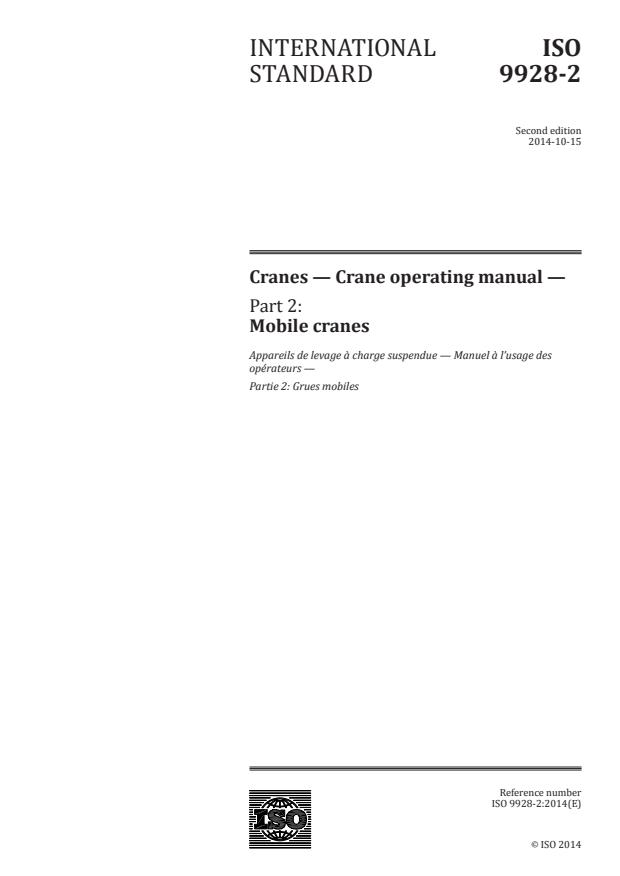
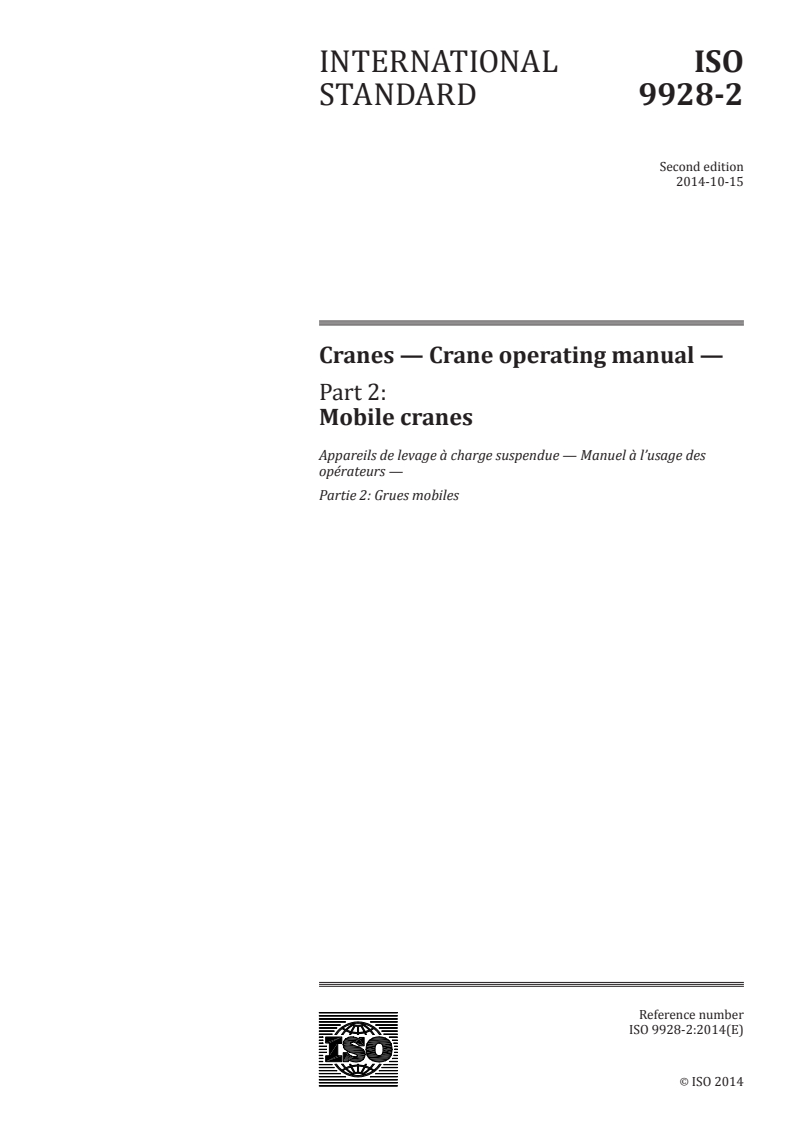
INTERNATIONAL ISO
STANDARD 9928-2
Second edition
2014-10-15
Cranes — Crane operating manual —
Part 2:
Mobile cranes
Appareils de levage à charge suspendue — Manuel à l’usage des
opérateurs —
Partie 2: Grues mobiles
Reference number
©
ISO 2014
© ISO 2014
All rights reserved. Unless otherwise specified, no part of this publication may be reproduced or utilized otherwise in any form
or by any means, electronic or mechanical, including photocopying, or posting on the internet or an intranet, without prior
written permission. Permission can be requested from either ISO at the address below or ISO’s member body in the country of
the requester.
ISO copyright office
Case postale 56 • CH-1211 Geneva 20
Tel. + 41 22 749 01 11
Fax + 41 22 749 09 47
E-mail copyright@iso.org
Web www.iso.org
Published in Switzerland
ii © ISO 2014 – All rights reserved
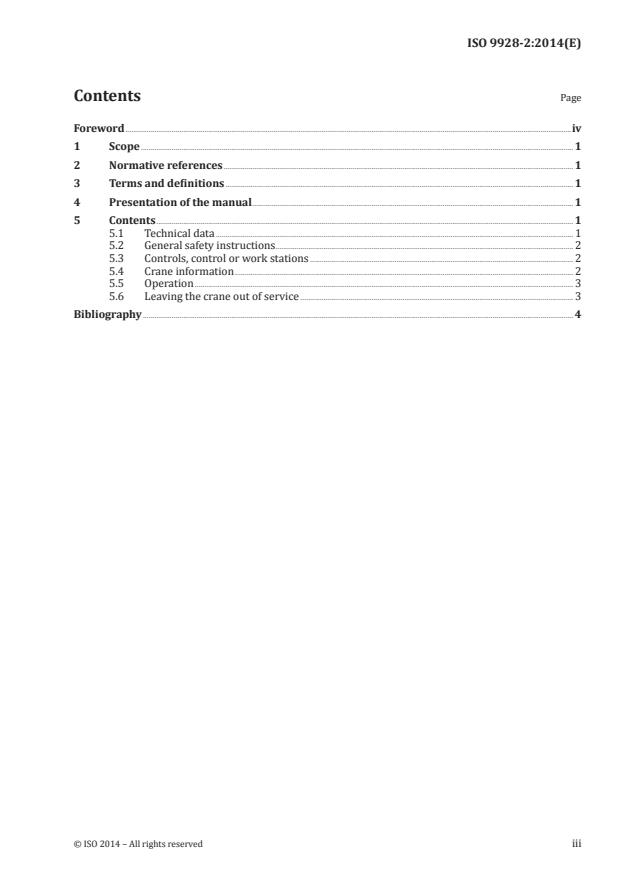
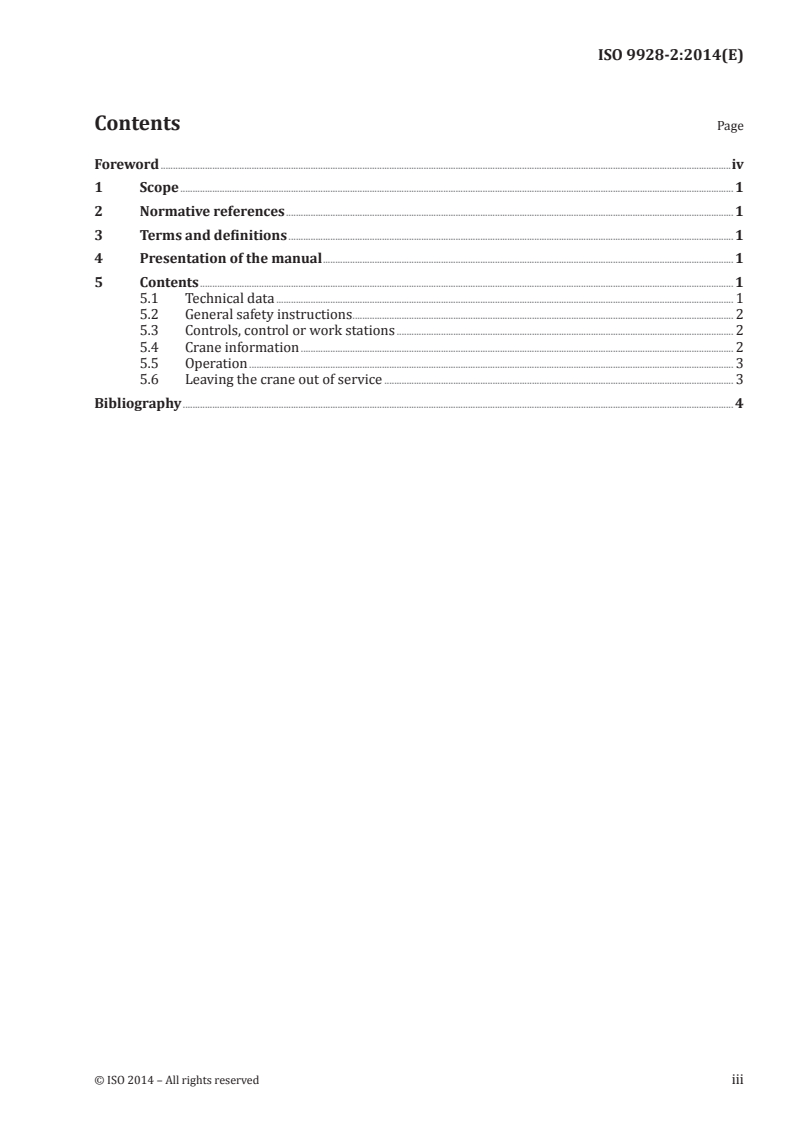
Contents Page
Foreword .iv
1 Scope . 1
2 Normative references . 1
3 Terms and definitions . 1
4 Presentation of the manual . 1
5 Contents . 1
5.1 Technical data . 1
5.2 General safety instructions . 2
5.3 Controls, control or work stations . 2
5.4 Crane information . 2
5.5 Operation . 3
5.6 Leaving the crane out of service . 3
Bibliography . 4
Foreword
ISO (the International Organization for Standardization) is a worldwide federation of national standards
bodies (ISO member bodies). The work of preparing International Standards is normally carried out
through ISO technical committees. Each member body interested in a subject for which a technical
committee has been established has the right to be represented on that committee. International
organizations, governmental and non-governmental, in liaison with ISO, also take part in the work.
ISO collaborates closely with the International Electrotechnical Commission (IEC) on all matters of
electrotechnical standardization.
The procedures used to develop this document and those intended for its further maintenance are
described in the ISO/IEC Directives, Part 1. In particular the different approval criteria needed for the
different types of ISO documents should be noted. This document was drafted in accordance with the
editorial rules of the ISO/IEC Directives, Part 2 (see www.iso.org/directives).
Attention is drawn to the possibility that some of the elements of this document may be the subject of
patent rights. ISO shall not be held responsible for identifying any or all such patent rights. Details of any
patent rights identified during the development of the document will be in the Introduction and/or on
the ISO list of patent declarations received (see www.iso.org/patents).
Any trade name used in this document is information given for the convenience of users and does not
constitute an endorsement.
For an explanation on the meaning of ISO specific terms and expressions related to conformity
assessment, as well as information about ISO’s adherence to the WTO principles in the Technical Barriers
to Trade (TBT) see the following URL: Foreword - Supplementary information
...
INTERNATIONAL ISO
STANDARD 9928-2
Second edition
2014-10-15
Cranes — Crane operating manual —
Part 2:
Mobile cranes
Appareils de levage à charge suspendue — Manuel à l’usage des
opérateurs —
Partie 2: Grues mobiles
Reference number
©
ISO 2014
© ISO 2014
All rights reserved. Unless otherwise specified, no part of this publication may be reproduced or utilized otherwise in any form
or by any means, electronic or mechanical, including photocopying, or posting on the internet or an intranet, without prior
written permission. Permission can be requested from either ISO at the address below or ISO’s member body in the country of
the requester.
ISO copyright office
Case postale 56 • CH-1211 Geneva 20
Tel. + 41 22 749 01 11
Fax + 41 22 749 09 47
E-mail copyright@iso.org
Web www.iso.org
Published in Switzerland
ii © ISO 2014 – All rights reserved
Contents Page
Foreword .iv
1 Scope . 1
2 Normative references . 1
3 Terms and definitions . 1
4 Presentation of the manual . 1
5 Contents . 1
5.1 Technical data . 1
5.2 General safety instructions . 2
5.3 Controls, control or work stations . 2
5.4 Crane information . 2
5.5 Operation . 3
5.6 Leaving the crane out of service . 3
Bibliography . 4
Foreword
ISO (the International Organization for Standardization) is a worldwide federation of national standards
bodies (ISO member bodies). The work of preparing International Standards is normally carried out
through ISO technical committees. Each member body interested in a subject for which a technical
committee has been established has the right to be represented on that committee. International
organizations, governmental and non-governmental, in liaison with ISO, also take part in the work.
ISO collaborates closely with the International Electrotechnical Commission (IEC) on all matters of
electrotechnical standardization.
The procedures used to develop this document and those intended for its further maintenance are
described in the ISO/IEC Directives, Part 1. In particular the different approval criteria needed for the
different types of ISO documents should be noted. This document was drafted in accordance with the
editorial rules of the ISO/IEC Directives, Part 2 (see www.iso.org/directives).
Attention is drawn to the possibility that some of the elements of this document may be the subject of
patent rights. ISO shall not be held responsible for identifying any or all such patent rights. Details of any
patent rights identified during the development of the document will be in the Introduction and/or on
the ISO list of patent declarations received (see www.iso.org/patents).
Any trade name used in this document is information given for the convenience of users and does not
constitute an endorsement.
For an explanation on the meaning of ISO specific terms and expressions related to conformity
assessment, as well as information about ISO’s adherence to the WTO principles in the Technical Barriers
to Trade (TBT) see the following URL: Foreword - Supplementary information
...