

ISO 8566-2:2016
(Main)Cranes — Cabins and control stations — Part 2: Mobile cranes
General Information
- Abstract
ISO 8566-2:2016 establishes the criteria for cabins for mobile cranes as defined in ISO 4306‑2. These criteria are intended to cover cabins only for crane operation and not for road travel. The general criteria for cabins on mobile cranes are presented in ISO 8566‑1.
- Status
- Published
- Publication Date
- 01-Feb-2016
- Technical Committee
- ISO/TC 96/SC 6 - Mobile cranes
- Drafting Committee
- ISO/TC 96/SC 6 - Mobile cranes
- Current Stage
- 9093 - International Standard confirmed
- Start Date
- 11-Jul-2022
- Completion Date
- 29-Aug-2026
Buy Documents
ISO 8566-2:2016 - Cranes -- Cabins and control stations
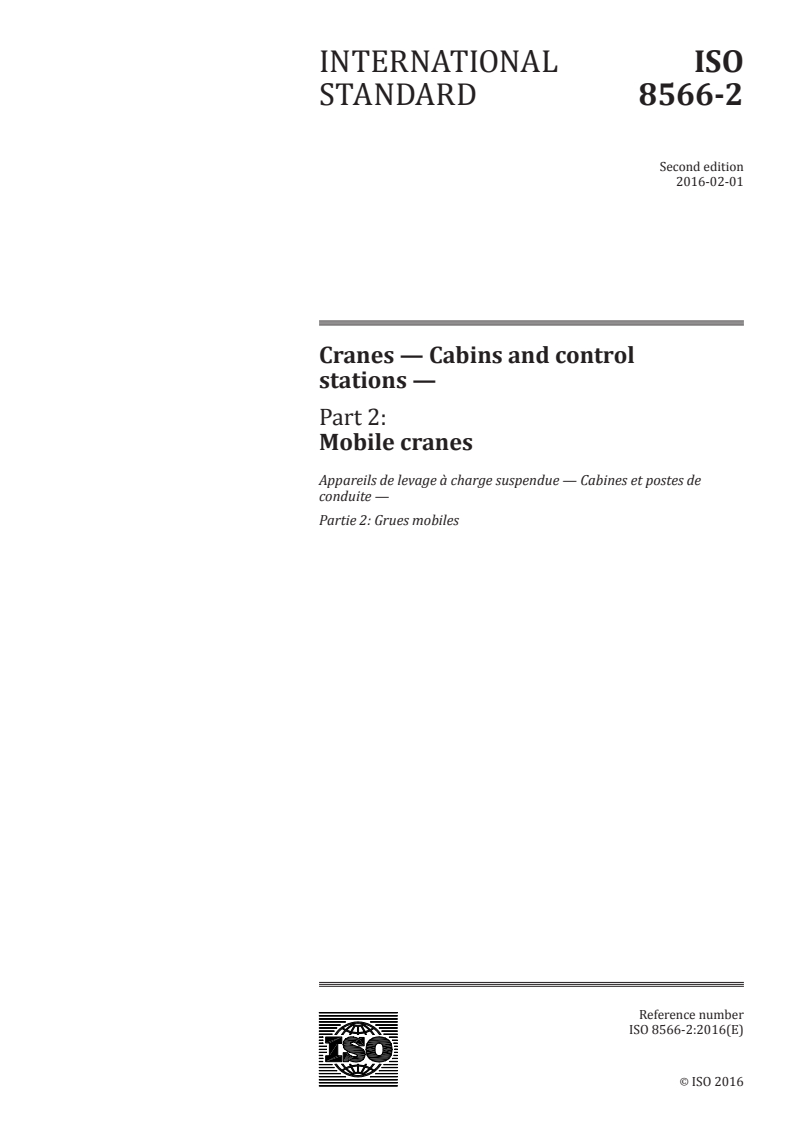

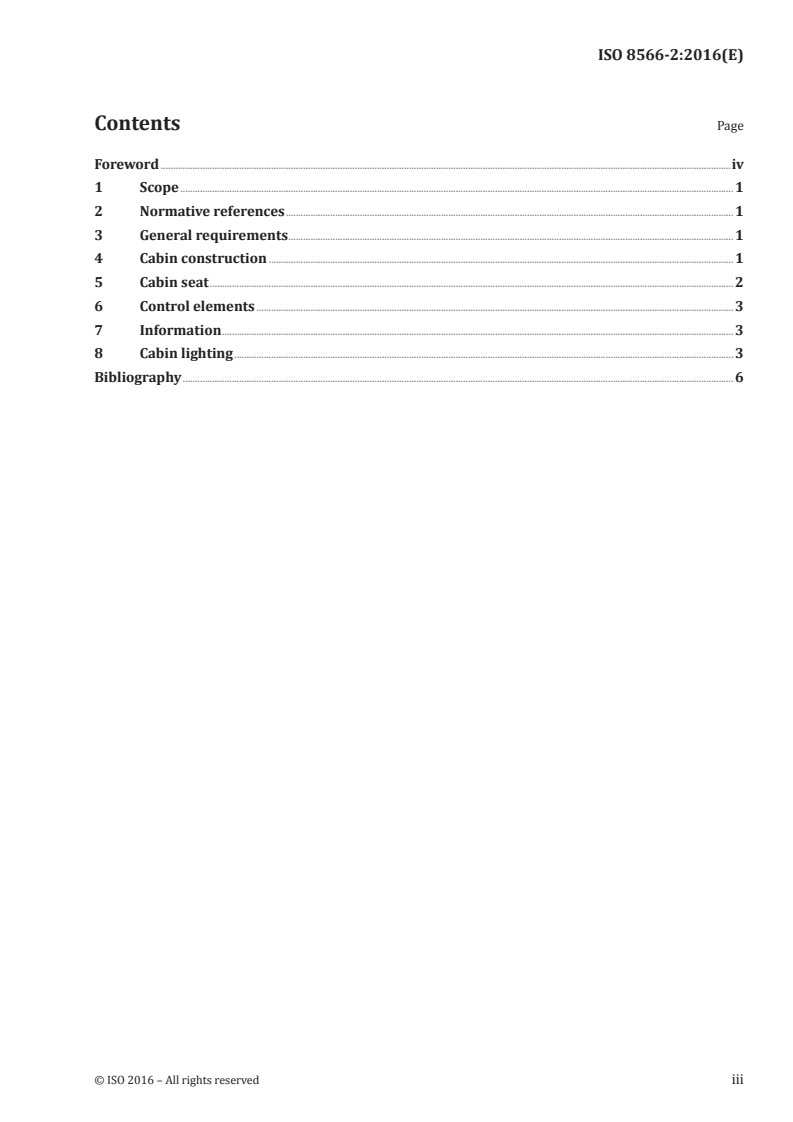
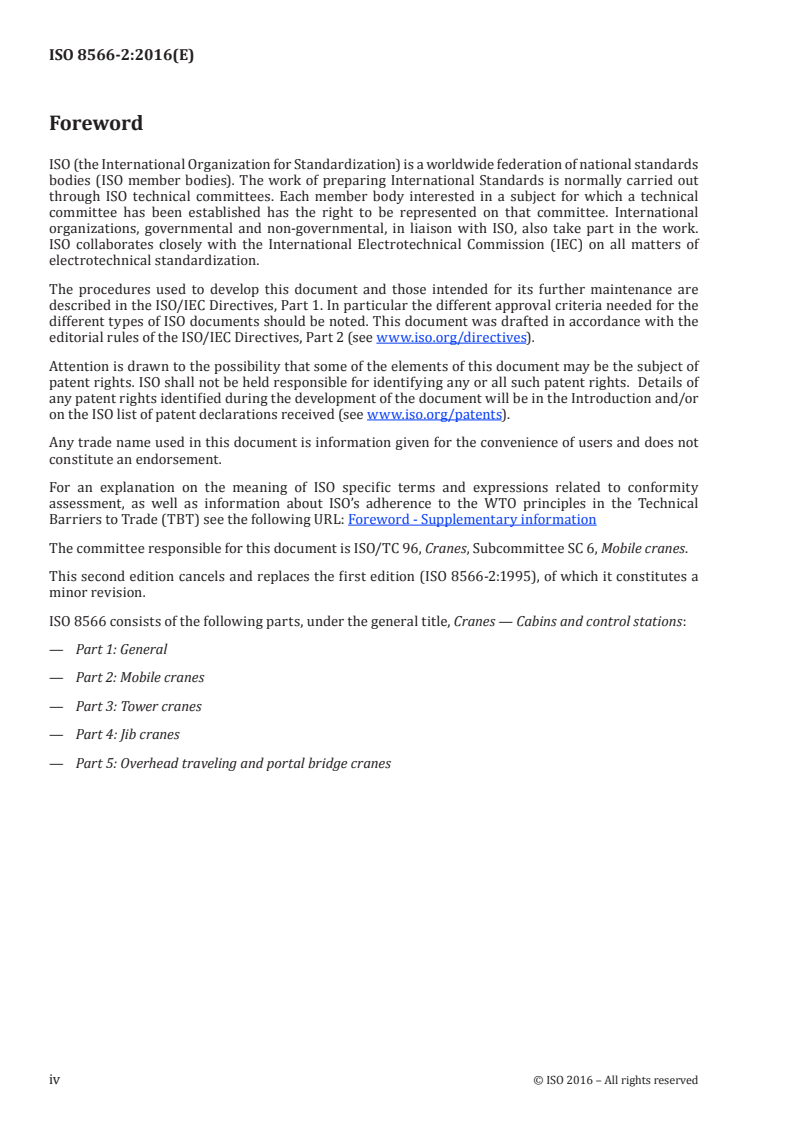
ISO 8566-2:2016 - Cranes — Cabins and control stations — Part 2: Mobile cranes/2/2016
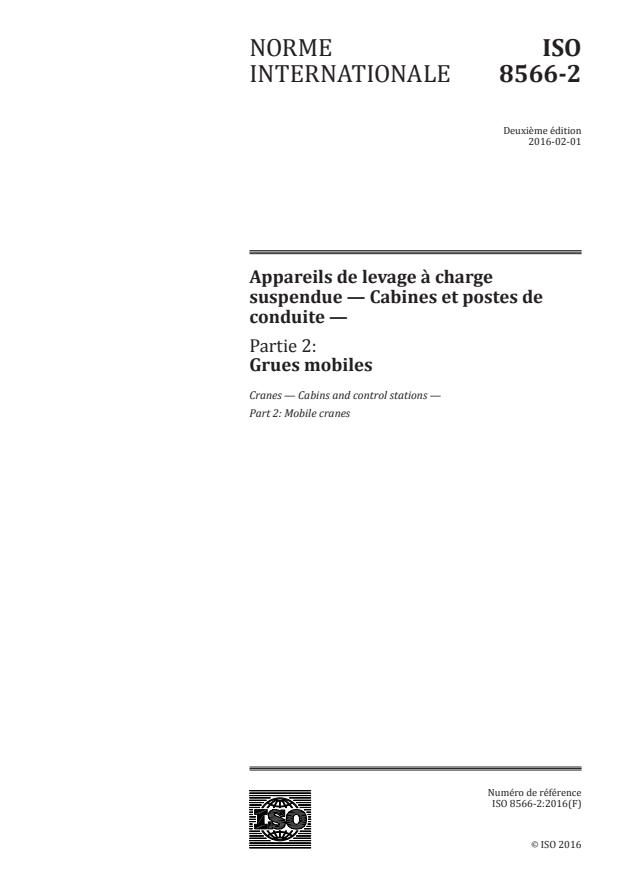
ISO 8566-2:2016 - Appareils de levage à charge suspendue -- Cabines et postes de conduite
ISO 8566-2:2016 - Appareils de levage à charge suspendue — Cabines et postes de conduite — Partie 2: Grues mobiles/2/2016
Overview
ISO 8566-2:2016 is an international standard that specifies the criteria for cabins used on mobile cranes as defined in ISO 4306‑2. This standard addresses cabins exclusively designed for crane operation-not for road travel-and supplements the general cabin requirements presented in ISO 8566-1. The focus is on ensuring operator safety, comfort, and effective control during crane lifting tasks.
The standard covers critical aspects of cabin construction, ergonomics, visibility, operator controls, lighting, and safety features for mobile crane cabins. It provides manufacturers and operators with clear guidelines on cabin design and operational requirements to support efficient and safe crane operation.
Key Topics
Cabin Construction
Cabins must be weatherproof and constructed with durable transparent safety glass for windows, ensuring operator protection and unobstructed visibility. Windows are required on the front, top/roof, and both sides, allowing visibility forward, upward, and laterally. Special attention is given to restricting openings near moving jib or hoist mechanisms to prevent injuries.Cabin Dimensions and Access
Minimum cabin dimensions for a one-operator space are defined to ensure sufficient operator room and comfort. Access to the cabin should include primary and alternative means such as ladders or steps, compliant with ISO 11660-2. Doors must have secure locking mechanisms and should prevent accidental opening during operation or travel.Operator Seating
Seats must be adjustable without tools, mount firmly, provide back support through an inclinable backrest, and incorporate vibration damping where needed. Width, depth, and height dimensions of seats are standardized to support operator ergonomics. Wheel-mounted cranes should include seat belts for transit safety, although not required if the operator only controls crane functions.Control Elements and Information
Control layout principles align with ISO 7752-2 to ensure intuitive and safe crane operation. Essential information such as rated capacity charts, hand-signal placards, operating range diagrams, and hazard notices must be clearly displayed within easy reach of the seated operator. Both durable hard copies and monitor-based information displays are permitted.Cabin Lighting
Illumination inside the cabin is mandatory to allow legibility of all critical information, including manuals, labels, and charts. Lighting fixtures must be permanently installed to provide adequate artificial illumination during operational hours.
Applications
ISO 8566-2:2016 is essential for manufacturers, designers, and operators of mobile cranes to:
- Design crane cabins that enhance operator safety and comfort during lifting operations.
- Ensure cabins provide clear visibility and effective control layouts, reducing operational risks.
- Comply with international safety regulations to facilitate global equipment acceptance.
- Improve operator ergonomics, reducing fatigue and enhancing productivity on construction sites, industrial facilities, and infrastructure projects.
- Guide maintenance and inspection regimes for cabins, focusing on structural integrity, control reliability, and operator environment conditions.
This standard is relevant to construction companies, crane rental firms, safety auditors, certification bodies, and regulatory authorities overseeing crane safety and operation.
Related Standards
- ISO 8566-1 - Cranes - Cabins and control stations - Part 1: General. Covers general cabin criteria applicable across crane types.
- ISO 4306-2 - Cranes - Vocabulary - Part 2: Mobile cranes. Provides definitions related to mobile crane components, including cabins.
- ISO 7752-2 - Cranes - Control layout and characteristics - Part 2: Basic arrangement and requirements for mobile cranes. Specifies control element layouts.
- ISO 11660-2 - Cranes - Access, guards and restraints - Part 2: Mobile cranes. Details safe access and restraint systems for mobile cranes.
- ISO 9942-1 - Cranes - Information labels - Part 1: General. Outlines information labeling requirements relevant to operator safety.
By adhering to ISO 8566-2:2016 and its companion standards, organizations can ensure mobile crane cabins meet stringent international safety, usability, and performance requirements, leading to safer crane operation worldwide.
Relations
- Effective Date
- 04-Nov-2015
Buy Documents
ISO 8566-2:2016 - Cranes -- Cabins and control stations
ISO 8566-2:2016 - Cranes — Cabins and control stations — Part 2: Mobile cranes/2/2016
ISO 8566-2:2016 - Appareils de levage à charge suspendue -- Cabines et postes de conduite
ISO 8566-2:2016 - Appareils de levage à charge suspendue — Cabines et postes de conduite — Partie 2: Grues mobiles/2/2016
Frequently Asked Questions
ISO 8566-2:2016 is a standard published by the International Organization for Standardization (ISO). Its full title is "Cranes — Cabins and control stations — Part 2: Mobile cranes". This standard covers: ISO 8566-2:2016 establishes the criteria for cabins for mobile cranes as defined in ISO 4306‑2. These criteria are intended to cover cabins only for crane operation and not for road travel. The general criteria for cabins on mobile cranes are presented in ISO 8566‑1.
ISO 8566-2:2016 establishes the criteria for cabins for mobile cranes as defined in ISO 4306‑2. These criteria are intended to cover cabins only for crane operation and not for road travel. The general criteria for cabins on mobile cranes are presented in ISO 8566‑1.
ISO 8566-2:2016 is classified under the following ICS (International Classification for Standards) categories: 53.020.20 - Cranes. The ICS classification helps identify the subject area and facilitates finding related standards.
ISO 8566-2:2016 has the following relationships with other standards: It is inter standard links to ISO 8566-2:1995. Understanding these relationships helps ensure you are using the most current and applicable version of the standard.
ISO 8566-2:2016 is available in PDF format for immediate download after purchase. The document can be added to your cart and obtained through the secure checkout process. Digital delivery ensures instant access to the complete standard document.
Standards Content (Sample)
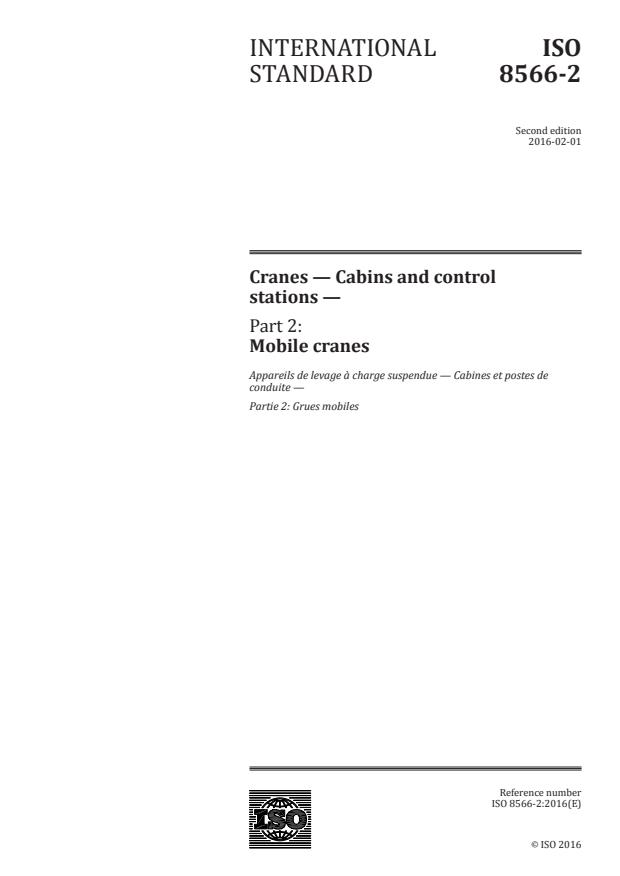
INTERNATIONAL ISO
STANDARD 8566-2
Second edition
2016-02-01
Cranes — Cabins and control
stations —
Part 2:
Mobile cranes
Appareils de levage à charge suspendue — Cabines et postes de
conduite —
Partie 2: Grues mobiles
Reference number
©
ISO 2016
© ISO 2016, Published in Switzerland
All rights reserved. Unless otherwise specified, no part of this publication may be reproduced or utilized otherwise in any form
or by any means, electronic or mechanical, including photocopying, or posting on the internet or an intranet, without prior
written permission. Permission can be requested from either ISO at the address below or ISO’s member body in the country of
the requester.
ISO copyright office
Ch. de Blandonnet 8 • CP 401
CH-1214 Vernier, Geneva, Switzerland
Tel. +41 22 749 01 11
Fax +41 22 749 09 47
copyright@iso.org
www.iso.org
ii © ISO 2016 – All rights reserved
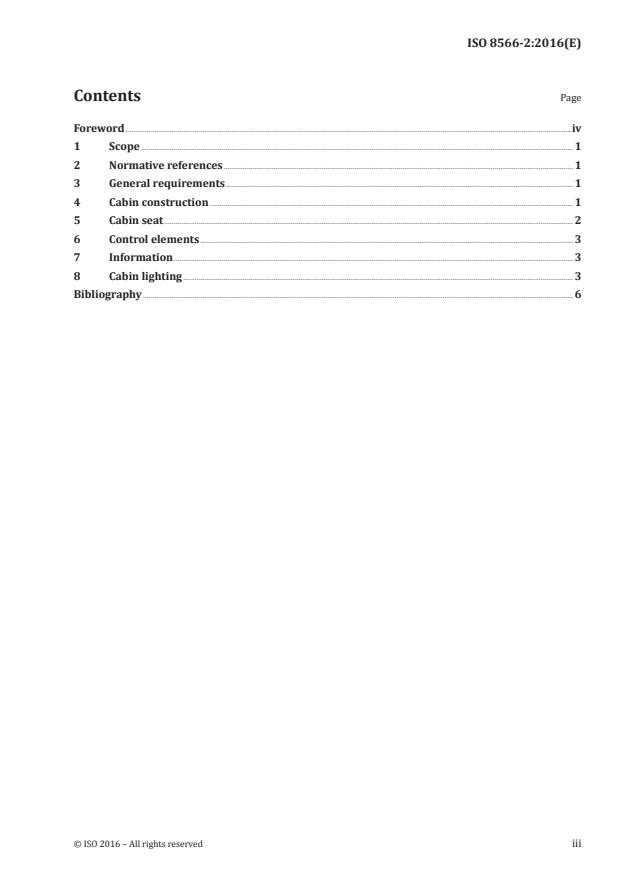
Contents Page
Foreword .iv
1 Scope . 1
2 Normative references . 1
3 General requirements . 1
4 Cabin construction . 1
5 Cabin seat . 2
6 Control elements . 3
7 Information . 3
8 Cabin lighting . 3
Bibliography . 6
Foreword
ISO (the International Organization for Standardization) is a worldwide federation of national standards
bodies (ISO member bodies). The work of preparing International Standards is normally carried out
through ISO technical committees. Each member body interested in a subject for which a technical
committee has been established has the right to be represented on that committee. International
organizations, governmental and non-governmental, in liaison with ISO, also take part in the work.
ISO collaborates closely with the International Electrotechnical Commission (IEC) on all matters of
electrotechnical standardization.
The procedures used to develop this document and those intended for its further maintenance are
described in the ISO/IEC Directives, Part 1. In particular the different approval criteria needed for the
different types of ISO documents should be noted. This document was drafted in accordance with the
editorial rules of the ISO/IEC Directives, Part 2 (see www.iso.org/directives).
Attention is drawn to the possibility that some of the elements of this document may be the subject of
patent rights. ISO shall not be held responsible for identifying any or all such patent rights. Details of
any patent rights identified during the development of the document will be in the Introduction and/or
on the ISO list of patent declarations received (see www.iso.org/patents).
Any trade name used in this document is information given for the convenience of users and does not
constitute an endorsement.
For an explanation on the meaning of ISO specific terms and expressions related to conformity
assessment, as well as information about ISO’s adherence to the WTO principles in the Technical
Barriers to Trade (TBT) see the following URL: Foreword - Supplementary information
The committee responsible for this document is ISO/TC 96, Cranes, Subcommittee SC 6, Mobile cranes.
This second edition cancels and replaces the first edition (ISO 8566-2:1995), of which it constitutes a
minor revision.
ISO 8566 consists of the following parts, under the general title, Cranes — Cabins and control stations:
— Part 1: General
— Part 2: Mobile cranes
— Part 3: Tower cranes
— Part 4: Jib cranes
— Part 5: Overhead traveling and portal bridge cranes
iv © ISO 2016 – All rights reserved
INTERNATIONAL STANDARD ISO 8566-2:2016(E)
Cranes — Cabins and control stations —
Part 2:
Mobile cranes
1 Scope
This part of ISO 8566 establishes the criteria for cabins for mobile cranes as defined in ISO 4306-2.
These criteria are intended to cover cabins only for crane operation and not for road travel.
The general criteria for cabins on mobile cranes are presented in ISO 8566-1.
2 Normative references
The following documents, in whole or in part, are normatively referenced in this document and are
indispensable for its application. For dated references, only the edition cited applies. For undated
references, the latest edition of the referenced document (including any amendments) applies.
ISO 7752-2, Cranes — Control layout and characteristics — Part 2: Basic arrangement and requirements
for mobile cranes
ISO 8566-1, Cranes — Cabins and control stations — Part 1: General
ISO 11660-2, Cranes — Access, guards and restraints — Part 2: Mobile cranes
3 General requirements
3.1 The general requirements for mobile crane cabins may apply to the operation of the crane for
lifting and for job-site travel.
3.2 The general requirements for the cabin, including those concerning visibility, noise and vibration,
shall be in accordance with ISO 8566-1.
4 Cabin construc
...
INTERNATIONAL ISO
STANDARD 8566-2
Second edition
2016-02-01
Cranes — Cabins and control
stations —
Part 2:
Mobile cranes
Appareils de levage à charge suspendue — Cabines et postes de
conduite —
Partie 2: Grues mobiles
Reference number
©
ISO 2016
© ISO 2016, Published in Switzerland
All rights reserved. Unless otherwise specified, no part of this publication may be reproduced or utilized otherwise in any form
or by any means, electronic or mechanical, including photocopying, or posting on the internet or an intranet, without prior
written permission. Permission can be requested from either ISO at the address below or ISO’s member body in the country of
the requester.
ISO copyright office
Ch. de Blandonnet 8 • CP 401
CH-1214 Vernier, Geneva, Switzerland
Tel. +41 22 749 01 11
Fax +41 22 749 09 47
copyright@iso.org
www.iso.org
ii © ISO 2016 – All rights reserved
Contents Page
Foreword .iv
1 Scope . 1
2 Normative references . 1
3 General requirements . 1
4 Cabin construction . 1
5 Cabin seat . 2
6 Control elements . 3
7 Information . 3
8 Cabin lighting . 3
Bibliography . 6
Foreword
ISO (the International Organization for Standardization) is a worldwide federation of national standards
bodies (ISO member bodies). The work of preparing International Standards is normally carried out
through ISO technical committees. Each member body interested in a subject for which a technical
committee has been established has the right to be represented on that committee. International
organizations, governmental and non-governmental, in liaison with ISO, also take part in the work.
ISO collaborates closely with the International Electrotechnical Commission (IEC) on all matters of
electrotechnical standardization.
The procedures used to develop this document and those intended for its further maintenance are
described in the ISO/IEC Directives, Part 1. In particular the different approval criteria needed for the
different types of ISO documents should be noted. This document was drafted in accordance with the
editorial rules of the ISO/IEC Directives, Part 2 (see www.iso.org/directives).
Attention is drawn to the possibility that some of the elements of this document may be the subject of
patent rights. ISO shall not be held responsible for identifying any or all such patent rights. Details of
any patent rights identified during the development of the document will be in the Introduction and/or
on the ISO list of patent declarations received (see www.iso.org/patents).
Any trade name used in this document is information given for the convenience of users and does not
constitute an endorsement.
For an explanation on the meaning of ISO specific terms and expressions related to conformity
assessment, as well as information about ISO’s adherence to the WTO principles in the Technical
Barriers to Trade (TBT) see the following URL: Foreword - Supplementary information
The committee responsible for this document is ISO/TC 96, Cranes, Subcommittee SC 6, Mobile cranes.
This second edition cancels and replaces the first edition (ISO 8566-2:1995), of which it constitutes a
minor revision.
ISO 8566 consists of the following parts, under the general title, Cranes — Cabins and control stations:
— Part 1: General
— Part 2: Mobile cranes
— Part 3: Tower cranes
— Part 4: Jib cranes
— Part 5: Overhead traveling and portal bridge cranes
iv © ISO 2016 – All rights reserved
INTERNATIONAL STANDARD ISO 8566-2:2016(E)
Cranes — Cabins and control stations —
Part 2:
Mobile cranes
1 Scope
This part of ISO 8566 establishes the criteria for cabins for mobile cranes as defined in ISO 4306-2.
These criteria are intended to cover cabins only for crane operation and not for road travel.
The general criteria for cabins on mobile cranes are presented in ISO 8566-1.
2 Normative references
The following documents, in whole or in part, are normatively referenced in this document and are
indispensable for its application. For dated references, only the edition cited applies. For undated
references, the latest edition of the referenced document (including any amendments) applies.
ISO 7752-2, Cranes — Control layout and characteristics — Part 2: Basic arrangement and requirements
for mobile cranes
ISO 8566-1, Cranes — Cabins and control stations — Part 1: General
ISO 11660-2, Cranes — Access, guards and restraints — Part 2: Mobile cranes
3 General requirements
3.1 The general requirements for mobile crane cabins may apply to the operation of the crane for
lifting and for job-site travel.
3.2 The general requirements for the cabin, including those concerning visibility, noise and vibration,
shall be in accordance with ISO 8566-1.
4 Cabin construc
...
NORME ISO
INTERNATIONALE 8566-2
Deuxième édition
2016-02-01
Appareils de levage à charge
suspendue — Cabines et postes de
conduite —
Partie 2:
Grues mobiles
Cranes — Cabins and control stations —
Part 2: Mobile cranes
Numéro de référence
©
ISO 2016
DOCUMENT PROTÉGÉ PAR COPYRIGHT
© ISO 2016, Publié en Suisse
Droits de reproduction réservés. Sauf indication contraire, aucune partie de cette publication ne peut être reproduite ni utilisée
sous quelque forme que ce soit et par aucun procédé, électronique ou mécanique, y compris la photocopie, l’affichage sur
l’internet ou sur un Intranet, sans autorisation écrite préalable. Les demandes d’autorisation peuvent être adressées à l’ISO à
l’adresse ci-après ou au comité membre de l’ISO dans le pays du demandeur.
ISO copyright office
Ch. de Blandonnet 8 • CP 401
CH-1214 Vernier, Geneva, Switzerland
Tel. +41 22 749 01 11
Fax +41 22 749 09 47
copyright@iso.org
www.iso.org
ii © ISO 2016 – Tous droits réservés
Sommaire Page
Avant-propos .iv
1 Domaine d’application . 1
2 Références normatives . 1
3 Exigences générales . 1
4 Construction de la cabine . 1
5 Siège de cabine . 2
6 Organes de service . 3
7 Information . 3
8 Éclairage de la cabine . 3
Bibliographie . 6
Avant-propos
L’ISO (Organisation internationale de normalisation) est une fédération mondiale d’organismes
nationaux de normalisation (comités membres de l’ISO). L’élaboration des Normes internationales est
en général confiée aux comités techniques de l’ISO. Chaque comité membre intéressé par une étude
a le droit de faire partie du comité technique créé à cet effet. Les organisations internationales,
gouvernementales et non gouvernementales, en liaison avec l’ISO participent également aux travaux.
L’ISO collabore étroitement avec la Commission électrotechnique internationale (IEC) en ce qui
concerne la normalisation électrotechnique.
Les procédures utilisées pour élaborer le présent document et celles destinées à sa mise à jour sont
décrites dans les Directives ISO/IEC, Partie 1. Il convient, en particulier de prendre note des différents
critères d’approbation requis pour les différents types de documents ISO. Le présent document a été
rédigé conformément aux règles de rédaction données dans les Directives ISO/IEC, Partie 2 (voir www.
iso.org/directives).
L’attention est appelée sur le fait que certains des éléments du présent document peuvent faire l’objet de
droits de propriété intellectuelle ou de droits analogues. L’ISO ne saurait être tenue pour responsable
de ne pas avoir identifié de tels droits de propriété et averti de leur existence. Les détails concernant
les références aux droits de propriété intellectuelle ou autres droits analogues identifiés lors de
l’élaboration du document sont indiqués dans l’Introduction et/ou dans la liste des déclarations de
brevets reçues par l’ISO (voir www.iso.org/brevets).
Les appellations commerciales éventuellement mentionnées dans le présent document sont données
pour information, par souci de commodité, à l’intention des utilisateurs et ne sauraient constituer
un engagement.
Pour une explication de la signification des termes et expressions spécifiques de l’ISO liés à
l’évaluation de la conformité, ou pour toute information au sujet de l’adhésion de l’ISO aux principes
de l’OMC concernant les obstacles techniques au commerce (OTC), voir le lien suivant: Avant-propos —
Informations supplémentaires.
Le comité responsable de l’élaboration du présent document est ISO/TC 96, Appareils de levage à charge
suspendue, sous-comité SC 6, Grues mobiles.
Cette deuxième édition annule et remplace la première édition (ISO 8566-2:1995), qui fait l’objet d’une
révision mineure.
L’ISO 8566 comprend les parties suivantes, présentées sous le titre général Appareils de levage à charge
suspendue - Cabines et postes de conduite:
— Partie 1: Généralités
— Partie 2: Grues mobiles
— Partie 3: Grues à tour
— Partie 4: Grues à flèche
— Partie 5: Ponts roulants et ponts portiques
iv © ISO 2016 – Tous droits réservés
NORME INTERNATIONALE ISO 8566-2:2016(F)
Appareils de levage à charge suspendue — Cabines et
postes de conduite —
Partie 2:
Grues mobiles
1 Domaine d’application
La présente partie de l’ISO 8566 prescrit les critères auxquels doivent satisfaire les cabines de grues
mobiles telles que définies dans l’ISO 4306-2. Ces critères ne couvrent que les cabines pour la manœuvre
de la grue et non celles pour le déplacement sur route.
Les critères généraux pour les cabines de grues mobiles sont présentées dans l’ISO 8566-1.
2 Références normatives
Les documents de référence suivants sont indispensables pour l’application du présent document. Pour
les références datées, seule l’édition citée s’applique. Pour les références non datées, la dernière édition
du document de référence s’applique (y compris les éventuels amendements).
ISO 7752-2, Appareils de levage à charge suspendue — Disposition et caractéristiques des commandes —
Partie 2: Disposition et exigences de base pour les grues mobiles
ISO 8566-1, Appareils de levage à charge suspendue — Cabines et postes de conduite — Partie 1: Généralités
ISO 11660-2, Appareils de levage à charge suspendue — Moyens d’accès, dispositifs de protection et de
retenue — Partie 2: Grues mobiles
3 Exigences générales
3.1 Les exigences générales relatives aux cabines des grues mobiles peuvent s’appliquer au
fonctionnement de la grue pour le levage et celui pour le déplacement sur le chantier.
3.2 Les exigences générales relatives à la cabine, y compris celles concernant la visibilité, le bruit et les
vibrations, doivent être conformes à celles spécifiées dans l’ISO 8566-1.
4 Construction de la cabine
4.1 Les cabines et enceintes doivent être construites de façon à protéger des intempéries le poste de
conduite.
4.2 Des fenêtres doivent être prévues
...
NORME ISO
INTERNATIONALE 8566-2
Deuxième édition
2016-02-01
Appareils de levage à charge
suspendue — Cabines et postes de
conduite —
Partie 2:
Grues mobiles
Cranes — Cabins and control stations —
Part 2: Mobile cranes
Numéro de référence
©
ISO 2016
DOCUMENT PROTÉGÉ PAR COPYRIGHT
© ISO 2016, Publié en Suisse
Droits de reproduction réservés. Sauf indication contraire, aucune partie de cette publication ne peut être reproduite ni utilisée
sous quelque forme que ce soit et par aucun procédé, électronique ou mécanique, y compris la photocopie, l’affichage sur
l’internet ou sur un Intranet, sans autorisation écrite préalable. Les demandes d’autorisation peuvent être adressées à l’ISO à
l’adresse ci-après ou au comité membre de l’ISO dans le pays du demandeur.
ISO copyright office
Ch. de Blandonnet 8 • CP 401
CH-1214 Vernier, Geneva, Switzerland
Tel. +41 22 749 01 11
Fax +41 22 749 09 47
copyright@iso.org
www.iso.org
ii © ISO 2016 – Tous droits réservés
Sommaire Page
Avant-propos .iv
1 Domaine d’application . 1
2 Références normatives . 1
3 Exigences générales . 1
4 Construction de la cabine . 1
5 Siège de cabine . 2
6 Organes de service . 3
7 Information . 3
8 Éclairage de la cabine . 3
Bibliographie . 6
Avant-propos
L’ISO (Organisation internationale de normalisation) est une fédération mondiale d’organismes
nationaux de normalisation (comités membres de l’ISO). L’élaboration des Normes internationales est
en général confiée aux comités techniques de l’ISO. Chaque comité membre intéressé par une étude
a le droit de faire partie du comité technique créé à cet effet. Les organisations internationales,
gouvernementales et non gouvernementales, en liaison avec l’ISO participent également aux travaux.
L’ISO collabore étroitement avec la Commission électrotechnique internationale (IEC) en ce qui
concerne la normalisation électrotechnique.
Les procédures utilisées pour élaborer le présent document et celles destinées à sa mise à jour sont
décrites dans les Directives ISO/IEC, Partie 1. Il convient, en particulier de prendre note des différents
critères d’approbation requis pour les différents types de documents ISO. Le présent document a été
rédigé conformément aux règles de rédaction données dans les Directives ISO/IEC, Partie 2 (voir www.
iso.org/directives).
L’attention est appelée sur le fait que certains des éléments du présent document peuvent faire l’objet de
droits de propriété intellectuelle ou de droits analogues. L’ISO ne saurait être tenue pour responsable
de ne pas avoir identifié de tels droits de propriété et averti de leur existence. Les détails concernant
les références aux droits de propriété intellectuelle ou autres droits analogues identifiés lors de
l’élaboration du document sont indiqués dans l’Introduction et/ou dans la liste des déclarations de
brevets reçues par l’ISO (voir www.iso.org/brevets).
Les appellations commerciales éventuellement mentionnées dans le présent document sont données
pour information, par souci de commodité, à l’intention des utilisateurs et ne sauraient constituer
un engagement.
Pour une explication de la signification des termes et expressions spécifiques de l’ISO liés à
l’évaluation de la conformité, ou pour toute information au sujet de l’adhésion de l’ISO aux principes
de l’OMC concernant les obstacles techniques au commerce (OTC), voir le lien suivant: Avant-propos —
Informations supplémentaires.
Le comité responsable de l’élaboration du présent document est ISO/TC 96, Appareils de levage à charge
suspendue, sous-comité SC 6, Grues mobiles.
Cette deuxième édition annule et remplace la première édition (ISO 8566-2:1995), qui fait l’objet d’une
révision mineure.
L’ISO 8566 comprend les parties suivantes, présentées sous le titre général Appareils de levage à charge
suspendue - Cabines et postes de conduite:
— Partie 1: Généralités
— Partie 2: Grues mobiles
— Partie 3: Grues à tour
— Partie 4: Grues à flèche
— Partie 5: Ponts roulants et ponts portiques
iv © ISO 2016 – Tous droits réservés
NORME INTERNATIONALE ISO 8566-2:2016(F)
Appareils de levage à charge suspendue — Cabines et
postes de conduite —
Partie 2:
Grues mobiles
1 Domaine d’application
La présente partie de l’ISO 8566 prescrit les critères auxquels doivent satisfaire les cabines de grues
mobiles telles que définies dans l’ISO 4306-2. Ces critères ne couvrent que les cabines pour la manœuvre
de la grue et non celles pour le déplacement sur route.
Les critères généraux pour les cabines de grues mobiles sont présentées dans l’ISO 8566-1.
2 Références normatives
Les documents de référence suivants sont indispensables pour l’application du présent document. Pour
les références datées, seule l’édition citée s’applique. Pour les références non datées, la dernière édition
du document de référence s’applique (y compris les éventuels amendements).
ISO 7752-2, Appareils de levage à charge suspendue — Disposition et caractéristiques des commandes —
Partie 2: Disposition et exigences de base pour les grues mobiles
ISO 8566-1, Appareils de levage à charge suspendue — Cabines et postes de conduite — Partie 1: Généralités
ISO 11660-2, Appareils de levage à charge suspendue — Moyens d’accès, dispositifs de protection et de
retenue — Partie 2: Grues mobiles
3 Exigences générales
3.1 Les exigences générales relatives aux cabines des grues mobiles peuvent s’appliquer au
fonctionnement de la grue pour le levage et celui pour le déplacement sur le chantier.
3.2 Les exigences générales relatives à la cabine, y compris celles concernant la visibilité, le bruit et les
vibrations, doivent être conformes à celles spécifiées dans l’ISO 8566-1.
4 Construction de la cabine
4.1 Les cabines et enceintes doivent être construites de façon à protéger des intempéries le poste de
conduite.
4.2 Des fenêtres doivent être prévues
...