

ISO 8104-1
(Main)Improvement of safety and accessibility on existing lifts, escalators and moving walks — Part 1: Improvement of safety of passengers and goods passenger lifts
- Abstract
1.1 This document gives a methodology for improving the safety of existing passenger and goods passenger lifts with the aim of reaching an equivalent level of safety to that of a newly installed lifts by the application of today’s state-of-the-art for safety. 1.1 This document gives a methodology for improving the safety of existing passenger and goods passenger lifts with the aim of reaching an equivalent level of safety to that of a newly installed lifts by the application of today’s state-of-the-art for safety. This document prioritizes improvements of safety based on objective hazard analysis but does not define a methodology for achieving full compliance to current standards for new installations. NOTE Due to situations such as the building design, etc. it may not be possible in all cases to reach today’s state-of-the-art for safety. This document applies to permanently installed passenger or goods passenger lifts, with traction, positive or hydraulic drive serving defined landing levels, having a car designed for the transportation of persons or persons and goods and moving along guide rails inclined not more than 15° to the vertical. This document includes the improvement of safety of existing lifts for: a) passengers; b) maintenance and inspection personnel; c) persons outside the well, machinery space(s) and the pulley room(s) (but in their immediate vicinity); d) any other authorized persons. 1.2 This document is not applicable to: e) lifts with drive systems others than those mentioned above; f) lifting appliances such as paternosters, mine lifts, theatre lifts, appliances with automatic caging, skips, lifts and hoists for building and public works sites, ships’ hoists, platforms for exploration or drilling at sea, construction and maintenance appliances; g) installations where the inclination of the guide rails to the vertical exceeds 15°; h) lifting appliances with a rated speed lower than or equal to 0,15 m/s; i) safety during transport, installation, repairs and dismantling of lifts. However, this document can usefully be taken as a reference basis. 1.3 This document does not cover a) Improvement of safety for specific items like vandalism, seismic conditions, fire issues, etc. b) Improvement of accessibility
- Status
- Not Published
- Technical Committee
- ISO/TC 178 - Lifts, escalators and moving walks
- Current Stage
- 6000 - International Standard under publication - 60 Publication
- Start Date
- 22-Oct-2026
Buy Documents

ISO/FDIS 8104-1 - Improvement of safety and accessibility on existing lifts, escalators and moving walks — Part 1: Improvement of safety of passengers and goods passenger lifts
REDLINE ISO/FDIS 8104-1 - Improvement of safety and accessibility on existing lifts, escalators and moving walks — Part 1: Improvement of safety of passengers and goods passenger lifts
ISO 8104-1 is an ISO document for improving the safety of existing passenger and goods passenger lifts. It sets out a risk-based methodology for bringing those lifts closer to the safety level of newly installed lifts by using today’s state of the art for safety. Although the series title mentions accessibility, this part focuses on safety, not accessibility improvements.
What does ISO 8104-1 specify?
ISO 8104-1 specifies a method for assessing hazards on existing lifts and selecting safety upgrades in a staged way. It applies to permanently installed passenger and goods passenger lifts with traction, positive or hydraulic drive, serving defined landing levels, with guide rails inclined not more than 15° to the vertical.
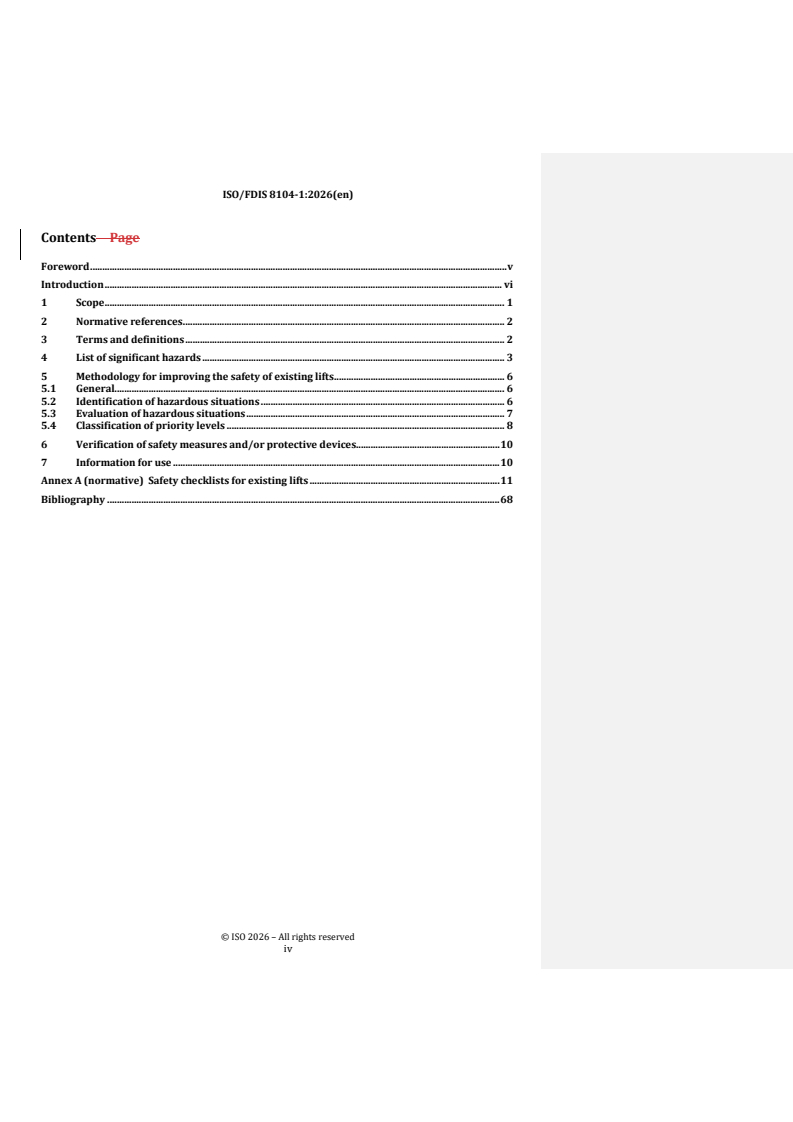
The document is organized into seven clauses and one normative annex.
| Part of the document | What it covers |
|---|---|
| Clauses 1-3 | Scope, normative references, and terms and definitions |
| Clause 4 | List of significant hazards |
| Clause 5 | Methodology for improving the safety of existing lifts |
| Clause 6 | Verification of safety measures and/or protective devices |
| Clause 7 | Information for use |
| Annex A | Safety checklists for existing lifts |
ISO 8104-1 excludes other drive systems, several special-purpose lifting appliances, installations with guide rails inclined more than 15°, very slow lifting appliances at or below 0.15 m/s, and safety during transport, installation, repairs and dismantling. It also does not cover specific issues such as vandalism, seismic conditions, fire issues, or accessibility improvements.
What are the key requirements of ISO 8104-1?
Risk-based upgrading is the core approach
ISO 8104-1 requires upgrades to be planned from an objective hazard analysis, not as a one-step rewrite to a new-installation standard. Clause 5.1 says technical solutions should match state-of-the-art new-lift solutions as far as possible, while still allowing alternative measures if they achieve an equivalent or higher safety level.
In practice, this means an owner or inspector can choose a different technical solution if it delivers the same safety result. Where a residual risk remains, the document calls for measures such as signs, instructions, and training.
Annex A is the main tool for identifying hazards
ISO 8104-1 uses Annex A as the checklist tool for identifying hazardous situations on a specific lift. Clause 5.2 says the checklist covers the hazardous situations listed in Clause 4, and that additional risk assessment is needed when a very old lift or special technology creates hazards not covered by the document.
This matters because the method is not limited to paper compliance. A technically competent person is expected to inspect the installation, identify the relevant hazards, and act immediately if extreme risks are found.
Hazards are grouped so upgrades can be prioritized
ISO 8104-1 does not treat all hazards the same. Clause 5.3 evaluates the hazards against a risk profile, and Clause 5.4 converts that profile into four priority levels - extreme, high, medium and low - so upgrades can be scheduled over time.
The document also adapts the ISO 14798 risk profile by splitting probability level D into C-D, D and D-E. In practice, that helps owners decide which measures need immediate action and which can be planned for later modernization.
Clause 4 provides the hazard map for the whole lift
ISO 8104-1 lists significant hazards across the full installation, including the well, machinery spaces, landing doors and car doors, the car, suspension means, guide rails, lift machine, electric installations, controls, and notices and markings.
That list matters because it tells an auditor where to look first. It also shows the document is not limited to one component - it is a whole-lift safety review.
Verification after modification is required
ISO 8104-1 requires modified lifts to be examined and tested again before being returned to service. Clause 6 says those checks must use applicable state-of-the-art standards, and they must include associated components and systems that may be affected by the modification.
This is important in practice because one retrofit can alter another part of the lift. The document expects the verification to cover the full functional impact, not only the changed component.
Records and user information must be updated
ISO 8104-1 requires documentation for components that are modified, replaced, or added. Clause 7 also requires important modifications to be recorded in the technical part of the register or file according to ISO 8100-1:2019.
For owners and maintainers, this means the retrofit history must stay traceable. That makes later inspections, further upgrades, and risk reviews easier.
If a hazard is still present, operational measures are needed
ISO 8104-1 says that when a residual risk cannot be eliminated, appropriate measures such as signs, instructions, and training shall be given. It also says remaining hazardous situations should be documented for future upgrades and periodic re-audits.
In practice, the document supports both engineering controls and operational controls. That is useful when a building constraint prevents a full technical solution.
What terms does ISO 8104-1 define?
ISO 8104-1 defines existing lift as a lift that is already in service.
The document uses hazardous situation for a condition or event on the lift that has to be assessed and, where needed, reduced.
It uses state-of-the-art for safety as the current benchmark for safety measures applied to new lifts, which is the reference point for upgrades.
A priority level is the way the document ranks hazards so that improvements can be staged as extreme, high, medium, or low.
Residual risk is the risk that remains after the chosen protective measures have been applied, and it must be documented if it cannot be removed.
Risk assessment is the method used to evaluate hazards before selecting corrective actions.
Who uses ISO 8104-1?
ISO 8104-1 is written for national authorities that set or filter modernization programs for existing lifts. It is also for lift owners, who need a structured way to improve safety within regulatory and budget limits.
Maintenance companies and inspection bodies use it to audit installations, explain the current safety level, and propose risk reduction measures. Lift engineers, modernization contractors, and building managers use it to plan staged upgrades, record residual risks, and verify the effect of changes on the whole installation.
Which standards are used with ISO 8104-1?
ISO 8104-1 references several standards that support the upgrade method:
- ISO 8100-1:2019 - base safety rules for new passenger and goods passenger lifts; Annex A compares many retrofit measures against it.
- ISO 13857:2019 - safety distances used where guarding or clearance limits are needed.
- ASME A17.1-2022/CSA B44:22 - North American elevator and escalator code used in Annex A.
- ASME A17.3-2020 - existing-elevator code used for retrofit comparison in Annex A.
- ASME A17.7-2007/CSA B44:07 - performance-based code for solutions outside prescriptive A17.1 requirements.
- EN 81-21:2022 - used where retrofit solutions for existing buildings are discussed in Annex A.
- EN 81-28:2022 - supports the remote alarm and two-way voice communication measures.
- EN 81-58:2022 - supports landing door fire resistance test-related measures.
- JIS A 4307-1:2019 - Japanese lift standard used for the Annex A comparison.
- ISO 14798 - the risk assessment and reduction methodology used in Clause 5 and referenced for re-evaluating hazards.
What does the ISO 8104-1 document contain?
ISO 8104-1 contains a full hazard list, a staged risk-ranking method, and practical checklists for audits of existing lifts. Clause 4’s hazard table is the backbone of the document, and Clause 5 turns that list into a prioritization process for retrofit planning.
Clause 5 also includes a modified risk profile and a schedule concept for implementation, so users can decide what must be done immediately and what can wait for later modernization. Clause 6 adds the verification step after modifications.
Annex A is the most operational part of the document. It provides safety checklists and comparison material for identifying hazards, selecting protective measures, and checking them against ISO 8100-1:2019, ASME A17.1/A17.3/A17.7, and JIS A 4307-1:2019. It also includes a flowchart for the assessment process.
Buy Documents
ISO/FDIS 8104-1 - Improvement of safety and accessibility on existing lifts, escalators and moving walks — Part 1: Improvement of safety of passengers and goods passenger lifts
REDLINE ISO/FDIS 8104-1 - Improvement of safety and accessibility on existing lifts, escalators and moving walks — Part 1: Improvement of safety of passengers and goods passenger lifts
Get Certified
Connect with accredited certification bodies for this standard

DIBt (Deutsches Institut für Bautechnik)
German Institute for Building Technology.

DIN CERTCO
DIN Group product certification.

Aboma Certification B.V.
Specialized in construction, metal, and transport sectors.
Sponsored listings
Frequently Asked Questions
ISO 8104-1 is a draft published by the International Organization for Standardization (ISO). Its full title is "Improvement of safety and accessibility on existing lifts, escalators and moving walks — Part 1: Improvement of safety of passengers and goods passenger lifts". This standard covers: 1.1 This document gives a methodology for improving the safety of existing passenger and goods passenger lifts with the aim of reaching an equivalent level of safety to that of a newly installed lifts by the application of today’s state-of-the-art for safety. 1.1 This document gives a methodology for improving the safety of existing passenger and goods passenger lifts with the aim of reaching an equivalent level of safety to that of a newly installed lifts by the application of today’s state-of-the-art for safety. This document prioritizes improvements of safety based on objective hazard analysis but does not define a methodology for achieving full compliance to current standards for new installations. NOTE Due to situations such as the building design, etc. it may not be possible in all cases to reach today’s state-of-the-art for safety. This document applies to permanently installed passenger or goods passenger lifts, with traction, positive or hydraulic drive serving defined landing levels, having a car designed for the transportation of persons or persons and goods and moving along guide rails inclined not more than 15° to the vertical. This document includes the improvement of safety of existing lifts for: a) passengers; b) maintenance and inspection personnel; c) persons outside the well, machinery space(s) and the pulley room(s) (but in their immediate vicinity); d) any other authorized persons. 1.2 This document is not applicable to: e) lifts with drive systems others than those mentioned above; f) lifting appliances such as paternosters, mine lifts, theatre lifts, appliances with automatic caging, skips, lifts and hoists for building and public works sites, ships’ hoists, platforms for exploration or drilling at sea, construction and maintenance appliances; g) installations where the inclination of the guide rails to the vertical exceeds 15°; h) lifting appliances with a rated speed lower than or equal to 0,15 m/s; i) safety during transport, installation, repairs and dismantling of lifts. However, this document can usefully be taken as a reference basis. 1.3 This document does not cover a) Improvement of safety for specific items like vandalism, seismic conditions, fire issues, etc. b) Improvement of accessibility
1.1 This document gives a methodology for improving the safety of existing passenger and goods passenger lifts with the aim of reaching an equivalent level of safety to that of a newly installed lifts by the application of today’s state-of-the-art for safety. 1.1 This document gives a methodology for improving the safety of existing passenger and goods passenger lifts with the aim of reaching an equivalent level of safety to that of a newly installed lifts by the application of today’s state-of-the-art for safety. This document prioritizes improvements of safety based on objective hazard analysis but does not define a methodology for achieving full compliance to current standards for new installations. NOTE Due to situations such as the building design, etc. it may not be possible in all cases to reach today’s state-of-the-art for safety. This document applies to permanently installed passenger or goods passenger lifts, with traction, positive or hydraulic drive serving defined landing levels, having a car designed for the transportation of persons or persons and goods and moving along guide rails inclined not more than 15° to the vertical. This document includes the improvement of safety of existing lifts for: a) passengers; b) maintenance and inspection personnel; c) persons outside the well, machinery space(s) and the pulley room(s) (but in their immediate vicinity); d) any other authorized persons. 1.2 This document is not applicable to: e) lifts with drive systems others than those mentioned above; f) lifting appliances such as paternosters, mine lifts, theatre lifts, appliances with automatic caging, skips, lifts and hoists for building and public works sites, ships’ hoists, platforms for exploration or drilling at sea, construction and maintenance appliances; g) installations where the inclination of the guide rails to the vertical exceeds 15°; h) lifting appliances with a rated speed lower than or equal to 0,15 m/s; i) safety during transport, installation, repairs and dismantling of lifts. However, this document can usefully be taken as a reference basis. 1.3 This document does not cover a) Improvement of safety for specific items like vandalism, seismic conditions, fire issues, etc. b) Improvement of accessibility
ISO 8104-1 is classified under the following ICS (International Classification for Standards) categories: 91.140.90 - Lifts. Escalators. The ICS classification helps identify the subject area and facilitates finding related standards.
ISO 8104-1 is available in PDF format for immediate download after purchase. The document can be added to your cart and obtained through the secure checkout process. Digital delivery ensures instant access to the complete standard document.
Standards Content (Sample)
Contents
- Introduction
- 0.1 General
- 0.2 Background of this document
- 0.3 Approach behind the creation of this document
- 0.4 Use of this document
- 1 Scope
- 1.1 This document gives a methodology for improving the safety of existing passenger and goods
- 2 Normative references
- 3 Terms and definitions
- 3.1 existing lift
- 4 List of significant hazards
- 1 General
- 1.1 Presence of harmful materials
- 2 Well
- 2.1 Inadequate locking devices on access, emergency and inspection doors to well and pit
- 2.2 No stopping of car when access, emergency and inspection doors to well or pit are opened
- 2.3 Well enclosures with perforate walls
- 2.4 Well enclosures with perforate walls near door locks
- 2.5 Partially enclosed well with too low enclosure
- 2.6 Inadequate vertical surface below landing door sills
- 2.7 Counterweight/balancing weight without safety gear in case of accessible spaces below well
- 2.8 No or inadequate screen of counterweight/balancing weight in the pit
- 2.9 No or inadequate partition in the pit for lifts in a common well
- 2.10 No or inadequate partition between moving parts of lifts in a common well
- 2.11 Insufficient refuge spaces and clearances in headroom
- 2.12 Insufficient refuge spaces and clearances in pit
- 2.13 No or inadequate means to enter the pit
- 2.14 No or inadequate lighting of the well
- 2.15 No or inadequate stopping device in the pit
- 2.16 No alarm initiation devices in pit and on car roof
- 2.18 Excessive horizontal distance between car door and landing door
- 2.19 Too large distance between leading edges of car and landing doors
- 3 Machinery spaces and pulley rooms
- 3.1 No or unsafe means of access to machinery spaces and pulley rooms
- 3.2 Inadequate lighting in machinery spaces and pulley rooms
- 3.3 No or inadequate stopping device(s) in the pulley room
- 3.5 Slippery floor in machinery spaces or pulley rooms
- 3.6 Insufficient horizontal or vertical clearances in machinery spaces
- 3.7 No or inadequate protection on different levels and recesses in the machine room
- 3.8 No or inadequate intercom system between car and the location of the emergency operation
- 4 Landing doors and car doors
- 4.1 Perforate landing doors
- 4.2 Perforate car doors
- 4.3 Inadequate strength of landing doors
- 4.4 Inadequate strength of car doors
- 4.5 Inadequate glass in landing doors other than vision panels
- 4.6 Inadequate glass in car doors other than vision panels
- 4.7 Inadequate glass vision panels in landing doors
- 4.8 Inadequate glass vision panels in car doors
- 4.10 No or inadequate protective device (150 N) for re-opening of power operated sliding doors
- 4.13 No or inadequate lighting on landings
- 4.14 No safe locking device on landing door
- 4.15 No special device (e.g. triangular key) for emergency unlocking of landing door
- 4.18 Inadequate fire resistance of landing doors
- 4.19 Car door moving with open (hinged) landing door
- 4.20 Car without door(s)
- 5 Car, counterweight and balancing weight
- 5.1 Large car area in relation to rated load
- 5.2 No car apron or inadequate length of car apron
- 5.3 Unsafe locking of emergency trap door on the car
- 5.4 Insufficient strength of car roof and emergency trap door
- 5.5 No or inadequate protection against falling from car roof
- 5.6 Insufficient ventilation in car
- 5.7 Inadequate lighting in car
- 5.8 No or inadequate emergency lighting in car
- 5.9 No emergency lighting on the car roof
- 5.10 No or inadequate load control
- 5.11 No or inadequate remote alarm system
- 6.1 No or inadequate protection against injury from traction sheaves, pulleys or sprockets
- 6.2 No or inadequate protection against rope/chains leaving the sheaves, pulleys or sprockets
- 6.3 No or inadequate protection against the introduction of objects between ropes/chains and
- 6.4 No or inadequate protection against free fall or descent with excessive speed
- 6.6 No or inadequate protection means against unintended car movement with open doors
- 6.7 No or inadequate protection against creeping on hydraulic lifts
- 6.8 No or inadequate slack rope switch for governor rope
- 6.9 No or inadequate slack rope/chain detection device
- 7 Guide rails, buffers and final limit switches
- 7.1 Inadequate guidance system for counterweight or balancing weight
- 7.2 No or inadequate buffers
- 7.3 No or inadequate final limit switches
Introduction
0.1 General
This document was developed to establish a methodology to support procedures for improving the safety of existing lifts.
0.2 Background of this document
More than 23 million lifts are in use today in the world.
Lifts were installed to the safety level appropriate at time of installation. This level is often lower than today’s state-of-the-art for safety.
New technologies, experiences, and social expectations have led to today's state-of-the-art for safety. This has led to the situation today with different levels of safety. However, users and authorized persons expect a common minimum level of safety wherever they go.
In addition, there is a growing trend for people to live longer and for disabled people to expect access and design for all. Therefore, it is especially important to provide a safe means of vertical transport for elderly and disabled persons.
Lift attendants and, in many cases, building caretakers are not so common anymore, so it is important that relevant safety features for the rescue of trapped persons are provided. Furthermore, the life cycle of a lift is longer than most other transportation systems and building equipment, which therefore means that lift design, performance, and safety can fall behind modern technologies. If existing lifts are upgraded to today's state-of-the-art for safety, the number of injuries is very likely to decrease (especially in buildings which can be accessed by the general public).
0.3 Approach behind the creation of this document
This document:
1) categorizes various hazards and hazardous situations, each of which has been analysed by a risk assessment; 2) is intended to provide corrective actions to progressively and selectively improve, step by step, the safety of all existing passenger and goods passenger lifts towards today’s state-of-the-art for safety; 3) enables each lift to be audited and safety measures to be identified and implemented in a step by step and selective fashion according to the frequency and severity of any single risk; 4) lists the high, medium and low risks and corrective actions which can be applied in separate steps in order to mitigate the risks.
Other designs to previous national regulations or standards, providing they have an equivalent safety level, can also support this approach.
0.4 Use of this document
This document can be used as a guideline for:
1) national authorities to determine their own programme of implementation in a step by step process via 1) a filtering process (see Clause 5) in a reasonable and practicable way based on the level of risk (e.g. high, medium, low) and social and economic considerations; 2) owners to follow their responsibilities according to existing regulations; 1) "Reasonable and practicable” is defined as follows: “In deciding what is reasonable and practicable, the seriousness of a risk to injury should be weighed against the difficulty and cost of removing or reducing that risk. Where the difficulty and cost are high, and a careful assessment shows that the risk is rather low, short or medium term action may not need to be taken. On the other hand where the risk is high, action should be taken at whatever cost.”
ISO/FDIS 8104-1:2026(en) 3) maintenance companies and/or inspection bodies to inform the owners on the safety level of their installations and to propose risk reduction measures; 4) owners to upgrade their existing lifts on a voluntary basis in accordance with 3) if no regulations exist. NOTE 1 Owner of the installation: natural or legal person who has the power of disposal of the installation and takes the responsibility for its operation and use.
In making an audit of an existing lift installation, Annex A can be used to identify the hazards and corrective actions in this document. However, where a hazardous situation is identified which is not covered in this document a separate risk assessment should be made. This risk assessment should be based on ISO 14798. NOTE 2 The risk profile according to ISO 14798 has been slightly modified in order to define different priorities for the upgrading of items on existing lifts depending on the risk levels of the existing means (see 5.3 and 5.4). The probability level D is covering a large range of probabilities between level C and level E. Due to this reason the largest number of risks in existing lifts would fall into level D. Therefore, level D has been split into 3 smaller sub-levels C-D, D and D-E. Higher probabilities C-D which can lead to a high number of incidents are close to C and, therefore, are considered with high priority for severities 1 and 2 and with medium priority for severity 3. Lower probabilities D-E where only very few incidents can be expected being close to E are considered with medium priority for severity 1 in between high for 1 D and low for 1 E and with low priority for severity 2 as for 2 E.
FINAL DRAFT International Standard ISO/FDIS 8104-1:2026(en) Improvement of safety and accessibility on existing lifts, escalators and moving walks — Part 1:
Improvement of safety of passengers and goods passenger lifts
1 Scope
1.1 This document gives a methodology for improving the safety of existing passenger and goods
passenger lifts with the aim of reaching an equivalent level of safety to that of newly installed lifts by the application of today’s state-of-the-art for safety.
This document prioritizes improvements of safety based on objective hazard analysis but does not define a methodology for achieving full conformity to current standards for new installations. NOTE Due to situations, such as the building design, etc. it is not always possible to reach today’s state-of-the-art for safety.
This document applies to permanently installed passenger or goods passenger lifts, with traction, positive or hydraulic drive serving defined landing levels, having a car designed for the transportation of persons or persons and goods and moving along guide rails inclined not more than 15° to the vertical. This document includes the improvement of safety of existing lifts for:
a) passengers; b) maintenance and inspection personnel; c) persons outside the well, machinery space(s) and the pulley room(s) (but in their immediate vicinity); d) any other authorized persons.
1.2 This document is not applicable to:
e) lifts with drive systems others than those mentioned above; f) hydraulic lifts:
1) with a rated speed exceeding 1 m/s; 2) where the setting of the pressure relief valve exceeds 50 MPa; g) lifting appliances, such as paternosters, mine lifts, theatre lifts, appliances with automatic caging, skips, lifts and hoists for building and public works sites, ships’ hoists, platforms for exploration or drilling at sea, construction and maintenance appliances; h) installations where the inclination of the guide rails to the vertical exceeds 15°; i) lifting appliances with a rated speed lower than or equal to 0,15 m/s; j) safety during transport, installation, repairs and dismantling of lifts. However, this document can usefully be taken as a reference basis.
ISO/FDIS 8104-1:2026(en) 1.3 This document does not cover:
a) improvement of safety for specific items like vandalism, seismic conditions, fire issues, etc.; b) improvement of accessibility.
2 Normative references
The following documents are referred to in the text in such a way that some or all of their content constitutes requirements of this document. For dated references, only the edition cited applies. For undated references, the latest edition of the referenced document (including any amendments) applies. 2) ISO 8100-1:2019 , Lifts for the transport of persons and goods — Part 1: Safety rules for the construction and installation of passenger and goods passenger lifts ISO 13857:2019, Safety of machinery — Safety distances to prevent hazard zones being reached by upper and lower limbs ASME A17.1-2022/CSA B44:22, Safety Code for Elevators and Escalators ASME A17.3-2020, Safety Code for Existing Elevators and Escalators ASME A17.7-2007/CSA B44:07 (R2012), Performance-Based Safety Code for Elevators and Escalators EN 81-21:2022, Safety rules for the construction and installation of lifts — Lifts for the transport of persons and goods — Part 21: New passenger and goods passenger lifts in existing building EN 81-28:2022, Safety rules for the construction and installation of lifts — Lifts for the transport of persons and goods — Part 28: Remote alarm on passenger and goods passenger lifts EN 81-58:2022, Safety rules for the construction and installation of lifts — Examination and tests - Part 58:
Landing doors fire resistance test JIS A 4307-1:2019, Lifts for the transport of persons and goods — Part 1: Passenger and goods passenger lifts
3 Terms and definitions
For the purposes of this document, the terms and definitions given in ISO 8100-1and the following apply. ISO and IEC maintain terminology databases for use in standardization at the following addresses:
- ISO Online browsing platform: available at https:// www .iso .org/ obp
- IEC Electropedia: available at https:// www .electropedia .org/
3.1 existing lift
lift which is in service
4 List of significant hazards
This clause contains all the significant hazards, hazardous situations and events, as far as they are dealt with in this document, identified by risk assessments as significant for existing lifts and which require action to eliminate or reduce the risk.
2) Cancelled and replaced by ISO 8100-1:2026.
ISO/FDIS 8104-1:2026(en) Table 1 — List of significant hazards No. Hazard/Hazardous situation
1 General
1.1 Presence of harmful materials
2 Well
2.1 Inadequate locking devices on access, emergency and inspection doors to well and pit
2.2 No stopping of car when access, emergency and inspection doors to well or pit are opened
2.3 Well enclosures with perforate walls
2.4 Well enclosures with perforate walls near door locks
2.5 Partially enclosed well with too low enclosure
2.6 Inadequate vertical surface below landing door sills
2.7 Counterweight/balancing weight without safety gear in case of accessible spaces below well
2.8 No or inadequate screen of counterweight/balancing weight in the pit
2.9 No or inadequate partition in the pit for lifts in a common well
2.10 No or inadequate partition between moving parts of lifts in a common well
2.11 Insufficient refuge spaces and clearances in headroom
2.12 Insufficient refuge spaces and clearances in pit
2.13 No or inadequate means to enter the pit
2.14 No or inadequate lighting of the well
2.15 No or inadequate stopping device in the pit
2.16 No alarm initiation devices in pit and on car roof
2.17 Excessive horizontal distance between the inner surface of the well and the sill, door frame of the car or closing edge of car sliding doors
2.18 Excessive horizontal distance between car door and landing door
2.19 Too large distance between leading edges of car and landing doors
3 Machinery spaces and pulley rooms
3.1 No or unsafe means of access to machinery spaces and pulley rooms
3.2 Inadequate lighting in machinery spaces and pulley rooms
3.3 No or inadequate stopping device(s) in the pulley room
3.4 Inadequate suspension points for handling of equipment in machinery spaces and top of the well
3.5 Slippery floor in machinery spaces or pulley rooms
3.6 Insufficient horizontal or vertical clearances in machinery spaces
3.7 No or inadequate protection on different levels and recesses in the machine room
3.8 No or inadequate intercom system between car and the location of the emergency operation
4 Landing doors and car doors
4.1 Perforate landing doors
4.2 Perforate car doors
4.3 Inadequate strength of landing doors
4.4 Inadequate strength of car doors
4.5 Inadequate glass in landing doors other than vision panels
4.6 Inadequate glass in car doors other than vision panels
4.7 Inadequate glass vision panels in landing doors
4.8 Inadequate glass vision panels in car doors
4.9 No or inadequate protective device (e.g. light curtain) for re-opening of power operated car and landing sliding doors
4.10 No or inadequate protective device (150 N) for re-opening of power operated sliding doors
ISO/FDIS 8104-1:2026(en) TTabablele 1 1 ((ccoonnttiinnueuedd)) No. Hazard/Hazardous situation 4.11 No or inadequate protective device (150 N) for re-opening of power operated doors other than sliding doors 4.12 No or inadequate means against dragging of children hands in horizontally sliding car doors or landing doors with glass
4.13 No or inadequate lighting on landings
4.14 No safe locking device on landing door
4.15 No special device (e.g. triangular key) for emergency unlocking of landing door
4.16 No or inadequate self-closing and locking of the landing door after opening for whatever reason when the car is outside the unlocking zone 4.17 Inadequate link between multiple panels of landing doors (missing interlink or missing locking)
4.18 Inadequate fire resistance of landing doors
4.19 Car door moving with open (hinged) landing door
4.20 Car without door(s)
4.21 No car door restrictor where the landing door locking device is accessible when the car door is opened outside of the door zone
5 Car, counterweight and balancing weight
5.1 Large car area in relation to rated load
5.2 No car apron or inadequate length of car apron
5.3 Unsafe locking of emergency trap door on the car
5.4 Insufficient strength of car roof and emergency trap door
5.5 No or inadequate protection against falling from car roof
5.6 Insufficient ventilation in car
5.7 Inadequate lighting in car
5.8 No or inadequate emergency lighting in car
5.9 No emergency lighting on the car roof
5.10 No or inadequate load control
5.11 No or inadequate remote alarm system
6 Suspension means, compensation means, precautions against free fall, excessive overspeed, unintended car movement and creeping of the car
6.1 No or inadequate protection against injury from traction sheaves, pulleys or sprockets
6.2 No or inadequate protection against rope/chains leaving the sheaves, pulleys or sprockets
6.3 No or inadequate protection against the introduction of objects between ropes/chains and
sheaves, pulleys or sprockets
6.4 No or inadequate protection against free fall or descent with excessive speed
6.5 No or inadequate protection means against ascending car overspeed on traction drive lifts with counterweight
6.6 No or inadequate protection means against unintended car movement with open doors
6.7 No or inadequate protection against creeping on hydraulic lifts
6.8 No or inadequate slack rope switch for governor rope
6.9 No or inadequate slack rope/chain detection device
7 Guide rails, buffers and final limit switches
7.1 Inadequate guidance system for counterweight or balancing weight
7.2 No or inadequate buffers
7.3 No or inadequate final limit switches
8 Lift machine
8.1 Inadequate machine brake (only one brake set)
ISO/FDIS 8104-1:2026(en) TTabablele 1 1 ((ccoonnttiinnueuedd)) No. Hazard/Hazardous situation
8.2 No or inadequate emergency operation system
8.3 No or inadequate means for stopping the machine and checking its stopped position
8.4 No motor run-time limiter
8.5 No shut-off valve (hydraulic lifts)
8.6 No or inadequate low cylinder pressure device on hydraulic lifts
9 Electric installations and appliances
9.1 Insufficient protection against electric shock (direct contact)
9.2 Insufficient marking of connection terminals which remain live after switching off the main switch
9.3 No or inadequate protection against overheating of lift machine motor
9.4 No lockable main switch
9.5 No or inadequate stopping device at the machine in the machinery space
10 Protection against electric faults, controls, priorities
10.1 No earth fault protection in circuits with electric safety devices or in circuits controlling the brake or the down valve
10.2 No protection against phase reversal
10.3 Inadequate levelling and/or stopping accuracy
10.4 No or inadequate inspection control station and stopping device on the car roof
10.5 No or inadequate inspection control station in the pit
11 Notices, markings and operating instructions
11.1 Missing notices, markings and operating instructions
5 Methodology for improving the safety of existing lifts
5.1 General
All technical solutions for upgrading existing lifts should be aligned as much as possible to the state-of-theart solutions applicable for new lifts. The requirements and/or protective measures documented in today's state-of-the-art standards for new lifts should not be considered as the only possible solution. Alternatives are possible, provided they lead to an equivalent or higher safety level. Although immediate upgrading of all existing lifts to the state-of-the-art would be preferable from the safety point of view, this can not always be possible in a short period of time mainly due to economic reasons. This document does not provide legally binding requirements for measures to be carried out or for the period of time for such measures. Such obligations for existing lifts are subject to national legislation. The procedures described in this clause are intended to assist in setting up national regulations and/or providing a systematic approach to the lift owners for increasing the safety of existing lifts by showing:
- how to identify hazards;
- how to evaluate the existing hazardous situations; and
- how to classify priority levels which apply to the relevant hazards and risk reduction measures. Where the requirements of this document cannot be met, and a residual risk related to hazards in Table 1 remains or cannot be avoided, then appropriate measures such as signs, instructions and training shall be given.
Before upgrading a lift by one or several of the appropriate measures, the consequences to other parts of the lift shall be considered. This can lead to further modifications to align the interfaces and to prevent lowering the safety in other areas of the lift.
ISO/FDIS 8104-1:2026(en) After the upgrading of a lift by one or several of the appropriate measures, the remaining hazardous situations shall be documented and recorded for future upgrades and general awareness to manage any residual risks.
In a periodic scheme or whenever the use of the lift has changed, a new audit shall be carried out in order to check whether the previous assessment needs to be updated.
5.2 Identification of hazardous situations
Annex A contains checklists which shall be used for identification of the hazardous situations relevant for an individual lift. This list contains all hazardous situations indicated in Table 1. The hazardous situations have been listed on the basis of experience gathered from registered accidents as well as specific risk assessments. The state-of-the-art for safety of the relevant ISO, CEN, ASME, etc. served as a basis for risk reduction measures.
There can be additional hazardous situations for very old lifts or lifts with special technology which are not covered by this document. In this case, additional risk assessments shall be performed to identify hazards and risk reduction measures.
...
Contents
- Introduction
- 1 Scope
- 2 Normative references
- 3 Terms and definitions
- 4 List of significant hazards
- 1 General
- 1.1 Presence of harmful materials
- 2 Well
- 2.1 Inadequate locking devices on access, emergency and inspection doors to well and pit
- 2.2 No stopping of car when access, emergency and inspection doors to well or pit are opened
- 2.3 Well enclosures with perforate walls
- 2.4 Well enclosures with perforate walls near door locks
- 2.5 Partially enclosed well with too low enclosure
- 2.6 Inadequate vertical surface below landing door sills
- 2.7 Counterweight/balancing weight without safety gear in case of accessible spaces below well
- 2.8 No or inadequate screen of counterweight/balancing weight in the pit
- 2.9 No or inadequate partition in the pit for lifts in a common well
- 2.10 No or inadequate partition between moving parts of lifts in a common well
- 2.11 Insufficient refuge spaces and clearances in headroom
- 2.12 Insufficient refuge spaces and clearances in pit
- 2.13 No or inadequate means to enter the pit
- 2.14 No or inadequate lighting of the well
- 2.15 No or inadequate stopping device in the pit
- 2.16 No alarm initiation devices in pit and on car roof
- 2.18 Excessive horizontal distance between car door and landing door
- 2.19 Too large distance between leading edges of car and landing doors
- 3 Machinery spaces and pulley rooms
- 3.1 No or unsafe means of access to machinery spaces and pulley rooms
- 3.2 Inadequate lighting in machinery spaces and pulley rooms
- 3.3 No or inadequate stopping device(s) in the pulley room
- 3.4 Inadequate suspension points for handling of equipment in machinery spaces and top of the
- 3.5 Slippery floor in machinery spaces or pulley rooms
- 3.6 Insufficient horizontal or vertical clearances in machinery spaces
- 3.7 No or inadequate protection on different levels and recesses in the machine room
- 3.8 No or inadequate intercom system between car and the location of the emergency operation
- 4 Landing doors and car doors
- 4.1 Perforate landing doors
- 4.2 Perforate car doors
- 4.3 Inadequate strength of landing doors
- 4.4 Inadequate strength of car doors
- 4.5 Inadequate glass in landing doors other than vision panels
- 4.6 Inadequate glass in car doors other than vision panels
- 4.7 Inadequate glass vision panels in landing doors
- 4.8 Inadequate glass vision panels in car doors
- 4.10 No or inadequate protective device (150 N) for re-opening of power operated sliding doors
- 4.11 No or inadequate protective device (150 N) for re-opening of power operated doors other
- 4.13 No or inadequate lighting on landings
- 4.14 No safe locking device on landing door
- 4.15 No special device (e.g. triangular key) for emergency unlocking of landing door
- 4.16 No or inadequate self-closing and locking of the landing door after opening for whatever
- 4.17 Inadequate link between multiple panels of landing doors (missing interlink or missing
- 4.18 Inadequate fire resistance of landing doors
- 4.19 Car door moving with open (hinged) landing door
- 4.20 Car without door(s)
- 5 Car, counterweight and balancing weight
- 5.1 Large car area in relation to rated load
- 5.2 No car apron or inadequate length of car apron
- 5.3 Unsafe locking of emergency trap door on the car
- 5.4 Insufficient strength of car roof and emergency trap door
- 5.5 No or inadequate protection against falling from car roof
- 5.6 Insufficient ventilation in car
- 5.7 Inadequate lighting in car
- 5.8 No or inadequate emergency lighting in car
- 5.9 No emergency lighting on the car roof
- 5.10 No or inadequate load control
- 5.11 No or inadequate remote alarm system
- 6 Suspension means, compensation means, precautions against free fall, excessive
- 6.1 No or inadequate protection against injury from traction sheaves, pulleys or sprockets
- 6.2 No or inadequate protection against rope/chains leaving the sheaves, pulleys or sprockets
- 6.3 No or inadequate protection against the introduction of objects between ropes/chains and
- 6.4 No or inadequate protection against free fall or descent with excessive speed
- 6.5 No or inadequate protection means against ascending car overspeed on traction drive lifts
- 6.6 No or inadequate protection means against unintended car movement with open doors
- 6.7 No or inadequate protection against creeping on hydraulic lifts
- 6.8 No or inadequate slack rope switch for governor rope
- 6.9 No or inadequate slack rope/chain detection device
- 7 Guide rails, buffers and final limit switches
- 7.1 Inadequate guidance system for counterweight or balancing weight
- 7.2 No or inadequate buffers
- 7.3 No or inadequate final limit switches
Introduction
0.1 0.1General This document was developed to establish a methodology to support procedures for improving the safety of existing lifts.
0.2 0.2Background of this document More than 23 million lifts are in use today (2025) in the world. Lifts were installed to the safety level appropriate at time of installation. This level is often lower than today’s state-of-the-art for safety.
New technologies, experiences, and social expectations have led to today's state-of-the-art for safety. This has led to the situation today with different levels of safety. However, users and authorized persons expect a common minimum level of safety wherever they go.
In addition, there is a growing trend for people to live longer and for disabled people to expect access and design for all. Therefore, it is especially important to provide a safe means of vertical transport for elderly and disabled persons.
Lift attendants and, in many cases, building caretakers are not so common anymore, so it is important that relevant safety features for the rescue of trapped persons are provided. Furthermore, the life cycle of a lift is longer than most other transportation systems and building equipment, which therefore means that lift design, performance, and safety can fall behind modern technologies. If existing lifts are upgraded to today's state-of-the-art for safety, the number of injuries is very likely to decrease (especially in buildings which can be accessed by the general public). 0.3 0.3Approach behind the creation of this document This document:
1) 1) categorizes various hazards and hazardous situations, each of which has been analysed by a risk assessment; 2) 2) is intended to provide corrective actions to progressively and selectively improve, step by step, the safety of all existing passenger and goods passenger lifts towards today’s state-of-the-art for safety; 3) 3) enables each lift to be audited and safety measures to be identified and implemented in a step by step and selective fashion according to the frequency and severity of any single risk; 4) 4) lists the high, medium and low risks and corrective actions which can be applied in separate steps in order to mitigate the risks.
Other designs to previous national regulations or standards, providing they have an equivalent safety level, can also support this approach.
ISO/FDIS 8104-1:2026(en) 0.4 0.4Use of this document This document can be used as a guideline for:
1) 1) national authorities to determine their own programme of implementation in a step by step 11) process via a filtering process (see Clause 5Clause 5)) in a reasonable and practicable way based on the level of risk (e.g. high, medium, low) and social and economic considerations; 2) 2) owners to follow their responsibilities according to existing regulations; 3) 3) maintenance companies and/or inspection bodies to inform the owners on the safety level of their installations and to propose risk reduction measures; 4) 4) owners to upgrade their existing lifts on a voluntary basis in accordance with 3) if no regulations exist.
NOTE 1 Owner of the installation: natural or legal person who has the power of disposal of the installation and takes the responsibility for its operation and use.
In making an audit of an existing lift installation, Annex AAnnex A can be used to identify the hazards and corrective actions in this document. However, where a hazardous situation is identified which is not covered in this document a separate risk assessment should be made. This risk assessment should be based on ISO 14798.
NOTE 2 The risk profile according to ISO 14798 has been slightly modified in order to define different priorities for the upgrading of items on existing lifts depending on the risk levels of the existing means (see 5.35.3 and 5.45.4).). The probability level D is covering a large range of probabilities between level C and level E. Due to this reason the largest number of risks in existing lifts would fall into level D. Therefore, level D has been split into 3 smaller sub-levels C-D, D and D-E. Higher probabilities C-D which can lead to a high number of incidents are close to C and, therefore, are considered with high priority for severities 1 and 2 and with medium priority for severity 3. Lower probabilities D-E where only very few incidents can be expected being close to E are considered with medium priority for severity 1 in between high for 1 D and low for 1 E and with low priority for severity 2 as for 2 E.
1 "Reasonable and practicable” is defined as follows: “In deciding what is reasonable and practicable the seriousness of a risk to injury should be weighed against the difficulty and cost
of removing or reducing that risk. Where the difficulty and cost are high, and a careful assessment shows that the risk is rather low, short or medium term action may not need to be taken. On the other hand where the risk is high, action should be taken at whatever cost.”
1) "Reasonable and practicable” is defined as follows: “In deciding what is reasonable and practicable, the seriousness of a risk to injury should be weighed against the difficulty and cost of removing or reducing that risk. Where the difficulty and cost are high, and a careful assessment shows that the risk is rather low, short or medium term action may not need to be taken. On the other hand where the risk is high, action should be taken at whatever cost.”
ISO/FDIS 8104-1:2026(en) Improvement of safety and accessibility on existing lifts, escalators and moving walks — Part 1: Improvement of safety of passenger and goods passenger lifts — Part 1:
Improvement of safety of passengers and goods passenger lifts
1 Scope
1.1 1.1 This document gives a methodology for improving the safety of existing passenger and goods passenger lifts with the aim of reaching an equivalent level of safety to that of newly installed lifts by the application of today’s state-of-the-art for safety.
This document prioritizes improvements of safety based on objective hazard analysis but does not define a methodology for achieving full conformity to current standards for new installations. NOTE Due to situations, such as the building design, etc. it is not always possible to reach today’s state-of-the-art for safety.
This document applies to permanently installed passenger or goods passenger lifts, with traction, positive or hydraulic drive serving defined landing levels, having a car designed for the transportation of persons or persons and goods and moving along guide rails inclined not more than 15° to the vertical. This document includes the improvement of safety of existing lifts for:
a) a) passengers; b) b) maintenance and inspection personnel; c) c) persons outside the well, machinery space(s) and the pulley room(s) (but in their immediate vicinity); d) d) any other authorized persons.
1.2 1.2 This document is not applicable to:
e) e) lifts with drive systems others than those mentioned above; f) f) hydraulic lifts:
1) 1) with a rated speed exceeding 1 m/s; 2) 2) where the setting of the pressure relief valve exceeds 50 MPa; g) g) lifting appliances, such as paternosters, mine lifts, theatre lifts, appliances with automatic caging, skips, lifts and hoists for building and public works sites, ships’ hoists, platforms for exploration or drilling at sea, construction and maintenance appliances; h) h) installations where the inclination of the guide rails to the vertical exceeds 15°; i) i) lifting appliances with a rated speed lower than or equal to 0,15 m/s; j) j) safety during transport, installation, repairs and dismantling of lifts.
ISO/FDIS 8104-1:2026(en) However, this document can usefully be taken as a reference basis. 1.3 1.3 This document does not cover:
a) a) improvement of safety for specific items like vandalism, seismic conditions, fire issues, etc.; b) b) improvement of accessibility.
2 Normative references
The following documents are referred to in the text in such a way that some or all of their content constitutes requirements of this document. For dated references, only the edition cited applies. For undated references, the latest edition of the referenced document (including any amendments) applies. 2) ISO 8100-1:2019, , Lifts for the transport of persons and goods — Part 1: Safety rules for the construction and installation of passenger and goods passenger lifts ISO 13857:2019, Safety of machinery — Safety distances to prevent hazard zones being reached by upper and lower limbs ASME A17.1-2022/CSA B44:22, Safety Code for Elevators and Escalators ASME A17.3-2020, Safety Code for Existing Elevators and Escalators ASME A17.7-2007/CSA B44:07 (R2012), Performance-Based Safety Code for Elevators and Escalators EN 81--21:2022, Safety rules for the construction and installation of lifts — Lifts for the transport of persons and goods — Part 21: New passenger and goods passenger lifts in existing building EN 81--28:2022, Safety rules for the construction and installation of lifts — Lifts for the transport of persons and goods — Part 28: Remote alarm on passenger and goods passenger lifts EN 81--58:2022, Safety rules for the construction and installation of lifts — Examination and tests - Part 58:
Landing doors fire resistance test JIS A 4307-1:2019, Lifts for the transport of persons and goods — Part 1: Passenger and goods passenger lifts
3 Terms and definitions
For the purposes of this document, the terms and definitions given in ISO 8100-1:2019 and1and the following apply.
ISO and IEC maintain terminologicalterminology databases for use in standardization at the following addresses:
- — ISO Online browsing platform: available at https://www.iso.org/obp
- — IEC Electropedia: available at https://www.electropedia.org/ 3.1 3.1 existing lift lift which is in service
2) Cancelled and replaced by ISO 8100-1:2026.
ISO/FDIS 8104-1:2026(en)
4 List of significant hazards
This clause contains all the significant hazards, hazardous situations and events, as far as they are dealt with in this document, identified by risk assessments as significant for existing lifts and which require action to eliminate or reduce the risk.
Table 1 — List of significant hazards No. Hazard/Hazardous situation
1 General
1.1 Presence of harmful materials
2 Well
2.1 Inadequate locking devices on access, emergency and inspection doors to well and pit
2.2 No stopping of car when access, emergency and inspection doors to well or pit are opened
2.3 Well enclosures with perforate walls
2.4 Well enclosures with perforate walls near door locks
2.5 Partially enclosed well with too low enclosure
2.6 Inadequate vertical surface below landing door sills
2.7 Counterweight/balancing weight without safety gear in case of accessible spaces below well
2.8 No or inadequate screen of counterweight/balancing weight in the pit
2.9 No or inadequate partition in the pit for lifts in a common well
2.10 No or inadequate partition between moving parts of lifts in a common well
2.11 Insufficient refuge spaces and clearances in headroom
2.12 Insufficient refuge spaces and clearances in pit
2.13 No or inadequate means to enter the pit
2.14 No or inadequate lighting of the well
2.15 No or inadequate stopping device in the pit
2.16 No alarm initiation devices in pit and on car roof
2.17 Excessive horizontal distance between the inner surface of the well and the sill, door frame of the car or closing edge of car sliding doors
2.18 Excessive horizontal distance between car door and landing door
2.19 Too large distance between leading edges of car and landing doors
3 Machinery spaces and pulley rooms
3.1 No or unsafe means of access to machinery spaces and pulley rooms
3.2 Inadequate lighting in machinery spaces and pulley rooms
3.3 No or inadequate stopping device(s) in the pulley room
3.4 Inadequate suspension points for handling of equipment in machinery spaces and top of the
well
3.5 Slippery floor in machinery spaces or pulley rooms
3.6 Insufficient horizontal or vertical clearances in machinery spaces
3.7 No or inadequate protection on different levels and recesses in the machine room
ISO/FDIS 8104-1:2026(en) No. Hazard/Hazardous situation
3.8 No or inadequate intercom system between car and the location of the emergency operation
4 Landing doors and car doors
4.1 Perforate landing doors
4.2 Perforate car doors
4.3 Inadequate strength of landing doors
4.4 Inadequate strength of car doors
4.5 Inadequate glass in landing doors other than vision panels
4.6 Inadequate glass in car doors other than vision panels
4.7 Inadequate glass vision panels in landing doors
4.8 Inadequate glass vision panels in car doors
4.9 No or inadequate protective device (e.g. light curtain) for re-opening of power operated car and landing sliding doors
4.10 No or inadequate protective device (150 N) for re-opening of power operated sliding doors
4.11 No or inadequate protective device (150 N) for re-opening of power operated doors other
than sliding doors 4.12 No or inadequate means against dragging of children hands in horizontally sliding car doors or landing doors with glass
4.13 No or inadequate lighting on landings
4.14 No safe locking device on landing door
4.15 No special device (e.g. triangular key) for emergency unlocking of landing door
4.16 No or inadequate self-closing and locking of the landing door after opening for whatever
reason when the car is outside the unlocking zone
4.17 Inadequate link between multiple panels of landing doors (missing interlink or missing
locking)
4.18 Inadequate fire resistance of landing doors
4.19 Car door moving with open (hinged) landing door
4.20 Car without door(s)
4.21 No car door restrictor where the landing door locking device is accessible when the car door is opened outside of the door zone
5 Car, counterweight and balancing weight
5.1 Large car area in relation to rated load
5.2 No car apron or inadequate length of car apron
5.3 Unsafe locking of emergency trap door on the car
5.4 Insufficient strength of car roof and emergency trap door
5.5 No or inadequate protection against falling from car roof
5.6 Insufficient ventilation in car
5.7 Inadequate lighting in car
5.8 No or inadequate emergency lighting in car
5.9 No emergency lighting on the car roof
ISO/FDIS 8104-1:2026(en) No. Hazard/Hazardous situation
5.10 No or inadequate load control
5.11 No or inadequate remote alarm system
6 Suspension means, compensation means, precautions against free fall, excessive
overspeed, unintended car movement and creeping of the car
6.1 No or inadequate protection against injury from traction sheaves, pulleys or sprockets
6.2 No or inadequate protection against rope/chains leaving the sheaves, pulleys or sprockets
6.3 No or inadequate protection against the introduction of objects between ropes/chains and
sheaves, pulleys or sprockets
6.4 No or inadequate protection against free fall or descent with excessive speed
6.5 No or inadequate protection means against ascending car overspeed on traction drive lifts
with counterweight
6.6 No or inadequate protection means against unintended car movement with open doors
6.7 No or inadequate protection against creeping on hydraulic lifts
6.8 No or inadequate slack rope switch for governor rope
6.9 No or inadequate slack rope/chain detection device
7 Guide rails, buffers and final limit switches
7.1 Inadequate guidance system for counterweight or balancing weight
7.2 No or inadequate buffers
7.3 No or inadequate final limit switches
8 Lift machine
8.1 Inadequate machine brake (only one brake set)
8.2 No or inadequate emergency operation system
8.3 No or inadequate means for stopping the machine and checking its stopped position
8.4 No motor run-time limiter
8.5 No shut-off valve (hydraulic lifts)
8.6 No or inadequate low cylinder pressure device on hydraulic lifts
9 Electric installations and appliances
9.1 Insufficient protection against electric shock (direct contact)
9.2 Insufficient marking of connection terminals which remain live after switching off the main switch
9.3 No or inadequate protection against overheating of lift machine motor
9.4 No lockable main switch
9.5 No or inadequate stopping device at the machine in the machinery space
10 Protection against electric faults, controls, priorities
10.1 No earth fault protection in circuits with electric safety devices or in circuits controlling the brake or the down valve
10.2 No protection against phase reversal
10.3 Inadequate levelling and/or stopping accuracy
ISO/FDIS 8104-1:2026(en) No. Hazard/Hazardous situation
10.4 No or inadequate inspection control station and stopping device on the car roof
10.5 No or inadequate inspection control station in the pit
11 Notices, markings and operating instructions
11.1 Missing notices, markings and operating instructions
5 Methodology for improving the safety of existing lifts
5.1 General
All technical solutions for upgrading existing lifts should be aligned as much as possible to the state-of-the-art solutions applicable for new lifts. The requirements and/or protective measures documented in today's stateof-the-art standards for new lifts should not be considered as the only possible solution. Alternatives are possible, provided they lead to an equivalent or higher safety level. Although immediate upgrading of all existing lifts to the state-of-the-art would be preferable from the safety point of view, this can not always be possible in a short period of time mainly due to economic reasons. This document does not provide legally binding requirements for measures to be carried out or for the period of time for such measures. Such obligations for existing lifts are subject to national legislation. The procedures described in this clause are intended to assist in setting up national regulations and/or providing a systematic approach to the lift owners for increasing the safety of existing lifts by showing:
- — how to identify hazards; - — how to evaluate the existing hazardous situations; and - — how to classify priority levels which apply to the relevant hazards and risk reduction measures. Where the requirements of this document cannot be met, and a residual risk related to hazards in Table 1Table 1 remains or cannot be avoided, then appropriate measures such as signs, instructions and training shall be given.
Before upgrading a lift by one or several of the appropriate measures, the consequences to other parts of the lift shall be considered. This can lead to further modifications to align the interfaces and to prevent lowering the safety in other areas of the lift.
After the upgrading of a lift by one or several of the appropriate measures, the remaining hazardous situations shall be documented and recorded for future upgrades and general awareness to manage any residual risks. In a periodic scheme or whenever the use of the lift has changed, a new audit shall be carried out in order to check whether the previous assessment needs to be updated.
...