

ISO 8100-1:2026
(Main)Lifts for the transport of persons and goods — Part 1: Safety rules for the construction and installation of passenger and goods passenger lifts
General Information
- Abstract
This document specifies the safety rules for lifts permanently serving buildings and constructions and intended for the transport of persons or persons and goods. It applies to traction lifts, positive drive lifts and hydraulic lifts that: serve specific levels; and have a rated speed exceeding 0,15 m/s; and have an enclosed car; and move along guide rails inclined not more than 15° to the vertical; and are indoor or weather-protected. This document also applies to the electrical equipment of these lifts including the lighting and socket outlets in the well. This document specifies safety rules related to: persons to be safeguarded: users, including passengers, maintenance and inspection personnel; persons at the landings and outside of the well, or any machinery space and pulley room, who can be affected by the lift. property to be safeguarded: loads in the car; components of the lift installation; building in which the lift is installed. This document does not specify additional requirements for: lifts serving buildings with requirements for seismic conditions; lifts serving buildings with requirements for accessibility; lifts exposed to vandalism; lifts which can be used for firefighting and evacuation purposes under firefighters control; lifts which can be used to support faster evacuation of persons with disabilities; the behaviour of the lift when the control system of the lift receives a recall signal(s) in the event of fire in a building. This document is not applicable to passenger and goods passenger lifts, which are installed before the date of its publication.
- Status
- Published
- Publication Date
- 26-Mar-2026
- Technical Committee
- ISO/TC 178 - Lifts, escalators and moving walks
- Drafting Committee
- ISO/TC 178/WG 4 - Safety requirements and risk assessment
- Current Stage
- 6060 - International Standard published
- Start Date
- 27-Mar-2026
- Due Date
- 07-May-2023
- Completion Date
- 27-Mar-2026
Buy Documents
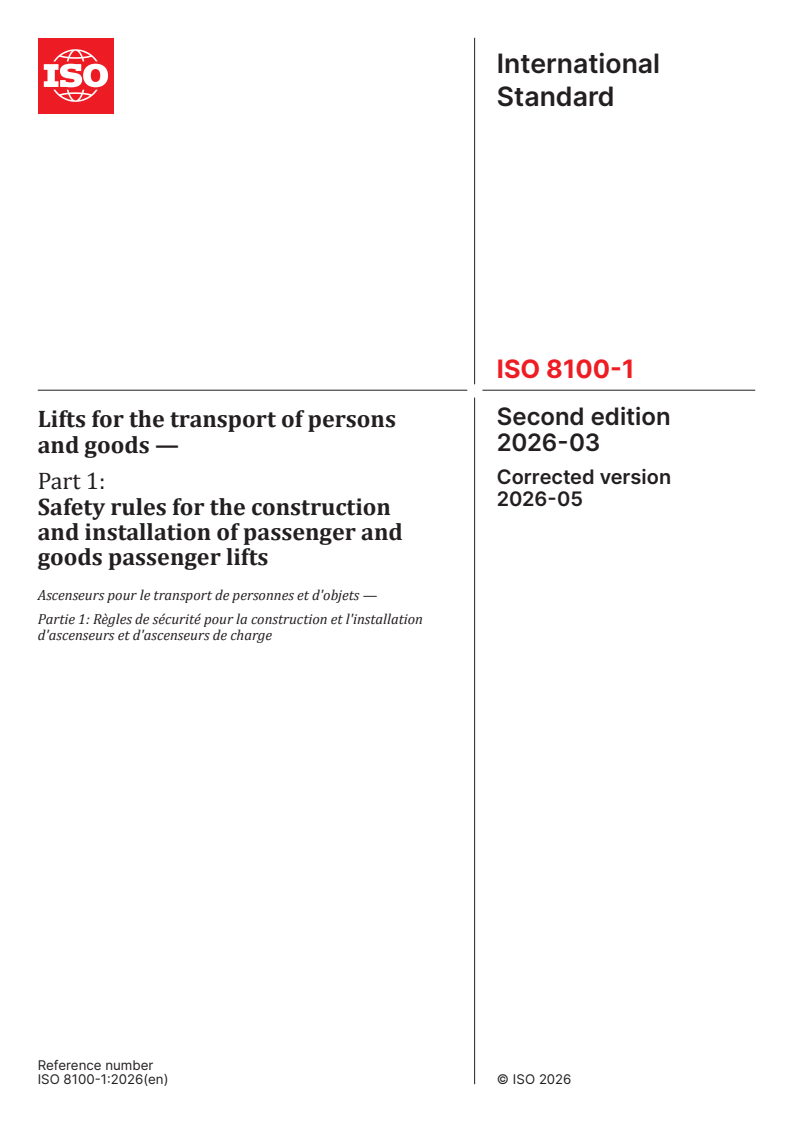
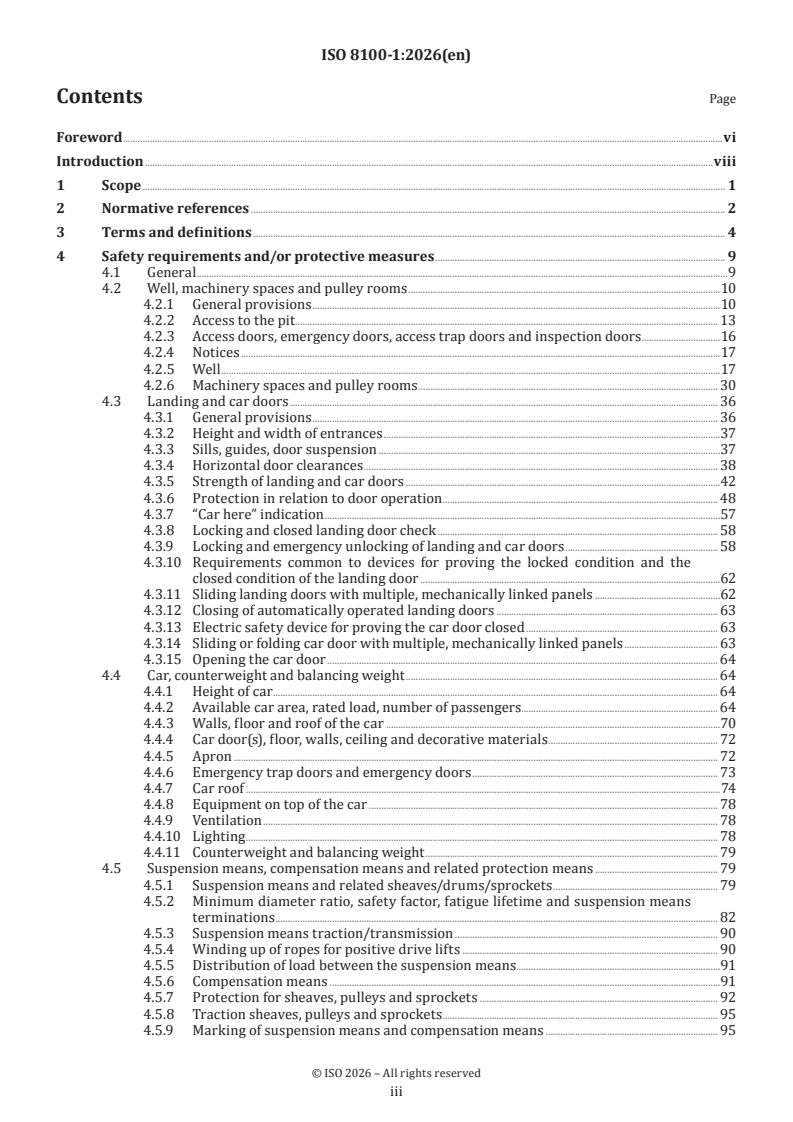
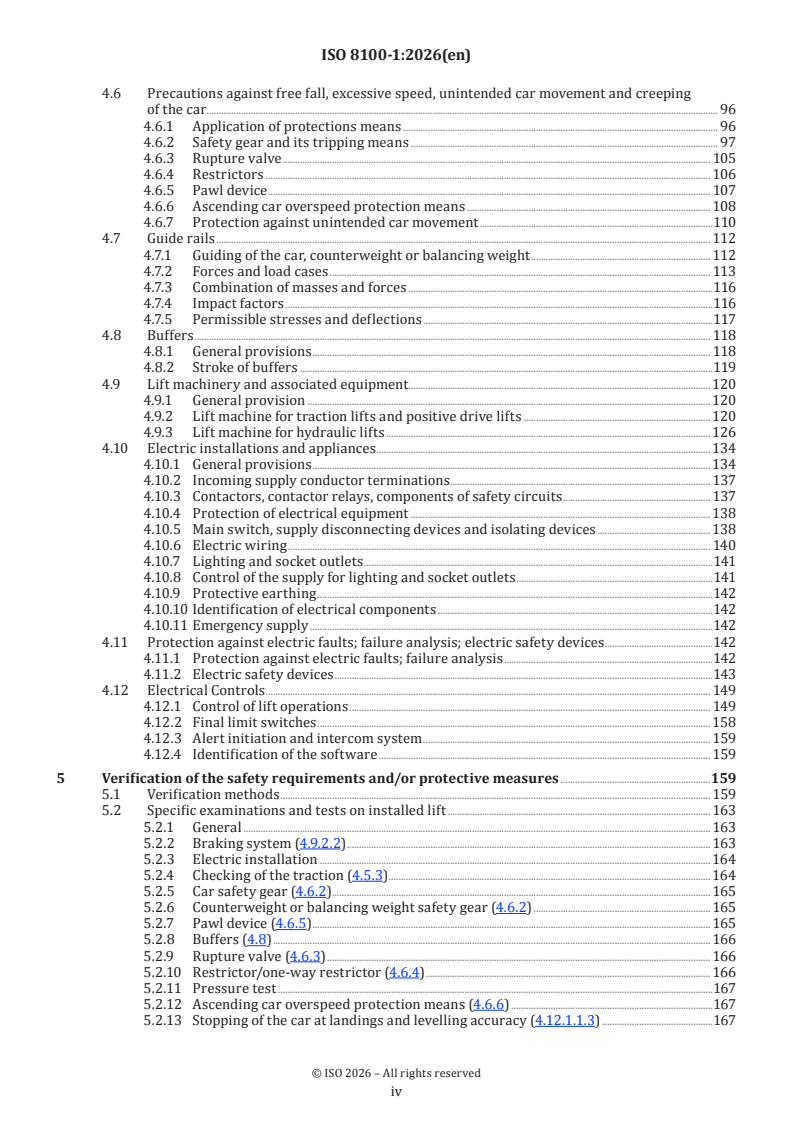
ISO 8100-1:2026 - Lifts for the transport of persons and goods — Part 1: Safety rules for the construction and installation of passenger and goods passenger lifts
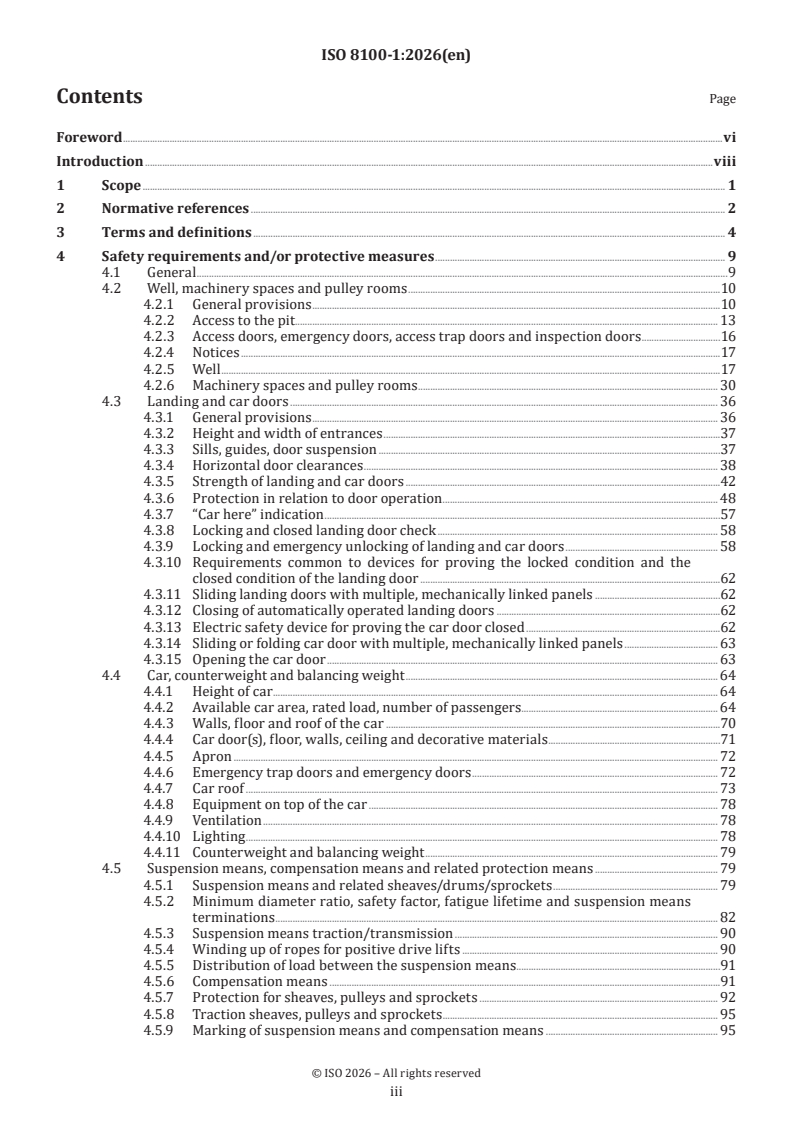
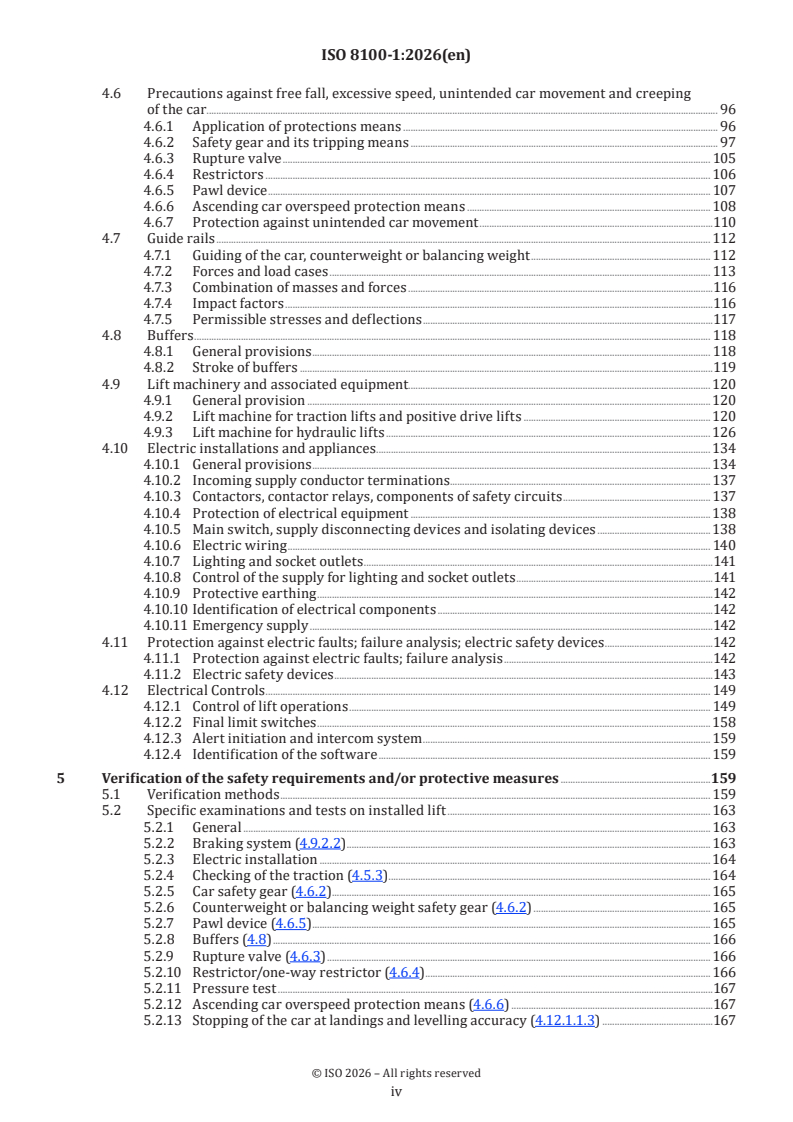
ISO 8100-1:2026 - Lifts for the transport of persons and goods — Part 1: Safety rules for the construction and installation of passenger and goods passenger lifts
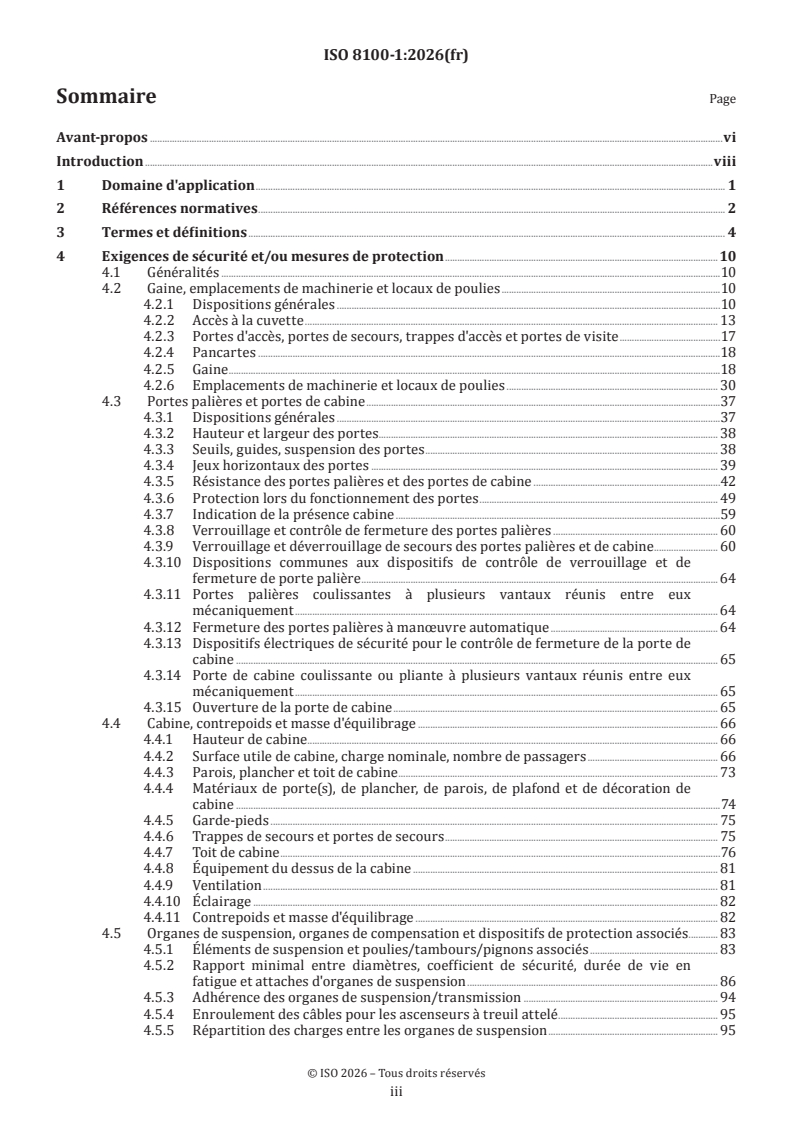
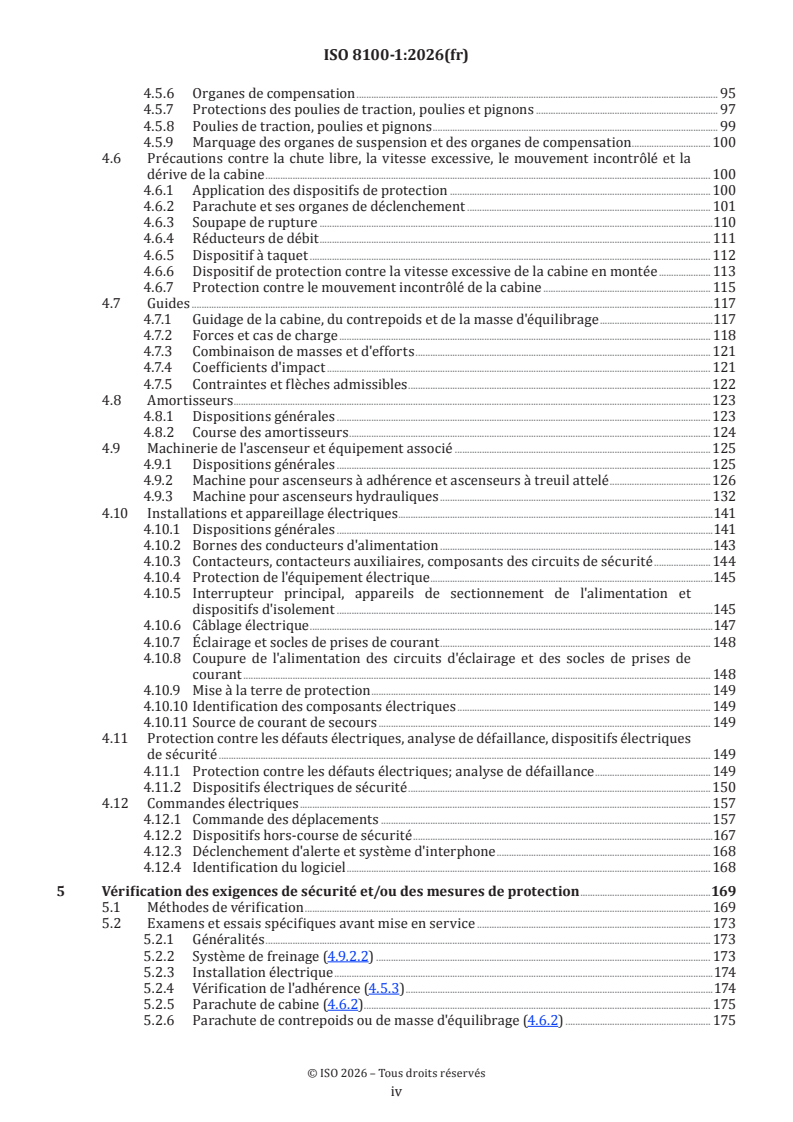
ISO 8100-1:2026 - Ascenseurs pour le transport de personnes et d'objets — Partie 1: Règles de sécurité pour la construction et l'installation d'ascenseurs et d'ascenseurs de charge
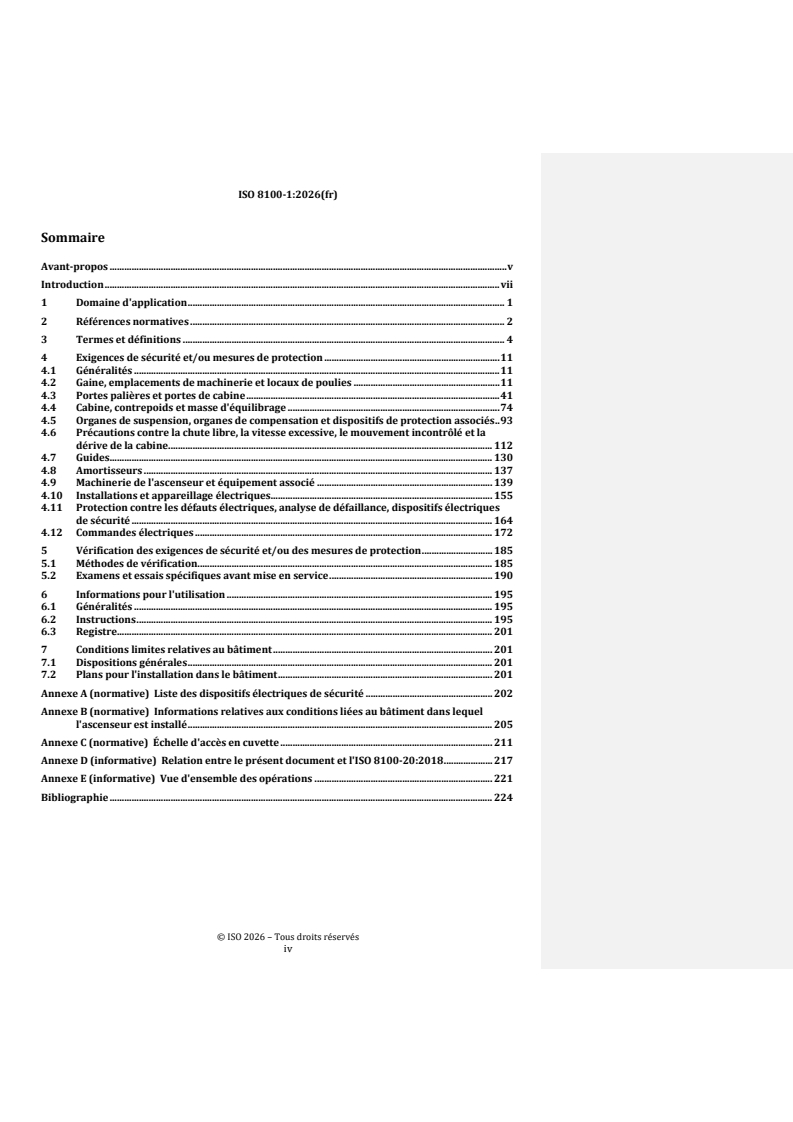
REDLINE ISO 8100-1:2026 - Ascenseurs pour le transport de personnes et d'objets — Partie 1: Règles de sécurité pour la construction et l'installation d'ascenseurs et d'ascenseurs de charge
Overview
ISO 8100-1:2026 sets out internationally recognized safety rules for the construction and installation of passenger and goods passenger lifts. Developed by the International Organization for Standardization (ISO), this standard ensures that lifts permanently serving buildings are designed, manufactured, and installed to protect both people and property. The requirements apply to traction lifts, positive drive lifts, and hydraulic lifts that operate at speeds greater than 0.15 m/s, feature enclosed cars, and move along guide rails inclined no more than 15° to the vertical. These lifts can be used indoors or in weather-protected environments.
ISO 8100-1:2026 is essential for manufacturers, building owners, facility managers, and safety regulators who are committed to ensuring lift safety, reliability, and regulatory compliance.
Key Topics
Main areas covered by ISO 8100-1:2026 include:
- General Safety Requirements: Frameworks and protective measures for lift installation and operation.
- Well and Machinery Spaces: Provisions for shaft (well), machinery spaces, and pulley rooms, including safe access and equipment arrangement.
- Landing and Car Doors: Specifications for door strength, operation, clearances, locking mechanisms, and emergency accessibility.
- Car Construction: Requirements for car size, rated load, structure, ventilation, lighting, and emergency exits.
- Suspension and Protection: Criteria for lift suspension means, compensation methods, safety factors, and mechanical protection.
- Prevention of Hazards: Measures against free fall, unintended movement, excessive speed, and guidance on safety gear and buffers.
- Electrical Safety: Electrical equipment standards, including wiring, controls, lighting, socket outlets, and protection against faults.
- Verification and Testing: Methods for verifying compliance and testing of safety systems during installation and operation.
- User and Maintenance Information: Obligations for providing clear instructions for use, emergency operation, maintenance, and inspection.
- Building Integration: Considerations for lift installation within buildings, including planning and boundary conditions.
Applications
ISO 8100-1:2026 is applied across several scenarios:
- New Construction: Specifies lift safety requirements for newly installed lifts in residential, commercial, and industrial buildings.
- Renovations and Modernizations: Provides guidelines for upgrading existing lifts where the standard is adopted to improve safety and reliability.
- Building Design: Informs architects, engineers, and developers on essential criteria for integrating lifts safely into new projects.
- Maintenance and Inspection: Guides lift servicing organizations in maintaining high safety standards during routine checks and repairs.
- Regulatory Compliance: Assists in meeting local and international building codes and workplace safety regulations focused on lift systems.
Note: ISO 8100-1:2026 does not cover additional requirements for lifts designed for seismic regions, enhanced accessibility, vandalism resistance, firefighting, or evacuation under firefighters' control. It also excludes requirements for lifts installed before the document's publication date.
Related Standards
ISO 8100-1:2026 works in conjunction with other key standards on lift design, installation, and operation:
- ISO 8100-2:2026 - Design rules, calculations, verifications, and tests of lift components.
- ISO 8102-1:2020 & ISO 8102-2:2021 - Electromagnetic compatibility requirements.
- ISO 8102-20:2022 - Cybersecurity for lifts and related equipment.
- ISO 8100-33:2022 - Specifications for T-type guide rails.
- ISO 12100:2010 - General risk assessment and reduction for machinery.
- EN 81-28:2022 - Communication systems for lifts.
- Other referenced ISO and IEC standards - Covering specifics on electrical safety, materials, and related components.
By following ISO 8100-1:2026, stakeholders benefit from globally recognized best practices, reduced risks, and enhanced lift safety and performance for users and maintenance personnel alike.
Relations
- Effective Date
- 01-Jul-2026
- Effective Date
- 12-Feb-2026
- Effective Date
- 23-Apr-2020
Buy Documents
ISO 8100-1:2026 - Lifts for the transport of persons and goods — Part 1: Safety rules for the construction and installation of passenger and goods passenger lifts
ISO 8100-1:2026 - Lifts for the transport of persons and goods — Part 1: Safety rules for the construction and installation of passenger and goods passenger lifts
ISO 8100-1:2026 - Ascenseurs pour le transport de personnes et d'objets — Partie 1: Règles de sécurité pour la construction et l'installation d'ascenseurs et d'ascenseurs de charge
REDLINE ISO 8100-1:2026 - Ascenseurs pour le transport de personnes et d'objets — Partie 1: Règles de sécurité pour la construction et l'installation d'ascenseurs et d'ascenseurs de charge
Get Certified
Connect with accredited certification bodies for this standard

DIBt (Deutsches Institut für Bautechnik)
German Institute for Building Technology.
DIN CERTCO
DIN Group product certification.

Aboma Certification B.V.
Specialized in construction, metal, and transport sectors.
Sponsored listings
Frequently Asked Questions
ISO 8100-1:2026 is a standard published by the International Organization for Standardization (ISO). Its full title is "Lifts for the transport of persons and goods — Part 1: Safety rules for the construction and installation of passenger and goods passenger lifts". This standard covers: This document specifies the safety rules for lifts permanently serving buildings and constructions and intended for the transport of persons or persons and goods. It applies to traction lifts, positive drive lifts and hydraulic lifts that: serve specific levels; and have a rated speed exceeding 0,15 m/s; and have an enclosed car; and move along guide rails inclined not more than 15° to the vertical; and are indoor or weather-protected. This document also applies to the electrical equipment of these lifts including the lighting and socket outlets in the well. This document specifies safety rules related to: persons to be safeguarded: users, including passengers, maintenance and inspection personnel; persons at the landings and outside of the well, or any machinery space and pulley room, who can be affected by the lift. property to be safeguarded: loads in the car; components of the lift installation; building in which the lift is installed. This document does not specify additional requirements for: lifts serving buildings with requirements for seismic conditions; lifts serving buildings with requirements for accessibility; lifts exposed to vandalism; lifts which can be used for firefighting and evacuation purposes under firefighters control; lifts which can be used to support faster evacuation of persons with disabilities; the behaviour of the lift when the control system of the lift receives a recall signal(s) in the event of fire in a building. This document is not applicable to passenger and goods passenger lifts, which are installed before the date of its publication.
This document specifies the safety rules for lifts permanently serving buildings and constructions and intended for the transport of persons or persons and goods. It applies to traction lifts, positive drive lifts and hydraulic lifts that: serve specific levels; and have a rated speed exceeding 0,15 m/s; and have an enclosed car; and move along guide rails inclined not more than 15° to the vertical; and are indoor or weather-protected. This document also applies to the electrical equipment of these lifts including the lighting and socket outlets in the well. This document specifies safety rules related to: persons to be safeguarded: users, including passengers, maintenance and inspection personnel; persons at the landings and outside of the well, or any machinery space and pulley room, who can be affected by the lift. property to be safeguarded: loads in the car; components of the lift installation; building in which the lift is installed. This document does not specify additional requirements for: lifts serving buildings with requirements for seismic conditions; lifts serving buildings with requirements for accessibility; lifts exposed to vandalism; lifts which can be used for firefighting and evacuation purposes under firefighters control; lifts which can be used to support faster evacuation of persons with disabilities; the behaviour of the lift when the control system of the lift receives a recall signal(s) in the event of fire in a building. This document is not applicable to passenger and goods passenger lifts, which are installed before the date of its publication.
ISO 8100-1:2026 is classified under the following ICS (International Classification for Standards) categories: 91.140.90 - Lifts. Escalators. The ICS classification helps identify the subject area and facilitates finding related standards.
ISO 8100-1:2026 has the following relationships with other standards: It is inter standard links to EN ISO 8100-2:2026, EN ISO 8100-1:2026, ISO 8100-1:2019. Understanding these relationships helps ensure you are using the most current and applicable version of the standard.
ISO 8100-1:2026 is available in PDF format for immediate download after purchase. The document can be added to your cart and obtained through the secure checkout process. Digital delivery ensures instant access to the complete standard document.
Standards Content (Sample)
International
Standard
ISO 8100-1
Second edition
Lifts for the transport of persons
2026-03
and goods —
Corrected version
Part 1:
2026-05
Safety rules for the construction
and installation of passenger and
goods passenger lifts
Ascenseurs pour le transport de personnes et d'objets —
Partie 1: Règles de sécurité pour la construction et l'installation
d'ascenseurs et d'ascenseurs de charge
Reference number
© ISO 2026
All rights reserved. Unless otherwise specified, or required in the context of its implementation, no part of this publication may
be reproduced or utilized otherwise in any form or by any means, electronic or mechanical, including photocopying, or posting on
the internet or an intranet, without prior written permission. Permission can be requested from either ISO at the address below
or ISO’s member body in the country of the requester.
ISO copyright office
CP 401 • Ch. de Blandonnet 8
CH-1214 Vernier, Geneva
Phone: +41 22 749 01 11
Email: copyright@iso.org
Website: www.iso.org
Published in Switzerland
ii
Contents Page
Foreword .vi
Introduction .viii
1 Scope . 1
2 Normative references . 2
3 Terms and definitions . 4
4 Safety requirements and/or protective measures . 9
4.1 General .9
4.2 Well, machinery spaces and pulley rooms .10
4.2.1 General provisions .10
4.2.2 Access to the pit . 13
4.2.3 Access doors, emergency doors, access trap doors and inspection doors .16
4.2.4 Notices .17
4.2.5 Well .17
4.2.6 Machinery spaces and pulley rooms . 30
4.3 Landing and car doors . 36
4.3.1 General provisions . 36
4.3.2 Height and width of entrances .37
4.3.3 Sills, guides, door suspension .37
4.3.4 Horizontal door clearances . 38
4.3.5 Strength of landing and car doors .42
4.3.6 Protection in relation to door operation . 48
4.3.7 “Car here” indication .57
4.3.8 Locking and closed landing door check . 58
4.3.9 Locking and emergency unlocking of landing and car doors . 58
4.3.10 Requirements common to devices for proving the locked condition and the
closed condition of the landing door .62
4.3.11 Sliding landing doors with multiple, mechanically linked panels .62
4.3.12 Closing of automatically operated landing doors . 63
4.3.13 Electric safety device for proving the car door closed . 63
4.3.14 Sliding or folding car door with multiple, mechanically linked panels . 63
4.3.15 Opening the car door . 64
4.4 Car, counterweight and balancing weight . 64
4.4.1 Height of car . . . 64
4.4.2 Available car area, rated load, number of passengers. 64
4.4.3 Walls, floor and roof of the car .70
4.4.4 Car door(s), floor, walls, ceiling and decorative materials . 72
4.4.5 Apron . 72
4.4.6 Emergency trap doors and emergency doors . 73
4.4.7 Car roof .74
4.4.8 Equipment on top of the car . 78
4.4.9 Ventilation . 78
4.4.10 Lighting . 78
4.4.11 Counterweight and balancing weight . 79
4.5 Suspension means, compensation means and related protection means . 79
4.5.1 Suspension means and related sheaves/drums/sprockets . 79
4.5.2 Minimum diameter ratio, safety factor, fatigue lifetime and suspension means
terminations . 82
4.5.3 Suspension means traction/transmission . 90
4.5.4 Winding up of ropes for positive drive lifts . 90
4.5.5 Distribution of load between the suspension means.91
4.5.6 Compensation means .91
4.5.7 Protection for sheaves, pulleys and sprockets . 92
4.5.8 Traction sheaves, pulleys and sprockets . 95
4.5.9 Marking of suspension means and compensation means . 95
iii
4.6 Precautions against free fall, excessive speed, unintended car movement and creeping
of the car . . 96
4.6.1 Application of protections means . 96
4.6.2 Safety gear and its tripping means . 97
4.6.3 Rupture valve . 105
4.6.4 Restrictors . 106
4.6.5 Pawl device . 107
4.6.6 Ascending car overspeed protection means . 108
4.6.7 Protection against unintended car movement .110
4.7 Guide rails . 112
4.7.1 Guiding of the car, counterweight or balancing weight . 112
4.7.2 Forces and load cases . 113
4.7.3 Combination of masses and forces .116
4.7.4 Impact factors .116
4.7.5 Permissible stresses and deflections .117
4.8 Buffers . 118
4.8.1 General provisions . 118
4.8.2 Stroke of buffers .119
4.9 Lift machinery and associated equipment. 120
4.9.1 General provision . 120
4.9.2 Lift machine for traction lifts and positive drive lifts . 120
4.9.3 Lift machine for hydraulic lifts . 126
4.10 Electric installations and appliances .134
4.10.1 General provisions .134
4.10.2 Incoming supply conductor terminations . . 137
4.10.3 Contactors, contactor relays, components of safety circuits . 137
4.10.4 Protection of electrical equipment . 138
4.10.5 Main switch, supply disconnecting devices and isolating devices .138
4.10.6 Electric wiring . 140
4.10.7 Lighting and socket outlets .141
4.10.8 Control of the supply for lighting and socket outlets .141
4.10.9 Protective earthing .142
4.10.10 Identification of electrical components .142
4.10.11 Emergency supply .142
4.11 Protection against electric faults; failure analysis; electric safety devices .142
4.11.1 Protection against electric faults; failure analysis .142
4.11.2 Electric safety devices .143
4.12 Electrical Controls . 149
4.12.1 Control of lift operations . 149
4.12.2 Final limit switches .158
4.12.3 Alert initiation and intercom system . 159
4.12.4 Identification of the software . 159
5 Verification of the safety requirements and/or protective measures .159
5.1 Verification methods . 159
5.2 Specific examinations and tests on installed lift . 163
5.2.1 General . 163
5.2.2 Braking system (4.9.2.2) . 163
5.2.3 Electric installation . 164
5.2.4 Checking of the traction (4.5.3) . 164
5.2.5 Car safety gear (4.6.2). 165
5.2.6 Counterweight or balancing weight safety gear (4.6.2) . 165
5.2.7 Pawl device (4.6.5) . . 165
5.2.8 Buffers (4.8) . 166
5.2.9 Rupture valve (4.6.3) . 166
5.2.10 Restrictor/one-way restrictor (4.6.4) . 166
5.2.11 Pressure test .167
5.2.12 Ascending car overspeed protection means (4.6.6) .167
5.2.13 Stopping of the car at landings and levelling accuracy (4.12.1.1.3) .167
iv
5.2.14 Protection against unintended car movement (4.6.7) .167
5.2.15 Protection against falling/shearing (4.3.9.3.4) .167
5.2.16 Balancing of vertically sliding door (4.3.3.3.5) .167
5.2.17 Counterweight balance (4.5.3) .167
5.2.18 Balancing weight balance (4.5.3) . 168
6 Information for use .168
6.1 General . 168
6.2 Instructions . 168
6.2.1 General . 168
6.2.2 Basic data and characteristics . 168
6.2.3 Operating information for use . 169
6.2.4 Information for maintenance, inspection, repair and periodic checks .170
6.2.5 Information for emergency operation . 172
6.3 Logbook. 172
7 Building-related boundary conditions.172
7.1 General provisions . 172
7.2 Plans for the installation in the building . 173
Annex A (normative) List of the electric safety devices .174
Annex B (normative) Information on the building-related conditions in which the lift is
installed .176
Annex C (normative) Pit access ladder .181
Annex D (informative) Relationship between this document and ISO 8100-20:2018 .187
Annex E (informative) Operations overview .190
Bibliography .191
v
Foreword
ISO (the International Organization for Standardization) is a worldwide federation of national standards
bodies (ISO member bodies). The work of preparing International Standards is normally carried out through
ISO technical committees. Each member body interested in a subject for which a technical committee
has been established has the right to be represented on that committee. International organizations,
governmental and non-governmental, in liaison with ISO, also take part in the work. ISO collaborates closely
with the International Electrotechnical Commission (IEC) on all matters of electrotechnical standardization.
The procedures used to develop this document and those intended for its further maintenance are described
in the ISO/IEC Directives, Part 1. In particular, the different approval criteria needed for the different types
of ISO document should be noted. This document was drafted in accordance with the editorial rules of the
ISO/IEC Directives, Part 2 (see www.iso.org/directives).
ISO draws attention to the possibility that the implementation of this document may involve the use of (a)
patent(s). ISO takes no position concerning the evidence, validity or applicability of any claimed patent
rights in respect thereof. As of the date of publication of this document, ISO had not received notice of (a)
patent(s) which may be required to implement this document. However, implementers are cautioned that
this may not represent the latest information, which may be obtained from the patent database available at
www.iso.org/patents. ISO shall not be held respo4.2.2nsible for identifying any or all such patent rights.
Any trade name used in this document is information given for the convenience of users and does not
constitute an endorsement.
For an explanation of the voluntary nature of standards, the meaning of ISO specific terms and expressions
related to conformity assessment, as well as information about ISO's adherence to the World Trade
Organization (WTO) principles in the Technical Barriers to Trade (TBT), see www.iso.org/iso/foreword.html.
This document was prepared by Technical Committee ISO/TC 178, Lifts, escalators and moving walks, in
collaboration with the European Committee for Standardization (CEN) Technical Committee CEN/TC 10,
Lifts, escalators and moving walks, in accordance with the Agreement on technical cooperation between ISO
and CEN (Vienna Agreement).
This second edition cancels and replaces the first edition (ISO 8100-1:2019), which has been technically
revised.
The main changes are as follows:
— requirements for vertically sliding landing and car doors have been added;
— requirements for suspension means other than steel wire ropes have been added;
— requirements for automatic rescue operation have been added;
— requirements for traction lifts with increased available car area have been added;
— requirements for SIL-rated circuits (previously called PESSRAL) have been revised;
— requirements for a working platform in the pit have been added;
— requirements to avoid the dragging of hands in doors have been extended;
— requirements for compensation means entering the refuge space in the pit have been added;
— requirements for the brake have been aligned with overload limits;
— performance and monitoring of the machine brake have been revised;
— requirements for pit access ladders have been revised;
— fire classification of electric cables has been specified;
— requirements for cybersecurity have been added;
vi
— requirements for emergency operation have been revised;
— bypassing normal travel limits in inspection operation has been added;
— SIL levels of the electric safety devices (Annex A) have been revised;
— short circuit between adjacent conductors of travelling cable has been added to electric fault list;
— mechanical strength of luminaires for the well lighting system has been specified;
— requirements for information for use have been revised;
— requirements for tripping the safety gear by electrical means have been added;
— the position of the inspection operation switch has been revised;
— the document structure has been revised as per the ISO/IEC Directives, Part 2.
For relationship with this document and ISO 8100-20:2018, see Annex D.
ISO/TS 8100-3 provides information on the differences between this document local standards (ASME A17.1/
CSA B44 and JIS A 4307 1/JIS A 4307-2) not included in this document.
A list of all parts in the ISO 8100 series can be found on the ISO website.
Any feedback or questions on this document should be directed to the user’s national standards body. A
complete listing of these bodies can be found at www.iso.org/members.html.
This corrected version of ISO 8100-1:2026 incorporates the following corrections:
— corrupted symbols in Formulae (3) and (4) have been corrected;
— in 4.2.2.2, the height of the toe board has been corrected from 0,10 mm to 0,10 m;
— reference in Table 25 has been corrected;
— year of publication of ISO 8100-2 has been corrected.
vii
Introduction
This document is a type-C standard as stated in ISO 12100:2010.
This document is of relevance, in particular, for the following stakeholder groups representing the market
players with regard to machinery safety:
— machine manufacturers (small, medium and large enterprises);
— health and safety bodies (regulators, accident prevention organizations, market surveillance, etc.).
Others can be affected by the level of machinery safety achieved with the means of the document by the
above-mentioned stakeholder groups:
— machine users/employers (small, medium and large enterprises);
— machine users/employees (e.g. trade unions, organizations for people with special needs);
— service providers, e.g. for maintenance (small, medium and large enterprises);
— consumers (in case of machinery intended for use by consumers).
The above-mentioned stakeholder groups have been given the possibility to participate in the drafting
process of this document.
The machinery concerned and the extent to which hazards, hazardous situations and hazardous events are
covered are indicated in the scope of this document.
When requirements of this type-C standard are different from those which are stated in type-A or type-B
standards, the requirements of this type-C standard take precedence over the requirements of the other
standards for machines that have been designed and built according to the requirements of this type-C
standard.
viii
International Standard ISO 8100-1:2026(en)
Lifts for the transport of persons and goods —
Part 1:
Safety rules for the construction and installation of passenger
and goods passenger lifts
1 Scope
This document specifies the safety rules for lifts permanently serving buildings and constructions and
intended for the transport of persons or persons and goods. It applies to traction lifts, positive drive lifts and
hydraulic lifts that:
— serve specific levels; and
— have a rated speed exceeding 0,15 m/s; and
— have an enclosed car; and
— move along guide rails inclined not more than 15° to the vertical; and
— are indoor or weather-protected.
This document also applies to the electrical equipment of these lifts including the lighting and socket outlets
in the well.
This document specifies safety rules related to:
— persons to be safeguarded:
— users, including passengers, maintenance and inspection personnel;
— persons at the landings and outside of the well, or any machinery space and pulley room, who can be
affected by the lift.
— property to be safeguarded:
— loads in the car;
— components of the lift installation;
— building in which the lift is installed.
This document does not specify additional requirements for:
— lifts serving buildings with requirements for seismic conditions;
— lifts serving buildings with requirements for accessibility;
— lifts exposed to vandalism;
— lifts which can be used for firefighting and evacuation purposes under firefighters control;
— lifts which can be used to support faster evacuation of persons with disabilities;
— the behaviour of the lift when the control system of the lift receives a recall signal(s) in the event of fire
in a building.
This document is not applicable to passenger and goods passenger lifts, which are installed before the date
of its publication.
2 Normative references
The following documents are referred to in the text in such a way that some or all of their content constitutes
requirements of this document. For dated references, only the edition cited applies. For undated references,
the latest edition of the referenced document (including any amendments) applies.
ISO 1219-1:2012, Fluid power systems and components — Graphical symbols and circuit diagrams — Part 1:
Graphical symbols for conventional use and data-processing applications
ISO 4344:2022, Steel wire ropes for lifts — Minimum requirements
ISO 4190-5:2006, Lift (Elevator) installation — Part 5: Control devices, signals and additional fittings
ISO 4413:2010, Hydraulic fluid power — General rules and safety requirements for systems and their components
ISO 6743-4:2015, Lubricants, industrial oils and related products (class L) — Classification — Part 4: Family H
(Hydraulic systems)
1)
ISO 7000:2019 , Graphical symbols for use on equipment — Registered symbols
1)
ISO 7010:2019 , Graphical symbols — Safety colours and safety signs — Registered safety signs
ISO 8100-2:2026, Lifts for the transport of persons and goods —Part 2: Design rules, calculations, verifications
and tests of lift components
ISO 8100-33:2022, Lifts for the transport of persons and goods — Part 33: T-type guide rails for lift cars and
counterweights
ISO 8102-1:2020, Electrical requirements for lifts, escalators and moving walks — Part 1: Electromagnetic
compatibility with regard to emission
ISO 8102-2:2021, Electrical requirements for lifts, escalators and moving walks — Part 2: Electromagnetic
compatibility with regard to immunity
ISO 8102-20:2022, Electrical requirements for lifts, escalators and moving walks — Part 20: Cybersecurity
ISO 12100:2010, Safety of machinery — General principles for design — Risk assessment and risk reduction
ISO 12543-2:2021, Glass in building — Laminated glass and laminated safety glass — Part 2: Laminated safety
glass
ISO 12543-3:2021, Glass in building — Laminated glass and laminated safety glass — Part 3: Laminated glass
ISO 13857:2019, Safety of machinery — Safety distances to prevent hazard zones being reached by upper and
lower limbs
ISO 14122-2:2016, Safety of machinery — Permanent means of access to machinery — Part 2: Working platforms
and walkways
ISO 14122-3:2016, Safety of machinery — Permanent means of access to machinery — Part 3: Stairs, stepladders
and guard-rails
ISO 14122-4:2016, Safety of machinery — Permanent means of access to machinery — Part 4: Fixed ladders
ISO 29584:2015, Glass in building — Pendulum impact testing and classification of safety glass
1) The graphical symbol collections of ISO 7000 and ISO 7101 can be previewed and purchased on the Online Browsing
Platform (OBP), www .iso .org/ obp
IEC 60204-1:2016+A1: 2021, Safety of machinery — Electrical equipment of machines — Part 1: General
requirements
IEC 60227-6:2001, Polyvinyl chloride insulated cables of rated voltages up to and including 450/750 V — Part 6:
Lift cables and cables for flexible connections
IEC 60332-1-2:2025, Tests on electric and optical fibre cables under fire conditions — Part 1‑2: Test for vertical
flame propagation for a single insulated wire or cable — Procedure for 1 kW pre‑mixed flame
IEC 60364-4-41:2005+AMD1:2 017, Low voltage electrical installations — Part 4‑41: Protection for safety —
Protection against electric shock
IEC 60364-6:2016, Low voltage electrical installations — Part 6: Verification
2)
IEC 60417:2002 , Database — Graphical symbols for use on equipment
IEC 60529:1989+AMD1: 1999+ AMD2: 2013, Degrees of protection provided by enclosures (IP Code)
IEC 60598-1:2024, Luminaires — Part 1: General requirements and tests
IEC 60617:2025, Database — Graphical symbols for diagrams
IEC 60664-1:2020, Insulation coordination for equipment within low-voltage systems — Part 1: Principles,
requirements and tests
IEC 60947-4-1:2023, Low‑voltage switchgear and controlgear — Part 4‑1: Contactors and motor‑starters —
Electromechanical contactors and motor-starters
IEC 60947-5-1:2024, Low-voltage switchgear and controlgear — Part 5-1: Control circuit devices and switching
elements — Electromechanical control circuit devices
IEC 61310-3:2007, Safety of machinery — Indication, marking and actuation — Requirements for the location
and operation of actuators
IEC 61508-1:2010, Functional safety of electrical/electronic/programmable electronic safety‑related systems —
Part 1: General requirements
IEC 61800-5-2:2016, Adjustable speed electrical power drive systems — Part 5-2: Safety requirements.
Functional
IEC 61810-1:2015+AMD1: 2019, Electromechanical elementary relays — Part 1: General requirements
IEC 61810-3:2015, Electromechanical elementary relays — Part 3: Relays with forcibly guided (mechanically
linked) contacts
EN 81-28:2022, Safety rules for the construction and installation of lifts — Lifts for the transport of persons and
goods — Part 28: Remote alarm on passenger and goods passenger lifts
EN 13411-3:2022, Terminations for steel wire ropes — Part 3: Safety. Ferrules and ferrule-securing
EN 13411-6:2004+A1: 2008, Terminations for steel wire ropes — Part 6: Safety. Asymmetric wedge socket
EN 13411-7:2021, Terminations for steel wire ropes — Part 7: Safety. Symmetric wedge socket
EN 13411-8:2011, Termination for steel wire ropes — Part 8: Safety. Swage terminals and swaging
EN 13501-1:2018, Fire classification of construction products and building elements — Part 1: Classification
using data from reaction to fire tests
EN 13501-6:2018+A1: 2022, Fire classification of construction products and building elements —
Part 6: Classification using data from reaction to fire tests on electric cables
2) The graphical symbol collections of IEC 60417 can be previewed and purchased on the Online Browsing Platform
(OBP), www .iso .org/ obp
EN 50214:2024, Flat polyvinyl chloride sheathed flexible cables
3 Terms and definitions
For the purposes of this document, the terms and definitions given in ISO 12100:2010 and the following
apply.
ISO and IEC maintain terminology databases for use in standardization at the following addresses:
— ISO Online browsing platform: available at https:// www .iso .org/ obp
— IEC Electropedia: available at https:// www .electropedia .org/
3.1
apron
smooth vertical part extending downwards from the sill of the landing or car entrance
3.2
automatic operation
operation in which start of the movement of the car happens in response to the momentary actuation of
operating devices or in response to any other automatic starting function
Note 1 to entry: See Annex E for additional information.
3.3
automatic rescue operation
device or function that operates automatically in case of failure or loss of power supply to move the lift car
to a landing
3.4
average probability of dangerous failure on demand
PFD
avg
mean unavailability of a E/E/PE safety-related system to perform the specified safety function when a
demand occurs from the lift or lift control system
[SOURCE: IEC 61508-4:2010, 3.6.18, modified — replaced "EUC or EUC control system" with "lift or lift
control system"; deleted Notes 1, 2 and 3]
3.5
average frequency of a dangerous failure per hour
PFH
average frequency of a dangerous failure of a E/E/PE safety-related system to perform the specified safety
function over a given period of time
[SOURCE: IEC 61508-4:2010, 3.6.19, modified — deleted Notes 1, 2, 3 and 4.]
3.6
balancing weight
mass which compensates all or part of the mass of the car
3.7
buffer
device with characteristics to dissipate or store kinetic energy
3.8
car
part of the lift which carries passengers and goods
3.9
carbon fibre reinforced polymer
CFRP
material consisting of carbon filaments and resin
3.10
counterweight
mass which compensates the mass of the car and a part of the rated load
3.11
direct acting lift
hydraulic lift where the ram or cylinder is directly attached to the car or the car sling
3.12
down direction valve
electrically controlled valve in a hydraulic circuit for controlling the descent of the car
3.13
drive control system
system controlling and monitoring the running of the lift machine
3.14
electrical anti-creep system
measure for hydraulic lifts against the danger of the car moving slowly away from the floor level
3.15
electric safety device
safety contact, safety circuit or SIL-rated circuit, having the required reliability of operation
3.16
electric safety chain
total of the electric safety devices
3.17
full load pressure
static pressure exerted on the piping, jack, valve block, etc., with the car and rated load being at rest at the
highest landing level
3.18
goods passenger lift
passenger lift with additional measures for the transport of goods
3.19
headroom
part of the well between the highest landing served by the car and the ceiling of the well
3.20
hold-to-run control device
control device which initiates and maintains machine functions only as long as the manual control (actuator)
is actuated
[SOURCE: ISO 12100:2010, 3.28.3]
3.21
hydraulic lift
lift in which movement of the car is operated by hydraulic fluid
3.22
indirect acting lift
hydraulic lift where the ram or cylinder is connected to the car or the car sling by suspension means
3.23
instantaneous safety gear
safety gear without limitation of retardation
3.24
jack
combination of a cylinder and a ram forming a hydraulic actuating unit
3.25
levelling
operation which achieves the stopping accuracy at a landing
3.26
levelling accuracy
vertical distance between car sill and landing sill
3.27
lift machine
unit which drives and stops the lift, including any motor, gear, machine brake, sheave/sprockets and drum
(traction or positive drive lift) or comprising the pump, pump motor and control valves (hydraulic drive lift)
3.28
machine room
fully enclosed machinery space outside of the well with ceiling, walls, floor and access door(s) in which
machinery as a whole or in parts is placed
3.29
machinery
control cabinet(s) and drive system, lift machine, main switch(es), and devices for emergency and test
operation
3.30
machinery space
volume(s) inside or outside of
...
International
Standard
ISO 8100-1
Second edition
Lifts for the transport of persons
2026-03
and goods —
Part 1:
Safety rules for the construction
and installation of passenger and
goods passenger lifts
Ascenseurs pour le transport de personnes et d'objets —
Partie 1: Règles de sécurité pour la construction et l'installation
d'ascenseurs et d'ascenseurs de charge
Reference number
© ISO 2026
All rights reserved. Unless otherwise specified, or required in the context of its implementation, no part of this publication may
be reproduced or utilized otherwise in any form or by any means, electronic or mechanical, including photocopying, or posting on
the internet or an intranet, without prior written permission. Permission can be requested from either ISO at the address below
or ISO’s member body in the country of the requester.
ISO copyright office
CP 401 • Ch. de Blandonnet 8
CH-1214 Vernier, Geneva
Phone: +41 22 749 01 11
Email: copyright@iso.org
Website: www.iso.org
Published in Switzerland
ii
Contents Page
Foreword .vi
Introduction .viii
1 Scope . 1
2 Normative references . 2
3 Terms and definitions . 4
4 Safety requirements and/or protective measures . 9
4.1 General .9
4.2 Well, machinery spaces and pulley rooms .10
4.2.1 General provisions .10
4.2.2 Access to the pit . 13
4.2.3 Access doors, emergency doors, access trap doors and inspection doors .16
4.2.4 Notices .17
4.2.5 Well .17
4.2.6 Machinery spaces and pulley rooms . 30
4.3 Landing and car doors . 36
4.3.1 General provisions . 36
4.3.2 Height and width of entrances .37
4.3.3 Sills, guides, door suspension .37
4.3.4 Horizontal door clearances . 38
4.3.5 Strength of landing and car doors .42
4.3.6 Protection in relation to door operation . 48
4.3.7 “Car here” indication .57
4.3.8 Locking and closed landing door check . 58
4.3.9 Locking and emergency unlocking of landing and car doors . 58
4.3.10 Requirements common to devices for proving the locked condition and the
closed condition of the landing door .62
4.3.11 Sliding landing doors with multiple, mechanically linked panels .62
4.3.12 Closing of automatically operated landing doors .62
4.3.13 Electric safety device for proving the car door closed .62
4.3.14 Sliding or folding car door with multiple, mechanically linked panels . 63
4.3.15 Opening the car door . 63
4.4 Car, counterweight and balancing weight . 64
4.4.1 Height of car . . . 64
4.4.2 Available car area, rated load, number of passengers. 64
4.4.3 Walls, floor and roof of the car .70
4.4.4 Car door(s), floor, walls, ceiling and decorative materials .71
4.4.5 Apron . 72
4.4.6 Emergency trap doors and emergency doors . 72
4.4.7 Car roof . 73
4.4.8 Equipment on top of the car . 78
4.4.9 Ventilation . 78
4.4.10 Lighting . 78
4.4.11 Counterweight and balancing weight . 79
4.5 Suspension means, compensation means and related protection means . 79
4.5.1 Suspension means and related sheaves/drums/sprockets . 79
4.5.2 Minimum diameter ratio, safety factor, fatigue lifetime and suspension means
terminations . 82
4.5.3 Suspension means traction/transmission . 90
4.5.4 Winding up of ropes for positive drive lifts . 90
4.5.5 Distribution of load between the suspension means.91
4.5.6 Compensation means .91
4.5.7 Protection for sheaves, pulleys and sprockets . 92
4.5.8 Traction sheaves, pulleys and sprockets . 95
4.5.9 Marking of suspension means and compensation means . 95
iii
4.6 Precautions against free fall, excessive speed, unintended car movement and creeping
of the car . . 96
4.6.1 Application of protections means . 96
4.6.2 Safety gear and its tripping means . 97
4.6.3 Rupture valve . 105
4.6.4 Restrictors . 106
4.6.5 Pawl device . 107
4.6.6 Ascending car overspeed protection means . 108
4.6.7 Protection against unintended car movement .110
4.7 Guide rails . 112
4.7.1 Guiding of the car, counterweight or balancing weight . 112
4.7.2 Forces and load cases . 113
4.7.3 Combination of masses and forces .116
4.7.4 Impact factors .116
4.7.5 Permissible stresses and deflections .117
4.8 Buffers . 118
4.8.1 General provisions . 118
4.8.2 Stroke of buffers .119
4.9 Lift machinery and associated equipment. 120
4.9.1 General provision . 120
4.9.2 Lift machine for traction lifts and positive drive lifts . 120
4.9.3 Lift machine for hydraulic lifts . 126
4.10 Electric installations and appliances .134
4.10.1 General provisions .134
4.10.2 Incoming supply conductor terminations . . 137
4.10.3 Contactors, contactor relays, components of safety circuits . 137
4.10.4 Protection of electrical equipment . 138
4.10.5 Main switch, supply disconnecting devices and isolating devices .138
4.10.6 Electric wiring . 140
4.10.7 Lighting and socket outlets .141
4.10.8 Control of the supply for lighting and socket outlets .141
4.10.9 Protective earthing .142
4.10.10 Identification of electrical components .142
4.10.11 Emergency supply .142
4.11 Protection against electric faults; failure analysis; electric safety devices .142
4.11.1 Protection against electric faults; failure analysis .142
4.11.2 Electric safety devices .143
4.12 Electrical Controls . 149
4.12.1 Control of lift operations . 149
4.12.2 Final limit switches .158
4.12.3 Alert initiation and intercom system . 159
4.12.4 Identification of the software . 159
5 Verification of the safety requirements and/or protective measures .159
5.1 Verification methods . 159
5.2 Specific examinations and tests on installed lift . 163
5.2.1 General . 163
5.2.2 Braking system (4.9.2.2) . 163
5.2.3 Electric installation . 164
5.2.4 Checking of the traction (4.5.3) . 164
5.2.5 Car safety gear (4.6.2). 165
5.2.6 Counterweight or balancing weight safety gear (4.6.2) . 165
5.2.7 Pawl device (4.6.5) . . 165
5.2.8 Buffers (4.8) . 166
5.2.9 Rupture valve (4.6.3) . 166
5.2.10 Restrictor/one-way restrictor (4.6.4) . 166
5.2.11 Pressure test .167
5.2.12 Ascending car overspeed protection means (4.6.6) .167
5.2.13 Stopping of the car at landings and levelling accuracy (4.12.1.1.3) .167
iv
5.2.14 Protection against unintended car movement (4.6.7) .167
5.2.15 Protection against falling/shearing (4.3.9.3.4) .167
5.2.16 Balancing of vertically sliding door (4.3.3.3.5) .167
5.2.17 Counterweight balance (4.5.3) .167
5.2.18 Balancing weight balance (4.5.3) . 168
6 Information for use .168
6.1 General . 168
6.2 Instructions . 168
6.2.1 General . 168
6.2.2 Basic data and characteristics . 168
6.2.3 Operating information for use . 169
6.2.4 Information for maintenance, inspection, repair and periodic checks .170
6.2.5 Information for emergency operation . 172
6.3 Logbook. 172
7 Building-related boundary conditions.172
7.1 General provisions . 172
7.2 Plans for the installation in the building . 173
Annex A (normative) List of the electric safety devices .174
Annex B (normative) Information on the building-related conditions in which the lift is installed .176
Annex C (normative) Pit access ladder .181
Annex D (informative) Relationship between this document and ISO 8100-20:2018 .187
Annex E (informative) Operations overview .190
Bibliography .191
v
Foreword
ISO (the International Organization for Standardization) is a worldwide federation of national standards
bodies (ISO member bodies). The work of preparing International Standards is normally carried out through
ISO technical committees. Each member body interested in a subject for which a technical committee
has been established has the right to be represented on that committee. International organizations,
governmental and non-governmental, in liaison with ISO, also take part in the work. ISO collaborates closely
with the International Electrotechnical Commission (IEC) on all matters of electrotechnical standardization.
The procedures used to develop this document and those intended for its further maintenance are described
in the ISO/IEC Directives, Part 1. In particular, the different approval criteria needed for the different types
of ISO document should be noted. This document was drafted in accordance with the editorial rules of the
ISO/IEC Directives, Part 2 (see www.iso.org/directives).
ISO draws attention to the possibility that the implementation of this document may involve the use of (a)
patent(s). ISO takes no position concerning the evidence, validity or applicability of any claimed patent
rights in respect thereof. As of the date of publication of this document, ISO had not received notice of (a)
patent(s) which may be required to implement this document. However, implementers are cautioned that
this may not represent the latest information, which may be obtained from the patent database available at
www.iso.org/patents. ISO shall not be held responsible for identifying any or all such patent rights.
Any trade name used in this document is information given for the convenience of users and does not
constitute an endorsement.
For an explanation of the voluntary nature of standards, the meaning of ISO specific terms and expressions
related to conformity assessment, as well as information about ISO's adherence to the World Trade
Organization (WTO) principles in the Technical Barriers to Trade (TBT), see www.iso.org/iso/foreword.html.
This document was prepared by Technical Committee ISO/TC 178, Lifts, escalators and moving walks, in
collaboration with the European Committee for Standardization (CEN) Technical Committee CEN/TC 10,
Lifts, escalators and moving walks, in accordance with the Agreement on technical cooperation between ISO
and CEN (Vienna Agreement).
This second edition cancels and replaces the first edition (ISO 8100-1:2019), which has been technically
revised.
The main changes are as follows:
— requirements for vertically sliding landing and car doors have been added;
— requirements for suspension means other than steel wire ropes have been added;
— requirements for automatic rescue operation have been added;
— requirements for traction lifts with increased available car area have been added;
— requirements for SIL-rated circuits (previously called PESSRAL) have been revised;
— requirements for a working platform in the pit have been added;
— requirements to avoid the dragging of hands in doors have been extended;
— requirements for compensation means entering the refuge space in the pit have been added;
— requirements for the brake have been aligned with overload limits;
— performance and monitoring of the machine brake have been revised;
— requirements for pit access ladders have been revised;
— fire classification of electric cables has been specified;
— requirements for cybersecurity have been added;
vi
— requirements for emergency operation have been revised;
— bypassing normal travel limits in inspection operation has been added;
— SIL levels of the electric safety devices (Annex A) have been revised;
— short circuit between adjacent conductors of travelling cable has been added to electric fault list;
— mechanical strength of luminaires for the well lighting system has been specified;
— requirements for information for use have been revised;
— requirements for tripping the safety gear by electrical means have been added;
— the position of the inspection operation switch has been revised;
— the document structure has been revised as per the ISO/IEC Directives, Part 2.
For relationship with this document and ISO 8100-20:2018, see Annex D.
ISO/TS 8100-3 provides information on the differences between this document local standards (ASME A17.1/
CSA B44 and JIS A 4307 1/JIS A 4307-2) not included in this document.
A list of all parts in the ISO 8100 series can be found on the ISO website.
Any feedback or questions on this document should be directed to the user’s national standards body. A
complete listing of these bodies can be found at www.iso.org/members.html.
vii
Introduction
This document is a type-C standard as stated in ISO 12100:2010.
This document is of relevance, in particular, for the following stakeholder groups representing the market
players with regard to machinery safety:
— machine manufacturers (small, medium and large enterprises);
— health and safety bodies (regulators, accident prevention organizations, market surveillance, etc.).
Others can be affected by the level of machinery safety achieved with the means of the document by the
above-mentioned stakeholder groups:
— machine users/employers (small, medium and large enterprises);
— machine users/employees (e.g. trade unions, organizations for people with special needs);
— service providers, e.g. for maintenance (small, medium and large enterprises);
— consumers (in case of machinery intended for use by consumers).
The above-mentioned stakeholder groups have been given the possibility to participate in the drafting
process of this document.
The machinery concerned and the extent to which hazards, hazardous situations and hazardous events are
covered are indicated in the scope of this document.
When requirements of this type-C standard are different from those which are stated in type-A or type-B
standards, the requirements of this type-C standard take precedence over the requirements of the other
standards for machines that have been designed and built according to the requirements of this type-C
standard.
viii
International Standard ISO 8100-1:2026(en)
Lifts for the transport of persons and goods —
Part 1:
Safety rules for the construction and installation of passenger
and goods passenger lifts
1 Scope
This document specifies the safety rules for lifts permanently serving buildings and constructions and
intended for the transport of persons or persons and goods. It applies to traction lifts, positive drive lifts and
hydraulic lifts that:
— serve specific levels; and
— have a rated speed exceeding 0,15 m/s; and
— have an enclosed car; and
— move along guide rails inclined not more than 15° to the vertical; and
— are indoor or weather-protected.
This document also applies to the electrical equipment of these lifts including the lighting and socket outlets
in the well.
This document specifies safety rules related to:
— persons to be safeguarded:
— users, including passengers, maintenance and inspection personnel;
— persons at the landings and outside of the well, or any machinery space and pulley room, who can be
affected by the lift.
— property to be safeguarded:
— loads in the car;
— components of the lift installation;
— building in which the lift is installed.
This document does not specify additional requirements for:
— lifts serving buildings with requirements for seismic conditions;
— lifts serving buildings with requirements for accessibility;
— lifts exposed to vandalism;
— lifts which can be used for firefighting and evacuation purposes under firefighters control;
— lifts which can be used to support faster evacuation of persons with disabilities;
— the behaviour of the lift when the control system of the lift receives a recall signal(s) in the event of fire
in a building.
This document is not applicable to passenger and goods passenger lifts, which are installed before the date
of its publication.
2 Normative references
The following documents are referred to in the text in such a way that some or all of their content constitutes
requirements of this document. For dated references, only the edition cited applies. For undated references,
the latest edition of the referenced document (including any amendments) applies.
ISO 1219-1:2012, Fluid power systems and components — Graphical symbols and circuit diagrams — Part 1:
Graphical symbols for conventional use and data-processing applications
ISO 4344:2022, Steel wire ropes for lifts — Minimum requirements
ISO 4190-5:2006, Lift (Elevator) installation — Part 5: Control devices, signals and additional fittings
ISO 4413:2010, Hydraulic fluid power — General rules and safety requirements for systems and their components
ISO 6743-4:2015, Lubricants, industrial oils and related products (class L) — Classification — Part 4: Family H
(Hydraulic systems)
1)
ISO 7000:2019 , Graphical symbols for use on equipment — Registered symbols
1)
ISO 7010:2019 , Graphical symbols — Safety colours and safety signs — Registered safety signs
ISO 8100-2:2026, Lifts for the transport of persons and goods —Part 2: Design rules, calculations, verifications
and tests of lift components
ISO 8100-33:2022, Lifts for the transport of persons and goods — Part 33: T-type guide rails for lift cars and
counterweights
ISO 8102-1:2020, Electrical requirements for lifts, escalators and moving walks — Part 1: Electromagnetic
compatibility with regard to emission
ISO 8102-2:2021, Electrical requirements for lifts, escalators and moving walks — Part 2: Electromagnetic
compatibility with regard to immunity
ISO 8102-20:2022, Electrical requirements for lifts, escalators and moving walks — Part 20: Cybersecurity
ISO 12100:2010, Safety of machinery — General principles for design — Risk assessment and risk reduction
ISO 12543-2:2021, Glass in building — Laminated glass and laminated safety glass — Part 2: Laminated safety
glass
ISO 12543-3:2021, Glass in building — Laminated glass and laminated safety glass — Part 3: Laminated glass
ISO 13857:2019, Safety of machinery — Safety distances to prevent hazard zones being reached by upper and
lower limbs
ISO 14122-2:2016, Safety of machinery — Permanent means of access to machinery — Part 2: Working platforms
and walkways
ISO 14122-3:2016, Safety of machinery — Permanent means of access to machinery — Part 3: Stairs, stepladders
and guard-rails
ISO 14122-4:2016, Safety of machinery — Permanent means of access to machinery — Part 4: Fixed ladders
ISO 29584:2015, Glass in building — Pendulum impact testing and classification of safety glass
1) The graphical symbol collections of ISO 7000 and ISO 7101 can be previewed and purchased on the Online Browsing
Platform (OBP), www .iso .org/ obp
IEC 60204-1:2016+A1: 2021, Safety of machinery — Electrical equipment of machines — Part 1: General
requirements
IEC 60227-6:2001, Polyvinyl chloride insulated cables of rated voltages up to and including 450/750 V — Part 6:
Lift cables and cables for flexible connections
IEC 60332-1-2:2025, Tests on electric and optical fibre cables under fire conditions — Part 1‑2: Test for vertical
flame propagation for a single insulated wire or cable — Procedure for 1 kW pre‑mixed flame
IEC 60364-4-41:2005+AMD1:2 017, Low voltage electrical installations — Part 4‑41: Protection for safety —
Protection against electric shock
IEC 60364-6:2016, Low voltage electrical installations — Part 6: Verification
2)
IEC 60417:2002 , Database — Graphical symbols for use on equipment
IEC 60529:1989+AMD1: 1999+ AMD2: 2013, Degrees of protection provided by enclosures (IP Code)
IEC 60598-1:2024, Luminaires — Part 1: General requirements and tests
IEC 60617:2025, Database — Graphical symbols for diagrams
IEC 60664-1:2020, Insulation coordination for equipment within low-voltage systems — Part 1: Principles,
requirements and tests
IEC 60947-4-1:2023, Low‑voltage switchgear and controlgear — Part 4‑1: Contactors and motor‑starters —
Electromechanical contactors and motor-starters
IEC 60947-5-1:2024, Low-voltage switchgear and controlgear — Part 5-1: Control circuit devices and switching
elements — Electromechanical control circuit devices
IEC 61310-3:2007, Safety of machinery - Indication, marking and actuation — Requirements for the location
and operation of actuators
IEC 61508-1:2010, Functional safety of electrical/electronic/programmable electronic safety‑related systems —
Part 1: General requirements
IEC 61800-5-2:2016, Adjustable speed electrical power drive systems — Part 5-2: Safety requirements.
Functional
IEC 61810-1:2015+AMD1: 2019, Electromechanical elementary relays — Part 1: General requirements
IEC 61810-3:2015, Electromechanical elementary relays - Part 3: Relays with forcibly guided (mechanically
linked) contacts
EN 81-28:2022, Safety rules for the construction and installation of lifts — Lifts for the transport of persons and
goods — Part 28: Two-way communication system to contact a rescue service
EN 13411-3:2022, Terminations for steel wire ropes — Part 3: Safety. Ferrules and ferrule-securing
EN 13411-6:2004+A1: 2008, Terminations for steel wire ropes — Part 6: Safety. Asymmetric wedge socket
EN 13411-7:2021, Terminations for steel wire ropes — Part 7: Safety. Symmetric wedge socket
EN 13411-8:2011, Termination for steel wire ropes — Part 8: Safety. Swage terminals and swaging
EN 13501-1:2018, Fire classification of construction products and building elements — Part 1: Classification
using data from reaction to fire tests
EN 13501-6:2018+A1: 2022, Fire classification of construction products and building elements —
Part 6: Classification using data from reaction to fire tests on electric cables
2) The graphical symbol collections of IEC 60417 can be previewed and purchased on the Online Browsing Platform
(OBP), www .iso .org/ obp
EN 50214:2024, Flat polyvinyl chloride sheathed flexible cables
3 Terms and definitions
For the purposes of this document, the terms and definitions given in ISO 12100:2010 and the following
apply.
ISO and IEC maintain terminology databases for use in standardization at the following addresses:
— ISO Online browsing platform: available at https:// www .iso .org/ obp
— IEC Electropedia: available at https:// www .electropedia .org/
3.1
apron
smooth vertical part extending downwards from the sill of the landing or car entrance
3.2
automatic operation
operation in which start of the movement of the car happens in response to the momentary actuation of
operating devices or in response to any other automatic starting function
Note 1 to entry: See Annex E for additional information.
3.3
automatic rescue operation
device or function that operates automatically in case of failure or loss of power supply to move the lift car
to a landing
3.4
average probability of dangerous failure on demand
PFD
avg
mean unavailability of a E/E/PE safety-related system to perform the specified safety function when a
demand occurs from the lift or lift control system
[SOURCE: IEC 61508-4:2010, 3.6.18, modified — replaced "EUC or EUC control system" with "lift or lift
control system"; deleted Notes 1, 2 and 3]
3.5
average frequency of a dangerous failure per hour
PFH
average frequency of a dangerous failure of a E/E/PE safety-related system to perform the specified safety
function over a given period of time
[SOURCE: IEC 61508-4:2010, 3.6.19, modified — deleted Notes 1, 2, 3 and 4.]
3.6
balancing weight
mass which compensates all or part of the mass of the car
3.7
buffer
device with characteristics to dissipate or store kinetic energy
3.8
car
part of the lift which carries passengers and goods
3.9
carbon fibre reinforced polymer
CFRP
material consisting of carbon filaments and resin
3.10
counterweight
mass which compensates the mass of the car and a part of the rated load
3.11
direct acting lift
hydraulic lift where the ram or cylinder is directly attached to the car or the car sling
3.12
down direction valve
electrically controlled valve in a hydraulic circuit for controlling the descent of the car
3.13
drive control system
system controlling and monitoring the running of the lift machine
3.14
electrical anti-creep system
measure for hydraulic lifts against the danger of the car moving slowly away from the floor level
3.15
electric safety device
safety contact, safety circuit or SIL-rated circuit, having the required reliability of operation
3.16
electric safety chain
total of the electric safety devices
3.17
full load pressure
static pressure exerted on the piping, jack, valve block, etc., with the car and rated load being at rest at the
highest landing level
3.18
goods passenger lift
passenger lift with additional measures for the transport of goods
3.19
headroom
part of the well between the highest landing served by the car and the ceiling of the well
3.20
hold-to-run control device
control device which initiates and maintains machine functions only as long as the manual control (actuator)
is actuated
[SOURCE: ISO 12100:2010, 3.28.3]
3.21
hydraulic lift
lift in which movement of the car is operated by hydraulic fluid
3.22
indirect acting lift
hydraulic lift where the ram or cylinder is connected to the car or the car sling by suspension means
3.23
instantaneous safety gear
safety gear without limitation of retardation
3.24
jack
combination of a cylinder and a ram forming a hydraulic actuating unit
3.25
levelling
operation which achieves the stopping accuracy at a landing
3.26
levelling accuracy
vertical distance between car sill and landing sill
3.27
lift machine
unit which drives and stops the lift, including any motor, gear, machine brake, sheave/sprockets and drum
(traction or positive drive lift) or comprising the pump, pump motor and control valves (hydraulic drive lift)
3.28
machine room
fully enclosed machinery space outside of the well with ceiling, walls, floor and access door(s) in which
machinery as a whole or in parts is placed
3.29
machinery
control cabinet(s) and drive system, lift machine, main switch(es), and devices for emergency and test
operation
3.30
machinery space
volume(s) inside or outside of the well where the machinery as a whole or in parts is placed, including the
working areas associated with the machinery
3.31
machinery cabinet
fully enclosed volume outside of the well and machine room where the machinery as a whole or parts of it
are placed
Note 1 to entry: Related working area is located outside of the machinery cabinet.
3.32
maintenance
process of examination, lubrication, cleaning and adjustments of lift parts to ensure the safe and intended
functioning of the lift and its components after the completion of the installation and throughout its life
...
Norme
internationale
ISO 8100-1
Deuxième édition
Ascenseurs pour le transport de
2026-03
personnes et d'objets —
Partie 1:
Règles de sécurité pour la
construction et l'installation
d'ascenseurs et d'ascenseurs de
charge
Lifts for the transport of persons and goods —
Part 1: Safety rules for the construction and installation of
passenger and goods passenger lifts
Numéro de référence
DOCUMENT PROTÉGÉ PAR COPYRIGHT
© ISO 2026
Tous droits réservés. Sauf prescription différente ou nécessité dans le contexte de sa mise en œuvre, aucune partie de cette
publication ne peut être reproduite ni utilisée sous quelque forme que ce soit et par aucun procédé, électronique ou mécanique,
y compris la photocopie, ou la diffusion sur l’internet ou sur un intranet, sans autorisation écrite préalable. Une autorisation peut
être demandée à l’ISO à l’adresse ci-après ou au comité membre de l’ISO dans le pays du demandeur.
ISO copyright office
Case postale 401 • Ch. de Blandonnet 8
CH-1214 Vernier, Genève
Tél.: +41 22 749 01 11
E-mail: copyright@iso.org
Web: www.iso.org
Publié en Suisse
ii
Sommaire Page
Avant-propos .vi
Introduction .viii
1 Domaine d'application . 1
2 Références normatives . 2
3 Termes et définitions . 4
4 Exigences de sécurité et/ou mesures de protection .10
4.1 Généralités .10
4.2 Gaine, emplacements de machinerie et locaux de poulies .10
4.2.1 Dispositions générales .10
4.2.2 Accès à la cuvette . 13
4.2.3 Portes d'accès, portes de secours, trappes d'accès et portes de visite .17
4.2.4 Pancartes .18
4.2.5 Gaine .18
4.2.6 Emplacements de machinerie et locaux de poulies . 30
4.3 Portes palières et portes de cabine .37
4.3.1 Dispositions générales .37
4.3.2 Hauteur et largeur des portes. 38
4.3.3 Seuils, guides, suspension des portes . 38
4.3.4 Jeux horizontaux des portes . 39
4.3.5 Résistance des portes palières et des portes de cabine .42
4.3.6 Protection lors du fonctionnement des portes . 49
4.3.7 Indication de la présence cabine .59
4.3.8 Verrouillage et contrôle de fermeture des portes palières . 60
4.3.9 Verrouillage et déverrouillage de secours des portes palières et de cabine . 60
4.3.10 Dispositions communes aux dispositifs de contrôle de verrouillage et de
fermeture de porte palière . 64
4.3.11 Portes palières coulissantes à plusieurs vantaux réunis entre eux
mécaniquement . 64
4.3.12 Fermeture des portes palières à manœuvre automatique . 64
4.3.13 Dispositifs électriques de sécurité pour le contrôle de fermeture de la porte de
cabine . 65
4.3.14 Porte de cabine coulissante ou pliante à plusieurs vantaux réunis entre eux
mécaniquement . 65
4.3.15 Ouverture de la porte de cabine . 65
4.4 Cabine, contrepoids et masse d'équilibrage . 66
4.4.1 Hauteur de cabine . 66
4.4.2 Surface utile de cabine, charge nominale, nombre de passagers . 66
4.4.3 Parois, plancher et toit de cabine . 73
4.4.4 Matériaux de porte(s), de plancher, de parois, de plafond et de décoration de
cabine .74
4.4.5 Garde-pieds . 75
4.4.6 Trappes de secours et portes de secours . 75
4.4.7 Toit de cabine .76
4.4.8 Équipement du dessus de la cabine . 81
4.4.9 Ventilation . 81
4.4.10 Éclairage . 82
4.4.11 Contrepoids et masse d'équilibrage . 82
4.5 Organes de suspension, organes de compensation et dispositifs de protection associés . 83
4.5.1 Éléments de suspension et poulies/tambours/pignons associés . 83
4.5.2 Rapport minimal entre diamètres, coefficient de sécurité, durée de vie en
fatigue et attaches d'organes de suspension . 86
4.5.3 Adhérence des organes de suspension/transmission . 94
4.5.4 Enroulement des câbles pour les ascenseurs à treuil attelé . 95
4.5.5 Répartition des charges entre les organes de suspension . 95
iii
4.5.6 Organes de compensation . 95
4.5.7 Protections des poulies de traction, poulies et pignons . 97
4.5.8 Poulies de traction, poulies et pignons . 99
4.5.9 Marquage des organes de suspension et des organes de compensation . 100
4.6 Précautions contre la chute libre, la vitesse excessive, le mouvement incontrôlé et la
dérive de la cabine . 100
4.6.1 Application des dispositifs de protection . 100
4.6.2 Parachute et ses organes de déclenchement . 101
4.6.3 Soupape de rupture .110
4.6.4 Réducteurs de débit . 111
4.6.5 Dispositif à taquet . 112
4.6.6 Dispositif de protection contre la vitesse excessive de la cabine en montée . 113
4.6.7 Protection contre le mouvement incontrôlé de la cabine . 115
4.7 Guides .117
4.7.1 Guidage de la cabine, du contrepoids et de la masse d'équilibrage .117
4.7.2 Forces et cas de charge . 118
4.7.3 Combinaison de masses et d'efforts . 121
4.7.4 Coefficients d'impact . 121
4.7.5 Contraintes et flèches admissibles . 122
4.8 Amortisseurs . 123
4.8.1 Dispositions générales . 123
4.8.2 Course des amortisseurs . 124
4.9 Machinerie de l'ascenseur et équipement associé . 125
4.9.1 Dispositions générales . 125
4.9.2 Machine pour ascenseurs à adhérence et ascenseurs à treuil attelé . 126
4.9.3 Machine pour ascenseurs hydrauliques . 132
4.10 Installations et appareillage électriques .141
4.10.1 Dispositions générales .141
4.10.2 Bornes des conducteurs d'alimentation .143
4.10.3 Contacteurs, contacteurs auxiliaires, composants des circuits de sécurité . 144
4.10.4 Protection de l'équipement électrique .145
4.10.5 Interrupteur principal, appareils de sectionnement de l'alimentation et
dispositifs d'isolement .145
4.10.6 Câblage électrique .147
4.10.7 Éclairage et socles de prises de courant . 148
4.10.8 Coupure de l'alimentation des circuits d'éclairage et des socles de prises de
courant . 148
4.10.9 Mise à la terre de protection . 149
4.10.10 Identification des composants électriques . 149
4.10.11 Source de courant de secours . 149
4.11 Protection contre les défauts électriques, analyse de défaillance, dispositifs électriques
de sécurité . 149
4.11.1 Protection contre les défauts électriques; analyse de défaillance . 149
4.11.2 Dispositifs électriques de sécurité . 150
4.12 Commandes électriques . 157
4.12.1 Commande des déplacements . 157
4.12.2 Dispositifs hors-course de sécurité .167
4.12.3 Déclenchement d'alerte et système d'interphone . 168
4.12.4 Identification du logiciel . 168
5 Vérification des exigences de sécurité et/ou des mesures de protection .169
5.1 Méthodes de vérification . 169
5.2 Examens et essais spécifiques avant mise en service . 173
5.2.1 Généralités . 173
5.2.2 Système de freinage (4.9.2.2) . 173
5.2.3 Installation électrique .174
5.2.4 Vérification de l'adhérence (4.5.3) .174
5.2.5 Parachute de cabine (4.6.2) . 175
5.2.6 Parachute de contrepoids ou de masse d'équilibrage (4.6.2) . 175
iv
5.2.7 Dispositif à taquet (4.6.5) . 175
5.2.8 Amortisseurs (4.8) .176
5.2.9 Soupape de rupture (4.6.3) .176
5.2.10 Réducteur de débit/clapet freineur (4.6.4) .176
5.2.11 Essai de pression . 177
5.2.12 Dispositif de protection contre la vitesse excessive de la cabine en montée (4.6.6) . 177
5.2.13 Arrêt de la cabine à l'étage et précision de nivelage (4.12.1.1.3) . 177
5.2.14 Protection contre le mouvement incontrôlé de la cabine (4.6.7) . 177
5.2.15 Protection contre les chutes/cisaillement (4.3.9.3.4) . 177
5.2.16 Équilibrage d'une porte coulissante verticalement (4.3.3.3.5). 177
5.2.17 Équilibre du contrepoids (4.5.3). 178
5.2.18 Équilibre de la masse d'équilibrage (4.5.3) . 178
6 Informations pour l'utilisation .178
6.1 Généralités . 178
6.2 Instructions . 178
6.2.1 Généralités . 178
6.2.2 Données et caractéristiques de base . 178
6.2.3 Informations pour l'utilisation relatives au fonctionnement . 180
6.2.4 Informations pour la maintenance, l'inspection, la réparation et les contrôles
périodiques . 180
6.2.5 Informations pour les opérations de secours . 182
6.3 Registre . 183
7 Conditions limites relatives au bâtiment .183
7.1 Dispositions générales . 183
7.2 Plans pour l'installation dans le bâtiment . 183
Annexe A (normative) Liste des dispositifs électriques de sécurité . 184
Annexe B (normative) Informations relatives aux conditions liées au bâtiment dans lequel
l'ascenseur est installé .187
Annexe C (normative) Échelle d'accès en cuvette .193
Annexe D (informative) Relation entre le présent document et l'ISO 8100-20:2018 .199
Annexe E (informative) Vue d'ensemble des opérations .203
Bibliographie . 204
v
Avant-propos
L'ISO (Organisation internationale de normalisation) est une fédération mondiale d'organismes nationaux
de normalisation (comités membres de l'ISO). L'élaboration des Normes internationales est en général
confiée aux comités techniques de l'ISO. Chaque comité membre intéressé par une étude a le droit de faire
partie du comité technique créé à cet effet. Les organisations internationales, gouvernementales et non
gouvernementales, en liaison avec l'ISO participent également aux travaux. L'ISO collabore étroitement avec
la Commission électrotechnique internationale (IEC) en ce qui concerne la normalisation électrotechnique.
Les procédures utilisées pour élaborer le présent document et celles destinées à sa mise à jour sont
décrites dans les Directives ISO/IEC, Partie 1. Il convient, en particulier, de prendre note des différents
critères d'approbation requis pour les différents types de documents ISO. Le présent document
a été rédigé conformément aux règles de rédaction données dans les Directives ISO/IEC, Partie 2
(voir www.iso.org/directives).
L'ISO attire l'attention sur le fait que la mise en application du présent document peut entraîner l'utilisation
d'un ou de plusieurs brevets. L'ISO ne prend pas position quant à la preuve, à la validité et à l'applicabilité
de tout droit de propriété revendiqué à cet égard. À la date de publication du présent document, l'ISO
n'avait pas reçu notification qu'un ou plusieurs brevets pouvaient être nécessaires à sa mise en application.
Toutefois, il y a lieu d'avertir les responsables de la mise en application du présent document que des
informations plus récentes sont susceptibles de figurer dans la base de données de brevets, disponible à
l'adresse www.iso.org/brevets. L'ISO ne saurait être tenue pour responsable de ne pas avoir identifié tout ou
partie de tels droits de brevet.
Les appellations commerciales éventuellement mentionnées dans le présent document sont données pour
information, par souci de commodité, à l'intention des utilisateurs et ne sauraient constituer un engagement.
Pour une explication de la nature volontaire des normes, la signification des termes et expressions
spécifiques de l'ISO liés à l'évaluation de la conformité, ou pour toute information au sujet de l'adhésion de
l'ISO aux principes de l'Organisation mondiale du commerce (OMC) concernant les obstacles techniques au
commerce (OTC), voir www.iso.org/avant-propos.
Le présent document a été élaboré par le comité technique ISO/TC 178, Ascenseurs, escaliers mécaniques et
trottoirs roulants, en collaboration avec le comité technique CEN/TC 10, Ascenseurs, escaliers mécaniques
et trottoirs roulants du Comité européen de normalisation (CEN), conformément à l'Accord de coopération
technique entre l'ISO et le CEN (Accord de Vienne).
Cette deuxième édition annule et remplace la première édition (ISO 8100-1:2019), qui a fait l'objet d'une
révision technique.
Les principales modifications sont les suivantes:
— des exigences relatives aux portes palières coulissantes verticalement et aux portes de cabine ont été
ajoutées;
— des exigences relatives aux organes de suspension autres que les câbles en acier ont été ajoutées;
— des exigences relatives aux manœuvres de secours automatiques ont été ajoutées;
— des exigences pour ascenseurs à adhérence avec une surface utile de la cabine augmentée ont été ajoutées;
— des exigences relatives aux circuits classés SIL (précédemment appelés PESSRAL) ont été révisées;
— des exigences pour une plate-forme de travail en cuvette ont été ajoutées;
— les exigences pour éviter le coincement de mains dans les portes ont été étendues;
— des exigences relatives aux organes de compensation entrant dans l'espace de refuge en cuvette ont été
ajoutées;
— les exigences relatives au frein ont été alignées avec les limites de surcharge;
vi
— la performance et la surveillance du frein de la machine ont été révisées;
— les exigences relatives aux échelles d'accès en cuvette ont été révisées;
— la classification au feu des câbles électriques a été spécifiée;
— des exigences relatives à la cybersécurité ont été ajoutées;
— les exigences relatives aux opérations de secours ont été révisées;
— le dépassement des positions extrêmes de fonctionnement normal dans le cadre d'une manœuvre
d'inspection a été ajouté;
— les niveaux SIL des dispositifs électriques de sécurité (Annexe A) ont été révisés;
— le court-circuit entre des conducteurs adjacents d'un câble pendentif a été ajouté à la liste des défauts
électriques;
— la résistance mécanique des luminaires pour le système d'éclairage de la gaine a été spécifiée;
— les exigences relatives aux informations pour l'utilisation ont été révisées;
— des exigences relatives au déclenchement du parachute par des moyens électriques ont été ajoutées;
— la position du commutateur de manœuvre d'inspection a été révisée;
— la structure du document a été revue conformément aux Directives ISO/IEC, Partie 2.
Pour les relations avec le présent document et l'ISO 8100-20:2018, voir l'Annexe D.
L'ISO/TS 8100-3 fournit des informations sur les différences entre les normes locales du présent document
(ASME A17.1/CSA B44 et JIS A 4307 1/JIS A 4307-2) qui ne sont pas incluses dans le présent document.
Une liste de toutes les parties de la série ISO 8100 se trouve sur le site web de l'ISO.
Il convient que l'utilisateur adresse tout retour d'information ou toute question concernant le présent
document à l'organisme national de normalisation de son pays. Une liste exhaustive desdits organismes se
trouve à l'adresse www.iso.org/fr/members.html.
La présente version française de l'ISO 8100-1:2026 correspond à la version anglaise publiée le 2026-03 et
corrigée le 2026-05:
— les pictogrammes corrompus dans les Formules (3) et (4) ont été corrigés;
— au 4.2.2.2, la hauteur de la plinthe a été corrigée de 0,10 mm à 0,10 m;
— la référence du Tableau 25 a été corrigée;
— l'année de publication de l'ISO 8100-2 a été corrigée.
vii
Introduction
Le présent document est une norme de type C telle que définie dans l'ISO 12100:2010.
Le présent document est destiné en particulier aux groupes de parties prenantes suivants, qui représentent
les acteurs du marché en matière de sécurité des machines:
— les constructeurs de machines (petites, moyennes et grandes entreprises);
— les organismes d'hygiène et de sécurité (autorités réglementaires, organismes de prévention des
accidents, surveillance du marché, etc.).
D'autres partenaires peuvent être concernés par le niveau de sécurité des machines atteint, par les moyens
préconisés dans le présent document, par les groupes de parties prenantes mentionnés ci-dessus:
— les utilisateurs de machines/employeurs (petites, moyennes et grandes entreprises);
— les utilisateurs de machines/employés (par exemple, syndicats, organisations représentant des personnes
ayant des besoins spécifiques);
— les prestataires de services, par exemple la maintenance (petites, moyennes et grandes entreprises);
— les consommateurs (lorsque la machinerie est prévue pour une utilisation par des consommateurs).
Les groupes de parties prenantes mentionnés ci-dessus ont eu la possibilité de participer à l'élaboration du
présent document.
La machinerie concernée et la mesure dans laquelle les phénomènes dangereux, les situations dangereuses et
les événements dangereux sont couverts sont indiquées dans le domaine d'application du présent document.
Lorsque les exigences de la présente norme de type C sont différentes de celles spécifiées dans les normes
de type A ou B, les exigences de la présente norme de type C prévalent sur les exigences des autres normes
applicables aux machines conçues et construites conformément aux exigences de la présente norme de
type C.
viii
Norme internationale ISO 8100-1:2026(fr)
Ascenseurs pour le transport de personnes et d'objets —
Partie 1:
Règles de sécurité pour la construction et l'installation
d'ascenseurs et d'ascenseurs de charge
1 Domaine d'application
Le présent document précise les règles de sécurité pour les ascenseurs desservant en permanence des
bâtiments et des constructions, et destinés au transport de personnes ou de personnes et d'objets. Il
s'applique aux ascenseurs à adhérence, aux ascenseurs à treuil attelé et aux ascenseurs hydrauliques:
— qui desservent des niveaux spécifiques; et
— dont la vitesse nominale est supérieure à 0,15 m/s; et
— qui ont une cabine close; et
— qui se déplacent le long de guides dont l'angle d’inclinaison avec la verticale n'excède pas 15°; et
— qui sont en intérieur ou protégés contre les intempéries.
Le présent document s'applique également aux équipements électriques de ces ascenseurs, y compris
l'éclairage et les socles de prises de courant en gaine.
Le présent document spécifie les règles de sécurité relatives:
— aux personnes à protéger:
— les usagers, y compris les passagers, le personnel de maintenance et d'inspection;
— les personnes se trouvant au niveau des paliers et à l'extérieur de la gaine, ou de tout emplacement
de machinerie et du local de poulies et qui peuvent être affectées par l'ascenseur;
— aux choses à protéger:
— les charges en cabine;
— le matériel constituant l'installation d'ascenseur;
— le bâtiment dans lequel est installé l'ascenseur.
Le présent document ne précise pas de prescriptions supplémentaires relatives:
— aux ascenseurs desservant des bâtiments ayant des exigences relatives aux conditions sismiques;
— aux ascenseurs desservant des bâtiments ayant des exigences relatives à l'accessibilité;
— aux ascenseurs exposés au vandalisme;
— aux ascenseurs pouvant être utilisés pour la lutte contre l'incendie et à des fins d'évacuation sous le
contrôle des pompiers;
— aux ascenseurs pouvant être utilisés pour permettre l'évacuation plus rapide des personnes en situation
de handicap;
— au comportement de l'ascenseur lorsque le système de commande de l'ascenseur reçoit un ou plusieurs
signaux de rappel en cas d'incendie dans un bâtiment.
Le présent document ne s'applique pas aux ascenseurs ni aux ascenseurs de charge installés avant sa date de
publication.
2 Références normatives
Les documents suivants sont cités dans le texte de sorte qu’ils constituent, pour tout ou partie de leur
contenu, des exigences du présent document. Pour les références datées, seule l’édition citée s’applique. Pour
les références non datées, la dernière édition du document de référence s'applique (y compris les éventuels
amendements).
ISO 1219-1:2012, Transmissions hydrauliques et pneumatiques — Symboles graphiques et schémas de circuit —
Partie 1: Symboles graphiques en emploi conventionnel et informatisé
ISO 4344:2022, Câbles en acier pour ascenseur — Exigences minimales
ISO 4190-5:2006, Installation d'ascenseurs — Partie 5: Dispositifs de commande et de signalisation et accessoires
complémentaires
ISO 4413:2010, Transmissions hydrauliques — Règles générales et exigences de sécurité relatives aux systèmes
et leurs composants
ISO 6743-4:2015, Lubrifiants, huiles industrielles et produits connexes (classe L) — Classification — Partie 4:
Famille H (Systèmes hydrauliques)
1)
ISO 7000:2019 , Symboles graphiques utilisables sur le matériel — Symboles enregistrés
1)
ISO 7010:2019 , Symboles graphiques — Couleurs de sécurité et signaux de sécurité — Signaux de sécurité
enregistrés
ISO 8100-2:2026, Ascenseurs pour le transport de personnes et d'objets — Partie 2: Règles de conception, calculs,
vérifications et essais des composants pour ascenseurs
ISO 8100-33:2022, Ascenseurs et monte-charges pour le transport des personnes et des marchandises — Partie
33: Guides à profil en T des cabines et contrepoids
ISO 8102-1:2020, Exigences électriques pour ascenseurs, escaliers mécaniques et trottoirs roulants — Partie 1:
Compatibilité électromagnétique en ce qui concerne les émissions
ISO 8102-2:2021, Exigences électriques pour ascenseurs, escaliers mécaniques et trottoirs roulants — Partie 2:
Compatibilité électromagnétique en ce qui concerne l'immunité
ISO 8102-20:2022, Exigences électriques pour les ascenseurs, les escaliers mécaniques et les trottoirs roulants
— Partie 20: Cybersécurité
ISO 12100:2010, Sécurité des machines — Principes généraux de conception — Appréciation du risque et
réduction du risque
ISO 12543-2:2021, Verre dans la construction — Verre feuilleté et verre feuilleté de sécurité — Partie 2: Verre
feuilleté de sécurité
ISO 12543-3:2021, Verre dans la construction — Verre feuilleté et verre feuilleté de sécurité — Partie 3: Verre
feuilleté
ISO 13857:2019, Sécurité des machines — Distances de sécurité empêchant les membres supérieurs et inférieurs
d'atteindre les zones dangereuses
1) Les collections de symboles graphiques de l'ISO 7000 et de l'ISO 7101 peuvent être consultées et achetées sur la
Plateforme de consultation en ligne (OBP), www .iso .org/ obp.
ISO 14122-2:2016, Sécurité des machines — Moyens d'accès permanents aux machines — Partie 2: Plates-formes
de travail et passerelles
ISO 14122-3:2016, Sécurité des machines — Moyens d'accès permanents aux machines — Partie 3: Escaliers,
échelles à marches et garde-corps
ISO 14122-4:2016, Sécurité des machines — Moyens d'accès permanents aux machines — Partie 4: Échelles fixes
ISO 29584:2015, Verre dans la construction — Essai d'impact au pendule et classification du verre de sécurité
I EC 6 020 4 -1:2016 +A 1: 2021, Sécurité des machines — Équipement électrique des machines — Partie 1: Exigences
générales
IEC 60227-6:2001, Conducteurs et câbles isolés au polychlorure de vinyle, de tension nominale au plus égale
à 450/750 V — Partie 6: Câbles pour ascenseurs et câbles pour connexions souples
IEC 60332-1-2:2025, Essais des câbles électriques et à fibres optiques soumis au feu — Partie 1-2: Essai de
propagation verticale de la flamme sur conducteur ou câble isolé — Procédure pour flamme à prémélange de
1 kW
I EC 6 036 4 - 4 - 41:20 05+A M D1: 2017, Installations électriques à basse tension — Partie 4-41: Protection pour
assurer la sécurité — Protection contre les chocs électriques
IEC 60364-6:2016, Installations électriques à basse tension — Partie 6: Vérification
2)
IEC 60417:2002 , Base de données — Symboles graphiques utilisables sur le matériel
I EC 6 0529:198 9+A M D1: 19 9 9, Degrés de protection procurés par les enveloppes (Code IP)
IEC 60598-1:2024, Luminaires — Partie 1: Exigences générales et essais
IEC 60617:2025, Base de données — Symboles graphiques pour schémas
IEC 60664-1:2020, Coordination de l’isolement des matériels dans les réseaux d’énergie électrique à basse
tension — Partie 1: Principes, exigences et essais
IEC 60947-4-1:2023, Appareillage à basse tension — Partie 4-1: Contacteurs et démarreurs de moteurs —
Contacteurs et démarreurs électromécaniques
IEC 60947-5-1:2024, Appareillage à basse tension — Partie 5-1: Appareils et éléments de commutation pour
circuits de commande — Appareils électromécaniques pour circuits de commande
IEC 61310-3:2007, Sécurité des machines — Indication, marquage et manœuvre — Exigences sur la position et
le fonctionnement des organes de commande
IEC 61508-1:2010, Sécurité fonctionnelle des systèmes électriques/électroniques/électroniques programmables
relatifs à la sécurité — Partie 1: Exigences générales
IEC 61800-5-2:2016, Entraînements électriques de puissance à vitesse variable — Partie 5-2: Exigences de
sécurité. Fonctionnelle
I EC 61810 -1:2015+A M D1: 2019, Relais électromécaniques élémentaires — Partie 1: Exigences générales
IEC 61810-3:2015, Relais électromécaniques élémentaires — Partie 3: Relais à contacts guidés (liés
mécaniquement)
EN 81-28:2022, Règles de sécurité pour la construction et l’installation des élévateurs — Élévateur pour le
transport de personnes et d’objets — Partie 28: téléalarme pour ascenseurs et ascenseurs de charge
EN 13411-3:2022, Terminaisons pour câbles en acier — Sécurité — Partie 3: Sécurité. Manchons et boucles
manchonnées
2) Les collections de symboles graphiques de l'IEC 60417 peuvent être consultées et achetées sur la Plateforme de
consultation en ligne (OBP), www .iso .org/ obp.
E N 13 411- 6:200 4 +A 1: 2008 , Terminaisons pour câbles en acier — Sécurité — Partie 6: Sécurité. Boîte à coin
asymétrique
EN 13411-7:2021, Terminaisons pour câbles en acier — Sécurité — Partie 7: Sécurité. Boîte à coin symétrique
EN 13411-8:2011, Terminaisons pour câbles en acier — Sécurité — Partie 8: Sécurité. Terminaisons à sertir et
sertissage
EN 13501-1:2018, Classement au feu des produits et éléments de construction — Partie 1: Classement à partir
des données d’essais de réaction au feu
E N 13501- 6:2018 +A 1: 2022 , Classement au feu des produits et éléments de construction — Partie 6: Classement
à partir des données d’essais de réaction au feu sur câbles de puissance, de commande et de communication
EN 50214:2024, Câbles souples méplats gainés en polychlorure de vinyle
3 Termes et définitions
Pour les besoins du présent document, les termes et les définitions de l'ISO 12100:2010 ainsi que les suivants
s'appliquent.
L'ISO et l'IEC tiennent à jour des bases de données terminologiques destinées à être utilisées en normalisation,
consultables aux adresses suivantes:
— ISO Online browsing platform: disponible à l'adresse https:// www .iso .org/ obp
— IEC Electropedia: disponible à l'adresse https:// www .electropedia .org/
3.1
garde-pieds
partie verticale lisse à l'aplomb du bord d'un seuil de palier ou de cabine et au-dessous de celui-ci
3.2
manœuvre automatique
mode de fonctionnement pendant lequel le début du mouvement de la cabine se produit en réponse à la
commande momentanée de dispositifs de manœuvre ou en réponse à toute autre fonction de démarrage
automatique
Note 1 à l'article: Voir l'Annexe E pour plus d'informations.
3.3
manœuvre de secours automatique
dispositif ou fonction qui se déclenche automatiquement en cas de défaillance ou de perte d'alimentation
électrique pour déplacer la cabine d'ascenseur vers un palier
3.4
probabilité moyenne d'une défaillance dangereuse sur demande
PFD
avg
indisponibilité moyenne d'un système E/E/PE lié à la sécurité pour remplir la fonction de sécurité spécifiée
lorsqu'une demande provient de l'ascenseur ou du système de commande de l'ascenseur
[SOURCE: IEC 61508‑4:2010, 3.6.18, modifié — «de l'équipement commandé ou système de commande
de l'équipement commandé» remplacé par «de l'ascenseur ou du système de commande de l'ascenseur»;
suppression des Notes 1, 2 et 3]
3.5
fréquence moyenne d'une défaillance dangereuse par heure
PFH
fréquence moyenne d'une défaillance dangereuse d'un système E/E/PE lié à la sécurité pour exécuter la
fonction de sécurité spécifiée sur une période donnée
[SOURCE: IEC 61508‑4:2010, 3.6.19, mo
...
ISO /TC 178
Date: 2026-05
ISO/TC 178
Secrétariat:
Deuxième édition
2026-03
Date: 2026-08-06
Ascenseurs pour le transport de personnes et d'objets —
Partie 1:
Règles de sécurité pour la construction et l'installation
d'ascenseurs et d'ascenseurs de charge
Lifts for the transport of persons and goods —Part 1: Safety rules for the construction and installation of
passenger and goods passenger lifts
Part 1: Safety rules for the construction and installation of passenger and goods passenger lifts
ICS: 91.140.90
Type du document: Norme internationale
Sous-type du document:
Stade du document: (60) Publication
Langue du document: F
DOCUMENT PROTÉGÉ PAR COPYRIGHT
©
Tous droits réservés. Sauf prescription différente ou nécessité dans le contexte de sa mise en œuvreoeuvre, aucune partie
de cette publication ne peut être reproduite ni utilisée sous quelque forme que ce soit et par aucun procédé, électronique
ou mécanique, y compris la photocopie, ou la diffusion sur l'internetl’internet ou sur un intranet, sans autorisation écrite
préalable. Une autorisation peut être demandée à l’ISO à l’adresse ci-après ou au comité membre de l’ISO dans le pays du
demandeur.
ISO copyright office
Case PostaleCP 401 • • Ch. de Blandonnet 8
CH-1214 Vernier, GenèveGeneva
Tél.: Phone: + 41 22 749 01 11
E-mail: copyright@iso.org
Web: Website: www.iso.org
Publié en Suisse
iii
Sommaire
Avant-propos . v
Introduction . vii
1 Domaine d'application . 1
2 Références normatives . 2
3 Termes et définitions . 4
4 Exigences de sécurité et/ou mesures de protection . 11
4.1 Généralités . 11
4.2 Gaine, emplacements de machinerie et locaux de poulies . 11
4.3 Portes palières et portes de cabine . 41
4.4 Cabine, contrepoids et masse d'équilibrage . 74
4.5 Organes de suspension, organes de compensation et dispositifs de protection associés . 93
4.6 Précautions contre la chute libre, la vitesse excessive, le mouvement incontrôlé et la
dérive de la cabine . 112
4.7 Guides . 130
4.8 Amortisseurs . 137
4.9 Machinerie de l'ascenseur et équipement associé . 139
4.10 Installations et appareillage électriques . 155
4.11 Protection contre les défauts électriques, analyse de défaillance, dispositifs électriques
de sécurité . 164
4.12 Commandes électriques . 172
5 Vérification des exigences de sécurité et/ou des mesures de protection . 185
5.1 Méthodes de vérification . 185
5.2 Examens et essais spécifiques avant mise en service . 190
6 Informations pour l'utilisation . 195
6.1 Généralités . 195
6.2 Instructions . 195
6.3 Registre . 201
7 Conditions limites relatives au bâtiment . 201
7.1 Dispositions générales . 201
7.2 Plans pour l'installation dans le bâtiment . 201
Annexe A (normative) Liste des dispositifs électriques de sécurité . 202
Annexe B (normative) Informations relatives aux conditions liées au bâtiment dans lequel
l'ascenseur est installé . 205
Annexe C (normative) Échelle d'accès en cuvette . 211
Annexe D (informative) Relation entre le présent document et l'ISO 8100-20:2018 . 217
Annexe E (informative) Vue d'ensemble des opérations . 221
Bibliographie . 224
iv
PageAvant-propos
L'ISO (Organisation internationale de normalisation) est une fédération mondiale d'organismes nationaux de
normalisation (comités membres de l'ISO). L'élaboration des Normes internationales est en général confiée
aux comités techniques de l'ISO. Chaque comité membre intéressé par une étude a le droit de faire partie du
comité technique créé à cet effet. Les organisations internationales, gouvernementales et non
gouvernementales, en liaison avec l'ISO participent également aux travaux. L'ISO collabore étroitement avec
la Commission électrotechnique internationale (IEC) en ce qui concerne la normalisation électrotechnique.
Les procédures utilisées pour élaborer le présent document et celles destinées à sa mise à jour sont décrites
dans les Directives ISO/IEC, Partie 1. Il convient, en particulier, de prendre note des différents critères
d'approbation requis pour les différents types de documents ISO. Le présent document a été rédigé
conformément aux règles de rédaction données dans les Directives ISO/IEC, Partie 2
(voir www.iso.org/directives).
Field Code Changed
L'ISO attire l'attention sur le fait que la mise en application du présent document peut entraîner l'utilisation
d'un ou de plusieurs brevets. L'ISO ne prend pas position quant à la preuve, à la validité et à l'applicabilité de
tout droit de propriété revendiqué à cet égard. À la date de publication du présent document, l'ISO n'avait pas
reçu notification qu'un ou plusieurs brevets pouvaient être nécessaires à sa mise en application. Toutefois, il
y a lieu d'avertir les responsables de la mise en application du présent document que des informations plus
récentes sont susceptibles de figurer dans la base de données de brevets, disponible à
l'adresse www.iso.org/brevets. L'ISO ne saurait être tenue pour responsable de ne pas avoir identifié tout ou
partie de tels droits de brevet.
Les appellations commerciales éventuellement mentionnées dans le présent document sont données pour
information, par souci de commodité, à l'intention des utilisateurs et ne sauraient constituer un engagement.
Pour une explication de la nature volontaire des normes, la signification des termes et expressions spécifiques
de l'ISO liés à l'évaluation de la conformité, ou pour toute information au sujet de l'adhésion de l'ISO aux
principes de l'Organisation mondiale du commerce (OMC) concernant les obstacles techniques au commerce
(OTC), voir www.iso.org/avant-propos.
Field Code Changed
Le présent document a été élaboré par le comité technique ISO/TC 178, Ascenseurs, escaliers mécaniques et
trottoirs roulants, en collaboration avec le comité technique CEN/TC 10, Ascenseurs, escaliers mécaniques et
trottoirs roulants du Comité européen de normalisation (CEN), conformément à l'Accord de coopération
technique entre l'ISO et le CEN (Accord de Vienne).
Cette deuxième édition annule et remplace la première édition (ISO 8100-1:2019), qui a fait l'objet d'une
révision technique.
Les principales modifications sont les suivantes:
— des exigences relatives aux portes palières coulissantes verticalement et aux portes de cabine ont été
ajoutées;
— des exigences relatives aux organes de suspension autres que les câbles en acier ont été ajoutées;
— des exigences relatives aux manœuvres de secours automatiques ont été ajoutées;
— des exigences pour ascenseurs à adhérence avec une surface utile de la cabine augmentée ont été ajoutées;
— des exigences relatives aux circuits classés SIL (précédemment appelés PESSRAL) ont été révisées;
— des exigences pour une plate-forme de travail en cuvette ont été ajoutées;
v
— les exigences pour éviter le coincement de mains dans les portes ont été étendues;
— des exigences relatives aux organes de compensation entrant dans l'espace de refuge en cuvette ont été
ajoutées;
— les exigences relatives au frein ont été alignées avec les limites de surcharge;
— la performance et la surveillance du frein de la machine ont été révisées;
— les exigences relatives aux échelles d'accès en cuvette ont été révisées;
— la classification au feu des câbles électriques a été spécifiée;
— des exigences relatives à la cybersécurité ont été ajoutées;
— les exigences relatives aux opérations de secours ont été révisées;
— le dépassement des positions extrêmes de fonctionnement normal dans le cadre d'une manœuvre
d'inspection a été ajouté;
— les niveaux SIL des dispositifs électriques de sécurité (Annexe A(Annexe A)) ont été révisés;
— le court-circuit entre des conducteurs adjacents d'un câble pendentif a été ajouté à la liste des défauts
électriques;
— la résistance mécanique des luminaires pour le système d'éclairage de la gaine a été spécifiée;
— les exigences relatives aux informations pour l'utilisation ont été révisées;
— des exigences relatives au déclenchement du parachute par des moyens électriques ont été ajoutées;
— la position du commutateur de manœuvre d'inspection a été révisée;
— la structure du document a été revue conformément aux Directives ISO/IEC, Partie 2.
Pour les relations avec le présent document et l'ISO 8100-20:2018, voir l'Annexe Dl'Annexe D.
L'ISO/TS 8100-3 fournit des informations sur les différences entre les normes locales du présent document
(ASME A17.1/CSA B44 et JIS A 4307 1/JIS A 4307-2) qui ne sont pas incluses dans le présent document.
Une liste de toutes les parties de la série ISO 8100 se trouve sur le site web de l'ISO.
Il convient que l'utilisateur adresse tout retour d'information ou toute question concernant le présent
document à l'organisme national de normalisation de son pays. Une liste exhaustive desdits organismes se
trouve à l'adresse www.iso.org/fr/members.html.
Field Code Changed
La présente version corrigée de l'ISO 8100-1:2026 inclut les corrections suivantes:
— les pictogrammes corrompus dans les Formules (3)Formule (3) et (4)Formule (4) ont été corrigés;
— au 4.2.2.24.2.2.2,, la hauteur de la plinthe a été corrigée de 0,10 mm à 0,10 m;
— la référence du Tableau 25 a été corrigée;
— l'année de publication de l'ISO 8100-2 a été corrigée.
vi
Introduction
Le présent document est une norme de type C telle que définie dans l'ISO 12100:2010.
Le présent document est destiné en particulier aux groupes de parties prenantes suivants, qui représentent
les acteurs du marché en matière de sécurité des machines:
— les constructeurs de machines (petites, moyennes et grandes entreprises);
— les organismes d'hygiène et de sécurité (autorités réglementaires, organismes de prévention des
accidents, surveillance du marché, etc.).
D'autres partenaires peuvent être concernés par le niveau de sécurité des machines atteint, par les moyens
préconisés dans le présent document, par les groupes de parties prenantes mentionnés ci-dessus:
— les utilisateurs de machines/employeurs (petites, moyennes et grandes entreprises);
— les utilisateurs de machines/employés (par exemple, syndicats, organisations représentant des personnes
ayant des besoins spécifiques);
— les prestataires de services, par exemple la maintenance (petites, moyennes et grandes entreprises);
— les consommateurs (lorsque la machinerie est prévue pour une utilisation par des consommateurs).
Les groupes de parties prenantes mentionnés ci-dessus ont eu la possibilité de participer à l'élaboration du
présent document.
La machinerie concernée et la mesure dans laquelle les phénomènes dangereux, les situations dangereuses et
les événements dangereux sont couverts sont indiquées dans le domaine d'application du présent document.
Lorsque les exigences de la présente norme de type C sont différentes de celles spécifiées dans les normes de
type A ou B, les exigences de la présente norme de type C prévalent sur les exigences des autres normes
applicables aux machines conçues et construites conformément aux exigences de la présente norme de type C.
vii
Ascenseurs pour le transport de personnes et d'objets —
Partie 1:
Règles de sécurité pour la construction et l'installation d'ascenseurs
et d'ascenseurs de charge
1 Domaine d'application
Le présent document précise les règles de sécurité pour les ascenseurs desservant en permanence des
bâtiments et des constructions, et destinés au transport de personnes ou de personnes et d'objets. Il s'applique
aux ascenseurs à adhérence, aux ascenseurs à treuil attelé et aux ascenseurs hydrauliques:
— qui desservent des niveaux spécifiques; et
— dont la vitesse nominale est supérieure à 0,15 m/s; et
— qui ont une cabine close; et
— qui se déplacent le long de guides dont l'angle d’inclinaison avec la verticale n'excède pas 15°; et
— qui sont en intérieur ou protégés contre les intempéries.
Le présent document s'applique également aux équipements électriques de ces ascenseurs, y compris
l'éclairage et les socles de prises de courant en gaine.
Le présent document spécifie les règles de sécurité relatives:
— aux personnes à protéger:
— les usagers, y compris les passagers, le personnel de maintenance et d'inspection;
— les personnes se trouvant au niveau des paliers et à l'extérieur de la gaine, ou de tout emplacement de
machinerie et du local de poulies et qui peuvent être affectées par l'ascenseur;
— aux choses à protéger:
— les charges en cabine;
— le matériel constituant l'installation d'ascenseur;
— le bâtiment dans lequel est installé l'ascenseur.
Le présent document ne précise pas de prescriptions supplémentaires relatives:
— aux ascenseurs desservant des bâtiments ayant des exigences relatives aux conditions sismiques;
— aux ascenseurs desservant des bâtiments ayant des exigences relatives à l'accessibilité;
— aux ascenseurs exposés au vandalisme;
— aux ascenseurs pouvant être utilisés pour la lutte contre l'incendie et à des fins d'évacuation sous le
contrôle des pompiers;
— aux ascenseurs pouvant être utilisés pour permettre l'évacuation plus rapide des personnes en situation
de handicap;
— au comportement de l'ascenseur lorsque le système de commande de l'ascenseur reçoit un ou plusieurs
signaux de rappel en cas d'incendie dans un bâtiment.
Le présent document ne s'applique pas aux ascenseurs ni aux ascenseurs de charge installés avant sa date de
publication.
2 Références normatives
Les documents suivants sont cités dans le texte de sorte qu’ils constituent, pour tout ou partie de leur contenu,
des exigences du présent document. Pour les références datées, seule l'éditionl’édition citée
s'appliques’applique. Pour les références non datées, la dernière édition du document de référence s'applique
(y compris les éventuels amendements).
ISO 1219-1:2012, Transmissions hydrauliques et pneumatiques — Symboles graphiques et schémas de circuit —
Partie 1: Symboles graphiques en emploi conventionnel et informatisé
ISO 4344:2022, Câbles en acier pour ascenseur — Exigences minimales
ISO 4190-5:2006, Installation d'ascenseurs — Partie 5: Dispositifs de commande et de signalisation et
accessoires complémentaires
ISO 4413:2010, Transmissions hydrauliques — Règles générales et exigences de sécurité relatives aux systèmes
et leurs composants
ISO 6743-4:2015, Lubrifiants, huiles industrielles et produits connexes (classe L) — Classification — Partie 4:
Famille H (Systèmes hydrauliques)
1)
ISO 7000:2019 , Symboles graphiques utilisables sur le matériel — Symboles enregistrés
1)
ISO 7010:2019 , Symboles graphiques — Couleurs de sécurité et signaux de sécurité — Signaux de sécurité
enregistrés
ISO 8100-2:2026, ÉlévateursAscenseurs pour le transport de personnes et d'objets — Partie 2: Règles de
conception, calculs, vérifications et essais des composants pour ascenseurs
ISO 8100-33:2022, Ascenseurs et monte-charges pour le transport des personnes et des marchandises — Partie
33: Guides à profil en T des cabines et contrepoids
ISO 8102-1:2020, Exigences électriques pour ascenseurs, escaliers mécaniques et trottoirs roulants — Partie 1:
Compatibilité électromagnétique en ce qui concerne les émissions
ISO 8102-2:2021, Exigences électriques pour ascenseurs, escaliers mécaniques et trottoirs roulants — Partie 2:
Compatibilité électromagnétique en ce qui concerne l'immunité
ISO 8102-20:2022, Exigences électriques pour les ascenseurs, les escaliers mécaniques et les trottoirs roulants
— Partie 20: Cybersécurité
1)
Les collections de symboles graphiques de l'ISO 7000 et de l'ISO 7101 peuvent être consultées et achetées sur la
Plateforme de consultation en ligne (OBP), www.iso.org/obp.
ISO 12100:2010, Sécurité des machines — Principes généraux de conception — Appréciation du risque et
réduction du risque
ISO 12543-2:2021, Verre dans la construction — Verre feuilleté et verre feuilleté de sécurité — Partie 2: Verre
feuilleté de sécurité
ISO 12543-3:2021, Verre dans la construction — Verre feuilleté et verre feuilleté de sécurité — Partie 3: Verre
feuilleté
ISO 13857:2019, Sécurité des machines — Distances de sécurité empêchant les membres supérieurs et inférieurs
d'atteindre les zones dangereuses
ISO 14122-2:2016, Sécurité des machines — Moyens d'accès permanents aux machines — Partie 2: Plates--
formes de travail et passerelles
ISO 14122-3:2016, Sécurité des machines — Moyens d'accès permanents aux machines — Partie 3: Escaliers,
échelles à marches et garde-corps
ISO 14122-4:2016, Sécurité des machines — Moyens d'accès permanents aux machines — Partie 4: Échelles fixes
ISO 29584:2015, Verre dans la construction — Essai d'impact au pendule et classification du verre de sécurité
IEC 60204-1:2016+A1:2021, Sécurité des machines — Équipement électrique des machines —
Partie 1: Exigences générales
IEC 60227-6:2001, Conducteurs et câbles isolés au polychlorure de vinyle, de tension nominale au plus égale
à 450/750 V — Partie 6: Câbles pour ascenseurs et câbles pour connexions souples
IEC 60332-1-2:2025, Essais des câbles électriques et à fibres optiques soumis au feu — Partie 1-2: Essai de
propagation verticale de la flamme sur conducteur ou câble isolé — Procédure pour flamme à prémélange de
1 kW
IEC 60364-4-41:2005+AMD1:2017, Installations électriques à basse tension — Partie 4-41: Protection pour
assurer la sécurité — Protection contre les chocs électriques
IEC 60364-6:2016, Installations électriques à basse tension — Partie 6: Vérification
2)
IEC 60417:2002 , Base de données — Symboles graphiques utilisables sur le matériel
IEC 60529:1989+AMD1:1999+AMD2:2013, Degrés de protection procurés par les enveloppes (Code IP)
IEC 60598-1:2024, Luminaires — Partie 1: Exigences générales et essais
IEC 60617:2025, Base de données — Symboles graphiques pour schémas
IEC 60664-1:2020, Coordination de l’isolement des matériels dans les réseaux d’énergie électrique à basse
tension — Partie 1: Principes, exigences et essais
IEC 60947-4-1:2023, Appareillage à basse tension — Partie 4-1: Contacteurs et démarreurs de moteurs —
Contacteurs et démarreurs électromécaniques
2)
Les collections de symboles graphiques de l'IEC 60417 peuvent être consultées et achetées sur la Plateforme de
consultation en ligne (OBP), www.iso.org/obp.
IEC 60947-5-1:2024, Appareillage à basse tension — Partie 5-1: Appareils et éléments de commutation pour
circuits de commande — Appareils électromécaniques pour circuits de commande
IEC 61310-3:2007, Sécurité des machines — Indication, marquage et manœuvre — Exigences sur la position et
le fonctionnement des organes de commande
IEC 61508-1:2010, Sécurité fonctionnelle des systèmes électriques/électroniques/électroniques programmables
relatifs à la sécurité — Partie 1: Exigences générales
IEC 61800-5-2:2016, Entraînements électriques de puissance à vitesse variable — Partie 5-2: Exigences de
sécurité. Fonctionnelle
IEC 61810-1:2015+AMD1:2019, Relais électromécaniques élémentaires — Partie 1: Exigences générales
IEC 61810-3:2015, Relais électromécaniques élémentaires — Partie 3: Relais à contacts guidés (liés
mécaniquement)
EN 81-28:2022, Règles de sécurité pour la construction et l'installationl’installation des élévateurs — Élévateur
pour le transport de personnes et d'objetsd’objets — Partie 28: téléalarme pour ascenseurs et ascenseurs de
charge
EN 13411-3:2022, Terminaisons pour câbles en acier — Sécurité — Partie 3: Sécurité. Manchons et boucles
manchonnées
EN 13411-6:2004+A1:2008, Terminaisons pour câbles en acier — Sécurité — Partie 6: Sécurité. Boîte à coin
asymétrique
EN 13411-7:2021, Terminaisons pour câbles en acier — Sécurité — Partie 7: Sécurité. Boîte à coin symétrique
EN 13411-8:2011, Terminaisons pour câbles en acier — Sécurité — Partie 8: Sécurité. Terminaisons à sertir et
sertissage
EN 13501-1:2018, Classement au feu des produits et éléments de construction — Partie 1: Classement à partir
des données d'essaisd’essais de réaction au feu
EN 13501-6:2018+A1:2022, Classement au feu des produits et éléments de construction — Partie 6: Classement
à partir des données d'essaisd’essais de réaction au feu sur câbles de puissance, de commande et de
communication
EN 50214:2024, Câbles souples méplats gainés en polychlorure de vinyle
3 Termes et définitions
Pour les besoins du présent document, les termes et les définitions de l'ISO 12100:2010 ainsi que les suivants
s'appliquent.
L'ISO et l'IEC tiennent à jour des bases de données terminologiques destinées à être utilisées en normalisation,
consultables aux adresses suivantes:
— ISO Online browsing platform: disponible à l'adresse https://www.iso.org/obp
Field Code Changed
— IEC Electropedia: disponible à l'adresse https://www.electropedia.org/
3.1
garde-pieds
partie verticale lisse à l'aplomb du bord d'un seuil de palier ou de cabine et au-dessous de celui-ci
3.2
manœuvre automatique
mode de fonctionnement pendant lequel le début du mouvement de la cabine se produit en réponse à la
commande momentanée de dispositifs de manœuvre ou en réponse à toute autre fonction de démarrage
automatique
Note 1 à l'article: Voir l'Annexe El'Annexe E pour plus d'informations.
3.3
manœuvre de secours automatique
dispositif ou fonction qui se déclenche automatiquement en cas de défaillance ou de perte d'alimentation
électrique pour déplacer la cabine d'ascenseur vers un palier
3.4
probabilité moyenne d'une défaillance dangereuse sur demande
PFD
avg
indisponibilité moyenne d'un système E/E/PE lié à la sécurité pour remplir la fonction de sécurité spécifiée
lorsqu'une demande provient de l'ascenseur ou du système de commande de l'ascenseur
[SOURCE: IEC 61508--4:2010, 3.6.18, modifié — «de l'équipement commandé ou système de commande de
l'équipement commandé» remplacé par «de l'ascenseur ou du système de commande de l'ascenseur»;
suppression des Notes 1, 2 et 3]
3.5
fréquence moyenne d'une défaillance dangereuse par heure
PFH
fréquence moyenne d'une défaillance dangereuse d'un système E/E/PE lié à la sécurité pour exécuter la
fonction de sécurité spécifiée sur une période donnée
[SOURCE: IEC 61508--4:2010, 3.6.19, modifié — suppression des Notes 1, 2, 3 et 4.]
3.6
masse d'équilibrage
masse qui compense tout ou partie de la masse de la cabine
3.7
amortisseur
dispositif ayant des caractéristiques permettant de dissiper ou de stocker l'énergie cinétique
3.8
cabine
organe de l'ascenseur qui transporte les personnes et les objets
3.9
polymère renforcé de fibres de carbone
CFRP
matériau constitué de filaments de carbone et de résine
3.10
contrepoids
masse qui compense la masse de la cabine et une partie de la charge nominale
3.11
ascenseur à action directe
ascenseur hydraulique où le piston ou le cylindre est directement relié à la cabine ou à son étrier
3.12
soupape de descente
soupape à commande électrique d'un circuit hydraulique permettant de contrôler la descente de la cabine
3.13
système d’entraînement
système commandant et surveillant le fonctionnement de la machine
3.14
système électrique anti-dérive
mesure pour des ascenseurs hydrauliques contre le risque de dérive lent de la cabine à partir du niveau palier
3.15
dispositif électrique de sécurité
contact de sécurité, circuit de sécurité ou circuit classé SIL, ayant la fiabilité de fonctionnement prescrite
3.16
chaîne de sécurité électrique
ensemble des dispositifs électriques de sécurité
3.17
pression à pleine charge
pression statique s'exerçant sur les canalisations, le vérin, le bloc de distribution, etc., lorsque la cabine portant
la charge nominale est à l'arrêt au niveau du palier le plus haut
3.18
ascenseur de charge
ascenseur ayant des mesures supplémentaires pour le transport d'objets
3.19
partie supérieure de la gaine
partie de la gaine comprise entre le plus haut niveau desservi par la cabine et le plafond de la gaine
3.20
dispositif de commande à action maintenue
dispositif de commande qui met et maintient en marche des fonctions d'une machine tant que l'organe manuel
de contrôle est actionné
[SOURCE: ISO 12100:2010, 3.28.3]
3.21
ascenseur hydraulique
ascenseur dans lequel le mouvement de la cabine est provoqué par un fluide hydraulique
3.22
ascenseur à action indirecte
ascenseur hydraulique dont le piston ou le cylindre est relié à la cabine ou à son étrier par des organes de
suspension
3.23
parachute à prise instantanée
parachute dont la prise sur les guides s'effectue par blocage quasi immédiat
3.24
vérin
assemblage d'un cylindre et d'un piston constituant un ensemble hydraulique moteur
3.25
nivelage
opération qui permet d'obtenir la précision d'arrêt au niveau d'un palier
3.26
précision de nivelage
distance verticale entre le seuil de cabine et le seuil de palier
3.27
machine
ensemble assurant le mouvement et l'arrêt de l'ascenseur, comprenant le moteur, la transmission, le frein de
machine, la poulie/les pignons et le tambour (ascenseur à adhérence ou à treuil attelé) ou comprenant la
pompe, le groupe moto-pompe et les soupapes de réglage (ascenseur à entraînement hydraulique)
3.28
local de machines
emplacement de machinerie à l'extérieur de la gaine complètement fermé par un plafond, des parois, un
plancher et une (des) porte(s) d'accès, dans lequel est situé tout ou partie de la machinerie
3.29
machinerie
armoire(s) pour le contrôle et le système d'entraînement, machine, interrupteur(s) principal (principaux), et
dispositifs pour une opération de secours et de test
3.30
emplacement de machinerie
volume(s) à l'intérieur ou à l'extérieur de la gaine dans lequel (lesquels) est situé tout ou partie de la
machinerie, y compris les zones de travail associées à la machinerie
3.31
armoire de machinerie
volume complètement fermé à l'extérieur de la gaine et du local de machines où la machinerie dans son
ensemble, ou des parties de la machinerie, sont placées
Note 1 à l'article: La zone de travail correspondante est située à l'extérieur de l'armoire de machinerie.
3.32
maintenance
processus d’inspection, de graissage, de nettoyage et ajustement des parties de l'ascenseur pour assurer le
fonctionnement prévu et en toute sécurité de l'ascenseur et de ses composants après achèvement de
l'installation et tout au long de son cycle de vie
[SOURCE: ISO 8100--20:2018, 3.19]
3.33
force de rupture minimale
MBF
valeur exprimée en kilonewtons en deçà de laquelle la force de rupture mesurée ne doit pas subir de
défaillance au cours d'un essai de force de rupture
3.34
durée de mission (mission unique)
intervalle de temps maximal entre la date de fabrication et la date de remplacement
3.35
clapet anti-retour
soupape empêchant le déversement du fluide hydraulique lorsque la pression est retirée du côté de l'orifice
d'entrée
3.36
fonctionnement normal
fonctionnement automatique au cours duquel l'ascenseur est utilisé pour le transport de passagers ou
d'objets, et au cours duquel la cabine est arrêtée automatiquement aux paliers
Note 1 à l'article: Voir l'Annexe El'Annexe E pour plus d'informations.
3.37
clapet freineur
soupape qui permet le libre passage du fluide dans un sens et en restreint le débit dans l'autre sens
3.38
limiteur de vitesse
organe permettant de détecter une vitesse excessive de l'ascenseur et de déclencher le fonctionnement de
dispositifs pour arrêter l'ascenseur
3.39
passager
personne transportée dans la cabine
3.40
dispositif à taquet
dispositif mécanique destiné à arrêter le mouvement involontaire de la cabine en descente et à la maintenir à
l'arrêt sur des supports fixes
3.41
cuvette
partie de la gaine située en contrebas du niveau d'arrêt inférieur desservi par la cabine
3.42
ascenseur à treuil attelé
ascenseur directement entraîné (autrement que par adhérence) par un tambour et des câbles ou par des
pignons et des chaînes ou par des pignons et des courroies dentées
3.43
remise sous tension après coupure de l’alimentation électrique
restauration de l'alimentation électrique suite à l'indisponibilité de cette dernière
3.44
opération préliminaire
mise sous tension de la machine en préparation d'un fonctionnement normal alors que la cabine est dans la
zone de portes et que les portes ne sont pas fermées ni verrouillées
3.45
limiteur de pression
soupape permettant de déverser automatiquement le fluide hydraulique lorsque la pression préréglée est
dépassée
3.46
parachute à prise amortie
parachute avec retard limité
3.47
local de poulies
local ne comportant pas de machine, où se trouvent des poulies et où peuvent se trouver éventuellement le(s)
limiteur(s) de vitesse
3.48
charge nominale
charge destinée à être transportée dans la cabine, par exemple passagers ou objets, en fonctionnement normal
3.49
vitesse nominale
vitesse, v, en mètres par seconde, de la cabine pour laquelle l'appareil a été construit
Note 1 à l'article: Pour les ascenseurs à entraînement hydraulique:
— vm est la vitesse nominale en montée, en mètres par seconde;
— vd est la vitesse nominale en descente, en mètres par seconde.
3.50
Iso-nivelage
opération consistant à corriger la position de la cabine, après l'arrêt de l'ascenseur au niveau d'un palier
3.51
force de rupture résiduelle
RBF
force que les organes de suspension peuvent supporter à la fin de leur durée de vie
3.52
réducteur de débit
composant dans lequel les orifices d'entrée et de sortie sont mis en communication par un ajutage
3.53
soupape de rupture
soupape qui se ferme automatiquement lorsque le débit hydraulique dépasse une valeur préréglée
3.54
circuit de sécurité
circuit basé sur des composants électriques et/ou électroniques
Note 1 à l'article: Les composants électriques comprennent les dispositifs électromécaniques comme les contacts et les
relais. Les composants électroniques comprennent les dispositifs électroniques non programmables à semiconducteurs.
3.55
parachute
organe mécanique prenant appui sur les guides
3.56
niveau d'intégrité de sécurité
SIL
niveau discret correspondant à une gamme de valeurs d'intégrité de sécurité, le niveau 4 d'intégrité de
sécurité possédant le plus haut degré d'intégrité et le niveau 1 possédant le plus bas
[SOURCE: IEC 61508--4:2010, 3.5.8, modifié.]
3.57
câble de sécurité
câble auxiliaire attaché à la cabine, au contrepoids ou à la masse d'équilibrage, destiné à déclencher un
parachute en cas de rupture des organes de suspension
3.58
robinet d'isolement
robinet à deux voies, actionné manuellement, qui permet ou empêche l'écoulement dans l'un ou l'autre sens
3.59
circuit classé SIL
circuit basé sur des composants électriques (E) et/ou électroniques (E) et/ou électroniques programmables
(PE) avec un niveau d'intégrité de sécurité (SIL) défini
Note 1 à l'article: Le terme est destiné à couvrir tous les dispositifs ou systèmes fonctionnant selon des principes
électriques.
EXEMPLE EXEMPLE Des composants électriques/électroniques/électroniques programmables
comprennent:
a) des dispositifs électromécaniques (électriques);
b) des appareils électroniques à semiconducteurs non programmables (dispositifs électroniques);
c) des appareils électroniques basés sur la technologie informatique (dispositifs électroniques programmables).
3.60
outil spécial
outil propre à l'équipement, requis pour une opération de maintenance ou de secours
3.61
précision d'arrêt
distance verticale entre le seuil de cabine et le seuil du palier au moment où la cabine est arrêtée par le système
de commande à l'étage de destination et où les portes atteignent leur position d'ouverture totale
3.62
élément suspendu
élément structurel porteur
3.63
ascenseur à adhérence
ascenseur qui est entraîné par adhérence entre la poulie motrice et les organes de suspension
3.64
câble pendentif
câble électrique souple pour la liaison entre la cabine, le contrepoids, la masse d'équilibrage ou un point fixe
3.65
zone de déverrouillage
zone, de part et d'autre du niveau du palier, où la cabine permet que la porte palière correspondante soit
déverrouillée
3.66
usager
personne utilisant une installation d'ascenseur, comprenant les passagers et les personnes attendant au
niveau des paliers
3.67
gaine
volume dans lequel se déplacent la cabine, le contrepoids ou la masse d'équilibrage, le cas échéant
4 Exigences de sécurité et/ou mesures de protection
4.1 Généralités
4.1.1 Les ascenseurs et ascenseurs de charge doivent être conformes aux exigences de sécurité et/ou aux
mesures de protection des articles/paragraphes suivants. En outre, les ascenseurs et ascenseurs de charge
doivent être conçus conformément aux principes de l'ISO 12100:2010 pour les phénomènes dangereux
spécifiques, mais non significatifs, qui ne sont pas couverts par le présent document.
NOTE La méthodologie de l'ISO 14798:2009 peut être utilisée pour des risques spécifiques.
4.1.2 Le système de fixation des protections doit rester lié à la protection ou à l'équipement lorsque la
protection est à retirer, conformément aux instructions du 6.2.46.2.4.
4.1.3 Les informations textuelles doivent être dans la (les) langue(s) acceptée(s) du pays où l'ascenseur est
installé.
4.1.4 Les affiches, pancartes, marquages et signaux:
— doivent être apposés à demeure;
— ne doivent pas être rendus illisibles par l'utilisation d'agents nettoyants, d'huile et de graisse, comme
indiqué en 6.2.46.2.4;;
— ne doivent pas être cachés derrière des parties du produit, à l'exclusion des enceintes.
4.2 Gaine, emplacements de machinerie et locaux de poulies
4.2.1 Dispositions générales
4.2.1.1 Arrangement de l'équipement d'ascenseur
4.2.1.1.1 Tous les composants d'ascenseur couverts par le présent document doivent seulement être
accessibles à l'aide d'une clé, à l'exception de ceux fournis pour être utilisés par des passagers.
Tous les composants d'ascenseur couverts par le présent document, à l'exception de ceux fournis pour être
utilisés par des passagers, doivent être situés:
— dans un local de machines; ou
— dans un local de poulies; ou
— dans une armoire de machinerie; ou
— dans la gaine.
4.2.1.1.2 Lorsque des composants (machine, contrôleur, limiteur de vitesse, interrupteurs, etc.) d'un
ascenseur sont installés dans un local de machines et/ou un local de poulies qui contient des composants
d'autres ascenseurs, les composants appartenant à cet ascenseur doivent être identifiés par un chiffre, une
lettre ou une couleur propre à cet ascenseur et utilisé(e) d'une façon cohérente.
4.2.1.2 Éclairage de la gaine
La gaine doit être munie d'un éclairage électrique placé à demeure, permettant d'assurer, même lorsque toutes
les portes sont fermées, pour toute position de la cabine dans la gaine, l'intensité d'éclairement suivante:
a) au moins 50 lx, à 1,00 m au-dessus du toit de la cabine, à l'intérieur de sa projection verticale;
b) au moins 50 lx, à 1,00 m au-dessus du fond de la cuvette, au-dessus de la plate-forme de la cuvette,
lorsqu'elle est prévue, et partout où une personne peut se tenir debout, travailler et/ou se mouvoir entre
les zones de travail;
c) au moins 20 lx, à l'extérieur des emplacements définis en 4.2.1.24.2.1.2 a) et 4.2.1.24.2.1.2 b), à l'exclusion
des zones d'ombre créées par la cabine ou d'autres composants.
Pour cela, des luminaires doivent être fixés partout dans la gaine entièrement close et, si nécessaire, des
luminaires supplémentaires sur le toit de la cabine en tant que partie du système d'éclairage de la gaine.
La résistance mécanique des luminaires installés à demeure doit être conforme:
— à l'IEC 60598-1:2024, 7.13 niveau 1 ou à l'IEC 62262:2002+AMD1:2021, IK03 pour des luminaires fixes;
et
— à l'IEC 60598-1:2024, 7.13 niveau 3 ou à l’IEC 62262:2002+AMD1:2021, IK05 pour des luminaires
portatifs.
Pour l'alimentation électrique de cet éclairage, voir 4.10.7.14.10.7.1.
Le luxmètre doit être orienté en face de la source de lumière pour effectuer les relevés d'éclairement.
4.2.1.3 Équipements électriques en cuvette, dans les emplacements de machinerie et dans les
locaux de poulies
4.2.1.3.1 Il doit être installé en cuvette:
a) au niveau de la porte d'accès à la cuvette, et au niveau de la ou des portes palières munies d'une échelle
permettant d'entrer dans la cuvette (voir 4.2.2.14.2.2.1),), un commutateur de manœuvre d'inspection
conforme à 4.12.1.5.1.24.12.1.5.1.2 a) et un moyen de contrôler l'éclairage de la gaine (voir 4.2.1.24.2.1.2))
ces deux éléments étant:
— à une distance verticale d'au minimum 0,90 m et d'au maximum 1,20 m au-dessus du palier d'accès;
— à une distance horizontale d'au maximum 0,75 m du bord intérieur de l'encadrement de la porte;
b) des dispositifs de commande de manœuvre d'inspection installés à demeure, conformément
à 4.12.1.54.12.1.5 sans commutateur de manœuvre d'inspection, à une distance libre horizontale ne
dépassant pas 0,30 m d'un espace de refuge;
c) un (des) socle(s) de prise(s) de courant conformément à 4.10.7.24.10.7.2;;
d) dans le cas d'une plate-forme de la cuvette et lorsqu'il y a des composants en mouvement au-dessous de
la plate-forme de la cuvette; un dispositif d'arrêt, conformément au 4.12.1.114.12.1.11,, situé sous la
plate--forme de la cuvette à une distance verticale d'au maximum 1,20 m au-dessus du fond au--dessous
de la plate-forme de la cuvette.
4.2.1.3.2 Dans les emplacements de machinerie et les locaux de poulies:
a) un moyen de commande de l'éclairage des espaces et des locaux doit être prévu conformément
au 4.10.8.24.10.8.2;;
b) un socle de prise de courant (voir 4.10.7.24.10.7.2)) pour chaque espace et local doit être prévu.
4.2.1.3.3 Dans les locaux de poulies, un dispositif d'arrêt conforme au 4.12.1.114.12.1.11 doit être installé à
proximité de chaque point d'accès.
4.2.1.4 Déclenchement d’alerte
Un ou des dispositifs de déclenchement d'alerte doivent être installés:
— sur le toit de la cabine, lorsqu'il n'est pas possible de lancer d'alerte via l'intérieur de la cabine
conformément au 4.2.6.4.3.14.2.6.4.3.1 c); et
— dans la cuvette ou sous la cabine, où aucune porte d'accès à la cuvette n'est prévue.
Le ou les dispositifs de déclenchement d'alerte doivent:
a) être raccordé(s) à un système de communication bidirectionnelle conformément à l'EN 81-28:2022; ou
b) activer un dispositif acoustique avec un niveau sonore de 80 dB (A) à une distance de 1,00 m, situé sur le
toit de la cabine ou au niveau d'un palier. Le dispositif acoustique doit être alimenté par la source de
courant de secours conformément au 4.10.114.10.11.
4.2.1.5 Forces
4.2.1.5.1 L'effort vertical sous chaque guide doit être calculé en tenant compte des forces pertinentes parmi
les suivantes: la force résultant de la masse de la file de guides, les charges dues aux composants fixés ou liés
au(x) guide(s) et/ou de la réaction supplémentaire générée par un arrêt d'urgence (par exemple, charge sur
la poulie de traction due au rebond lorsque la machine est sur les guides), de la réaction au moment de la prise
de parachute et de toute force de poussée exercée par les attaches des guides (voir 4.7.2.3.54.7.2.
...