


FprEN ISO 8100-1
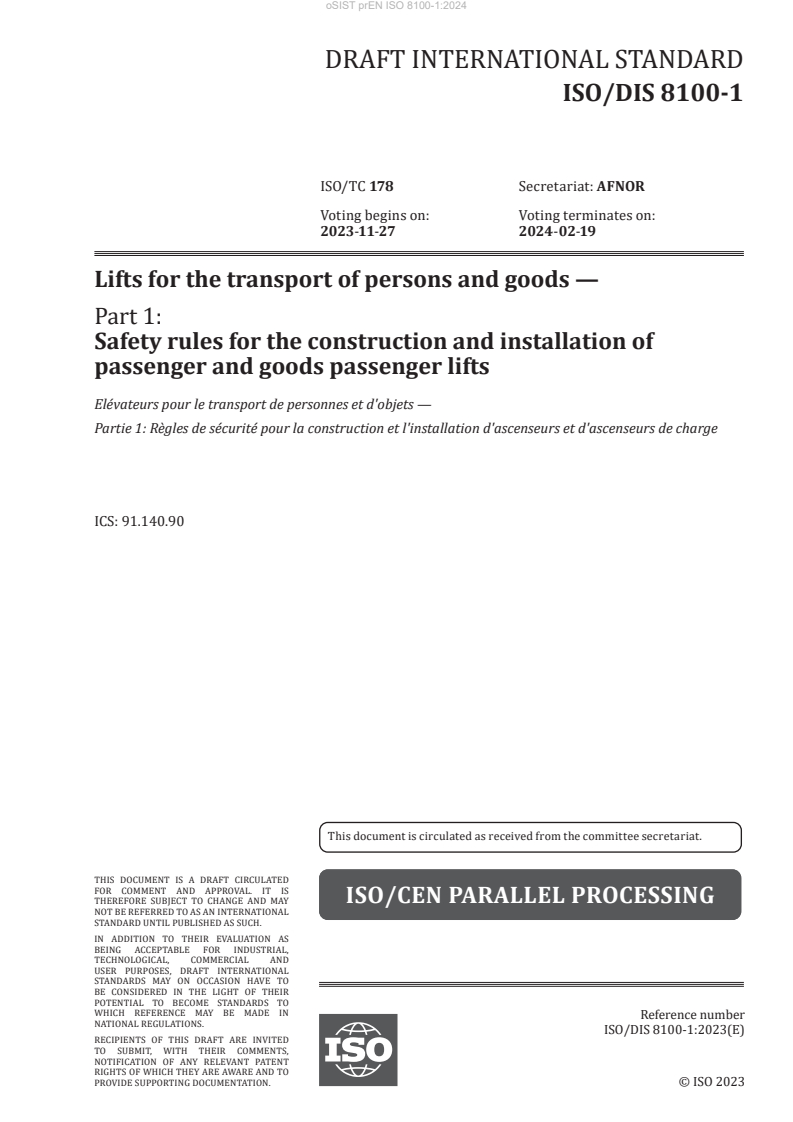
(Main)Lifts for the transport of persons and goods - Part 1: Safety rules for the construction and installation of passenger and goods passenger lifts (ISO/FDIS 8100-1:2025)
Lifts for the transport of persons and goods - Part 1: Safety rules for the construction and installation of passenger and goods passenger lifts (ISO/FDIS 8100-1:2025)
This document specifies the safety rules for lifts permanently serving buildings and constructions and intended for the transport of persons or persons and goods. It applies to traction lifts, positive drive lifts and hydraulic lifts that:
serve specific levels; and
have a rated speed exceeding 0,15 m/s; and
have an enclosed car; and
move along guide rails inclined not more than 15° to the vertical; and
are indoor or weather-protected.
This document also applies to the electrical equipment of these lifts including the lighting and socket outlets in the well.
This document specifies safety rules related to:
persons to be safeguarded:
users, including passengers, maintenance and inspection personnel;
persons at the landings and outside of the well, or any machinery space and pulley room, who can be affected by the lift.
property to be safeguarded:
loads in the car;
components of the lift installation;
building in which the lift is installed.
This document does not specify additional requirements for:
lifts serving buildings with requirements for seismic conditions;
lifts serving buildings with requirements for accessibility;
lifts exposed to vandalism;
lifts which can be used for firefighting and evacuation purposes under firefighters control;
lifts which can be used to support faster evacuation of persons with disabilities;
the behaviour of the lift when the control system of the lift receives a recall signal(s) in the event of fire in a building.
This document is not applicable to passenger and goods passenger lifts, which are installed before the date of its publication.
Aufzüge für den Personen- und Gütertransport - Teil 1: Sicherheitsregeln für die Konstruktion und den Einbau von Personen- und Lastenaufzügen (ISO/FDIS 8100-1:2025)
Dieses Dokument legt die Sicherheitsregeln für Aufzüge fest, die dauerhaft in Gebäuden und Konstruktionen eingesetzt werden und die für den Transport von Personen oder Personen und Gütern bestimmt sind. Es gilt für Treibscheibenaufzüge, Aufzüge mit formschlüssigem Antrieb und Hydraulikaufzüge, die:
festgelegte Ebenen bedienen;
eine Nenngeschwindigkeit haben, die 0,15 m/s überschreitet;
über einen geschlossenen Fahrkorb verfügen;
sich an Führungsschienen entlang bewegen, die nicht mehr als 15° gegen die Vertikale geneigt sind;
sich in einem Innenraum befinden oder vor Witterung geschützt sind.
Dieses Dokument gilt auch für die elektrische Ausrüstung dieser Aufzüge, einschließlich der Beleuchtung und Steckdosen im Schacht.
Dieses Dokument legt Sicherheitsregeln fest in Bezug auf:
Zu schützende Personen:
Benutzer, einschließlich Fahrgäste, Wartungs- und Prüfpersonal;
Personen an den Haltestellen und außerhalb des Schachts oder eines Aufstellungsortes für Triebwerk und Steuerung und eines Rollenraums, die durch den Aufzug beeinträchtigt werden können.
Zu schützende Gegenstände:
Güter im Fahrkorb;
Bauteile des Aufzugs;
das Gebäude, in dem sich der Aufzug befindet.
Dieses Dokument legt keine zusätzlichen Anforderungen an Folgendes fest:
in Gebäuden eingesetzte Aufzüge mit Anforderungen unter Erdbebenbedingungen;
in Gebäuden eingesetzte Aufzüge mit Anforderungen an die Zugänglichkeit;
Aufzüge, die mutwilliger Zerstörung ausgesetzt sind;
Aufzüge, die zur Brandbekämpfung und Evakuierung unter Kontrolle der Feuerwehr eingesetzt werden können;
Aufzüge, die zur Unterstützung der schnelleren Evakuierung von Menschen mit Behinderungen verwendet werden können;
das Verhalten des Aufzugs, wenn die Steuerung des Aufzugs im Fall eines Gebäudebrands ein Rückrufsignal bzw. mehrere Rückrufsignale empfängt.
Dieses Dokument gilt nicht für Personen- und Lastenaufzüge, die vor ihrer Veröffentlichung errichtet wurden.
Ascenseurs pour le transport de personnes et d'objets - Partie 1: Règles de sécurité pour la construction et l'installation d'ascenseurs et d'ascenseurs de charge (ISO/FDIS 8100-1:2025)
Dvigala za prevoz oseb in blaga - 1. del: Varnostna pravila za konstruiranje in vgradnjo dvigal (liftov) za osebna in tovorno-osebna dvigala (ISO/FDIS 8100-1:2025)
General Information
- Status
- Not Published
- Publication Date
- 29-Mar-2026
- Technical Committee
- CEN/TC 10 - Passenger, goods and service lifts
- Drafting Committee
- CEN/TC 10/WG 1 - Lifts and service lifts
- Current Stage
- 6055 - CEN Ratification completed (DOR) - Publishing
- Start Date
- 01-Mar-2026
- Due Date
- 11-Sep-2024
- Completion Date
- 01-Mar-2026
Relations
- Effective Date
- 12-Feb-2026
- Effective Date
- 18-Jan-2023
Overview
FprEN ISO 8100-1 is an international standard developed by CEN that defines the safety rules for the construction and installation of passenger and goods passenger lifts. This standard covers permanently installed new lifts with traction, positive, or hydraulic drives operating between defined landing levels. It targets lifts designed for transporting persons or persons and goods and suspended by ropes, chains, or jacks moving along guide rails inclined no more than 15° from the vertical.
This standard is essential for manufacturers, installers, and safety inspectors to ensure the highest safety standards in lift design and installation. It replaces previous standards such as SIST EN 81-20:2020, aiming for improved safety and harmonization within Europe.
Key Topics
The standard elaborates on several critical aspects of lift safety, including:
Scope and Exclusions: Specifies applicable lift types and excludes certain installations such as lifts with drives outside defined parameters, lifts in existing buildings with constraints, specialized lifting appliances (e.g., paternosters, mine lifts), and safety during transport or erection.
Safety Requirements and Protective Measures:
- Detailed provisions for shafts, machinery spaces, and pulley rooms, including access and emergency doors.
- Specifications for landing doors and car doors, such as dimensions, strength, locking mechanisms, and safety devices.
- Design criteria for car, counterweight, and balancing weight components, including materials, dimensions, and ventilation.
- Requirements for suspension means and compensation systems, including ropes, chains, and sheaves.
- Precautions against free fall, overspeed, unintended car movements, and safety gear specifications.
- Guide rails, buffers, and machinery safety: tolerances, stresses, and impact factors.
- Electrical installations and safety measures, including fault protection, wiring, and control systems.
- Control systems, limit switches, emergency alarms, and communication devices.
Special Cases and Supplementary Requirements: Considerations for lifts used by persons with disabilities, fire conditions, explosive atmospheres, extreme climates, seismic conditions, or transporting dangerous goods.
Applications
This standard applies to:
- Lift Manufacturers and Engineers developing new passenger and goods passenger lifts that meet stringent safety criteria.
- Installation Professionals ensuring lifts are installed in compliance with international safety rules.
- Safety Inspectors and Regulators auditing lifts to verify conformity with the latest safety requirements.
- Architects and Building Designers integrating lifts safely into new construction projects.
- Facility Managers upgrading or maintaining lift safety in various buildings.
By adhering to this standard, stakeholders ensure safe transportation of persons and goods within all types of commercial, residential, and public buildings, thereby reducing risks and improving user safety.
Related Standards
FprEN ISO 8100-1 aligns with and complements other international and European standards such as:
- EN 81-21: Focuses on lifts in existing buildings where certain conditions restrict the application of EN 81-20.
- EN 81-20: Previous standard replaced by ISO 8100-1, focusing on safety rules for lift construction and installation.
- Additional standards covering:
- Accessibility requirements for persons with disabilities.
- Fire safety provisions for lift use in emergencies.
- Standards for lifts operating in hazardous or extreme environments.
Adopting FprEN ISO 8100-1 helps unify global safety regulations, supporting the design of lifts that satisfy a broad spectrum of safety and operational requirements.
Keywords: ISO 8100-1, lift safety standards, passenger lifts, goods passenger lifts, lift construction, lift installation, traction lifts, hydraulic lifts, lift safety rules, CEN standards, elevator safety, building lift regulations, lift maintenance safety, elevator construction standards.

Get Certified
Connect with accredited certification bodies for this standard

ICC Evaluation Service
Building products evaluation and certification.

QAI Laboratories
Building and construction product testing and certification.

Aboma Certification B.V.
Specialized in construction, metal, and transport sectors.
Sponsored listings
Frequently Asked Questions
FprEN ISO 8100-1 is a draft published by the European Committee for Standardization (CEN). Its full title is "Lifts for the transport of persons and goods - Part 1: Safety rules for the construction and installation of passenger and goods passenger lifts (ISO/FDIS 8100-1:2025)". This standard covers: This document specifies the safety rules for lifts permanently serving buildings and constructions and intended for the transport of persons or persons and goods. It applies to traction lifts, positive drive lifts and hydraulic lifts that: serve specific levels; and have a rated speed exceeding 0,15 m/s; and have an enclosed car; and move along guide rails inclined not more than 15° to the vertical; and are indoor or weather-protected. This document also applies to the electrical equipment of these lifts including the lighting and socket outlets in the well. This document specifies safety rules related to: persons to be safeguarded: users, including passengers, maintenance and inspection personnel; persons at the landings and outside of the well, or any machinery space and pulley room, who can be affected by the lift. property to be safeguarded: loads in the car; components of the lift installation; building in which the lift is installed. This document does not specify additional requirements for: lifts serving buildings with requirements for seismic conditions; lifts serving buildings with requirements for accessibility; lifts exposed to vandalism; lifts which can be used for firefighting and evacuation purposes under firefighters control; lifts which can be used to support faster evacuation of persons with disabilities; the behaviour of the lift when the control system of the lift receives a recall signal(s) in the event of fire in a building. This document is not applicable to passenger and goods passenger lifts, which are installed before the date of its publication.
This document specifies the safety rules for lifts permanently serving buildings and constructions and intended for the transport of persons or persons and goods. It applies to traction lifts, positive drive lifts and hydraulic lifts that: serve specific levels; and have a rated speed exceeding 0,15 m/s; and have an enclosed car; and move along guide rails inclined not more than 15° to the vertical; and are indoor or weather-protected. This document also applies to the electrical equipment of these lifts including the lighting and socket outlets in the well. This document specifies safety rules related to: persons to be safeguarded: users, including passengers, maintenance and inspection personnel; persons at the landings and outside of the well, or any machinery space and pulley room, who can be affected by the lift. property to be safeguarded: loads in the car; components of the lift installation; building in which the lift is installed. This document does not specify additional requirements for: lifts serving buildings with requirements for seismic conditions; lifts serving buildings with requirements for accessibility; lifts exposed to vandalism; lifts which can be used for firefighting and evacuation purposes under firefighters control; lifts which can be used to support faster evacuation of persons with disabilities; the behaviour of the lift when the control system of the lift receives a recall signal(s) in the event of fire in a building. This document is not applicable to passenger and goods passenger lifts, which are installed before the date of its publication.
FprEN ISO 8100-1 is classified under the following ICS (International Classification for Standards) categories: 91.140.90 - Lifts. Escalators. The ICS classification helps identify the subject area and facilitates finding related standards.
FprEN ISO 8100-1 has the following relationships with other standards: It is inter standard links to ISO 8100-1:2026, EN 81-20:2020. Understanding these relationships helps ensure you are using the most current and applicable version of the standard.
FprEN ISO 8100-1 is associated with the following European legislation: EU Directives/Regulations: 2014/33/EU; Standardization Mandates: M/549, M/599. When a standard is cited in the Official Journal of the European Union, products manufactured in conformity with it benefit from a presumption of conformity with the essential requirements of the corresponding EU directive or regulation.
FprEN ISO 8100-1 is available in PDF format for immediate download after purchase. The document can be added to your cart and obtained through the secure checkout process. Digital delivery ensures instant access to the complete standard document.
Standards Content (Sample)
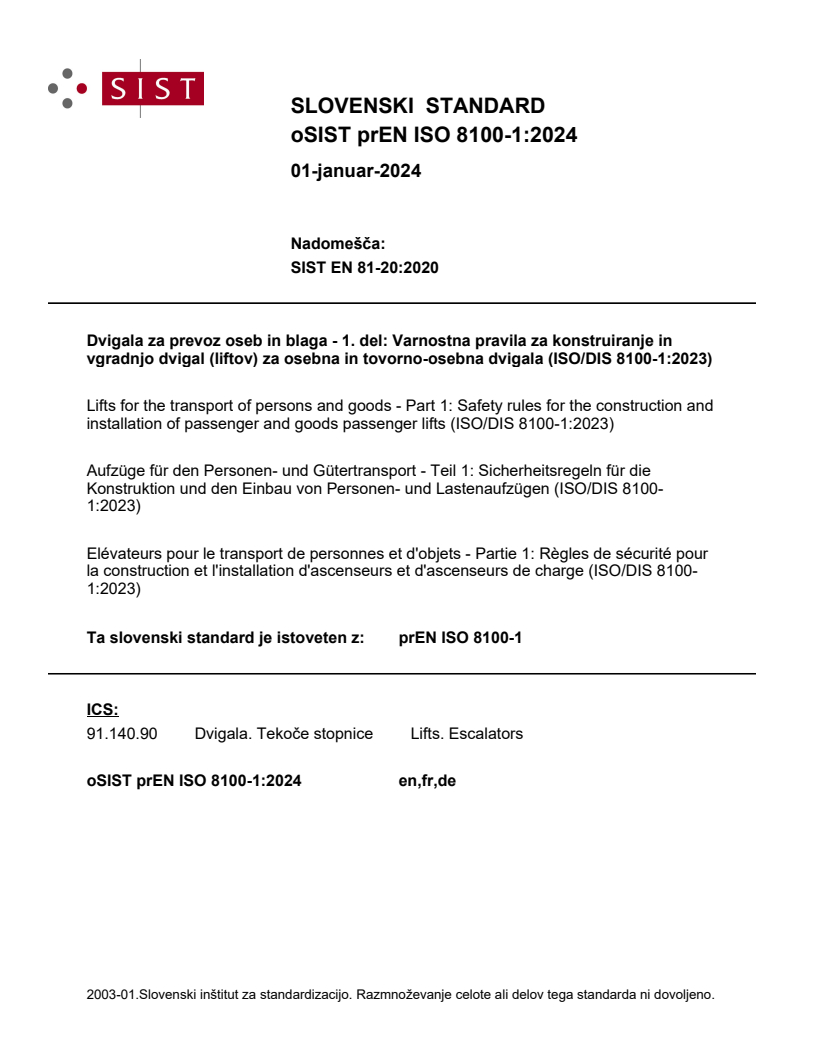
SLOVENSKI STANDARD
oSIST prEN ISO 8100-1:2024
01-januar-2024
Nadomešča:
SIST EN 81-20:2020
Dvigala za prevoz oseb in blaga - 1. del: Varnostna pravila za konstruiranje in
vgradnjo dvigal (liftov) za osebna in tovorno-osebna dvigala (ISO/DIS 8100-1:2023)
Lifts for the transport of persons and goods - Part 1: Safety rules for the construction and
installation of passenger and goods passenger lifts (ISO/DIS 8100-1:2023)
Aufzüge für den Personen- und Gütertransport - Teil 1: Sicherheitsregeln für die
Konstruktion und den Einbau von Personen- und Lastenaufzügen (ISO/DIS 8100-
1:2023)
Elévateurs pour le transport de personnes et d'objets - Partie 1: Règles de sécurité pour
la construction et l'installation d'ascenseurs et d'ascenseurs de charge (ISO/DIS 8100-
1:2023)
Ta slovenski standard je istoveten z: prEN ISO 8100-1
ICS:
91.140.90 Dvigala. Tekoče stopnice Lifts. Escalators
oSIST prEN ISO 8100-1:2024 en,fr,de
2003-01.Slovenski inštitut za standardizacijo. Razmnoževanje celote ali delov tega standarda ni dovoljeno.
oSIST prEN ISO 8100-1:2024
oSIST prEN ISO 8100-1:2024
DRAFT INTERNATIONAL STANDARD
ISO/DIS 8100-1
ISO/TC 178 Secretariat: AFNOR
Voting begins on: Voting terminates on:
2023-11-27 2024-02-19
Lifts for the transport of persons and goods —
Part 1:
Safety rules for the construction and installation of
passenger and goods passenger lifts
Elévateurs pour le transport de personnes et d'objets —
Partie 1: Règles de sécurité pour la construction et l'installation d'ascenseurs et d'ascenseurs de charge
ICS: 91.140.90
This document is circulated as received from the committee secretariat.
THIS DOCUMENT IS A DRAFT CIRCULATED
FOR COMMENT AND APPROVAL. IT IS
ISO/CEN PARALLEL PROCESSING
THEREFORE SUBJECT TO CHANGE AND MAY
NOT BE REFERRED TO AS AN INTERNATIONAL
STANDARD UNTIL PUBLISHED AS SUCH.
IN ADDITION TO THEIR EVALUATION AS
BEING ACCEPTABLE FOR INDUSTRIAL,
TECHNOLOGICAL, COMMERCIAL AND
USER PURPOSES, DRAFT INTERNATIONAL
STANDARDS MAY ON OCCASION HAVE TO
BE CONSIDERED IN THE LIGHT OF THEIR
POTENTIAL TO BECOME STANDARDS TO
WHICH REFERENCE MAY BE MADE IN
Reference number
NATIONAL REGULATIONS.
ISO/DIS 8100-1:2023(E)
RECIPIENTS OF THIS DRAFT ARE INVITED
TO SUBMIT, WITH THEIR COMMENTS,
NOTIFICATION OF ANY RELEVANT PATENT
RIGHTS OF WHICH THEY ARE AWARE AND TO
PROVIDE SUPPORTING DOCUMENTATION. © ISO 2023
oSIST prEN ISO 8100-1:2024
ISO/DIS 8100-1:2023(E)
DRAFT INTERNATIONAL STANDARD
ISO/DIS 8100-1
ISO/TC 178 Secretariat: AFNOR
Voting begins on: Voting terminates on:
Lifts for the transport of persons and goods —
Part 1:
Safety rules for the construction and installation of
passenger and goods passenger lifts
Elévateurs pour le transport de personnes et d'objets —
Partie 1: Règles de sécurité pour la construction et l'installation d'ascenseurs et d'ascenseurs de charge
ICS: 91.140.90
This document is circulated as received from the committee secretariat.
THIS DOCUMENT IS A DRAFT CIRCULATED
FOR COMMENT AND APPROVAL. IT IS
© ISO 2023
ISO/CEN PARALLEL PROCESSING
THEREFORE SUBJECT TO CHANGE AND MAY
All rights reserved. Unless otherwise specified, or required in the context of its implementation, no part of this publication may
NOT BE REFERRED TO AS AN INTERNATIONAL
be reproduced or utilized otherwise in any form or by any means, electronic or mechanical, including photocopying, or posting on STANDARD UNTIL PUBLISHED AS SUCH.
the internet or an intranet, without prior written permission. Permission can be requested from either ISO at the address below
IN ADDITION TO THEIR EVALUATION AS
or ISO’s member body in the country of the requester. BEING ACCEPTABLE FOR INDUSTRIAL,
TECHNOLOGICAL, COMMERCIAL AND
ISO copyright office
USER PURPOSES, DRAFT INTERNATIONAL
CP 401 • Ch. de Blandonnet 8
STANDARDS MAY ON OCCASION HAVE TO
BE CONSIDERED IN THE LIGHT OF THEIR
CH-1214 Vernier, Geneva
POTENTIAL TO BECOME STANDARDS TO
Phone: +41 22 749 01 11
WHICH REFERENCE MAY BE MADE IN
Reference number
Email: copyright@iso.org
NATIONAL REGULATIONS.
Website: www.iso.org ISO/DIS 8100-1:2023(E)
RECIPIENTS OF THIS DRAFT ARE INVITED
Published in Switzerland
TO SUBMIT, WITH THEIR COMMENTS,
NOTIFICATION OF ANY RELEVANT PATENT
RIGHTS OF WHICH THEY ARE AWARE AND TO
ii
PROVIDE SUPPORTING DOCUMENTATION. © ISO 2023
oSIST prEN ISO 8100-1:2024
ISO/DIS 8100-1:2023(E)
Contents Page
European Foreword . vi
Foreword .vii
Introduction .ix
1 Scope . 1
2 Normative references . 1
3 Terms and definitions . 4
4 Safety requirements and/or protective measures . 9
4.1 General . 9
4.2 Well, machinery spaces and pulley rooms . 9
4.2.1 General provisions . 9
4.2.2 Access to the pit . 13
4.2.3 Access, emergency, trap and inspection doors . 14
4.2.4 Notices . 15
4.2.5 Well . 16
4.2.6 Machinery spaces and pulley rooms .29
4.3 Landing doors and car doors . 36
4.3.1 General provisions . 36
4.3.2 Height and width of entrances .36
4.3.3 Sills, guides, door suspension .36
4.3.4 Horizontal door clearances . 37
4.3.5 Strength of landing and car doors . 41
4.3.6 Protection in relation to door operation . 47
4.3.7 “Car here” indication .56
4.3.8 Locking and closed landing door check . 57
4.3.9 Locking and emergency unlocking of landing and car doors . 57
4.3.10 Requirements common to devices for proving the locked condition and the
closed condition of the landing door .60
4.3.11 Sliding landing doors with multiple, mechanically linked panels . 61
4.3.12 Closing of automatically operated landing doors . 61
4.3.13 Electric safety device for proving the car doors closed . 61
4.3.14 Sliding or folding car doors with multiple, mechanically linked panels . 61
4.3.15 Opening the car door . 62
4.4 Car, counterweight and balancing weight . 62
4.4.1 Height of car . . . 62
4.4.2 Available car area, rated load, number of passengers.63
4.4.3 Walls, floor and roof of the car .68
4.4.4 Car door, floor, wall, ceiling and decorative materials . 70
4.4.5 Apron . 70
4.4.6 Emergency trap doors and emergency doors . 71
4.4.7 Car roof .72
4.4.8 Equipment on top of the car . 75
4.4.9 Ventilation . 75
4.4.10 Lighting . 75
4.4.11 Counterweight and balancing weight . 76
4.5 Suspension means, compensation means and related protection means . 76
4.5.1 Suspension means and related sheaves/drums/sprockets . 76
4.5.2 Minimum diameter ratio, safety factor, suspension means terminations .79
4.5.3 Suspension means traction/transmission .85
4.5.4 Winding up of ropes for positive drive lifts .86
4.5.5 Distribution of load between the suspension means.87
4.5.6 Compensation means .87
4.5.7 Protection for sheaves, pulleys and sprockets .88
iii
oSIST prEN ISO 8100-1:2024
ISO/DIS 8100-1:2023(E)
4.5.8 Traction sheaves, pulleys and sprockets in the well. 91
4.5.9 Marking for suspension and compensation means . 91
4.6 Precautions against free fall, excessive speed, unintended car movement and
creeping of the car . 91
4.6.1 General provisions . 91
4.6.2 Safety gear and its tripping means . 93
4.6.3 Rupture valve .99
4.6.4 Restrictors .100
4.6.5 Pawl device . 101
4.6.6 Ascending car overspeed protection means .102
4.6.7 Protection against unintended car movement .103
4.7 Guide rails .106
4.7.1 Guiding of the car, counterweight or balancing weight .106
4.7.2 Permissible stresses and deflections .106
4.7.3 Combination of masses and forces .109
4.7.4 Impact factors .109
4.8 Buffers . 111
4.8.1 Car and counterweight buffers . 111
4.8.2 Stroke of car and counterweight buffers .112
4.9 Lift machinery and associated equipment.113
4.9.1 General provision .113
4.9.2 Lift machine for traction lifts and positive drive lifts .113
4.9.3 Lift machine for hydraulic lifts .120
4.10 Electric installations and appliances .129
4.10.1 General provisions .129
4.10.2 Incoming supply conductor terminations . .131
4.10.3 Contactors, contactor relays, components of safety circuits .131
4.10.4 Protection of electrical equipment .132
4.10.5 Main switches .133
4.10.6 Electric wiring .134
4.10.7 Lighting and socket outlets .135
4.10.8 Control of the supply for lighting and socket outlets .136
4.10.9 Protective earthing .136
4.10.10 Electrical identification .136
4.11 Protection against electric faults; failure analysis; electric safety devices .136
4.11.1 Protection against electric faults; failure analysis .136
4.11.2 Electric safety devices .137
4.12 Controls — Final limit switches — Priorities . 143
4.12.1 Control of lift operations . 143
4.12.2 Final limit switches .151
4.12.3 Emergency alarm device and intercom system .152
4.12.4 Priorities and signals .153
5 Verification of the safety requirements and/or protective measures . 153
5.1 Verification methods .153
5.2 Specific examinations and tests on installed lift .157
5.2.1 General .157
5.2.2 Braking system (4.9.2.2) .157
5.2.3 Electric installation .158
5.2.4 Checking of the traction (4.5.3) .158
5.2.5 Car safety gear (4.6.2).158
5.2.6 Counterweight or balancing weight safety gear (4.6.2) .159
5.2.7 Pawl device (5.6.5) .159
5.2.8 Buffers (4.8) .159
5.2.9 Rupture valve (4.6.3) .160
5.2.10 Restrictor/one-way restrictor (4.6.4) .160
5.2.11 Pressure test .160
5.2.12 Ascending car overspeed protection means (4.6.6) .160
5.2.13 Stopping of the car at landings and levelling accuracy (4.12.1.1.4) . 161
iv
oSIST prEN ISO 8100-1:2024
ISO/DIS 8100-1:2023(E)
5.2.14 Protection against unintended car movement (4.6.7) . 161
5.2.15 Protection against falling/shearing (4.3.9.3.4) . 161
5.2.16 Balancing of vertical sliding door (4.3.3.3.5) . 161
5.2.17 Counterweight balance (4.5.3) . 161
6 Information for use .161
6.1 General . 161
6.2 Instructions . 161
6.2.1 General . 161
6.2.2 Basic data and characteristics .162
6.2.3 Information for use .162
6.2.4 Information for maintenance .162
6.2.5 Information for emergency operation .163
6.3 Logbook.163
7 Use of ISO/TS 8100-3 . 164
Annex A (normative) List of the electric safety devices . 165
Annex B (normative) Building-related boundary conditions in which the lift is installed .167
Annex C (normative) Pit access ladder . 169
Annex D (informative) Relationship between this document and ISO 8100-20 .174
Annex ZA (informative) Relationship between this European Standard and the essential
requirements of Directive 2014/33/EU aimed to be covered . 183
Bibliography . 189
v
oSIST prEN ISO 8100-1:2024
ISO/DIS 8100-1:2023(E)
European Foreword
This document (prEN ISO 8100-1:2023) has been prepared by Technical Committee CEN/TC 10 “Lifts,
escalators and moving walks”, the secretariat of which is held by AFNOR.
This document is currently submitted to the CEN Enquiry.
This document will supersede EN 81-20:2020.
This document is part of the EN 81 series of standards. The structure of the EN 81 series is described in
CEN/TR 81-10:2008.
This document has been prepared under a Standardization Request given to CEN by the European
Commission and the European Free Trade Association, and supports essential requirements of
EU Directive(s) / Regulation(s).
For relationship with EU Directive(s) / Regulation(s), see informative Annex ZA, which is an integral
part of this document.
According to the CEN-CENELEC Internal Regulations, the national standards organizations of the
following countries are bound to implement this European Standard: Austria, Belgium, Bulgaria,
Croatia, Cyprus, Czech Republic, Denmark, Estonia, Finland, Republic of North Macedonia, France,
Germany, Greece, Hungary, Iceland, Ireland, Italy, Latvia, Lithuania, Luxembourg, Malta, Netherlands,
Norway, Poland, Portugal, Romania, Slovakia, Slovenia, Spain, Sweden, Switzerland, Turkey and the
United Kingdom.
vi
oSIST prEN ISO 8100-1:2024
ISO/DIS 8100-1:2023(E)
Foreword
ISO (the International Organization for Standardization) is a worldwide federation of national standards
bodies (ISO member bodies). The work of preparing International Standards is normally carried out
through ISO technical committees. Each member body interested in a subject for which a technical
committee has been established has the right to be represented on that committee. International
organizations, governmental and non-governmental, in liaison with ISO, also take part in the work.
ISO collaborates closely with the International Electrotechnical Commission (IEC) on all matters of
electrotechnical standardization.
The procedures used to develop this document and those intended for its further maintenance are
described in the ISO/IEC Directives, Part 1. In particular, the different approval criteria needed for the
different types of ISO documents should be noted. This document was drafted in accordance with the
editorial rules of the ISO/IEC Directives, Part 2 (see www.iso.org/directives).
ISO draws attention to the possibility that the implementation of this document may involve the use
of (a) patent(s). ISO takes no position concerning the evidence, validity or applicability of any claimed
patent rights in respect thereof. As of the date of publication of this document, ISO [had/had not] received
notice of (a) patent(s) which may be required to implement this document. However, implementers are
cautioned that this may not represent the latest information, which may be obtained from the patent
database available at www.iso.org/patents. ISO shall not be held responsible for identifying any or all
such patent rights.
Any trade name used in this document is information given for the convenience of users and does not
constitute an endorsement.
For an explanation of the voluntary nature of standards, the meaning of ISO specific terms and
expressions related to conformity assessment, as well as information about ISO's adherence to
the World Trade Organization (WTO) principles in the Technical Barriers to Trade (TBT) see
www.iso.org/iso/foreword.html.
This document was prepared by Technical Committee ISO/TC 178, Lifts, escalators, passenger conveyors
This second edition cancels and replaces the first edition (ISO 8100-1:2019), which has been technically
revised.
The main changes are as follows:
— Editorial revision of the document structure according to the ISO/IEC Directives, part 2;
— Requirements for vertical sliding landing doors and car doors are added;
— Requirements for suspension means other than steel wire ropes are added;
— Requirements for automatic rescue operation are added;
— Requirements for traction lifts with increased available car area are added;
— Requirements for SIL-rated circuits (previously called PESSRAL) have been revised;
— Requirements for a working platform in the pit are added;
— Requirements to avoid the dragging of hands in doors are extended;
— Requirements for compensation means entering the refuge space in the pit are added;
— Requirements for the brake are aligned with overload limits;
— Performance and monitoring of the machine brake are revised;
— Requirements for pit access ladders are revised;
vii
oSIST prEN ISO 8100-1:2024
ISO/DIS 8100-1:2023(E)
— Fire classification of electric cables is specified.
For relationship with this document and ISO 8100-20, see informative Annex D, which is an integral
part of this document.
A list of all parts in the ISO 8100 series can be found on the ISO website.
Any feedback or questions on this document should be directed to the user’s national standards body. A
complete listing of these bodies can be found at www.iso.org/members.html.
viii
oSIST prEN ISO 8100-1:2024
ISO/DIS 8100-1:2023(E)
Introduction
This document is a type C standard as stated in ISO 12100:2010.
This document is of relevance, in particular, for the following stakeholder groups representing the
market players with regard to machinery safety:
— machine manufacturers (small, medium and large enterprises);
— health and safety bodies (regulators, accident prevention organizations, market surveillance etc.).
Others can be affected by the level of machinery safety achieved with the means of the document by the
above-mentioned stakeholder groups:
— machine users/employers (small, medium and large enterprises);
— machine users/employees (e.g. trade unions, organizations for people with special needs);
— service providers, e.g. for maintenance (small, medium and large enterprises);
— consumers (in case of machinery intended for use by consumers).
The above-mentioned stakeholder groups have been given the possibility to participate in the drafting
process of this document
The machinery concerned and the extent to which hazards, hazardous situations and hazardous events
are covered are indicated in the scope of this document.
When requirements of this type-C standard are different from those which are stated in type-A or
type-B standards, the requirements of this type-C standard take precedence over the requirements of
the other standards for machines that have been designed and built according to the requirements of
this type-C standard.
The object of this document is to define safety rules related to passenger and goods passenger lifts.
Persons to be safeguarded:
— users, including passengers, maintenance and inspection personnel;
— persons at the landings and outside of the well, or any machinery space and pulley room, who can
be effected by the lift.
Property to be safeguarded:
a) loads in car;
b) components of the lift installation;
c) building in which the lift is installed;
ix
oSIST prEN ISO 8100-1:2024
oSIST prEN ISO 8100-1:2024
DRAFT INTERNATIONAL STANDARD ISO/DIS 8100-1:2023(E)
Lifts for the transport of persons and goods —
Part 1:
Safety rules for the construction and installation of
passenger and goods passenger lifts
1 Scope
This document specifies the safety rules for lifts permanently installed in buildings, which are intended
for the transport of passengers or passengers and goods . This document applies to:
— lifts, with traction drive, positive drive or hydraulic drive;
— lifts serving specific levels
— lifts having a closed car;
— lifts moving along guide rails inclined not more than 15° to the vertical.
— lifts installed in buildings with boundary conditions in accordance with Annex B;
— the electrical equipment of the lift, including lighting and socket outlets in the well.
This document does not specify additional requirements for:
— lifts installed in buildings with requirements for seismic conditions;
— lifts installed in buildings with requirements for accessibility;
— lifts exposed to vandalism;
— lifts to be used for firefighting;
— lifts intended for the transport of goods alone where the carrier is accessible, and fitted with controls
situated inside the carrier or within reach of a person inside the carrier;
— the behavior of the lift when the control system of the lift receives a recall signal(s) in the event of
fire in a building.
This document is not applicable to passenger and goods passenger lifts, which are installed before the
date of its publication.
2 Normative references
The following documents are referred to in the text in such a way that some or all of their content
constitutes requirements of this document. For dated references, only the edition cited applies. For
undated references, the latest edition of the referenced document (including any amendments) applies.
ISO 1219-1:2012, Fluid power systems and components — Graphical symbols and circuit diagrams — Part
1: Graphical symbols for conventional use and data-processing applications
ISO 3008-2:2017, Fire-resistance tests — Part 2: Lift landing door assemblies
ISO 4344:2022, Steel wire ropes for lifts — Minimum requirements
ISO 4190-5:2006, Lift (Elevator) installation — Part 5: Control devices, signals and additional fittings
oSIST prEN ISO 8100-1:2024
ISO/DIS 8100-1:2023(E)
ISO 4413:2010, Hydraulic fluid power — General rules and safety requirements for systems and their
components
ISO 6743-4:2015, Lubricants, industrial oils and related products (class L) — Classification — Part 4:
Family H (Hydraulic systems)
ISO 7010:2019, Graphical symbols — Safety colours and safety signs — Registered safety signs
ISO 8100-2:2023, Lifts for the transport of persons and goods —Part 2: Design rules, calculations,
examinations and tests of lift components
ISO 8102-1:2020, Electrical requirements for lifts, escalators and moving walks — Part 1: Electromagnetic
compatibility with regard to emission
ISO 8102-2:2021, Electrical requirements for lifts, escalators and moving walks — Part 2: Electromagnetic
compatibility with regard to immunity
ISO 8102-20:2022, Electrical requirements for lifts, escalators and moving walks — Part 20: Cybersecurity
ISO 12100:2010, Safety of machinery — General principles for design — Risk assessment and risk reduction
ISO 12543-2:2021, Glass in building — Laminated glass and laminated safety glass — Part 2: Laminated
safety glass
ISO 12543-3:2021, Glass in building — Laminated glass and laminated safety glass — Part 3: Laminated
glass
ISO 13857:2019, Safety of machinery — Safety distances to prevent hazard zones being reached by upper
and lower limbs
ISO 14122-3:2016, Safety of machinery — Permanent means of access to machinery — Part 3: Stairs,
stepladders and guard-rails
ISO 14122-4:2016, Safety of machinery — Permanent means of access to machinery — Part 4: Fixed ladders
ISO 29584:2015, Glass in building — Pendulum impact testing and classification of safety glass
I EC 6 020 4 -1:2016 +A 1: 2021, Safety of machinery — Electrical equipment of machines — Part 1: General
requirements
IEC 60227-6:2001, Polyvinyl chloride insulated cables of rated voltages up to and including 450/750 V —
Part 6: Lift cables and cables for flexible connections
I EC 6 0332-1-2:20 0 4 +A M D1: 2015, Tests on electric and optical fibre cables under fire conditions —
Part 1‑2: Test for vertical flame propagation for a single insulated wire or cable — Procedure for 1 kW pre‑
mixed flame
IEC 60332-3-24:2018, Tests on electric and optical fibre cables under fire conditions – Part 3‑24: Test for
vertical flame spread of vertically‑mounted bunched wires or cables – Category C
I EC 6 036 4 - 4 - 41:20 05+A M D1: 2017, Low voltage electrical installations — Part 4‑41: Protection for
safety — Protection against electric shock
IEC 60364-6:2016, Low voltage electrical installations — Part 6: Verification
IEC 60417:2002, Database — Graphical symbols for use on equipment
I EC 6 0529:198 9+A M D1: 19 9 9, Degrees of protection provided by enclosures (IP Code)
IEC 60598-1:2020, Luminaires — Part 1: General requirements and tests
IEC 60617:2012, Database — Graphical symbols for diagrams
oSIST prEN ISO 8100-1:2024
ISO/DIS 8100-1:2023(E)
IEC 60664-1:2020, Insulation coordination for equipment within low-voltage systems — Part 1: Principles,
requirements and tests
I EC 6 075 4 -2:2011+A M D1: 2019, Test on gases evolved during combustion of materials from cables —
Part 2: Determination of acidity (by pH measurement) and conductivity
IEC 60947-4-1:2018, Low‑voltage switchgear and controlgear — Part 4: Contactors and motor —
starters - Section 1: Electromechanical contactors and motor-starters
IEC 60947-5-1:2016, Low-voltage switchgear and controlgear — Part 5-1: Control circuit devices and
switching elements — Electromechanical control circuit devices
I EC 6 0 9 47-5 -5:19 97+A M D1: 20 05, Low-voltage switchgear and controlgear — Part 5-5: Control circuit
devices and switching elements — Electrical emergency stop device with mechanical latching function
I EC 6103 4 -2:20 05+A M D1: 2013, Measurement of smoke density of cables burning under defined conditions
– Part 2: Test procedure and requirements
IEC 61310-3:2007, Safety of machinery - Indication, marking and actuation — Requirements for the
location and operation of actuators
IEC 61508-1:2010, Functional safety of electrical/electronic/programmable electronic safety-related
systems — Part 1: General requirements
IEC 61800-5-2:2016, Adjustable speed electrical power drive systems — Part 5-2: Safety requirements.
Functional
I EC 61810 -1:2015+A M D1: 2019, Electromechanical elementary relays — Part 1: General requirements
IEC 61810-3:2015, Electromechanical elementary relays - Part 3: Relays with forcibly guided (mechanically
linked) contacts
EN 81-28:2022, Safety rules for the construction and installation of lifts — Lifts for the transport of persons
and goods — Part 28: Remote alarm on passenger and goods passenger lifts
EN 81-58:2022, Safety rules for the construction and installation of lifts — Examinations and tests —
Part 58: Landing door fire resistance test
EN 81-71:2022, Safety rules for the construction and installation of lifts — Particular applications to
passenger lifts and goods passenger lifts — Part 71: Vandal resistant lifts
E N 19 93-1-1:20 06 +A 1: 2014, Eurocode 3 — Design of steel structures — Part 1-1: General rules and rules
for buildings
E N 12385 -1:2002+A 1: 2008 , Steel wire ropes. Safety. General requirements
1)
EN 12385-5:2021 , Steel wire ropes — Safety — Stranded ropes for lifts
EN 13411-3:2022, Terminations for steel wire ropes — Part 3: Safety. Ferrules and ferrule-securing
E N 13 411- 6:200 4 +A 1: 2008 , Terminations for steel wire ropes — Part 6: Safety. Asymmetric wedge socket
EN 13411-7:2021, Terminations for steel wire ropes — Part 7: Safety. Symmetric wedge socket
EN 13411-8:2011, Termination for steel wire ropes — Part 8: Safety. Swage terminals and swaging
EN 13501-1:2018, Fire classification of construction products and building elements — Part 1: Classification
using data from reaction to fire tests
E N 13501- 6:2018 +A 1: 2022 , Fire classification of construction products and building elements —
Part 6: Classification using data from reaction to fire tests on electric cables
1) As impacted by EN 12385-5:2021/AC:2021
oSIST prEN ISO 8100-1:2024
ISO/DIS 8100-1:2023(E)
EN 50214:2006, Flat polyvinyl chloride sheathed flexible cables
3 Terms and definitions
For the purposes of this document, the following terms and definitions as well as terms and definitions
given in ISO 12100:2010 apply.
ISO and IEC maintain terminological databases for use in standardization at the following addresses:
— ISO Online browsing platform: available at https:// www .iso .org/ obp
— IEC Electropedia: available at https:// www .electropedia .org/
3.1
apron
smooth vertical part extending downwards from the sill of the landing or car entrance
3.2
automatic operation
operation in which start of the movement of the lift happens in response to the momentary actuation of
operating devices or in response to any other automatic starting function
3.3
automatic rescue operation
device or function that operates automatically in case of failure or loss of power supply to move the lift
car to a landing
3.4
balancing weight
mass which saves energy by balancing all or part of the mass of the car
3.5
buffer
mechanical device with characteristics to dissipate or store kinetic energy
3.6
car
part of the lift which carries the loads
3.7
counterweight
mass which ensures traction
3.8
direct acting lift
hydraulic lift where the ram or cylinder is directly attached to the car or the car sling
3.9
down direction valve
electrically controlled valve in a hydraulic circuit for controlling the descent of the car
3.10
drive control system
system controlling and monitoring the running of the lift machine
3.11
electrical anti-creep system
combination of measures for hydraulic lifts against the danger of the car moving slowly away from the
floor level
oSIST prEN ISO 8100-1:2024
ISO/DIS 8100-1:2023(E)
3.12
electric safety device
safety contact, safety circuit or SIL-rated circuit, having the required reliability of operation
3.13
electric safety chain
total of the electric safety devices connected in such a way as to stop the lift when one of them is
activated
3.14
full load pressure
static pressure exerted on the piping, jack, valve block, etc., with the car and rated load being at rest at
the highest landing level
3.15
goods passenger lift
passenger lift with additional measures for the tra
...
Questions, Comments and Discussion
Ask us and Technical Secretary will try to provide an answer. You can facilitate discussion about the standard in here.
Loading comments...