


ISO 55001:2014
(Main)Asset management — Management systems — Requirements
Asset management — Management systems — Requirements
ISO 55001:2014 specifies requirements for an asset management system within the context of the organization. ISO 55001:2014 can be applied to all types of assets and by all types and sizes of organizations.
Gestion d'actifs — Systèmes de management — Exigences
L'ISO 55001:2014 spécifie les exigences pour un système de gestion d'actifs dans le contexte de l'organisation. L'ISO 55001:2014 peut être appliquée à tous les types d'actifs ainsi que par tous les types et toutes les tailles d'organisations.
Obvladovanje premoženja - Sistemi vodenja - Zahteve
Ta mednarodni standard določa zahteve za sistem obvladovanja premoženja v okviru organizacije.
Ta mednarodni standard se lahko uporablja za vse vrste premoženja in ga lahko uporabljajo organizacije vseh vrst in velikosti.
OPOMBA 1: Ta mednarodni standard je namenjen predvsem uporabi za obvladovanje fizičnega premoženja, vendar
se lahko uporablja tudi za druge vrste premoženja.
OPOMBA 2: Ta mednarodni standard ne podaja finančnih, računovodskih ali tehničnih zahtev za
obvladovanje specifičnih vrst premoženja.
OPOMBA 3: Za namene standardov ISO 55000, ISO 55002 in tega mednarodnega standarda se izraz »sistem obvladovanja
premoženja« nanaša na sistem upravljanja za obvladovanje premoženja.
General Information
- Status
- Withdrawn
- Publication Date
- 08-Jan-2014
- Technical Committee
- ISO/TC 251 - Asset management
- Drafting Committee
- ISO/TC 251 - Asset management
- Current Stage
- 9599 - Withdrawal of International Standard
- Start Date
- 03-Jul-2024
- Completion Date
- 14-Feb-2026
Relations
- Effective Date
- 09-Feb-2026
- Effective Date
- 06-Jun-2022
Buy Documents




ISO 55001:2014 - Asset management -- Management systems -- Requirements

ISO 55001:2014 - Asset management -- Management systems -- Requirements


ISO 55001:2014 - Gestion d'actifs -- Systemes de management -- Exigences


ISO 55001:2014 - Gestion d'actifs -- Systèmes de management -- Exigences

ISO 55001:2014 - Asset management -- Management systems -- Requirements
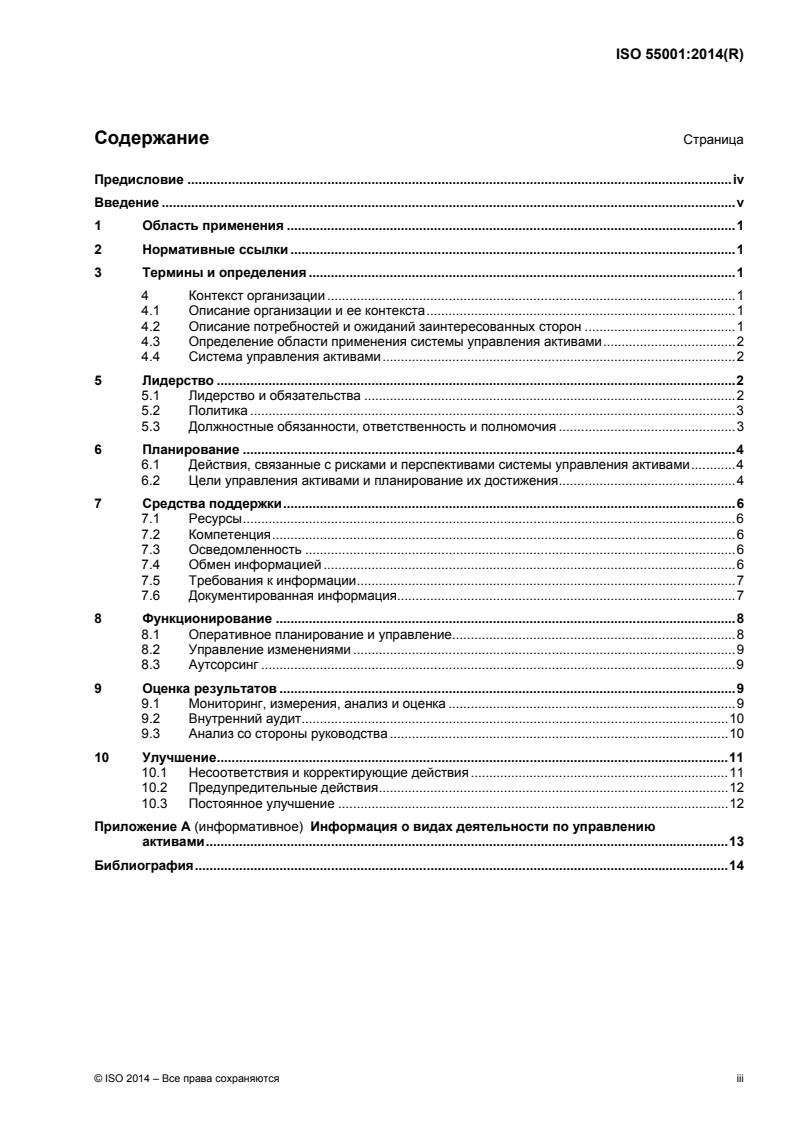
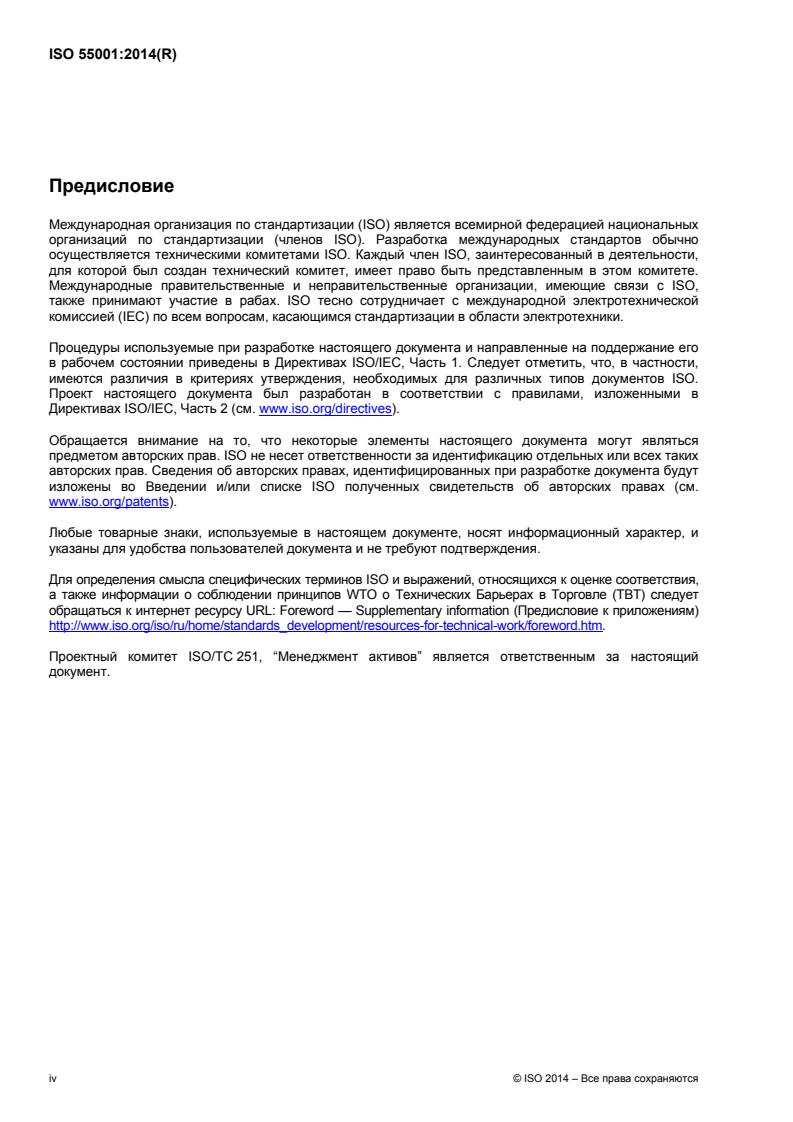


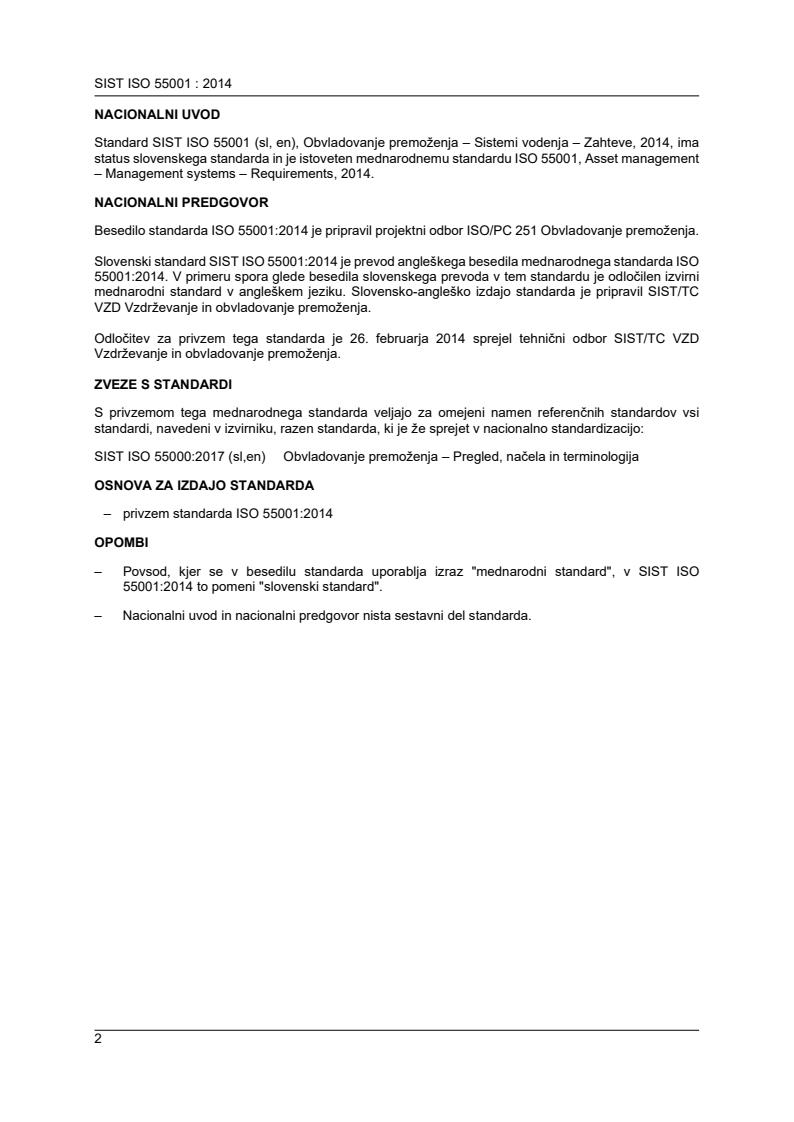
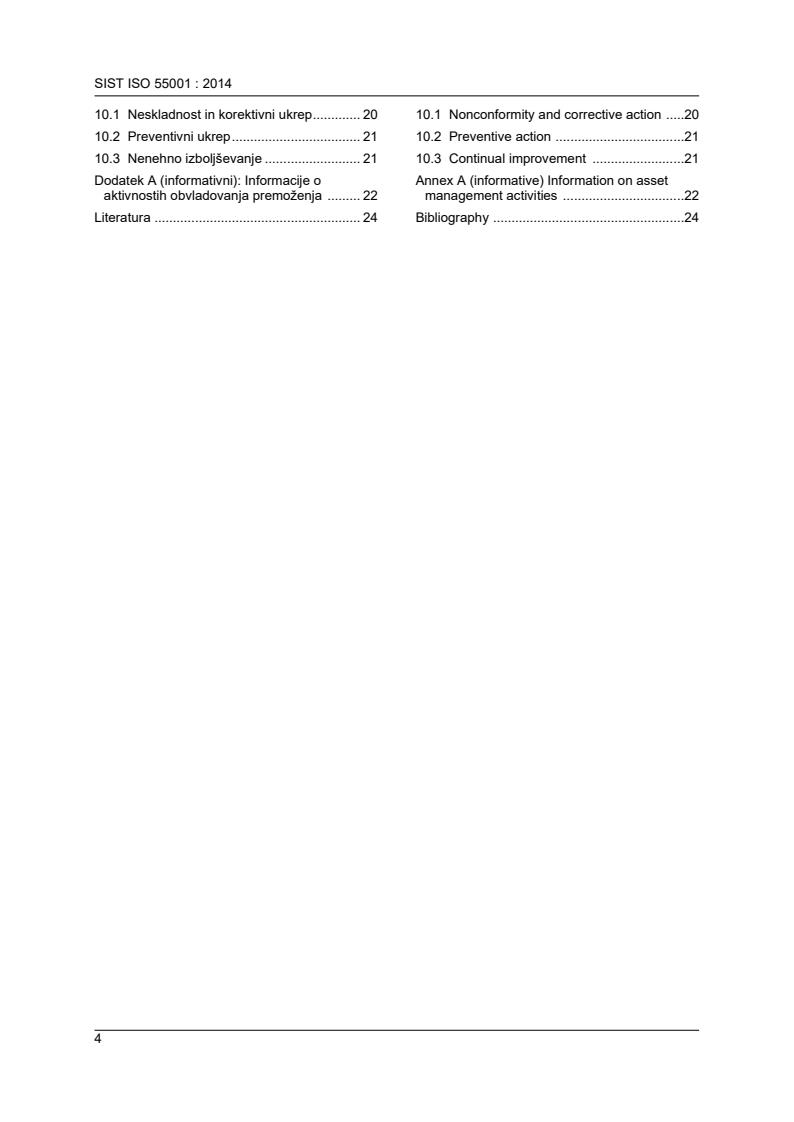
Related Packages

Get Certified
Connect with accredited certification bodies for this standard

BSI Group
BSI (British Standards Institution) is the business standards company that helps organizations make excellence a habit.

Bureau Veritas
Bureau Veritas is a world leader in laboratory testing, inspection and certification services.

DNV
DNV is an independent assurance and risk management provider.
Sponsored listings
Frequently Asked Questions
ISO 55001:2014 is a standard published by the International Organization for Standardization (ISO). Its full title is "Asset management — Management systems — Requirements". This standard covers: ISO 55001:2014 specifies requirements for an asset management system within the context of the organization. ISO 55001:2014 can be applied to all types of assets and by all types and sizes of organizations.
ISO 55001:2014 specifies requirements for an asset management system within the context of the organization. ISO 55001:2014 can be applied to all types of assets and by all types and sizes of organizations.
ISO 55001:2014 is classified under the following ICS (International Classification for Standards) categories: 03.100.01 - Company organization and management in general; 03.100.70 - Management systems. The ICS classification helps identify the subject area and facilitates finding related standards.
ISO 55001:2014 has the following relationships with other standards: It is inter standard links to EN 16646:2014, ISO 55001:2024. Understanding these relationships helps ensure you are using the most current and applicable version of the standard.
ISO 55001:2014 is available in PDF format for immediate download after purchase. The document can be added to your cart and obtained through the secure checkout process. Digital delivery ensures instant access to the complete standard document.
Standards Content (Sample)
SLOVENSKI STANDARD
01-april-2014
Obvladovanje premoženja - Sistemi vodenja - Zahteve
Asset management - Management systems - Requirements
Gestion d'actifs - Systèmes de management - Exigences
Ta slovenski standard je istoveten z: ISO 55001:2014
ICS:
03.100.10 Nabava. Dobava. Logistika Purchasing. Procurement.
Logistics
03.100.70 Sistemi vodenja Management systems
2003-01.Slovenski inštitut za standardizacijo. Razmnoževanje celote ali delov tega standarda ni dovoljeno.
INTERNATIONAL ISO
STANDARD 55001
First edition
2014-01-15
Asset management — Management
systems — Requirements
Gestion d’actifs — Systèmes de management — Exigences
Reference number
©
ISO 2014
© ISO 2014
All rights reserved. Unless otherwise specified, no part of this publication may be reproduced or utilized otherwise in any form
or by any means, electronic or mechanical, including photocopying, or posting on the internet or an intranet, without prior
written permission. Permission can be requested from either ISO at the address below or ISO’s member body in the country of
the requester.
ISO copyright office
Case postale 56 • CH-1211 Geneva 20
Tel. + 41 22 749 01 11
Fax + 41 22 749 09 47
E-mail copyright@iso.org
Web www.iso.org
Published in Switzerland
ii © ISO 2014 – All rights reserved
Contents Page
Foreword .iv
Introduction .v
1 Scope . 1
2 Normative reference . 1
3 Terms and definitions . 1
4 Context of the organization . 1
4.1 Understanding the organization and its context . 1
4.2 Understanding the needs and expectations of stakeholders . 1
4.3 Determining the scope of the asset management system. 2
4.4 Asset management system . 2
5 Leadership . 2
5.1 Leadership and commitment . 2
5.2 Policy . 3
5.3 Organizational roles, responsibilities and authorities. 3
6 Planning . 3
6.1 Actions to address risks and opportunities for the asset management system . 3
6.2 Asset management objectives and planning to achieve them . 4
7 Support . 5
7.1 Resources . 5
7.2 Competence . 5
7.3 Awareness . 6
7.4 Communication . 6
7.5 Information requirements . 6
7.6 Documented information . 7
8 Operation . 8
8.1 Operational planning and control . 8
8.2 Management of change . 8
8.3 Outsourcing. 8
9 Performance evaluation . 8
9.1 Monitoring, measurement, analysis and evaluation . 8
9.2 Internal audit . 9
9.3 Management review . 9
10 Improvement .10
10.1 Nonconformity and corrective action .10
10.2 Preventive action .10
10.3 Continual improvement .11
Annex A (informative) Information on asset management activities .12
Bibliography .13
Foreword
ISO (the International Organization for Standardization) is a worldwide federation of national standards
bodies (ISO member bodies). The work of preparing International Standards is normally carried out
through ISO technical committees. Each member body interested in a subject for which a technical
committee has been established has the right to be represented on that committee. International
organizations, governmental and non-governmental, in liaison with ISO, also take part in the work.
ISO collaborates closely with the International Electrotechnical Commission (IEC) on all matters of
electrotechnical standardization.
The procedures used to develop this document and those intended for its further maintenance are
described in the ISO/IEC Directives, Part 1. In particular the different approval criteria needed for the
different types of ISO documents should be noted. This document was drafted in accordance with the
editorial rules of the ISO/IEC Directives, Part 2 (see www.iso.org/directives).
Attention is drawn to the possibility that some of the elements of this document may be the subject of
patent rights. ISO shall not be held responsible for identifying any or all such patent rights. Details of
any patent rights identified during the development of the document will be in the Introduction and/or
on the ISO list of patent declarations received (see www.iso.org/patents).
Any trade name used in this document is information given for the convenience of users and does not
constitute an endorsement.
For an explanation on the meaning of ISO specific terms and expressions related to conformity
assessment, as well as information about ISO’s adherence to the WTO principles in the Technical Barriers
to Trade (TBT) see the following URL: Foreword - Supplementary information
The committee responsible for this document is Project Committee ISO/PC 251, Asset management.
iv © ISO 2014 – All rights reserved
Introduction
This International Standard specifies the requirements for the establishment, implementation,
maintenance and improvement of a management system for asset management, referred to as an “asset
management system”.
This International Standard can be used by any organization. The organization determines to which of
its assets this International Standard applies.
This International Standard is primarily intended for use by:
— those involved in the establishment, implementation, maintenance and improvement of an asset
management system;
— those involved in delivering asset management activities and service providers;
— internal and external parties to assess the organization’s ability to meet legal, regulatory and
contractual requirements and the organization’s own requirements.
The order in which requirements are presented in this International Standard does not reflect their
importance or imply the order in which they are to be implemented.
Further guidance regarding the application of the requirements within this International Standard is
provided in ISO 55002.
General information on asset management, and information on the terminology applicable to this
International Standard, is provided in ISO 55000. Organizations can find that consideration of the
principles will assist the development of asset management in their organization.
This International Standard applies the definition of “risk” given in ISO 31000:2009 and ISO Guide 73:2009.
In addition, it uses the term “stakeholder” rather than “interested party”.
This International Standard is designed to enable an organization to align and integrate its asset
management system with related management system requirements.
Annex A provides additional information on areas related to asset management activities.
INTERNATIONAL STANDARD ISO 55001:2014(E)
Asset management — Management systems —
Requirements
1 Scope
This International Standard specifies requirements for an asset management system within the context
of the organization.
This International Standard can be applied to all types of assets and by all types and sizes of organizations.
NOTE 1 This International Standard is intended to be used for managing physical assets in particular, but it
can also be applied to other asset types.
NOTE 2 This International Standard does not specify financial, accounting or technical requirements for
managing specific asset types.
NOTE 3 For the purposes of ISO 55000, ISO 55002 and this International Standard, the term “asset management
system” is used to refer to a management system for asset management.
2 Normative reference
The following documents, in whole or in part, are normatively referenced in this document and are
indispensable for its application. For dated references, only the edition cited applies. For undated
references, the latest edition of the referenced document (including any amendments) applies.
ISO 55000:2014, Asset management — Overview, principles and terminology
3 Terms and definitions
For the purposes of this document, the terms and definitions given in ISO 55000 apply.
4 Context of the organization
4.1 Understanding the organization and its context
The organization shall determine external and internal issues that are relevant to its purpose and that
affect its ability to achieve the intended outcome(s) of its asset management system.
Asset management objectives, included in the strategic asset management plan (SAMP), shall be aligned
to, and consistent with, the organizational objectives.
4.2 Understanding the needs and expectations of stakeholders
The organization shall determine:
— the stakeholders that are relevant to the asset management system;
— the requirements and expectations of these stakeholders with respect to asset management;
— the criteria for asset management decision making;
— the stakeholder requirements for recording financial and non-financial information relevant to
asset management, and for reporting on it both internally and externally.
4.3 Determining the scope of the asset management system
The organization shall determine the boundaries and applicability of the asset management system to
establish its scope. The scope shall be aligned with the SAMP and the asset management policy. When
determining this scope, the organization shall consider:
— the external and internal issues referred to in 4.1;
— the requirements referred to in 4.2;
— the interaction with other management systems, if used.
The organization shall define the asset portfolio covered by the scope of the asset management system.
The scope shall be available as documented information.
4.4 Asset management system
The organization shall establish, implement, maintain and continually improve an asset management
system, including the processes needed and their interactions, in accordance with the requirements of
this International Standard.
The organization shall develop a SAMP which includes documentation of the role of the asset management
system in supporting achievement of the asset management objectives.
5 Leadership
5.1 Leadership and commitment
Top management shall demonstrate leadership and commitment with respect to the asset management
system by:
— ensuring that the asset management policy, the SAMP and asset management objectives are
established and are compatible with the organizational objectives;
— ensuring the integration of the asset management system requirements into the organization’s
business processes;
— ensuring that the resources for the asset management system are available;
— communicating the importance of effective asset management and of conforming to the asset
management system requirements;
— ensuring that the asset management system achieves its intended outcome(s);
— directing and supporting persons to contribute to the effectiveness of the asset management system;
— promoting cross-functional collaboration within the organization;
— promoting continual improvement;
— supporting other relevant management roles to demonstrate their leadership as it applies to their
areas of responsibility;
— ensuring that the approach used for managing risk in asset management is aligned with the
organization’s approach for managing risk.
NOTE Reference to “business” in this International Standard can be interpreted broadly to mean those
activities that are core to the purposes of the organization’s existence.
2 © ISO 2014 – All rights reserved
5.2 Policy
Top management shall establish an asset management policy that:
a) is appropriate to the purpose of the organization;
b) provides a framework for setting asset management objectives;
c) includes a commitment to satisfy applicable requirements;
d) includes a commitment to continual improvement of the asset management system.
The asset management policy shall:
— be consistent with the organizational plan;
— be consistent with other relevant organizational policies;
— be appropriate to the nature and scale of the organization’s assets and operations;
— be available as documented information;
— be communicated within the organization;
— be available to stakeholders, as appropriate;
— be implemented and be periodically reviewed and, if required, updated.
5.3 Organizational roles, responsibilities and authorities
Top management shall ensure that the responsibilities and authorities for relevant roles are assigned
and communicated within the organization.
Top management shall assign the responsibility and authority for:
a) establishing and updating the SAMP, including asset management objectives;
b) ensuring that the asset management system supports delivery of the SAMP;
c) ensuring that the asset management system conforms to the requirements of this International
Standard;
d) ensuring the suitability, adequacy and effectiveness of the asset management system;
e) establishing and updating the asset management plan(s) (see 6.2.2);
f) reporting on the performance of the asset management system to top management.
6 Planning
6.1 Actions to address risks and opportunities for the asset management system
When planning for the asset management system, the organization shall consider the issues referred to
in 4.1 and the requirements referred to in 4.2 and determine the risks and opportunities that need to be
addressed to:
— give assurance that the asset management system can achieve its intended outcome(s);
— prevent, or reduce undesired effects;
— achieve continual improvement.
The organization shall plan:
a) actions to address these risks and opportunities, taking into account how these risks and
opportunities can change with time;
b) how to:
— integrate and implement the actions into its asset management system processes;
— evaluate the effectiveness of these actions.
6.2 Asset management objectives and planning to achieve them
6.2.1 Asset management objectives
The organization shall establish asset management objectives at relevant functions and levels.
When establishing its asset management ob
...
INTERNATIONAL ISO
STANDARD 55001
First edition
2014-01-15
Asset management — Management
systems — Requirements
Gestion d’actifs — Systèmes de management — Exigences
Reference number
©
ISO 2014
© ISO 2014
All rights reserved. Unless otherwise specified, no part of this publication may be reproduced or utilized otherwise in any form
or by any means, electronic or mechanical, including photocopying, or posting on the internet or an intranet, without prior
written permission. Permission can be requested from either ISO at the address below or ISO’s member body in the country of
the requester.
ISO copyright office
Case postale 56 • CH-1211 Geneva 20
Tel. + 41 22 749 01 11
Fax + 41 22 749 09 47
E-mail copyright@iso.org
Web www.iso.org
Published in Switzerland
ii © ISO 2014 – All rights reserved
Contents Page
Foreword .iv
Introduction .v
1 Scope . 1
2 Normative reference . 1
3 Terms and definitions . 1
4 Context of the organization . 1
4.1 Understanding the organization and its context . 1
4.2 Understanding the needs and expectations of stakeholders . 1
4.3 Determining the scope of the asset management system. 2
4.4 Asset management system . 2
5 Leadership . 2
5.1 Leadership and commitment . 2
5.2 Policy . 3
5.3 Organizational roles, responsibilities and authorities. 3
6 Planning . 3
6.1 Actions to address risks and opportunities for the asset management system . 3
6.2 Asset management objectives and planning to achieve them . 4
7 Support . 5
7.1 Resources . 5
7.2 Competence . 5
7.3 Awareness . 6
7.4 Communication . 6
7.5 Information requirements . 6
7.6 Documented information . 7
8 Operation . 8
8.1 Operational planning and control . 8
8.2 Management of change . 8
8.3 Outsourcing. 8
9 Performance evaluation . 8
9.1 Monitoring, measurement, analysis and evaluation . 8
9.2 Internal audit . 9
9.3 Management review . 9
10 Improvement .10
10.1 Nonconformity and corrective action .10
10.2 Preventive action .10
10.3 Continual improvement .11
Annex A (informative) Information on asset management activities .12
Bibliography .13
Foreword
ISO (the International Organization for Standardization) is a worldwide federation of national standards
bodies (ISO member bodies). The work of preparing International Standards is normally carried out
through ISO technical committees. Each member body interested in a subject for which a technical
committee has been established has the right to be represented on that committee. International
organizations, governmental and non-governmental, in liaison with ISO, also take part in the work.
ISO collaborates closely with the International Electrotechnical Commission (IEC) on all matters of
electrotechnical standardization.
The procedures used to develop this document and those intended for its further maintenance are
described in the ISO/IEC Directives, Part 1. In particular the different approval criteria needed for the
different types of ISO documents should be noted. This document was drafted in accordance with the
editorial rules of the ISO/IEC Directives, Part 2 (see www.iso.org/directives).
Attention is drawn to the possibility that some of the elements of this document may be the subject of
patent rights. ISO shall not be held responsible for identifying any or all such patent rights. Details of
any patent rights identified during the development of the document will be in the Introduction and/or
on the ISO list of patent declarations received (see www.iso.org/patents).
Any trade name used in this document is information given for the convenience of users and does not
constitute an endorsement.
For an explanation on the meaning of ISO specific terms and expressions related to conformity
assessment, as well as information about ISO’s adherence to the WTO principles in the Technical Barriers
to Trade (TBT) see the following URL: Foreword - Supplementary information
The committee responsible for this document is Project Committee ISO/PC 251, Asset management.
iv © ISO 2014 – All rights reserved
Introduction
This International Standard specifies the requirements for the establishment, implementation,
maintenance and improvement of a management system for asset management, referred to as an “asset
management system”.
This International Standard can be used by any organization. The organization determines to which of
its assets this International Standard applies.
This International Standard is primarily intended for use by:
— those involved in the establishment, implementation, maintenance and improvement of an asset
management system;
— those involved in delivering asset management activities and service providers;
— internal and external parties to assess the organization’s ability to meet legal, regulatory and
contractual requirements and the organization’s own requirements.
The order in which requirements are presented in this International Standard does not reflect their
importance or imply the order in which they are to be implemented.
Further guidance regarding the application of the requirements within this International Standard is
provided in ISO 55002.
General information on asset management, and information on the terminology applicable to this
International Standard, is provided in ISO 55000. Organizations can find that consideration of the
principles will assist the development of asset management in their organization.
This International Standard applies the definition of “risk” given in ISO 31000:2009 and ISO Guide 73:2009.
In addition, it uses the term “stakeholder” rather than “interested party”.
This International Standard is designed to enable an organization to align and integrate its asset
management system with related management system requirements.
Annex A provides additional information on areas related to asset management activities.
INTERNATIONAL STANDARD ISO 55001:2014(E)
Asset management — Management systems —
Requirements
1 Scope
This International Standard specifies requirements for an asset management system within the context
of the organization.
This International Standard can be applied to all types of assets and by all types and sizes of organizations.
NOTE 1 This International Standard is intended to be used for managing physical assets in particular, but it
can also be applied to other asset types.
NOTE 2 This International Standard does not specify financial, accounting or technical requirements for
managing specific asset types.
NOTE 3 For the purposes of ISO 55000, ISO 55002 and this International Standard, the term “asset management
system” is used to refer to a management system for asset management.
2 Normative reference
The following documents, in whole or in part, are normatively referenced in this document and are
indispensable for its application. For dated references, only the edition cited applies. For undated
references, the latest edition of the referenced document (including any amendments) applies.
ISO 55000:2014, Asset management — Overview, principles and terminology
3 Terms and definitions
For the purposes of this document, the terms and definitions given in ISO 55000 apply.
4 Context of the organization
4.1 Understanding the organization and its context
The organization shall determine external and internal issues that are relevant to its purpose and that
affect its ability to achieve the intended outcome(s) of its asset management system.
Asset management objectives, included in the strategic asset management plan (SAMP), shall be aligned
to, and consistent with, the organizational objectives.
4.2 Understanding the needs and expectations of stakeholders
The organization shall determine:
— the stakeholders that are relevant to the asset management system;
— the requirements and expectations of these stakeholders with respect to asset management;
— the criteria for asset management decision making;
— the stakeholder requirements for recording financial and non-financial information relevant to
asset management, and for reporting on it both internally and externally.
4.3 Determining the scope of the asset management system
The organization shall determine the boundaries and applicability of the asset management system to
establish its scope. The scope shall be aligned with the SAMP and the asset management policy. When
determining this scope, the organization shall consider:
— the external and internal issues referred to in 4.1;
— the requirements referred to in 4.2;
— the interaction with other management systems, if used.
The organization shall define the asset portfolio covered by the scope of the asset management system.
The scope shall be available as documented information.
4.4 Asset management system
The organization shall establish, implement, maintain and continually improve an asset management
system, including the processes needed and their interactions, in accordance with the requirements of
this International Standard.
The organization shall develop a SAMP which includes documentation of the role of the asset management
system in supporting achievement of the asset management objectives.
5 Leadership
5.1 Leadership and commitment
Top management shall demonstrate leadership and commitment with respect to the asset management
system by:
— ensuring that the asset management policy, the SAMP and asset management objectives are
established and are compatible with the organizational objectives;
— ensuring the integration of the asset management system requirements into the organization’s
business processes;
— ensuring that the resources for the asset management system are available;
— communicating the importance of effective asset management and of conforming to the asset
management system requirements;
— ensuring that the asset management system achieves its intended outcome(s);
— directing and supporting persons to contribute to the effectiveness of the asset management system;
— promoting cross-functional collaboration within the organization;
— promoting continual improvement;
— supporting other relevant management roles to demonstrate their leadership as it applies to their
areas of responsibility;
— ensuring that the approach used for managing risk in asset management is aligned with the
organization’s approach for managing risk.
NOTE Reference to “business” in this International Standard can be interpreted broadly to mean those
activities that are core to the purposes of the organization’s existence.
2 © ISO 2014 – All rights reserved
5.2 Policy
Top management shall establish an asset management policy that:
a) is appropriate to the purpose of the organization;
b) provides a framework for setting asset management objectives;
c) includes a commitment to satisfy applicable requirements;
d) includes a commitment to continual improvement of the asset management system.
The asset management policy shall:
— be consistent with the organizational plan;
— be consistent with other relevant organizational policies;
— be appropriate to the nature and scale of the organization’s assets and operations;
— be available as documented information;
— be communicated within the organization;
— be available to stakeholders, as appropriate;
— be implemented and be periodically reviewed and, if required, updated.
5.3 Organizational roles, responsibilities and authorities
Top management shall ensure that the responsibilities and authorities for relevant roles are assigned
and communicated within the organization.
Top management shall assign the responsibility and authority for:
a) establishing and updating the SAMP, including asset management objectives;
b) ensuring that the asset management system supports delivery of the SAMP;
c) ensuring that the asset management system conforms to the requirements of this International
Standard;
d) ensuring the suitability, adequacy and effectiveness of the asset management system;
e) establishing and updating the asset management plan(s) (see 6.2.2);
f) reporting on the performance of the asset management system to top management.
6 Planning
6.1 Actions to address risks and opportunities for the asset management system
When planning for the asset management system, the organization shall consider the issues referred to
in 4.1 and the requirements referred to in 4.2 and determine the risks and opportunities that need to be
addressed to:
— give assurance that the asset management system can achieve its intended outcome(s);
— prevent, or reduce undesired effects;
— achieve continual improvement.
The organization shall plan:
a) actions to address these risks and opportunities, taking into account how these risks and
opportunities can change with time;
b) how to:
— integrate and implement the actions into its asset management system processes;
— evaluate the effectiveness of these actions.
6.2 Asset management objectives and planning to achieve them
6.2.1 Asset management objectives
The organization shall establish asset management objectives at relevant functions and levels.
When establishing its asset management objectives, the organization shall consider the requirements of
relevant stakeholders and of other financial, technical, legal, regulatory and organizational requirements
in the asset management planning process.
The asset management objectives shall:
— be consistent and aligned with the organizational objectives;
— be consistent with the asset management policy;
— be established and updated using asset management decision-making
...
ISO 55001
Asset
management
Management systems:
Requirements
First edition
2014-01-15
Our vision Our process
To be the world’s leading provider of high Our standards are developed by experts
quality, globally relevant International all over the world who work on a volunteer
Standards through members and or part-time basis. We sell International
stakeholders. Standards to help recover the costs of
organizing this process and making
standards widely available.
Please respect our licensing terms and
Our mission
copyright to ensure this system remains
ISO develops high quality voluntary
independent.
International Standards that facilitate
international exchange of goods and If you would like to contribute to the
services, support sustainable and equitable development of ISO standards, please
economic growth, promote innovation and contact the ISO Member Body in your
protect health, safety and the environment. country:
www. i s o . or g /i s o/ home/a b ou t /i s o _
members.htm
This document has been prepared by: Copyright protected document
ISO/PC 251, Asset management.
All rights reserved. Unless otherwise
specified, no part of this publication may
Committee members: be reproduced or utilized otherwise in
any form or by any means, electronic or
ABNT, AENOR, AFNOR, ANSI, BIS, BSI, DGN,
mechanical, including photocopying, or
DIN, ESMA, GOST R, ICONTEC, INDECOPI,
posting on the internet or intranet, without
INN, IPQ, IRAM, JISC, KATS, NBN, NEN,
prior written permission. Permission can
NSAI, SA, SABS, SAC, SCC, SFS, SIS, SN, SNV,
be requested from either ISO at the address
UNI, UNMZ, IIOC (liaison organization).
below or ISO’s member body in the country
of the requester:
Cover photo credit: ISO/Central Secretariat.
ISO copyright office
Case postale 56 • CH-1211 Geneva 20
Tel. +41 22 749 01 11
Fax. +41 22 749 09 47
E-mail copyright@iso.org
Web www.iso.org
Published in Switzerland.
2 © ISO 2014 – All rights reserved
Executive summary
• An asset is something that has potential • Aligning the asset management objectives
or actual value to an organization. with the organizational objectives, as
well as linking asset reports to financial
• Effective and efficient asset management
reports, can improve the organization’s
enables an organization to achieve its
effectiveness and efficiency.
objectives.
• The benefits of asset management can
• The application of an asset management
include: improved financial performance;
system provides assurance that those
managed risk; improved services
objectives can be achieved consistently
and outputs; demonstrated social
and sustainably over time.
responsibility; demonstrated compliance;
enhanced reputation; improved
• Asset management allows an organization
organizational sustainability; improved
to examine the need for, and performance
efficiency and effectiveness.
of, assets and asset systems at different
levels.
Contents Page
Foreword .5
Introduction.6
1 Scope .7
2 Normative reference .7
3 Terms and definitions .7
4 Context of the organization.7
4.1 Understanding the organization and its context .7
4.2 Understanding the needs and expectations of stakeholders .7
4.3 Determining the scope of the asset management system .7
4.4 Asset management system .8
5 Leadership .8
5.1 Leadership and commitment .8
5.2 Policy .8
5.3 Organizational roles, responsibilities and authorities .9
6 Planning .9
6.1 Actions to address risks and opportunities for the asset management system .9
6.2 Asset management objectives and planning to achieve them .9
7 Support .10
7.1 Resources .10
7.2 Competence .11
7.3 Awareness .11
7.4 Communication .11
7.5 Information requirements .11
7.6 Documented information .12
8 Operation .13
8.1 Operational planning and control .13
8.2 Management of change .13
8.3 Outsourcing .13
9 Performance evaluation .13
9.1 Monitoring, measurement, analysis and evaluation .13
9.2 Internal audit .14
9.3 Management review .14
10 Improvement .15
10.1 Nonconformity and corrective action .15
10.2 Preventive action .15
10.3 Continual improvement .15
Annex A (informative) Information on asset management activities .16
Bibliography .18
4 © ISO 2014 – All rights reserved
Foreword
ISO (the International Organization for Attention is drawn to the possibility that some
Standardization) is a worldwide federation of the elements of this document may be the
of national standards bodies (ISO member subject of patent rights. ISO shall not be held
bodies). The work of preparing International responsible for identifying any or all such
Standards is normally carried out through patent rights. Details of any patent rights
ISO technical committees. Each member body identified during the development of the
interested in a subject for which a technical document will be in the Introduction and/or
committee has been established has the on the ISO list of patent declarations received
right to be represented on that committee. (see www.iso.org/patents).
International organizations, governmental
Any trade name used in this document is
and non-governmental, in liaison with ISO,
information given for the convenience of users
also take part in the work. ISO collaborates
and does not constitute an endorsement.
closely with the International Electrotechnical
Commission (IEC) on all matters of
For an explanation on the meaning of ISO
electrotechnical standardization.
specific terms and expressions related to
conformity assessment, as well as information
The procedures used to develop this
about ISO’s adherence to the WTO principles
document and those intended for its further
in the Technical Barriers to Trade (TBT) see
maintenance are described in the ISO/IEC
the following URL: Foreword - Supplementary
Directives, Part 1. In particular the different
information
approval criteria needed for the different
types of ISO documents should be noted. This
The committee responsible for this document
document was drafted in accordance with
is Project Committee ISO/PC 251, Asset
the editorial rules of the ISO/IEC Directives,
management.
Part 2 (see www.iso.org/directives).
Introduction
This International Standard specifies term “stakeholder” rather than “interested
the requirements for the establishment, party”.
implementation, maintenance and
This International Standard is designed to
improvement of a management system for
enable an organization to align and integrate
asset management, referred to as an “asset
its asset management system with related
management system”.
management system requirements.
This International Standard can be used by any
Annex A provides additional information on
organization. The organization determines to
areas related to asset management activities.
which of its assets this International Standard
applies.
This International Standard is primarily
intended for use by:
— those involved in the establishment,
implementation, maintenance and
improvement of an asset management
system;
— those involved in delivering asset
management activities and service
providers;
— internal and external parties to assess
the organization’s ability to meet legal,
regulatory and contractual requirements
and the organization’s own requirements.
The order in which requirements are
presented in this International Standard does
not reflect their importance or imply the order
in which they are to be implemented.
Further guidance regarding the application
of the requirements within this International
Standard is provided in ISO 55002.
General information on asset management,
and information on the terminology applicable
to this International Standard, is provided
in ISO 55000. Organizations can find that
consideration of the principles will assist the
development of asset management in their
organization.
This International Standard applies the
definition of “risk” given in ISO 31000:2009
and ISO Guide 73:2009. In addition, it uses the
6 © ISO 2014 – All rights reserved
intended outcome(s) of its asset management
1 Scope
system.
This International Standard specifies
Asset management objectives, included in
requirements for an asset management system
the strategic asset management plan (SAMP),
within the context of the organization.
shall be aligned to, and consistent with, the
This International Standard can be applied to
organizational objectives.
all types of assets and by all types and sizes of
organizations.
4.2 Understanding the needs
NOTE 1 This International Standard is intended to
and expectations of stakehold-
be used for managing physical assets in particular, but
ers
it can also be applied to other asset types.
The organization shall determine:
NOTE 2 This International Standard does not
specify financial, accounting or technical requirements
— the stakeholders that are relevant to the
for managing specific asset types.
asset management system;
NOTE 3 For the purposes of ISO 55000, ISO 55002
and this International Standard, the term “asset
— the requirements and expectations of
management system” is used to refer to a management
these stakeholders with respect to asset
system for asset management.
management;
— the criteria for asset management decision
2 Normative reference
making;
The following documents, in whole or in part,
— the stakeholder requirements for
are normatively referenced in this document
recording financial and non-financial
and are indispensable for its application.
information relevant to asset management,
For dated references, only the edition cited
and for reporting on it both internally and
applies. For undated references, the latest
externally.
edition of the referenced document (including
any amendments) applies.
4.3 Determining the scope of the
ISO 55000:2014, Asset management —
asset management system
Overview, principles and terminology
The organization shall determine the
boundaries and applicability of the asset
3 Terms and definitions
management system to establish its scope. The
scope shall be aligned with the SAMP and the
For the purposes of this document, the terms
asset management policy. When determining
and definitions given in ISO 55000 apply.
this scope, the organization shall consider:
— the external and internal issues referred
4 Context of the organization
to in 4.1;
— the requirements referred to in 4.2;
4.1 Understanding the organiza-
tion and its context
— the interaction with other management
systems, if used.
The organization shall determine external and
internal issues that are relevant to its purpose
The organization shall define the asset
and that affect its ability to achieve the portfolio covered by the scope of the asset
management system.
The scope shall be available as documented — promoting cross-functional collaboration
information. within the organization;
— promoting continual improvement;
4.4 Asset management system
— supporting other relevant management
The organization shall establish, implement,
roles to demonstrate their leadership as it
maintain and continually improve an asset
applies to their areas of responsibility;
management system, including the processes
needed and their interactions, in accordance — ensuring that the approach used for
managing risk in asset management is
with the requirements of this International
aligned with the organization’s approach
Standard.
for managing risk.
The organization shall develop a SAMP which
NOTE Reference to “business” in this
includes documentation of the role of the
International Standard can be interpreted broadly to
asset management system in supporting
mean those activities that are core to the purposes of
achievement of the asset management
the organization’s existence.
objectives.
5.2 Policy
5 Leadership
Top management shall establish an asset
management policy that:
5.1 Leadership and commitment
a) is appropriate to the purpose of the
Top management shall demonstrate leadership
organization;
and commitment with respect to the asset
b) provides a framework for setting asset
management system by:
management objectives;
— ensuring that the asset management
c) includes a commitment to satisfy
policy, the SAMP and asset management
applicable requirements;
objectives are established and are
compatible with the organizational
d) includes a commitment to continual
objectives;
improvement of the asset management
system.
— ensuring the integration of the asset
management system requirements into
The asset management policy shall:
the organization’s business processes;
— be consistent with the organizational
— ensuring that the resources for the asset
plan;
management system are available;
— be consistent with other relevant
— communicating the importance of
organizational policies;
effective asset management and of
conforming to the asset management
— be appropriate to the nature and scale of
system requirements;
the organization’s assets and operations;
— ensuring that the asset management
— be available as documented information;
system achieves its intended outcome(s);
— be communicated within the organization;
— directing and supporting persons to
contribute to the effectiveness of the asset
— be available to stakeholders, as
management system; appropriate;
8 © ISO 2014 – All rights reserved
— be implemented and be periodically — prevent, or reduce undesired effects;
reviewed and, if required, updated.
— achieve continual improvement.
5.3 Organizational roles, respon- The organization shall plan:
sibilities and authorities
a) actions to address these risks and
opportunities, taking into account how
Top management shall ensure that the
these risks and opportunities can change
responsibilities and authorities for relevant
with time;
roles are assigned and communicated within
the organization.
b) how to:
Top management shall assign the responsibilit y
— integrate and implement the actions
and authority for:
into its asset management system
processes;
a) establishing and updating the SAMP,
including asset management objectives;
— evaluate the effectiveness of these
actions.
b) ensuring that the asset management
system supports delivery of the SAMP;
6.2 Asset management objec-
c) ensuring that the asset management
tives and planning to achieve
system conforms to the requirements of
them
this International Standard;
d) ensuring the suitability, adequacy and
6.2.1 Asset management objec-
effectiveness of the asset management
tives
system;
The organization shall establish asset
e) establishing and updating the asset
management objectives at relevant functions
management plan(s) (see 6.2.2);
and levels.
f) reporting on the performance of the asset
When establishing its asset management
management system to top management.
objectives, the organization shall consider the
requirements of relevant stakehol
...
ISO 55001
ISO 55001
Gestion
d’actifs
Systèmes de management
Exigences
Première édition
2014-01-15
Notre vision Notre processus
Être le premier fournisseur mondial de
Nos normes sont élaborées par des experts
Normes internationales de haute qua-
du monde entier qui travaillent à titre
lité, pertinentes sur le plan mondial, au bénévole ou à temps partiel pour la nor-
travers de ses membres et de ses parties malisation. Pour pouvoir couvrir les coûts
prenantes.
qu’impliquent l’organisation du proces-
sus de normalisation et la diffusion des
Notre mission normes à grande échelle, les normes sont
payantes.
L’ISO élabore des Normes internationales
de haute qualité et d’application volon-
Merci de respecter nos conditions de
taire, destinées à faciliter les échanges licence et notre droit d’auteur pour gar-
internationaux de biens et de services, à antir l’indépendance de ce système.
soutenir une croissance économique dura-
Si vous souhaitez contribuer à l’élaboration
ble et équitable, à promouvoir l’innovation
des normes ISO, prenez contact avec le
et à assurer une protection en matière de
comité membre de l’ISO dans votre pays:
santé, de sécurité et d’environnement.
www.iso.org/iso/home/about/iso_
members.htm
Ce document a été élaboré par:
Document protégé par Copyright
ISO/PC 251, Gestion des actifs Droits de reproduction réservés. Sauf
indication contraire, aucune partie de
Comités membres:
cette publication ne peut être reproduite
ni utilisée sous quelque forme que ce
ABNT, AENOR, AFNOR, ANSI, BIS, BSI,
soit et par aucun procédé, électronique
DGN, DIN, ESMA, GOST R, ICONTEC,
ou mécanique, y compris la photocopie,
INDECOPI, INN, IPQ, IRAM, JISC, KATS,
l’affichage sur l’Internet ou sur un intranet,
NBN, NEN, NSAI, SA, SABS, SAC, SCC,
sans autorisation écrite préalable. Les
SFS, SIS, SN, SNV, UNI, UNMZ, IIOC
demandes d’autorisation peuvent être
(organisation en liaison). adressées à l’ISO à l’adresse ci-après ou
du comité membre de l’ISO dans le pays
du demandeur:
Crédit photo de couverture: ISO/CS, 2014
ISO copyright office
Case postale 56 • CH-1211 Geneva 20
Tel. +41 22 749 01 11
Fax. +41 22 749 09 47
E-mail copyright@iso.org
Web www.iso.org
Résumé
• Un actif est une chose ou une entité qui a une valeur potentielle ou réelle pour
un organisme.
• Une gestion efficace et efficiente de ses actifs permet à un organisme
d’atteindre ses objectifs.
• Un système de gestion des actifs donne à l’organisme qui le met en œuvre
l’assurance d’atteindre régulièrement et durablement ces objectifs.
• La gestion des actifs permet à un organisme d’examiner le besoin, ainsi que la
performance, d’actifs et de systèmes d’actifs, à différents niveaux.
• L’alignement des objectifs de gestion des actifs sur ceux de l’organisme, et lier
les rapports concernant les actifs aux rapports financiers peut permettre à un
organisme de gagner en efficience et en efficacité.
• La gestion d’actifs peut procurer divers avantages, notamment: une meilleure
performance financière, une gestion du risque, une amélioration des services
et des produits, une démonstration de la responsabilité sociétale, un gain en
termes de réputation, et une durabilité organisationnelle, une efficacité et une
efficience accrues.
Sommaire Page
Résumé .3
Avant-propos .5
Introduction .6
1 Domaine d’application .7
2 Références normatives .7
3 Termes et définitions .7
4 Contexte de l’organisme .7
4.1 Connaissances de l’organisme et contexte .7
4.2 Compréhension des besoins et attentes des parties prenantes .7
4.3 Détermination du périmètre du système de gestion d’actifs .8
4.4 Système de gestion d’actifs .8
5 Leadership .8
5.1 Leadership et engagement.8
5.2 Politique . 9
5.3 Rôles, responsabilités et autorités au sein de l’organisme .9
6 Planification . 10
6.1 Actions pour traiter les risques et les opportunités pour le système de gestion
d’actifs.10
6.2 Objectifs de la gestion d’actifs et plans pour les atteindre .10
7 Soutien . 12
7.1 Ressources .12
7.2 Compétences .12
7.3 Sensibilisation .13
7.4 Communication .13
7.5 Exigences relatives aux informations .13
7.6 Informations documentées .14
8 Fonctionnement . 15
8.1 Planification et maîtrise opérationnelles .15
8.2 Gestion des modifications .15
8.3 Externalisation .16
9 Évaluation des performances . 16
9.1 Surveillance, mesure, analyse et évaluation .16
9.2 Audit interne .17
9.3 Revue de direction .17
10 Amélioration . 18
10.1 Non-conformité et actions correctives .18
10.2 Actions préventives .19
10.3 Amélioration continue .19
Annexe A (informative) Informations concernant les activités de gestion d’actifs . 20
Bibliographie . 22
Avant-propos
L’ISO (Organisation internationale de normalisation) est une fédération mondiale
d’organismes nationaux de normalisation (comités membres de l’ISO). L’élaboration des
Normes internationales est en général confiée aux comités techniques de l’ISO. Chaque
comité membre intéressé par une étude a le droit de faire partie du comité technique créé
à cet effet. Les organisations internationales, gouvernementales et non gouvernementales,
en liaison avec l’ISO participent également aux travaux. L’ISO collabore étroitement avec
la Commission électrotechnique internationale (IEC) en ce qui concerne la normalisation
électrotechnique.
Les procédures utilisées pour élaborer le présent document et celles destinées à sa mise
à jour sont décrites dans les Directives ISO/IEC, Partie 1. Il convient en particulier, de
prendre note des différents critères d’approbation requis pour les différents types de
documents ISO. Le présent document a été rédigé conformément aux règles de rédaction
données dans les Directives ISO/IEC, Partie 2 (voir www.iso.org/directives).
L’attention est appelée sur le fait que certains des éléments du présent document peu-
vent faire l’objet de droits de propriété intellectuelle ou de droits analogues. L’ISO ne
saurait être tenue pour responsable de ne pas avoir identifié de tels droits de propriété
et averti de leur existence. Les détails concernant les références aux droits de propriété
intellectuelle ou autres droits analogues identifiés lors de l’élaboration du document sont
indiqués dans l’Introduction et/ou dans la liste des déclarations de brevets reçues par
l’ISO (voir www.iso.org/brevets).
Les appellations commerciales éventuellement mentionnées dans le présent document
sont données pour information, par souci de commodité, à l’intention des utilisateurs et
ne sauraient constituer un engagement.
Pour une explication de la signification des termes et expressions spécifiques de l’ISO liés
à l’évaluation de la conformité, ou pour toute information au sujet de l’adhésion de l’ISO
aux principes de l’OMC concernant les obstacles techniques au commerce (OTC), voir le
lien suivant: Avant-propos — Informations supplémentaires.
Le comité chargé de l’élaboration du présent document est le Comité de projet ISO/PC 251,
Gestion des actifs.
La présente Norme internationale est fondée sur la version corrigée de l’ISO 55001:2014
qui inclut l’alignement terminologique fondé sur l’ISO/IEC Directives, Partie 1, Annexe SL,
2013.
Introduction
La présente Norme internationale spécifie les exigences pour l’établissement, la mise en
œuvre, la maintenance et l’amélioration d’un système de management pour la gestion
d’actifs (c’est-à-dire un système de gestion d’actifs).
La présente Norme internationale peut être utilisée par tout organisme. L’organisme
détermine auquel de ses actifs la présente Norme internationale s’applique.
La présente Norme internationale est principalement destinée à être utilisée:
— par les personnes physiques ou morales impliquées dans l’élaboration, la mise en
œuvre, la maintenance et l’amélioration d’un système de gestion d’actifs;
— par les personnes physiques ou morales impliquées dans des activités de gestion
d’actifs et par les prestataires de services;
— par les parties internes et externes pour évaluer l’aptitude de l’organisme à
satisfaire aux exigences légales, réglementaires et contractuelles ainsi qu’aux
propres exigences de l’organisme.
L’ordre dans lequel les exigences sont présentées dans la présente Norme internationale
ne reflète pas leur importance et n’implique pas l’ordre dans lequel elles doivent être
mises en œuvre.
D’autres recommandations concernant l’application des exigences dans la présente Norme
internationale sont fournies dans l’ISO 55002.
Des informations générales sur la gestion d’actifs ainsi que des informations sur la ter-
minologie applicable à la présente Norme internationale sont fournies dans l’ISO 55000.
Les organismes peuvent trouver que la prise en compte des principes les aidera dans
l’établissement d’une gestion des actifs au sein de leur organisme.
La présente Norme internationale applique la définition de « risque » donnée dans
l’ISO 31000:2009 et le GUIDE ISO 73:2009. De plus, elle utilise le terme « partie prenante »
plutôt que « partie intéressée ».
La présente Norme internationale est destinée à permettre à un organisme d’aligner et
d’intégrer son système de gestion d’actifs avec les exigences des systèmes de manage-
ment associés.
L’Annexe A fournit des informations supplémentaires sur des domaines associés aux
activités de gestion d’actifs.
1 Domaine d’application
La présente Norme internationale spécifie les exigences pour un système de gestion
d’actifs dans le contexte de l’organisme.
La présente Norme internationale peut être appliquée à tous les types d’actifs ainsi que
par tous les types et toutes les tailles d’organismes.
NOTE 1 La présente Norme internationale est destinée à être utilisée pour la gestion d’actifs
physiques en particulier, mais elle peut aussi s’appliquer à d’autres types d’actifs.
NOTE 2 La présente Norme internationale ne spécifie pas d’exigences de nature financière,
comptable ou technique concernant la gestion de types d’actifs spécifiques.
NOTE 3 Pour les besoins de l’ISO 55000, l’ISO 55002 et la présente Norme internationale, le
terme « système de gestion d’actifs » est utilisé pour désigner un système de management pour
la gestion d’actifs.
2 Références normatives
Les documents suivants, en tout ou partie, sont référencés de façon normative dans le
présent document et sont indispensables à son application. Pour les références datées,
seule l’édition citée s’applique. Pour les références non datées, la dernière édition du
document référencé (y compris les éventuels amendements) s’applique.
ISO 55000:2014, Gestion d’actifs – Aperçu général, principes et terminologie
3 Termes et définitions
Pour les besoins du présent document, les termes et définitions donnés dans l’ISO 55000
s’appliquent.
4 Contexte de l’organisme
4.1 Connaissances de l’organisme et contexte
L’organisme doit déterminer les enjeux externes et internes pertinents compte tenu de
ses objectifs, et qui influent sur sa capacité à obtenir le(s) résultat(s) attendu(s) de son
système de gestion d’actifs.
Les objectifs en matière de gestion d’actifs, inclus dans le plan stratégique pour la gestion
d’actifs (PSGA), doivent être alignés sur, et cohérents avec, les objectifs de l’organisme.
4.2 Compréhension des besoins et attentes des parties
prenantes
L’organisme doit déterminer:
— les parties prenantes qui sont concernées par le système de gestion d’actifs;
— les exigences et les attentes de ces parties prenantes par rapport à la gestion
d’actifs;
— les critères décisionnels pour la gestion d’actifs;
— les exigences des parties prenantes relatives à l’enregistrement des informations
financières et non financières pertinentes pour la gestion d’actifs et à leur
communication aussi bien en interne qu’en externe.
4.3 Détermination du périmètre du système de gestion
d’actifs
Pour établir le périmètre du système de gestion d’actifs, l’organisme doit en déterminer
les limites et l’applicabilité. Le périmètre doit être aligné avec le PSGA et la politique de
gestion d’actifs. Lorsqu’il établit ce périmètre, l’organisme doit prendre en compte:
— les enjeux externes et internes auxquels il est fait référence en 4.1;
— les exigences auxquelles il est fait référence en 4.2;
— l’interaction avec d’autres systèmes de management, le cas échéant.
L’organisme doit définir le portefeuille d’actifs couvert par le périmètre du système de
gestion d’actifs.
Le périmètre doit être disponible sous forme d’information documentée.
4.4 Système de gestion d’actifs
L’organisme doit établir, mettre en œuvre, tenir à jour et continuellement améliorer un
système de gestion d’actifs, y compris les processus nécessaires et leurs interactions,
conformément aux exigences de la présente Norme internationale.
L’organisme doit élaborer un PSGA incluant une documentation du rôle du système de
gestion d’actifs dans la réalisation des objectifs de gestion d’actifs.
5 Leadership
5.1 Leadership et engagement
La direction doit faire preuve de leadership et affirmer son engagement en faveur du
système de gestion d’actifs en:
— s’assurant que la politique de gestions d’actifs, le PSGA et les objectifs de gestion
d’actifs sont établis et qu’ils sont compatibles avec les objectifs de l’organisme;
— s’assurant que les exigences liées au système de gestion d’actifs sont intégrées aux
processus « métiers » de l’organisme;
— s’assurant que les ressources requises pour le système de gestion d’actifs sont
disponibles;
— communiquant qu’il est important de disposer d’un système de gestion d’actifs
efficace et de se conformer aux exigences liées à ce système;
— s’assurant que le système de gestion d’actifs produit le ou les résultats escomptés;
— orientant et appuyant les personnes pour qu’elles contribuent à l’efficacité du
système de gestion d’actifs;
— favorisant une collaboration entre les fonctions au sein de l’organisme;
— promouvant l’amélioration continue;
— aidant les autres rôles managériaux concernés à eux aussi faire preuve de
leadership puisque la condition s’applique à leurs domaines de responsabilité;
— s’assurant que l’approche adoptée pour le management du risque dans la gestion
d’actifs est alignée sur l’approche de l’organisme en matière de management du
risque.
NOTE Dans la présente Norme internationale, il convient d’interpréter le terme « métier » au
sens large, c’est-à-dire comme se référant aux activités liées à l’existence même de l’organisme.
5.2 Politique
La direction doit établir une politique de gestion d’actifs qui:
a) est adaptée à la mission de l’organisme;
b) fournit un cadre pour l’établissement d’objectifs de gestion d’actifs;
c) inclut l’engagement de satisfaire aux exigences applicables;
d) inclut l’engagement d’œuvrer pour l’amélioration continue du système de gestion
d’actifs.
La politique de gestion d’actifs doit:
— être cohérente avec le plan de l’organisme;
— être cohérente avec les autres politiques pertinentes de l’organisme;
— être adaptée à la nature et à l’échelle des actifs et des opérations de l’organisme;
— être disponible sous forme d’information documentée;
— être communiquée au sein de l’organisme;
— être mise à la disposition des parties prenantes, le cas échéant;
— être mise en œuvre et faire l’objet d’une revue et, si nécessaire, d’une mise à jour
périodiques.
5.3 Rôles, responsabilités et autorités au sein de l’organisme
La direction doit s’assurer que les responsabilités et autorités des rôles concernés sont
attribuées et communiquées au sein de l’organisme.
La direction doit désigner qui a la responsabilité et l’autorité de:
a) établir et mettre à jour le PSGA, y compris les objectifs de gestion d’actifs;
b) s’assurer que le système de gestion d’actifs contribue à la réalisation du PSGA;
c) s’assurer que le système de gestion d’actifs est conforme aux exigences de la
présente Norme internationale;
d) s’assurer de la pertinence, de l’adéquation et de l’efficacité du système de gestion
d’actifs;
e) établir et mettre à jour le(s) plan(s) de gestion d’actifs (voir 6.2.2);
f) rendre compte à la direction des performances du système de gestion d’actifs.
6 Planification
6.1 Actions pour traiter les risques et les opportunités pour le
système de gestion d’actifs
Lorsqu’il planifie son système de gestion d’actifs, l’organisme doit tenir compte des enjeux
de 4.1 et des exigences de 4.2 et déterminer les risques et opportunités qui nécessitent
des actions pour:
— s’assurer que le système de gestion d’actifs peut produire le ou les résultats
escomptés;
— prévenir ou limiter les effets indésirables;
— appliquer avec succès une démarche d’amélioration continue.
L’organisme doit planifier:
a) les actions menées du fait des risques et opportunités, compte tenu de la manière
dont ceux-ci peuvent évoluer dans le temps;
b) la manière:
— d’intégrer et de mettre en œuvre les actions au sein des processus du système
de gestion d’actifs;
— d’évaluer l’efficacité de ces actions.
6.2 Objectifs de la gestion d’actifs et plans pour les atteindre
6.2.1 Objectifs de la gestion d’actifs
L’organisme doit établir, aux fonctions et niveaux concernés, des objectifs de la gestion
d’actifs.
Lorsqu’il établit ses objectifs de gestion d’actifs, l’organisme doit tenir compte des exi-
gences des parties prenantes concernées, ainsi que d’autres exigences financières, tech-
niques, légales, réglementaires et organisationnelles dans le processus
...
NORME ISO
INTERNATIONALE 55001
Première édition
2014-01-15
Version corrigée
2014-08-01
Gestion d’actifs — Systèmes de
management — Exigences
Asset management — Management systems — Requirements
Numéro de référence
©
ISO 2014
DOCUMENT PROTÉGÉ PAR COPYRIGHT
© ISO 2014
Droits de reproduction réservés. Sauf indication contraire, aucune partie de cette publication ne peut être reproduite ni utilisée
sous quelque forme que ce soit et par aucun procédé, électronique ou mécanique, y compris la photocopie, l’affichage sur
l’internet ou sur un Intranet, sans autorisation écrite préalable. Les demandes d’autorisation peuvent être adressées à l’ISO à
l’adresse ci-après ou au comité membre de l’ISO dans le pays du demandeur.
ISO copyright office
Case postale 56 • CH-1211 Geneva 20
Tel. + 41 22 749 01 11
Fax + 41 22 749 09 47
E-mail copyright@iso.org
Web www.iso.org
Publié en Suisse
ii © ISO 2014 – Tous droits réservés
Sommaire Page
Avant-propos .iv
Introduction .v
1 Domaine d’application . 1
2 Références normatives . 1
3 Termes et définitions . 1
4 Contexte de l’organisme . 1
4.1 Connaissances de l’organisme et contexte . 1
4.2 Compréhension des besoins et attentes des parties prenantes . 1
4.3 Détermination du périmètre du système de gestion d’actifs . 2
4.4 Système de gestion d’actifs . 2
5 Leadership . 2
5.1 Leadership et engagement. 2
5.2 Politique . 3
5.3 Rôles, responsabilités et autorités au sein de l’organisme . 3
6 Planification . 3
6.1 Actions pour traiter les risques et les opportunités pour le système de gestion d’actifs . 3
6.2 Objectifs de la gestion d’actifs et plans pour les atteindre . 4
7 Soutien . 5
7.1 Ressources . 5
7.2 Compétences . 5
7.3 Sensibilisation . 6
7.4 Communication . 6
7.5 Exigences relatives aux informations . 6
7.6 Informations documentées . 7
8 Fonctionnement . 8
8.1 Planification et maîtrise opérationnelles . 8
8.2 Gestion des modifications . 8
8.3 Externalisation . 8
9 Évaluation des performances . 9
9.1 Surveillance, mesure, analyse et évaluation . 9
9.2 Audit interne . 9
9.3 Revue de direction .10
10 Amélioration .10
10.1 Non-conformité et actions correctives .10
10.2 Actions préventives .11
10.3 Amélioration continue .11
Annex A (informative) Informations concernant les activités de gestion d’actifs .12
Bibliographie .14
Avant-propos
L’ISO (Organisation internationale de normalisation) est une fédération mondiale d’organismes
nationaux de normalisation (comités membres de l’ISO). L’élaboration des Normes internationales est
en général confiée aux comités techniques de l’ISO. Chaque comité membre intéressé par une étude
a le droit de faire partie du comité technique créé à cet effet. Les organisations internationales,
gouvernementales et non gouvernementales, en liaison avec l’ISO participent également aux travaux.
L’ISO collabore étroitement avec la Commission électrotechnique internationale (IEC) en ce qui concerne
la normalisation électrotechnique.
Les procédures utilisées pour élaborer le présent document et celles destinées à sa mise à jour sont
décrites dans les Directives ISO/IEC, Partie 1. Il convient en particulier, de prendre note des différents
critères d’approbation requis pour les différents types de documents ISO. Le présent document a été
rédigé conformément aux règles de rédaction données dans les Directives ISO/IEC, Partie 2 (voir www.
iso.org/directives).
L’attention est appelée sur le fait que certains des éléments du présent document peuvent faire l’objet de
droits de propriété intellectuelle ou de droits analogues. L’ISO ne saurait être tenue pour responsable
de ne pas avoir identifié de tels droits de propriété et averti de leur existence. Les détails concernant les
références aux droits de propriété intellectuelle ou autres droits analogues identifiés lors de l’élaboration
du document sont indiqués dans l’Introduction et/ou dans la liste des déclarations de brevets reçues par
l’ISO (voir www.iso.org/brevets).
Les appellations commerciales éventuellement mentionnées dans le présent document sont données
pour information, par souci de commodité, à l’intention des utilisateurs et ne sauraient constituer un
engagement.
Pour une explication de la signification des termes et expressions spécifiques de l’ISO liés à l’évaluation de
la conformité, ou pour toute information au sujet de l’adhésion de l’ISO aux principes de l’OMC concernant
les obstacles techniques au commerce (OTC), voir le lien suivant: Avant-propos — Informations
supplémentaires.
Le comité chargé de l’élaboration du présent document est le Comité de projet ISO/PC 251, Gestion des
actifs.
La présente version corrigée de l’ISO 55001:2014 inclut l’alignement terminologique fondé sur
l’ISO/IEC Directives, Partie 1, Annexe SL, 2013.
iv © ISO 2014 – Tous droits réservés
Introduction
La présente Norme internationale spécifie les exigences pour l’établissement, la mise en œuvre, la
maintenance et l’amélioration d’un système de management pour la gestion d’actifs (c’est-à-dire un
système de gestion d’actifs).
La présente Norme internationale peut être utilisée par tout organisme. L’organisme détermine auquel
de ses actifs la présente Norme internationale s’applique.
La présente Norme internationale est principalement destinée à être utilisée:
— par les personnes physiques ou morales impliquées dans l’élaboration, la mise en œuvre, la
maintenance et l’amélioration d’un système de gestion d’actifs;
— par les personnes physiques ou morales impliquées dans des activités de gestion d’actifs et par les
prestataires de services;
— par les parties internes et externes pour évaluer l’aptitude de l’organisme à satisfaire aux exigences
légales, réglementaires et contractuelles ainsi qu’aux propres exigences de l’organisme.
L’ordre dans lequel les exigences sont présentées dans la présente Norme internationale ne reflète pas
leur importance et n’implique pas l’ordre dans lequel elles doivent être mises en œuvre.
D’autres recommandations concernant l’application des exigences dans la présente Norme internationale
sont fournies dans l’ISO 55002.
Des informations générales sur la gestion d’actifs ainsi que des informations sur la terminologie
applicable à la présente Norme internationale sont fournies dans l’ISO 55000. Les organismes peuvent
trouver que la prise en compte des principes les aidera dans l’établissement d’une gestion des actifs au
sein de leur organisme.
La présente Norme internationale applique la définition de « risque » donnée dans l’ISO 31000:2009 et
le GUIDE ISO 73:2009. De plus, elle utilise le terme « partie prenante » plutôt que « partie intéressée ».
La présente Norme internationale est destinée à permettre à un organisme d’aligner et d’intégrer son
système de gestion d’actifs avec les exigences des systèmes de management associés.
L’Annexe A fournit des informations supplémentaires sur des domaines associés aux activités de gestion
d’actifs.
NORME INTERNATIONALE ISO 55001:2014(F)
Gestion d’actifs — Systèmes de management — Exigences
1 Domaine d’application
La présente Norme internationale spécifie les exigences pour un système de gestion d’actifs dans le
contexte de l’organisme.
La présente Norme internationale peut être appliquée à tous les types d’actifs ainsi que par tous les
types et toutes les tailles d’organismes.
NOTE 1 La présente Norme internationale est destinée à être utilisée pour la gestion d’actifs physiques en
particulier, mais elle peut aussi s’appliquer à d’autres types d’actifs.
NOTE 2 La présente Norme internationale ne spécifie pas d’exigences de nature financière, comptable ou
technique concernant la gestion de types d’actifs spécifiques.
NOTE 3 Pour les besoins de l’ISO 55000, l’ISO 55002 et la présente Norme internationale, le terme « système de
gestion d’actifs » est utilisé pour désigner un système de management pour la gestion d’actifs.
2 Références normatives
Les documents suivants, en tout ou partie, sont référencés de façon normative dans le présent document
et sont indispensables à son application. Pour les références datées, seule l’édition citée s’applique.
Pour les références non datées, la dernière édition du document référencé (y compris les éventuels
amendements) s’applique.
ISO 55000:2014, Gestion d’actifs – Aperçu général, principes et terminologie
3 Termes et définitions
Pour les besoins du présent document, les termes et définitions donnés dans l’ISO 55000 s’appliquent.
4 Contexte de l’organisme
4.1 Connaissances de l’organisme et contexte
L’organisme doit déterminer les enjeux externes et internes pertinents compte tenu de ses objectifs, et
qui influent sur sa capacité à obtenir le(s) résultat(s) attendu(s) de son système de gestion d’actifs.
Les objectifs en matière de gestion d’actifs, inclus dans le plan stratégique pour la gestion d’actifs (PSGA),
doivent être alignés sur, et cohérents avec, les objectifs de l’organisme.
4.2 Compréhension des besoins et attentes des parties prenantes
L’organisme doit déterminer:
— les parties prenantes qui sont concernées par le système de gestion d’actifs;
— les exigences et les attentes de ces parties prenantes par rapport à la gestion d’actifs;
— les critères décisionnels pour la gestion d’actifs;
— les exigences des parties prenantes relatives à l’enregistrement des informations financières et non
financières pertinentes pour la gestion d’actifs et à leur communication aussi bien en interne qu’en
externe.
4.3 Détermination du périmètre du système de gestion d’actifs
Pour établir le périmètre du système de gestion d’actifs, l’organisme doit en déterminer les limites et
l’applicabilité. Le périmètre doit être aligné avec le PSGA et la politique de gestion d’actifs. Lorsqu’il
établit ce périmètre, l’organisme doit prendre en compte:
— les enjeux externes et internes auxquels il est fait référence en 4.1;
— les exigences auxquelles il est fait référence en 4.2;
— l’interaction avec d’autres systèmes de management, le cas échéant.
L’organisme doit définir le portefeuille d’actifs couvert par le périmètre du système de gestion d’actifs.
Le périmètre doit être disponible sous forme d’information documentée.
4.4 Système de gestion d’actifs
L’organisme doit établir, mettre en œuvre, tenir à jour et continuellement améliorer un système de
gestion d’actifs, y compris les processus nécessaires et leurs interactions, conformément aux exigences
de la présente Norme internationale.
L’organisme doit élaborer un PSGA incluant une documentation du rôle du système de gestion d’actifs
dans la réalisation des objectifs de gestion d’actifs.
5 Leadership
5.1 Leadership et engagement
La direction doit faire preuve de leadership et affirmer son engagement en faveur du système de gestion
d’actifs en:
— s’assurant que la politique de gestions d’actifs, le PSGA et les objectifs de gestion d’actifs sont établis
et qu’ils sont compatibles avec les objectifs de l’organisme;
— s’assurant que les exigences liées au système de gestion d’actifs sont intégrées aux processus
« métiers » de l’organisme;
— s’assurant que les ressources requises pour le système de gestion d’actifs sont disponibles;
— communiquant qu’il est important de disposer d’un système de gestion d’actifs efficace et de se
conformer aux exigences liées à ce système;
— s’assurant que le système de gestion d’actifs produit le ou les résultats escomptés;
— orientant et appuyant les personnes pour qu’elles contribuent à l’efficacité du système de gestion
d’actifs;
— favorisant une collaboration entre les fonctions au sein de l’organisme;
— promouvant l’amélioration continue;
— aidant les autres rôles managériaux concernés à eux aussi faire preuve de leadership puisque la
condition s’applique à leurs domaines de responsabilité;
— s’assurant que l’approche adoptée pour le management du risque dans la gestion d’actifs est alignée
sur l’approche de l’organisme en matière de management du risque.
2 © ISO 2014 – Tous droits réservés
NOTE Dans la présente Norme internationale, il convient d’interpréter le terme « métier » au sens large, c’est-
à-dire comme se référant aux activités liées à l’existence même de l’organisme.
5.2 Politique
La direction doit établir une politique de gestion d’actifs qui:
a) est adaptée à la mission de l’organisme;
b) fournit un cadre pour l’établissement d’objectifs de gestion d’actifs;
c) inclut l’engagement de satisfaire aux exigences applicables;
d) inclut l’engagement d’œuvrer pour l’amélioration continue du système de gestion d’actifs.
La politique de gestion d’actifs doit:
— être cohérente avec le plan de l’organisme;
— être cohérente avec les autres politiques pertinentes de l’organisme;
— être adaptée à la nature et à l’échelle des actifs et des opérations de l’organisme;
— être disponible sous forme d’information documentée;
— être communiquée au sein de l’organisme;
— être mise à la disposition des parties prenantes, le cas échéant;
— être mise en œuvre et faire l’objet d’une revue et, si nécessaire, d’une mise à jour périodiques.
5.3 Rôles, responsabilités et autorités au sein de l’organisme
La direction doit s’assurer que les responsabilités et autorités des rôles concernés sont attribuées et
communiquées au sein de l’organisme.
La direction doit désigner qui a la responsabilité et l’autorité de:
a) établir et mettre à jour le PSGA, y compris les objectifs de gestion d’actifs;
b) s’assurer que le système de gestion d’actifs contribue à la réalisation du PSGA;
c) s’assurer que le système de gestion d’actifs est conforme aux exigences de la présente Norme
internationale;
d) s’assurer de la pertinence, de l’adéquation et de l’efficacité du système de gestion d’actifs;
e) établir et mettre à jour le(s) plan(s) de gestion d’actifs (voir 6.2.2);
f) rendre compte à la direction des performances du système de gestion d’actifs.
6 Planification
6.1 Actions pour traiter les risques et les opportunités pour le système de gestion
d’actifs
Lorsqu’il planifie son système de gestion d’actifs, l’organisme doit tenir compte des enjeux de 4.1 et des
exigences de 4.2 et déterminer les risques et opportunités qui nécessitent des actions pour:
— s’assurer que le système de gestion d’actifs peut produire le ou les résultats escomptés;
— prévenir ou limiter les effets indésirables;
— appliquer avec succès une démarche d’amélioration continue.
L’organisme doit planifier:
a) les actions menées du fait des risques et opportunités, compte tenu de la manière dont ceux-ci
peuvent évoluer dans le temps;
b) la manière:
— d’intégrer et de mettre en œuvre les actions au sein des processus du système de gestion d’actifs;
— d’évaluer l’efficacité de ces actions.
6.2 Objectifs de la gestion d’actifs et plans pour les atteindre
6.2.1 Objectifs de la gestion d’actifs
L’organisme doit établir, aux fonctions et niveaux concernés, des objectifs de la gestion d’actifs.
Lorsqu’il établit ses objectifs de gestion d’actifs, l’organisme doit tenir compte des exigences des parties
prenantes concernées, ainsi que d’autres exigences financières, techniques, légales, réglementaires et
organisationnelles dans le processus de planification de la gestion d’actifs.
Les objectifs de la gestion d’actifs doivent:
— être cohérents avec, et alignés sur, les objectifs de l’organisme;
— être cohérents avec la politique de gestion d’actifs;
— être établis et mis à jour en utilisant des critères décisionnels de la gestion d’actifs (voir 4.2);
— être établis et mis à jour en tant que partie intégrante du PSGA;
— être mesurables (si c’est possible);
— tenir compte des exigences applicables;
— être surveillés;
— être communiqués aux parties prenantes concernées;
— être revus et mis à jour, le cas échéant.
L’organisme doit conserver des informations documentées sur les objectifs de la gestion d’actifs.
6.2.2 Planification pour atteindre les objectifs de la gestion d’actifs
L’organisme doit intégrer la planification pour atteindre les o
...
NORMA ISO
INTERNACIONAL 55001
Primera edición
Traducción oficial
2014-01-15
Official translation
Traduction officielle
Gestión de activos — Sistemas de
gestión — Requisitos
Asset management — Management systems — Requirements
Gestion d’actifs — Systèmes de management — Exigences
Publicado por la Secretaría Central de ISO en Ginebra, Suiza, como
traducción oficial en español avalada por el Translation Working
Group, que ha certificado la conformidad en relación con las
versiones inglesa y francesa.
Número de referencia
©
ISO 2014
DOCUMENTO PROTEGIDO POR COPYRIGHT
© ISO 2014, Publicado en Suiza
Reservados los derechos de reproducción. Salvo prescripción diferente, no podrá reproducirse ni utilizarse ninguna parte de
esta publicación bajo ninguna forma y por ningún medio, electrónico o mecánico, incluidos el fotocopiado, o la publicación en
Internet o una Intranet, sin la autorización previa por escrito. La autorización puede solicitarse a ISO en la siguiente dirección o
al organismo miembro de ISO en el país solicitante.
ISO copyright office
Ch. de Blandonnet 8 • CP 401
CH-1214 Vernier, Geneva, Switzerland
Tel. +41 22 749 01 11
Fax +41 22 749 09 47
copyright@iso.org
www.iso.org
Traducción oficial/Official translation/Traduction officielle
ii © ISO 2014 – Todos los derechos reservados
Índice Página
Prólogo .iv
Introducción .vi
1 Objeto y campo de aplicación. 1
2 Referencias normativas . 1
3 Términos y definiciones . 1
4 Contexto de la organización . 1
4.1 Comprensión de la organización y su contexto . 1
4.2 Comprensión de las necesidades y expectativas de las partes interesadas . 1
4.3 Determinación del alcance del sistema de gestión de activos . 2
4.4 Sistema de gestión de activos . 2
5 Liderazgo . 2
5.1 Liderazgo y compromiso . 2
5.2 Política . 3
5.3 Roles, responsabilidades y autoridad en la organización . 3
6 Planificación. 3
6.1 Acciones para hacer frente a riesgos y oportunidades para el sistema de gestión
de activos . 3
6.2 Objetivos de gestión de activos y planificación para lograrlos . 4
6.2.1 Objetivos de gestión de activos . 4
6.2.2 Planificación para lograr los objetivos de gestión de activos . 4
7 Apoyo . 5
7.1 Recursos. 5
7.2 Competencia . 5
7.3 Toma de conciencia . 6
7.4 Comunicación . 6
7.5 Requisitos de información . 6
7.6 Información documentada . 7
7.6.1 Generalidades . 7
7.6.2 Redacción y actualización . 7
7.6.3 Control de la información documentada . 7
8 Operación . 8
8.1 Planificación y control operacional . 8
8.2 Gestión del cambio . 8
8.3 Contrato a terceros . 8
9 Evaluación del desempeño. 9
9.1 Seguimiento, medición, análisis y evaluación . 9
9.2 Auditoría interna . 9
9.3 Revisión por la dirección .10
10 Mejora .10
10.1 No conformidad y acciones correctivas .10
10.2 Acciones preventivas .11
10.3 Mejora continua .11
Anexo A (informativo) Información sobre las actividades de gestión de activos.12
Bibliografía .14
Traducción oficial/Official translation/Traduction officielle
Prólogo
ISO (Organización Internacional de Normalización) es una federación mundial de organismos nacionales
de normalización (organismos miembros de ISO). El trabajo de preparación de las normas internacionales
normalmente se realiza a través de los comités técnicos de ISO. Cada organismo miembro interesado en
una materia para la cual se haya establecido un comité técnico, tiene el derecho de estar representado en
dicho comité. Las organizaciones internacionales, públicas y privadas, en coordinación con ISO, también
participan en el trabajo. ISO colabora estrechamente con la Comisión Electrotécnica Internacional (IEC)
en todas las materias de normalización electrotécnica.
En la parte 1 de las Directivas ISO/IEC se describen los procedimientos utilizados para desarrollar esta
norma y para su mantenimiento posterior. En particular debería tomarse nota de los diferentes criterios
de aprobación necesarios para los distintos tipos de documentos ISO. Esta norma se redactó de acuerdo
a las reglas editoriales de la parte 2 de las Directivas ISO/IEC. www.iso.org/directives.
Se llama la atención sobre la posibilidad de que algunos de los elementos de este documento puedan
estar sujetos a derechos de patente. ISO no asume la responsabilidad por la identificación de cualquiera
o todos los derechos de patente. Los detalles sobre cualquier derecho de patente identificado durante
el desarrollo de esta norma se indican en la introducción y/o en la lista ISO de declaraciones de patente
recibidas (véase www.iso.org/patents).
Cualquier nombre comercial utilizado en esta norma es información a la atención de los usuarios y no
constituyen una recomendación.
Para obtener una explicación sobre el significado de los términos específicos de ISO y expresiones
relacionadas con la evaluación de la conformidad, así como información de la adhesión de ISO a los
principios de la OMC (Organización Mundial del Comercio) respecto a los obstáculos técnicos al comercio
(TBT), véase la siguiente dirección: Prólogo - Información complementaria.
El comité responsable de este documento es el Comité del Proyecto ISO/PC 251, Gestión de activos.
Traducción oficial/Official translation/Traduction officielle
iv © ISO 2014 – Todos los derechos reservados
Prólogo de la versión en español
Esta norma ha sido traducida por el Grupo de Trabajo “Spanish Translation” del Comité de Proyecto
ISO/PC 251, Gestión de activos, en el que han participado representantes de los organismos nacionales
de normalización y representantes del sector empresarial de los siguientes países:
Argentina, México, España, Costa Rica, Chile, Perú, Cuba, Ecuador y Colombia.
La innegable importancia de esta norma deriva, sustancialmente, del hecho de que ella representa una
iniciativa pionera en la normalización internacional, con la que se consigue unificar la terminología del
sector de la gestión de activos en lengua española.
Traducción oficial/Official translation/Traduction officielle
Introducción
Esta Norma Internacional especifica los requisitos para establecer, implementar, mantener y mejorar el
sistema de gestión para la gestión de activos, llamado “sistema de gestión de activos”.
Cualquier organización puede utilizar esta Norma Internacional. La organización determina a cuáles de
sus activos se aplica esta Norma Internacional.
En principio, esta Norma Internacional está destinada para que la usen:
— aquellos involucrados en establecer, implementar, mantener y mejorar el sistema de gestión de activos;
— aquellos involucrados en desarrollar actividades de gestión de activos y prestadores de servicios;
— las partes internas y externas que evalúan la capacidad de la organización para cumplir con
requisitos legales, regulatorios y contractuales y con los requisitos propios de la organización.
El orden de los requisitos en esta Norma Internacional no refleja su importancia ni implica un orden de
implementación.
En la Norma ISO 55002 se proporciona orientación adicional para la implementación de los requisitos
dentro de esta Norma Internacional.
En la Norma ISO 55000 se proporciona información general sobre la gestión de activos e información
sobre la terminología aplicable a esta Norma Internacional. Las organizaciones pueden encontrar que la
consideración de los principios las ayudará a gestionar los activos de sus organizaciones.
En esta Norma Internacional se aplica la definición de “riesgo” consignada en la Norma ISO 31000:2009
y en la Guía ISO 73:2009.
Esta Norma Internacional está diseñada para permitir a la organización alinear e integrar su sistema de
gestión de activos con los requisitos de otros sistemas de gestión relacionados.
El Anexo A proporciona información adicional sobre áreas relacionadas con las actividades de
gestión de activos.
Traducción oficial/Official translation/Traduction officielle
vi © ISO 2014 – Todos los derechos reservados
NORMA INTERNACIONAL ISO 55001:2014 (traducción oficial)
Gestión de activos — Sistemas de gestión — Requisitos
1 Objeto y campo de aplicación
Esta Norma Internacional especifica los requisitos de un sistema de gestión de activos dentro del
contexto de una organización.
Esta Norma Internacional puede aplicarse a todo tipo de activos y por organizaciones de todo tipo y tamaño.
NOTA 1 Esta Norma Internacional está destinada a usarse en particular para la gestión de activos físicos, pero
también puede aplicarse a otros tipos de activos.
NOTA 2 Esta Norma Internacional no especifica requisitos financieros, financieros o técnicos para gestionar
tipos de activos específicos.
NOTA 3 Para los propósitos de las Normas ISO 55000, ISO 55002 y de esta Norma Internacional, el término
“sistema de gestión de activos” se usa para referirse a un sistema de gestión para la gestión de activos.
2 Referencias normativas
Los documentos indicados a continuación, en su totalidad o en parte, son normas para consulta
indispensables para la aplicación de este documento. Para las referencias con fecha, sólo se aplica la edición
citada. Para las referencias sin fecha se aplica la última edición (incluyendo cualquier modificación de ésta).
ISO 55000:2014, Gestión de activos — Aspectos generales, principios y terminología.
3 Términos y definiciones
Para los fines de este documento, se aplican los términos y definiciones incluidos en la Norma ISO 55000”
4 Contexto de la organización
4.1 Comprensión de la organización y su contexto
La organización debe determinar las cuestiones externas e internas pertinentes a su propósito y que
afectan su capacidad para alcanzar los resultados propuestos de su sistema de gestión de activos.
Los objetivos de la gestión de activos, incluidos en el plan estratégico de gestión de activos (PEGA),
deben estar alineados y ser coherentes con los objetivos de la organización.
4.2 Comprensión de las necesidades y expectativas de las partes interesadas
La organización debe determinar:
— las partes interesadas pertinentes al sistema de gestión de activos;
— los requisitos y expectativas de las partes interesadas la gestión de activos;
— los criterios para la toma de decisiones en la gestión de activos;
— los requisitos de las partes interesadas para registrar la información financiera y no financiera
relativa a la gestión de activos y darla a conocer tanto interna como externamente.
Traducción oficial/Official translation/Traduction officielle
4.3 Determinación del alcance del sistema de gestión de activos
La organización debe determinar los límites y la aplicabilidad del sistema de gestión de activos para
establecer su alcance. El alcance debe estar alineado con el PEGA y la política de gestión de activos. Al
determinar su alcance, la organización debe considerar:
— los cuestiones externas e internas referidas en el apartado 4.1;
— los requisitos referidos en el apartado 4.2;
— la interacción con otros sistemas de gestión, si corresponde.
La organización debe definir el portafolio de activos cubierto por el alcance del sistema de gestión de activos.
El alcance debe estar disponible como información documentada.
4.4 Sistema de gestión de activos
La organización debe establecer, implementar, mantener y mejorar continuamente un sistema de gestión
de activos, incluyendo los procesos necesarios y sus interacciones, de acuerdo con los requisitos de esta
Norma Internacional.
La organización debe desarrollar un PEGA que incluya la documentación del rol del sistema de gestión
de activos para apoyar el logro de los objetivos de gestión de activos.
5 Liderazgo
5.1 Liderazgo y compromiso
La alta dirección debe demostrar el liderazgo y el compromiso con respecto al sistema de gestión
de activos al:
— asegurarse de que la política de gestión de activos, el PEGA y los objetivos de gestión de activos se
establezcan y sean compatibles con los objetivos de la organización;
— asegurar la integración de los requisitos del sistema de gestión de activos dentro de los procesos de
negocio de la organización;
— asegurar la disponibilidad de los recursos necesarios para el sistema de gestión de activos;
— comunicar la importancia de la eficaz gestión de activos y de su conformidad con los requisitos del
sistema de gestión de activos;
— asegurarse de que el sistema de gestión de activos logre los resultados propuestos;
— dirigir y apoyar a las personas, para contribuir a la eficacia del sistema de gestión de activos;
— promover la colaboración multifuncional dentro de la organización;
— promover la mejora continua;
— apoyar otras funciones de gestión pertinentes para demostrar cómo se aplica su liderazgo en sus
respectivas áreas de responsabilidad;
— asegurarse de que el enfoque utilizado para gestionar el riesgo en la gestión de activos esté alineado
con el enfoque para gestionar el riesgo de la organización.
NOTA Relacionado con “negocio” en esta norma internacional, puede interpretarse ampliamente para
referirse a aquellas actividades que son el principal propósito de la existencia de la organización.
Traducción oficial/Official translation/Traduction officielle
2 © ISO 2014 – Todos los derechos reservados
5.2 Política
La alta dirección debe establecer una política de gestión de activos que:
a) sea adecuada para el propósito de la organización;
b) provea un marco de referencia para el establecimiento de los objetivos de gestión de activos;
c) incluya un compromiso para cumplir los requisitos aplicables;
d) incluya un compromiso de mejora continua del sistema de gestión de activos.
La política de gestión de activos debe:
— ser coherente con el plan organizacional;
— ser coherente con otras políticas pertinentes de la organización;
— ser adecuada a la naturaleza y escala de los activos y operaciones de la organización;
— estar disponible como información documentada;
— comunicarse dentro de la organización;
— estar disponible para las partes interesadas, cuando corresponda;
— ser implementada y revisada periódicamente y en caso de ser necesario, actualizada.
5.3 Roles, responsabilidades y autoridad en la organización
La alta dirección debe asegurar que la responsabilidad y autoridad de los roles pertinentes se asigne y
comunique dentro de la organización.
La alta dirección debe asignar la responsabilidad y autoridad para:
a) establecer y actualizar el PEGA, incluidos los objetivos de gestión de activos;
b) asegurar que el sistema de gestión de activos apoye la ejecución del PEGA;
c) asegurar que el sistema de gestión de activos cumpla con los requisitos de esta Norma Internacional;
d) asegurarse la idoneidad, adecuación y eficacia del sistema de gestión de activos;
e) establecer y actualizar el plan de gestión de activos (véase 6.2.2);
f) informar sobre el desempeño del sistema de gestión de activos a la alta dirección.
6 Planificación
6.1 Acciones para hacer frente a riesgos y oportunidades para el sistema de gestión de
activos
Al planificar el sistema de gestión de activos, la organización debe considerar las cuestiones referidas en
el apartado 4.1 y los requisitos referidos en el apartado 4.2 y determinar los riesgos y las oportunidades
que necesitan tratarse para:
— asegurar que el sistema de gestión de activos pueda lograr los resultados propuestos;
— prevenir o reducir efectos indeseados;
— lograr la mejora continua.
Traducción oficial/Official translation/Traduction officielle
La organización debe planificar:
a) acciones para tratar esos riesgos y oportunidades, considerando cómo los riesgos y las oportunidades
pueden cambiar a lo largo del tiempo;
b) cómo:
— integrar e implementar las acciones en los procesos de su sistema de gestión de activos;
— evaluar la eficacia de esas acciones.
6.2 Objetivos de gestión de activos y planificación para lograrlos
6.2.1 Objetivos de gestión de activos
La organización debe establecer objetivos de gestión de activos en las funciones y niveles pertinentes.
Al establecer objetiv
...
МЕЖДУНАРОДНЫЙ ISO
СТАНДАРТ 55001
Первое издание
2014-01-15
Управление активами. Системы
менеджмента. Требования
Asset management — Management systems — Requirements
Ответственность за подготовку русской версии несёт GOST R
(Российская Федерация) в соответствии со статьёй 18.1 Устава ISO
Ссылочный номер
©
ISO 2014
Отказ от ответственности при работе в PDF
Настоящий файл PDF может содержать интегрированные шрифты. В соответствии с условиями лицензирования, принятыми
фирмой Adobe, этот файл можно распечатать или смотреть на экране, но его нельзя изменить, пока не будет получена
лицензия на интегрированные шрифты и они не будут установлены на компьютере, на котором ведется редактирование. В
случае загрузки настоящего файла заинтересованные стороны принимают на себя ответственность за соблюдение
лицензионных условий фирмы Adobe. Центральный секретариат ISO не несет никакой ответственности в этом отношении.
Adobe – торговый знак фирмы Adobe Systems Incorporated.
Подробности, относящиеся к программным продуктам, использованные для создания настоящего файла PDF, можно найти в
рубрике General Info файла; параметры создания PDF были оптимизированы для печати. Были приняты во внимание все
меры предосторожности с тем, чтобы обеспечить пригодность настоящего файла для использования комитетами-членами
ISO. В редких случаях возникновения проблемы, связанной со сказанным выше, просьба проинформировать Центральный
секретариат по адресу, приведенному ниже.
ДОКУМЕНТ ЗАЩИЩЕН АВТОРСКИМ ПРАВОМ
Все права сохраняются. Если не указано иное, никакую часть настоящей публикации нельзя копировать или использовать в
какой-либо форме или каким-либо электронным или механическим способом, включая фотокопии и микрофильмы, без
предварительного письменного согласия ISO, которое должно быть получено после запроса о разрешении, направленного по
адресу, приведенному ниже, или в комитет-член ISO в стране запрашивающей стороны.
ISO copyright office
Case postale 56 • CH-1211 Geneva 20
Tel. + 41 22 749 01 11
Fax + 41 22 749 09 47
E-mail copyright@iso.org
Web www.iso.org
Опубликовано в Швейцарии
ii © ISO 2014 – Все права сохраняются
Содержание Страница
Предисловие .iv
Введение .v
1 Область применения .1
2 Нормативные ссылки .1
3 Термины и определения .1
4 Контекст организации .1
4.1 Описание организации и ее контекста.1
4.2 Описание потребностей и ожиданий заинтересованных сторон .1
4.3 Определение области применения системы управления активами.2
4.4 Система управления активами.2
5 Лидерство .2
5.1 Лидерство и обязательства .2
5.2 Политика .3
5.3 Должностные обязанности, ответственность и полномочия .3
6 Планирование .4
6.1 Действия, связанные с рисками и перспективами системы управления активами.4
6.2 Цели управления активами и планирование их достижения.4
7 Средства поддержки.6
7.1 Ресурсы.6
7.2 Компетенция.6
7.3 Осведомленность .6
7.4 Обмен информацией .6
7.5 Требования к информации.7
7.6 Документированная информация.7
8 Функционирование .8
8.1 Оперативное планирование и управление.8
8.2 Управление изменениями .9
8.3 Аутсорсинг .9
9 Оценка результатов .9
9.1 Мониторинг, измерения, анализ и оценка .9
9.2 Внутренний аудит.10
9.3 Анализ со стороны руководства .10
10 Улучшение.11
10.1 Несоответствия и корректирующие действия.11
10.2 Предупредительные действия.12
10.3 Постоянное улучшение .12
Приложение А (информативное) Информация о видах деятельности по управлению
активами.13
Библиография.14
Предисловие
Международная организация по стандартизации (ISO) является всемирной федерацией национальных
организаций по стандартизации (членов ISO). Разработка международных стандартов обычно
осуществляется техническими комитетами ISO. Каждый член ISO, заинтересованный в деятельности,
для которой был создан технический комитет, имеет право быть представленным в этом комитете.
Международные правительственные и неправительственные организации, имеющие связи с ISO,
также принимают участие в рабах. ISO тесно сотрудничает с международной электротехнической
комиссией (IEC) по всем вопросам, касающимся стандартизации в области электротехники.
Процедуры используемые при разработке настоящего документа и направленные на поддержание его
в рабочем состоянии приведены в Директивах ISO/IEC, Часть 1. Следует отметить, что, в частности,
имеются различия в критериях утверждения, необходимых для различных типов документов ISO.
Проект настоящего документа был разработан в соответствии с правилами, изложенными в
Директивах ISO/IEC, Часть 2 (см. www.iso.org/directives).
Обращается внимание на то, что некоторые элементы настоящего документа могут являться
предметом авторских прав. ISO не несет ответственности за идентификацию отдельных или всех таких
авторских прав. Сведения об авторских правах, идентифицированных при разработке документа будут
изложены во Введении и/или списке ISO полученных свидетельств об авторских правах (см.
www.iso.org/patents).
Любые товарные знаки, используемые в настоящем документе, носят информационный характер, и
указаны для удобства пользователей документа и не требуют подтверждения.
Для определения смысла специфических терминов ISO и выражений, относящихся к оценке соответствия,
а также информации о соблюдении принципов WTO о Технических Барьерах в Торговле (TBT) следует
обращаться к интернет ресурсу URL: Foreword — Supplementary information (Предисловие к приложениям)
http://www.iso.org/iso/ru/home/standards_development/resources-for-technical-work/foreword.htm.
Проектный комитет ISO/TC 251, “Менеджмент активов” является ответственным за настоящий
документ.
iv © ISO 2014 – Все права сохраняются
Введение
Настоящий стандарт устанавливает требования к разработке, внедрению, поддержанию в рабочем
состоянии и улучшению системы менеджмента для управления активами, которая далее именуется, как
«система управления активами».
Настоящий стандарт может быть использован любыми организациями. Организация самостоятельно
определяет, к каким ее активам применяется настоящий международный стандарт.
Настоящий стандарт предназначен для применения в первую очередь:
— теми, кто вовлечен в разработку, внедрение, поддержание в рабочем состоянии и улучшение
системы управления активами;
— теми, кто вовлечен в деятельность по управлению активами, включая поставщиков таких услуг;
— внутренними и внешними сторонами, желающими оценить способность организации
соответствовать требованиям законодательства, требованиям регулирующих органов и
контрактным требованиям, а также собственным требованиям организации.
Порядок изложения требований настоящего стандарта не отражает их важность или
последовательность при внедрении.
Руководящие указания по выполнению требований настоящего стандарта приведены в ISO 55002.
Общая информация по управлению активами и информация по терминологии, которая применяется в
настоящем стандарте, приведена в ISO 55000. Предполагается, что организации сочтут полезным учет
принципов при разработке деятельности по управлению активами.
В настоящем стандарте применяется определение термина «риск», как это дано в ISO 31000:2009 и
ISO/IEC Guide 73:2009.
Настоящий стандарт разработан так, чтобы организация могла согласовать и интегрировать свою
систему управления активами с соответствующими требованиями других систем управления.
Приложение А содержит информацию о прикладных сферах деятельности по управлению активами.
МЕЖДУНАРОДНЫЙ СТАНДАРТ ISO 55001:2014(R)
Управление активами. Системы менеджмента. Требования
1 Область применения
Настоящий стандарт устанавливает требования к системе управления активами с учетом контекста
организации.
Настоящий стандарт может быть применен к любым типам активов и может использоваться
организациям любого типа и размера.
ПРИМЕЧАНИЕ 1 Настоящий стандарт предназначен в большей степени для использования при управлении
физическими активами, однако он может применяться к другим типам активов.
ПРИМЕЧАНИЕ 2 Настоящий стандарт не устанавливает требования в финансовой, бухгалтерской или
технической области для конкретных типов активов.
ПРИМЕЧАНИЕ 3 В целях применения в ISO 55000, ISO 55002 и настоящего стандарта термин «система
управления активами» отражает понятие «система менеджмента для управления активами».
2 Нормативные ссылки
В настоящем стандарте использована нормативная ссылка на следующий стандарт:
ISO 55000-2014, Управление активами. Основные положения, принципы и терминология
3 Термины и определения
В настоящем стандарте применяются термины и определения, данные в ISO 55000.
4 Контекст организации
4.1 Описание организации и ее контекста
Организация должна определить внешние и внутренние обстоятельства, которые имеют отношение к
ее намерениям и которые влияют на способность организации достичь намеченных результатов ее
системы управления активами.
Цели управления активами, включенные в стратегический план управления активами (SAMP), должны
следовать из целей организации и быть согласованными с ними.
4.2 Описание потребностей и ожиданий заинтересованных сторон
Организация должна определить:
— заинтересованные стороны, которые имеют отношение к системе управления активами;
— требования и ожидания этих заинтересованных сторон в отношении управления активами;
— критерии принятия решений при управлении активами;
— требования заинтересованных сторон к регистрации финансовой и нефинансовой информации,
относящейся к управлению активами, а также их требования к внутренней и внешней отчетности,
касающейся такой информации.
4.3 Определение области применения системы управления активами
Для того чтобы установить область применения системы управления активами, организация должна
определить ее границы и объем использования. Область применения должна быть следовать из
стратегического плана управления активами и политики управления активами быть согласованной с
ними. При определении области применения, организация должна учитывать:
— внешние и внутренние обстоятельства, указанные в 4.1 Описание организации и ее контекста;
— требования, указанные в 4.2 Описание потребностей и ожиданий заинтересованных сторон;
— взаимодействие с другими системами управления, если они используются.
Организация должна определить портфель активов, охватываемый областью применения системы
управления активами.
Область применения должна быть доступна как документированная информация.
4.4 Система управления активами
Организация должна разработать, внедрить, поддерживать в рабочем состоянии и постоянно улучшать
систему управления активами, включая необходимые процессы и их взаимодействие, в соответствии с
требованиями настоящего стандарта.
Организация должна разработать стратегический план управления активами, который включает
документацию, описывающую роль системы управления активами в содействии достижению целей
управления активами.
5 Лидерство
5.1 Лидерство и обязательства
Высшее руководство должно демонстрировать лидерство и обязательства относительно системы
управления активами посредством:
— обеспечением того, что политика управления активами, стратегический план управления активами
и цели управления активами установлены и согласованы с целями организации;
— обеспечением интеграции требований системы управления активами в бизнес-процессы
организации;
— обеспечением наличия ресурсов для системы управления активами;
— информированием о важности эффективного управления активами и важности соответствия
требованиям системы управления активами;
— обеспечением достижения системой управления активами намеченных результатов;
— руководством и поддержкой персонала организации в его деятельности по обеспечению
результативности системы управления активами;
— способствованием взаимодействию внутри организации при выполнении работ, имеющих
пересекающиеся функции;
— содействием постоянному улучшению;
2 © ISO 2014 – Все права сохраняются
— поддержкой других руководителей для демонстрации ими лидерства в своих областях
ответственности;
— обеспечением соответствия подхода к управлению рисками при управлении активами с общим
подходом к управления рисками, используемым в организации.
ПРИМЕЧАНИЕ Понятие «бизнес» в настоящем стандарте трактуется в общем смысле как главная
деятельность организации для целей обеспечения ее существования.
5.2 Политика
Высшее руководство должно установить политику управления активами, которая:
a) соответствует целям организации;
b) обеспечивает основу для формирования целей управления активами;
c) включает обязательство соответствовать применимым требованиям;
d) включает обязательство по постоянному улучшению системы управления активами.
Политика управления активами должна быть:
— согласованной с планом организации;
— согласованной с другими относящимися к активам политиками организации;
— соответствующей природе и масштабу активов и деятельности организации;
— доступна как документированная информация;
— была доведена до сведения персонала внутри организации;
— доступна для заинтересованных сторон при необходимости;
— претворена в жизнь, должна периодически анализироваться и, если требуется, обновляться.
5.3 Должностные обязанности, ответственность и полномочия
Высшее руководство должно обеспечить, чтобы ответственность и полномочия для соответствующих
должностей при управлении активами были определены и доведены персоналу организации.
Высшее руководство должно установить ответственность и полномочия для:
a) формирования и обновления стратегического плана управления активами, включая цели
управления активами;
b) обеспечения того, чтобы система управления активами способствовала выполнению
стратегического плана организации;
c) обеспечения того, чтобы система управления активами соответствовала требованиям настоящего
стандарта;
d) обеспечения пригодности, соответствия и результативности системы управления активами;
e) формирования и обновления планов управления активами (см. 6.2.2 Планирование достижения целей
управления активами);
f) предоставления высшему руководству отчетов о достигнутых результатах системы управления
активами.
6 Планирование
6.1 Действия, связанные с рисками и перспективами системы управления активами
При планировании системы управления активами организация должна учитывать обстоятельства,
изложенные в 4.1 Описание организации и ее контекста и требования, изложенные в 4.2
Описание потребностей и ожиданий заинтересованных сторон, и определить риски и перспективы,
которые должны быть связаны с:
— гарантированием того, что система управления активами способна достичь намеченных
результатов;
— предупреждением или уменьшением нежелательных последствий;
— достижением постоянного улучшения.
Организация должна планировать:
a) деятельность, связанную с этими рисками и перспективами, учитывая, как эти риски и перспективы
могут измениться со временем;
b) то, как:
— интегрировать и внедрить эту деятельность в процессы системы управления активами;
— оценивать результативность такой деятельности.
6.2 Цели управления активами и планирование их достижения
6.2.1 Цели управления активами
Организация должна установить цели управления активами для соответствующих видов деятельности,
на всех структурных уровнях.
В процессе планирования управления активами при установлении своих целей управления активами
организация должна учитывать требования соответствующих заинтересованных сторон, а также
другие финансовые, технические, нормативные, законодательные и организационные требования.
Цели управления активами должны:
— быть согласованными с целями организации и следовать из них;
— быть согласованными с политикой управления активами;
— формироваться и обновляться с использованием критериев принятия решений (см. 4.2
Описание потребностей и ожиданий заинтересованных сторон);
— формироваться и корректироваться как часть стратегического плана управления активами;
— быть измеримыми (когда это осуществимо);
— учитывать применимые требования;
— обеспечивать возможность мониторинга;
— быть доведены до соответствующих заинтересованных сторон;
— анализироваться и обновляться при необходимости.
4 © ISO 2014 – Все права сохраняются
Организация должна хранить документированную информацию, относящуюся к целям управления
активами.
6.2.2 Планирование достижения целей управления активами
Организация должна интегрировать планирование достижения целей управления активами с другой
деятельностью по планированию, включая финансовое планирование, планирование человеческих
ресурсов и других средств поддержки.
Для достижения целей управления активами организация должна разработать, документально
оформить и поддерживать в рабочем состоянии планы управления активами. Такие планы должны
быть согласованы с политикой управления активами и стратегическим планом управления активами и
следовать их них.
Организация должна обеспечить, чт
...
SL O V EN S K I SIST ISO 55001
S T ANDAR D april 2014
Obvladovanje premoženja – Sistemi vodenja – Zahteve
Asset management – Management systems – Requirements
Gestion d'actifs – Systèmes de management – Exigences
Referenčna oznaka
ICS 01.100.10; 03.100.70 SIST ISO 55001:2014 (sl)
Nadaljevanje na straneh 2 do 25
© 2022-09: Slovenski inštitut za standardizacijo. Razmnoževanje ali kopiranje celote ali delov tega dokumenta ni dovoljeno.
SIST ISO 55001 : 2014
NACIONALNI UVOD
Standard SIST ISO 55001 (sl, en), Obvladovanje premoženja – Sistemi vodenja – Zahteve, 2014, ima
status slovenskega standarda in je istoveten mednarodnemu standardu ISO 55001, Asset management
– Management systems – Requirements, 2014.
NACIONALNI PREDGOVOR
Besedilo standarda ISO 55001:2014 je pripravil projektni odbor ISO/PC 251 Obvladovanje premoženja.
Slovenski standard SIST ISO 55001:2014 je prevod angleškega besedila mednarodnega standarda ISO
55001:2014. V primeru spora glede besedila slovenskega prevoda v tem standardu je odločilen izvirni
mednarodni standard v angleškem jeziku. Slovensko-angleško izdajo standarda je pripravil SIST/TC
VZD Vzdrževanje in obvladovanje premoženja.
Odločitev za privzem tega standarda je 26. februarja 2014 sprejel tehnični odbor SIST/TC VZD
Vzdrževanje in obvladovanje premoženja.
ZVEZE S STANDARDI
S privzemom tega mednarodnega standarda veljajo za omejeni namen referenčnih standardov vsi
standardi, navedeni v izvirniku, razen standarda, ki je že sprejet v nacionalno standardizacijo:
SIST ISO 55000:2017 (sl,en) Obvladovanje premoženja – Pregled, načela in terminologija
OSNOVA ZA IZDAJO STANDARDA
– privzem standarda ISO 55001:2014
OPOMBI
– Povsod, kjer se v besedilu standarda uporablja izraz "mednarodni standard", v SIST ISO
55001:2014 to pomeni "slovenski standard".
– Nacionalni uvod in nacionalni predgovor nista sestavni del standarda.
SIST ISO 55001 : 2014
VSEBINA CONTENTS
Predgovor . 5 Foreword . 5
Uvod . 6 Introduction . 6
1 Področje uporabe . 7 1 Scope . 7
2 Zveza s standardi . 7 2 Normative reference . 7
3 Izrazi in definicije . 7 3 Terms and definitions . 7
4 Kontekst organizacije . 7 4 Context of the organization . 7
4.1 Razumevanje organizacije in njenega 4.1 Understanding the organization and its
konteksta . 7 context . 7
4.2 Razumevanje potreb in pričakovanj 4.2 Understanding the needs and
deležnikov . 8 expectations of stakeholders . 8
4.3 Opredeljevanje obsega sistema 4.3 Determining the scope of the asset
obvladovanja premoženja . 8 management system . 8
4.4 Sistem obvladovanja premoženja . 8 4.4 Asset management system . 8
5 Voditeljstvo . 9 5 Leadership . 9
5.1 Voditeljstvo in zavezanost . 9 5.1 Leadership and commitment . 9
5.2 Politika . 9 5.2 Policy . 9
5.3 Organizacijske vloge, odgovornosti in 5.3 Organizational roles, responsibilities and
pooblastila . 10 authorities .10
6 Planiranje . 10 6 Planning .10
6.1 Ukrepi za obravnavanje tveganj in 6.1 Actions to address risks and opportunities
priložnosti sistema obvladovanja for the asset management system .10
premoženja . 10
6.2 Cilji obvladovanja premoženja in 6.2 Asset management objectives and
planiranje njihovega doseganja . 11 planning to achieve them .11
7 Podpora . 13 7 Support .13
17.1 Viri. 13 7.1 Resources .13
7.2 Kompetence . 13 7.2 Competence .13
7.3 Ozaveščenost . 14 7.3 Awareness .14
7.4 Komuniciranje . 14 7.4 Communication .14
7.5 Zahteve po informacijah . 14 7.5 Information requirements .14
7.6 Dokumentirane informacije . 15 7.6 Documented information .15
8 Delovanje . 17 8 Operation .17
8.1 Planiranje in obvladovanje delovanja . 17 8.1 Operational planning and control .17
8.2 Obvladovanje sprememb . 17 8.2 Management of change .17
8.3 Oddajanje v izvajanje zunanjemu 8.3 Outsourcing .17
izvajalcu . 17
9 Ovrednotenje učinkovitosti in uspešnosti . 18 9 Performance evaluation .18
19.1 Spremljanje, merjenje, analiziranje in 9.1 Monitoring, measurement, analysis and
ovrednotenje . 18 evaluation .18
9.2 Notranja presoja . 19 9.2 Internal audit .19
19.3 Vodstveni pregled . 19 9.3 Management review .19
10 Izboljševanje . 20 10 Improvement .20
SIST ISO 55001 : 2014
10.1 Neskladnost in korektivni ukrep . 20 10.1 Nonconformity and corrective action .20
10.2 Preventivni ukrep . 21 10.2 Preventive action .21
10.3 Nenehno izboljševanje . 21 10.3 Continual improvement .21
Dodatek A (informativni): Informacije o Annex A (informative) Information on asset
aktivnostih obvladovanja premoženja . 22 management activities .22
Literatura . 24 Bibliography .24
SIST ISO 55001 : 2014
Predgovor Foreword
Mednarodna organizacija za standardizacijo ISO (the International Organization for
(ISO) je svetovna zveza nacionalnih organov za Standardization) is a worldwide federation of
standarde (članov ISO). Mednarodne standarde national standards bodies (ISO member
po navadi pripravljajo tehnični odbori ISO. Vsak bodies). The work of preparing International
član, ki ga zanima področje, za katero je bil Standards is normally carried out through ISO
ustanovljen tehnični odbor, ima pravico biti technical committees. Each member body
zastopan v tem odboru. Pri delu sodelujejo tudi interested in a subject for which a technical
mednarodne vladne in nevladne organizacije, committee has been established has the right
povezane z ISO. V vseh zadevah, ki so to be represented on that committee.
povezane s standardizacijo na področju International organizations, governmental and
elektrotehnike, ISO tesno sodeluje z non-governmental, in liaison with ISO, also
Mednarodno elektrotehniško komisijo (IEC). take part in the work. ISO collaborates closely
with the International Electrotechnical
Commission (IEC) on all matters of
electrotechnical standardization.
Postopki, uporabljeni pri razvoju tega The procedures used to develop this document
dokumenta, in postopki, predvideni za njegovo and those intended for its further maintenance
nadaljnje vzdrževanje, so opisani v Direktivah are described in the ISO/IEC Directives, Part 1.
ISO/IEC, 1. del. Posebna pozornost naj se In particular the different approval criteria
nameni različnim kriterijem odobritve, potrebnim needed for the different types of ISO
za različne vrste dokumentov ISO. Ta dokument documents should be noted. This document
je bil pripravljen v skladu z uredniškimi pravili was drafted in accordance with the editorial
Direktiv ISO/IEC, 2. del (glej rules of the ISO/IEC Directives, Part 2 (see
www.iso.org/directives). www.iso.org/directives).
Opozoriti je treba na možnost, da je lahko nekaj Attention is drawn to the possibility that some
elementov tega dokumenta predmet patentnih of the elements of this document may be the
pravic. ISO ne prevzema odgovornosti za subject of patent rights. ISO shall not be held
identifikacijo katerihkoli ali vseh takih patentnih responsible for identifying any or all such
pravic. Podrobnosti o morebitnih patentnih patent rights. Details of any patent rights
pravicah, prepoznanih med pripravo tega identified during the development of the
dokumenta, bodo navedene v uvodu in/ali na document will be in the Introduction and/or on
seznamu patentnih izjav, ki jih je prejela the ISO list of patent declarations received (see
organizacija ISO (glej www.iso.org/patents). www.iso.org/patents).
Morebitna trgovska imena, uporabljena v tem Any trade name used in this document is
dokumentu, so informacije za uporabnike in ne information given for the convenience of users
pomenijo podpore blagovni znamki. and does not constitute an endorsement.
Za razlago pomena specifičnih pojmov in izrazov For an explanation on the meaning of ISO
ISO, povezanih z ugotavljanjem skladnosti, ter specific terms and expressions related to
informacij o tem, kako ISO spoštuje načela conformity assessment, as well as information
Mednarodne trgovinske organizacije (WTO) v about ISO’s adherence to the WTO principles
Tehničnih ovirah pri trgovanju (TBT), glej in the Technical Barriers to Trade (TBT) see
naslednji naslov URL: the following URL: Foreword - Supplementary
www.iso.org/foreword.html. information.
Ta dokument je pripravil projektni odbor ISO/PC The committee responsible for this document
251 Obvladovanje premoženja. is Project Committee ISO/PC 251, Asset
management.
SIST ISO 55001 : 2014
Uvod Introduction
Ta mednarodni standard določa zahteve za This International Standard specifies the
vzpostavitev, izvajanje, vzdrževanje in requirements for the establishment,
izboljševanje sistema vodenja za obvladovanje implementation, maintenance and
premoženja, imenovanega "sistem improvement of a management system for
obvladovanja premoženja". asset management, referred to as an "asset
management system".
Ta mednarodni standard lahko uporablja This International Standard can be used by any
katerakoli organizacija. Organizacija določi, za organization. The organization determines to
katera od njenih premoženj se ta mednarodni which of its assets this International Standard
standard uporablja. applies.
Ta mednarodni standard je v prvi vrsti namenjen: This International Standard is primarily
intended for use by:
− tistim, ki so vključeni v vzpostavitev, − those involved in the establishment,
izvajanje, vzdrževanje in izboljševanje implementation, maintenance and
sistema obvladovanja premoženja; improvement of an asset management
system;
− tistim, ki so vključeni v izvajanje aktivnosti − those involved in delivering asset
obvladovanja premoženja, in izvajalcem management activities and service
storitev; providers;
− notranjim in zunanjim stranem za oceno − internal and external parties to assess the
zmožnosti organizacije izpolnjevati organization’s ability to meet legal,
zakonske, regulativne in pogodbene regulatory and contractual requirements
zahteve ter lastne zahteve organizacije. and the organization’s own requirements.
Vrstni red, v katerem so zahteve predstavljene v The order in which requirements are presented
tem mednarodnem standardu, ne odraža njihove in this International Standard does not reflect
pomembnosti ali namiguje na vrstni red, v their importance or imply the order in which
katerem jih je treba izvajati. they are to be implemented.
Dodatni napotki o uporabi zahtev v tem Further guidance regarding the application of
mednarodnem standardu so na voljo v ISO the requirements within this International
55002. Standard is provided in ISO 55002.
Splošne informacije o obvladovanju premoženja General information on asset management,
in informacije o terminologiji, ki se uporablja za and information on the terminology applicable
ta mednarodni standard, so na voljo v ISO to this International Standard, is provided in
55000. Organizacije lahko ugotovijo, da bo ISO 55000. Organizations can find that
upoštevanje načel pomagalo pri razvoju consideration of the principles will assist the
obvladovanja premoženja v njihovi organizaciji. development of asset management in their
organization.
Ta mednarodni standard uporablja definicijo This International Standard applies the definition
"tveganja" iz standardov ISO 31000:2009 in ISO of "risk" given in ISO 31000:2009 and ISO Guide
Guide 73:2009. Poleg tega uporablja izraz 73:2009. In addition, it uses the term
"deležnik" in ne "zainteresirana stran". "stakeholder" rather than "interested party".
Ta mednarodni standard je zasnovan tako, da This International Standard is designed to
omogoči organizaciji, da uskladi in integrira svoj enable an organization to align and integrate its
sistem obvladovanja premoženja s sorodnimi asset management system with related
zahtevami sistemov vodenja. management system requirements.
Dodatek A zagotavlja dodatne informacije o Annex A provides additional information on
področjih, povezanih z aktivnostmi obvladovanja areas related to asset management activities.
premoženja.
SIST ISO 55001 : 2014
Obvladovanje premoženja – Sistemi Asset management – Management
vodenja – Zahteve systems – Requirements
1 Področje uporabe 1 Scope
Ta mednarodni standard določa zahteve za This International Standard specifies
sistem obvladovanja premoženja v kontekstu requirements for an asset management system
organizacije. within the context of the organization.
OPOMBA 1: Ta mednarodni standard je namenjen NOTE 1 This International Standard is intended to
predvsem uporabi pri obvladovanju fizičnih be used for managing physical assets in
premoženj, vendar ga je mogoče uporabiti particular, but it can also be applied to
tudi za druge vrste premoženja. other asset types.
OPOMBA 2: Ta mednarodni standard ne opredeljuje NOTE 2 This International Standard does not
finančnih, računovodskih ali tehničnih specify financial, accounting or technical
zahtev za obvladovanje specifičnih vrst requirements for managing specific asset
premoženja. types.
OPOMBA 3: V ISO 55000, ISO 55002 in tem NOTE 3 For the purposes of ISO 55000, ISO 55002
mednarodnem standardu se izraz "sistem and this International Standard, the term
obvladovanja premoženja" uporablja za "asset management system" is used to
sklicevanje na sistem vodenja za refer to a management system for asset
obvladovanje premoženja. management.
2 Zveze s standardi 2 Normative reference
Naslednji dokumenti, v celoti ali delno, so v tem The following documents, in whole or in part,
dokumentu normativno navedeni in so are normatively referenced in this document
nepogrešljivi za njegovo uporabo. Za datirane and are indispensable for its application. For
reference velja samo navedena izdaja. Za dated references, only the edition cited applies.
nedatirane reference velja zadnja izdaja For undated references, the latest edition of the
navedenega dokumenta (vključno z morebitnimi referenced document (including any
dopolnili). amendments) applies.
ISO 55000:2014, Obvladovanje premoženja – ISO 55000:2014, Asset management –
Pregled, načela in terminologija Overview, principles and terminology
3 Izrazi in definicije 3 Terms and definitions
V tem dokumentu se uporabljajo izrazi in For the purposes of this document, the terms
definicije iz standarda ISO 55000. and definitions given in ISO 55000 apply.
4 Kontekst organizacije 4 Context of the organization
4.1 Razumevanje organizacije in njenega 4.1 Understanding the organization and its
konteksta context
Organizacija mora opredeliti zunanje in notranje The organization shall determine external and
zadeve, ki so pomembne za njen namen in ki internal issues that are relevant to its purpose
vplivajo na njeno zmožnost doseči načrtovan(-e) and that affect its ability to achieve the intended
rezultat(-e) svojega sistema obvladovanja outcome(s) of its asset management system.
premoženja.
Cilji obvladovanja premoženja, vključeni v Asset management objectives, included in the
strateški plan obvladovanja premoženja strategic asset management plan (SAMP),
(SAMP), morajo biti usklajeni z organizacijskimi shall be aligned to, and consistent with, the
cilji in dosledni z njimi. organizational objectives.
SIST ISO 55001 : 2014
4.2 Razumevanje potreb in pričakovanj 4.2 Understanding the needs and
deležnikov expectations of stakeholders
Organizacija mora opredeliti: The organization shall determine:
− deležnike, ki so pomembni za sistem − the stakeholders that are relevant to the
obvladovanja premoženja, asset management system;
− zahteve in pričakovanja teh deležnikov − the requirements and expectations of
glede obvladovanja premoženja, these stakeholders with respect to asset
management;
− kriterije za odločanje pri obvladovanju − the criteria for asset management
premoženja, decision making;
− zahteve deležnikov za evidentiranje − the stakeholder requirements for
finančnih in nefinančnih informacij, recording financial and non-financial
pomembnih za obvladovanje premoženja, information relevant to asset
ter za poročanje o njih, tako notranje kot management, and for reporting on it both
zunanje. internally and externally.
4.3 Opredeljevanje obsega sistema 4.3 Determining the scope of the asset
obvladovanja premoženja management system
Organizacija mora opredeliti meje in uporabnost The organization shall determine the
sistema obvladovanja premoženja, da določi boundaries and applicability of the asset
njegov obseg. Obseg mora biti usklajen s SAMP management system to establish its scope.
in politiko obvladovanja premoženja. Pri The scope shall be aligned with the SAMP and
opredeljevanju tega obsega mora organizacija the asset management policy. When
upoštevati: determining this scope, the organization shall
consider:
− zunanje in notranje zadeve iz 4.1, − the external and internal issues referred
to in 4.1;
− zahteve iz 4.2, − the requirements referred to in 4.2;
− interakcijo z drugimi sistemi vodenja, če se − the interaction with other management
uporabljajo. systems, if used.
Organizacija mora opredeliti portfelj premoženja, The organization shall define the asset portfolio
ki ga zajema področje sistema obvladovanja covered by the scope of the asset
premoženja. management system.
Obseg sistema obvladovanja premoženja mora The scope shall be available as documented
biti na voljo kot dokumentirana informacija. information.
4.4 Sistem obvladovanja premoženja 4.4 Asset management system
Organizacija mora vzpostaviti, izvajati, The organization shall establish, implement,
vzdrževati in nenehno izboljševati sistem maintain and continually improve an asset
obvladovanja premoženja, vključno s potrebnimi management system, including the processes
procesi in njihovim medsebojnim sodelovanjem, needed and their interactions, in accordance
v skladu z zahtevami tega mednarodnega with the requirements of this International
standarda. Standard.
Organizacija mora razviti SAMP, ki vključuje The organization shall develop a SAMP which
dokumentacijo o vlogi sistema obvladovanja includes documentation of the role of the asset
premoženja pri podpiranju doseganja ciljev management system in supporting
obvladovanja premoženja. achievement of the asset management
objectives
SIST ISO 55001 : 2014
5 Voditeljstvo 5 Leadership
5.1 Voditeljstvo in zavezanost 5.1 Leadership and commitment
Najvišje vodstvo mora dokazovati voditeljstvo in Top management shall demonstrate
zavezanost v zvezi s sistemom obvladovanja leadership and commitment with respect to the
premoženja: asset management system by:
− z zagotavljanjem, da so politika − ensuring that the asset management
obvladovanja premoženja, SAMP in cilji policy, the SAMP and asset management
obvladovanja premoženja vzpostavljeni in objectives are established and are
skladni z organizacijskimi cilji, compatible with the organizational
objectives;
− z zagotavljanjem vključevanja zahtev − ensuring the integration of the asset
sistema obvladovanja premoženja v management system requirements into
poslovne procese organizacije, the organization’s business processes;
− z zagotavljanjem, da so viri za sistem − ensuring that the resources for the asset
obvladovanja premoženja na voljo, management system are available;
− s komuniciranjem o pomembnosti − communicating the importance of
učinkovitega obvladovanja premoženja in effective asset management and of
skladnosti z zahtevami sistema conforming to the asset management
obvladovanja premoženja, system requirements;
− z zagotavljanjem, da sistem obvladovanja − ensuring that the asset management
premoženja doseže predvidene rezultate, system achieves its intended outcome(s);
− z usmerjanjem in podporo osebam, da − directing and supporting persons to
prispevajo k uspešnosti sistema contribute to the effectiveness of the asset
obvladovanja premoženja, management system;
− s spodbujanjem medfunkcijskega − promoting cross-functional collaboration
sodelovanja znotraj organizacije, within the organization;
− s spodbujanjem nenehnega izboljševanja, − promoting continual improvement;
− s podpiranjem drugih relevantnih − supporting other relevant management
vodstvenih vlog, da dokazujejo voditeljstvo roles to demonstrate their leadership as it
na svojih področjih odgovornosti, applies to their areas of responsibility;
− z zagotavljanjem, da je pristop, ki se − ensuring that the approach used for
uporablja za obvladovanje tveganj pri managing risk in asset management is
obvladovanju premoženja, usklajen s aligned with the organization’s approach
pristopom organizacije za obvladovanje for managing risk.
tveganj.
OPOMBA: Pomen besede "poslovanje", uporabljene v NOTE Reference to "business" in this
tem mednarodnem standardu, se lahko širše International Standard can be
razloži kot tiste dejavnosti, ki so ključne za interpreted broadly to mean those
obstoj organizacije. activities that are core to the purposes of
the organization’s existence.
5.2 Politika 5.2 Policy
Najvišje vodstvo mora vzpostaviti politiko Top management shall establish an asset
obvladovanja premoženja, ki: management policy that:
a) ustreza namenu organizacije, a) is appropriate to the purpose of the
organization;
b) daje okvir za opredeljevanje ciljev b) provides a framework for setting asset
obvladovanja premoženja, management objectives;
SIST ISO 55001 : 2014
c) vključuje zavezanost izpolnjevanju c) includes a commitment to satisfy
veljavnih zahtev, applicable requirements;
d) vključuje zavezanost nenehnemu d) includes a commitment to continual
izboljševanju sistema obvladovanja improvement of the asset management
premoženja. system.
Politika obvladovanja premoženja mora: The asset management policy shall:
− biti dosledna z organizacijskim planom, − be consistent with the organizational plan;
− biti dosledna z drugimi ustreznimi − be consistent with other relevant
organizacijskimi politikami, organizational policies;
− ustrezati naravi in obsegu premoženj in − be appropriate to the nature and scale of
poslovanja organizacije, the organization’s assets and operations;
− biti na voljo kot dokumentirana informacija, − be available as documented information;
− biti obravnavana znotraj organizacije, − be communicated within the organization;
− biti po potrebi na voljo deležnikom, − be available to stakeholders, as
appropriate;
− biti izvajana, redno pregledovana in po − be implemented and be periodically
potrebi posodobljena. reviewed and, if required, updated.
5.3 Organizacijske vloge, odgovornosti in 5.3 Organizational roles, responsibilities
pooblastila and authorities
Najvišje vodstvo mora zagotoviti, da so Top management shall ensure that the
odgovornosti in pooblastila za relevantne vloge responsibilities and authorities for relevant
dodeljene in sporočene znotraj organizacije. roles are assigned and communicated within
the organization.
Najvišje vodstvo mora dodeliti odgovornosti in Top management shall assign the
pooblastila za: responsibility and authority for:
a) vzpostavitev in posodabljanje SAMP, a) establishing and updating the SAMP,
vključno s cilji obvladovanja premoženja, including asset management objectives;
b) zagotavljanje, da sistem obvladovanja b) ensuring that the asset management
premoženja podpira izvajanje SAMP, system supports delivery of the SAMP;
c) zagotavljanje, da je sistem obvladovanja c) ensuring that the asset management
premoženja skladen z zahtevami tega system conforms to the requirements of
mednarodnega standarda, this International Standard;
d) zagotavljanje primernosti, ustreznosti in d) ensuring the suitability, adequacy and
uspešnosti sistema obvladovanja effectiveness of the asset management
premoženja, system;
e) vzpostavitev in posodabljanje plana(-ov) e) establishing and updating the asset
obvladovanja premoženja (glej 6.2.2), management plan(s) (see 6.2.2);
f) poročanje o izvajanju sistema obvladovanja f) reporting on the performance of the asset
premoženja najvišjemu vodstvu. management system to top management.
6 Planiranje 6 Planning
6.1 Ukrepi za obravnavanje tveganj in 6.1 Actions to address risks and
priložnosti sistema obvladovanja opportunities for the asset management
premoženja system
Pri planiranju sistema obvladovanja premoženja When planning for the asset management
mora organizacija upoštevati zadeve iz 4.1 in system, the organization shall consider the
zahteve iz 4.2 ter opredeliti tveganja in issues referred to in 4.1 and the requirements
SIST ISO 55001 : 2014
priložnosti, ki jih je treba obravnavati: referred to in 4.2 and determine the risks and
opportunities that need to be addressed to:
− da se zagotovi, da sistem obvladovanja − give assurance that the asset
premoženja lahko doseže predvideni(-e) management system can achieve its
rezultat(-e), intended outcome(s);
− da se preprečijo ali zmanjšajo neželeni − prevent, or reduce undesired effects;
učinki,
− da se izvaja nenehno izboljševanje. − achieve continual improvement.
Organizacija mora planirati: The organization shall plan:
a) ukrepe za obravnavanje teh tveganj in a) actions to address these risks and
priložnosti ob upoštevanju, kako se lahko ta opportunities, taking into account how
tveganja in priložnosti s časom spreminjajo, these risks and opportunities can change
with time;
b) kako: b) how to:
− vključiti in izvajati ukrepe v svojih − integrate and implement the actions
procesih sistema obvladovanja into its asset management system
premoženja, processes;
− ovrednotiti uspešnost teh ukrepov. − evaluate the effectiveness of these
actions.
6.2 Cilji obvladovanja premoženja in 6.2 Asset management objectives and
planiranje njihovega doseganja planning to achieve them
6.2.1 Cilji obvladovanja premoženja 6.2.1 Asset management objectives
Organizacija mora vzpostaviti cilje obvladovanja The organization shall establish asset
premoženja na ustreznih funkcijah in ravneh. management objectives at relevant functions
and levels.
Pri vzpostavitvi svojih ciljev obvladovanja When establishing its asset management
premoženja mora organizacija upoštevati objectives, the organization shall consider the
zahteve ustreznih deležnikov in druge finančne, requirements of relevant stakeholders and of
tehnične, zakonske, regulativne in other financial, technical, legal, regulatory and
organizacijske zahteve v procesu planiranja organizational requirements in the asset
obvladovanja premoženja. management planning process.
Cilji obvladovanja premoženja morajo: The asset management objectives shall:
− biti dosledni in usklajeni z organizacijskimi − be consistent and aligned with the
cilji, organizational objectives;
− biti dosledni s politiko obvladovanja − be consistent with the asset management
premoženja, policy;
− biti vzpostavljeni in posodobljeni z uporabo − be established and updated using asset
kriterijev za odločanje za obvladovanje management decision-making criteria
premoženja (glej 4.2), (see 4.2);
− biti vzpostavljeni in posodobljeni kot del − be established and updated as part of the
SAMP, SAMP;
− biti merljivi (če je izvedljivo), − be measurable (if practicable);
− upoštevati veljavne zahteve, − take into account applicable
requirements;
SIST ISO 55001 : 2014
− biti spremljani, − be monitored;
− biti komunicirani relevantnim deležnikom, − be communicated to relevant
stakeholders;
− biti pregledani in posodobljeni, kot je − be reviewed and updated as appropriate.
primerno.
Organizacija mora hraniti dokumentirane The organization shall retain documented
informacije o ciljih obvladovanja premoženja. information on the asset management
objectives.
6.2.2 Planiranje doseganja ciljev 6.2.2 Planning to achieve asset
obvladovanja premoženja management objectives
Organizacija mora planiranje za dosego ciljev The organization shall integrate the planning to
obvladovanja premoženja povezati z drugimi achieve asset management objectives with
aktivnostmi organizacijskega planiranja, other organizational planning activities,
vključno s finančnimi, kadrovskimi in drugimi including financial, human resources and other
podpornimi funkcijami. support functions.
Organizacija mora vzpostaviti, dokumentirati in The organization shall establish, document and
vzdrževati plan(-e) obvladovanja premoženja za maintain asset management plan(s) to achieve
doseganje ciljev obvladovanja premoženja. Ti the asset management objectives. These asset
plani obvladovanja premoženja morajo biti management plan(s) shall be aligned with the
usklajeni s politiko obvladovanja premoženja in asset management policy and the SAMP.
SAMP.
Organizacija mora zagotoviti, da plan(-i) The organization shall ensure that the asset
obvladovanja premoženja upošteva(-jo) management plan(s) take(s) into account
ustrezne zahteve, ki izvirajo zunaj sistema relevant requirements coming from outside the
obvladovanja premoženja. asset management system.
Pri planiranju, kako doseči svoje cilje When planning how to achieve its asset
obvladovanja premoženja, mora organizacija management objectives, the organization shall
določiti in dokumentirati: determine and document:
a) način in kriterije za odločanje in določanje a) the method and criteria for decision
prioritet aktivnosti in virov za doseganje making and prioritizing of the activities and
svojega(-ih) plana(-ov) in ciljev resources to achieve its asset
obvladovanja premoženja, management plan(s) and asset
management objectives;
b) procese in metode, ki jih je treba uporabiti b) the processes and methods to be
pri obvladovanju premoženj v vseh fazah employed in managing its assets over
njihovega življenjskega cikla, their life cycles;
c) kaj bo storjeno, c) what will be done;
d) kateri viri bodo potrebni, d) what resources will be required;
e) kdo bo odgovoren, e) who will be responsible;
f) kdaj bodo cilji doseženi, f) when it will be completed;
g) kako bodo rezultati vrednoteni, g) how the results will be evaluated;
h) ustrezno časovno(-a) obdobje(-a) za plane h) the appropriate time horizon(s) for the
obvladovanja premoženja, asset management plan(s);
i) finančne in nefinančne posledice plana(-ov) i) the financial and non-financial
obvladovanja premoženja, implications of the asset management
plan(s);
j) obdobje pregleda plana(-ov) obvladovanja j) the review period for the asset
premoženja (glej 9.1), management plan(s) (see 9.1);
SIST ISO 55001 : 2014
k) ukrepe obravnavanja tveganj in priložnosti, k) actions to address risks and opportunities
povezanih z obvladovanjem premoženja, associated with managing the assets,
ob upoštevanju, kako se lahko ta tveganja taking into account how these risks and
in priložnosti s časom spreminjajo, z opportunities can change with time, by
vzpostavitvijo procesov za: establishing processes for:
− prepoznavanje tveganj in priložnosti, − identification of risks and opportunities;
− ocenjevanje tveganj in priložnosti, − assessment of risks and opportunities;
− ugotavljanje pomembnosti premoženj − determining the significance of assets
za doseganje ciljev obvladovanja in achieving asset management
premoženja, objectives;
− izvajanje ustrezne obravnave in − implementation of the appropriate
spremljanja tveganj in priložnosti. treatment, and monitoring, of risks and
opportunities.
Organizacija mora zagotoviti, da se njena The organization shall ensure that its asset
tveganja v zvezi z obvladovanjem premoženja management related risks are considered in
upoštevajo v pristopu organizacije k obvlado- the organization’s risk management approach
vanju tveganj, vključno z ukrepanjem ob including contingency planning.
nepredvidljivih dogodkih.
OPOMBA: Glej ISO 31000 za nadaljnje napotke o NOTE See ISO 31000 for further guidance on risk
obvladovanju tveganj. management
7 Podpora 7 Support
7.1 Viri 7.1 Resources
Organizacija mora določiti in zagotoviti potrebne The organization shall determine and provide
vire za vzpostavitev, izvajanje, vzdrževanje in the resources needed for the establishment,
nenehno izboljševanje sistema obvladovanja implementation, maintenance and continual
premoženja. improvement of the asset management
system.
Organizacija mora zagotoviti vire, potrebne za The organization shall provide the resources
doseganje ciljev obvladovanja premoženja in za required for meeting the asset management
izvajanje aktivnosti, določenih v planu(-ih) objectives and for implementing the activities
obvladovanja premoženja. specified in the asset management plan(s).
7.2 Kompetence 7.2 Competence
Organizacija mora: The organization shall:
− opredeliti potrebno kompetentnost osebja, − determine the necessary competence of
ki pod njenim nadzorom izvaja delo, ki person(s) doing work under its control that
vpliva na učinkovitost in uspešnost affects its asset performance, asset
premoženja, izvajanje obvladovanja management performance and asset
premoženja in zmogljivost sistema management system performance;
obvladovanja premoženja,
− zagotoviti kompetentnost tega osebja na − ensure that these persons are competent
podlagi ustreznega izobraževanja, on the basis of appropriate education,
usposabljanja ali izkušenj,
training, or experience;
− kjer je primerno, ukrepati za pridobitev − where applicable, take actions to acquire
potrebne kompetentnosti in ovrednotiti the necessary competence, and evaluate
uspešnost izvedenih ukrepov, the effectiveness of the actions taken;
− hraniti ustrezne dokumentirane informacije − retain appropriate documented
kot dokaz kompetentnosti, information as evidence of competence;
SIST ISO 55001 : 2014
− redno pregledovati trenutne in prihodnje − periodically review current and future
potrebe in zahteve usposobljenosti. competency needs and requirements.
OPOMBA: Veljavni ukrepi lahko vključujejo na primer: NOTE Applicable actions can include, for
usposabljanje, mentorstvo ali example: the provision of training to, the
prerazporeditev trenutno zaposlenih oseb ali mentoring of, or the reassignment of
zaposlovanje ali pogodbeno sodelovanje s currently employed persons; or the
kompetentnimi osebami. hiring or contracting of competent
persons.
7.3 Ozaveščenost 7.3 Awareness
Osebe, ki opravljajo delo pod nadzorom Persons doing work under the organization’s
organizacije in lahko vplivajo na doseganje ciljev control, who can have an impact on the
obvladovanja premoženja, se morajo zavedati: achievement of the asset management
objectives, shall be aware of:
− politike obvladovanja premoženja, − the asset management policy;
− svojega prispevka k uspešnosti sistema − their contribution to the effectiveness of
obvladovanja premoženja, vključno s the asset management system, including
koristmi izboljšanega izvajanja the benefits of improved asset
obvladovanja premoženja, management performance;
− svojega izvajanja del in s tem povezanih − their work activities, the associated risks
tveganj in priložnosti ter njihovega and opportunities and how they relate to
medsebojnega odnosa, each other;
− posledic neskladnosti z zahtevami sistema − the implications of not conforming to the
obvladovanja premoženja. asset management system requirements.
7.4 Komuniciranje 7.4 Communication
Organizacija mora opredeliti potrebo po The organization shall determine the need for
notranjem in zunanjem komuniciranju, ki je internal and external communications relevant
ustrezno za premoženja, obvladovanje to assets, asset management and the asset
premoženja in sistem obvladovanja premoženja, management system including:
vključno s tem:
− o čem bo komunicirala, − on what it will communicate;
− kdaj bo komunicirala, − when to communicate;
− s kom bo komunicirala, − with whom to communicate;
− kako bo komunicirala. − how to communicate.
7.5 Zahteve po informacijah 7.5 Information requirements
Organizacija mora opredeliti svoje zahteve po The organization shall determine its
informacijah za podporo svojega premoženja, information requirements to support its assets,
obvladovanja premoženja, sistema obvlado- asset management, asset management
vanja premoženja in doseganja svojih system and the achievement of its
organizacijskih ciljev. Pri tem: organizational objectives. In doing this:
a) mora organizacija upoštevati: a) the organization shall include
consideration of:
− pomembnost identificiranih tveganj, − the significance of the identified risks;
− vloge in odgovornosti pri obvladovanju − the roles and responsibilities for asset
premoženja, management;
− procese, postopke in aktivnosti − the asset management processes,
obvladovanja premoženja, procedures and activities;
SIST ISO 55001 : 2014
− izmenjavo informacij z njenimi deležniki, − the exchange of information with its
vključno z izvajalci storitev, stakeholders, including service
providers;
− vpliv kakovosti, razpoložljivosti in − the impact of quality, availability and
upravljanja informacij na sprejemanje management of information on
organizacijskih odločitev, organizational decision making;
b) mora organizacija opredeliti: b) the organization shall determine:
− zahteve za lastnosti identificiranih − the attribute requirements of identified
informacij, information;
− zahteve za kakovost identificiranih − the quality requirements of identified
informacij, information;
− kako in kdaj se informacije zbirajo, − how and when information is to be
analizirajo in vrednotijo, collected, analysed and evaluated;
c) mora organizacija določiti, izvajati in c) the organization shall specify, implement
vzdrževati procese za upravljanje svojih and maintain processes for managing its
informacij, information;
d) mora organizacija opredeliti zahteve za d) the organization shall determine the
uskladitev terminologije s finančnega in requirements for alignment of financial
nefinančnega področja, pomembne za and non-financial terminology relevant to
obvladovanje premoženja v celotni asset management throughout the
organizaciji, organization;
e) mora organizacija zagotoviti doslednost in e) the organization shall ensure that there is
sledljivost med finančnimi in tehničnimi consistency and traceability between the
podatki ter drugimi ustreznimi nefinančnimi financial and technical data and other
podatki v obsegu, potrebnem za relevant non-financial data, to the extent
izpolnjevanje njenih zakonskih in required to meet its legal and regulatory
regulativnih zahtev, ob upoštevanju zahtev requirements while considering its
svojih deležnikov in organizacijskih ciljev. stakeholders’ requirements and
organizational objectives.
7.6 Dokumentirane informacije 7.6 Documented information
7.6.1 Splošno 7.6.1 General
Sistem obvladovanja premoženja organizacije The organization’s asset management system
mora vključevati: shall include:
− dokumentirane informacije, kot jih zahteva − documented information as required by
ta mednarodni standard, this International Standard;
− dokumentirane informacije o veljavnih − documented information for applicable
zakonskih in regulativnih zahtevah, legal and regulatory requirements;
− dokumentirane informacije, ki jih je − documented information determined by
organizacija opredelila kot potrebne za the organization as being necessary for
uspešnost sistema obvladovanja the effectiveness of the asset
premoženja, kot je določeno v 7.5. management system, as specified in 7.5.
OPOMBA: Obseg dokumentiranih informacij za sistem NOTE The extent of the documented
obvladovanja premoženja se lahko razlikuje information for an asset management
od organizacije do organizacije zaradi: system can differ from one organization
to another due to:
− velikosti organizacije in vrste njenih − the size of organization and its type
aktivnosti, procesov, izdelkov in storitev, of activities, processes, products
and services;
SIST ISO 55001 : 2014
− zapletenosti procesov in njihovega − the complexity of processes and
medsebojnega vplivanja, their interactions;
− kompetentnosti oseb, − the competence of persons;
− kompleksnosti premoženja (premoženj). − the complexity of the asset(s).
7.6.2 Ustvarjanje in posodabljanje 7.6.2 Creating and updating
Pri ustvarjanju in posodabljanju dokumentiranih When creating and updating documented
informacij mora organizacija zagotoviti ustrezno: information the organization shall ensure
appropriate:
− identifikacijo in opis (npr. naslov, datum, − identification and description (e.g. a title,
avtor ali referenčna številka), date, author, or reference number);
− obliko (npr. jezik, različica programske − format (e.g. language, s
...
Questions, Comments and Discussion
Ask us and Technical Secretary will try to provide an answer. You can facilitate discussion about the standard in here.
Loading comments...