


ISO/FDIS 13347-3
(Main)Fans - Determination of fan sound power levels under standardized laboratory conditions - Part 3: Enveloping surface methods
Fans - Determination of fan sound power levels under standardized laboratory conditions - Part 3: Enveloping surface methods
ISO 13347-3:2004 applies to industrial fans as defined in ISO 5801 and ISO 13349. It is limited to the determination of airborne sound emission for the specified set-ups. Vibration is not measured, nor is the sensitivity of airborne sound emission to vibration effects determined. The sizes of fan which can be tested in accordance with ISO 13347-3:2004 are limited only by the practical aspects of the test set-up. Dimensional limitations, test fan dimensions, and air performance will control the room size, power and mounting requirements for the test fan. The test arrangements in ISO 13347-3:2004 establish the laboratory conditions necessary for a successful test. Rarely will it be possible to meet these requirements in situ and ISO 13347-3:2004 is not intended for field measurements. Intending users are reminded that, in these situations, there may well be additional acoustic system effects where inlet and outlet conditions at the fan are less than ideal. The enveloping surface methods may be used for the determination of open inlet and/or open outlet sound power level of fans for standardized installation types. An estimation (with increased uncertainty) of ducted sound power for fans too small, or otherwise inconvenient, for testing by the in-duct method described in ISO 5136 may also be obtained by the addition of end reflection corrections.
Ventilateurs — Détermination des niveaux de puissance acoustique des ventilateurs dans des conditions de laboratoire standardisées — Partie 3: Méthodes de la surface enveloppante
L'ISO 13347-3:2004 s'applique aux ventilateurs industriels tels que définis dans l'ISO 5801 et l'ISO 13349. Elle se limite à la détermination de l'émission de son aérien pour les installations spécifiées. Les vibrations ne sont pas mesurées et la sensibilité de l'émission de son aérien aux effets des vibrations n'est pas déterminée. La taille du ventilateur qu'il est possible de soumettre à l'essai conformément à l'ISO 13347-3:2004 est uniquement limitée par les aspects pratiques de l'installation d'essai. Les limitations dimensionnelles, les dimensions du ventilateur d'essai et les performances aérauliques contrôlent la taille de la salle, les exigences relatives à la puissance et au montage du ventilateur d'essai. Les configurations d'essai décrites dans la présente norme établissent les conditions de laboratoire nécessaires à la réussite de l'essai. Ces exigences seront rarement satisfaites in situ et l'ISO 13347-3:2004 n'est pas destinée à des mesurages sur le terrain. Les utilisateurs futurs doivent en effet garder à l'esprit que dans ces situations, des effets supplémentaires des systèmes acoustiques peuvent apparaître lorsque les critères relatifs à l'entrée et à la sortie du ventilateur ne sont en aucun cas optimisés. Les méthodes relatives à la surface enveloppante peuvent être utilisées pour la détermination du niveau de puissance acoustique à l'entrée libre et/ou la sortie libre des ventilateurs, pour les types d'installation normalisés. Il est également possible d'obtenir une estimation (avec une incertitude accrue) de la puissance acoustique en conduit des ventilateurs de taille trop réduite ou non adaptés à l'essai, au moyen de la méthode en conduit décrite dans l'ISO 5136, moyennant l'ajout de corrections de réflexion d'extrémité.
General Information
- Status
- Not Published
- Technical Committee
- ISO/TC 117 - Fans
- Drafting Committee
- ISO/TC 117/WG 13 - Jet fans
- Current Stage
- 5020 - FDIS ballot initiated: 2 months. Proof sent to secretariat
- Start Date
- 10-Dec-2025
- Completion Date
- 10-Dec-2025
Relations
- Effective Date
- 23-Sep-2023
- Effective Date
- 23-Sep-2023
Overview
ISO/FDIS 13347-3:2025 specifies standardized laboratory methods for determining the sound power levels of industrial fans under defined acoustic conditions using enveloping surface techniques. This third part of the ISO 13347 series focuses specifically on enveloping surface methods applied to fans as defined in ISO 13349-1. It provides precise procedures for airborne sound emission measurement in controlled laboratory settings, excluding vibration analysis.
Designed for industrial fans, this standard complements performance and noise testing standards such as ISO 5801 and ISO 5136, providing robust sound power data under standardized installation categories. It supports consistent, reproducible measurement essential for comparing fan acoustic performance and assists in predicting sound pressure levels in installed conditions.
Key Topics
- Scope and Applicability: Covers the airborne sound emission of industrial fans sized according to practical test setup constraints. Applicable for open inlet and/or outlet fans per standardized installation types - categories A through E, as defined by ISO 13349-1.
- Test Environment Conditions: Specifies laboratory acoustic environment requirements referencing ISO 3744 to ensure suitability, including indoor and outdoor test spaces, minimal airflow turbulence, and climate controls (±5% temperature and humidity variation).
- Measurement Surface Definition: Describes how to determine and use the enveloping measurement surface around the fan to capture sound power reliably, considering dimensions and positioning in relation to reflective planes.
- Installation Categories: Defines five installation types used in testing:
- Category A: Free inlet, free outlet with partition
- Category B: Free inlet, ducted outlet
- Category C: Ducted inlet, free outlet
- Category D: Ducted inlet, ducted outlet
- Category E: Free inlet, free outlet without partition
- Test Setup Requirements: Details ducting, anechoic terminations, and flow measurement/control device specifications based on ISO 5136 and ISO 5801. Emphasizes minimizing noise interference from auxiliary devices and ensuring that measurement microphones avoid high airflow velocity zones.
- Sound Power Level Calculation: Covers standardized procedures for capturing sound pressure levels and applying corrections (like end reflection corrections for ducted sound power estimation) to determine accurate sound power levels referenced to 1 pW.
- Documentation and Symbols: Recommends consistent use of symbols and units aligned with ISO directives for clarity and harmonization, facilitating accurate reporting and data interpretation.
Applications
ISO 13347-3:2025 is essential for manufacturers, testing laboratories, and acoustic engineers involved in:
- Fan Product Development: Enables precise measurement of sound power levels to guide design improvements and ensure compliance with noise regulations.
- Performance Comparison: Supports standardized assessment for benchmarking fans under controlled laboratory conditions, making acoustic data comparable globally.
- Installation Planning: Provides baseline sound power data that helps acoustical consultants and engineers predict sound pressure outcomes in various installation scenarios, identifying potential noise impact on environments.
- Acoustic Certification: Assists organizations seeking certification or compliance with regulations by providing internationally recognized test methods.
- Small Fan Noise Estimation: Offers alternative acoustic evaluation methods for fans too small or inconvenient for in-duct testing via ISO 5136, enhancing flexibility in sound power determination.
Related Standards
- ISO 5801: Performance testing of industrial fans using standardized airways.
- ISO 5136: In-duct method for determining sound power radiated by fans and air-moving devices.
- ISO 3744: Engineering method for determining sound power levels of noise sources in free fields over reflecting planes.
- ISO 10302-1: Measurement of airborne noise from small air-moving devices.
- ISO 13347-1: General overview of fan sound power level determination.
- ISO 13349-1: Fan vocabulary and definitions, covering fan installation categories applicable in acoustic testing.
For comprehensive testing and evaluation of industrial fan noise emissions, ISO/FDIS 13347-3:2025 ensures internationally harmonized, reproducible laboratory methods that facilitate reliable sound power level determination, crucial for noise control, fan design, and installation acoustic assessment.


ISO/FDIS 13347-3 - Fans — Determination of fan sound power levels under standardized laboratory conditions — Part 3: Enveloping surface methods Released:11/26/2025
REDLINE ISO/FDIS 13347-3 - Fans — Determination of fan sound power levels under standardized laboratory conditions — Part 3: Enveloping surface methods Released:11/26/2025

ISO/FDIS 13347-3 - Ventilateurs — Détermination des niveaux de puissance acoustique des ventilateurs dans des conditions de laboratoire standardisées — Partie 3: Méthodes de la surface enveloppante Released:16. 12. 2025
Frequently Asked Questions
ISO/FDIS 13347-3 is a draft published by the International Organization for Standardization (ISO). Its full title is "Fans - Determination of fan sound power levels under standardized laboratory conditions - Part 3: Enveloping surface methods". This standard covers: ISO 13347-3:2004 applies to industrial fans as defined in ISO 5801 and ISO 13349. It is limited to the determination of airborne sound emission for the specified set-ups. Vibration is not measured, nor is the sensitivity of airborne sound emission to vibration effects determined. The sizes of fan which can be tested in accordance with ISO 13347-3:2004 are limited only by the practical aspects of the test set-up. Dimensional limitations, test fan dimensions, and air performance will control the room size, power and mounting requirements for the test fan. The test arrangements in ISO 13347-3:2004 establish the laboratory conditions necessary for a successful test. Rarely will it be possible to meet these requirements in situ and ISO 13347-3:2004 is not intended for field measurements. Intending users are reminded that, in these situations, there may well be additional acoustic system effects where inlet and outlet conditions at the fan are less than ideal. The enveloping surface methods may be used for the determination of open inlet and/or open outlet sound power level of fans for standardized installation types. An estimation (with increased uncertainty) of ducted sound power for fans too small, or otherwise inconvenient, for testing by the in-duct method described in ISO 5136 may also be obtained by the addition of end reflection corrections.
ISO 13347-3:2004 applies to industrial fans as defined in ISO 5801 and ISO 13349. It is limited to the determination of airborne sound emission for the specified set-ups. Vibration is not measured, nor is the sensitivity of airborne sound emission to vibration effects determined. The sizes of fan which can be tested in accordance with ISO 13347-3:2004 are limited only by the practical aspects of the test set-up. Dimensional limitations, test fan dimensions, and air performance will control the room size, power and mounting requirements for the test fan. The test arrangements in ISO 13347-3:2004 establish the laboratory conditions necessary for a successful test. Rarely will it be possible to meet these requirements in situ and ISO 13347-3:2004 is not intended for field measurements. Intending users are reminded that, in these situations, there may well be additional acoustic system effects where inlet and outlet conditions at the fan are less than ideal. The enveloping surface methods may be used for the determination of open inlet and/or open outlet sound power level of fans for standardized installation types. An estimation (with increased uncertainty) of ducted sound power for fans too small, or otherwise inconvenient, for testing by the in-duct method described in ISO 5136 may also be obtained by the addition of end reflection corrections.
ISO/FDIS 13347-3 is classified under the following ICS (International Classification for Standards) categories: 17.140.20 - Noise emitted by machines and equipment; 23.120 - Ventilators. Fans. Air-conditioners. The ICS classification helps identify the subject area and facilitates finding related standards.
ISO/FDIS 13347-3 has the following relationships with other standards: It is inter standard links to ISO 13347-3:2004/Amd 1:2010, ISO 13347-3:2004. Understanding these relationships helps ensure you are using the most current and applicable version of the standard.
ISO/FDIS 13347-3 is available in PDF format for immediate download after purchase. The document can be added to your cart and obtained through the secure checkout process. Digital delivery ensures instant access to the complete standard document.
Standards Content (Sample)
FINAL DRAFT
International
Standard
ISO/TC 117
Fans — Determination of fan sound
Secretariat: BSI
power levels under standardized
Voting begins on:
laboratory conditions —
2025-12-10
Part 3:
Voting terminates on:
2026-02-04
Enveloping surface methods
Ventilateurs — Détermination des niveaux de puissance
acoustique des ventilateurs dans des conditions de laboratoire
normalisées —
Partie 3: Méthodes de la surface enveloppante
RECIPIENTS OF THIS DRAFT ARE INVITED TO SUBMIT,
WITH THEIR COMMENTS, NOTIFICATION OF ANY
RELEVANT PATENT RIGHTS OF WHICH THEY ARE AWARE
AND TO PROVIDE SUPPOR TING DOCUMENTATION.
IN ADDITION TO THEIR EVALUATION AS
BEING ACCEPTABLE FOR INDUSTRIAL, TECHNO-
LOGICAL, COMMERCIAL AND USER PURPOSES, DRAFT
INTERNATIONAL STANDARDS MAY ON OCCASION HAVE
TO BE CONSIDERED IN THE LIGHT OF THEIR POTENTIAL
TO BECOME STAN DARDS TO WHICH REFERENCE MAY BE
MADE IN NATIONAL REGULATIONS.
Reference number
FINAL DRAFT
International
Standard
ISO/TC 117
Fans — Determination of fan sound
Secretariat: BSI
power levels under standardized
Voting begins on:
laboratory conditions —
Part 3:
Voting terminates on:
Enveloping surface methods
Ventilateurs — Détermination des niveaux de puissance
acoustique des ventilateurs dans des conditions de laboratoire
normalisées —
Partie 3: Méthodes de la surface enveloppante
RECIPIENTS OF THIS DRAFT ARE INVITED TO SUBMIT,
WITH THEIR COMMENTS, NOTIFICATION OF ANY
RELEVANT PATENT RIGHTS OF WHICH THEY ARE AWARE
AND TO PROVIDE SUPPOR TING DOCUMENTATION.
© ISO 2025
IN ADDITION TO THEIR EVALUATION AS
All rights reserved. Unless otherwise specified, or required in the context of its implementation, no part of this publication may
BEING ACCEPTABLE FOR INDUSTRIAL, TECHNO-
LOGICAL, COMMERCIAL AND USER PURPOSES, DRAFT
be reproduced or utilized otherwise in any form or by any means, electronic or mechanical, including photocopying, or posting on
INTERNATIONAL STANDARDS MAY ON OCCASION HAVE
the internet or an intranet, without prior written permission. Permission can be requested from either ISO at the address below
TO BE CONSIDERED IN THE LIGHT OF THEIR POTENTIAL
or ISO’s member body in the country of the requester.
TO BECOME STAN DARDS TO WHICH REFERENCE MAY BE
MADE IN NATIONAL REGULATIONS.
ISO copyright office
CP 401 • Ch. de Blandonnet 8
CH-1214 Vernier, Geneva
Phone: +41 22 749 01 11
Email: copyright@iso.org
Website: www.iso.org
Published in Switzerland Reference number
ii
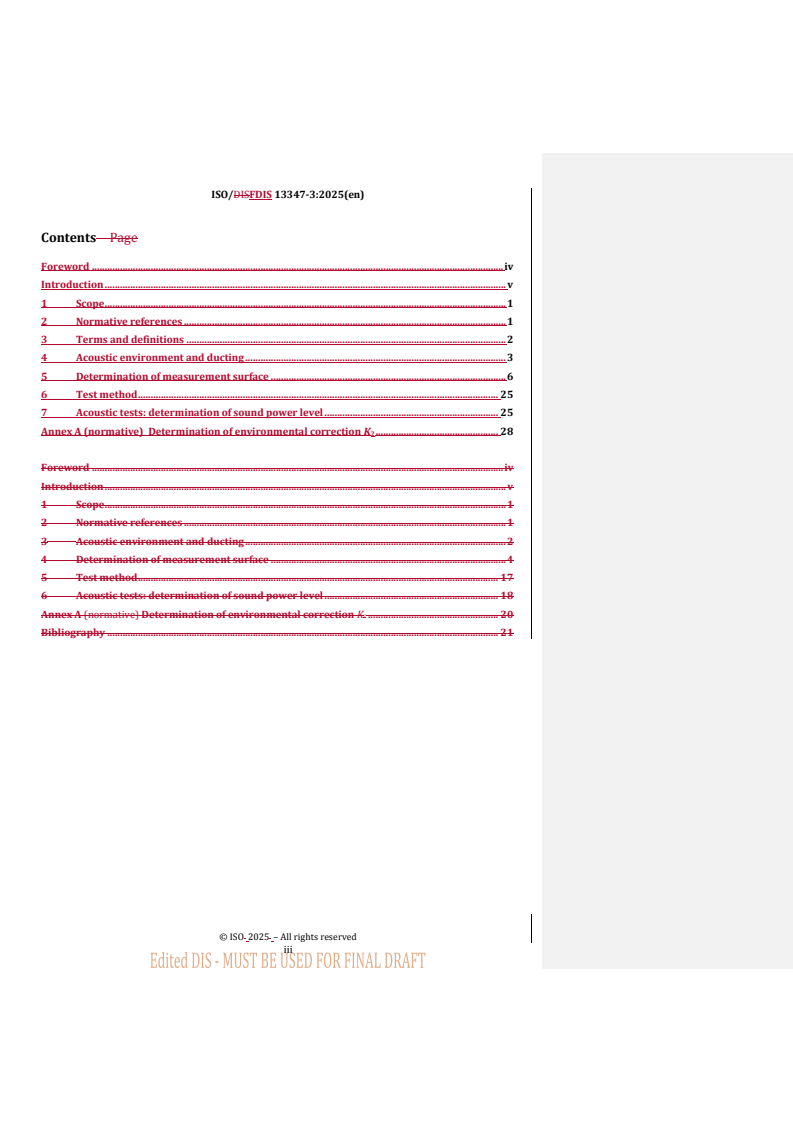
Contents Page
Foreword .iv
Introduction .v
1 Scope . 1
2 Normative references . 1
3 Terms and definitions . 2
3.1 Symbols and units .2
4 Acoustic environment and ducting . 2
4.1 General .2
4.2 Test installation .3
4.2.1 General .3
4.2.2 Installation category A . . .4
4.2.3 Installation category B .4
4.2.4 Installation category C .4
4.2.5 Casing sound power, Installation category D .4
4.2.6 Installation category E .4
4.2.7 Ducted small fans .5
4.2.8 End Reflection correction .5
4.3 Fan-powered exhaust ventilators .5
4.4 Drive and transmission noise . . .5
5 Determination of measurement surface . 5
5.1 General .5
5.2 Measurement surfaces .6
5.3 Arrangement of measuring points (rectangular parallelepiped) (installation category
A to E) .6
5.4 Arrangement of measuring points (large sphere or hemisphere).9
5.4.1 General .9
5.4.2 Hemispherical measurement surface (installation category A and category E) .9
5.4.3 Characteristic dimension D (installation categories B, C and D) .
o
5.4.4 Hemispherical and spherical measurement surfaces (installation categories B,
C and D) .10
5.4.5 Location of microphone positions .10
5.5 Arrangement of measuring points (small hemisphere) . 15
6 Test method .18
7 Acoustic tests: determination of sound power level .18
7.1 General .18
7.2 Calculation .18
7.2.1 Calculation of surface sound pressure level .18
7.2.2 Calculation of sound power level .19
7.3 Uncertainty of measurements .19
Annex A (normative) Determination of environmental correction K .20
iii
Foreword
ISO (the International Organization for Standardization) is a worldwide federation of national standards
bodies (ISO member bodies). The work of preparing International Standards is normally carried out through
ISO technical committees. Each member body interested in a subject for which a technical committee
has been established has the right to be represented on that committee. International organizations,
governmental and non-governmental, in liaison with ISO, also take part in the work. ISO collaborates closely
with the International Electrotechnical Commission (IEC) on all matters of electrotechnical standardization.
The procedures used to develop this document and those intended for its further maintenance are described
in the ISO/IEC Directives, Part 1. In particular, the different approval criteria needed for the different types
of ISO document should be noted. This document was drafted in accordance with the editorial rules of the
ISO/IEC Directives, Part 2 (see www.iso.org/directives).
ISO draws attention to the possibility that the implementation of this document may involve the use of (a)
patent(s). ISO takes no position concerning the evidence, validity or applicability of any claimed patent
rights in respect thereof. As of the date of publication of this document, ISO had not received notice of (a)
patent(s) which may be required to implement this document. However, implementers are cautioned that
this may not represent the latest information, which may be obtained from the patent database available at
www.iso.org/patents. ISO shall not be held responsible for identifying any or all such patent rights.
Any trade name used in this document is information given for the convenience of users and does not
constitute an endorsement.
For an explanation of the voluntary nature of standards, the meaning of ISO specific terms and expressions
related to conformity assessment, as well as information about ISO's adherence to the World Trade
Organization (WTO) principles in the Technical Barriers to Trade (TBT), see www.iso.org/iso/foreword.html.
This document was prepared by Technical Committee ISO/TC 117, Fans.
This second edition cancels and replaces the first edition (ISO 13347-3:2004), which has been technically
revised. It also incorporates the Technical Corrigendum ISO 13347-3:2004/Cor 1:2006 and the Amendment
ISO 13347-3:2004/Amd 1:2010.
The main changes are as follows:
— inclusion of acoustic methods for installation category E fans;
— symbols have been harmonized with those used in ISO 5801 and other ISO documents listed in the
Normative references;
— editorial corrections have been incorporated.
A list of all parts in the ISO 13347 series can be found on the ISO website.
Any feedback or questions on this document should be directed to the user’s national standards body. A
complete listing of these bodies can be found at www.iso.org/members.html.
iv
Introduction
This document gives a method for determining the sound power level of a fan. The method is reproducible in
all laboratories which are qualified according to the requirements of this document.
The method employs standard sound measurement instrumentation, applied to rooms which are restricted
in certain acoustic properties. The test set-ups are generally designed to represent the physical orientation
of a fan as installed, in accordance with ISO 5801 or ISO 13350.
Since sound power levels are considered independent of the acoustic environment around the fan, a
good comparison can be made between two or more fans proposed for any specific air performance
condition. Moreover, these values establish an accurate base for estimating the acoustical outcome of the
fan installation in terms of sound pressure levels. A successful estimate of sound pressure levels requires
extensive information on the fan and the environment in which it is to be located.
It is often advantageous for the equipment user to employ acoustical consultation to ensure that all factors
affecting final sound pressure levels are considered. More detailed information on the complexity of this
situation can be found in acoustic text books.
v
FINAL DRAFT International Standard ISO/FDIS 13347-3:2025(en)
Fans — Determination of fan sound power levels under
standardized laboratory conditions —
Part 3:
Enveloping surface methods
1 Scope
This document specifies a method for determining the sound power level of a fan. This document is applicable
to fans as defined in ISO 13349-1. The applicability of this document is limited to the determination of
airborne sound emission for the specified set-ups. Vibration is not measured, nor is the sensitivity of
airborne sound emission to vibration effects determined.
The sizes of fan which can be tested in accordance with this document are limited only by the practical
aspects of the test set-up. Dimensional limitations, test fan dimensions, and air performance will control the
room size, power and mounting requirements for the test fan.
NOTE Small fans can be tested according to this document or to ISO 10302-1, according to usage.
The test arrangements in this document establish the laboratory conditions necessary for a successful test.
Rarely will it be possible to meet these requirements in situ and this document is not intended for field
measurements.
NOTE Intending users are reminded that, in these situations, there can be additional acoustic system effects
where inlet and outlet conditions at the fan are less than ideal.
The enveloping surface methods can be used for the determination of open inlet and/or open outlet sound
power level of fans for the standardized installation category’s given in 4.1.
An estimation (with increased uncertainty) of ducted sound power for fans too small, or otherwise
inconvenient, for testing by the in-duct method described in ISO 5136 can also be obtained by the addition of
end reflection corrections (see of ISO 13347-1:2025, Annex C).
2 Normative references
The following referenced documents are indispensable for the application of this document. For dated
references, only the edition cited applies. For undated references, the latest edition of the referenced
document (including any amendments) applies.
ISO 3744, Acoustics — Determination of sound power levels of noise sources using sound pressure — Engineering
method in an essentially free field over a reflecting plane
ISO 5136, Acoustics — Determination of sound power radiated into a duct by fans and other air-moving devices
— In-duct method
ISO 5801, Fans — Performance testing using standardized airways
ISO 10302-1, Acoustics — Measurement of airborne noise emitted and structure-borne vibration induced by
small air-moving devices — Part 1: Airborne noise measurement
ISO 13347-1, Fans — Determination of fan sound power levels under standardized laboratory conditions — Part
1: General overview
ISO 13349-1, Fans — Vocabulary and definitions of categories — Part 1: Vocabulary
ISO 13350, Fans — Performance testing of jet fans
3 Terms and definitions
For the purposes of this document, the terms and definitions given in ISO 13347-1 apply.
ISO and IEC maintain terminology databases for use in standardization at the following addresses:
— ISO Online browsing platform: available at https:// www .iso .org/ obp
— IEC Electropedia: available at https:// www .electropedia .org/
3.1 Symbols and units
For consistency and mutual understanding, it is recommended that the symbols and units shown in Table 1
be used in reporting and calculation. Unless otherwise noted, the subscript number refers to the mid-
frequency of the octave band or one-third octave band number.
Table 1 — Symbols, units
Symbol Term SI unit
−12
dB
L sound power level, re 1 pW (1 × 10 W)
W
E duct end correction dB
D m
equivalent diameter
e
the largest dimension of the circular or rectangular orifice m
D
O
the measurement distance m
D
r
the nominal diameter of the inlet configuration m
D
N
h the height of centre of orifice above floor level or above another reflecting plane m
lll,, dimensions of the reference box m
12 3
S the measurement surface area m
S the cross-sectional area of a section through the fan in the measurement surface m
H
plane), only to be determined approximately; illustrated here for axial fans in exam-
ples a), c) and e) above
S the portion of measurement surface in contact with the discharge flow, for fans with m
S
outlet orifice
4 Acoustic environment and ducting
4.1 General
The fan installation conditions shall conform to the five installation categories, as specified in ISO 13349-1:
— installation category A: free inlet, free outlet with a partition;
— installation category B: free inlet, ducted outlet;
— installation category C: ducted inlet, free outlet;
— installation category D: ducted inlet, ducted outlet, (casing breakout noise may also be determined
for category D ducted inlet, ducted outlet);
— installation category E: free inlet, free outlet without a partition.
a) Category A b) Category B
c) Category C d) Category D e) Category E
Figure 1 — Installation categories
The test environments that are suitable for measurements according to this procedure are specified in detail
in ISO 3744. They can be outdoors or indoors.
For fans generating large flowrates, measurements should be undertaken in a large space to minimise the
recirculation of turbulent airflow through the fan and to ensure that microphones are not positioned in high
velocity flowrates.
Care should be taken to conduct outdoor tests on still calm days where the effects of the wind on
fan aerodynamic and/or noise performance may be discounted. A maximum wind speed of 3 m/s is
recommended.
During the period of the tests, the variation in the ambient air temperature and in relative humidity should
not exceed ±5 %.
For tests according to this procedure, the environment correction K shall be determined according to
Annex A, and should be less than or equal to 4 dB in any one-third octave band.
4.2 Test installation
4.2.1 General
The test arrangement shall comply with the general requirements of this clause and with the requirements
given in ISO 13347-1.
The ducting and anechoic termination and flow measurement and control device, when necessary, fitted to
the fan for tests for installation B, C and D shall be as specified in ISO 5136 and ISO 5801. Simplified anechoic
termination shall be fitted, see also ISO 13347-1.
The appropriate operating condition shall be determined from a measurement of the air volume flowrate
and fan pressure in accordance with ISO 5801, small fans shall be tested in accordance with ISO 10302-1.
The sound pressure level in the test area due to the noise generated by the flow measurement or control
device shall be at least 10 dB below the measured sound pressure level from the fan under test.
When an air vent is necessary for air to recirculate into or out of the test area, it shall be silenced and placed
on the room surface. It may also be used to regulate the air flow.
If practicable, all auxiliary equipment necessary for the fan under test shall be located outside the test area
which shall be cleared of all objects which may interfere with the measurements.
Care should be taken to ensure that any electrical conduits and fittings, piping, or air ducts connected to the
equipment do not radiate significant amounts of sound energy into the test area.
4.2.2 Installation category A
The fan shall be placed in an aperture over the reflecting plane such that the fan inlet or outlet orifice
(as appropriate) is axially located in relation to the reflecting plane in a manner representative of its
recommended installation. The fan orifice shall be placed coaxially with the wall aperture, and, to ensure
satisfactory air flow conditions, the aperture shall be larger all round than the fan orifice by an amount at
least as great as the thickness of the reflecting plane structure, and the intervening gap shall be sealed by a
panel. Provision shall be made for determining and adjusting the fan air flowrate.
Care should be taken to avoid vibration of the sealing panel.
NOTE The reverberant conditions of the non-measured side can affect the measurements made on the measured
side of the fan.
4.2.3 Installation category B
The inlet of the fan shall be placed in the vicinity of the centre of the test area. Ducting connected to the
fan discharge shall either be of sufficiently massive construction or be treated externally so as to avoid
transmission of undesired noise from within the duct.
The duct shall be terminated with a simplified anechoic device as described in ISO 13347-1. The outlet duct
shall comprise an intermediate duct, a transition duct if necessary, a test duct or terminating duct and an
anechoic termination (see ISO 13347-1:2025, Annex D).
Precautions should be taken to ensure that noise from the flow control or flow measurement device does not
interfere with noise from the fan at any of the measurement locations.
NOTE Unless precautions are made to ensure otherwise, the sound pressure levels measured will include noise
radiated from the fan casing and the fan drive motor (see ISO 13347-1).
4.2.4 Installation category C
The outlet of the fan shall be placed in the vicinity of the centre of the test area. Ducting connected to the fan
inlet shall either be of sufficiently massive construction or be treated externally so as to avoid transmission
of undesired noise from within the duct.
The duct shall be terminated with a simplified anechoic device as described in ISO 13347-1. The inlet duct
shall comprise an intermediate duct, a transition duct if necessary, a test duct or terminating duct and an
anechoic termination (see ISO 13347-1:2025, Annex D).
Precautions should be taken to ensure that noise from the flow control or flow measurement devices does
not interfere with noise from the fan at any of the measurement locations.
NOTE Unless precautions are made to ensure otherwise, the sound pressure levels measured will include noise
radiated from the fan casing and the fan drive motor (see ISO 13347-1).
4.2.5 Casing sound power, Installation category D
The sound power radiated from the external surface of the fan casing and, if appropriate, from the drive,
may be determined by this method provided that noise radiated from the associated ducting is minimal.
The ducting connected to the fan inlet or outlet shall be terminated with a simplified anechoic device as
described in ISO 13347-1 to ensure that the reflection coefficients are within the limits specified in Table 4
of ISO 13347-1, and shall also comply with 4.2.1, 4.2.3 and 4.2.4 of this document.
4.2.6 Installation category E
The fan shall be placed in the vicinity of the centre of the test area.
Performance of jet fans shall be measured in accordance with ISO 13350.
NOTE The sound pressure levels measured on the inlet can include noise radiated from t
...
ISO/DISFDIS 13347-3:2025(en)
ISO/TC 117
Secretariat: BSI
Date: 2025-09-2611-25
Fans — Determination of fan sound power levels under standardized
laboratory conditions —
Part 3:
Enveloping surface methods
Ventilateurs — Détermination des niveaux de puissance acoustique des ventilateurs dans des conditions de
laboratoire normalisées — Partie 3: Méthodes de la surface enveloppante
Partie 3: Méthodes de la surface enveloppante
FDIS stage
All rights reserved. Unless otherwise specified, or required in the context of its implementation, no part of this publication
may be reproduced or utilized otherwise in any form or by any means, electronic or mechanical, including photocopying,
or posting on the internet or an intranet, without prior written permission. Permission can be requested from either ISO
at the address below or ISO'sISO’s member body in the country of the requester.
ISO Copyright Officecopyright office
CP 401 • Ch. de Blandonnet 8
CH-1214 Vernier, Geneva
Phone: + 41 22 749 01 11
Email: copyright@iso.org
E-mail: copyright@iso.org
Website: www.iso.orgwww.iso.org
Published in Switzerland.
ii
ISO/DISFDIS 13347-3:2025(en)
Contents Page
Foreword . iv
Introduction . v
1 Scope . 1
2 Normative references . 1
3 Terms and definitions . 2
4 Acoustic environment and ducting . 3
5 Determination of measurement surface . 6
6 Test method . 25
7 Acoustic tests: determination of sound power level . 25
Annex A (normative) Determination of environmental correction K2 . 28
Foreword . iv
Introduction . v
1 Scope . 1
2 Normative references . 1
3 Acoustic environment and ducting . 2
4 Determination of measurement surface . 4
5 Test method . 17
6 Acoustic tests: determination of sound power level . 18
Annex A (normative) Determination of environmental correction K2 . 20
Bibliography . 21
© ISO 2025 – All rights reserved
iii
Foreword
ISO (the International Organization for Standardization) is a worldwide federation of national standards
bodies (ISO member bodies). The work of preparing International Standards is normally carried out through
ISO technical committees. Each member body interested in a subject for which a technical committee has been
established has the right to be represented on that committee. International organizations, governmental and
non-governmental, in liaison with ISO, also take part in the work. ISO collaborates closely with the
International Electrotechnical Commission (IEC) on all matters of electrotechnical standardization.
The procedures used to develop this document and those intended for its further maintenance are described
in the ISO/IEC Directives, Part 1. In particular, the different approval criteria needed for the different types of
ISO document should be noted. This document was drafted in accordance with the editorial rules of the
ISO/IEC Directives, Part 2 (see www.iso.org/directives).
ISO draws attention to the possibility that the implementation of this document may involve the use of (a)
patent(s). ISO takes no position concerning the evidence, validity or applicability of any claimed patent rights
in respect thereof. As of the date of publication of this document, ISO had not received notice of (a) patent(s)
which may be required to implement this document. However, implementers are cautioned that this may not
represent the latest information, which may be obtained from the patent database available at
www.iso.org/patents.www.iso.org/patents. ISO shall not be held responsible for identifying any or all such
patent rights.
Any trade name used in this document is information given for the convenience of users and does not
constitute an endorsement.
For an explanation of the voluntary nature of standards, the meaning of ISO specific terms and expressions
related to conformity assessment, as well as information about ISO's adherence to the World Trade
Organization (WTO) principles in the Technical Barriers to Trade (TBT), see
www.iso.org/iso/foreword.htmlwww.iso.org/iso/foreword.html.
This document was prepared by Technical Committee ISO/TC 117, Fans.
This second edition cancels and replaces the first edition (ISO 13347-3:2004), which has been technically
revised. It also incorporates the Technical Corrigendum ISO 13347-3:2004/Cor 1:2006 and the Amendment
ISO 13347-3:2004/Amd 1:2010.
The main changes are as follows:
The main changes compared with ISO 13347-2:2004 are as follows:
— the inclusion of acoustic methods for installation category E fans;
— symbols have been harmonized with those used in ISO 5801 and other ISO standards asdocuments listed
in the Normative references [2];
— editorial corrections have been incorporated.
A list of all parts in the ISO 13347 series can be found on the ISO website.
Any feedback or questions on this document should be directed to the user’s national standards body. A
complete listing of these bodies can be found at www.iso.org/members.htmlwww.iso.org/members.html.
iv
ISO/DISFDIS 13347-3:2025(en)
Introduction
This document gives a method for determining the sound power level of a fan. The method is reproducible in
all laboratories which are qualified according to the requirements of this document.
The method employs standard sound measurement instrumentation, applied to rooms which are restricted in
certain acoustic properties. The test set-ups are generally designed to represent the physical orientation of a
fan as installed, in accordance with ISO 5801 or ISO 13350.
Since sound power levels are considered independent of the acoustic environment around the fan, a good
comparison can be made between two or more fans proposed for any specific air performance condition.
Moreover, these values establish an accurate base for estimating the acoustical outcome of the fan installation
in terms of sound pressure levels. A successful estimate of sound pressure levels requires extensive
information on the fan and the environment in which it is to be located.
It is often advantageous for the equipment user to employ acoustical consultation to ensure that all factors
which affect theaffecting final sound pressure levels are considered. More detailed information on the
complexity of this situation can be found in acoustic text books.
© ISO 2025 – All rights reserved
v
DRAFT International Standard ISO/DIS 13347-3:2025(en)
Fans — Determination of fan sound power levels under standardized
laboratory conditions — Part 3: Enveloping surface methods
Fans — Determination of fan sound power levels under standardized
laboratory conditions —
Part 3:
Enveloping surface methods
1 Scope
This document specifies a method for determining the sound power level of a fan. This document is applicable
to fans as defined in ISO 13349-1. The applicability of this document is limited to the determination of airborne
sound emission for the specified set-ups. Vibration is not measured, nor is the sensitivity of airborne sound
emission to vibration effects determined.
The sizes of fan which can be tested in accordance with this document are limited only by the practical aspects
of the test set-up. Dimensional limitations, test fan dimensions, and air performance will control the room size,
power and mounting requirements for the test fan.
NOTE Small fans can be tested according to this document or to ISO 10302-1, according to usage.
The test arrangements in this document establish the laboratory conditions necessary for a successful test.
Rarely will it be possible to meet these requirements in situ and this document is not intended for field
measurements.
NOTE Intending users are reminded that, in these situations, there can be additional acoustic system effects where
inlet and outlet conditions at the fan are less than ideal.
The enveloping surface methods can be used for the determination of open inlet and/or open outlet sound
power level of fans for the standardized installation category’s given in 4.1.4.1.
An estimation (with increased uncertainty) of ducted sound power for fans too small, or otherwise
inconvenient, for testing by the in-duct method described in ISO 5136 can also be obtained by the addition of
end reflection corrections (see Annex C of ISO 13347-1:2025, Annex C).
2 Normative references
The following referenced documents are indispensable for the application of this document. For dated
references, only the edition cited applies. For undated references, the latest edition of the referenced
document (including any amendments) applies.
ISO 3744, Acoustics — Determination of sound power levels of noise sources using sound pressure — Engineering
method in an essentially free field over a reflecting plane
ISO 5136, Acoustics — Determination of sound power radiated into a duct by fans and other air-moving devices
— In-duct method
ISO 5801, Fans — Performance testing using standardized airways
ISO 10302-1, Acoustics — Measurement of airborne noise emitted and structure-borne vibration induced by
small air-moving devices — Part 1: Airborne noise measurement
ISO 13347--1, Fans — Determination of fan sound power levels under standardized laboratory conditions —
Part 1: General overview
ISO 13349--1, Fans — Vocabulary and definitions of categories — Part 1: Vocabulary
ISO 13350, Fans — Performance testing of jet fans
3 Terms and definitions
For the purposes of this document, the terms and definitions definedgiven in ISO 13347-1 shall apply.
ISO and IEC maintain terminology databases for use in standardization at the following addresses:
— — ISO Online browsing platform: available at https://www.iso.org/obphttps://www.iso.org/obp
— — IEC Electropedia: available at https://www.electropedia.org/https://www.electropedia.org/
3.1 3.2 Symbols and units
For consistency and mutual understanding, it is recommended that the symbols and units shown in Table 10
be used in reporting and calculation. Unless otherwise noted, the subscript number refers to the mid-
frequency of the octave band or one-third octave band number.
Table 1 — Symbols, units
Symbol Term SI unit
−12
𝐿 sound power level, re 1 pW (1 × 10 W) dB
𝑊
E duct end correction dB
𝐷 equivalent diameter m
e
𝐷 equivalent diameter m
e
𝐷 𝐷 the largest dimension of the circular or rectangular orifice m
O O
𝐷 𝐷 the measurement distance m
r r
𝐷 𝐷 the nominal diameter of the inlet configuration m
N N
h the height of centre of orifice above floor level or above another reflecting plane m
𝑙 , 𝑙 , 𝑙 , 𝑙 , 𝑙 dimensions of the reference box m
1 2 3 2 3
S the measurement surface area m
the cross-sectional area of a section through the fan in the measurement surface m
𝑆 𝑆 plane), only to be determined approximately; illustrated here for axial fans in
H H
examples a), c) and e) above
the portion of measurement surface in contact with the discharge flow, for fans with m
𝑆 𝑆
S S
outlet orifice
ISO/DISFDIS 13347-3:2025(en)
4 Acoustic environment and ducting
4.1 General
The fan installation conditions shall conform to the five installation categories, as specified in ISO 13349-1:
— installation category A: free inlet, free outlet with a partition;
— installation category B: free inlet, ducted outlet;
— installation category C: ducted inlet, free outlet;
— installation category D: ducted inlet, ducted outlet, (casing breakout noise may also be
determined for category D ducted inlet, ducted outlet);
— installation category E: free inlet, free outlet without a partition.
a) Category A b) Category B
c) Category C d) Category D e) Category E
Figure Figure 1 — Installation categories
The test environments that are suitable for measurements according to this procedure are specified in detail
in ISO 3744. They can be outdoors or indoors.
For fans generating large flowrates, measurements should be undertaken in a large space to minimise the
recirculation of turbulent airflow through the fan and to ensure that microphones are not positioned in high
velocity flowrates.
Care should be taken to conduct outdoor tests on still calm days where the effects of the wind on fan
aerodynamic and/or noise performance may be discounted. A maximum wind speed of 3 m/s is
recommended.
During the period of the tests, the variation in the ambient air temperature and in relative humidity should
not exceed ±5 %.
For tests according to this procedure, the environment correction K 𝐾 shall be determined according to
Annex A,Annex A, and should be less than or equal to 4 dB in any one-third octave band.
© ISO 2025 – All rights reserved
4.2 Test installation
4.2.1 General
The test arrangement shall comply with the general requirements of this clause and with the requirements
given in ISO 13347-1.
The ducting and anechoic termination and flow measurement and control device, when necessary, fitted to
the fan for tests for installation B, C and D shall be as specified in ISO 5136 and ISO 5801. Simplified anechoic
termination shall be fitted, see also ISO 13347-1.
The appropriate operating condition shall be determined from a measurement of the air volume flowrate and
fan pressure in accordance with ISO 5801, small fans shall be tested in accordance with ISO 10302-1.
The sound pressure level in the test area due to the noise generated by the flow measurement or control device
shall be at least 10 dB below the measured sound pressure level from the fan under test.
When an air vent is necessary for air to recirculate into or out of the test area, it shall be silenced and placed
on the room surface. It may also be used to regulate the air flow.
If practicable, all auxiliary equipment necessary for the fan under test shall be located outside the test area
which shall be cleared of all objects which may interfere with the measurements.
Care should be taken to ensure that any electrical conduits and fittings, piping, or air ducts connected to the
equipment do not radiate significant amounts of sound energy into the test area.
4.2.2 Installation category A
The fan shall be placed in an aperture over the reflecting plane such that the fan inlet or outlet orifice (as
appropriate) is axially located in relation to the reflecting plane in a manner representative of its
recommended installation. The fan orifice shall be placed coaxially with the wall aperture, and, to ensure
satisfactory air flow conditions, the aperture shall be larger all round than the fan orifice by an amount at least
as great as the thickness of the reflecting plane structure, and the intervening gap shall be sealed by a panel.
Provision shall be made for determining and adjusting the fan air flowrate.
Care should be taken to avoid vibration of the sealing panel.
NOTE The reverberant conditions of the non-measured side can affect the measurements made on the measured
side of the fan.
4.2.3 Installation category B
The inlet of the fan shall be placed in the vicinity of the centre of the test area. Ducting connected to the fan
discharge shall either be of sufficiently massive construction or be treated externally so as to avoid
transmission of undesired noise from within the duct.
The duct shall be terminated with a simplified anechoic device as described in ISO 13347-1. The outlet duct
shall comprise an intermediate duct, a transition duct if necessary, a test duct or terminating duct and an
anechoic termination (see ISO 13347-1:—,:2025, Annex D).
Precautions should be taken to ensure that noise from the flow control or flow measurement device does not
interfere with noise from the fan at any of the measurement locations.
NOTE Unless precautions are made to ensure otherwise, the sound pressure levels measured will include noise
radiated from the fan casing and the fan drive motor (see ISO 13347-1).
ISO/DISFDIS 13347-3:2025(en)
4.2.4 Installation category C
The outlet of the fan shall be placed in the vicinity of the centre of the test area. Ducting connected to the fan
inlet shall either be of sufficiently massive construction or be treated externally so as to avoid transmission of
undesired noise from within the duct.
The duct shall be terminated with a simplified anechoic device as described in ISO 13347-1. The inlet duct
shall comprise an intermediate duct, a transition duct if necessary, a test duct or terminating duct and an
anechoic termination (see ISO 13347-1:—,:2025, Annex D).
Precautions should be taken to ensure that noise from the flow control or flow measurement devices does not
interfere with noise from the fan at any of the measurement locations.
NOTE Unless precautions are made to ensure otherwise, the sound pressure levels measured will include noise
radiated from the fan casing and the fan drive motor (see ISO 13347-1).
4.2.5 Casing sound power, Installation category D
The sound power radiated from the external surface of the fan casing and, if appropriate, from the drive, may
be determined by this method provided that noise radiated from the associated ducting is minimal. The
ducting connected to the fan inlet or outlet shall be terminated with a simplified anechoic device as described
in ISO 13347-1 to ensure that the reflection coefficients are within the limits specified in Table 4 of ISO 13347-
1, and shall also comply with 4.2.1, 4.2.3 and 4.2.44.2.1, 4.2.3 and 4.2.4 of this document.
4.2.6 Installation category E
The fan shall be placed in the vicinity of the centre of the test area.
Performance of jet fans shall be measured in accordance with ISO 13350.
NOTE The sound pressure levels measured on the inlet can include noise radiated from the casing and a contribution
of noise from the outlet. The same applies to sound pressure levels measured on the outlet.
4.2.7 Ducted small fans
Fans with test ducts smaller in diameter than those specified in ISO 13347-1:—,:2025, Clause 8, cannot be
tested by the in-duct method.
4.2.8 End Reflection correction
If an indication of the in-duct sound power level is required, it may be obtained for these fans by applying the
end reflection correction to the sound pressure level determined in the room. This resultant sound power
level is not a true in-duct sound power level, but may be taken as a characteristic in-duct sound power level
for fans for the purposes of noise control calculations. The end reflection correction E can be found in
ISO 13347-1.
𝐿 = 𝐿 𝐿 = 𝐿 + 𝐸
𝑊(𝑖𝑛 𝑑𝑢𝑐𝑡) 𝑊 𝑊(𝑖𝑛𝑑𝑢𝑐𝑡) 𝑊
4.3 Fan-powered exhaust ventilators
Fan-powered exhaust ventilators may be tested by the free field method. When it is not possible to mount a
unit with gravity-controlled shutters in its correct mounting attitude, the shutters shall be locked in the correct
mounting operating position. The units shall be mounted in as representative a manner as possible with only
that degree of vibration isolation recommended for a normal site installation. The opening in the test room
shall be dimensionally similar to the recommended opening for the installed unit. The powered ventilator
© ISO 2025 – All rights reserved
shall not be separated from the external face of the test room by a connecting duct but additional fittings may
be used to simulate accurately the mounting conditions specified by the manufacturer.
4.4 Drive and transmission noise
In cases where the fan drive and its inlet and outlet are in the same measurement space, the noise will be
partly aerodynamic and partly due to the drive and transmission. If the drive is representative of that supplied
with the fan, this noise shall be taken to be the noise from the fan assembly. In cases where drive and
transmission are not supplied as standard, the contribution to the noise made by these shall be checked by
removing the fan impeller and substituting an equal and smooth surfaced mass. The noise thus obtained shall
be measured. If this is 10 dB or more below the level in any octave band due to the complete assembly,
transmission noise may be ignored. For differences between 6 dB and 10 dB, background noise corrections in
accordance with ISO 3744 shall be made. Otherwise, some action shall be taken to reduce noise from this
source. If the drive and transmission are considered to make a significant contribution to the total noise, this
fact shall be included in the test report.
5 Determination of measurement surface
5.1 General
This document recognises a number of different methods for defining the positions at which microphones
shall be placed for measuring the fan noise. The general principle is to define a hypothetical surface enveloping
some or all of the source, or if there is a reflecting plane, enveloping the source and terminating on the
reflecting plane.
5.2 Measurement surfaces
5.2.1 General
The different measurement surfaces are as shown in 5.2.2 to 5.2.4,5.2.2 to 5.2.4, to be used with installation
category A, B, C, D and E as appropriate.
5.2.2 A rectangular parallelepiped enclosing the sound source
As shown in Figure 2.0. This surface is easily and accurately measured. It may include part of the casing
radiated noise, in which case this shall be clearly identified. Directivity of the noise is not easily deduced.
5.2.3 A sphere, or hemisphere over a reflecting plane
As shown in Figures 3, 4 and 5.0, 0 and 0. Directivity of the sound may be deduced by plotting curves of equal
dB value through the levels at the measuring points.
5.2.4 A small-radius hemisphere, the centre of which is located at the intersection of the axis of
symmetry of the inlet(s) and of the plane normal to this axis at the inlet under consideration
As shown in Figure 6,0, this method is suitable for use in more restricted spaces, but is generally confined to
the measurement of inlet noise on fans having a ducted outlet. For absolute comparisons, the use of a
Reference Sound Source is necessary.
5.3 Arrangement of measuring points (rectangular parallelepiped) (installation category A
to E)
A hypothetical reference surface in the form of a rectangular parallelepiped (reference box) shall enclose the
fan, any protruding elements which are not significant radiators of sound energy beingare disregarded.
ISO/DISFDIS 13347-3:2025(en)
For the determination of sound power level 𝐿 𝐿 𝑜𝑟 𝐿 𝐿 the reference box
𝑊 (𝐵,𝑖𝑛 + 𝑐𝑎𝑠) 𝑊(𝐵,𝑖𝑛+𝑐𝑎𝑠) 𝑊 (𝐵,𝑜𝑢𝑡) 𝑊(𝐵,𝑜𝑢𝑡)
shall be selected in such a way that it encloses a portion of the space at the orifice, and in the case of outlet
orifices, a portion of the discharge flow, and t
...
PROJET FINAL
Norme
internationale
ISO/TC 117
Ventilateurs — Détermination des
Secrétariat: BSI
niveaux de puissance acoustique
Début de vote:
des ventilateurs dans des conditions
2025-12-10
de laboratoire standardisées —
Vote clos le:
2026-02-04
Partie 3:
Méthodes de la surface
enveloppante
Fans — Determination of fan sound power levels under
standardized laboratory conditions —
Part 3: Enveloping surface methods
LES DESTINATAIRES DU PRÉSENT PROJET SONT
INVITÉS À PRÉSENTER, AVEC LEURS OBSERVATIONS,
NOTIFICATION DES DROITS DE PROPRIÉTÉ DONT ILS
AURAIENT ÉVENTUELLEMENT CONNAISSANCE ET À
FOURNIR UNE DOCUMENTATION EXPLICATIVE.
OUTRE LE FAIT D’ÊTRE EXAMINÉS POUR
ÉTABLIR S’ILS SONT ACCEPTABLES À DES FINS
INDUSTRIELLES, TECHNOLOGIQUES ET COM-MERCIALES,
AINSI QUE DU POINT DE VUE DES UTILISATEURS, LES
PROJETS DE NORMES
INTERNATIONALES DOIVENT PARFOIS ÊTRE CONSIDÉRÉS
DU POINT DE VUE DE LEUR POSSI BILITÉ DE DEVENIR DES
NORMES POUVANT
SERVIR DE RÉFÉRENCE DANS LA RÉGLEMENTATION
NATIONALE.
Numéro de référence
PROJET FINAL
Norme
internationale
ISO/TC 117
Ventilateurs — Détermination des
Secrétariat: BSI
niveaux de puissance acoustique
Début de vote:
des ventilateurs dans des conditions
2025-12-10
de laboratoire standardisées —
Vote clos le:
2026-02-04
Partie 3:
Méthodes de la surface
enveloppante
Fans — Determination of fan sound power levels under
standardized laboratory conditions —
Part 3: Enveloping surface methods
LES DESTINATAIRES DU PRÉSENT PROJET SONT
INVITÉS À PRÉSENTER, AVEC LEURS OBSERVATIONS,
NOTIFICATION DES DROITS DE PROPRIÉTÉ DONT ILS
AURAIENT ÉVENTUELLEMENT CONNAISSANCE ET À
FOURNIR UNE DOCUMENTATION EXPLICATIVE.
DOCUMENT PROTÉGÉ PAR COPYRIGHT
OUTRE LE FAIT D’ÊTRE EXAMINÉS POUR
ÉTABLIR S’ILS SONT ACCEPTABLES À DES FINS
© ISO 2025 INDUSTRIELLES, TECHNOLOGIQUES ET COM-MERCIALES,
AINSI QUE DU POINT DE VUE DES UTILISATEURS, LES
Tous droits réservés. Sauf prescription différente ou nécessité dans le contexte de sa mise en œuvre, aucune partie de cette
PROJETS DE NORMES
INTERNATIONALES DOIVENT PARFOIS ÊTRE CONSIDÉRÉS
publication ne peut être reproduite ni utilisée sous quelque forme que ce soit et par aucun procédé, électronique ou mécanique,
DU POINT DE VUE DE LEUR POSSI BILITÉ DE DEVENIR DES
y compris la photocopie, ou la diffusion sur l’internet ou sur un intranet, sans autorisation écrite préalable. Une autorisation peut
NORMES POUVANT
être demandée à l’ISO à l’adresse ci-après ou au comité membre de l’ISO dans le pays du demandeur.
SERVIR DE RÉFÉRENCE DANS LA RÉGLEMENTATION
NATIONALE.
ISO copyright office
Case postale 401 • Ch. de Blandonnet 8
CH-1214 Vernier, Genève
Tél.: +41 22 749 01 11
E-mail: copyright@iso.org
Web: www.iso.org
Publié en Suisse Numéro de référence
ii
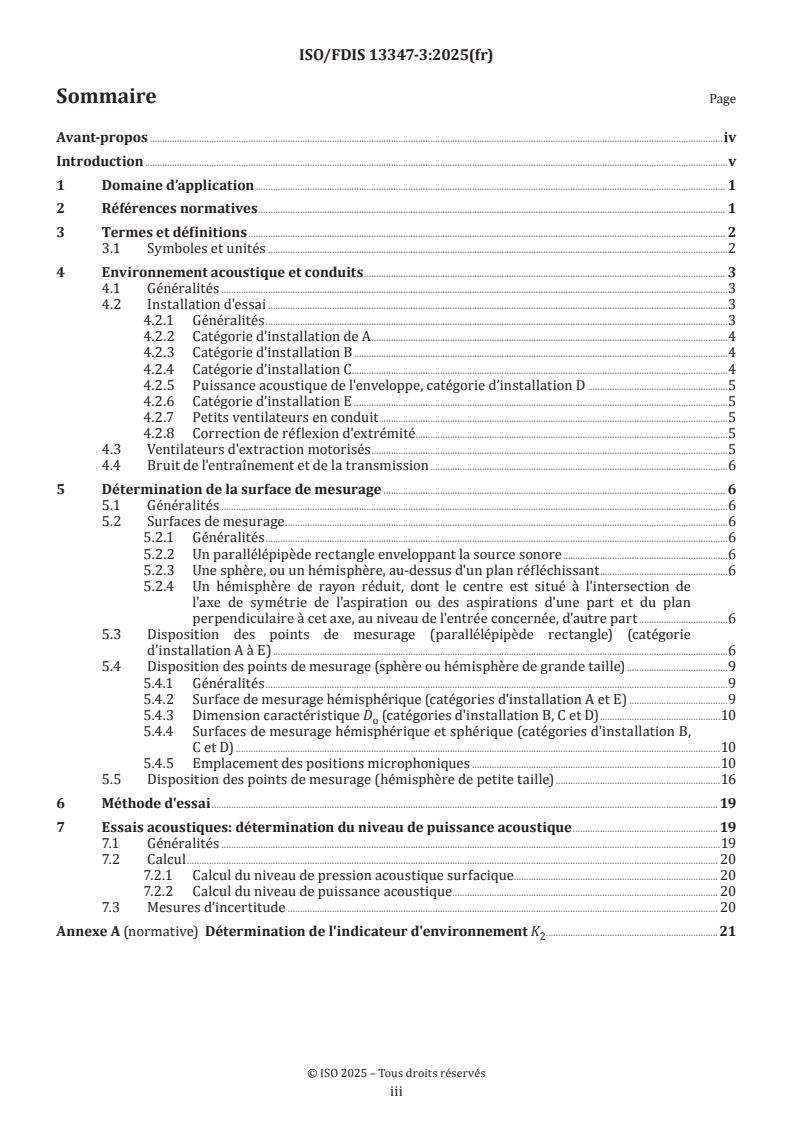
Sommaire Page
Avant-propos .iv
Introduction .v
1 Domaine d’application . 1
2 Références normatives . 1
3 Termes et définitions . 2
3.1 Symboles et unités .2
4 Environnement acoustique et conduits . 3
4.1 Généralités .3
4.2 Installation d'essai .3
4.2.1 Généralités .3
4.2.2 Catégorie d’installation de A .4
4.2.3 Catégorie d’installation B .4
4.2.4 Catégorie d’installation C . .4
4.2.5 Puissance acoustique de l'enveloppe, catégorie d’installation D .5
4.2.6 Catégorie d’installation E .5
4.2.7 Petits ventilateurs en conduit .5
4.2.8 Correction de réflexion d'extrémité.5
4.3 Ventilateurs d'extraction motorisés .5
4.4 Bruit de l'entraînement et de la transmission .6
5 Détermination de la surface de mesurage . 6
5.1 Généralités .6
5.2 Surfaces de mesurage .6
5.2.1 Généralités .6
5.2.2 Un parallélépipède rectangle enveloppant la source sonore .6
5.2.3 Une sphère, ou un hémisphère, au-dessus d'un plan réfléchissant .6
5.2.4 Un hémisphère de rayon réduit, dont le centre est situé à l'intersection de
l'axe de symétrie de l'aspiration ou des aspirations d'une part et du plan
perpendiculaire à cet axe, au niveau de l'entrée concernée, d'autre part .6
5.3 Disposition des points de mesurage (parallélépipède rectangle) (catégorie
d'installation A à E) .6
5.4 Disposition des points de mesurage (sphère ou hémisphère de grande taille) .9
5.4.1 Généralités .9
5.4.2 Surface de mesurage hémisphérique (catégories d'installation A et E) .9
5.4.3 Dimension caractéristique D (catégories d'installation B, C et D) .10
o
5.4.4 Surfaces de mesurage hémisphérique et sphérique (catégories d'installation B,
C et D) .10
5.4.5 Emplacement des positions microphoniques .10
5.5 Disposition des points de mesurage (hémisphère de petite taille) .16
6 Méthode d'essai . 19
7 Essais acoustiques: détermination du niveau de puissance acoustique . 19
7.1 Généralités .19
7.2 Calcul . 20
7.2.1 Calcul du niveau de pression acoustique surfacique . 20
7.2.2 Calcul du niveau de puissance acoustique . 20
7.3 Mesures d’incertitude . 20
Annexe A (normative) Détermination de l'indicateur d'environnement K .21
iii
Avant-propos
L'ISO (Organisation internationale de normalisation) est une fédération mondiale d'organismes nationaux
de normalisation (comités membres de l'ISO). L'élaboration des Normes internationales est en général
confiée aux comités techniques de l'ISO. Chaque comité membre intéressé par une étude a le droit de faire
partie du comité technique créé à cet effet. Les organisations internationales, gouvernementales et non
gouvernementales, en liaison avec l'ISO participent également aux travaux. L'ISO collabore étroitement avec
la Commission électrotechnique internationale (IEC) en ce qui concerne la normalisation électrotechnique.
Les procédures utilisées pour élaborer le présent document et celles destinées à sa mise à jour sont
décrites dans les Directives ISO/IEC, Partie 1. Il convient, en particulier, de prendre note des différents
critères d'approbation requis pour les différents types de documents ISO. Le présent document a
été rédigé conformément aux règles de rédaction données dans les Directives ISO/IEC, Partie 2 (voir
www.iso.org/directives).
L’ISO attire l’attention sur le fait que la mise en application du présent document peut entraîner l’utilisation
d’un ou de plusieurs brevets. L’ISO ne prend pas position quant à la preuve, à la validité et à l’applicabilité de
tout droit de propriété revendiqué à cet égard. À la date de publication du présent document, l’ISO n'avait pas
reçu notification qu’un ou plusieurs brevets pouvaient être nécessaires à sa mise en application. Toutefois,
il y a lieu d’avertir les responsables de la mise en application du présent document que des informations
plus récentes sont susceptibles de figurer dans la base de données de brevets, disponible à l'adresse
www.iso.org/brevets. L’ISO ne saurait être tenue pour responsable de ne pas avoir identifié tout ou partie de
tels droits de propriété.
Les appellations commerciales éventuellement mentionnées dans le présent document sont données pour
information, par souci de commodité, à l’intention des utilisateurs et ne sauraient constituer un engagement.
Pour une explication de la nature volontaire des normes, la signification des termes et expressions
spécifiques de l'ISO liés à l'évaluation de la conformité, ou pour toute information au sujet de l'adhésion de
l'ISO aux principes de l’Organisation mondiale du commerce (OMC) concernant les obstacles techniques au
commerce (OTC), voir www.iso.org/avant-propos.
Le présent document a été élaboré par le comité technique ISO/TC 117, Ventilateurs.
Cette seconde édition annule et remplace la première édition (ISO 13347-3:2004), qui a fait l'objet d'une
révision technique. Elle incorpore également le Rectificatif technique ISO 13347-3:2004/Cor 1:2006, ainsi
que l'amendement ISO 13347-3:2004/Amd 1:2010.
Les principales modifications sont les suivantes:
— inclusion de méthodes acoustiques pour les ventilateurs de catégorie d’installation E;
— harmonisation des symboles avec ceux utilisés dans l’ISO 5801 et dans les autres normes ISO citées en
références normatives;
— corrections rédactionnelles.
Une liste de toutes les parties de la série ISO 13347 se trouve sur le site web de l’ISO.
Il convient que l’utilisateur adresse tout retour d’information ou toute question concernant le présent
document à l’organisme national de normalisation de son pays. Une liste exhaustive desdits organismes se
trouve à l’adresse www.iso.org/fr/members.html.
iv
Introduction
Le présent document donne une méthode de détermination du niveau de puissance acoustique d'un
ventilateur. La méthode est reproductible dans tous les laboratoires qualifiés conformément aux exigences
du présent document.
La méthode emploie un appareillage de mesure acoustique standard qui s'applique aux salles présentant des
restrictions du point de vue de certaines propriétés acoustiques. Les installations d'essai sont généralement
conçues pour représenter l'orientation physique réelle d'un ventilateur, conformément à l'ISO 5801 ou
ISO 13350.
Puisque l'on considère que les niveaux de puissance acoustique sont indépendants de l'environnement
acoustique autour du ventilateur, il est possible d'effectuer une comparaison correcte entre deux ou
plusieurs ventilateurs, présentés pour toute condition de performance d'aérage spécifique. De plus, ces
valeurs établissent une base précise pour l'estimation des résultats acoustiques de l'installation relative au
ventilateur, en termes de niveaux de pression acoustique. Une estimation correcte des niveaux de pression
acoustique requiert des informations détaillées sur le ventilateur et son environnement d'installation.
Il est souvent avantageux pour l'utilisateur de l'équipement d'utiliser une consultation acoustique afin
de garantir que tous les facteurs qui influencent les niveaux de pression acoustique finaux sont pris en
considération. Il est possible de trouver des informations plus détaillées sur la complexité de cette situation
dans des ouvrages traitant d'acoustique.
v
PROJET FINAL Norme internationale ISO/FDIS 13347-3:2025(fr)
Ventilateurs — Détermination des niveaux de puissance
acoustique des ventilateurs dans des conditions de
laboratoire standardisées —
Partie 3:
Méthodes de la surface enveloppante
1 Domaine d’application
Le présent document spécifie une méthode pour déterminer le niveau de puissance acoustique d'un
ventilateur. Le présent document s'applique aux ventilateurs tels que définis dans l'ISO 13349. L'applicabilité
du présent document se limite à la détermination de l'émission de bruit aérien pour les installations
spécifiées. Les vibrations ne sont pas mesurées et la sensibilité de l'émission de bruit aérien aux effets des
vibrations n'est pas déterminée.
La taille du ventilateur qu'il est possible de soumettre à l'essai conformément au présent document est
uniquement limitée par les aspects pratiques de l'installation d'essai. Les limitations dimensionnelles, les
dimensions du ventilateur d'essai et les performances aérauliques contrôlent la taille de la salle, les exigences
relatives à la puissance et au montage du ventilateur d'essai.
NOTE Il est possible de soumettre à l'essai des ventilateurs de petite taille au moyen du présent document ou de
l'ISO 10302-1, selon l'usage.
Les configurations d'essai décrites dans le présent document établissent les conditions de laboratoire
nécessaires à la réussite de l'essai. Ces exigences seront rarement satisfaites in situ et le présent document
n'est pas destiné à des mesurages sur le terrain.
NOTE Les utilisateurs futurs doivent en effet garder à l'esprit que dans ces situations, des effets supplémentaires
des systèmes acoustiques peuvent apparaître lorsque les critères relatifs à l'aspiration et au refoulement du ventilateur
ne sont en aucun cas optimisés.
Les méthodes relatives à la surface enveloppante peuvent être utilisées pour la détermination du niveau
de puissance acoustique à l'aspiration libre et/ou au refoulement libre des ventilateurs, pour les catégories
d'installation standardisées donnés en 4.1.
Il est également possible d'obtenir une estimation (avec une incertitude accrue) de la puissance acoustique
en conduit des ventilateurs de taille trop réduite ou non adaptés à l'essai, au moyen de la méthode en conduit
décrite dans l'ISO 5136, moyennant l'ajout de corrections de réflexion d'extrémité (voir l'ISO 13347-1:2025,
Annexe C).
2 Références normatives
Les documents de référence suivants sont indispensables pour l'application du présent document. Pour
les références datées, seule l'édition citée s'applique. Pour les références non datées, la dernière édition du
document de référence s'applique (y compris les éventuels amendements).
ISO 3744, Acoustique — Détermination des niveaux de puissance acoustique et des niveaux d’énergie acoustique
émis par les sources de bruit à partir de la pression acoustique — Méthodes d’expertise pour des conditions
approchant celles du champ libre sur plan réfléchissant
ISO 5136, Acoustique — Détermination de la puissance acoustique rayonnée dans un conduit par des ventilateurs
et d'autres systèmes de ventilation — Méthode en conduit
ISO 5801, Ventilateurs — Essais aérauliques sur circuits normalisés
ISO 10302-1, Acoustique — Mesurage du bruit aérien émis et des vibrations de structure induites par les petits
équipements de ventilation — Partie 1: Mesurage du bruit aérien
ISO 13347-1, Ventilateurs — Détermination des niveaux de puissance acoustique des ventilateurs dans des
conditions de laboratoire standardisées — Partie 1: Présentation générale
ISO 13349-1, Ventilateurs — Vocabulaire et définitions des catégories — Partie 1: Vocabulaire
ISO 13350, Ventilateurs — Essai de performance des ventilateurs accélérateurs
3 Termes et définitions
Pour les besoins du présent document, les termes et définitions données dans l'ISO 13347-1 s'appliquent.
L'ISO et l'IEC tiennent à jour des bases de données terminologiques destinées à être utilisées en normalisation,
consultables aux adresses suivantes:
— ISO Online browsing platform: disponible à l'adresse https:// www .iso .org/ obp
— IEC Electropedia: disponible à l'adresse https:// www .electropedia .org/
3.1 Symboles et unités
Pour des raisons de cohérence et de compréhension mutuelle, il est recommandé d'utiliser les symboles et
les unités indiqués dans le Tableau 1 pour les rapports et les calculs. Sauf indication contraire, le numéro
en indice fait référence à la fréquence moyenne de la bande d'octave ou au numéro de la bande d'un tiers
d'octave.
Tableau 1 — Symboles, unités
Symbole Terme Unité SI
−12
dB
niveau de puissance acoustique, re 1 pW (1 × 10 W)
L
W
E correction de l'extrémité du conduit dB
m
D diamètre équivalent
e
D la plus grande dimension de l'orifice circulaire ou rectangulaire m
o
la distance de mesurage m
D
r
le diamètre nominal de la configuration de l'aspiration m
D
N
la hauteur du centre de l'orifice au-dessus du niveau du plancher ou au-dessus d'un m
h
autre plan réfléchissant
dimensions du parallélépipède de référence m
lll,,
12 3
S aire de la surface de mesurage m
aire transversale d'une section du ventilateur sur le plan de la surface de mesurage), m
S dont la détermination est approximative; illustrée ici pour des ventilateurs axiaux
H
dans les exemples a), c) et e) ci-dessus
partie de la surface de mesurage en contact avec le débit d'extraction, pour les ventila- m
S
S
teurs avec un orifice de refoulement
4 Environnement acoustique et conduits
4.1 Généralités
Les conditions d'installation du ventilateur doivent être conformes aux cinq catégories d'installation
spécifiées dans l'ISO 13349-1:
— installation de catégorie A: aspiration libre, refoulement libre avec une paroi;
— installation de catégorie B: aspiration libre, refoulement en conduit;
— installation de catégorie C: aspiration en conduit, refoulement libre;
— installation de catégorie D: aspiration en conduit, refoulement en conduit (il est également possible
de déterminer le bruit en limite d'enveloppe pour le type D, aspiration en
conduit, refoulement en conduit);
— installation de catégorie E: aspiration libre, refoulement libre sans paroi.
a) Catégorie A b) Catégorie B
c) Catégorie C d) Catégorie D e) Catégorie E
Figure 1 — Catégories d'installation
Les environnements d'essai adaptés aux mesurages effectués conformément à ce mode opératoire sont
spécifiés en détail dans l'ISO 3744. Ils peuvent être réalisés à l'extérieur ou à l'intérieur.
Pour les ventilateurs générant des débits importants, il convient d'effectuer les mesurages dans un grand
espace de façon à minimiser la recirculation de turbulences dans le ventilateur et à garantir que les
microphones ne soient pas positionnés dans des écoulements à haute vitesse.
Il convient de veiller à effectuer les essais en extérieur lorsque le temps est clément afin de pouvoir ignorer
les effets du vent sur les performances acoustiques et/ou aérodynamiques du ventilateur. Une vitesse de
vent maximale de 3 m/s est recommandée.
Durant la période des essais, il convient que la variation de température de l'air ambiant ainsi que celle de la
valeur de l'humidité relative ne dépasse pas chacune ±5 %.
Pour les essais effectués conformément à ce mode opératoire, l'indicateur d'environnement K doit être
déterminé selon l’Annexe A, et il convient qu’il soit inférieur ou égal à 4 dB dans toute bande de tiers d'octave.
4.2 Installation d'essai
4.2.1 Généralités
L'installation d'essai doit être conforme aux exigences générales du présent article ainsi qu'aux exigences
fournies dans l'ISO 13347-1.
Les conduits, la terminaison anéchoïque, les dispositifs de mesurage et de contrôle du débit, si nécessaire,
équipant le ventilateur pour les essais dans le cadre d'installations B, C et D doivent respecter les
spécifications de l'ISO 5136 et de l'ISO 5801. Les terminaisons anéchoïque simplifiées doivent être adaptées,
voir également l'ISO 13347-1.
Les conditions de fonctionnement adéquates doivent être déterminées à partir d'un mesurage du débit
volumétrique et de la pression du ventilateur conformément à l'ISO 5801, les ventilateurs de petite taille
doivent être soumis à l'essai conformément à l'ISO 10302-1.
Dans la zone d'essai, le niveau de pression acoustique dû au bruit généré par le dispositif de mesurage ou de
contrôle du débit doit être inférieur de 10 dB au moins au niveau de pression acoustique mesuré à partir du
ventilateur soumis à l'essai.
Lorsqu'un système d'aération est nécessaire pour permettre à l'air de circuler vers l'intérieur ou l'extérieur
de la zone d'essai, il doit être équipé d'un silencieux et placé sur la surface de la salle. Il est également possible
de l'utiliser pour réguler le flux d'air.
Si possible, tous les équipements auxiliaires nécessaires au ventilateur soumis à l'essai doivent être situés en
dehors de la zone d'essai; celle-ci ne doit pas inclure d'objets susceptibles d'influencer les mesurages.
Il convient de veiller à ce que les équipements et les lignes électriques, la tuyauterie ou les conduits d'air
connectés à l'équipement ne rayonnent pas des quantités notables d'énergie acoustique dans la zone d'essai.
4.2.2 Catégorie d’installation de A
Le ventilateur doit être placé dans une ouverture au-dessus du plan réfléchissant de sorte que son
orifice d'aspiration ou de refoulement (selon le cas) soit situé dans la direction axiale par rapport au plan
réfléchissant, dans une position représentative de son installation recommandée. L'orifice du ventilateur
doit être placé de façon coaxiale par rapport à l'ouverture de la paroi, et afin de garantir des conditions de
débit satisfaisantes, l'ouverture doit être plus grande que l'orifice du ventilateur selon une valeur au moins
aussi importante que l'épaisseur de la structure du plan réfléchissant; le bâillement doit être scellé par un
panneau. Des dispositions doivent être prises pour la détermination et le réglage du débit du ventilateur.
Il convient de veiller à éviter les vibrations du panneau de scellement.
NOTE Les conditions réverbérantes au niveau de l'extrémité non mesurée peuvent affecter les mesurages sur
l'autre extrémité du ventilateur.
4.2.3 Catégorie d’installation B
L'entrée du ventilateur doit être placée à proximité du centre de la zone d'essai. Les conduits raccordés au
niveau de l'échappement d'air du ventilateur doivent présenter une construction suffisamment solide ou
être traités extérieurement afin d'éviter la transmission de bruits indésirables à partir du conduit.
Le conduit doit présenter une terminaison anéchoïque simplifiée telle que décrite dans l'ISO 13347-1. Le
conduit au refoulement doit se composer d'un conduit intermédiaire, d'un conduit de transition si nécessaire,
d'un conduit d'essai ou terminal et d'une terminaison anéchoïque (voir l'ISO 13347-1:2025, Annexe D).
Il convient de veiller à ce que le bruit issu des dispositifs de mesurage ou de contrôle du débit n'interfère pas
avec le bruit issu du ventilateur, à tout emplacement de mesurage.
NOTE Les niveaux de pression acoustique mesurés incluront le bruit rayonné par l'enveloppe et le moteur du
ventilateur, à moins que des précautions ne soient prises pour garantir une autre mesure (voir l'ISO 13347-1).
4.2.4 Catégorie d’installation C
Le refoulement du ventilateur doit être placée à proximité du centre de la zone d'essai. Les conduits raccordés
au niveau de l'aspiration du ventilateur doivent présenter une construction suffisamment solide ou être
traités extérieurement afin d'éviter la transmission de bruits indésirables à partir du conduit.
Le conduit doit présenter une terminaison anéchoïque simplifiée telle que décrite dans l'ISO 13347-1. Le
conduit à l'aspiration doit se composer d'un conduit intermédiaire, d'un conduit de transition si nécessaire,
d'un conduit d'essai ou terminal et d'une terminaison anéchoïque (voir l'ISO 13347-1:2025, Annexe D).
Il convient de veiller à ce que le bruit issu des dispositifs de mesurage ou de contrôle du débit n'interfère pas
avec le bruit issu du ventilateur, à tout emplacement de mesurage.
NOTE Les niveaux de pression acoustique mesurés incluront le bruit rayonné par l'enveloppe et le moteur du
ventilateur, à moins que des précautions ne soient prises pour garantir une autre mesure (voir ISO 13347-1).
4.2.5 Puissance acoustique de l'enveloppe, catégorie d’installation D
Cette méthode peut permettre de déterminer la puissance acoustique rayonnée par la surface externe de
l'enveloppe et, selon le cas, par l'entraînement du ventilateur, à condition que le bruit rayonné par le conduit
associé soit minime. Le conduit raccordé à l'aspiration ou au refoulement du ventilateur doit présenter
une terminaison anéchoïque simplifiée telle que décrite dans l'ISO 13347-1, de façon à garantir que les
coefficients de réflexion se situent dans les limites spécifiées dans l'ISO 13347-1, Tableau 4; il doit également
être conforme aux 4.2.1, 4.2.3 et 4.2.4 du présent document.
4.2.6 Catégorie d’installation E
Le ventilateur doit être placé à proximité du centre de la zone d’essai.
La performance des ventilateurs accélérateurs doit être mesurée c
...
Questions, Comments and Discussion
Ask us and Technical Secretary will try to provide an answer. You can facilitate discussion about the standard in here.
Loading comments...