


ISO/IEC 23008-1:2017
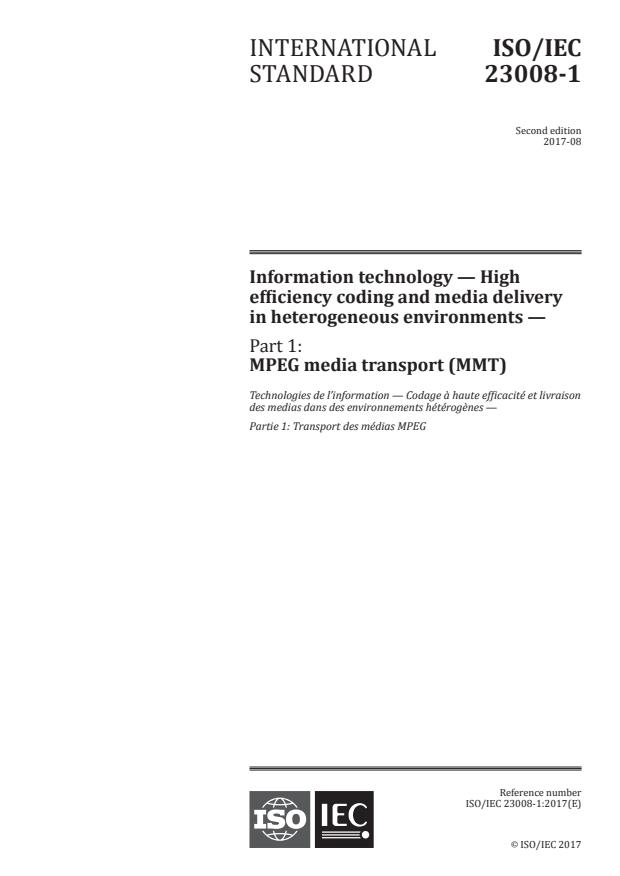
(Main)Information technology — High efficiency coding and media delivery in heterogeneous environments — Part 1: MPEG media transport (MMT)
Information technology — High efficiency coding and media delivery in heterogeneous environments — Part 1: MPEG media transport (MMT)
ISO/IEC 23008-1:2017 specifies MPEG media transport (MMT) technologies, which include a single encapsulation format, delivery protocols and signalling messages for transport and delivery of multimedia data over heterogeneous packet-switched networks for multimedia services. Types of packet-switched networks supported by this document include bidirectional networks such as Internet Protocol (IP) networks and unidirectional networks such as digital broadcast networks (which may or may not use the IP). The technologies specified by this document belong to one of three functional areas of MMT: media processing unit (MPU) format, signalling messages and delivery protocol. The MPU format specifies the "mpuf" branded ISO-based media file format (ISOBMFF) encapsulating both timed and non-timed media contents. The MPU format is a self-contained ISOBMFF structure enabling independent consumption of media data, which hides codec-specific details from the delivery function. The signalling functional area specifies the formats of signalling messages carrying information for managing media content delivery and consumption, e.g. specific media locations and delivery configuration of media contents. The delivery functional area specifies the payload formats that are independent of media and codec types, which allow fragmentation and aggregation of contents encapsulated as specified by this document for delivery using packet-switched oriented transport protocols. The delivery functional area also provides an application layer transport protocol that allows for advanced delivery of media contents.
Technologies de l'information — Codage à haute efficacité et livraison des medias dans des environnements hétérogènes — Partie 1: Transport des médias MPEG
General Information
- Status
- Withdrawn
- Publication Date
- 10-Aug-2017
- Current Stage
- 9599 - Withdrawal of International Standard
- Start Date
- 13-Jan-2023
- Completion Date
- 14-Feb-2026
Relations
- Effective Date
- 25-Apr-2020
- Effective Date
- 30-Jun-2018
- Effective Date
- 21-Nov-2015
- Effective Date
- 21-Nov-2015
- Effective Date
- 21-Nov-2015

Get Certified
Connect with accredited certification bodies for this standard

BSI Group
BSI (British Standards Institution) is the business standards company that helps organizations make excellence a habit.

NYCE
Mexican standards and certification body.
Sponsored listings
Frequently Asked Questions
ISO/IEC 23008-1:2017 is a standard published by the International Organization for Standardization (ISO). Its full title is "Information technology — High efficiency coding and media delivery in heterogeneous environments — Part 1: MPEG media transport (MMT)". This standard covers: ISO/IEC 23008-1:2017 specifies MPEG media transport (MMT) technologies, which include a single encapsulation format, delivery protocols and signalling messages for transport and delivery of multimedia data over heterogeneous packet-switched networks for multimedia services. Types of packet-switched networks supported by this document include bidirectional networks such as Internet Protocol (IP) networks and unidirectional networks such as digital broadcast networks (which may or may not use the IP). The technologies specified by this document belong to one of three functional areas of MMT: media processing unit (MPU) format, signalling messages and delivery protocol. The MPU format specifies the "mpuf" branded ISO-based media file format (ISOBMFF) encapsulating both timed and non-timed media contents. The MPU format is a self-contained ISOBMFF structure enabling independent consumption of media data, which hides codec-specific details from the delivery function. The signalling functional area specifies the formats of signalling messages carrying information for managing media content delivery and consumption, e.g. specific media locations and delivery configuration of media contents. The delivery functional area specifies the payload formats that are independent of media and codec types, which allow fragmentation and aggregation of contents encapsulated as specified by this document for delivery using packet-switched oriented transport protocols. The delivery functional area also provides an application layer transport protocol that allows for advanced delivery of media contents.
ISO/IEC 23008-1:2017 specifies MPEG media transport (MMT) technologies, which include a single encapsulation format, delivery protocols and signalling messages for transport and delivery of multimedia data over heterogeneous packet-switched networks for multimedia services. Types of packet-switched networks supported by this document include bidirectional networks such as Internet Protocol (IP) networks and unidirectional networks such as digital broadcast networks (which may or may not use the IP). The technologies specified by this document belong to one of three functional areas of MMT: media processing unit (MPU) format, signalling messages and delivery protocol. The MPU format specifies the "mpuf" branded ISO-based media file format (ISOBMFF) encapsulating both timed and non-timed media contents. The MPU format is a self-contained ISOBMFF structure enabling independent consumption of media data, which hides codec-specific details from the delivery function. The signalling functional area specifies the formats of signalling messages carrying information for managing media content delivery and consumption, e.g. specific media locations and delivery configuration of media contents. The delivery functional area specifies the payload formats that are independent of media and codec types, which allow fragmentation and aggregation of contents encapsulated as specified by this document for delivery using packet-switched oriented transport protocols. The delivery functional area also provides an application layer transport protocol that allows for advanced delivery of media contents.
ISO/IEC 23008-1:2017 is classified under the following ICS (International Classification for Standards) categories: 35.040 - Information coding; 35.040.40 - Coding of audio, video, multimedia and hypermedia information. The ICS classification helps identify the subject area and facilitates finding related standards.
ISO/IEC 23008-1:2017 has the following relationships with other standards: It is inter standard links to ISO/IEC 23008-1:2017/Amd 1:2017, ISO/IEC 23008-1:2023, ISO/IEC 23008-1:2014, ISO/IEC 23008-1:2014/Amd 1:2015, ISO/IEC 23008-1:2014/FDAmd 2. Understanding these relationships helps ensure you are using the most current and applicable version of the standard.
ISO/IEC 23008-1:2017 is available in PDF format for immediate download after purchase. The document can be added to your cart and obtained through the secure checkout process. Digital delivery ensures instant access to the complete standard document.
Standards Content (Sample)
INTERNATIONAL ISO/IEC
STANDARD 23008-1
Second edition
2017-08
Information technology — High
efficiency coding and media delivery
in heterogeneous environments —
Part 1:
MPEG media transport (MMT)
Technologies de l’information — Codage à haute efficacité et livraison
des medias dans des environnements hétérogènes —
Partie 1: Transport des médias MPEG
Reference number
©
ISO/IEC 2017
© ISO/IEC 2017, Published in Switzerland
All rights reserved. Unless otherwise specified, no part of this publication may be reproduced or utilized otherwise in any form
or by any means, electronic or mechanical, including photocopying, or posting on the internet or an intranet, without prior
written permission. Permission can be requested from either ISO at the address below or ISO’s member body in the country of
the requester.
ISO copyright office
Ch. de Blandonnet 8 • CP 401
CH-1214 Vernier, Geneva, Switzerland
Tel. +41 22 749 01 11
Fax +41 22 749 09 47
copyright@iso.org
www.iso.org
ii © ISO/IEC 2017 – All rights reserved
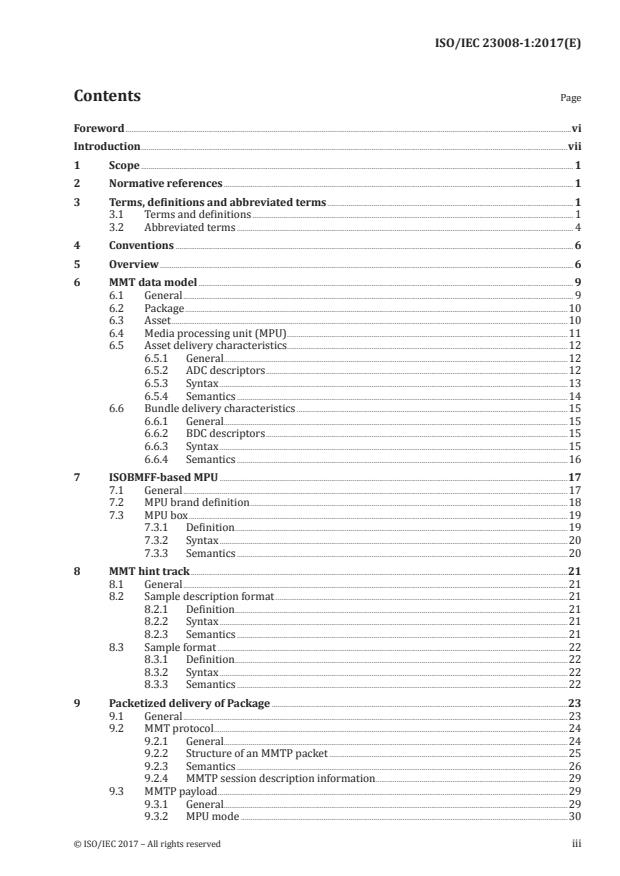
Contents Page
Foreword .vi
Introduction .vii
1 Scope . 1
2 Normative references . 1
3 Terms, definitions and abbreviated terms . 1
3.1 Terms and definitions . 1
3.2 Abbreviated terms . 4
4 Conventions . 6
5 Overview . 6
6 MMT data model . 9
6.1 General . 9
6.2 Package .10
6.3 Asset .10
6.4 Media processing unit (MPU) .11
6.5 Asset delivery characteristics.12
6.5.1 General.12
6.5.2 ADC descriptors .12
6.5.3 Syntax .13
6.5.4 Semantics .14
6.6 Bundle delivery characteristics .15
6.6.1 General.15
6.6.2 BDC descriptors .15
6.6.3 Syntax .15
6.6.4 Semantics .16
7 ISOBMFF-based MPU .17
7.1 General .17
7.2 MPU brand definition .18
7.3 MPU box .19
7.3.1 Definition .19
7.3.2 Syntax .20
7.3.3 Semantics .20
8 MMT hint track .21
8.1 General .21
8.2 Sample description format .21
8.2.1 Definition .21
8.2.2 Syntax .21
8.2.3 Semantics .21
8.3 Sample format .22
8.3.1 Definition .22
8.3.2 Syntax .22
8.3.3 Semantics .22
9 Packetized delivery of Package .23
9.1 General .23
9.2 MMT protocol .24
9.2.1 General.24
9.2.2 Structure of an MMTP packet .25
9.2.3 Semantics .26
9.2.4 MMTP session description information.29
9.3 MMTP payload .29
9.3.1 General.29
9.3.2 MPU mode .30
© ISO/IEC 2017 – All rights reserved iii
9.3.3 Generic file delivery mode .32
9.3.4 Signalling message mode.37
9.4 MMTP operation .38
9.4.1 General.38
9.4.2 Delivering MPUs .38
9.4.3 Delivering generic objects .40
9.4.4 Header compression for MMTP packet .43
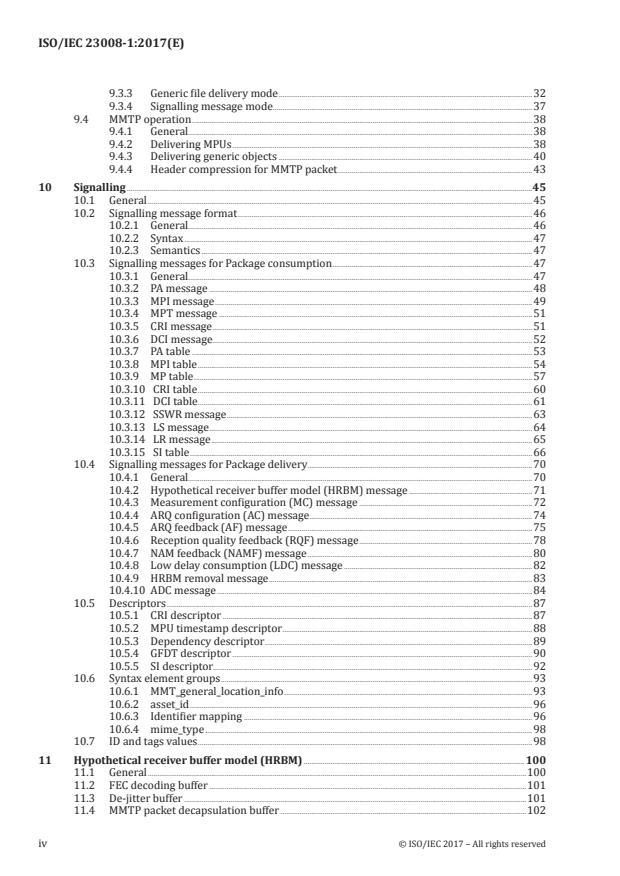
10 Signalling .45
10.1 General .45
10.2 Signalling message format .46
10.2.1 General.46
10.2.2 Syntax .47
10.2.3 Semantics .47
10.3 Signalling messages for Package consumption .47
10.3.1 General.47
10.3.2 PA message .48
10.3.3 MPI message .49
10.3.4 MPT message .51
10.3.5 CRI message .51
10.3.6 DCI message .52
10.3.7 PA table .53
10.3.8 MPI table .54
10.3.9 MP table .57
10.3.10 CRI table .60
10.3.11 DCI table .61
10.3.12 SSWR message .63
10.3.13 LS message .64
10.3.14 LR message .65
10.3.15 SI table .66
10.4 Signalling messages for Package delivery.70
10.4.1 General.70
10.4.2 Hypothetical receiver buffer model (HRBM) message .71
10.4.3 Measurement configuration (MC) message .72
10.4.4 ARQ configuration (AC) message.74
10.4.5 ARQ feedback (AF) message .75
10.4.6 Reception quality feedback (RQF) message .78
10.4.7 NAM feedback (NAMF) message .80
10.4.8 Low delay consumption (LDC) message .82
10.4.9 HRBM removal message .83
10.4.10 ADC message .84
10.5 Descriptors .87
10.5.1 CRI descriptor .87
10.5.2 MPU timestamp descriptor .88
10.5.3 Dependency descriptor .89
10.5.4 GFDT descriptor .90
10.5.5 SI descriptor . . .92
10.6 Syntax element groups .93
10.6.1 MMT_general_location_info .93
10.6.2 asset_id .96
10.6.3 Identifier mapping .96
10.6.4 mime_type .98
10.7 ID and tags values .98
11 Hypothetical receiver buffer model (HRBM) .100
11.1 General .100
11.2 FEC decoding buffer .101
11.3 De-jitter buffer .101
11.4 MMTP packet decapsulation buffer .102
iv © ISO/IEC 2017 – All rights reserved
11.5 Usage of HRBM .102
11.6 Estimation of end-to-end delay and buffer requirement .102
11.7 HRBM signalling.103
12 Cross layer interface (CLI) .103
12.1 General .103
12.2 Cross layer information .103
12.2.1 General.103
12.2.2 Top-down QoS information .103
12.2.3 Bottom-up QoS information .103
12.2.4 Network abstraction for media (NAM) .104
12.2.5 Syntax .104
12.2.6 Semantics .105
Annex A (informative) Jitter calculation in MMTP .106
Annex B (normative) XML syntax and MIME type for signalling message .107
Annex C (normative) AL-FEC framework for MMT .114
Annex D (informative) QoS management model for MMT .139
Annex E (informative) Operation of downloadable DRM and CAS .141
Annex F (informative) DASH segment over MMTP .142
Annex G (normative) Scheme of MMT URI .145
Bibliography .146
© ISO/IEC 2017 – All rights reserved v
Foreword
ISO (the International Organization for Standardization) and IEC (the International Electrotechnical
Commission) form the specialized system for worldwide standardization. National bodies that are
members of ISO or IEC participate in the development of International Standards through technical
committees established by the respective organization to deal with particular fields of technical
activity. ISO and IEC technical committees collaborate in fields of mutual interest. Other international
organizations, governmental and non-governmental, in liaison with ISO and IEC, also take part in the
work. In the field of information technology, ISO and IEC have established a joint technical committee,
ISO/IEC JTC 1.
The procedures used to develop this document and those intended for its further maintenance are
described in the ISO/IEC Directives, Part 1. In particular the different approval criteria needed for
the different types of document should be noted. This document was drafted in accordance with the
editorial rules of the ISO/IEC Directives, Part 2 (see www .iso .org/ directives).
Attention is drawn to the possibility that some of the elements of this document may be the subject
of patent rights. ISO and IEC shall not be held responsible for identifying any or all such patent
rights. Details of any patent rights identified during the development of the document will be in the
Introduction and/or on the ISO list of patent declarations received (see www .iso .org/ patents).
Any trade name used in this document is information given for the convenience of users and does not
constitute an endorsement.
For an explanation on the voluntary nature of standards, the meaning of ISO specific terms and
expressions related to conformity assessment, as well as information about ISO’s adherence to the
World Trade Organization (WTO) principles in the Technical Barriers to Trade (TBT) see the following
URL: w w w . i s o .org/ iso/ foreword .html.
This document was prepared by Technical Committee ISO/IEC JTC 1, Information technology,
Subcommittee SC 29, Coding of audio, picture, multimedia and hypermedia information.
This second edition cancels and replaces the first edition (ISO/IEC 23008-1:2014), which has been
technically revised. It also incorporates the Amendment ISO/IEC 23008-1:2014/Amd 1:2015 and the
Technical Corrigendum ISO/IEC 23008-1:2014/Cor 1:2015.
The main changes compared to the previous edition are as follows:
— editorial integration of ISO/IEC 23008-1:2014/Amd 1:2015, ISO/IEC 23008-1:2014/FDAmd 2,
ISO/IEC 23008-1:2014/Cor 1:2015 and ISO/IEC 23008-1:2014/CD COR 2;
— minor editorial corrections (for example, numbering in Tables and Figures).
A list of all parts in the ISO/IEC 23008 series can be found on the ISO website.
vi © ISO/IEC 2017 – All rights reserved
Introduction
This document specifies the MPEG media transport (MMT) technologies for the transport and delivery
of coded media data for multimedia services over heterogeneous packet-switched networks including
internet protocol (IP) networks and digital broadcasting networks. In this document, “coded media
data” includes both timed audiovisual media data and non-timed data.
MMT is designed under the assumption that the coded media data will be delivered over a packet-
switched delivery network. Several characteristics of such delivery environment, such as non-constant
end-to-end delay of each packet from the sending entity to the receiving entity, have been taken into
consideration.
For efficient and effective delivery and consumption of coded media data over packet-switched delivery
networks, this document provides the following elements:
— the logical model to construct contents composed of components from various sources, for example,
components of mash-up applications;
— the formats to convey information about the coded media data, to enable delivery layer processing,
such as packetization;
— the packetization method and the structure of the packet to deliver media content over packet-
switched networks supporting media and coding independent hybrid delivery over multiple
channels;
— the format of the signalling messages to manage delivery and consumption of media content.
© ISO/IEC 2017 – All rights reserved vii
INTERNATIONAL STANDARD ISO/IEC 23008-1:2017(E)
Information technology — High efficiency coding and
media delivery in heterogeneous environments —
Part 1:
MPEG media transport (MMT)
1 Scope
This document specifies MPEG media transport (MMT) technologies, which include a single
encapsulation format, delivery protocols and signalling messages for transport and delivery of
multimedia data over heterogeneous packet-switched networks for multimedia services. Types of
packet-switched networks supported by this document include bidirectional networks such as Internet
Protocol (IP) networks and unidirectional networks such as digital broadcast networks (which may or
may not use the IP).
The technologies specified by this document belong to one of three functional areas of MMT: media
processing unit (MPU) format, signalling messages and delivery protocol.
The MPU format specifies the “mpuf” branded ISO-based media file format (ISOBMFF) encapsulating
both timed and non-timed media contents. The MPU format is a self-contained ISOBMFF structure
enabling independent consumption of media data, which hides codec-specific details from the delivery
function.
The signalling functional area specifies the formats of signalling messages carrying information
for managing media content delivery and consumption, e.g. specific media locations and delivery
configuration of media contents.
The delivery functional area specifies the payload formats that are independent of media and codec
types, which allow fragmentation and aggregation of contents encapsulated as specified by this
document for delivery using packet-switched oriented transport protocols. The delivery functional
area also provides an application layer transport protocol that allows for advanced delivery of media
contents.
2 Normative references
The following documents are referred to in the text in such a way that some or all of their content
constitutes requirements of this document. For dated references, only the edition cited applies. For
undated references, the latest edition of the referenced document (including any amendments) applies.
ISO/IEC 14496-12:2015, Information technology — Coding of audio-visual objects — Part 12: ISO base
media file format
IETF RFC 3986, Uniform Resource Identifier (URI): Generic Syntax, January 2005
3 Terms, definitions and abbreviated terms
3.1 Terms and definitions
For the purposes of this document, the following terms and definitions apply.
© ISO/IEC 2017 – All rights reserved 1
ISO and IEC maintain terminological databases for use in standardization at the following addresses:
— IEC Electropedia: available at http:// www .electropedia .org/
— ISO Online browsing platform: available at http:// www .iso .org/ obp
3.1.1
access unit
AU
smallest media data entity to which timing information can be attributed
3.1.2
asset
any multimedia data entity that is associated with a unique identifier and that is used for building a
multimedia presentation
3.1.3
dependent asset
asset (3.1.2) for which one or more other assets are necessary for decoding of the contained media content
3.1.4
encoding symbol
unit of data generated by the encoding process
3.1.5
encoding symbol block
set of encoding symbols (3.1.4)
3.1.6
FEC code
algorithm for encoding data such that the encoded data flow is resilient to data loss
3.1.7
FEC encoded flow
logical set of flows that consists of an FEC source flow (3.1.11) and one or more associated FEC repair
flows (3.1.9)
3.1.8
FEC payload ID
identifier that identifies the contents of an MMTP packet (3.1.20) with respect to the MMT FEC scheme
(3.1.16)
3.1.9
FEC repair flow
data flow carrying repair symbols to protect an FEC source flow (3.1.11)
3.1.10
FEC repair packet
MMTP packet (3.1.20) along with repair FEC payload identifier (3.1.27) to deliver one or more repair
symbols (3.1.29) of a repair symbol block (3.1.30)
3.1.11
FEC source flow
flow of MMTP packets (3.1.20) protected by an MMT FEC scheme (3.1.16)
3.1.12
FEC source packet
MMTP packet (3.1.20) protected by an FEC encoding
2 © ISO/IEC 2017 – All rights reserved
3.1.13
media fragment unit
MFU
fragment of a media processing unit (3.1.14)
3.1.14
media processing unit
MPU
generic container for independently decodable timed (3.1.35) or non-timed data (3.1.25) that is media
codec agnostic
3.1.15
MMT entity
software and/or hardware implementation that is compliant to a profile of MMT
3.1.16
MMT FEC scheme
forward error correction procedure that defines the additional protocol aspects required to use an FEC
scheme in MMT
3.1.17
MMT protocol
MMTP
application layer transport protocol for delivering MMTP payload (3.1.22) over IP networks
3.1.18
MMT receiving entity
MMT entity (3.1.15) that receives and consumes media data
3.1.19
MMT sending entity
MMT entity (3.1.15) that sends media data to one or more MMT receiving entities (3.1.18)
3.1.20
MMTP packet
formatted unit of the media data to be delivered using the MMT protocol (3.1.17)
3.1.21
MMTP packet flow
sequence of MMTP packets (3.1.20) with same MMT sending entity (3.1.19) and MMT receiving entity
(3.1.18)
3.1.22
MMTP payload
formatted unit of media data to carry Packages (3.1.26) and/or signalling messages using either the
MMT protocol (3.1.17) or an Internet application layer transport protocols
EXAMPLE RTP.
3.1.23
MMTP session
single MMTP transport flow (3.1.24) that is used for certain period of time
3.1.24
MMTP transport flow
series of MMTP packet flow (3.1.21) delivered to the same destination
3.1.25
non-timed data
media data that do not have inherent timeline for the decoding and/or presenting of its media content
© ISO/IEC 2017 – All rights reserved 3
3.1.26
package
logical collection of media data, delivered using MMT
3.1.27
repair FEC payload ID
FEC payload ID (3.1.8) for repair packets
3.1.28
repair packet block
segmented set of FEC repair flow (3.1.9) which can be used to recover lost source packets
3.1.29
repair symbol
encoding symbol that contains redundancy information for error correction
3.1.30
repair symbol block
set of repair symbols (3.1.29) which can be used to recover lost source symbols (3.1.33)
3.1.31
source FEC payload ID
FEC payload ID (3.1.8) for source packets
3.1.32
source packet block
segmented set of FEC source flow (3.1.11) that is to be protected as a single block
3.1.33
source symbol
unit of data to be encoded by an FEC encoding process
3.1.34
source symbol block
set of source symbols (3.1.33) generated from a single source packet block (3.1.32)
3.1.35
timed data
data that has inherent timeline information for the decoding and/or presentation of its media contents
3.1.36
asset delivery characteristics
ADC
description about required quality of service (QoS) for delivery of assets (3.1.2)
Note 1 to entry: ADC is represented by the parameters agnostic to a specific delivery environment.
3.1.37
network abstraction for media
parameter that is used for an interface between media application layer and underlying network layer
3.2 Abbreviated terms
ADC asset delivery characteristics
AL-FEC application layer forward error correction
ARQ automatic repeat request
AU access unit
4 © ISO/IEC 2017 – All rights reserved
AVC advanced video coding
CLI cross layer interface
CRI clock relation information
DCI device capability information
GFD generic file delivery
HRBM hypothetical receiver buffer model
HTTP hypertext transfer protocol
ISOBMFF ISO-based media file format
LA-FEC layer aware forward error correction
LR license revocation
LS license signalling
MPI media presentation information
MC measurement configuration
MFU media fragment unit
MMT MPEG media transport
MMTP MMT protocol
MP MMT package
MPU media processing unit
MTU maximum transmission unit
MVC multi-view video coding
NAM network abstraction for media
NTP network time protocol
PA package access
PID packet identifier
PTP precision time protocol
RAP random access point
RTP real-time protocol
SDP session description protocol
SI security information
SSWR security software request
SVC scalable video coding
© ISO/IEC 2017 – All rights reserved 5
TCP transmission control protocol
TS transport stream
UDP user datagram protocol
URI uniform resource identifier
URL uniform resource locator
URN uniform resource name
UUID universally unique identifier
UTC coordinated universal time
XML extensible mark-up language
4 Conventions
The following convention applies in this document.
— The Big Endian number representation scheme is used.
5 Overview
This document defines a set of tools to enable advanced media transport and delivery services. The
tools spread over three different functional areas: media processing unit (MPU) format, delivery and
signalling. Even though the tools are designed to be efficiently used together, they may also be used
independently regardless of the use of tools from the other functional areas.
The media processing unit (MPU) functional area defines the logical structure of media content, the
Package and the format of the data units to be processed by an MMT entity and their instantiation with
the ISO-based media file format as specified in ISO/IEC 14496-12. The Package specifies the components
comprising the media content and the relationship among them to provide necessary information for
advanced delivery. The format of data units in this document is defined to encapsulate the encoded
media data for either storage or delivery and to allow for easy conversion between data to be stored
and data to be delivered (see Clause 7).
The delivery functional area defines an application layer transport protocol and a payload format. The
application layer transport protocol defined in this document provides enhanced features for delivery
of multimedia data when compared with conventional application layer transport protocols, e.g.
multiplexing and support of mixed use of streaming and download delivery in a single packet flow (see
9.2). The payload format is defined to enable the carriage of encoded media data which is agnostic to
media types and encoding methods (see 9.3).
The signalling functional area defines formats of signalling messages to manage delivery and
consumption of media data. Signalling messages for consumption management are used to signal the
structure of the Package (see 10.3) and signalling messages for delivery management are used to signal
the structure of the payload format and protocol configuration (see 10.4).
A multimedia service may use any subset of the tools defined in this document according to its specific
needs. Furthermore, interfaces between protocols and standards defined by this specification and
those defined in other specifications can also be defined and used. Figure 1 illustrates the different
functions and their relationships to existing protocols and standards.
6 © ISO/IEC 2017 – All rights reserved
Figure 1 — MMT functional areas, tools and interfaces
Figure 2 depicts the end-to-end architecture for this document. The MMT sending entity is responsible
for sending the Packages to the MMT receiving entity as MMTP packet flows. The sending entity may
be required to gather contents from content providers based on the presentation information of the
Package that is provided by a Package provider.
A Package provider and content providers may be co-located. Media content is provided as an Asset
that is segmented into a series of encapsulated MMT processing units that forms a MMTP packet flow.
The MMTP packet flow of such content is generated by using the associated transport characteristics
information. Signalling messages may be used to manage the delivery and the consumption of Packages.
This document defines the interfaces between the MMT sending entity and the MMT receiving entity,
as well as their operations. The MMT sending entity shall conform to the sender operations as defined
in Clause 9.
© ISO/IEC 2017 – All rights reserved 7
Figure 2 — End-to-end architecture of MMT
An MMT receiving entity operates at one or more MMT functional areas. An exemplary MMT receiving
entity architecture is shown in Figure 3.
The MMT protocol (MMTP) is used to receive and de-multiplex the streamed media based on the
packet_id and the payload type. The de-capsulation procedure depends on the type of payload that is
carried and is processed separately and thus, is not shown here.
The presentation engine layer is responsible for setting up the multimedia scene and referencing the
content that is received using the MMT protocol.
8 © ISO/IEC 2017 – All rights reserved
Figure 3 — Example of MMT receiving entity
6 MMT data model
6.1 General
This clause introduces the logical data model assumed for the operation of the MMT protocol. The MMT
protocol provides both streaming delivery and download delivery of coded media data. For streaming
delivery, MMT protocol assumes the specific data model including MPUs, Assets and Package. The MMT
protocol preserves the data model during the delivery by indicating the structural relationships among
the MPU, Asset and Package using signalling messages.
The collection of the encoded media data and its related metadata builds a Package. The Package may be
delivered from one or more MMT sending entities to the MMT receiving entities. Each piece of encoded
media data of a Package, such as a piece of audio or video content, constitutes an Asset.
An Asset is associated with an identifier which may be agnostic to its actual physical location or service
provider that is offering it, so that an Asset can be globally and uniquely identified. Assets with different
identifiers shall not be interchangeable. For example, two different Assets may carry two different
encodings of the same content but they are not interchangeable.
MMT does not specify a particular identification mechanism but allows the usage of URIs or UUIDs for
this purpose. Each Asset has its own timeline which may be of different duration than that of the whole
presentation created by the Package.
Each MPU constitutes a non-overlapping piece of an Asset, i.e. two consecutive MPUs of the same
Asset shall not contain the same m
...
Questions, Comments and Discussion
Ask us and Technical Secretary will try to provide an answer. You can facilitate discussion about the standard in here.
Loading comments...