

ISO/IEC 23008-8:2018
(Main)Information technology — High efficiency coding and media delivery in heterogeneous environments — Part 8: Conformance specification for HEVC
General Information
- Abstract
This document specifies a set of tests and procedures designed to indicate whether encoders or decoders meet the normative requirements specified in Rec. ITU-T H.265 | ISO/IEC 23008‑2. NOTE The conformance bitstreams identified within the text are available at http://standards.iso.org/iso-iec/23008/-8/ed-2/en.
- Status
- Published
- Publication Date
- 06-Aug-2018
- Current Stage
- 9092 - International Standard to be revised
- Start Date
- 20-Jul-2026
- Completion Date
- 29-Aug-2026
Buy Documents




ISO/IEC 23008-8:2018 - Information technology -- High efficiency coding and media delivery in heterogeneous environments


ISO/IEC 23008-8:2018 - Information technology — High efficiency coding and media delivery in heterogeneous environments — Part 8: Conformance specification for HEVC/7/2018
Overview
ISO/IEC 23008-8:2018 specifies conformance tests and procedures for HEVC (H.265) implementations. It defines how to verify whether encoder bitstreams and decoder implementations meet the normative requirements of Rec. ITU‑T H.265 | ISO/IEC 23008‑2. The document uses a set of published conformance bitstreams and the reference software decoder (Rec. ITU‑T H.265.2 | ISO/IEC 23008‑5) to exercise and validate compliance. Conformance materials (bitstreams, decoded outputs/hashes, trace files and descriptions) are available at http://standards.iso.org/iso-iec/23008/-8/ed-2/en.
Key Topics
- Bitstream conformance: Procedures to verify that a bitstream conforms to the HEVC syntax and constraints by parsing and/or decoding with the reference decoder.
- Decoder conformance: Tests to confirm decoders meet output correctness, output order conformance, and output timing conformance as defined in H.265.
- Reference software use: Requirement to use the H.265 reference decoder/encoder for many tests and to generate reference decoded pictures or hashes when not supplied.
- Test suites and bitstream taxonomy: Normative test suites and a wide range of conformance bitstreams covering:
- block structure, intra and inter coding
- transform and quantization
- deblocking filter and sample-adaptive offset (SAO)
- entropy coding
- temporal scalability and scalable extensions
- parallel-processing tools
- high-level syntax and format range/bit-depth extensions (10-bit, MV‑HEVC, 3D‑HEVC, etc.)
- Complementary testing: Guidance that additional verifiers may be necessary for HRD (Hypothetical Reference Decoder) and other annex tests not fully covered by the reference decoder.
- Conformance package contents: Each bitstream package can include the bitstream, decoded pictures or hashes, a short description and a trace file.
Applications
- Product compliance validation: Manufacturers of HEVC encoders and decoders use ISO/IEC 23008-8 to certify that their products conform to H.265 profiles, tiers and levels.
- Interoperability testing: Broadcasters, streaming platforms, and silicon vendors rely on the conformance suites to ensure playback compatibility across devices.
- Test and QA automation: QA teams integrate the conformance bitstreams and reference decoder into automated validation pipelines for firmware/software releases.
- Standards labs and certification bodies: Use the documented procedures and normative test suites to produce objective conformance reports.
Who should use this standard
- Codec implementers (encoder/decoder developers)
- QA engineers and test labs
- System integrators, device manufacturers, OTT and broadcast engineers
- Conformance and certification bodies
Related standards
- Rec. ITU‑T H.265 | ISO/IEC 23008‑2 - HEVC specification (normative reference)
- Rec. ITU‑T H.265.2 | ISO/IEC 23008‑5 - HEVC reference software (encoder/decoder)
Relations
- Consolidated By
ISO 15245-1:2021 - Gas cylinders — Parallel threads for connection of valves to gas cylinders — Part 1: Specification - Effective Date
- 06-Jun-2022
- Effective Date
- 10-Jul-2021
- Effective Date
- 11-Jun-2016
Buy Documents
ISO/IEC 23008-8:2018 - Information technology -- High efficiency coding and media delivery in heterogeneous environments
ISO/IEC 23008-8:2018 - Information technology — High efficiency coding and media delivery in heterogeneous environments — Part 8: Conformance specification for HEVC/7/2018
Get Certified
Connect with accredited certification bodies for this standard

BSI Group
BSI (British Standards Institution) is the business standards company that helps organizations make excellence a habit.

NYCE
Mexican standards and certification body.
Sponsored listings
Frequently Asked Questions
ISO/IEC 23008-8:2018 is a standard published by the International Organization for Standardization (ISO). Its full title is "Information technology — High efficiency coding and media delivery in heterogeneous environments — Part 8: Conformance specification for HEVC". This standard covers: This document specifies a set of tests and procedures designed to indicate whether encoders or decoders meet the normative requirements specified in Rec. ITU-T H.265 | ISO/IEC 23008‑2. NOTE The conformance bitstreams identified within the text are available at http://standards.iso.org/iso-iec/23008/-8/ed-2/en.
This document specifies a set of tests and procedures designed to indicate whether encoders or decoders meet the normative requirements specified in Rec. ITU-T H.265 | ISO/IEC 23008‑2. NOTE The conformance bitstreams identified within the text are available at http://standards.iso.org/iso-iec/23008/-8/ed-2/en.
ISO/IEC 23008-8:2018 is classified under the following ICS (International Classification for Standards) categories: 35.040 - Information coding; 35.040.40 - Coding of audio, video, multimedia and hypermedia information. The ICS classification helps identify the subject area and facilitates finding related standards.
ISO/IEC 23008-8:2018 has the following relationships with other standards: It is inter standard links to ISO 15245-1:2021, ISO/IEC 23008-8:2018/Amd 1:2019, ISO/IEC 23008-8:2015. Understanding these relationships helps ensure you are using the most current and applicable version of the standard.
ISO/IEC 23008-8:2018 is available in PDF format for immediate download after purchase. The document can be added to your cart and obtained through the secure checkout process. Digital delivery ensures instant access to the complete standard document.
Standards Content (Sample)
INTERNATIONAL ISO/IEC
STANDARD 23008-8
Second edition
2018-08
Information technology — High
efficiency coding and media delivery
in heterogeneous environments —
Part 8:
Conformance specification for HEVC
Technologies de l'information — Codage à haute efficacité et livraison
des medias dans des environnements hétérogènes —
Partie 8: Spécification de conformité du codage video à haute
efficacité
Reference number
©
ISO/IEC 2018
© ISO/IEC 2018
All rights reserved. Unless otherwise specified, or required in the context of its implementation, no part of this publication may
be reproduced or utilized otherwise in any form or by any means, electronic or mechanical, including photocopying, or posting
on the internet or an intranet, without prior written permission. Permission can be requested from either ISO at the address
below or ISO’s member body in the country of the requester.
ISO copyright office
CP 401 • Ch. de Blandonnet 8
CH-1214 Vernier, Geneva
Phone: +41 22 749 01 11
Fax: +41 22 749 09 47
Email: copyright@iso.org
Website: www.iso.org
Published in Switzerland
ii © ISO/IEC 2018 – All rights reserved
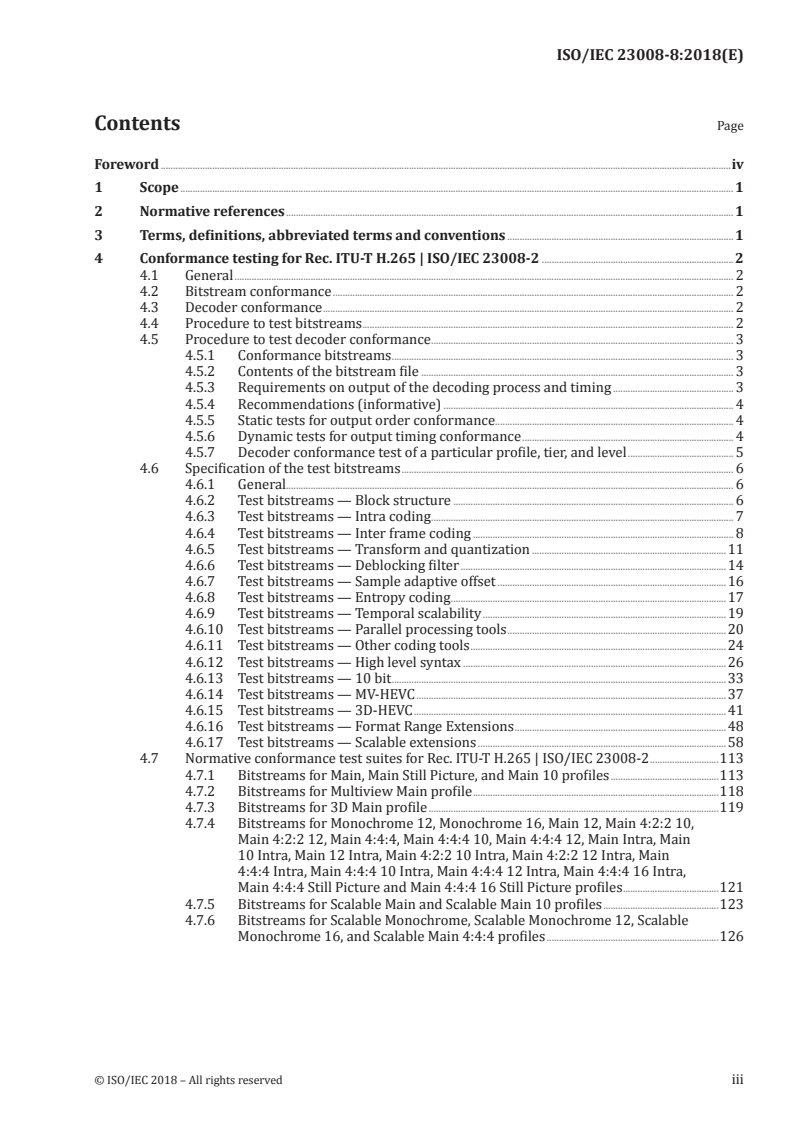
Contents Page
Foreword .iv
1 Scope . 1
2 Normative references . 1
3 Terms, definitions, abbreviated terms and conventions . 1
4 Conformance testing for Rec. ITU-T H.265 | ISO/IEC 23008-2 . 2
4.1 General . 2
4.2 Bitstream conformance . 2
4.3 Decoder conformance . 2
4.4 Procedure to test bitstreams . 2
4.5 Procedure to test decoder conformance . 3
4.5.1 Conformance bitstreams . 3
4.5.2 Contents of the bitstream file . 3
4.5.3 Requirements on output of the decoding process and timing . 3
4.5.4 Recommendations (informative) . 4
4.5.5 Static tests for output order conformance . . 4
4.5.6 Dynamic tests for output timing conformance . 4
4.5.7 Decoder conformance test of a particular profile, tier, and level . 5
4.6 Specification of the test bitstreams . 6
4.6.1 General. 6
4.6.2 Test bitstreams — Block structure . 6
4.6.3 Test bitstreams — Intra coding . 7
4.6.4 Test bitstreams — Inter frame coding . 8
4.6.5 Test bitstreams — Transform and quantization .11
4.6.6 Test bitstreams — Deblocking filter .14
4.6.7 Test bitstreams — Sample adaptive offset .16
4.6.8 Test bitstreams — Entropy coding .17
4.6.9 Test bitstreams — Temporal scalability .19
4.6.10 Test bitstreams — Parallel processing tools .20
4.6.11 Test bitstreams — Other coding tools .24
4.6.12 Test bitstreams — High level syntax .26
4.6.13 Test bitstreams — 10 bit .33
4.6.14 Test bitstreams — MV-HEVC .37
4.6.15 Test bitstreams — 3D-HEVC .41
4.6.16 Test bitstreams — Format Range Extensions .48
4.6.17 Test bitstreams — Scalable extensions .58
4.7 Normative conformance test suites for Rec. ITU-T H.265 | ISO/IEC 23008-2 .113
4.7.1 Bitstreams for Main, Main Still Picture, and Main 10 profiles .113
4.7.2 Bitstreams for Multiview Main profile .118
4.7.3 Bitstreams for 3D Main profile .119
4.7.4 Bitstreams for Monochrome 12, Monochrome 16, Main 12, Main 4:2:2 10,
Main 4:2:2 12, Main 4:4:4, Main 4:4:4 10, Main 4:4:4 12, Main Intra, Main
10 Intra, Main 12 Intra, Main 4:2:2 10 Intra, Main 4:2:2 12 Intra, Main
4:4:4 Intra, Main 4:4:4 10 Intra, Main 4:4:4 12 Intra, Main 4:4:4 16 Intra,
Main 4:4:4 Still Picture and Main 4:4:4 16 Still Picture profiles .121
4.7.5 Bitstreams for Scalable Main and Scalable Main 10 profiles .123
4.7.6 Bitstreams for Scalable Monochrome, Scalable Monochrome 12, Scalable
Monochrome 16, and Scalable Main 4:4:4 profiles .126
© ISO/IEC 2018 – All rights reserved iii
Foreword
ISO (the International Organization for Standardization) and IEC (the International Electrotechnical
Commission) form the specialized system for worldwide standardization. National bodies that are
members of ISO or IEC participate in the development of International Standards through technical
committees established by the respective organization to deal with particular fields of technical
activity. ISO and IEC technical committees collaborate in fields of mutual interest. Other international
organizations, governmental and non-governmental, in liaison with ISO and IEC, also take part in the
work. In the field of information technology, ISO and IEC have established a joint technical committee,
ISO/IEC JTC 1.
The procedures used to develop this document and those intended for its further maintenance are
described in the ISO/IEC Directives, Part 1. In particular the different approval criteria needed for
the different types of document should be noted. This document was drafted in accordance with the
editorial rules of the ISO/IEC Directives, Part 2 (see www .iso .org/directives).
Attention is drawn to the possibility that some of the elements of this document may be the subject
of patent rights. ISO and IEC shall not be held responsible for identifying any or all such patent
rights. Details of any patent rights identified during the development of the document will be in the
Introduction and/or on the ISO list of patent declarations received (see www .iso .org/patents).
Any trade name used in this document is information given for the convenience of users and does not
constitute an endorsement.
For an explanation on the voluntary nature of standards, the meaning of ISO specific terms and
expressions related to conformity assessment, as well as information about ISO's adherence to the
World Trade Organization (WTO) principles in the Technical Barriers to Trade (TBT) see the following
URL: www .iso .org/iso/foreword .html.
This document was prepared by Technical Committee ISO/IEC JTC 1, Information technology,
Subcommittee SC 29, Coding of audio, picture, multimedia and hypermedia information, in collaboration
with ITU-T. A technically aligned twin text is published as ITU-T H.265.1.
This second edition cancels and replaces the first edition (ISO/IEC ISO/IEC 23008-8:2015), which has
been technically revised.
The main changes compared to the previous edition are as follows:
— addition of conformance testing for Multiview Main and 3D Main profiles;
— addition of conformance testing for Format Range Extensions profiles;
— addition of conformance testing for Scalable profiles.
A list of all parts in the ISO/IEC 23008 series can be found on the ISO website.
iv © ISO/IEC 2018 – All rights reserved
INTERNATIONAL STANDARD ISO/IEC 23008-8:2018(E)
Information technology — High efficiency coding and
media delivery in heterogeneous environments —
Part 8:
Conformance specification for HEVC
1 Scope
This document specifies a set of tests and procedures designed to indicate whether encoders or
decoders meet the normative requirements specified in Rec. ITU-T H.265 | ISO/IEC 23008-2.
NOTE The conformance bitstreams identified within the text are available at http: //standards .iso .org/iso
-iec/23008/ -8/ed -2/en.
2 Normative references
The following documents are referred to in the text in such a way that some or all of their content
constitutes requirements of this document. For dated references, only the edition cited applies. For
undated references, the latest edition of the referenced document (including any amendments) applies.
Rec. ITU-T H.265 | ISO/IEC 23008-2:2017, Information technology — High efficiency video coding and
media delivery in heterogeneous environment — Part 2: High Efficiency Video Coding
Rec. ITU-T H.265.2 | ISO/IEC 23008-5, Information technology — High efficiency video coding and media
delivery in heterogeneous environment — Part 2: High Efficiency Video Coding Reference Software
3 Terms, definitions, abbreviated terms and conventions
For the purposes of this document, the terms, definitions, abbreviated terms and conventions given in
Rec. ITU-T H.265 | ISO/IEC 23008-2 and the following apply.
ISO and IEC maintain terminological databases for use in standardization at the following addresses:
— IEC Electropedia: available at http: //www .electropedia .org/
— ISO Online browsing platform: available at https: //www .iso .org/obp
3.1
bitstream
sequence of bits, in the form of a NAL unit stream or a byte stream, that forms the representation of
coded pictures and associated data forming one or more CVSs
Note 1 to entry: In this document, this refers specifically to video bitstream according to ISO/IEC 23008-2.
[SOURCE: Rec. ITU-T H.265 | ISO/IEC 23008-2:2017, 3.12, modified – Note 1 to entry added]
3.2
decoder
embodiment of a decoding process
Note 1 to entry: In this document, this refers specifically to a video decoder as specified in ISO/IEC 23008-2.
Note 2 to entry: The decoder does not include the display process, which is outside the scope of this document.
© ISO/IEC 2018 – All rights reserved 1
[SOURCE: Rec. ITU-T H.265 | ISO/IEC 23008-2:2017, 3.40, modified – Notes 1 and 2 to entry added]
3.3
encoder
embodiment of an encoding process
Note 1 to entry: The process, not specified in this document (except in regard to identification of the reference
software encoder), produces a bitstream.
[SOURCE: Rec. ITU-T H.265 | ISO/IEC 23008-2:2017, 3.49, modified – Note 1 to entry added]
3.4
reference software decoder
decoding software required for this document
Note 1 to entry: For this document, the reference software decoder is provided in Rec. ITU-T H.265.2 | ISO/IEC
23008-5.
3.5
reference software encoder
encoding software required for this document
Note 1 to entry: For this document, the reference software encoder is provided in Rec. ITU-T H.265.2 | ISO/IEC
23008-5.
4 Conformance testing for Rec. ITU-T H.265 | ISO/IEC 23008-2
4.1 General
The following clauses specify normative tests for verifying conformance of video bitstreams as well
as decoders. Those normative tests make use of test data (bitstream test suites) provided at http:
//standards .iso .org/iso -iec/23008/ -8/ed -2/en and the reference software decoder specified in Rec.
ITU-T H.265.2 | ISO/IEC 23008-5.
4.2 Bitstream conformance
Bitstream conformance for Rec. ITU-T H.265 | ISO/IEC 23008-2 is specified by ISO/IEC 23008-2:2017, C.4.
4.3 Decoder conformance
Decoder conformance for Rec. ITU-T H.265 | ISO/IEC 23008-2 is specified by ISO/IEC 23008-2:2017, C.5.
4.4 Procedure to test bitstreams
A bitstream that claims conformance with Rec. ITU-T H.265 | ISO/IEC 23008-2 shall pass the following
normative test.
The bitstream shall be decoded by processing it with the reference software decoder. When processed by
the reference software decoder, the bitstream shall not cause any error or non-conformance messages
to be reported by the reference software decoder. This test should not be applied to bitstreams that
are known to contain errors introduced by transmission, as such errors are highly likely to result in
bitstreams that lack conformance to Rec. ITU-T H.265 | ISO/IEC 23008-2.
Successfully passing the reference software decoder test provides only a strong presumption that the
bitstream under test is conforming to the video layer, i.e., that it does indeed meet all the requirements
for the video layer (except Annexes C, D and E) specified in Rec. ITU-T H.265 | ISO/IEC 23008-2 that are
tested by the reference software decoder.
2 © ISO/IEC 2018 – All rights reserved
Additional tests may be necessary to more thoroughly check that the bitstream properly meets
all the requirements specified in Rec. ITU-T H.265 | ISO/IEC 23008-2 including the hypothetical
reference decoder (HRD) conformance (based on Annexes C, D and E). These complementary tests
may be performed using other video bitstream verifiers that perform more complete tests than those
implemented by the reference software decoder.
Rec. ITU-T H.265 | ISO/IEC 23008-2 contains several informative recommendations that are not an
integral part of that Document. When testing a bitstream for conformance, it may also be useful to test
whether or not the bitstream follows those recommendations.
To check correctness of a bitstream, it is necessary to parse the entire bitstream and to extract all the
syntax elements and other values derived from those syntactic elements and used by the decoding
process specified in Rec. ITU-T H.265 | ISO/IEC 23008-2.
A verifier may not necessarily perform all stages of the decoding process specified in Rec. ITU-T H.265 |
ISO/IEC 23008-2 in order to verify bitstream correctness. Many tests can be performed on syntax
elements in a state prior to their use in some processing stages.
4.5 Procedure to test decoder conformance
4.5.1 Conformance bitstreams
A bitstream has values of general_profile_idc, general_tier_flag, and general_level_idc corresponding
to a set of specified constraints on a bitstream for which a decoder conforming to a specified profile,
tier, and level is required in Rec. ITU-T H.265 | ISO/IEC 23008-2:2017, Annex A to properly perform the
decoding process.
4.5.2 Contents of the bitstream file
The conformance bitstreams are provided at http: //standards .iso .org/iso -iec/23008/ -8/ed -2/en. The
following information is included in a single zipped file for each such bitstream.
— bitstream;
— decoded pictures or hashes of decoded pictures (may not be present);
— short description of the bitstream;
— trace file (results while decoding the bitstream, in ASCII format).
In cases where the decoded pictures or hashes of decoded pictures are not available, the reference
software decoder shall be used to generate the necessary reference decoded pictures from the
bitstream.
4.5.3 Requirements on output of the decoding process and timing
Two classes of decoder conformance are specified:
— output order conformance;
— output timing conformance.
The output of the decoding process is specified in Rec. ITU-T H.265 | ISO/IEC 23008-2:2017, Clause 8
and Annex C.
For output order conformance, it is a requirement that all of the decoded pictures specified for output
in Rec. ITU-T H.265 | ISO/IEC 23008-2:2017, Annex C shall be output by a conforming decoder in the
specified order and that the values of the decoded samples in all of the pictures that are output shall be
(exactly equal to) the values specified in Rec. ITU-T H.265 | ISO/IEC 23008-2:2017, Clause 8.
© ISO/IEC 2018 – All rights reserved 3
For output timing conformance, it is a requirement that a conforming decoder shall also output the
decoded samples at the rates and times specified in Rec. ITU-T H.265 | ISO/IEC 23008-2:2017, Annex C.
The display process, which ordinarily follows the output of the decoding process, is outside the scope of
this document.
4.5.4 Recommendations (informative)
In addition to the requirements, it is desirable that conforming decoders implement various informative
recommendations specified in Rec. ITU-T H.265 | ISO/IEC 23008-2 that are not an integral part of that
document. This clause discusses some of these recommendations.
It is recommended that a conforming decoder be able to resume the decoding process as soon
as possible after the loss or corruption of part of a bitstream. In most cases it is possible to resume
decoding at the next start code or slice header. It is recommended that a conforming decoder be able to
perform concealment for the coding tree blocks or video packets for which all the coded data has not
been received.
4.5.5 Static tests for output order conformance
Static tests of a video decoder require testing of the decoded samples. This clause explains how this
test can be accomplished when the decoded samples at the output of the decoding process are available.
It may not be possible to perform this type of test with a production decoder (due to the lack of an
appropriate accessible interface in the design at which to perform the test). In that case this test should
be performed by the manufacturer during the design and development phase. Static tests are used for
testing the decoding process. The test will check that the values of the samples decoded by the decoder
under test shall be identical to the values of the samples decoded by the reference decoder. When a hash
of the values of the samples of the decoded pictures is attached to the bitstream file, a corresponding
hash operation performed on the values of the samples of the decoded pictures produced by the decoder
under test shall produce the same results.
4.5.6 Dynamic tests for output timing conformance
Dynamic tests are applied to check that all the decoded samples are output and that the timing of
the output of the decoder's decoded samples conforms to the specification of Rec. ITU-T H.265 | ISO/
IEC 23008-2:2017, Clause 8 and Annex C, and to verify that the HRD models (as specified by the CPB and
DPB specification in Rec. ITU-T H.265 | ISO/IEC 23008-2:2017, Annex C) are not violated when the bits
of the bitstream are delivered at the proper rate.
The dynamic test is often easier to perform on a complete decoding system, which may include a
systems decoder, a video decoder and a display process. It may be possible to record the output of
the display process and to check that display order and timing of decoded pictures are correct at the
output of the display process. However, since the display process is not within the normative scope of
Rec. ITU-T H.265 | ISO/IEC 23008-2, there may be cases where the output of the display process differs
in timing or value even though the video decoder is conforming. In this case, the output of the video
decoder itself (before the display process) would need to be captured in order to perform the dynamic
tests on the video decoder. In particular the output order and timing of the decoded pictures shall be
correct.
If buffering period and picture timing SEI messages are included in the test bitstream, HRD conformance
shall be verified using the values of nal_initial_cpb_removal_delay, nal_initial_cpb_removal_offset, au_
cpb_removal_delay_minus1 and pic_dpb_output_delay that are included in the bitstream.
If buffering period and picture timing SEI messages are not included in the bitstream, the following
inferences shall be made to generate the missing parameters:
— fixed_pic_rate_within_cvs_flag shall be inferred to be equal to 1;
— low_delay_hrd_flag shall be inferred to be equal to 0;
4 © ISO/IEC 2018 – All rights reserved
— cbr_flag shall be inferred to be equal to 0;
— The frame rate of the bitstream shall be inferred to be equal to the frame rate value specified in the
corresponding table of subclause 6.7, where the bitstream is listed. If this is missing, then a frame
rate of either 25 or 30 000 ÷ 1 001 can be inferred;
— vui_time_scale shall be set equal to 90 000 and the value of vui_num_units_in_tick shall be computed
based on frame rate;
— The bit rate of the bitstream shall be inferred to be equal to the maximum value for the level specified
in Rec. ITU-T H.265 | ISO/IEC 23008-2:2017, Table A-1;
— CPB and DPB sizes shall be inferred to be equal to the maximum value for the level specified in Rec.
ITU-T H.265 | ISO/IEC 23008-2:2017, Table A-1.
With the above inferences, the HRD shall be operated as follows.
— The CPB is filled starting at time t = 0, until it is full, before removal of the first access unit. This
means that the nal_initial_cpb_removal_delay shall be inferred to be equal to the total CPB buffer
size divided by the bit rate divided by 90 000 (rounded downwards) and nal_initial_cpb_removal_
offset shall be inferred to be equal to zero.
— The first access unit is removed at time t = nal_initial_cpb_removal_delay ÷ 90 000 and subsequent
access units are removed at intervals based on the frame distance, i.e. (90 000 ÷ vui_num_units_
in_tick).
— Using these inferences, the CPB will not overflow or underflow and the DPB will not overflow.
4.5.7 Decoder conformance test of a particular profile, tier, and level
In order for a decoder of a particular profile, tier, and level to claim output order conformance to Rec.
ITU-T H.265 | ISO/IEC 23008-2 as specified by this document, the decoder shall successfully pass the
static test specified in subclause 6.5.5 with all the bitstreams of the normative test suite specified for
testing decoders of this particular profile, tier, and level combination.
In order for a decoder of a particular profile, tier, and level to claim output timing conformance to Rec.
ITU-T H.265 | ISO/IEC 23008-2 as specified by this document, the decoder shall successfully pass both
the static test specified in subclause 6.5.5 and the dynamic test specified in subclause 6.5.6 with all the
bitstreams of the normative test suite specified for testing decoders of this particular profile, tier, and
level. Tables 1 through 6 specify the normative test suites for each profile, tier, and level combination.
The test suite for a particular profile, tier, and level combination is the list of bitstreams that are marked
with an 'X' in the column corresponding to that profile, tier, and level combination. In the column 'Main
tier', 'X' indicate the bitstream is for Main tier. A decoder conformed to Main tier shall be capable of
decoding the specified bitstreams, among the testing profile-level combination, indicated by 'X' at 'Main
tier' column in Table 1. A decoder conformed to High tier shall be capable of decoding all the specified
bitstreams, among the testing profile-level combination, in Table 1.
'X' indicates that the bitstream is designed to test both the dynamic and static conformance of the
decoder.
The bitstream column specifies the bitstream used for each test.
A decoder that conforms to the Main profile, Main Still Picture profile, or Main 10 profile at a specific
level shall be capable of decoding the specified bitstreams in Table 1.
A decoder that conforms to the Multiview Main profile at specific level shall be capable of decoding the
specified bitstreams in Table 2. In addition to the bitstreams defined in Table 3, a decoder that conforms
to the Multiview Main profile shall be capable of decoding the Main profile bitstreams specified in
Table 1.
© ISO/IEC 2018 – All rights reserved 5
A decoder that conforms to the 3D Main profile (as specified in Rec. ITU-T H.265 | ISO/IEC 23008-2:2017,
Clause I.11) at specific level shall be capable of decoding the specified bitstreams in Table 3. In addition
to the bitstreams defined in Table 3, a decoder that conforms to the 3D Main profile shall be capable of
decoding the Multiview Main profile bitstreams specified in Table 2.
A decoder that conforms to the Monochrome, Monochrome 12, Monochrome 16, Main 12, Main
4:2:2 10, Main 4:2:2 12, Main 4:4:4, Main 4:4:4 10, Main 4:4:4 12, Main Intra, Main 10 Intra, Main 12
Intra, Main 4:2:2 10 Intra, Main 4:2:2 12 Intra, Main 4:4:4 Intra, Main 4:4:4 10 Intra, Main 4:4:4 12
Intra, Main 4:4:4 16 Intra, Main 4:4:4 Still Picture, or Main 4:4:4 16 Still Picture profile (as specified
in Rec. ITU-T H.265 | ISO/IEC 23008-2:2017, A.3.5), which are collectively referred to as the format
range extensions profiles, shall be capable of decoding the specified bitstreams in Table 4. A decoder
that conforms to some format range extensions profiles is also required to be capable of decoding
bitstreams that conform to particular other profiles. Thus, in addition to the specified bitstreams in
Table 4, a decoder that conforms to a format range extensions profile shall also be capable of decoding
the bitstreams specified in Table 1 that conform to the decoding requirements specified for the format
range extensions profile in Rec. ITU-T H.265 | ISO/IEC 23008-2:2017, A.3.5.
A decoder that conforms to the High Throughput 4:4:4 16 Intra profile (as specified in Rec. ITU-T H.265 |
ISO/IEC 23008-2:2017, A.3.6) at specific level shall be capable of decoding the specified bitstreams in
Table 4.
A decoder that conforms to a list of profile, tier, level, INBLD capability quadruplets such that one of
the quadruplets corresponds to a profile indication of Scalable Main or Scalable Main 10 profile (as
specified in Rec. ITU-T H.265 | ISO/IEC 23008-2:2017, H.11.1.1) at specific level, shall be capable of
decoding the specified bitstreams in Table 5. A decoder that conforms to a list of profile, tier, level,
INBLD capability quadruplets such that one of the quadruplets corresponds to a profile indication of
Scalable Main or Scalable Main 10 profile at specific level shall also be capable of decoding the specified
bitstreams in Table 1.
A decoder that conforms to a list of profile, tier, level, INBLD capability quadruplets such that one of
the quadruplets corresponds to a profile indication of Scalable Monochrome, Scalable Monochrome 12,
Scalable Monochrome 16 or Scalable Main 4:4:4 (as specified in Rec. ITU-T H.265 | ISO/IEC 23008-2:2017,
H.11.1.2, collectively referred to as scalable format range extension profiles) at specific level, shall be
capable of decoding the specified bitstreams in Table 6. A decoder that conforms to a list of profile, tier,
level, INBLD capability quadruplets such that one of the quadruplets corresponds to a scalable format
range extension profile is also required to be capable of decoding bitstreams that conform to particular
other profiles. Thus, in addition to the specified bitstreams in Table 6, a decoder that conforms to a list
of profile, tier, level, INBLD capability quadruplets such that one of the quadruplets corresponds to a
scalable format range extension profile shall also be capable of decoding the bitstreams specified in
Table 1 and Table 5 that conform to the decoding requirements specified for the scalable format range
extensions profile in Rec. ITU-T H.265 | ISO/IEC 23008-2:2017, H.11.1.2.
4.6 Specification of the test bitstreams
4.6.1 General
Some characteristics of each bitstream listed in Table 1 are specified in this clause. In Table 1, the value
"29.97" shall be interpreted as an approximation of an exact value of 30 000 ÷ 1 001 and the value
"59.94" shall be interpreted as an approximation of an exact value of 60 000 ÷ 1 001.
4.6.2 Test bitstreams — Block structure
4.6.2.1 Test bitstreams #STRUCT_A
Specification: All slices are coded as I, P or B slices. Each picture contains one slice. Various CTU and
maximum CU sizes are used.
Functional stage: Test the reconstruction process of slices.
6 © ISO/IEC 2018 – All rights reserved
Purpose: Check that the decoder can properly decode I, P and B slices with various CTU and maximum
CU sizes.
4.6.2.2 Test bitstreams #STRUCT_B
Specification: All slices are coded as I, P or B slices. Each picture contains one slice. Various CTU and
minimum CU sizes are used.
Functional stage: Test the reconstruction process of slices.
Purpose: Check that the decoder can properly decode I, P and B slices with various CTU and minimum
CU sizes.
4.6.3 Test bitstreams — Intra coding
4.6.3.1 Test bitstreams #IPRED_A, #IPRED_B, and #IPRED_C
Specification: All slices are coded as I slices. Each picture contains one slice. All intra prediction modes
(35 modes for each of luma 32x32, luma 16x16, luma 8x8, luma 4x4, chroma 16x16, chroma 8x8 and
chroma 4x4, for a total 245 modes) are used. The IPRED_B bitstream contains only one picture, and
conforms to the Main Still Picture profile.
Functional stage: Test the reconstruction process of I slices.
Purpose: Check that the decoder can properly decode I slices with all intra prediction modes.
4.6.3.2 Test bitstreams #CIP_A
Specification: The bitstream contains one I slice and one B slice, using one slice per picture. Both SAO
and the deblocking filter are disabled.
Functional stage: Test the reference sample substitution process for intra sample prediction.
Purpose: Check that the decoder can properly decode slices of coded pictures containing intra TUs
with unavailable samples for intra prediction.
4.6.3.3 Test bitstreams #CIP_B
Specification: The bitstream contains an I-picture and 4 P-pictures. Each picture contains only one
slice. constrained_intra_pred_flag is equal to 1.
Functional stage: Test the reference sample substitution process for intra sample prediction.
Purpose: Check that the decoder can properly decode slices of coded pictures containing intra TUs
with unavailable samples for intra prediction.
4.6.3.4 Test bitstreams #CIP_C
Specification: The bitstream contains one I slice and one B slice, using more than one slice per picture.
Both SAO and the deblocking filter are disabled.
Functional stage: Test the reference sample substitution process for intra sample prediction.
Purpose: Check that the decoder can properly decode slices of coded pictures containing intra TUs
with unavailable samples for intra prediction.
© ISO/IEC 2018 – All rights reserved 7
4.6.4 Test bitstreams — Inter frame coding
4.6.4.1 Test bitstreams #MERGE_A
Specification: All slices are coded as I or B slices. Each picture contains only one slice. five_minus_
max_num_merge_cand is set equal to 4.
Functional stage: Test the reconstruction process of motion vector prediction.
Purpose: Check that the decoder can properly decode with the maximum number of merging candidates
equal to any value permitted by the standard (i.e. 1, 2, 3, 4, 5).
4.6.4.2 Test bitstreams #MERGE_B
Specification: All slices are coded as I or B slices. Each picture contains only one slice. five_minus_
max_num_merge_cand is set equal to 3.
Functional stage: Test the reconstruction process of motion vector prediction.
Purpose: Check that the decoder can properly decode with the maximum number of merging candidates
equal to any value permitted by the standard (i.e. 1, 2, 3, 4, 5).
4.6.4.3 Test bitstreams #MERGE_C
Specification: All slices are coded as I or B slices. Each picture contains only one slice. five_minus_
max_num_merge_cand is set equal to 2.
Functional stage: Test the reconstruction process of motion vector prediction.
Purpose: Check that the decoder can properly decode with the maximum number of merging candidates
equal to any value permitted by the standard (i.e. 1, 2, 3, 4, 5).
4.6.4.4 Test bitstreams #MERGE_D
Specification: All slices are coded as I or B slices. Each picture contains only one slice. five_minus_
max_num_merge_cand is set equal to 1.
Functional stage: Test the reconstruction process of motion vector prediction.
Purpose: Check that the decoder can properly decode with the maximum number of merging candidates
equal to any value permitted by the standard (i.e. 1, 2, 3, 4, 5).
4.6.4.5 Test bitstreams #MERGE_E
Specification: All slices are coded as I or B slices. Each picture contains only one slice. five_minus_
max_num_merge_cand is set equal to 0.
Functional stage: Test the reconstruction process of motion vector prediction.
Purpose: Check that the decoder can properly decode with the maximum number of merging candidates
equal to any value permitted by the standard (i.e. 1, 2, 3, 4, 5).
4.6.4.6 Test bitstreams #MERGE_F
Specification: All slices are coded as I or B slices. Each picture contains only one slice. sps_temporal_
mvp_enabled_flag is equal to 0 and five_minus_max_num_merge_cand is equal to 0.
Functional stage: Test the reconstruction process of motion vector prediction.
Purpose: Check that the decoder can properly decode when the temporal merging candidate is not
included in the merge candidate set.
8 © ISO/IEC 2018 – All rights reserved
4.6.4.7 Test bitstreams #MERGE_G
Specification: All slices are coded as I or B slices. Each picture contains only one slice. five_minus_
max_num_merge_cand is set equal to 0.
Functional stage: Test the reconstruction process of motion vector prediction.
Purpose: Check that the decoder can properly decode with merge index ranging from 0 to 4.
4.6.4.8 Test bitstreams #PMERGE_A
Specification: All slices are coded as I or B slices. Each picture contains only one slice. log2_parallel_
merge_level_minus2 is set equal to 0.
Functional stage: Test the reconstruction process of motion vector prediction.
Purpose: Check that the decoder can properly decode parallel merge level values permitted by the
standard (i.e. 2, 3, 4, 5, 6 for luma CTB size 64x64).
4.6.4.9 Test bitstreams #PMERGE_B
Specification: All slices are coded as I or B slices. Each picture contains only one slice. log2_parallel_
merge_level_minus2 is set equal to 1.
Functional stage: Test the reconstruction process of motion vector prediction.
Purpose: Check that the decoder can properly decode parallel merge level values permitted by the
standard (i.e. 2, 3, 4, 5, 6 for luma CTB size 64x64).
4.6.4.10 Test bitstreams #PMERGE_C
Specification: All slices are coded as I or B slices. Each picture contains only one slice. log2_parallel_
merge_level_minus2 is set equal to 2.
Functional stage: Test the reconstruction process of motion vector prediction.
Purpose: Check that the decoder can properly decode the parallel merge level values permitted by the
standard (i.e. 2, 3, 4, 5, 6 for luma CTB size 64x64).
4.6.4.11 Test bitstreams #PMERGE_D
Specification: All slices are coded as I or B slices. Each picture contains only one slice. log2_parallel_
merge_level_minus2 is set equal to 3.
Functional stage: Test the reconstruction process of motion vector prediction.
Purpose: Check that the decoder can properly decode the parallel merge level values permitted by the
standard (i.e. 2, 3, 4, 5, 6 for luma CTB size 64x64).
4.6.4.12 Test bitstreams #PMERGE_E
Specification: All slices are coded as I or B slices. Each picture contains only one slice. log2_parallel_
merge_level_minus2 is set equal to 4.
Functional stage: Test the reconstruction process of motion vector prediction.
Purpose: Check that the decoder can properly decode the parallel merge level values permitted by the
standard (i.e. 2, 3, 4, 5, 6 for luma CTB size 64x64).
© ISO/IEC 2018 – All rights reserved 9
4.6.4.13 Test bitstreams #AMVP_A
Specification: All slices are coded as I or P slices. Each picture contains only one slice. num_ref_idx_l0_
default_active_minus1 is equal to 0, num_ref_idx_l1_default_active_minus1 is equal to 0 and num_ref_
idx_active_override_flag is equal to 0.
Functional stage: Test the reconstruction process of motion vector prediction.
Purpose: Check that the decoder can properly decode when motion vector scaling is not needed for
spatial motion vector prediction candidate generation (all inter-coded PUs within the same slice have
the same inter_pred_idc and ref_idx_l0).
4.6.4.14 Test bitstreams #AMVP_B
Specification: All slices are coded as I or B slices. Each picture contains only one slice. Multiple reference
pictures are used. For some slices, num_ref_idx_l0_default_active_minus1 is equal to 3 and num_ref_idx_
active_override_flag is equal to 0. For other B slices, num_ref_idx_l0_default_active_minus1 is equal to 1,
num_ref_idx_l1_default_active_minus1 is equal to 1 and num_ref_idx_active_override_flag is equal to 0.
Functional stage: Test the reconstruction process of motion vector prediction.
Purpose: Check that the decoder can properly decode when motion vector scaling is not needed for
spatial motion vector prediction candidate generation.
4.6.4.15 Test bitstreams #AMVP_C
Specification: All slices are coded as I or P slices. Each picture contains only one slice.
Functional stage: Test the reconstruction process of motion vector prediction, specifically, motion
vector prediction during the low delay condition.
Purpose: Check that the decoder can properly decode when motion vector scaling is not needed for
spatial motion vector prediction candidate generation.
4.6.4.16 Test bitstreams #TMVP_A
Specification: Each picture contains only one slice. slice_temporal_mvp_enabled_flag is set equal to 0
for pictures 0 to 8 and 1 for pictures 9 to 16.
Functional stage: Test the reconstruction process of motion vector prediction.
Purpose: Check that the decoder can properly decode for different slice_temporal_mvp_enabled_
flag values.
4.6.4.17 Test bitstreams #MVDL1ZERO_A
Specification: The bitstream contains multiple B slices per picture. Randomized on and off switching
of the mvd_l1_zero_flag is included for multiple B slices.
Functional stage: Test the reconstruction process of motion vector prediction.
Purpose: Check that the decoder can properly decode when the parsing of list 1 motion vector
difference for bi-prediction varies according to values of mvd_l1_zero_flag.
4.6.4.18 Test bitstreams #MVCLIP_A
Specification: Each picture contains only one slice. Motion vector prediction and merge candidate
motion vectors are clipped to 16-bit values. Clipped motion vector prediction and merge candidates are
selected.
Functional stage: Test the reconstruction process of motion vector prediction.
10 © ISO/IEC 2018 – All rights reserved
Purpose: Check that the decoder can properly decode when clipping of motion vector prediction and
merge candidate motion vectors to 16-bit values occurs.
4.6.4.19 Test bitstreams #MVEDGE_A
Specification: Each picture contains only one slice. The bitstream includes motion vectors pointing to
the padded edge regions in a picture.
Functional stage: Test the reconstruction process of motion vector prediction.
Purpose: Check that the decoder can properly decode motion vectors pointing to the padded edge
regions of a picture.
4.6.4.20 Test bitstreams #WP_A
Specification: All slices are coded as I or P slices. Each picture contains only one slice. weighted_pred_
flag is equal to 1. Plural reference indices are assigned to each reference picture.
Functional stage: Weighted sample prediction process for P slices with plural reference indices.
Purpose: Check that the decoder can properly decode weighted sample prediction for P slices with
plural reference indices.
4.6.4.21 Test bitstreams #WP_B
Specification: All slices are coded as I, P or B slices. Each picture contains only one slice. weighted_
pred_flag is equal to 1 and weighted_bipred_flag is equal to 1. Plural reference indices are assigned to
each reference picture.
Functional stage: Weighted sample prediction process for P and B slices with plural reference indices.
Purpose: Check that the decoder can properly decode weighted sample prediction for P and B slices
with plural reference indices.
4.6.5 Test bitstreams — Transform and quantization
4.6.5.1 Test bitstreams #RQT_A
Specification: All slices are coded as I or B slices. Each picture contains only one slice. max_transform_
hierarchy_depth_inter and max_transform_hierarchy_depth_intra are both set equal to 0.
Functional stage: Test the reconstruction process of slices with residual quadtree.
Purpose: Check that the decoder can properly decode slices with residual quadtree with intra and inter
depth equal to 0.
4.6.5.2 Test bitstreams #RQT_B
Specification: All slices are coded as I or B slices. Each picture contains only one slice. max_transform_
hierarchy_depth_inter and max_transform_hierarchy_depth_intra are both set equal to 1.
Functional stage: Test the reconstruction process of slices with residual quadtree.
Purpose: Check that the decoder properly decodes slices with residual quadtree with intra and inter
depth equal to 1.
4.6.5.3 Test bitstreams #RQT_C
Specification: All slices are coded as I or B slices. Each picture contains only one slice. max_transform_
hierarchy_depth_inter and max_transfor
...
INTERNATIONAL ISO/IEC
STANDARD 23008-8
Second edition
2018-08
Information technology — High
efficiency coding and media delivery
in heterogeneous environments —
Part 8:
Conformance specification for HEVC
Technologies de l'information — Codage à haute efficacité et livraison
des medias dans des environnements hétérogènes —
Partie 8: Spécification de conformité du codage video à haute
efficacité
Reference number
©
ISO/IEC 2018
© ISO/IEC 2018
All rights reserved. Unless otherwise specified, or required in the context of its implementation, no part of this publication may
be reproduced or utilized otherwise in any form or by any means, electronic or mechanical, including photocopying, or posting
on the internet or an intranet, without prior written permission. Permission can be requested from either ISO at the address
below or ISO’s member body in the country of the requester.
ISO copyright office
CP 401 • Ch. de Blandonnet 8
CH-1214 Vernier, Geneva
Phone: +41 22 749 01 11
Fax: +41 22 749 09 47
Email: copyright@iso.org
Website: www.iso.org
Published in Switzerland
ii © ISO/IEC 2018 – All rights reserved
Contents Page
Foreword .iv
1 Scope . 1
2 Normative references . 1
3 Terms, definitions, abbreviated terms and conventions . 1
4 Conformance testing for Rec. ITU-T H.265 | ISO/IEC 23008-2 . 2
4.1 General . 2
4.2 Bitstream conformance . 2
4.3 Decoder conformance . 2
4.4 Procedure to test bitstreams . 2
4.5 Procedure to test decoder conformance . 3
4.5.1 Conformance bitstreams . 3
4.5.2 Contents of the bitstream file . 3
4.5.3 Requirements on output of the decoding process and timing . 3
4.5.4 Recommendations (informative) . 4
4.5.5 Static tests for output order conformance . . 4
4.5.6 Dynamic tests for output timing conformance . 4
4.5.7 Decoder conformance test of a particular profile, tier, and level . 5
4.6 Specification of the test bitstreams . 6
4.6.1 General. 6
4.6.2 Test bitstreams — Block structure . 6
4.6.3 Test bitstreams — Intra coding . 7
4.6.4 Test bitstreams — Inter frame coding . 8
4.6.5 Test bitstreams — Transform and quantization .11
4.6.6 Test bitstreams — Deblocking filter .14
4.6.7 Test bitstreams — Sample adaptive offset .16
4.6.8 Test bitstreams — Entropy coding .17
4.6.9 Test bitstreams — Temporal scalability .19
4.6.10 Test bitstreams — Parallel processing tools .20
4.6.11 Test bitstreams — Other coding tools .24
4.6.12 Test bitstreams — High level syntax .26
4.6.13 Test bitstreams — 10 bit .33
4.6.14 Test bitstreams — MV-HEVC .37
4.6.15 Test bitstreams — 3D-HEVC .41
4.6.16 Test bitstreams — Format Range Extensions .48
4.6.17 Test bitstreams — Scalable extensions .58
4.7 Normative conformance test suites for Rec. ITU-T H.265 | ISO/IEC 23008-2 .113
4.7.1 Bitstreams for Main, Main Still Picture, and Main 10 profiles .113
4.7.2 Bitstreams for Multiview Main profile .118
4.7.3 Bitstreams for 3D Main profile .119
4.7.4 Bitstreams for Monochrome 12, Monochrome 16, Main 12, Main 4:2:2 10,
Main 4:2:2 12, Main 4:4:4, Main 4:4:4 10, Main 4:4:4 12, Main Intra, Main
10 Intra, Main 12 Intra, Main 4:2:2 10 Intra, Main 4:2:2 12 Intra, Main
4:4:4 Intra, Main 4:4:4 10 Intra, Main 4:4:4 12 Intra, Main 4:4:4 16 Intra,
Main 4:4:4 Still Picture and Main 4:4:4 16 Still Picture profiles .121
4.7.5 Bitstreams for Scalable Main and Scalable Main 10 profiles .123
4.7.6 Bitstreams for Scalable Monochrome, Scalable Monochrome 12, Scalable
Monochrome 16, and Scalable Main 4:4:4 profiles .126
© ISO/IEC 2018 – All rights reserved iii
Foreword
ISO (the International Organization for Standardization) and IEC (the International Electrotechnical
Commission) form the specialized system for worldwide standardization. National bodies that are
members of ISO or IEC participate in the development of International Standards through technical
committees established by the respective organization to deal with particular fields of technical
activity. ISO and IEC technical committees collaborate in fields of mutual interest. Other international
organizations, governmental and non-governmental, in liaison with ISO and IEC, also take part in the
work. In the field of information technology, ISO and IEC have established a joint technical committee,
ISO/IEC JTC 1.
The procedures used to develop this document and those intended for its further maintenance are
described in the ISO/IEC Directives, Part 1. In particular the different approval criteria needed for
the different types of document should be noted. This document was drafted in accordance with the
editorial rules of the ISO/IEC Directives, Part 2 (see www .iso .org/directives).
Attention is drawn to the possibility that some of the elements of this document may be the subject
of patent rights. ISO and IEC shall not be held responsible for identifying any or all such patent
rights. Details of any patent rights identified during the development of the document will be in the
Introduction and/or on the ISO list of patent declarations received (see www .iso .org/patents).
Any trade name used in this document is information given for the convenience of users and does not
constitute an endorsement.
For an explanation on the voluntary nature of standards, the meaning of ISO specific terms and
expressions related to conformity assessment, as well as information about ISO's adherence to the
World Trade Organization (WTO) principles in the Technical Barriers to Trade (TBT) see the following
URL: www .iso .org/iso/foreword .html.
This document was prepared by Technical Committee ISO/IEC JTC 1, Information technology,
Subcommittee SC 29, Coding of audio, picture, multimedia and hypermedia information, in collaboration
with ITU-T. A technically aligned twin text is published as ITU-T H.265.1.
This second edition cancels and replaces the first edition (ISO/IEC ISO/IEC 23008-8:2015), which has
been technically revised.
The main changes compared to the previous edition are as follows:
— addition of conformance testing for Multiview Main and 3D Main profiles;
— addition of conformance testing for Format Range Extensions profiles;
— addition of conformance testing for Scalable profiles.
A list of all parts in the ISO/IEC 23008 series can be found on the ISO website.
iv © ISO/IEC 2018 – All rights reserved
INTERNATIONAL STANDARD ISO/IEC 23008-8:2018(E)
Information technology — High efficiency coding and
media delivery in heterogeneous environments —
Part 8:
Conformance specification for HEVC
1 Scope
This document specifies a set of tests and procedures designed to indicate whether encoders or
decoders meet the normative requirements specified in Rec. ITU-T H.265 | ISO/IEC 23008-2.
NOTE The conformance bitstreams identified within the text are available at http: //standards .iso .org/iso
-iec/23008/ -8/ed -2/en.
2 Normative references
The following documents are referred to in the text in such a way that some or all of their content
constitutes requirements of this document. For dated references, only the edition cited applies. For
undated references, the latest edition of the referenced document (including any amendments) applies.
Rec. ITU-T H.265 | ISO/IEC 23008-2:2017, Information technology — High efficiency video coding and
media delivery in heterogeneous environment — Part 2: High Efficiency Video Coding
Rec. ITU-T H.265.2 | ISO/IEC 23008-5, Information technology — High efficiency video coding and media
delivery in heterogeneous environment — Part 2: High Efficiency Video Coding Reference Software
3 Terms, definitions, abbreviated terms and conventions
For the purposes of this document, the terms, definitions, abbreviated terms and conventions given in
Rec. ITU-T H.265 | ISO/IEC 23008-2 and the following apply.
ISO and IEC maintain terminological databases for use in standardization at the following addresses:
— IEC Electropedia: available at http: //www .electropedia .org/
— ISO Online browsing platform: available at https: //www .iso .org/obp
3.1
bitstream
sequence of bits, in the form of a NAL unit stream or a byte stream, that forms the representation of
coded pictures and associated data forming one or more CVSs
Note 1 to entry: In this document, this refers specifically to video bitstream according to ISO/IEC 23008-2.
[SOURCE: Rec. ITU-T H.265 | ISO/IEC 23008-2:2017, 3.12, modified – Note 1 to entry added]
3.2
decoder
embodiment of a decoding process
Note 1 to entry: In this document, this refers specifically to a video decoder as specified in ISO/IEC 23008-2.
Note 2 to entry: The decoder does not include the display process, which is outside the scope of this document.
© ISO/IEC 2018 – All rights reserved 1
[SOURCE: Rec. ITU-T H.265 | ISO/IEC 23008-2:2017, 3.40, modified – Notes 1 and 2 to entry added]
3.3
encoder
embodiment of an encoding process
Note 1 to entry: The process, not specified in this document (except in regard to identification of the reference
software encoder), produces a bitstream.
[SOURCE: Rec. ITU-T H.265 | ISO/IEC 23008-2:2017, 3.49, modified – Note 1 to entry added]
3.4
reference software decoder
decoding software required for this document
Note 1 to entry: For this document, the reference software decoder is provided in Rec. ITU-T H.265.2 | ISO/IEC
23008-5.
3.5
reference software encoder
encoding software required for this document
Note 1 to entry: For this document, the reference software encoder is provided in Rec. ITU-T H.265.2 | ISO/IEC
23008-5.
4 Conformance testing for Rec. ITU-T H.265 | ISO/IEC 23008-2
4.1 General
The following clauses specify normative tests for verifying conformance of video bitstreams as well
as decoders. Those normative tests make use of test data (bitstream test suites) provided at http:
//standards .iso .org/iso -iec/23008/ -8/ed -2/en and the reference software decoder specified in Rec.
ITU-T H.265.2 | ISO/IEC 23008-5.
4.2 Bitstream conformance
Bitstream conformance for Rec. ITU-T H.265 | ISO/IEC 23008-2 is specified by ISO/IEC 23008-2:2017, C.4.
4.3 Decoder conformance
Decoder conformance for Rec. ITU-T H.265 | ISO/IEC 23008-2 is specified by ISO/IEC 23008-2:2017, C.5.
4.4 Procedure to test bitstreams
A bitstream that claims conformance with Rec. ITU-T H.265 | ISO/IEC 23008-2 shall pass the following
normative test.
The bitstream shall be decoded by processing it with the reference software decoder. When processed by
the reference software decoder, the bitstream shall not cause any error or non-conformance messages
to be reported by the reference software decoder. This test should not be applied to bitstreams that
are known to contain errors introduced by transmission, as such errors are highly likely to result in
bitstreams that lack conformance to Rec. ITU-T H.265 | ISO/IEC 23008-2.
Successfully passing the reference software decoder test provides only a strong presumption that the
bitstream under test is conforming to the video layer, i.e., that it does indeed meet all the requirements
for the video layer (except Annexes C, D and E) specified in Rec. ITU-T H.265 | ISO/IEC 23008-2 that are
tested by the reference software decoder.
2 © ISO/IEC 2018 – All rights reserved
Additional tests may be necessary to more thoroughly check that the bitstream properly meets
all the requirements specified in Rec. ITU-T H.265 | ISO/IEC 23008-2 including the hypothetical
reference decoder (HRD) conformance (based on Annexes C, D and E). These complementary tests
may be performed using other video bitstream verifiers that perform more complete tests than those
implemented by the reference software decoder.
Rec. ITU-T H.265 | ISO/IEC 23008-2 contains several informative recommendations that are not an
integral part of that Document. When testing a bitstream for conformance, it may also be useful to test
whether or not the bitstream follows those recommendations.
To check correctness of a bitstream, it is necessary to parse the entire bitstream and to extract all the
syntax elements and other values derived from those syntactic elements and used by the decoding
process specified in Rec. ITU-T H.265 | ISO/IEC 23008-2.
A verifier may not necessarily perform all stages of the decoding process specified in Rec. ITU-T H.265 |
ISO/IEC 23008-2 in order to verify bitstream correctness. Many tests can be performed on syntax
elements in a state prior to their use in some processing stages.
4.5 Procedure to test decoder conformance
4.5.1 Conformance bitstreams
A bitstream has values of general_profile_idc, general_tier_flag, and general_level_idc corresponding
to a set of specified constraints on a bitstream for which a decoder conforming to a specified profile,
tier, and level is required in Rec. ITU-T H.265 | ISO/IEC 23008-2:2017, Annex A to properly perform the
decoding process.
4.5.2 Contents of the bitstream file
The conformance bitstreams are provided at http: //standards .iso .org/iso -iec/23008/ -8/ed -2/en. The
following information is included in a single zipped file for each such bitstream.
— bitstream;
— decoded pictures or hashes of decoded pictures (may not be present);
— short description of the bitstream;
— trace file (results while decoding the bitstream, in ASCII format).
In cases where the decoded pictures or hashes of decoded pictures are not available, the reference
software decoder shall be used to generate the necessary reference decoded pictures from the
bitstream.
4.5.3 Requirements on output of the decoding process and timing
Two classes of decoder conformance are specified:
— output order conformance;
— output timing conformance.
The output of the decoding process is specified in Rec. ITU-T H.265 | ISO/IEC 23008-2:2017, Clause 8
and Annex C.
For output order conformance, it is a requirement that all of the decoded pictures specified for output
in Rec. ITU-T H.265 | ISO/IEC 23008-2:2017, Annex C shall be output by a conforming decoder in the
specified order and that the values of the decoded samples in all of the pictures that are output shall be
(exactly equal to) the values specified in Rec. ITU-T H.265 | ISO/IEC 23008-2:2017, Clause 8.
© ISO/IEC 2018 – All rights reserved 3
For output timing conformance, it is a requirement that a conforming decoder shall also output the
decoded samples at the rates and times specified in Rec. ITU-T H.265 | ISO/IEC 23008-2:2017, Annex C.
The display process, which ordinarily follows the output of the decoding process, is outside the scope of
this document.
4.5.4 Recommendations (informative)
In addition to the requirements, it is desirable that conforming decoders implement various informative
recommendations specified in Rec. ITU-T H.265 | ISO/IEC 23008-2 that are not an integral part of that
document. This clause discusses some of these recommendations.
It is recommended that a conforming decoder be able to resume the decoding process as soon
as possible after the loss or corruption of part of a bitstream. In most cases it is possible to resume
decoding at the next start code or slice header. It is recommended that a conforming decoder be able to
perform concealment for the coding tree blocks or video packets for which all the coded data has not
been received.
4.5.5 Static tests for output order conformance
Static tests of a video decoder require testing of the decoded samples. This clause explains how this
test can be accomplished when the decoded samples at the output of the decoding process are available.
It may not be possible to perform this type of test with a production decoder (due to the lack of an
appropriate accessible interface in the design at which to perform the test). In that case this test should
be performed by the manufacturer during the design and development phase. Static tests are used for
testing the decoding process. The test will check that the values of the samples decoded by the decoder
under test shall be identical to the values of the samples decoded by the reference decoder. When a hash
of the values of the samples of the decoded pictures is attached to the bitstream file, a corresponding
hash operation performed on the values of the samples of the decoded pictures produced by the decoder
under test shall produce the same results.
4.5.6 Dynamic tests for output timing conformance
Dynamic tests are applied to check that all the decoded samples are output and that the timing of
the output of the decoder's decoded samples conforms to the specification of Rec. ITU-T H.265 | ISO/
IEC 23008-2:2017, Clause 8 and Annex C, and to verify that the HRD models (as specified by the CPB and
DPB specification in Rec. ITU-T H.265 | ISO/IEC 23008-2:2017, Annex C) are not violated when the bits
of the bitstream are delivered at the proper rate.
The dynamic test is often easier to perform on a complete decoding system, which may include a
systems decoder, a video decoder and a display process. It may be possible to record the output of
the display process and to check that display order and timing of decoded pictures are correct at the
output of the display process. However, since the display process is not within the normative scope of
Rec. ITU-T H.265 | ISO/IEC 23008-2, there may be cases where the output of the display process differs
in timing or value even though the video decoder is conforming. In this case, the output of the video
decoder itself (before the display process) would need to be captured in order to perform the dynamic
tests on the video decoder. In particular the output order and timing of the decoded pictures shall be
correct.
If buffering period and picture timing SEI messages are included in the test bitstream, HRD conformance
shall be verified using the values of nal_initial_cpb_removal_delay, nal_initial_cpb_removal_offset, au_
cpb_removal_delay_minus1 and pic_dpb_output_delay that are included in the bitstream.
If buffering period and picture timing SEI messages are not included in the bitstream, the following
inferences shall be made to generate the missing parameters:
— fixed_pic_rate_within_cvs_flag shall be inferred to be equal to 1;
— low_delay_hrd_flag shall be inferred to be equal to 0;
4 © ISO/IEC 2018 – All rights reserved
— cbr_flag shall be inferred to be equal to 0;
— The frame rate of the bitstream shall be inferred to be equal to the frame rate value specified in the
corresponding table of subclause 6.7, where the bitstream is listed. If this is missing, then a frame
rate of either 25 or 30 000 ÷ 1 001 can be inferred;
— vui_time_scale shall be set equal to 90 000 and the value of vui_num_units_in_tick shall be computed
based on frame rate;
— The bit rate of the bitstream shall be inferred to be equal to the maximum value for the level specified
in Rec. ITU-T H.265 | ISO/IEC 23008-2:2017, Table A-1;
— CPB and DPB sizes shall be inferred to be equal to the maximum value for the level specified in Rec.
ITU-T H.265 | ISO/IEC 23008-2:2017, Table A-1.
With the above inferences, the HRD shall be operated as follows.
— The CPB is filled starting at time t = 0, until it is full, before removal of the first access unit. This
means that the nal_initial_cpb_removal_delay shall be inferred to be equal to the total CPB buffer
size divided by the bit rate divided by 90 000 (rounded downwards) and nal_initial_cpb_removal_
offset shall be inferred to be equal to zero.
— The first access unit is removed at time t = nal_initial_cpb_removal_delay ÷ 90 000 and subsequent
access units are removed at intervals based on the frame distance, i.e. (90 000 ÷ vui_num_units_
in_tick).
— Using these inferences, the CPB will not overflow or underflow and the DPB will not overflow.
4.5.7 Decoder conformance test of a particular profile, tier, and level
In order for a decoder of a particular profile, tier, and level to claim output order conformance to Rec.
ITU-T H.265 | ISO/IEC 23008-2 as specified by this document, the decoder shall successfully pass the
static test specified in subclause 6.5.5 with all the bitstreams of the normative test suite specified for
testing decoders of this particular profile, tier, and level combination.
In order for a decoder of a particular profile, tier, and level to claim output timing conformance to Rec.
ITU-T H.265 | ISO/IEC 23008-2 as specified by this document, the decoder shall successfully pass both
the static test specified in subclause 6.5.5 and the dynamic test specified in subclause 6.5.6 with all the
bitstreams of the normative test suite specified for testing decoders of this particular profile, tier, and
level. Tables 1 through 6 specify the normative test suites for each profile, tier, and level combination.
The test suite for a particular profile, tier, and level combination is the list of bitstreams that are marked
with an 'X' in the column corresponding to that profile, tier, and level combination. In the column 'Main
tier', 'X' indicate the bitstream is for Main tier. A decoder conformed to Main tier shall be capable of
decoding the specified bitstreams, among the testing profile-level combination, indicated by 'X' at 'Main
tier' column in Table 1. A decoder conformed to High tier shall be capable of decoding all the specified
bitstreams, among the testing profile-level combination, in Table 1.
'X' indicates that the bitstream is designed to test both the dynamic and static conformance of the
decoder.
The bitstream column specifies the bitstream used for each test.
A decoder that conforms to the Main profile, Main Still Picture profile, or Main 10 profile at a specific
level shall be capable of decoding the specified bitstreams in Table 1.
A decoder that conforms to the Multiview Main profile at specific level shall be capable of decoding the
specified bitstreams in Table 2. In addition to the bitstreams defined in Table 3, a decoder that conforms
to the Multiview Main profile shall be capable of decoding the Main profile bitstreams specified in
Table 1.
© ISO/IEC 2018 – All rights reserved 5
A decoder that conforms to the 3D Main profile (as specified in Rec. ITU-T H.265 | ISO/IEC 23008-2:2017,
Clause I.11) at specific level shall be capable of decoding the specified bitstreams in Table 3. In addition
to the bitstreams defined in Table 3, a decoder that conforms to the 3D Main profile shall be capable of
decoding the Multiview Main profile bitstreams specified in Table 2.
A decoder that conforms to the Monochrome, Monochrome 12, Monochrome 16, Main 12, Main
4:2:2 10, Main 4:2:2 12, Main 4:4:4, Main 4:4:4 10, Main 4:4:4 12, Main Intra, Main 10 Intra, Main 12
Intra, Main 4:2:2 10 Intra, Main 4:2:2 12 Intra, Main 4:4:4 Intra, Main 4:4:4 10 Intra, Main 4:4:4 12
Intra, Main 4:4:4 16 Intra, Main 4:4:4 Still Picture, or Main 4:4:4 16 Still Picture profile (as specified
in Rec. ITU-T H.265 | ISO/IEC 23008-2:2017, A.3.5), which are collectively referred to as the format
range extensions profiles, shall be capable of decoding the specified bitstreams in Table 4. A decoder
that conforms to some format range extensions profiles is also required to be capable of decoding
bitstreams that conform to particular other profiles. Thus, in addition to the specified bitstreams in
Table 4, a decoder that conforms to a format range extensions profile shall also be capable of decoding
the bitstreams specified in Table 1 that conform to the decoding requirements specified for the format
range extensions profile in Rec. ITU-T H.265 | ISO/IEC 23008-2:2017, A.3.5.
A decoder that conforms to the High Throughput 4:4:4 16 Intra profile (as specified in Rec. ITU-T H.265 |
ISO/IEC 23008-2:2017, A.3.6) at specific level shall be capable of decoding the specified bitstreams in
Table 4.
A decoder that conforms to a list of profile, tier, level, INBLD capability quadruplets such that one of
the quadruplets corresponds to a profile indication of Scalable Main or Scalable Main 10 profile (as
specified in Rec. ITU-T H.265 | ISO/IEC 23008-2:2017, H.11.1.1) at specific level, shall be capable of
decoding the specified bitstreams in Table 5. A decoder that conforms to a list of profile, tier, level,
INBLD capability quadruplets such that one of the quadruplets corresponds to a profile indication of
Scalable Main or Scalable Main 10 profile at specific level shall also be capable of decoding the specified
bitstreams in Table 1.
A decoder that conforms to a list of profile, tier, level, INBLD capability quadruplets such that one of
the quadruplets corresponds to a profile indication of Scalable Monochrome, Scalable Monochrome 12,
Scalable Monochrome 16 or Scalable Main 4:4:4 (as specified in Rec. ITU-T H.265 | ISO/IEC 23008-2:2017,
H.11.1.2, collectively referred to as scalable format range extension profiles) at specific level, shall be
capable of decoding the specified bitstreams in Table 6. A decoder that conforms to a list of profile, tier,
level, INBLD capability quadruplets such that one of the quadruplets corresponds to a scalable format
range extension profile is also required to be capable of decoding bitstreams that conform to particular
other profiles. Thus, in addition to the specified bitstreams in Table 6, a decoder that conforms to a list
of profile, tier, level, INBLD capability quadruplets such that one of the quadruplets corresponds to a
scalable format range extension profile shall also be capable of decoding the bitstreams specified in
Table 1 and Table 5 that conform to the decoding requirements specified for the scalable format range
extensions profile in Rec. ITU-T H.265 | ISO/IEC 23008-2:2017, H.11.1.2.
4.6 Specification of the test bitstreams
4.6.1 General
Some characteristics of each bitstream listed in Table 1 are specified in this clause. In Table 1, the value
"29.97" shall be interpreted as an approximation of an exact value of 30 000 ÷ 1 001 and the value
"59.94" shall be interpreted as an approximation of an exact value of 60 000 ÷ 1 001.
4.6.2 Test bitstreams — Block structure
4.6.2.1 Test bitstreams #STRUCT_A
Specification: All slices are coded as I, P or B slices. Each picture contains one slice. Various CTU and
maximum CU sizes are used.
Functional stage: Test the reconstruction process of slices.
6 © ISO/IEC 2018 – All rights reserved
Purpose: Check that the decoder can properly decode I, P and B slices with various CTU and maximum
CU sizes.
4.6.2.2 Test bitstreams #STRUCT_B
Specification: All slices are coded as I, P or B slices. Each picture contains one slice. Various CTU and
minimum CU sizes are used.
Functional stage: Test the reconstruction process of slices.
Purpose: Check that the decoder can properly decode I, P and B slices with various CTU and minimum
CU sizes.
4.6.3 Test bitstreams — Intra coding
4.6.3.1 Test bitstreams #IPRED_A, #IPRED_B, and #IPRED_C
Specification: All slices are coded as I slices. Each picture contains one slice. All intra prediction modes
(35 modes for each of luma 32x32, luma 16x16, luma 8x8, luma 4x4, chroma 16x16, chroma 8x8 and
chroma 4x4, for a total 245 modes) are used. The IPRED_B bitstream contains only one picture, and
conforms to the Main Still Picture profile.
Functional stage: Test the reconstruction process of I slices.
Purpose: Check that the decoder can properly decode I slices with all intra prediction modes.
4.6.3.2 Test bitstreams #CIP_A
Specification: The bitstream contains one I slice and one B slice, using one slice per picture. Both SAO
and the deblocking filter are disabled.
Functional stage: Test the reference sample substitution process for intra sample prediction.
Purpose: Check that the decoder can properly decode slices of coded pictures containing intra TUs
with unavailable samples for intra prediction.
4.6.3.3 Test bitstreams #CIP_B
Specification: The bitstream contains an I-picture and 4 P-pictures. Each picture contains only one
slice. constrained_intra_pred_flag is equal to 1.
Functional stage: Test the reference sample substitution process for intra sample prediction.
Purpose: Check that the decoder can properly decode slices of coded pictures containing intra TUs
with unavailable samples for intra prediction.
4.6.3.4 Test bitstreams #CIP_C
Specification: The bitstream contains one I slice and one B slice, using more than one slice per picture.
Both SAO and the deblocking filter are disabled.
Functional stage: Test the reference sample substitution process for intra sample prediction.
Purpose: Check that the decoder can properly decode slices of coded pictures containing intra TUs
with unavailable samples for intra prediction.
© ISO/IEC 2018 – All rights reserved 7
4.6.4 Test bitstreams — Inter frame coding
4.6.4.1 Test bitstreams #MERGE_A
Specification: All slices are coded as I or B slices. Each picture contains only one slice. five_minus_
max_num_merge_cand is set equal to 4.
Functional stage: Test the reconstruction process of motion vector prediction.
Purpose: Check that the decoder can properly decode with the maximum number of merging candidates
equal to any value permitted by the standard (i.e. 1, 2, 3, 4, 5).
4.6.4.2 Test bitstreams #MERGE_B
Specification: All slices are coded as I or B slices. Each picture contains only one slice. five_minus_
max_num_merge_cand is set equal to 3.
Functional stage: Test the reconstruction process of motion vector prediction.
Purpose: Check that the decoder can properly decode with the maximum number of merging candidates
equal to any value permitted by the standard (i.e. 1, 2, 3, 4, 5).
4.6.4.3 Test bitstreams #MERGE_C
Specification: All slices are coded as I or B slices. Each picture contains only one slice. five_minus_
max_num_merge_cand is set equal to 2.
Functional stage: Test the reconstruction process of motion vector prediction.
Purpose: Check that the decoder can properly decode with the maximum number of merging candidates
equal to any value permitted by the standard (i.e. 1, 2, 3, 4, 5).
4.6.4.4 Test bitstreams #MERGE_D
Specification: All slices are coded as I or B slices. Each picture contains only one slice. five_minus_
max_num_merge_cand is set equal to 1.
Functional stage: Test the reconstruction process of motion vector prediction.
Purpose: Check that the decoder can properly decode with the maximum number of merging candidates
equal to any value permitted by the standard (i.e. 1, 2, 3, 4, 5).
4.6.4.5 Test bitstreams #MERGE_E
Specification: All slices are coded as I or B slices. Each picture contains only one slice. five_minus_
max_num_merge_cand is set equal to 0.
Functional stage: Test the reconstruction process of motion vector prediction.
Purpose: Check that the decoder can properly decode with the maximum number of merging candidates
equal to any value permitted by the standard (i.e. 1, 2, 3, 4, 5).
4.6.4.6 Test bitstreams #MERGE_F
Specification: All slices are coded as I or B slices. Each picture contains only one slice. sps_temporal_
mvp_enabled_flag is equal to 0 and five_minus_max_num_merge_cand is equal to 0.
Functional stage: Test the reconstruction process of motion vector prediction.
Purpose: Check that the decoder can properly decode when the temporal merging candidate is not
included in the merge candidate set.
8 © ISO/IEC 2018 – All rights reserved
4.6.4.7 Test bitstreams #MERGE_G
Specification: All slices are coded as I or B slices. Each picture contains only one slice. five_minus_
max_num_merge_cand is set equal to 0.
Functional stage: Test the reconstruction process of motion vector prediction.
Purpose: Check that the decoder can properly decode with merge index ranging from 0 to 4.
4.6.4.8 Test bitstreams #PMERGE_A
Specification: All slices are coded as I or B slices. Each picture contains only one slice. log2_parallel_
merge_level_minus2 is set equal to 0.
Functional stage: Test the reconstruction process of motion vector prediction.
Purpose: Check that the decoder can properly decode parallel merge level values permitted by the
standard (i.e. 2, 3, 4, 5, 6 for luma CTB size 64x64).
4.6.4.9 Test bitstreams #PMERGE_B
Specification: All slices are coded as I or B slices. Each picture contains only one slice. log2_parallel_
merge_level_minus2 is set equal to 1.
Functional stage: Test the reconstruction process of motion vector prediction.
Purpose: Check that the decoder can properly decode parallel merge level values permitted by the
standard (i.e. 2, 3, 4, 5, 6 for luma CTB size 64x64).
4.6.4.10 Test bitstreams #PMERGE_C
Specification: All slices are coded as I or B slices. Each picture contains only one slice. log2_parallel_
merge_level_minus2 is set equal to 2.
Functional stage: Test the reconstruction process of motion vector prediction.
Purpose: Check that the decoder can properly decode the parallel merge level values permitted by the
standard (i.e. 2, 3, 4, 5, 6 for luma CTB size 64x64).
4.6.4.11 Test bitstreams #PMERGE_D
Specification: All slices are coded as I or B slices. Each picture contains only one slice. log2_parallel_
merge_level_minus2 is set equal to 3.
Functional stage: Test the reconstruction process of motion vector prediction.
Purpose: Check that the decoder can properly decode the parallel merge level values permitted by the
standard (i.e. 2, 3, 4, 5, 6 for luma CTB size 64x64).
4.6.4.12 Test bitstreams #PMERGE_E
Specification: All slices are coded as I or B slices. Each picture contains only one slice. log2_parallel_
merge_level_minus2 is set equal to 4.
Functional stage: Test the reconstruction process of motion vector prediction.
Purpose: Check that the decoder can properly decode the parallel merge level values permitted by the
standard (i.e. 2, 3, 4, 5, 6 for luma CTB size 64x64).
© ISO/IEC 2018 – All rights reserved 9
4.6.4.13 Test bitstreams #AMVP_A
Specification: All slices are coded as I or P slices. Each picture contains only one slice. num_ref_idx_l0_
default_active_minus1 is equal to 0, num_ref_idx_l1_default_active_minus1 is equal to 0 and num_ref_
idx_active_override_flag is equal to 0.
Functional stage: Test the reconstruction process of motion vector prediction.
Purpose: Check that the decoder can properly decode when motion vector scaling is not needed for
spatial motion vector prediction candidate generation (all inter-coded PUs within the same slice have
the same inter_pred_idc and ref_idx_l0).
4.6.4.14 Test bitstreams #AMVP_B
Specification: All slices are coded as I or B slices. Each picture contains only one slice. Multiple reference
pictures are used. For some slices, num_ref_idx_l0_default_active_minus1 is equal to 3 and num_ref_idx_
active_override_flag is equal to 0. For other B slices, num_ref_idx_l0_default_active_minus1 is equal to 1,
num_ref_idx_l1_default_active_minus1 is equal to 1 and num_ref_idx_active_override_flag is equal to 0.
Functional stage: Test the reconstruction process of motion vector prediction.
Purpose: Check that the decoder can properly decode when motion vector scaling is not needed for
spatial motion vector prediction candidate generation.
4.6.4.15 Test bitstreams #AMVP_C
Specification: All slices are coded as I or P slices. Each picture contains only one slice.
Functional stage: Test the reconstruction process of motion vector prediction, specifically, motion
vector prediction during the low delay condition.
Purpose: Check that the decoder can properly decode when motion vector scaling is not needed for
spatial motion vector prediction candidate generation.
4.6.4.16 Test bitstreams #TMVP_A
Specification: Each picture contains only one slice. slice_temporal_mvp_enabled_flag is set equal to 0
for pictures 0 to 8 and 1 for pictures 9 to 16.
Functional stage: Test the reconstruction process of motion vector prediction.
Purpose: Check that the decoder can properly decode for different slice_temporal_mvp_enabled_
flag values.
4.6.4.17 Test bitstreams #MVDL1ZERO_A
Specification: The bitstream contains multiple B slices per picture. Randomized on and off switching
of the mvd_l1_zero_flag is included for multiple B slices.
Functional stage: Test the reconstruction process of motion vector prediction.
Purpose: Check that the decoder can properly decode when the parsing of list 1 motion vector
difference for bi-prediction varies according to values of mvd_l1_zero_flag.
4.6.4.18 Test bitstreams #MVCLIP_A
Specification: Each picture contains only one slice. Motion vector prediction and merge candidate
motion vectors are clipped to 16-bit values. Clipped motion vector prediction and merge candidates are
selected.
Functional stage: Test the reconstruction process of motion vector prediction.
10 © ISO/IEC 2018 – All rights reserved
Purpose: Check that the decoder can properly decode when clipping of motion vector prediction and
merge candidate motion vectors to 16-bit values occurs.
4.6.4.19 Test bitstreams #MVEDGE_A
Specification: Each picture contains only one slice. The bitstream includes motion vectors pointing to
the padded edge regions in a picture.
Functional stage: Test the reconstruction process of motion vector prediction.
Purpose: Check that the decoder can properly decode motion vectors pointing to the padded edge
regions of a picture.
4.6.4.20 Test bitstreams #WP_A
Specification: All slices are coded as I or P slices. Each picture contains only one slice. weighted_pred_
flag is equal to 1. Plural reference indices are assigned to each reference picture.
Functional stage: Weighted sample prediction process for P slices with plural reference indices.
Purpose: Check that the decoder can properly decode weighted sample prediction for P slices with
plural reference indices.
4.6.4.21 Test bitstreams #WP_B
Specification: All slices are coded as I, P or B slices. Each picture contains only one slice. weighted_
pred_flag is equal to 1 and weighted_bipred_flag is equal to 1. Plural reference indices are assigned to
each reference picture.
Functional stage: Weighted sample prediction process for P and B slices with plural reference indices.
Purpose: Check that the decoder can properly decode weighted sample prediction for P and B slices
with plural reference indices.
4.6.5 Test bitstreams — Transform and quantization
4.6.5.1 Test bitstreams #RQT_A
Specification: All slices are coded as I or B slices. Each picture contains only one slice. max_transform_
hierarchy_depth_inter and max_transform_hierarchy_depth_intra are both set equal to 0.
Functional stage: Test the reconstruction process of slices with residual quadtree.
Purpose: Check that the decoder can properly decode slices with residual quadtree with intra and inter
depth equal to 0.
4.6.5.2 Test bitstreams #RQT_B
Specification: All slices are coded as I or B slices. Each picture contains only one slice. max_transform_
hierarchy_depth_inter and max_transform_hierarchy_depth_intra are both set equal to 1.
Functional stage: Test the reconstruction process of slices with residual quadtree.
Purpose: Check that the decoder properly decodes slices with residual quadtree with intra and inter
depth equal to 1.
4.6.5.3 Test bitstreams #RQT_C
Specification: All slices are coded as I or B slices. Each picture contains only one slice. max_transform_
hierarchy_depth_inter and max_transfor
...