

ISO 20498-1:2019
(Main)Traditional Chinese medicine — Computerized tongue image analysis system — Part 1: General requirements
General Information
- Abstract
This document specifies general requirements for a computerized tongue image analysis system (CTIS). This document is limited to the safety aspects and technical requirements for a CTIS, excluding the diagnosis or interpretation of tongue images.
- Status
- Published
- Publication Date
- 05-Mar-2019
- Technical Committee
- ISO/TC 249 - Traditional Chinese medicine
- Current Stage
- 9093 - International Standard confirmed
- Start Date
- 02-Jan-2025
- Completion Date
- 29-Aug-2026
Buy Documents


ISO 20498-1:2019 - Traditional Chinese medicine -- Computerized tongue image analysis system
ISO 20498-1:2019 - Traditional Chinese medicine — Computerized tongue image analysis system — Part 1: General requirements/31/2019
Overview
ISO 20498-1:2019 defines the general requirements for a Computerized Tongue Image Analysis System (CTIS) used in Traditional Chinese Medicine (TCM). The standard focuses on the technical and safety aspects of CTIS hardware and software-covering components, image acquisition quality, colour capture, data processing, display and biocompatibility-while explicitly excluding clinical diagnosis or interpretation of tongue images.
Key topics and technical requirements
- CTIS components: lighting part, image acquisition part, data processing part, display, and optional tongue positioning.
- Tongue positioning: guidance or fixtures to ensure an undistorted image; whole exposed tongue must be included. Valid incident angle between tongue surface and sensor: 0°–30° (see Annex A).
- Lighting: requirements for luminance, colour temperature, colour rendering index (CRI) and illumination distribution. Lighting should uniformly cover the five anatomical tongue areas (tip, centre, root, left and right margins). (See ISO 20498-2 for detailed lighting environment requirements.)
- Image acquisition:
- Spatial resolution: sensor resolution of at least 1.0 megapixel.
- Colour components: capture at least one colour model or three colour components (examples: RGB, CIE Lab*, CMYK).
- Acquisition techniques: Bayer filter, three-CCD systems, or hyperspectral imaging are acceptable methods.
- Data processing: image correction, segmentation and feature extraction algorithms required to produce clear, reproducible tongue images (see Annex C for processing considerations).
- Display and storage: monitors must present the original image resolution; image data (original, corrected, segmented) shall be stored in editable/storable image formats.
- Safety and biocompatibility:
- Material safety and biological evaluation per ISO 10993-1.
- Infection prevention and cleaning routines for closed systems.
- Electrical and mechanical safety per IEC 60601-1 requirements (referenced clauses).
Practical applications and users
ISO 20498-1:2019 is used by:
- Medical device manufacturers designing CTIS hardware (cameras, lighting, positioning fixtures).
- Software developers building image-correction, segmentation and analysis pipelines for tongue imaging.
- Clinical researchers and trial designers seeking standardized acquisition for reproducible data.
- Regulatory and quality assurance teams evaluating safety, biocompatibility and conformance.
- TCM practitioners and integrative clinics implementing standardized imaging workflows for documentation and research (not clinical diagnosis guidance).
Related standards
- ISO 20498-2 - Traditional Chinese medicine - CTIS - Part 2: Light environment (detailed lighting requirements)
- ISO 10993-1 - Biological evaluation of medical devices
- IEC 60601-1 - Medical electrical equipment - Basic safety and essential performance
This standard helps ensure consistent, high-quality tongue image capture and safe device design-foundational for reproducible research, device certification and clinical-grade imaging systems in TCM applications.
Buy Documents
ISO 20498-1:2019 - Traditional Chinese medicine -- Computerized tongue image analysis system
ISO 20498-1:2019 - Traditional Chinese medicine — Computerized tongue image analysis system — Part 1: General requirements/31/2019
Get Certified
Connect with accredited certification bodies for this standard

BSI Group
BSI (British Standards Institution) is the business standards company that helps organizations make excellence a habit.

TÜV Rheinland
TÜV Rheinland is a leading international provider of technical services.

TÜV SÜD
TÜV SÜD is a trusted partner of choice for safety, security and sustainability solutions.
Sponsored listings
Frequently Asked Questions
ISO 20498-1:2019 is a standard published by the International Organization for Standardization (ISO). Its full title is "Traditional Chinese medicine — Computerized tongue image analysis system — Part 1: General requirements". This standard covers: This document specifies general requirements for a computerized tongue image analysis system (CTIS). This document is limited to the safety aspects and technical requirements for a CTIS, excluding the diagnosis or interpretation of tongue images.
This document specifies general requirements for a computerized tongue image analysis system (CTIS). This document is limited to the safety aspects and technical requirements for a CTIS, excluding the diagnosis or interpretation of tongue images.
ISO 20498-1:2019 is classified under the following ICS (International Classification for Standards) categories: 11.040.99 - Other medical equipment. The ICS classification helps identify the subject area and facilitates finding related standards.
ISO 20498-1:2019 is available in PDF format for immediate download after purchase. The document can be added to your cart and obtained through the secure checkout process. Digital delivery ensures instant access to the complete standard document.
Standards Content (Sample)
INTERNATIONAL ISO
STANDARD 20498-1
First edition
2019-03
Corrected version
2019-05
Traditional Chinese medicine —
Computerized tongue image analysis
system —
Part 1:
General requirements
Médecine traditionnelle chinoise — Système d’analyse d’images
numérisées de la langue —
Partie 1: Exigences générales
Reference number
©
ISO 2019
© ISO 2019
All rights reserved. Unless otherwise specified, or required in the context of its implementation, no part of this publication may
be reproduced or utilized otherwise in any form or by any means, electronic or mechanical, including photocopying, or posting
on the internet or an intranet, without prior written permission. Permission can be requested from either ISO at the address
below or ISO’s member body in the country of the requester.
ISO copyright office
CP 401 • Ch. de Blandonnet 8
CH-1214 Vernier, Geneva
Phone: +41 22 749 01 11
Fax: +41 22 749 09 47
Email: copyright@iso.org
Website: www.iso.org
Published in Switzerland
ii © ISO 2019 – All rights reserved
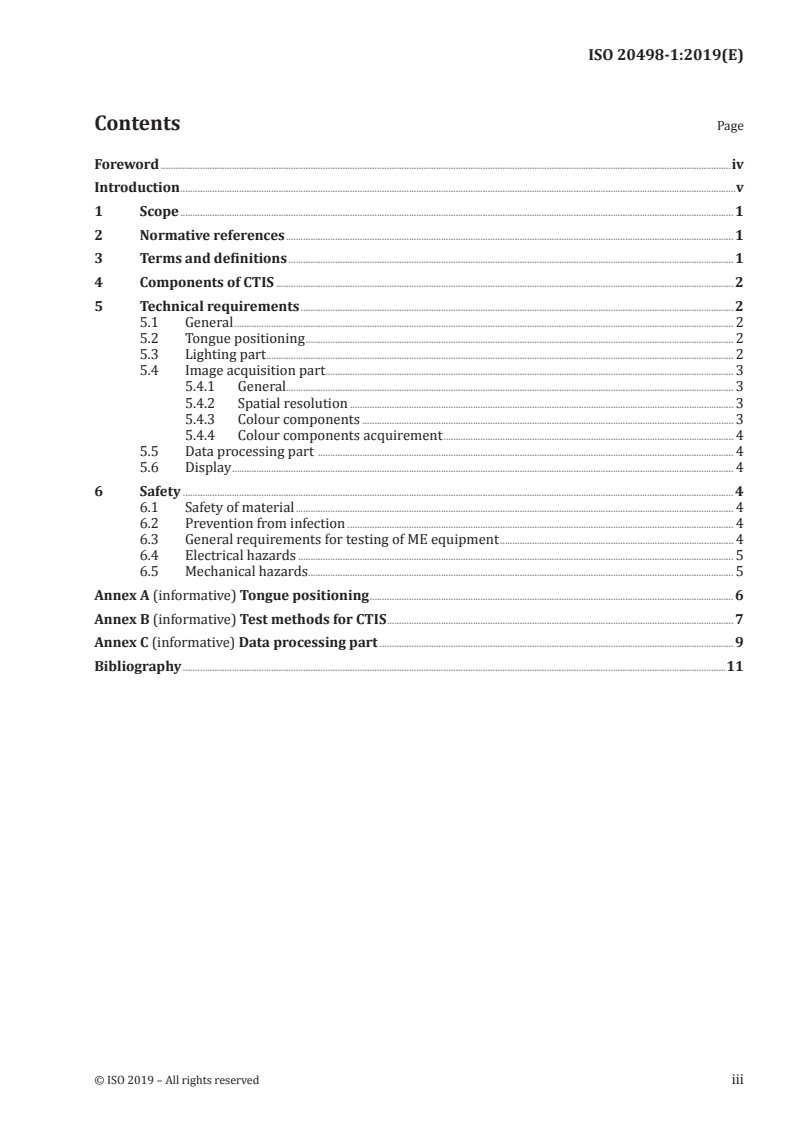
Contents Page
Foreword .iv
Introduction .v
1 Scope . 1
2 Normative references . 1
3 Terms and definitions . 1
4 Components of CTIS . 2
5 Technical requirements . 2
5.1 General . 2
5.2 Tongue positioning . 2
5.3 Lighting part . 2
5.4 Image acquisition part . 3
5.4.1 General. 3
5.4.2 Spatial resolution . 3
5.4.3 Colour components . 3
5.4.4 Colour components acquirement . 4
5.5 Data processing part . 4
5.6 Display . 4
6 Safety . 4
6.1 Safety of material . 4
6.2 Prevention from infection . 4
6.3 General requirements for testing of ME equipment . 4
6.4 Electrical hazards . 5
6.5 Mechanical hazards . 5
Annex A (informative) Tongue positioning . 6
Annex B (informative) Test methods for CTIS . 7
Annex C (informative) Data processing part . 9
Bibliography .11
Foreword
ISO (the International Organization for Standardization) is a worldwide federation of national standards
bodies (ISO member bodies). The work of preparing International Standards is normally carried out
through ISO technical committees. Each member body interested in a subject for which a technical
committee has been established has the right to be represented on that committee. International
organizations, governmental and non-governmental, in liaison with ISO, also take part in the work.
ISO collaborates closely with the International Electrotechnical Commission (IEC) on all matters of
electrotechnical standardization.
The procedures used to develop this document and those intended for its further maintenance are
described in the ISO/IEC Directives, Part 1. In particular, the different approval criteria needed for the
different types of ISO documents should be noted. This document was drafted in accordance with the
editorial rules of the ISO/IEC Directives, Part 2 (see www .iso .org/directives).
Attention is drawn to the possibility that some of the elements of this document may be the subject of
patent rights. ISO shall not be held responsible for identifying any or all such patent rights. Details of
any patent rights identified during the development of the document will be in the Introduction and/or
on the ISO list of patent declarations received (see www .iso .org/patents).
Any trade name used in this document is information given for the convenience of users and does not
constitute an endorsement.
For an explanation of the voluntary nature of standards, the meaning of ISO specific terms and
expressions related to conformity assessment, as well as information about ISO's adherence to the
World Trade Organization (WTO) principles in the Technical Barriers to Trade (TBT) see www .iso
.org/iso/foreword .html.
This document was prepared by Technical Committee ISO/TC 249, Traditional Chinese medicine.
A list of all parts in the ISO 20498 series can be found on the ISO website.
Any feedback or questions on this document should be directed to the user’s national standards body. A
complete listing of these bodies can be found at www .iso .org/members .html.
This corrected version of ISO 20498-1:2019 incorporates the following corrections:
— edition date in the running header changed to 2019;
— copyright date in the footer changed to 2019.
iv © ISO 2019 – All rights reserved
Introduction
The tongue’s colour, form, motion, substance and coating are the main factors to be considered when
analysing tongue features. Measuring the geometric shape involves observing the changes in the
thickness and size of a tongue and the cracks and teeth marks on its surface. The important features of
the tongue coating which cover the surface of the tongue are colour, degree of wetness, thickness, form
and distribution.
Although tongue diagnosis is convenient and non-invasive, it is difficult to achieve an objective and
standardized examination. Differences in inspection circumstances, such as light source or a client’s
posture, affect the result significantly. Moreover, as the diagnosis relies on the observer’s experience
and knowledge, it is hard to obtain a standardized result. Recently, many research projects have
attempted to solve these problems, and various types of computerized tongue image analysis system
(CTIS) have been developed.
Various cameras, such as a commercial digital camera, bayer charge-coupled device (CCD) camera,
high-performance 3CCD camera and a hyperspectral camera, were used for the CTIS. Recently, a multi-
view CTIS has been developed designed for 3D tongue modelling and sublingual vein acquirement,
comprising 3D CTIS.
Different CTIS technologies have unique advantages and specificities according to the application
and diagnostic environment, but this variation may cause inconsistent diagnoses in practical clinical
application. To improve CTIS performance and clinical approach, it has become necessary to develop an
International Standard for the functions and elements of a CTIS.
INTERNATIONAL STANDARD ISO 20498-1:2019(E)
Traditional Chinese medicine — Computerized tongue
image analysis system —
Part 1:
General requirements
1 Scope
This document specifies general requirements for a computerized tongue image analysis system (CTIS).
This document is limited to the safety aspects and technical requirements for a CTIS, excluding the
diagnosis or interpretation of tongue images.
2 Normative references
The following documents are referred to in the text in such a way that some or all of their content
constitutes requirements for this document. For dated references, only the edition cited applies. For
undated references, the latest edition of the referenced document (including any amendments) applies.
ISO 10993-1, Biological evaluation of medical devices — Part 1: Evaluation and testing within a risk
management process
ISO 20498-2, Traditional Chinese medicine — Computerized tongue image analysis system — Part 2: Light
environment
IEC 60601-1:2005/AMD1: 2012, Medical electrical equipment — Part 1: General requirements for basic
safety and essential performance
3 Terms and definitions
For the purposes of this document, the following terms and definitions apply.
ISO and IEC maintain terminological databases for use in standardization at the following addresses:
— ISO Online browsing platform: available at https: //www .iso .org/obp
— IEC Electropedia: available at http: //www .electropedia .org/
3.1
computerized tongue image analysis system
CTIS
device or system used to acquire tongue images to be analysed by computer
3.2
charge-coupled device
CCD
device for the movement of electrical charge, usually from within the device to an area where the
charge can be manipulated
3.3
tongue positioning
guiding and maintaining the posture of the protruding tongue
3.4
lighting part
structure for illuminating the tongue surface with various light sources and optical techniques
3.5
image acquisition part
image sensor and optical lenses used to produce the
...
INTERNATIONAL ISO
STANDARD 20498-1
First edition
2019-03
Corrected version
2019-05
Traditional Chinese medicine —
Computerized tongue image analysis
system —
Part 1:
General requirements
Médecine traditionnelle chinoise — Système d’analyse d’images
numérisées de la langue —
Partie 1: Exigences générales
Reference number
©
ISO 2019
© ISO 2019
All rights reserved. Unless otherwise specified, or required in the context of its implementation, no part of this publication may
be reproduced or utilized otherwise in any form or by any means, electronic or mechanical, including photocopying, or posting
on the internet or an intranet, without prior written permission. Permission can be requested from either ISO at the address
below or ISO’s member body in the country of the requester.
ISO copyright office
CP 401 • Ch. de Blandonnet 8
CH-1214 Vernier, Geneva
Phone: +41 22 749 01 11
Fax: +41 22 749 09 47
Email: copyright@iso.org
Website: www.iso.org
Published in Switzerland
ii © ISO 2019 – All rights reserved
Contents Page
Foreword .iv
Introduction .v
1 Scope . 1
2 Normative references . 1
3 Terms and definitions . 1
4 Components of CTIS . 2
5 Technical requirements . 2
5.1 General . 2
5.2 Tongue positioning . 2
5.3 Lighting part . 2
5.4 Image acquisition part . 3
5.4.1 General. 3
5.4.2 Spatial resolution . 3
5.4.3 Colour components . 3
5.4.4 Colour components acquirement . 4
5.5 Data processing part . 4
5.6 Display . 4
6 Safety . 4
6.1 Safety of material . 4
6.2 Prevention from infection . 4
6.3 General requirements for testing of ME equipment . 4
6.4 Electrical hazards . 5
6.5 Mechanical hazards . 5
Annex A (informative) Tongue positioning . 6
Annex B (informative) Test methods for CTIS . 7
Annex C (informative) Data processing part . 9
Bibliography .11
Foreword
ISO (the International Organization for Standardization) is a worldwide federation of national standards
bodies (ISO member bodies). The work of preparing International Standards is normally carried out
through ISO technical committees. Each member body interested in a subject for which a technical
committee has been established has the right to be represented on that committee. International
organizations, governmental and non-governmental, in liaison with ISO, also take part in the work.
ISO collaborates closely with the International Electrotechnical Commission (IEC) on all matters of
electrotechnical standardization.
The procedures used to develop this document and those intended for its further maintenance are
described in the ISO/IEC Directives, Part 1. In particular, the different approval criteria needed for the
different types of ISO documents should be noted. This document was drafted in accordance with the
editorial rules of the ISO/IEC Directives, Part 2 (see www .iso .org/directives).
Attention is drawn to the possibility that some of the elements of this document may be the subject of
patent rights. ISO shall not be held responsible for identifying any or all such patent rights. Details of
any patent rights identified during the development of the document will be in the Introduction and/or
on the ISO list of patent declarations received (see www .iso .org/patents).
Any trade name used in this document is information given for the convenience of users and does not
constitute an endorsement.
For an explanation of the voluntary nature of standards, the meaning of ISO specific terms and
expressions related to conformity assessment, as well as information about ISO's adherence to the
World Trade Organization (WTO) principles in the Technical Barriers to Trade (TBT) see www .iso
.org/iso/foreword .html.
This document was prepared by Technical Committee ISO/TC 249, Traditional Chinese medicine.
A list of all parts in the ISO 20498 series can be found on the ISO website.
Any feedback or questions on this document should be directed to the user’s national standards body. A
complete listing of these bodies can be found at www .iso .org/members .html.
This corrected version of ISO 20498-1:2019 incorporates the following corrections:
— edition date in the running header changed to 2019;
— copyright date in the footer changed to 2019.
iv © ISO 2019 – All rights reserved
Introduction
The tongue’s colour, form, motion, substance and coating are the main factors to be considered when
analysing tongue features. Measuring the geometric shape involves observing the changes in the
thickness and size of a tongue and the cracks and teeth marks on its surface. The important features of
the tongue coating which cover the surface of the tongue are colour, degree of wetness, thickness, form
and distribution.
Although tongue diagnosis is convenient and non-invasive, it is difficult to achieve an objective and
standardized examination. Differences in inspection circumstances, such as light source or a client’s
posture, affect the result significantly. Moreover, as the diagnosis relies on the observer’s experience
and knowledge, it is hard to obtain a standardized result. Recently, many research projects have
attempted to solve these problems, and various types of computerized tongue image analysis system
(CTIS) have been developed.
Various cameras, such as a commercial digital camera, bayer charge-coupled device (CCD) camera,
high-performance 3CCD camera and a hyperspectral camera, were used for the CTIS. Recently, a multi-
view CTIS has been developed designed for 3D tongue modelling and sublingual vein acquirement,
comprising 3D CTIS.
Different CTIS technologies have unique advantages and specificities according to the application
and diagnostic environment, but this variation may cause inconsistent diagnoses in practical clinical
application. To improve CTIS performance and clinical approach, it has become necessary to develop an
International Standard for the functions and elements of a CTIS.
INTERNATIONAL STANDARD ISO 20498-1:2019(E)
Traditional Chinese medicine — Computerized tongue
image analysis system —
Part 1:
General requirements
1 Scope
This document specifies general requirements for a computerized tongue image analysis system (CTIS).
This document is limited to the safety aspects and technical requirements for a CTIS, excluding the
diagnosis or interpretation of tongue images.
2 Normative references
The following documents are referred to in the text in such a way that some or all of their content
constitutes requirements for this document. For dated references, only the edition cited applies. For
undated references, the latest edition of the referenced document (including any amendments) applies.
ISO 10993-1, Biological evaluation of medical devices — Part 1: Evaluation and testing within a risk
management process
ISO 20498-2, Traditional Chinese medicine — Computerized tongue image analysis system — Part 2: Light
environment
IEC 60601-1:2005/AMD1: 2012, Medical electrical equipment — Part 1: General requirements for basic
safety and essential performance
3 Terms and definitions
For the purposes of this document, the following terms and definitions apply.
ISO and IEC maintain terminological databases for use in standardization at the following addresses:
— ISO Online browsing platform: available at https: //www .iso .org/obp
— IEC Electropedia: available at http: //www .electropedia .org/
3.1
computerized tongue image analysis system
CTIS
device or system used to acquire tongue images to be analysed by computer
3.2
charge-coupled device
CCD
device for the movement of electrical charge, usually from within the device to an area where the
charge can be manipulated
3.3
tongue positioning
guiding and maintaining the posture of the protruding tongue
3.4
lighting part
structure for illuminating the tongue surface with various light sources and optical techniques
3.5
image acquisition part
image sensor and optical lenses used to produce the
...