

ISO 8820-5:2015
(Main)Road vehicles — Fuse-links — Part 5: Fuse-links with axial terminals (Strip fuse-links) Types SF 30 and SF 51 and test fixtures
General Information
- Abstract
ISO 8820-5:2015 specifies fuse-links with axial terminals (Strip fuse-links) Type SF 30 and SF 51 and test fixtures for fuses in road vehicles. It establishes, for these fuse-link types, the rated current, test procedures, performance requirements, and dimensions. ISO 8820-5:2015 is applicable to fuse-links with a rated voltage of 32 V, a current rating of 30 A to 500 A, and a breaking capacity of 2 000 A intended for use in the electrical system of road vehicles with a nominal voltage of 12 V and/or 24 V. ISO 8820-5:2015 is intended to be used in conjunction with ISO 8820‑1 and with ISO 8820‑2. The numbering of its Clauses corresponds to that of ISO 8820‑1, whose requirements are applicable except where modified by requirements particular to this part of ISO 8820.
- Status
- Published
- Publication Date
- 15-Mar-2015
- Technical Committee
- ISO/TC 22/SC 32 - Electrical and electronic components and general system aspects
- Drafting Committee
- ISO/TC 22/SC 32/WG 5 - Fuses and circuit breakers
- Current Stage
- 9060 - Close of review
- Completion Date
- 02-Dec-2031
Overview
ISO 8820-5:2015 specifies fuse‑links with axial terminals (strip fuse‑links) - Types SF 30 and SF 51 - and the associated test fixtures for use in road vehicle electrical systems. The part defines rated voltages, current ratings, physical dimensions, marking/colour coding, and the test procedures and performance requirements needed to verify safe operation. It is applicable to fuse‑links with a rated voltage of 32 V, current ratings from 30 A to 500 A, and a breaking capacity of 2 000 A, intended for vehicles with nominal 12 V and/or 24 V electrical systems.
Key topics and technical requirements
- Rated parameters: Rated voltage 32 V; current range 30–500 A; breaking capacity 2 000 A.
- Types covered: Strip fuse‑links Type SF 30 and SF 51 including dimensional specifications and designation examples (Clause 6).
- Test program: Prescribes test sequences and sample groups for dimensional checks, marking, terminal strength, voltage drop, transient current cycling, climatic/chemical/mechanical loads, operating‑time tests, current steps and breaking capacity (Clauses 5 and Table 2).
- Voltage drop: Specifies measurement points and maximum voltage‑drop limits for rated currents to define energy dissipation and temperature rise.
- Transient current cycling: Defines pulse sequences to evaluate tolerance to transient energy; note this test does not apply to SF 30 ≥150 A and SF 51 ≥300 A (agreement between supplier/manufacturer required for those sizes).
- Terminal and connection requirements: Test fixture connection resistance limits: maximum 1.0 mΩ for SF 30 and 0.35 mΩ for SF 51 to ensure proper test performance. Terminals must have corrosion‑protective finish and adequate mechanical/electrical properties.
- Special use note: SF 30 at 150–200 A and SF 51 at 300–500 A are intended only for short‑circuit protection and require cables with insulation able to withstand test stresses.
- Test cables and materials: Test cable sizes and conductor material requirements are specified (see Clause 5 and Table 3), with conductor material referenced to ISO 6722.
- Colour coding and marking: Standardizes marking and colour coding for current ratings to aid identification.
Practical applications - who uses this standard
- Automotive OEMs and electrical system designers specifying protective devices.
- Fuse manufacturers and component suppliers developing SF 30 / SF 51 strip fuses.
- Test laboratories and certification bodies performing conformity and performance testing.
- Aftermarket and repair suppliers ensuring replacement parts meet vehicle safety requirements.
- Electrical engineers validating short‑circuit protection, voltage drop and transient performance in 12 V / 24 V vehicle systems.
Related standards
- ISO 8820-1: Definitions and general test requirements (used in conjunction with this part).
- ISO 8820-2: User guidelines.
- ISO 6722: Conductor material specification for test cables.
Keywords: ISO 8820-5, SF 30, SF 51, strip fuse-links, automotive fuses, road vehicles, test fixtures, voltage drop, breaking capacity, transient current cycling.
Relations
- Effective Date
- 31-Dec-2011
Get Certified
Connect with accredited certification bodies for this standard

TÜV Rheinland
TÜV Rheinland is a leading international provider of technical services.

TÜV SÜD
TÜV SÜD is a trusted partner of choice for safety, security and sustainability solutions.

DEKRA Certification Inc.
DEKRA US certification services.
Sponsored listings
Frequently Asked Questions
ISO 8820-5:2015 is a standard published by the International Organization for Standardization (ISO). Its full title is "Road vehicles — Fuse-links — Part 5: Fuse-links with axial terminals (Strip fuse-links) Types SF 30 and SF 51 and test fixtures". This standard covers: ISO 8820-5:2015 specifies fuse-links with axial terminals (Strip fuse-links) Type SF 30 and SF 51 and test fixtures for fuses in road vehicles. It establishes, for these fuse-link types, the rated current, test procedures, performance requirements, and dimensions. ISO 8820-5:2015 is applicable to fuse-links with a rated voltage of 32 V, a current rating of 30 A to 500 A, and a breaking capacity of 2 000 A intended for use in the electrical system of road vehicles with a nominal voltage of 12 V and/or 24 V. ISO 8820-5:2015 is intended to be used in conjunction with ISO 8820‑1 and with ISO 8820‑2. The numbering of its Clauses corresponds to that of ISO 8820‑1, whose requirements are applicable except where modified by requirements particular to this part of ISO 8820.
ISO 8820-5:2015 specifies fuse-links with axial terminals (Strip fuse-links) Type SF 30 and SF 51 and test fixtures for fuses in road vehicles. It establishes, for these fuse-link types, the rated current, test procedures, performance requirements, and dimensions. ISO 8820-5:2015 is applicable to fuse-links with a rated voltage of 32 V, a current rating of 30 A to 500 A, and a breaking capacity of 2 000 A intended for use in the electrical system of road vehicles with a nominal voltage of 12 V and/or 24 V. ISO 8820-5:2015 is intended to be used in conjunction with ISO 8820‑1 and with ISO 8820‑2. The numbering of its Clauses corresponds to that of ISO 8820‑1, whose requirements are applicable except where modified by requirements particular to this part of ISO 8820.
ISO 8820-5:2015 is classified under the following ICS (International Classification for Standards) categories: 43.040.10 - Electrical and electronic equipment. The ICS classification helps identify the subject area and facilitates finding related standards.
ISO 8820-5:2015 has the following relationships with other standards: It is inter standard links to ISO 8820-5:2007. Understanding these relationships helps ensure you are using the most current and applicable version of the standard.
ISO 8820-5:2015 is available in PDF format for immediate download after purchase. The document can be added to your cart and obtained through the secure checkout process. Digital delivery ensures instant access to the complete standard document.
Standards Content (Sample)
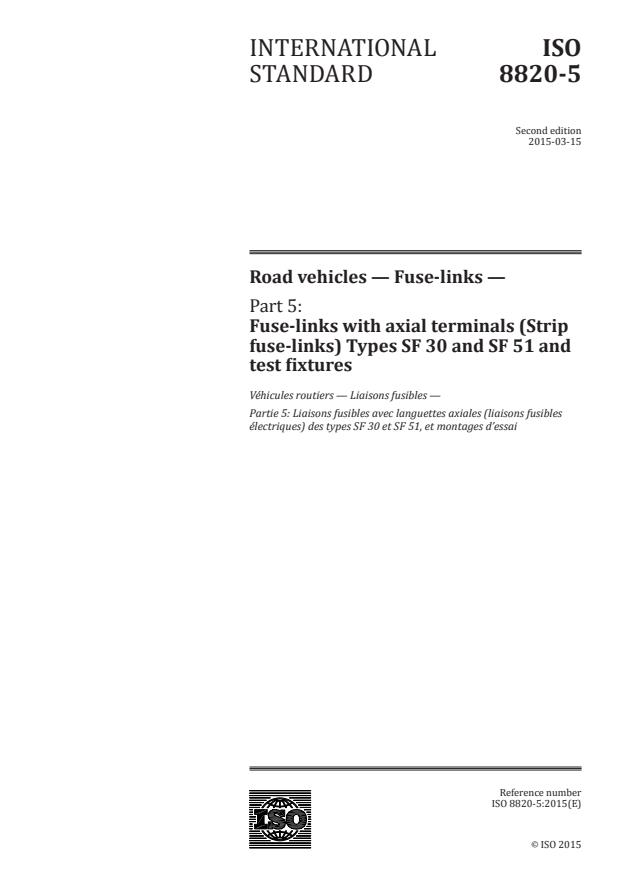
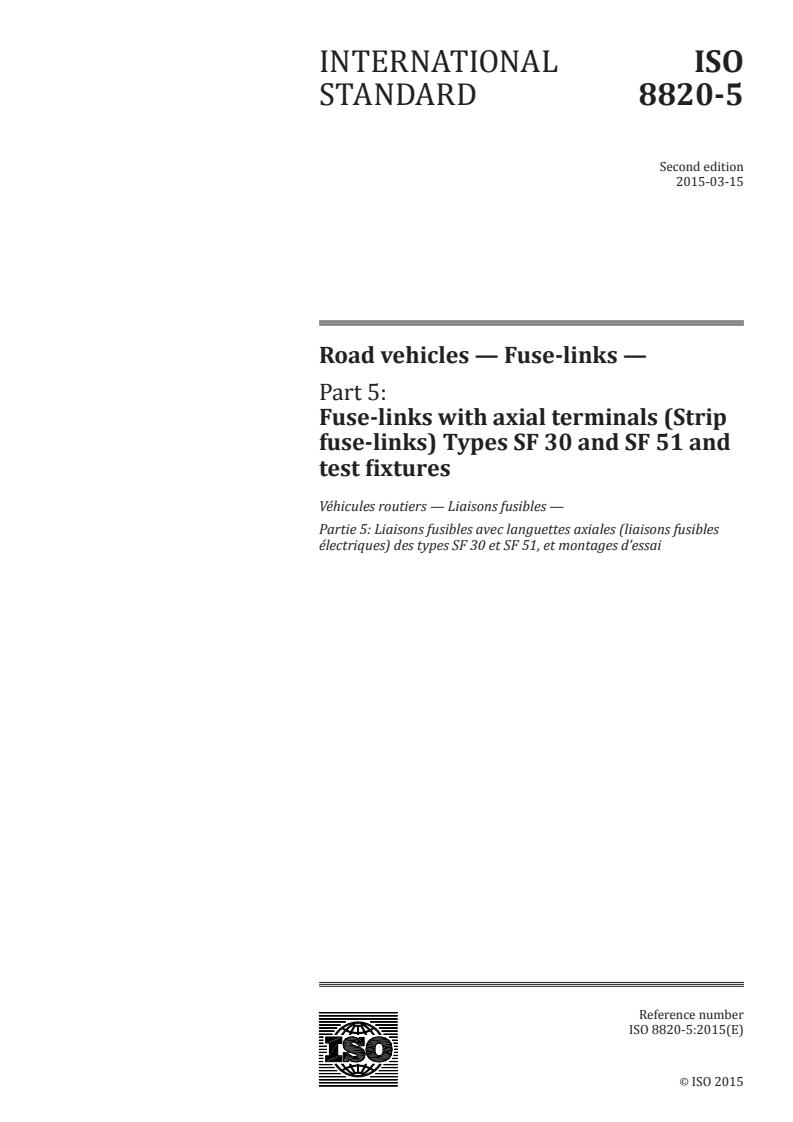
INTERNATIONAL ISO
STANDARD 8820-5
Second edition
2015-03-15
Road vehicles — Fuse-links —
Part 5:
Fuse-links with axial terminals (Strip
fuse-links) Types SF 30 and SF 51 and
test fixtures
Véhicules routiers — Liaisons fusibles —
Partie 5: Liaisons fusibles avec languettes axiales (liaisons fusibles
électriques) des types SF 30 et SF 51, et montages d’essai
Reference number
©
ISO 2015
© ISO 2015
All rights reserved. Unless otherwise specified, no part of this publication may be reproduced or utilized otherwise in any form
or by any means, electronic or mechanical, including photocopying, or posting on the internet or an intranet, without prior
written permission. Permission can be requested from either ISO at the address below or ISO’s member body in the country of
the requester.
ISO copyright office
Case postale 56 • CH-1211 Geneva 20
Tel. + 41 22 749 01 11
Fax + 41 22 749 09 47
E-mail copyright@iso.org
Web www.iso.org
Published in Switzerland
ii © ISO 2015 – All rights reserved
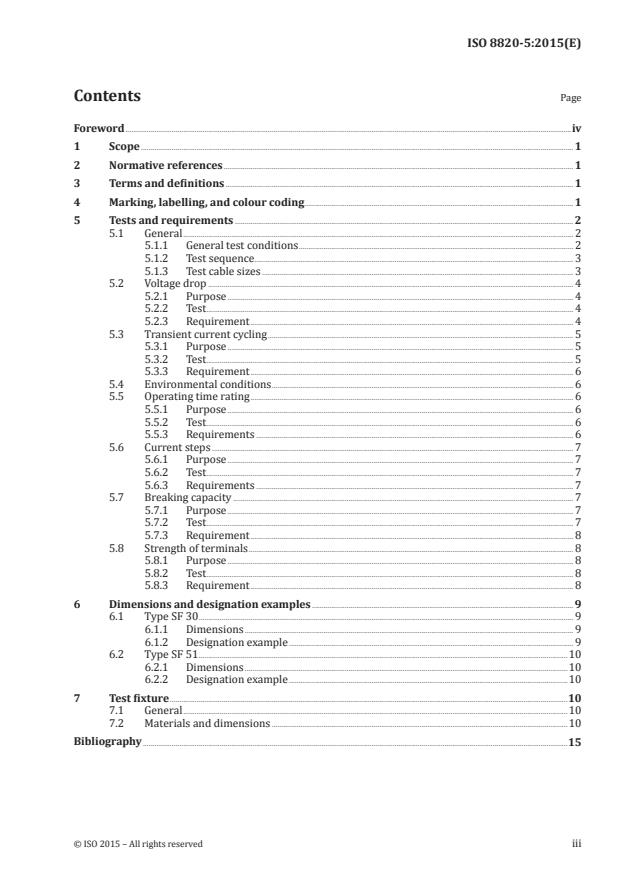
Contents Page
Foreword .iv
1 Scope . 1
2 Normative references . 1
3 Terms and definitions . 1
4 Marking, labelling, and colour coding . 1
5 Tests and requirements . 2
5.1 General . 2
5.1.1 General test conditions . 2
5.1.2 Test sequence . . . 3
5.1.3 Test cable sizes . 3
5.2 Voltage drop . 4
5.2.1 Purpose . 4
5.2.2 Test . 4
5.2.3 Requirement . 4
5.3 Transient current cycling . 5
5.3.1 Purpose . 5
5.3.2 Test . 5
5.3.3 Requirement . 6
5.4 Environmental conditions . 6
5.5 Operating time rating . 6
5.5.1 Purpose . 6
5.5.2 Test . 6
5.5.3 Requirements . 6
5.6 Current steps . 7
5.6.1 Purpose . 7
5.6.2 Test . 7
5.6.3 Requirements . 7
5.7 Breaking capacity . 7
5.7.1 Purpose . 7
5.7.2 Test . 7
5.7.3 Requirement . 8
5.8 Strength of terminals . 8
5.8.1 Purpose . 8
5.8.2 Test . 8
5.8.3 Requirement . 8
6 Dimensions and designation examples . 9
6.1 Type SF 30 . 9
6.1.1 Dimensions . 9
6.1.2 Designation example . 9
6.2 Type SF 51 .10
6.2.1 Dimensions .10
6.2.2 Designation example .10
7 Test fixture .10
7.1 General .10
7.2 Materials and dimensions .10
Bibliography .15
Foreword
ISO (the International Organization for Standardization) is a worldwide federation of national standards
bodies (ISO member bodies). The work of preparing International Standards is normally carried out
through ISO technical committees. Each member body interested in a subject for which a technical
committee has been established has the right to be represented on that committee. International
organizations, governmental and non-governmental, in liaison with ISO, also take part in the work.
ISO collaborates closely with the International Electrotechnical Commission (IEC) on all matters of
electrotechnical standardization.
The procedures used to develop this document and those intended for its further maintenance are
described in the ISO/IEC Directives, Part 1. In particular the different approval criteria needed for the
different types of ISO documents should be noted. This document was drafted in accordance with the
editorial rules of the ISO/IEC Directives, Part 2 (see www.iso.org/directives).
Attention is drawn to the possibility that some of the elements of this document may be the subject of
patent rights. ISO shall not be held responsible for identifying any or all such patent rights. Details of any
patent rights identified during the development of the document will be in the Introduction and/or on
the ISO list of patent declarations received (see www.iso.org/patents).
Any trade name used in this document is information given for the convenience of users and does not
constitute an endorsement.
For an explanation on the meaning of ISO specific terms and expressions related to conformity
assessment, as well as information about ISO’s adherence to the WTO principles in the Technical Barriers
to Trade (TBT) see the following URL: Foreword - Supplementary Information
The committee responsible for this document is ISO/TC 22, Road vehicles, Subcommittee SC 3, Electric
and electronic equipment.
This second edition cancels and replaces the first edition (ISO 8820-5:2007), which has been
technically revised.
ISO 8820 consists of the following parts, under the general title Road vehicles — Fuse-links:
— Part 1: Definitions and general test requirements
— Part 2: User guidelines
— Part 3: Fuse-link with tabs (blade type) Type C (medium), Type E (high current) and Type F (miniature)
— Part 4: Fuse-links with female contacts (type A) and bolt-in contacts (type B) and their test fixtures
— Part 5: Fuse-links with axial terminals (Strip fuse-links) Types SF 30 and SF 51 and test fixtures
— Part 6 Single-bolt fuse-links
— Part 7: Fuse-links with tabs (Type G) with rated voltage of 450 V
— Part 8: Fuse-links with bolt-in contacts (Type H and J) with rated voltage of 450 V
— Part 9: Fuse-links with shortened tabs (Type K)
— Part 10: Fuse-links with tabs Type L (high current miniature)
iv © ISO 2015 – All rights reserved
INTERNATIONAL STANDARD ISO 8820-5:2015(E)
Road vehicles — Fuse-links —
Part 5:
Fuse-links with axial terminals (Strip fuse-links) Types SF
30 and SF 51 and test fixtures
1 Scope
This part of ISO 8820 specifies fuse-links with axial terminals (Strip fuse-links) Type SF 30 and SF 51
and test fixtures for fuses in road vehicles. It establishes, for these fuse-link types, the rated current, test
procedures, performance requirements, and dimensions.
This part of ISO 8820 is applicable to fuse-links with a rated voltage of 32 V, a current rating of 30 A to
500 A, and a breaking capacity of 2 000 A intended for use in the electrical system of road vehicles with
a nominal voltage of 12 V and/or 24 V.
This part of ISO 8820 is intended to be used in conjunction with ISO 8820-1 and with ISO 8820-2. The
numbering of its Clauses corresponds to that of
...
INTERNATIONAL ISO
STANDARD 8820-5
Second edition
2015-03-15
Road vehicles — Fuse-links —
Part 5:
Fuse-links with axial terminals (Strip
fuse-links) Types SF 30 and SF 51 and
test fixtures
Véhicules routiers — Liaisons fusibles —
Partie 5: Liaisons fusibles avec languettes axiales (liaisons fusibles
électriques) des types SF 30 et SF 51, et montages d’essai
Reference number
©
ISO 2015
© ISO 2015
All rights reserved. Unless otherwise specified, no part of this publication may be reproduced or utilized otherwise in any form
or by any means, electronic or mechanical, including photocopying, or posting on the internet or an intranet, without prior
written permission. Permission can be requested from either ISO at the address below or ISO’s member body in the country of
the requester.
ISO copyright office
Case postale 56 • CH-1211 Geneva 20
Tel. + 41 22 749 01 11
Fax + 41 22 749 09 47
E-mail copyright@iso.org
Web www.iso.org
Published in Switzerland
ii © ISO 2015 – All rights reserved
Contents Page
Foreword .iv
1 Scope . 1
2 Normative references . 1
3 Terms and definitions . 1
4 Marking, labelling, and colour coding . 1
5 Tests and requirements . 2
5.1 General . 2
5.1.1 General test conditions . 2
5.1.2 Test sequence . . . 3
5.1.3 Test cable sizes . 3
5.2 Voltage drop . 4
5.2.1 Purpose . 4
5.2.2 Test . 4
5.2.3 Requirement . 4
5.3 Transient current cycling . 5
5.3.1 Purpose . 5
5.3.2 Test . 5
5.3.3 Requirement . 6
5.4 Environmental conditions . 6
5.5 Operating time rating . 6
5.5.1 Purpose . 6
5.5.2 Test . 6
5.5.3 Requirements . 6
5.6 Current steps . 7
5.6.1 Purpose . 7
5.6.2 Test . 7
5.6.3 Requirements . 7
5.7 Breaking capacity . 7
5.7.1 Purpose . 7
5.7.2 Test . 7
5.7.3 Requirement . 8
5.8 Strength of terminals . 8
5.8.1 Purpose . 8
5.8.2 Test . 8
5.8.3 Requirement . 8
6 Dimensions and designation examples . 9
6.1 Type SF 30 . 9
6.1.1 Dimensions . 9
6.1.2 Designation example . 9
6.2 Type SF 51 .10
6.2.1 Dimensions .10
6.2.2 Designation example .10
7 Test fixture .10
7.1 General .10
7.2 Materials and dimensions .10
Bibliography .15
Foreword
ISO (the International Organization for Standardization) is a worldwide federation of national standards
bodies (ISO member bodies). The work of preparing International Standards is normally carried out
through ISO technical committees. Each member body interested in a subject for which a technical
committee has been established has the right to be represented on that committee. International
organizations, governmental and non-governmental, in liaison with ISO, also take part in the work.
ISO collaborates closely with the International Electrotechnical Commission (IEC) on all matters of
electrotechnical standardization.
The procedures used to develop this document and those intended for its further maintenance are
described in the ISO/IEC Directives, Part 1. In particular the different approval criteria needed for the
different types of ISO documents should be noted. This document was drafted in accordance with the
editorial rules of the ISO/IEC Directives, Part 2 (see www.iso.org/directives).
Attention is drawn to the possibility that some of the elements of this document may be the subject of
patent rights. ISO shall not be held responsible for identifying any or all such patent rights. Details of any
patent rights identified during the development of the document will be in the Introduction and/or on
the ISO list of patent declarations received (see www.iso.org/patents).
Any trade name used in this document is information given for the convenience of users and does not
constitute an endorsement.
For an explanation on the meaning of ISO specific terms and expressions related to conformity
assessment, as well as information about ISO’s adherence to the WTO principles in the Technical Barriers
to Trade (TBT) see the following URL: Foreword - Supplementary Information
The committee responsible for this document is ISO/TC 22, Road vehicles, Subcommittee SC 3, Electric
and electronic equipment.
This second edition cancels and replaces the first edition (ISO 8820-5:2007), which has been
technically revised.
ISO 8820 consists of the following parts, under the general title Road vehicles — Fuse-links:
— Part 1: Definitions and general test requirements
— Part 2: User guidelines
— Part 3: Fuse-link with tabs (blade type) Type C (medium), Type E (high current) and Type F (miniature)
— Part 4: Fuse-links with female contacts (type A) and bolt-in contacts (type B) and their test fixtures
— Part 5: Fuse-links with axial terminals (Strip fuse-links) Types SF 30 and SF 51 and test fixtures
— Part 6 Single-bolt fuse-links
— Part 7: Fuse-links with tabs (Type G) with rated voltage of 450 V
— Part 8: Fuse-links with bolt-in contacts (Type H and J) with rated voltage of 450 V
— Part 9: Fuse-links with shortened tabs (Type K)
— Part 10: Fuse-links with tabs Type L (high current miniature)
iv © ISO 2015 – All rights reserved
INTERNATIONAL STANDARD ISO 8820-5:2015(E)
Road vehicles — Fuse-links —
Part 5:
Fuse-links with axial terminals (Strip fuse-links) Types SF
30 and SF 51 and test fixtures
1 Scope
This part of ISO 8820 specifies fuse-links with axial terminals (Strip fuse-links) Type SF 30 and SF 51
and test fixtures for fuses in road vehicles. It establishes, for these fuse-link types, the rated current, test
procedures, performance requirements, and dimensions.
This part of ISO 8820 is applicable to fuse-links with a rated voltage of 32 V, a current rating of 30 A to
500 A, and a breaking capacity of 2 000 A intended for use in the electrical system of road vehicles with
a nominal voltage of 12 V and/or 24 V.
This part of ISO 8820 is intended to be used in conjunction with ISO 8820-1 and with ISO 8820-2. The
numbering of its Clauses corresponds to that of
...