

ISO/IEC 27034-3:2018
(Main)Information technology — Application security — Part 3: Application security management process
General Information
- Abstract
This document provides a detailed description and implementation guidance for the Application Security Management Process.
- Status
- Published
- Publication Date
- 21-May-2018
- Drafting Committee
- ISO/IEC JTC 1/SC 27/WG 4 - Security controls and services
- Current Stage
- 9093 - International Standard confirmed
- Start Date
- 27-Oct-2023
- Completion Date
- 29-Aug-2026

Overview
ISO/IEC 27034-3:2018 - part of the ISO/IEC 27034 application security series - defines the Application Security Management Process (ASMP) and provides implementation guidance for embedding application security into an organization’s projects and lifecycle. The standard describes how to identify application security requirements, assess risks, create and maintain an Application Normative Framework (ANF), provision and operate applications securely, and audit application security. Key concepts include roles and responsibilities, the relationship with the Organizational Normative Framework (ONF), use of approved tools, and defining an application’s targeted and actual level of trust.
Key technical topics and requirements
- Application Security Management Process (ASMP): structured steps for integrating security across an application’s life cycle - from requirements to operation and auditing.
- Application Normative Framework (ANF): a documented set of elements (business, regulatory, technological contexts; specifications; actors and responsibilities; selected security measures; lifecycle and information) that govern application-specific security.
- Risk assessment: assessing application security risks and defining mitigation activities (realization and verification activities are required).
- Roles and responsibilities: explicitly communicating and documenting roles, qualifications and accountability for application security.
- Level of trust: defining a targeted level of trust for an application and measuring its actual level of trust against that target.
- Verification and auditing: systematic verification activities and audits to confirm outcomes and maintain compliance.
- Guidance and tool use: selection and use of approved tools and consistent alignment with organizational policies (ONF).
Practical applications
- Embed ASMP into software development and DevOps pipelines to ensure security requirements are identified, implemented and verified throughout the SDLC.
- Create and maintain an ANF to centralize application-specific security policies, controls and lifecycle rules.
- Use the standard to structure threat and risk assessments, map controls to regulatory requirements, and define audit criteria.
- Support procurement, third-party application evaluation, and secure deployment by documenting targeted levels of trust and verification evidence.
Who should use this standard
- Application security managers and architects
- Security and risk managers
- Development and DevOps teams integrating security into SDLC
- Compliance officers and auditors evaluating application controls
- Product owners and IT governance teams aligning application practices with organizational policies
Related standards
- ISO/IEC 27034 series (other parts covering concepts and controls)
- ISO/IEC 27001 / ISO/IEC 27002 (information security management and controls)
ISO/IEC 27034-3 is practical guidance for organizations that want repeatable, auditable application security management tailored to their business and technology contexts.
Get Certified
Connect with accredited certification bodies for this standard

BSI Group
BSI (British Standards Institution) is the business standards company that helps organizations make excellence a habit.

Bureau Veritas
Bureau Veritas is a world leader in laboratory testing, inspection and certification services.

DNV
DNV is an independent assurance and risk management provider.
Sponsored listings
Frequently Asked Questions
ISO/IEC 27034-3:2018 is a standard published by the International Organization for Standardization (ISO). Its full title is "Information technology — Application security — Part 3: Application security management process". This standard covers: This document provides a detailed description and implementation guidance for the Application Security Management Process.
This document provides a detailed description and implementation guidance for the Application Security Management Process.
ISO/IEC 27034-3:2018 is classified under the following ICS (International Classification for Standards) categories: 35.030 - IT Security; 35.040 - Information coding. The ICS classification helps identify the subject area and facilitates finding related standards.
ISO/IEC 27034-3:2018 is available in PDF format for immediate download after purchase. The document can be added to your cart and obtained through the secure checkout process. Digital delivery ensures instant access to the complete standard document.
Standards Content (Sample)
INTERNATIONAL ISO/IEC
STANDARD 27034-3
First edition
2018-05
Information technology — Application
security —
Part 3:
Application security management
process
Technologie de l’information — Sécurité des applications —
Partie 3: Processus de gestion de la sécurité d'une application
Reference number
©
ISO/IEC 2018
© ISO/IEC 2018
All rights reserved. Unless otherwise specified, or required in the context of its implementation, no part of this publication may
be reproduced or utilized otherwise in any form or by any means, electronic or mechanical, including photocopying, or posting
on the internet or an intranet, without prior written permission. Permission can be requested from either ISO at the address
below or ISO’s member body in the country of the requester.
ISO copyright office
CP 401 • Ch. de Blandonnet 8
CH-1214 Vernier, Geneva
Phone: +41 22 749 01 11
Fax: +41 22 749 09 47
Email: copyright@iso.org
Website: www.iso.org
Published in Switzerland
ii © ISO/IEC 2018 – All rights reserved
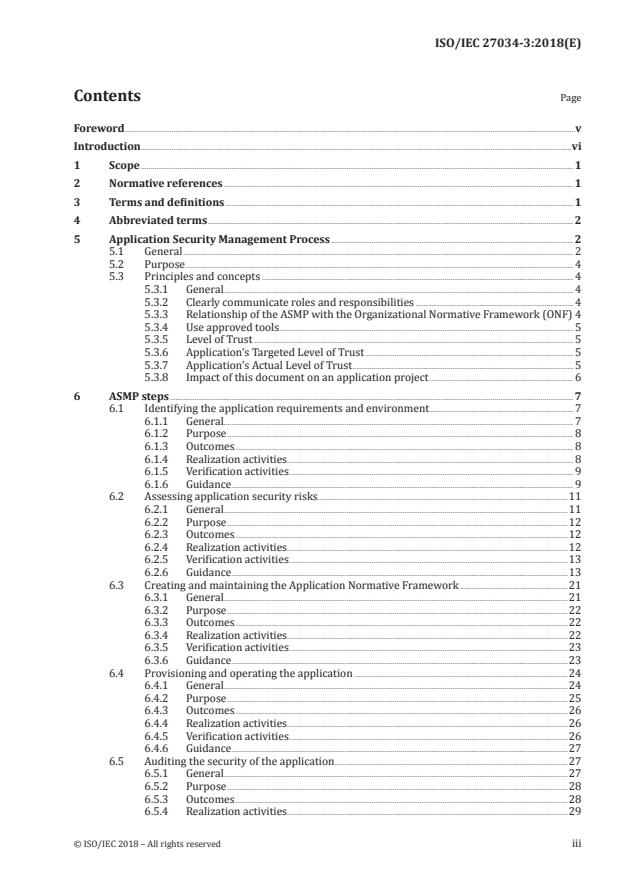
Contents Page
Foreword .v
Introduction .vi
1 Scope . 1
2 Normative references . 1
3 Terms and definitions . 1
4 Abbreviated terms . 2
5 Application Security Management Process . 2
5.1 General . 2
5.2 Purpose . 4
5.3 Principles and concepts . 4
5.3.1 General. 4
5.3.2 Clearly communicate roles and responsibilities . 4
5.3.3 Relationship of the ASMP with the Organizational Normative Framework (ONF) 4
5.3.4 Use approved tools . 5
5.3.5 Level of Trust . 5
5.3.6 Application‘s Targeted Level of Trust . 5
5.3.7 Application’s Actual Level of Trust . 5
5.3.8 Impact of this document on an application project . 6
6 ASMP steps . 7
6.1 Identifying the application requirements and environment . 7
6.1.1 General. 7
6.1.2 Purpose . 8
6.1.3 Outcomes . 8
6.1.4 Realization activities. 8
6.1.5 Verification activities . . 9
6.1.6 Guidance. 9
6.2 Assessing application security risks .11
6.2.1 General.11
6.2.2 Purpose .12
6.2.3 Outcomes .12
6.2.4 Realization activities.12
6.2.5 Verification activities . .13
6.2.6 Guidance.13
6.3 Creating and maintaining the Application Normative Framework .21
6.3.1 General.21
6.3.2 Purpose .22
6.3.3 Outcomes .22
6.3.4 Realization activities.22
6.3.5 Verification activities . .23
6.3.6 Guidance.23
6.4 Provisioning and operating the application .24
6.4.1 General.24
6.4.2 Purpose .25
6.4.3 Outcomes .26
6.4.4 Realization activities.26
6.4.5 Verification activities . .26
6.4.6 Guidance.27
6.5 Auditing the security of the application .27
6.5.1 General.27
6.5.2 Purpose .28
6.5.3 Outcomes .28
6.5.4 Realization activities.29
© ISO/IEC 2018 – All rights reserved iii
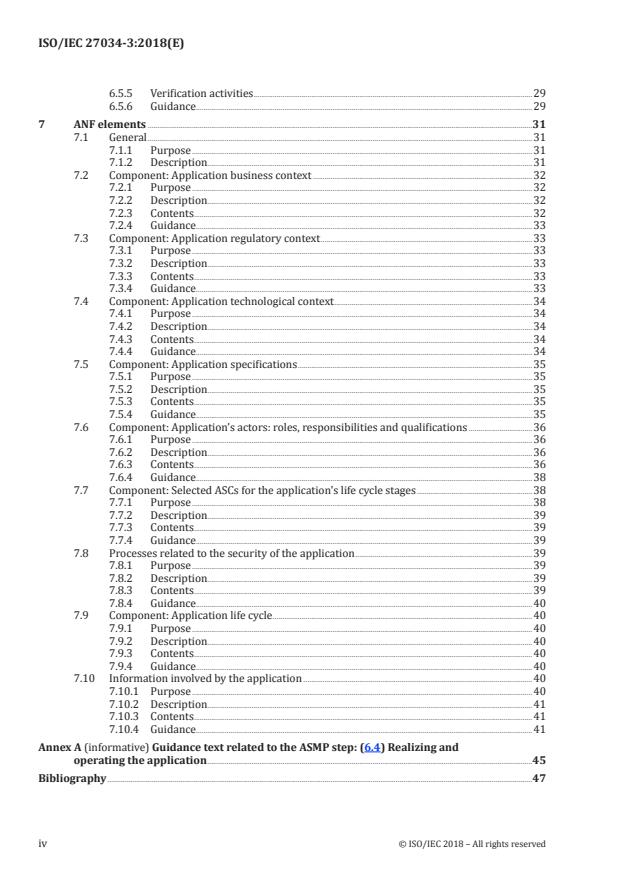
6.5.5 Verification activities . .29
6.5.6 Guidance.29
7 ANF elements .31
7.1 General .31
7.1.1 Purpose .31
7.1.2 Description . . .31
7.2 Component: Application business context .32
7.2.1 Purpose .32
7.2.2 Description . . .32
7.2.3 Contents . .32
7.2.4 Guidance.33
7.3 Component: Application regulatory context .33
7.3.1 Purpose .33
7.3.2 Description . . .33
7.3.3 Contents . .33
7.3.4 Guidance.33
7.4 Component: Application technological context .34
7.4.1 Purpose .34
7.4.2 Description . . .34
7.4.3 Contents . .34
7.4.4 Guidance.34
7.5 Component: Application specifications .35
7.5.1 Purpose .35
7.5.2 Description . . .35
7.5.3 Contents . .35
7.5.4 Guidance.35
7.6 Component: Application’s actors: roles, responsibilities and qualifications .36
7.6.1 Purpose .36
7.6.2 Description . . .36
7.6.3 Contents . .36
7.6.4 Guidance.38
7.7 Component: Selected ASCs for the application's life cycle stages .38
7.7.1 Purpose .38
7.7.2 Description . . .39
7.7.3 Contents . .39
7.7.4 Guidance.39
7.8 Processes related to the security of the application .39
7.8.1 Purpose .39
7.8.2 Description . . .39
7.8.3 Contents . .39
7.8.4 Guidance.40
7.9 Component: Application life cycle .40
7.9.1 Purpose .40
7.9.2 Description . . .40
7.9.3 Contents . .40
7.9.4 Guidance.40
7.10 Information involved by the application .40
7.10.1 Purpose .40
7.10.2 Description . . .41
7.10.3 Contents . .41
7.10.4 Guidance.41
Annex A (informative) Guidance text related to the ASMP step: (6.4) Realizing and
operating the application .45
Bibliography .47
iv © ISO/IEC 2018 – All rights reserved
Foreword
ISO (the International Organization for Standardization) and IEC (the International Electrotechnical
Commission) form the specialized system for worldwide standardization. National bodies that are
members of ISO or IEC participate in the development of International Standards through technical
committees established by the respective organization to deal with particular fields of technical
activity. ISO and IEC technical committees collaborate in fields of mutual interest. Other international
organizations, governmental and non-governmental, in liaison with ISO and IEC, also take part in the
work. In the field of information technology, ISO and IEC have established a joint technical committee,
ISO/IEC JTC 1.
The procedures used to develop this document and those intended for its further maintenance are
described in the ISO/IEC Directives, Part 1. In particular the different approval criteria needed for
the different types of document should be noted. This document was drafted in accordance with the
editorial rules of the ISO/IEC Directives, Part 2 (see www .iso .org/directives).
Attention is drawn to the possibility that some of the elements of this document may be the subject
of patent rights. ISO and IEC shall not be held responsible for identifying any or all such patent
rights. Details of any patent rights identified during the development of the document will be in the
Introduction and/or on the ISO list of patent declarations received (see www .iso .org/patents).
Any trade name used in this document is information given for the convenience of users and does not
constitute an endorsement.
For an explanation on the voluntary nature of standards, the meaning of ISO specific terms and
expressions related to conformity assessment, as well as information about ISO's adherence to the
World Trade Organization (WTO) principles in the Technical Barriers to Trade (TBT) see the following
URL: www .iso .org/iso/foreword .html.
This document was prepared by Joint Technical Committee ISO/IEC JTC 1, Information technology,
Subcommittee SC 27, Security techniques.
A list of all parts in the ISO/IEC 27034 series can be found on the ISO website.
© ISO/IEC 2018 – All rights reserved v
Introduction
0.1 General
A systematic approach to integrate security controls throughout the engineering lifecycle provides an
organization with evidence that information being used or stored by its applications is being adequately
protected.
The ISO/IEC 27034 series assists organizations in integrating security throughout the life cycle of their
applications by providing frameworks and processes scoped at organization and application levels.
This document defines the processes required for managing the security of an application identified as
processing critical information by the organization.
Table 1 — ISO/IEC 27034 Framework overview
Scope ISO/IEC 27034 framework What it represents
One centralized repository of application secu-
Organization Normative Framework (ONF)
rity information
Organization
Process is in place to maintain and continuous-
ONF Management process
ly improve ONF
Application Normative Framework (ANF) Repository for all ASCs of an application
Application
A risk based process that uses the ANF to build
Application Security Management Process
and validate applications
As shown in Table 1, organization-level framework and process are provided by the Organization
Normative Framework (ONF). The ONF, its elements and supporting processes are defined in ISO/
IEC 27034-2.
Application-level framework and processes are provided by this document in Clauses 5, 6 and 7. The
Application Security Management Process (ASMP) helps a project team apply relevant portions of the
ONF to a specific application project and formally record evidence of the outcomes in an Application
Normative Framework (ANF).
Processes for determining the application requirements and environment are included in 6.1 to
6.5. Subclause 6.1 addresses the identification of the application requirements and its environment,
assessing the application security risks. Evaluating the application's Targeted Level of Trust is
addressed in 6.2, creating and maintaining the ANF and Application Security Controls (ASCs) is covered
in 6.3, and processes pertaining to realizing and operating the application are included in 6.4. Finally,
6.5 presents a process to verify that the ANF and the ASCs are properly implemented.
0.2 Purpose
The purpose of this document is to provide requirements and guidance for the Application Security
Management Process and the Application Normative Framework.
vi © ISO/IEC 2018 – All rights reserved
0.3 Targeted audience
0.3.1 General
Although this document provides best practices for a general audience, it is especially useful for the
following actors:
a) managers;
b) provisioning and operation team;
c) acquirers;
d) suppliers;
e) auditors;
f) users.
0.3.2 Managers
Managers are persons involved in the management of an application. Examples of managers are:
a) information security managers including the Chief Information Security Officer (CISO);
b) project managers;
c) product line managers;
d) development managers;
e) application owners;
f) line managers including the Chief Information Officer (CIO), who supervise employees.
Typically, managers need to:
a) ensure that any application projects, initiatives or processes are based on the results of risk
management;
b) make sure that certain proper information security clearances are in place as required by applicable
information security policies and procedures;
c) manage the implementation of a secure application;
d) provide security awareness, training and oversight to all actors;
e) balance the cost of implementing and maintaining application security against the risks and value
it represents for the organization;
f) ensure compliance with standards, laws and regulations according to an application’s regulatory
context;
g) ensure the documentation of security policies and procedures for the application;
h) stay abreast of all application-related security plans throughout the organization's network;
i) determine which security controls and corresponding verification measurements should be
implemented and tested;
j) authorize the targeted level of trust according to the context specific to the organization;
k) periodically review the applications for security weaknesses and threats and take corrective and
preventive actions;
© ISO/IEC 2018 – All rights reserved vii
l) review auditor reports recommending application acceptance or rejection based on proper
implementation of required application security controls;
m) ensure that security flaws are prevented through secure coding practices;
n) base their decisions on lessons learned derived from knowledge base records.
0.3.3 Provisioning and operation team
Members of provisioning and operation team (known collectively as the project team or as the
application team) are persons involved in an application’s design, development and maintenance
throughout its whole life cycle. Example provisioning and operations team roles include:
a) architects;
b) analysts;
c) programmers;
d) testers;
e) IT administrators, such as system administrators, database administrators, network
administrators, and application administrators.
Typically, members need to:
a) understand which application security controls should be applied at each stage of an application's
life cycle and why;
b) understand which controls should be implemented in the application itself;
c) minimize the impact of introducing controls into the development, test and documentation
activities within the application life cycle;
d) make sure that introduced controls meet the requirements;
e) obtain access to tools and best practices in order to streamline development, testing and
documentation;
f) facilitate peer review;
g) participate in acquisition planning and strategy;
h) arrange disposal of residual items after work is completed, (e.g. property management/disposal).
viii © ISO/IEC 2018 – All rights reserved
0.3.4 Acquirers
This includes all persons involved in acquiring a product or service.
Typically, acquirers need to:
a) establish business relationships to obtain needed goods and services, (e.g. for the solicitation,
evaluation and awarding of contracts);
b) prepare requests for proposals that include requirements for security controls;
c) select suppliers that comply with such requirements;
d) verify evidence of security controls applied by outsourcing services;
e) evaluate products by verifying evidence of correctly implemented application security controls.
0.3.5 Suppliers
This includes all persons involved in supplying a product or service.
Typically suppliers need to:
a) comply to application security requirements from requests for proposals;
b) select appropriate application security controls for proposals, with respect to their impact on cost;
c) provide evidence that required security controls are implemented correctly in proposed products
or services.
0.3.6 Auditors
Auditors are persons who need to:
a) understand the scope and procedures involved in verification measurements for the corresponding
controls;
b) ensure that audit results are repeatable;
c) establish a list of verification measurements which generate evidence that an application has
reached the Targeted Level of Trust;
d) apply standardized audit processes based on the use of verifiable evidence, according to ISO/
IEC 27034 (all parts).
0.3.7 Users
Users are persons who need to trust that:
a) it is deemed secure to use or deploy an application;
b) an application produces reliable results consistently and in a timely manner;
c) the controls and their corresponding verification measurements are positioned and functioning
correctly as expected.
© ISO/IEC 2018 – All rights reserved ix
INTERNATIONAL STANDARD ISO/IEC 27034-3:2018(E)
Information technology — Application security —
Part 3:
Application security management process
1 Scope
This document provides a detailed description and implementation guidance for the Application
Security Management Process.
2 Normative references
The following documents are referred to in the text in such a way that some or all of their content
constitutes requirements of this document. For dated references, only the edition cited applies. For
undated references, the latest edition of the referenced document (including any amendments) applies.
ISO/IEC 27000, Information technology — Security techniques — Information security management
systems — Overview and vocabulary
ISO/IEC 27034-1, Information technology — Security techniques — Application security — Part 1:
Overview and concepts
ISO/IEC 27034-2, Information technology — Security techniques — Application security — Part 2:
Organization normative framework
ISO/IEC 27034-5, Information technology — Security techniques — Application security — Part 5:
Protocols and application security controls data structure
3 Terms and definitions
For the purposes of this document, the terms and definitions given in ISO/IEC 27034-1, ISO/IEC 27034-
2, and ISO/IEC 27000 and the following apply.
ISO and IEC maintain terminological databases for use in standardization at the following addresses:
— ISO Online browsing platform: available at https: //www .iso .org/obp
— IEC Electropedia: available at https: //www .electropedia .org/
3.1
application security audit
AS audit
systematic, independent and documented process for obtaining audit evidence from the verification of
application security activities, and evaluating it objectively to determine the extent to which the audit
criteria required by an application security authority are fulfilled
3.2
application security verification
process of reviewing and verifying security activity outcomes by performing the associated verification-
measurement activity
Note 1 to entry: For an organization, required ONF elements and security activities meet ONF specifications and
are compliant with ONF management process.
© ISO/IEC 2018 – All rights reserved 1
Note 2 to entry: For an application, a security activity and its associated verification-measurement activity may
be part of an ASC.
3.3
critical information
information which, if compromised, can result in an unacceptable risk
3.4
domain expert
person who is an expert in a particular domain, area or topic
3.5
risk management
coordinated activities to direct and control an organization with regard to risk
Note 1 to entry: This document uses the term “process” to describe risk management overall. The elements
within the risk management process are termed “activities”.
[SOURCE: ISO Guide 73:2009, 2.1]
4 Abbreviated terms
AS Application Security
ASC Application Security Control
ASMP Application Security Management Process
ANF Application Normative Framework
ASLCRM Application Life Cycle Security Reference Model
ONF Organization Normative Framework
5 Application Security Management Process
5.1 General
The Application Security Management Process (ASMP) is the overall process for managing security on
each specific application used or developed by an organization.
The ONF Committee is responsible for implementing and maintaining the ASMP by use of the ONF
management process (see ISO/IEC 27034-2:2015, 5.4.3). This committee is also responsible for ensuring
that the ASMP is applied to all application projects in the organization.
The Application owner is accountable for ensuring an ASMP is in place for the application project
(see Table 3).
For each application project, the project manager is responsible for implementing and using the ASMP
in the course of the project (see Table 3).
The Application Security Management Process is performed in five steps:
a) identifying the application requirements and environment;
b) assessing application security risks;
c) creating and maintaining the Application Normative Framework;
d) provisioning and operating the application;
2 © ISO/IEC 2018 – All rights reserved
e) auditing the security of the application.
The first 3 steps of the ASMP are focused on identifying and recording appropriate application security
controls (ASCs) for an application. Considering that security up front is a fundamental aspect of
application security, the optimal point to define security requirements for a software project is during
the initial planning stages. This early definition of requirements allows project teams to identify key
milestones and deliverables, and permits the integration of security in a way that minimizes any
disruption to plans and schedules.
The last 2 steps of the ASMP are focused on implementation and verification of ASCs.
ISO/IEC 27034 (all parts) provides components, processes and frameworks that help an organization
to acquire, implement and use applications it can trust, at an acceptable security cost determined
by the organization. Moreover specifically, these components, processes and frameworks provide
demonstrable evidence that applications reach and maintain a targeted level of trust.
As shown in Figure 1, these components, processes and frameworks are part of two overall processes:
a) the ONF Management Process;
b) the Application Security Management Process (ASMP).
Key
group process
element action
Figure 1 — Application Security Management Process
© ISO/IEC 2018 – All rights reserved 3
These two processes are used at different levels and time frames in the organization and have different
scopes. The ONF Management Process (see ISO/IEC 27034-2) is a continuous organizational-level
process and the ASMP is used for managing security on each specific application project.
5.2 Purpose
The Application Security Management Process allows an organization to manage security for each
application it uses.
5.3 Principles and concepts
5.3.1 General
In addition to principles introduced in ISO/IEC 27034-1, organizations creating, operating or
maintaining applications should be guided by the following principles:
a) every application should be assigned a Targeted Level of Trust;
b) any security component or process used in an application project should be selected from the ONF;
c) all ASCs selected with the Targeted Level of Trust should be implemented, verified and audited.
5.3.2 Clearly communicate roles and responsibilities
This document uses RACI charts for assigning roles and responsibilities for carrying out activities
in processes. Such charts identify actors responsible, accountable, consulted or informed for the
realization of an activity. Abbreviations are used for describing responsibilities of actors. Those are
enumerated in Table 2.
Table 2 — Abbreviations for responsibilities used in RACI charts
Code Responsibility
R Responsible for the realization of an activity
A Accountable for the realization of an activity
C Consulted during the realization of an activity
I Informed of the realization of an activity
Use of RACI charts within an organization implementing this document is not required. Organizations
should align guidance provided in this document with their own method of clarifying roles and
responsibilities.
When conducting realization and verification activities, it is critical for organizations to determine the
resources that are responsible, accountable, consulted, and are informed. Table 2 provides a starting
point for discussion during the realization of an ANF.
5.3.3 Relationship of the ASMP with the Organizational Normative Framework (ONF)
The ONF, which is covered in detail in ISO/IEC 27034-2, provides an organization-level context for the
ASMP. This context includes all processes involved in application security, as well as regulations, laws,
best practices, roles, and responsibilities accepted by the organization. The ASMP uses this context
to create and maintain the Application Normative Framework (ANF) for each application project. In
return, the ASMP supports continual improvement of the ONF through feedback of new knowledge,
application security control improvement suggestions and practices gained in the course of an
application’s development and deployment.
4 © ISO/IEC 2018 – All rights reserved
5.3.4 Use approved tools
Project teams should take advantage of new security analysis functionality and protections by
leveraging approved tools and their associated security checks, such as compiler/linker options and
warnings. A list of approved tools should be provided as part of the Organization Normative Framework.
If the project team is aware of a tool that exceeds what is currently outlined in the ONF’s approved list,
it should use the ONF’s feedback process to inform the ONF Committee about the tool.
NOTE The description, purpose and role of the ONF committee is described in ISO/IEC 27034-2:2015, 5.4.3.
5.3.5 Level of Trust
A “Level of Trust” is a label that identifies a set of applicable ASCs from the Application Security Control
Library in the ONF. The ISO/IEC 27034 framework proposes two types of Levels of Trust that can be
associated with an application:
a) Targeted Level of Trust;
b) Actual Level of Trust
The Targeted Level of Trust should be derived using an organizationally relevant implementation of the
risk management process outlined in ISO/IEC 27005.
5.3.6 Application‘s Targeted Level of Trust
Applicable security controls for a Targeted Level of Trust can either be pre-defined in the ONF or be
derived from a workflow that identifies the applicable controls based on the selected Level of Trust
and more refined application security specifications. The workflow may leverage automation and
tools, such as Secure Application Lifecycle Management systems, to make the process consistent across
multiple applications.
The risk assessment process produces the security requirements from which the application's Targeted
Level of Trust is derived. This in turn becomes the goal for the application's project team.
The application Targeted Level of Trust can aid in conveying a level of confidence needed by the
organization so that it would be willing to use or deploy the application after accepting the residual
risks determined by the risk assessment.
The application Targeted Level of Trust is vital to the security of the application because it directly
determines the appropriate Application Security Controls to be selected from the ASC library and
implemented in the application life cycle.
The application Targeted Level of Trust should be one of (or within the range of) the levels of trust
defined in the Organization ASC Library (see ISO/IEC 27034-1:2011, 8.1.2.6), which is part of the ONF.
The ASC library (ISO/IEC 27034-1:2011, Figure 4) can be represented as a table and the application
Targeted Level of Trust as a column in that table. Thus selecting a level of trust means selecting all ASCs
in that column.
The following is a sample breakdown of Levels of Trust that an organization may define:
EXAMPLE 1 Business critical applications, internal applications, public applications.
EXAMPLE 2 Generic Web Public Application: Targeted Level of Trust is public applications, technology context
is a web based application with a database, and business context is that the application stores and processes end
user passwords.
5.3.7 Application’s Actual Level of Trust
The application's Actual Level of Trust is the maximum confidence level demonstrated by the verification
team according to the verification measurements of all the application’s ASCs.
© ISO/IEC 2018 – All rights reserved 5
Each ASC included in the ANF for any given application project provides a specific and detailed
measurement activity to be performed by the verification team, along with a pointer to the specific
stage in the application life cycle in which the measurement should be performed.
The application's Actual Level of Trust is obtained during the application security review by verifying
the ASCs that should completed at a specific point in the application’s life cycle. If any ASC fails
verification, the organization should take appropriate measures to correct the situation.
Successful achievement of the application Targeted Level of Trust is confirmed when the successful
verification of all its ASCs have been performed and with the generation of all the necessary supporting
evidence from the verification measurement activities.
If some ASCs fail verification, the application owner should take appropriate measure to address the
problem.
Given the application's Targeted Level of Trust has been authorized by the application owner during
step 2 of the ASMP, the application would be deemed secure by the organization for use or deployment
for a specific period of time based on the verification team‘s agreement of the supporting evidence
demonstrating that the application Targeted Level of Trust was achieved. The security status of the
application
...