

ISO 8934-1:2026
(Main)Biotechnology — Cell viability analytical methods — Part 1: General requirements and considerations
- Abstract
This document specifies the general requirements for cell viability analytical methods and for reporting cell viability. This document gives general guidelines for selecting and establishing fit for purpose cell viability analytical methods. This document specifies requirements for establishing standard operating procedures for cell viability analytical methods. This document also gives guidelines for managing sources of variability for cell viability measurements during pre-analytical, analytical, and post-analytical phases. This document is applicable to cells in suspension, cells adhered to a substrate, and cells in complex matrices. This document is primarily applicable to cell viability measurements of nucleated mammalian cells. NOTE 1 Several sector/application-specific international and national standards for cell viability currently exist. NOTE 2 When applicable, the user can consult existing standards when operating within their scope.
- Status
- Published
- Publication Date
- 20-May-2026
- Technical Committee
- SC 1 - Analytical methods
- Drafting Committee
- ISO/TC 276/SC 1/WG 2 - Cell characterization
- Current Stage
- 6060 - International Standard published - 60 Publication
- Start Date
- 21-May-2026
- Due Date
- 25-Apr-2026
- Completion Date
- 25-Apr-2026

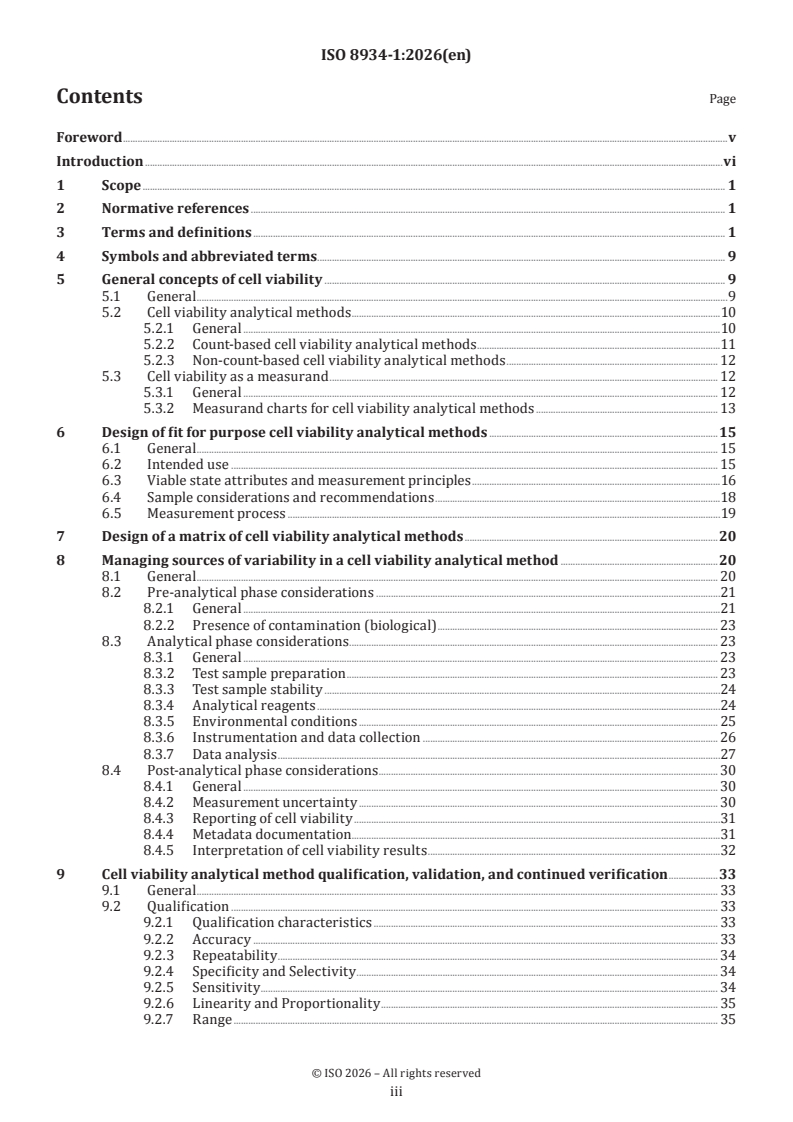
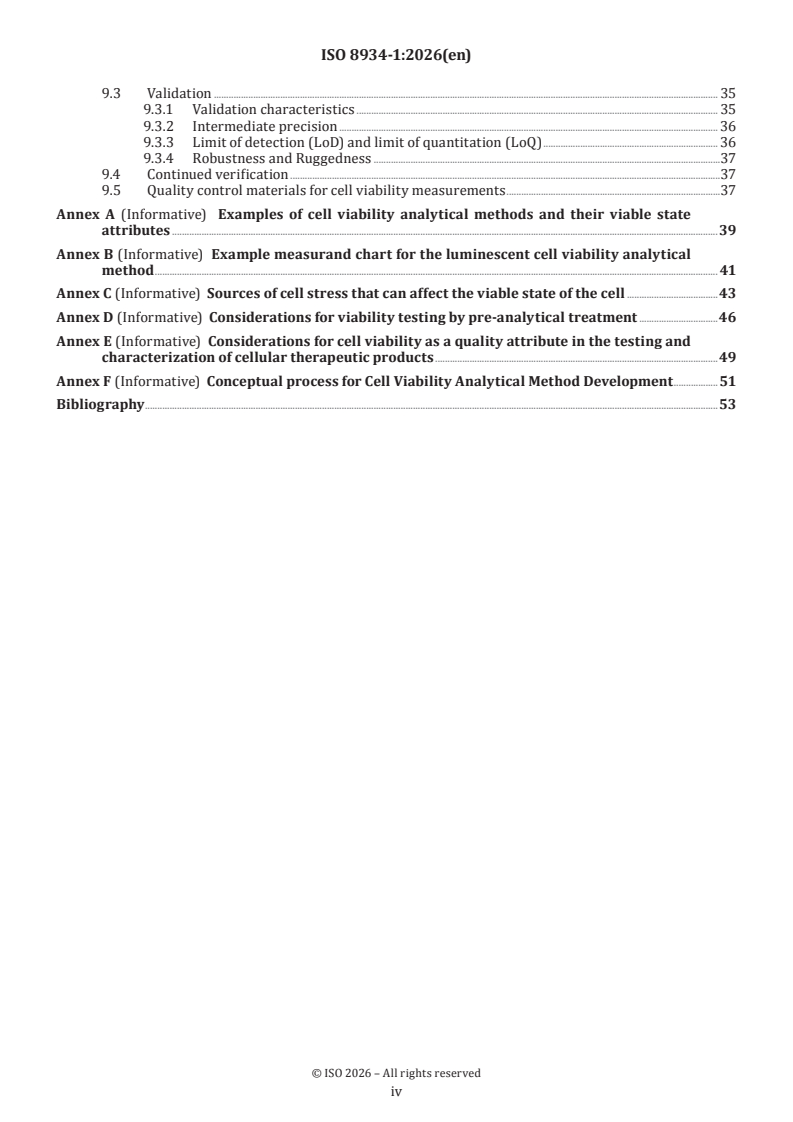
ISO 8934-1:2026 is an ISO standard from biotechnology that sets general requirements and considerations for cell viability analytical methods. It tells users how to select a fit-for-purpose method, establish standard operating procedures (SOPs), manage variability, qualify and validate the method, and report cell viability for cells in suspension, cells adhered to a substrate, and cells in complex matrices, mainly for nucleated mammalian cells. It is written for laboratories and organizations that need consistent cell viability measurements for research, manufacturing, and release decisions.
What does ISO 8934-1:2026 specify?
ISO 8934-1:2026 specifies the general requirements for cell viability analytical methods and for reporting cell viability. It also gives guidance for choosing a method that fits the intended use, and for controlling variability across the pre-analytical, analytical, and post-analytical phases.
The document is organized into clauses 1 to 9, followed by informative annexes A to F. The main flow is: scope, terms, concepts of cell viability, design of fit-for-purpose methods, design of a matrix of methods, variability management, and qualification, validation, and continued verification.
| Annex | What it covers |
|---|---|
| Annex A | Examples of cell viability analytical methods and the viable state attributes they evaluate |
| Annex B | Example measurand chart for the luminescent cell viability analytical method |
| Annex C | Sources of cell stress that can affect the viable state of the cell |
| Annex D | Considerations for viability testing by pre-analytical treatment |
| Annex E | Cell viability as a quality attribute in testing and characterization of cellular therapeutic products |
| Annex F | Conceptual process for Cell Viability Analytical Method Development |
What are the key requirements of ISO 8934-1:2026?
ISO 8934-1:2026 is built around a fit-for-purpose approach. In practice, that means the user must define the intended use first, then choose the viable state attribute, measurement principle, sample handling, and measurement process that suit that use.
Document the intended use and design around it
Clause 6.2 says the intended use of a cell viability measurement shall be documented. Examples include release testing, storage and transport stability testing, starting material characterization, cell expansion monitoring, bioprocess monitoring, cytotoxicity testing, analytical method normalization, and cell passaging.
That matters because performance needs change with the use case. A method for early upstream samples may need different sensitivity, automation, sample volume, or ability to separate nucleated cells from debris than a method used for purified material or final release.
Select the viable state attribute and measurement principle
Clause 6.3 requires the selected viable state attribute(s) and the measurement principle to be documented. The standard treats viability as based on one or more attributes linked to the viable state, such as membrane integrity, metabolic activity, molecular markers of injury, proliferative capacity, adhesion, motility, morphology, or mechanical response.
In practice, this means the user must be clear about what the method is really measuring. Two methods can both be called “viability” methods but produce different results if one tracks membrane integrity and another tracks metabolic activity.
Define the sample conditions that can affect the result
Clause 6.4 and Clause 8 stress that sample properties can strongly affect cell viability measurements. The document highlights cell concentration, cell type, medium, matrix, debris, aggregation, heterogeneity, donor variability, storage conditions, contamination, and the timing of the measurement after a traumatic event such as cryopreservation or electroporation.
This matters because the same method can behave differently on fresh cells, thawed cells, primary tissue-derived cells, bioreactor samples, cell lines, or cells in engineered matrices. The method should be chosen and, if needed, adjusted so that the sample still represents the process or product being assessed.
Use a measurement process that matches the analytical need
Clause 6.5 says the instrument and data collection approach should be fit for the intended use, with attention to specificity, sensitivity, range, linearity or proportionality, repeatability, reproducibility, and accuracy. It also lists practical factors such as cost, maintenance, calibration, throughput, automation, reference materials, traceability, time per assay, and data handling.
For users, this is a selection framework. A method is not just chosen for technical performance; it must also work operationally in the lab or manufacturing setting where it will be used.
Manage variability across all phases and document the controls
Clause 8 breaks the measurement process into pre-analytical, analytical, and post-analytical phases, and says sources of variability should be evaluated, documented, and managed. It also expects strategies for monitoring and verification, plus replication, randomization, and, where appropriate, blinding.
That means the user should control what happens before measurement, during sample preparation and data collection, and after the result is generated. The standard also points to documenting uncertainty, metadata, and interpretation so results can be defended and compared.
Use method matrices when one method is not enough
Clause 7 allows a matrix of complementary cell viability analytical methods when a single method does not give an adequate view of the sample. The methods should be run on comparable samples so the data can be combined or interpreted together.
This is important when viability has more than one relevant dimension. Results from different methods may not be linearly correlated, so they may be cumulative rather than confirmatory.
Plan qualification, validation, and continued verification
Clause 9 requires a qualification or validation plan based on intended use, followed by continued verification during routine use. The clause covers accuracy, repeatability, specificity, selectivity, sensitivity, linearity, proportionality, range, intermediate precision, limit of detection (LoD), limit of quantitation (LoQ), robustness, and ruggedness.
For the reader, this is the quality control backbone of the method. It tells you what needs to be shown before routine use and what must keep being checked afterward, especially if new sample types or unknown characteristics are introduced.
Use quality control materials appropriately
Clause 9.5 discusses quality control materials (QCMs) and in-house reference materials. They should represent nominally viable, nominally non-viable, or other relevant viable states, and they can be created by processes such as thermal, chemical, mechanical, light, or nutrient stress.
This matters because a control material should challenge the method in a realistic way. The standard also warns that beads or cell-like particles may help with some instrument checks but are not always representative of real cells.
What terms does ISO 8934-1:2026 define?
- Cell viability analytical method - an investigative procedure for measuring or assessing viable cells, non-viable cells, other viable-state-related categories, or their ratio.
- Viable state - the condition of cells related to one or more attributes of being alive.
- Viable state attribute - a physical, biochemical, or biological property that indicates the viable state of the cell(s).
- Intended use - the use for which the product, process, or service is intended according to supplied specifications or instructions.
- Fit for purpose - aligned with prearranged requirements for the intended use.
- Standard operating procedure (SOP) - a written procedure for repetitive use, aimed at obtaining a desired outcome.
- Quality control material (QCM) - a reference material used for quality control of a measurement.
Who uses ISO 8934-1:2026?
ISO 8934-1:2026 is intended for biotechnology users who measure cell viability in research, development, manufacturing, and quality control. The introduction names basic research, drug discovery, toxicity testing, manufacturing control, and release testing for cell banks, biological products, and cellular therapeutic products.
In practice, the standard is useful to method developers, analytical scientists, quality managers, validation teams, production and bioprocess engineers, and buyers or technical evaluators who need to choose a viability method for a specific workflow. It is especially relevant where cell quality, dose, potency, or process control depends on how viability is measured and reported.
Which standards are used with ISO 8934-1:2026?
ISO 8934-1:2026 cites several related standards and guidance documents that support its terminology and method design.
- ISO 8934-2 - referenced for experimental designs for cell count-based cell viability analytical methods and for additional QCM preparation information.
- ISO 23033:2021 - provides the broader framework for analytical methods for cellular therapeutic products and is used in Annex E for terminology and quality-attribute context.
- ISO 20391-1:2018 - provides general guidance on cell counting and is a source for several counting-related terms used in the document.
- ISO 20391-2:2018 - provides experimental design and statistical analysis guidance for quantifying counting method performance.
- ISO Guide 80 - used as the basis for preparing QCMs in Clause 9.5.
What does the ISO 8934-1:2026 document contain?
ISO 8934-1:2026 contains a structured explanation of cell viability as a measurand, including count-based and non-count-based approaches, and the relationship between viability, viable cells, and the viable state. It includes a practical framework for selecting a method based on intended use, sample properties, and measurement process constraints.
The document also contains detailed guidance on managing variability across pre-analytical, analytical, and post-analytical phases, plus qualification, validation, and continued verification of the method. Annex A lists example methods such as dye exclusion, metabolic assays, imaging-based approaches, and electrical or signal-based approaches; Annex B gives an example measurand chart; Annex C and Annex D focus on stress and pre-analytical treatment; Annex E relates the standard to cellular therapeutic products; and Annex F shows the conceptual development process.
Frequently Asked Questions
ISO 8934-1:2026 is a standard published by the International Organization for Standardization (ISO). Its full title is "Biotechnology — Cell viability analytical methods — Part 1: General requirements and considerations". This standard covers: This document specifies the general requirements for cell viability analytical methods and for reporting cell viability. This document gives general guidelines for selecting and establishing fit for purpose cell viability analytical methods. This document specifies requirements for establishing standard operating procedures for cell viability analytical methods. This document also gives guidelines for managing sources of variability for cell viability measurements during pre-analytical, analytical, and post-analytical phases. This document is applicable to cells in suspension, cells adhered to a substrate, and cells in complex matrices. This document is primarily applicable to cell viability measurements of nucleated mammalian cells. NOTE 1 Several sector/application-specific international and national standards for cell viability currently exist. NOTE 2 When applicable, the user can consult existing standards when operating within their scope.
This document specifies the general requirements for cell viability analytical methods and for reporting cell viability. This document gives general guidelines for selecting and establishing fit for purpose cell viability analytical methods. This document specifies requirements for establishing standard operating procedures for cell viability analytical methods. This document also gives guidelines for managing sources of variability for cell viability measurements during pre-analytical, analytical, and post-analytical phases. This document is applicable to cells in suspension, cells adhered to a substrate, and cells in complex matrices. This document is primarily applicable to cell viability measurements of nucleated mammalian cells. NOTE 1 Several sector/application-specific international and national standards for cell viability currently exist. NOTE 2 When applicable, the user can consult existing standards when operating within their scope.
ISO 8934-1:2026 is classified under the following ICS (International Classification for Standards) categories: 07.080 - Biology. Botany. Zoology. The ICS classification helps identify the subject area and facilitates finding related standards.
ISO 8934-1:2026 is available in PDF format for immediate download after purchase. The document can be added to your cart and obtained through the secure checkout process. Digital delivery ensures instant access to the complete standard document.
Standards Content (Sample)
Contents
- Introduction
- 1 Scope
- 2 Normative references
- 3 Terms and definitions
- 3.1 analytical method
- 3.2 analytical method matrix
- 3.3 attribute
- 3.4 attribute component
- 3.5 biological property
- 3.6 bioprocessing monitoring mode
- 3.7 calibration
- 3.8 cell concentration
- 3.9 cell count
- 3.10 cell death
- 3.11 cell viability analytical method
- 3.12 examinand
- 3.13 examination
- 3.14 fit for purpose
- 3.15 in-house reference material
- 3.16 installation qualification
- 3.17 intended use
- 3.18 intermediate measurand
- 3.19 intermediate precision
- 3.20 limit of detection
- 3.21 limit of quantitation
- 3.22 measurand
- 3.23 measurement principle
- 3.24 measurement target
- 3.25 membrane integrity
- 3.26 metadata
- 3.27 nominal property
- 3.28 operational qualification
- 3.29 performance criteria
- 3.30 performance qualification
- 3.31 precision
- 3.32 quality attribute
- 3.33 quality control material
- 3.34 quantity
- 3.35 quantity formula
- 3.36 quantity value
- 3.37 reference material
- 3.38 repeatability
- 3.39 representative sample
- 3.40 reproducibility
- 3.41 robustness
- 3.42 ruggedness
- 3.43 sample
- 3.44 sensitivity
- 3.45 specification
- 3.46 specificity
- 3.47 stability
- 3.48 standard operating procedure
- 3.49 test method
- 3.50 test sample
- 3.51 validation
- 3.52 verification
- 3.53 viability
- 3.54 viable cells
- 3.55 viable state
- 3.56 viable state attribute
- 4 Symbols and abbreviated terms
- 5 General concepts of cell viability
- 5.1 General
- 5.2 Cell viability analytical methods
- 5.3 Cell viability as a measurand
- 6 Design of fit for purpose cell viability analytical methods
- 6.1 General
- 6.2 Intended use
- 6.3 Viable state attributes and measurement principles
- 6.4 Sample considerations and recommendations
- 6.5 Measurement process
- 7 Design of a matrix of cell viability analytical methods
- 8 Managing sources of variability in a cell viability analytical method
- 8.1 General
- 8.2 Pre-analytical phase considerations
- 8.3 Analytical phase considerations
- 8.4 Post-analytical phase considerations
- 9 Cell viability analytical method qualification, validation, and continued
- 9.1 General
- 9.2 Qualification
Introduction
Evaluation of cell viability is a fundamental measurement in biotechnology. Cell viability measurements are widely and routinely used in basic research, drug discovery, toxicity testing, manufacturing control and release testing for cell banks, biological products, and cellular therapeutic products. Cell viability can be important in ensuring the safety and efficacy of cellular therapeutic products, in determining cell dose and product potency in cellular therapeutic products, and in the manufacturing and control of cell-based products and products derived from cells.
A quantity value for cell viability can be determined through a broad range of analytical methods evaluating different attributes related to the viable state of the cell(s). Several biological properties, or attributes, serve as the targets for identifying the viable state of the cell(s), and can be used to determine the viability status of cells. Examples include observations of the cell’s membrane integrity, metabolic activity, nuclear morphology, and a cell’s ability to replicate. Cell viability can also refer to different quantities related to viable and non-viable cells including percent cell viability, viable cell concentration, and signals related to the viable state. There is also a wide range of instrumentation used in the measurement of cell viability, including image based, flow cytometry based, spectrophotometric, and electrical signal-based approaches. Given the wide range of analytical methods associated with cell viability, it is often challenging to compare cell viability results from different analytical methods without additional knowledge regarding the viable state attribute investigated or the analytical method that was conducted. In addition, different applications require the use of different cell viability analytical methods that are compatible with or relevant to the intended use. Although cell viability standards exist, these standards are either test method specific, test article specific, sector specific or region specific. Existing standards do not address the general need of establishing common terminology for cell viability, considerations for fit for purpose cell viability analytical method development and the reporting of cell viability measurement results. This document establishes a common approach for defining fit for purpose cell viability analytical methods to facilitate common understanding between users of the standard. This document provides general concepts and terminology for cell viability measurements, provides considerations for measurement control strategies and validation strategies, and considerations for establishing cell viability analytical method standard operating procedures. This document also includes the establishment of a common framework for reporting cell viability measurements.
This document is intended for a broad and worldwide industry where the quality and viability of cells are critical for research and product development.
This part of the ISO 8934 series is focused primarily on mammalian cells.
International Standard ISO 8934-1:2026(en) Biotechnology — Cell viability analytical methods — Part 1:
General requirements and considerations
1 Scope
This document specifies the general requirements for cell viability analytical methods and for reporting cell viability. This document gives general guidelines for selecting and establishing fit for purpose cell viability analytical methods. This document specifies requirements for establishing standard operating procedures for cell viability analytical methods. This document also gives guidelines for managing sources of variability for cell viability measurements during pre-analytical, analytical, and post-analytical phases. This document is applicable to cells in suspension, cells adhered to a substrate, and cells in complex matrices. This document is primarily applicable to cell viability measurements of nucleated mammalian cells. NOTE 1 Several sector/application-specific international and national standards for cell viability currently exist. NOTE 2 When applicable, the user can consult existing standards when operating within their scope.
2 Normative references
There are no normative references in this document.
3 Terms and definitions
For the purposes of this document, the following terms and definitions apply. ISO and IEC maintain terminology databases for use in standardization at the following addresses:
- ISO Online browsing platform: available at https:// www .iso .org/ obp
- IEC Electropedia: available at https:// www .electropedia .org/
3.1 analytical method
investigative procedure for qualitatively or quantitatively measuring or assessing the presence, amount, or functional activity of a target entity (the analyte) [SOURCE: ISO 23033:2021, 3.3]
3.2 analytical method matrix
set of two or more complementary analytical methods (3.1) to measure different aspects of a quality attribute (3.32) [SOURCE: ISO 23033:2021, 3.7]
3.3 attribute
physical, chemical, biological, or microbiological property or characteristic [SOURCE: ISO 20391-1:2018, 3.5]
ISO 8934-1:2026(en)
3.4 attribute component
quantity used to derive a quality attribute (3.32) [SOURCE: ISO 23033:2021, 3.9]
3.5 biological property
biological phenomenon that is evaluated to assess the quality attribute (3.32) [SOURCE: ISO 23033:2021, 3.11]
3.6 bioprocessing monitoring mode
spatio-temporal position of a measurement device (i.e. sensor) or measurement process in relation to a bioreactor or vessel
3.7 calibration
operation that, under specified conditions in a first step, establishes a relation between the quantity (3.34) values with measurement uncertainties provided by measurement standards and corresponding indications with associated measurement uncertainties and, in a second step, uses this information to establish a relation for obtaining a measurement result from an indication [SOURCE: ISO/IEC Guide 99:2007, 2.39, modified — Notes to entry deleted.]
3.8 cell concentration
cell count (3.9) per volume Note 1 to entry: Typically used for cells in suspension.
[SOURCE: ISO 20391-1:2018, 3.6]
3.9 cell count
discrete number of cells Note 1 to entry: Cell count is typically expressed as cell concentration (3.8) or area density. [SOURCE: ISO 20391-1:2018, 3.7]
3.10 cell death
state of irreversible degeneration of vital cellular functions culminating in the loss of cellular integrity Note 1 to entry: Definition based on Reference [5].
3.11 cell viability analytical method
investigative procedure for measuring or assessing the presence, amount, or functional activity of viable cells (3.53), non-viable cells, other category related to viable state (3.55), or ratio thereof
3.12 examinand
nominal property (3.27) intended to be examined Note 1 to entry: Definition based on Reference [7].
ISO 8934-1:2026(en)
3.13 examination
process of experimentally obtaining one or more values that can reasonably be attributed to a nominal property (3.27) together with any other available relevant information Note 1 to entry: Definition based on Reference [7].
3.14 fit for purpose
in line with prearranged requirements for an intended use (3.17) [SOURCE: ISO 20387:2018, 3.24, modified — Note to entry deleted.]
3.15 in-house reference material
non-certified material or substance, produced by one laboratory, one or more of whose property values are sufficiently homogeneous and well established to be used for the intended use (3.17) Note 1 to entry: The use of in-house reference materials can include, but is not limited to, validation (3.51), calibration (3.7), monitoring of comparability, and potency and process evaluations. [SOURCE: ISO 23033:2021, 3.24]
3.16 installation qualification
IQ establishing by objective evidence that all key aspects of the process equipment and ancillary system installation adhere to the manufacturer’s approved specification (3.45) and that the recommendations of the supplier of the equipment are suitably considered [SOURCE: ISO 23033:2021, 3.25]
3.17 intended use
use for which a product, process, or service is intended according to the specifications (3.45), instructions or information or multiple of them provided by the manufacturer or user [SOURCE: ISO 23033:2021, 3.26]
3.18 intermediate measurand
measurand (3.22) that is obtained as a part of the analytical method (3.1) where the quantity value (3.36) is utilized by the user of the analytical method (3.1) but not reported as a quantity value (3.36) for the reported measurand
3.19 intermediate precision
measurement precision under a set of intermediate precision (3.31) conditions Note 1 to entry: The intermediate precision condition refers to the condition of measurement, out of a set of conditions that includes the same measurement procedure, same location, and replicate measurements on the same or similar objects over an extended period of time but can include other conditions involving changes (e.g. analyst or instrument). [SOURCE: ISO/IEC Guide 99:2007, 2.23, modified — “measurement” was deleted from the term, note 1 to entry has been added.]
3.20 limit of detection
lowest amount of analyte in a sample (3.43) which can be detected but not necessarily quantitated as an exact value [SOURCE: ISO 23033:2021, 3.29]
ISO 8934-1:2026(en)
3.21 limit of quantitation
lowest amount of analyte in a sample (3.43) which can be quantitatively determined with suitable precision (3.31) and accuracy Note 1 to entry: The limit of quantitation is a parameter of quantitative analytical methods (3.1) for low levels of compounds in sample (3.43) matrices and is used particularly for the determination of impurities (3.23) or degradation products or both.
[SOURCE: ISO 23033:2021, 3.30]
3.22 measurand
quantity (3.34) intended to be measured [SOURCE: ISO/IEC Guide 99:2007, 2.3, modified — Notes to entry and examples deleted.]
3.23 measurement principle
phenomenon serving as a basis of a measurement Note 1 to entry: The phenomenon can be of a physical, chemical, or biological in nature. [SOURCE: ISO/IEC Guide 99:2007, 2.4, modified — Notes to entry and examples have been deleted.]
3.24 measurement target
intended object of measurement Note 1 to entry: A measurement target can denote a feature or complex features of cells that is informative of cellular status or quality. The term is additional to the term analyte or measurand (3.22) in situations where the use of those terms is not appropriate or possible.
Note 2 to entry: A measurement target can include both a measurand (3.22) and examinand (3.12). [SOURCE: ISO 23033:2021, 3.21, modified – Notes to entry added]
3.25 membrane integrity
ability of a cell membrane to generate or maintain gradients of the concentration of specific target molecules in solution Note 1 to entry: Membrane integrity indicates metabolic activity of the cell but is not related to proliferation potential. Note 2 to entry: The result of a membrane integrity test depends on the selected molecule.
3.26 metadata
data that define and describe other data [SOURCE: ISO/IEC 11179-1:2023, 3.2.26]
3.27 nominal property
property of a phenomenon, body, or substance, where the property has no magnitude Note 1 to entry: The nominal property is one for which only comparability by equivalence applies. [SOURCE: ISO/IEC Guide 99:2007, 1.30, modified — Notes to entry and examples deleted.]
ISO 8934-1:2026(en)
3.28 operational qualification
OQ establishing by objective evidence process control limits and action levels which result in an analytical method (3.1) that meets all predetermined requirements [SOURCE: ISO 23033:2021, 3.33]
3.29 performance criteria
required functionality and behaviour of the test method (3.49) [SOURCE: ISO 23033:2021, 3.34]
3.30 performance qualification
PQ establishing by objective evidence that the analytical method (3.1), under anticipated conditions, consistently meets all predetermined requirements [SOURCE: ISO 23033:2021, 3.35]
3.31 precision
closeness of agreement between indications or measured quantity (3.34) values obtained by replicate measurements on the same or similar objects under specified conditions Note 1 to entry: Precision is usually expressed numerically by measures of imprecision, such as standard deviation, variance, or coefficient of variation under the specified conditions of measurement. Note 2 to entry: The 'specified conditions' can be, for example, repeatability (3.38) conditions of measurement, intermediate precision (3.19) conditions of measurement, or reproducibility (3.40) conditions of measurement. Note 3 to entry: Measured quantity value (3.36) refers to the quantity (3.34) value representing a measurement result. [SOURCE: ISO/IEC Guide 99:2007, 2.15, modified — Term “measurement precision” was deleted and Notes 3 and 4 to entry were deleted.]
3.32 quality attribute
physical, chemical, biological, or microbiological property or characteristic that is an indicator of the quality [SOURCE: ISO 23033:2021, 3.38]
3.33 quality control material
QCM reference material (3.37) used for quality control of a measurement [SOURCE: ISO Guide 30: 2015, 2.1.22]
3.34 quantity
property of a phenomenon, body, or substance, where the property has a magnitude that can be expressed as a number and a reference [SOURCE: ISO/IEC Guide 99:2007, 1.1, modified — Notes to entry and example were deleted.]
ISO 8934-1:2026(en)
3.35 quantity formula
mathematical relation among quantities (3.34) in a given system of quantities, independent of measurement units [SOURCE: ISO/IEC Guide 99:2007, 1.22, modified — notes and examples were deleted and term changed to "quantity formula".]
3.36 quantity value
value of a quantity number and reference together expressing magnitude of a quantity (3.34) [SOURCE: ISO/IEC Guide 99:2007, 1.19, modified — Notes to entry and examples were deleted.]
3.37 reference material
material, sufficiently homogeneous and stable with reference to specified properties, which has been established to be fit for its intended use (3.17) in measurement or in examination (3.13) of nominal properties (3.27) [SOURCE: ISO/IEC Guide 99:2007, 5.13, modified — Notes to entry and examples deleted.]
3.38 repeatability
precision (3.31) of measurement under a set of repeatability conditions of measurement Note 1 to entry: Repeatability conditions of a measurement refers to condition of measurement, out of a set of conditions that includes the same measurement procedure, same operators, same measuring system, same operating conditions and same location, and replicate measurements on the same or similar objects over a short period of time (see ISO 23033:2021, 3.41).
[SOURCE: ISO/IEC Guide 99:2007, 2.21, modified — Term “measurement repeatability” was deleted and Note 1 to entry was added.]
3.39 representative sample
sample (3.43) that accurately represents or reflects the attributes (3.3) of the system Note 1 to entry: Generally intended to provide information on the system, often to serve as a basis for decision on the system or its production.
[SOURCE: ISO 23033:2021, 3.42]
3.40 reproducibility
precision (3.31) of measurement under reproducibility conditions of measurement Note 1 to entry: Reproducibility conditions of measurement refer to the condition of measurement, out of a set of conditions that includes different locations, operators, measuring systems, and replicate measurements on the same or similar objects.
[SOURCE: ISO/IEC Guide 99:2007, 2.25, modified — Note to entry replaced and term “measurement reproducibility” modified.]
3.41 robustness
measure of a test method (3.49) capacity to remain unaffected by small, but deliberate variations in method parameters and provides an indication of its reliability during normal usage [SOURCE: ISO 23033:2021, 3.44]
ISO 8934-1:2026(en)
3.42 ruggedness
degree of reproducibility (3.40) of test results obtained by the analysis of the same samples (3.43) under a variety of normal test conditions Note 1 to entry: Normal test conditions can include for example: different laboratories, different analysts, different instruments, different reagent lots, different analysis days, different elapsed times, different temperatures etc. [SOURCE: ISO 23033:2021, 3.45]
3.43 sample
one or more parts taken from a system [SOURCE: ISO 23033:2021, 3.46]
3.44 sensitivity
quotient of the change in an indication of a measuring system and the corresponding change in a value of a quantity (3.34) being measured [SOURCE: ISO/IEC Guide 99:2007, 4.12, modified — Notes to entry deleted and term “sensitivity of a measuring system” revised.]
3.45 specification
document stating needs or expectations that are stated, generally implied or obligatory
3.46 specificity
characteristic of a test method (3.49) that expresses qualitatively and quantitatively its ability to detect or determine an individual analyte without interferences from accompanying species [SOURCE: ISO 23033:2021, 3.48, modified – Note to entry deleted.]
3.47 stability
characteristic of a material, when stored under specified conditions, to maintain a value(s) for stated property(ies) within specified limits for a specified period of time [SOURCE: ISO/TS 20399-1:2022, 3.17]
3.48 standard operating procedure
SOP written procedure prescribed for repetitive use as a practice, in accordance with agreed-upon specifications (3.45) aimed at obtaining a desired outcome [SOURCE: ISO 21899:2020, 3.22]
3.49 test method
technical procedure used with a specified analytical method (3.1) [SOURCE: ISO 23033:2021, 3.52]
3.50 test sample
small aliquot of the sample (3.43) that is prepared for measurement in the method of interest Note 1 to entry: Generally, test samples are representative of the sample (3.43) they are prepared from and are sometimes referred to as “representative test sample(s)”.
ISO 8934-1:2026(en) [SOURCE: ISO 20391-2:2019, 3.1.35]
3.51 validation
confirmation, through the provision of objective evidence, that the requirements for a specific intended use (3.17) or application have been fulfilled [SOURCE: ISO 9000:2015, 3.8.13, modified — Notes to entry deleted.]
3.52 verification
confirmation, through the provision of objective evidence, that specified requirements have been fulfilled [SOURCE: ISO 9000:2015, 3.8.12, modified — Notes to entry deleted.]
3.53 viability
quantity or quantities (3.34) associated with the viable state (3.55)of cells within a cell sample (3.43) , that is based on the measurement of a pre-selected viable state attribute(s) (3.56) that is (are) relevant to the intended use (3.17) Note 1 to entry: The viable state (3.55) of cells can change over time and can be heterogeneous within a cell population. Thus, viability typically only represents the viable state (3.55) of a cell or of cells within a cell population at the time of measurement.
3.54 viable cells
cells within a sample (3.43) that have an attribute (3.3) or attributes (3.3) of being alive (e.g. metabolically active, capable of reproduction, possessed of intact cell membrane, or with the capacity to resume these functions) defined based on the intended use (3.17) Note 1 to entry: Non-viable cells can be considered those cells within a sample (3.43) that do not exhibit an attribute (3.3) or attributes (3.3) of being alive based on the intended use (3.17). [SOURCE: ISO 20391-1:2018, 3.29, modified — Note 1 to entry added.]
...