

ISO/TR 4752:2025
(Main)Biotechnology — Inventory of methods for detection of microbiological contamination in mammalian cell culture
General Information
- Abstract
This document provides an inventory of methods for the detection of microbiological contamination in mammalian cell culture. This document includes considerations for the selection of methods to test the presence of common contaminants such as bacteria, fungi, viruses and mycoplasma. This document is not applicable to prions and protists. This document is intended for use by biomedical researchers, biobank operators and others performing mammalian cell culture.
- Status
- Published
- Publication Date
- 05-Jun-2025
- Technical Committee
- ISO/TC 276 - Biotechnology
- Drafting Committee
- ISO/TC 276/WG 3 - Analytical methods
- Current Stage
- 6060 - International Standard published
- Start Date
- 06-Jun-2025
- Completion Date
- 06-Jun-2025
Overview
ISO/TR 4752:2025 - Biotechnology: Inventory of methods for detection of microbiological contamination in mammalian cell culture is a Technical Report (first edition, June 2025) that compiles and describes available approaches to detect microbiological contamination in mammalian cell cultures. The document provides an inventory of methods for detecting common contaminants - bacteria, fungi, viruses and mycoplasma - and gives practical considerations for selecting appropriate tests. It is expressly not applicable to prions or protists.
Key topics and technical requirements
- Scope and purpose: Presents an overview of methods rather than prescriptive, normative test requirements; intended to support risk-based testing strategies for cell culture testing and contamination monitoring.
- Detection process & general concepts: Covers principles of aseptic testing, limitations of visual inspection, and the need for risk assessment based on cell origin, reagents and intended use.
- Terms and definitions: Defines key terms used in testing workflows (e.g., accuracy, sample, sensitivity, PCR assay, dPCR, NGS, rRNA, mycoplasma).
- Contamination test information: Guidance on assessing likely contaminants using exposure history, raw materials (e.g., animal sera), and cell type.
- Critical control points: Identifies areas to control to ensure reliable detection - samples, reagents and equipment, operation, personnel and environment - supporting robust quality control and documentation.
- Annexes with exemplary methods:
- Annex A: bacteria and fungi testing methods
- Annex B: virus detection approaches
- Annex C: mycoplasma detection techniques These annexes summarize available methods and pro/con considerations without prescribing a single technique.
- Quality and documentation: Emphasizes validation, controls, data recording and the limits of testing (cannot guarantee absolute absence of all contaminants).
Practical applications
- Use this standard to develop or refine a contamination-testing regime for mammalian cell cultures used in:
- basic and translational biomedical research
- biobanking and cell repositories
- preclinical and manufacturing cell-based workflows
- Practical uses include selection of test methods (culture-based, molecular assays such as qPCR/dPCR, sequencing-based approaches), design of environmental monitoring, and establishing SOPs for routine cell culture testing and documentation.
Who will use ISO/TR 4752:2025
- Biomedical researchers, laboratory managers and technicians
- Biobank operators and custodians of cell lines
- Quality assurance personnel in academic, clinical and industrial cell-culture facilities
Related standards
Relevant ISO references cited in the report include standards for terminology and methods such as ISO 11139, ISO 20395, ISO 20397 (NGS/MPS), and environmental guidance like ISO 16000‑44 and ISO 11057.
Keywords: ISO/TR 4752:2025, microbiological contamination, mammalian cell culture, mycoplasma detection, virus detection, bacteria and fungi testing, cell culture testing, contamination monitoring, PCR, dPCR, NGS.
Frequently Asked Questions
ISO/TR 4752:2025 is a technical report published by the International Organization for Standardization (ISO). Its full title is "Biotechnology — Inventory of methods for detection of microbiological contamination in mammalian cell culture". This standard covers: This document provides an inventory of methods for the detection of microbiological contamination in mammalian cell culture. This document includes considerations for the selection of methods to test the presence of common contaminants such as bacteria, fungi, viruses and mycoplasma. This document is not applicable to prions and protists. This document is intended for use by biomedical researchers, biobank operators and others performing mammalian cell culture.
This document provides an inventory of methods for the detection of microbiological contamination in mammalian cell culture. This document includes considerations for the selection of methods to test the presence of common contaminants such as bacteria, fungi, viruses and mycoplasma. This document is not applicable to prions and protists. This document is intended for use by biomedical researchers, biobank operators and others performing mammalian cell culture.
ISO/TR 4752:2025 is classified under the following ICS (International Classification for Standards) categories: 07.080 - Biology. Botany. Zoology. The ICS classification helps identify the subject area and facilitates finding related standards.
ISO/TR 4752:2025 is available in PDF format for immediate download after purchase. The document can be added to your cart and obtained through the secure checkout process. Digital delivery ensures instant access to the complete standard document.
Standards Content (Sample)
Technical
Report
ISO/TR 4752
First edition
Biotechnology — Inventory
2025-06
of methods for detection of
microbiological contamination in
mammalian cell culture
Biotechnologie — Inventaire des méthodes pour la détection de
la contamination microbiologique dans la culture cellulaire de
mammifères
Reference number
© ISO 2025
All rights reserved. Unless otherwise specified, or required in the context of its implementation, no part of this publication may
be reproduced or utilized otherwise in any form or by any means, electronic or mechanical, including photocopying, or posting on
the internet or an intranet, without prior written permission. Permission can be requested from either ISO at the address below
or ISO’s member body in the country of the requester.
ISO copyright office
CP 401 • Ch. de Blandonnet 8
CH-1214 Vernier, Geneva
Phone: +41 22 749 01 11
Email: copyright@iso.org
Website: www.iso.org
Published in Switzerland
ii
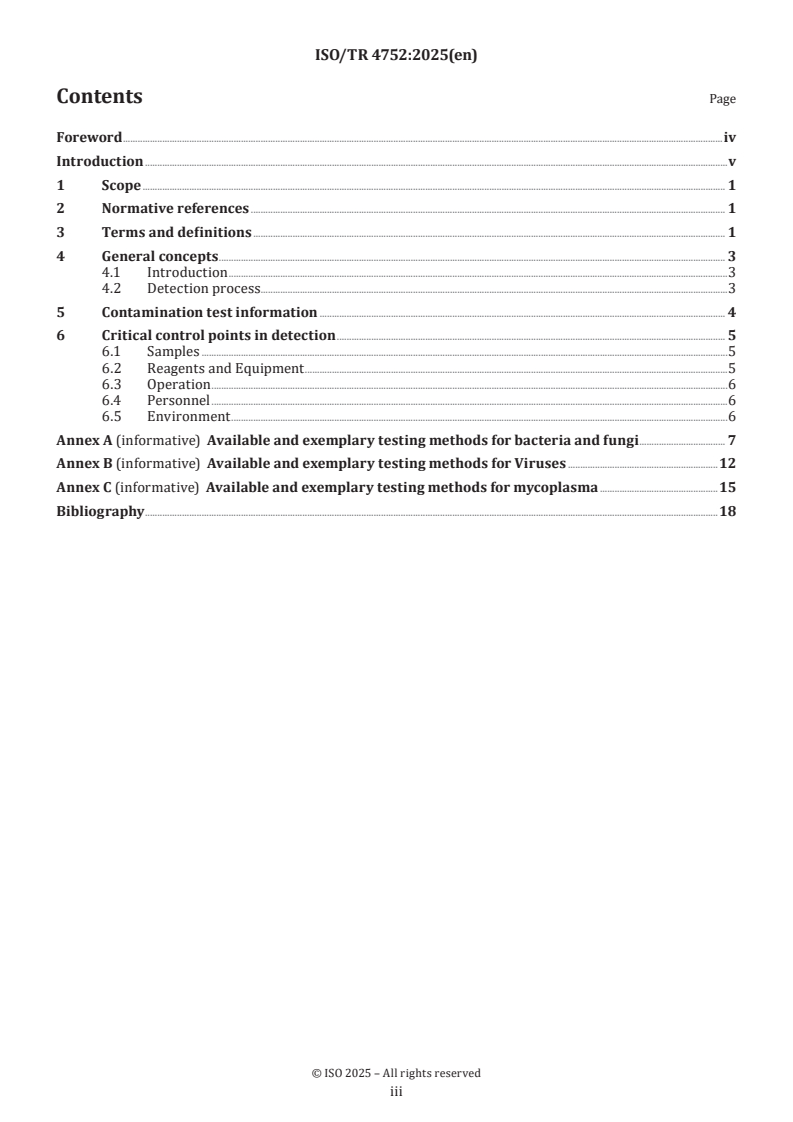
Contents Page
Foreword .iv
Introduction .v
1 Scope . 1
2 Normative references . 1
3 Terms and definitions . 1
4 General concepts . 3
4.1 Introduction .3
4.2 Detection process.3
5 Contamination test information . 4
6 Critical control points in detection . 5
6.1 Samples .5
6.2 Reagents and Equipment .5
6.3 Operation .6
6.4 Personnel .6
6.5 Environment .6
Annex A (informative) Available and exemplary testing methods for bacteria and fungi . 7
Annex B (informative) Available and exemplary testing methods for Viruses .12
Annex C (informative) Available and exemplary testing methods for mycoplasma .15
Bibliography .18
iii
Foreword
ISO (the International Organization for Standardization) is a worldwide federation of national standards
bodies (ISO member bodies). The work of preparing International Standards is normally carried out through
ISO technical committees. Each member body interested in a subject for which a technical committee
has been established has the right to be represented on that committee. International organizations,
governmental and non-governmental, in liaison with ISO, also take part in the work. ISO collaborates closely
with the International Electrotechnical Commission (IEC) on all matters of electrotechnical standardization.
The procedures used to develop this document and those intended for its further maintenance are described
in the ISO/IEC Directives, Part 1. In particular, the different approval criteria needed for the different types
of ISO document should be noted. This document was drafted in accordance with the editorial rules of the
ISO/IEC Directives, Part 2 (see www.iso.org/directives).
ISO draws attention to the possibility that the implementation of this document may involve the use of (a)
patent(s). ISO takes no position concerning the evidence, validity or applicability of any claimed patent
rights in respect thereof. As of the date of publication of this document, ISO had not received notice of (a)
patent(s) which may be required to implement this document. However, implementers are cautioned that
this may not represent the latest information, which may be obtained from the patent database available at
www.iso.org/patents. ISO shall not be held responsible for identifying any or all such patent rights.
Any trade name used in this document is information given for the convenience of users and does not
constitute an endorsement.
For an explanation of the voluntary nature of standards, the meaning of ISO specific terms and expressions
related to conformity assessment, as well as information about ISO's adherence to the World Trade
Organization (WTO) principles in the Technical Barriers to Trade (TBT), see www.iso.org/iso/foreword.html.
The document was prepared by Technical Committee ISO/TC 276, Biotechnology, Subcommittee SC 1,
Analytical methods.
Any feedback or questions on this document should be directed to the user’s national standards body. A
complete listing of these bodies can be found at www.iso.org/members.html.
iv
Introduction
Cell culture plays an extremely important role in biotechnology and life science research. Therefore, the
reliability of scientific data from cell culture is essential. One of the most common problems in cell culture
is microbiological contamination. This usually results in catastrophic cell death or contamination sustained
at low levels (sometimes due to the use of antibiotics), and thus impacts the reliability of experimental data
derived from cell culture. Nonetheless, despite its prevalence and importance, the lack of open discussion
discourages development and learning of best practices to avoid microbial contamination in cell culture.
Microbial contamination is an economic issue as it affects the reproducibility of scientific data, the efficiency
of in vitro cell culture work and most importantly, the safety of laboratory operators. It is therefore
necessary to monitor microbial contamination through a full understanding of the source of contamination
and employ good testing techniques before and during cell culture.
When cultured cells have been contaminated, first the various aspects of the contamination are identified,
including the nature of contamination, the time of contamination and the operating environment.
Contaminants can include bacteria, fungi, mycoplasma, viruses and other types of organisms. In order to
demonstrate the absence of microbiological contamination in cell culture, it can be necessary to conduct a
series of tests for likely organisms and such an approach will benefit from risk assessment of the cell type,
cell origin and reagents used for their culture.
Environmental monitoring in areas where cells are cultured and stored can reduce the risk of microbial
contamination from the processing environment.
This document provides an inventory of methods for the detection of microbiological contamination in
mammalian cell culture in order to provide users with an overview that also includes information on pro-
and contra indications for the listed methods in relation to the appropriate sample type.
v
Technical Report ISO/TR 4752:2025(en)
Biotechnology — Inventory of methods for detection of
microbiological contamination in mammalian cell culture
1 Scope
This document provides an inventory of methods for the detection of microbiological contamination in
mammalian cell culture. This document includes considerations for the selection of methods to test the
presence of common contaminants such as bacteria, fungi, viruses and mycoplasma. This document is not
applicable to prions and protists.
This document is intended for use by biomedical researchers, biobank operators and others performing
mammalian cell culture.
2 Normative references
There are no normative references in this document.
3 Terms and definitions
For the purposes of this document, the following terms and definitions apply.
ISO and IEC maintain terminology databases for use in standardization at the following addresses:
— ISO Online browsing platform: available at https:// www .iso .org/ obp
— IEC Electropedia: available at https:// www .electropedia .org/
3.1
accuracy
closeness of agreement between a measured quantity value and the true quantity value of a measurand
[SOURCE: ISO/IEC Guide 99:2007, 2.13, modified — Notes to entry deleted.]
3.2
digital PCR
dPCR
procedure in which nucleic acid templates are distributed across multiple partitions of nominally equivalent
volume, such that some partitions contain template and others do not, followed by PCR amplification of
target sequences and detection of specific PCR products, providing a count of the number of partitions with
a positive and negative signal for the target template
Note 1 to entry: Nucleic acid target sequences are assumed to be randomly and independently distributed across the
partitions during the partitioning process.
Note 2 to entry: The count of positive and negative partitions is normally based on end point detection of PCR products
following thermal cycling, however real-time qPCR monitoring of PCR product accumulation is additionally possible
for some dPCR platforms.
[SOURCE: ISO 20395:2019, 3.10]
3.3
intended use
intended purpose
use for which a product, process, or service is intended according to the specifications, instructions or
information or multiple of them provided by the manufacturer or user
[SOURCE: ISO 23033:2021, 3.26]
3.4
microbial contamination
presence of unintended bacteria, fungi, mycoplasma, or viruses
[SOURCE: ISO 11139:2018, 3.171]
3.5
next generation sequencing
NGS
non-Sanger-based high-throughput nucleic acid sequencing
Note 1 to entry: Millions or billions of nucleic acid strands can be sequenced in parallel, yielding substantially more
throughput.
Note 2 to entry: NGS (next-generation-sequencing) is also well recognized as MPS (massively parallel sequencing) in
the ISO 20397 series.
Note 3 to entry: MPS or NGS covers long read sequencing and short read sequencing.
[SOURCE: ISO/DIS 20397-3:2024, 3.16]
3.6
PCR assay
qPCR or dPCR (3.2) measurement method with specified oligonucleotide primers (and, in some cases, a
probe or probes) that is used to identify or quantify a nucleic acid target
[SOURCE: ISO 20395:2019, 3.23]
3.7
reagent
substance used in chemical/biochemical analysis or other reaction
[SOURCE: ISO 20391-1:2018, 3.19]
3.8
resolution
smallest change in a quantity being measured that causes a perceptible change in the corresponding
indication
Note 1 to entry: Resolution can depend on, for example, ratio of signal and noise (internal or external). It can also
depend on the value of a quantity being measured.
[SOURCE: JCGM 200:2012, 4.14, modified — Friction not mentioned in Note 1 to entry.]
3.9
ribosomal RNA
rRNA
non-coding ribonucleic acid contained in ribosomes
Note 1 to entry: The nucleotide sequence of rRNA subunits can be used to detect microorganisms (e.g. 16S rRNA, 18S rRNA).
3.10
sample
one or more parts taken from a system
[SOURCE: ISO 23033:2021, 3.46]
3.11
sensitivity
quotient of the change in an indication of a measuring system and the corresponding change in a value of a
quantity being measured
Note 1 to entry: Sensitivity of a measuring system can depend on the value of the quantity being measured.
Note 2 to entry: The change considered in a value of a quantity being measured must be large compared with the
resolution.
[SOURCE: ISO/IEC Guide 99:2007, 4.12, modified — "sensitivity" is given as the only preferred term.]
3.12
test sample
small aliquot of the sample that is prepared for measurement in the method of interest
Note 1 to entry: Generally, test samples are representative of the sample they are prepared from and are sometimes
referred to as “representative test sample(s)”.
[SOURCE: ISO 20391-2:2019, 3.36]
3.13
validation
confirmation, through the provision of objective evidence, that the requirements for a specific intended use
or application have been fulfilled
[SOURCE: ISO 23033:2021, 3.54]
4 General concepts
4.1 Introduction
Contamination of cell culture can produce adverse effects in cell phenotype and quality, as well as
applications in research and development including clinical studies, stem cell manufacturing etc.
Diverse methods and techniques have been developed for laboratory monitoring and testing of microbial
contaminants. Many microbial contaminants especially coarse contamination by bacteria and fungi can
lead to significant abnormalities in cell viability and appearance, which can be visually observed by the
naked eye or under a microscope. However, many contaminants such as low levels of bacteria and fungi,
mycoplasma and viruses cannot be detected by changes in cell appearance and cell culture medium through
direct observation. Thus, appropriate techniques are used for testing microbial contaminants based on the
characteristics of the microbial contaminants and laboratory facilities.
4.2 Detection process
The detection of microbiological contamination in mammalian cell cultures is carried out under aseptic
conditions.
NOTE 1 Air quality of the testing environment can be defined according to ISO standards for certain regulated
[33,34]
applications. Further guidance is given in ISO 16000-44 and ISO 11057 .
The detection of microbiological contamination of mammalian cells including bacteria, fungi, viruses,
and mycoplasma does not specifically consider the evaluation of the likelihood of contamination by other
organism groups like prions and protists.
NOTE 2 Mycoplasma is a bacterium (or germ) that can infect cell cultures and different parts of human body.
Unlike other bacteria, mycoplasma do not have cell walls. They are also very small compared to other bacteria. Many
antibiotics kill bacteria by weakening those walls. Since mycoplasma bacteria don't have them, some antibiotics, like
penicillin, won't work against them. Mycoplasma is discussed separately from bacteria in this document.
A risk assessment to identify any likely contaminants can facilitate regime establishment for microbiological
contamination detection in a particular cell culture. This regime helps to address any potential
microbiological hazards associated with the derivation, culture methods, media and storage history of the
cell culture to be tested.
The testing of cell cultures for bacteria, fungi, viruses, mycoplasma is usually considered to be a routine
procedure for any mammalian cell cultures, unless specific conditions apply to render this unnecessary.
Certain organisms that are common contaminants arising from the general laboratory environment and
other type cell cultures can be considered in microbial detection for any mammalian cell culture.
Considerations for selection of the test measurements depend on the intended purpose as well as sample
and processing factors that introduce additional potential for microbial contamination. These include,
but are not limited to, the intended purpose for cells, cell types, cell attributes, potential effects of sample
heterogeneity, and the presence of inhibitory substances in samples to be used for the detection.
The laboratory establishes procedures for the preparation of controls and reference materials, including,
but not limited to, calibration, validation, expiry date and hazard identification.
Details of raw data, controls and results are normally recorded and documented for the purpose of quality
control, review, audit and assessment.
NOTE 3 Such an approach is incapable of predicting and detecting all forms of contamination (i.e., it cannot assert
that a culture is free of contamination).
5 Contamination test information
The users first make risk assessment to determine the possible contamination before microbial
contamination testing. This assessment depends on the source of cells, the history of exposure to potential
contamination, the expected application purpose of cells and the environment.
Cells from different species are likely to carry different potential microorganisms.
The exposure history of the cell culture is taken into account including a detailed assessment of raw materials
and other materials which can have come into direct contact with the cells in question. Raw materials of
biological origin are of special concern since they can transmit organisms present in the original source
materials. In particular, materials derived from higher risk mammalian tissues and body fluids are assessed
for risk of infection of the final materials depending on the likelihood of contamination and its inactivation
or removal during processing. Of special concern are animal serum and other raw materials used widely to
culture cells are of special concern as they can become contaminated by viruses present in donors which
cannot be subjected to effective disinfection or sterilization.
Relevant contamination detection can be carried out according to the purpose of cell use, with respect to the
safety of laboratory personnel, the type and quality of data obtained from cell culture-based assays, and the
potential for ongoing application of the tested cell culture where any contaminants can be passed to other
cultures, e.g. as feeder cells, to provide conditioned cell culture media, or extracellular matrix.
The environmental factors of cell preparation and cell culture can cause contamination. Possible
contamination can be assessed based on exposure history, e.g. animal serum used to culture cells can be
contaminated by specific microorganisms.
Understanding the existing detection methods, their characteristics, and their detection capabilities is
important in order to meet the needed detection requirements. In the context of the risk assessment, the
analytical laboratory evaluates the applicability of existing test methods, and selects the appropriate method
for the samples to be tested. Details are listed in Annex A, Annex B and Annex C for each type of method.
Full consideration of the testing approach includes types of contamination (e.g. specific microorganisms
or broader contaminants), and test resolution (e.g., limits of detection and limits of quantification) and
specificity of techniques.
Selection of an appropriate testing method considers factors including target microorganisms,
characteristics of samples, and handling procedures. The method is verified and validated.
An understanding of defined parameters and limits of these testing approaches facilitates successful
selection of an appropriate approach and suitable frequency for contamination testing. Successful
assessments for different types of cell cultures and microbial contamination consider:
a) qualitative method versus quantitative methods;
b) targeting of different pollution degrees and pollution stages;
c) approaches to reduce false negative or false positive testing;
d) an approach to arbitration if the results are inconsistent;
e) an approach to select of a set of methods for joint detection where a single method is not feasible;
f) the suitability of sample characteristics and storage conditions for the selected test method.
The equipment, reagents, and consumables influence detection. Equipment type, measurement range and
accuracy for detection, in comparison to sample-related fit-for-purpose requirements, all influence the
method selection. Successful test performance is supported by:
a) contamination-free collection of samples for testing;
b) sterility testing operators with either corresponding testing ability, skill certificate, work experience, or
multiple of these qualifications;
c) microbiological testing laboratory alignment with biosafety requirements.
6 Critical control points in detection
6.1 Samples
The determination of a sufficient amount of test samples depends on the selected testing method. The
storage conditions can also influence the stability of the test samples.
6.2 Reagents and Equipment
Equipment, reagents and consumables influence microbial detection. Reference materials can be used for
quality control in the testing process, and improve confidence in the testing. Selecting appropriate non-toxic
and non-leaching containers according to the sample size helps to avoid evaporation and ensures that no
microorganisms can contaminate the properly closed container. Using appropriate devices and instruments
enable desired microbial detection capacity and workload to be achieved. The type, measuring range and
accuracy of these devices and instruments are important in order to meet suitable detection requirements.
Storage of the reagents in a suitable environment helps to ensure their stability. The absence of antimicrobial
activity in solutions, diluents, flushing agents, and consumables used for microbiological testing contributes
to result accuracy.
A medium used for microbial detection that meets corresponding requirements of the selected method
contributes to success.
EXAMPLE The minimum quantity requirements of mycoplasma culture medium, the sterility and minimum
quantity requirements of culture media for sterility test, etc.
6.3 Operation
Microbial contamination in the sampling handling process can be avoided by performing a microbiological
standard operating procedure. Appropriate separation methods can be selected according to the
optimal growth conditions and nutritional needs of microorganisms. Consideration of the growth rate of
microorganisms is important to obtain sufficient organisms for contamination detection. In particular,
spore formation is important for certain microbial species and fungi.
Certain bacteria as well as mycoplasma can either adhere to cell membranes, enter cells, or both, and
potentially appear only at very low concentration in the culture supernatant which can impede detection of
contamination in such cases.
6.4 Personnel
Competent personnel with corresponding qualifications and professional experience contribute to the
accuracy of testing procedures.
6.5 Environment
Environmental monitoring is a process that involves collecting and analysing microbial data from samples
of air, surfaces, and personnel in a controlled environment to determine its quality. This process ensures
that the cell culturing and processing areas are not a source of microbial contamination.
Environmental monitoring includes physical and microbiological test methods, and can involve active and
passive air sampling, surface monitoring, and personal monitoring.
Appropriate and sufficient facilities assist successful testing in a cell microbiological testing laboratory.
Germ-free experimental environment helps to ensure the quality of the results including the resolution,
accuracy, specificity and reproducibility.
Annex A
(informative)
Available and exemplary testing methods for bacteria and fungi
A.1 General
A number of techniques have been successfully used in biotechnology for the analysis of bacterial and fungal
contamination, and can detect endotoxins to confirm whether the cell culture has a history of bacterial
contamination. The techniques for bacteria and fungi including are listed in the following. Bacteria and
fungi detection methods, their resolution, advantages, and disadvantages are summarized in Table A.1.
A.2 Routine optical microscopic observation
Routine observation of cell cultures can facilitate early detection of contamination and guide staff to take
measures in time.
[1]
Coarse bacterial and fungal contamination can be visible by eye .
Individual bacteria can appear as dark spots or rods in the extracellular milieu under optical microscopy.
With fungi, evidence of mycelia formation or hyphae can be observed visually and under the light
[1]
microscope .
Yeast appears as very small round cells (single or as short chains) that can appear to be budding.
Contaminating acid-fast bacteria (mycobacteria) can be found under a microscope at the air/medium
interface, but when the optics are focused on the cell monolayer itself, it is noteworthy that these organisms
[2,3]
typically cannot be observed. Mycobacteria are usually too small (0,2 µm to 0,3 µm) for direct observation
in optical microscopy. Optical detection can be supported by specific fluorescent staining.
A.3 Culture-based approach
One approach is direct inoculation of the microbiological growth medium. Growth media can be incubated at
specific temperatures for several days and observed for visible contamination. And after culture, the media
subsequently can be sub-cultured on solid agar media to reveal colonies of colourable organisms.
A.4 Nucleic acid-based approach
A.4.1 PCR
PCR can be used to detect highly conserved sequences, specifically 16s rRNA and 18s rRNA genes, are used
to identify possible bacterial and fungal contamination.
The sequences of 16s rRNA and 18s rRNA variable region can also be amplified to analyse the species of the
contaminating bacteria or fungi.
PCR is a DNA amplification technique, which developed in early 1980s, and this method is widely used to
[4]
detect bacteria. PCR is developed as a tool for the amplification and quantification of a short targeted
[5]
regions of bacteria’s genetic material at small amounts .
PCR is a comparatively fast method. Due to the capability of PCR to detect small amounts of nucleic
[6] [5]
acids, using this method to detect microbial contaminants can generate misleading results. The use of
appropriate positive and negative controls for nucleic acids extraction and PCR helps to avoid misleading
results. Using the PCR technique necessitates sequencing information of the specific DNA fragment, as it can
only be used for detection of known pathogens with sequence data available.
A.4.2 Sequencing
High-throughput/next-generation sequencing (HTS/NGS) can be utilized to identify any potential nucleic
acid contaminants, including bacteria, fungi, viruses, and mycoplasma. HTS/NGS is applicable for both
targeted sequencing and the sequencing of unknown contaminants.
A.5 Cell components-based approach
A.5.1 Gram stain
Gram staining is the most commonly used in bacteriology for classification and identification of bacteria.
Gram staining can divide all bacteria into Gram-positive bacteria and Gram-negative bacteria. Gram
staining of the organisms reveals a weak positive reaction that is usually granular and bipolar, while acid-
[3]
fast staining is a diagnostic for mycobacteria. Gram stain is not a high resolution assay, but it is rapid, and
can readily detect coarse contamination and give a general classification of contaminants and whether there
are multiple organisms.
A.6 Optical biosensors
Optical methods are identified as cost-effective, rapid, and easy methods. Optical transducers are an
attractive technology for the direct detection of bacteria.
Optical
...