

ISO 24421:2023
(Main)Biotechnology — Minimum requirements for optical signal measurements in photometric methods for biological samples
General Information
- Abstract
This document specifies minimum requirements to support accurate measurement of optical signals in photometric methods used for qualitative or quantitative characterization of biological samples. This document is applicable to optical signals that are generated, for example, by bioluminescence, chemiluminescence and fluorescence, and optical signals that are detected as changes of light due to absorption. This document addresses the verification of optical signal measurement instruments used in photometric methods for measurement of biological samples including considerations for the use of optical references. This document does not provide sector- or application-specific performance criteria for the workflow of measuring biological samples. When applicable, users can also consult existing sector- or application- specific standards, or both.
- Status
- Published
- Publication Date
- 09-Jul-2023
- Technical Committee
- ISO/TC 276 - Biotechnology
- Drafting Committee
- ISO/TC 276/WG 3 - Analytical methods
- Current Stage
- 6060 - International Standard published
- Start Date
- 10-Jul-2023
- Due Date
- 02-Jun-2023
- Completion Date
- 10-Jul-2023

Overview
ISO 24421:2023 - Biotechnology - Minimum requirements for optical signal measurements in photometric methods for biological samples - provides a general framework of minimum requirements to support accurate optical signal measurements in photometric methods. It covers measurement types such as bioluminescence, chemiluminescence, fluorescence and absorption and addresses verification of optical-signal measurement instruments and the use of optical references (e.g., LED‑based reference light sources, calibrated power meters). The standard is intended to improve repeatability, intermediate precision and reproducibility of optical measurements used for qualitative and quantitative characterization of biological samples.
Key topics and technical requirements
- Scope and principles: Defines terms (optical signal, dynamic range, precision, accuracy) and gives general measurement principles for photometric methods.
- Instrument verification: Minimum requirements for verifying optical-signal measurement instruments (e.g., luminometers, fluorescence plate readers, flow cytometers) including procedures and examples in informative annexes.
- Optical references and reference light sources: Guidance on selection, use and characterization of optical references to compare measurements across instruments, labs and manufacturers.
- Dynamic range and background signals: Requirements to determine and report instrument dynamic range and to assess background/blank signals that affect quantitative results.
- Calibration curve and quantitative measurement: Minimum expectations for constructing and using calibration curves and for establishing quantitative measurement capability.
- Data analysis and reporting: Guidance on data treatment, reporting of measurement conditions and performance monitoring to support reproducible results.
- Personnel and method considerations: Notes on competence and procedural elements needed to ensure reliable photometric measurements.
- Informative annexes: Practical examples (qualification of luminometers, well-to-well crosstalk, calibration examples, spectral properties) to aid implementation.
Practical applications and intended users
ISO 24421:2023 is applicable across biotechnology, life sciences and medical laboratories where photometric methods are used, including:
- Instrument manufacturers (design and verification of luminometers, plate readers, flow cytometers)
- Laboratory managers and quality assurance personnel implementing instrument qualification and ongoing performance monitoring
- Method developers validating photometric assays (bioluminescence, fluorescence, absorption)
- Regulatory and accreditation bodies assessing measurement practices
- Researchers and biomanufacturing teams needing consistent optical-signal measurement for drug development, toxicity testing, regenerative medicine, biobanking and environmental risk assessment
Note: ISO 24421 provides general minimum requirements and does not replace sector‑ or application‑specific performance criteria; users should consult relevant domain standards when applicable.
Related standards
The document references terminology databases and includes a bibliography and annex listing representative photometric methods and relevant standards to consult for application‑specific guidance.
Frequently Asked Questions
ISO 24421:2023 is a standard published by the International Organization for Standardization (ISO). Its full title is "Biotechnology — Minimum requirements for optical signal measurements in photometric methods for biological samples". This standard covers: This document specifies minimum requirements to support accurate measurement of optical signals in photometric methods used for qualitative or quantitative characterization of biological samples. This document is applicable to optical signals that are generated, for example, by bioluminescence, chemiluminescence and fluorescence, and optical signals that are detected as changes of light due to absorption. This document addresses the verification of optical signal measurement instruments used in photometric methods for measurement of biological samples including considerations for the use of optical references. This document does not provide sector- or application-specific performance criteria for the workflow of measuring biological samples. When applicable, users can also consult existing sector- or application- specific standards, or both.
This document specifies minimum requirements to support accurate measurement of optical signals in photometric methods used for qualitative or quantitative characterization of biological samples. This document is applicable to optical signals that are generated, for example, by bioluminescence, chemiluminescence and fluorescence, and optical signals that are detected as changes of light due to absorption. This document addresses the verification of optical signal measurement instruments used in photometric methods for measurement of biological samples including considerations for the use of optical references. This document does not provide sector- or application-specific performance criteria for the workflow of measuring biological samples. When applicable, users can also consult existing sector- or application- specific standards, or both.
ISO 24421:2023 is classified under the following ICS (International Classification for Standards) categories: 07.080 - Biology. Botany. Zoology. The ICS classification helps identify the subject area and facilitates finding related standards.
ISO 24421:2023 is available in PDF format for immediate download after purchase. The document can be added to your cart and obtained through the secure checkout process. Digital delivery ensures instant access to the complete standard document.
Standards Content (Sample)
INTERNATIONAL ISO
STANDARD 24421
First edition
2023-07
Biotechnology — Minimum
requirements for optical signal
measurements in photometric
methods for biological samples
Biotechnologie — Exigences minimales relatives aux mesures
de signaux optiques dans les méthodes photométriques pour les
échantillons biologiques
Reference number
© ISO 2023
All rights reserved. Unless otherwise specified, or required in the context of its implementation, no part of this publication may
be reproduced or utilized otherwise in any form or by any means, electronic or mechanical, including photocopying, or posting on
the internet or an intranet, without prior written permission. Permission can be requested from either ISO at the address below
or ISO’s member body in the country of the requester.
ISO copyright office
CP 401 • Ch. de Blandonnet 8
CH-1214 Vernier, Geneva
Phone: +41 22 749 01 11
Email: copyright@iso.org
Website: www.iso.org
Published in Switzerland
ii
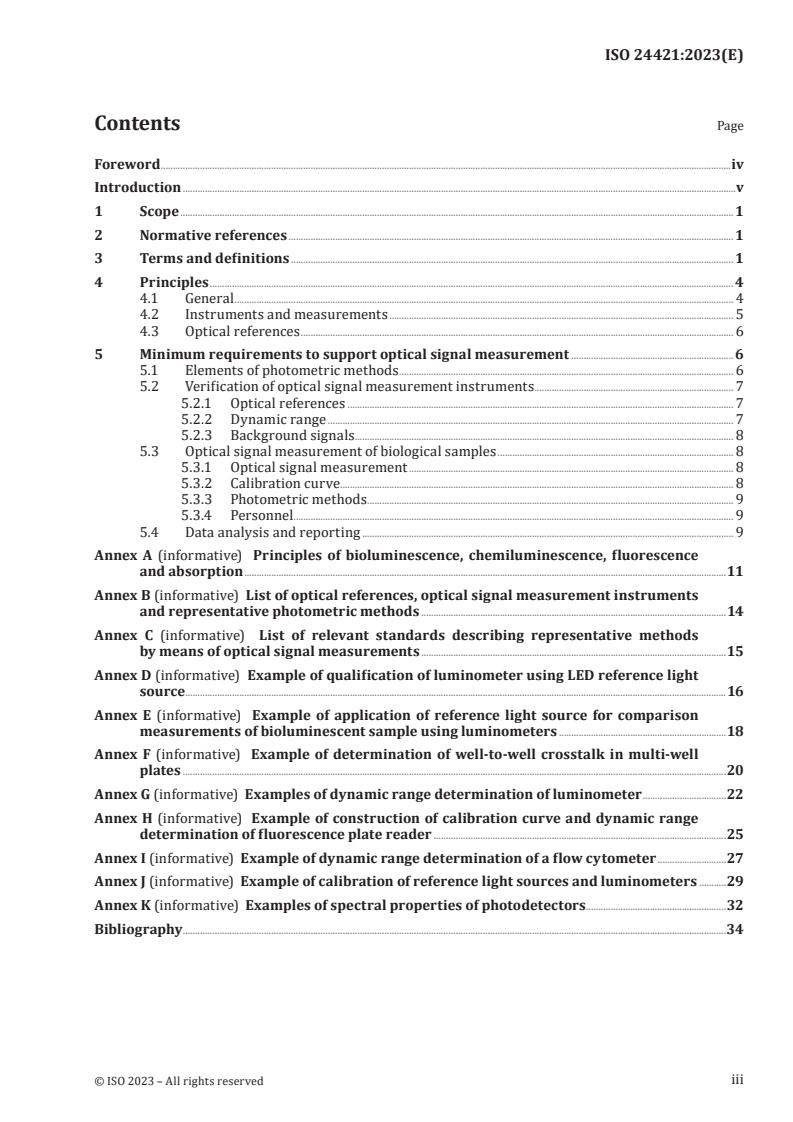
Contents Page
Foreword .iv
Introduction .v
1 Scope . 1
2 Normative references . 1
3 Terms and definitions . 1
4 Principles . 4
4.1 General . 4
4.2 Instruments and measurements . 5
4.3 Optical references . 6
5 Minimum requirements to support optical signal measurement . 6
5.1 Elements of photometric methods . 6
5.2 Verification of optical signal measurement instruments . 7
5.2.1 Optical references . 7
5.2.2 Dynamic range . 7
5.2.3 Background signals . 8
5.3 Optical signal measurement of biological samples . 8
5.3.1 Optical signal measurement . 8
5.3.2 Calibration curve. 8
5.3.3 Photometric methods . . 9
5.3.4 Personnel . 9
5.4 Data analysis and reporting . 9
Annex A (informative) Principles of bioluminescence, chemiluminescence, fluorescence
and absorption .11
Annex B (informative) List of optical references, optical signal measurement instruments
and representative photometric methods .14
Annex C (informative) List of relevant standards describing representative methods
by means of optical signal measurements .15
Annex D (informative) Example of qualification of luminometer using LED reference light
source . .16
Annex E (informative) Example of application of reference light source for comparison
measurements of bioluminescent sample using luminometers .18
Annex F (informative) Example of determination of well-to-well crosstalk in multi-well
plates .20
Annex G (informative) Examples of dynamic range determination of luminometer .22
Annex H (informative) Example of construction of calibration curve and dynamic range
determination of fluorescence plate reader .25
Annex I (informative) Example of dynamic range determination of a flow cytometer .27
Annex J (informative) Example of calibration of reference light sources and luminometers .29
Annex K (informative) Examples of spectral properties of photodetectors .32
Bibliography .34
iii
Foreword
ISO (the International Organization for Standardization) is a worldwide federation of national standards
bodies (ISO member bodies). The work of preparing International Standards is normally carried out
through ISO technical committees. Each member body interested in a subject for which a technical
committee has been established has the right to be represented on that committee. International
organizations, governmental and non-governmental, in liaison with ISO, also take part in the work.
ISO collaborates closely with the International Electrotechnical Commission (IEC) on all matters of
electrotechnical standardization.
The procedures used to develop this document and those intended for its further maintenance are
described in the ISO/IEC Directives, Part 1. In particular, the different approval criteria needed for the
different types of ISO documents should be noted. This document was drafted in accordance with the
editorial rules of the ISO/IEC Directives, Part 2 (see www.iso.org/directives).
Attention is drawn to the possibility that some of the elements of this document may be the subject of
patent rights. ISO shall not be held responsible for identifying any or all such patent rights. Details of
any patent rights identified during the development of the document will be in the Introduction and/or
on the ISO list of patent declarations received (see www.iso.org/patents).
Any trade name used in this document is information given for the convenience of users and does not
constitute an endorsement.
For an explanation of the voluntary nature of standards, the meaning of ISO specific terms and
expressions related to conformity assessment, as well as information about ISO’s adherence to
the World Trade Organization (WTO) principles in the Technical Barriers to Trade (TBT), see
www.iso.org/iso/foreword.html.
This document was prepared by Technical Committee ISO/TC 276, Biotechnology.
Any feedback or questions on this document should be directed to the user’s national standards body. A
complete listing of these bodies can be found at www.iso.org/members.html.
iv
Introduction
This document defines terms and provides general guidance for accurate measurement of optical
signals used for analysis of biological samples in photometric methods. These photometric methods
can use optical signal measurements, including bioluminescence, chemiluminescence, fluorescence or
absorption measurement, that can be applied in the fields of biotechnology, life science and medicine.
A measured optical signal value is applied for evaluating biological parameters qualitatively or
quantitatively, including cellular and metabolic activities, and gene expressions. Photometric methods
are used in applications such as toxicity testing, environmental risk assessment, biomanufacturing,
drug development, regenerative medicine and biobanking.
There are significant needs for both manufacturers and users for high quality optical signal measurement
in photometric methods in industry to increase confidence in the repeatability, intermediate precision
and reproducibility for analysis of biological samples. While repeatability of the photometric method is
already sufficient for qualitative characterization of biological samples, quantitative characterization
requires more accurate intermediate precision and reproducibility of optical signal measurement. It
requires proper optical signal measurements, and it also requires assessment of deviations from the
ideal proportionality of the optical signal and the output of the photometric method. Requirements
for proper optical signal measurement are an important component of the description of specific
applications of photometric methods.
This document provides a general framework to support proper measurement of an optical signal in
a photometric method. It focuses on the utilization of optical references and relevant technical issues
for optical signal measurement in photometric methods, including procedures for verification of
instruments, continual performance monitoring of instruments and photometric method validation.
Optical references can be used to verify instruments to increase confidence in the repeatability,
intermediate precision, and reproducibility of optical signal measurement. For example, an optical
signal emitted from biological samples can be compared on a common measurement scale within a
laboratory, between manufacturer and manufacturer, manufacturer and user, or user and user.
v
INTERNATIONAL STANDARD ISO 24421:2023(E)
Biotechnology — Minimum requirements for optical signal
measurements in photometric methods for biological
samples
1 Scope
This document specifies minimum requirements to support accurate measurement of optical signals in
photometric methods used for qualitative or quantitative characterization of biological samples.
This document is applicable to optical signals that are generated, for example, by bioluminescence,
chemiluminescence and fluorescence, and optical signals that are detected as changes of light due to
absorption.
This document addresses the verification of optical signal measurement instruments used in
photometric methods for measurement of biological samples including considerations for the use of
optical references.
This document does not provide sector- or application-specific performance criteria for the workflow
of measuring biological samples. When applicable, users can also consult existing sector- or application-
specific standards, or both.
2 Normative references
There are no normative references in this document.
3 Terms and definitions
For the purposes of this document, the following terms and definitions apply.
ISO and IEC maintain terminology databases for use in standardization at the following addresses:
— ISO Online browsing platform: available at https:// www .iso .org/ obp
— IEC Electropedia: available at https:// www .electropedia .org/
3.1
accuracy
closeness of agreement between a measured quantity value and a true quantity value of a measurand
Note 1 to entry: The concept “measurement accuracy” is not a quantity and is not given a numerical quantity
value. A measurement is said to be more accurate when it offers a smaller measurement error.
Note 2 to entry: The term “measurement accuracy” should not be used for measurement trueness and the term
“measurement precision” should not be used for “measurement accuracy”, which, however, is related to both
these concepts.
Note 3 to entry: “Measurement accuracy” is sometimes understood as closeness of agreement between measured
quantity values that are being attributed to the measurand.
Note 4 to entry: ISO 5725-1:1994 uses a different definition for “accuracy”.
[SOURCE: ISO/IEC Guide 99:2007, 2.13, modified — “measurement accuracy” and “accuracy of
measurement” deleted as terms. Note 4 to entry added.]
3.2
biological sample
material or object of biological origin
3.3
dynamic range
range of optical signal (3.6) values that can be measured quantitatively
[SOURCE: ISO 2041:2018, 3.4.17, modified — “optical signal” and “quantitatively” added to the
definition.]
3.4
light source
optical device emitting appropriate wavelength(s) in a specified spectral region
Note 1 to entry: A light source can be a part of an optical signal (3.6) measurement instrument.
[SOURCE: ISO 25178-604:2013, 2.3.1 modified — “wavelength(s)” replaced “range of wavelengths”.
Note 1 to entry added.]
3.5
optical reference
material, light source (3.4) or photodetector, sufficiently reproducible and stable with respect to optical
properties, that has been established to be fit for its intended use
EXAMPLE Light emitting diode (LED)-based reference light source (3.11), laser, slide of fluorescent glass,
fluorescent dye in solution or other matrix (e.g. fluorescent bead), slide embedded fluorescent material, reference
filter, reference cuvette, reference film, reference solution, power meter (3.9) (see Annex B).
Note 1 to entry: The term “optical reference” includes both uncalibrated references and calibrated standards.
Optical references can be distributed by an internal organization or prepared by a laboratory (e.g. in-house
standard, in-house reference material).
Note 2 to entry: Optical references can be used for verification (3.14) of optical signal (3.6) measurement
instruments (see Annexes D, E, G, H, I and J).
3.6
optical signal
light emitted or changes of light due to absorption caused by transmitting light through samples or
chromogenic substances
Note 1 to entry: The optical signal measurement involves, for example, bioluminescence, chemiluminescence,
fluorescence and absorption measurements. Annex A gives information about optical signals.
Note 2 to entry: In this document, the term “optical signal” focuses on light before detection.
3.7
optical signal intensity
strength of an optical signal (3.6)
Note 1 to entry: Intensity can be used to express the absolute strength or relative strength of an optical signal.
An appropriate unit can be used in order to express the intensity of a particular optical signal.
3.8
photometric method
analytical technique using optical signal (3.6) measurement(s) to determine components or biological
parameters of biological samples (3.2)
Note 1 to entry: The photometric method includes preanalytical, optical signal measurement and data analysis
procedures.
Note 2 to entry: Biological parameters of biological samples include, for example, cellular and metabolic activities,
and gene expressions.
Note 3 to entry: Examples for representative photometric methods are shown in Annex B.
Note 4 to entry: Analysis and assay results of photometric methods can be expressed qualitatively or
quantitatively.
Note 5 to entry: The term “radiometric” is widely used instead of “photometric” in the field of optical engineering
(e.g. IEC 60050-845).
3.9
power meter
optical power meter
measurement device to determine the radiant power of light used as an optical reference (3.5)
Note 1 to entry: The watt (W) is used as a unit to express radiant power.
3.10
precision
closeness of agreement between indications or measured quantity values obtained by replicate
measurements on the same or similar objects under specified conditions
Note 1 to entry: Measurement precision is usually expressed numerically by measures of imprecision, such as
standard deviation, variance, or coefficient of variation under the specified conditions of measurement.
Note 2 to entry: The “specified conditions” can be, for example, repeatability conditions of measurement,
intermediate precision conditions of measurement, or reproducibility conditions of measurement (see
ISO 5725-3:1994).
Note 3 to entry: Measurement precision is used to define measurement repeatability, intermediate measurement
precision, and measurement reproducibility.
Note 4 to entry: Sometimes “measurement precision” is erroneously used to mean measurement accuracy.
Note 5 to entry: ISO 5725-1:1994 uses a different definition for “precision”.
[SOURCE: ISO/IEC Guide 99:2007, 2.15, modified — “measurement precision” deleted as a term. Note 5
to entry added.]
3.11
reference light source
light source (3.4) used as an optical reference (3.5)
EXAMPLE Characterized or calibrated LED and laser.
3.12
reference material for calibration curve
material with known value of concentration or amount of a specific substance, for intended purpose
Note 1 to entry: It is identical to or commutable with the measurement object of a biological sample (3.2).
Note 2 to entry: Examples for expressing concentration and amount are mol/l and mol, respectively.
3.13
validation
confirmation, through the provision of objective evidence, that the requirements for a specific intended
use or application have been fulfilled
Note 1 to entry: The objective evidence needed for a validation is the result of a test or other form of determination
such as performing alternative calculations or reviewing documents.
Note 2 to entry: The word “validated” is used to designate the corresponding status.
Note 3 to entry: The use conditions for validation can be real or simulated.
Note 4 to entry: ISO/TS 16393:2019 uses the term “validation” in a different meaning in defining “validation
experiment”. ISO/IEC Guide 99:2007 uses a different definition for “validation”.
[SOURCE: ISO 9000:2015, 3.8.13, modified — Note 4 to entry added.]
3.14
verification
confirmation, through the provision of objective evidence, that specified requirements have been
fulfilled
Note 1 to entry: The objective evidence needed for a verification can be the result of an inspection or of other
forms of determination such as performing alternative calculations or reviewing documents.
Note 2 to entry: The activities carried out for verification are sometimes called a “qualification process”.
Note 3 to entry: The word “verified” is used to designate the corresponding status.
Note 4 to entry: ISO/IEC Guide 99:2007 uses a different definition for “verification”.
[SOURCE: ISO 9000:2015, 3.8.12, modified — Note 4 to entry added.]
4 Principles
4.1 General
Optical signal measurements, including bioluminescence, chemiluminescence, fluorescence and
absorption measurements, are used in photometric methods. Optical signal measurements are often
used for biological samples to determine a diverse set of biological parameters qualitatively and
quantitatively, including cellular and metabolic activities, and gene expressions (see Annex A for more
information). In the photometric methods, the optical signal intensity and spectrum from biological
samples are measured using instruments.
NOTE 1 Examples of instruments are luminometers, imaging analysers, fluorescence plate readers, flow
cytometers, microarray readers, spectrofluorometers, plate readers, spectrophotometers and DNA sequencers
(see Annex B).
Accuracy, precision, repeatability and reproducibility represent some of the important metrological
factors used for evaluating the effectiveness of photometric method applied.
Photometric methods can be qualitatively validated using positive and negative control materials.
NOTE 2 The performance characteristics of qualitative photometric methods and their validation can be
determined with appropriate statistical models depending on the method, structure of data and statistical
experience (e.g. ISO/TS 16393).
Accurate analysis and assay results are obtained by measuring the optical signal with an appropriate
selection of experimental materials, including the reagents generating the optical signal from the
sample, and the use of suitable instruments for the intended purpose.
Sample preparation is also an important factor governing the performance of a photometric method.
Optical signal measurements produce relative and absolute optical signal values that are functionally
related to the quantity of specific characteristics of biological samples or biological parameters. In
spectral-resolved measurements, spectral characteristics are indicative for the interaction of particular
molecules, structural elements of molecules, or molecular interaction with electromagnetic radiation of
different energy.
In some cases, calibration curves constructed using a reference material for calibration curve are
required for quantification of the absolute amount of biological sample. A calibration curve can be also
used to determine an effective amount of a test article (e.g. an amount that elicits 50 % response across
the calibration curve or ED ).
NOTE 3 Annex H gives an example for the construction of a calibration curve.
For measurement of biological samples, it is sometimes necessary to label or stain biological samples,
introduce a reporter gene into cells, tissues and whole organisms, or trigger chemical reactions.
NOTE 4 Reagent quality and its photophysical and chemical properties affects optical signals from the sample.
Activity of cells can sometimes affect optical signals.
NOTE 5 Ambient light radiation can cause deterioration of bioluminescent reagents, chemiluminescent
reagents, fluorescent materials and fading absorption.
When cells are used in photometric methods, the robustness of analysis and assay results is less reliable
if the cellular activity is unstable. In particular, optical signal measurement results are directly affected
by the stability of the cellular activity during long-term storage/subculturing and by the stability of
responsiveness to the target bioactive substance. The incident measuring light can also affect cellular
functions and properties, in particular if the cells are exposed to the light for a long period. Accordingly,
the reliability of optical signal measurement results can be increased by maintaining cell stability.
NOTE 6 Examples are assays to evaluate cellular activity, including viability, toxicity and metabolic activity by
means of cell-based assays.
NOTE 7 Relevant standards that describe representative methods by means of optical signal measurements
are listed in Annex C.
Preanalytical procedures applied before performing optical signal measurements, including cell lysis,
antigen-antibody reaction, dye labelling or staining, can affect analysis and assay results.
4.2 Instruments and measurements
Photodetectors, including photomultipliers, photodiodes and image sensors, have specific spectral
responsivities. Optical signals, including bioluminescence, chemiluminescence, fluorescence and
absorption, can be measured accurately by using spectrally suited photodetectors and colour filters.
NOTE 1 Annex K gives examples for spectral responsivity data of photodetectors.
The optical signal measurement instruments are affected by environmental conditions, including
laboratory temperature, and exposure to direct sunlight. Adjustment of the spatial resolution of an
instrument can be required depending on the application.
Optical signals can be measured quantitatively when the signal intensity is within the dynamic range of
the photodetector. Photodetectors have specific linear or nonlinear responsivities within this dynamic
range, which can be determined with test measurements.
NOTE 2 The limits of linearity can be determined statistically.
Most instruments perform relative measurements of optical signals. The output values, therefore,
depend on the instrument unless a reference material is available to establish a calibration curve. Only
when the instruments are absolutely calibrated in radiometric values including the number of photons,
can the measured optical signal values be expressed as absolute radiometric quantities.
Background signals can affect optical signal measurement results. Typical sources of background
signals are electrical noises (e.g. dark count and read-out noise) and optical noises (e.g. stray light and
external light).
Background signals can exist even in the absence of optical signals. Background signals are
automatically or manually subtracted after optical signal measurement.
4.3 Optical references
Optical references can be used to confirm the performance of optical signal measurement instruments,
including repeatability, intermediate precision, reproducibility, dynamic range and other related
instrument performance.
Consistency of optical characteristics between the optical reference and the biological sample increases
confidence in instrument performance and the analysis and assay results by measuring the optical
signals of biological samples.
NOTE Examples for optical references are an LED-based reference light source (see Annex D for an exemplary
luminometer qualification with LED), laser, slide of fluorescent glass, fluorescent dye in solution or other matrix
(e.g. fluorescent bead), slide embedded fluorescent material, reference filter, reference cuvette, reference film,
reference solution and power meter (see Annex B).
Optical references can be used for installation qualification, operational qualification and performance
qualification. Optical references can also be used to compare photodetector responsivity between
instruments.
Optical references can be used to calibrate optical signals to amounts or relative amounts, or potencies
of target biological samples.
5 Minimum requirements to support optical signal measurement
5.1 Elements of photometric methods
Standardized approaches should be followed to provide accurate analysis and assay results by
measuring the optical signal in photometric methods for analysis of biological samples.
Instruments, reagents, biological samples including cells, and other experimental materials used for
optical signal measurement in the photometric methods shall be selected for the intended purpose and
procedures. Reagents and biological samples shall be properly stored and maintained.
NOTE 1 Stability of reagents and biological samples can change during long-term storage and maintenance.
NOTE 2 In cells expressing reporter gene(s), including bioluminescence, chemiluminescence, fluorescence or
colorimetric reporter gene, expression level of the reporter gene(s) can change during storage and subculturing.
The copy number of the reporter gene(s) can also change during long-term subculturing.
The manufacturer’s instructions should be followed for storage and use of reagents and biological
samples.
Optical components of instruments (photodetectors, optics and light sources) used for optical signal
measurements shall be selected in accordance with the optical characteristics, including spectral
properties, of the photometric methods and biological sample.
Interference or enhancement of the optical signal by the apparatus, reagents, solvent and biological
sample used should be taken into account.
NOTE 3 Some apparatus, reagents and solutions have inappropriate characteristics for optical signal
measurements, including inhibition or enhancement of reactions creating interfering signals due to absorptive/
fluorescent/quenching/phosphorescent/corrosive properties.
NOTE 4 Ancillary materials including phenol red (due to absorption) can alter optical signal measurement
results.
NOTE 5 Adhesion to container walls can cause false concentration particularly for low concentration samples.
Depending on instrument design, the concentration can also be too high due to carry over from a preceding
measurement of high concentration samples.
5.2 Verification of optical signal measurement instruments
5.2.1 Optical references
Optical signal measurement instruments shall be verified using optical references.
NOTE 1 Examples of optical references and instruments are listed in Annex B.
Optical references can be used to verify repeatability, intermediate precision and reproducibility.
Optical signal measurement instruments that have been verified by the manufacturer should be
maintained according to the manufacturer’s instructions.
Reference light sources, including light emitting diode (LED) or laser, can be used to verify responsivity
of luminometers, fluorescence plate readers, microarray readers and imaging analysers. Pulsed LEDs
can be used as a reference light source for photodetectors in flow cytometers.
NOTE 2 Annex E gives information and an example for the application of reference light sources for comparison
measurements of luminescent biological samples using luminometers.
Reference fluorescent materials, including fluorescent substance, solution or beads, can be used to
verify responsivity of imaging analysers, flow cytometers, spectrofluorometers and fluorescence plate
readers.
NOTE 3 Further guidance on characterization and assessment of suitable reference materials can be found in
ISO Guide 35:2017.
A power meter (an optical power meter) can be used to verify excitation light power (W) of imaging
analysers, flow cytometers, spectrofluorometers, microarray readers, fluorescence plate readers,
spectrophotometers and plate readers.
A reference cuvette or reference material for absorbance measurement can be used to verify
responsivity of plate readers, spectrophotometers and imaging analysers.
A reference light source whose optical signal value is calibrated absolutely against power (W) or
number of photons can be applied to calibrate absolute sensitivity of the instruments.
NOTE 4 Annex J gives an example for the calibration of reference light sources and luminometers.
In-house standards (e.g. authentic materials) can be used as optical references when the reproducibility
or the stability is confirmed.
5.2.2 Dynamic range
The dynamic range of the photodetector in an instrument to quantitatively measure optical signal(s)
from biological sample(s) shall be determined.
NOTE 1 Evaluation of dynamic range is generally conducted as installation qualification and/or operational
qualification of optical signal measurement instruments.
NOTE 2 The lower limit of dynamic range can be given by the limit of quantification, whereas the upper limit
of dynamic range can be characterized by onset of unacceptable anomalies in sensitivity.
NOTE 3 Examples for the dynamic range determination of luminometers can be found in Annex G. Annex H
gives an example for the construction of a calibration curve and the dynamic range determination of fluorescence
plate readers. Annex I gives an example of the dynamic range determination for flow cytometers.
The dynamic range can be determined using an LED reference light source, serial dilution of reference
material or reporter proteins, including bioluminescence, chemiluminescence, fluorescence and
chromogenic proteins, chemiluminescent reagents, and reference cuvettes or reference materials for
absorbance measurement.
Reference fluorescent material series with variable and previously determined relative densities
or concentrations can be used to determine, adjust and correct the dynamic range of fluorescence
measurement instruments.
5.2.3 Background signals
Background signals associated with instruments shall be determined by measurements taken in
conditions without the interference of optical signals from analytes. Background signal subtraction
should be appropriate for the intended purpose.
NOTE 1 Examples of background signals are dark count and read-out noise.
NOTE 2 Background signals can be evaluated using an untreated sample or without a sample.
Error sources related to optical signal measurements, including stray light from neighbouring samples
and spectral overlapping between multiple detection channels, should be evaluated using appropriate
samples or optical references.
NOTE 3 Spectral overlapping can be determined and compensated by using single-coloured samples, which
are stained or labelled with the same fluorophore or luminophore as the test sample.
Error sources from biological samples and containers, including autofluorescence, photobleaching,
quenching and phototoxicity, should be taken into account.
To reduce photobleaching and phototoxicity, the upper limit of the excitation light and the exposure
time should be controlled.
When multi-well plates are used as a measurement container, applicable well-to-well crosstalk should
be taken into account.
NOTE 4 The colour of multi-well plates influences detection sensitivity and well-to-well crosstalk. Additional
information is given in Annex F.
5.3 Optical signal measurement of biological samples
5.3.1 Optical signal measurement
Optical signal measurements shall be performed using instruments that have been verified according
to 5.2.
For quantitative evaluation, the optical signal intensity from a biological sample shall be within the
dynamic range of the instrument used, as described in 5.2.2. Beyond this range results can only be
considered for qualitative evaluation.
NOTE 1 Sometimes the signal intensity detected by the instruments can be brought within the dynamic range
by adjusting the sample concentration.
NOTE 2 Incident light on some photodetectors can eventually be controlled within the dynamic range of the
instruments by adjusting the power of light source.
5.3.2 Calibration curve
The target biological samples shall be quantified within the dynamic range of a calibration curve.
NOTE 1 The calibration curve can be constructed using a reference material for calibration curve wherever
applicable.
NOTE 2 There are some quantification methods that can be performed without using calibration curve
methods, but only if a calibrated optical density (OD) measurement method is available and a molar attenuation
coefficient (ε) has previously been determined.
NOTE 3 Annex H gives an example for the construction of a calibration curve.
NOTE 4 Calibration curves can be used for verification of instruments, especially for determination of
dynamic range.
NOTE 5 There are some quantification methods that do not need the construction of calibration curves (e.g.
digital polymerase chain reaction (PCR)).
5.3.3 Photometric methods
Photometric methods originally developed in the same laboratory or modified from the validated
methods shall be validated for each specified intended use.
When predefined acceptance criteria are provided for the validation of a photometric method, the
method shall be validated for laboratory use based on the same criteria.
For photometric methods intended to evaluate each relative activity of target bioactive substances,
optical signal measurement data, including fold-change values, should be validated by a comparison
experiment using appropriate positive and negative control materials.
NOTE Accurate analysis and assay results by measuring optical signal can be validated by participating in
external quality assessment (EQA) or proficiency testing (PT).
5.3.4 Personnel
Optical signal measurement in photometric methods shall be performed by personnel, including the
operator, who are appropriately trained and understand the concepts of the requirements in 5.2, 5.3.1
and 5.3.2.
NOTE Specific guidance on personnel in medical laboratories can be found in ISO 15189.
Devices and instruments specifically designed and developed for untrained non-professional operation
should be used according to the manufacturer’s instructions.
5.4 Data analysis and reporting
Reporting shall incorporate details to allow independent assessment.
Reports should include the following elements, wherever applicable:
a) optical signal measurement procedure:
1) the measurement protocol and data analysis method;
2) calculation formulae (e.g. subtraction of absorbance at certain wavelengths, order of such
subtractions);
3) the reaction time (from the addition of reagent before optical signal measurement);
4) the environmental condition(s) (e.g. temperature, humidity);
b) optical signal measurement instruments:
1) the component of instrument (e.g. photodetector, filter, spectroscopy);
2) instrument specifications and settings used (e.g. gate or exposure time for optical signal
detection, wavelength resolution);
3) the suitability of instrument characteristics to optical properties of sample (e.g. spectral
matching);
c) optical references:
1) the type and name;
2) specifications as applicable (e.g. power (W) or photon number for reference light source,
spectrum and intensity for fluorescence material, responsivity for power meter, absorbance
for reference cuvette or material);
3) the measurement conditions (e.g. settings of instrument and optical reference);
4) the measurement result of optical references as applicable;
5) the precision when statistical analysis is performed;
NOTE 1 Measurement result can be expressed as relative or absolute values.
d) biological samples:
1) the type and specifications of each sample (e.g. lot number, source, passage number of cells) as
applicable;
2) the date and sampling procedure(s) as applicable;
3) the transport and storage conditions as applicable;
e) reagents and substances:
1) the name, source (e.g. lot number) and country of origin;
2) the transport and storage conditions as applicable;
3) the description of a reference material for calibration curve, and appropriate positive and
negative control materials used as applicable;
f) results of the optical signal measurement of biological samples:
1) the measurement result;
2) the precision when statistical analysis is performed;
3) the person responsible for the results including the operator;
4) information on the units of optical signal; measurement results given on the basis of relative or
arbitrary units should be expressed in the unit of the optical reference;
NOTE 2 Units can be expressed as relative or absolute values.
5) the date and time of optical signal measurement;
g) unexpected observations:
1) any unexpected observations made during analysis;
2) validated modifications from the manufacturer's instructions or applicable standard operation
procedures;
3) the observed interference factors.
NOTE 3 The information in the above list can be included in a quantification result, calibration, instrument
verification and method validation report.
Annex A
(informative)
Principles of bioluminescence, chemiluminescence, fluorescence
and absorption
A.1 General
Components of biological samples and biological parameters, including cellular and metabolic activities,
and gene expressions, are measured and evaluated qualitatively or quantitatively by photometric
methods. In the photometric methods, the optical signal intensity and spectrum from samples
associated with the quantity of biological samples or changes in biological parameters are measured
using optical signal measurement instruments. Optical signals to be measured originate from
bioluminescence, chemiluminescence, fluorescence, absorption and other related optical signals. In this
annex, representative principles of optical signal measurements in photometric methods are described.
NOTE 1 This document describes measurements of bioluminescence, chemiluminescence, fluorescence and
absorption because they are widely utilized in photometric methods. There are, however, some other possible
optical signals that can be measured including phosphorescence, electroluminescence and Raman scattering.
There are also some techniques related to fluorescence, including Foerster energy transfer, fluorescence lifetime,
fluorescence polarization and multi-photon excitation. Nephelometry measuring turbidity is also related to
optical signal measurement.
NOTE 2 In the photometry and radiometry field, luminous intensity (in units of candela) and radiant intensity
(in units of W/sr) are strictly defined for a point source. However, the term “intensity”, including “optical signal
intensity”, in this document simply indicates strength of optical signal and is not used only for a point source.
A.2 Bioluminescence and chemiluminescence
Light emission resulting from chemical reactions of certain chemicals including luminol is defined
as “chemiluminescence” and the responding chemical reaction is often called “chemiluminescence
reaction”. In a chemiluminescence reaction, enzymes including peroxidase and phosphatase are
often used as a catalyst that is widely employed in photometric methods such as enzyme-linked
immunosorbent assay. In cases where the enzyme is luciferase or photoprotein, the reaction is
called “bioluminescence reaction”. As the reaction substrate used for bioluminescence reaction
is called “luciferin”, bioluminescence reaction is called “luciferin-luciferase reaction”. The term
“bioluminescence” covers the production and emission of light by a living organism or emission of light
by a laboratory biochemical system. Therefore, bioluminescence
...