


ISO 230-10:2016
(Main)Test code for machine tools — Part 10: Determination of the measuring performance of probing systems of numerically controlled machine tools
Test code for machine tools — Part 10: Determination of the measuring performance of probing systems of numerically controlled machine tools
ISO 230-10:2016 specifies test procedures to evaluate the measuring performance of contacting probing systems (used in a discrete-point probing mode) integrated with a numerically controlled machine tool. It does not include other types of probing systems, such as those used in scanning mode or non-contacting probing systems. The evaluation of the performance of the machine tool, used as a coordinate measuring machine (CMM), is outside the scope of this part of ISO 230. Such performance evaluation involves traceability issues, is strongly influenced by machine tool geometric accuracy and can, in addition to the machine tool probing system tests specified in this part of ISO 230, be evaluated according to ISO 10360‑2 and ISO 10360‑5. Numerically controlled machine tools can apply contacting probing systems in machining process applications, such as - identification that the correct workpiece has been loaded before machining, - location and/or alignment of the workpiece, - measurement of the workpiece after machining, but while still on the machine, - measurement of the position and orientation of the machine tool rotary axes, - measurement and setting of the cutting tool (radius, length and offset of the tool), and - detection of tool breakage. NOTE 1 This part of ISO 230 focuses on machining centres, but it is intended that other types of machines, for instance turning and grinding centres, be included in a future revision of this part of ISO 230. NOTE 2 This part of ISO 230 does not include non-contacting type of probes (e.g. optical probes), but it is intended that they be included in a future revision of this part of ISO 230.
Code d'essai des machines-outils — Partie 10: Détermination des performances de mesure des systèmes de palpage des machines-outils à commande numérique
ISO 230-10:2016 spécifie des procédures d'essai pour évaluer les performances de mesure des systèmes de palpage à contact (utilisés en mode de palpage discret) intégrés dans une machine-outil à commande numérique. Elle n'inclut pas d'autres types de systèmes de palpage tels que ceux utilisés dans les systèmes de palpage en mode «scanning» ou sans contact. L'évaluation des performances de la machine-outil utilisée comme machine à mesurer tridimensionnelle (MMT) ne fait pas partie du domaine d'application de la présente partie de l'ISO 230. L'évaluation de telles performances implique des problèmes de traçabilité et est fortement influencée par l'exactitude géométrique de la machine-outil. En plus d'être soumises aux essais du système de palpage de la machine-outil spécifiés dans la présente partie de l'ISO 230, elles peuvent être évaluées conformément à l'ISO 10360‑2 et l'ISO 10360‑5. Les machines-outils à commande numérique peuvent actuellement utiliser des systèmes de palpage à contact dans les applications d'usinage telles que - l'identification permettant de vérifier que la bonne pièce a été chargée avant l'usinage, - la position et/ou l'alignement de la pièce, - le mesurage de la pièce après usinage, la pièce étant encore sur la machine, - le mesurage de la position et de l'orientation des axes rotatifs de la machine-outil, - le mesurage et le réglage de l'outil coupant (rayon, longueur et décalage de l'outil), et - la détection des casses d'outils. NOTE 1 La présente partie de l'ISO 230 se focalise sur les centres d'usinage, mais d'autres types de machines, notamment les centres de tournage et de meulage, seront inclus dans une future révision de la présente partie de l'ISO 230. NOTE 2 La présente partie de l'ISO 230 n'inclut aucun type de palpeurs sans contact (par exemple, palpeurs optiques), mais ils seront inclus dans une future révision de la présente partie de l'ISO 230.
General Information
- Status
- Withdrawn
- Publication Date
- 02-Feb-2016
- Technical Committee
- ISO/TC 39/SC 2 - Test conditions for metal cutting machine tools
- Drafting Committee
- ISO/TC 39/SC 2 - Test conditions for metal cutting machine tools
- Current Stage
- 9599 - Withdrawal of International Standard
- Start Date
- 24-Mar-2022
- Completion Date
- 12-Feb-2026
Relations
- Effective Date
- 23-Apr-2020
- Effective Date
- 05-Nov-2015
- Effective Date
- 05-Nov-2015


Get Certified
Connect with accredited certification bodies for this standard

National Aerospace and Defense Contractors Accreditation Program (NADCAP)
Global cooperative program for special process quality in aerospace.
CARES (UK Certification Authority for Reinforcing Steels)
UK certification for reinforcing steels and construction.
DVS-ZERT GmbH
German welding certification society.
Sponsored listings
Frequently Asked Questions
ISO 230-10:2016 is a standard published by the International Organization for Standardization (ISO). Its full title is "Test code for machine tools — Part 10: Determination of the measuring performance of probing systems of numerically controlled machine tools". This standard covers: ISO 230-10:2016 specifies test procedures to evaluate the measuring performance of contacting probing systems (used in a discrete-point probing mode) integrated with a numerically controlled machine tool. It does not include other types of probing systems, such as those used in scanning mode or non-contacting probing systems. The evaluation of the performance of the machine tool, used as a coordinate measuring machine (CMM), is outside the scope of this part of ISO 230. Such performance evaluation involves traceability issues, is strongly influenced by machine tool geometric accuracy and can, in addition to the machine tool probing system tests specified in this part of ISO 230, be evaluated according to ISO 10360‑2 and ISO 10360‑5. Numerically controlled machine tools can apply contacting probing systems in machining process applications, such as - identification that the correct workpiece has been loaded before machining, - location and/or alignment of the workpiece, - measurement of the workpiece after machining, but while still on the machine, - measurement of the position and orientation of the machine tool rotary axes, - measurement and setting of the cutting tool (radius, length and offset of the tool), and - detection of tool breakage. NOTE 1 This part of ISO 230 focuses on machining centres, but it is intended that other types of machines, for instance turning and grinding centres, be included in a future revision of this part of ISO 230. NOTE 2 This part of ISO 230 does not include non-contacting type of probes (e.g. optical probes), but it is intended that they be included in a future revision of this part of ISO 230.
ISO 230-10:2016 specifies test procedures to evaluate the measuring performance of contacting probing systems (used in a discrete-point probing mode) integrated with a numerically controlled machine tool. It does not include other types of probing systems, such as those used in scanning mode or non-contacting probing systems. The evaluation of the performance of the machine tool, used as a coordinate measuring machine (CMM), is outside the scope of this part of ISO 230. Such performance evaluation involves traceability issues, is strongly influenced by machine tool geometric accuracy and can, in addition to the machine tool probing system tests specified in this part of ISO 230, be evaluated according to ISO 10360‑2 and ISO 10360‑5. Numerically controlled machine tools can apply contacting probing systems in machining process applications, such as - identification that the correct workpiece has been loaded before machining, - location and/or alignment of the workpiece, - measurement of the workpiece after machining, but while still on the machine, - measurement of the position and orientation of the machine tool rotary axes, - measurement and setting of the cutting tool (radius, length and offset of the tool), and - detection of tool breakage. NOTE 1 This part of ISO 230 focuses on machining centres, but it is intended that other types of machines, for instance turning and grinding centres, be included in a future revision of this part of ISO 230. NOTE 2 This part of ISO 230 does not include non-contacting type of probes (e.g. optical probes), but it is intended that they be included in a future revision of this part of ISO 230.
ISO 230-10:2016 is classified under the following ICS (International Classification for Standards) categories: 25.080.01 - Machine tools in general. The ICS classification helps identify the subject area and facilitates finding related standards.
ISO 230-10:2016 has the following relationships with other standards: It is inter standard links to ISO 230-10:2022, ISO 230-10:2011, ISO 230-10:2011/Amd 1:2014. Understanding these relationships helps ensure you are using the most current and applicable version of the standard.
ISO 230-10:2016 is available in PDF format for immediate download after purchase. The document can be added to your cart and obtained through the secure checkout process. Digital delivery ensures instant access to the complete standard document.
Standards Content (Sample)
INTERNATIONAL ISO
STANDARD 230-10
Second edition
2016-02-01
Test code for machine tools —
Part 10:
Determination of the measuring
performance of probing systems of
numerically controlled machine tools
Code d’essai des machines-outils —
Partie 10: Détermination des performances de mesure des systèmes de
palpage des machines-outils à commande numérique
Reference number
©
ISO 2016
© ISO 2016, Published in Switzerland
All rights reserved. Unless otherwise specified, no part of this publication may be reproduced or utilized otherwise in any form
or by any means, electronic or mechanical, including photocopying, or posting on the internet or an intranet, without prior
written permission. Permission can be requested from either ISO at the address below or ISO’s member body in the country of
the requester.
ISO copyright office
Ch. de Blandonnet 8 • CP 401
CH-1214 Vernier, Geneva, Switzerland
Tel. +41 22 749 01 11
Fax +41 22 749 09 47
copyright@iso.org
www.iso.org
ii © ISO 2016 – All rights reserved
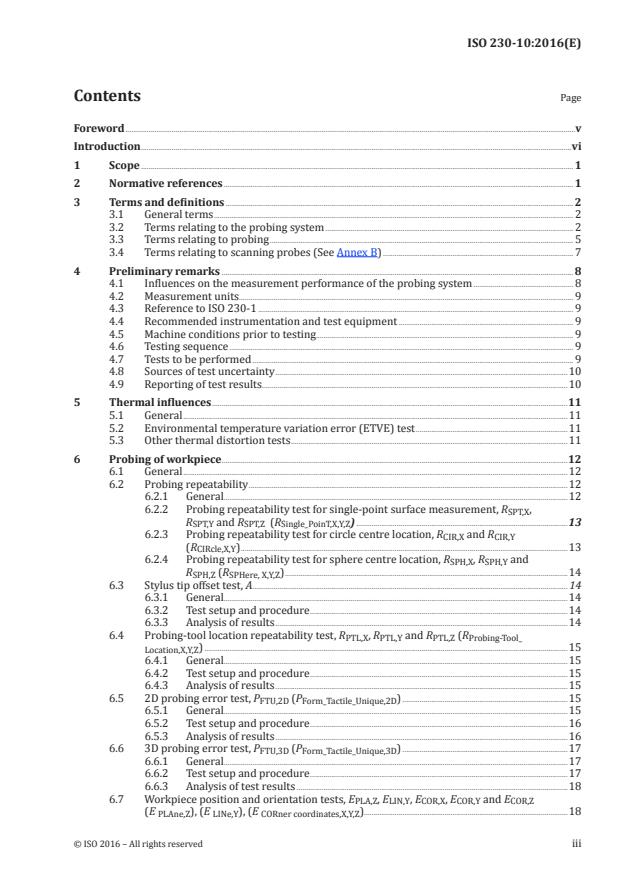
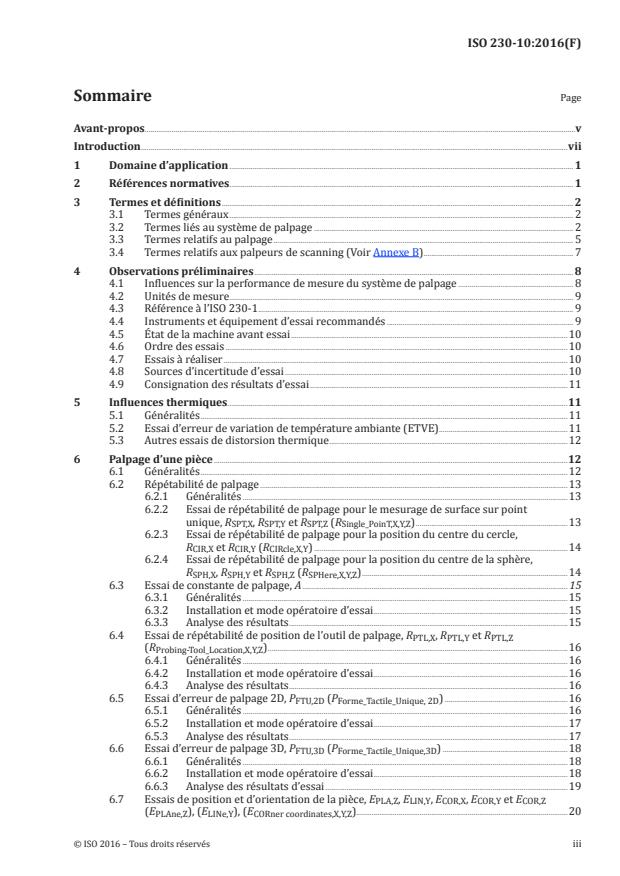
Contents Page
Foreword .v
Introduction .vi
1 Scope . 1
2 Normative references . 1
3 Terms and definitions . 2
3.1 General terms . 2
3.2 Terms relating to the probing system . 2
3.3 Terms relating to probing . 5
3.4 Terms relating to scanning probes (See Annex B) . 7
4 Preliminary remarks . 8
4.1 Influences on the measurement performance of the probing system . 8
4.2 Measurement units. 9
4.3 Reference to ISO 230-1 . 9
4.4 Recommended instrumentation and test equipment . 9
4.5 Machine conditions prior to testing. 9
4.6 Testing sequence . 9
4.7 Tests to be performed . 9
4.8 Sources of test uncertainty .10
4.9 Reporting of test results .10
5 Thermal influences .11
5.1 General .11
5.2 Environmental temperature variation error (ETVE) test .11
5.3 Other thermal distortion tests .11
6 Probing of workpiece .12
6.1 General .12
6.2 Probing repeatability .12
6.2.1 General.12
6.2.2 Probing repeatability test for single-point surface measurement, R ,
SPT,X
R and R (R ) .13
SPT,Y SPT,Z Single_PoinT,X,Y,Z
6.2.3 Probing repeatability test for circle centre location, R and R
CIR,X CIR,Y
(R ) .13
CIRcle,X,Y
6.2.4 Probing repeatability test for sphere centre location, R , R and
SPH,X SPH,Y
R (R ) .14
SPH,Z SPHere, X,Y,Z
6.3 Stylus tip offset test, A . 14
6.3.1 General.14
6.3.2 Test setup and procedure .14
6.3.3 Analysis of results .14
6.4 Probing-tool location repeatability test, R , R and R (R
PTL,X PTL,Y PTL,Z Probing-Tool_
) .15
Location,X,Y,Z
6.4.1 General.15
6.4.2 Test setup and procedure .15
6.4.3 Analysis of results .15
6.5 2D probing error test, P (P ) .15
FTU,2D Form_Tactile_Unique,2D
6.5.1 General.15
6.5.2 Test setup and procedure .16
6.5.3 Analysis of results .16
6.6 3D probing error test, P (P ) .17
FTU,3D Form_Tactile_Unique,3D
6.6.1 General.17
6.6.2 Test setup and procedure .17
6.6.3 Analysis of test results .18
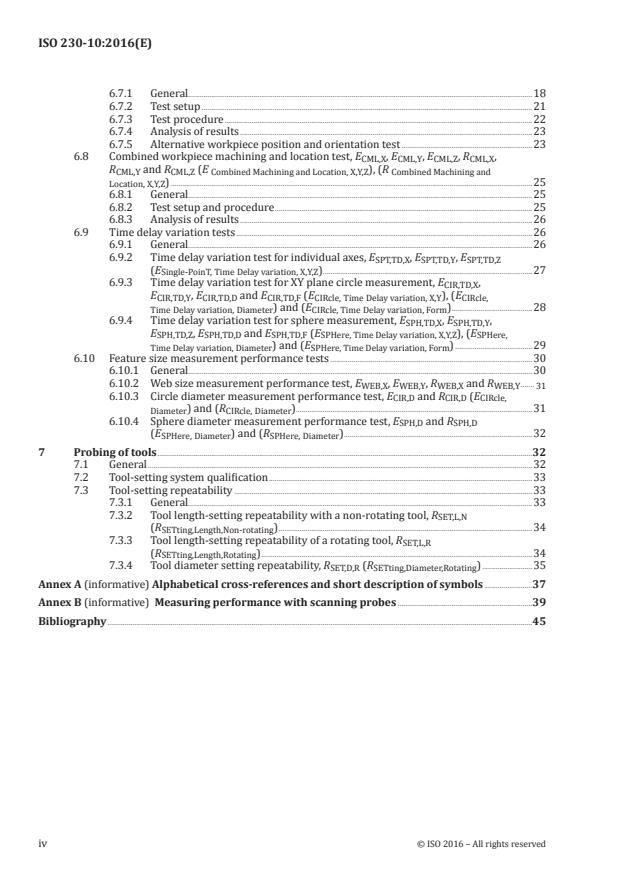
6.7 Workpiece position and orientation tests, E , E , E , E and E
PLA,Z LIN,Y COR,X COR,Y COR,Z
(E ), (E ), (E ) .18
PLAne,Z LINe,Y CORner coordinates,X,Y,Z
6.7.1 General.18
6.7.2 Test setup .21
6.7.3 Test procedure .22
6.7.4 Analysis of results .23
6.7.5 Alternative workpiece position and orientation test .23
6.8 Combined workpiece machining and location test, E , E , E , R ,
CML,X CML,Y CML,Z CML,X
R and R (E ), (R
CML,Y CML,Z Combined Machining and Location, X,Y,Z Combined Machining and
) .25
Location, X,Y,Z
6.8.1 General.25
6.8.2 Test setup and procedure .25
6.8.3 Analysis of results .26
6.9 Time delay variation tests .26
6.9.1 General.26
6.9.2 Time delay variation test for individual axes, E , E , E
SPT,TD,X SPT,TD,Y SPT,TD,Z
(E ) . .27
Single-PoinT, Time Delay variation, X,Y,Z
6.9.3 Time delay variation test for XY plane circle measurement, E ,
CIR,TD,X
E , E and E (E ), (E
CIR,TD,Y CIR,TD,D CIR,TD,F CIRcle, Time Delay variation, X,Y CIRcle,
) and (E ) .28
Time Delay variation, Diameter CIRcle, Time Delay variation, Form
6.9.4 Time delay variation test for sphere measurement, E , E ,
SPH,TD,X SPH,TD,Y
E , E and E (E ), (E
SPH,TD,Z SPH,TD,D SPH,TD,F SPHere, Time Delay variation, X,Y,Z SPHere,
) and (E ) .29
Time Delay variation, Diameter SPHere, Time Delay variation, Form
6.10 Feature size measurement performance tests .30
6.10.1 General.30
6.10.2 Web size measurement performance test, E , E , R and R .
WEB,X WEB,Y WEB,X WEB,Y 31
6.10.3 Circle diameter measurement performance test, E and R (E
CIR,D CIR,D CIRcle,
) and (R ) .31
Diameter CIRcle, Diameter
6.10.4 Sphere diameter measurement performance test, E and R
SPH,D SPH,D
(E ) and (R ) .32
SPHere, Diameter SPHere, Diameter
7 Probing of tools .32
7.1 General .32
7.2 Tool-setting system qualification .33
7.3 Tool-setting repeatability .33
7.3.1 General.33
7.3.2 Tool length-setting repeatability with a non-rotating tool, R
SET,L,N
(R ) .34
SETting,Length,Non-rotating
7.3.3 Tool length-setting repeatability of a rotating tool, R
SET,L,R
(R ) .34
SETting,Length,Rotating
7.3.4 Tool diameter setting repeatability, R (R ) .35
SET,D,R SETting,Diameter,Rotating
Annex A (informative) Alphabetical cross-references and short description of symbols .37
Annex B (informative) Measuring performance with scanning probes .39
Bibliography .45
iv © ISO 2016 – All rights reserved
Foreword
ISO (the International Organization for Standardization) is a worldwide federation of national standards
bodies (ISO member bodies). The work of preparing International Standards is normally carried out
through ISO technical committees. Each member body interested in a subject for which a technical
committee has been established has the right to be represented on that committee. International
organizations, governmental and non-governmental, in liaison with ISO, also take part in the work.
ISO collaborates closely with the International Electrotechnical Commission (IEC) on all matters of
electrotechnical standardization.
The procedures used to develop this document and those intended for its further maintenance are
described in the ISO/IEC Directives, Part 1. In particular the different approval criteria needed for the
different types of ISO documents should be noted. This document was drafted in accordance with the
editorial rules of the ISO/IEC Directives, Part 2 (see www.iso.org/directives).
Attention is drawn to the possibility that some of the elements of this document may be the subject of
patent rights. ISO shall not be held responsible for identifying any or all such patent rights. Details of
any patent rights identified during the development of the document will be in the Introduction and/or
on the ISO list of patent declarations received (see www.iso.org/patents).
Any trade name used in this document is information given for the convenience of users and does not
constitute an endorsement.
For an explanation on the meaning of ISO specific terms and expressions related to conformity
assessment, as well as information about ISO’s adherence to the WTO principles in the Technical
Barriers to Trade (TBT) see the following URL: Foreword - Supplementary information
The committee responsible for this document is ISO/TC 39, Machine tools, Subcommittee SC 2, Test
conditions for metal cutting machine tools.
This second edition cancels and replaces the first edition (ISO 230-10:2011), of which it constitutes a
minor revision. It also incorporates the amendment ISO 230-10:2011/Amd 1:2014. In Table B.1 an entry
with the value of “R x 0,050” has been replaced with “R x 0,500”.
ISO 230 consists of the following parts, under the general title Test code for machine tools:
— Part 1: Geometric accuracy of machines operating under no-load or quasi-static conditions
— Part 2: Determination of accuracy and repeatability of positioning numerically controlled axes
— Part 3: Determination of thermal effects
— Part 4: Circular tests for numerically controlled machine tools
— Part 5: Determination of the noise emission
— Part 6: Determination of positioning accuracy on body and face diagonals (Diagonal displacement tests)
— Part 7: Geometric accuracy of axes of rotation
— Part 8: Vibrations [Technical Report]
— Part 9: Estimation of measurement uncertainty for machine tool tests according to series ISO 230, basic
equations [Technical Report]
— Part 10: Determination of the measuring performance of probing systems of numerically controlled
machine tools
The following part is under preparation:
— Part 11: Measuring instruments and their application to machine tool geometry tests [Technical Report]
Introduction
The purpose of ISO 230 (all parts) is to standardize methods of testing the accuracy of machine tools,
excluding portable power tools.
This part of ISO 230 concerns test procedures to evaluate the measuring performance of contacting
probing systems (used in a discrete-point probing mode) integrated with a numerically controlled
machine tool. The test procedures are not intended to distinguish between the various causes of errors.
They intend to demonstrate the combined influence of the environment, machine tool, probing system
and probing software on the measuring performance.
The results of these tests do not reflect on the performance of the machine tool in a metal cutting mode.
When the tests are required for acceptance purposes, it is up to the user to choose, in agreement with
the manufacturer/supplier, those tests relating to the properties of the components of the machine
probing system, which are of interest.
The results of these tests do not reflect on the performance of the machine tool used as a coordinate
measuring machine (CMM). Such performance involves traceability issues and it is intended that they
be evaluated according to ISO 10360-2 and ISO 10360-5.
An alphabetical list and short description of the symbols used in this part of ISO 230 is given in Annex A.
Test procedures to measure performance with scanning probes are given in Annex B.
vi © ISO 2016 – All rights reserved
INTERNATIONAL STANDARD ISO 230-10:2016(E)
Test code for machine tools —
Part 10:
Determination of the measuring performance of probing
systems of numerically controlled machine tools
1 Scope
This part of ISO 230 specifies test procedures to evaluate the measuring performance of contacting
probing systems (used in a discrete-point probing mode) integrated with a numerically controlled
machine tool.
It does not include other types of probing systems, such as those used in scanning mode or non-
contacting probing systems. The evaluation of the performance of the machine tool, used as a
coordinate measuring machine (CMM), is outside the scope of this part of ISO 230. Such performance
evaluation involves traceability issues, is strongly influenced by machine tool geometric accuracy and
can, in addition to the machine tool probing system tests specified in this part of ISO 230, be evaluated
according to ISO 10360-2 and ISO 10360-5.
Numerically controlled machine tools can apply contacting probing systems in machining process
applications, such as
— identification that the correct workpiece has been loaded before machining,
— location and/or alignment of the workpiece,
— measurement of the workpiece after machining, but while still on the machine,
— measurement of the position and orientation of the machine tool rotary axes,
— measurement and setting of the cutting tool (radius, length and offset of the tool), and
— detection of tool breakage.
NOTE 1 This part of ISO 230 focuses on machining centres, but it is intended that other types of machines, for
instance turning and grinding centres, be included in a future revision of this part of ISO 230.
NOTE 2 This part of ISO 230 does not include non-contacting type of probes (e.g. optical probes), but it is
intended that they be included in a future revision of this part of ISO 230.
2 Normative references
The following documents, in whole or in part, are normatively referenced in this document and are
indispensable for its application. For dated references, only the edition cited applies. For undated
references, the latest edition of the referenced document (including any amendments) applies.
ISO 230-1, Test code for machine tools — Part 1: Geometric accuracy of machines operating under no-load
or quasi-static conditions
ISO 230-2, Test code for machine tools — Part 2: Determination of accuracy and repeatability of positioning
of numerically controlled axes
ISO 230-3:2007, Test code for machine tools — Part 3: Determination of thermal effects
ISO 10360-5:2010, Geometrical product specifications (GPS) — Acceptance and reverification tests
for coordinate measuring machines (CMM) — Part 5: CMMs using single and multiple stylus contacting
probing systems
3 Terms and definitions
For the purposes of this document, the following terms and definitions apply.
NOTE In measuring mode, machine tools are used like CMMs. Therefore, definitions for probing systems
performance tests for CMMs apply also for machine tools. However, since not all machine tool users are familiar
with the use of CMMs, this part of ISO 230 provides definitions specifically with machine tools in mind, making
sure that they do not create any conflicts with CMM definitions.
3.1 General terms
3.1.1
machine coordinate system
MCS
coordinate system fixed with respect to physical or calculated axes of a machine tool
[SOURCE: ISO 10360-1:2000, 2.5 — modified.]
3.1.2
workpiece coordinate system
WCS
coordinate system fixed with respect to a workpiece
[SOURCE: ISO 10360-1:2000, 2.4]
3.1.3
measuring volume
three-dimensional space encompassing all linear coordinates that are accessible for measurement on
the machine tool
[SOURCE: ISO 10360-1:2000, 2.3 — modified.]
3.2 Terms relating to the probing system
3.2.1
probe
device that senses a feature and generates the signal(s) during probing
[SOURCE: ISO 10360-1:2000, 3.1 — modified.]
Note 1 to entry: There are several types of probes used on machine tools and they use different technologies to
achieve the same aim.
Note 2 to entry: Probes can either be “switching” types or “proportional” types. These are all available as either
“contacting” or “non-contacting” systems. Non-contacting systems are not part of the scope of this part of ISO 230.
3.2.1.1
switching probe
probe that gives a binary signal as a result of contact with a surface being measured (detected)
3.2.1.2
proportional probe
probe that gives a signal (analogue or digital) proportional to a displacement of the stylus tip
2 © ISO 2016 – All rights reserved
3.2.1.3
contacting probe
probe that needs material contact with a surface being measured (detected) in order to function
[SOURCE: ISO 10360-1:2000, 3.2 — modified.]
EXAMPLE Electrical circuit breakage, strain gauge.
Note 1 to entry: The contacting feed speed applied to obtain the material contact can influence the performance
of such probes. Proper contacting feed speed is specified in the manufacturer’s/supplier’s instructions.
Note 2 to entry: For best performance, the contacting feed speed applied during measurement is the same as the
feed speed applied during probe qualification.
3.2.1.4
non-contacting probe
probe that needs no material contact with a surface being measured in order to function
[SOURCE: ISO 10360-1:2000, 3.3 — modified.]
EXAMPLE Optical and laser systems, inductive and capacitive systems.
Note 1 to entry: Non-contacting probes are not included in the scope of this part of ISO 230.
3.2.2
probing system
system consisting of a probe (3.2.1), signal transmission system (e.g. optical, radio, wire), signal
conditioning hardware, the probing hardware and software and, where present, probe extensions,
probe changing system, stylus and stylus extensions, when used in conjunction with a suitable
numerically controlled machine tool
[SOURCE: ISO 10360-1:2000, 2.6 — modified.]
Note 1 to entry: Tests specified in this part of ISO 230 are referred to probing systems consisting of contacting
probes equipped with a single stylus system that is parallel to the machine tool spindle axis average line, as
depicted in Figure 2. For applications using stylus systems equipped with multiple styli (see Figure 3), and for
application where measurement is performed by using multiple orientations of the spindle axis average line with
respect to the WCS, additional tests are specified in ISO 10360-5.
3.2.3
probing system qualification
establishment of the parameters of a probing system (based on manufacturer’s/supplier’s instructions)
necessary for subsequent measurements
Note 1 to entry: Effective stylus tip diameter (3.2.5) and location of the stylus tip centre with respect to the MCS
are typical parameters established by probing system qualification.
Note 2 to entry: Suppliers’ technical literature sometimes refers to probing system qualification with the
expression “probing system calibration”; this expression is not appropriate.
3.2.4
pre-travel
distance between the point of first material contact of the probe stylus tip with the surface being
measured (detected) and the point where the probe signal is generated
Note 1 to entry: Pre-travel is affected by probe construction, probing direction, probing speed, switching force,
stylus system length and compliance, time delay between probing signal and machine tool position transducer
read-out, etc.
Note 2 to entry: Pre-travel variation (commonly referred to as “lobing”), under specified probing conditions, is a
very important probing system characteristic.
Note 3 to entry: Some probe qualification techniques can significantly reduce the effects of probing system pre-
travel variation.
3.2.5
effective stylus tip diameter
effective stylus tip size
stylus tip dimension used by some probing software to compensate for measured feature size, etc.
Note 1 to entry: The effective stylus tip diameter (size) is associated with probing system performance and is
determined by appropriate probing system qualification, rather than by simply measuring the stylus tip size.
3.2.6
stylus tip
physical element that establishes the contact with the object to measure
[SOURCE: ISO 10360-1:2000, 4.2 — modified.]
3.2.7
stylus system
system composed of a stylus and stylus extension(s) (if any)
[SOURCE: ISO 10360-1:2000, 4.4 — modified.]
Note 1 to entry: Stylus extensions can reduce stylus system stiffness and can adversely influence probing system
performance. Therefore, performance tests are carried out using the particular stylus extension(s) of interest.
3.2.8
stylus system length
distance from the centre of the stylus tip to the shoulder of the stylus system
Note 1 to entry: See Figure 1.
Key
a stylus system length
Figure 1 — Stylus system length
3.2.9
probing tool
device consisting of a probe and its stylus system, attached to a tool holder
Note 1 to entry: See Figure 2.
3.2.10
probing-tool length
distance from the most protruding point of the stylus tip to the machine tool spindle reference surface
or gauge line that connects to the probing tool
Note 1 to entry: See Figure 2.
Note 2 to entry: Some probing systems establish the probing-tool length as the distance from the centre of the
stylus tip surface to the machine tool spindle reference surface that connects to the probing tool.
Note 3 to entry: For solid-shank-type tool holders, the spindle reference surface is at the spindle cone gauge line.
For other tool holders (hollow shank), the spindle reference surface is the spindle face.
Note 4 to entry: The procedure for establishing the length of the probing tool is specified in
manufacturer’s/supplier’s instructions.
4 © ISO 2016 – All rights reserved
Key
1 spindle
2 tool holder
3 probe
4 stylus
L probing-tool length
Figure 2 — Probing-tool length
3.2.11
stylus tip offset
effective distance from the centre of the stylus tip to the axis average line of the spindle, in which the
probing tool is mounted
3.3 Terms relating to probing
3.3.1
probing
probe
measurement action that results in the determination of values (e.g. coordinate values, length values,
false/true values)
[SOURCE: ISO 10360-1:2000, 2.7 — modified.]
Note 1 to entry: Probing associated with the measurement of cutting tools does not necessarily result in the
determination of coordinate values.
Note 2 to entry: Probing associated with tool breakage detection results in the determination of a false/true state.
3.3.1.1
1D probing
measurement allowing for probing motion parallel to one machine coordinate system axis or to one
workpiece coordinate system axis at one time only
Note 1 to entry: 1D measurement capability is associated with the probing system performance, not only with
the contacting probe capabilities.
3.3.1.2
2D probing
measurement allowing for probing motion along a vector in a plane
Note 1 to entry: Typical contacting probes that operate in the −X, +X, −Y, +Y and −Z directions, and in any
combination of such directions, are sometimes referred to as 2,5D probes. These contacting probes do not allow
for (or allow for very limited) traction in the +Z direction.
Note 2 to entry: Measurement in the +Z direction capability can be obtained by the use of stylus systems equipped
with multiple styli, as depicted in Figure 3, where stylus tip 2 (moving in the +Z direction) contacts the workpiece
surface and causes the probe to generate the signal as a consequence of the deflection in the −Z direction.
Note 3 to entry: Independent qualification for stylus tip 1 and for stylus tip 2, and additional tests, are specified
in ISO 10360-5.
Key
1 stylus tip 1
2 stylus tip 2
3 spindle
4 tool holder
5 probe
6 workpiece
Figure 3 — Probing-tool equipped with 2 styli
3.3.1.3
3D probing
measurement allowing for probing motion along any vector in space
3.3.2
probing repeatability
degree of closeness of coordinate values provided by the probing system when it is repeatedly applied
to the same measurand under the same test conditions
Note 1 to entry: This definition specifically refers to the scope of this part of ISO 230 and the probing systems
under test; it is not extended to the general definition associated with the metrological characteristics defined in
other International Standards.
Note 2 to entry: Probing repeatability can be expressed quantitatively in terms of the dispersion characteristics
of the measured values or by the range of measured values.
Note 3 to entry: Probing repeatability relates to the complete probing system. It is not comparable with “probe
repeatability” as defined in the probe suppliers’ handbooks.
6 © ISO 2016 – All rights reserved
3.3.3
probing error
P
FTU
error within which the range of the radii of a reference artefact can be determined by a machine tool
using one stylus system
Note 1 to entry: The symbol, P , is taken from ISO 10360-5:2010, 3.6 and 3.9. The character P indicates that
FTU
the error is related primarily to the probing system performance, the character F indicates that it is a form error,
the character T refers to a contacting (tactile) probing system and the character U indicates the use of a single
(unique) stylus.
Note 2 to entry: A typical reference artefact for 2D probing is a ring calibrated for form. A typical reference
artefact for 3D probing is a sphere calibrated for form.
Note 3 to entry: 2D probing error is addressed in 6.5 and 3D probing error is addressed in 6.6.
3.4 Terms relating to scanning probes (See Annex B)
3.4.1
rest position
position of the centre of the probe’s stylus tip when it is stationary and not deflected by contact
with a surface
Note 1 to entry: The rest position is a nominal position that is established during qualification. The actual rest
position at any time typically varies slightly from this value.
3.4.2
maximum scanning deflection
maximum deflection that can be applied to the centre of the probe’s stylus tip during a scanning
measurement specified by the manufacturer
Note 1 to entry: The maximum scanning deflection can vary with direction of deflection (x,y,z).
3.4.3
probe over-travel limit
maximum deflection of the centre of the probe stylus tip from the rest position that can be applied
without causing damage to the probe stylus assembly
3.4.4
minimum scanning deflection
minimum deflection of the centre of the stylus tip from its rest position that is allowed during a
scanning measurement
Note 1 to entry: Deflection is programmed to be large enough to ensure that the stylus tip maintains contact
with the surface throughout the measurement.
3.4.5
scanning measurement range
maximum allowed distance between the nominal scan line and the actual scan line, as specified by the
manufacturer/supplier
Note 1 to entry: This distance may be expressed separately for the different axes of the probe, e.g. ± 0,3 mm in X
and Y, ± 0,2 mm in Z.
Note 2 to entry: The scanning measurement range is less than the difference between the maximum scanning
deflection and the minimum scanning deflection for a number of reasons, including
— deviation from the pre-defined tool-path caused by machine tool path following errors,
— approximations during tool-path generation (e.g. approximating a curve by straight line segments), and
— additional probe deflection caused by movement along the surface (e.g. friction, local surface normal
deviations, surface finish).
3.4.6
stylus tip normal acceleration
acceleration of the centre of the stylus tip relative to the surface being measured, normal to the
target surface
Note 1 to entry: Stylus tip normal acceleration is sometimes considered to limit the scanning feed speed for
features that have sharp scanning path variations, and would therefore demand high rates of acceleration from
the machine tool axes. Scanning performance is affected mostly by acceleration normal to the surface being
measured, as machine position errors in the direction of the target scan line do not usually lead to significant
measurement errors.
3.4.7
indicated tip centre point
indicated position of the centre of the stylus tip during a measurement
Note 1 to entry: This is also known as an “indicated measured point” (see ISO 10360-1:2000, 2.12).
3.4.8
scanning sphere centre position reproducibility
maximum variation of the sphere centre positions obtained through multiple measurements compared
to the sphere centre position obtained by the first measurement
3.4.9
pre-defined path scanning
method of scanning in which the motion of the probing system between two defined end points is
directed by a target scan line
[SOURCE: ISO 10360-1:2000, 7.5]
Note 1 to entry: In this method of scanning, feedback from the probing system is not used to direct the motion of
the probing system.
4 Preliminary remarks
4.1 Influences on the measurement performance of the probing system
Measurement performance of the probing system includes the machine tool characteristics over a
limited, small volume and shall not be simply derived from the stand-alone probe specifications.
The main influences on performance of probing systems of a machine tool are the following:
a) repeatability of machine tool;
b) geometric accuracy of machine tool, i.e. positioning accuracy (including resolution, backlash),
straightness, roll, pitch, yaw error motion, squareness between axes, etc.;
c) contamination of surfaces being measured (detected);
d) probing error and repeatability of probing system, including probing-tool changing and relocation;
e) probing system qualification;
f) temperature influences on machine tool, probing system, artefact and workpiece/tool, including
drift of moving axes and spindles;
g) feed speed and accelerations during measurement;
h) standoff and overtravel distances;
8 © ISO 2016 – All rights reserved
i) time delay and time delay variation between probing signal and read-out of machine tool
position transducers;
j) surface of workpiece/tool probed.
Workpiece probing repeatability shall be checked in accordance with the tests in 6.2; probing-tool
location repeatability shall be checked in accordance with the test in 6.4; tool setting repeatability shall
be checked in accordance with the tests in 7.3.
Testing for performance of workpiece probing system and geometric accuracy of the machine tool (in a
limited, small volume) is given in 6.5 and 6.6.
Testing for time delay variation between probing signal and read-out of machine position transducers
is given in 6.9; feature size measurement performance tests are given in 6.10.
Temperature influences are best observed using procedures given in 5.2 and in ISO 230-3.
4.2 Measurement units
In this part of ISO 230, all linear dimensions and deviations are expressed in millimetres. All angular
dimensions are expressed in degrees. Angular deviations are, in principle, expressed in ratios but
in some cases, microradians or arc-seconds may be used for clarification purposes. The following
expression should be used for conversion of the units of angular deviations or tolerances:
0,010/1 000 = 10 μrad ≈ 2”
4.3 Reference to ISO 230-1
To apply this part of ISO 230, reference should be made to ISO 230-1, especially for the installation of
the machine before testing.
4.4 Recommended instrumentation and test equipment
The measuring instruments indicated in the tests described in the following clauses are examples
only. Other instruments measuring the same quantities and having the same or smaller measurement
uncertainty may be used. Linear displacement sensors shall have a resolution of 0,001 mm or better.
4.5 Machine conditions prior to testing
Before starting the measurements, the machine tool geometric performance shall be assessed in
accordance with relevant International Standards (e.g. ISO 230-1, ISO 230-2, ISO 230-3, ISO 10791-1).
NOTE Appropriate national standards can apply.
In addition, the procedures for probe configuration and qualification shall be performed according to
the conditions specified by the manufacturer/supplier.
4.6 Testing sequence
The sequence in which the tests are presented in this part of ISO 230 does not define the practical order
of testing. The tests described in Clauses 5, 6 and 7 may be performed either singly or in any combination.
4.7 Tests to be performed
When testing a machine, it is neither always necessary nor possible to carry out all the tests described in
this part of ISO 230. When the tests are required for acceptance purposes, it is up to the user to choose,
in agreement with the manufacturer/supplier, those tests which are of interest. These tests shall be
clearly stated when ordering a machine. Mere reference to this part of ISO 230 for the acceptance tests,
without specifying the tests that shall be carried out, and without agreement on the relevant expenses,
cannot be considered binding for any contracting party.
4.8 Sources of test uncertainty
The tests described in this part of ISO 230 reveal the characteristics of the probing system as a
measuring instrument. Therefore, they are characteristically different from the tests described in
other parts of ISO 230. For example, when testing the repeatability of positioning of a numerically
controlled machine tool axis, the aim is to determine the repeatability of a specific machine tool
characteristic under specified repeated measurement conditions. It shall be considered that this part of
ISO 230 focuses on the determination of the performances of a specific measuring system: the probing
system itself; therefore, consideration is made to estimate test uncertainty components rather than
measurement uncertainty components as specified by ISO/TR 230-9.
Valuable information may be gathered from ISO/TS 23165.
The main contributors to the test uncertainty for probing system measurement performance tests
are as follows:
— the uncertainty of the calibration of the reference artefact, i.e. test ring or test sphere, where applicable;
— the alignment of the reference ring(s), where applicable;
— the fixturing of the reference artefact, where applicable;
— the compensation of thermally induced errors, when measuring at temperatures outside the
manufacturer’s/supplier’s environmental temperature guidelines, performed in accordance with 5.1;
NOTE If tests are performed at temperatures complying with the manufacturer’s/supplier’s guidelines
or if no environmental temperature guidelines are given, the test results properly represent the metrological
characteristics of the probing system und
...
NORME ISO
INTERNATIONALE 230-10
Deuxième édition
2016-02-01
Code d’essai des machines-outils —
Partie 10:
Détermination des performances
de mesure des systèmes de palpage
des machines-outils à commande
numérique
Test code for machine tools —
Part 10: Determination of the measuring performance of probing
systems of numerically controlled machine tools
Numéro de référence
©
ISO 2016
DOCUMENT PROTÉGÉ PAR COPYRIGHT
© ISO 2016, Publié en Suisse
Droits de reproduction réservés. Sauf indication contraire, aucune partie de cette publication ne peut être reproduite ni utilisée
sous quelque forme que ce soit et par aucun procédé, électronique ou mécanique, y compris la photocopie, l’affichage sur
l’internet ou sur un Intranet, sans autorisation écrite préalable. Les demandes d’autorisation peuvent être adressées à l’ISO à
l’adresse ci-après ou au comité membre de l’ISO dans le pays du demandeur.
ISO copyright office
Ch. de Blandonnet 8 • CP 401
CH-1214 Vernier, Geneva, Switzerland
Tel. +41 22 749 01 11
Fax +41 22 749 09 47
copyright@iso.org
www.iso.org
ii © ISO 2016 – Tous droits réservés
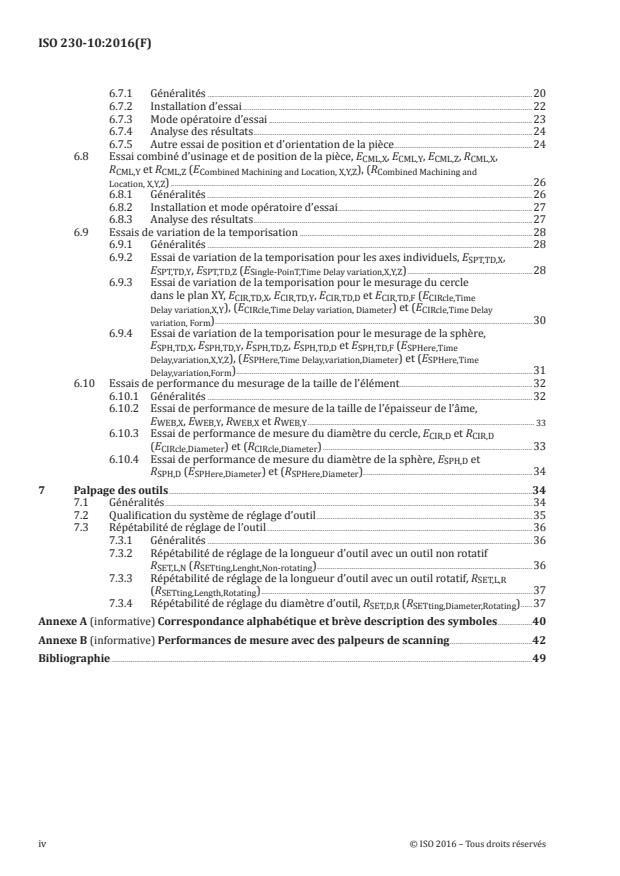
Sommaire Page
Avant-propos .v
Introduction .vii
1 Domaine d’application . 1
2 Références normatives . 1
3 Termes et définitions . 2
3.1 Termes généraux . 2
3.2 Termes liés au système de palpage . 2
3.3 Termes relatifs au palpage . 5
3.4 Termes relatifs aux palpeurs de scanning (Voir Annexe B) . 7
4 Observations préliminaires . 8
4.1 Influences sur la performance de mesure du système de palpage . 8
4.2 Unités de mesure . 9
4.3 Référence à l’ISO 230-1 . 9
4.4 Instruments et équipement d’essai recommandés . 9
4.5 État de la machine avant essai .10
4.6 Ordre des essais .10
4.7 Essais à réaliser .10
4.8 Sources d’incertitude d’essai .10
4.9 Consignation des résultats d’essai .11
5 Influences thermiques .11
5.1 Généralités .11
5.2 Essai d’erreur de variation de température ambiante (ETVE) .11
5.3 Autres essais de distorsion thermique .12
6 Palpage d’une pièce .12
6.1 Généralités .12
6.2 Répétabilité de palpage .13
6.2.1 Généralités .13
6.2.2 Essai de répétabilité de palpage pour le mesurage de surface sur point
unique, R , R et R (R ) .13
SPT,X SPT,Y SPT,Z Single_PoinT,X,Y,Z
6.2.3 Essai de répétabilité de palpage pour la position du centre du cercle,
R et R (R ) .14
CIR,X CIR,Y CIRcle,X,Y
6.2.4 Essai de répétabilité de palpage pour la position du centre de la sphère,
R , R et R (R ) .14
SPH,X SPH,Y SPH,Z SPHere,X,Y,Z
6.3 Essai de constante de palpage, A . 15
6.3.1 Généralités .15
6.3.2 Installation et mode opératoire d’essai .15
6.3.3 Analyse des résultats .15
6.4 Essai de répétabilité de position de l’outil de palpage, R , R et R
PTL,X PTL,Y PTL,Z
(R ) .16
Probing‑Tool_Location,X,Y,Z
6.4.1 Généralités .16
6.4.2 Installation et mode opératoire d’essai .16
6.4.3 Analyse des résultats .16
6.5 Essai d’erreur de palpage 2D, P (P ) .16
FTU,2D Forme_Tactile_Unique, 2D
6.5.1 Généralités .16
6.5.2 Installation et mode opératoire d’essai .17
6.5.3 Analyse des résultats .17
6.6 Essai d’erreur de palpage 3D, P (P ) .18
FTU,3D Forme_Tactile_Unique,3D
6.6.1 Généralités .18
6.6.2 Installation et mode opératoire d’essai .18
6.6.3 Analyse des résultats d’essai .19
6.7 Essais de position et d’orientation de la pièce, E , E , E , E et E
PLA,Z LIN,Y COR,X COR,Y COR,Z
(E ), (E ), (E ).20
PLAne,Z LINe,Y CORner coordinates,X,Y,Z
6.7.1 Généralités .20
6.7.2 Installation d’essai .22
6.7.3 Mode opératoire d’essai .23
6.7.4 Analyse des résultats .24
6.7.5 Autre essai de position et d’orientation de la pièce.24
6.8 Essai combiné d’usinage et de position de la pièce, E , E , E , R ,
CML,X CML,Y CML,Z CML,X
R et R (E ), (R
CML,Y CML,Z Combined Machining and Location, X,Y,Z Combined Machining and
) .26
Location, X,Y,Z
6.8.1 Généralités .26
6.8.2 Installation et mode opératoire d’essai .27
6.8.3 Analyse des résultats .27
6.9 Essais de variation de la temporisation .28
6.9.1 Généralités .28
6.9.2 Essai de variation de la temporisation pour les axes individuels, E ,
SPT,TD,X
E , E (E ) .28
SPT,TD,Y SPT,TD,Z Single‑PoinT,Time Delay variation,X,Y,Z
6.9.3 Essai de variation de la temporisation pour le mesurage du cercle
dans le plan XY, E , E , E et E (E
CIR,TD,X CIR,TD,Y CIR,TD,D CIR,TD,F CIRcle,Time
), (E ) et (E
Delay variation,X,Y CIRcle,Time Delay variation, Diameter CIRcle,Time Delay
) .30
variation, Form
6.9.4 Essai de variation de la temporisation pour le mesurage de la sphère,
E , E , E , E et E (E
SPH,TD,X SPH,TD,Y SPH,TD,Z SPH,TD,D SPH,TD,F SPHere,Time
), (E ) et (E
Delay,variation,X,Y,Z SPHere,Time Delay,variation,Diameter SPHere,Time
) .31
Delay,variation,Form
6.10 Essais de performance du mesurage de la taille de l’élément.32
6.10.1 Généralités .32
6.10.2 Essai de performance de mesure de la taille de l’épaisseur de l’âme,
E , E , R et R .
WEB,X WEB,Y WEB,X WEB,Y 33
6.10.3 Essai de performance de mesure du diamètre du cercle, E et R
CIR,D CIR,D
(E ) et (R ) .33
CIRcle,Diameter CIRcle,Diameter
6.10.4 Essai de performance de mesure du diamètre de la sphère, E et
SPH,D
R (E ) et (R ) .34
SPH,D SPHere,Diameter SPHere,Diameter
7 Palpage des outils .34
7.1 Généralités .34
7.2 Qualification du système de réglage d’outil .35
7.3 Répétabilité de réglage de l’outil .36
7.3.1 Généralités .36
7.3.2 Répétabilité de réglage de la longueur d’outil avec un outil non rotatif
R (R ) .36
SET,L,N SETting,Lenght,Non‑rotating
7.3.3 Répétabilité de réglage de la longueur d’outil avec un outil rotatif, R
SET,L,R
(R ) .37
SETting,Length,Rotating
7.3.4 Répétabilité de réglage du diamètre d’outil, R (R ) .37
SET,D,R SETting,Diameter,Rotating
Annexe A (informative) Correspondance alphabétique et brève description des symboles .40
Annexe B (informative) Performances de mesure avec des palpeurs de scanning .42
Bibliographie .49
iv © ISO 2016 – Tous droits réservés
Avant-propos
L’ISO (Organisation internationale de normalisation) est une fédération mondiale d’organismes
nationaux de normalisation (comités membres de l’ISO). L’élaboration des Normes internationales est
en général confiée aux comités techniques de l’ISO. Chaque comité membre intéressé par une étude
a le droit de faire partie du comité technique créé à cet effet. Les organisations internationales,
gouvernementales et non gouvernementales, en liaison avec l’ISO participent également aux travaux.
L’ISO collabore étroitement avec la Commission électrotechnique internationale (IEC) en ce qui
concerne la normalisation électrotechnique.
Les procédures utilisées pour élaborer le présent document et celles destinées à sa mise à jour sont
décrites dans les Directives ISO/IEC, Partie 1. Il convient, en particulier de prendre note des différents
critères d’approbation requis pour les différents types de documents ISO. Le présent document a été
rédigé conformément aux règles de rédaction données dans les Directives ISO/IEC, Partie 2 (voir www.
iso.org/directives).
L’attention est appelée sur le fait que certains des éléments du présent document peuvent faire l’objet de
droits de propriété intellectuelle ou de droits analogues. L’ISO ne saurait être tenue pour responsable
de ne pas avoir identifié de tels droits de propriété et averti de leur existence. Les détails concernant
les références aux droits de propriété intellectuelle ou autres droits analogues identifiés lors de
l’élaboration du document sont indiqués dans l’Introduction et/ou dans la liste des déclarations de
brevets reçues par l’ISO (voir www.iso.org/brevets).
Les appellations commerciales éventuellement mentionnées dans le présent document sont données
pour information, par souci de commodité, à l’intention des utilisateurs et ne sauraient constituer
un engagement.
Pour une explication de la signification des termes et expressions spécifiques de l’ISO liés à
l’évaluation de la conformité, ou pour toute information au sujet de l’adhésion de l’ISO aux principes
de l’OMC concernant les obstacles techniques au commerce (OTC), voir le lien suivant: Avant-propos —
Informations supplémentaires.
Le comité chargé de l’élaboration du présent document est l’ISO/TC 39, Machines-outils, sous-comité
SC 2, Conditions de réception des machines travaillant par enlèvement de métal.
Cette deuxième édition annule et remplace la première édition (ISO 230-10:2011), dont elle constitue
une révision mineure. Elle intègre également l’amendement ISO 230‑10:2011/Amd 1:2014. Dans le
Tableau B.1 une entrée avec la valeur de «R x 0,050» a été remplacée par «R x 0,500».
L’ISO 230 comprend les parties suivantes, présentées sous le titre général Code d’essai des machines-outils:
— Partie 1: Exactitude géométrique des machines fonctionnant à vide ou dans des conditions quasi-statiques
— Partie 2: Détermination de l’exactitude et de la répétabilité de positionnement des axes en commande
numérique
— Partie 3: Évaluation des effets thermiques
— Partie 4: Essais de circularité des machines-outils à commande numérique
— Partie 5: Détermination de l’émission sonore
— Partie 6: Détermination de la précision de positionnement sur les diagonales principales et de face
(Essais de déplacement en diagonale)
— Partie 7: Exactitude géométrique des axes de rotation
— Partie 8: Vibrations [Rapport technique]
— Partie 9: Estimation de l’incertitude de mesure pour les essais des machines-outils selon la série ISO 230,
équations de base [Rapport technique]
— Partie 10: Détermination des performances de mesure des systèmes de palpage des machines-outils à
commande numérique
La partie suivante est en cours d’élaboration:
— Partie 11: Instruments de mesure compatibles avec les essais de géométrie des machines-outils
[Rapport technique]
vi © ISO 2016 – Tous droits réservés
Introduction
L’objet de l’ISO 230 (toutes les parties) est de normaliser des méthodes d’essai pour la vérification de
l’exactitude des machines-outils, à l’exception des machines-outils électriques portatives.
La présente partie de l’ISO 230 spécifie des procédures d’essai pour évaluer les performances de mesure
des systèmes de palpage à contact (utilisés en mode palpage discret) intégrés dans une machine‑outil
à commande numérique. Les procédures d’essai ne sont pas destinées à différencier les différentes
causes d’erreurs. Elles visent à démontrer l’influence combinée de l’environnement, de la machine‑outil,
du système de palpage et du logiciel de palpage sur les performances de mesure.
Les résultats de ces essais n’ont aucune incidence sur les performances de la machine-outil en mode
enlèvement de métal. Lorsque des essais de réception sont spécifiés, il incombe à l’utilisateur, en
concertation avec le fabricant/le fournisseur, de sélectionner les essais relatifs aux caractéristiques des
composants du système de palpage qui présentent un intérêt.
Les résultats de ces essais n’ont aucune incidence sur les performances de la machine-outil utilisée
comme machine à mesurer tridimensionnelle (MMT). Ces performances impliquent des problèmes de
traçabilité et il est prévu de les évaluer conformément à l’ISO 10360-2 et l’ISO 10360-5.
Une liste alphabétique et une brève description des symboles utilisés dans la présente partie de
l’ISO 230 sonts données dans l’Annexe A.
Les procédures d’essai pour mesurer la performance avec des palpeurs de scanning sont données
dans l’Annexe B.
NORME INTERNATIONALE ISO 230-10:2016(F)
Code d’essai des machines-outils —
Partie 10:
Détermination des performances de mesure des systèmes
de palpage des machines-outils à commande numérique
1 Domaine d’application
La présente partie de l’ISO 230 spécifie des procédures d’essai pour évaluer les performances de mesure
des systèmes de palpage à contact (utilisés en mode de palpage discret) intégrés dans une machine‑
outil à commande numérique.
Elle n’inclut pas d’autres types de systèmes de palpage tels que ceux utilisés dans les systèmes de
palpage en mode «scanning» ou sans contact. L’évaluation des performances de la machine‑outil utilisée
comme machine à mesurer tridimensionnelle (MMT) ne fait pas partie du domaine d’application de la
présente partie de l’ISO 230. L’évaluation de telles performances implique des problèmes de traçabilité
et est fortement influencée par l’exactitude géométrique de la machine‑outil. En plus d’être soumises
aux essais du système de palpage de la machine‑outil spécifiés dans la présente partie de l’ISO 230, elles
peuvent être évaluées conformément à l’ISO 10360-2 et l’ISO 10360-5.
Les machines‑outils à commande numérique peuvent actuellement utiliser des systèmes de palpage à
contact dans les applications d’usinage telles que
— l’identification permettant de vérifier que la bonne pièce a été chargée avant l’usinage,
— la position et/ou l’alignement de la pièce,
— le mesurage de la pièce après usinage, la pièce étant encore sur la machine,
— le mesurage de la position et de l’orientation des axes rotatifs de la machine‑outil,
— le mesurage et le réglage de l’outil coupant (rayon, longueur et décalage de l’outil), et
— la détection des casses d’outils.
NOTE 1 La présente partie de l’ISO 230 se focalise sur les centres d’usinage, mais d’autres types de machines,
notamment les centres de tournage et de meulage, seront inclus dans une future révision de la présente partie
de l’ISO 230.
NOTE 2 La présente partie de l’ISO 230 n’inclut aucun type de palpeurs sans contact (par exemple, palpeurs
optiques), mais ils seront inclus dans une future révision de la présente partie de l’ISO 230.
2 Références normatives
Les documents suivants, en tout ou partie, sont référencés de manière normative dans le présent
document et sont indispensables à son application. Pour les références datées, seule l’édition citée
s’applique. Pour les références non datées, la dernière édition du document de référence s’applique (y
compris les éventuels amendements).
ISO 230-1, Code d’essai des machines-outils — Partie 1: Exactitude géométrique des machines fonctionnant
à vide ou dans des conditions quasi-statiques
ISO 230-2, Code d’essai des machines-outils — Partie 2: Détermination de l’exactitude et de la répétabilité
de positionnement des axes à commande numérique
ISO 230-3:2007, Code d’essai des machines-outils — Partie 3: Évaluation des effets thermiques
ISO 10360-5:2010, Spécification géométrique des produits (GPS) — Essais de réception et de vérification
périodique des machines à mesurer tridimensionnelles (MMT) — Partie 5: MMT utilisant des systèmes de
palpage à stylet simple ou à stylets multiples
3 Termes et définitions
Pour les besoins du présent document, les termes et définitions suivants s’appliquent.
NOTE En mode mesurage, les machines‑outils sont utilisées comme des MMT. Les définitions relatives aux
essais des performances des systèmes de palpage pour les MMT s’appliquent donc également aux machines‑
outils. Tous les utilisateurs de machines-outils ne sont toutefois pas familiarisés avec l’utilisation des MMT. C’est
pourquoi la présente partie de l’ISO 230 donne des définitions spécifiques aux machines‑outils qui évitent tout
risque de contradiction avec les définitions relatives aux MMT.
3.1 Termes généraux
3.1.1
repère machine
RM
système de coordonnées lié aux axes, physiques ou calculés, d’une machine-outil
[SOURCE: ISO 10360‑1:2000, 2.5 modifiée.]
3.1.2
repère pièce
RP
système de coordonnées lié à la pièce
[SOURCE: ISO 10360-1:2000, 2.4]
3.1.3
volume de mesure
espace tridimensionnel englobant l’ensemble des coordonnées linéaires accessibles au mesurage sur la
machine-outil
[SOURCE: ISO 10360‑1:2000, 2.3 modifiée.]
3.2 Termes liés au système de palpage
3.2.1
palpeur
dispositif qui détecte un élément et génère un (des) signal (signaux) pendant le palpage
[SOURCE: ISO 10360‑1:2000, 3.1 modifiée.]
Note 1 à l’article: Il existe plusieurs types de palpeurs utilisés sur les machines-outils et employant différentes
technologies pour atteindre le même but.
Note 2 à l’article: Les palpeurs peuvent être de type «à déclenchement» ou «proportionnel». Ils sont disponibles
sous la forme de systèmes «à contact» ou «sans contact». Les systèmes sans contact ne font pas partie du domaine
d’application de la présente partie de l’ISO 230.
3.2.1.1
palpeur à déclenchement
palpeur émettant un signal binaire au contact d’une surface à mesurer (à détecter)
2 © ISO 2016 – Tous droits réservés
3.2.1.2
palpeur proportionnel
palpeur émettant un signal (analogique ou numérique) proportionnel à un déplacement de la pointe du
stylet
3.2.1.3
palpeur à contact
palpeur qui nécessite un contact matériel avec une surface à mesurer (à détecter) pour fonctionner
[SOURCE: ISO 10360‑1:2000, 3.2 modifiée.]
EXEMPLE Disjoncteur électrique, jauge de contrainte.
Note 1 à l’article: La vitesse d’avance de contact appliquée pour obtenir le contact matériel peut influencer les
performances de ces palpeurs. La vitesse d’avance de contact appropriée est spécifiée dans les instructions du
fabricant/fournisseur.
Note 2 à l’article: Pour obtenir des performances optimales, la vitesse d’avance de contact appliquée pendant le
mesurage est identique à la vitesse appliquée pendant la qualification du palpeur.
3.2.1.4
palpeur sans contact
palpeur qui ne nécessite pas un contact matériel avec une surface à mesurer pour fonctionner
[SOURCE: ISO 10360‑1:2000, 3.3 modifiée.]
EXEMPLE Systèmes optiques et laser, systèmes inductifs et capacitifs.
Note 1 à l’article: Les palpeurs sans contact ne font pas partie du domaine d’application de la présente partie
de l’ISO 230.
3.2.2
système de palpage
système constitué d’un palpeur (3.2.1), d’un système de transmission de signal (par exemple, optique,
radio, filaire), d’un matériel de traitement du signal, du matériel et du logiciel de palpage et, selon le cas,
de rallonges de palpeur, d’un système de changement de palpeur, d’un stylet et de rallonges de stylet, en
cas d’utilisation conjointe avec une machine-outil à commande numérique appropriée
[SOURCE: ISO 10360‑1:2000, 2.6 modifiée.]
Note 1 à l’article: Les essais spécifiés dans la présente partie de l’ISO 230 concernent les systèmes de palpage
constitués de palpeurs à contact équipés d’un système de stylet simple parallèle à la ligne moyenne d’axe de
broche de la machine-outil, comme illustré à la Figure 2. Pour les applications utilisant des systèmes équipés
de stylets multiples (voir Figure 3) et pour les applications dans lesquelles le mesurage est effectué en utilisant
plusieurs orientations de la ligne moyenne d’axe de broche par rapport au RP, des essais supplémentaires sont
spécifiés dans l’ISO 10360‑5.
3.2.3
qualification du système de palpage
établissement des paramètres d’un système de palpage (d’après les instructions du fabricant/fournisseur)
nécessaires pour les mesurages à venir
Note 1 à l’article: Le diamètre effectif de la touche de style (3.2.5) et la position du centre de la touche de stylet par
rapport au RM sont des paramètres types établis par la qualification du système de palpage.
Note 2 à l’article: La documentation technique des fournisseurs utilise parfois l’expression «étalonnage du
système de palpage» pour désigner la qualification du système de palpage; cette expression n’est pas appropriée.
3.2.4
pré-course
distance entre le point du premier contact matériel de la touche de stylet du palpeur dont la surface est
mesurée (détectée) et le point d’émission du signal du palpeur
Note 1 à l’article: La pré‑course est affectée par la construction du palpeur, la direction de palpage, la vitesse de
palpage, la force de déclenchement, la longueur et la conformité du système de stylet, la temporisation entre le
signal de palpage et la lecture des transducteurs de position de la machine‑outil, etc.
Note 2 à l’article: Dans les conditions de palpage spécifiées, la variation de pré‑course (couramment appelée
«frange») est une caractéristique très importante du système de palpage.
Note 3 à l’article: Certaines techniques de qualification du palpeur peuvent nettement réduire les effets de
variation de pré‑course du système de palpage.
3.2.5
diamètre effectif de la touche de stylet
taille effective de la touche de stylet
dimension utilisée par certains logiciels de palpage pour compenser la taille de l’élément mesuré, etc.
Note 1 à l’article: Le diamètre effectif (taille) de la touche de stylet est associé aux performances du système
de palpage et est déterminé par une qualification appropriée au système de palpage plutôt qu’en mesurant
simplement la taille de la touche de stylet.
3.2.6
touche de stylet
élément physique qui établit le contact avec l’objet à mesurer
[SOURCE: ISO 10360‑1:2000, 4.2 modifiée.]
3.2.7
système de stylet
système composé d’un stylet et de rallonge(s) de stylet (selon le cas)
[SOURCE: ISO 10360-1:2000, 4.4 — modifiée.]
Note 1 à l’article: Les rallonges de stylet peuvent réduire la rigidité du système de stylet et influencer négativement
les performances du système de palpage. Par conséquent, les essais de performance sont effectués en prenant en
compte les particularités des rallonges de stylet.
3.2.8
longueur du système de stylet
〈touche de stylet sphérique〉 distance du centre de la touche de stylet à l’épaulement du stylet
Note 1 à l’article: Voir Figure 1.
Légende
a longueur du système de stylet
Figure 1 — Longueur du système de stylet
3.2.9
outil de palpage
dispositif constitué d’un palpeur et de son système de stylet, fixé à un porte‑outil
Note 1 à l’article: Voir Figure 2.
4 © ISO 2016 – Tous droits réservés
3.2.10
longueur de l’outil de palpage
distance du point le plus saillant de la touche de stylet à la surface de référence de la broche de la
machine‑outil ou du plan de jauge qui se connecte à l’outil de palpage
Note 1 à l’article: Voir Figure 2.
Note 2 à l’article: Certains systèmes de palpage définissent la longueur de l’outil de palpage comme distance
entre le centre de la surface de la touche de stylet et la surface de référence de la broche de la machine-outil qui
se connecte à l’outil de palpage.
Note 3 à l’article: Pour les porte-outils de type à queue pleine, la surface de référence de la broche se trouve au
niveau du plan de jauge du cône de broche. Pour les autres porte‑outils (à queue creuse), la surface de référence
de la broche se trouve au niveau de la face de la broche.
Note 4 à l’article: La procédure pour établir la longueur de l’outil de palpage est spécifiée dans les instructions du
fabricant/fournisseur.
Légende
1 broche
2 porte-outil
3 palpeur
4 stylet
L longueur de l’outil de palpage
Figure 2 — Longueur de l’outil de palpage
3.2.11
constante de palpage
distance effective du centre de la touche de stylet à la ligne moyenne de l’axe de broche, sur laquelle
l’outil de palpage est fixé
3.3 Termes relatifs au palpage
3.3.1
palpage
palper
action de mesurage consistant à déterminer des valeurs (par exemple, valeurs de coordonnées, valeurs
de longueurs, valeurs fausses/vraies)
[SOURCE: ISO 10360‑1:2000, 2.7 modifiée.]
Note 1 à l’article: Le palpage associé au mesurage des outils coupants ne permettra pas nécessairement de
déterminer des valeurs de coordonnées.
Note 2 à l’article: Le palpage associé à la détection de bris d’outil permettra de déterminer un état faux/vrai.
3.3.1.1
palpage 1D
mesurage permettant de palper un mouvement parallèle aux axes d’un repère machine ou aux axes d’un
repère pièce à un moment donné uniquement
Note 1 à l’article: La fonctionnalité de mesurage 1D est associée aux performances du système de palpage et non
uniquement aux caractéristiques du palpeur à contact.
3.3.1.2
palpage 2D
mesurage permettant de palper un mouvement le long d’un vecteur dans un plan
Note 1 à l’article: Les palpeurs à contact types fonctionnant dans les directions −X, +X, −Y, +Y et −Z, et dans
n’importe quelle combinaison de ces directions, sont parfois appelés palpeurs 2,5D. Ces palpeurs à contact ne
permettront pas une traction (ou permettront une traction très limitée) dans la direction +Z.
Note 2 à l’article: La fonctionnalité de mesurage dans la direction +Z peut être obtenue en utilisant les systèmes
de stylet équipés de stylets multiples comme illustré à la Figure 3 dans lesquels la touche de stylet 2 (se déplaçant
dans la direction +Z) sera en contact avec la surface de la pièce et incitera le palpeur à émettre le signal en
conséquence de la déviation dans la direction −Z.
Note 3 à l’article: Une qualification indépendante pour la touche de stylet 1 et la touche de stylet 2, ainsi que des
essais supplémentaires sont spécifiés dans l’ISO 10360‑5.
Légende
1 touche de stylet 1
2 touche de stylet 2
3 broche
4 porte-outil
5 palpeur
6 pièce
Figure 3 — Outil de palpage équipé de deux stylets
3.3.1.3
palpage 3D
mesurage permettant de palper un mouvement le long de tout vecteur dans l’espace
6 © ISO 2016 – Tous droits réservés
3.3.2
répétabilité de palpage
écart entre les valeurs de coordonnées fournies par le système de palpage lorsqu’il est appliqué de
manière répétitive au même mesurande, dans les mêmes conditions d’essai
Note 1 à l’article: Cette définition concerne spécifiquement le domaine d’application de la présente partie
de l’ISO 230 et les systèmes de palpage étudiés; elle ne s’applique pas à la définition générale associée aux
caractéristiques métrologiques définies dans d’autres Normes internationales.
Note 2 à l’article: La répétabilité de palpage peut être exprimée quantitativement, en termes de caractéristiques
de dispersion des valeurs mesurées ou par l’amplitude des valeurs mesurées.
Note 3 à l’article: La répétabilité de palpage concerne l’ensemble du système de palpage. Elle n’est pas comparable
à la «répétabilité du palpeur» définie dans les catalogues des fournisseurs de palpeurs.
3.3.3
erreur de palpage
P
FTU
erreur à l’intérieur de laquelle l’amplitude des rayons d’une entretoise de référence peut être déterminée
par une machine-outil en utilisant un système de stylet
Note 1 à l’article: Le symbole P est tiré de l’ISO 10360-5:2010, 3.6 et 3.9. La lettre P indique que l’erreur est
FTU
principalement liée aux performances du système de palpage, la lettre F indique qu’il s’agit d’une erreur de
forme, la lettre T désigne un système de palpage à contact (tactile) et la lettre U indique l’utilisation d’un stylet
simple (unique).
Note 2 à l’article: Une entretoise de référence type pour le palpage 2D est un anneau de forme étalonnée. Une
entretoise de référence type pour le palpage 3D est une sphère de forme étalonnée.
Note 3 à l’article: L’erreur de palpage 2D est décrite en 6.5 et l’erreur de palpage 3D en 6.6.
3.4 Termes relatifs aux palpeurs de scanning (Voir Annexe B)
3.4.1
position de repos
position du centre de la touche du stylet du palpeur lorsqu’elle est fixe et n’est pas déviée par le contact
avec une surface
Note 1 à l’article: La position de repos est une position nominale qui est établie au cours de la qualification. La
position de repos réelle à un moment quelconque s’écarte en général légèrement de cette valeur.
3.4.2
déviation maximale de scanning
déviation maximale spécifiée par le fabricant pouvant être appliquée au centre de la touche du stylet du
palpeur au cours d’un mesurage par scanning
Note 1 à l’article: La déviation maximale de scanning peut varier en fonction de la direction de la déviation (x, y, z).
3.4.3
limite de surcourse du palpeur
déviation maximale au centre de la touche du stylet du palpeur depuis la position de repos pouvant être
appliquée sans endommager l’ensemble stylet‑palpeur
3.4.4
déviation minimale de scanning
déviation minimale du centre de la touche du stylet depuis sa position de repos, qui est admise au cours
d’un mesurage par scanning
Note 1 à l’article: La déviation est programmée pour être suffisamment grande pour s’assurer que la touche du
stylet reste en contact avec la surface pendant tout le mesurage.
3.4.5
amplitude de mesure du scanning
distance maximale admise entre la ligne de scanning nominale et la ligne de scanning réelle, telle que
spécifiée par le fabricant/fournisseur
Note 1 à l’article: Cette distance peut être exprimée séparément pour les différents axes du palpeur, par exemple
± 0,3 mm sur X et Y, ± 0,2 mm sur Z.
Note 2 à l’article: L’amplitude de mesure du scanning est inférieure à la différence entre la déviation maximale de
scanning et la déviation minimale de scanning pour plusieurs raisons y compris
— de l’écart par rapport à la trajectoire prédéfinie de l’outil du fait des erreurs de suivi de trajectoire de la machine,
— des approximations au cours de la génération de la trajectoire de l’outil (par exemple, approximation d’une
courbe par des segments de droites), et
— de la déviation supplémentaire du palpeur causée par le mouvement le long de la surface (par exemple,
frottement, écarts normaux locaux en surface, finition de surface).
3.4.6
accélération normale de la touche du stylet
accélération du centre de la touche du stylet par rapport à la surface mesurée, normale à la surface cible
Note 1 à l’article: On considère parfois que l’accélération normale de la touche du stylet limite la vitesse d’avance
du scanning pour les éléments qui présentent des changements de direction brusques de la trajectoire de scanning
et qui exigent donc, de fortes accélérations des axes de la machine‑outil. La performance de scanning est surtout
sensible à l’accélération dans la direction normale à la surface mesurée, car les erreurs de positionnement de la
machine le long de la ligne de scanning cible ne conduisent généralement pas à des erreurs de mesure importantes.
3.4.7
point central de la touche indiqué
position indiquée du centre de la touche du stylet au cours d’un mesurage
Note 1 à l’article: Ceci est également connu sous le nom de «point de mesure indiqué» (voir l’ISO 10360-1:2000, 2.12).
3.4.8
reproductibilité de la position du centre de la sphère de scanning
variation maximale des positions du centre de la sphère obtenues à la suite de multiples mesurages
comparée à la position du centre de la sphère obtenue lors du premier mesurage
3.4.9
trajectoire de scanning prédéfinie
méthode de scanning pour laquelle le déplacement du système de palpage entre deux points extrêmes
définis est guidé selon une ligne de scanning cible
[SOURCE: ISO 10360-1:2000, 7.5]
Note 1 à l’article: Dans cette méthode de scanning, le retour d’informations du système de palpage n’est pas
utilisé pour guider le déplacement du système de palpage.
4 Observations préliminaires
4.1 Influences sur la performance de mesure du système de palpage
La performance de mesure du système de palpage inclut les caractéristiques de la machine‑outil sur un
volume petit et limité et ne doit pas être simplement tirée des spécifications de palpage individuelles.
Les principales influences sur la performance des systèmes de palpage d’une machine‑outil sont les
suivantes:
a) répétabilité de la machine‑outil;
8 © ISO 2016 – Tous droits réservés
b) exactitude géométrique de la machine‑outil, à savoir l’exactitude de positionnement (notamment,
résolution, jeu), la rectitude, le roulis, le pas, le mouvement d’erreur en lacet, la perpendicularité
entre les axes, etc.;
c) contamination des surfaces à mesurer (à détecter);
d) erreur de palpage et répétabilité du système de palpage, comprenant le changement et le
repositionnement de l’outil de palpage;
e) qualification du système de palpage;
f) influences de la température sur la machine‑outil, le système de palpage, l’entretoise et la
pièce/l’outil, comprenant la dérive des axes et des broches en rotation;
g) vitesse d’avance et accélérations pendant le mesurage;
h) distances de sécurité et de surcourse;
i) temporisation et variation de la temporisation entre le signal de palpage et la lecture des
transducteurs de position de la machine‑outil;
j) surface de la pièce/l’outil palpé(e).
La répétabilité de palpage de la pièce doit être vérifiée conformément aux essais de 6.2; la répétabilité
de la position de l’outil de palpage doit être vérifiée conformément à l’essai de 6.4; la répétabilité de
réglage de l’outil doit être vérifiée conformément à l’essai de 7.3.
Les performances du système de palpage de la pièce et l’exactitude géométrique de la machine‑outil
(dans un volume petit et limité) sont soumises à essai en 6.5 et en 6.6.
La variation de la temporisation entre le signal de palpage et la lecture des transducteurs de position
de la machine-outil est soumise à essai en 6.9; les essais de performance du mesurage de la taille de
l’élément sont donnés en 6.10.
Les procédures données en 5.2 et dans l’ISO 230-3 sont les procédures les plus adaptées pour observer
les influences de la température.
4.2 Unités de mesure
Dans la présente partie de l’ISO 230, toutes les dimensions linéaires et tous les écarts sont exprimés en
millimètres. Toutes les dimensions angulaires sont exprimées en degrés. Les écarts angulaires sont,
en principe, exprimés sous forme de rapports, mais dans certains cas les microradians ou les secondes
d’arc peuvent être utilisés pour des besoins de clarification. Il convient d’utiliser les expressions
...
Questions, Comments and Discussion
Ask us and Technical Secretary will try to provide an answer. You can facilitate discussion about the standard in here.
Loading comments...