


ISO 2270:1989
(Main)Non-ionic surface active agents — Polyethoxylated derivatives — Iodometric determination of oxyethylene groups
Non-ionic surface active agents — Polyethoxylated derivatives — Iodometric determination of oxyethylene groups
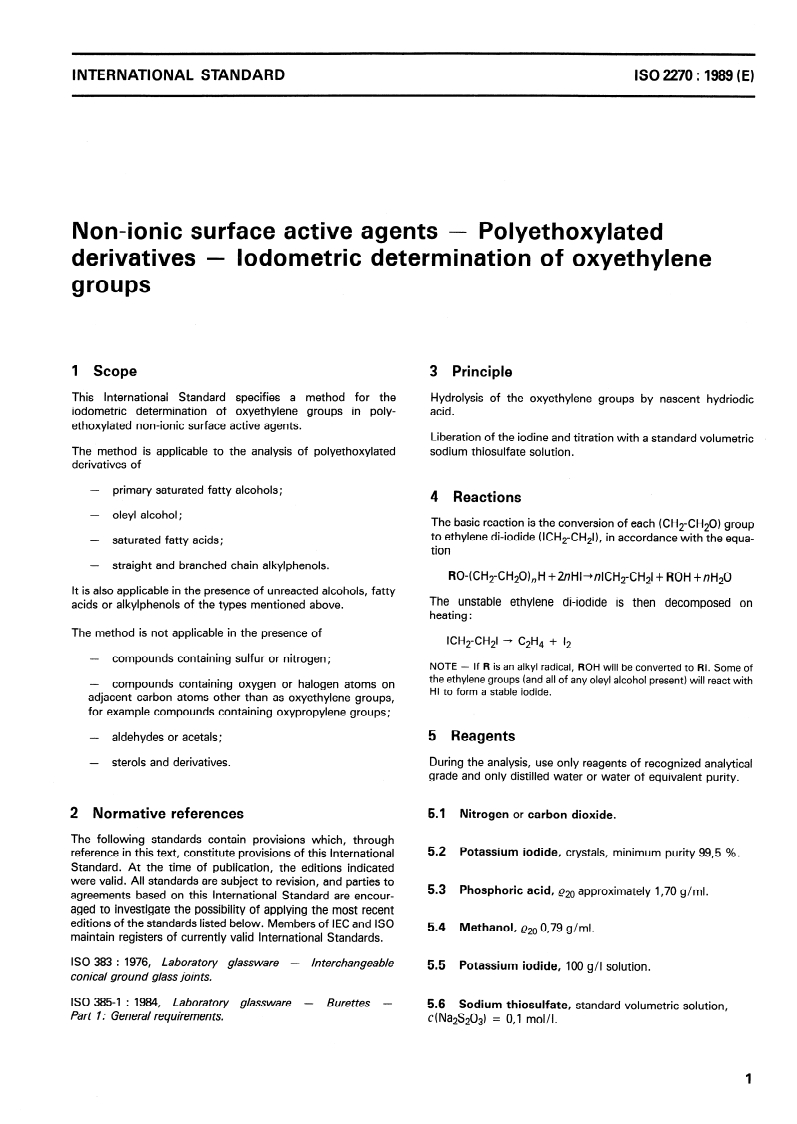
The sample is hydrolyzed by nascent hydroiodic acid. The iodine liberated is titrated with a standard volumetric sodium thiosulfate solution. The method is applicable to the analysis of polyethoxylated derivatives of primary saturated fatty alcohols, oleyl alcohol, satureted fatty acids, straight and branched chain alkylphenols. It is not applicable in the present of compounds containing sulfur or nitrogen, compounds containing oxypropylene group, aldehydes or acetals, sterols and derivatives.
Agents de surface non ioniques — Dérivés polyéthoxylés — Dosage iodométrique des groupes oxyéthylène
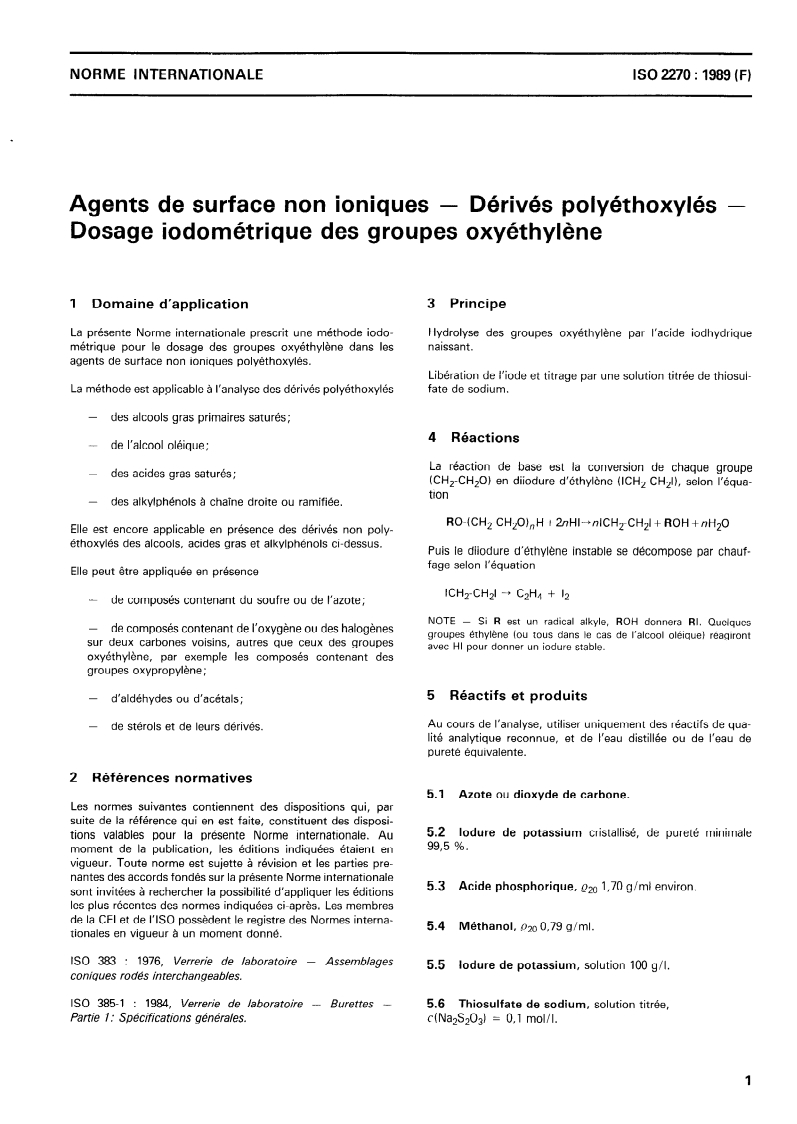
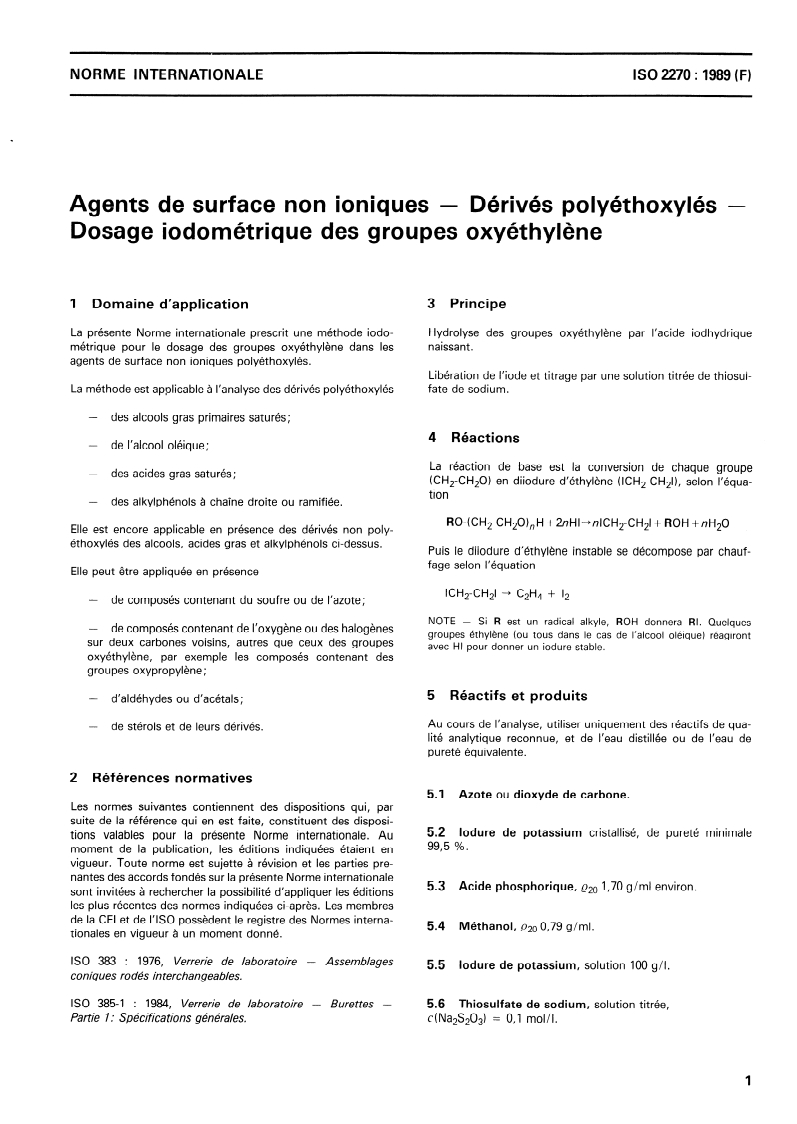
La présente Norme internationale prescrit une méthode iodométrique pour le dosage des groupes oxyéthylène dans les agents de surface non ioniques polyéthoxylés. La méthode est applicable à l'analyse des dérivés polyéthoxylés des alcools gras primaires saturés; de l'alcool oléique; des acides gras saturés; des alkylphénols à chaîne droite ou ramifiée. Elle est encore applicable en présence des dérivés non polyéthoxylés des alcools, acides gras et alkylphénols ci-dessus. Elle peut être appliquée en présence de composés contenant du soufre ou de l'azote; de composés contenant de l'oxygène ou des halogènes sur deux carbones voisins, autres que ceux des groupes oxyéthylène, par exemple les composés contenant des groupes oxypropylène; d'aldéhydes ou d'acétals; de stérols et de leurs dérivés.
General Information
- Status
- Published
- Publication Date
- 16-Aug-1989
- Technical Committee
- ISO/TC 91 - Surface active agents
- Drafting Committee
- ISO/TC 91 - Surface active agents
- Current Stage
- 9020 - International Standard under periodical review
- Start Date
- 15-Apr-2026
- Completion Date
- 15-Apr-2026
Relations
- Effective Date
- 15-Apr-2008
Overview
ISO 2270:1989 is an international standard established by the International Organization for Standardization (ISO) that specifies a precise chemical method for determining the oxyethylene group content in non-ionic surface active agents. This standard focuses on polyethoxylated derivatives through an iodometric titration process. The method involves the hydrolysis of oxyethylene groups by nascent hydriodic acid, liberation of iodine, and titration with a standard sodium thiosulfate solution.
This standardized method is essential for quality control and analysis of polyethoxylated surfactants commonly used in industrial and laboratory settings. It ensures accurate quantification of oxyethylene groups in specific derivatives while outlining clear limitations for compounds containing interfering elements.
Key Topics
Scope and Applicability
The method applies to polyethoxylated derivatives of:- Primary saturated fatty alcohols
- Oleyl alcohol
- Saturated fatty acids
- Straight and branched chain alkylphenols
It excludes samples containing:
- Sulfur or nitrogen compounds
- Compounds with oxypropylene groups
- Aldehydes or acetals
- Sterols and their derivatives
Principle of the Method
The analysis is based on the hydrolysis of oxyethylene groups by nascent hydriodic acid to form ethylene di-iodide, which on heating decomposes to iodine. The liberated iodine is then titrated iodometrically with standardized sodium thiosulfate solution.Chemical Reactions
The core reaction converts oxyethylene groups (–CH2–CH2–O–) to ethylene di-iodide under acidic conditions, releasing iodine in proportion to the oxyethylene content.Analytical Procedure
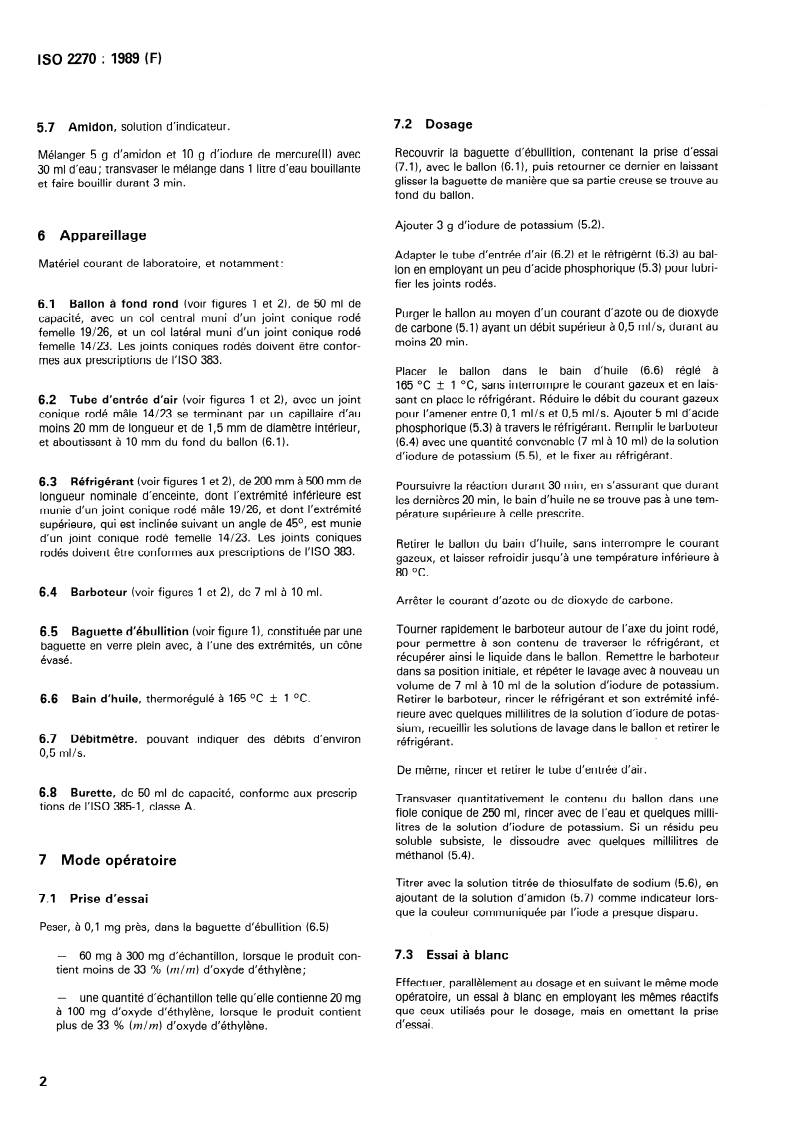
The standard lays out detailed steps involving specific laboratory apparatus such as a round-bottom flask, gas inlet tube, reflux condenser, absorption bulbs, and an oil bath at 165°C. It requires the use of reagents including phosphoric acid, potassium iodide, sodium thiosulfate, methanol, and starch indicator solution.Precision and Repeatability
The method guarantees a maximum repeatability difference of 1.5% and a reproducibility difference between laboratories of up to 3% for samples containing more than 10% ethylene oxide by mass.
Applications
Quality Control in Surfactant Manufacturing
ISO 2270:1989 provides surfactant producers with a reliable approach for determining the exact oxyethylene content in non-ionic surfactants, crucial for maintaining product performance and compliance with specifications.Chemical Research and Development
Researchers developing new polyethoxylated non-ionic surfactants can use this standard to accurately assess the oxyethylene group content during synthesis and formulation.Regulatory and Compliance Testing
Laboratories analyzing commercial surfactant products can employ this method to verify manufacturer claims and meet international regulatory requirements.Industrial Process Monitoring
Enables continuous monitoring and control of ethoxylation processes in chemical plants producing surface active agents.
Related Standards
ISO 383:1976
Laboratory glassware - Interchangeable conical ground glass joints, which specifies apparatus requirements used in the procedure.ISO 385-1:1984
Laboratory glassware - Burettes - General requirements, ensuring precision in titration measurements.Other ISO standards related to surface active agents and polyethoxylated compounds may complement ISO 2270:1989 for comprehensive surfactant analysis.
Keywords: ISO 2270, non-ionic surface active agents, polyethoxylated derivatives, oxyethylene groups, iodometric determination, sodium thiosulfate titration, surfactant analysis, ethylene oxide content, chemical standard, surfactant quality control, iodometric titration method, analytical chemistry standards.
Buy Documents

ISO 2270:1989 - Non-ionic surface active agents -- Polyethoxylated derivatives -- Iodometric determination of oxyethylene groups
ISO 2270:1989 - Non-ionic surface active agents — Polyethoxylated derivatives — Iodometric determination of oxyethylene groups/17/1989


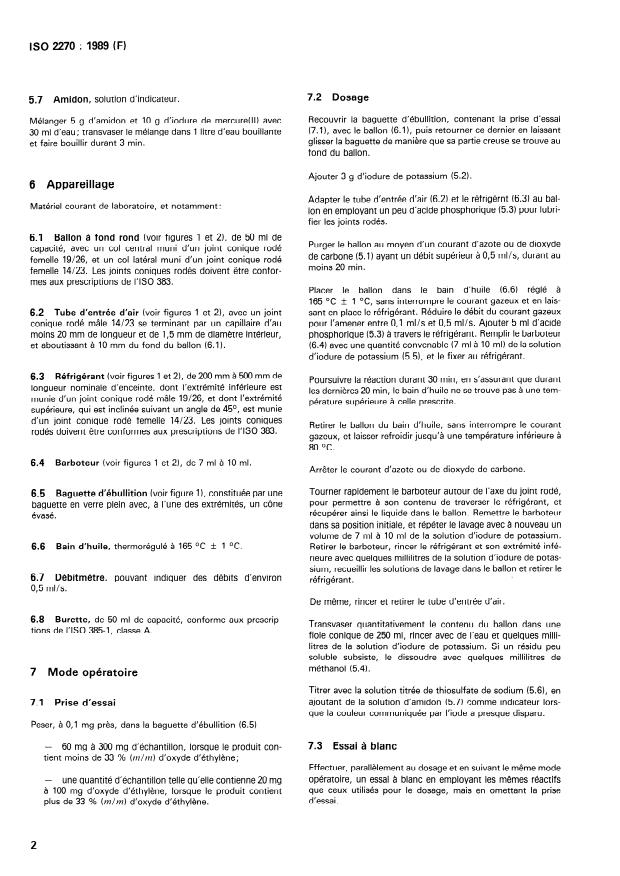
ISO 2270:1989 - Agents de surface non ioniques -- Dérivés polyéthoxylés -- Dosage iodométrique des groupes oxyéthylene

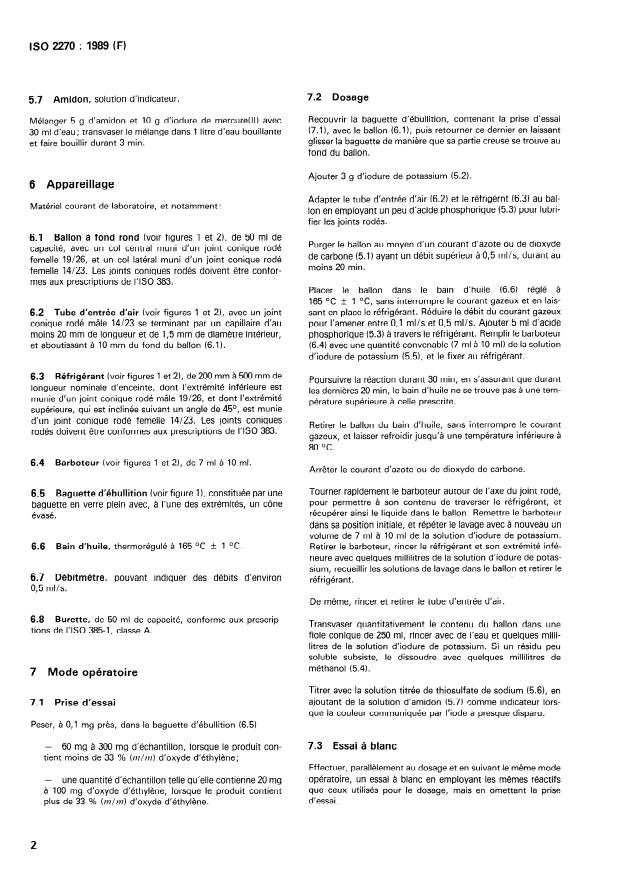
ISO 2270:1989 - Agents de surface non ioniques -- Dérivés polyéthoxylés -- Dosage iodométrique des groupes oxyéthylene
ISO 2270:1989 - Agents de surface non ioniques — Dérivés polyéthoxylés — Dosage iodométrique des groupes oxyéthylène/17/1989
ISO 2270:1989 - Agents de surface non ioniques — Dérivés polyéthoxylés — Dosage iodométrique des groupes oxyéthylène/17/1989
Get Certified
Connect with accredited certification bodies for this standard

ECOCERT
Organic and sustainability certification.

Eurofins Food Testing Global
Global leader in food, environment, and pharmaceutical product testing.

Intertek Bangladesh
Intertek certification and testing services in Bangladesh.
Sponsored listings
Frequently Asked Questions
ISO 2270:1989 is a standard published by the International Organization for Standardization (ISO). Its full title is "Non-ionic surface active agents — Polyethoxylated derivatives — Iodometric determination of oxyethylene groups". This standard covers: The sample is hydrolyzed by nascent hydroiodic acid. The iodine liberated is titrated with a standard volumetric sodium thiosulfate solution. The method is applicable to the analysis of polyethoxylated derivatives of primary saturated fatty alcohols, oleyl alcohol, satureted fatty acids, straight and branched chain alkylphenols. It is not applicable in the present of compounds containing sulfur or nitrogen, compounds containing oxypropylene group, aldehydes or acetals, sterols and derivatives.
The sample is hydrolyzed by nascent hydroiodic acid. The iodine liberated is titrated with a standard volumetric sodium thiosulfate solution. The method is applicable to the analysis of polyethoxylated derivatives of primary saturated fatty alcohols, oleyl alcohol, satureted fatty acids, straight and branched chain alkylphenols. It is not applicable in the present of compounds containing sulfur or nitrogen, compounds containing oxypropylene group, aldehydes or acetals, sterols and derivatives.
ISO 2270:1989 is classified under the following ICS (International Classification for Standards) categories: 71.100.40 - Surface active agents. The ICS classification helps identify the subject area and facilitates finding related standards.
ISO 2270:1989 has the following relationships with other standards: It is inter standard links to ISO 2270:1972. Understanding these relationships helps ensure you are using the most current and applicable version of the standard.
ISO 2270:1989 is available in PDF format for immediate download after purchase. The document can be added to your cart and obtained through the secure checkout process. Digital delivery ensures instant access to the complete standard document.
Standards Content (Sample)
INTERNATIONAL
ISO
STANDARD
Second edition
1989-08- 15
Non-ionic surface active agents -
Polyethoxylated derivatives - lodometric
determination of oxyethylene groups
Agents de surface non ioniques - D&iv& polykthoxyks - Dosage iodomktrique
des groupes oxykthylene
Reference number
ISO 2270 : 1989 (El
iso2270:1989 (EI
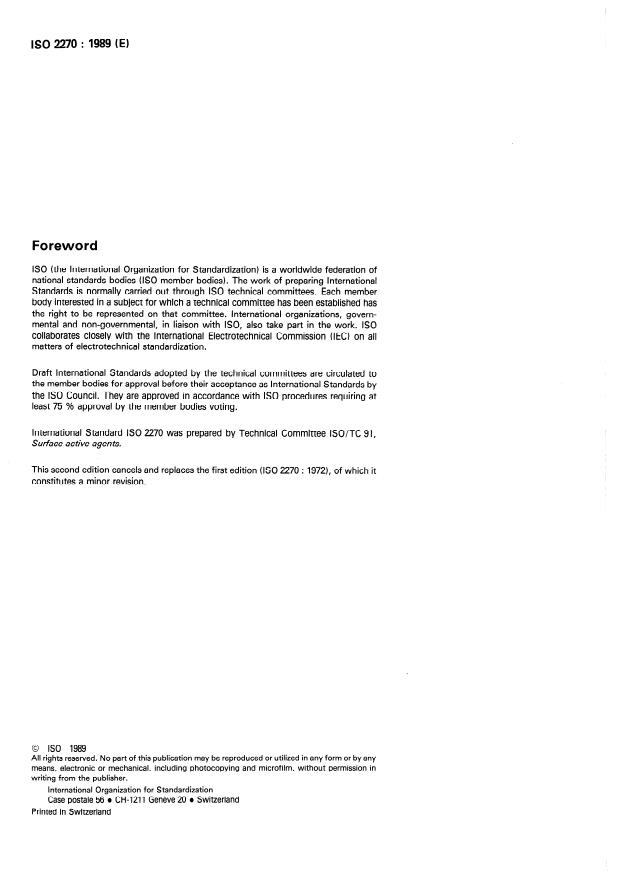
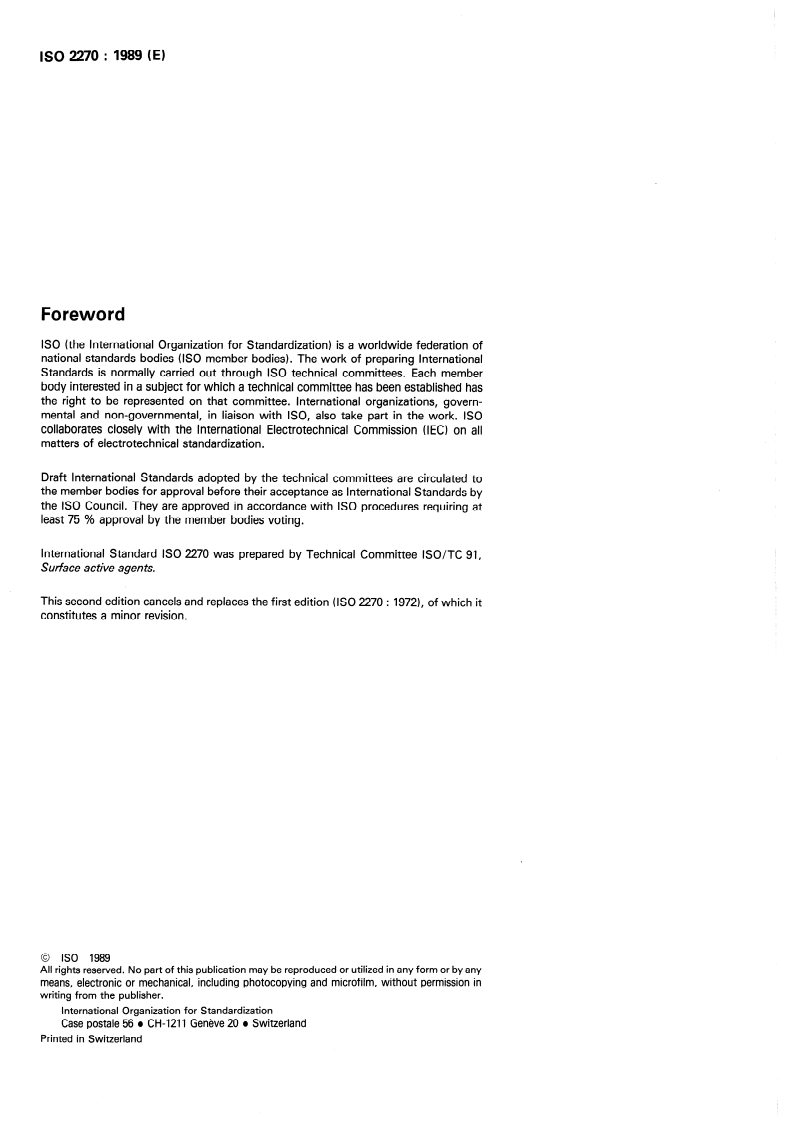
Foreword
ISO (the International Organization for Standardization) is a worldwide federation of
national Standards bodies (ISO member bodies). The work of preparing International
Standards is normally carried out through ISO technical committees. Esch member
body interested in a subject for which a technical committee has been established has
the right to be represented on that committee. International organizations, govern-
mental and non-governmental, in liaison with ISO, also take part in the work. ISO
collaborates closely with the International Electrotechnical Commission (IEC) on all
matters of electrotechnical standardization.
Draft International Standards adopted by the technical committees are circulated to
the member bodies for approval before their acceptance as International Standards by
the ISO Council. They are approved in accordance with ISO procedures requiring at
least 75 % approval by the member bodies voting.
International Standard ISO 2270 was prepared by Technical Committee ISO/TC 91,
Surface active agents.
This second edition cancels and replaces the first edition (ISO 2270 : 19721, of which it
constitutes a minor revision.
0 ISO 1989
All rights reserved. No patt of this publication may be reproduced or utilized in any form or by any
means, electronie or mechanical, including photocopying and microfilm, without Permission in
writing from the publisher.
International Organization for Standardization
Case postale 56 l CH-121 1 Geneve 20 l Switzerland
Printed in Switzerland
ISO 2270 : 1989 (E)
INTERNATIONAL STANDARD
Non-ionic surface active agents - Polyethoxylated
lodometric determination of oxyethylene
derivatives -
groups
3 Principle
1 Scope
This Internationai Standard specifies a method for the Hydrolysis of the oxyethylene groups by nascent hydriodic
oxyethylene groups in poly- acid.
iodometric determination 01
active agents.
ethoxylated non-ionic surface
Liberation of the iodine and titration with a Standard volumetric
the analysis of polyethoxylated sodium thiosulfate Solution.
The method is applicable to
derivatives of
- primary saturated fatty alcohols;
4 Reactions
-
oleyl alcohol ;
The basic reaction is the conversion of each (CH,-CH201 group
to ethylene di-iodide (ICH*-CH+), in accordance with the equa-
-
saturated fatty acids;
tion
-
straight and branched chain alkylphenols.
RO-(CH2-CH20),H +2nHI--+nICH2-CH21+ ROH +nH20
lt is also applicable in the presence of unreacted alcohols, fatty
The unstable ethylene di-iodide is then decomposed on
acids or alkylphenols of the types mentioned above.
heating :
The method is not applicable in the presence of
ICH2-CH21 -, C2H, + 1,
-
compounds containing Sulfur or nitrogen;
NOTE - If R is an alkyl radical, ROH will be converted to RI. Some of
the ethylene groups (and all of any oleyl alcohol present) will react with
-
compounds containing Oxygen or halogen atoms on
Hl to form a stable iodide.
adjacent carbon atoms other than as oxyethylene groups,
for example compounds containing oxypropylene groups;
-
5 Reagents
aldehydes or acetals;
-
During the analysis, use only reagents of recognized analytical
sterols and derivatives.
grade and only distilled water or water of equivalent purity.
5.1 Nitrogen or carbon dioxide.
2 Normative references
The following Standards contain provisions which, through
5.2 Potassium iodide, crystals, minimum purity 99,5 %.
reference in this text, constitute provisions of this International
Standard. At the time of publication, the editions indicated
were valid. All Standards are subject to revision, and Parties to
5.3 Phosphoric acid, ~20 approximately 1,70 g/ml.
agreements based on this International Standard are encour-
aged to investigate the possibility of applying the most recent
editions of the Standards listed below. Members of IEC and ISO
5.4 Methanol, ~2~ 0,79 g/ml.
maintain registers of currently valid International Standards.
ISO 383 : 1976, Laboratory glassware - lnterchangeable
5.5 Potassium iodide, 100 g/l Solution.
conical ground glass join ts.
ISO 385-1 : 1984, Laboratory glassware - Burettes -
5.6 Sodium thiosulfate, Standard volumetric Solution,
Part 1: General requiremen ts.
c ( Na2S203) = 0,l mol/l.
ISO 2270 : 1989 (El
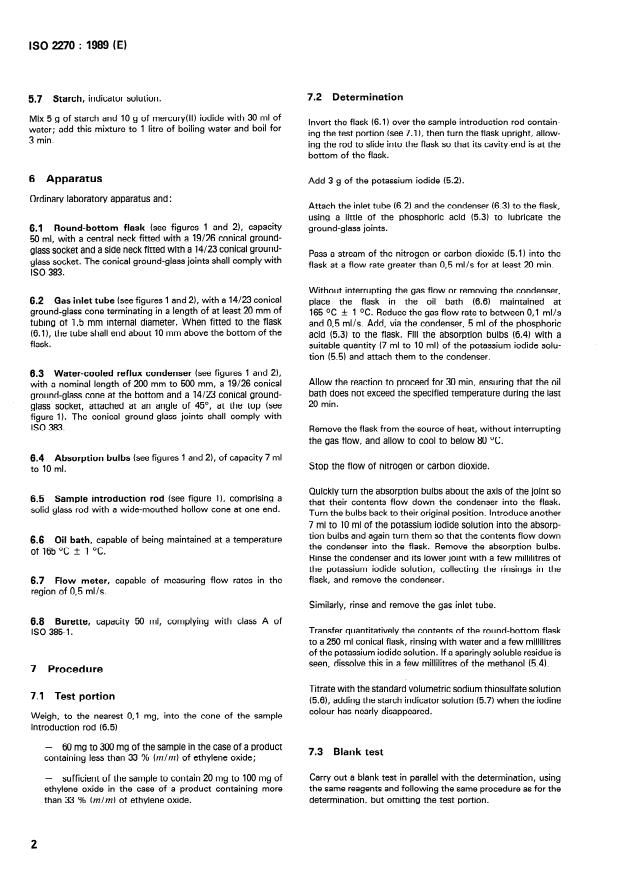
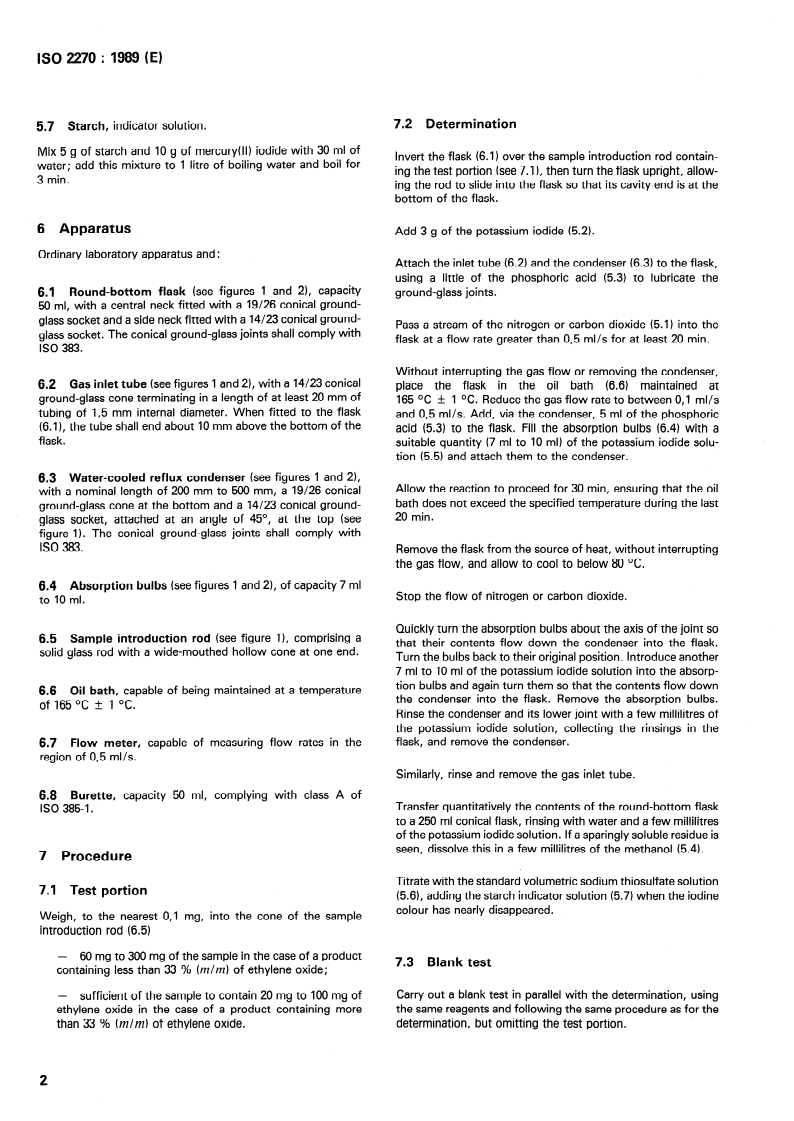
7.2 Determination
5.7 Starch, indicator Solution.
Mix 5 g of starch and 10 g of mercury(II) iodide with 30 ml of
Invert the flask (6.1) over the Sample introduction rod contain-
water; add this mixture to 1 litre of boiling water and boil for
ing the test Portion (sec 7.11, then turn the flask upright, allow-
3 min.
ing the rod to slide into the flask so that its cavity+end is at the
bottom of the flask.
6 Apparatus
Add 3 g of the potassium iodide (5.2).
Ordinary laboratory apparatus and :
Attach the inlet tube (6.2) and the condenser (6.3) to the flask,
using a little of the phosphoric acid (5.3) to lubricate the
6.1 Round-bottom flask (see figures 1 and 21, capacity ground-glass joints.
50 ml, with a central neck fitted with a 19/26 conical ground-
glass socket and a side neck fitted with a 14/23 conical ground-
Pass a stream of the nitrogen or carbon dioxide (5.1 ) into the
glass socket. The conical ground-glass joints shall comply with
rate greater tha n 0,5 ml/s for at least 20 min.
flask at a flow
ISO 383.
Without interrupting the gas flow or re
...
INTERNATIONAL
ISO
STANDARD
Second edition
1989-08- 15
Non-ionic surface active agents -
Polyethoxylated derivatives - lodometric
determination of oxyethylene groups
Agents de surface non ioniques - D&iv& polykthoxyks - Dosage iodomktrique
des groupes oxykthylene
Reference number
ISO 2270 : 1989 (El
iso2270:1989 (EI
Foreword
ISO (the International Organization for Standardization) is a worldwide federation of
national Standards bodies (ISO member bodies). The work of preparing International
Standards is normally carried out through ISO technical committees. Esch member
body interested in a subject for which a technical committee has been established has
the right to be represented on that committee. International organizations, govern-
mental and non-governmental, in liaison with ISO, also take part in the work. ISO
collaborates closely with the International Electrotechnical Commission (IEC) on all
matters of electrotechnical standardization.
Draft International Standards adopted by the technical committees are circulated to
the member bodies for approval before their acceptance as International Standards by
the ISO Council. They are approved in accordance with ISO procedures requiring at
least 75 % approval by the member bodies voting.
International Standard ISO 2270 was prepared by Technical Committee ISO/TC 91,
Surface active agents.
This second edition cancels and replaces the first edition (ISO 2270 : 19721, of which it
constitutes a minor revision.
0 ISO 1989
All rights reserved. No patt of this publication may be reproduced or utilized in any form or by any
means, electronie or mechanical, including photocopying and microfilm, without Permission in
writing from the publisher.
International Organization for Standardization
Case postale 56 l CH-121 1 Geneve 20 l Switzerland
Printed in Switzerland
ISO 2270 : 1989 (E)
INTERNATIONAL STANDARD
Non-ionic surface active agents - Polyethoxylated
lodometric determination of oxyethylene
derivatives -
groups
3 Principle
1 Scope
This Internationai Standard specifies a method for the Hydrolysis of the oxyethylene groups by nascent hydriodic
oxyethylene groups in poly- acid.
iodometric determination 01
active agents.
ethoxylated non-ionic surface
Liberation of the iodine and titration with a Standard volumetric
the analysis of polyethoxylated sodium thiosulfate Solution.
The method is applicable to
derivatives of
- primary saturated fatty alcohols;
4 Reactions
-
oleyl alcohol ;
The basic reaction is the conversion of each (CH,-CH201 group
to ethylene di-iodide (ICH*-CH+), in accordance with the equa-
-
saturated fatty acids;
tion
-
straight and branched chain alkylphenols.
RO-(CH2-CH20),H +2nHI--+nICH2-CH21+ ROH +nH20
lt is also applicable in the presence of unreacted alcohols, fatty
The unstable ethylene di-iodide is then decomposed on
acids or alkylphenols of the types mentioned above.
heating :
The method is not applicable in the presence of
ICH2-CH21 -, C2H, + 1,
-
compounds containing Sulfur or nitrogen;
NOTE - If R is an alkyl radical, ROH will be converted to RI. Some of
the ethylene groups (and all of any oleyl alcohol present) will react with
-
compounds containing Oxygen or halogen atoms on
Hl to form a stable iodide.
adjacent carbon atoms other than as oxyethylene groups,
for example compounds containing oxypropylene groups;
-
5 Reagents
aldehydes or acetals;
-
During the analysis, use only reagents of recognized analytical
sterols and derivatives.
grade and only distilled water or water of equivalent purity.
5.1 Nitrogen or carbon dioxide.
2 Normative references
The following Standards contain provisions which, through
5.2 Potassium iodide, crystals, minimum purity 99,5 %.
reference in this text, constitute provisions of this International
Standard. At the time of publication, the editions indicated
were valid. All Standards are subject to revision, and Parties to
5.3 Phosphoric acid, ~20 approximately 1,70 g/ml.
agreements based on this International Standard are encour-
aged to investigate the possibility of applying the most recent
editions of the Standards listed below. Members of IEC and ISO
5.4 Methanol, ~2~ 0,79 g/ml.
maintain registers of currently valid International Standards.
ISO 383 : 1976, Laboratory glassware - lnterchangeable
5.5 Potassium iodide, 100 g/l Solution.
conical ground glass join ts.
ISO 385-1 : 1984, Laboratory glassware - Burettes -
5.6 Sodium thiosulfate, Standard volumetric Solution,
Part 1: General requiremen ts.
c ( Na2S203) = 0,l mol/l.
ISO 2270 : 1989 (El
7.2 Determination
5.7 Starch, indicator Solution.
Mix 5 g of starch and 10 g of mercury(II) iodide with 30 ml of
Invert the flask (6.1) over the Sample introduction rod contain-
water; add this mixture to 1 litre of boiling water and boil for
ing the test Portion (sec 7.11, then turn the flask upright, allow-
3 min.
ing the rod to slide into the flask so that its cavity+end is at the
bottom of the flask.
6 Apparatus
Add 3 g of the potassium iodide (5.2).
Ordinary laboratory apparatus and :
Attach the inlet tube (6.2) and the condenser (6.3) to the flask,
using a little of the phosphoric acid (5.3) to lubricate the
6.1 Round-bottom flask (see figures 1 and 21, capacity ground-glass joints.
50 ml, with a central neck fitted with a 19/26 conical ground-
glass socket and a side neck fitted with a 14/23 conical ground-
Pass a stream of the nitrogen or carbon dioxide (5.1 ) into the
glass socket. The conical ground-glass joints shall comply with
rate greater tha n 0,5 ml/s for at least 20 min.
flask at a flow
ISO 383.
Without interrupting the gas flow or re
...
NORME
ISO
INTERNATIONALE
Deuxième édition
1989-08- 15
Agents de surface non ioniques - Dérivés
polyéthoxylés - Dosage iodométrique des
groupes oxyéthylène
Non-ionic surface active agen Ifs - Polyethoxylated derivatives -
lodome trie
de termina
tion of oxyethylene groups
Numéro de référence
ISO 2270 : 1989 (FI
1s0 2270 : 1989 (FI
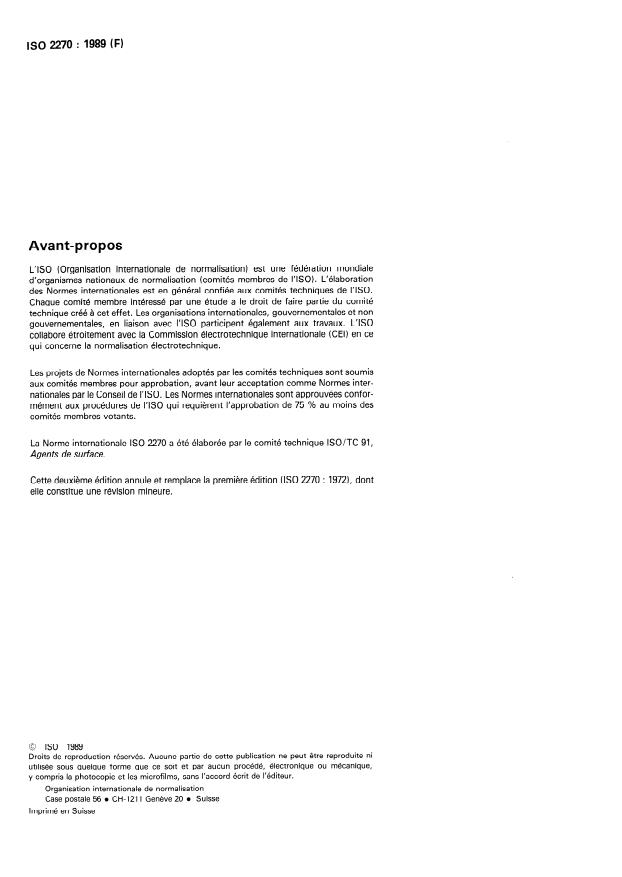
Avant-propos
L’ISO (Organisation internationale de normalisation) est une fédération mondiale
d’organismes nationaux de normalisation (comités membres de I’ISO). L’élaboration
des Normes internationales est en général confiée aux comités techniques de I’ISO.
Chaque comité membre intéressé par une étude a le droit de faire partie du comité
technique créé à cet effet. Les organisations internationales, gouvernementales et non
gouvernementales, en liaison avec I’ISO participent également aux travaux. L’ISO
collabore étroitement avec la Commission électrotechnique internationale (CEI) en ce
qui concerne la normalisation électrotechnique.
Les projets de Normes internationales adoptés par les comités techniques sont soumis
aux comités membres pour approbation, avant leur acceptation comme Normes inter-
nationales par le Conseil de I’ISO. Les Normes internationales sont approuvées confor-
mément aux procédures de I’ISO qui requièrent l’approbation de 75 % au moins des
comités membres votants.
internatio
La Norme nale ISO 2270 a été éla borée par le comité techniq ue ISO/TC 91,
Agents de surface.
Cette deuxième édition annule et remplace remière édition (ISO : 1972), dont
la P
elle constitue une révision mineu re.
0 ISO 1989
Droits de reproduction réservés. Aucune partie de cette publication ne peut être reproduite ni
utilisée sous quelque forme que ce soit et par aucun procédé, électronique ou mécanique,
y compris la photocopie et les microfilms, sans l’accord écrit de l’éditeur.
Organisation internationale de normalisation
Case postale 56 l CH-1211 Genève 20 e Su isse
Imprimé en Suisse
ISO 2270 : 1989 (F)
NORME INTERNATIONALE
Agents de surface non ioniques - Dérivés polyéthoxylés -
Dosage iodométrique des groupes oxyéthylène
3 Principe
1 Domaine d’application
Hydrolyse des groupes oxyéthylène par l’acide iodhydrique
La présente Norme internationale prescrit une méthode iodo-
naissant.
métrique pour le dosage des groupes oxyéthylène dans les
agents de surface non ioniques polyéthoxylés.
Libération de l’iode et titrage par une solution titrée de thiosul-
La méthode est applicable à l’analyse des dérivés polyéthoxylés fate de sodium.
- des alcools gras primaires saturés;
4 Réactions
- de l’alcool oléique;
La réaction de base est la conversion de chaque groupe
- des acides gras saturés;
(CH,-CH201 en diiodure d’éthylène (ICHZ-CH$), selon I’équa-
tion
- des alkylphénols à chaîne droite ou ramifiée.
RO-KHZ-CH,O),H +2nHI-wlCH2-CH21 + ROH +nH20
Elle est encore applicable en présence des dérivés non poly-
éthoxylés des alcools, acides gras et alkylphénols ci-dessus.
Puis le diiodure d’éthylène instable se décompose par chauf-
fage selon l’équation
Elle peut être appliquée en présence
ICH2-CH,1 -+ C2H4 + l2
- de composés contenant du soufre ou de l’azote;
NOTE - Si R est un radical alkyle, ROH donnera RI. Quelques
- de composés contenant de l’oxygène ou des halogènes
groupes éthylène (ou tous dans le cas de l’alcool oléique) réagiront
sur deux carbones voisins, autres que ceux des groupes
avec HI pour donner un iodure stable.
oxyéthylène, par exemple les composés contenant des
groupes oxypropylène;
5 Réactifs et produits
- d’aldéhydes ou d’acétals;
Au cours de l’analyse, utiliser uniquement des réactifs de qua-
- de stérols et de leurs dérivés.
lité analytique reconnue, et de l’eau distillée ou de l’eau de
pureté équivalente.
2 Références normatives
5.1 Azote ou dioxyde de carbone.
Les normes suivantes contiennent des dispositions qui, par
suite de la référence qui en est faite, constituent des disposi-
5.2 Iodure de potassium cristallisé, de pureté minimale
tions valables pour la présente Norme internationale. Au
99,5 %.
moment de la publication, les éditions indiquées étaient en
vigueur. Toute norme est sujette à révision et les parties pre-
nantes des accords fondés sur la présente Norme internationale
5.3 Acide phosphorique, ~2~ 1,70 g/ml environ.
sont invitées à rechercher la possibilité d’appliquer les éditions
les plus récentes des normes indiquées ci-après. Les membres
de la CEI et de I’ISO possèdent le registre des Normes interna-
5.4 Méthanol, ~20 0,79 g/ml.
tionales en vigueur à un moment donné.
ISO 383 : 1976, Verrerie de laboratoire - Assemblages
5.5 Iodure de potassium, solution 100 g/l.
coniques rodés in terchangeables.
Thiosulfate de sodium, solution titrée,
ISO 385-l : 1984, Verrerie de laboratoire - Burettes - 5.6
4Na2S203) = 0,l mol/l.
Partie 7 : Spécifications générales.
1s0 2270 : 1989 (FI
7.2 Dosage
Amidon, solution d’indicateur.
5.7
Recouvrir la baguette d’ébullition, contenant la prise d’essai
Mélanger 5 g d’amidon et 10 g d’iodure de mercure(H) avec
(7.11, avec le ballon (6.11, puis retourner ce dernier en laissant
30 ml d’eau; transvaser le mélange dans 1 litre d’eau bouillante
glisser la baguette de manière que sa partie creuse se trouve au
et faire bouillir durant 3 min.
fond du ballon.
Ajouter 3 g d’iodure de potassium (5.2).
6 Appareillage
Adapter le tube d’entrée d’air (6.2) et le réfrigérnt (6.3) au bal-
Matériel courant de laboratoire, et notamment:
lon en employant un peu d’acide phosphorique (5.3) pour lubri-
fier les joints rodés.
6.1 Ballon à fond rond (voir figures 1 et 21, de 50 ml de
Purger le ballon au moyen d’un courant d’azote ou de dioxyde
capacité, avec un col central muni d’un joint conique rodé
de carbone (5.1) ayant un débit supérieur à 0,5 ml/s, durant au
femelle 19/26, et un col latéral muni d’un joint conique rodé
moins 20 min.
femelle 14/23. Les joints conique
...
NORME
ISO
INTERNATIONALE
Deuxième édition
1989-08- 15
Agents de surface non ioniques - Dérivés
polyéthoxylés - Dosage iodométrique des
groupes oxyéthylène
Non-ionic surface active agen Ifs - Polyethoxylated derivatives -
lodome trie
de termina
tion of oxyethylene groups
Numéro de référence
ISO 2270 : 1989 (FI
1s0 2270 : 1989 (FI
Avant-propos
L’ISO (Organisation internationale de normalisation) est une fédération mondiale
d’organismes nationaux de normalisation (comités membres de I’ISO). L’élaboration
des Normes internationales est en général confiée aux comités techniques de I’ISO.
Chaque comité membre intéressé par une étude a le droit de faire partie du comité
technique créé à cet effet. Les organisations internationales, gouvernementales et non
gouvernementales, en liaison avec I’ISO participent également aux travaux. L’ISO
collabore étroitement avec la Commission électrotechnique internationale (CEI) en ce
qui concerne la normalisation électrotechnique.
Les projets de Normes internationales adoptés par les comités techniques sont soumis
aux comités membres pour approbation, avant leur acceptation comme Normes inter-
nationales par le Conseil de I’ISO. Les Normes internationales sont approuvées confor-
mément aux procédures de I’ISO qui requièrent l’approbation de 75 % au moins des
comités membres votants.
internatio
La Norme nale ISO 2270 a été éla borée par le comité techniq ue ISO/TC 91,
Agents de surface.
Cette deuxième édition annule et remplace remière édition (ISO : 1972), dont
la P
elle constitue une révision mineu re.
0 ISO 1989
Droits de reproduction réservés. Aucune partie de cette publication ne peut être reproduite ni
utilisée sous quelque forme que ce soit et par aucun procédé, électronique ou mécanique,
y compris la photocopie et les microfilms, sans l’accord écrit de l’éditeur.
Organisation internationale de normalisation
Case postale 56 l CH-1211 Genève 20 e Su isse
Imprimé en Suisse
ISO 2270 : 1989 (F)
NORME INTERNATIONALE
Agents de surface non ioniques - Dérivés polyéthoxylés -
Dosage iodométrique des groupes oxyéthylène
3 Principe
1 Domaine d’application
Hydrolyse des groupes oxyéthylène par l’acide iodhydrique
La présente Norme internationale prescrit une méthode iodo-
naissant.
métrique pour le dosage des groupes oxyéthylène dans les
agents de surface non ioniques polyéthoxylés.
Libération de l’iode et titrage par une solution titrée de thiosul-
La méthode est applicable à l’analyse des dérivés polyéthoxylés fate de sodium.
- des alcools gras primaires saturés;
4 Réactions
- de l’alcool oléique;
La réaction de base est la conversion de chaque groupe
- des acides gras saturés;
(CH,-CH201 en diiodure d’éthylène (ICHZ-CH$), selon I’équa-
tion
- des alkylphénols à chaîne droite ou ramifiée.
RO-KHZ-CH,O),H +2nHI-wlCH2-CH21 + ROH +nH20
Elle est encore applicable en présence des dérivés non poly-
éthoxylés des alcools, acides gras et alkylphénols ci-dessus.
Puis le diiodure d’éthylène instable se décompose par chauf-
fage selon l’équation
Elle peut être appliquée en présence
ICH2-CH,1 -+ C2H4 + l2
- de composés contenant du soufre ou de l’azote;
NOTE - Si R est un radical alkyle, ROH donnera RI. Quelques
- de composés contenant de l’oxygène ou des halogènes
groupes éthylène (ou tous dans le cas de l’alcool oléique) réagiront
sur deux carbones voisins, autres que ceux des groupes
avec HI pour donner un iodure stable.
oxyéthylène, par exemple les composés contenant des
groupes oxypropylène;
5 Réactifs et produits
- d’aldéhydes ou d’acétals;
Au cours de l’analyse, utiliser uniquement des réactifs de qua-
- de stérols et de leurs dérivés.
lité analytique reconnue, et de l’eau distillée ou de l’eau de
pureté équivalente.
2 Références normatives
5.1 Azote ou dioxyde de carbone.
Les normes suivantes contiennent des dispositions qui, par
suite de la référence qui en est faite, constituent des disposi-
5.2 Iodure de potassium cristallisé, de pureté minimale
tions valables pour la présente Norme internationale. Au
99,5 %.
moment de la publication, les éditions indiquées étaient en
vigueur. Toute norme est sujette à révision et les parties pre-
nantes des accords fondés sur la présente Norme internationale
5.3 Acide phosphorique, ~2~ 1,70 g/ml environ.
sont invitées à rechercher la possibilité d’appliquer les éditions
les plus récentes des normes indiquées ci-après. Les membres
de la CEI et de I’ISO possèdent le registre des Normes interna-
5.4 Méthanol, ~20 0,79 g/ml.
tionales en vigueur à un moment donné.
ISO 383 : 1976, Verrerie de laboratoire - Assemblages
5.5 Iodure de potassium, solution 100 g/l.
coniques rodés in terchangeables.
Thiosulfate de sodium, solution titrée,
ISO 385-l : 1984, Verrerie de laboratoire - Burettes - 5.6
4Na2S203) = 0,l mol/l.
Partie 7 : Spécifications générales.
1s0 2270 : 1989 (FI
7.2 Dosage
Amidon, solution d’indicateur.
5.7
Recouvrir la baguette d’ébullition, contenant la prise d’essai
Mélanger 5 g d’amidon et 10 g d’iodure de mercure(H) avec
(7.11, avec le ballon (6.11, puis retourner ce dernier en laissant
30 ml d’eau; transvaser le mélange dans 1 litre d’eau bouillante
glisser la baguette de manière que sa partie creuse se trouve au
et faire bouillir durant 3 min.
fond du ballon.
Ajouter 3 g d’iodure de potassium (5.2).
6 Appareillage
Adapter le tube d’entrée d’air (6.2) et le réfrigérnt (6.3) au bal-
Matériel courant de laboratoire, et notamment:
lon en employant un peu d’acide phosphorique (5.3) pour lubri-
fier les joints rodés.
6.1 Ballon à fond rond (voir figures 1 et 21, de 50 ml de
Purger le ballon au moyen d’un courant d’azote ou de dioxyde
capacité, avec un col central muni d’un joint conique rodé
de carbone (5.1) ayant un débit supérieur à 0,5 ml/s, durant au
femelle 19/26, et un col latéral muni d’un joint conique rodé
moins 20 min.
femelle 14/23. Les joints conique
...
NORME
ISO
INTERNATIONALE
Deuxième édition
1989-08- 15
Agents de surface non ioniques - Dérivés
polyéthoxylés - Dosage iodométrique des
groupes oxyéthylène
Non-ionic surface active agen Ifs - Polyethoxylated derivatives -
lodome trie
de termina
tion of oxyethylene groups
Numéro de référence
ISO 2270 : 1989 (FI
1s0 2270 : 1989 (FI
Avant-propos
L’ISO (Organisation internationale de normalisation) est une fédération mondiale
d’organismes nationaux de normalisation (comités membres de I’ISO). L’élaboration
des Normes internationales est en général confiée aux comités techniques de I’ISO.
Chaque comité membre intéressé par une étude a le droit de faire partie du comité
technique créé à cet effet. Les organisations internationales, gouvernementales et non
gouvernementales, en liaison avec I’ISO participent également aux travaux. L’ISO
collabore étroitement avec la Commission électrotechnique internationale (CEI) en ce
qui concerne la normalisation électrotechnique.
Les projets de Normes internationales adoptés par les comités techniques sont soumis
aux comités membres pour approbation, avant leur acceptation comme Normes inter-
nationales par le Conseil de I’ISO. Les Normes internationales sont approuvées confor-
mément aux procédures de I’ISO qui requièrent l’approbation de 75 % au moins des
comités membres votants.
internatio
La Norme nale ISO 2270 a été éla borée par le comité techniq ue ISO/TC 91,
Agents de surface.
Cette deuxième édition annule et remplace remière édition (ISO : 1972), dont
la P
elle constitue une révision mineu re.
0 ISO 1989
Droits de reproduction réservés. Aucune partie de cette publication ne peut être reproduite ni
utilisée sous quelque forme que ce soit et par aucun procédé, électronique ou mécanique,
y compris la photocopie et les microfilms, sans l’accord écrit de l’éditeur.
Organisation internationale de normalisation
Case postale 56 l CH-1211 Genève 20 e Su isse
Imprimé en Suisse
ISO 2270 : 1989 (F)
NORME INTERNATIONALE
Agents de surface non ioniques - Dérivés polyéthoxylés -
Dosage iodométrique des groupes oxyéthylène
3 Principe
1 Domaine d’application
Hydrolyse des groupes oxyéthylène par l’acide iodhydrique
La présente Norme internationale prescrit une méthode iodo-
naissant.
métrique pour le dosage des groupes oxyéthylène dans les
agents de surface non ioniques polyéthoxylés.
Libération de l’iode et titrage par une solution titrée de thiosul-
La méthode est applicable à l’analyse des dérivés polyéthoxylés fate de sodium.
- des alcools gras primaires saturés;
4 Réactions
- de l’alcool oléique;
La réaction de base est la conversion de chaque groupe
- des acides gras saturés;
(CH,-CH201 en diiodure d’éthylène (ICHZ-CH$), selon I’équa-
tion
- des alkylphénols à chaîne droite ou ramifiée.
RO-KHZ-CH,O),H +2nHI-wlCH2-CH21 + ROH +nH20
Elle est encore applicable en présence des dérivés non poly-
éthoxylés des alcools, acides gras et alkylphénols ci-dessus.
Puis le diiodure d’éthylène instable se décompose par chauf-
fage selon l’équation
Elle peut être appliquée en présence
ICH2-CH,1 -+ C2H4 + l2
- de composés contenant du soufre ou de l’azote;
NOTE - Si R est un radical alkyle, ROH donnera RI. Quelques
- de composés contenant de l’oxygène ou des halogènes
groupes éthylène (ou tous dans le cas de l’alcool oléique) réagiront
sur deux carbones voisins, autres que ceux des groupes
avec HI pour donner un iodure stable.
oxyéthylène, par exemple les composés contenant des
groupes oxypropylène;
5 Réactifs et produits
- d’aldéhydes ou d’acétals;
Au cours de l’analyse, utiliser uniquement des réactifs de qua-
- de stérols et de leurs dérivés.
lité analytique reconnue, et de l’eau distillée ou de l’eau de
pureté équivalente.
2 Références normatives
5.1 Azote ou dioxyde de carbone.
Les normes suivantes contiennent des dispositions qui, par
suite de la référence qui en est faite, constituent des disposi-
5.2 Iodure de potassium cristallisé, de pureté minimale
tions valables pour la présente Norme internationale. Au
99,5 %.
moment de la publication, les éditions indiquées étaient en
vigueur. Toute norme est sujette à révision et les parties pre-
nantes des accords fondés sur la présente Norme internationale
5.3 Acide phosphorique, ~2~ 1,70 g/ml environ.
sont invitées à rechercher la possibilité d’appliquer les éditions
les plus récentes des normes indiquées ci-après. Les membres
de la CEI et de I’ISO possèdent le registre des Normes interna-
5.4 Méthanol, ~20 0,79 g/ml.
tionales en vigueur à un moment donné.
ISO 383 : 1976, Verrerie de laboratoire - Assemblages
5.5 Iodure de potassium, solution 100 g/l.
coniques rodés in terchangeables.
Thiosulfate de sodium, solution titrée,
ISO 385-l : 1984, Verrerie de laboratoire - Burettes - 5.6
4Na2S203) = 0,l mol/l.
Partie 7 : Spécifications générales.
1s0 2270 : 1989 (FI
7.2 Dosage
Amidon, solution d’indicateur.
5.7
Recouvrir la baguette d’ébullition, contenant la prise d’essai
Mélanger 5 g d’amidon et 10 g d’iodure de mercure(H) avec
(7.11, avec le ballon (6.11, puis retourner ce dernier en laissant
30 ml d’eau; transvaser le mélange dans 1 litre d’eau bouillante
glisser la baguette de manière que sa partie creuse se trouve au
et faire bouillir durant 3 min.
fond du ballon.
Ajouter 3 g d’iodure de potassium (5.2).
6 Appareillage
Adapter le tube d’entrée d’air (6.2) et le réfrigérnt (6.3) au bal-
Matériel courant de laboratoire, et notamment:
lon en employant un peu d’acide phosphorique (5.3) pour lubri-
fier les joints rodés.
6.1 Ballon à fond rond (voir figures 1 et 21, de 50 ml de
Purger le ballon au moyen d’un courant d’azote ou de dioxyde
capacité, avec un col central muni d’un joint conique rodé
de carbone (5.1) ayant un débit supérieur à 0,5 ml/s, durant au
femelle 19/26, et un col latéral muni d’un joint conique rodé
moins 20 min.
femelle 14/23. Les joints conique
...
NORME
ISO
INTERNATIONALE
Deuxième édition
1989-08- 15
Agents de surface non ioniques - Dérivés
polyéthoxylés - Dosage iodométrique des
groupes oxyéthylène
Non-ionic surface active agen Ifs - Polyethoxylated derivatives -
lodome trie
de termina
tion of oxyethylene groups
Numéro de référence
ISO 2270 : 1989 (FI
1s0 2270 : 1989 (FI
Avant-propos
L’ISO (Organisation internationale de normalisation) est une fédération mondiale
d’organismes nationaux de normalisation (comités membres de I’ISO). L’élaboration
des Normes internationales est en général confiée aux comités techniques de I’ISO.
Chaque comité membre intéressé par une étude a le droit de faire partie du comité
technique créé à cet effet. Les organisations internationales, gouvernementales et non
gouvernementales, en liaison avec I’ISO participent également aux travaux. L’ISO
collabore étroitement avec la Commission électrotechnique internationale (CEI) en ce
qui concerne la normalisation électrotechnique.
Les projets de Normes internationales adoptés par les comités techniques sont soumis
aux comités membres pour approbation, avant leur acceptation comme Normes inter-
nationales par le Conseil de I’ISO. Les Normes internationales sont approuvées confor-
mément aux procédures de I’ISO qui requièrent l’approbation de 75 % au moins des
comités membres votants.
internatio
La Norme nale ISO 2270 a été éla borée par le comité techniq ue ISO/TC 91,
Agents de surface.
Cette deuxième édition annule et remplace remière édition (ISO : 1972), dont
la P
elle constitue une révision mineu re.
0 ISO 1989
Droits de reproduction réservés. Aucune partie de cette publication ne peut être reproduite ni
utilisée sous quelque forme que ce soit et par aucun procédé, électronique ou mécanique,
y compris la photocopie et les microfilms, sans l’accord écrit de l’éditeur.
Organisation internationale de normalisation
Case postale 56 l CH-1211 Genève 20 e Su isse
Imprimé en Suisse
ISO 2270 : 1989 (F)
NORME INTERNATIONALE
Agents de surface non ioniques - Dérivés polyéthoxylés -
Dosage iodométrique des groupes oxyéthylène
3 Principe
1 Domaine d’application
Hydrolyse des groupes oxyéthylène par l’acide iodhydrique
La présente Norme internationale prescrit une méthode iodo-
naissant.
métrique pour le dosage des groupes oxyéthylène dans les
agents de surface non ioniques polyéthoxylés.
Libération de l’iode et titrage par une solution titrée de thiosul-
La méthode est applicable à l’analyse des dérivés polyéthoxylés fate de sodium.
- des alcools gras primaires saturés;
4 Réactions
- de l’alcool oléique;
La réaction de base est la conversion de chaque groupe
- des acides gras saturés;
(CH,-CH201 en diiodure d’éthylène (ICHZ-CH$), selon I’équa-
tion
- des alkylphénols à chaîne droite ou ramifiée.
RO-KHZ-CH,O),H +2nHI-wlCH2-CH21 + ROH +nH20
Elle est encore applicable en présence des dérivés non poly-
éthoxylés des alcools, acides gras et alkylphénols ci-dessus.
Puis le diiodure d’éthylène instable se décompose par chauf-
fage selon l’équation
Elle peut être appliquée en présence
ICH2-CH,1 -+ C2H4 + l2
- de composés contenant du soufre ou de l’azote;
NOTE - Si R est un radical alkyle, ROH donnera RI. Quelques
- de composés contenant de l’oxygène ou des halogènes
groupes éthylène (ou tous dans le cas de l’alcool oléique) réagiront
sur deux carbones voisins, autres que ceux des groupes
avec HI pour donner un iodure stable.
oxyéthylène, par exemple les composés contenant des
groupes oxypropylène;
5 Réactifs et produits
- d’aldéhydes ou d’acétals;
Au cours de l’analyse, utiliser uniquement des réactifs de qua-
- de stérols et de leurs dérivés.
lité analytique reconnue, et de l’eau distillée ou de l’eau de
pureté équivalente.
2 Références normatives
5.1 Azote ou dioxyde de carbone.
Les normes suivantes contiennent des dispositions qui, par
suite de la référence qui en est faite, constituent des disposi-
5.2 Iodure de potassium cristallisé, de pureté minimale
tions valables pour la présente Norme internationale. Au
99,5 %.
moment de la publication, les éditions indiquées étaient en
vigueur. Toute norme est sujette à révision et les parties pre-
nantes des accords fondés sur la présente Norme internationale
5.3 Acide phosphorique, ~2~ 1,70 g/ml environ.
sont invitées à rechercher la possibilité d’appliquer les éditions
les plus récentes des normes indiquées ci-après. Les membres
de la CEI et de I’ISO possèdent le registre des Normes interna-
5.4 Méthanol, ~20 0,79 g/ml.
tionales en vigueur à un moment donné.
ISO 383 : 1976, Verrerie de laboratoire - Assemblages
5.5 Iodure de potassium, solution 100 g/l.
coniques rodés in terchangeables.
Thiosulfate de sodium, solution titrée,
ISO 385-l : 1984, Verrerie de laboratoire - Burettes - 5.6
4Na2S203) = 0,l mol/l.
Partie 7 : Spécifications générales.
1s0 2270 : 1989 (FI
7.2 Dosage
Amidon, solution d’indicateur.
5.7
Recouvrir la baguette d’ébullition, contenant la prise d’essai
Mélanger 5 g d’amidon et 10 g d’iodure de mercure(H) avec
(7.11, avec le ballon (6.11, puis retourner ce dernier en laissant
30 ml d’eau; transvaser le mélange dans 1 litre d’eau bouillante
glisser la baguette de manière que sa partie creuse se trouve au
et faire bouillir durant 3 min.
fond du ballon.
Ajouter 3 g d’iodure de potassium (5.2).
6 Appareillage
Adapter le tube d’entrée d’air (6.2) et le réfrigérnt (6.3) au bal-
Matériel courant de laboratoire, et notamment:
lon en employant un peu d’acide phosphorique (5.3) pour lubri-
fier les joints rodés.
6.1 Ballon à fond rond (voir figures 1 et 21, de 50 ml de
Purger le ballon au moyen d’un courant d’azote ou de dioxyde
capacité, avec un col central muni d’un joint conique rodé
de carbone (5.1) ayant un débit supérieur à 0,5 ml/s, durant au
femelle 19/26, et un col latéral muni d’un joint conique rodé
moins 20 min.
femelle 14/23. Les joints conique
...
Questions, Comments and Discussion
Ask us and Technical Secretary will try to provide an answer. You can facilitate discussion about the standard in here.
Loading comments...