

ISO 4323:2025
(Main)Surface active agents — Soaps — Determination of chloride content by potentiometric method
General Information
- Abstract
This document specifies a potentiometric method for the determination of the chloride content in soaps, with or without other surface-active agents, and also in compounded products. The method is applicable for chloride mass fractions between 0,01 % to 1,0 %.
- Status
- Published
- Publication Date
- 30-Sep-2025
- Technical Committee
- ISO/TC 91 - Surface active agents
- Drafting Committee
- ISO/TC 91 - Surface active agents
- Current Stage
- 6060 - International Standard published
- Start Date
- 01-Oct-2025
- Due Date
- 22-May-2026
- Completion Date
- 01-Oct-2025
Overview
ISO 4323:2025 - Surface active agents - Soaps - Determination of chloride content by potentiometric method - specifies a potentiometric titration procedure to determine chloride content in soaps, compounded products and formulations containing surface‑active agents. The method is applicable to chloride mass fractions from 0.01 % to 1.0 % and uses silver nitrate titration monitored with a silver ion selective electrode (or combined electrode) connected to a potentiometer or autotitrator.
Keywords: ISO 4323:2025, chloride determination, potentiometric titration, soaps, silver nitrate, ion selective electrode, soap quality control.
Key topics and technical requirements
- Scope and applicability
- Intended for soaps with or without other surface‑active agents and for compounded products.
- Measurement range: 0.01 % to 1.0 % chloride (mass fraction).
- Principle
- Dissolve a test portion in water and isopropanol, acidify with nitric acid, then titrate chloride ions with standardized silver nitrate potentiometrically.
- Reagents and solutions
- Nitric acid ~6 mol/L; silver nitrate standard solutions (~0.1 mol/L and diluted 0.01 mol/L); sodium chloride primary standard solutions (0.1 and 0.01 mol/L); isopropanol; use water complying with ISO 3696.
- Store concentrated AgNO3 in amber flasks and prepare working dilutions immediately prior to use.
- Apparatus and glassware
- Potentiometer (sensitivity 2 mV, range −500 mV to +500 mV) or autotitrator.
- Silver ion selective electrode with double‑junction reference (or combined electrode).
- Class A glassware per ISO 385/648/1042; burettes or automatic plunger burettes; analytical balance (1 mg).
- Procedure and calculations
- Sampling per ISO 8212 (grating soap bars, avoid moisture loss).
- Maintain measurement temperature ~25 °C ± 5 °C and minimize temperature differences between solutions.
- Endpoint detection uses successive potential increments (ΔE); formulae provided to calculate exact titrant volume (V) and molarity (T).
- Blank test mandatory; precision and repeatability/reproducibility clauses included.
Applications and who uses this standard
- Quality control (QC) laboratories in soap and detergent manufacturing for routine chloride content testing.
- Product development and formulation teams validating raw material purity and finished product composition.
- Regulatory and compliance testing where chloride levels affect product specifications or stability.
- Independent testing laboratories performing standardized, traceable potentiometric chloride determinations. Practical benefits include reliable, reproducible chloride quantification across a defined range and clear sampling/validation steps tailored to solid soap bars and compounded products.
Related standards
- ISO 8212 - Soaps and detergents - Techniques of sampling during manufacture
- ISO 3696 - Water for analytical laboratory use - Specification and test methods
- ISO 385, ISO 648, ISO 1042 - Laboratory glassware (burettes, pipettes, volumetric flasks)
- Prepared by ISO/TC 91 (Surface active agents)
Use ISO 4323:2025 to implement a validated potentiometric chloride test method for soap manufacturing, laboratory accreditation, and product specification control.
Relations
- Effective Date
- 25-May-2024
Get Certified
Connect with accredited certification bodies for this standard

ECOCERT
Organic and sustainability certification.

Eurofins Food Testing Global
Global leader in food, environment, and pharmaceutical product testing.

Intertek Bangladesh
Intertek certification and testing services in Bangladesh.
Sponsored listings
Frequently Asked Questions
ISO 4323:2025 is a standard published by the International Organization for Standardization (ISO). Its full title is "Surface active agents — Soaps — Determination of chloride content by potentiometric method". This standard covers: This document specifies a potentiometric method for the determination of the chloride content in soaps, with or without other surface-active agents, and also in compounded products. The method is applicable for chloride mass fractions between 0,01 % to 1,0 %.
This document specifies a potentiometric method for the determination of the chloride content in soaps, with or without other surface-active agents, and also in compounded products. The method is applicable for chloride mass fractions between 0,01 % to 1,0 %.
ISO 4323:2025 is classified under the following ICS (International Classification for Standards) categories: 71.100.40 - Surface active agents. The ICS classification helps identify the subject area and facilitates finding related standards.
ISO 4323:2025 has the following relationships with other standards: It is inter standard links to ISO 4323:2018. Understanding these relationships helps ensure you are using the most current and applicable version of the standard.
ISO 4323:2025 is available in PDF format for immediate download after purchase. The document can be added to your cart and obtained through the secure checkout process. Digital delivery ensures instant access to the complete standard document.
Standards Content (Sample)
International
Standard
ISO 4323
Third edition
Surface active agents — Soaps —
2025-10
Determination of chloride content
by potentiometric method
Reference number
© ISO 2025
All rights reserved. Unless otherwise specified, or required in the context of its implementation, no part of this publication may
be reproduced or utilized otherwise in any form or by any means, electronic or mechanical, including photocopying, or posting on
the internet or an intranet, without prior written permission. Permission can be requested from either ISO at the address below
or ISO’s member body in the country of the requester.
ISO copyright office
CP 401 • Ch. de Blandonnet 8
CH-1214 Vernier, Geneva
Phone: +41 22 749 01 11
Email: copyright@iso.org
Website: www.iso.org
Published in Switzerland
ii
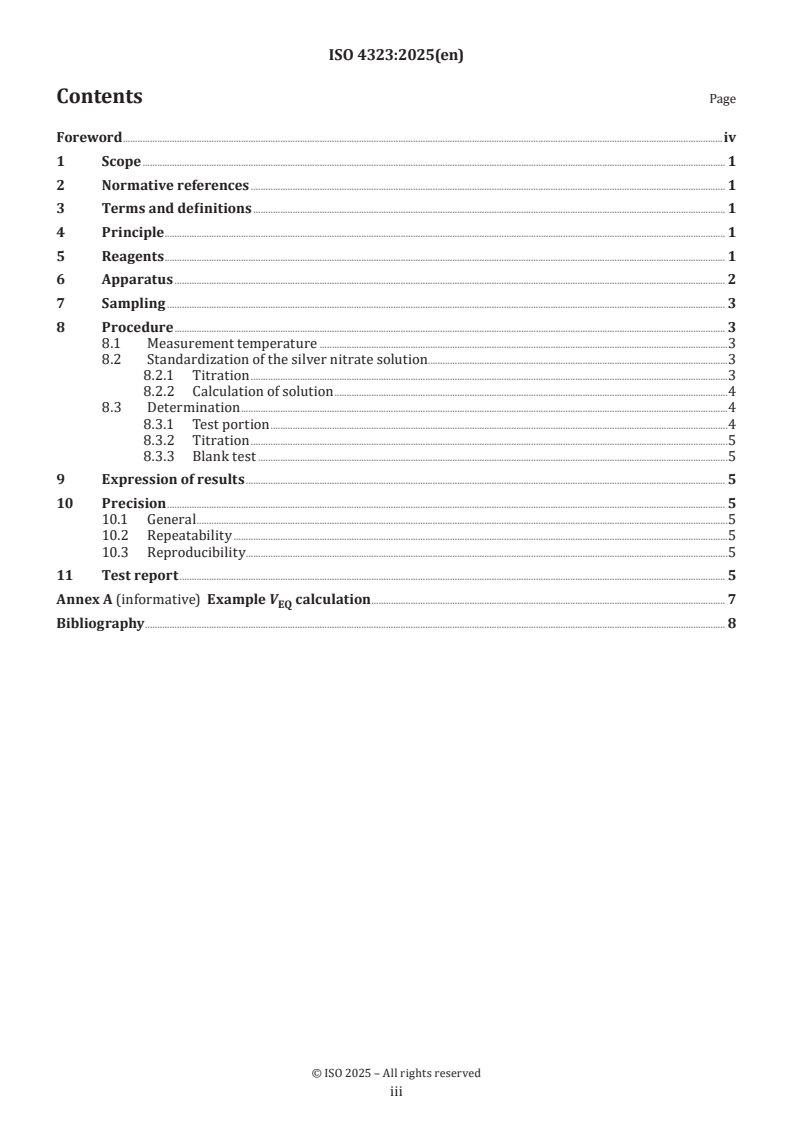
Contents Page
Foreword .iv
1 Scope . 1
2 Normative references . 1
3 Terms and definitions . 1
4 Principle . 1
5 Reagents . 1
6 Apparatus . 2
7 Sampling . 3
8 Procedure . 3
8.1 Measurement temperature .3
8.2 Standardization of the silver nitrate solution.3
8.2.1 Titration .3
8.2.2 Calculation of solution .4
8.3 Determination .4
8.3.1 Test portion .4
8.3.2 Titration .5
8.3.3 Blank test .5
9 Expression of results . 5
10 Precision . 5
10.1 General .5
10.2 Repeatability .5
10.3 Reproducibility . .5
11 Test report . 5
Annex A (informative) Example V calculation . 7
EQ
Bibliography . 8
iii
Foreword
ISO (the International Organization for Standardization) is a worldwide federation of national standards
bodies (ISO member bodies). The work of preparing International Standards is normally carried out through
ISO technical committees. Each member body interested in a subject for which a technical committee
has been established has the right to be represented on that committee. International organizations,
governmental and non-governmental, in liaison with ISO, also take part in the work. ISO collaborates closely
with the International Electrotechnical Commission (IEC) on all matters of electrotechnical standardization.
The procedures used to develop this document and those intended for its further maintenance are described
in the ISO/IEC Directives, Part 1. In particular, the different approval criteria needed for the different types
of ISO document should be noted. This document was drafted in accordance with the editorial rules of the
ISO/IEC Directives, Part 2 (see www.iso.org/directives).
ISO draws attention to the possibility that the implementation of this document may involve the use of (a)
patent(s). ISO takes no position concerning the evidence, validity or applicability of any claimed patent
rights in respect thereof. As of the date of publication of this document, ISO had not received notice of (a)
patent(s) which may be required to implement this document. However, implementers are cautioned that
this may not represent the latest information, which may be obtained from the patent database available at
www.iso.org/patents. ISO shall not be held responsible for identifying any or all such patent rights.
Any trade name used in this document is information given for the convenience of users and does not
constitute an endorsement.
For an explanation of the voluntary nature of standards, the meaning of ISO specific terms and expressions
related to conformity assessment, as well as information about ISO's adherence to the World Trade
Organization (WTO) principles in the Technical Barriers to Trade (TBT), see www.iso.org/iso/foreword.html.
This document was prepared by Technical Committee ISO/TC 91, Surface active agents.
This third edition cancels and replaces the second edition (ISO 4323:2018), which has been technically
revised.
The main changes are as follows:
— Normative references have been revised;
— text revised;
— precision clause added.
Any feedback or questions on this document should be directed to the user’s national standards body. A
complete listing of these bodies can be found at www.iso.org/members.html.
iv
International Standard ISO 4323:2025(en)
Surface active agents — Soaps — Determination of chloride
content by potentiometric method
1 Scope
This document specifies a potentiometric method for the determination of the chloride content in soaps,
with or without other surface-active agents, and also in compounded products.
The method is applicable for chloride mass fractions between 0,01 % to 1,0 %.
2 Normative references
The following documents are referred to in the text in such a way that some or all of their content constitutes
requirements of this document. For dated references, only the edition cited applies. For undated references,
the latest edition of the referenced document (including any amendments) applies.
ISO 385, Laboratory glassware — Burettes
ISO 648, Laboratory glassware — Single-volume pipettes
ISO 1042, Laboratory glassware — One-mark volumetric flasks
ISO 3696, Water for analytical laboratory use — Specification and test methods
ISO 8212, Soaps and detergents — Techniques of sampling during manufacture
3 Terms and definitions
For the purposes of this document, the following terms and definitions apply.
ISO and IEC maintain terminology databases for use in standardization at the following addresses:
— ISO Online browsing platform: available at https:// www .iso .org/ obp
— IEC Electropedia: available at https:// www .electropedia .org/
3.1
chloride content
mass fraction of chloride, expressed as sodium chloride and in percent, determined in accordance with the
procedure described in this document
4 Principle
A test portion is dissolved in water and isopropanol. The suspension is acidified with nitric acid then the
chloride ions are titrated potentiometrically with a silver nitrate standard solution by using either a silver
ion selective electrode plus a reference electrode or a combined electrode.
5 Reagents
During the analysis, unless otherwise stated, use only reagents of recognized analytical grade and only
distilled water or water of equivalent purity in accordance with ISO 3696.
...