


ISO/IEC TR 15446:2004
(Main)Information technology — Security techniques — Guide for the production of Protection Profiles and Security Targets
Information technology — Security techniques — Guide for the production of Protection Profiles and Security Targets
ISO/IEC TR 15446:2004 provides guidance relating to the construction of Protection Profiles (PPs) and Security Targets (STs) that are intended to be compliant with ISO/IEC 15408 (the "Common Criteria"). ISO/IEC TR 15446:2004 gives suggestions on how to develop each section of a PP or ST. It is supported by an annex that contains generic examples of each type of PP and ST component, and by other annexes that contain detailed worked examples. ISO/IEC TR 15446:2004 is primarily aimed at those who are involved in the development of PPs and STs. However, it is also likely to be useful to evaluators of PPs and STs and to those who are responsible for monitoring PP and ST evaluation. It may also be of interest to consumers and users of PPs and STs who wish to understand what guidance the PP/ST author used, and which parts of the PP or ST are of principal interest.
Technologies de l'information — Techniques de sécurité — Guide pour la production de profils de protection et de cibles de sécurité
General Information
- Status
- Withdrawn
- Publication Date
- 01-Jul-2004
- Withdrawal Date
- 01-Jul-2004
- Current Stage
- 9599 - Withdrawal of International Standard
- Start Date
- 24-Feb-2009
- Completion Date
- 12-Feb-2026
Relations
- Effective Date
- 15-Apr-2008
Get Certified
Connect with accredited certification bodies for this standard

BSI Group
BSI (British Standards Institution) is the business standards company that helps organizations make excellence a habit.

Bureau Veritas
Bureau Veritas is a world leader in laboratory testing, inspection and certification services.

DNV
DNV is an independent assurance and risk management provider.
Sponsored listings
Frequently Asked Questions
ISO/IEC TR 15446:2004 is a technical report published by the International Organization for Standardization (ISO). Its full title is "Information technology — Security techniques — Guide for the production of Protection Profiles and Security Targets". This standard covers: ISO/IEC TR 15446:2004 provides guidance relating to the construction of Protection Profiles (PPs) and Security Targets (STs) that are intended to be compliant with ISO/IEC 15408 (the "Common Criteria"). ISO/IEC TR 15446:2004 gives suggestions on how to develop each section of a PP or ST. It is supported by an annex that contains generic examples of each type of PP and ST component, and by other annexes that contain detailed worked examples. ISO/IEC TR 15446:2004 is primarily aimed at those who are involved in the development of PPs and STs. However, it is also likely to be useful to evaluators of PPs and STs and to those who are responsible for monitoring PP and ST evaluation. It may also be of interest to consumers and users of PPs and STs who wish to understand what guidance the PP/ST author used, and which parts of the PP or ST are of principal interest.
ISO/IEC TR 15446:2004 provides guidance relating to the construction of Protection Profiles (PPs) and Security Targets (STs) that are intended to be compliant with ISO/IEC 15408 (the "Common Criteria"). ISO/IEC TR 15446:2004 gives suggestions on how to develop each section of a PP or ST. It is supported by an annex that contains generic examples of each type of PP and ST component, and by other annexes that contain detailed worked examples. ISO/IEC TR 15446:2004 is primarily aimed at those who are involved in the development of PPs and STs. However, it is also likely to be useful to evaluators of PPs and STs and to those who are responsible for monitoring PP and ST evaluation. It may also be of interest to consumers and users of PPs and STs who wish to understand what guidance the PP/ST author used, and which parts of the PP or ST are of principal interest.
ISO/IEC TR 15446:2004 is classified under the following ICS (International Classification for Standards) categories: 35.030 - IT Security; 35.040 - Information coding. The ICS classification helps identify the subject area and facilitates finding related standards.
ISO/IEC TR 15446:2004 has the following relationships with other standards: It is inter standard links to ISO/IEC TR 15446:2009. Understanding these relationships helps ensure you are using the most current and applicable version of the standard.
ISO/IEC TR 15446:2004 is available in PDF format for immediate download after purchase. The document can be added to your cart and obtained through the secure checkout process. Digital delivery ensures instant access to the complete standard document.
Standards Content (Sample)
TECHNICAL ISO/IEC
REPORT TR
First edition
2004-07-01
Information technology — Security
techniques — Guide for the production of
Protection Profiles and Security Targets
Technologies de l’information — Techniques de sécurité — Guide pour
la production de profils de protection et de cibles de sécurité
Reference number
©
ISO/IEC 2004
PDF disclaimer
This PDF file may contain embedded typefaces. In accordance with Adobe's licensing policy, this file may be printed or viewed but
shall not be edited unless the typefaces which are embedded are licensed to and installed on the computer performing the editing. In
downloading this file, parties accept therein the responsibility of not infringing Adobe's licensing policy. The ISO Central Secretariat
accepts no liability in this area.
Adobe is a trademark of Adobe Systems Incorporated.
Details of the software products used to create this PDF file can be found in the General Info relative to the file; the PDF-creation
parameters were optimized for printing. Every care has been taken to ensure that the file is suitable for use by ISO member bodies. In
the unlikely event that a problem relating to it is found, please inform the Central Secretariat at the address given below.
© ISO/IEC 2004
All rights reserved. Unless otherwise specified, no part of this publication may be reproduced or utilized in any form or by any means,
electronic or mechanical, including photocopying and microfilm, without permission in writing from either ISO at the address below or
ISO's member body in the country of the requester.
ISO copyright office
Case postale 56 • CH-1211 Geneva 20
Tel. + 41 22 749 01 11
Fax + 41 22 749 09 47
E-mail copyright@iso.org
Web www.iso.org
Published in Switzerland
ii © ISO/IEC 2004 – All rights reserved
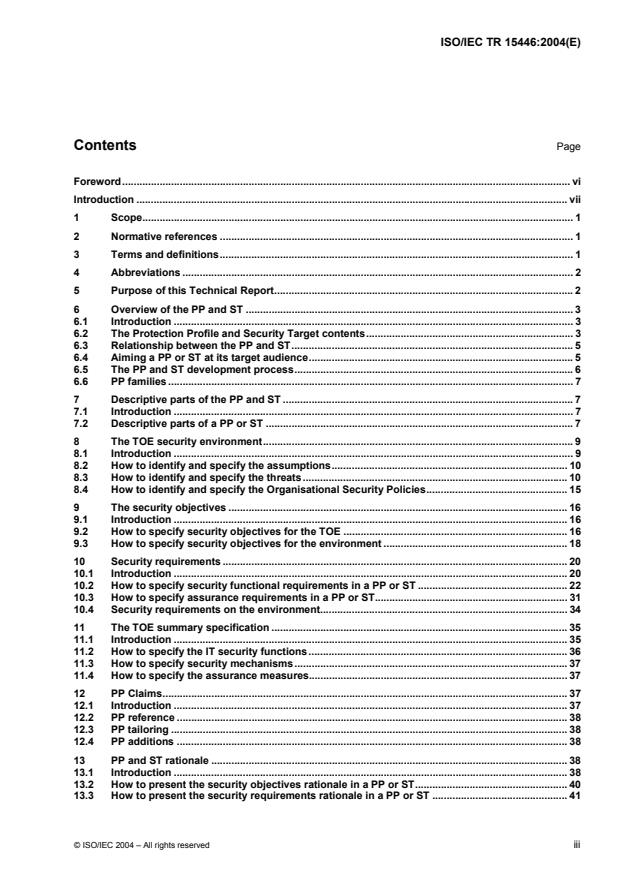
Contents Page
Foreword. vi
Introduction . vii
1 Scope. 1
2 Normative references . 1
3 Terms and definitions. 1
4 Abbreviations . 2
5 Purpose of this Technical Report. 2
6 Overview of the PP and ST . 3
6.1 Introduction . 3
6.2 The Protection Profile and Security Target contents. 3
6.3 Relationship between the PP and ST. 5
6.4 Aiming a PP or ST at its target audience. 5
6.5 The PP and ST development process. 6
6.6 PP families . 7
7 Descriptive parts of the PP and ST . 7
7.1 Introduction . 7
7.2 Descriptive parts of a PP or ST . 7
8 The TOE security environment. 9
8.1 Introduction . 9
8.2 How to identify and specify the assumptions. 10
8.3 How to identify and specify the threats. 10
8.4 How to identify and specify the Organisational Security Policies. 15
9 The security objectives . 16
9.1 Introduction . 16
9.2 How to specify security objectives for the TOE . 16
9.3 How to specify security objectives for the environment . 18
10 Security requirements . 20
10.1 Introduction . 20
10.2 How to specify security functional requirements in a PP or ST . 22
10.3 How to specify assurance requirements in a PP or ST. 31
10.4 Security requirements on the environment. 34
11 The TOE summary specification . 35
11.1 Introduction . 35
11.2 How to specify the IT security functions. 36
11.3 How to specify security mechanisms. 37
11.4 How to specify the assurance measures. 37
12 PP Claims. 37
12.1 Introduction . 37
12.2 PP reference . 38
12.3 PP tailoring . 38
12.4 PP additions . 38
13 PP and ST rationale . 38
13.1 Introduction . 38
13.2 How to present the security objectives rationale in a PP or ST. 40
13.3 How to present the security requirements rationale in a PP or ST . 41
© ISO/IEC 2004 – All rights reserved iii
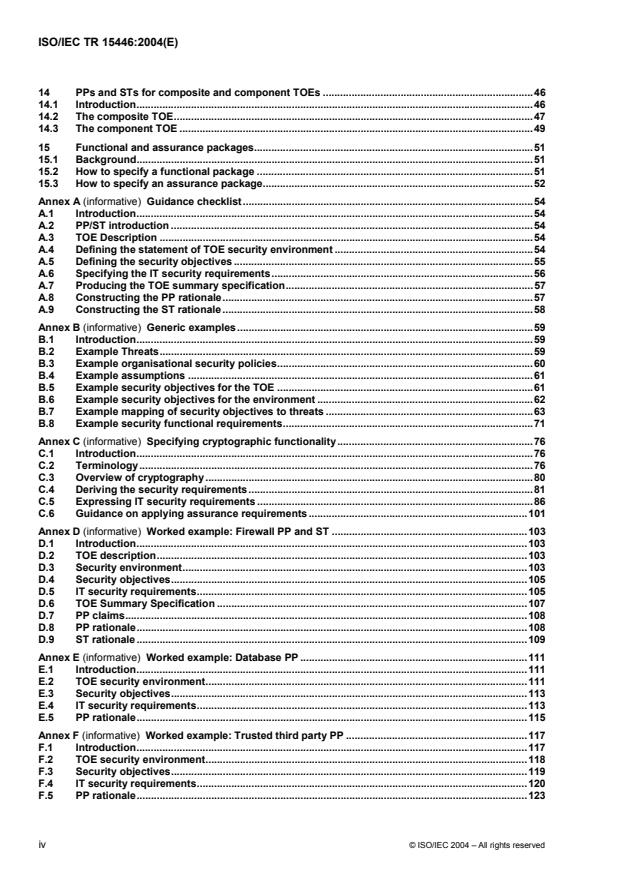
14 PPs and STs for composite and component TOEs .46
14.1 Introduction.46
14.2 The composite TOE.47
14.3 The component TOE .49
15 Functional and assurance packages.51
15.1 Background.51
15.2 How to specify a functional package .51
15.3 How to specify an assurance package.52
Annex A (informative) Guidance checklist.54
A.1 Introduction.54
A.2 PP/ST introduction .54
A.3 TOE Description .54
A.4 Defining the statement of TOE security environment .54
A.5 Defining the security objectives .55
A.6 Specifying the IT security requirements.56
A.7 Producing the TOE summary specification.57
A.8 Constructing the PP rationale.57
A.9 Constructing the ST rationale .58
Annex B (informative) Generic examples.59
B.1 Introduction.59
B.2 Example Threats.59
B.3 Example organisational security policies.60
B.4 Example assumptions .61
B.5 Example security objectives for the TOE .61
B.6 Example security objectives for the environment .62
B.7 Example mapping of security objectives to threats .63
B.8 Example security functional requirements.71
Annex C (informative) Specifying cryptographic functionality.76
C.1 Introduction.76
C.2 Terminology.76
C.3 Overview of cryptography .80
C.4 Deriving the security requirements.81
C.5 Expressing IT security requirements .86
C.6 Guidance on applying assurance requirements .101
Annex D (informative) Worked example: Firewall PP and ST .103
D.1 Introduction.103
D.2 TOE description.103
D.3 Security environment.103
D.4 Security objectives.105
D.5 IT security requirements.105
D.6 TOE Summary Specification .107
D.7 PP claims.108
D.8 PP rationale.108
D.9 ST rationale .109
Annex E (informative) Worked example: Database PP .111
E.1 Introduction.111
E.2 TOE security environment.111
E.3 Security objectives.113
E.4 IT security requirements.113
E.5 PP rationale.115
Annex F (informative) Worked example: Trusted third party PP .117
F.1 Introduction.117
F.2 TOE security environment.118
F.3 Security objectives.119
F.4 IT security requirements.120
F.5 PP rationale.123
iv © ISO/IEC 2004 – All rights reserved
Bibliography . 125
© ISO/IEC 2004 – All rights reserved v
Foreword
ISO (the International Organization for Standardization) and IEC (the International Electrotechnical
Commission) form the specialized system for worldwide standardization. National bodies that are members of
ISO or IEC participate in the development of International Standards through technical committees
established by the respective organization to deal with particular fields of technical activity. ISO and IEC
technical committees collaborate in fields of mutual interest. Other international organizations, governmental
and non-governmental, in liaison with ISO and IEC, also take part in the work. In the field of information
technology, ISO and IEC have established a joint technical committee, ISO/IEC JTC 1.
International Standards are drafted in accordance with the rules given in the ISO/IEC Directives, Part 2.
The main task of the joint technical committee is to prepare International Standards. Draft International
Standards adopted by the joint technical committee are circulated to national bodies for voting. Publication as
an International Standard requires approval by at least 75 % of the national bodies casting a vote.
In exceptional circumstances, the joint technical committee may propose the publication of a Technical Report
of one of the following types:
— type 1, when the required support cannot be obtained for the publication of an International Standard,
despite repeated efforts;
— type 2, when the subject is still under technical development or where for any other reason there is the
future but not immediate possibility of an agreement on an International Standard;
— type 3, when the joint technical committee has collected data of a different kind from that which is
normally published as an International Standard (“state of the art”, for example).
Technical Reports of types 1 and 2 are subject to review within three years of publication, to decide whether
they can be transformed into International Standards. Technical Reports of type 3 do not necessarily have to
be reviewed until the data they provide are considered to be no longer valid or useful.
Attention is drawn to the possibility that some of the elements of this document may be the subject of patent
rights. ISO and IEC shall not be held responsible for identifying any or all such patent rights.
ISO/IEC TR 15446, which is a Technical Report of type 3, was prepared by Joint Technical Committee
ISO/IEC JTC 1, Information technology, Subcommittee SC 27, IT Security techniques.
vi © ISO/IEC 2004 – All rights reserved
Introduction
The purpose of a Protection Profile (PP) is to state a security problem rigorously for a given collection of
systems or products - known as the Target Of Evaluation (TOE) - and to specify security requirements to
address that problem without dictating how these requirements will be implemented. (For this reason, a PP is
said to provide an implementation-independent security description.) A PP thus includes several related kinds
of security information:
a) A PP overview and a TOE description which identify, in terms appropriate for users of information
technology, the statement of need or security problem to be addressed.
b) A description of the TOE security environment which refines the statement of need with respect to the
intended environment of use, producing the threats to be countered and the organisational security
policies to be met in light of specific assumptions.
c) Security objectives which scope the TOE evaluation based on the description of the TOE security
environment, giving information about how, and to what extent, the security concerns are to be met. The
purpose of a security objective is to mitigate risk and to support the security policies of the PP sponsor.
d) Security functional requirements and assurance requirements which address the problem posed by the
statement of need, to the extent defined by the security objectives for the TOE and its IT environment.
The security functional requirements explain what must be done by the TOE, and what must be done by
its IT environment, in order to meet the security objectives. The assurance requirements explain the
degree of confidence expected in the security functions of the TOE and the IT environment.
e) A rationale which demonstrates that the security functional requirements and assurance requirements
suffice to meet the statement of need. The security objectives must explain what is to be done about the
security concerns found in the description of the TOE security environment. The security functional
requirements and assurance requirements must meet the security objectives.
A Security Target (ST) is similar to PP, except that it contains additional implementation-specific information
detailing how the security requirements are realised in a particular product or system. Thus, the ST contains
the following additional information not found in a PP:
a) A TOE summary specification that presents TOE-specific security functions and assurance measures.
b) An optional PP claims portion that explains which PPs the ST is claimed to be conformant with, if any.
c) Finally, the rationale contains additional evidence establishing that the TOE summary specification
ensures satisfaction of the implementation-independent requirements, and that any claims about PP
conformance are satisfied.
A PP may be used to define a ‘standard’ set of security requirements with which one or more products may
claim compliance, or which systems used for a particular purpose within an organisation must comply. (See
ISO/IEC 15408-1, 2.3 for the definition of the terms product and system, and also ISO/IEC 15408-1, 4.1.2 for
a general discussion of the distinction between the two). A PP may apply to a particular type of TOE (e.g.
operating system, database management system, smartcard, firewall, and so on), or it could apply to a set of
products grouped together in a composite TOE (system or product).
Product vendors may respond to the security concerns defined by a PP by producing an ST which
demonstrates how their product addresses those security concerns. However, it is not mandatory for an ST to
claim conformance with a PP. A product vendor may assume a set of security concerns for their market place
and produce an ST specifying how the security functions claimed by their product meets those concerns, and
this forms the baseline for the product evaluation.
© ISO/IEC 2004 – All rights reserved vii
A PP may also define the security requirements to be satisfied by a specific IT system. In this event, the ST is
proposed in response to the PP, i.e. the ST may be written in response to an RFP (Request For Proposal) that
references the PP. A PP and ST can thus be used as a means of communication among the party responsible
for managing the development of a system, the stakeholders in that system, and the organisation responsible
for producing the system (hereafter referred to as the developer). The content of the PP and ST may be
negotiated among the players. Evaluation of the actual system against the ST - which has been confirmed as
conformant with the PP - may be part of the acceptance process. (It should of course be noted that an ST may
be written by a developer as part of a response to an RFP that does not reference a PP.)
viii © ISO/IEC 2004 – All rights reserved
TECHNICAL REPORT ISO/IEC TR 15446:2004(E)
Information technology — Security techniques — Guide for the
production of Protection Profiles and Security Targets
1 Scope
This document provides guidance relating to the construction of Protection Profiles (PPs) and Security Targets
(STs) that are intended to be compliant with ISO/IEC 15408 (the ‘Common Criteria’).
As such, the document is primarily aimed at those who are involved in the development of PPs and STs.
However, it is also likely to be useful to evaluators of PPs and STs and to those who are responsible for
monitoring PP and ST evaluation. It may also be of interest to consumers and users of PPs and STs who wish
to understand what guidance the PP/ST author used, and which parts of the PP or ST are of principal interest.
It is assumed that readers of this Technical Report are familiar with ISO/IEC 15408-1, and in particular
Annexes B and C which describe PPs and STs. PP and ST authors will (of course) need to become familiar
with the other parts of ISO/IEC 15408 as described in this Report, including introductory material such as the
functional requirements paradigm described in ISO/IEC 15408-2, 1.3.
This document is an informational ISO Technical Report intended for guidance only. It should not be cited as a
Standard on the content or structure for the evaluation of PPs and STs. It is intended to be fully consistent
with ISO/IEC 15408; however, in the event of any inconsistency between this Technical Report and
ISO/IEC 15408, the latter as a normative Standard takes precedence.
This Technical Report does not deal with issues such as PP registration and associated tasks such as the
handling of protected intellectual property (e.g. patents) in a PP. For information on PP registration
procedures, see [1].
2 Normative references
The following referenced documents are indispensable for the application of this document. For dated
references, only the edition cited applies. For undated references, the latest edition of the referenced
document (including any amendments) applies.
ISO/IEC 15408-1:1999, Information technology — Security techniques — Evaluation criteria for IT security —
Part 1: Introduction and general model
ISO/IEC 15408-2:1999, Information technology — Security techniques — Evaluation criteria for IT security —
Part 2: Security functional requirements
ISO/IEC 15408-3:1999, Information technology — Security techniques — Evaluation criteria for IT security —
Part 3: Security assurance requirements
ISO 2382-8:1998, Information technology — Vocabulary — Part 8: Security
3 Terms and definitions
For the purposes of this document, the terms and definitions given in ISO/IEC 15408-1, 2.3 apply.
© ISO/IEC 2004 – All rights reserved 1
4 Abbreviations
For the purposes of this document, the abbreviations given in ISO/IEC 15408-1, 2.1 and the following apply:
DBMS Database Management System
OSP Organizational Security Policy
RFP Request for Proposal
SAR Security Assurance Requirement
SFR Security Functional Requirement
TSS TOE Summary Specification
TTP Trusted Third Party.
5 Purpose of this Technical Report
This Technical Report provides detailed guidance relating to the various parts of a PP or ST, and how they
interrelate. For a summary of the key points of guidance contained in this document, presented in the form of
a checklist, the interested reader should consult Annex A.
This Technical Report is structured such that the guidance to PP and ST authors is presented in the main
body (i.e. the individual clauses), with a summary presented in Annex A as mentioned above. Subsequent
annexes then present a variety of examples to illustrate application of the guidance.
Clauses 1 to 4 contain introductory and reference material, and are followed by this overview (Clause 5).
Clause 6 provides an overview of the PP and ST which presents example contents lists and highlights the
expected contents of, and the target audience for, the various parts of a PP or ST. This clause also discusses
the relationship between the PP and the ST and issues relating to the PP/ST development process. Clause 7
examines in more depth the descriptive parts of a PP and ST, covering the PP and ST introduction and the
TOE description (which tend to be more aimed at consumers and users) as well as PP application notes
(which tend to be more aimed at ST authors and TOE developers).
The next five clauses of the Technical Report follow the order of the PP and ST contents as outlined in
ISO/IEC 15408-1, Figures B.1 and C.1.
Clause 8 gives guidance on the definition of the TOE security environment in a PP or ST, which covers the
various aspects of the ‘security concerns’ to be met by the TOE. Clause 9 then provides guidance on the
definition of the intended response to the different aspects of the security concerns by the TOE and its
environment, as given in the specification of security objectives in a PP or ST. Both of these clauses are of
general interest, not only to PP/ST authors, but also to others such as consumers and users of PPs and STs.
Clause 10 provides guidance on the selection and specification of IT security requirements in a PP or ST. This
clause goes into some detail describing how the functional and assurance components defined in
ISO/IEC 15408, as well as non-ISO/IEC 15408 components, should be used to provide a clear definition of the
IT security requirements. Clauses 11 and 12 then provide specific guidance relating to STs, covering the TOE
summary specification and PP compliance claims respectively. These three clauses will be mainly of interest
to PP/ST authors and evaluators.
Clause 13 provides guidance on the construction and presentation of the Rationale sections of a PP and ST.
Clause 14 examines the issues specific to PPs and STs for composite TOEs, i.e. TOEs that are composed of
two or more component TOEs, each of which has its own PP or ST.
2 © ISO/IEC 2004 – All rights reserved
Clause 15 provides guidance on the construction of functional and assurance packages, which are defined so
as to be useable in different PPs and STs. A package is thus seen as potentially a very useful tool intended to
promote and facilitate cost-effective construction of PPs and ST.
As described above, Annex A summarises the guidance in the form of a checklist.
Annex B presents example threats, organisational security policies, assumptions, and security objectives, and
identifies appropriate ISO/IEC 15408 functional components for specifying common or generic security
functional requirements. Although these examples are intended to be wide-ranging, they are in no way
claimed to be exhaustive.
Annex C provides guidance that specifically relates to PPs and STs for TOEs which implement cryptographic
functionality. Such guidance has been included to cover a wide range of such TOEs, and deal with the specific
issues relating to specification of cryptographic functionality. (Future versions of the Technical Report may
include similar annexes for other types of TOE.)
Annexes D to F illustrate application of the guidance in a variety of contexts, using worked examples for
different types of TOE. Each of these examples is based on actual PPs and STs that have been developed
(independent of this Technical Report). In Annex D, we see application of guidance to the construction of a
firewall PP and ST. Annex E discusses a database management system PP, where it can be seen that the
issue of dependencies on the IT environment is of particular importance. Finally, Annex F examines the issues
surrounding the development of a Trusted Third Party (TTP) PP.
6 Overview of the PP and ST
6.1 Introduction
This clause provides an overview of the PP and ST, summarising the contents of both documents, discussing
the relationship between the PP and ST, and the process by which the documents are developed. See also
ISO/IEC 15408-1, Annexes B and C.
6.2 The Protection Profile and Security Target contents
The required content of a PP is portrayed in ISO/IEC 15408-1, Figure B.1. Table 1 following translates this
into an example contents list.
The required content of an ST is portrayed in ISO/IEC 15408-1, Figure C.1. Table 2 following adds additional
content to that of Table 1 to give an example contents list for an ST.
The reader of a PP or ST, as with any document, should be able to easily discern where the required content
is within the PP or ST.
The Introduction identifies the PP or ST and TOE (including its version number) and provides a summary of
the PP or ST in narrative form. The summary for a PP can be used for inclusion in a PP catalogue and
register. For an ST, suitable for inclusion e.g. in a list of products that have been evaluated. This section is
discussed in more detail in Clause 7 of this Technical Report.
The TOE Description provides general information on the TOE (or TOE type), and serves as an aid to
understanding its security requirements and intended usage. For an ST, the TOE description should also
include a definition of the configuration in which the TOE is to be evaluated. This section is discussed in more
detail in Clause 7 of this Technical Report.
The TOE Security Environment provides a definition of the context in which the TOE resides, and in particular
defines the ‘security concerns’ the TOE is intended to address. This description details any assumptions
defining the scope of the security concerns, the scope of the intended use, the identified threats to the assets
requiring protection (together with a description of those assets), and any organisational security policies with
which the TOE must comply. This section is discussed in detail in Clause 8 of this Technical Report.
© ISO/IEC 2004 – All rights reserved 3
Table 1 — Example Protection Profile Contents List
1 PP INTRODUCTION
1.1 Identification
1.2 Overview
2 TOE DESCRIPTION
3 TOE SECURITY ENVIRONMENT
3.1 Assumptions
3.2 Threats
3.3 Organisational Security Policies
4 SECURITY OBJECTIVES
4.1 Security Objectives for the TOE
4.2 Security Objectives for the Environment
5 IT SECURITY REQUIREMENTS
5.1 TOE Security Functional Requirements
5.2 TOE Security Assurance Requirements
5.3 Security Requirements for the IT Environment
6 PP APPLICATION NOTES
7 RATIONALE
7.1 Security Objectives Rationale
7.2 Security Requirements Rationale
Table 2 — Example Contents List for a Security Target
1 ST INTRODUCTION
1.3 ISO/IEC 15408 Conformance
a
TOE SUMMARY SPECIFICATION
6.1 TOE Security Functions
6.2 Assurance Measures
7 PP CLAIMS
7.1 PP Reference
7.2 PP Tailoring
7.3 PP Additions
8 RATIONALE
8.3 TOE Summary Specification Rationale
8.4 PP Claims Rationale
a
PP Application Notes are not included in a Security Target.
The Security Objectives provide a concise statement of the intended response to the security concerns, both
in terms of the security objectives to be satisfied by the TOE, and the security objectives to be satisfied by IT
4 © ISO/IEC 2004 – All rights reserved
and non-IT measures within the TOE environment. This section is discussed in detail in Clause 9 of this
Technical Report.
The IT Security Requirements define the security functional requirements on the TOE, the security assurance
requirements, and any security requirements on software, firmware and/or hardware in the IT environment for
the TOE. The IT security requirements are to be defined using, where applicable, functional and assurance
components from ISO/IEC 15408-2 and ISO/IEC 15408-3. This section is discussed in detail in Clause 10 of
this Technical Report.
The PP Application Notes is an optional section in a PP providing any additional supporting information
considered useful by the PP author. Note that application notes may be distributed amongst the relevant
sections of the PP instead of being provided in a separate section. This is discussed in more detail in Clause 7
of this Technical Report.
The TOE Summary Specification is the section in an ST that defines the IT security functions provided by the
TOE to meet the specified security functional requirements, and also any assurance measures claimed to
satisfy the specified security assurance requirements. This is discussed in detail in Clause 11 of this Technical
Report.
The PP Claims is an optional section of an ST which identifies any PPs with which the ST is claimed to
conform, and any additions or tailoring of the PP objectives or requirements. This is discussed in detail in
Clause 12 of this Technical Report.
The Rationale provides a demonstration that the PP or ST specifies a complete and cohesive set of IT
security requirements, and that a conformant TOE would effectively address the defined security concerns,
and that the IT security functions and assurance measures are suitable to meet the TOE security
requirements. Note that the rationale may be distributed amongst the relevant sections of the PP or ST
instead of being provided in a separate section. This is discussed in detail in Clause 13 of this Technical
Report.
Note also that the Rationale section may be packaged as a separate document, as stated in
ISO/IEC 15408-1, B.2.8.
6.3 Relationship between the PP and ST
It will be evident from comparison of the example contents list in Tables 1 and 2 that there is a high degree of
commonality between a PP and an ST, in particular within the TOE Security Environment, Security Objectives
and IT Security Requirements sections, and the parts of the Rationale section which address these aspects.
Indeed, if an ST simply claims conformance with a PP with no additional functional or assurance
requirements, then the content of these sections of the ST may be identical to that the corresponding sections
in the PP. In such cases it is recommended that the ST simply references the PP content, providing detail only
where it differs from the PP.
The following sections in the ST provide detail that will not be featured in a PP, reflecting the specific nature of
the ST, i.e. as a definition of how the TOE will provide a solution to the defined security concerns:
a) the TOE Summary Specification, covering IT security functions, security mechanisms or techniques, and
assurance measures;
b) the optional PP Claims, detailing and justifying any claims of compliance with referenced PP(s);
c) those parts of the Rationale in the ST which demonstrate the adequacy of the IT security functions and
the assurance measures to satisfy the TOE security requirements.
6.4 Aiming a PP or ST at its target audience
One of the key challenges in writing a PP or ST is to factor the presentation so that all of the intended
audiences are properly served:
© ISO/IEC 2004 – All rights reserved 5
a) Consumers (i.e. procurers and high-level decision-makers) need a general understanding of what
conforming TOEs will provide in the way of security. For successful PPs, this may be the largest class of
readers.
b) Developers (including implementers in the case of an ST) need an unambiguous definition of security
requirements in order to build conforming TOEs.
c) TOE users (including installers, administrators, and maintainers) need information on the required TOE
security environment.
d) Evaluators need information that will justify the technical soundness and effectiveness of the PP or ST.
PPs and STs are designed in such a way that different sections serve different audiences, and they need to
be written accordingly.
The PP/ST Introduction, TOE Description, and TOE Security Environment sections should be written primarily
for consumers. The Security Objectives section may be also written for consumers. It should, however, be
remembered that TOE developers will also need to take account of information in the TOE Security
Environment and Security Objectives sections.
The IT Security Requirements section of the PP should be written primarily for TOE developers, although the
information it contains is also likely to be of interest to TOE consumers. Conversely, the TOE Summary
Specification section of a ST should be written primarily for evaluators and consumers. If these sections are
not self contained, they should explicitly indicate which other PP sections and which other documents (e.g.
referenced encryption standards) are necessary for a full and accurate understanding of the presented IT
security requirements. In particular, if the TOE Summary Specification depends for its meaning on the IT
Security Requirements section, this fact should be explicitly pointed out.
Evaluators need to be familiar with all sections of a PP or ST. However, the Rationale section while of interest
to each user of a PP or ST, is generally evaluation information and primarily for evaluators.
6.5 The PP and ST development process
The presentation of the requirements for PPs and STs in Annexes B and C of ISO/IEC 15408-1, and in
clauses 3 to 5 of ISO/IEC 15408-3, might suggest that it is expected that PPs and STs are always developed
in a logical ‘top-down’ manner, e.g. (in the case of a PP) that:
a) the security concerns are first defined;
b) the security objectives are then identified to address the security concerns;
c) IT security requirements are then defined to satisfy the security objectives for the TOE.
Whilst such a possibility is not ruled out, it is more likely that an iterative process will be required. For
example, definition of IT security requirements may highlight clarifications needed to the definition of the
security objectives, or even the security concerns. In general, a number of iterations may be required in which
the relationships between threats, organisational security policies, security objectives and IT security
requirements and functions are examined closely, particularly when the PP or ST Rationale is being
constructed. Only when all identified gaps in the rationale are filled may it be assumed that the PP or ST is
complete.
During an iterative process of PP or ST development new information might surface, within the scope of the
current security concerns, that may lead changes to the document that reflect changes in external
circumstances, for example:
a) new threats may be identified;
b) organisational security policies may change;
6 © ISO/IEC 2004 – All rights reserved
c) cost and time constraints may impose changes in division of responsibility between what the TOE is
expected to do, and what is expected of the TOE environment;
d) changes in intended attack potential may impact on the TOE security environment.
It is also possible (e.g. if the TOE is a product which has already been developed) that the PP or ST author
already has a clear idea of the SFRs that the TOE will meet (even if these have not yet been expressed in the
way ISO/IEC 15408 requires). In such cases the definition of the security concerns and security objectives will
unavoidably be influenced by the knowledge of the form of the security solution the TOE provides. The PP/ST
development process will in those cases be, to some extent, ‘bottom-up’.
6.6 PP families
A ‘PP family’ is (as its name suggests) a set of closely related PPs, which typically apply to the same product
or system type (e.g. operating system, firewall, and so on). A PP may thus be developed as part of a wider
process of developing a family of PP
...
Questions, Comments and Discussion
Ask us and Technical Secretary will try to provide an answer. You can facilitate discussion about the standard in here.
Loading comments...