

ISO 13029:2012
(Main)Textiles — Determination of drying rate in dynamic state by the modified sweating-guarded hotplate
General Information
- Abstract
ISO 13029:2012 specifies a method for measuring the drying rate of fabric products for sports, leisure use or underwear, that have contact with the skin in their normal use, and other similar fabric products. The method is not applicable to textiles that cannot be permeated by water vapour or for those textiles which are more than 5 mm thick.
- Status
- Published
- Publication Date
- 14-Aug-2012
- Technical Committee
- ISO/TC 38 - Textiles
- Drafting Committee
- ISO/TC 38/WG 27 - Fabric properties relating to moisture
- Current Stage
- 9093 - International Standard confirmed
- Start Date
- 06-Sep-2023
- Completion Date
- 29-Aug-2026
Overview
ISO 13029:2012 is an international standard that specifies a precise method for determining the drying rate of textile fabrics in a dynamic state using the modified sweating-guarded hotplate (SGHP). This method targets fabric products designed for sportswear, leisure apparel, underwear, and other textiles in direct contact with the skin during normal use. The drying rate measurement helps evaluate the moisture-management capabilities of fabrics by simulating real-life sweating conditions where heat and moisture continuously interact with the textile’s surface.
This standard is applicable to textiles that are permeable to water vapor and less than 5 mm thick, ensuring relevance for moisture-wicking and quick-drying fabrics. The testing conditions replicate dynamic states of drying, closely mimicking human body heat and sweat evaporation processes, unlike conventional steady-state drying tests.
Key Topics
Dynamic Drying Rate Measurement
ISO 13029 defines drying rate as the time required for a specimen saturated with a specific volume of distilled water (5 ml) to return to its initial steady-state water vapor condition under controlled isothermal conditions (35 °C, 40% RH). This simulates the continuous moisture and heat exposure fabrics experience in use.Modified Sweating-Guarded Hotplate Apparatus
The testing uses a modified SGHP device compliant with ISO 11092 but enhanced with a water input system delivering water precisely onto the specimen surface. This allows standardized and repeatable wetting followed by measurement of the drying process.Water Vapour Resistance (Ret)
The standard incorporates the measurement of water vapour resistance to understand the fabric’s breathability and moisture transfer, which directly impacts drying performance. Conditions prevent vapor condensation, providing accurate drying rate data.Test Procedure and Calculation
The procedure includes specimen preparation, conditioning, measurement of vapor resistance, wetting with distilled water, and timing the drying process. Drying time is calculated by identifying starting and ending points of drying using changes in vapor resistance, then expressed in seconds per 5ml of water.Reporting and Repeatability
The test report must list sample identification, testing conditions, number of specimens, drying rates (average and variation), and any deviations from the procedure. Annex A presents an example comparing drying rates among four polyester knitted fabrics, showcasing repeatability and capability to quantify drying performance differences.
Applications
ISO 13029:2012 supports professionals in the textile industry, including:
Sportswear and Activewear Manufacturing
Designing and selecting fabrics with optimal moisture management to improve wearer comfort and performance.Underwear and Leisure Apparel Production
Ensuring fabrics maintain dryness and reduce clamminess during wear.Textile Research & Development
Evaluating new fabric innovations incorporating sweat-wicking and quick-drying technologies through consistent and reliable drying rate testing.Quality Control
Verifying product claims related to moisture management and establishing benchmarks for drying performance in various fabric constructions.Comparative Textile Testing
Comparing different fabric samples, fiber compositions, or finishes to guide material selection based on objective drying rate data.
Related Standards
ISO 11092: Physiological Effects of Textiles
Provides foundational methods for measuring thermal and water-vapour resistance of textiles in steady-state conditions, upon which the modified method in ISO 13029 builds.AATCC Test Method 195: Liquid Moisture Management Properties
Offers complementary dynamic measurements of moisture transport in textiles, broadening the understanding of moisture-management beyond drying rate.
Keywords: ISO 13029, textile drying rate, moisture management textiles, sweating-guarded hotplate, fabric drying test, water vapor resistance, sportswear fabric testing, quick-drying textiles, moisture-wicking fabrics, dynamic drying measurement, international textile standards.
Get Certified
Connect with accredited certification bodies for this standard

Control Union Certifications
Global certification for agriculture and sustainability.

Hohenstein Institut
Textile testing and certification.

Bureau Veritas Bangladesh
Bureau Veritas certification services in Bangladesh.
Sponsored listings
Frequently Asked Questions
ISO 13029:2012 is a standard published by the International Organization for Standardization (ISO). Its full title is "Textiles — Determination of drying rate in dynamic state by the modified sweating-guarded hotplate". This standard covers: ISO 13029:2012 specifies a method for measuring the drying rate of fabric products for sports, leisure use or underwear, that have contact with the skin in their normal use, and other similar fabric products. The method is not applicable to textiles that cannot be permeated by water vapour or for those textiles which are more than 5 mm thick.
ISO 13029:2012 specifies a method for measuring the drying rate of fabric products for sports, leisure use or underwear, that have contact with the skin in their normal use, and other similar fabric products. The method is not applicable to textiles that cannot be permeated by water vapour or for those textiles which are more than 5 mm thick.
ISO 13029:2012 is classified under the following ICS (International Classification for Standards) categories: 59.060.01 - Textile fibres in general. The ICS classification helps identify the subject area and facilitates finding related standards.
ISO 13029:2012 is available in PDF format for immediate download after purchase. The document can be added to your cart and obtained through the secure checkout process. Digital delivery ensures instant access to the complete standard document.
Standards Content (Sample)
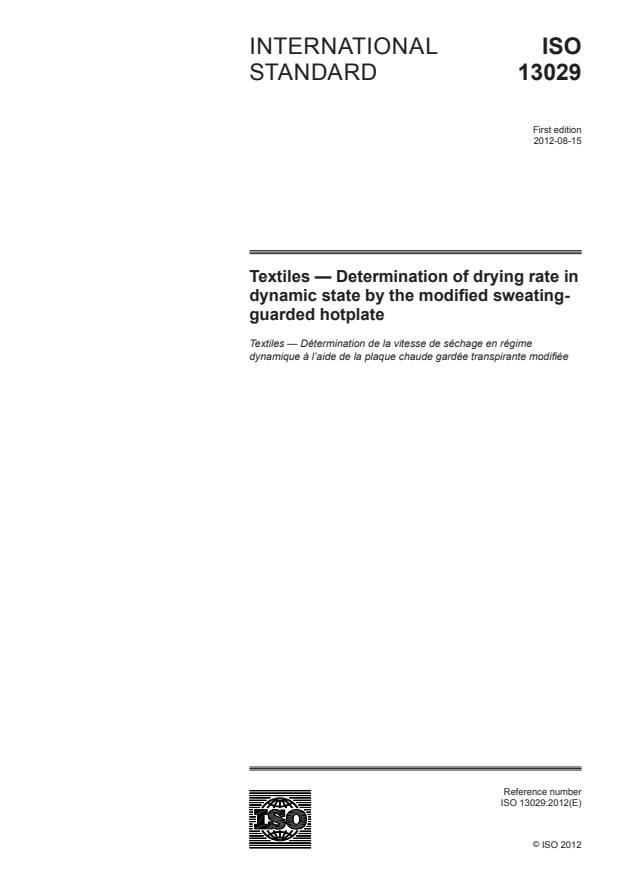
INTERNATIONAL ISO
STANDARD 13029
First edition
2012-08-15
Textiles — Determination of drying rate in
dynamic state by the modified sweating-
guarded hotplate
Textiles — Détermination de la vitesse de séchage en régime
dynamique à l’aide de la plaque chaude gardée transpirante modifiée
Reference number
©
ISO 2012
All rights reserved. Unless otherwise specified, no part of this publication may be reproduced or utilized in any form or by any means,
electronic or mechanical, including photocopying and microfilm, without permission in writing from either ISO at the address below or ISO’s
member body in the country of the requester.
ISO copyright office
Case postale 56 • CH-1211 Geneva 20
Tel. + 41 22 749 01 11
Fax + 41 22 749 09 47
E-mail copyright@iso.org
Web www.iso.org
Published in Switzerland
ii © ISO 2012 – All rights reserved
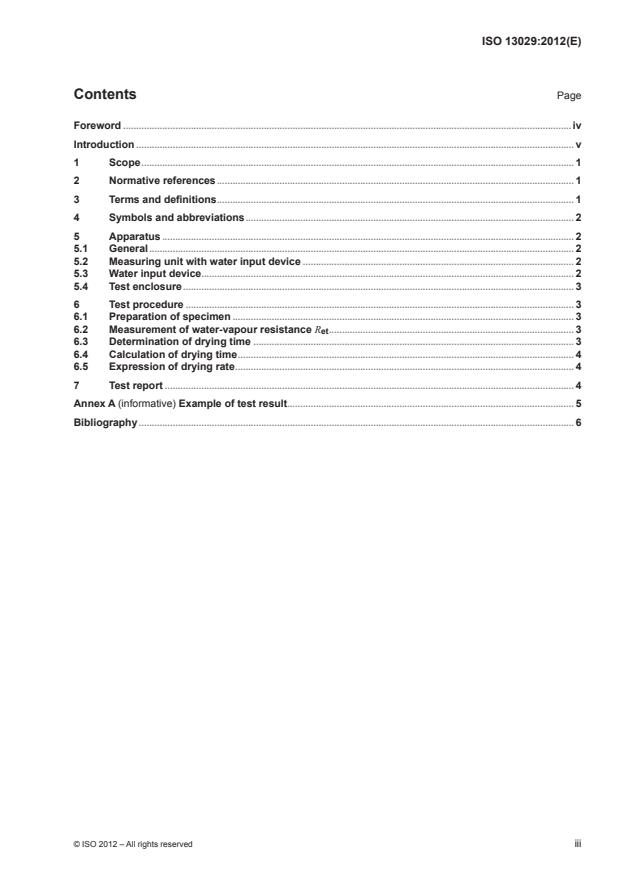
Contents Page
Foreword .iv
Introduction . v
1 Scope . 1
2 Normative references . 1
3 Terms and definitions . 1
4 Symbols and abbreviations . 2
5 Apparatus . 2
5.1 General . 2
5.2 Measuring unit with water input device . 2
5.3 Water input device. 2
5.4 Test enclosure . 3
6 Test procedure . 3
6.1 Preparation of specimen . 3
6.2 Measurement of water-vapour resistance R . 3
et
6.3 Determination of drying time . 3
6.4 Calculation of drying time . 4
6.5 Expression of drying rate . 4
7 Test report . 4
Annex A (informative) Example of test result . 5
Bibliography . 6
Foreword
ISO (the International Organization for Standardization) is a worldwide federation of national standards bodies
(ISO member bodies). The work of preparing International Standards is normally carried out through ISO
technical committees. Each member body interested in a subject for which a technical committee has been
established has the right to be represented on that committee. International organizations, governmental and
non-governmental, in liaison with ISO, also take part in the work. ISO collaborates closely with the International
Electrotechnical Commission (IEC) on all matters of electrotechnical standardization.
International Standards are drafted in accordance with the rules given in the ISO/IEC Directives, Part 2.
The main task of technical committees is to prepare International Standards. Draft International Standards
adopted by the technical committees are circulated to the member bodies for voting. Publication as an
International Standard requires approval by at least 75 % of the member bodies casting a vote.
Attention is drawn to the possibility that some of the elements of this document may be the subject of patent
rights. ISO shall not be held responsible for identifying any or all such patent rights.
ISO 13029 was prepared by Technical Committee ISO/TC 38, Textiles.
iv © ISO 2012 – All rights reserved
Introduction
The purpose of this International Standard is for testing textile fabrics that have moisture-management properties.
International Standards do not provide a detailed definition of Moisture Management Textiles. Here, moisture
management generally refers to a feature in which absorbed sweat is transported within the fabric and along
the fabric surface and is dried from the fabric surface.
The drying that takes place in textiles, which are designed to dry the absorbed sweat in a timely manner using the
capillary-tube phenomenon, progresses in a condition that is different from the drying that is generally practiced
after washing. This is because textiles intended for moisture-management properties show the feature of drying
the absorbed sweat at the same time as the sweat vapour is continuously allowed in from the human body.
Also, the drying of the textile progresses by evaporating only in the direction that is opposite to the side where
the sweat heated by the human body temperature contacts the skin. To distinguish between these two types
of drying, the condition in which textiles are dried after washing is specified as “steady state” while “dynamic
state” drying is the term used for the drying feature of the textile material with moisture-management properties.
To evaluate the drying condition of textiles under a dynamic state, the sweating-guarded hotplate (SGHP)
equipment specified in ISO 11092 has been modified and used. Distilled water is used to avoid the estimation
errors that can occur when applying artificial sweat to the SGHP.
This International Standard does not evaluate the physiological feature of textile materials. However, it can
provide information that can be used for comparison among textile materials by estimating their drying features
in limited environmental conditions.
INTERNATIONAL STANDARD ISO 13029:2012(E)
Textiles — Determination of drying rate in dynamic state by the
modified sweating-guarded hotplate
1 Scope
This International Standard specifies a method for measuring the drying rate of fabric products for sports,
leisure use or underwear, that have contact with the skin in their normal use, and other similar fabric products.
The method is not applicable to textiles that cannot be permeated by water vapour or for those textiles which
are more than 5 mm thick.
2 Normative refere
...