


ISO 16143-1:2014
(Main)Stainless steels for general purposes — Part 1: Corrosion-resistant flat products
Stainless steels for general purposes — Part 1: Corrosion-resistant flat products
ISO 16143-1:2014 specifies the technical delivery conditions for hot- or cold-rolled sheet/plate and strip for general purposes made of the most important corrosion-resistant stainless steel grades.
Aciers inoxydables pour usage général — Partie 1: Produits plats en acier résistant à la corrosion
General Information
Relations
Standards Content (Sample)
DRAFT INTERNATIONAL STANDARD ISO/DIS 16143-1
ISO/TC 17/SC 4 Secretariat: DIN
Voting begins on Voting terminates on
2012-12-03 2013-03-03
INTERNATIONAL ORGANIZATION FOR STANDARDIZATION • МЕЖДУНАРОДНАЯ ОРГАНИЗАЦИЯ ПО СТАНДАРТИЗАЦИИ • ORGANISATION INTERNATIONALE DE NORMALISATION
Stainless steels for general purposes —
Part 1:
Flat products
Aciers inoxydables pour usage général —
Partie 1: Produits plats
[Revision of first edition (ISO 16143-1:2004)
ICS 77.140.20
To expedite distribution, this document is circulated as received from the committee
secretariat. ISO Central Secretariat work of editing and text composition will be undertaken at
publication stage.
Pour accélérer la distribution, le présent document est distribué tel qu'il est parvenu du
secrétariat du comité. Le travail de rédaction et de composition de texte sera effectué au
Secrétariat central de l'ISO au stade de publication.
THIS DOCUMENT IS A DRAFT CIRCULATED FOR COMMENT AND APPROVAL. IT IS THEREFORE SUBJECT TO CHANGE AND MAY NOT BE
REFERRED TO AS AN INTERNATIONAL STANDARD UNTIL PUBLISHED AS SUCH.
IN ADDITION TO THEIR EVALUATION AS BEING ACCEPTABLE FOR INDUSTRIAL, TECHNOLOGICAL, COMMERCIAL AND USER PURPOSES, DRAFT
INTERNATIONAL STANDARDS MAY ON OCCASION HAVE TO BE CONSIDERED IN THE LIGHT OF THEIR POTENTIAL TO BECOME STANDARDS TO
WHICH REFERENCE MAY BE MADE IN NATIONAL REGULATIONS.
RECIPIENTS OF THIS DRAFT ARE INVITED TO SUBMIT, WITH THEIR COMMENTS, NOTIFICATION OF ANY RELEVANT PATENT RIGHTS OF WHICH
THEY ARE AWARE AND TO PROVIDE SUPPORTING DOCUMENTATION.
© International Organization for Standardization, 2012
ISO/DIS 16143-1
Copyright notice
This ISO document is a Draft International Standard and is copyright-protected by ISO. Except as permitted
under the applicable laws of the user’s country, neither this ISO draft nor any extract from it may be
reproduced, stored in a retrieval system or transmitted in any form or by any means, electronic,
photocopying, recording or otherwise, without prior written permission being secured.
Requests for permission to reproduce should be addressed to either ISO at the address below or ISO’s
member body in the country of the requester.
ISO copyright office
Case postale 56 • CH-1211 Geneva 20
Tel. + 41 22 749 01 11
Fax + 41 22 749 09 47
E-mail copyright@iso.org
Web www.iso.org
Reproduction may be subject to royalty payments or a licensing agreement.
Violators may be prosecuted.
ii © ISO 2012 – All rights reserved
ISO/DIS 16143-1
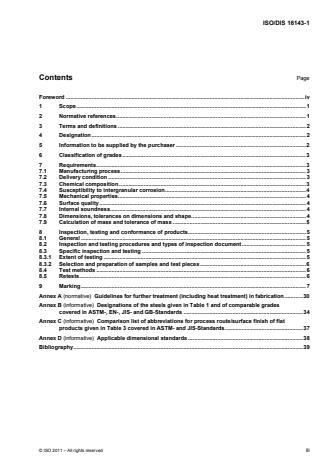
Contents Page
Foreword .iv
1 Scope.1
2 Normative references.1
3 Terms and definitions .2
4 Designation .2
5 Information to be supplied by the purchaser .2
6 Classification of grades.3
7 Requirements.3
7.1 Manufacturing process.3
7.2 Delivery condition .3
7.3 Chemical composition .3
7.4 Susceptibility to intergranular corrosion.4
7.5 Mechanical properties.4
7.6 Surface quality.4
7.7 Internal soundness.4
7.8 Dimensions, tolerances on dimensions and shape.4
7.9 Calculation of mass and tolerance of mass .5
8 Inspection, testing and conformance of products.5
8.1 General .5
8.2 Inspection and testing procedures and types of inspection document.5
8.3 Specific inspection and testing .5
8.3.1 Extent of testing .5
8.3.2 Selection and preparation of samples and test pieces .6
8.4 Test methods .6
8.5 Retests.6
9 Marking.7
Annex A (normative) Guidelines for further treatment (including heat treatment) in fabrication.30
Annex B (informative) Designations of the steels given in Table 1 and of comparable grades
covered in ASTM-, EN-, JIS- and GB-Standards .34
Annex C (informative) Comparison list of abbreviations for process route/surface finish of flat
products given in Table 3 covered in ASTM- and JIS-Standards.37
Annex D (informative) Applicable dimensional standards .38
Bibliography.39
ISO/DIS 16143-1
Foreword
ISO (the International Organization for Standardization) is a worldwide federation of national standards bodies
(ISO member bodies). The work of preparing International Standards is normally carried out through ISO
technical committees. Each member body interested in a subject for which a technical committee has been
established has the right to be represented on that committee. International organizations, governmental and
non-governmental, in liaison with ISO, also take part in the work. ISO collaborates closely with the
International Electrotechnical Commission (IEC) on all matters of electrotechnical standardization.
International Standards are drafted in accordance with the rules given in the ISO/IEC Directives, Part 2.
The main task of technical committees is to prepare International Standards. Draft International Standards
adopted by the technical committees are circulated to the member bodies for voting. Publication as an
International Standard requires approval by at least 75 % of the member bodies casting a vote.
Attention is drawn to the possibility that some of the elements of this document may be the subject of patent
rights. ISO shall not be held responsible for identifying any or all such patent rights.
ISO 16143-1 was prepared by Technical Committee ISO/TC 17, Steels, Subcommittee SC 4, Heat treatable
and alloy steels.
This second edition cancels and replaces the first edition (ISO 16143-1:2004) which has been technically
revised.
ISO 16143 consists of the following parts, under the general title Stainless steels for general purposes:
Part 1: Corrosion resistant flat products
Part 2: Corrosion resistant semi-finished products, bars and sections
Part 3: Wire
iv © ISO 2011 – All rights reserved
DRAFT INTERNATIONAL STANDARD ISO/DIS 16143-1
Stainless steels for general purposes — Part 1: Corrosion
resistant flat products
1 Scope
This part of ISO 16143 specifies the technical delivery conditions for hot- or cold-rolled sheet/plate and strip
for general purposes made of the most important corrosion-resistant stainless steel grades.
NOTE In the text, under the term “general purposes”, purposes other than the special purposes mentioned in the
bibliographic references [1] — [4] are understood.
In addition to this part of ISO 16143, the general technical delivery requirements of ISO 404 are applicable.
This part of ISO 16143 does not apply to components manufactured by further processing of the product
forms listed in paragraph 1 where quality characteristics are altered as a result of such processing.
2 Normative references
The following referenced documents are indispensable for the application of this document. For dated
references, only the edition cited applies. For undated references, the latest edition of the referenced
document (including any amendments) applies.
ISO 148-1, Metallic materials – Charpy pendulum impact test – Part 1: Test method
ISO 377, Steel and steel products — Location and preparation of samples and test pieces for mechanical
testing
ISO 404, Steel and steel products — General technical delivery requirements
ISO 3651-2, Determination of resistance to intergranular corrosion of stainless steels — Part 2: Ferritic,
austenitic and ferritic-austenitic (duplex) stainless steels — Corrosion test in media containing sulfuric acid
ISO/TS 4949, Steel names based on letter symbols
ISO 6506-1, Metallic materials - Brinell hardness test - Part 1: Test method
ISO 6507-1, Metallic materials - Vickers hardness test - Part 1: Test method
ISO 6508-1, Metallic materials - Rockwell hardness test - Part 1: Test method (scales A, B, C, D, E, F, G, H,
K, N, T)
ISO 6892-1, Metallic materials - Tensile testing - Part 1: Method of test at room temperature
ISO 6892-2, Metallic materials - Tensile testing - Part 2: Method of test at elevated temperature
ISO 6929, Steel products — Definitions and classification
ISO/TR 9769, Steel and iron — Review of available methods of analysis
ISO 10474, Steel and steel products — Inspection documents
ISO/DIS 16143-1
ISO 14284, Steel and iron — Sampling and preparation of samples for the determination of chemical
composition
ISO 15510, Stainless steels — Chemical composition
3 Terms and definitions
For the purposes of this document, the terms and definitions given in ISO 6929 and the following apply.
3.1
corrosion-resistant stainless steels
steels, with at least 10,5 % (mass fraction) Cr and a maximum of 1,2 % (mass fraction) C, for which resistance
to corrosion is of primary importance
3.2
product forms
see ISO 6929
4 Designation
For the steel grades covered by this International Standard, the steel names as given in the tables are
allocated in accordance with ISO/TS 4949.
For the steel grades covered by this International Standard, the steel numbers as given in the tables are
allocated in accordance with ISO 15510.
5 Information to be supplied by the purchaser
It shall be the responsibility of the purchaser to specify all requirements that are necessary for products
covered by this specification. Such requirements to be considered include, but are not limited to, the following:
a) the desired quantity;
b) the product form (strip or sheet/plate);
c) the number of the appropriate dimensional standard (see Annex D), the nominal dimensions, plus any
choice of requirements;
d) the type of material (steel);
e) the number of this International Standard, i.e. ISO 16143-1;
f) the steel name or steel number;
g) if, for the relevant steel in Tables 4 to 8, more than one treatment condition is covered, the symbol for the
desired heat treatment or cold worked condition;
h) the desired process route (see Table 3);
i) if a verification of internal soundness is required, for flat products with thickness ≥ 6 mm requirements may
be agreed at the time of enquiry and order (see 7.7);
j) any further optional test agreed between manufacturer and purchaser at the time of enquiry and order
(see 8.2.3 b);
k) the type of inspection document and its designation in accordance with ISO 10474 (see 8.2.1).
2 © ISO 2011 – All rights reserved
ISO/DIS 16143-1
EXAMPLE 5 t of cold-rolled narrow strip in accordance with ISO 9445-1 with a specified thickness of 0,25 mm,
precision thickness tolerance (P), with a specified width of 250 mm, precision tolerance on width (P) and with restricted
tolerances on edge camber (R) made of a steel grade with name X5CrNi18-10 and number 4301-304-00-I as specified in
ISO 16143-1, in process route 2D and inspection certificate 3.1 as specified in ISO 10474 is designated as follows:
5 t cold-rolled narrow strip ISO 9445-1 — 0,25P 250P — R
Steel ISO 16143-1 - X5CrNi18-10 2D
ISO 10474 – 3.1
or
5 t cold-rolled narrow strip ISO 9445-1 — 0,25P 250P — R
Steel ISO 16143-1 - 4301-304-00-I 2D
ISO 10474 – 3.1
6 Classification of grades
Corrosion-resistant stainless steels covered in this part of ISO 16143 are classified according to their structure
into:
austenitic steels;
austenitic-ferritic steels;
ferritic steels;
martensitic steels;
precipitation-hardening steels.
7 Requirements
7.1 Manufacturing process
Unless a special steelmaking process is agreed upon at the time of ordering, the steelmaking process shall be
at the discretion of the manufacturer. When he so requests, the purchaser shall be informed what steelmaking
process is being used.
7.2 Delivery condition
The products shall be supplied in the delivery condition agreed upon in the order, by reference to the process
route given in Table 3 and, where different alternatives exist, to the treatment conditions given in Tables 4
to 8, 14 and 16 (also see Annex A).
7.3 Chemical composition
7.3.1 The chemical composition requirements given in Table 1 apply with respect to the chemical
composition of the cast analysis.
7.3.2 The product analysis may deviate from the limiting values for the cast analysis given in Table 1 by the
values listed in Table 2.
NOTE It is under discussion to change the deviations to the values according to ASTM.
ISO/DIS 16143-1
7.4 Susceptibility to intergranular corrosion
Referring to resistance to intergranular corrosion as defined in ISO 3651-2, for ferritic, austenitic and
austenitic-ferritic steels the specification in Tables 4, 5 and 6 apply.
NOTE The susceptibility of stainless steels to intergranular corrosion is dependent on the type of environment and
therefore cannot always be clearly ascertained through standard laboratory tests. The selection of the test or tests to be
agreed upon should be based on experience with the use of the selected grade of steel in the intended environment.
7.5 Mechanical properties
The mechanical properties at room temperature as specified in Tables 4 to 8 apply for the relevant specified
heat-treatment condition. This does not apply to the process route 1U (hot rolled, not heat-treated, not
descaled). If, by agreement at the time of ordering, the products are to be supplied in a non-heat-treated
condition, the mechanical properties specified in Tables 4 to 8 shall be obtainable from reference test pieces
which have received the appropriate heat treatment (simulated heat treatment).
The values in Tables 9 to 13 apply for the 0,2 %- and 1 %-proof strength at elevated temperatures.
For cold worked products, the 0,2 %-proof-strength levels at ambient temperature as specified in Table 14
apply. The available 0,2 %-proof strength levels in the cold worked condition are indicated in Table 15.
Alternatively, cold worked products can be ordered according to their tensile strength levels as given in Tables
16 and 17.
NOTE Austenitic steels are insensitive to brittle fracture in the solution-annealed condition. Because they do not have
a pronounced transition temperature, which is characteristic of other steels, they are also useful for application at
cryogenic temperatures.
7.6 Surface quality
The general surface appearance with respect to soundness and surface finish shall be consistent with good
production practice, for the grade and quality ordered, as determined by visual inspection. When products are
delivered in coil form, the degree and extent of imperfections may be expected to be greater, due to the
impracticability of removing short lengths of coil.
Products delivered with hot-rolled or cold-rolled finishes (see Table 3) shall, unless otherwise agreed, be
supplied with only one surface inspected to the required finish (the prime surface). In such instances, the
manufacturer should indicate the prime surface, by marking the material or the packaging, or by some other
agreed method. The default method is to mark the prime surface, and to make this surface the top surface of
plates, sheets and cut lengths, or the outside surface of coiled products.
Where necessary, precise requirements on surface quality may be agreed upon at the time of enquiry and
order.
7.7 Internal soundness
For the internal soundness, where appropriate, requirements together with the conditions for their verification
may be agreed upon at the time of enquiry and order.
7.8 Dimensions, tolerances on dimensions and shape
The dimensions and the tolerances on dimensions and shape are to be agreed upon at the time of enquiry
and order, as far as possible with reference to the dimensional standards ISO 9444-1, ISO 9444-2,
ISO 9445-1, ISO 9445-2 and ISO 18286 (see Annex D).
4 © ISO 2011 – All rights reserved
ISO/DIS 16143-1
7.9 Calculation of mass and tolerance of mass
7.9.1 The density values of the relevant grades for calculating the nominal mass of the products shall be
taken from Annex B of ISO 15510.
7.9.2 If the tolerances on mass are not specified in the dimensional standards mentioned in 7.8, they may
be agreed upon at the time of enquiry and order.
8 Inspection, testing and conformance of products
8.1 General
The manufacturer shall carry out appropriate process control, inspection and testing to assure himself that the
delivery complies with the requirements of the order.
This includes the following:
a suitable frequency of verification of the dimensions of the products;
an adequate intensity of visual examination of the surface quality of the products;
an appropriate frequency and type of test to ensure that the correct grade of steel is delivered.
The nature and frequency of these verifications, examinations and tests are determined by the manufacturer,
based on the degree of consistency that has been determined by the evidence of his quality system. In view of
this, verifications by specific tests for these requirements are not necessary, unless otherwise agreed.
8.2 Inspection and testing procedures and types of inspection document
8.2.1 Products complying with this International Standard shall be ordered and delivered with one of the
inspection documents as specified in ISO 10474. The type of document shall be agreed upon at the time of
enquiry and order. If the order does not contain any specification of this type, a test report 2.2 shall be issued.
8.2.2 If, in accordance with the agreements made at the time of enquiry and order, a test report 2.2 is to be
provided, this shall cover:
a) the statement that the material complies with the requirements of the order;
b) the results of the cast analysis for all elements specified for the type of steel supplied.
8.2.3 If, in accordance with the agreements in the order, an inspection document 3.1 or 3.2 of ISO 10474 is
to be provided, the specific inspections and tests described in 8.3 shall be carried out and their results shall be
certified in the document.
In addition to 8.2.2 a) and b) the document shall cover
a) the results of the mandatory tests marked in the second column of Table 18 by an “m”;
b) the results of any optional test or inspection agreed when ordering, marked in the second column of
Table 18 by an “o”.
8.3 Specific inspection and testing
8.3.1 Extent of testing
The tests to be carried out, either mandatorily (m) or by agreement (o), the composition and size of the test
units, and the number of sample products, samples and test pieces to be taken are given in Table 9.
ISO/DIS 16143-1
8.3.2 Selection and preparation of samples and test pieces
8.3.2.1 The general conditions for selection and preparation of samples and test pieces shall be in
accordance with ISO 377 and ISO 14284.
8.3.2.2 The test samples for the tensile test shall be taken in accordance with Figure 1 in such a way that
they are located halfway between the centre and a longitudinal edge.
The samples shall be taken from products in the delivery condition. If agreed, the samples may be taken
before flattening. For samples to be given a simulated heat treatment, the conditions for annealing shall be
agreed.
8.3.2.3 Samples for the hardness test and for the resistance to intergranular corrosion test, where
requested, shall be taken from the same locations as those for the mechanical tests. For direction of bending
the test piece in the resistance to intergranular corrosion test, see Figure 2.
8.4 Test methods
8.4.1 Unless otherwise agreed upon when ordering, the choice of a suitable physical or chemical method of
analysis to determine the product analysis is at the discretion of the manufacturer. In cases of dispute, the
analysis shall be carried out by a laboratory approved by the two parties. In these cases, the reference
method of analysis shall be agreed upon, where possible, with reference to ISO/TR 9769.
8.4.2 The tensile test shall be carried out in accordance with ISO 6892-1 taking into account the additional
a
or deviating conditions specified in footnote of Figure 1. It shall be performed under controlled conditions in
accordance with clause 5 of ISO 6892-1.
Unless otherwise agreed upon, the tensile strength and elongation after fracture shall be determined and,
additionally, for ferritic and austenitic-ferritic steels, the 0,2 % proof strength, and for austenitic steels, the
0,2 % and 1 % proof strengths shall be determined.
If a tensile test at elevated temperature has been ordered, this shall be carried out in accordance with ISO
6892-2. If the proof strength is to be verified, the 0,2 %-proof strength shall be determined, for ferritic,
martensitic, precipitation hardening and austenitic-ferritic steels. In the case of austenitic steels, the 0,2 %-
and the 1 %-proof strength shall be determined.
8.4.3 If an impact test has been ordered, it shall be carried out in accordance with ISO 148-1 on test pieces
with a V-notch and a 2 mm hammer. The average obtained from three test pieces is considered to be the test
result (see also ISO 404).
8.4.4 The Brinell hardness test shall be carried out in accordance with ISO 6506-1. The Vickers hardness
test shall be carried out in accordance with ISO 6507-1. The Rockwell hardness test shall be carried out in
accordance with ISO 6508-1.
8.4.5 The resistance to intergranular corrosion shall be tested in accordance with ISO 3651-2, unless
otherwise agreed upon.
8.4.6 Dimensions and dimensional tolerances of the products shall be verified in accordance with the
requirements of the relevant dimensional standards (see 7.8).
8.5 Retests
See ISO 404.
6 © ISO 2011 – All rights reserved
ISO/DIS 16143-1
9 Marking
9.1 The products shall be marked with the manufacturer's trademark or symbol and the steel name or
number. The product shall also be marked with cast number, thickness or dimension as well as an
identification number related to an appropriate inspection certificate.
9.2 Unless otherwise agreed the method of marking and the material of marking shall be at the option of the
manufacturer. Its quality shall be such that it shall be durable for at least one year, can withstand normal
handling and can be stored in unheated storage under cover. Corrosion resistance of the product shall not be
impaired by the marking.
9.3 Each unit shall be marked. As an alternative, for items that are wrapped, bundled or boxed, or where
the surface is ground or polished, the marking may be applied to the packaging, or to a tag securely attached
to it.
DRAFT INTERNATIONAL STANDARD ISO/DIS 16143-1
Table 1 — Chemical composition (cast analysis)
a
Steel designation % (mass fraction)
Name ISO-number C Si Mn P S Cr Mo Ni N Others
Austenitic steels
b
X5CrNi17-7 4319-301-00-I 0,07 1,00 2,00 0,045 16,0 to 18,0 — 6,0 to 8,0 0,10 —
0,030
X12CrNi17-7 43XX-301-09-X 0,15 1,00 2,00 0,045 0,030 16,0 to 18,0 — 6,0 to 8,0 — —
0,10 to
X2CrNiN18-7 4318-301-53-I 0,030 1,00 2,00 0,045 0,015 16,0 to 18,5 — 6,0 to 8,0 —
0,20
X6CrNiCu17-8-2 4567-304-76-I 0,08 1,70 3,00 0,045 0,030 15,0 to 18,0 — 6,0 to 9,0 — Cu: 1,00 to 3,00
b
X10CrNi18-8 4310-301-00-I 0,05 to 0,15 2,00 2,00 0,045 16,0 to 19,0 0,80 6,0 to 9,5 0,10 —
0,030
b
X2CrNi18-9 4307-304-03-I 0,030 1,00 2,00 0,045 17,5 to 19,5 — 8,0 to 10,0 0,10 —
0,030
2,00 to
X12CrNiSi18-9-3 4326-302-15-I 0,15 2,00 0,045 0,030 17,0 to 19,0 — 8,0 to 10,0 — —
3,00
0,12 to
b
X2CrNiN18-9 4311-304-53-I 0,030 1,00 2,00 0,045 17,5 to 19,5 — 8,0 to 10,0 —
0,030
0,22
b
X5CrNi18-10 4301-304-00-I 0,07 1,00 2,00 0,045 0,030 17,5 to 19,5 — 8,0 to 10,5 0,10 —
b
X6CrNiTi18-10 4541-321-00-I 0,08 1,00 2,00 0,045 17,0 to 19,0 — 9,0 to 12,0 — Ti: 5xC to 0,70
0,030
Nb: 10xC to
b
X6CrNiNb18-10 4550-347-00-I 0,08 1,00 2,00 0,045 17,0 to 19,0 — 9,0 to 12,0 —
0,030
1,00
b
X2CrNi19-11 4306-304-03-I 0,030 1,00 2,00 0,045 0,030 18,0 to 20,0 — 10,0 to 12,0 0,10 —
b
X6CrNi18-12 4303-305-00-I 0,08 1,00 2,00 0,045 17,0 to 19,0 — 10,5 to 13,0 0,10 —
0,030
0,10 to
X8CrMnCuN17-8-3 4597-204-76-I 0,10 2,00 6,5 to 9,0 0,040 0,030 15,0 to 18,0 1,00 3,00 Cu: 2,00 to 3,5
0,30
0,05 to
b
X12CrMnNiN17-7-5 4372-201-00-I 0,15 1,00 5,5 to 7,5 0,045 16,0 to 18,0 3,5 to 5,5 — —
0,030
0,25
0,15 to
X2CrMnNiN17-7-5 4371-201-53-I 0,030 1,00 6,0 to 8,0 0,045 0,015 16,0 to 17,5 — 3,5 to 5,5 Cu: 1,00
0,25
ISO/DIS 16143-1
Table 1 (continued)
a
Steel designation % (mass fraction)
Name ISO-number C Si Mn P S Cr Mo Ni N Others
Cu: 1,00 to
X9CrMnNiCu17-8-5-2 4618-201-76-E 0,10 1,00 5,5 to 9,5 0,070 0,010 16,5 to 18,5 — 4,5 to 5,5 0,15
2,50
0,07 to 0,50 to 0,20 to
X11CrNiMnN19-8-6 4369-202-91-I 5,0 to 7,5 0,030 0,015 17,5 to 19,5 — 6,5 to 8,5 —
0,15 1,00 0,30
X1CrNi25-21 4335-310-02-I 0,02 0,25 2,00 0,025 0,010 24,0 to 26,0 0,20 20,0 to 22,0 0,10 —
Austenitic steels with Mo
b
X2CrNiMo17-12-2 4404-316-03-I 0,030 1,00 2,00 0,045 16,5 to 18,5 2,00 to 3,00 10,0 to 13,0 0,10 —
0,030
b
X5CrNiMo17-12-2 4401-316-00-I 0,07 1,00 2,00 0,045 16,5 to 18,5 2,00 to 3,00 10,0 to 13,0 0,10 —
0,030
Ti: 5xC to
b
X6CrNiMoTi17-12-2 4571-316-35-I 0,08 1,00 2,00 0,045 0,030 16,5 to 18,5 2,00 to 2,50 10,5 to 13,5 —
0,70
b
X2CrNiMo17-12-3 4432-316-03-I 0,030 1,00 2,00 0,045 16,5 to 18,5 2,50 to 3,00 10,5 to 13,0 0,10 —
0,030
b
16,5 to 18,5 2,50 to 3,00 10,5 to 13,0 0,10 —
X3CrNiMo17-12-3 4436-316-00-I 0,05 1,00 2,00 0,045 0,030
0,12 to
b
X2CrNiMoN17-12-3 4429-316-53-I 0,030 1,00 2,00 0,045 16,5 to 18,5 2,50 to 3,00 10,5 to 13,0 —
0,030
0,22
X2CrNiMo17-14-3 44xx-316-03-X 0,030 1,00 2,00 0,045 0,030 16,0 to 18,0 2,0 to 3,0 12,0 to 15,0 — —
X2CrNiMo18-14-3 4435-316-91-I 0,030 1,00 2,00 0,045 0,015 17,0 to 19,0 2,50 to 3,00 12,5 to 15,0 0,10 —
0,12 to
0,030 1,00 2,00 0,045 0,015 16,5 to 18,5 4,0 to 5,0 12,5 to 14,5 —
X2CrNiMoN17-13-5 4439-317-26-E
0,22
b
X2CrNiMo19-14-4 4438-317-03-I 0,030 1,00 2,00 0,045 17,5 to 20,0 3,0 to 4,0 12,0 to 15,0 0,10 —
0,030
0,18 to Cu: 0,50 to
X1CrNiMoCuN20-18-7 4547-312-54-I 0,020 0,70 1,00 0,035 0,015 19,5 to 20,5 6,0 to 7,0 17,5 to 18,5
0,25 1,00
0,10 to
X1CrNiMoN25-22-2 4466-310-50-E 0,020 0,70 2,00 0,025 0,010 24,0 to 26,0 2,00 to 2,50 21,0 to 23,0 —
0,16
Cu: 1,00 to
2,00
0,35 to
X1CrNiMoCuNW24-22-6 4659-312-66-I 0,020 0,70 2,0 to 4,0 0,030 0,010 23,0 to 25,0 5,5 to 6,5 21,0 to 23,0
0,50
W: 1,50 to
2,50
ISO/DIS 16143-1
Table 1 (continued)
a
Steel designation % (mass fraction)
Name ISO-number C Si Mn P S Cr Mo Ni N Others
Austenitic steels with Mo
2,0 to
X1CrNiMoCuN24-22-8 4652-326-54-I 0,020 0,50 0,030 0,005 23,0 to 25,0 7,0 to 8,0 21,0 to 23,0 0,45 to 0,55 Cu: 0,30 to 0,60
4,0
5,0 to
X2CrNiMnMoN25-18-6-5 4565-345-65-I 0,030 1,00 0,030 0,015 24,0 to 26,0 4,0 to 5,0 16,0 to 19,0 0,30 to 0,60 Nb: 0,15
7,0
Austenitic steels with Ni/Co as main alloying elements
X1NiCrMoCu25-20-5 4539-089-04-I 0,020 0,75 2,00 0,035 0,015 19,0 to 22,0 4,0 to 5,0 23,5 to 26,0 0,15 Cu: 1,20 to 2,00
X1NiCrMoCuN25-20-7 4529-089-26-I 0,020 0,75 2,00 0,035 0,015 19,0 to 21,0 6,0 to 7,0 24,0 to 26,0 0,15 to 0,25 Cu: 0,50 to 1,50
X2NiCrMoN25-21-7 4478-083-67-U 0,030 1,00 2,00 0,040 0,030 20,0 to 22,0 6,0 to 7,0 23,5 to 25,5 0,18 to 0,25 Cu: 0,75
X1NiCrMoCu31-27-4 4563-080-28-I 0,020 0,70 2,00 0,030 0,010 26,0 to 28,0 3,0 to 4,0 30,0 to 32,0 0,10 Cu: 0,70 to 1,50
Austenitic-ferritic steels
d d
0,030 1,00 2,00 0,040 0,010 21,5 to 24,0 0,45 1,00 to 2,90 0,16 to 0,28 —
X2CrNiN22-2 4062-322-02-U
4,0 to
d d
0,040 1,00 0,040 0,015 21,0 to 22,0 0,10 to 0,80 1,35 to 1,90 0,20 to 0,25 Cu: 0,10 to 0,80
X2CrMnNiN21-5-1 4162-321-01-E
6,0
X2CrNiN23-4 4362-323-04-I 0,030 1,00 2,00 0,035 0,015 22,0 to 24,5 0,10 to 0,60 3,5 to 5,5 0,05 to 0,20 Cu: 0,10 to 0,60
X2CrNiMoN22-5-3 4462-318-03-I 0,030 1,00 2,00 0,035 0,015 21,0 to 23,0 2,5 to 3,5 4,5 to 6,5 0,10 to 0,22 —
2,50 to
d d
0,030 0,70 0,035 0,005 23,0 to 25,0 1,00 to 2,00 3,0 to 4,5 0,20 to 0,30 Cu: 0,10 to 0,80
X2CrNiMnMoCuN24-4-3-2 4662-824-41-X
4,0
X2CrNiMoCuN25-6-3 4507-325-20-I 0,030 0,70 2,00 0,035 0,015 24,0 to 26,0 2,5 to 4,0 5,0 to 7,5 0,15 to 0,30 Cu: 1,00 to 2,50
X2CrNiMoN25-7-3 4481-312-60-J 0,030 1,00 1,50 0,040 0,030 24,0 to 26,0 2,50 to 3,5 5,5 to 7,5 0,08 to 0,30 —
X2CrNiMoN25-7-4 4410-327-50-E 0,030 1,00 2,00 0,035 0,015 24,0 to 26,0 3,0 to 4,5 6,0 to 8,0 0,24 to 0,35 —
Cu: 0,50 to 1,00
X2CrNiMoCuWN25-7-4 4501-327-60-I 0,030 1,00 1,00 0,035 0,015 24,0 to 26,0 3,0 to 4,0 6,0 to 8,0 0,20 to 0,30
W: 0,50 o 1,00
Ferritic steels
Ti: 6x(CN) to
b
X2CrTi12 4512-409-10-I 0,030 1,00 1,00 0,040 10,5 to 12,5 — 0,50 —
0,030
0,65
X2CrNi12 4003-410-77-I 0,030 1,00 2,00 0,040 0,015 10,5 to 12,5 — 0,30 to 1,10 0,030 —
10 © ISO 2011 – All rights reserved
ISO/DIS 16143-1
Table 1 (continued)
a
Steel designation % (mass fraction)
Name ISO-number C Si Mn P S Cr Mo Ni N Others
Ferritic steels
f b
0,08 1,00 1,00 0,040 0,030 11,5 to 14,0 — 0,75 — —
X6Cr13 4000-410-08-I
b
X6Cr17 4016-430-00-I 0,08 1,00 1,00 0,040 16,0 to 18,0 — — — —
0,030
Ti: [4x(CN)
b
X3CrTi17 4510-430-35-I 0,05 1,00 1,00 0,040 16,0 to 19,0 — — —
0,030
c
0,20] to 0,75
X3CrNb17 4511-430-71-I 0,05 1,00 1,00 0,040 0,015 16,0 to 18,0 — — — Nb: 12xC to 1,00
X6CrNi17-1 4017-430-91-E 0,08 1,00 1,00 0,040 0,015 16,0 to 18,0 — 1,20 to 1,60 — —
Ti: 8x(C+N) to
h
X2CrCuTi18 4664-430-75-J 0,025 1,00 1,00 0,040 0,030 16,0 to 20,0 — — 0,025 0,80
Cu: 0,30 to 0,80
Ti: 0,10 to 0,60
X2CrTiNb18 4509-439-40-X 0,030 1,00 1,00 0,040 0,015 17,5 to 18,5 — — — Nb: 0,30 + 3xC to
1,00
Nb: 0,20 to 1,00
X2CrNbCu21 4621-445-00-E 0,030 1,00 1,00 0,040 0,015 20, 0 to 21,5 — — 0,030
Cu: 0,10 to 1,00
X6CrMoNb17-1 4526-436-00-I 0,08 1,00 1,00 0,040 0,015 16,0 to 18,0 0,80 to 1,40 — 0,040 Nb: 5xC to 1,00
Ti+Nb+Zr: 8x(C+N)
0,025 1,00 1,00 0,040 0,030 17,0 to 20,0 0,40 to 0,80 – 0,025
X2CrMo19 4609-436-77-J
to 0,80
Ti+Nb+Zr: 8x(C+N)
X2CrMoNbTi18-1 4513-436-00-J 0,025 1,00 1,00 0,040 0,030 16,0 to 19,0 0,75 to 1,50 — 0,025
to 0,80
Ti: 4x(C+N) +0,15
X2CrMoTi18-2 4521-444-00-I 0,025 1,00 1,00 0,040 0,015 17,0 to 20,0 1,75 to 2,50 — 0,030
c
to 0,80
X2CrMo23-1 4128-445-92-J 0,025 1,00 1,00 0,040 0,030 21,0 to 24, 0 0,70 to 1,50 — 0,025 —
X1CrMo30-2 4135-447-92-C 0,010 0,40 0,40 0,030 0,020 28,5 to 32,0 1,50 to 2,50 — 0,015 —
Martensitic steels
b
X12Cr13 4006-410-00-I 0,08 to 0,15 1,00 1,50 0,040 11,5 to 13,5 — 0,75 — —
0,030
b
X20Cr13 4021-420-00-I 0,16 to 0,25 1,00 1,50 0,040 12,0 to 14,0 — — — —
0,030
ISO/DIS 16143-1
Table 1 (continued)
a
Steel designation
% (mass fraction)
Name ISO-number C Si Mn P S Cr Mo Ni N Others
Martensitic steels
b
X30Cr13 4028-420-00-I 0,26 to 0,35 1,00 1,50 0,040 12,0 to 14,0 — — — —
0,030
b
X39Cr13 4031-420-00-I 0,36 to 0,42 1,00 1,00 0,040 12,5 to 14,5 — — — —
0,030
b
X46Cr13 4034-420-00-I 0,43 to 0,50 1,00 1,00 0,040 0,030 12,5 to 14,5 — — — —
X38CrMo14 4419-420-97-E 0,36 to 0,42 1,00 1,00 0,040 0,015 13,0 to 14,5 0,60 to 1,00 — — —
0,45 to 0,55 1,00 1,00 0,040 0,015 14,0 to 15,0 0,50 to 0,80 — — V: 0,10 to 0,20
X50CrMoV15 4116-420-77-E
0,50 to
X3CrNiMo13-4 4313-415-00-I 0,05 0,70 0,040 0,015 12,0 to 14,0 0,30 to 1,00 3,5 to 4,5 — —
1,00
X4CrNiMo16-5-1 4418-431-77-E 0,06 0,70 1,50 0,040 0,015 15,0 to 17,0 0,80 to 1,50 4,0 to 6,0 ≥ 0,020 —
Precipitation-hardening steel
Cu: 3,0 to 5,0
b
0,07 1,00 1,50 0,040 0,030 15,0 to 17,0 0,60 3,0 to 5,0 —
X5CrNiCuNb16-4 4542-174-00-I
Nb: 0,15 to 0,45
e
X7CrNiAl17-7 4568-177-00-I 0,09 0,70 1,00 0,040 0,015 16,0 to 18,0 — — Al: 0,70 to 1,50
6,5 to 7,8
Elements not quoted in this table may not be intentionally added to the steel without the agreement of the purchaser, except for finishing the cast. All appropriate precautions shall be taken
to avoid the addition of such elements from scrap and other materials used in production, which would impair mechanical properties and the suitability of the steel.
a
Maximum values unless indicated otherwise.
b
Particular ranges of sulfur content may provide improvement of particular properties. For machinability, a controlled sulfur content of 0,015 % to 0,030 % is recommended. For weldability, a controlled sulfur
content of 0,008 % to 0,020 % may be beneficial. For polishability, a controlled sulfur content of 0,015 % maximum is recommended.
c Stabilisation may be by use of titanium and/or niobium and/or zirconium. According to the atomic mass of these elements and the content of carbon and nitrogen, the equivalence shall be the following: Nb (%
by mass) Zr (% by mass) 7/4 Ti (% by mass).
d
Patented steel grades
e
By special agreement, the steel when intended for cold deformation may also be ordered with 7,00 % to 8,30 % Ni.
f
For certain applications, e.g. weldability or high-strength wire, a maximum of 0,12 % C may be agreed upon.
12 © ISO 2011 – All rights reserved
ISO/DIS 16143-1
Table 2 — Permissible deviations between the product analysis and the limiting values
given in Table 1 for the cast analysis
Permissible maximum content Permissible
a
Element in the cast analysis deviation
% (mass fraction) % (mass fraction)
≤ 0,030 0,005
Carbon
0,030 ≤ 0,20 0,01
0,20 ≤ 0,5 0,02
≤ 1,00 0,04
Silicon
1,00 ≤3,00 0,07
≤ 1,00 0,04
Manganese 1,00 ≤ 2,00 0,07
2,00 ≤ 10,0 0,1
Phosphorus ≤ 0,045 0,005
≤ 0,015 0,003
Sulfur
0,015 ≤ 0,030 0,005
Chromium ≥ 10,5 ≤ 28,0 0,2
≤ 0,60 0,03
Molybdenum 0,60 1,75 0,07
≥ 1,75 ≤ 8,0 0,1
≤ 1,00 0,04
Nickel
1,00 ≤ 5,0 0,1
5,0 ≤ 32,0 0,2
≤ 0,10 0,01
Nitrogen
0,10 ≤ 0,60 0,02
Aluminium ≥ 0,30 ≤ 1,50 0,1
≤ 1,00 0,04
Copper
1,00 ≤ 5,00 0,1
Niobium ≤ 1,00 0,05
Titanium ≤ 0,75 0,03
Tungsten ≤ 2,50 0,05
a
means that in one cast the deviation may occur over the upper value or under the lower value of the
specified range in Table 1, but not both at the same time.
ISO/DIS 16143-1
a
Table 3 — Types of process route and surface finish of flat products
b
Abbreviation Type of process route Surface finish Notes
Hot rolled, not heat-treated, not Covered with the Suitable for products which are to be further worked, e.g.
Hot rolled 1U
descaled rolling scale strip for rerolling.
Suitable for parts which will be descaled or machined in
Hot rolled, heat-treated, not Covered with the
1C subsequent production or for certain heat-resistant
descaled rolling scale
applications.
The type of mechanical descaling, e.g. coarse grinding
Hot rolled, heat-treated, or shot blasting, depends on the steel grade and the
1E Free of scale
mechanically descaled product, and is left to the manufacturer’s discretion,
unless otherwise agreed upon.
Usually standard for most steel types to ensure good
corrosion resistance; also common finish for further
1D Hot rolled, heat-treated, pickled Free of scale
processing. It is permissible for grinding marks to be
present. Not as smooth as 2D or 2B.
Cold rolled 2H Work-hardened Bright Cold worked to obtain higher strength level.
Suitable for parts which will be descaled or machined in
Cold rolled, heat-treated, not Smooth with scale
2C subsequent production or for certain heat-resistant
descaled from heat treatment
applications.
Cold rolled, heat-treated, Free of scale Usually applied to steels with scale that is very resistant
2E
mechanically descaled See footnote f. to pickling solutions. May be followed by pickling.
2D Cold rolled, heat-treated, pickled Smooth Finish for good ductility, but not as smooth as 2B or 2R.
Most common finish for most steel types to ensure good
Cold rolled, heat-treated, corrosion resistance, smoothness and flatness. Also
2B Smoother than 2D
pickled, skin passed common finish for further processing. Skin passing may
be by tension levelling.
Cold rolled, heat-treated, bright- Smoother an more Typical finish for ferritic grades when high reflectivity is
2A
pickled, skin passed reflective than 2B desired.
Cold rolled, hardened and Either hardened and tempered in a protective
2Q Free of scale
tempered, scale free atmosphere or descaled after heat treatment.
Smooth, bright, Smoother and brighter than 2B. Also common finish for
c
2R
Cold rolled, bright annealed
reflective further processing.
Grade of grit or surface roughness can be specified.
d e
Special finishes 1G or 2G
Ground See footnote
Undirectional texture, not very reflective.
Smoother than Grade of brush or polishing belt or surface roughness
d
ground.
1J or 2J can be specified. Unidirectional texture, not very
Brushed or dull polished
e
reflective.
See footnote
Additional specific requirements to a “J”-type finish, in
order to achieve adequate corrosion resistance for
d e
1K or 2K
Satin polish See footnote
marine and external architectural applications.
Transverse Ra 0,5 µm with clean cut surface finish.
e
1N or 2N Hair line polish
See footnote
Mechanical polishing. Process or surface roughness can
d e
1P or 2P Bright polished See footnote be specified. Non-directional finish, reflective with high
degree of image clarity.
Uniform non-
Cold rolled, heat-treated, skin Heat treatment by bright annealing or by annealing and
2F reflective matt
passed on roughened rolls pickling.
surface
1M Chequer plates used for floors.
Design to be agreed
Patterned upon; 2nd surface
A fine texture finish mainly used for architectural
2M
flat
applications.
Design to be agreed
2W Corrugated Used to increase strength and/or for cosmetic effect.
upon
Colour to be agreed
d
2L Coloured
upon
d
1S or 2S Coated with e.g. tin, aluminium, titanium.
Surface coated
a
Not all process routes and surface finishes are available for all steels.
b
First digit, 1 hot rolled, 2 cold rolled.
c
May be skin passed.
d
One surface only, unless specifically agreed upon at the time of enquiry and order.
e
Within each finish description, the surface characteristics can vary, and more specific requirements may need to be agreed upon between
manufacturer and purchaser (e.g. grade of grit or surface roughness).
f
Different methods of mechanical descaling can be used. Shot blasting will result in a rough and dull surface while brushing can result in a
smooth surface.
14 © ISO 2011 – All rights reserved
ISO/DIS 16143-1
Table 4 — Mechanical properties at room temperature for austenitic steels
in the solution-annealed condition (see Table A.1)
Elongati
Thick Resistance to
on after
Product Tensile
Steel designation ness Proof strength Impact energy intergranular
a
fracture
form strength
f
t corrosion
d
R R R A KV
p0,2 p1,0 m 80
in the in the
mm
MPa % J J
Name ISO-number (Class) delivery sensitized
g
max.
min. MPa min. min. min.
condition
condition
b, c
(tr.) (tr.) l. tr.
Austenitic steels
C 6 205 235 min. 520 40 – –
X5CrNi17-7 4319-301-00-I yes no
H 9 205 235 min. 520 40 – –
P 75 205 235 min. 520 40 – –
C 6 205 — min. 520 40 – –
X12CrNi17-7 43xx-301-09-X yes no
H 9 205 — min. 520 40 – –
P 75 205 — min. 520 40 – –
C 8 350 380 650 to 850 40 – –
X2CrNiN18-7 4318-301-53-I H 13,5 350 370 650 to 850 40 90 60 yes yes
P 75 330 630 to 830 45 90 60
C 8 155 — min. 450 40 – –
X6CrNiCu17-8-2 4567-304-76-I no no
H 13,5 155 — min. 450 40 – –
i
P 75 155 — min. 450 40 – –
C 8 250 280 600 to 800 40 – –
X10CrNi18-8 4310-301-00-I no no
H 13,5 230 270 600 to 800 40 – –
C (AT1) 220 250 520 to 720 – –
8 45
h
C (AT2) 175 — 480 to 680 – –
X2CrNi18-9 4307-304-03-I yes yes
H 13,5 200 240 520 to 720 45 100 60
i
P 75 200 240 500 to 700 45 100 60
C 8 205 — min. 520 40 – –
X12CrNiSi18-9-3
4326-302-15-I H 13,5 205 — min. 520 40 no no
– –
i
P 75 205 — min. 520 40
– –
C 8 290 320 550 to 750 40 – –
X2CrNiN18-9 4311-304-53-I yes yes
H 13,5 270 310 550 to 750 40 100 60
i
P 75 270 310 530 to 730 40 100 60
j
C 8 230 260 540 to 740 45 – –
k
j
X5CrNi18-10 4301-304-00-I yes no
H 13,5 210 250 540 to 740 45 100 60
i
P 75 210 250 520 to 720 45 100 60
C 8 220 250 520 to 720 40 – –
X6CrNiTi18-10 4541-321-00-I
H 13,5 200 240 520 to 720 40 100 60 yes yes
i
P 75 200 240 500 to 700 40 100 60
C 8 220 250 520 to 720 40 – –
X6CrNiNb18-10 4550-347-00-I H 13,5 200 240 520 to 720 40 100 60 yes yes
i
P 75 200 240 500 to 700 40 100 60
C 8 220 250 520 to 720 45 – –
X2CrNi19-11 4306-304-03-I H 13,5 200 240 520 to 720 45 100 60 yes yes
i
P 75 200 240 500 to 700 45 100 60
C 6 175 205 min. 480 40 – –
X6CrNi18-12 4303-305-00-I H 9 175 205 min. 480 40 – – yes no
P 75 175 205 min. 480 40 – –
C 8 300 330 580 to780 40 – –
X8CrMnCuN17-8-3 4597-204-76-I yes no
H 13,5 300 330 580 to780 40
...
INTERNATIONAL ISO
STANDARD 16143-1
Second edition
2014-05-15
Corrected version
2014-09-01
Stainless steels for general
purposes —
Part 1:
Corrosion-resistant flat products
Aciers inoxydables pour usage général —
Partie 1: Produits plats en acier résistant à la corrosion
Reference number
©
ISO 2014
© ISO 2014
All rights reserved. Unless otherwise specified, no part of this publication may be reproduced or utilized otherwise in any form
or by any means, electronic or mechanical, including photocopying, or posting on the internet or an intranet, without prior
written permission. Permission can be requested from either ISO at the address below or ISO’s member body in the country of
the requester.
ISO copyright office
Case postale 56 • CH-1211 Geneva 20
Tel. + 41 22 749 01 11
Fax + 41 22 749 09 47
E-mail copyright@iso.org
Web www.iso.org
Published in Switzerland
ii © ISO 2014 – All rights reserved
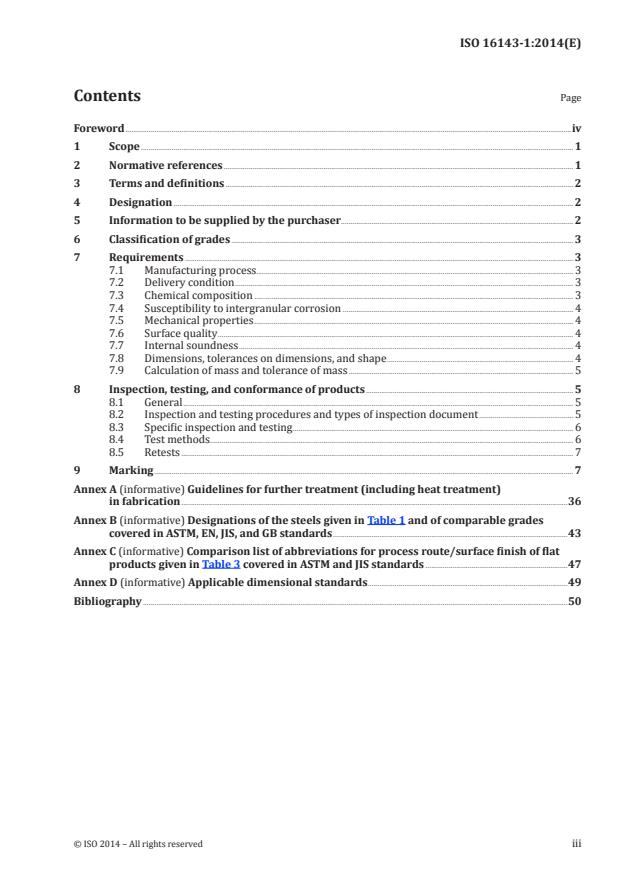
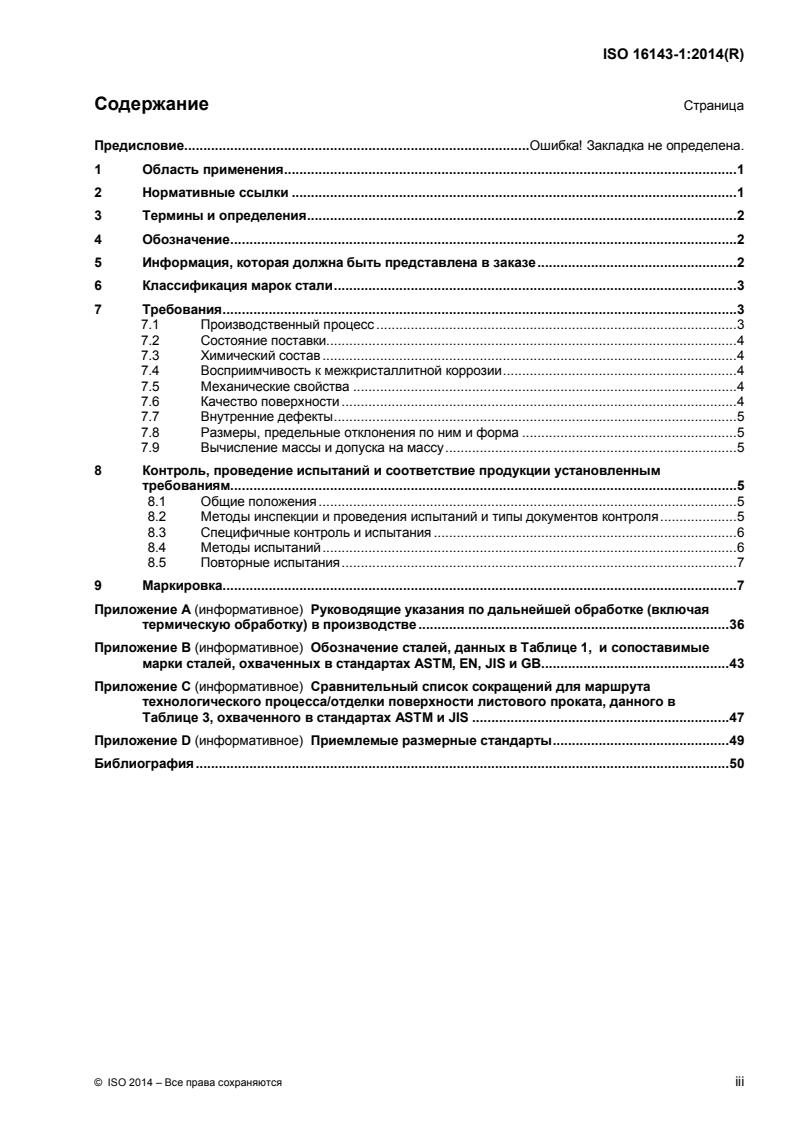
Contents Page
Foreword .iv
1 Scope . 1
2 Normative references . 1
3 Terms and definitions . 2
4 Designation . 2
5 Information to be supplied by the purchaser. 2
6 Classification of grades . 3
7 Requirements . 3
7.1 Manufacturing process. 3
7.2 Delivery condition . 3
7.3 Chemical composition . 3
7.4 Susceptibility to intergranular corrosion . 4
7.5 Mechanical properties . 4
7.6 Surface quality . 4
7.7 Internal soundness . 4
7.8 Dimensions, tolerances on dimensions, and shape . 4
7.9 Calculation of mass and tolerance of mass . 5
8 Inspection, testing, and conformance of products . 5
8.1 General . 5
8.2 Inspection and testing procedures and types of inspection document . 5
8.3 Specific inspection and testing . 6
8.4 Test methods . 6
8.5 Retests . 7
9 Marking . 7
Annex A (informative) Guidelines for further treatment (including heat treatment)
in fabrication .36
Annex B (informative) Designations of the steels given in Table 1 and of comparable grades
covered in ASTM, EN, JIS, and GB standards .43
Annex C (informative) Comparison list of abbreviations for process route/surface finish of flat
products given in Table 3 covered in ASTM and JIS standards .47
Annex D (informative) Applicable dimensional standards .49
Bibliography .50
Foreword
ISO (the International Organization for Standardization) is a worldwide federation of national standards
bodies (ISO member bodies). The work of preparing International Standards is normally carried out
through ISO technical committees. Each member body interested in a subject for which a technical
committee has been established has the right to be represented on that committee. International
organizations, governmental and non-governmental, in liaison with ISO, also take part in the work.
ISO collaborates closely with the International Electrotechnical Commission (IEC) on all matters of
electrotechnical standardization.
The procedures used to develop this document and those intended for its further maintenance are
described in the ISO/IEC Directives, Part 1. In particular the different approval criteria needed for the
different types of ISO documents should be noted. This document was drafted in accordance with the
editorial rules of the ISO/IEC Directives, Part 2 (see www.iso.org/directives).
Attention is drawn to the possibility that some of the elements of this document may be the subject of
patent rights. ISO shall not be held responsible for identifying any or all such patent rights. Details of
any patent rights identified during the development of the document will be in the Introduction and/or
on the ISO list of patent declarations received (see www.iso.org/patents).
Any trade name used in this document is information given for the convenience of users and does not
constitute an endorsement.
For an explanation on the meaning of ISO specific terms and expressions related to conformity
assessment, as well as information about ISO’s adherence to the WTO principles in the Technical Barriers
to Trade (TBT) see the following URL: Foreword - Supplementary information
The committee responsible for this document is ISO/TC 17, Steels, Subcommittee SC 4, Heat treatable and
alloy steels.
This second edition cancels and replaces the first edition (ISO 16143-1:2004), which has been technically
revised.
This corrected version of ISO 16143-1:2014 incorporates the following corrections: in Tables 1, 6, A.3
and B.1, the steel designation name “X2CrNbCu22” has been corrected to “X2CrTiCu22”; normative
reference ISO 15510 has been updated to the latest edition (2014); some cross-references and footnotes
have been corrected or deleted.
ISO 16143 consists of the following parts, under the general title Stainless steels for general purposes:
— Part 1: Corrosion-resistant flat products
— Part 2: Corrosion-resistant semi-finished products, bars, rods and sections
— Part 3: Wire
iv © ISO 2014 – All rights reserved
INTERNATIONAL STANDARD ISO 16143-1:2014(E)
Stainless steels for general purposes —
Part 1:
Corrosion-resistant flat products
1 Scope
This part of ISO 16143 specifies the technical delivery conditions for hot- or cold-rolled sheet/plate and
strip for general purposes made of the most important corrosion-resistant stainless steel grades.
NOTE 1 In the text, under the term “general purposes”, purposes other than the special purposes mentioned in
References [1] to [4] are understood.
NOTE 2 Heat-resistant steel grades can be found in ISO 4955 and they can be used for corrosion-resistant
purposes.
In addition to this part of ISO 16143, the general technical delivery requirements of ISO 404 are applicable.
This part of ISO 16143 does not apply to components manufactured by further processing of the product
forms listed in the first paragraph where quality characteristics are altered as a result of such processing.
2 Normative references
The following documents, in whole or in part, are normatively referenced in this document and are
indispensable for its application. For dated references, only the edition cited applies. For undated
references, the latest edition of the referenced document (including any amendments) applies.
ISO 148-1, Metallic materials — Charpy pendulum impact test — Part 1: Test method
ISO 377, Steel and steel products — Location and preparation of samples and test pieces for mechanical
testing
ISO 404, Steel and steel products — General technical delivery requirements
ISO 3651-2, Determination of resistance to intergranular corrosion of stainless steels — Part 2: Ferritic,
austenitic and ferritic-austenitic (duplex) stainless steels — Corrosion test in media containing sulfuric acid
ISO 6506-1, Metallic materials — Brinell hardness test — Part 1: Test method
ISO 6507-1, Metallic materials — Vickers hardness test — Part 1: Test method
ISO 6508-1, Metallic materials — Rockwell hardness test — Part 1: Test method (scales A, B, C, D, E, F, G, H,
K, N, T)
ISO 6892-1:2009, Metallic materials — Tensile testing — Part 1: Method of test at room temperature
ISO 6892-2, Metallic materials — Tensile testing — Part 2: Method of test at elevated temperature
ISO 6929, Steel products — Vocabulary
ISO 10474, Steel and steel products — Inspection documents
ISO 14284, Steel and iron — Sampling and preparation of samples for the determination of chemical
composition
ISO 15510:2014, Stainless steels — Chemical composition
ISO/TS 4949, Steel names based on letter symbols
ISO/TR 9769, Steel and iron — Review of available methods of analysis
3 Terms and definitions
For the purposes of this document, the terms and definitions given in ISO 6929 and the following apply.
3.1
corrosion-resistant stainless steel
steel, with at least 10,5 % (mass fraction) Cr and a maximum of 1,2 % (mass fraction) C, for which
resistance to corrosion is of primary importance
3.2
product form
shape of a product
Note 1 to entry: Different forms of products are given in ISO 6929.
4 Designation
For the steel grades covered by this part of ISO 16143, the steel names as given in the tables are allocated
in accordance with ISO/TS 4949.
For the steel grades covered by this part of ISO 16143, the steel numbers as given in the tables are
allocated in accordance with ISO 15510.
5 Information to be supplied by the purchaser
It shall be the responsibility of the purchaser to specify all requirements that are necessary for products
covered by this part of ISO 16143. Such requirements to be considered include, but are not limited to, the
following:
a) the desired quantity;
b) the product form (strip or sheet/plate);
c) the number of the appropriate dimensional standard, e.g. ISO 9444-1, ISO 9444-2, ISO 9445-1,
ISO 9445-2, and ISO 18286 (see Annex D), the nominal dimensions, plus any choice of requirements;
d) the type of material (steel);
e) the number of this part of ISO 16143 (i.e. ISO 16143-1);
f) the steel name or steel number;
g) if, for the relevant steel in Tables 4 to 8, more than one treatment condition is covered, the symbol
for the desired heat treatment or cold-worked condition;
h) the desired process route/surface finish (see Table 3);
i) if a verification of internal soundness is required for flat products with thickness ≥6 mm,
requirements can be agreed at the time of enquiry and order (see 7.7);
j) any further optional test agreed between the manufacturer and purchaser at the time of enquiry
and order [see 8.2.3 b)];
k) the type of inspection document and its designation in accordance with ISO 10474 (see 8.2.1).
2 © ISO 2014 – All rights reserved
EXAMPLE 5 t of cold-rolled narrow strip in accordance with ISO 9445-1 with a specified thickness of 0,25 mm,
precision thickness tolerance (P), with a specified width of 250 mm, precision tolerance on width (P) and with
restricted tolerances on edge camber (R) made of a steel grade with name X5CrNi18-10 and number 4301-304-
00-I as specified in ISO 16143-1, in process route 2D and inspection certificate 3.1 as specified in ISO 10474, is
designated as follows:
5 t cold-rolled narrow strip ISO 9445-1 - 0,25P × 250P - R
Steel ISO 16143-1 - X5CrNi18-10 + 2D
ISO 10474 – 3.1
or
5 t cold-rolled narrow strip ISO 9445-1 - 0,25P × 250P - R
Steel ISO 16143-1 - 4301-304-00-I + 2D
ISO 10474 – 3.1
6 Classification of grades
Corrosion-resistant stainless steels covered in this part of ISO 16143 are classified according to their
structure into
— austenitic steels,
— austenitic-ferritic steels,
— ferritic steels,
— martensitic steels, or
— precipitation-hardening steels.
7 Requirements
7.1 Manufacturing process
Unless a special steelmaking process is agreed upon at the time of ordering, the steelmaking process
shall be at the discretion of the manufacturer. When he so requests, the purchaser shall be informed
what steelmaking process is being used.
7.2 Delivery condition
The products shall be supplied in the delivery condition agreed upon in the order, by reference to the
process route given in Table 3 and, where different alternatives exist, to the treatment conditions given
in Tables 4 to 8, 14, and 16 (see also Annex A).
7.3 Chemical composition
7.3.1 The chemical composition requirements given in Table 1 apply with respect to the chemical
composition of the cast analysis.
7.3.2 The product analysis can deviate from the limiting values for the cast analysis given in Table 1 by
the values listed in Table 2.
7.4 Susceptibility to intergranular corrosion
Referring to resistance to intergranular corrosion as defined in ISO 3651-2, for ferritic, austenitic, and
austenitic-ferritic steels, the specifications in Tables 4, 5, and 6 apply.
The susceptibility of stainless steels to intergranular corrosion is dependent on the type of environment
and therefore cannot always be clearly ascertained through standard laboratory tests. The selection of
the test or tests to be agreed upon should be based on experience with the use of the selected grade of
steel in the intended environment.
7.5 Mechanical properties
The mechanical properties at room temperature as specified in Tables 4 to 8 apply for the relevant
specified heat-treatment condition. This does not apply to the process route 1U (hot rolled, not heat
treated, not descaled). If, by agreement at the time of ordering, the products are to be supplied in a non-
heat-treated condition, the mechanical properties specified in Tables 4 to 8 shall be obtainable from
reference test pieces which have received the appropriate heat treatment (simulated heat treatment).
The values in Tables 9 to 13 apply for the 0,2 %- and 1 %-proof strength at elevated temperatures.
For cold-worked products, the 0,2 %-proof strength levels at ambient temperature as specified in
Table 14 apply. The available 0,2 %-proof strength levels in the cold-worked condition are indicated in
Table 15.
Alternatively, cold-worked products can be ordered according to their tensile strength levels as given in
Tables 16 and 17.
NOTE Austenitic steels are insensitive to brittle fracture in the solution-annealed condition. Because they
do not have a pronounced transition temperature, which is characteristic of other steels, they are also useful for
application at cryogenic temperatures.
7.6 Surface quality
The general surface appearance with respect to soundness and surface finish shall be consistent with
good production practice, for the grade and quality ordered, as determined by visual inspection. When
products are delivered in coil form, the degree and extent of imperfections can be expected to be greater,
due to the impracticability of removing short lengths of coil.
Products delivered with hot-rolled or cold-rolled finishes (see Table 3) shall, unless otherwise agreed, be
supplied with only one surface inspected to the required finish (the prime surface). In such instances,
the manufacturer should indicate the prime surface, by marking the material or the packaging, or by
some other agreed method. The default method is to mark the prime surface, and to make this surface
the top surface of plates, sheets, and cut lengths, or the outside surface of coiled products.
Where necessary, precise requirements on surface quality can be agreed upon at the time of enquiry
and order.
7.7 Internal soundness
For internal soundness, where appropriate, requirements together with the conditions for their
verification can be agreed upon at the time of enquiry and order.
7.8 Dimensions, tolerances on dimensions, and shape
The dimensions and the tolerances on dimensions and shape are to be agreed upon at the time of enquiry
and order, as far as possible with reference to the dimensional standards ISO 9444-1, ISO 9444-2,
ISO 9445-1, ISO 9445-2, and ISO 18286 (see Annex D).
4 © ISO 2014 – All rights reserved
7.9 Calculation of mass and tolerance of mass
7.9.1 The density values of the relevant grades for calculating the nominal mass of the products shall be
taken from Annex D of ISO 15510:2014.
7.9.2 If the tolerances on mass are not specified in the dimensional standards mentioned in 7.8, they
can be agreed upon at the time of enquiry and order.
8 Inspection, testing, and conformance of products
8.1 General
The manufacturer shall carry out appropriate process control, inspection, and testing to ensure that the
delivery complies with the requirements of the order.
This includes the following:
— a suitable frequency of verification of the dimensions of the products;
— an adequate intensity of visual examination of the surface quality of the products;
— an appropriate frequency and type of test to ensure that the correct grade of steel is delivered.
The nature and frequency of these verifications, examinations, and tests are determined by the
manufacturer, based on the degree of consistency that has been determined by the evidence of his
quality system. In view of this, verifications by specific tests for these requirements are not necessary,
unless otherwise agreed.
8.2 Inspection and testing procedures and types of inspection document
8.2.1 Products complying with this part of ISO 16143 shall be ordered and delivered with one of the
inspection documents as specified in ISO 10474. The type of document shall be agreed upon at the time
of enquiry and order. If the order does not contain any specification of this type, a test report 2.2 shall be
issued.
8.2.2 If, in accordance with the agreements made at the time of enquiry and order, a test report 2.2 is to
be provided, this shall cover
a) the statement that the material complies with the requirements of the order and
b) the results of the cast analysis for all elements specified for the type of steel supplied.
8.2.3 If, in accordance with the agreements in the order, an inspection document 3.1 or 3.2 of ISO 10474
is to be provided, the specific inspections and tests described in 8.3 shall be carried out and their results
shall be certified in the document.
In addition to 8.2.2 a) and b), the document shall cover
a) the results of the mandatory tests marked in the second column of Table 18 by an “m” and
b) the results of any optional test or inspection agreed when ordering, marked in the second column
of Table 18 by an “o”.
8.3 Specific inspection and testing
8.3.1 Extent of testing
The tests to be carried out, either mandatorily (m) or by agreement (o), the composition and size of the
test units, and the number of sample products, samples, and test pieces to be taken are given in Table 18.
8.3.2 Selection and preparation of samples and test pieces
8.3.2.1 The general conditions for selection and preparation of samples and test pieces shall be in
accordance with ISO 377 and ISO 14284.
8.3.2.2 The test samples for the tensile test shall be taken in accordance with Table 19 in such a way
that they are located halfway between the centre and a longitudinal edge.
The samples shall be taken from products in the delivery condition. If agreed, the samples can be taken
before flattening. For samples to be given a simulated heat treatment, the conditions for annealing shall
be agreed.
8.3.2.3 Samples for the hardness test and for the resistance to intergranular corrosion test, where
requested, shall be taken from the same locations as those for the mechanical tests. For the direction of
bending the test piece in the resistance to intergranular corrosion test, see Figure 1.
8.4 Test methods
8.4.1 Unless otherwise agreed upon when ordering, the choice of a suitable physical or chemical
method of analysis to determine the product analysis is at the discretion of the manufacturer. In cases of
dispute, the analysis shall be carried out by a laboratory approved by the two parties. In these cases, the
reference method of analysis shall be agreed upon, where possible, with reference to ISO/TR 9769.
8.4.2 The tensile test shall be carried out in accordance with ISO 6892-1:2009, taking into account the
a
additional or deviating conditions specified in footnote of Table 1. It shall be performed under controlled
conditions in accordance with Clause 5 of ISO 6892-1:2009.
Unless otherwise agreed upon, the tensile strength and elongation after fracture shall be determined
and, additionally, for ferritic and austenitic-ferritic steels, the 0,2 %-proof strength, and for austenitic
steels, the 0,2 %- and 1 %-proof strengths shall be determined.
If a tensile test at elevated temperature has been ordered, this shall be carried out in accordance with
ISO 6892-2. If the proof strength is to be verified, the 0,2 %-proof strength shall be determined, for
ferritic, martensitic, precipitation-hardening, and austenitic-ferritic steels. In the case of austenitic
steels, the 0,2 %- and the 1 %-proof strength shall be determined.
8.4.3 If an impact test has been ordered, it shall be carried out in accordance with ISO 148-1 on test
pieces with a V-notch and a 2 mm hammer. The average obtained from three test pieces is considered to
be the test result (specified in ISO 404).
8.4.4 The Brinell hardness test shall be carried out in accordance with ISO 6506-1. The Vickers hardness
test shall be carried out in accordance with ISO 6507-1. The Rockwell hardness test shall be carried out
in accordance with ISO 6508-1.
8.4.5 The resistance to intergranular corrosion shall be tested in accordance with ISO 3651-2, unless
otherwise agreed upon.
6 © ISO 2014 – All rights reserved
8.4.6 Dimensions and dimensional tolerances of the products shall be verified in accordance with the
requirements of the relevant dimensional standards (see 7.8).
8.5 Retests
Use ISO 404.
9 Marking
9.1 The products shall be marked with the manufacturer’s trademark or symbol and the steel name or
number. The product shall also be marked with the cast number, thickness, or dimension, as well as an
identification number related to an appropriate inspection certificate.
9.2 Unless otherwise agreed, the method of marking and the material of marking shall be at the option
of the manufacturer. Its quality shall be such that it shall be durable for at least one year, can withstand
normal handling, and can be stored in unheated storage under cover. The corrosion resistance of the
product shall not be impaired by the marking.
9.3 Each unit shall be marked. As an alternative, for items that are wrapped, bundled, or boxed, or
where the surface is ground or polished, the marking can be applied to the packaging, or to a tag securely
attached to it.
8 © ISO 2014 – All rights reserved
Table 1 — Chemical composition (cast analysis)
a
Steel designation % (mass fraction)
Name ISO number C Si Mn P S Cr Mo Ni N Others
Austenitic steels
b
X5CrNi17-7 4319-301-00-I 0,07 1,00 2,00 0,045 0,030 16,0 to 18,0 — 6,0 to 8,0 0,10 —
X12CrNi17-7 4310-301-09-X 0,15 1,00 2,00 0,045 0,030 16,0 to 18,0 — 6,0 to 8,0 — —
X2CrNiN18-7 4318-301-53-I 0,030 1,00 2,00 0,045 0,015 16,0 to 18,5 — 6,0 to 8,0 0,10 to 0,20 —
Cu: 1,00 to
X6CrNiCu17-8-2 4567-304-76-I 0,08 1,70 3,00 0,045 0,030 15,0 to 18,0 — 6,0 to 9,0 —
3,00
b
X10CrNi18-8 4310-301-00-I 0,05 to 0,15 2,00 2,00 0,045 0,030 16,0 to 19,0 0,80 6,0 to 9,5 0,10 —
b
X2CrNi18-9 4307-304-03-I 0,030 1,00 2,00 0,045 0,030 17,5 to 19,5 — 8,0 to 10,0 0,10 —
X12CrNiSi18-9-3 4326-302-15-I 0,15 2,00 to 3,00 2,00 0,045 0,030 17,0 to 19,0 — 8,0 to 10,0 — —
b
X2CrNiN18-9 4311-304-53-I 0,030 1,00 2,00 0,045 0,030 17,5 to 19,5 — 8,0 to 10,0 0,12 to 0,22 —
b
X5CrNi18-10 4301-304-00-I 0,07 1,00 2,00 0,045 0,030 17,5 to 19,5 — 8,0 to 10,5 0,10 —
Ti: 5 × C to
b
X6CrNiTi18-10 4541-321-00-I 0,08 1,00 2,00 0,045 0,030 17,0 to 19,0 — 9,0 to 12,0 —
0,70
Nb: 10 × C to
b
X6CrNiNb18-10 4550-347-00-I 0,08 1,00 2,00 0,045 0,030 17,0 to 19,0 — 9,0 to 12,0 —
1,00
b
X2CrNi19-11 4306-304-03-I 0,030 1,00 2,00 0,045 0,030 18,0 to 20,0 — 10,0 to 12,0 0,10 —
b
X6CrNi18-12 4303-305-00-I 0,08 1,00 2,00 0,045 0,030 17,0 to 19,0 — 10,5 to 13,0 0,10 —
Cu: 2,00 to
X8CrMnCuN17-8-3 4597-204-76-I 0,10 2,00 6,5 to 9,0 0,040 0,030 15,0 to 18,0 1,00 3,00 0,10 to 0,30
3,5
b
X12CrMnNiN17-7-5 4372-201-00-I 0,15 1,00 5,5 to 7,5 0,045 0,030 16,0 to 18,0 — 3,5 to 5,5 0,05 to 0,25 —
X2CrMnNiN17-7-5 4371-201-53-I 0,030 1,00 6,0 to 8,0 0,045 0,015 16,0 to 17,5 — 3,5 to 5,5 0,15 to 0,25 Cu: 1,00
Table 1 — (continued)
a
Steel designation % (mass fraction)
Name ISO number C Si Mn P S Cr Mo Ni N Others
Cu: 1,00 to
X9CrMnNiCu17-8-5-2 4618-201-76-E 0,10 1,00 5,5 to 9,5 0,070 0,010 16,5 to 18,5 — 4,5 to 5,5 0,15
2,50
X11CrNiMnN19-8-6 4369-202-91-I 0,07 to 0,15 0,50 to 1,00 5,0 to 7,5 0,030 0,015 17,5 to 19,5 — 6,5 to 8,5 0,20 to 0,30 —
X1CrNi25-21 4335-310-02-I 0,020 0,25 2,00 0,025 0,010 24,0 to 26,0 0,20 20,0 to 22,0 0,10 —
Austenitic steels with Mo
b
X2CrNiMo17-12-2 4404-316-03-I 0,030 1,00 2,00 0,045 0,030 16,5 to 18,5 2,00 to 3,00 10,0 to 13,0 0,10 —
b
X5CrNiMo17-12-2 4401-316-00-I 0,08 1,00 2,00 0,045 0,030 16,0 to 18,0 2,00 to 3,00 10,0 to 13,0 0,10 —
Ti: 5 × C to
b
X6CrNiMoTi17-12-2 4571-316-35-I 0,08 1,00 2,00 0,045 0,030 16,5 to 18,5 2,00 to 2,50 10,5 to 13,5 —
0,70
b
X2CrNiMo17-12-3 4432-316-03-I 0,030 1,00 2,00 0,045 0,030 16,5 to 18,5 2,50 to 3,00 10,5 to 13,0 0,10 —
b
X3CrNiMo17-12-3 4436-316-00-I 0,05 1,00 2,00 0,045 0,030 16,5 to 18,5 2,50 to 3,00 10,5 to 13,0 0,10 —
b
X2CrNiMoN17-12-3 4429-316-53-I 0,030 1,00 2,00 0,045 0,030 16,5 to 18,5 2,50 to 3,00 10,5 to 13,0 0,12 to 0,22 —
X2CrNiMo17-14-3 4435-316-03-X 0,030 1,00 2,00 0,045 0,030 16,0 to 18,0 2,0 to 3,0 12,0 to 15,0 — —
X2CrNiMo18-14-3 4435-316-91-I 0,030 1,00 2,00 0,045 0,015 17,0 to 19,0 2,50 to 3,00 12,5 to 15,0 0,10 —
X2CrNiMoN17-13-5 4439-317-26-E 0,030 1,00 2,00 0,045 0,015 16,5 to 18,5 4,0 to 5,0 12,5 to 14,5 0,12 to 0,22 —
b
X2CrNiMo19-14-4 4438-317-03-I 0,030 1,00 2,00 0,045 0,030 17,5 to 20,0 3,0 to 4,0 12,0 to 15,0 0,10 —
Cu: 0,50 to
X1CrNiMoCuN20-18-7 4547-312-54-I 0,020 0,70 1,00 0,035 0,015 19,5 to 20,5 6,0 to 7,0 17,5 to 18,5 0,18 to 0,25
1,00
X1CrNiMoN25-22-2 4466-310-50-E 0,020 0,70 2,00 0,025 0,010 24,0 to 26,0 2,00 to 2,50 21,0 to 23,0 0,10 to 0,16 —
Cu: 1,00 to
2,00
X1CrNiMoCuNW24-22-6 4659-312-66-I 0,020 0,70 2,0 to 4,0 0,030 0,010 23,0 to 25,0 5,5 to 6,5 21,0 to 23,0 0,35 to 0,50
W: 1,50 to
2,50
10 © ISO 2014 – All rights reserved
Table 1 — (continued)
a
Steel designation % (mass fraction)
Name ISO number C Si Mn P S Cr Mo Ni N Others
Austenitic steels with Mo
Cu: 0,30 to
X1CrNiMoCuN24-22-8 4652-326-54-I 0,020 0,50 2,0 to 4,0 0,030 0,005 23,0 to 25,0 7,0 to 8,0 21,0 to 23,0 0,45 to 0,55
0,60
X2CrNiMnMoN25-18-6-5 4565-345-65-I 0,030 1,00 5,0 to 7,0 0,030 0,015 24,0 to 26,0 4,0 to 5,0 16,0 to 19,0 0,30 to 0,60 Nb: 0,15
Austenitic steels with Ni/Co as main alloying elements
Cu: 1,20 to
X1NiCrMoCu25-20-5 4539-089-04-I 0,020 0,75 2,00 0,035 0,015 19,0 to 22,0 4,0 to 5,0 23,5 to 26,0 0,15
2,00
Cu: 0,50 to
X1NiCrMoCuN25-20-7 4529-089-26-I 0,020 0,75 2,00 0,035 0,015 19,0 to 21,0 6,0 to 7,0 24,0 to 26,0 0,15 to 0,25
1,50
X2NiCrMoN25-21-7 4478-083-67-U 0,030 1,00 2,00 0,040 0,030 20,0 to 22,0 6,0 to 7,0 23,5 to 25,5 0,18 to 0,25 Cu: 0,75
Cu: 0,70 to
X1NiCrMoCu31-27-4 4563-080-28-I 0,020 0,70 2,00 0,030 0,010 26,0 to 28,0 3,0 to 4,0 30,0 to 32,0 0,10
1,50
Austenitic-ferritic steels
f f
X2CrNiN22-2 4062-322-02-U 0,030 1,00 2,00 0,040 0,010 21,5 to 24,0 0,45 1,00 to 2,90 0,16 to 0,28 —
Cu: 0,10 to
f f
X2CrMnNiN21-5-1 4162-321-01-E 0,040 1,00 4,0 to 6,0 0,040 0,015 21,0 to 22,0 0,10 to 0,80 1,35 to 1,90 0,20 to 0,25
0,80
Cu: 0,10 to
X2CrNiN23-4 4362-323-04-I 0,030 1,00 2,00 0,035 0,015 22,0 to 24,5 0,10 to 0,60 3,5 to 5,5 0,05 to 0,20
0,60
X2CrNiMoN22-5-3 4462-318-03-I 0,030 1,00 2,00 0,035 0,015 21,0 to 23,0 2,5 to 3,5 4,5 to 6,5 0,10 to 0,22 —
Cu: 0,10 to
f f
X2CrNiMnMoCuN24-4-3-2 4662-824-41-X 0,030 0,70 2,50 to 4,0 0,035 0,005 23,0 to 25,0 1,00 to 2,00 3,0 to 4,5 0,20 to 0,30
0,80
Cu: 1,00 to
X2CrNiMoCuN25-6-3 4507-325-20-I 0,030 0,70 2,00 0,035 0,015 24,0 to 26,0 2,5 to 4,0 5,0 to 7,5 0,15 to 0,30
2,50
X2CrNiMoN25-7-3 4481-312-60-J 0,030 1,00 1,50 0,040 0,030 24,0 to 26,0 2,50 to 3,5 5,5 to 7,5 0,08 to 0,30 —
X2CrNiMoN25-7-4 4410-327-50-E 0,030 1,00 2,00 0,035 0,015 24,0 to 26,0 3,0 to 4,5 6,0 to 8,0 0,24 to 0,35 —
Cu: 0,50 to
1,00
X2CrNiMoCuWN25-7-4 4501-327-60-I 0,030 1,00 1,00 0,035 0,015 24,0 to 26,0 3,0 to 4,0 6,0 to 8,0 0,20 to 0,30
W: 0,50 o
1,00
Ferritic steels
Ti: 6 × (C+N)
b
X2CrTi12 4512-409-10-I 0,030 1,00 1,00 0,040 0,030 10,5 to 12,5 — 0,50 —
to 0,65
X2CrNi12 4003-410-77-I 0,030 1,00 2,00 0,040 0,015 10,5 to 12,5 — 0,30 to 1,10 0,030 —
Table 1 — (continued)
a
Steel designation % (mass fraction)
Name ISO number C Si Mn P S Cr Mo Ni N Others
Ferritic steels
d b
X6Cr13 4000-410-08-I 0,08 1,00 1,00 0,040 0,030 11,5 to 14,0 — 0,75 — —
d b
X6Cr17 4016-430-00-I 0,08 1,00 1,00 0,040 0,030 16,0 to 18,0 — — — —
Nb or Ti:
X2CrNb17 4510-430-36-X 0,030 0,75 1,00 0,040 0,030 16,0 to 19,0 — — —
0,10 to 1,00
Ti: 0,15 to
b
X3CrTi17 4510-430-35-I 0,05 1,00 1,00 0,040 0,030 16,0 to 19,0 — — —
c
0,75
Nb: 12 × C
X3CrNb17 4511-430-71-I 0,05 1,00 1,00 0,040 0,015 16,0 to 18,0 — — —
to 1,00
X6CrNi17-1 4017-430-91-E 0,08 1,00 1,00 0,040 0,015 16,0 to 18,0 — 1,20 to 1,60 — —
Ti: 8 × (C+N)
c
to 0,80
X2CrCuTi18 4664-430-75-J 0,025 1,00 1,00 0,040 0,030 16,0 to 20,0 — — 0,025
Cu: 0,30 to
0,80
Ti: 0,10 to
0,60
X2CrTiNb18 4509-439-40-X 0,030 1,00 1,00 0,040 0,015 17,5 to 18,5 — — —
Nb: 0,30 +
3 × C to 1,00
Nb: 0,20 to
1,00
X2CrNbCu21 4621-445-00-E 0,030 1,00 1,00 0,040 0,015 20, 0 to 21,5 — — 0,030
Cu: 0,10 to
1,00
Cu:0,30 to
0,80
X2CrTiCu22 4621-443-30-J 0,025 1,00 1,00 0,040 0,030 20,0 to 23,0 — — 0,025
Ti: 8 × (C+N)
c
to 0,80
Nb: 5 × C to
X6CrMoNb17-1 4526-436-00-I 0,08 1,00 1,00 0,040 0,015 16,0 to 18,0 0,80 to 1,40 — 0,040
1,00
Ti+Nb+Zr:
X2CrMo19 4609-436-77-J 0,025 1,00 1,00 0,040 0,030 17,0 to 20,0 0,40 to 0,80 — 0,025 8 × (C+N) to
0,80
Ti+Nb+Zr:
X2CrMoNbTi18-1 4513-436-00-J 0,025 1,00 1,00 0,040 0,030 16,0 to 19,0 0,75 to 1,50 — 0,025 8 × (C+N) to
0,80
Ti: 4 × (C+N)
X2CrMoTi18-2 4521-444-00-I 0,025 1,00 1,00 0,040 0,015 17,0 to 20,0 1,75 to 2,50 — 0,030 +0,15 to
c
0,80
X2CrMo23-1 4128-445-92-J 0,025 1,00 1,00 0,040 0,030 21,0 to 24, 0 0,70 to 1,50 — 0,025 —
12 © ISO 2014 – All rights reserved
Table 1 — (continued)
a
Steel designation % (mass fraction)
Name ISO number C Si Mn P S Cr Mo Ni N Others
X1CrMo30-2 4135-447-92-C 0,010 0,40 0,40 0,030 0,020 28,5 to 32,0 1,50 to 2,50 — 0,015 —
Martensitic steels
b
X12Cr13 4006-410-00-I 0,08 to 0,15 1,00 1,50 0,040 0,030 11,5 to 13,5 — 0,75 — —
b
X20Cr13 4021-420-00-I 0,16 to 0,25 1,00 1,50 0,040 0,030 12,0 to 14,0 — — — —
b
X30Cr13 4028-420-00-I 0,26 to 0,35 1,00 1,50 0,040 0,030 12,0 to 14,0 — — — —
b
X39Cr13 4031-420-00-I 0,36 to 0,42 1,00 1,00 0,040 0,030 12,5 to 14,5 — — — —
b
X46Cr13 4034-420-00-I 0,43 to 0,50 1,00 1,00 0,040 0,030 12,5 to 14,5 — — — —
X38CrMo14 4419-420-97-E 0,36 to 0,42 1,00 1,00 0,040 0,015 13,0 to 14,5 0,60 to 1,00 — — —
X50CrMoV15 4116-420-77-E 0,45 to 0,55 1,00 1,00 0,040 0,015 14,0 to 15,0 0,50 to 0,80 — — V: 0,10 to 0,20
X3CrNiMo13-4 4313-415-00-I 0,05 0,70 0,50 to 1,00 0,040 0,015 12,0 to 14,0 0,30 to 1,00 3,5 to 4,5 — —
X4CrNiMo16-5-1 4418-431-77-E 0,06 0,70 1,50 0,040 0,015 15,0 to 17,0 0,80 to 1,50 4,0 to 6,0 ≥0,020 —
Precipitation-hardening steels
Cu: 3,0 to 5,0
b
X5CrNiCuNb16-4 4542-174-00-I 0,07 1,00 1,50 0,040 0,030 15,0 to 17,0 0,60 3,0 to 5,0 — Nb: 0,15 to
0,45
Al: 0,70 to
e
X7CrNiAl17-7 4568-177-00-I 0,09 0,70 1,00 0,040 0,015 16,0 to 18,0 — 6,5 to 7,8 —
1,50
NOTE Elements not quoted in this table cannot be intentionally added to the steel without the agreement of the purchaser, except for finishing the cast. All appropriate precautions
shall be taken to avoid the addition of such elements from scrap and other materials used in production, which would impair mechanical properties and the suitability of the steel.
a
Maximum values unless indicated otherwise.
b
Particular ranges of sulfur content can provide improvement of particular properties. For machinability, a controlled sulfur content of 0,015 % to 0,030 % is recommended. For
weldability, a controlled sulfur content of 0,008 % to 0,020 % can be beneficial. For polishability, a controlled sulfur content of 0,015 % maximum is recommended.
c
Stabilization can be by the use of titanium and/or niobium and/or zirconium. According to the atomic mass of these elements and the content of carbon and nitrogen, the
equivalence shall be the following: Nb (% by mass) ≡ Zr (% by mass) ≡ 7/4 Ti (% by mass).
d
For certain applications, e.g. weldability or high strength wire, a maximum of 0,12 % C can be agreed upon.
e
By special agreement, the steel, when intended for cold deformation, can also be ordered with 7,0 % to 8,3 % Ni.
f
Patented steel grades.
Table 2 — Permissible deviations between the product analysis and the limiting values given in
Table 1 for the cast analysis
a
Specified limits, cast analysis Permissible deviation
Element
% (mass fraction) % (mass fraction)
≤0,030 +0,005
>0,030 ≤0,20 ±0,01
Carbon
>0,20 ≤0,60 ±0,02
>0,60 ≤1,20 ±0,03
≤1,00 +0,05
Silicon >1,00 ≤3,00 ±0,10
>3,00 ≤6,00 ±0,15
≤1,00 +0,03
Manganese >1,00 ≤2,00 ±0,04
>2,00 ≤15,0 ±0,10
≤0,045 +0,005
Phosphorus
>0,045 0,070 ±0,010
≤0,015 +0,003
Sulfur >0,015 ≤0,030 ±0,005
≥0,10 ≤0,50 ±0,02
≥10,5 ≤15,0 ±0,15
Chromium >15,0 ≤20,0 ±0,20
>20,0 ≤35,0 ±0,25
≤0,60 +0,03
Molybdenum >0,60 ≤1,75 ±0,05
>1,75 ≤8,0 ±0,10
≤1,00 +0,03
>1,00 ≤5,0 ±0,07
Nickel >5,0 ≤10,0 ±0,10
>10,0 ≤20,0 ±0,15
>20,0 ≤38,0 ±0,20
≤0,10 +0,01
Nitrogen
≥0,10 ≤0,60 ±0,02
≥0,05 ≤0,30 ±0,05
Aluminium
>0,30 ≤1,50 ±0,10
Boron ≤0,010 +0,000 5
≤1,00 +0,04
Copper
>1,00 ≤5,0 ±0,10
Niobium ≤1,00 +0,05
≤1,00 +0,05
Titanium
>1,00 ≤3,0 ±0,07
a
± means that in one cast, the deviation can occur over the upper value or under the lower value of the specified range in
Table 1, but not both at the same time.
Table 2 (continued)
a
Specified limits, cast analysis Permissible deviation
Element
% (mass fraction) % (mass fraction)
Tungsten ≤3,00 +0,05
Vanadium ≤0,50 +0,03
a
± means that in one cast, the deviation can occur over the upper value or under the lower value of the specified range in
Table 1, but not both at the same time.
a
Table 3 — Types of process route and surface finish of flat products
b
Abbreviation Type of process route Surface finish Notes
Hot rolled, not heat Covered with the Suitable for products which are to be further
1U
treated, not descaled rolling scale worked, e.g. strip for rerolling.
Suitable for parts which will be descaled or
Hot rolled, heat treated, Covered with the
1C machined in subsequent production or for
not descaled rolling scale
certain heat-resistant applications.
The type of mechanical descaling, e.g. coarse
grinding or shot blasting, depends on the
Hot rolled, heat treated,
Hot rolled
1E Free of scale steel grade and the product, and is left to the
mechanically descaled
manufacturer’s discretion, unless otherwise
agreed upon.
Usually standard for most steel types to
ensure good corrosion resistance; also com-
Hot rolled, heat treated,
1D Free of scale mon finish for further processing. It is per-
pickled
missible for grinding marks to be present.
Not as smooth as 2D or 2B.
2H Work hardened Bright Cold worked to obtain higher strength level.
Smooth with Suitable for parts which will be descaled or
Cold rolled, heat treated,
2C scale from heat machined in subsequent production or for
not descaled
treatment certain heat-resistant applications.
Usually applied to steels with scale that are
Cold rolled, heat treated,
f
2E Free of scale very resistant to pickling solutions. Can be
mechanically descaled
followed by pickling.
Cold rolled, heat treated, Finish for good ductility, but not as smooth
2D Smooth
pickled as 2B or 2R.
Most common finish for most steel types to
ensure good corrosion resistance, smooth-
Cold rolled
Cold rolled, heat treated, Smoother than
2B ness, and flatness. Also common finish for
pickled, skin passed 2D
further processing. Tension levelling can be
used as an alternative to skin passing.
Cold rolled, heat treated, Smoother and Typical finish for ferritic grades when high
2A bright pickled, skin more reflective reflectivity is desired.
passed than 2B
Either hardened and tempered in a protec-
Cold rolled, hardened and
2Q Free of scale tive atmosphere or descaled after heat
tempered, scale free
treatment.
Cold rolled, bright Smooth, bright, Smoother and brighter than 2B. Also com-
2R
c
annealed reflective mon finish for further processing.
14 © ISO 2014 – All rights reserved
Table 3 (continued)
b
Abbreviation Type of process route Surface finish Notes
Grade of grit or surface roughness can be
d e
1G or 2G Ground specified. Undirectional texture, not very
reflective.
Grade of brush or polishing belt or surface
Smoother than
d
1J or 2J Brushed or dull polished roughness can be specified. Unidirectional
e
ground
texture, not very reflective.
Additional specific requirements to a “J”-
type finish, in order to achieve adequate
d e
1K or 2K Satin polish corrosion resistance for marine and external
architectural applications. Transverse
Ra < 0,5 µm with clean cut surface finish.
e
1N or 2N Hair line polish
Mechanical polishing. Process or surface
roughness can be specified. Non-directional
Special fin-
d e
1P or 2P Bright polished
finish, reflective with high degree of image
ishes
clarity.
Cold rolled, heat treated, Uniform non- Heat treatment by bright annealing or by
2F skin passed on roughened reflective matt annealing and pickling.
rolls surface
1M Chequer plates used for floors.
Design to be
Patterned agreed upon;
A fine texture finish mainly used for archi-
2M
2nd surface flat
tectural applications.
Design to be Used to increase strength and/or for cos-
2W Corrugated
agreed upon metic effect.
Colour to be
d
2L Coloured
agreed upon
d
1S or 2S Surface coated Coated with e.g. tin, aluminium, titanium.
a
Not all process routes and surface finishes are available for all steels.
b
First digit: 1 = hot rolled, 2 = cold rolled.
c
Can be skin passed.
d
One surface only, unless specifically agreed upon at the time of enquiry and order.
e
Within each finish description, the surface characteristics can vary, and more specific requirements might have
to be agreed upon between manufacturer and purchaser (e.g. grade of grit or surface roughness).
f
Different methods of mechanical descaling can be used. Shot blasting will result in a rough and dull surface while
brushing can result in a smooth surface.
Table 4 — Mechanical properties at room temperature for austenitic steels in the solution-
annealed condition (see Table A.1)
Elonga-
Thick- tion Resistance to
Product Proof Tensile
e
Steel designation ness after Impact energy intergranular
a
form strength strength
f
t frac- corrosion
ture
d
R R R A KV in the in the
p0,2 p1,0 m 80 2
deliv- sensi-
mm
MPa % J J
Name ISO number (Class) ery tized
max.
min. MPa min. min. min.
condi- condi-
bc
(tr.) (tr.) l. tr. g
tion tion
Austenitic steels
C 6 205 235 min. 520 40 — —
X5CrNi17-7 4319-301-00-I H 9 205 235 min. 520 40 — — yes no
P 75 205 235 min. 520 40 — —
C 6 205 — min. 520 40 — —
X12CrNi17-7 4310-301-09-X H 9 205 — min. 520 40 — — yes no
P 75 205 — min. 520 40 — —
650 to
C 8 350 380 40 — —
650 to
X2CrNiN18-7 4318-301-53-I H 13,5 350 370 40 90 60 yes yes
630 to
P 75 330 370 45 90 60
C 8 155 — min. 450 40 — —
X6Cr-
4567-304-76-I H 13,5 155 — min. 450 40 — — no no
NiCu17-8-2
i
P 75 155 — min. 450 40 — —
600 to
C 8 250 280 40 — —
X10CrNi18-8 4310-301-00-I no no
600 to
H 13,5 2
...
МЕЖДУНАРОДНЫЙ ISO
СТАНДАРТ 16143-1
Первое издание
2014-05-15
Сталь нержавеющая общего
назначения
Часть 1.
Плоский прокат из коррозионно-
стойкой стали
Stainless steels for general purpose –
Part 1: Corrosion-resistant flat products
Ответственность за подготовку русской версии несѐт GOST R
(Российская Федерация) в соответствии со статьѐй 18.1 Устава
ISO
Ссылочный номер
©
ISO 2014
ДОКУМЕНТ ЗАЩИЩЕН АВТОРСКИМ ПРАВОМ
© ISO 2014
Все права сохраняются. Если не указано иное, никакую часть настоящей публикации нельзя копировать или использовать в
какой-либо форме или каким-либо электронным или механическим способом, включая фотокопии и микрофильмы, без
предварительного письменного согласия офиса ISO или членов ISO в стране регистрации пребывания.
ISO copyright office
Case postale 56 CH-1211 Geneva 20
Tel. + 41 22 749 01 11
Fax + 41 22 749 09 47
E-mail copyright@iso.org
Web www.iso.org
Отпечатано в Швейцарии
ii © ISO 2014 – Все права сохраняются
Содержание Страница
Предисловие .Ошибка! Закладка не определена.
1 Область применения .1
2 Нормативные ссылки .1
3 Термины и определения .2
4 Обозначение .2
5 Информация, которая должна быть представлена в заказе .2
6 Классификация марок стали .3
7 Требования .3
7.1 Производственный процесс .3
7.2 Состояние поставки.4
7.3 Химический состав .4
7.4 Восприимчивость к межкристаллитной коррозии .4
7.5 Механические свойства .4
7.6 Качество поверхности .4
7.7 Внутренние дефекты .5
7.8 Размеры, предельные отклонения по ним и форма .5
7.9 Вычисление массы и допуска на массу .5
8 Контроль, проведение испытаний и соответствие продукции установленным
требованиям.5
8.1 Общие положения .5
8.2 Методы инспекции и проведения испытаний и типы документов контроля .5
8.3 Специфичные контроль и испытания .6
8.4 Методы испытаний .6
8.5 Повторные испытания .7
9 Маркировка .7
Приложение A (информативное) Руководящие указания по дальнейшей обработке (включая
термическую обработку) в производстве . 36
Приложение B (информативное) Обозначение сталей, данных в Таблице 1, и сопоставимые
марки сталей, охваченных в стандартах ASTM, EN, JIS и GB . 43
Приложение C (информативное) Сравнительный список сокращений для маршрута
технологического процесса/отделки поверхности листового проката, данного в
Таблице 3, охваченного в стандартах ASTM и JIS . 47
Приложение D (информативное) Приемлемые размерные стандарты . 49
Библиография . 50
© ISO 2014 – Все права сохраняются iii
Предисловие
Международная организация по стандартизации (ISO) является всемирной федерацией национальных
организаций по стандартизации (комитетов-членов ISO). Разработка международных стандартов
обычно осуществляется техническими комитетами ISO. Каждый комитет-член, заинтересованный в
деятельности, для которой был создан технический комитет, имеет право быть представленным в этом
комитете. Международные правительственные и неправительственные организации, имеющие связи с
ISO, также принимают участие в работах. Что касается стандартизации в области электротехники, то
ISO работает в тесном сотрудничестве с Международной электротехнической комиссией (IEC).
Методики, использованные при разработке настоящего документа, а также процедуры его дальнейшей
поддержки, изложены в Директивах ISO/IEC, часть 1. В частности, следует отметить разные
приемочные критерии, необходимые для различных типов документов ISO. Проект настоящего
документа подготовлен в соответствии с редакционными правилами Директив ISO/IEC, часть 2
(смотрите www.iso.org/directives).
Следует иметь в виду, что некоторые элементы настоящего документа могут быть объектом патентных
прав. Международная организация по стандартизации не может нести ответственность за
идентификацию какого-либо одного или всех патентных прав. Подробности патентных прав,
выявленные в течение разработки настоящего документа, будут указаны в разделе Введение и/или в
перечне патентных деклараций, которые были получены в ISO.
Любое торговое название товара в настоящем документе есть информация для удобства
пользователей и не является одобрением упомянутого в этом документе товара.
Разъяснения смысла специальных терминов и выражений ISO, имеющих отношение к оценке
соответствия, а также информацию о строгом соблюдении со стороны ISO принципов ВТО,
изложенных в соглашении по техническим барьерам в торговле, смотрите в следующем URL (едином
указателе ресурсов): Предисловие – Дополнительная информация.
Ответственным комитетом за настоящий документ является ISO/TC 17, Сталь, подкомитет SC4,
Термически обрабатываемые и легированные марки стали.
Настоящее второе издание отменяет и замещает третье издание (ISO 16143-1:2004), которое было
технически пересмотрено:
Часть 1. Плоский прокат из коррозионно-стойкой стали
Часть 2. Коррозионно-стойкие полуфабрикаты, сортовой прокат, прутки и профили
Часть 3. Проволока
iv © ISO 2014 – Все права сохраняются
МЕЖДУНАРОДНЫЙ СТАНДАРТ ISO 16143-1:2014(R)
Сталь нержавеющая общего назначения.
Часть 1.
Плоский прокат из коррозионно-стойкой стали
1 Область применения
Настоящая часть ISO 16143 задает технические условия поставки для горячедеформированной и
холоднодеформированной металлопродукции общего назначения (тонкий/толстый лист и полоса) из
наиболее важных марок нержавеющей стали, стойкой к воздействию коррозии.
ПРИМЕЧАНИЕ 1 По тексту под термином металлопродукция ―общего назначенияs‖ понимают назначения,
которые отличаются от специальных назначений, упомянутых в ссылках [1] – [4].
ПРИМЕЧАНИЕ 2 Марки жаростойкой стали можно найти в ISO 4955, и они могут быть использованы для
коррозионно-стойких назначений.
Дополнительно к настоящей части ISO 16143 применяются общие технические требования поставки,
указанные в ISO 404.
Настоящая часть ISO 16143 не применяется для компонентов, изготовленных последующей
технологической обработкой форм металлопродукции, перечисленной в первом параграфе, в случае,
когда характеристики качества изменяются в результате такого технологического процесса.
2 Нормативные ссылки
Следующие ссылочные документы являются обязательными для применения настоящего документа.
Для устаревших ссылок применяется только цитируемое издание. Для недатированных ссылок
применяется самое последнее издание ссылочного документа (включая поправки).
ISO 148-1, Материалы металлические. Испытание на удар по Шарпи на маятниковом копре. Часть 1.
Метод испытания
ISO 377, Сталь и стальные изделия. Места вырезки испытываемых образцов стали и
приготовление частей образца для проведения механических испытаний
ISO 404, Сталь и стальные изделия. Общие технические требования поставки
ISO 3651-2, Стали нержавеющие. Определение стойкости к межкристаллитной коррозии. Часть 2.
Ферритные, аустенитные и ферритно-аустенитные (двухфазные) нержавеющие стали.
Испытание на коррозию в среде, содержащей серную кислоту
ISO 6506-1, Материалы металлические. Определение твердости по Бринеллю. Часть 1. Метод
испытания
ISO 6507-1, Материалы металлические. Определение твердости по Виккерсу. Часть 1. Метод
испытания
ISO 6508-1, Материалы металлические. Определение твердости по Роквеллу. Часть 1. Метод
испытания (шкалы A, B, C, D, E, F, G, H, K, N, T)
ISO 6892-1:2009, Материалы металлические. Испытание на растяжение. Часть 1. Метод испытания
при комнатной температуре
© ISO 2014 – Все права сохраняются 1
ISO 6892-2, Материалы металлические. Испытание на растяжение. Часть 2. Метод испытания при
повышенной температуре
ISO 6929, Стальная продукция. Словарь
ISO 10474, Сталь и стальные изделия. Документы о контроле
ISO 14284, Сталь и чугун. Отбор и приготовление образцов для определения химического состава
ISO 15510:2010, Сталь нержавеющая. Химический состав
ISO/TS 4949, Названия марок стали на основе буквенных символов
ISO/TR 9769, Сталь и чугун. Обзор доступных методов анализа
3 Термины и определения
В настоящем документе применяются термины и определения, данные в ISO 6929, а также
следующие.
3.1
нержавеющая коррозионно-стойкая сталь
corrosion-resistant stainless steel
сталь с массовой долей хрома (Cr), по меньшей мере, 10,5 % и массовой долей углерода (С) максимум
1,2 %, для которой сопротивление коррозии является качеством первостепенной важности.
3.2
форма металлопродукции
product form
профиль металлопродукции
4 Обозначение
Для марок стали, охваченных этой частью ISO 16143, названия сталей, данные в таблицах,
распределяются в соответствии с ISO/TS 4949.
Для марок стали, охваченных этой частью ISO 16143, номера сталей, данные в таблицах,
распределяются в соответствии с ISO 15510.
5 Информация, которая должна быть представлена в заказе
Заказчик должен представить изготовителю все требования, необходимые для поставки продукции в
соответствии с настоящей частью ISO 16143. Такие требования, которые необходимо указать в заказе,
включают без какого-либо ограничения следующее:
a) объем поставки;
b) вид металлопродукции (полоса или тонкий/толстый лист);
c) номер соответствующего стандарта на размеры/сортамент, например ISO 9444-1, ISO 9444-2, ISO
9445-1, ISO 9445-2, и ISO 18286 (смотрите Приложение D), номинальные размеры, а также
дополнительно любой выбор требований;
d) тип материала (сталь);
e) номер настоящей части ISO 16143 (т.е. ISO 16143-1);
2 © ISO 2014 – Все права сохраняются
f) наименование или номер марки стали;
g) если для уместной марки стали в Таблицах 4 – 8 предусматривается больше чем одно условие
обработки, то указывается символ необходимой термической обработки или нагартованного
состояния;
h) рекомендуемый маршрут технологической обработки/окончательной отделки поверхности
(смотрите Таблицу 3);
i) если требуется проверка отсутствия внутренних дефектов в плоском прокате толщиной ≥ 6 мм, то
требования могут быть согласованы во время обсуждения и оформления заказа (смотрите 7.7);
j) любое дополнительное испытание по желанию заказчика, согласованное между изготовителем и
заказчиком во время обсуждения и оформления заказа [смотрите 8.2.3 b)];
k) тип документа о контроле и его обозначение в соответствии с ISO 10474 (смотрите 8.2.1).
ПРИМЕР 5 т холоднодеформированного узкого полосового проката согласно ISO 9445-1 с заданной
толщиной 0,25 мм, допуском точности на толщину (P), заданной шириной 250 мм, допуском точности на ширину
(P) и ограниченными допустимыми отклонениями искривления продольной кромки (R), изготовленного из марки
стали наименованием X5CrNi18-10 и номером 4301-304-00-I, как задано в ISO 16143-1, по технологическому
маршруту 2D и сертификату приемо-сдаточных испытаний 3.1, как задано в ISO 10474, обозначается следующим
образом:
Холоднодеформированный узкий полосовой прокат массой 5 т
по ISO 9445-1 - 0,25P × 250P - R
Сталь по ISO 16143-1 - X5CrNi18-10 + 2D
ISO 10474 – 3.1
или
Холоднодеформированный узкий полосовой прокат массой 5 т
по ISO 9445-1 - 0,25P × 250P - R
Сталь ISO 16143-1 - 4301-304-00-I + 2D
ISO 10474 – 3.1
6 Классификация марок стали
Нержавеющие коррозионно-стойкие марки стали по настоящей части ISO 16143 подразделяются в
зависимости от структуры на
— аустенитные,
— аустенитно-ферритные,
— ферритные,
— мартенситные или
— дисперсионно-твердеющие.
7 Требования
7.1 Производственный процесс
Если специальный процесс выплавки стали не оговаривается во время оформления заказа, то метод
© ISO 2014 – Все права сохраняются 3
выплавки стали должен быть предоставлен изготовителю. По запросу заказчика изготовитель должен
информировать заказчика о применяемом методе выплавки.
7.2 Состояние поставки
Металлопродукция должна поставляться в состоянии поставки, согласованном в заказе, со ссылкой на
маршрут технологического процесса в Таблице 3, а в случае, когда существуют другие альтернативы,
то на условия обработки, заданные в Таблицах 4 – 8, 14 и 16 (смотрите также Приложение A).
7.3 Химический состав
7.3.1 Требования к химическому составу, данные в Таблице 1, применяются в отношении анализа
химического состава жидкой стали ( анализа плавки).
7.3.2 Результаты анализа продукции могут отличаться от предельных значений анализа жидкой
стали, данного в Таблице 1, на величины, перечисленные в Таблице 2.
7.4 Восприимчивость к межкристаллитной коррозии
Если ссылаться на сопротивление к межкристаллитной коррозии, как определено в ISO 3551-2, для
ферритных, аустенитных и аустенитно-ферритных сталей, то применяются технические условия в
Таблицах 4, 5 и 6.
Восприимчивость нержавеющих сталей к межкристаллитной коррозии зависит от типа окружающей
среды и поэтому не может быть всегда точно установлена через стандартные лабораторные
испытания. Выбор испытания или испытаний, которые подлежат согласованию, следует делать на
основе опыта с использованием отобранной марки стали в планируемой среде окружения.
7.5 Механические свойства
Механические свойства при комнатной температуре, как задано в Таблицах 4 – 8, применяются для
уместного заданного состояния после термической обработки. Это положение не применяется к
маршруту технологического процесса 1U (деформирование в горячем состоянии, без термической
обработки и удаления окалины). Если по соглашению во время оформления заказа, металлопродукция
должна поставляться в состоянии без термической обработки, то механические свойства должны
определяться на исследуемых частях образца для испытаний, которые прошли соответствующую
термическую обработку (моделированную термическую обработку).
Значения в Таблицах 9 – 13 применяются для условного предела текучести при величине остаточной
деформации 0,2 % и 1 % на повышенных температурах.
Для нагартованной металлопродукции применяются уровни условного предела текучести при
величине остаточной деформации 0,2 %, как задано в Таблице 14. Доступные уровни условного
предела текучести при величине остаточной деформации 0,2 % для нагартованного состояния указаны
в Таблице 15.
Альтернативно, нагартованная металлопродукция может быть заказана согласно уровням ее
технического предела текучести, как дано в Таблицах 16 и 17.
ПРИМЕЧАНИЕ Аустенитные стали являются нечувствительными к хрупкому излому в состоянии обработки на
твердый раствор. Так как они не имеют резко выраженной температуры (фазового) перехода, что характерно для
других сталей, то аустенитные стали являются также полезными для применения на криогенных температурах.
7.6 Качество поверхности
Общий вид поверхности в том, что касается отсутствия внутренних дефектов и окончательной отделки
поверхности, не должен противоречить хорошей производственной практике, марке и качеству
согласно заказу, что устанавливается визуальным осмотром. При поставке продукции в виде мотков и
рулонов можно ожидать большую степень и количество внутренних дефектов из-за непрактичности
4 © ISO 2014 – Все права сохраняются
удаления коротких участков по длине мотка или рулона.
Продукция, поставляемая с окончательной отделкой во время прокатки в горячем или холодном
состоянии (смотрите Таблицу 3), должна поставляться, если не согласовано иначе, только с одной
поверхностью, которая прошла контроль на требуемую чистовую обработку. В таких случаях
изготовитель должен указать качественную поверхность путем маркировки материала или упаковки
или каким-либо другим согласованным способом. Способ по умолчанию заключается в том, чтобы
маркировать качественную поверхность и делать ее верхней поверхностью толстых, тонких листов и
отрезков мерной длины или наружной поверхностью рулонной продукции.
В случае необходимости точные требования на качество поверхности могут быть согласованы во
время обсуждения и оформления заказа.
7.7 Внутренние дефекты
Что касается внутренних дефектов, то, в подходящем случае, требования вместе с условиями их
проверки могут быть согласованы во время обсуждения и оформления заказа.
7.8 Размеры, предельные отклонения по ним и форма
Размеры и допустимые отклонения размеров и форма должны быть согласованы во время обсуждения
и оформления заказа, ссылаясь, насколько это возможно, на такие стандарты, регламентирующие
размеры, как ISO 9444-1, ISO 9444-2, ISO 0445-2 и ISO 1828 (см. Приложение D).
7.9 Вычисление массы и допуска на массу
7.9.1 Значения плотности уместных марок для вычисления номинальной массы металлопродукции
должны быть взяты из Приложения D к ISO 15510:2010.
7.9.2 Если допуски на массу не задаются в размерных стандартах, упомянутых в 7.8, то они могут
быть согласованы во время обсуждения и оформления заказа.
8 Контроль, проведение испытаний и соответствие продукции установленным
требованиям
8.1 Общие положения
Изготовитель должен осуществлять подходящее управление технологическим процессом, инспекцию и
проводить испытания для гарантии, что поставка соответствует требованиям заказа.
Упомянутое выше включает следующее:
— подходящую периодичность проверки размеров продукции;
— адекватную интенсивность визуального осмотра качества поверхности продукции;
— подходящую частоту и тип испытания, чтобы удостовериться в поставке стали правильной марки.
Характер и частота этих проверок, осмотров и испытаний устанавливается изготовителем на основе
степени последовательности, которая была подтверждена заводской системой контроля качества.
Ввиду сказанного выше, отпадает необходимость в проверках с помощью специальных испытаний,
если не согласовано иначе.
8.2 Методы инспекции и проведения испытаний и типы документов контроля
8.2.1 Продукция, соответствующая настоящей части ISO 16143, должна быть заказана и поставлена
© ISO 2014 – Все права сохраняются 5
с одним из документов контроля, как задано в ISO 10474. Тип документа должен быть согласован во
время обсуждения и оформления заказа. Если в заказе не содержится какая-либо спецификация этого
типа, то должен быть выдан протокол приемо-сдаточных испытаний по форме 2.2.
8.2.2 Если согласно договоренностям, достигнутым во время обсуждения и оформления заказа,
необходимо представить протокол приемо-сдаточных испытаний по форме 2.2, то в нем должно быть
указано следующее:
a) заявление, что определенный материал соответствует требованиям заказа и
b) результаты анализа плавки (жидкой стали) по всем химическим элементам, заданным для типа
поставляемой стали.
8.2.3 Если согласно договоренностям, указанным в заказе, надо представить документ контроля по
форме 3.1 или 3.2 в ISO 10474, то должны быть проведены специальные инспекции и испытания,
изложенные в 8.3, а их результаты сертифицированы в определенном документе.
В дополнение к 8.2.2 a) и b) в упомянутом выше документе должно быть охвачено следующее:
a) результаты обязательных испытаний, отмеченных во втором столбце Таблицы 18 знаком ‖m‖, и
b) результаты любого дополнительного испытания или инспекции, которые были согласованы при
оформлении заказа и отмечены во втором столбце Таблицы 18 знаком ‖o‖.
8.3 Специфичные контроль и испытания
8.3.1 Степень испытания
Проводимые обязательные испытания, отмеченные знаком ‖m‖, или по договоренности (со знаком ‖o‖.),
химический состав и габариты испытательных установок, а также количество представительных
изделий, образцов для испытаний и исследуемых частей, которые надо брать из этих образцов, дается
в Таблице 18.
8.3.2 Выборка и приготовление образцов и исследуемых частей
8.3.2.1 Общие условия для выборки и приготовления образцов и исследуемых частей должны быть
в соответствии с ISO 377 и ISO 14284.
8.3.2.2 Образцы для проведения испытаний на растяжения должны быть взяты в соответствии с
Таблицей 19 таким образом, что они располагаются на половине расстояния между центром и
продольной кромкой.
Образцы должны быть вырезаны из продукции в состоянии поставки. Если согласовано с заказчиком,
то образцы могут быть взяты до протяжки продукции через плющильные валки. Для образцов, которым
надо пройти моделированную термическую обработку, должен быть согласован режим этой обработки.
8.3.2.3 Образцы для испытания на твердость и сопротивление межкристаллитной коррозии, в случае
запроса, должны быть вырезаны в тех же самых местах, где были взяты образцы для механических
испытаний. Что касается направления изгиба исследуемой части образца на испытании сопротивления
межкристаллитной коррозии, то см. Рисунок 1.
8.4 Методы испытаний
8.4.1 Если не согласовано иначе при оформлении заказа, то выбор подходящего физического или
химического метода анализа готового изделия отдается на усмотрение изготовителя. В случае
разногласий этот анализ должен быть выполнен лабораторией, одобренной обеими сторонами. В этих
случаях контрольный метод анализа должен быть согласован, по возможности, с обращением к
требованиям в ISO/TR 9769.
6 © ISO 2014 – Все права сохраняются
8.4.2 Испытание на растяжение должно быть проведено в соответствии с ISO 6992-1:2009, учитывая
a
дополнительные или отклоняющиеся условия, заданные в сноске Таблицы 1. Оно должно быть
выполнено в управляемом режиме в соответствии с Разделом 5 в ISO 6892-1:2009.
Если не согласовано иначе, то должны быть установлены прочность на растяжение и удлинение после
разрыва. Дополнительно для ферритных и аустенитно-ферритных сталей должен быть установлен
условный предел текучести при величине остаточной деформации 0,2 %, а для аустенитных сталей
условный предел текучести при величине остаточной деформации 0,2 % и 1 %.
Если было заказано испытание на растяжение при повышенной температуре, то оно должно быть
проведено в соответствии с ISO 6892-2. Если надо проверить условный предел текучести, то его
величина при остаточной деформации 0,2 % должна быть установлена для ферритных, мартенситных,
дисперсно-твердеющих и аустенитно-ферритных сталей. В случае аустенитных сталей должен быть
установлен условный предел текучести при остаточной деформации 0,2 %.
8.4.3 Если было заказано испытание на удар, то оно должно быть проведено согласно ISO 148-1 на
исследуемых частях образцов с V-образным надрезом и при использовании 2-мм молота. Среднее,
полученное на трех исследуемых частях, считается результатом испытания (заданного в ISO 404).
8.4.4 Испытание на твердость по Бринеллю должно быть проведено в соответствии с ISO 6506-1.
Испытание на твердость по Виккерсу должно быть проведено в соответствии с ISO 6507-1. Испытание
на твердость по Роквеллу должно быть проведено в соответствии с ISO 6508-1
8.4.5 Сопротивление межкристаллитной коррозии должно быть испытано в соответствии с ISO 3651-2,
если не было согласовано иначе.
8.4.6 Размеры и допуски на размер продукции должны быть проверены в соответствии с
требованиями уместных размерных стандартов (см. 7.8)
8.5 Повторные испытания
Используйте ISO 404
9 Маркировка
9.1 Продукция должна маркироваться торговым знаком изготовителя или символом и названием или
номером стали. Изделие также должно иметь маркер номера литья, толщины или размера и
идентификационный номер, относящийся к свидетельству о контроле.
9.2 Если не согласовано иначе, то метод и материал маркировки определяет изготовитель. Качество
материала должно обеспечивать долговечность не меньше года, выдерживать нормальную
загрузку/разгрузку и хранение на складе без отопления под навесом.
9.3 Каждое изделие должно маркироваться. Как альтернатива, для изделий в обертке, связке или
ящике или когда поверхность покрыта слоем грунта или отполирована, маркировка может быть
нанесена на упаковке или надежно прикрепленном ярлыке.
© ISO 2014 – Все права сохраняются 7
8 © ISO 2014 – Все права сохраняются
© ISO 2014 – Все права сохраняются 9
10 © ISO 2014 – Все права сохраняются
© ISO 2014 – Все права сохраняются 11
12 © ISO 2014 – Все права сохраняются
Таблица 2 — Допустимые отклонения между анализом готового изделия и
предельными значениями, данными в Таблице 1 для анализа плавки (жидкой стали)
a
Заданные пределы, анализ плавки Допустимое отклонение
Элемент
% (массовая доля) % (массовая доля)
u0,030
+0,005
u 0,20
>0,030 ±0,01
Углерод
u 0,60
>0,20 ±0,02
u 1,20
>0,60 ±0,03
u 1,00
+0,05
u 3,00
Кремний >1,00 ±0,10
u,00
>3,00 ±0,15
u 1,00
+0,03
Марганец u 2,00
>1,00 ±0,04
>2,00 ≤15,0 ±0,10
≤0,045 +0,005
Фосфор
>0,045 0,070 ±0,010
≤0,015 +0,003
u0,030
>0,015 ±0,005
Сера
W0,10 u 0,50
±0,02
W10,5 u 15,0
±0,15
Хром >15,0 ≤20,0 ±0,20
u 35,0
>20,0 ±0,25
u 0,60
+0,03
Молибден >0,60 u 1,75 ±0,05
u 8,0
>1,75 ±0,10
u 1,00
+0,03
u 5,0
>1,00 ±0,07
u 10,0
Никель >5,0 ±0,10
u 20,0
>10,0 ±0,15
>20,0 u 38,0 ±0,20
u 0,10
+0,01
Азот
W0,10 u 0,60
±0,02
W0,05 u 0,30
±0,05
Алюминий
u 1,50
>0,30 ±0,10
u 0,010
Бор +0,000 5
u 1,00 +0,04
Медь
u 5,0
>1,00 ±0,10
u 1,00
Ниобий +0,05
u 1,00
+0,05
Титан
u 3,0
>1,00 ±0,07
u 3,00
Вольфрам +0,05
u 0,50
Ванадий +0,03
a
± означает, что в одной плавке отклонение может случиться выше верхнего значения или ниже
нижнего значения заданного диапазона в Таблице 1, но не в обеих значениях одновременно.
© ISO 2014 – Все права сохраняются 13
Таблица 3 — Типы маршрута технологического процесса и чистовая отделка плоского
a
проката
Тип маршрута
b Чистота
Сокращение технологического Примечания
поверхности
процесса
Горячая прокатка Покрыта Подходит для изделий, которые надо
без термической окалиной далее обрабатывать, например,
1U
обработки и без после полоса для повторной прокатки.
снятия окалины прокатки
Подходит для частей, с которых
Горячая прокатка, Покрыта
будет сниматься окалина, или они
термическая окалиной
1C будут обработаны на станке в
обработки, без после
последующем производстве, или для
снятия окалины прокатки
некоторых жаропрочных применений.
Горячая прокатка, Тип механического снятия окалины -
Горячая
термическая грубая шлифовка или дробеструйная
прокатка
1E обработки, Без окалины очистка - зависит от марки стали и
механическая изделия и поручается изготовителю,
очистка от окалины если не согласовано иначе.
Обычно стандартная для
большинства типов стали, чтобы
обеспечивать хорошую защиту от
Горячая прокатка,
термическая коррозии; также общепринятая
1D Без окалины
обработки, чистовая обработка для
травление последующей отделки. Допустимо
присутствие меток от шлифовки. Не
такая гладкая как 2D или 2B.
Механическое Нагартовка для обретения более
2H Осветленная
упрочение (наклеп) высокого уровня прочности.
Подходит для частей, с которых
Холодная прокатка, Гладкая с
будет сниматься окалина, или они
термическая окалиной от
2C будут обработаны на станке в
обработки, без термической
последующем производстве, или для
снятия окалины обработки
некоторых жаропрочных применений.
Холодная прокатка, Обычно применяются для сталей с
термообработки, окалиной, которая является очень
f
2E Без окалины
механическая стойкой к растворам травления. За
очистка от окалины ним может следовать травление.
Холодная прокатка, Отделка для хорошей пластичности,
2D термообработки, Гладкая но не такая гладкая как 2B или 2R.
травление
Холодная
Обычно стандартная для
прокатка
большинства типов стали, чтобы
Холодная прокатка,
обеспечивать хорошую защиту от
термообработки,
Более коррозии, гладкость и плоскостность.
травление, пропуск
гладкая, чем также общепринятая чистовая
2B
в дрессировочной
2D отделка для последующей обработки
клети
Выравнивание напряжения можно
(пассированная)
использовать как вариант пропуска в
дрессировочной клети.
Холодная прокатка, Типичная чистовая отделка для
Более
термообработки, ферритных марок стали, когда
гладкая и
травление до требуется высокая зеркальная
2A более
блеска, пропуск в способность.
зеркальная,
дрессировочной
чем 2B
клети
14 © ISO 2014 – Все права сохраняются
Таблица 3 (продолжение)
Тип маршрута
Чистота
b
Сокращение технологического Примечания
поверхности
процесса
Холодная прокатка, Упрочнение либо закалка в защитной
упрочение, закалка, атмосфере или снятие окалины
2Q Без окалины
без окалины после термической обработки.
Холодная
прокатка Холодная прокатка, Более гладкая и светлая, чем 2B.
Гладкая,
2R осветленная осветленная, Также общепринятая отделка для
c
последующей обработки.
отжигом зеркальная
Класс зернистости и шероховатость
поверхности могут быть заданы. Не
e
d
1G or 2G Шлифование
направленная текстура, не очень
сильное отражение.
Класс щетки и полировального
Более гладкая, ремня или шероховатость
Обработка щеткой
1J or 2J чем при поверхности могут быть заданы. Не
d
или матирование e
шлифовании направленная текстура, слабое
отражение.
Дополнительные специальные
Сатинированная требования к отделке ―J‖ для
(атласная, адекватной защиты от коррозии в
e
1K or 2K
равномерная морских и наружных архитектурных
d
мелкая) полировка применениях. Поперечная
Ra < 0,5 мкм с чистовым проходом.
e
1N or 2N Волосная полировка
Механическая полировка. Процесс
или шероховатость поверхности
Специаль-
Осветленная
e
1P or 2P d может задаваться. Не направленная
ные
полировка
отделка с высокой степенью четкого
обработки
изображения.
Холодная прокатка, Термическая обработка путем
термическая Равномерная блестящего отжига или путем отжига
обработка, неотражающая и травления.
2F
пассивирование на матовая
шероховатых поверхность
валках
1M Плитки в шахматном порядке на пол.
Дизайн надо
согласовать; 2-
Тонкая текстурная отделка в
Текстурирование
ая поверхность
основном для архитектурных
2M
плоская
применений
Гофрированная Дизайн надо Используется, чтобы увеличить
2W
поверхность согласовать прочность и/или эффект вида.
Цветная, Цвет надо
2L d
окрашенная согласовать
Поверхность с Покрытие, например, оловом,
1S or 2S d
покрытием алюминием, титаном.
a
Не все маршруты технологических процессов и чистоты поверхности доступны для всех сталей.
b
Первая цифра: 1 = горячая прокатка, 2 =холодная прокатка.
c
Может быть пропущена в дрессировочной клети.
d
Только одна поверхность, если не согласовано специально во время оформления заказа.
e
В рамках каждого описания отделки, характеристики поверхности могут изменяться и более
специфические требования могут быть согласованы между изготовителем и заказчиком (например
класс зернистости или шероховатость поверхности).
f
Можно применять разные способы механической очистки окалины. Дробеструйная обработка дает
грубую и матовую поверхность, а очистка щеткой – гладкую поверхность.
© ISO 2014 – Все права сохраняются 15
Таблица 4 — Механические свойства при комнатной температуре для аустенитных
сталей в обработанном состоянии на твердый раствор (см. Таблицу A.1)
Удли-
Форма Тол- Условный Прочность Сопротивление
Энергия
нение
Обозначение стали
изде- щина предел на растя- межкристаллит
e
удара
после
a f
лия t прочности жение ной коррозии
разрыва
d
R R R A KV В В сенси-
p0,2 p1,0 m 80 2
состо билизи-
мм
МПа % Дж Дж
Наименование Номер ISO (Класс) янии рован-
макс.
мин. МПа мин. мин. мин.
поста ном сос-
bc
g
(попер.) (попер.) прод. поп.
вки тоянии
Аустенитные стали
C 6 205 235 мин. 520 40 — —
X5CrNi17-7 4319-301-00-I H 9 205 235 мин. 520 40 — — да нет
P 75 205 235 мин. 520 40 — —
C 6 205 — мин. 520 40 — —
X12CrNi17-7 4310-301-09-X H 9 205 — мин. 520 40 — — да нет
P 75 205 — мин. 520 40 — —
C 8 350 380 650 850 40 — —
X2CrNiN18-7 4318-301-53-I H 13,5 350 370 650 850 40 90 60 да да
P 75 330 370 630 830 45 90 60
C 8 155 — мин. 450 40 — —
X6CrNiCu17-8-2 4567-304-76-I H 13,5 155 — мин. 450 40 — — нет нет
P 75i 155 — мин. 450 40 — —
C 8 250 280 600 800 40 — —
X10CrNi18-8 4310-301-00-I нет нет
H 13,5 230 270 600 800 40 — —
C
220 250 520 720 — —
(+AT1)
8 45
C
(+AT2) 175 — 480 680 — —
X2CrNi18-9 4307-304-03-I да да
h
H 13,5 200 240 520 720 45 100 60
P 75i 200 240 500 700 45 100 60
C 8 205 — мин. 520 40 — —
X12CrNiSi18-9-3 4326-302-15-I H 13,5 205 — мин. 520 40 — — нет нет
P 75i 205 — min. 520 40 — —
C 8 290 320 550 750 40 — —
X2CrNiN18-9 4311-304-53-I H 13,5 270 310 550 750 40 100 60 yes yes
P 75i 270 310 530 730 40 100 60
16 © ISO 2014 – Все права сохраняются
Таблица 4 (продолжение)
Удли-
Форма Тол- Условный Прочность Сопротивление
нение Энергия
Обозначение стали изде- щина предел на растя- межкристаллит
e
после удара
a f
лия t прочности жение ной коррозии
разрыва
d
R R R A KV В В сенси-
p0,2 p1,0 m 80 2
состо билизи-
мм
МПа % Дж Дж
Наименование Номер ISO (Класс) янии рован-
макс.
МПа
мин. мин. мин. мин.
поста ном сос-
bc
g
(попер.) (попер.) прод. поп.
вки тоянии
C 8 230 260 540 740 45i — —
k
X5CrNi18-10 4301-304-00-I H 13,5 210 250 540 740 45i 100 60 да нет
P 75i 210 250 520 720 45 100 60
C 8 220 250 520 720 40 — —
X6CrNiTi18-10 4541-321-00-I H 13,5 200 240 520 720 40 100 60 да да
P 75i 200 240 500 700 40 100 60
C 8 220 250 520 720 40 — —
X6CrNiNb18-10 4550-347-00-I H 13,5 200 240 520 720 40 100 60 да да
P 75i 200 240 500 700 40 100 60
C 8 220 250 520 720 45 — —
X2CrNi19-11 4306-304-03-I H 13,5 200 240 520 720 45 100 60 да да
P 75i 200 240 500 700 45 100 60
C 6 175 205 мин. 480 40 — —
X6CrNi18-12 4303-305-00-I H 9 175 205 мин. 480 40 — — да нет
P 75 175 205 мин. 480 40 — —
C 8 300 330 580 780 40 — —
X8CrMnCuN17-
4597-204-76-I да нет
8-3
H 13,5 300 330 580 780 40 100 60
© ISO 2014 – Все права сохраняются 17
Таблица 4 (продолжение)
Удли-
Форма Тол- Условный Прочность Сопротивление
нение Энергия
Обозначение стали изде- щина предел на растя- межкристаллит
e
после удара
a f
лия t прочности жение ной коррозии
разрыва
d
Rp0,2 Rp1,0 Rm A80 KV2 В В сенси-
состо билизи-
мм
МПа % Дж Дж
Наименование Номер ISO (Класс) янии рован-
макс.
мин. МПа мин. мин. мин.
поста ном сос-
bc
g
(попер.) (попер.) прод. поп.
вки тоянии
C 8 350 380 680 880 45 — —
X12CrMnNIN17-
4372-201-00-I H 13,5 330 370 680 880 45 100 60
да нет
7-5
P 75 330 370 680 880 40 100 60
C 8 300 330 650 850 45 — —
X2CrMnNiN17-7-
4371-201-53-I H 13,5 280 320 650 850 45 100 60 да да
P 75 280 320 630 830 35 100 60
C 8 230 250 540 850 45 100 60
X9CrMnNiCu17-
4618-201-76-E H 13,5 230 250 520 830 45 100 60 да да
8-5-2
P 75 210 240 520 830 45 100 60
X11CrNiMnN19-
4369-202-91-I C 4 340 370 750 950 35 — — да нет
8-6
X1CrNi25-21 4335-310-02-I P 75i 200 240 470 670 40 100 60 да да
Аустенитные стали с Mo
C
8 240 270 530 730 40 — —
(+AT1)
C
8 175 — 480 680 40 — —
h
X2CrNiMo17-12-2 4404-316-03-I да да
(+AT2)
H 13,5 220 260 530 730 40 100 60
P 75i 220 260 510 710 40 100 60
C
8 240 270 530 730 40 — —
(+AT1)
C
k
8 205 — 520 720 40 — —
X5CrNiMo17-12-2 4401-316-00-I да нет
(+AT2)h
H 13,5 220 260 530 730 40 100 60
P 75i 220 260 510 710 40 100 60
C 8 240 270 530 730 40 — —
X6CrNiMoTi17-
4571-316-35-I H 13,5 220 260 530 730 40 100 60 да да
12-2
P 75i 220 260 510 710 40 100 60
18 © ISO 2014 – Все права сохраняются
Таблица 4 (продолжение)
Удли-
Форма Тол- Условный Прочность Сопротивление
нение Энергия
Обозначение стали изде- щина предел на растя- межкристаллит
e
после удара
a f
лия t прочности жение ной коррозии
разрыва
d
R R R A KV В В сенси-
p0,2 p1,0 m 80 2
состо билизи-
мм
МПа % Дж Дж
Наименование Номер ISO (Класс) янии рован-
макс.
мин. МПа мин. мин. мин.
поста ном сос-
bc
g
(попер.) (попер.) прод. поп.
вки тоянии
C 8 240 270 530 730 40 — —
X2CrNiMo17-12-3 4432-316-03-I H 13,5 220 260 530 730 40 100 60 да да
P 75i 220 260 510 710 40 100 60
C 8 240 270 530 730 40 — —
k
X3CrNiMo17-12-3 4436-316-00-I H 13,5 220 260 530 730 40 100 60 да нет
P 75i 220 260 510 710 40 100 60
C 8 300 330 580 780 35 — —
X2CrNiMoN17-
4429-316-53-I H 13,5 280 320 580 780 35 100 60 да да
12-3
P 75i 280 320 580 780 40 100 60
C 8 175 — мин. 480 40 — —
X2CrNiMo17-14-3 4435-316-03-X H 13,5 175 — мин. 480 40 — — да да
P 75 175 — мин. 480 40 — —
C 6 240 270 550 750 40 — —
X2CrNiMo18-14-3 4435-316-91-I H 12 220 260 550 750 40 100 60 да да
P 75h 220 260 520 720 45 100 60
C 8 290 320 580 780 35 — —
X2CrNiMoN17-
4439-317-26-E H 13,5 270 310 580 780 35 100 60 да да
13-5
P 75i 270 310 580 780 40 100 60
C 8 240 270 550 700 35 — —
X2CrNiMo19-14-4 4438-317-03-I H 13,5 220 260 550 700 35 100 60 да да
P 75 220 260 550 700 40 100 60
C 8 320 350 650 850 35 — —
X1CrNiMoCuN20-
4547-312-54-I H 13,5 300 340 650 850 35 100 60 да да
18-7
P 75 300 340 650 850 40 100 60
X1CrNiMoN25-
4466-310-50-E P 75i 250 290 540 740 40 100 60 да да
22-2
X1CrNiMoCuNW2
4659-312-66-I P 75i 420 460 800 1 000 40 100 60 да да
4-22-6
© ISO 2014 – Все права сохраняются 19
Таблица 4 (продолжение)
Удли-
Форма Тол- Условный Прочность Сопротивление
нение Энергия
Обозначение стали изде- щина предел на растя- межкристаллит
e
после удара
a f
лия t прочности жение ной коррозии
разрыва
d
Rp0,2 Rp1,0 Rm A80 KV2 В В сенси-
состо билизи-
мм
МПа % Дж Дж
Наименование Номер ISO (Класс) янии рован-
макс.
мин. МПа мин. мин. мин.
поста ном сос-
bc
g
(попер.) (попер.) прод. поп.
вки тоянии
C 8 430 470 750 950 40 — —
X1CrNiMo-
4652-326-54-I
CuN24-22-8 H 13,5 430 470 750 950 40 100 60
да да
P 15 430 470 750 950 40 100 60
C 6 420 460 800 1 000 35 120 90
X2CrNiMn-
4565-345-65-I
MoN25-18-6-5 H 10 420 460 800 1 000 35 120 90 да да
P 40 420 460 800 1 000 35 120 90
Аустенитные стали с Ni/Co в качестве главных легирующих элементов
C 6 240 270 530 730 35 — —
X1NiCrMoCu25
4539-089-04-I H 12 220 260 530 730 35 100 60 да да
-20-5
P 75i 220 260 510 710 35 100 60
X1NiCrMo-
4529-089-26-I P 75 300 340 650 850 40 100 60 да да
CuN25-20-7
C 6 240 270 530 730 35 — —
X1NiCrMoCu25
4539-089-04-I H 12 220 260 530 730 35 100 60 да да
-20-5
P 75i 220 260 510 710 35 100 60
C 6 275 305 мин. 640 40 — —
X2NiCrMoN25- 4478-083-67-
H 9 275 305 мин. 640 40 — — да да
21-7 U
P 75 275 305 мин. 640 40 — —
X1NiCrMo-
4529-089-26-I P 75 300 340 650 850 40 100 60 да да
CuN25-20-7
20 © ISO 2014 – Все права сохраняются
Таблица 4 (продолжение)
Удли-
Форма Тол- Условный Прочность Сопротивление
нение Энергия
Обозначение стали изде- щина предел на растя- межкристаллит
e
после удара
a f
лия t прочности жение ной коррозии
разрыва
d
R R R A KV В В сенси-
p0,2 p1,0 m 80 2
состо билизи-
мм
МПа % Дж Дж
Наименование Номер ISO (Класс) янии рован-
макс.
мин. МПа мин. мин. мин.
поста ном сос-
bc
g
(попер.) (попер.) прод. поп.
вки тоянии
X1NiCrMoCu
4563-080-28-I P 75i 220 260 500 700 40 100 60 да да
31-27-4
ПРИМЕЧАНИЕ 1 МПа = 1 Н/мм
a
С = холоднодеформированная полоса. H = горячедеформированная
Если, в случае полосы с величинами ширины прокатки < 300 мм, берутся продольно вырезанные части
для проведения испытания, то минимальные значения уменьшаются следующим образом:
b
условный предел текучести: минус 15 МПа;
удлинение для постоянной измерительной базы: минус 5 %;
удлинение для пропорциональной измерительной базы: минус 2 %;
Для непрерывно горячедеформированной продукции минимальные значения R на 20 МПа выше и
p 0,2
c
минимальные значения R на 10 МПа выше могут быть согласованы во время оформления заказа.
p 1,0
Для толщины t < 3 мм эти значения применяются для исследуемых частей образца продукции с
измерительной базой 80 мм и шириной 20 мм; могут быть также использованы исследуемые части
образца продукции с измерительной базой 50 мм и шириной 12,5 мм. Для толщины t 3 мм
d
упомянутые значения применяются для исследуемых частей образца продукции с измерительной
базой 5,65 S
o
e
Испытание на удар только для толщины свыше 10 мм
f
При испытании в соответствии с ISO 3651-2
g
Смотрите ПРИМЕЧАНИЕ к 7.4
Прокат в этом состоянии поставляется только в случае, если специально согласовано во время
h
оформления заказа. В противном случае осуществляется поставка в состоянии ‖+AT1‖.
i
Для значений толщины свыше 75 мм механические свойства могут быть обусловлены
Для материала, выпрямленного на правильно-растяжной машине, это минимальное значение является
j
на 5 % ниже
k
Сенсибилизация в течение 15 мин на 700 C с последующим охлаждением на воздухе.
© ISO 2014 – Все права сохраняются 21
Таблица 5 — Механические свойства при комнатной температуре для аустенитно-
ферритных сталей в обработанном состоянии на твердый раствор (см. Таблицу A.2)
Условн
ый
Энергия Сопротивление
Тол Прочно Удлинен
предел
удара межкристаллитной
Обозначение стали щина сть на
...
Questions, Comments and Discussion
Ask us and Technical Secretary will try to provide an answer. You can facilitate discussion about the standard in here.
Loading comments...