

ISO 10285:2007/Amd 1:2012
(Amendment)Rolling bearings — Sleeve type linear ball bearings — Boundary dimensions and tolerances — Amendment 1
General Information
- Abstract
- Status
- Published
- Publication Date
- 14-May-2012
- Technical Committee
- ISO/TC 4/SC 11 - Linear motion rolling bearings
- Drafting Committee
- ISO/TC 4/SC 11 - Linear motion rolling bearings
- Current Stage
- 6060 - International Standard published
- Start Date
- 15-May-2012
- Due Date
- 16-Jun-2013
- Completion Date
- 16-Jun-2013
Buy Documents

ISO 10285:2007/Amd 1:2012 - Rolling bearings — Sleeve type linear ball bearings — Boundary dimensions and tolerances — Amendment 1 Released:11/4/2013

ISO 10285:2007/Amd 1:2012 - Roulements — Roulements linéaires a recirculation de billes, type manchon — Dimensions d'encombrement et tolérances — Amendement 1 Released:11/4/2013
Overview
ISO 10285:2007/Amd 1:2012 is an important amendment to the international standard specifying boundary dimensions and tolerances for sleeve type linear ball bearings. Published by the International Organization for Standardization (ISO), this amendment provides refined tolerancing guidelines critical to the design, manufacture, and quality control of linear ball bearings with recirculating balls housed in sleeve-type constructions.
The document updates and corrects tolerance classes within the original ISO 10285:2007, ensuring enhanced precision in linear bearing applications. It addresses dimensional accuracy and permissible deviations, key to maintaining reliable and consistent linear motion performance in mechanical systems.
Key Topics
Sleeve Type Linear Ball Bearings
Focuses specifically on linear ball bearings characterized by having a sleeve or manchon design, which guides linear motion with reduced friction and high precision.Boundary Dimensions
Defines the exact physical dimensional limits such as inner diameter (d), outer diameter (Dmp), and width (ws min), which are essential for compatibility with mating components.Tolerance Classes
Introduces detailed tolerance grades like L9, L7, L6, and subclasses (L7A, L6A, L6J, L6JA) with associated symbols and specific upper and lower deviation limits to ensure consistent manufacturing quality.Tolerance Symbols and Notes
Includes a tabular classification of tolerance symbols (e.g., h6, IT7) with footnotes explaining specific conditions, such as applicability to plastic molded components and special tolerance cases.Correction and Clarifications
Amendment 1 corrects previous tolerance specifications, notably revising Table A.1 to better reflect the tolerancing needs for sleeve type linear bearings.
Applications
ISO 10285:2007/Amd 1:2012 is essential for industries and engineers involved in:
Precision Machinery
Where linear ball bearings must maintain tight dimensional control to ensure smooth and accurate motion, such as CNC machines or industrial automation equipment.Automotive Manufacturing
For components requiring linear motion guidance with minimized friction and wear, enhancing product lifespan and operational reliability.Robotics
Enabling precise and repeatable movement in robotic arms and actuators by standardizing bearing dimensions and tolerances.Aerospace and Defense
Where linear bearing components must meet rigorous standards for performance and interchangeability under demanding conditions.Quality Control and Inspection
Facilitates acceptance criteria for linear bearing batches ensuring they conform to international tolerancing standards, reducing production defects and compatibility issues.
Related Standards
For comprehensive understanding and integration, ISO 10285:2007/Amd 1:2012 relates to:
ISO 10285:2007 (Base Standard) - The original specification for sleeve type linear ball bearings, serving as the foundation for this amendment.
ISO/TS 16281 - Tolerancing guidelines for linear motion rolling bearings, providing supplementary information on fitting and assembly tolerances.
ISO 492 - Radial ball bearing boundary dimensions and tolerances, which can apply to rolling element bearings in related mechanical assemblies.
ISO/TC 4 Subcommittee Documentation - Covering all aspects of rolling bearings, including terminology, performance evaluation, and testing methods.
Keywords: ISO 10285 amendment, sleeve type linear ball bearings, linear motion bearings, boundary dimensions, tolerance classes, dimensional tolerances, rolling bearings standard, precision linear bearings, linear ball bearing tolerances, ISO rolling bearings
Relations
- Effective Date
- 06-Jun-2022
- Effective Date
- 08-Jan-2022
Buy Documents
ISO 10285:2007/Amd 1:2012 - Rolling bearings — Sleeve type linear ball bearings — Boundary dimensions and tolerances — Amendment 1 Released:11/4/2013
ISO 10285:2007/Amd 1:2012 - Roulements — Roulements linéaires a recirculation de billes, type manchon — Dimensions d'encombrement et tolérances — Amendement 1 Released:11/4/2013
Frequently Asked Questions
ISO 10285:2007/Amd 1:2012 is a standard published by the International Organization for Standardization (ISO). Its full title is "Rolling bearings — Sleeve type linear ball bearings — Boundary dimensions and tolerances — Amendment 1". This standard covers: Rolling bearings — Sleeve type linear ball bearings — Boundary dimensions and tolerances — Amendment 1
Rolling bearings — Sleeve type linear ball bearings — Boundary dimensions and tolerances — Amendment 1
ISO 10285:2007/Amd 1:2012 is classified under the following ICS (International Classification for Standards) categories: 21.100.20 - Rolling bearings. The ICS classification helps identify the subject area and facilitates finding related standards.
ISO 10285:2007/Amd 1:2012 has the following relationships with other standards: It is inter standard links to ISO 20557-2:2018, ISO 10285:2007. Understanding these relationships helps ensure you are using the most current and applicable version of the standard.
ISO 10285:2007/Amd 1:2012 is available in PDF format for immediate download after purchase. The document can be added to your cart and obtained through the secure checkout process. Digital delivery ensures instant access to the complete standard document.
Standards Content (Sample)
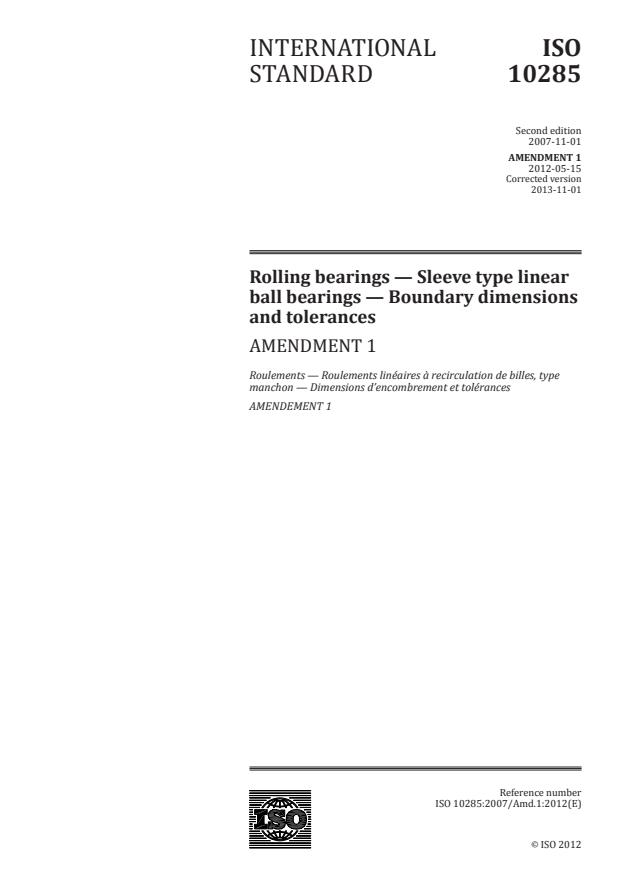
INTERNATIONAL ISO
STANDARD 10285
Second edition
2007-11-01
AMENDMENT 1
2012-05-15
Corrected version
2013-11-01
Rolling bearings — Sleeve type linear
ball bearings — Boundary dimensions
and tolerances
AMENDMENT 1
Roulements — Roulements linéaires à recirculation de billes, type
manchon — Dimensions d’encombrement et tolérances
AMENDEMENT 1
Reference number
ISO 10285:2007/Amd.1:2012(E)
©
ISO 2012
ISO 10285:2007/Amd.1:2012(E)
© ISO 2012
All rights reserved. Unless otherwise specified, no part of this publication may be reproduced or utilized otherwise in any form
or by any means, electronic or mechanical, including photocopying, or posting on the internet or an intranet, without prior
written permission. Permission can be requested from either ISO at the address below or ISO’s member body in the country of
the requester.
ISO copyright office
Case postale 56 • CH-1211 Geneva 20
Tel. + 41 22 749 01 11
Fax + 41 22 749 09 47
E-mail copyright@iso.org
Web www.iso.org
Published in Switzerland
ii © ISO 2012 – All rights reserved
ISO 10285:2007/Amd.1:2012(E)
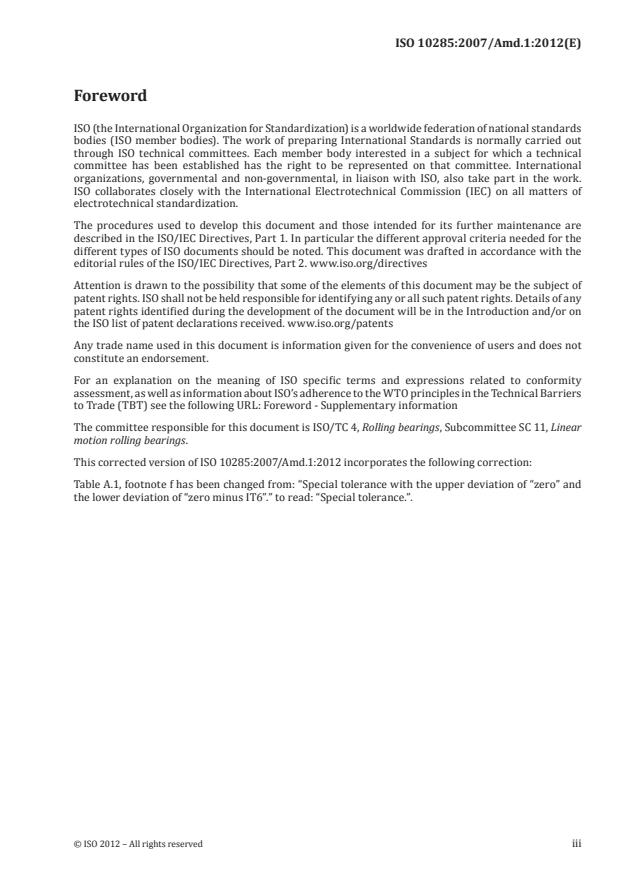
Foreword
ISO (the International Organization for Standardization) is a worldwide federation of national standards
bodies (ISO member bodies). The work of preparing International Standards is normally carried out
through ISO technical committees. Each member body interested in a subject for which a technical
committee has been established has the right to be represented on that committee. International
organizations, governmental and non-governmental, in liaison with ISO, also take part in the work.
ISO collaborates closely with the International Electrotechnical Commission (IEC) on all matters of
electrotechnical standardization.
The procedures used to develop this document and those intended for its further maintenance are
described in the ISO/IEC Directives, Part 1. In particular the different approval criteria needed for the
different types of ISO documents should be noted. This document was drafted in accordance with the
editorial rules of the ISO/IEC Directives, Part 2. www.iso.org/directives
Attention is drawn to the possibility that some of the elements of this documen
...
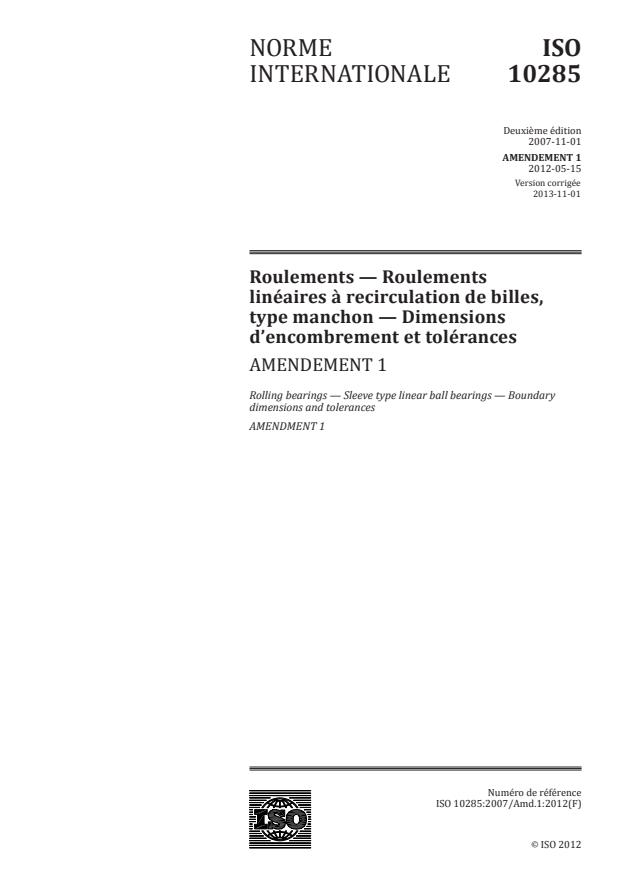
NORME ISO
INTERNATIONALE 10285
Deuxième édition
2007-11-01
AMENDEMENT 1
2012-05-15
Version corrigée
2013-11-01
Roulements — Roulements
linéaires à recirculation de billes,
type manchon — Dimensions
d’encombrement et tolérances
AMENDEMENT 1
Rolling bearings — Sleeve type linear ball bearings — Boundary
dimensions and tolerances
AMENDMENT 1
Numéro de référence
ISO 10285:2007/Amd.1:2012(F)
©
ISO 2012
ISO 10285:2007/Amd.1:2012(F)
DOCUMENT PROTÉGÉ PAR COPYRIGHT
© ISO 2012
Droits de reproduction réservés. Sauf indication contraire, aucune partie de cette publication ne peut être reproduite ni utilisée
sous quelque forme que ce soit et par aucun procédé, électronique ou mécanique, y compris la photocopie, l’affichage sur
l’internet ou sur un Intranet, sans autorisation écrite préalable. Les demandes d’autorisation peuvent être adressées à l’ISO à
l’adresse ci-après ou au comité membre de l’ISO dans le pays du demandeur.
ISO copyright office
Case postale 56 • CH-1211 Geneva 20
Tel. + 41 22 749 01 11
Fax + 41 22 749 09 47
E-mail copyright@iso.org
Web www.iso.org
Version française parue en 2013
Publié en Suisse
ii © ISO 2012 – Tous droits réservés
ISO 10285:2007/Amd.1:2012(F)
Avant-propos
L’ISO (Organisation internationale de normalisation) est une fédération mondiale d’organismes
nationaux de normalisation (comités membres de l’ISO). L’élaboration des Normes internationales est
en général confiée aux comités techniques de l’ISO. Chaque comité membre intéressé par une étude
a le droit de faire partie du comité technique créé à cet effet. Les organisations internationales,
gouvernementales et non gouvernementales, en liaison avec l’ISO participent également aux travaux.
L’ISO collabore étroitement avec la Commission électrotechnique internationale (CEI) en ce qui concerne
la normalisation électrotechnique.
Les procédures utilisées pour élaborer le présent document et celles destinées à sa mise à jour sont
décrites dans les Directives ISO/CEI, Partie 1. Il convient, en particulier de prendre note des différents
critères d’approbation requis pour les différents types de documents ISO. Le présent document a été
rédigé conformément aux règles de rédaction données dans les Directives ISO/CEI, Partie 2 (voir www.
iso.org/directives).
L’attention est appelée sur le fait que certains des éléments du présent document peuvent faire l’objet de
droits de propriété intellectuelle ou de droits analogues. L’ISO ne saurait être tenue pour responsable
de
...