

ISO/TR 25269:2026
(Main)Rolling bearings — Calculation of theoretical reliability
General Information
- Abstract
This document contains information on the reliability analysis for rolling bearings. The method described only pertains to the fatigue life per ISO 281 or ISO 16281 of rolling bearings. Other mechanisms of failure, like wear, microspalling (gray-staining) or white etching cracks (WEC), lie outside the scope of this document. A multi-row rolling bearing is considered as a single rolling bearing in the context of this document. The method is based on the life analysis per ISO 281 or ISO 16281, thus the general directions and limitations given in these documents apply. The calculated theoretical reliability is not suitable as the only criterion to select or optimize a rolling bearing or rolling bearing arrangements in powertrains, because the actual bearing reliability in service is also dependent on minimum load, rolling element slip, lubricant and lubricant supply, and heat dissipation. The calculated theoretical reliability does not replace or substitute any safety factors used for consideration of uncertainties in load assumptions, e.g. operation factors for shock loads.
- Status
- Published
- Publication Date
- 25-May-2026
- Technical Committee
- ISO/TC 4/SC 8 - Load ratings and life
- Current Stage
- 6060 - International Standard published
- Start Date
- 26-May-2026
- Due Date
- 29-May-2027
- Completion Date
- 26-May-2026
Overview
ISO/TR 25269:2026, Rolling bearings - Calculation of theoretical reliability, is an ISO technical report that provides a standardized method for analyzing the theoretical reliability of rolling bearings, specifically in terms of fatigue life. This standard is built on the principles established in ISO 281 and ISO 16281, focusing exclusively on failure mechanisms associated with rolling contact fatigue. Other bearing failure modes such as wear, microspalling (gray-staining), or white etching cracks (WEC) are excluded from its scope.
The method outlined in ISO/TR 25269:2026 utilizes statistical distributions, primarily the Weibull distribution, to estimate the probability that a rolling bearing or a system of bearings will perform without fatigue-related failure under specified operating conditions and for a defined period or number of revolutions. It is important to note that the calculated theoretical reliability is not intended as the sole criterion for bearing selection or optimization, as real-world reliability depends on additional operational factors.
Key Topics
- Reliability Analysis Focus: The standard details the procedures for calculating the theoretical reliability of rolling bearings using fatigue life data as per ISO 281 and ISO 16281.
- Statistical Methods: The Weibull distribution (both two-parameter and three-parameter forms) is used for modeling the variability of bearing life and failure probability.
- System Reliability: Provides a method to calculate the combined theoretical reliability of arrangements containing multiple individual rolling bearings.
- Exclusions and Limitations:
- Only fatigue life failure mode is covered.
- Does not address failure due to wear, microspalling, or WEC.
- Theoretical reliability calculations do not substitute for operational safety factors or compensate for uncertainties in load assumptions.
- Multi-row rolling bearings are treated as single entities in reliability analysis.
- Practical Examples and Graphical Representations: Includes demonstrative calculation examples and diagrams to clarify reliability computations.
Applications
The guidance provided by ISO/TR 25269:2026 is highly valuable across industries where rolling bearings are essential components, such as automotive, industrial machinery, wind energy, and power transmissions. Key applications include:
- Engineering Design: Supports engineers in conducting comparative assessments of rolling bearings based on standardized fatigue life reliability calculations.
- System Analysis: Enables the assessment of total reliability for systems with multiple bearings, such as gearboxes and drivetrains.
- Predictive Maintenance Planning: Assists in estimating bearing longevity for maintenance scheduling and risk management.
- Quality Control: Facilitates a uniform approach to evaluating bearing reliability for product development and validation.
- Education and Training: Provides a technical foundation for teaching and understanding statistical methods in bearing reliability assessment.
While ISO/TR 25269:2026 is a crucial tool for theoretical calculations, users should always integrate operational realities, including minimum load, lubrication, rolling element slip, and thermal conditions, when selecting bearings or planning maintenance.
Related Standards
Understanding and using ISO/TR 25269:2026 often requires familiarity with several closely related international standards:
ISO 281:2007 – Rolling bearings - Dynamic load ratings and rating life
Defines basic dynamic load ratings and the method for calculating bearing life.ISO 16281:2025 – Rolling bearings - Methods for calculating the modified reference rating life for universally loaded rolling bearings
Addresses life calculation methods considering actual operating conditions.ISO/TR 1281-1 and ISO/TR 1281-2 – Explanatory notes on ISO 281
Provide background, explanations, and guidance related to ISO 281 and bearing life calculation.VDMA 23904
Focuses on reliability assessment for wind energy gearboxes.IEC/TS 61400-4-1
Addresses reliability assessment of drivetrain components in wind turbines.
Leveraging ISO/TR 25269:2026 in combination with these standards enables a holistic approach to rolling bearing reliability analysis and supports the engineering of safer, more dependable mechanical systems.
Frequently Asked Questions
ISO/TR 25269:2026 is a technical report published by the International Organization for Standardization (ISO). Its full title is "Rolling bearings — Calculation of theoretical reliability". This standard covers: This document contains information on the reliability analysis for rolling bearings. The method described only pertains to the fatigue life per ISO 281 or ISO 16281 of rolling bearings. Other mechanisms of failure, like wear, microspalling (gray-staining) or white etching cracks (WEC), lie outside the scope of this document. A multi-row rolling bearing is considered as a single rolling bearing in the context of this document. The method is based on the life analysis per ISO 281 or ISO 16281, thus the general directions and limitations given in these documents apply. The calculated theoretical reliability is not suitable as the only criterion to select or optimize a rolling bearing or rolling bearing arrangements in powertrains, because the actual bearing reliability in service is also dependent on minimum load, rolling element slip, lubricant and lubricant supply, and heat dissipation. The calculated theoretical reliability does not replace or substitute any safety factors used for consideration of uncertainties in load assumptions, e.g. operation factors for shock loads.
This document contains information on the reliability analysis for rolling bearings. The method described only pertains to the fatigue life per ISO 281 or ISO 16281 of rolling bearings. Other mechanisms of failure, like wear, microspalling (gray-staining) or white etching cracks (WEC), lie outside the scope of this document. A multi-row rolling bearing is considered as a single rolling bearing in the context of this document. The method is based on the life analysis per ISO 281 or ISO 16281, thus the general directions and limitations given in these documents apply. The calculated theoretical reliability is not suitable as the only criterion to select or optimize a rolling bearing or rolling bearing arrangements in powertrains, because the actual bearing reliability in service is also dependent on minimum load, rolling element slip, lubricant and lubricant supply, and heat dissipation. The calculated theoretical reliability does not replace or substitute any safety factors used for consideration of uncertainties in load assumptions, e.g. operation factors for shock loads.
ISO/TR 25269:2026 is classified under the following ICS (International Classification for Standards) categories: 21.100.20 - Rolling bearings. The ICS classification helps identify the subject area and facilitates finding related standards.
ISO/TR 25269:2026 is available in PDF format for immediate download after purchase. The document can be added to your cart and obtained through the secure checkout process. Digital delivery ensures instant access to the complete standard document.
Standards Content (Sample)
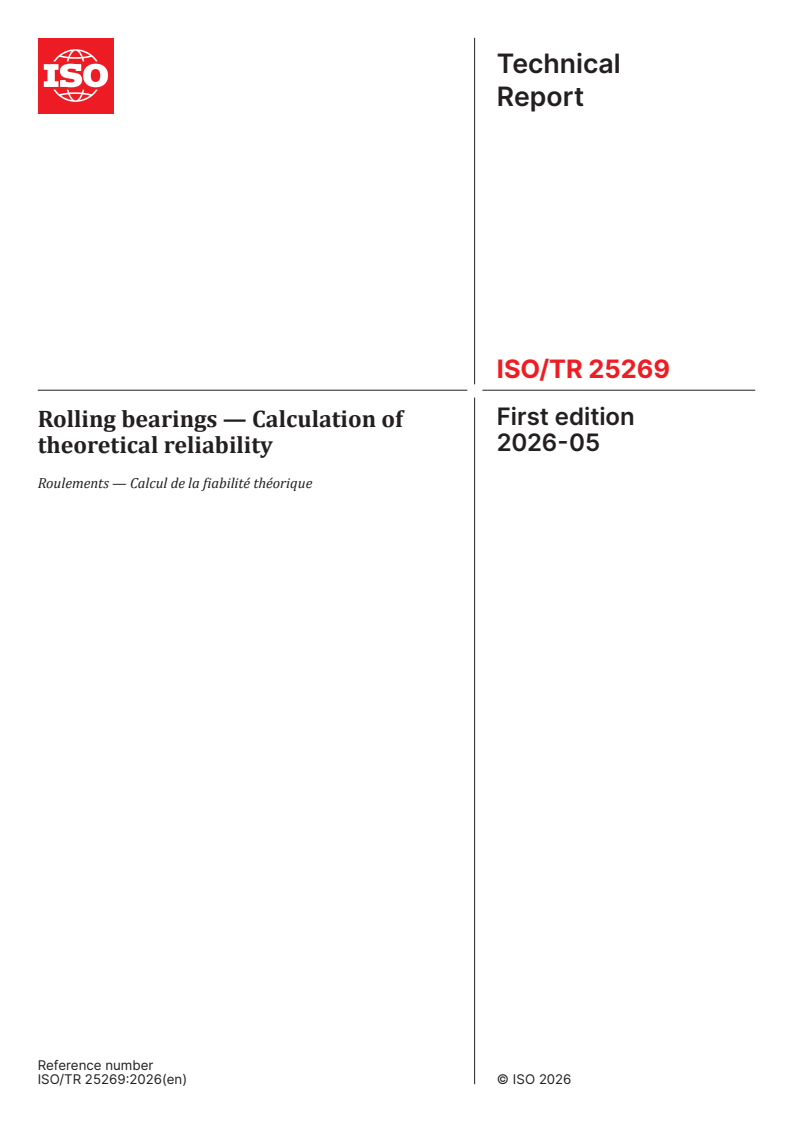
Technical
Report
ISO/TR 25269
First edition
Rolling bearings — Calculation of
2026-05
theoretical reliability
Roulements — Calcul de la fiabilité théorique
Reference number
© ISO 2026
All rights reserved. Unless otherwise specified, or required in the context of its implementation, no part of this publication may
be reproduced or utilized otherwise in any form or by any means, electronic or mechanical, including photocopying, or posting on
the internet or an intranet, without prior written permission. Permission can be requested from either ISO at the address below
or ISO’s member body in the country of the requester.
ISO copyright office
CP 401 • Ch. de Blandonnet 8
CH-1214 Vernier, Geneva
Phone: +41 22 749 01 11
Email: copyright@iso.org
Website: www.iso.org
Published in Switzerland
ii
Contents Page
Foreword .iv
Introduction .v
1 Scope . 1
2 Normative references . 1
3 Terms and definitions . 1
4 Symbols . 1
5 Theoretical reliability of rolling bearings . 2
5.1 General .2
5.2 Calculation of the theoretical reliability of a rolling bearing .3
5.3 Calculation of the theoretical system reliability .4
Annex A (informative) Graphical representation of theoretical reliability . 5
Annex B (informative) Calculation examples . 6
Bibliography . 7
iii
Foreword
ISO (the International Organization for Standardization) is a worldwide federation of national standards
bodies (ISO member bodies). The work of preparing International Standards is normally carried out through
ISO technical committees. Each member body interested in a subject for which a technical committee
has been established has the right to be represented on that committee. International organizations,
governmental and non-governmental, in liaison with ISO, also take part in the work. ISO collaborates closely
with the International Electrotechnical Commission (IEC) on all matters of electrotechnical standardization.
The procedures used to develop this document and those intended for its further maintenance are described
in the ISO/IEC Directives, Part 1. In particular, the different approval criteria needed for the different types
of ISO document should be noted. This document was drafted in accordance with the editorial rules of the
ISO/IEC Directives, Part 2 (see www.iso.org/directives).
ISO draws attention to the possibility that the implementation of this document may involve the use of (a)
patent(s). ISO takes no position concerning the evidence, validity or applicability of any claimed patent
rights in respect thereof. As of the date of publication of this document, ISO had not received notice of (a)
patent(s) which may be required to implement this document. However, implementers are cautioned that
this may not represent the latest information, which may be obtained from the patent database available at
www.iso.org/patents. ISO shall not be held responsible for identifying any or all such patent rights.
Any trade name used in this document is information given for the convenience of users and does not
constitute an endorsement.
For an explanation of the voluntary nature of standards, the meaning of ISO specific terms and expressions
related to conformity assessment, as well as information about ISO's adherence to the World Trade
Organization (WTO) principles in the Technical Barriers to Trade (TBT), see www.iso.org/iso/foreword.html.
This document was prepared by Technical Committee ISO/TC 4, Rolling bearings, Subcommittee SC 8, Load
ratings and life.
Any feedback or questions on this document should be directed to the user’s national standards body. A
complete listing of these bodies can be found at www.iso.org/members.html.
iv
Introduction
The fatigue lives of a population of rolling bearings are subject to a large statistical variation, that is usually
[1]
described by a Weibull distribution. This Weibull distribution also is one fundamental concept in the
statistical accumulation of failure probability used in the analysis of load ratings and rating life of rolling
[2]
bearings per ISO 281 and ISO 16281, see ISO/TR 1281-1 .
However, since rolling contact fatigue life can be described both by a two-parameter as well as a three-
parameter Weibull distribution, different methods have been proposed for the reliability analysis of rolling
bearings.
This document describes a method for the calculation of the theoretical reliability of rolling bearings
[3]
that is consistent with the provisions of both ISO 281 and ISO 16281, as well as VDMA 23904 and
[4]
IEC/TS 61400-4-1 .
v
Technical Report ISO/TR 25269:2026(en)
Rolling bearings — Calculation of theoretical reliability
1 Scope
This document contains information on the reliability analysis for rolling bearings. The method described
only pertains to the fatigue life per ISO 281 or ISO 16281 of rolling bearings. Other mechanisms of failure, like
wear, microspalling (gray-staining) or white etching cracks (WEC), lie outside the scope of this document.
A multi-row rolling bearing is considered as a single rolling bearing in the context of this document.
The method is based on the life analysis per ISO 281 or ISO 16281, thus the general directions and limitations
given in these documents apply.
The calculated theoretical reliability is not suitable as the only criterion to select or optimize a rolling
bearing or rolling bearing arrangements in powertrains, because the actual bearing reliability in service is
also dependent on minimum load, rolling element slip, lubricant and lubricant supply, and heat dissipation.
The calculated theoretical reliability does not replace or substitute any safety factors used for consideration
of uncertainties in load assumptions, e.g. operation factors for shock loads.
2 Normative references
The following documents are referred to in the text in such a way that some or all of their content constitutes
requirements of this document. For dated references, only the edition cited applies. For undated references,
the latest edition of the referenced document (including any amendments) applies.
ISO 281:2007, Rolling bearings — Dynamic load ratings and rating life
ISO 16281:2025, Rolling bearings — Methods for calculating the modified reference rating life for universally
loaded rolling bearings
3 Terms and definitions
For the purposes of this document, the following terms and definitions apply. See also the terms and
definitions in ISO 281:2007, Clause 3 and in ISO 16281:2025 Clause 3.
ISO and IEC maintain terminology databases for use in st
...