

ISO 19457:2026
(Main)Rolling bearings — Roller blocks as subassemblies for linear motion rolling bearings — Boundary dimensions and tolerance values
General Information
- Abstract
This document specifies the boundary dimensions and tolerances for Types A to D of roller blocks. Types E and F of roller blocks are given in Annex A. They require fixing parts and are not yet produced on a broad manufacturer base.
- Status
- Published
- Publication Date
- 01-Jul-2026
- Technical Committee
- ISO/TC 4/SC 11 - Linear motion rolling bearings
- Drafting Committee
- ISO/TC 4/SC 11 - Linear motion rolling bearings
- Current Stage
- 6060 - International Standard published
- Start Date
- 02-Jul-2026
- Due Date
- 18-Jan-2026
- Completion Date
- 02-Jul-2026

Overview
ISO 19457:2026 sets out internationally standardized boundary dimensions and tolerance values for roller blocks used as subassemblies in linear motion rolling bearings. The standard covers Types A to D, with additional guidance for Types E and F provided in an annex due to their more limited manufacturing base and the need for fixing parts. By establishing consistent terminology, dimensions, and tolerance classes, ISO 19457:2026 enables manufacturers, engineers, and users to specify and source interchangeable linear motion roller block components across diverse applications.
With the ongoing use of roller blocks for maintenance and spare parts in existing installations, this standard supports continued compatibility as technologies evolve towards alternative linear motion solutions, such as profiled rail guides covered by related ISO standards.
Key Topics
- Types of Roller Blocks Covered
- Types A, B, C (subtypes C1 metric, C2 inch), and D specified in detail
- Types E and F described in Annex A, require additional fixing parts, and have limited production
- Dimensions and Tolerance Values
- Defines boundary dimensions for width, height, length, and mounting surface placement
- Four classes of tolerances for manufacturing precision: G (Normal), E (High), D (Precision), and C (Super Precision)
- Terms and Definitions
- Establishes consistent terminology for critical elements such as roller block body, roller holding part, mounting surfaces, and rolling surfaces
- Mounting and Configuration
- Recommendations for adjacent mounting surfaces and tolerancing of interfacing parts are included, aiding reliable assembly and alignment
- Symbol Conventions
- Details standardized symbols and measurements aligning with other ISO bearing standards
Applications
Roller blocks designed to ISO 19457:2026 are widely used in machinery and equipment requiring precise, low-friction linear motion. Typical application areas include:
- Machine Tools: For high-precision linear guides, enabling accurate positioning and durability in harsh environments.
- Automation Systems: Supporting conveyor systems, pick-and-place equipment, and robotic axes.
- Industrial Production Lines: Ensuring consistent movement and replaceability of linear bearing subassemblies for ongoing maintenance.
- Replacement and Retrofitting: Facilitates sourcing of interchangeable components for legacy systems where original designs are still in use.
Standardized roller blocks reduce lead times, simplify inventory management, and foster reliable global procurement and supply. The dimensional and tolerance guidance ensures compatibility, not only within a manufacturer’s range but also across international suppliers.
Related Standards
To ensure interface compatibility and broaden usability, ISO 19457:2026 references several key standards:
- ISO 15241 - Rolling bearings - Symbols for physical quantities
- ISO 24393:2008 - Rolling bearings - Linear motion rolling bearings - Vocabulary
- ISO 12090-1 - Profiled rail guides for linear motion rolling bearings - Boundary dimensions and tolerances for series 1, 2, 3
- ISO 12090-2 - Profiled rail guides for linear motion rolling bearings - Boundary dimensions and tolerances for series 4, 5
- ISO 273 - Fasteners - Clearance holes for bolts and screws
- ISO 286-1/2 - Geometrical product specifications (GPS) - ISO code system for tolerances on linear sizes
Adoption of ISO 19457:2026, together with these related standards, enables manufacturers to deliver globally compatible rolling bearing solutions, improving efficiency and interoperability in linear motion technologies.
Frequently Asked Questions
ISO 19457:2026 is a standard published by the International Organization for Standardization (ISO). Its full title is "Rolling bearings — Roller blocks as subassemblies for linear motion rolling bearings — Boundary dimensions and tolerance values". This standard covers: This document specifies the boundary dimensions and tolerances for Types A to D of roller blocks. Types E and F of roller blocks are given in Annex A. They require fixing parts and are not yet produced on a broad manufacturer base.
This document specifies the boundary dimensions and tolerances for Types A to D of roller blocks. Types E and F of roller blocks are given in Annex A. They require fixing parts and are not yet produced on a broad manufacturer base.
ISO 19457:2026 is classified under the following ICS (International Classification for Standards) categories: 21.100.20 - Rolling bearings. The ICS classification helps identify the subject area and facilitates finding related standards.
ISO 19457:2026 is available in PDF format for immediate download after purchase. The document can be added to your cart and obtained through the secure checkout process. Digital delivery ensures instant access to the complete standard document.
Standards Content (Sample)
International
Standard
ISO 19457
First edition
Rolling bearings — Roller blocks
2026-07
as subassemblies for linear motion
rolling bearings — Boundary
dimensions and tolerance values
Roulements — Roulements pour mouvement linéaire, sous-
ensembles, patin à rouleaux — Dimensions d'encombrement et
valeurs de tolérance
Reference number
© ISO 2026
All rights reserved. Unless otherwise specified, or required in the context of its implementation, no part of this publication may
be reproduced or utilized otherwise in any form or by any means, electronic or mechanical, including photocopying, or posting on
the internet or an intranet, without prior written permission. Permission can be requested from either ISO at the address below
or ISO’s member body in the country of the requester.
ISO copyright office
CP 401 • Ch. de Blandonnet 8
CH-1214 Vernier, Geneva
Phone: +41 22 749 01 11
Email: copyright@iso.org
Website: www.iso.org
Published in Switzerland
ii
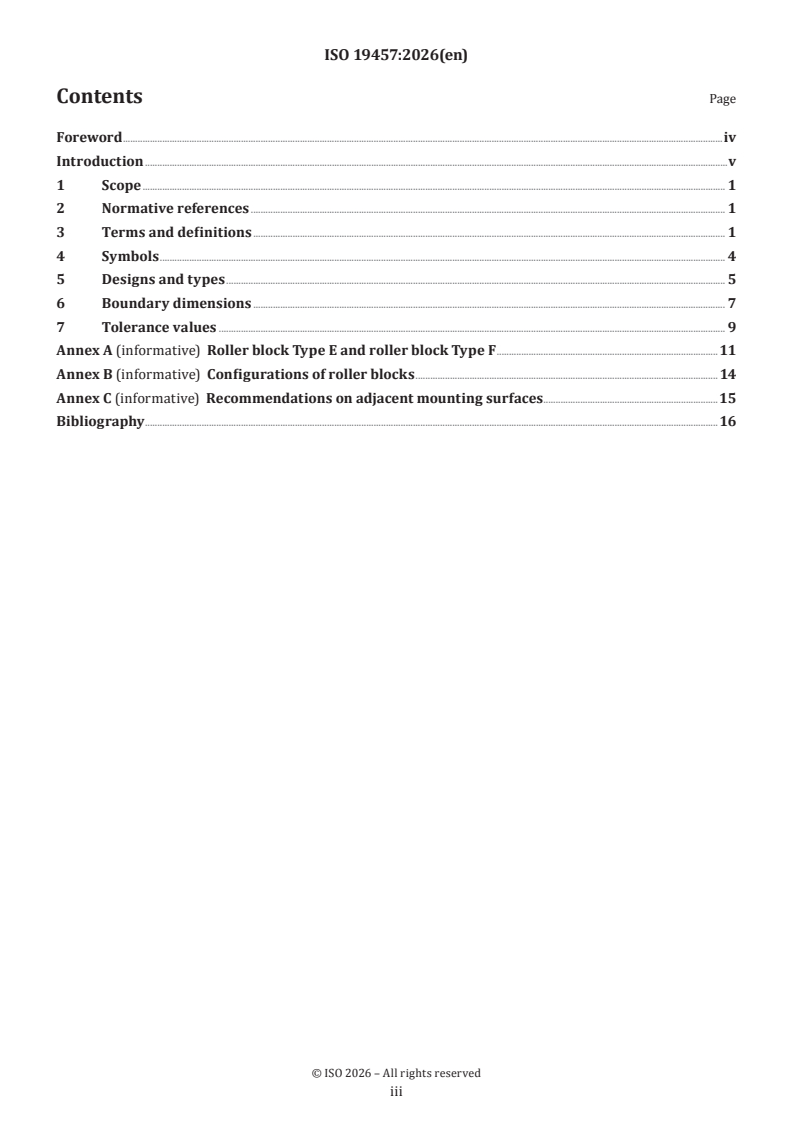
Contents Page
Foreword .iv
Introduction .v
1 Scope . 1
2 Normative references . 1
3 Terms and definitions . 1
4 Symbols . 4
5 Designs and types . 5
6 Boundary dimensions . 7
7 Tolerance values . 9
Annex A (informative) Roller block Type E and roller block Type F .11
Annex B (informative) Configurations of roller blocks . 14
Annex C (informative) Recommendations on adjacent mounting surfaces .15
Bibliography .16
iii
Foreword
ISO (the International Organization for Standardization) is a worldwide federation of national standards
bodies (ISO member bodies). The work of preparing International Standards is normally carried out through
ISO technical committees. Each member body interested in a subject for which a technical committee
has been established has the right to be represented on that committee. International organizations,
governmental and non-governmental, in liaison with ISO, also take part in the work. ISO collaborates closely
with the International Electrotechnical Commission (IEC) on all matters of electrotechnical standardization.
The procedures used to develop this document and those intended for its further maintenance are described
in the ISO/IEC Directives, Part 1. In particular, the different approval criteria needed for the different types
of ISO document should be noted. This document was drafted in accordance with the editorial rules of the
ISO/IEC Directives, Part 2 (see www.iso.org/directives).
ISO draws attention to the possibility that the implementation of this document may involve the use of (a)
patent(s). ISO takes no position concerning the evidence, validity or applicability of any claimed patent
rights in respect thereof. As of the date of publication of this document, ISO had not received notice of (a)
patent(s) which may be required to implement this document. However, implementers are cautioned that
this may not represent the latest information, which may be obtained from the patent database available at
www.iso.org/patents. ISO shall not be held responsible for identifying any or all such patent rights.
Any trade name used in this document is information given for the convenience of users and does not
constitute an endorsement.
For an explanation of the voluntary nature of standards, the meaning of ISO specific terms and expressions
related to conformity assessment, as well as information about ISO's adherence to the World Trade
Organization (WTO) principles in the Technical Barriers to Trade (TBT), see www.iso.org/iso/foreword.html.
This document was prepared by Technical Committee ISO/TC 4, Rolling bearings, Subcommittee SC 11,
Linear motion rolling bearings.
Any feedback or questions on this document should be directed to the user’s national standards body. A
complete listing of these bodies can be found at www.iso.org/members.html.
iv
Introduction
Linear motion rolling bearing subassemblies as standardized in this document are a product that has been
on the market for several decades. It is projected that these products will become less important in future
technology. However, in some application areas there is still a need for spare parts.
The designs with profiled rail guides and linear motion rolling bearings in ISO 12090-1 and ISO 12090-2 can
replace the roller block design given in this document.
The title of this document applies the classification of linear motion rolling bearings as defined in
ISO 24393:2008, Annex A.
v
International Standard ISO 19457:2026(en)
Rolling bearings — Roller blocks as subassemblies for
linear motion rolling bearings — Boundary dimensions and
tolerance values
1 Scope
This document specifies the boundary dimensions and tolerances for Types A to D of roller blocks.
Types E and F of roller blocks are given in Annex A. They require fixing parts and are not yet produced on a
broad manufacturer base.
2 Normative references
The following documents are referred to in the text in such a way that some or all of their content constitutes
requirements of this document. For dated references, only the edition cited applies. For undated references,
the latest edition of the referenced document (including any amendments) applies.
ISO 15241, Rolling bearings — Symbols for physical quantities
ISO 24393:2008, Rolling bearings — Linear motion rolling bearings — Vocabulary
3 Terms and definitions
For the purposes of this document, the terms and definitions given in ISO 24393:2008 and the following
apply.
ISO and IEC maintain terminology databases for use in standardization at the following addresses:
— ISO Online browsing platform: available at https:// www .iso .org/ obp
— IEC Electropedia: available at https:// www .electropedia .org/
3.1
roller block
linear roller bearing
linear bearing subassembly consisting of roller block body and a number of closed loops of recirculating
rollers, which are designed to achieve unlimited motion along a flat rail or flat guideway
Note 1 to entry: An example of a roller block is illustrated in Figure 1.
[SOURCE: ISO 24393:2008, 03.01.07]
Key
1 roller block body (3.2)
2 rollers
3 roller holding part (3.3)
Figure 1 — Example of a roller block with exploded view
3.2
roller block body
cuboid part having rectangular cross-section of a roller block with one or more raceways on one of its
outside surfaces and supporting load
Note 1 to entry: See Figure 1.
[SOURCE: ISO 24393:2008, 04.01.07 modified – The wordings “having rectangular cross-section” as well as
“and supporting load” have been added. "basically" has been removed.]
3.3
roller holding part
parts of roller block except rollers and roller block body which together retain and guide the rollers in a
recirculation path
Note 1 to entry: See Figure 1.
3.4
mounting surface
surface of the roller block which is fixed to the adjacent construction
Note 1 to entry: See Figure 2.
a) Roller block Type A
b) Roller block Type B
c) Roller block Type C
d) Roller block Type D
e) Roller block Type E
f) Roller block Type F
Key
1 mounting surface
Figure 2 — Mounting surfaces of roller blocks
3.5
rolling surface
plane theoretically tangential to the cylindrical surfaces of rollers
Note 1 to entry: See Figure 3.
Key
1 rolling surface
Figure 3 — Rolling surface
4 Symbols
For the purposes of this document, the symbols given in ISO 15241 and the following apply, see Table 1.
The symbols (except those for tolerances) shown in Figures 4 to 7 and the values given in Tables 2 to 6
denote nominal dimensions, unless specified otherwise.
Table 1 — Symbols
Symbol Description Unit
B Overall width of roller block mm
B Width of roller holding part mm
H Height from mounting surface to rolling surface mm
H Height of roller block mm
h Overall length of bolt hole mm
h Height of mounting flange mm
J Centre distance between mounting bolt holes (width) mm
J Centre distance between mounting bolt holes (length) mm
L Length of roller block mm
L Length of mounting flange mm
L Length of mounting surface mm
M Designation of internal screw thread for mounting bolts -
N Diameter of mounting bolt holes mm
a, b
V Variation of the sorting height µm
HmL
V Variation of height from mounting surface to rolling surface µm
Hs
∆
Deviation of overall width of roller block µm
Bs
∆ Deviation of width of roller holding p
...