


ISO/ASTM 51261:2002
(Main)Guide for selection and calibration of dosimetry systems for radiation processing
Guide for selection and calibration of dosimetry systems for radiation processing
ISO/ASTM 51261 covers the basis for selecting and calibrating dosimetry systems used to measure absorbed doses in gamma-ray or X-ray fields and in electron beams used for radiation processing. It discusses the types of dosimetry systems that may be used during calibration or on a routine basis as part of quality assurance in commercial radiation processing of products. ISO/ASTM 51261 also discusses interpretation of absorbed doses and briefly outlines measurements of the uncertainties associated with the dosimetry. The details of the calibration of the analytical instrumentation are addressed in individual dosimetry system standard practices. The absorbed-dose range covered is up to 1 MGy (100 Mrad). Source energies covered are from 0,1 to 50 MeV photons and electrons. This International Standard should be used along with standard practices and guides for specific dosimetry systems and applications covered in other standards. It does not cover dosimetry for radiation processing with neutrons or heavy charged particles.
Guide de choix et d'étalonnage des appareils de mesure dosimétrique pour le traitement par irradiation
General Information
- Status
- Withdrawn
- Publication Date
- 17-Apr-2002
- Withdrawal Date
- 17-Apr-2002
- Current Stage
- 9599 - Withdrawal of International Standard
- Start Date
- 22-Mar-2013
- Completion Date
- 12-Feb-2026
Relations
- Revised
ISO/ASTM 51261:2013 - Practice for calibration of routine dosimetry systems for radiation processing - Effective Date
- 06-Aug-2011
- Revises
ISO 15556:1998 - Guide for selection and calibration of dosimetry systems for radiation processing - Effective Date
- 15-Apr-2008
Get Certified
Connect with accredited certification bodies for this standard

BSMI (Bureau of Standards, Metrology and Inspection)
Taiwan's standards and inspection authority.
Sponsored listings
Frequently Asked Questions
ISO/ASTM 51261:2002 is a standard published by the International Organization for Standardization (ISO). Its full title is "Guide for selection and calibration of dosimetry systems for radiation processing". This standard covers: ISO/ASTM 51261 covers the basis for selecting and calibrating dosimetry systems used to measure absorbed doses in gamma-ray or X-ray fields and in electron beams used for radiation processing. It discusses the types of dosimetry systems that may be used during calibration or on a routine basis as part of quality assurance in commercial radiation processing of products. ISO/ASTM 51261 also discusses interpretation of absorbed doses and briefly outlines measurements of the uncertainties associated with the dosimetry. The details of the calibration of the analytical instrumentation are addressed in individual dosimetry system standard practices. The absorbed-dose range covered is up to 1 MGy (100 Mrad). Source energies covered are from 0,1 to 50 MeV photons and electrons. This International Standard should be used along with standard practices and guides for specific dosimetry systems and applications covered in other standards. It does not cover dosimetry for radiation processing with neutrons or heavy charged particles.
ISO/ASTM 51261 covers the basis for selecting and calibrating dosimetry systems used to measure absorbed doses in gamma-ray or X-ray fields and in electron beams used for radiation processing. It discusses the types of dosimetry systems that may be used during calibration or on a routine basis as part of quality assurance in commercial radiation processing of products. ISO/ASTM 51261 also discusses interpretation of absorbed doses and briefly outlines measurements of the uncertainties associated with the dosimetry. The details of the calibration of the analytical instrumentation are addressed in individual dosimetry system standard practices. The absorbed-dose range covered is up to 1 MGy (100 Mrad). Source energies covered are from 0,1 to 50 MeV photons and electrons. This International Standard should be used along with standard practices and guides for specific dosimetry systems and applications covered in other standards. It does not cover dosimetry for radiation processing with neutrons or heavy charged particles.
ISO/ASTM 51261:2002 is classified under the following ICS (International Classification for Standards) categories: 17.240 - Radiation measurements. The ICS classification helps identify the subject area and facilitates finding related standards.
ISO/ASTM 51261:2002 has the following relationships with other standards: It is inter standard links to ISO/ASTM 51261:2013, ISO 15556:1998. Understanding these relationships helps ensure you are using the most current and applicable version of the standard.
ISO/ASTM 51261:2002 is available in PDF format for immediate download after purchase. The document can be added to your cart and obtained through the secure checkout process. Digital delivery ensures instant access to the complete standard document.
Standards Content (Sample)
INTERNATIONAL ISO/ASTM
STANDARD 51261
First edition
2002-03-15
Guide for selection and calibration of
dosimetry systems for radiation
processing
Guide de choix et d’étalonnage des appareils de mesure
dosimétrique pour le traitement par irradiation
Reference number
© ISO/ASTM International 2002
PDF disclaimer
This PDF file may contain embedded typefaces. In accordance with Adobe’s licensing policy, this file may be printed or viewed but shall
not be edited unless the typefaces which are embedded are licensed to and installed on the computer performing the editing. In
downloading this file, parties accept therein the responsibility of not infringing Adobe’s licensing policy. Neither the ISO Central
Secretariat nor ASTM International accepts any liability in this area.
Adobe is a trademark of Adobe Systems Incorporated.
Details of the software products used to create this PDF file can be found in the General Info relative to the file; the PDF-creation
parameters were optimized for printing. Every care has been taken to ensure that the file is suitable for use by ISO member bodies
and ASTM members. In the unlikely event that a problem relating to it is found, please inform the ISO Central Secretariat or ASTM
International at the addresses given below.
© ISO/ASTM International 2002
All rights reserved. Unless otherwise specified, no part of this publication may be reproduced or utilized in any form or by any means, electronic or mechanical,
including photocopying and microfilm, without permission in writing from either ISO at the address below or ISO’s member body in the country of the
requester. In the United States, such requests should be sent to ASTM International.
ISO copyright office ASTM International, 100 Barr Harbor Drive, PO Box C700,
Case postale 56 • CH-1211 Geneva 20 West Conshohocken, PA 19428-2959, USA
Tel. +41 22 749 01 11 Tel. +610 832 9634
Fax +41 22 749 09 47 Fax +610 832 9635
E-mail copyright@iso.ch E-mail khooper@astm.org
Web www.iso.ch Web www.astm.org
Printed in the United States
ii © ISO/ASTM International 2002 – All rights reserved
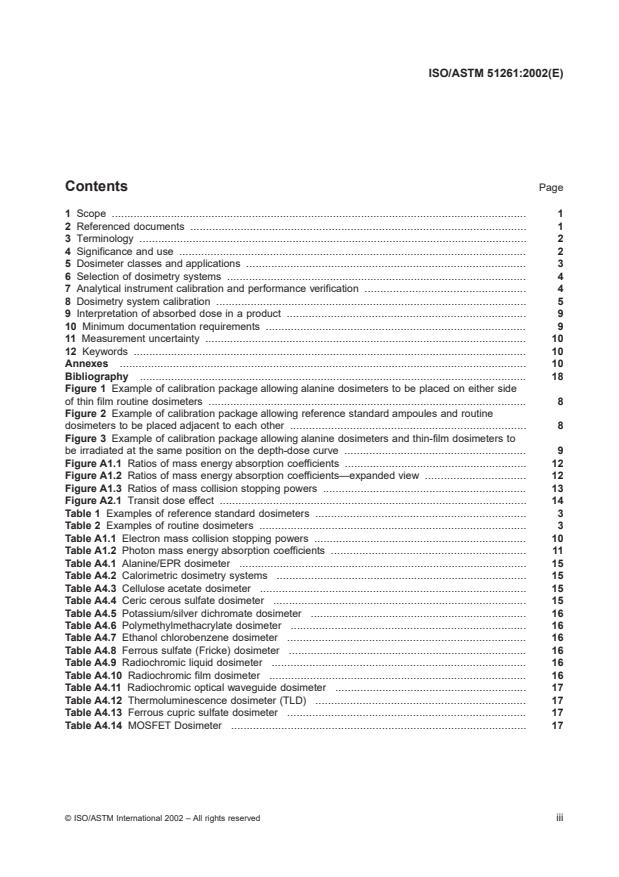
Contents Page
1 Scope . 1
2 Referenced documents . 1
3 Terminology . 2
4 Significance and use . 2
5 Dosimeter classes and applications . 3
6 Selection of dosimetry systems . 4
7 Analytical instrument calibration and performance verification . 4
8 Dosimetry system calibration . 5
9 Interpretation of absorbed dose in a product . 9
10 Minimum documentation requirements . 9
11 Measurement uncertainty . 10
12 Keywords . 10
Annexes . 10
Bibliography . 18
Figure 1 Example of calibration package allowing alanine dosimeters to be placed on either side
of thin film routine dosimeters . 8
Figure 2 Example of calibration package allowing reference standard ampoules and routine
dosimeters to be placed adjacent to each other . 8
Figure 3 Example of calibration package allowing alanine dosimeters and thin-film dosimeters to
be irradiated at the same position on the depth-dose curve . 9
Figure A1.1 Ratios of mass energy absorption coefficients . 12
Figure A1.2 Ratios of mass energy absorption coefficients—expanded view . 12
Figure A1.3 Ratios of mass collision stopping powers . 13
Figure A2.1 Transit dose effect . 14
Table 1 Examples of reference standard dosimeters . 3
Table 2 Examples of routine dosimeters . 3
Table A1.1 Electron mass collision stopping powers . 10
Table A1.2 Photon mass energy absorption coefficients . 11
Table A4.1 Alanine/EPR dosimeter . 15
Table A4.2 Calorimetric dosimetry systems . 15
Table A4.3 Cellulose acetate dosimeter . 15
Table A4.4 Ceric cerous sulfate dosimeter . 15
Table A4.5 Potassium/silver dichromate dosimeter . 16
Table A4.6 Polymethylmethacrylate dosimeter . 16
Table A4.7 Ethanol chlorobenzene dosimeter . 16
Table A4.8 Ferrous sulfate (Fricke) dosimeter . 16
Table A4.9 Radiochromic liquid dosimeter . 16
Table A4.10 Radiochromic film dosimeter . 16
Table A4.11 Radiochromic optical waveguide dosimeter . 17
Table A4.12 Thermoluminescence dosimeter (TLD) . 17
Table A4.13 Ferrous cupric sulfate dosimeter . 17
Table A4.14 MOSFET Dosimeter . 17
© ISO/ASTM International 2002 – All rights reserved iii
Foreword
ISO (the International Organization for Standardization) is a worldwide federation of national standards bodies
(ISO member bodies). The work of preparing International Standards is normally carried out through ISO
technical committees. Each member body interested in a subject for which a technical committee has been
established has the right to be represented on that committee. International organizations, governmental and
non-governmental, in liaison with ISO, also take part in the work. ISO collaborates closely with the
International Electrotechnical Commission (IEC) on all matters of electrotechnical standardization.
Draft International Standards adopted by the technical committees are circulated to the member bodies for
voting. Publication as an International Standard requires approval by at least 75% of the member bodies
casting a vote.
ASTM International is one of the world’s largest voluntary standards development organizations with global
participation from affected stakeholders. ASTM technical committees follow rigorous due process balloting
procedures.
A pilot project between ISO and ASTM International has been formed to develop and maintain a group of
ISO/ASTM radiation processing dosimetry standards. Under this pilot project, ASTM Subcommittee E10.01,
Dosimetry for Radiation Processing, is responsible for the development and maintenance of these dosimetry
standards with unrestricted participation and input from appropriate ISO member bodies.
Attention is drawn to the possibility that some of the elements of this International Standard may be the subject
of patent rights. Neither ISO nor ASTM International shall be held responsible for identifying any or all such
patent rights.
International Standard ISO/ASTM 51261 was developed by ASTM Committee E10, Nuclear Technology and
Applications, through Subcommittee E10.01, and by Technical Committee ISO/TC 85, Nuclear Energy.
Annexes A1, A2, A3, A4 and A5 of this International Standard are for information only.
iv © ISO/ASTM International 2002 – All rights reserved
Standard Guide for
Selection and Calibration of Dosimetry Systems for
Radiation Processing
This standard is issued under the fixed designation ISO/ASTM 51261; the number immediately following the designation indicates the
year of original adoption or, in the case of revision, the year of last revision.
1. Scope E 1026 Practice for Using the Fricke Reference Standard
Dosimetry System
1.1 This guide covers the basis for selecting and calibrating
2.2 ISO/ASTM Standards:
dosimetry systems used to measure absorbed dose in gamma-
51204 Practice for Dosimetry in Gamma Irradiation Facili-
ray or X-ray fields and in electron beams used for radiation
ties for Food Processing
processing. It discusses the types of dosimetry systems that
51205 Practice for Use of a Ceric-Cerous Sulfate Dosimetry
may be employed during calibration or on a routine basis as
System
part of quality assurance in commercial radiation processing of
51275 Practice for Use of a Radiochromic Film Dosimetry
products. This guide also discusses interpretation of absorbed
System
dose and briefly outlines measurements of the uncertainties
51276 Practice for Use of a Polymethylmethacrylate Do-
associated with the dosimetry. The details of the calibration of
simetry System
the analytical instrumentation are addressed in individual
51310 Practice for Use of a Radiochromic Optical
dosimetry system standard practices.
Waveguide Dosimetry System
1.2 The absorbed-dose range covered is up to 1 MGy (100
51400 Practice for Characterization and Performance of a
Mrad). Source energies covered are from 0.1 to 50 MeV
High-Dose Radiation Dosimetry Calibration Laboratory
photons and electrons.
51401 Practice for Use of a Dichromate Dosimetry System
1.3 This guide should be used along with standard practices
51431 Practice for Dosimetry in Electron and Bremsstrahl-
and guides for specific dosimetry systems and applications
ung Irradiation Facilities for Food Processing
covered in other standards.
51538 Practice for Use of the Ethanol-Chlorobenzene Do-
1.4 Dosimetry for radiation processing with neutrons or
simetry System
heavy charged particles is not covered in this guide.
51540 Practice for Use of a Radiochromic Liquid Dosim-
1.5 This standard does not purport to address all of the
etry System
safety concerns, if any, associated with its use. It is the
51607 Practice for Use of the Alanine-EPR Dosimetry
responsibility of the user of this standard to establish appro-
System
priate safety and health practices and determine the applica-
51631 Practice for Use of Calorimetric Dosimetry Systems
bility of regulatory limitations prior to use.
for Electron Beam Dose Measurements and Dosimeter
2. Referenced Documents
Calibrations
51649 Practice for Dosimetry in an Electron Beam Facility
2.1 ASTM Standards:
for Radiation Processing at Energies between 300 keV and
E 170 Terminology Relating to Radiation Measurements
25 MeV
and Dosimetry
51650 Practice for Use of Cellulose Acetate Dosimetry
E 178 Practice for Dealing with Outlying Observations
Systems
E 456 Terminology Relating to Quality and Statistics
51702 Practice for Dosimetry in a Gamma Irradiation Fa-
E 666 Practice for Calculating Absorbed Dose from Gamma
cility for Radiation Processing
or X Radiation
51707 Guide for Estimating Uncertainties in Dosimetry
E 668 Practice for Application of Thermoluminescence-
51956 Practice for the Use of Thermoluminescence-
Dosimetry (TLD) Systems for Determining Absorbed Dose
Dosimetry (TLD) Systems for Radiation Processing
In Radiation-Hardness Testing of Electronic Devices
2.3 International Commission on Radiation Units and
Measurements Reports:
ICRU Report 14 Radiation Dosimetry: X-rays and Gamma
This guide is under the jurisdiction of ASTM Committee E10 on Nuclear
rays with Maximum Photon Energies Between 0.6 and 50
Technology and Applications and is the direct responsibility of Subcommittee
E10.01 on Dosimetry for Radiation Processing, and is also under the jurisdiction of MeV
ISO/TC 85/WG 3.
ICRU Report 17 Radiation Dosimetry: X-rays Generated at
Current edition approved Jan. 22, 2002. Published March 15, 2002. Originally
Potentials of 5 to 150 kV
published as ASTM E 1261 – 88. Last previous ASTM edition E 1261 – 00. ASTM
e1
ICRU Report 34 The Dosimetry of Pulsed Radiation
E 1261 – 94 was adopted by ISO in 1998 with the intermediate designation ISO
15556:1998(E). The present International Standard ISO/ASTM 51261:2002(E) is a
revision of ISO 15556.
2 4
Annual Book of ASTM Standards, Vol 12.02. Available from International Commission on Radiation Units and Measure-
Annual Book of ASTM Standards, Vol 14.02. ments, 7910 Woodmont Avenue, Suite 800, Bethesda, MD 20814, USA.
© ISO/ASTM International 2002 – All rights reserved
ICRU Report 35 Radiation Dosimetry: Electron Beams surement is in agreement within acceptable limits of uncer-
with Energies between 1 and 50 MeV tainty with comparable nationally or internationally recognized
ICRU Report 37 Stopping Powers for Electrons and
standards.
Positrons
3.1.11 primary–standard dosimeter—dosimeter, of the
ICRU Report 60 Radiation Quantities and Units
highest metrological quality, established and maintained as an
absorbed dose standard by a national or international standards
3. Terminology
organization.
3.1 Definitions:
3.1.12 process load—a volume of material with a specified
3.1.1 accredited dosimetry calibration laboratory—a labo-
loading configuration irradiated as a single entity.
ratory that meets specific performance criteria and has been
3.1.13 quality assurance—all systematic actions necessary
tested and approved by a recognized accrediting organization.
to provide adequate confidence that a calibration, measure-
3.1.2 calibration curve—graphical representation of the
ment, or process is performed to a predefined level of quality.
dosimetry system’s response function.
3.1.3 calibration facility—combination of an ionizing radia- 3.1.14 reference–standard dosimeter—dosimeter of high
metrological quality used as a standard to provide measure-
tion source and its associated instrumentation that provides a
uniform and reproducible absorbed dose, or absorbed dose rate, ments traceable to, and consistent with, measurements made
using primary–standard dosimeters.
traceable to national or international standards at a specified
location and within a specific material, and that may be used to
3.1.15 response function—mathematical representation of
derive the dosimetry system’s response function or calibration
the relationship between dosimeter response and absorbed dose
curve.
for a given dosimetry system.
3.1.4 charged particle equilibrium—the condition that ex-
3.1.16 routine dosimeter—dosimeter calibrated against a
ists in an incremental volume within a material under irradia-
primary, reference, or transfer–standard dosimeter and used for
tion if the kinetic energies and number of charged particles (of
routine absorbed dose measurement.
each type) entering the volume are equal to those leaving that
3.1.17 simulated product—a mass of material with attenu-
volume.
ation and scattering properties similar to those of the product,
3.1.4.1 Discussion—When electrons are the predominant
material or substance to be irradiated.
charged particle, the term “electron equilibrium” is often used
3.1.17.1 Discussion—Simulated product is used during ir-
to describe charged-particle equilibrium. See also the discus-
radiator characterization as a substitute for the actual product,
sions attached to the definitions of kerma and absorbed dose in
material or substance to be irradiated. When used in routine
E 170.
production runs, it is sometimes referred to as a compensating
3.1.5 dosimeter batch—quantity of dosimeters made from a
dummy. When used for absorbed-dose mapping, the simulated
specific mass of material with uniform composition, fabricated
product is sometimes referred to as phantom material.
in a single production run under controlled, consistent condi-
3.1.18 dosimeter stock—part of a dosimeter batch held by
tions, and having a unique identification code.
the user.
3.1.6 dosimetry system—system used to determine absorbed
dose, consisting of dosimeters, measurement instruments and 3.1.19 transfer–standard dosimeter—dosimeter, often a ref-
their associated reference standards, and procedures for the erence–standard dosimeter, suitable for transport between dif-
system’s use. ferent locations used to compare absorbed dose measurements.
3.1.7 electron equilibrium—charged particle equilibrium
3.1.20 verification—confirmation by examination of objec-
for electrons.
tive evidence that specified requirements have been met.
3.1.8 measurement intercomparison—a process by which
3.1.20.1 Discussion—In the case of measuring equipment,
an on-site measurement system is evaluated against a measure-
the result of verification leads to a decision to restore to service
ment of a standard reference device or material that is traceable
or to perform adjustments, repair, downgrade, or declare
to a nationally or internationally recognized standard.
obsolete. In all cases it is required that a written trace of the
3.1.8.1 Discussion—In radiation processing, reference stan-
verification performed be kept on the instrument’s individual
dard or transfer–standard dosimeters are irradiated at one
record.
irradiation facility, and sent to another for analysis. Alterna-
3.2 Definitions of other terms used in this standard that
tively, an issuing laboratory may send dosimeters to an
pertain to radiation measurement and dosimetry may be found
irradiation facility. The irradiated dosimeters are then sent back
in ASTM Terminology E 170. Definitions in ASTM Terminol-
to the issuing laboratory for analysis.
ogy E 170 are compatible with ICRU 60; that document,
3.1.9 measurement quality assurance plan—a documented
therefore, may be used as an alternative reference.
program for the measurement process that assures on a
continuing basis that the overall uncertainty meets the require-
4. Significance and Use
ments of the specific application. This plan requires traceability
to, and consistency with, nationally or internationally recog- 4.1 Ionizing radiation is used to produce various desired
nized standards. effects in products. Examples include the sterilization of
3.1.10 measurement traceability—the ability to demonstrate medical products, processing of food, modification of poly-
by means of an unbroken chain of comparisons that a mea- mers, irradiation of electronic devices, and curing of inks,
© ISO/ASTM International 2002 – All rights reserved
TABLE 1 Examples of Reference–Standard Dosimeters
coatings, and adhesives (1, 2) . The absorbed doses employed
in these applications range from about 10 Gy to more than 100 Useful
Refer-
Dosimeter Readout System Absorbed
A
kGy.
ences
Dose, Gy
4.2 Regulations for sterilization of medical products and
−4
Ionization chamber Electrometer 10 to 10 (11,12)
radiation processing of food exist in many countries. These
2 5
Calorimeter Thermometer 10 to 10 (13)
regulations may require that the response of the dosimetry
Alanine EPR spectrometer 1 to 10 (14)
3 5
Ceric cerous sulfate UV spectrophotometer or 10 to 10 (15,16)
system be calibrated and traceable to national standards (3, 4,
solution electrochemical
5). Adequate dosimetry, with proper statistical controls and
potentiometer
documentation, is necessary to ensure that the products are
Ethanol chlorobenzene Spectrophotometer, color 10 to 2 3 10 (17, 18)
solution titration, high frequency
properly processed.
conductivity
4.3 Proper dosimetric measurements must be employed to
Ferrous sulfate solution UV spectrophotometer 20 to 4 3 10 (19)
3 5
ensure that the product receives the desired absorbed dose. The Potassium/silver UV/visible 10 to 10 (20)
dichromate spectrophotometer
dosimeters must be calibrated. Calibration of a routine dosim-
A
These references are not exhaustive; others may be found in the literature.
etry system can be carried out directly in a national or
accredited standards laboratory by standardized irradiation of
routine dosimeters. Alternatively, it may be carried out through process monitoring. Discussions about the selection and cali-
the use of a local (in-house) calibration facility (6) or in a
bration of routine dosimeters are provided in 6.2 and 8.4,
production irradiator. All possible factors that may affect the respectively. Examples of routine dosimeters are listed in Table
response of dosimeters, including environmental conditions 2; more details of the characteristics of several of these systems
and variations of such conditions within a processing facility, may be found in Annex A4.
should be known and taken into account. The associated 5.1.4 Transfer–Standard Dosimeters—Transfer–standard
analytical instrumentation must also be calibrated.
dosimeters are specially selected dosimeters used for transfer-
ring dose information from an accredited or national standards
5. Dosimeter Classes and Applications
laboratory to an irradiation facility in order to establish
5.1 Dosimeters may be divided into four basic classes in
traceability for that calibration facility. Transfer–standard do-
accordance with their relative quality and areas of applications
simeters should be used under conditions specified by the
as follows:
issuing laboratory. They may be either reference–standard
5.1.1 Primary–Standard Dosimeter—Primary–standard do-
dosimeters (Table 1) or routine dosimeters (Table 2) that have
simeters are established and maintained by national standards
characteristics meeting the requirements of the particular
laboratories for calibration of radiation environments (fields).
application. In addition to the references given in Tables 1 and
Primary–standard dosimeters are typically used to calibrate or
2, relevant information on some other types of dosimeters may
intercompare radiation environments in dosimetry calibration
be found in ASTM Practice E 668 and in ISO/ASTM Practices
laboratories, and are not normally used as routine dosimeters.
51275 and 51276,.
Discussions about the selection and calibration of primary-
NOTE 1—None of the reference–standard dosimeters or routine dosim-
–standard dosimeters are provided in 6.1 and 8.2.1, respec-
eters listed have all of the desirable characteristics given in Section 6 for
tively. The two most commonly used primary–standard dosim-
eters are ionization chambers and calorimeters (for details, see
TABLE 2 Examples of Routine Dosimeters
ICRU Reports 14, 17, 34, and 35).
Useful Absorbed Refer-
5.1.2 Reference–Standard Dosimeter—Reference–standard
Dosimeter Readout System
A
Dose, Gy ences
dosimeters are used to calibrate radiation environments and to
Alanine EPR spectrometer 1 to 10 (14)
calibrate routine dosimeters. Reference–standard dosimeters
2 5
Dyed polymethyl- Visible spectrophotometer 10 to 10 (21,22,23)
may also be used in routine dosimetry applications for radia-
methacrylate
3 5
Clear polymethyl- UV spectrophotometer 10 to 10 (21,24)
tion processing where higher quality dosimetry measurements
methacrylate
are desired. Widely used reference dosimeters include the
4 5
Cellulose acetate Spectrophotometer 10 to 4 3 10 (25)
−4 3
ferrous sulfate (Fricke) aqueous solution (see ASTM Practice Lithium borate, lithium Thermoluminescence 10 to 10 (26)
fluoride reader
E 1026) and the alanine-EPR dosimetry system (see ISO/
2 6
Lithium fluoride (optical UV/Visible spectrophoto- 10 to 10 (27)
ASTM Practice 51607). Discussions about the selection and
grade) meter
calibration of reference–standard dosimeters are provided in Radiochromic dye films, Visible spectrophotometer 1 to 10 (6,8,28)
solutions, optical
6.2 and 8.2.2, respectively. Devices used as primary–standard
wave guide
dosimeters may also be used as reference–standard dosimeters, 3 5
Ceric cerous sulfate Potentiometer or UV 10 to 10 (15)
in which case they shall be calibrated (see 8.2.2). Examples of solution spectrophotometer
3 3
Ferrous cupric sulfate UV spectrophotometer 10 to 5 3 10 (29)
reference dosimeters are listed in Table 1; more details of the
solution
characteristics of several systems may be found in Annex A4. 6
Ethanol chlorobenzene Spectophotometer, 10 to 2 3 10 (18)
5.1.3 Routine Dosimeters—Routine dosimeters are used in solution color titration, high-
frequency conductivity
radiation processing facilities for absorbed dose mapping and
−5 4
Amino acids Lyoluminescence 10 to 10 (30)
reader
5 MOSFET Voltmeter 1 to 2 3 10 (31)
The boldface numbers given in parentheses refer to the bibliography at the end
A
of this guide. These references are not exhaustive; others may be found in the literature.
© ISO/ASTM International 2002 – All rights reserved
an “ideal” transfer–standard dosimeter. However, such dosimeters may be
and labor required for dosimeter readout and interpretation,
used as transfer–standard dosimeters if the absence of one or more
and
desirable characteristics has negligible effect on the response of the
6.2.2.4 Ruggedness of the system (resistance to damage
dosimeter, or if correction factors can be applied to bring the dosimeter’s
during routine handling and use in a processing environment).
response into conformity within the necessary limits of uncertainty for the
6.2.3 Additional Criteria Specific to Transfer Standard Do-
application.
simetry Systems:
6. Selection of Dosimetry Systems 6.2.3.1 Long pre-irradiation shelf life,
6.2.3.2 Post-irradiation response stability (ability to be ar-
6.1 Primary Standard Dosimetry System—The criterion for
chived), and
the selection of a specific primary–standard dosimeter by a
6.2.3.3 Portability, that is ability to withstand shipping to an
national laboratory depends on the specific measurement
irradiation facility and insensitivity to extremes of environmen-
application requirement.
tal conditions during transport.
6.2 Reference Standard, Transfer Standard and Routine
Dosimetry Systems
7. Analytical Instrument Calibration and Performance
6.2.1 General Criteria:
Verification
6.2.1.1 Suitability of the dosimeter for the absorbed-dose
7.1 Before the overall system is calibrated, and at periodic
range of interest and for use with a specific product,
intervals between calibrations, the individual component in-
6.2.1.2 Stability and reproducibility of the system,
struments of the dosimetry system shall be calibrated or shall
6.2.1.3 Ease of system calibration,
have their performance verified. These periodic checks should
6.2.1.4 Ability to control or correct system response for
verify the stability of the components of the system, and should
systematic error, such as those caused by temperature and
demonstrate that the components are performing as they were
humidity (for example, see Ref (6)),
when the overall system was calibrated.
6.2.1.5 Overall initial and operational cost of the system,
7.1.1 If appropriate standards exist, calibrate the individual
including dosimeters, readout equipment, and labor,
instruments in accordance with documented procedures so that
6.2.1.6 Variance (that is, correlation coefficient) of the
the instruments’ measurements are traceable to nationally or
dosimetry system response data within established limits about
internationally recognized standards.
a fitted calibration curve over the absorbed-dose range of
7.1.1.1 For optical absorbance measurements using a spec-
interest,
trophotometer, check and document that the wavelength and
6.2.1.7 Dependence of dosimeter response on environmen-
absorbance scales are within the documented specifications at
tal conditions (such as temperature, humidity, and light) before,
or near the analysis wavelength using optical absorbance filters
during, and after calibration and production irradiation. Effects
and wavelength standards traceable to national or international
of environmental conditions on the dosimeter readout equip-
standards.
ment shall also be considered.
7.1.1.2 For thickness measurements using a thickness
6.2.1.8 Dependence of dosimeter response on absorbed-
gauge, check and document that the instrument is within
dose rate or incremental delivery of absorbed dose, or both,
documented specifications using gauge blocks traceable to
6.2.1.9 Stability of dosimeter response both before and after
national or international standards.
irradiation,
7.1.2 For dosimetry system instruments where nationally or
6.2.1.10 Agreement of dosimeter response within a batch
internationally recognized standards do not exist, verify correct
and between batches,
instrument performance using documented industry or manu-
6.2.1.11 Effects of size, location, orientation, and composi-
facturer’s procedures to demonstrate that the instrument is
tion of the dosimeter on the radiation field or the interpretation
functioning in accordance with its own performance specifica-
of the absorbed-dose measurement. In cases where it is
tions.
desirable to measure absorbed dose at the interface of different
materials (for example, at a bone-tissue interface or the surface NOTE 3—For example, the alanine dosimetry system employs electron
paramagnetic resonance (EPR) spectroscopy for analysis. The proper
of a product), dosimeters should be used that are thin compared
operation of the EPR spectrometer instrumentation is verified with
to distances over which the absorbed-dose gradient is signifi-
appropriate EPR spin standards such as irradiated alanine dosimeters,
cant, and
pitch sample, or Mn(II) in CaO (see ISO/ASTM Practice 51607 for
6.2.1.12 Effects of differences in radiation energy spectra
details).
between calibration and product irradiation fields.
7.1.3 Repeat instrument calibration or instrument perfor-
NOTE 2—Availability of adequate information on the performance
mance verification at periodic intervals between the overall
characteristics of the dosimetry systems should be considered in selecting
system calibrations in accordance with documented proce-
a dosimetry system.
dures, and again if any maintenance or modification of the
6.2.2 Additional Criteria Specific to Routine Dosimetry
instrument occurs that may affect its performance.
Systems:
NOTE 4—For some analytical instrumentation, correct performance can
6.2.2.1 Ease and simplicity of use
be demonstrated by showing that the readings of dosimeters given known
6.2.2.2 Availability of dosimeters in reasonably large quan-
absorbed doses are in agreement with the expected readings within the
tities
limits of the dosimetry system uncertainty. This method is only applicable
6.2.2.3 Time required for dosimeter response development, for reference standard dosimetry systems where the long term stability of
© ISO/ASTM International 2002 – All rights reserved
the response has been demonstrated and documented. ), then, calculate log(base 10) of this ratio: Q =
minimum dose (D
min
log(D /D ). If Q is equal to or greater than 1, calculate the product of
max min
7.1.4 Instrument calibrations and instrument performance
5 3 Q, and round this up to the nearest integer value. This value represents
verifications shall be conducted by qualified individuals in
the minimum number of sets to be used.
accordance with documented quality procedures.
8.3.2 For each absorbed dose point, use the number of
7.1.5 Calibration or performance verification of each instru-
dosimeters required to achieve the desired confidence level
ment shall demonstrate that the measurements are within
(see ASTM Practice E 668).
specified limits over the full range of utilization.
8.3.3 Position the dosimeters in the calibration radiation
8. Dosimetry System Calibration
field in a defined, reproducible location. The variation in
8.1 General: absorbed-dose rate within the volume occupied by the dosim-
8.1.1 The calibration of a dosimetry system consists of the eters should be as low as practically possible.
irradiation of dosimeters to a number of known absorbed doses 8.3.4 When using a gamma-ray source or X-ray beam for
over the range of use, analysis of the dosimeters using calibration, surround the dosimeter with a sufficient amount of
calibrated analytical equipment, and the generation of a cali- material to achieve approximate electron equilibrium condi-
tions (7).
bration curve or response function. Calibration verification is
performed periodically to confirm the continued validity of the
NOTE 7—The appropriate thickness of such material depends on the
calibration curve or response function. Calibration facilities
energy of the radiation (see ASTM Practices E 666 and E 668). For
shall meet the requirements specified in ISO/ASTM Practice
measurement of absorbed dose in water, use materials that have radiation-
51400 and therefore shall have an absorbed-dose rate that has
absorption properties essentially equivalent to water. For example, for a
60Co source, 3 to 5 mm of solid polystyrene (or equivalent polymeric
measurement traceability to nationally or internationally rec-
material) should surround the dosimeter in all directions.
ognized standards.
8.3.5 Monitor and, if required, control the temperature of
NOTE 5—In several countries, the national standard is realized indi-
the dosimeters during irradiation.
rectly through a calibrated radiation field. For example, the absorbed-dose
rate in the center of a Co source array at the U.S. National Institute of
NOTE 8—To minimize temperature extremes and to aid in the measure-
Standards and Technology (NIST) has been well characterized by calo-
ment of dosimeter temperature it is important that there be good thermal
rimetry and is one of the national standards used by NIST to irradiate
contact between the dosimeters and a heat sink especially for electron
reference standard, transfer standard, and routine dosimeters to known
beam or x-ray irradiation.
absorbed-dose levels.
8.3.6 If the response of the dosimeters is affected by
8.1.2 Procedures, protocols, and training of personnel shall
humidity and they are not in a sealed container, monitor, and if
be provided to ensure that the correct absorbed dose is given to
required, control the relative humidity during irradiation.
dosimeters.
8.3.7 Specify the calibration dose in terms of the material of
8.2 Calibration of Dosimetry Classes:
interest. The calibration dose is usually specified in terms of
8.2.1 Primary–Standard Dosimeters—These devices do not
absorbed dose in water. See Annex A1 for conversion factors
require calibration against other standards because their mea-
for calculating the absorbed dose in different materials.
surements are based on fundamental physical principles.
8.4 Absorbed Dose Rate Effects:
8.2.2 Reference–Standard Dosimeters—Calibration of ref-
8.4.1 For some routine dosimetry systems, the dosimeter
erence–standard dosimeters is carried out by national or
response at different absorbed-dose rates for the same given
accredited laboratories using criteria specified in ISO/ASTM
absorbed dose may differ over portions of the system’s
Practice 51400.
working range. This divergence may be dependent on several
8.2.3 Transfer–Standard Dosimeters—Transfer–standard
factors, such as the magnitude of the absorbed dose and type of
dosimeters may be selected from either reference–standard
radiation (gamma, electron beam, or X ray). If the absorbed
dosimeters or routine dosimeters (see 5.1.4). Transfer–standard
dose rate effects are not known, divergence tests shall be
dosimeters shall be calibrated by the class distinction require-
performed. In these tests, other factors that could influence
ments of the dosimeter type selected for dose measurement
dosimeter response, for example irradiation temperature,
intercomparison transfer (see 8.2.2 and 8.2.4).
should be either fixed or kept within a narrow range. The
8.2.4 Routine Dosimeters—Calibration of routine dosim-
divergence may be checked by several methods. Two such
eters is performed by irradiation of the dosimeters in a
methods are described in Annex A5.
calibration facility or in a production irradiator followed by
8.5 Transit Dose Effects:
analysis at the production irradiator.
8.5.1 Transit dose effects occur when the timing of a
8.3 Calibration Procedure:
calibration irradiation does not take into account the dose
8.3.1 The number of sets of dosimeters required to deter-
received during the movement of the dosimeters or the source
mine the calibration curve or response function of the dosim-
into and out of the irradiation position. For example, the timer
etry system depends on the absorbed-dose range of utilization.
on a Gammacell-type irradiator does not start until the sample
Use at least five sets for each factor of ten span of absorbed
drawer reaches the fully-down (irradiate) position. Some dose
dose, or at least four sets if the range of utilization is less than
is received as the drawer goes down and after the irradiation as
a factor of ten.
the drawer goes up that is not accounted for in the timer setting.
This transit dose can be significant for low-dose irradiations
NOTE 6—To determine mathematically the minimum number of sets to
be used, divide the maximum dose in the range of utilization (D )bythe and should be determined experimentally and taken into
max
© ISO/ASTM International 2002 – All rights reserved
account when calculating timer settings. Two methods of tions in a production irradiator may introduce uncertainties that
determining transit dose correction are given in Annex A2. are difficult to quantify. Transporting of the dosimeters to and
from the calibration facility may also introduce uncertainties
8.6 Frequency of Calibration and Verification:
from pre- and post-irradiation storage effects.
8.6.1 Calibrate the dosimetry system for each new batch of
reference standard, transfer standard, or routine dosimeters 8.8.1.1 Irradiate routine dosimeters to known absorbed
doses in a calibration facility.
prior to use.
8.8.1.2 Specify to the calibration facility that the irradiation
8.6.2 At an interval not exceeding one year, re-calibrate the
dosimetry system for each batch of reference standard, transfer conditions should be as similar as possible to those in the actual
production irradiator. These conditions, including the energy
standard, or routine dosimeters unless the dosimetry system is
more frequently validated by measurement intercomparison. spectrum, absorbed-dose rate, and irradiation temperature,
should be as close as practical to those encountered during
This re-calibration shall include the analytical instrumentation
(see Section 7). Depending on seasonal variations in ambient routine use. The variation of these conditions should be
documented and incorporated into the uncertainty analysis.
conditions (for example, temperature and relative humidity)
the interval between re-calibrations may be decreased (see
NOTE 11—The temperature and absorbed dose rate experienced by
Note 4).
dosimeters may vary during a production run. However, it is usually not
8.6.3 Verify the calibration of the dosimetry system for each
practical to perform the calibration of the dosimeters under the same
new stock of reference standard, transfer standard, and routine varying conditions. To approximate production irradiator conditions, the
calibration should be performed at a fixed temperature somewhere
dosimeters using at least three absorbed doses over the range of
between the average and the maximum temperatures encountered during
application in order to confirm that their responses are the same
routine production; and, if a calibration facility with the desired dose rate
as for the current stock.
is available, at a fixed dose rate somewhere between the average and the
8.7 Calibration and Dose Measurement Uncertainties:
maximum dose rates experienced during routine production. The possible
8.7.1 The uncertainties in the calibration and absorbed dose
effects of differences in temperature and dose rate between the calibration
measurement of a dosimetry system depend on the specific facility and production irradiator can be minimized by performing the
calibration using the method described in 8.8.3.
dosimetry system employed. Refer to ISO/ASTM Guide 51707
and the appropriate standard for a given dosimetry system for
8.8.1.3 Adverse environmental conditions (such as high or
uncertainty statements. See 2.1 and Annex A4 for references to
low temperature and humidity) during transport of the dosim-
the appropriate dosimetry system standards.
eters to and from the calibration facility may affect the
8.8 Irradiation of Dosimeters—The irradiation of routine
dosimeter response.
dosimeters may be performed by one of three different meth-
8.8.1.4 Package dosimeters to minimize the effects of envi-
ods. One method (described in 8.8.1) calls for routine dosim-
ronmental conditions during transport.
eters to be irradiated in a gamma, electron beam, or X-ray
8.8.1.5 Include maximum temperature indicators in the
(bremsstrahlung) calibration facility. The second method (de-
dosimeter package during transport to determine if the calibra-
scribed in 8.8.2) calls for routine dosimeters to be irradiated in
tion has been compromised and is therefore invalid.
an in-house calibration facility that has an absorbed-dose rate
8.8.1.6 Confirm that the environmental conditions during
measured by reference or transfer–standard dosimeters. The
transport have not changed the response of the dosimeter. This
third method (described in 8.8.3) calls for routine dosimeters to
may be achieved by sending a set of dosimeters irradiated to
be irradiated together with reference or transfer–standard
known absorbed doses along with the set of dosimeters sent for
dosimeters in the production irradiator.
calibration. The readings of the two sets of dosimeters should
be compared when they are returned with readings from
NOTE 9—The response of some routine dosimeters may be affected by
the combined effect of several environmental factors such as absorbed additional dosimeters given the same absorbed dose and stored
dose rate, energy spectrum, temperature, or relative humidity (including
under controlled conditions.
seasonal variations in temperature or relative humidity). For these cases,
8.8.1.7 Calibration curves for routine dosimetry systems
it may not be possible to take these combined effects into account by
obtained by irradiating dosimeters in a calibration facility
applying a correction factor. Therefore, the calibration of routine dosim-
irradiator shall be verified for the actual conditions of use in the
eters should be performed using irradiation conditions similar to those in
production irradiator (see 8.8.1.8).
the actual production irradiator.
8.8.1.8 Calibration verification may be performed by irra-
NOTE 10—The response of reference and transfer–standard dosimeters
to environmental effects such as temperature a
...
Questions, Comments and Discussion
Ask us and Technical Secretary will try to provide an answer. You can facilitate discussion about the standard in here.
Loading comments...