


ISO 56-2:1979
(Main)Shellac — Specification — Part 2: Machine-made shellac
Shellac — Specification — Part 2: Machine-made shellac
Gomme laque en feuilles — Spécification — Partie 2: Gomme laque en feuilles de fabrication mécanique
General Information
- Status
- Withdrawn
- Publication Date
- 31-Mar-1979
- Withdrawal Date
- 31-Mar-1979
- Technical Committee
- ISO/TC 50 - Lac -- STAND-BY
- Drafting Committee
- ISO/TC 50 - Lac -- STAND-BY
- Current Stage
- 9599 - Withdrawal of International Standard
- Start Date
- 13-Apr-2000
- Completion Date
- 12-Feb-2026
Relations
- Amended By
ISO 56-2:1979/Amd 1:1996 - Shellac — Specification — Part 2: Machine-made shellac — Amendment 1 - Effective Date
- 06-Jun-2022
- Parent
ISO 56-2:1979/Amd 1:1996 - Shellac — Specification — Part 2: Machine-made shellac — Amendment 1 - Effective Date
- 15-Apr-2008
Frequently Asked Questions
ISO 56-2:1979 is a standard published by the International Organization for Standardization (ISO). Its full title is "Shellac — Specification — Part 2: Machine-made shellac". This standard covers: Shellac — Specification — Part 2: Machine-made shellac
Shellac — Specification — Part 2: Machine-made shellac
ISO 56-2:1979 is classified under the following ICS (International Classification for Standards) categories: 87.060.20 - Binders. The ICS classification helps identify the subject area and facilitates finding related standards.
ISO 56-2:1979 has the following relationships with other standards: It is inter standard links to ISO 56-2:1979/Amd 1:1996; is excused to ISO 56-2:1979/Amd 1:1996. Understanding these relationships helps ensure you are using the most current and applicable version of the standard.
ISO 56-2:1979 is available in PDF format for immediate download after purchase. The document can be added to your cart and obtained through the secure checkout process. Digital delivery ensures instant access to the complete standard document.
Standards Content (Sample)
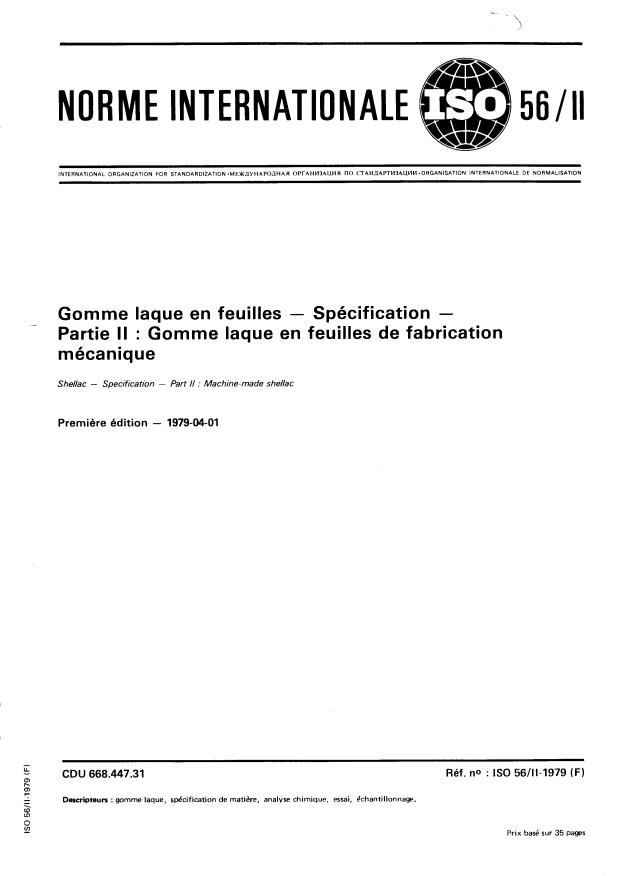
INTERNATIONAL STANDARD
INTERNATIONAL ORGANIZATION FOR STANDARDIZATIONWWE~YHAPO~HAR OPrAHM3Al&lR fl0 CTAH~APTM3A~MbWORGANISATION INTERNATIONALE DE NORMALISATION
Shellac - Specification - Part II : Machine-made shellac
Gomme laque en feuies - Sphcification - Partie lf : Gomme laque en feuies de fabrication mhcanique
First edition - 1979-04-01
w
-
UDC 668.447.31 Ref. No. ISO 56/11-1979 (E)
Descriptors : shellac, materials specifications, Chemical analysis, tests,$ sampling,
T
Price based on 35 pages
FOREWORD
ISO (the International Organization for Standardization) is a worldwide federation
of national Standards institutes (ISO member bodies). The work of developing
International Standards is carried out through ISO technical committees. Every
member body interested in a subject for which a technical committee has been set
up has the right to be represented on that committee. International organizations,
governmental and non-governmental, in liaison with ISO, also take part in the work.
Qraft International Standards adopted by the technical committees are circulated
to the member bodies for approval before their acceptance as International
Standards by the ISO Council.
International Standard ISO 56/ll was developed by Technical Committee
lSO/TC 50, Lac, and was circulated to the member bodies in November 1976.
lt has been approved by the member bodies of the following countries :
Austral ia Korea, Rep. of Sweden
Austria Mexico Turkey
Czechoslovakia Netherlands Yugoslavia
India Romania
The member body o f the following country expressed d
isapproval of the document
on technical grounds
Canada
This International Standard cancels and replaces ISO Recommendation R 56-1957
of which it constitutes a technical revision.
GI International Organkation for Standardkation, 1979 l
Printed in Switzerland
Acknowledgement is due for the assistance that has been derived from the specifi-
cations and publications of the American Society for Testing and Materials, the
American Bleached Shellac Manufacturers’ Association, the United States Shellac
Importers’ Association, the British Standards Institution, the Agricultural
Marketing Adviser to the Government of India, Messrs. Angelo Brothers Ltd.,
Calcutta, and the lndian Lac Research Institute. Considerable assitance has been
derived also from A Handbook of Shellac Analysis, by M. Rangaswami and H. K.
Sen, issued by the India Lac Research Institute.
Page
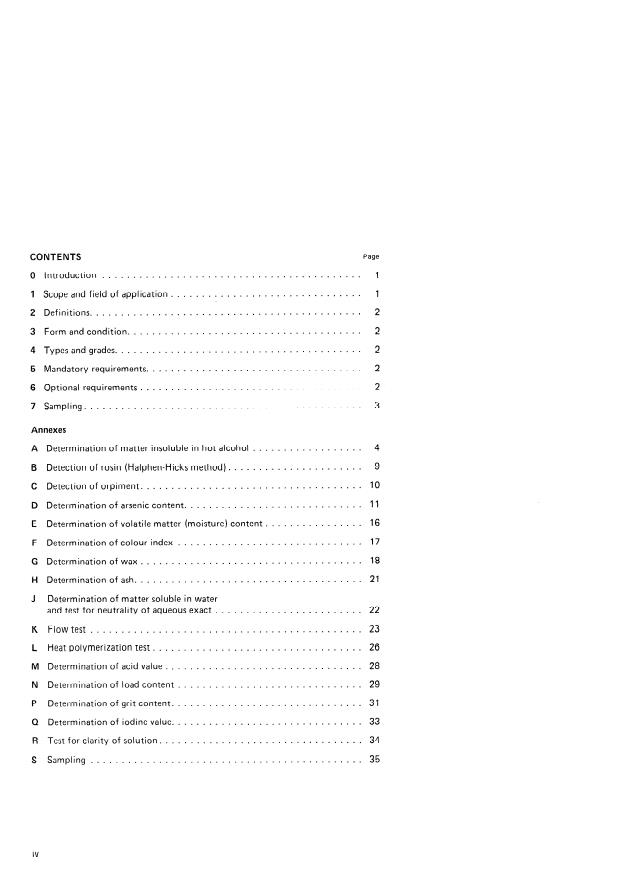
CONTENTS
..........................................
0 lntroduction 1
...............................
1 Scope and field of application 1
........................................... 2
2 Definitions.
..................................... 2
3 Form and condition.
....................................... 2
4 Types and grades.
5 Mandatory requirements. . 2
....................................
6 Optional requirements 2
7 Sampling . 3
Annexes
A Determination of matter insoluble in hot alcohol . 4
...................... 9
B Detection of rosin (Halphen-Hicks method)
................................... 10
C Detection of orpiment.
............................ 11
D Determination of arsenic content.
................ 16
E Determination of volatile matter (moisture) content
.............................. 17
F Determination of colour index
.................................... 18
G Determination of wax
.................................... 21
W Determination of ash.
J Determination of matter soluble in water
and test for neutrality of aqueous exact . 22
K Flowtest . 23
.................................. 26
L Heat polymerization test
................................ 28
M Determination of acid value
N Determination of load content . 29
..............................
P Determination of grit content. 31
..............................
Q Determination of iodine value. 33
................................
R Test for clarity of solution. 34
S Sampling . . ._. 35
iV
INTERNATIONAL STANDARD ISO 56/ll-1979 (E)
Part II : Machine-made shellac
Shellac - Specification -
0 INTRODUCTION f) wax,
0.1 ISO/R 56, published in 1957, covered shellac, hand- 9) asb
made as well as machine-made. lt has been revised into two
h) matter soluble in water,
Parts, one for each kind.
j) flow test,
0.2 The types and grades of machine-made shellac have
k) heat polymerization test,
been found to require modification in Order that the
characteristics of a given consignment of this material may
m) acid value,
be clearly defined. Machine-made shellac has now been
n) lead content,
divided into four main types, on the basis of the method of
manufacture, and then into grades, within each type, on the
pl grit,
basis of colour. Requirements for matter insoluble in hot
.alcohol, colour index and ash have now been prescribed
q) iodine value, and
based on the new System of types and grades.
r) clarity of Solution,
0.3 Whereas in lSO/R 56 the limit for wax was left subject
are optional.
to agreement between the purchaser and the supplier,
definite values have now been included. New requirements
0.6 The sizes of sieves given in the text of this Inter-
have been laid down for grit, iodine value, clarity of
national Standard have been indicated in terms of aperture
Solution, and alkalinity of the aqueous extract.
dimensions, in accordance with ISO 565, Test sieves -
Woven metal wire cloth and perforated plate - Nominal
0.4 The requirement for non-volatile matter soluble in
sizes of apertures.
cold alcohol has not been retained as the requirement is
applied in practice to waste products of lac only. The
0.7 For the purpose of deciding whether a particular re-
methods for quantitative determination of rosin have also
quirement of this International Standard is complied with,
been dropped since this type of adulteration is no longer
the final value, observed or calculated, expressing the result
in evidente. In ISO/R 56, an alternative method (the
of a test or an analysis, shall be rounded off to the same
Westinghouse method) was given for determination of
number of places as the specified value, it being always
flow. In this International Standard it has been dropped.
understood that the analyst will carry out the determi-
nation to at least one place more than in the specified value.
0.5 Three of the requirements for machine-made shellac,
namely those for
1 SCOPE AND FIELD OF APPLICATION
a) matter insoluble in hot alcohol,
1.1
This International Standard specifies requirements and
b) absence of rosin, and
corresponding methods of test for machine-made shellac.
c) absence of orpiment,
1.2 This International Standard is intended chiefly to
are included in this International Standard as essential
cover the technical provisions for guidance in the purchase
clauses.
of the material, but does not include all the necessary
The remaining requirements, namely those for provisions of a contract.
d) volatile matter (moisture),
1.3 The limits prescribed in this International Standard
are limits for rejection.
e) colour index,
ISO 56/11-1979 (E)
5.2 Rosin
2 DEFINITIONS
Machine-made shellac shall not contain any rosin, when
For the purpose of this International Standard, the
tested by the method specified in annex B.
following definitions apply.
5.3 Orpiment
2.1 sticklac : The natura1 product of lac insects.
5.3.1 Machine-made shellac shall not contain any
2.2 seedlac : The product obtained by washing crushed
orpiment, when tested by the method specified in annex C,
sticklac.
except when a specified percentage is agreed to between the
purchaser and the supplier, in which case the determination
2.3 shellac : The product obtained by refining seedlac by
shall be carried out as specified in annex D, method 1.
heat process or by solvent process or by both heat and
solvent procecses.
5.3.2 When the material is required for food or drug
preparations, the determination of traces of arsenic, too
2.4 approved Sample : The Sample aggreed upon between
small for titration by method l in annex D, shall be carried
the purchaser and the supplier as the Standard for colour
out by method II in annex D.
and appearance.
6 OPTIONAL REQUIREMENTS
The optional requirements given below shall be subject to
3 FORM AND CONDITION
agreement between the purchaser and the supplier.
Machine-made shellac shall be in the form of flakes, sheets,
buttoms, or any other from agreed between the purchaser
6.1 Volatile matter (moisture)
and the supplier.
Machine-made shellac shall not contain more than 2,0 %
(m/m) volatile matter (moisture) as determined by the
method specified in annex E.
4 TYPES AND GRADES
4.1 Four types of machine-made shellac are specified, 6.2 Colour index or colour and appearance
namely
6.2.1 The colour index of machine-made shellac, as
- produced by heat process. determined by the method specified in annex F, shall not
Type 1
exceed the limits given in table 2.
Type II - produced by hot solvent process.
TABLE 2
Type Ill - de-waxed.
Type IV - decolorized and de-waxed.
4.2 Five grades in each of types I and II, namely grades 1,
32 22 35 50
1, II 8
in each of types I II
2, 3, 4 and 5 are specified. Four grades
and IV, namely grades 1, 2, 3, and 4 are specified.
9 20 35 50 -
Ill
IV 03 2s 3,5 5,0 -
b
5 MANDATORY REQUIREMENTS
6.2.2 Alternatively, the appareance and colour of the
5.1 Matter insoluble in hot alcohol
shellac shall be not inferior to those of an approved Sample
Machine-made shellac shall not contain matter insoluble in
when judged by visual examination.
hot alcohol, determined by either of the methods specified
in annex A, as agreed between the purchaser and the
6.3 Wax
supplier, in excess of the Iimits given in table 1.
Machine-made shellac of type I and type II shall not
contain more than 5,5 % (mlm) of wax, and that of
TABLE 1
type Ill and type IV not more than 0,2 % (mlm) of wax,
when tested in accordance with method I and method II
Maximum
Type
respectively, specified in annex G.
% (mh)
I I I
6.4 Ash
Machine-made shellac shall yield not more than 0,3 %
(m/m) of ash, as determined by the method specified in
annex H.
ISO 56/ll-1979 (E)
6.9 Lead content
6.5 Matter soluble in water
The maximum limit for lead content shall be subject to
Machine-made shellac shall not contain more than 0,5 %
agreement between the purchaser and the supplier and the
(m/m) of matter soluble in water and the aqueous extract
lead content shall be determined by the method specified
shall not be acidic to methyl red or alkaline to bromo-
in annex N.
thymol blue. Matter soluble in water shall be determined
by the method specified in annex J.
6.10 Grit content
The maximum limit for grit content shall be as agreed to
6.6 Flow test
between the purchaser and the supplier. When required, it
Machine-made shellac shall have a flow within the range
shall be determined by the method specified in annex P.
agreed to between the purchaser and the supplier, when
tested by the method specified in annex K.
6.11 lodine value
The maximum limit for the iodine value shall be as agreed
6.7 Heat polymerization test to between the purchaser and the supplier. When required,
it shall be determined by either of the two methods
Machine-made shellac shall have a heat polymerization time
specified in annex 0.
within the range agreed to between the purchaser and the
supplier, when tested by the method specified in annex L.
6.12 Clarity of Solution
Unless otherwise agreed, the temperature of test shall be
150 Oc.
This requirement is applicable to type 111 and type IV
shellac and shall be subject to agreement between the
purchaser and the supplier. The shellac shall show no
6.8 Acid value
turbidity when tested by the method specified in annex R.
The acid value of the machine-made shellac shall be fixed, if
desired, by agreement between the purchaser and the
7 SAMPLING
supplier. lt shall be determined by the method specified
in annex M. Samples shall be taken in the manner specified in annex S.
%SO 56/ll-1979 (E)
ANNEX A
(See 5.1)
DETERMINATION OF MATTER INSOLUBLE IN HOT ALCOHOL
having a width of approximately 100 mm and other
Al PRINCIPLE
dimensions as given in figure 2.
Extraction of a test Portion with 95 % (V/V) ethanol and
weighing of the undissolved residue. The cover has a flanged hole of diameter 57 + 1 mm, for
a 200 ml beaker, and also a hole of diameter 35 + 1 mm
through which the top of the filter tube (A.2.2.1.4)
projects. Directly below this hole, in the bottom of the
A.2 METHOD I
bath, is a flanged hole, of diameter 25 + 1 mm, to hold the
rubber stopper, through which the stem of the filter tube
A.2.1 Reagent
extends, to discharge into the flask (A.2.2.1.3). The hot
water bath is mounted on a low tripod or stand.
Alcohol, 95 % (WV) ethanol or 95 % (V/V) denatured
spirit.
A.2.2.5 Gas burner, low form, adjustable, Bunsen type,
carrying a draught shield, or any other suitable heating
A.2.2 Apparatus
device.
Ordinary laboratory apparatus and
A.2.2.6 Electric oven, capable of being maintained at
100 + 2 “c.
Extraction apparatus, comprising
A.2.2.7 Desiccator, containing sulphuric acid (e i ,84 g/mI).
A.2.2.1.1 Condenser, all glass, of the type and dimensions
shown in figure 1, the tip of which is tut at an angle of
45 ‘. The condenser has two holes in its tip through which A.2.2.8 Balance, accurate to 0,002 g.
Passes the wire holding the Siphon tube (A.2.2.1.2).
A.2.2.9 Stop-watch or good two-minute sand-glass.
A.2.2.1.2 Siphon tube, of glass, of the type and
dimensions shown in figure 1. The Siphon tube has two
A.2.3 Preparation of extraction cartridge
holes near the top for a wire to be fastened to the
condenser tip, leaving about 6 mm space between the top
A.2.3.1 Place 125 ml of the alcohol (A.2.1) in the conical
sf the tube and the condenser tip.
flask (A.2.2.1.3) and a new extraction cartridge (A.2.2.2) in
the Siphon tube (A.2.2.1.2). Introduce the Siphon tube into
A.2.2.1.3 Conical flask, heat resistant, wide mouthed,
the flask and connect it to the condenser (A.2.2.1 .l),
conical, preferably of borosilicate glass of height
making Sure that there is an ample flow of cold water
approximately 175 mm and approximately 50 mm inside
through the condenser. Adjust the rate of heating so as to
diameter at the top. The flask has a tight-fitting cork of
give a cycle of fiiling and emptying in the Siphon tube every
depth 25 mm, bored to fit the stem of the condenser. The
2 min and extract for 30 min. Dry the cartridge in the oven
bottom of the cork is just above the holes for the wire (A.2.2.6), maintained at 100 + 2 “C. After 2 h, weigh it in
in the condenser. To support the flask, a suitable ring
the tared weighing bottle (A.2.2.3), which has been kept in
support with iron clamp and nickel-chromium or iron gauze
the desiccator (A.2.2.7), Iifting the stopper of the bottle
SS used. The gauze has no asbestos covering.
momentarily before weighing. Repeat the operations of
drying, for periods of 1 h, and weighing, until the loss in
mass between two successive weighings does not exceed
IJ.2.2.1.4 Carbon filter tube, of the type and dimensions
shown in figure 1, having a light spiral spring at the bottom 0,002 g.
to hold up the extraction cartridge (A.2.2.2). The stem of
the filter tube is fitted with a rubber stopper and firmly
A.2.3.2 Use only new cartridges. A number of cartridges
held in the hot water bath (A.2.2.4).
may be extracted, dried, weighed and kept in weighing
bottles in the desiccator until needed for use.
A.2.2.2 Extraction cartridges, of fat-free Paper, of
diameter approximately 25 mm and height approximately
A.2.4 Test Portion
60 mm.
Before analysis, thoroughly mix the “test Sample”
As2.2.3 Weighing bottle, glass-stoppered, of height
(see S.3.1 of annex S) by rolling on Paper, at least ten
approximately 80 mm and diameter approximately 40 mm.
times, to ensure uniformity of the test Sample. Weigh,
directly from the Paper, 4,5 to 5,5 g of the Sample, to an
accuracy of 0,Ol g.
A.2.2.4 Hot water bath, made of topper or stainless steel,
ISO 56/ll-1979 (E)
Dimensions in millimetres
All dimensions are approximate
@ int. 32 + 05
M
@ext. 18+1
+I
%
C#I ext.33 $ int.3to 3,5
ff-
\ v
.) \
Co
Siphon tube
+I
:
)
$ ext. 32 + 1 ’.
Al+
‘r.f I
x
1’ L,
:
:
‘) . (
/’ ‘,
(v:
+I
$I ext. 7to 7,5
E
Q int. 11 + 1
f-W
Condenser Filter tube
FIGURE 1 - Extraction apparatus for determination of matter insoluble in hot alcohol (method 1)
Dimensions in m il I imetres
All dimensions are approximate
-
Qext.32+ I
$35711
@57kl
\ I
Q int.
FIGURE 2 - Hot water bath for determination of matter insoluble in hot alcohol (method 1)
ISO 56/ll-1979 (E)
1 h, and weighing until the loss in mass, between two
A.2.5 Determination
successive weighings does not exceed 0,002 g.
Place the test Portion (A.2.4) in a 200 ml tall, lipped
From the mass of the residue and the mass of the Sample,
beaker, add 125 ml of the alcohol (A.2.1) cover with a
calculate the percentage of insoluble matter. Use the
watch-glass and place on the hot water bath (A.2.2.4)
(see figure 2). Boil the Solution vigorously for 30 min to lowest mass in calculation.
ensure complete Solution of the shellac and dispersion of
wax. Keep the volume of alcohol constant by adding from
A.2.6 Expression of results
a wash-bottle, washing down the sides of the beaker.
The matter ins01 uble i n hot alcohol is given, expressed
Meanwhile, place an extracted and weighed cartridge
as a percentage by mass, by the formula
(A.2.2.2) in the filter tube (A.2.2.1.4). Maintain the hot
water around the tube at a temperature of not less than
!Ldoo
90 “C. Wet the cartridge with hot alcohol and decant the
mO
boiling Solution into the heated cartridge until the beaker
is nearly empty.
Wash the remaining Solution and the insoluble matter
is the mass, in grams, of the test Portion
mO
into the cartridge, using a “policeman ”, if necessary, with (A.2.4);
successive portions of hot alcohol contained in a wash-
is the mass, in grams, of the residue.
ml
bottle kept hot on the water bath. Finally, wash the
cartridge from the top downwards with a fine stream of
hot alcohol. A complete washing and transfer from the
original beaker will require at least 75 ml of hot alcohol.
A.3 METHOD II
Transfer the cartridge containing the insoluble matter to
the Siphon tube (A.2.2.1.2), place 125 ml of the alcohol
A.3.1 Reagent
in the conical flask (A.2.2.1.3) and connect up the
Alcohol, 95 % (WV) ethanol or 95 % (WV) denatured
apparatus. Start the water flowing through the condenser
spirit.
(A.2.2.1.1), making Sure that there is an adequate supply
for efficient condensation. Light the burner (A.2.2.5) and
time the extraction from the first emptying of the Siphon,
A.3.2 Apparatus
running the extraction for exactly 1 h. Immediately adjust
Ordinary laboratory apparatus and
the rate of heating so that a complete filling and emptying
of the Siphon tube takes place every 2 min, as determined
Extraction apparatus’ ), consisting of Siphon tube,
by the stop-watch or preferably by the two-minute sand- A.3.2.1
glass (A.2.2.9), one for each extraction apparatus. adaptor, condenser and flask, assembled with the aid of
corks or ground glass joints so that the solvent tan be kept
In this way exactly 30 cycles per hour are accomplished.
boiling in the flask and its vapour tan pass upwards by way
lf this cycle rate is not meticulously maintained, neither
of the adaptor to the condenser. The refluxing solvent runs
check results on duplicate samples in the Same laboratory,
from the condenser into the cup of the Siphon tube.
nor concordant figures from one Iaboratory to another tan
be obtained, even when working on the Same Standard
A.3.2.1.1 Siphon tube, of glass, of the type shown in
Sample. lt is also necessary to protect the apparatus from
figure 3, having approximate internal height of 52 mm and
draughts while in Operation, otherwise the proper cycle
a minimum internal diameter of 32 mm, resting in an
rate cannot be maintained.
adaptor tube in such a way that the Siphon tube is
Occasionally, shellacs are encountered which do not surrounded by the ascending vapours of the boiling solvent
(See figure 3).
yield the required number of 30 siphonings per hour,
due to slow filtration. In these cases, continue the
extraction until 30 siphonings have been accomplished or
A.3.2.1.2 Condenser, of any convenient design.
repeat the test with a 2 g test Portion and report the
Sample as abnormal or slow filtering.
A.3.2.1.3 Flask, of any convenient size.
Remove the cartridge, drain in an upright position on filter
A.3.2.2 Filter Paper, of diameter 125 mm, medium grade.
Paper and dry in the oven (A.2.2.6), maintained at
100 t 2 “C. Aft d
er rying for 2 h, place the cartridge in the
weighing bottle (A.2.2.3), cool in the desiccator (A.2.2.7)
and weigh, removing the stopper momentarily just before
weighing. Repeat the operations of drying, for periods of
The type of extraction apparatus used is not critical, provided that it is of such a design as to ensure a continuous series of extractions at
1)
approximately the boiling temperature of the solvent. If preferred, the apparatus specified in method l (see clause A.2), consisting of Siphon
tube, condenser and flask, could be satisfactorily used.
ISO 56/11-1979 (E)
Dimensions in m il I imetres
All dimensions are approximate
Fitted th rough cork
to reflux condenser
Tube
flask
FIGURE 3 - Siphon tube and adaptor
A.3.2.4 Gas burner, low form, adjustable, Bunsen type, oven (A.3.2.5), maintained at 100 + 2 “C for 30 min.
carrying a draught shield, or any other suitable heating Rapidly transfer to separate weighing bottles (A.3.2.3)
device. which have been kept in the desiccator (A.3.2.6). Place
each bottle and its contents back in the desiccator for
20 min, then weigh by counterbalance, preferably using
A.3.2.5 Electric oven, capable of being maintained
a rapid-weighing balance of the aperiodic type.
at 100?2 ”C.
Place the test Portion (A-3-3) in the filter Paper envelope S;
A.3.2.6 Desiccator, containing sulphuric acid (p 1,84 g/mI).
fold in the original folds, taking care not to leave any
channel through which finely divided material might
A.3.2.7 Balance, accurate to 0,002 g.
escape. Again enclose in Paper C and secure with thread.
Place the resulting envelope in a 100 ml beaker and cover it
with the alcohol (A.3.1). Allow to stand overnight at room
A.3.3 Test Portion ’
temperature. Place the envelope in the cup of the Siphon
Weigh 4,5 to 5,5 g of the “test Sample” of shellac (See S.3.1
tube (A.3.2.1.1) and extract continuously with hot alcohol
of annex S) to an accuracy of 0,Ol g.
for 4 h. Keep the envelope wholly below the surface of the
alcohol, when the cup is full. Maintain a rapid rate of
A.3.4 Determination extraction throughout, though the extract time taken for
the cycle of filling and emptying the cup of the Siphon tube
Fold the filter Paper (A.3.2.2) so that it forms a completely
is not critical.
closed envelope (see figure 4). Mark this Paper S (for
Sample); wrap it closely in a second filter Paper marked C At the end of the specified time, remove the Paper
(for counterpoise). Separate the filter Papers and dry in the envelope, allow to drain, separate the two Papers, dry each
lSQ 56/11-1979 (E)
on a glass plate in air for 15 min and then for 2 h in the
operations of drying and weighing until the differente
oven, maintained at 100 + 2 “C. Place the Papers rapidly
between two successive weighings is less than 0,002 g. Use
in their respective weighing bottles, allow to stand in the
the lowest mass in the calculation.
desiccator for 20 min and again weigh by counterbalance,
after momentarily removing and replacing the Stoppers in
the usual manner. Dry the Papers for a further period of
A.3.5 Expression of results
1 h at a temperature of 100 -t 2 “C and weigh again. If
there is a loss in mass in excess of 0,002 g, repeat the
As for method I (see A.2.6).
@@
S
@
S
e
FIGURE 4 - Folding of filter Paper
ISO 56/1 I-l979 (E)
ANNEX B
(See 5.2)
DETECTION OF ROSIN (HALPHEN-HICKS METHOD)
B.l REAGENTS B.2.7 Watch-glass.
B.l.l Ethanol, absolute.
B.3 PROCEDURE
B.1.2 Acetic acid, glacial.
8.3.1 Place about 2 g of the “test Sample” (see S.3.1 of
annex S) in the 250 ml conical flask (B.2.1) add 10 ml of
B.l.3 Petroleum ether, boiling Point below 80 “C.
the ethanol (B.l.l) or of the glacial acetic acid (B.1.2) and
Shake until dissolution of the resinous materials is
B.1.4 Solution A, comprising 1 part by volume of Phenol
complete. Then add slowly and with continuous agitation
dissoived in 2 Parts by volume of carbon tetrachloride.
50 ml of the Petroleum ether (B.1.3). After the addition
of the Petroleum ether, add 50 ml of water in exactly the
B.1.5 Solution B, comprising 1 part by volume of bromine same manner, transfer to the small separating funnel (B.2.2)
dissolved in 4 Parts by volume of carbon tetrachloride. and allow it to stand until the Petroleum ether separates.
Draw off the water layer, wash the Petroleum ether layer
once with water and then filter the Petroleum ether extract
through a dry filter Paper (B.2.3) into the evaporating dish
(B.2.4). Evaporate to dryness on the steam bath (B.2.5).
B.2 APPARATUS
B.3.2 Add 1 to 2 ml of Solution A (B.1.4) to the residue
B.2.1 Conical flask, of capacity 250 ml.
left after evaporation of the Solution in Petroleum ether
and pour this mixture into the cavity of the porcelain
B.2.2 Separating funnel.
colour-reaction plate (8.2.6) until it just fills the
depression. Immediately fill an adjacent cavity with
B.2.3 Filter Paper.
Solution B (B.1.5). Cover the plate with the inverted watch-
glass (B.2.7) and note the colour, if any, produced in
B.2.4 Evaporating dish, round bottomed.
solution A by the action of the bromine vapour from
Solution B.
B.2.5 Steam bath.
B.3.3 A decided purple or deep indigo blue colour is an
B.2.6 Porcelain colour-reaction plate. indication of the presence of rosin.
ISO 56/11-1979 (E)
ANNEX C
(See 5.3.1)
DETECTION OF ORPIMENT
C.l PRINCIPLE C.3 PROCEDURE
The presence of 0,5 % (m/m) or more of orpiment in C.3.1 Prepare in a small conical flask a 200 g/l Solution of
shellac gives the shellac flake a yellow, opaque appearance. the shellac in the alcohol (C.2.1) or borax Solution (C.2.2).
Even a trace of orpiment tan be detected from a Solution Allow the Solution to-stand, to allow any orpiment present
in ethanol or in aqueous borax if the shellac is free from to settle in a layer at the bottom. Examine from below.
dirt.
C.3.2 Yellow particles of orpiment will be visible if it is
present; 0,3 % (mlm) orpiment gives a continuous layer.
C.2 REAGENTS
C.3.2.1 This method is most sensitive when the alcohol is
C.2.1 Alcohol, 95 % (VW) ethanol or 95 % (VlV) de-
cooled to 0 “C before preparing the solution. The same
natured spirit.
effect is not obtained by dissolving at room temperature
and then cooling because, under these conditions, the
C.2.2 Borax, 50 g/l Solution of sodium tetraborate deca- agglomerates of wax are liable to hold the orpiment
hydrate (Na,B,O,4OH,O) in distilled water. particles in Suspension.
ISO 56/11-1979 (E)
ANNEX D
(See 5.3.1 and 5.3.2)
DETERMINATION OF ARSENIC CONTENT
D.2.3 Apparatus
D.l SCOPE
Ordinary laboratory apparatus and
This annex specifies two methods for the determination of
arsenic content, one for an appreciable amount of arsenic
and the other for traces of arsenic.
D.2.3.1 Kjeldahl flask, made of heat-resistant glass or
silica, of capacity 100 or 200 ml.
D.2 METHOD I (Appreciable amount of arsenic)
D.2.3.2 Kjeldahl distillation apparatus, as shown in
figure 5.
D.2.1 Principle
Digestion of the shellac with nitric acid and sulphuric acid,
treatment of the Solution with a chloride-hydrazine-
0.2.4 Test Portion
bromide mixture, distillation, and titration of the arsenic
compound obtained by a suitable method. Weigh 4,5 to 5,5 g of the “test Sample” (see S.3.1 of
annex S) to an accuracy of 0,Ol g.
D.2.2 Reagents
During the analysis, use only reagents of recognized analy-
0.2.5 Determination
tical grade and only distilled water or water of equivalent
purity .
D.2.5.1 Place the test Portion (0.2.4) in the Kjeldahl
flask (D.2.3.1), add 10 ml of the dilute nitric acid solution
D.2.2.1 Sodium hydrogen carbonate.
(D.2.2.5) and heat the mixture until any initial vigorous
reaction subsides and ceases. Cool and add gradually IO ml
D.2.2.2 Nitrit acid, p 1,42 g/ml.
of the sulphuric acid (0.2.2.3) at such a rate as to prevent
excessive frothing or heating (10 min are usually required)
D.2.2.3 Sulphuric acid, p 1,84 g/ml. and continue heating. Add to the hot Solution 5 ml of the
nitric acid (0.2.2.2) in small portions, and boil until colour-
less. If necessary, add the nitric acid in further small
D.2.2.4 Hydrochlorit acid, p 1,16 g/m 1.
portions at a time. Note for the purpose of the blank test
the total volume of nitric acid added. (The digestion usually
D.2.2.5 Nitrit acid, dilute (3 + 7) solution.
takes about 30 min.) Cool, dilute with 50 ml of water and
transfer to the flask of the distillation apparatus (0.2.3.2).
D.2.2.6 Sodium hydroxide, approximately 2 N Solution.
Boil the Solution, without inserting the condensing arm, till
the bulk is reduced to about 10 ml or until white fumes
D.2.2.7 Chloride-hydrazine-bromide mixture.
appear. Cool, dilute and again boil down to 10 ml; cool and
add 7 ml of water. Cool the liquid weil, add 5 g of the
Mix 5 g of sodium chloride, 0,5 g of hydrazine sulphate and
chloride-hydrazine-bromide mixture (D.2.2.7), followed
0,02 g of potassium bromide and store in a tightly
rapidly by 10 ml of the hydrochloric acid (0.2.2.4).
stoppered bottle.
0.2.5.2 Fit the condenser quickly and distil the liquid
D.2.2.8 Potassium bromate, 0,Ol N Standard volumetric
into 20 ml of water, the exit tube dipping below the surface
Solution.
of the liquid; cool in ice until about 5 min after the
condenser is full of steam. Dilute the distillate to 100 ml,
D.2.2.9 lodine, 0,Ol N Standard volumetric Solution.
add a few drops of the methyl orange indicator Solution
(D.2.2.10), heat the Solution to 80 ‘C, and titrate with the
D.2.2.10 Methyl orange indicator, 0,4 g/l Solution in 20 %
Standard volumetric potassium bromate Solution (0.2.2.8)
(WV) ethanol.-
or, alternatively, nearly neutralize the distillate with the
sodium hydroxide Solution (D.2.2.6), then add 3 g excess
D.2.2.11 Starch Solution.
of the sodium hydrogen carbonate (0.2.2.1) and titrate the
Solution with the Standard volumetric iodine Solution
Make a Paste of 0,2 g of soluble starch in cold water and
(D.2.2.9), using the starch Solution (D.2.2.11) as indicator.
pour into 100 ml of boiling water. Boil for 5 min, cool and
bottle.
D.2.5.3 Make sure that no solid material Comes in contact
Prepare a fresh Solution every 2 or 3 days. with the ground-in Portion of the flask.
60 56/11-1979 (E)
Dimensions in millimetres
25 ml
Y
25 ml
\ 100 or 200 ml
FIGURE 5 - Kjeldahl distillation apparatus for use in the determination of arsenic content (method 1)
D.2.6 Blank test Standard volumetric iodine Solution (0.2.2.9) used for
the determination (D.2.5), after applying correction for
Carry out a blank test at the Same time as the
the blank test;
determination, following the same procedure and using
the Same reagents, but omitting the test Portion. T is the normality of the Standard volumetric
potassium bromate Solution (0.2.2.8) or of the Standard
volumetric iodine Solution (0.2.2.9);
D.2.7 Expression of results
m is the mass, in grams, of the test Portion (D.2.4).
The arsenic (As) content is given, expressed as a percentage
by mass of arsenic(lll) sulphide (As&), by the formula
D.3 METHOD II (Traces of arsenic)
6,15 V T
m
D.3.1 Reagents
where
During the analysis,
use only reagents of recognized
V is the volume, in millilitres, of the Standard volu- analytical grade and only distilled water or water of
metric potassium bromate Solution (D.2.2.8) or of the equivalent purity. All the reagents, with the exception of
ISO 56/ll-1979 (E)
(0.3.1.1 1) and (D.3.1.12), shall be free from traces of 0.3.1.13 Mercury(lI) chloride Paper, consisting of smooth
arsenic. white filter Paper of width not less than 25 mm, soaked in a
saturated Solution of mercury(ll) chloride in water, pressed
to remove superfluous Solution, and dried at 60 “C in the
D.3.1.1 Potassium iodide, crystals or in the ferm of
dark. The grade of the filter Paper shall be such that the
powder.
grammage is between 65 and 120 g/m2 ; the thickness, in
millimetres, of 400 Papers shall be approximately equal,
D.3.1.2 Zinc, granulated, complying with the following
numerically, to the grammage, in grams per Square metre.
test :
Mercury(I 1) chloride Paper should be sotred in a stoppered
Take 50 ml of water, 10 ml of the stannated hydrochloric
bottle in the dark. Papers which have been exposed to
acid Solution (0.3.1.8) and 0,l ml of the dilute Solution of
sunlight or to ammonia gas should not be used as they give
arsenic (0.3.1.12) in the wide-mouth bottle (0.3.2.1). Add
a lighter coloured stain or no stain at all when employed
1 g of the potassium iodide (0.3.1.1) and 10 g of zinc.
in the quantitative test for arsenic.
Quickly place the prepared glass tube (0.3.2.2) in Position.
Allow the reaction to continue for 1 h. A faint but distinct
0.3.1.14 Methyl orange indicator, 0,4 g/l Solution in 20 %
yellow stain shall be produced on the mercury(ll) chloride
(WV) ethanol.
Paper (0.3.1.13).
D.3.2 Apparatus
0.3.1.3 Nitrit acid, p 1,42 g/mI.
The follow ing apparatus assembled as shown in figure 6 is
requ ired.
0.3.1.4 Sulphuric acid, p 1,84 g/mI.
D.3.2.1 Wide-mouth bottle, of capacity 120 ml.
D.3.1.5 Hydrochlorit acid, p 1,16 g/m 1.
D.3.2.2 Glass tube, made from ordinary glass tubing, and
D.3.1.6 Nitrit acid, dilute ( 3 + 7) solution.
having a total length of 200 mm, an internal diameter of
exactly 6,5 mm and an external diameter of about 8 mm.
D.3.1.7 Tin(ll) chloride Solution.
lt shall be drawn out at one end to a diameter of about
Dilute 60 ml of concentrated hydrochloric acid with 20 ml
1 mm and a hole not less than 2 mm in diameter shall be
of water, add to it 20 g of tin, heat gently until gas ceases
blown in the side of the tube, near the constricted part.
to be evolved, and add sufficient water to produce 100 ml,
The upper end of the tube shall be tut off Square and shall
allowing the undissolved tin to remain in the Solution.
be either rounded off slightly or ground smooth.
Decant the clear Solution, add an equal volume of
concentrated hydrochloric acid, boil down to the original
D.3.2.3 Rubber bungs, three
volume and filter through a finegrained filter Paper.
Cne shall fit exactly into the mouth of the wide-mouth
bottle and shall have a hole bored centrally to take the tube
D.3.1.8 Stannated hydrochloric acid solution.
from its constricted end. Esch of the other two rubber
Mix together 1 ml of the tin(ll) chloride Solution (0.3.1.7)
bungs (about 25 mm x 25 mm) shall have a hole of
and 100 ml sf the hydrochloric acid (0.3.1.5).
diameter 6,5 mm, bored centrally, and shall be fitted with
a rubber band or spring Clip for holding them tightly
D.3.1.9 Lead acetate, 100 g/l Solution in distilled water, together.
recently boiled.
0.3.2.4 Preparation of the glass tube.
D.3.1 .lO Chloride-hydrazine-bromide mixture.
Meisten a small quantity of cotton wool with the lead
acetate (D.3.1.9) and then dry it in a dust-free atmosphere.
Lightly pack the glass tube (0.3.2.2) with this cotton wool,
SO that the upper surface of the cotton wool is not less than
25 mm below the top of the tube. Insert the upper end of
the tube into the narrow end of the one of the pair of
D.3.1 .11 Arsenic, concentrated Solution.
rubber bungs (D.3.2.3), either to a depth of about 10 mm
Dissolve 0,132 g of arsenic trioxide in 50 ml of the hydro-
when the tube has a rounded-off end, or so that the ground
’
chloric acid (0.3.1.5) and add sufficient water to produce
end of the tube is flush with the larger end of the bung.
100 ml.
Place a piece of the mercury(lI) chloride Paper (D.3.1.11)
flat on the top of the bung. Place the other bung over this
D.3.1.12 Arsenic, dilute Solution. with its larger end in contact with the piece of mercury(II)
chloride Paper. Fasten the two bungs by means of the
Dilute 1 ml of the concentrated Solution of arsenic
rubber band or the spring Clip, in such a manner that the
(0.3.1 .ll) with sufficient water to produce 100 ml.
bores of the two bungs (or the upper bung and the glass
1 ml of this Solution contain 0,Ol mg of arsenic (or tube) form a continuous tube of diameter 6,5 mm
0,0132 mg of As,O,). interrupted by a diagram of mercury(lI) chloride paper-
ISO 56/11-1979 (E)
oride a water bath and evaporate the residue twice to dryness
Any other method of attaching the mercury( 11) ch
with 5 ml of water to remove any nitric acid. Dissolve the
Paper may be used, provided that
final residue by warming in 3 ml of the sulphuric acid
I the
a) the whole of the evolved gas Passes throug
(D.3.1.4), cool and dilute with water. Transfer the whole
Paper;
of the Solution to the wide-mouth bottle (D.3.2.1), add
15 ml of the stannated hydrochloric acid Solution (0.3.1.8)
b) the Portion of the Paper in contact with the gas is
and 1 g of the potassium iodide (0.3.1.1). Then add 10 g
a circle of diameter 6,5 mm;
of the zinc (D.3.1.2). Quickly place the prepared glass
c) the Paper is protected from sunlight during the test. tube (0.3.2.2) in Position. Allow the reaction to
continue for 40 min. Remove the piece of mercury(I 1)
chloride Paper at the end of this period. If arsenic is present
0.3.3 Procedure
in the material, compare the yellow stain produced on the
D.3.3.1 Treat 5 g of the “test Sample” exactly in the
mercuric chloride Paper, by daylight, with the Standard
manner prescribed in D.2.5.1 and then proceed as follows.
stains prepared as described under D.3.3.4. If the stain
in this test exceeds that equivalent to 0,02 mg of arsenic
D.3.3.2 Fit the condenser quickly and distil the liquid trioxide (As,O& make up the Solution to a known volume
into a mixture of 10 ml of water and 2 ml of the nitric with dilute sulphuric acid (1 : 8) and take an aliquot
acid (0.3.1.3). Then evaporate the distillate to dryness on Portion to produce a stain suitable for matthing.
Dimensions in millimetres
Mercury (1 I ) chloride
Paper
Spring cl ips
Cotton wool
with lead acetate
.@ 2 min.
Wide-mou th bottle
of capacity 120 ml
Granulated zinc
FIGURE 6 - Apparatus for the determination of arsenic content (method II )
ISO 56/11-1979 (E)
The reaction may be accelerated by placing the apparatus sol utions as described under 0.3.3.2 to prepare the
on a warm surface, care being taken that the mercury( II) sta ndard stains.
chloride Paper remains quite dry throughout the test. The
Make Sure that no solid material
Comes in contact with
most suitable temperature for carrying out the test is
the ground -in Portion of the bottle.
generally about 40 ‘C, but because the rate of evolution of
the gas varies somewhat with different batches of zinc, the
temperature may be adjusted to obtain a regular, but not
D.3.4 Blank test
too violent, evolution of gas. The tube should be washed
Carry out a blank test in parallel with the determination,
with concentrated hydrochloric acid. rinsed with water, and
following the Same procedure and using the same quantities
dried between successive tests.
of all the reagents, but omitting the test Portion. No visible
stain should be produced on the mercury(ll) chloride
D.3.3.3 Compare th e stains with freshl y prepare d Standard
Paper.
stains immediately at the completion of the test.
0.3.3.4 Prepare the Standard stains as follows :
D.3.5 Expression of results
Mix together 50 ml of water, 10 ml of the stannated Express the arsenic content of the shellac Sample as Parts of
hydrochloric acid Solution and appropriate volumes of the
arsenic (As) or arsenic trioxide Oxide (As,OJ per million
dilute Solution of arsenic (D.3.1.12). Treat the resulting Parts of shellac.
ISO 56/ll-1979 (E)
ANNEX E
(See 6.1)
DETERMINATION OF VOLATILE MATTER (MOISTURE) CONTENT
E.1 PRINCIPLE E.3.2 Keep the dish with the test Portion, without
covering it, in the oven (E.2.2) maintained at 40 2 2 “C for
Heating of a weighed test Portion of the “Sample as
4 h. At the end of this period, transfer the dish and cover
received” at 40 It: 2 “C f or 4 h followed by storage over
to a vacuum desiccator (E.2.3). Immediately evacuate the
concentrated sulphuric acid in vacuo for 18 h.
desiccator and keep the Sample uncovered in vacuo for
18 h. Remove the dish, cover it with the ground glass cover
and immediately weigh.
E.2 APPARATUS
E.2.1 Flat-bottomed dish, of 75 mm diameter, provided
with a ground glass cover.
E.2.2 Oven, well ventilated capable of being controlled at
40 + 2 “c.
E.4 EXPRESSION OF RESULTS
The volatile matte r (moisture) tonten t is given, expressed as
E.2.3 Vacuum desiccator, containing sulphuric acid
a percentage by m ass, by the f ormula
(p 1,84 g/mI) as desiccant.
“0 -ml
x 100
E.3 PROCEDURE mO
E.3.1 Use the “Sample as received” ground to specified
size (see S.3.2 of annex S) for this test. Weigh the clean,
m. is the mass, in grams, of the test Portion before
dry, flat-bottomed dish with ground glass cover (E.2.1).
drying;
Transfer approximately 2 g of the powdered Sample of the
dish, cover it with the ground glass cover and weigh it is the mass, in grams, of the test portion after
ml
again. The differente gives the mass of the test Portion. drying.
ISO 56/ll-1979 (E)
ANNEX F
(See 6.2.1)
DETERMINATION OF COLOUR INDEX
F.l PRINCIPLE F.4.2 Pipette 5 ml of the filtered shellac Solution into a
thin-walled test tube (F.3.2). Take 5 ml of the appropriate
Comparison of the colour of a Standard Solution of iodine
Standard iodine Solution, (F.2.2) or (F.2.3), in another test
with a Solution of the shellac in ethanol, by diluting either
tube (F.3.2) for matthing. Compare the colour of the two
Solution progressively until a close match is obtained.
solutions, holding the test tubes against the light with a
piece of moistened filter Paper or opal glass interposed
in between the light Source and the test tubes. Add the
F.2 REAGENTS
alcohol from a burette to the shellac Solution with shaking
During the analysis, use only reagents of recognized until the colour is the same as that of the Standard iodine
analytical grade and only distilled water of equivalent Solution. Note the volume of alcohol added. Alternatively,
purity. in the case of type IV shellac, if the lac Solution is lighter,
dilute the Standard Solution (F.2.3) with water contained in
a second burette until a match is obtained and note the
F.2.1 Alcohol, 95 % (V/V) rectified spirit; or 95 % (V/V)
volume of water added.
denatured spirit, provided that it is colourless.
...
,
-\
NORME INTERNATIONALE @ SS/ii
‘*=e
INTERNATIONAL ORGANIZATION FOR STANDARDIZATION .MEWIYHAPOAHAR OPrAHM3AUHI il0 CTAHAAPTMJAUMH .ORGANISATION INTERNATIONALE DE NORMALISATION
Gomme laque en feuilles - Spécification -
-
Partie II : Gomme laque en feuilles de fabrication
mécanique
Shellac - Specification - Part Il : Machine-made shellac
Première édition - 1979-04-01
I
U
Réf. no : IS0 56/11-1979 (FI
CDU 668.447.31
h
,-
c
Descripteurs : gomme laque, spécification de matière, analyse chimique, essai, échantillonnage.
- -
.
W
m
Prix basé sur 35 pages
AVANT-PROPOS
L'ISO (Organisation internationale de normalisation) est une fédération mondiale
d'organismes nationaux de normalisation (comités membres de I'ISO). L'élaboration
des Normes internationales est confiée aux comités techniques de I'ISO. Chaque
a le droit de faire partie du comité technique
comité membre intéressé par une étude
correspondant. Les organisations internationales, gouvernementales et non
I'ISO, participent également aux travaux.
gouvernementales, en liaison avec
Les projets de Normes internationales adoptés par les comités techniques sont
soumis aux comités membres pour approbation, avant leur acceptation comme
Normes internationales Dar le Conseil de I'ISO.
La Norme internationale IS0 56/11 a été élaborée par le comité technique
lSO/lC 50, Gomme laque, et a été soumise aux comités membres en
novembre 1976.
:
Les comités membres des pays suivants l'ont approuvée
Australie Mexique Tchécoslovaquie
Autriche Pays-Bas Turquie
Corée, Rép. de Roumanie Yougoslavie
Inde Suède
Le comité membre du pays suivant l'a désapprouvée pour des raisons techniques :
Canada
Cette Norme internationale annule et remplace la Recommandation
ISO/R 56-1957, dont elle constitue une révision technique.
'2 Organisation internationale de normalisation, 1979
Imarimé en Suisse
II
II faut reconnaître ici l'aide que l'on a trouvée dans les spécifications et les publica-
tions de I'American Society for Testing and Materials, de I'American Bleached
Shellac Manufacturers' Association, de l'United States Shellac Importers'
Association, de la British Standards Institution, du Conseiller pour le commerce
agricole auprès du Gouvernement de l'Inde, de la firme Angelo Brothers Ltd., de
Calcutta, et de l'Institut indien de recherches sur la gomme laque. On a aussi tiré
une aide considérable du Manuel d'analyse de la gomme laque de M. Rangaswarni
et H.K. Sen, publié par l'Institut indien de recherches sur la gomme laque.
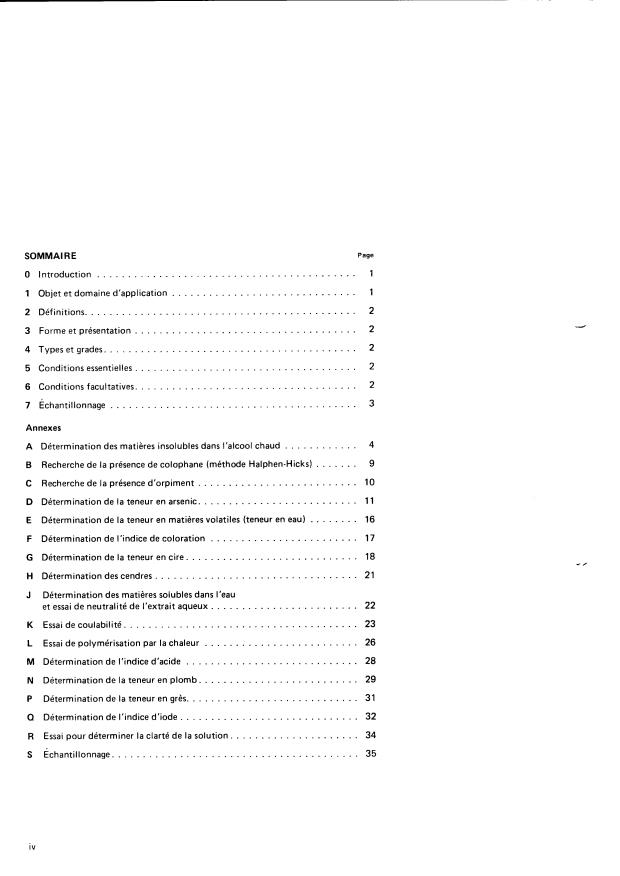
SOMMAI RE Page
O Introduction . 1
1 Objet et domaine d'application . 1
2 Définitions . 2
J
3 Forme et présentation . 2
4 Typesetgrades . 2
5 Conditions essentielles . 2
6 Conditions facultatives . 2
7 Echantillonnage . 3
Annexes
A Détermination des matières insolubles dans l'alcool chaud . 4
Recherche de la présence de colophane (méthode Halphen-Hicks) . 9
B
C Recherche de la présence d'orpiment . 10
D Détermination de la teneur en arsenic . 11
E Détermination de la teneur en matières volatiles (teneur en eau) . 16
F Détermination de l'indice de coloration . 17
G Détermination de la teneur en cire . 18
H Détermination des cendres . 21
J Détermination des matières solubles dans l'eau
et essai de neutralité de l'extrait aqueux . 22
K Essai de coulabilité . 23
L Essai de polymérisation par la chaleur . 26
M Détermination de l'indice d'acide . 28
N Détermination de la teneur en plomb . 29
P Détermination de la teneur en grès . 31
O Détermination de l'indice d'iode . 32
R Essai pour déterminer la clarté de la solution . 34
S Echantillonnage . 35
IV
IS0 56/11-1979 (F)
NORM E I NTE R NAT ION ALE
Gomme laque en feuilles - Spécification -
Partie II : Gomme laque en feuilles de fabrication
mécanique
O INTRODUCTION e) indice de coloration,
0.1 L'ISO/R 56, publiée en 1957, traitait de la gomme f) cire,
laque en feuilles de fabrication manuelle ainsi que de la
g) cendres,
gomme laque en feuilles de fabrication mécanique. Elle a
été maintenant révisée en deux parties, une pour chaque
h) matières solubles dans l'eau,
type.
j) essai de coulabilité,
0.2 On a constaté que les types et les grades de gomme
k) essai de polymérisation par la chaleur,
laque en feuilles de fabrication mécanique exigent certaines
m) indice d'acide,
modifications en vue de pouvoir nettement définir les carac-
téristiques d'une livraison déterminée de ce produit. La
n) teneur en plomb,
gomne laque en feuilles de fabrication mécanique est main-
tenant répartie en quatre types principaux, basés sur les
P) grès,
diverses méthodes de fabrication, et ensuite en grades, en
q) indice d'iode, et
fonction de la couleur, dans chaque type. Les conditions
requises pour les matières insolubles dans l'alcool chaud,
r) clarté de la solution
l'indice de coloration et les cendres sont maintenant fixés
sur la base du nouveau système de types et de grades.
y figurent à titre de conditions facultatives.
0.3 Alors que, dans I'ISO/R 56, la limite de la teneur en
0.6 Les grosseurs de mailles des tamis indiquées dans ce
cire était sujette à un accord entre l'acheteur et le fournis-
document sont exprimées en diamètres d'ouverture, confor-
seur, des valeurs bien déterminées ont maintenant été
à I'ISO 565, Tamis de contrôle - Toiles métalli-
mément
ajoutées. De nouvelles conditions ont été fixées en ce qui
ques et tôles perforées - Dimensions nominales des ouver-
concerne le grès, l'indice d'iode, la clarté de la solution et
tures.
l'alcalinité de l'extrait aqueux.
0.7 Afin de décider si une condition requise dans la
0.4 La condition pour les matières non volatiles solubles
présente Norme internationale est remplie, la valeur défini-
dans l'alcool froid n'a pas été retenue étant donné que cette
tive relevée ou calculée, qui représente le résultat d'un essai
condition n'est appliquée, dans la pratique, que pour les
ou d'une analyse, doit être arrondie au même nombre de
déchets de la gomme laque. On a également omis les métho-
décimales que la valeur spécifiée, étant entendu que I'opé-
des de détermination quantitative de la colophane, car ce
rateur doit calculer le résultat d'une détermination à, au
type d'aldultération n'est plus en évidence. Dans I'ISO/R 56,
moins, une décimale de plus que la valeur spécifiée.
une méthode alternative (la méthode Westinghouse) est
donnée pour la détermination de la coulabilité. Dans la
elle a été omise.
présente Norme internationale,
0.5 Trois des conditions requises pour la gomme laque 1 OBJET ET DOMAINE D'APPLICATION
en feuilles de fabrication mécanique, à savoir : .
1.1 La présente Norme internationale spécifie les condi-
et les méthodes d'essai correspondantes de la gomme
tions
a) matières insolubles dans l'alcool chaud,
laque en feuilles de fabrication mécanique.
b) absence de colophane, et
1.2 La présente Norme internationale est principalement
c) absence d'orpiment
destinée à définir les conditions techniques pour guider
figurent dans la présente Norme internationale a titre de
l'achat du produit, mais ne comporte pas toutes les diçpo-
conditions essen tiel les. sitions nécessaires d'un contrat.
Les conditions restantes, à savoir :
1.3 Les limites prescrites dans la présente Norme interna-
tionale ne doivent pas être dépassées.
d) matières volatiles (teneur en eau),
IS0 56/11-1979 (FI
2 DEFINITIONS 5.2 Colophane
Dans le cadre de la présente Norme internationale, les défi- La gomme laque en feuilles de fabrication mécanique ne
nitions suivantes sont applicables. doit pas contenir de colophane, d'après un contrôle
effectué selon la méthode spécifiée dans l'annexe B.
2.1 gomme laque en bâtons : Produit naturel des insectes
5.3 Orpiment
de la gomme laque.
5.3.1 La gomme laque en feuilles de fabrication mécani-
2.2 gomme laque en grains : Produit obtenu par lavage de
que ne doit pas contenir d'orpiment, d'après un essai
la gomme laque en bâtons, broyée.
effectué suivant la méthode spécifiée dans l'annexe C, sauf
si la présence d'un pourcentage spécifié est convenue entre
2.3 gomme laque en feuilles : Produit obtenu à partir de la
l'acheteur et le fournisseur, auquel cas la détermination doit
gomme laque en grains, par raffinage à chaud ou par solvant
être effectuée comme spécifié dans l'annexe D, méthode I.
ou par ces deux procédés à la fois.
5.3.2 Lorsque le produit est destiné à la préparation de
2.4 échantillon agréé : Échantillon de couleur et d'aspect
produits alimentaires ou pharmaceutiques, la recherche de
et le fournisseur.
étalons, agréé entre l'acheteur
traces d'arsenic, en quantités trop faibles pour être déter-
minées selon la méthode I de l'annexe D, doit être effectuée
suivant la méthode II de l'annexe D.
3 FORME ET PRÉSENTATION
3.1 La gomme laque en feuilles de fabrication mécanique
6 CONDITIONS FACULTATIVES
se présente sous la forme de paillettes, de feuilles, de
Les conditions facultatives données ci-dessous sont fixées
boutons, ou sous toute autre forme adoptée par accord
et le fournisseur. et le fournisseur.
mutuel entre l'acheteur par accord mutuel entre l'acheteur
6.1 Matières volatiles (teneur en eau)
4 TYPES ET GRADES
La gomme laque en feuilles de fabrication mécanique ne
4.1 Quatre types de gomme laque en feuilles de fabrica-
pas contenir plus de 2,O % h/m) de matières volatiles
doit
tion mécanique sont spécifiés, à savoir :
(eau), cette teneur devant être déterminée par la méthode
spécifiée dans l'annexe E.
Type I - produite par raffinage à chaud.
Type II - produite par solvant.
6.2 Indice de coloration ou couleur et aspect
Type I I I - décirée.
6.2.1 L'indice de coloration de la gomme laque en feuilles
de fabrication mécanique, déterminé par la méthode spéci-
Type IV - décolorée et décirée
fiée dans l'annexe F, ne doit pas dépasser les limites don-
nées dans le tableau 2.
4.2 Cinq grades dans chacun des types I et II, à savoir
TABLEAU 2
grades 1, 2, 3, 4 et 5, sont spécifiés. Quatre grades dans
-1
chacun des types I I I et IV, à savoir grades 1, 2,3 et 4, sont
spécifiés.
A B C D E
5 CONDITIONS ESSENTIELLES
5.1 Matières insolubles dans l'alcool chaud
La gomme laque en feuilles de fabrication mécanique ne
doit pas contenir de matières insolubles dans l'alcool chaud,
déterminées par l'une ou l'autre des méthodes spécifiées
dans l'annexe A, selon l'accord convenu entre l'acheteur et
6.2.2 Alternativement l'aspect et la couleur de la gomme
le fournisseur, au-delà des limites données dans le tableau 1.
laque en feuilles ne doivent pas être inférieurs à ceux d'un
TABLEAU 1 échantillon agréé, déterminé d'après un examen visuel.
Maximum 6.3 Cire
% îm/mi
La gomme laque en feuilles de fabrication mécanique du
type I et du type II ne doit pas contenir plus de 5,5 %
(rn/rn) de cire et celle du type II I et du type IV ne doit pas
contenir plus de 0,2 % (rn/m) de cire, déterminés respecti-
III 0.2
vement par la méthode I et par la méthode II spécifiées
IV 0.2
dans l'annexe G.
IS0 56/11-1979 (F)
6.4 Cendres
6.9 Teneur en plomb
La gomme laque en feuilles de fabrication mécanique ne
La teneur maximale en plomb doit être fixée par accord
doit pas contenir plus de 0,3 % (rn/rn) de cendres, détermi- et le fournisseur et la teneur en
mutuel entre l'acheteur
né d'après la méthode spécifiée dans l'annexe H. plomb est déterminée par la méthode spécifiée dans
l'annexe N.
6.5 Matières solubles dans l'eau
La gomme laque en feuilles de fabrication mécanique ne
6.10 Teneur en grès
doit pas contenir plus de 0,5 % (rn/rn) de matières solubles
dans l'eau et l'extrait aqueux ne doit pas être acide au rouge La teneur maximale en grès doit être fixée par accord
de méthyle ou alcalin au bleu de bromothymol. La teneur mutuel entre l'acheteur et le fournisseur. Si nécessaire, elle
en matières solubles dans l'eau est déterminée par la est déterminée par la méthode spécifiée dans l'annexe P.
méthode spécifiée dans l'annexe J.
6.6 Essai de coulabilité 6.1 1 Indice d'iode
La gomme laque en feuilles de fabrication mécanique doit La limite maximale de l'indice d'iode doit être fixée par
avoir une coulabilité dans la gamme ayant fait l'objet d'un accord mutuel entre l'acheteur et le fournisseur. Si néces-
- accord entre l'acheteur et le fournisseur, lorsqu'elle est saire, elle est déterminée par l'une des deux méthodes
déterminée par la méthode spécifiée dans l'annexe K. spécifiées dans l'annexe Q.
6.7 Essai de polymérisation par la chaleur
6.12 Clarté de la solution
La gomme laque en feuilles de fabrication mécanique doit
avoir un temps de polymérisation par la chaleur dans la Cette condition est applicable à la gomme laque en feuilles
gamme ayant fait l'objet d'un accord entre l'acheteur et le du type III et du type IV et elle doit faire l'objet d'un
fournisseur, lorsqu'il est déterminé d'après la méthode accord entre l'acheteur et le fournisseur. La gomme laque
en feuilles ne doit présenter aucune turbidité lorsqu'elle fait
spécifiée dans l'annexe L. Sauf accord contraire, la tempé-
150 OC. l'objet de l'essai spécifié dans l'annexe R.
rature d'essai doit être de
6.8 Indice d'acide
L'indice d'acide de la gomme laque en feuilles de fabrica-
7 ÉCHANTILLONNAGE
tion mécanique doit être fixé, si on le désire, par accord
entre l'acheteur et le fournisseur. II est déterminé suivant la Les échantillons doivent être prélevés suivant la manière
méthode spécifiée dans l'annexe M. spécifiée dans l'annexe S.
IS0 56/11-1979 (F)
ANNEXE A
(Voir 5.1)
DÉTERMINATION DES MATIÈRES INSOLUBLES DANS L'ALCOOL CHAUD
A.l PRINCIPE verre d'environ 80 mm de hauteur et d'environ 40 mm de
diamètre.
Extraction d'une prise d'essai avec l'éthanol à 95 % (V/v)
et pesée du résidu non dissous.
A.2.2.4 Bain-marie, en cuivre d'épaisseur 0,9 mm environ
(ou de 21 B.G.) (approximativement 8 kg/m2), ayant une
largeur de 100 mm environ et les autres dimensions telles
A.2 MÉTHODEI
qu'elles sont indiquées à la figure 2.
A.2.1 Réactif
Le couvercle est percé d'un trou de diamètre 57 k 1 mm,
pour un bécher de 200 ml, et d'un autre trou, de diamètre
éthanol à 95 % (V/V) ou alcool dénaturé à 95 %
Alcool,
35 f 1 mm, par lequel passe l'extrémité supérieure du
(V/V).
filtre (A.2.2.1.4). Juste au-dessous de ce trou, dans le fond
-
du bain, un trou bordé, de diamètre 25 f 1 mm, contient
A.2.2 Appareillage
le bouchon en caoutchouc à travers lequel passe la tige du
filtre, pour se vider dans la fiole (A.2.2.1.3). Le bain-marie
Matériel courant de laboratoire et
est monté sur un trépied ou un support bas.
A.2.2.1 Appareil à extraction, comprenant
A.2.2.5 Brûleur à gaz, de forme basse, ajustable, du type
à plaque de protection contre les courants d'air,
Bunsen,
A.2.2.1.1 Condenseur, tout en verre, du type et des
ou tout autre dispositif de chauffage approprié.
dimensions indiqués à la figure 1, avec le bout coupé a un
angle de 45'. Le condenseur à deux trous à son extrémité
A.2.2.6 Étuve, pouvant être maintenue à 1 O0 I 2 OC.
le tube à siphon (A.2.2.1.2).
pour retenir
A.2.2.7 Dessiccateur, contenant de l'acide sulfurique
A.2.2.1.2 Tube à siphon, en verre, du type et des dimen-
(p 1,84 g/mi).
sions indiqués à la figure 1. Le siphon a deux trous près de
l'extrémité supérieure pour que l'on puisse attacher un fil
de fer au bout du condenseur, en laissant un espace de A.2.2.8 Balance, précise à 0,002 g.
6mm environ entre le sommet du tube et le bout du
condenseur.
A.2.2.9 Compte-secondes ou bon sablier de deux minutes.
A.2.2.1.3 Fiole conique, résistante à la chaleur, à col
A.2.3 Préparation de la cartouche d'extraction
évasé, de type conique, de préférence en verre borosilicaté,
d'environ 175 mm de hauteur et d'environ 50 mm de dia-
A.2.3.1 Verser 125 ml de l'alcool (A.2.1) dans la fiole I'
métre intérieur au sommet. La fiole est munie d'un bou-
conique (A.2.2.1.3) et placer une cartouche d'extraction
chon hermétique, de profondeur 25 mm, et percé pour lais-
neuve (A.2.2.2) dans le tube à siphon (A.2.2.1.2). Intro-
ser passer la tige du condenseur. L'extrémité inférieure du
duire le tube à siphon dans la fiole et le raccorder au
bouchon vient juste au-dessus des trous du condenseur.
condenseur (A.2.2.1.1), en s'assurant qu'il y a un écoule-
Pour maintenir la fiole, un support approprié, composé
ment abondant d'eau froide dans celui-ci. Régler le taux
d'un anneau en fer et d'une toile de nickelchromium ou
à établir un cycle de remplissage
de chauffage de manière
de fer, est utilisé. La toile métallique n'est pas enveloppée
et de vidage du tube à siphon toutes les 2 min et procéder
d'amiante.
à l'extraction durant 30min. Sécher la cartouche dans
l'étuve (A.2.2.6) maintenue à la température de
A.2.2.1.4 Filtre à carbone, du type et des dimensions indi-
100 f 2 OC. Au bout de 2 h, la peser dans le flacon de
qués à la figure 1, muni à son extrémité inférieure d'un
pesage taré (A.2.2.3) que l'on a maintenu au-dessus d'une
petit ressort à boudin pour maintenir la cartouche d'extrac-
solution d'acide sulfurique dans le dessiccateur (A.2.2.71,
tion (A.2.2.2). La tige du filtre est munie d'un bouchon en
en débouchant momentanément le flacon avant la pesée.
caoutchouc et maintenue fermement dans un bain-marie
Recommencer les opérations de séchage, à des intervalles
(A.2.2.4).
de 1 h, et de pesage, jusqu'à ce que la perte de masse entre
deux pesées successives ne dépasse pas 0,002 g.
A.2.2.2 Cartouches d'extraction, en papier exempt de
corps gras, d'environ 25 mm de diamètre et d'environ
A.2.3.2 On ne doit utiliser que des cartouches neuves. On
60 mm de hauteur.
peut extraire, sécher, peser et conserver dans des flacons
de pesage, dam le dessiccateur, un certain nombre de
A.2.2.3 Flacons de pesage, fermés par un bouchon en cartouches, jusqu'à ce que leur utilisation soit nécessaire.
IS0 56/11-1979 (F)
Dimensions en millimètres
Toutes les dimensions sont approximatives
0 int. 32 + 0.5
- 2 trous $ 3
dext. 18+ 1
int. 3 à 3,s
Siphon
$3
Condenseu r Filtre
FIGURE 1 - Appareil à extraction pour la détermination des matières insolubles dans l'alcool chaud (méthode I)
Dimensions en millimètres
Toutes les dimensions sont approximatives
Bouchon en caoutchouc
FIGURE 2 - Bain-marie pour la détermination des matières insolubles dans l'alcool chaud (méthode I)
IS0 56/11-1979 (FI
A.2.4 Prise d'essai protéger l'appareil contre les courants d'air pendant le fonc-
tionnement, sinon on ne peut maintenir le nombre de
Avant l'analyse, bien mélanger l'échantillon pour essai de
cycles convenables.
gomme laque en feuilles (voir S.3.1 de l'annexe S) en le
roulant sur du papier, dix fois au moins, pour assurer Parfois, on trouve des échantillons de gomme laque en
l'uniformité de l'échantillon d'essai. Peser 4.5 à 5.5 g de feuilles qui ne donnent pas le nombre requis de 30 cycles
l'échantillon, à 0,Ol g près, directement sur la feuille de par heure, en raison de la lenteur de filtration. Dans ce cas,
papier. continuer l'extraction jusqu'à ce que 30 cycles aient été
accomplis, ou recommencer l'essai avec un échantillon de
2 g et signaler l'échantillon comme anormal ou filtrant ien-
A.2.5 Détermination
tement.
Placer la prise d'essai (~2.4) dans un grand bécher de
Enlever la cartouche, égoutter verticalement sur du papier
200 ml muni d'un bec verseur, ajouter 125 ml de l'alcool
filtre et sécher dans l'étuve (A.2.2.6) maintenue à la tempé-
(A.2.1), couvrir avec un verre de montre et mettre au
rature de 100 f 2 OC. Après un séchage de 2 h, mettre la
bain-marie (A.2.2.4) (voir figure 2). Porter la solution a
cartouche dans le flacon de pesage (A.2.2.3), refroidir dans
vive ébullition durant 30 min pour dissoudre complètement
le dessiccateur (A.2.2.7) et peser, en enlevant momentané-
la gomme laque en feuilles et disperser la cire. Maintenir
ment le bouchon juste avant de peser. Recommencer les
constant le volume d'alcool, en ajoutant de l'alcool chaud
opérations de séchage, à des intervalles de 1 h, et de pesage,
contenu dans un flacon de rinçage, en rinçant les côtés du
jusqu'à ce que la perte de masse entre deux pesées succes-
béche r.
sives ne dépasse pas 0,002 g.
Dans l'intervalle, placer une cartouche (A.2.2.2) extraite
D'après la masse du résidu et la masse de l'échantillon, cal-
et pesée dans le filtre (A.2.2.1.4). L'eau chaude autour du
culer le pourcentage de matières insolubles. Utiliser la masse
tube doit être maintenue à une température de 90°C au
la plus petite pour calculer les résultats.
minimum. Imbiber la cartouche d'alcool chaud et décanter
la solution bouillante en la versant dans la cartouche
A.2.6 Expression des résultats
chauffée, jusqu'à ce que le bécher soit presque vide.
Le pourcentage, en masse, de matières insolubles dans
Verser le reste de la solution ainsi que les matières insolu-
l'éthanol chaud est donné par la formule
bles dans la cartouche, en rinçant à l'aide d'un agitateur
caoutchouté, si nécessaire, avec des quantités successives
ml
d'alcool chaud contenu dans un flacon de rinçage conservé
- x 100
au chaud dans un bain-marie. Enfin, rincer la cartouche de
m0
haut en bas avec un mince filet d'alcool chaud. II faut au
où
moins 75 ml d'alcool chaud pour assurer un rinçage
complet et le transvasement du bécher original dans la
mo est la masse, en grammes, de la prise d'essai (A.2.4);
cartouche.
m, est la masse, en grammes, du résidu
Introduire la cartouche contenant les matières insolubles
dans le tube à siphon (A.2.2.1.2), mettre 125 ml de l'alcool
A.3 MÉTHODE II
dans la fiole conique (A.2.2.1.3) et raccorder tous les élé-
ments de l'appareil. Faire couler l'eau dans le condenseur
Y
(A.2.2.1.1). en veillant à ce qu'elle soit en quantité suffi- A.3.1 Réactif
sante pour assurer une condensation efficace. Allumer le
Alcool, éthanol a 95 % (V/V) ou alcool dénaturé à 95 %
brûleur (A.2.2.5) et chronométrer l'extraction durant 1 h
(V/V).
a partir du premier vidage du siphon. Régler
exactement
imvédiatement le taux de chauffage de manière à établir
A.3.2 Appareillage
un cycle complet de remplissage et de vidage du tube à
siphon toutes les 2 min, chronométré à l'aide du compte-
Matériel courant de laboratoire et
secondes ou de préférence du sablier de deux min (A.2.2.9),
pour chaque cycle d'extraction.
A.3.2.1 Appareil à extraction' 1, se composant d'un tube à
De cette manière 30 cycles par heure exactement sont
siphon, d'un adaptateur, d'un condenseur et d'une fiole,
accomplis. Si ce cycle n'est pas rigoureusement maintenu,
montés à l'aide de bouchons ou de raccords rodés de façon
on ne peut vérifier les résultats sur des échantillons de
que le solvant puisse être maintenu à l'ébullition dans la
rechange dans le même laboratoire, ni obtenir des chiffres
fiole et que les vapeurs qu'il dégage puissent monter dans le
concordants d'un laboratoire à un autre, même si l'on tra- condenseur en passant par l'adaptateur. Le solvant reflue du
vaille sur le même étalon. II est également nécessaire de condenseur dans le godet du tube à siphon.
1 ) Le type exact de l'appareil extracteur n'est pas d'une importance capitale, pourvu que sa conception permette une série ininterrompue
d'extractions du solvant à approximativement sa température d'ébullition. L'appareil indiqué pour la méthode I (voir chapitre A.2), composé
d'un tube a siphon, d'un condenseur et d'une fiole, convient aussi bien a cet essai.
IS0 56/11-1979 (F)
A.3.2.7 Balance, précise à 0,002 g.
A.3.2.1.1 Tube à siphon, en verre, du type indiqué à la
figure 3, ayant une hauteur intérieure d'environ 52 mm et
un diamètre intérieur minimal de 32 mm, reposant sur un
A.3.3 Prise d'essai
à ce que le tube à siphon soit
tube adaptateur de facon
Peser 4.5 à 5.5 g de l'«échantillon pour essai)) de gomme
entouré des vapeurs que dégage le solvant en ébullition
(voir figure 3). laque en feuilles (voir S.3.1 de l'annexe S), à 0,Ol g près.
A.3.2.1.2 Condenseur, de n'importe quel modèle appro- A.3.4 Détermination
prié.
Plier le papier filtre (A.3.2.2) de façon à former une enve-
loppe complètement fermée (voir figure 4). Marquer ce
A.3.2.1.3 Fiole, de n'importe quelle tai!le appropriée.
papier d'un S (échantillon); l'envelopper dans un deuxième
papier filtre marqué d'un C (tare). Séparer les deux papiers
A.3.2.2 Papier filtre, de diamètre 125 mm, type moyen.
et les sécher dans l'étuve (A.3.2.5) maintenue à une tempé-
rature de 100 ir 2 "C durant 30 min. Porter rapidement
dans des flacons séparés de pesage (A.3.2.3). qui ont été
A.3.2.3 Flacons de pesage, en verre, d'environ 80 mm de
maintenus dans le deçsiccateur (A.3.2.6). Remettre les fla-
hauteur et d'environ 40 mm de diamètre, à bouchon émeri.
cons avec leur contenu dans le dessiccateur durant 20 min
et peser ensuite par double pesage, de préférence au moyen
A.3.2.4 Brûleur à gaz, de forme basse, ajustable, du type
_, d'une balance rapide du type apériodique.
Bunsen, avec plaque de protection contre les courants d'air,
ou tout autre dispositif approprié.
Placer la prise d'essai (A.3.3) dans l'enveloppe du papier
filtre marquée d'un S; plier dans les plis d'origine, en pre-
A.3.2.5 Étuve, pouvant être maintenue à 100 f 2 OC.
nant soin de ne laisser aucun passage possible, à travers
lequel le produit finament broyé puisse s'échapper par la
A.3.2.6 Dessiccateur, contenant de l'acide sulfurique suite. Envelopper de nouveau dans le papier filtre marqué
(p 1,84 g/mi). d'un C et lier avec du fil. Placer cett enveloppe dans un
Dimensions en millimètres
les dimensions sont approximatives
Toutes
, d int. 60 Fixé à travers un bouchon
condenseur à reflux
\
C
Tube s'adaptant a la
à travers un bouchon
fiole
FIGURE 3 - lube a siphon et tube adaptateur
IS0 56/11-1979 (FI
bécher de 100 ml et recouvrir avec de l’alcool (A.3.1). 100 f 2 OC. Replacer les papiers rapidement dans leur fla-
con de pesage respectif, laisser dans le dessiccateur du:ant
Laisser reposer toute la nuit à la température ambiante.
20 min et repeser par double pesage, après avoir retiré
Placer l‘enveloppe dans le godet du tube à siphon
(A.3.2.1.1) et faire une extraction continue avec de l‘alcool momentanément et ensuite remis le bouchon, de la manière
4 h. Maintenir l’enveloppe entièrement habituelle. Sécher à nouveau les papiers durant 1 h a une
chaud durant
immergée dans l‘alcool, lorsque le godet est plein. Maintenir température de 100 ? 2 OC et repeser. Si la perte de masse
un rythme accéléré pendant toute l’opération, quoique la est supérieure à 0,002 g, renouveler les opérations de
durée exacte du cycle de remplissage et de vidage du godet séchage et de pesage jusqu’a ce que la différence relevée
ne soit pas d‘une importance capitale. entre deux pesées successives soit inférieure à 0,002 g. Utili-
ser la masse la plus petite pour calculer les résultats.
Une fois le délai spécifié écoulé, retirer l‘enveloppe de
papier filtre, laisser égoutter, séparer les deux feuilles de
papier, sécher chaque papier filtre à l‘air durant 15 min, sur
A.3.5 Expression des résultats
une plaque en verre, et ensuite durant 2 h dans l‘étuve à
Comme pour la méthode I (voir A.2.6).
réglage thermostatique maintenue à une température de
O
cc
@e-
”@
FIGURE 4 - Pliage du papier filtre
IS0 56/11-1979 (FI
ANNEXE B
(Voir 5.2)
RECHERCHE DE LA PRÉSENCE DE COLOPHANE (MÉTHODE HALPHEN-HICKS)
B.I RÉACTIFS B.2.7 Verre de montre.
B.l.l Éthanol, absolu.
B.3 MODE OPÉRATOIRE
B. 1.2 Acide acétique, crista I I i sa b I e.
8.3.1 Mettre environ 2 g de l'«échantillon pour essai))
(voir S.3.1 de l'annexe S) dans la fiole conique de 250 ml
B.1.3 Éther de pétrole, point d'ébullition inférieur à
(B.2.1), ajouter 10ml de l'éthanol (B.I.1) ou de l'acide
80 OC.
acétique cristallisable (B.1.2) et agiter jusqu'à complète
dissolution des produits résineux. Ajouter alors lentement
B.1.4 Solution A, comprenant 1 partie par volume de
et en remuant constamment 50 ml de l'éther de pétrole
phénol dissous dans 2 parties par volume de tétrachlorure
(B.1.3). Après l'addition de l'éther de pétrole, ajouter 50 ml
de carbone.
d'eau exactement de la même manière, verser dans I'ampou-
le à décanter (8.2.2) et laisser reposer jusqu'à ce que l'éther
se sépare. Décanter la couche d'eau, laver une
B.1.5 Solution B, comprenant 1 partie par volume de de pétrole
fois avec de l'eau la couche d'éther de pétrole, puis filtrer
brome dissous dans 4 parties par volume de tétrachlorure de
carbone. l'extrait d'éther de pétrole à travers un papjer filtre sec
(B.2.3) dans la capsule d'évaporation (B.2.4). Evaporer jus-
qu'à siccité sur le bain de vapeur (8.2.5).
B.2 APPAREILLAGE
8.3.2 Ajouter 1 à 2 ml de la solution A (B.1.41, au résidu
8.2.1 Fiole conique, de capacité 250 ml.
laissé après évaporation de la solution dans l'éther de
pétrole et verser ce mélange dans le récipient en porcelaine
B.2.2 Ampoule à décanter.
(B.2.6) utilisé pour la réaction de la couleur, jusqu'à ce qu'il
en remplisse juste la cavité. Remplir immédiatement une
B.2.3 Papier filtre.
cavité adjacente avec la solution B (B.I.5). Couvrir le réci-
avec le verre de montre renversé (B.2.7) et noter, le
pient
B.2.4 Capsule d'évaporation, à fond rond.
cas échéant, la couleur qui se produit dans la solution A
sous l'action des vapeurs de brome provenant de la solu-
tion B.
B.2.5 Bain de vapeur.
B.2.6 Récipient en porcelaine pour la réaction de la 8.3.3 Une couleur franchement violette ou bleu indigo
couleur. foncé indique la présence de colophane.
IS0 56/11-1979 (FI
ANNEXE C
(Voir 5.3.1)
RECHERCHE DE LA PRÉSENCE D'ORPIMENT
C.l PRINCIPE c.3 MODE OPÉRATOIRE
Préparer, dans une petite fiole conique, une solution
La présence de 0,5 % (rn/rn), ou plus, d'orpiment dans la C.3.1
gomme laque en feuilles donne à celle-ci une couleur jaune à 200 g/I de la gomme laque en feuilles dans l'alcool (C.2.1)
d'apparence opaque. Même une trace d'orpiment peut être ou la solution de borax (C.2.2). Laisser reposer la solution
se dépo-
détectée à l'aide d'une solution dans l'alcool ou dans le pour que I'orpiment éventuellement présent puisse
ser sous forme de couche au fond de la fiole. Examiner par
borax aqueux si la gomme laque est propre.
en dessous.
C.3.2 Les particules jaunes d'orpiment seront visibles si
celui-ci est présent; 0.3 % (rn/m) d'orpiment dans l'alcool
c.2 RÉACTIFS
donne une couche continue.
C.2.1 Alcool, éthanol à 95 % (V/V) ou alcool dénaturé à
C.3.2.1 Cette méthode est particulièrement sensible lors-
95 % (V/V).
qu'on refroidit l'alcool à O "C avant de préparer la solution.
On n'obtient pas le même effet en dissolvant à la tempéra-
ture ambiante et en refroidissant ensuite, parce que, dans
C.2.2 Borax, solution à 50g/l de tétraborate de sodium ces conditions les agglomérats de cire sont susceptibles de
décahydraté (Na,B,O,.lOH,O) dans de l'eau distillée. contenir des particules d'orpiment en suspension.
IS0 56/11-1979 (F)
ANNEXE D
(Voir 5.3.1 et 5.3.2)
DÉTERMINATION DE LA TENEUR EN ARSENIC
D.2.3 Appareillage
D.l OBJET
La présente annexe spécifie deux méthodes pour déceler la Matériel courant de laboratoire et
présence d'arsenic, l'une pour une quantité appréciable
d'arsenic, l'autre pour des traces d'arsenic.
Fiole de Kieldahl, en verre réfractaire ou en silice,
D.2.3.1
de capacité 1 O0 ou 200 ml.
D.2 MÉTHODE I (Quantité appréciable d'arsenic)
D.2.3.2 Appareil à distillation de Kjeldahl, tel que repré-
senté à la figure 5.
D.2.1 Principe
Dissolution de la gomme laque en feuilles dans de l'acide
D.2.4 Prise d'essai
nitrique et de l'acide sulfurique, traitement de la solution
avec un mélange de chlorure-hydrazine-bromure, distilla- Peser 4.5 à 5,5 g de l'((échantillon pour essai)) (voir S.3.1)
S), à 0,Ol g près.
tion, puis titrage du composé d'arsenic obtenu selon une de l'annexe
méthode appropriée.
D.2.5 Détermination
D.2.2 Réactifs
D.2.5.1 Placer la prise d'essai (D.2.4) dans la fiole de
Au cours de l'analyse, n'utiliser que des réactifs de qualité
Kjeldahl (D.2.3.1), ajouter 10 ml de l'acide nitrique dilué
analytique reconnue et que de l'eau distillée ou de pureté
(D.2.2.5) et chauffer le mélange jusqu'à ce que la premiere
équivalente.
cesse complètement. Refroidir et ajouter
réaction violente
graduellement 10 ml de l'acide sulfurique (D.2.2.3).
D.2.2.1 Bicarbonate de sodium.
suffisamment lentement pour éviter tout écumage ou tout
échauffement excessifs (cette opération demande en général
D.2.2.2 Acide nitrique, p 1,42 g/ml.
10 min) et continuer de chauffer. Ajouter à la solution
chaude 5 ml de l'acide nitrique (D.2.2.2) par petites doses
D.2.2.3 Acide sulfurique, p 1.84 g/ml.
et faire bouillir jusqu'à décoloration complète. Au besoin,
ajouter peu à peu quelques petites doses supplémentaires
D.2.2.4 Acide chlorhydrique, p 1,16 g/ml. d'acide nitrique. Enregistrer le volume total d'acide nitrique
utilisé pour les besoins de l'essai à blanc. (L'évaporation
demande, en général, environ 30 min.) Refroidir, diluer
D.2.2.5 Acide nitrique, dilué (3 + 7).
avec 50 ml d'eau et transvaser dans la fiole de l'appareil à
.
distillation (D.2.3.2). Faire bouillir la solution, sans
D.2.2.6 Hydroxyde de sodium, solution 2 N environ.
introduire le condenseur dans l'appareil, jusqu'à ce que le
volume soit réduit à 10 ml ou jusqu'à l'apparition de
D.2.2.7 Mélange chlorure-hydrazine-bromure.
vapeurs blanches. Refroidir, diluer et bouillir de nouveau
jusqu'à réduire le volume à 10 ml; refroidir et ajouter 7 ml
Mélanger 5 g de chlorure de sodium, 0,5 g de sulfate d'hy-
et ajouter 5 g du mélange de
d'eau. Refroidir complètement
drazine et 0.02 g de bromure de potassium et conserver
chlorure-hydrazine-bromure (D.2.2.7), puis ajouter rapi-
dans un flacon bouché hermétiquement.
dement 10 ml de l'acide chlorhydrique (D.2.2.4).
D.2.2.8 Bromate de potassium, solution titrée 0,Ol N.
D.2.5.2 Ajuster rapidement le condenseur et distiller le
liquide dans 20 ml d'eau, le tube plongeant au-dessous de la
D.2.2.9 lode, solution titrée 0,Ol N.
surface du liquide; refroidir dans la glace durant 5 min
environ après que le condenseur ait été rempli de vapeur.
D.2.2.10 Méthylorange, solution indicatrice à 0,4 g/I dans
Diluer le distillat à 100 ml, ajouter quelques gouttes de la
de l'éthanol à 20 % (V/V).
solution indicatrice de méthylorange (D.2.2.10), chauffer la
solution à 80 "C et titrer avec la solution titrée de bromate
D.2.2.11 Amidon en solution.
ou, alternativement, neutraliser
de potassium (D.2.2.8)
presque le distillat avec la solution d'hydroxyde de sodium
Préparer un empois avec 0,2 g d'amidon soluble dans de
(D.2.2.6). ajouter ensuite 3 g d'excédent du bicarbonate de
l'eau froide, puis verser dans 100 ml d'eau bouillante.
sodium (D.2.2.1) et titrer la solution avec la solution titrée
Bouillir durant 5 min, refroidir et mettre en flacon.
d'iode (D.2.2.9), en utilisant la solution d'amidon
Préparer une nouvelle solution tous les 2 ou 3 jours. (D.2.2.11) comme indicateur.
IS0 56/11-1979 (FI
Dimensions en millimètres
25 ml
50 ml,
(Y
C
si
.(c
25 ml
O
(D /'
d
/
'100 ou 200 mi
FIGURE 5 - Appareil à distillation de Kjeldahl pour la détermination de la teneur en arsenic (méthode I)
où
D.2.5.3 Veiller à ce qu'aucun corps solide ne vienne en
contact avec la partie rodée de la fiole.
V est le volume, en millilitres, de la solution titrée de
bromate de potassium (D.2.2.8) ou de la solution titrée
D.2.6 Essai à blanc
d'iode (D.2.2.9), utilisé pour la détermination (D.2.5),
après avoir appliqué les corrections pour l'essai à blanc;
Effectuer un essai à blanc en même temps que la détermi-
nation, en suivant le même mode opératoire et en utilisant
T est la normalité de la solution titrée de bromate de
les mêmes réactifs, mais sans utiliser la prise d'essai.
potassium (D.2.2.8) ou de la solution titrée d'iode
(D.2.2.9) ;
D.2.7 Expression des résultats
m est la masse, en grammes, de la prise d'essai (D.2.4).
La teneur en arsenic (As), exprimée en pourcentage en
masse de sulfure d'arsenic(ll1) (As,SJ), est donnée par la
D.3 MÉTHODE II (Traces d'arsenic)
formule
D.3.1 Réactifs
6.15 V T
m Au cours de l'analyse, n'utiliser que des réactifs de qualité
IS0 56/11-1979 (F)
analytique reconnue et que de l'eau distillée ou de pureté D.3.1.13 Papier imprégné de chlorure de mercure(ll),
équivalente. Tous les réactifs, à l'exception de (D.3.1.1 1) et consistant en un papier filtre blanc lisse, de largeur 25 mm
(D.3.1.12). doivent être exempts de traces d'arsenic. au minimum, imprégné d'une solution saturée de chlorure
de mercure(l1) dans de l'eau, essoré pour exprimer le sur-
plus de solution et séché dans le noir à la température de
D.3.1.1 Iodure de potassium, cristallin ou sous forme de
60 OC. La qualité du papier filtre est telle que le grammage
poudre.
se situe entre 65 et 120 g/m2; l'épaisseur, en millimètres,
de 400 papiers doit avoir approximativement la même
D.3.1.2 Zinc granulé, conforme a l'essai ci-après :
valeur numérique que le grammage, en grammes par mètre
Verser 50 ml d'eau, 10 ml de la soltition d'acide chlorhy-
carré. Le papier imprégné de chlorure de mercure(1I) doit
drique stanné (D.3.1.8) et 0.1 ml de la solution diluée
être conservé à l'abri de la lumière dans un flacon bouché.
d'arsenic (Cl.3.1.12) dans le flacon à large goulot (D.3.2.1).
Les papiers ayant été exposés à la lumière du soleil ou à
Ajouter 1 g de l'iodure de potassium (D.3.1.1) et log de
des émanations d'ammoniaque ne doivent pas être utilisés
zinc. Mettre rapidement en position le tube en verre
étant donné qu'ils donnent une tache plus claire, ou pas de
(D.3.2.2) préparé. Laisser la réaction se poursuivre durant
tache du tout, lorsqu'ils servent pour déterminer la quantité
1 h. Une tache jaune légère, mais nette, doit apparaître sur
d'arsenic.
le papier imprégné de chlorure de mercure(l1) (D.3.1.13).
D.3.1.14 Méthylorange, solution indicatrice à 0,4 g/I dans
D.3.1.3 Acide nitrique, p 1.42 g/mi
de l'éthanol à 20 % (V/V).
D.3.1.4 Acide sulfurique, p 1.84 g/ml
D.3.2 Appareillage
L'appareillage suivant, assemblé suivant les indications de
D.3.1.5 Acide chlorhydrique, p 1.16 g/ml
la figure 6, est nécessaire.
D.3.1.6 Acide nitrique, dilué (3 + 7)
D.3.2.1 Flacon à large goulot, de capacité 120 ml.
D.3.1.7 Chlorure d'étain(ll1, solution.
D.3.2.2 Tube en verre, fait en verre ordinaire et ayant une
Diluer 60 ml d'acide chlorhydrique concentré avec 20 ml longueur totale de 200 mm, un diamètre intérieur de
d'eau, ajouter 20 g d'étain, chauffer légèrement jusqu'à ce
6.5 mm exactement et un diamètre extérieur de 8 mm envi-
ron. II doit être étiré à l'une de ses extrémités à un diamètre
que les émanations de gaz cessent, ajouter de l'eau pour
faire 100 ml, en laissant l'étain non dissous dans la solu- d'environ 1 mm et un trou latéral ayant un diamètre de
tion. Décanter la solution limpide et ajouter un volume se trouver près de cet étranglement.
2 mm au minimum doit
égal d'acide chlorhydrique, laisser réduire jusqu'à son pre-
L'extrémité supérieure du tube doit être coupée d'équerre
mier volume et filtrer à travers un papier filtre à grain fin.
et les bords doivent être soit légèrement arrondis, soit
meulés pour éliminer les aspérités.
D.3.1.8 Acide chlorhydrique stanné, solution.
D.3.2.3 Trois bouchons en caoutchouc.
Mélanger 1 ml de la solution de chlorure d'étain(l1)
(D.3.1.7) avec 100 ml de l'acide chlorhydrique (D.3.1.5).
L'un de ces bouchons doit être ajusté pour boucher le
flacon à large goulot et doit comporter un trou central pour
D.3.1.9 Acétate de plomb, solution à 100 g/I dans de l'eau recevoir l'étranglement du tube en verre. Chacun des deux
distillée fraîchement bouillie. autres bouchons (environ 25 mm x 25 mm) doit comporter
un trou central ayant un diamètre de 6,5 mm et doit être
muni d'une bande en caoutchouc ou d'une pince à ressort
D.3.1.10 Mélange chlorure-hydrazine-bromure.
pour maintenir les deux bouchons serrés l'un contre l'autre.
Mélanger 59 de chlorure de sodium, 0,5 g de sulfate
et 0.02 g de bromure de potassium et conserver
d'hydrazine
D.3.2.4 Préparation du tube en verre
dans un flacon bouché hermétiquement.
Humecter une petite quantité de coton hydrophile avec la
solution d'acétate de plomb (D.3.1.9) et sécher ensuite
D.3.1.11 Arsenic, solution concentrée.
dans un endroit exempt de poussière. Garnir le tube en
Dissoudre 0,132 g d'anhydride arsénieux dans 50 ml de
verre (D.3.2.2) du coton ainsi préparé, de façon que la sur-
l'acide chlorhydrique (D.3.1.5) et ajouter de l'eau pour
face supérieure du coton se trouve à 25 mm au maximum
faire 100 ml.
de l'extrémité supérieure du tube. Introduire cette extré-
mité dans la partie étroite d'un des deux bouchons en
D.3.1.12 Arsenic, solution diluée.
caoutchouc (D.3.2.3) maintenus ensemble, soit à une pro-
les bords du tube sont arrondis,
fondeur de 10 mm lorsque
Diluer 1 ml de la solution concentrée d'arsenic (D.3.1.11)
soit de façon que les bords meulés du tube se trouvent au
avec de l'eau pour faire 100 ml.
ras de l'extrémité la plus large du bouchon. Poser un mor-
1 ml de cette solution contient 0,Ol mg d'arsenic (ou ceau du papier imprégné du chlorure de mercure(l1)
0,0132 mg d'As,03). (D.3.1.11) à plat sur le bouchon. Placer l'autre bouchon
IS0 56/11 -1979 (FI
0.3.3 Mode opératoire
par-dessus, avec l'extrémité la plus large en contact avec le
papier imprégné de chlorure de mercure(1 I). Attacher les
D.3.3.1 Traiter 59 de l'«échantillon pour essai)) de la
deux bouchons ensemble au moyen d'une bande en caout-
même manière que celle indiquée en D.2.5.1 et procéder
chouc ou d'une pince à ressort, de facon que les trous des
ensuite comme suit.
deux bouchons (ou celui du bouchon supérieur et le tube
en verre) soient bien en face et forment un tube continu de
diamètre 6,5 mm, coupé par un diaphragme de papier
D.3.3.2 Ajuster rapidement le condenseur et distiller le
imprégné de chlorure de mercure(l1).
liquide dans un mélange de 10ml d'eau et de 2 ml de
l'acide nitrique (D.3.1.3). Evaporer ensuite le distillat au
Toute autre méthode pour attacher le papier imprégné de
bain-marie, jusqu'à ce qu'il soit sec, puis évaporer le résidu
chlorure de mercure(l1) peut être utilisée, à condition que
par deux fois à siccité, avec 5 ml d'eau pour enlever tout
a) la totalité du gaz qui se dégage traverse le papier;
acide nitrique. Dissoudre le résidu final en le chauffant dans
3 ml de l'acide sulfurique (D.3.1.41, refroidir et diluer avec
b) la partie du papier en contact avec le gaz forme un
de l'eau. Transvaser la totalité de la solution dans le flacon
cercle de diamètre 6,5 mm;
à large goulot (D.3.2.1). ajouter 15 ml de la solution d'acide
c) le papier soit à l'abri du soleil pendant l'essai. chlorhydrique stanné (D.3.1.8) et 1 g de l'iodure de potas-
Dimensions en millimetres
Papier impregne de
Bouchons en
-chlorure de mercure(l1)
caoutchouc
Pinces à ressort
Coton imprégné
C d'acétate de plomb
C
P
qj 2 min.
Flacon à large goulot
de capacité 120 ml
. - . __ - -
-
...
Questions, Comments and Discussion
Ask us and Technical Secretary will try to provide an answer. You can facilitate discussion about the standard in here.
Loading comments...