

ISO/IEC 27034-1:2011
(Main)Information technology — Security techniques — Application security — Part 1: Overview and concepts
General Information
- Abstract
ISO/IEC 27034 provides guidance to assist organizations in integrating security into the processes used for managing their applications. ISO/IEC 27034-1:2011 presents an overview of application security. It introduces definitions, concepts, principles and processes involved in application security. ISO/IEC 27034 is applicable to in-house developed applications, applications acquired from third parties, and where the development or the operation of the application is outsourced.
- Status
- Published
- Publication Date
- 20-Nov-2011
- Drafting Committee
- ISO/IEC JTC 1/SC 27/WG 4 - Security controls and services
- Current Stage
- 9093 - International Standard confirmed
- Start Date
- 27-Oct-2022
- Completion Date
- 29-Aug-2026

Overview
ISO/IEC 27034-1:2011 is the international application security standard that provides an overview of concepts, definitions and principles for integrating security into application life‑cycle processes. Part 1 introduces the vocabulary and high‑level framework used across ISO/IEC 27034, explains how application security fits with an organization’s information security management system (ISMS), and describes context, roles and processes for managing security of in‑house, third‑party or outsourced applications.
Keywords: ISO/IEC 27034-1:2011, application security standard, Application Normative Framework, Organization Normative Framework.
Key topics and technical requirements
- Scope and definitions: Clarifies the difference between application security and software security and defines key terms used in later parts of ISO/IEC 27034.
- Application security requirements: Identifies sources of requirements (business, regulatory, technical) and the need to engineer security requirements into application specifications.
- Risk and controls: Covers application‑level risk assessment, threat/vulnerability considerations, impact analysis and selection of controls appropriate to the application context.
- Organization Normative Framework (ONF): Guidance for establishing organizational policies, libraries and processes that support consistent application security.
- Application Normative Framework (ANF) and Application Security Controls (ASC): Structures for mapping controls to specific application needs and life‑cycle stages.
- Processes: High‑level processes for ONF management, application security management, provisioning/operation and security auditing.
- Integration guidance: Mapping examples showing how to fit existing secure development lifecycles (SDL) and other standards (e.g., mapping ASCs with NIST SP 800‑53) into ISO/IEC 27034.
Practical applications
- Embedding security into requirements, design, implementation, testing and operation of enterprise applications.
- Creating an Application Normative Framework to reuse security patterns, controls and responsibilities across projects.
- Performing targeted application risk assessments and demonstrating application security to auditors or acquirers.
- Guiding procurement, outsourcing and supplier assurance activities for application development and operation.
Who should use this standard
- Security managers and ISMS teams integrating application controls.
- Application owners, development and operations teams responsible for secure delivery.
- Procurement/acquisition teams and vendors evaluating security expectations.
- Auditors and assurance professionals assessing application security maturity.
Related standards
ISO/IEC 27034 is intended to work with other standards such as ISO/IEC 27001, ISO/IEC 27002, ISO/IEC 27005, and mappings to security assurance and system life‑cycle standards (e.g., ISO/IEC 15288, ISO/IEC 12207).
Get Certified
Connect with accredited certification bodies for this standard

BSI Group
BSI (British Standards Institution) is the business standards company that helps organizations make excellence a habit.

Bureau Veritas
Bureau Veritas is a world leader in laboratory testing, inspection and certification services.

DNV
DNV is an independent assurance and risk management provider.
Sponsored listings
Frequently Asked Questions
ISO/IEC 27034-1:2011 is a standard published by the International Organization for Standardization (ISO). Its full title is "Information technology — Security techniques — Application security — Part 1: Overview and concepts". This standard covers: ISO/IEC 27034 provides guidance to assist organizations in integrating security into the processes used for managing their applications. ISO/IEC 27034-1:2011 presents an overview of application security. It introduces definitions, concepts, principles and processes involved in application security. ISO/IEC 27034 is applicable to in-house developed applications, applications acquired from third parties, and where the development or the operation of the application is outsourced.
ISO/IEC 27034 provides guidance to assist organizations in integrating security into the processes used for managing their applications. ISO/IEC 27034-1:2011 presents an overview of application security. It introduces definitions, concepts, principles and processes involved in application security. ISO/IEC 27034 is applicable to in-house developed applications, applications acquired from third parties, and where the development or the operation of the application is outsourced.
ISO/IEC 27034-1:2011 is classified under the following ICS (International Classification for Standards) categories: 35.030 - IT Security; 35.040 - Information coding. The ICS classification helps identify the subject area and facilitates finding related standards.
ISO/IEC 27034-1:2011 is available in PDF format for immediate download after purchase. The document can be added to your cart and obtained through the secure checkout process. Digital delivery ensures instant access to the complete standard document.
Standards Content (Sample)
INTERNATIONAL ISO/IEC
STANDARD 27034-1
First edition
2011-11-15
Information technology — Security
techniques — Application security —
Part 1:
Overview and concepts
Technologies de l'information — Techniques de sécurité — Sécurité
des applications —
Partie 1: Aperçu général et concepts
Reference number
©
ISO/IEC 2011
© ISO/IEC 2011
All rights reserved. Unless otherwise specified, no part of this publication may be reproduced or utilized in any form or by any means,
electronic or mechanical, including photocopying and microfilm, without permission in writing from either ISO at the address below or
ISO's member body in the country of the requester.
ISO copyright office
Case postale 56 CH-1211 Geneva 20
Tel. + 41 22 749 01 11
Fax + 41 22 749 09 47
E-mail copyright@iso.org
Web www.iso.org
Published in Switzerland
ii © ISO/IEC 2011 – All rights reserved
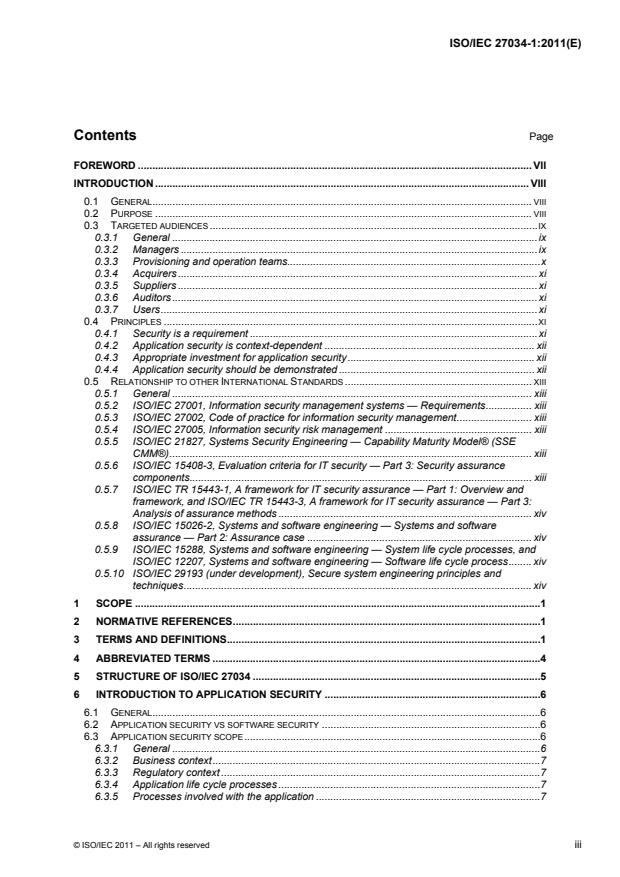
Contents Page
FOREWORD . VII
INTRODUCTION . VIII
0.1 GENERAL . VIII
0.2 PURPOSE . VIII
0.3 TARGETED AUDIENCES . IX
0.3.1 General . ix
0.3.2 Managers . ix
0.3.3 Provisioning and operation teams. x
0.3.4 Acquirers . xi
0.3.5 Suppliers . xi
0.3.6 Auditors . xi
0.3.7 Users . xi
0.4 PRINCIPLES . XI
0.4.1 Security is a requirement . xi
0.4.2 Application security is context-dependent . xii
0.4.3 Appropriate investment for application security . xii
0.4.4 Application security should be demonstrated . xii
0.5 RELATIONSHIP TO OTHER INTERNATIONAL STANDARDS . XIII
0.5.1 General . xiii
0.5.2 ISO/IEC 27001, Information security management systems — Requirements . xiii
0.5.3 ISO/IEC 27002, Code of practice for information security management . xiii
0.5.4 ISO/IEC 27005, Information security risk management . xiii
0.5.5 ISO/IEC 21827, Systems Security Engineering — Capability Maturity Model® (SSE
CMM®) . xiii
0.5.6 ISO/IEC 15408-3, Evaluation criteria for IT security — Part 3: Security assurance
components . xiii
0.5.7 ISO/IEC TR 15443-1, A framework for IT security assurance — Part 1: Overview and
framework, and ISO/IEC TR 15443-3, A framework for IT security assurance — Part 3:
Analysis of assurance methods . xiv
0.5.8 ISO/IEC 15026-2, Systems and software engineering — Systems and software
assurance — Part 2: Assurance case . xiv
0.5.9 ISO/IEC 15288, Systems and software engineering — System life cycle processes, and
ISO/IEC 12207, Systems and software engineering — Software life cycle process . xiv
0.5.10 ISO/IEC 29193 (under development), Secure system engineering principles and
techniques . xiv
1 SCOPE . 1
2 NORMATIVE REFERENCES . 1
3 TERMS AND DEFINITIONS . 1
4 ABBREVIATED TERMS . 4
5 STRUCTURE OF ISO/IEC 27034 . 5
6 INTRODUCTION TO APPLICATION SECURITY . 6
6.1 GENERAL . 6
6.2 APPLICATION SECURITY VS SOFTWARE SECURITY . 6
6.3 APPLICATION SECURITY SCOPE . 6
6.3.1 General . 6
6.3.2 Business context . 7
6.3.3 Regulatory context . 7
6.3.4 Application life cycle processes . 7
6.3.5 Processes involved with the application . 7
© ISO/IEC 2011 – All rights reserved iii
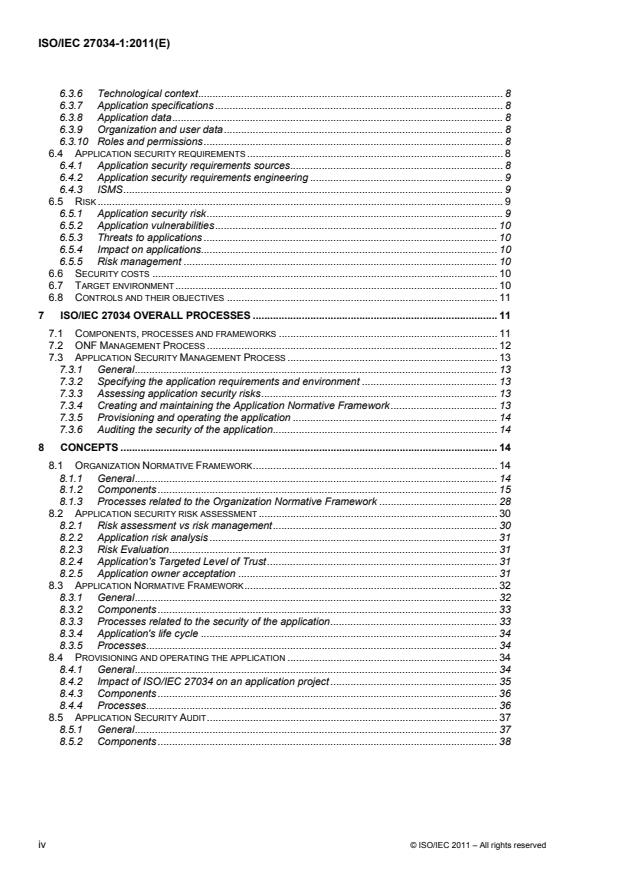
6.3.6 Technological context . 8
6.3.7 Application specifications . 8
6.3.8 Application data . 8
6.3.9 Organization and user data . 8
6.3.10 Roles and permissions . 8
6.4 APPLICATION SECURITY REQUIREMENTS . 8
6.4.1 Application security requirements sources . 8
6.4.2 Application security requirements engineering . 9
6.4.3 ISMS . 9
6.5 RISK . 9
6.5.1 Application security risk . 9
6.5.2 Application vulnerabilities . 10
6.5.3 Threats to applications . 10
6.5.4 Impact on applications . 10
6.5.5 Risk management . 10
6.6 SECURITY COSTS . 10
6.7 TARGET ENVIRONMENT . 10
6.8 CONTROLS AND THEIR OBJECTIVES . 11
7 ISO/IEC 27034 OVERALL PROCESSES . 11
7.1 COMPONENTS, PROCESSES AND FRAMEWORKS . 11
7.2 ONF MANAGEMENT PROCESS . 12
7.3 APPLICATION SECURITY MANAGEMENT PROCESS . 13
7.3.1 General . 13
7.3.2 Specifying the application requirements and environment . 13
7.3.3 Assessing application security risks . 13
7.3.4 Creating and maintaining the Application Normative Framework . 13
7.3.5 Provisioning and operating the application . 14
7.3.6 Auditing the security of the application . 14
8 CONCEPTS . 14
8.1 ORGANIZATION NORMATIVE FRAMEWORK . 14
8.1.1 General . 14
8.1.2 Components . 15
8.1.3 Processes related to the Organization Normative Framework . 28
8.2 APPLICATION SECURITY RISK ASSESSMENT . 30
8.2.1 Risk assessment vs risk management . 30
8.2.2 Application risk analysis . 31
8.2.3 Risk Evaluation . 31
8.2.4 Application's Targeted Level of Trust . 31
8.2.5 Application owner acceptation . 31
8.3 APPLICATION NORMATIVE FRAMEWORK . 32
8.3.1 General . 32
8.3.2 Components . 33
8.3.3 Processes related to the security of the application . 33
8.3.4 Application's life cycle . 34
8.3.5 Processes . 34
8.4 PROVISIONING AND OPERATING THE APPLICATION . 34
8.4.1 General . 34
8.4.2 Impact of ISO/IEC 27034 on an application project . 35
8.4.3 Components . 36
8.4.4 Processes . 36
8.5 APPLICATION SECURITY AUDIT . 37
8.5.1 General . 37
8.5.2 Components . 38
iv © ISO/IEC 2011 – All rights reserved
ANNEX A (INFORMATIVE) MAPPING AN EXISTING DEVELOPMENT PROCESS TO
ISO/IEC 27034 CASE STUDY . 39
A.1 GENERAL . 39
A.2 ABOUT THE SECURITY DEVELOPMENT LIFECYCLE . 39
A.3 SDL MAPPED TO THE ORGANIZATION NORMATIVE FRAMEWORK . 40
A.4 BUSINESS CONTEXT . 41
A.5 REGULATORY CONTEXT . 41
A.6 APPLICATION SPECIFICATIONS REPOSITORY . 42
A.7 TECHNOLOGICAL CONTEXT . 42
A.8 ROLES, RESPONSIBILITIES AND QUALIFICATIONS . 43
A.9 ORGANIZATION ASC LIBRARY . 44
A.9.1 Training . 45
A.9.2 Requirements . 45
A.9.3 Design . 46
A.9.4 Implementation. 47
A.9.5 Verification . 47
A.9.6 Release . 48
A.10 APPLICATION SECURITY AUDIT . 49
A.11 APPLICATION LIFE CYCLE MODEL . 51
A.12 SDL MAPPED TO THE APPLICATION SECURITY LIFE CYCLE REFERENCE MODEL . 53
ANNEX B (INFORMATIVE) MAPPING ASC WITH AN EXISTING STANDARD . 55
B.1 ASC CANDIDATE CATEGORIES . 55
B.1.1 Common security control-related considerations . 55
B.1.2 Operational/environmental-related considerations . 55
B.1.3 Physical Infrastructure-related considerations . 55
B.1.4 Public access-related considerations . 55
B.1.5 Technology-related considerations . 56
B.1.6 Policy/regulatory-related considerations . 56
B.1.7 Scalability-related considerations . 56
B.1.8 Security objective-related considerations . 56
B.2 CLASSES OF SECURITY CONTROLS . 57
B.3 SUB-CLASSES IN THE ACCESS CONTROL (AC) CLASS . 58
B.4 DETAILED ACCESS CONTROL CLASSES . 59
B.4.1 AC-1 Access control policy and procedures . 59
B.4.2 AC-2 Account management . 59
B.4.3 AC-17 Remote access . 60
B.5 DEFINITION OF AN ASC BUILT FROM A SAMPLE SP 800-53 CONTROL . 61
B.5.1 Control AU-14 as described in SP 800-53 Rev. 3 . 61
B.5.2 Control AU-14 as described using ISO/IEC 27034 ASC format . 62
ANNEX C (INFORMATIVE) ISO/IEC 27005 RISK MANAGEMENT PROCESS MAPPED WITH THE
ASMP . 65
BIBLIOGRAPHY . 67
© ISO/IEC 2011 – All rights reserved v
Figures Page
Figure 1 – Relationship to other International Standards . xiii
Figure 2 – Application Security Scope .6
Figure 3 – Organization Management Processes .12
Figure 4 – Organization Normative Framework (simplified) .15
Figure 5 – Graphical representation of an example of an Organization ASC Library .18
Figure 6 – Components of an ASC .20
Figure 7 – Graph of ASCs .21
Figure 8 – Top-level view of the Application Security Life Cycle Reference Model .24
Figure 9 – ONF Management Process .28
Figure 10 – Application Normative Framework .32
Figure 11 – Impact of ISO/IEC 27034 on roles and responsibilities in a typical application project.35
Figure 12 – ASC used as a security activity .36
Figure 13 – ASC used as a measurement .37
Figure 14 – Overview of the application security verification process .38
Figure A.1 – Security Development Lifecycle .40
Figure A.2 – SDL mapped to the Organization Normative Framework .40
Figure A.3 – Example of an ASC tree .45
Figure A.4 – Example of a Line of Business Application for Application Security Audit .50
Figure A.5 – SDL Process Illustration .52
Figure A.6 – SDL mapped to the Application Security Life Cycle Reference Model .53
Figure A.7 – Detailed mapping of SDL phases with stages in the Application Security Life Cycle Reference
Model .53
Figure C.1 – ISO/IEC 27005 risk management process mapped with the ASMP. . 65
Tables Page
Table 1 – Application Scope vs Application Security Scope . 7
Table 2 – Mapping of ISMS and application security-related ONF management subprocesses . 29
Table B.1 – Security control classes, families, and identifiers . 57
Table B.2 – Security control classes and security control baselines for low-impact, moderate-impact, and
high-impact information systems . 58
Table B.3 – SP800-53 control AU-14 described using ISO/IEC 27034 ASC format . 62
vi © ISO/IEC 2011 – All rights reserved
Foreword
ISO (the International Organization for Standardization) and IEC (the International Electrotechnical
Commission) form the specialized system for worldwide standardization. National bodies that are members of
ISO or IEC participate in the development of International Standards through technical committees
established by the respective organization to deal with particular fields of technical activity. ISO and IEC
technical committees collaborate in fields of mutual interest. Other international organizations, governmental
and non-governmental, in liaison with ISO and IEC, also take part in the work. In the field of information
technology, ISO and IEC have established a joint technical committee, ISO/IEC JTC 1.
International Standards are drafted in accordance with the rules given in the ISO/IEC Directives, Part 2.
The main task of the joint technical committee is to prepare International Standards. Draft International
Standards adopted by the joint technical committee are circulated to national bodies for voting. Publication as
an International Standard requires approval by at least 75 % of the national bodies casting a vote.
Attention is drawn to the possibility that some of the elements of this document may be the subject of patent
rights. ISO and IEC shall not be held responsible for identifying any or all such patent rights.
ISO/IEC 27034-1 was prepared by Joint Technical Committee ISO/IEC JTC 1, Information technology,
Subcommittee SC 27, IT Security techniques.
ISO/IEC 27034 consists of the following parts, under the general title Information technology — Security
techniques ― Application security:
― Part 1: Overview and concepts
The following parts are under preparation:
― Part 2: Organization normative framework
― Part 3: Application security management process
― Part 4: Application security validation
― Part 5: Protocols and application security control data structure
© ISO/IEC 2011 – All rights reserved vii
Introduction
0.1 General
Organizations should protect their information and technological infrastructures in order to stay in business.
Traditionally this has been addressed at the IT level by protecting the perimeter and such technological
infrastructure components as computers and networks, which is generally insufficient.
In addition, organizations are increasingly protecting themselves at the governance level by operating
formalized, tested and verified information security management systems (ISMS). A systematic approach
contributes to an effective information security management system as described in ISO/IEC 27001.
However, organizations face an ever-growing need to protect their information at the application level.
Applications should be protected against vulnerabilities which might be inherent to the application itself (e.g.
software defects), appear in the course of the application's life cycle (e.g. through changes to the application),
or arise due to the use of the application in a context for which it was not intended.
A systematic approach to increased application security provides evidence that information being used or
stored by an organization’s applications is adequately protected.
Applications can be acquired through internal development, outsourcing or purchasing a commercial product.
Applications can also be acquired through a combination of these approaches which might introduce new
security implications that should be considered and managed.
Examples of applications are human resource systems, finance systems, word-processing systems, customer
management systems, firewalls, anti-virus systems and intrusion detection systems.
Throughout its life cycle, a secure application exhibits prerequisite characteristics of software quality, such as
predictable execution and conformance, as well as meeting security requirements from a development,
management, technological infrastructure, and audit perspective. Security-enhanced processes and
practices—and the skilled people to perform them—are required to build trusted applications that do not
increase risk exposure beyond an acceptable or tolerable level of residual risk and support an effective ISMS.
Additionally, a secure application takes into account the security requirements stemming from the type of data,
the targeted environment (business, regulatory and technological contexts), the actors and the application
specifications. It should be possible to obtain evidence that is shown to demonstrate that an acceptable (or
tolerable) level of residual risk has been attained and is being maintained.
0.2 Purpose
The purpose of ISO/IEC 27034 is to assist organizations in integrating security seamlessly throughout the life
cycle of their applications by:
a) providing concepts, principles, frameworks, components and processes;
b) providing process-oriented mechanisms for establishing security requirements, assessing security
risks, assigning a Targeted Level of Trust and selecting corresponding security controls and
verification measures;
c) providing guidelines for establishing acceptance criteria to organizations outsourcing the development
or operation of applications, and for organizations purchasing from third-party applications;
d) providing process-oriented mechanisms for determining, generating and collecting the evidence
needed to demonstrate that their applications can be used securely under a defined environment;
e) supporting the general concepts specified in ISO/IEC 27001 and assisting with the satisfactory
implementation of information security based on a risk management approach; and
f) providing a framework that helps to implement the security controls specified in ISO/IEC 27002 and
other standards.
viii © ISO/IEC 2011 – All rights reserved
ISO/IEC 27034:
a) applies to the underlying software of an application and to contributing factors that impact its security,
such as data, technology, application development life cycle processes, supporting processes and
actors; and
b) applies to all sizes and all types of organizations (e.g. commercial enterprises, government agencies,
non-profit organizations) exposed to risks associated with applications.
ISO/IEC 27034 does not:
a) provide guidelines for physical and network security;
b) provide controls or measurements; or
c) provide secure coding specifications for any programming language.
ISO/IEC 27034 is not:
a) a software application development standard;
b) an application project management standard; or
c) a software development life cycle standard.
The requirements and processes specified in ISO/IEC 27034 are not intended to be implemented in isolation
but rather integrated into an organization's existing processes. To this effect, organizations should map their
existing processes and frameworks to those proposed by ISO/IEC 27034, thus reducing the impact of
implementing ISO/IEC 27034.
Annex A (informative) provides an example illustrating how an existing software development process can be
mapped to some of the components and processes of ISO/IEC 27034. Generally speaking, an organization
using any development life cycle should perform a mapping such as the one described in Annex A, and add
whatever missing components or processes are needed for compliance with ISO/IEC 27034.
0.3 Targeted audiences
0.3.1 General
The following audiences will benefit from ISO/IEC 27034 while carrying out their designated organizational
roles:
a) managers;
b) provisioning and operation teams;
c) acquisition personnel;
d) suppliers; and
e) auditors.
0.3.2 Managers
Managers are persons involved in the management of the application during its complete life cycle. The
applicable stages of the application life cycle include the provisioning stages and the production stages.
Examples of managers are:
a) information security managers;
b) project managers;
c) administrators;
d) software acquirers;
e) software development managers;
f) application owners;
g) line managers, who supervise employees.
© ISO/IEC 2011 – All rights reserved ix
Typically managers need to:
a) balance the cost of implementing and maintaining application security against the risks and value it
represents for the organization;
b) review auditor’s reports recommending acceptance or rejection based on whether an application has
attained and maintained its Targeted Level of Trust;
c) ensure compliance with standards, laws and regulations according to an application’s regulatory
context (see 8.1.2.2);
d) oversee the implementation of a secure application;
e) authorize the Targeted Level of Trust according to the organization’s specific context;
f) determine which security controls and corresponding verification measurements should be
implemented and tested;
g) minimize application security verification costs;
h) document security policies and procedures for an application;
i) provide security awareness, training and oversight to all actors;
j) put in place proper information security clearances required by applicable information security policies
and procedures; and
k) stay abreast of all system-related security plans throughout the organization's network.
0.3.3 Provisioning and operation teams
Members of provisioning and operation teams (known collectively as the project team) are persons involved in
an application’s design, development and maintenance throughout its whole life cycle. Members include:
a) architects,
b) analysts,
c) programmers,
d) testers,
e) system administrators,
f) database administrators,
g) network administrators, and
h) technical personnel.
Typically members need to:
a) understand which controls should be applied at each stage of an application's life cycle and why;
b) understand which controls should be implemented in the application itself;
c) minimize the impact of introducing controls into the development, test and documentation activities
within the application life cycle;
d) make sure that introduced controls meet the requirements of the associated measurements;
e) obtain access to tools and best practices in order to streamline development, testing and
documentation;
f) facilitate peer review;
g) participate in acquisition planning and strategy;
h) establish business relationships to obtain needed goods and services, (e.g. for the solicitation,
evaluation and awarding of contracts); and
i) arrange disposal of residual items after work is completed, (e.g. property management/disposal).
x © ISO/IEC 2011 – All rights reserved
0.3.4 Acquirers
This includes all persons involved in acquiring a product or service.
Typically acquirers need to:
a) prepare requests for proposals that include requirements for security controls;
b) select suppliers that comply with such requirements;
c) verify evidence of security controls applied by outsourcing services; and
d) evaluate products by verifying evidence of correctly implemented application security controls.
0.3.5 Suppliers
This includes all persons involved in supplying a product or service.
Typically suppliers need to:
a) comply to application security requirements from requests for proposals;
b) select appropriate application security controls for proposals, with respect to their impact on cost; and
c) provide evidence that required security controls are implemented correctly in proposed products or
services.
0.3.6 Auditors
Auditors are persons who need to:
a) understand the scope and procedures involved in verification measurements for the corresponding
controls;
b) ensure that audit results are repeatable;
c) establish a list of verification measurements which generate evidence that an application has reached
the Targeted Level of Trust as required by management; and
d) apply standardized audit processes based on the use of verifiable evidence.
0.3.7 Users
Users are persons who need to:
a) trust that it is deemed secure to use or deploy an application;
b) trust that an application produces reliable results consistently and in a timely manner; and
c) trust that the controls and their corresponding verification measurements are positioned and
functioning correctly as expected.
0.4 Principles
0.4.1 Security is a requirement
Security requirements should be defined and analyzed for each and every stage of an application's life cycle,
adequately addressed and managed on a continuous basis.
Application security requirements (see 6.4) should be treated in the same manner as functionality, quality and
usability requirements (see ISO/IEC 9126 for an example of a quality model). In addition, security-related
requirements to conform to the established limitations on residual risk should be instituted.
According to ISO/IEC/IEEE 29148 (under development), requirements should be necessary, abstract,
unambiguous, consistent, complete, concise, feasible, traceable and verifiable. The same characteristics
apply to security requirements. Vague security requirements such as “The developer should discover all
important security risks for the application” are too often encountered in application projects' documentation.
© ISO/IEC 2011 – All rights reserved xi
0.4.2 Application security is context-dependent
Application security is influenced by a defined target environment. The type and scope of application security
requirements are determined by the risks to which the application is subjected, which in turn depend on three
contexts:
a) business context: specific risks arising from the organization’s business domain (phone company,
transport company, government, etc.);
b) regulatory context: specific risks arising from the geographical location where the organization is doing
business (intellectual property rights and licensing, restrictions on cryptography protection, copyright,
laws and regulations, privacy legislation, etc.);
c) technological context: specific risks from the technologies used by the organization in the course of
business [reverse engineering, security of build tools, protection of source code, use of third-party pre-
compiled code, security testing, penetration testing, bounds checking, code checking, information and
communication technology (ICT) environment in which the application runs, configuration files and
uncompiled data, operating system privileges for installation and/or operation, maintenance, secure
distribution, etc.].
The technological context encompasses applications’ technical specifications (security functionality,
secure components, online payments, secure log, cryptography, permissions management, etc.).
An organization can affirm that an application is secure, but this affirmation is only valid for this particular
organization in its specific business, regulatory and technological contexts. If, for example, the application’s
technological infrastructure changes, or the application is used for the same purposes in another country,
these new contexts might impact the security requirements and the Targeted Level of Trust. The current
Application Security Controls might no longer adequately address the new security requirements and the
application might no longer be secure.
0.4.3 Appropriate investment for application security
The costs of applying Application Security Controls and performing audit measurements should be
commensurate with the Targeted Level of Trust (see 8.1.2.6.4) required by the application owner or by
management.
These costs can be considered as an investment because they reduce the costs, application owner
responsibilities and legal consequences of security breaches.
0.4.4 Application security should be demonstrated
The application auditing process in ISO/IEC 27034 (see 8.5) makes use of the verifiable evidence provided by
Application Security Controls (see 8.1.2.6.5).
An application cannot be declared secure unless the auditor agrees that the supporting evidence generated
by the corresponding verification measurements of the applicable Application Security Controls demonstrates
that it has reached management’s Targeted Level of Trust.
xii © ISO/IEC 2011 – All rights reserved
0.5 Relationship to other International Standards
0.5.1 General
Figure 1 shows relationships between ISO/IEC 27034 and other International Standards.
Figure 1 – Relationship to other International Standards
0.5.2 ISO/IEC 27001, Information security management systems — Requirements
ISO/IEC 27034 helps to implement, with a scope limited to application security, recommendations from
ISO/IEC 27001. In particular, the following approaches are used:
a) systematic approach to security management;
b) “Plan, Do, Check, Act” process approach; and
c) implementation of information security based on risk management.
0.5.3 ISO/IEC 27002, Code of practice for information security management
ISO/IEC 27002 provides practices that an organization can implement as Application Security Controls as
proposed by ISO/IEC 27034. Of utmost interest are controls from the following clauses in
ISO/IEC 27002:2005:
a) clause 10: Communications and Operations Management;
b) clause 11: Access Control; and most importantly
c) clause 12: Information Systems Acquisition, Development and Maintenance.
0.5.4 ISO/IEC 27005, Information security risk management
ISO/IEC 27034 helps to implement, with a scope limited to application security, the risk management process
proposed by ISO/IEC 27005. See Annex C (informative) for a more detailed discussion.
0.5.5 ISO/IEC 21827, Systems Security Engineering — Capability Maturity Model® (SSE-CMM®)
ISO/IEC 21827 provides security engineering base practices that an organization can implement as
Application Security Controls as proposed by ISO/IEC 27034. In addition, processes from ISO/IEC 27034 help
to attain several of the capabilities that define the capability levels in ISO/IEC 21827.
0.5.6 ISO/IEC 15408-3, Evaluation criteria for IT security — Part 3: Security assurance components
ISO/IEC 15408-3 provides requirements and action elements that an organization can implement as
Application Security Controls as proposed by ISO/IEC 27034.
© ISO/IEC 2011 – All rights reserved xiii
0.5.7 ISO/IEC TR 15443-1, A framework for IT security assurance — Part 1: Overview and framework,
and ISO/IEC TR 15443-3, A framework for IT security assurance — Part 3: Analysis of assurance
methods
ISO/IEC 27034 helps to enforce and reflect the principles of security assurance from ISO/IEC TR 15443-1 and
to contribute to the assurance cases of ISO/IEC TR 15443-3.
0.5.8 ISO/IEC 15026-2, Systems and software engineering — Systems and software assurance —
Part 2: Assurance case
Use of processes and Application Security Controls from ISO/IEC 27034 in application projects directly
provides assurance cases about the security of the application. In particular,
a) claims and their justifications are provided by the application security risk analysis process,
b) evidence is provided by Application Security Controls' built-in verification measurements, and
c) compliance to ISO/IEC 27034 can be used as argument in many such assurance cases.
See also 8.1.2.6.5.1.
0.5.9 ISO/IEC 15288, Systems and software engineering — System life cycle processes, and
ISO/IEC 12207, Systems and software engineering — Software life cycle processes
ISO/IEC 27034 provides additional processes for the organization, as well as Application Security Controls
that an organization can insert as additional activities into its existing systems and software engineering life
cycle processes as provided by ISO/IEC 15288 and ISO/IEC 12207.
0.5.10 ISO/IEC TR 29193 (under development), Secure system engineering principles and techniques
ISO/IEC TR 29193 provides guidance for secure system engineering of ICT sy
...