

ISO 2746:2015
(Main)Vitreous and porcelain enamels — High voltage test
General Information
- Abstract
ISO 2746:2015 describes two test methods of high voltage testing: - Test A is used to detect and locate defects in vitreous and porcelain enamels; - Test B is used to detect and locate defects and weak spots in vitreous and porcelain enamels. The tests are performed using DC or pulsed DC high voltage. The tests are applicable to dry surfaces of enamel coatings. In the case of moist surfaces, care should be taken to ensure that the locating of any defects is correctly performed. Since test voltages depend on the coating thickness, the test method, especially with test A, may not be suitable for test specimens for which the coating thickness varies to a large extent.
- Status
- Published
- Publication Date
- 27-Sep-2015
- Technical Committee
- ISO/TC 107 - Metallic and other inorganic coatings
- Drafting Committee
- ISO/TC 107/WG 2 - Vitreous and porcelain enamel coatings
- Current Stage
- 9060 - Close of review
- Completion Date
- 04-Jun-2031
Buy Documents
ISO 2746:2015 - Vitreous and porcelain enamels -- High voltage test
ISO 2746:2015 - Vitreous and porcelain enamels — High voltage test/28/2015
ISO 2746:2015 - Émaux vitrifiés -- Essai sous haute tension
ISO 2746:2015 - Émaux vitrifiés — Essai sous haute tension/28/2015
Overview
ISO 2746:2015 is an international standard specifying high voltage test methods for vitreous and porcelain enamels. It is designed to detect defects and weak spots in enamel coatings applied on metal substrates. This standard defines two types of testing:
- Test A: Non-destructive testing to detect and locate defects such as open pores that extend down to the metal base.
- Test B: Destructive testing used to identify both defects and weak spots that may compromise the enamel's performance, including under highly corrosive conditions or as a dielectric barrier.
Both tests employ DC or pulsed DC high voltage applied to the dry surface of enamel coatings, with specific test voltages depending on the enamel thickness. ISO 2746:2015 ensures consistent test procedures and accurate defect localization, facilitating quality control in enamel manufacturing and application.
Key Topics
Test Methods
- Test A: Detects open defects without damaging the enamel coating, ideal for thin layers.
- Test B: Identifies defects and weak spots; useful for thick coatings and critical safety assessments.
Testing Equipment
- DC or pulsed DC voltage generators conforming to IEC safety guidelines.
- Test electrodes made of metal wire or conductive rubber resistant to spark discharge.
- Indicator devices providing optical and/or acoustic signals for defect location.
- Thickness measurement tools compliant with ISO 2178 or ISO 2360 standards.
Test Voltage Selection
- Defined based on enamel layer thickness to avoid false positives or coating damage.
- Minimum voltage values provided in a detailed table (e.g., 1,100 V for 100 µm thickness up to 8,000 V for 2,000 µm).
- Higher voltages applied in Test B to identify weak spots beyond visible defects.
Testing Procedure
- Perform tests on clean, dry enamel surfaces at controlled temperatures (preferably below 35 °C).
- Connect the negative pole to the metal substrate and the positive pole to the test electrode.
- Systematically move the electrode across the enamel surface at recommended speeds.
- Observe for spark discharges, which indicate defects or weak spots.
- Record enamel thickness at points of spark discharge for accurate assessment.
Safety Considerations
- Users must comply with applicable health, safety, and environmental regulations.
- Proper insulation, grounding, and protective equipment are essential to prevent electric shock.
Applications
ISO 2746:2015 is relevant for industries and professionals involved in:
Quality Control of Enamel Coatings
Detect manufacturing defects in vitreous and porcelain enamel layers ensuring product durability and performance.Chemical and Corrosive Environment Equipment
Test enamel coatings on vessels and apparatus used in chemical industries to verify their resistance to corrosion and mechanical weak spots.Electrical Appliances and Insulation
Confirm the dielectric strength of enamel coatings on components, ensuring electrical safety and reliability in household and industrial electrical devices.Architectural and Decorative Panels
Monitor defect density in enamelled panels where visual and structural quality is critical.Research and Development
Evaluate new enamel formulations and coating techniques for improved defect resistance and electrical insulating properties.
Related Standards
- ISO 2178 – Measurement of non-magnetic coating thickness on magnetic substrates using magnetic methods.
- ISO 2360 – Measurement of non-conductive coatings on non-magnetic electrically conductive substrates through eddy-current methods.
- IEC/TS 60479-1 & 60479-2 – Effects of current on humans and livestock, providing safety guidelines for high voltage testing.
- IEC 60335-1, 60335-2-15, 60335-2-30 – Safety standards for household electrical appliances, applicable when enamel coatings function as dielectric materials.
Adhering to ISO 2746:2015 empowers manufacturers and testing laboratories to reliably detect and characterize defects in vitreous and porcelain enamels through standardized high voltage testing methods, ensuring product quality and safety in various industrial applications.
Relations
- Effective Date
- 25-Aug-2026
- Effective Date
- 25-Aug-2026
- Effective Date
- 25-Aug-2026
- Effective Date
- 25-Aug-2026
- Effective Date
- 25-Aug-2026
- Effective Date
- 25-Aug-2026
- Effective Date
- 12-Feb-2026
- Consolidates
ISO 20666:2008 - Water quality — Determination of the chronic toxicity to Brachionus calyciflorus in 48 h - Effective Date
- 06-Jun-2022
- Consolidated By
ISO 11691:2020 - Acoustics — Measurement of insertion loss of ducted silencers without flow — Laboratory survey method - Effective Date
- 06-Jun-2022
- Effective Date
- 04-Feb-2012
Buy Documents
ISO 2746:2015 - Vitreous and porcelain enamels -- High voltage test
ISO 2746:2015 - Vitreous and porcelain enamels — High voltage test/28/2015
ISO 2746:2015 - Émaux vitrifiés -- Essai sous haute tension
ISO 2746:2015 - Émaux vitrifiés — Essai sous haute tension/28/2015
Get Certified
Connect with accredited certification bodies for this standard

DVS-ZERT GmbH
German welding certification society.
CARES (UK Certification Authority for Reinforcing Steels)
UK certification for reinforcing steels and construction.
EWF/IIW (European/International Welding Federation)
International welding personnel certification.
Sponsored listings
Frequently Asked Questions
ISO 2746:2015 is a standard published by the International Organization for Standardization (ISO). Its full title is "Vitreous and porcelain enamels — High voltage test". This standard covers: ISO 2746:2015 describes two test methods of high voltage testing: - Test A is used to detect and locate defects in vitreous and porcelain enamels; - Test B is used to detect and locate defects and weak spots in vitreous and porcelain enamels. The tests are performed using DC or pulsed DC high voltage. The tests are applicable to dry surfaces of enamel coatings. In the case of moist surfaces, care should be taken to ensure that the locating of any defects is correctly performed. Since test voltages depend on the coating thickness, the test method, especially with test A, may not be suitable for test specimens for which the coating thickness varies to a large extent.
ISO 2746:2015 describes two test methods of high voltage testing: - Test A is used to detect and locate defects in vitreous and porcelain enamels; - Test B is used to detect and locate defects and weak spots in vitreous and porcelain enamels. The tests are performed using DC or pulsed DC high voltage. The tests are applicable to dry surfaces of enamel coatings. In the case of moist surfaces, care should be taken to ensure that the locating of any defects is correctly performed. Since test voltages depend on the coating thickness, the test method, especially with test A, may not be suitable for test specimens for which the coating thickness varies to a large extent.
ISO 2746:2015 is classified under the following ICS (International Classification for Standards) categories: 25.220.50 - Enamels. The ICS classification helps identify the subject area and facilitates finding related standards.
ISO 2746:2015 has the following relationships with other standards: It is inter standard links to EN ISO 13807:2022, EN ISO 28765:2022, EN ISO 28764:2015, EN ISO 28721-4:2015, EN ISO 28765:2016, EN ISO 28721-1:2019, EN ISO 2746:2015, ISO 20666:2008, ISO 11691:2020, ISO 2746:1998. Understanding these relationships helps ensure you are using the most current and applicable version of the standard.
ISO 2746:2015 is available in PDF format for immediate download after purchase. The document can be added to your cart and obtained through the secure checkout process. Digital delivery ensures instant access to the complete standard document.
Standards Content (Sample)
INTERNATIONAL ISO
STANDARD 2746
Third edition
2015-10-01
Vitreous and porcelain enamels —
High voltage test
Émaux vitrifiés — Essai sous haute tension
Reference number
©
ISO 2015
© ISO 2015, Published in Switzerland
All rights reserved. Unless otherwise specified, no part of this publication may be reproduced or utilized otherwise in any form
or by any means, electronic or mechanical, including photocopying, or posting on the internet or an intranet, without prior
written permission. Permission can be requested from either ISO at the address below or ISO’s member body in the country of
the requester.
ISO copyright office
Ch. de Blandonnet 8 • CP 401
CH-1214 Vernier, Geneva, Switzerland
Tel. +41 22 749 01 11
Fax +41 22 749 09 47
copyright@iso.org
www.iso.org
ii © ISO 2015 – All rights reserved
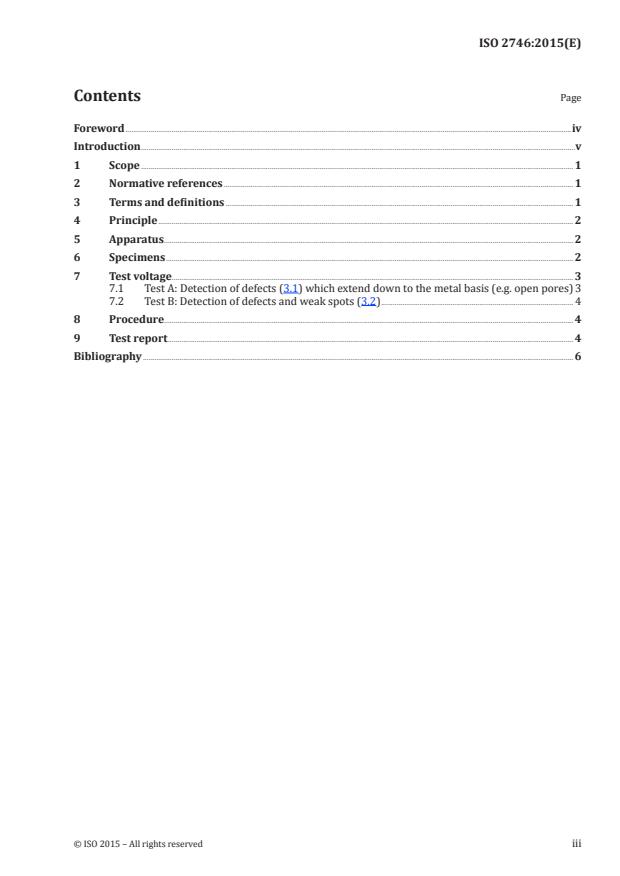
Contents Page
Foreword .iv
Introduction .v
1 Scope . 1
2 Normative references . 1
3 Terms and definitions . 1
4 Principle . 2
5 Apparatus . 2
6 Specimens . 2
7 Test voltage . 3
7.1 Test A: Detection of defects (3.1) which extend down to the metal basis (e.g. open pores) 3
7.2 Test B: Detection of defects and weak spots (3.2) . 4
8 Procedure. 4
9 Test report . 4
Bibliography . 6
Foreword
ISO (the International Organization for Standardization) is a worldwide federation of national standards
bodies (ISO member bodies). The work of preparing International Standards is normally carried out
through ISO technical committees. Each member body interested in a subject for which a technical
committee has been established has the right to be represented on that committee. International
organizations, governmental and non-governmental, in liaison with ISO, also take part in the work.
ISO collaborates closely with the International Electrotechnical Commission (IEC) on all matters of
electrotechnical standardization.
The procedures used to develop this document and those intended for its further maintenance are
described in the ISO/IEC Directives, Part 1. In particular the different approval criteria needed for the
different types of ISO documents should be noted. This document was drafted in accordance with the
editorial rules of the ISO/IEC Directives, Part 2 (see www.iso.org/directives).
Attention is drawn to the possibility that some of the elements of this document may be the subject of
patent rights. ISO shall not be held responsible for identifying any or all such patent rights. Details of
any patent rights identified during the development of the document will be in the Introduction and/or
on the ISO list of patent declarations received (see www.iso.org/patents).
Any trade name used in this document is information given for the convenience of users and does not
constitute an endorsement.
For an explanation on the meaning of ISO specific terms and expressions related to conformity
assessment, as well as information about ISO’s adherence to the WTO principles in the Technical
Barriers to Trade (TBT) see the following URL: Foreword - Supplementary information
ISO 2746 was prepared by the European Committee for Standardization (CEN) Technical Committee
CEN/TC 262, Metallic and other inorganic coatings, in collaboration with Technical Committee
ISO/TC 107, Metallic and other inorganic coatings, in accordance with the Agreement on technical
cooperation between ISO and CEN (Vienna Agreement).
This third edition cancels and replaces the second edition (ISO 2746:1998) which has been technically
revised. This edition has also been adopted as a European standard, which supersedes EN 14430:2004.
iv © ISO 2015 – All rights reserved
Introduction
There are two different objectives for high voltage testing of vitreous and porcelain enamels.
Test A is used to detect and locate defects, which extend down to the metal base (e.g. open pores). This
is a non-destructive test usually applied to thin enamel coatings. The test serves to monitor either that
the parts produced are free from defects at the chosen test voltage, or to count the number of existing
defects, e.g. to determine the defect density (defects/m ) of enamelled architecture panels.
Test B is used to detect and locate defects, which extend down to the metal base (e.g. open pores) and
to detect weak spots. This is a destructive test, i.e. the test can generate open pores with an electric
discharge through weak spots in the enamel coating. This test is usually applied to thick enamel
coatings and serves:
a) to verify that an enamel coating is safe to be used under highly corrosive conditions, e.g. to test the
enamel coating of vessels used in the chemical industry, or
b) to verify that the enamel coating is safe to be used as a dielectric.
Test A and test B require the same test equipment (see Clause 5) and follow the same test procedure
(see Clause 8). However, for test B the applied voltage is higher than in test A (see Clause 7).
INTERNATIONAL STANDARD ISO 2746:2015(E)
Vitreous and porcelain enamels — High voltage test
WARNING — This International Standard may not be compliant with some countries’ health and
safety legislations and calls for the use of substances and/or procedures that may be injurious to
health if adequate safety measures are not taken. This International Standard does not address
any health hazards, safety or environmental matters and legislations associated with its use. It
is the responsibility of the user of this International Standard to establish appropriate health,
safety and environmentally acceptable practices and take suitable actions to comply with any
national and international regulations. Compliance with this International Standard does not of
itself confer immunity from legal obligations.
1 Scope
This International Standard describes two test methods of high voltage testing:
— Test A is used to detect and locate defects in vitreous and porcelain enamels;
— Test B is used to detect and locate defects and weak spots in vitreous and porcelain enamels.
The tests are performed using DC or pulsed DC high voltage.
The tests are applicable to dry surfaces of enamel coatings. In the case of moist surfaces, care should be
taken to ensure that the locating of any defects is correctly performed.
Since test voltages depend on the coating thickness, the test method, especially with test A, may not be
suitable for test specimens for which the coating thickness varies to a large extent.
2 Normative references
The following documents, in whole or in part, are normatively referenced in this document and are
indispensable for its applica
...
INTERNATIONAL ISO
STANDARD 2746
Third edition
2015-10-01
Vitreous and porcelain enamels —
High voltage test
Émaux vitrifiés — Essai sous haute tension
Reference number
©
ISO 2015
© ISO 2015, Published in Switzerland
All rights reserved. Unless otherwise specified, no part of this publication may be reproduced or utilized otherwise in any form
or by any means, electronic or mechanical, including photocopying, or posting on the internet or an intranet, without prior
written permission. Permission can be requested from either ISO at the address below or ISO’s member body in the country of
the requester.
ISO copyright office
Ch. de Blandonnet 8 • CP 401
CH-1214 Vernier, Geneva, Switzerland
Tel. +41 22 749 01 11
Fax +41 22 749 09 47
copyright@iso.org
www.iso.org
ii © ISO 2015 – All rights reserved
Contents Page
Foreword .iv
Introduction .v
1 Scope . 1
2 Normative references . 1
3 Terms and definitions . 1
4 Principle . 2
5 Apparatus . 2
6 Specimens . 2
7 Test voltage . 3
7.1 Test A: Detection of defects (3.1) which extend down to the metal basis (e.g. open pores) 3
7.2 Test B: Detection of defects and weak spots (3.2) . 4
8 Procedure. 4
9 Test report . 4
Bibliography . 6
Foreword
ISO (the International Organization for Standardization) is a worldwide federation of national standards
bodies (ISO member bodies). The work of preparing International Standards is normally carried out
through ISO technical committees. Each member body interested in a subject for which a technical
committee has been established has the right to be represented on that committee. International
organizations, governmental and non-governmental, in liaison with ISO, also take part in the work.
ISO collaborates closely with the International Electrotechnical Commission (IEC) on all matters of
electrotechnical standardization.
The procedures used to develop this document and those intended for its further maintenance are
described in the ISO/IEC Directives, Part 1. In particular the different approval criteria needed for the
different types of ISO documents should be noted. This document was drafted in accordance with the
editorial rules of the ISO/IEC Directives, Part 2 (see www.iso.org/directives).
Attention is drawn to the possibility that some of the elements of this document may be the subject of
patent rights. ISO shall not be held responsible for identifying any or all such patent rights. Details of
any patent rights identified during the development of the document will be in the Introduction and/or
on the ISO list of patent declarations received (see www.iso.org/patents).
Any trade name used in this document is information given for the convenience of users and does not
constitute an endorsement.
For an explanation on the meaning of ISO specific terms and expressions related to conformity
assessment, as well as information about ISO’s adherence to the WTO principles in the Technical
Barriers to Trade (TBT) see the following URL: Foreword - Supplementary information
ISO 2746 was prepared by the European Committee for Standardization (CEN) Technical Committee
CEN/TC 262, Metallic and other inorganic coatings, in collaboration with Technical Committee
ISO/TC 107, Metallic and other inorganic coatings, in accordance with the Agreement on technical
cooperation between ISO and CEN (Vienna Agreement).
This third edition cancels and replaces the second edition (ISO 2746:1998) which has been technically
revised. This edition has also been adopted as a European standard, which supersedes EN 14430:2004.
iv © ISO 2015 – All rights reserved
Introduction
There are two different objectives for high voltage testing of vitreous and porcelain enamels.
Test A is used to detect and locate defects, which extend down to the metal base (e.g. open pores). This
is a non-destructive test usually applied to thin enamel coatings. The test serves to monitor either that
the parts produced are free from defects at the chosen test voltage, or to count the number of existing
defects, e.g. to determine the defect density (defects/m ) of enamelled architecture panels.
Test B is used to detect and locate defects, which extend down to the metal base (e.g. open pores) and
to detect weak spots. This is a destructive test, i.e. the test can generate open pores with an electric
discharge through weak spots in the enamel coating. This test is usually applied to thick enamel
coatings and serves:
a) to verify that an enamel coating is safe to be used under highly corrosive conditions, e.g. to test the
enamel coating of vessels used in the chemical industry, or
b) to verify that the enamel coating is safe to be used as a dielectric.
Test A and test B require the same test equipment (see Clause 5) and follow the same test procedure
(see Clause 8). However, for test B the applied voltage is higher than in test A (see Clause 7).
INTERNATIONAL STANDARD ISO 2746:2015(E)
Vitreous and porcelain enamels — High voltage test
WARNING — This International Standard may not be compliant with some countries’ health and
safety legislations and calls for the use of substances and/or procedures that may be injurious to
health if adequate safety measures are not taken. This International Standard does not address
any health hazards, safety or environmental matters and legislations associated with its use. It
is the responsibility of the user of this International Standard to establish appropriate health,
safety and environmentally acceptable practices and take suitable actions to comply with any
national and international regulations. Compliance with this International Standard does not of
itself confer immunity from legal obligations.
1 Scope
This International Standard describes two test methods of high voltage testing:
— Test A is used to detect and locate defects in vitreous and porcelain enamels;
— Test B is used to detect and locate defects and weak spots in vitreous and porcelain enamels.
The tests are performed using DC or pulsed DC high voltage.
The tests are applicable to dry surfaces of enamel coatings. In the case of moist surfaces, care should be
taken to ensure that the locating of any defects is correctly performed.
Since test voltages depend on the coating thickness, the test method, especially with test A, may not be
suitable for test specimens for which the coating thickness varies to a large extent.
2 Normative references
The following documents, in whole or in part, are normatively referenced in this document and are
indispensable for its applica
...
NORME ISO
INTERNATIONALE 2746
Troisième édition
2015-10-01
Émaux vitrifiés — Essai sous haute
tension
Vitreous and porcelain enamels — High voltage test
Numéro de référence
©
ISO 2015
DOCUMENT PROTÉGÉ PAR COPYRIGHT
© ISO 2015, Publié en Suisse
Droits de reproduction réservés. Sauf indication contraire, aucune partie de cette publication ne peut être reproduite ni utilisée
sous quelque forme que ce soit et par aucun procédé, électronique ou mécanique, y compris la photocopie, l’affichage sur
l’internet ou sur un Intranet, sans autorisation écrite préalable. Les demandes d’autorisation peuvent être adressées à l’ISO à
l’adresse ci-après ou au comité membre de l’ISO dans le pays du demandeur.
ISO copyright office
Ch. de Blandonnet 8 • CP 401
CH-1214 Vernier, Geneva, Switzerland
Tel. +41 22 749 01 11
Fax +41 22 749 09 47
copyright@iso.org
www.iso.org
ii © ISO 2015 – Tous droits réservés
Sommaire Page
Avant-propos .iv
Introduction .v
1 Domaine d’application . 1
2 Références normatives . 1
3 Termes et définitions . 1
4 Principe . 2
5 Appareillage . 2
6 Éprouvettes . 3
7 Tension d’essai. 3
7.1 Essai A: détection des défauts (3.1) s’étendant jusqu’au métal de base (pores
ouverts, par exemple) . 3
7.2 Essai B: détection des défauts et des points faibles (3.2) . 4
8 Mode opératoire. 4
9 Rapport d’essai . 5
Bibliographie . 6
Avant-propos
L’ISO (Organisation internationale de normalisation) est une fédération mondiale d’organismes
nationaux de normalisation (comités membres de l’ISO). L’élaboration des Normes internationales est
en général confiée aux comités techniques de l’ISO. Chaque comité membre intéressé par une étude
a le droit de faire partie du comité technique créé à cet effet. Les organisations internationales,
gouvernementales et non gouvernementales, en liaison avec l’ISO participent également aux travaux.
L’ISO collabore étroitement avec la Commission électrotechnique internationale (IEC) en ce qui
concerne la normalisation électrotechnique.
Les procédures utilisées pour élaborer le présent document et celles destinées à sa mise à jour sont
décrites dans les Directives ISO/IEC, Partie 1. Il convient, en particulier, de prendre note des différents
critères d’approbation requis pour les différents types de documents ISO. Le présent document a été
rédigé conformément aux règles de rédaction données dans les Directives ISO/IEC, Partie 2 (voir www.
iso.org/directives).
L’attention est appelée sur le fait que certains des éléments du présent document peuvent faire l’objet
de droits de propriété intellectuelle ou de droits analogues L’ISO ne saurait être tenue pour responsable
de ne pas avoir identifié de tels droits de propriété et averti de leur existence. Les détails concernant
les références aux droits de propriété intellectuelle ou autres droits analogues identifiés lors de
l’élaboration du document sont indiqués dans l’Introduction et/ou dans la liste des déclarations de
brevets reçues par l’ISO (voir www.iso.org/brevets).
Les appellations commerciales éventuellement mentionnées dans le présent document sont données
pour information, par souci de commodité, à l’intention des utilisateurs et ne sauraient constituer
un engagement.
Pour une explication de la signification des termes et expressions spécifiques de l’ISO liés à
l’évaluation de la conformité, ou pour toute information au sujet de l’adhésion de l’ISO aux principes
de l’OMC concernant les obstacles techniques au commerce (OTC), voir le lien suivant: Avant-propos —
Informations supplémentaires.
L’ISO 2746 a été élaborée par le comité technique CEN/TC 262, Revêtements métalliques et autres
revêtements inorganiques, du Comité européen de normalisation (CEN) en collaboration avec le comité
technique ISO/TC 107, Revêtements métalliques et autres revêtements inorganiques, conformément à
l’Accord de coopération technique entre l’ISO et le CEN (Accord de Vienne).
Cette troisième édition annule et remplace la deuxième édition (ISO 2746:1998), qui a fait l’objet d’une
révision technique. La présente édition a également été adoptée en tant que Nome européenne, en
remplacement de l’EN 14430:2004.
iv © ISO 2015 – Tous droits réservés
Introduction
L’essai sous haute tension des émaux vitrifiés a deux finalités.
L’essai A sert à déceler et à localiser les défauts qui s’étendent jusqu’au métal de base (pores ouverts,
par exemple). Il s’agit d’un essai non destructif, généralement utilisé pour les revêtements émaillés de
faible épaisseur. Cet essai est utilisé pour vérifier que les articles fabriqués sont exempts de défauts à la
tension d’essai choisie ou pour compter le nombre de défauts existants, par exemple pour déterminer la
densité de défauts (défauts/m ) des panneaux émaillés destinés à l’architecture.
L’essai B sert à déceler et à localiser les défauts qui s’étendent jusqu’au métal de base (pores ouverts,
par exemple) et à détecter les points faibles. Il s’agit d’un essai destructif, c’est-à-dire que l’essai peut
provoquer l’apparition de pores ouverts, par décharge électrique au travers des points faibles du
revêtement émaillé. Cet essai s’applique généralement aux revêtements émaillés épais et sert:
a) à vérifier qu’un revêtement émaillé peut être utilisé sans risque dans des conditions hautement
corrosives, par exemple pour soumettre à essai le revêtement émaillé de récipients utilisés dans
l’industrie chimique; ou
b) à vérifier que le revêtement émaillé peut être utilisé sans risque comme diélectrique.
Les essais A et B nécessitent le même appareillage d’essai (voir l’Article 5) et suivent le même mode
opératoire d’essai (voir l’Article 8). Toutefois, pour l’essai B, la tension appliquée est plus élevée que
pour l’essai A (voir l’Article 7).
NORME INTERNATIONALE ISO 2746:2015(F)
Émaux vitrifiés — Essai sous haute tension
AVERTISSEMENT — La présente Norme internationale peut ne pas être conforme à la législation
de certains pays en matière de santé et de sécurité et nécessite l’utilisation de substances
et/ou de modes opératoires qui peuvent s’avérer préjudiciables pour la santé si des mesures de
sécurité adéquates ne sont pas prises. La présente Norme internationale ne traite pas des risques
pour la santé, des questions de sécurité ou d’environnement, ni de la législation associée à son
utilisation. Il incombe à l’utilisateur de la présente Norme internationale d’établir des pratiques
appropriées acceptables en matière de santé, de sécurité et d’environnement et de prendre
des mesures adéquates pour satisfaire aux réglementations nationales et internationales.
La conformité à la présente Norme internationale ne dispense pas l’utilisateur du respect des
obligations légales.
1 Domaine d’application
La présente Norme internationale décrit deux méthodes d’essai sous haute tension:
— l’essai A sert à détecter et à localiser les défauts dans les émaux vitrifiés;
— l’essai B sert à détecter et à localiser les défauts et les points faibles dans les émaux vitrifiés.
Les essais sont réalisés sous haute tension en courant continu ou en courant continu pulsé.
Les essais sont effectués sur les surfaces sèches des revêtements émaillés. En cas de surfaces humides,
il convient de veiller à ce que la localisation des éventuels défauts soit correctement réalisée.
Les tensions d’essai variant en fonction de l’épaisseur du revêtement, les méthodes d’essai, en particulier
celle de l’essai A, peuvent ne pas convenir à des éprouvettes présentant une fluctuation importante de
l’épaisseur du revêtement.
2 Références normatives
Les documents ci-après, dans leur intégralité ou non, sont des références normatives indispensables à
l’application du présent document. Pour les références datées, seule l’édition citée s’applique. Pour les
références non datées, la dernière édition du document de référence s’applique (y compris les éventuels
amendements).
ISO 2178, Revêtements métalliques non magnétiques sur métal de base magnétique — Mesu
...
NORME ISO
INTERNATIONALE 2746
Troisième édition
2015-10-01
Émaux vitrifiés — Essai sous haute
tension
Vitreous and porcelain enamels — High voltage test
Numéro de référence
©
ISO 2015
DOCUMENT PROTÉGÉ PAR COPYRIGHT
© ISO 2015, Publié en Suisse
Droits de reproduction réservés. Sauf indication contraire, aucune partie de cette publication ne peut être reproduite ni utilisée
sous quelque forme que ce soit et par aucun procédé, électronique ou mécanique, y compris la photocopie, l’affichage sur
l’internet ou sur un Intranet, sans autorisation écrite préalable. Les demandes d’autorisation peuvent être adressées à l’ISO à
l’adresse ci-après ou au comité membre de l’ISO dans le pays du demandeur.
ISO copyright office
Ch. de Blandonnet 8 • CP 401
CH-1214 Vernier, Geneva, Switzerland
Tel. +41 22 749 01 11
Fax +41 22 749 09 47
copyright@iso.org
www.iso.org
ii © ISO 2015 – Tous droits réservés
Sommaire Page
Avant-propos .iv
Introduction .v
1 Domaine d’application . 1
2 Références normatives . 1
3 Termes et définitions . 1
4 Principe . 2
5 Appareillage . 2
6 Éprouvettes . 3
7 Tension d’essai. 3
7.1 Essai A: détection des défauts (3.1) s’étendant jusqu’au métal de base (pores
ouverts, par exemple) . 3
7.2 Essai B: détection des défauts et des points faibles (3.2) . 4
8 Mode opératoire. 4
9 Rapport d’essai . 5
Bibliographie . 6
Avant-propos
L’ISO (Organisation internationale de normalisation) est une fédération mondiale d’organismes
nationaux de normalisation (comités membres de l’ISO). L’élaboration des Normes internationales est
en général confiée aux comités techniques de l’ISO. Chaque comité membre intéressé par une étude
a le droit de faire partie du comité technique créé à cet effet. Les organisations internationales,
gouvernementales et non gouvernementales, en liaison avec l’ISO participent également aux travaux.
L’ISO collabore étroitement avec la Commission électrotechnique internationale (IEC) en ce qui
concerne la normalisation électrotechnique.
Les procédures utilisées pour élaborer le présent document et celles destinées à sa mise à jour sont
décrites dans les Directives ISO/IEC, Partie 1. Il convient, en particulier, de prendre note des différents
critères d’approbation requis pour les différents types de documents ISO. Le présent document a été
rédigé conformément aux règles de rédaction données dans les Directives ISO/IEC, Partie 2 (voir www.
iso.org/directives).
L’attention est appelée sur le fait que certains des éléments du présent document peuvent faire l’objet
de droits de propriété intellectuelle ou de droits analogues L’ISO ne saurait être tenue pour responsable
de ne pas avoir identifié de tels droits de propriété et averti de leur existence. Les détails concernant
les références aux droits de propriété intellectuelle ou autres droits analogues identifiés lors de
l’élaboration du document sont indiqués dans l’Introduction et/ou dans la liste des déclarations de
brevets reçues par l’ISO (voir www.iso.org/brevets).
Les appellations commerciales éventuellement mentionnées dans le présent document sont données
pour information, par souci de commodité, à l’intention des utilisateurs et ne sauraient constituer
un engagement.
Pour une explication de la signification des termes et expressions spécifiques de l’ISO liés à
l’évaluation de la conformité, ou pour toute information au sujet de l’adhésion de l’ISO aux principes
de l’OMC concernant les obstacles techniques au commerce (OTC), voir le lien suivant: Avant-propos —
Informations supplémentaires.
L’ISO 2746 a été élaborée par le comité technique CEN/TC 262, Revêtements métalliques et autres
revêtements inorganiques, du Comité européen de normalisation (CEN) en collaboration avec le comité
technique ISO/TC 107, Revêtements métalliques et autres revêtements inorganiques, conformément à
l’Accord de coopération technique entre l’ISO et le CEN (Accord de Vienne).
Cette troisième édition annule et remplace la deuxième édition (ISO 2746:1998), qui a fait l’objet d’une
révision technique. La présente édition a également été adoptée en tant que Nome européenne, en
remplacement de l’EN 14430:2004.
iv © ISO 2015 – Tous droits réservés
Introduction
L’essai sous haute tension des émaux vitrifiés a deux finalités.
L’essai A sert à déceler et à localiser les défauts qui s’étendent jusqu’au métal de base (pores ouverts,
par exemple). Il s’agit d’un essai non destructif, généralement utilisé pour les revêtements émaillés de
faible épaisseur. Cet essai est utilisé pour vérifier que les articles fabriqués sont exempts de défauts à la
tension d’essai choisie ou pour compter le nombre de défauts existants, par exemple pour déterminer la
densité de défauts (défauts/m ) des panneaux émaillés destinés à l’architecture.
L’essai B sert à déceler et à localiser les défauts qui s’étendent jusqu’au métal de base (pores ouverts,
par exemple) et à détecter les points faibles. Il s’agit d’un essai destructif, c’est-à-dire que l’essai peut
provoquer l’apparition de pores ouverts, par décharge électrique au travers des points faibles du
revêtement émaillé. Cet essai s’applique généralement aux revêtements émaillés épais et sert:
a) à vérifier qu’un revêtement émaillé peut être utilisé sans risque dans des conditions hautement
corrosives, par exemple pour soumettre à essai le revêtement émaillé de récipients utilisés dans
l’industrie chimique; ou
b) à vérifier que le revêtement émaillé peut être utilisé sans risque comme diélectrique.
Les essais A et B nécessitent le même appareillage d’essai (voir l’Article 5) et suivent le même mode
opératoire d’essai (voir l’Article 8). Toutefois, pour l’essai B, la tension appliquée est plus élevée que
pour l’essai A (voir l’Article 7).
NORME INTERNATIONALE ISO 2746:2015(F)
Émaux vitrifiés — Essai sous haute tension
AVERTISSEMENT — La présente Norme internationale peut ne pas être conforme à la législation
de certains pays en matière de santé et de sécurité et nécessite l’utilisation de substances
et/ou de modes opératoires qui peuvent s’avérer préjudiciables pour la santé si des mesures de
sécurité adéquates ne sont pas prises. La présente Norme internationale ne traite pas des risques
pour la santé, des questions de sécurité ou d’environnement, ni de la législation associée à son
utilisation. Il incombe à l’utilisateur de la présente Norme internationale d’établir des pratiques
appropriées acceptables en matière de santé, de sécurité et d’environnement et de prendre
des mesures adéquates pour satisfaire aux réglementations nationales et internationales.
La conformité à la présente Norme internationale ne dispense pas l’utilisateur du respect des
obligations légales.
1 Domaine d’application
La présente Norme internationale décrit deux méthodes d’essai sous haute tension:
— l’essai A sert à détecter et à localiser les défauts dans les émaux vitrifiés;
— l’essai B sert à détecter et à localiser les défauts et les points faibles dans les émaux vitrifiés.
Les essais sont réalisés sous haute tension en courant continu ou en courant continu pulsé.
Les essais sont effectués sur les surfaces sèches des revêtements émaillés. En cas de surfaces humides,
il convient de veiller à ce que la localisation des éventuels défauts soit correctement réalisée.
Les tensions d’essai variant en fonction de l’épaisseur du revêtement, les méthodes d’essai, en particulier
celle de l’essai A, peuvent ne pas convenir à des éprouvettes présentant une fluctuation importante de
l’épaisseur du revêtement.
2 Références normatives
Les documents ci-après, dans leur intégralité ou non, sont des références normatives indispensables à
l’application du présent document. Pour les références datées, seule l’édition citée s’applique. Pour les
références non datées, la dernière édition du document de référence s’applique (y compris les éventuels
amendements).
ISO 2178, Revêtements métalliques non magnétiques sur métal de base magnétique — Mesu
...