

ISO 29042-7:2010
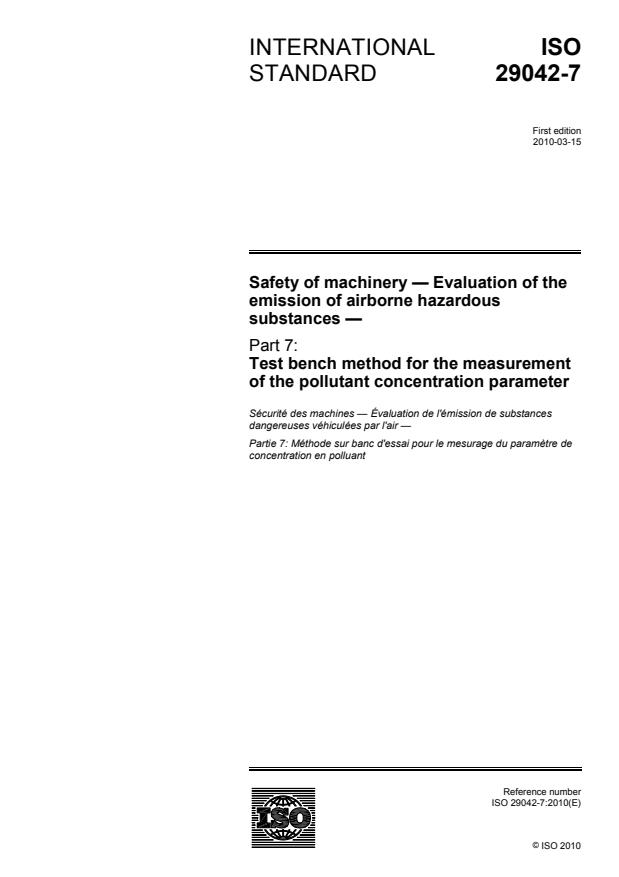
(Main)Safety of machinery — Evaluation of the emission of airborne hazardous substances — Part 7: Test bench method for the measurement of the pollutant concentration parameter
General Information
- Abstract
ISO 29042-7:2010 specifies a test bench method for the measurement of the pollutant concentration parameter of a given airborne hazardous substance from a machine, using a test bench under specified operating conditions. The method is applicable only to the determination of emitted gases, vapours and respirable particles.
- Status
- Published
- Publication Date
- 10-Mar-2010
- Technical Committee
- ISO/TC 199 - Safety of machinery
- Drafting Committee
- ISO/TC 199 - Safety of machinery
- Current Stage
- 9093 - International Standard confirmed
- Start Date
- 22-Apr-2026
- Completion Date
- 29-Aug-2026
Overview
ISO 29042-7:2010 is an international standard published by ISO focusing on the safety of machinery through the evaluation of the emission of airborne hazardous substances. Specifically, this part of the ISO 29042 series specifies a test bench method for measuring the pollutant concentration parameter emitted by machines under defined operating conditions. This method applies exclusively to gases, vapours, and respirable particles emitted during machine operation.
The standard provides a structured approach to assess emissions using a controlled test bench environment. It supports manufacturers, safety engineers, and regulatory bodies in quantifying pollutant emissions to ensure machinery complies with safety requirements and environmental regulations.
Key Topics
Test Bench Setup
The standard outlines the design of a test bench consisting of a test cabin, funnel, and air mover to generate a controlled airflow. The machine under test is placed inside a test cabin of specified dimensions, ensuring pollutant emissions are captured accurately at prescribed measurement planes within the exhaust duct or funnel region.Pollutant Concentration Parameter (Pcc)
Measurement focuses on determining the pollutant concentration at specific locations. The pollutant concentration parameter (Pcc) is calculated as the sum of the mean value and the 95% confidence interval, providing a statistically representative figure of the hazardous substance concentration emitted.Measurement Procedures
The machine is operated under normal working conditions on the test bench, with emissions measured during typical operational cycles. Multiple test runs are required to ensure reliable data. The measurement methods must comply with related international standards and detailed procedures specified in relevant type-C standards that cover particular machine types.Emission Types Covered
The method applies exclusively to airborne hazardous substances including gases, vapours, and breathable particles produced by machinery operations.Reporting Requirements
Detailed guidelines are provided for reporting test results, including machine description, operational data, pollutant control system details, measurement methods, environmental conditions, and results with statistical validation. This ensures transparency and reproducibility.
Applications
ISO 29042-7:2010 is a critical tool for industries that design, manufacture, or regulate machinery where airborne pollutant emissions present safety risks. Typical applications include:
Machine Performance Evaluation
Assessing pollutant emissions to verify compliance with health and safety legislation or internal environmental targets.Machine Development and Improvement
Informing design changes to reduce hazardous emissions and improve workplace safety by benchmarking pollutant concentrations.Comparative Analysis
Comparing different machines performing similar functions to select safer or more environmentally friendly options based on their pollutant emission profiles.Safety and Environmental Compliance
Supporting risk assessment and conformity verification processes for machinery under regulatory and certification frameworks.
Related Standards
ISO 29042-7:2010 is part of the broader ISO 29042 series concerning the evaluation of airborne hazardous substances emitted by machinery. Related parts include:
- ISO 29042-1: Selection of test methods for emission evaluation
- ISO 29042-2: Tracer gas method for emission rate measurement
- ISO 29042-3: Test bench method for emission rate measurement
- ISO 29042-4: Tracer method for capture efficiency of exhaust systems
- ISO 29042-5 & 6: Test bench methods for measuring mass separation efficiency of air cleaning systems
- Future Parts 8 and 9: Room methods for pollutant concentration measurement and decontamination index
Additionally, ISO 12100 provides foundational principles for machinery safety design, and ISO 2602 addresses statistical interpretation of test results, both integral to applying ISO 29042-7 effectively.
By adhering to ISO 29042-7:2010, stakeholders can ensure accurate assessment of airborne hazardous emissions, contributing to the safe and sustainable operation of machinery across various industrial sectors. Keywords: ISO 29042-7, machinery safety, airborne hazardous substances, pollutant concentration, test bench, emission measurement, gases, vapours, respirable particles, air quality, pollutant control.
Get Certified
Connect with accredited certification bodies for this standard

CIS Institut d.o.o.
Personal Protective Equipment (PPE) certification body. Notified Body NB-2890 for EU Regulation 2016/425 PPE.

Kiwa BDA Testing
Building and construction product certification.
Kmetijski inštitut Slovenije
Agricultural Institute of Slovenia. Soil testing, plant health, agricultural product analysis.
Sponsored listings
Frequently Asked Questions
ISO 29042-7:2010 is a standard published by the International Organization for Standardization (ISO). Its full title is "Safety of machinery — Evaluation of the emission of airborne hazardous substances — Part 7: Test bench method for the measurement of the pollutant concentration parameter". This standard covers: ISO 29042-7:2010 specifies a test bench method for the measurement of the pollutant concentration parameter of a given airborne hazardous substance from a machine, using a test bench under specified operating conditions. The method is applicable only to the determination of emitted gases, vapours and respirable particles.
ISO 29042-7:2010 specifies a test bench method for the measurement of the pollutant concentration parameter of a given airborne hazardous substance from a machine, using a test bench under specified operating conditions. The method is applicable only to the determination of emitted gases, vapours and respirable particles.
ISO 29042-7:2010 is classified under the following ICS (International Classification for Standards) categories: 13.110 - Safety of machinery. The ICS classification helps identify the subject area and facilitates finding related standards.
ISO 29042-7:2010 is available in PDF format for immediate download after purchase. The document can be added to your cart and obtained through the secure checkout process. Digital delivery ensures instant access to the complete standard document.
Standards Content (Sample)
INTERNATIONAL ISO
STANDARD 29042-7
First edition
2010-03-15
Safety of machinery — Evaluation of the
emission of airborne hazardous
substances —
Part 7:
Test bench method for the measurement
of the pollutant concentration parameter
Sécurité des machines — Évaluation de l'émission de substances
dangereuses véhiculées par l'air —
Partie 7: Méthode sur banc d'essai pour le mesurage du paramètre de
concentration en polluant
Reference number
©
ISO 2010
PDF disclaimer
This PDF file may contain embedded typefaces. In accordance with Adobe's licensing policy, this file may be printed or viewed but
shall not be edited unless the typefaces which are embedded are licensed to and installed on the computer performing the editing. In
downloading this file, parties accept therein the responsibility of not infringing Adobe's licensing policy. The ISO Central Secretariat
accepts no liability in this area.
Adobe is a trademark of Adobe Systems Incorporated.
Details of the software products used to create this PDF file can be found in the General Info relative to the file; the PDF-creation
parameters were optimized for printing. Every care has been taken to ensure that the file is suitable for use by ISO member bodies. In
the unlikely event that a problem relating to it is found, please inform the Central Secretariat at the address given below.
© ISO 2010
All rights reserved. Unless otherwise specified, no part of this publication may be reproduced or utilized in any form or by any means,
electronic or mechanical, including photocopying and microfilm, without permission in writing from either ISO at the address below or
ISO's member body in the country of the requester.
ISO copyright office
Case postale 56 • CH-1211 Geneva 20
Tel. + 41 22 749 01 11
Fax + 41 22 749 09 47
E-mail copyright@iso.org
Web www.iso.org
Published in Switzerland
ii © ISO 2010 – All rights reserved
Foreword
ISO (the International Organization for Standardization) is a worldwide federation of national standards bodies
(ISO member bodies). The work of preparing International Standards is normally carried out through ISO
technical committees. Each member body interested in a subject for which a technical committee has been
established has the right to be represented on that committee. International organizations, governmental and
non-governmental, in liaison with ISO, also take part in the work. ISO collaborates closely with the
International Electrotechnical Commission (IEC) on all matters of electrotechnical standardization.
International Standards are drafted in accordance with the rules given in the ISO/IEC Directives, Part 2.
The main task of technical committees is to prepare International Standards. Draft International Standards
adopted by the technical committees are circulated to the member bodies for voting. Publication as an
International Standard requires approval by at least 75 % of the member bodies casting a vote.
Attention is drawn to the possibility that some of the elements of this document may be the subject of patent
rights. ISO shall not be held responsible for identifying any or all such patent rights.
ISO 29042-7 was prepared by Technical Committee ISO/TC 199, Safety of machinery.
ISO 29042 consists of the following parts, under the general title Safety of machinery — Evaluation of the
emission of airborne hazardous substances:
⎯ Part 1: Selection of test methods
⎯ Part 2: Tracer gas method for the measurement of the emission rate of a given pollutant
⎯ Part 3: Test bench method for the measurement of the emission rate of a given pollutant
⎯ Part 4: Tracer method for the measurement of the capture efficiency of an exhaust system
⎯ Part 5: Test bench method for the measurement of the separation efficiency by mass of air cleaning
systems with unducted outlet
⎯ Part 6: Test bench method for the measurement of the separation efficiency by mass of air cleaning
systems with ducted outlet
⎯ Part 7: Test bench method for the measurement of the pollutant concentration parameter
A room method for the measurement of the pollutant concentration parameter and a decontamination index
are to form the subjects of future parts 8 and 9.
Introduction
The structure of safety standards in the field of machinery is as follows:
a) type-A standards (basic safety standards) giving basic concepts, principles for design, and general
aspects that can be applied to all machinery;
b) type-B standards (generic safety standards) dealing with one safety aspect or one type of safeguard that
can be used across a wide range of machinery:
⎯ type-B1 standards on particular safety aspects (e.g. safety distances, surface temperature, noise);
⎯ type-B2 standards on safeguards (e.g. two-hand controls, interlocking devices, pressure sensitive
devices, guards);
c) type-C standards (machine safety standards) dealing with detailed safety requirements for a particular
machine or group of machines.
This part of ISO 29042 is a type-B standard as stated in ISO 12100.
The requirements of this document can be supplemented or modified by a type-C standard.
For machines which are covered by the scope of a type-C standard and which have been designed and built
according to the requirements of that standard, the requirements of that type-C standard take precedence.
ISO/TC 199 has a mandate in this area to produce type-A and type-B standards, which will allow verification
of conformity with the essential safety requirements.
ISO 29042-7 is based on EN 1093-8:1998, amended by Amendment 1:2008, published by the European
Committee for Standardization (CEN).
iv © ISO 2010 – All rights reserved
INTERNATIONAL STANDARD ISO 29042-7:2010(E)
Safety of machinery — Evaluation of the emission of airborne
hazardous substances —
Part 7:
Test bench method for the measurement of the pollutant
concentration parameter
1 Scope
This part of ISO 29042 specifies a test bench method for the measurement of the pollutant concentration
parameter of a given airborne hazardous substance from a machine, using a test bench under specified
operating conditions. The method is applicable only to the determination of emitted gases, vapours and
respirable particles. It is intended that whenever possible the emission rate be determined in a test bench (see
ISO 29042-3).
Measurement of the pollutant concentration parameter of a machine can serve for the
a) evaluation of the performance of the machine,
b) evaluation of the improvement of the machine,
c) comparison of machines within different groups of machines with the same intended use (such groups
being defined by the function and materials processed),
d) ranking of machines from the same group according to their pollutant concentration parameters, and
e) determination of the state of the art of a machine with respect to its pollutant concentration parameter.
2 Normative references
The following referenced documen
...