


ISO/PRF 21719-1
(Main)Electronic fee collection — Personalization of on-board equipment (OBE) — Part 1: Framework
Electronic fee collection — Personalization of on-board equipment (OBE) — Part 1: Framework
ISO/TS 21719-1:2018 describes: - an overall description of the EFC personalization process; - a description of EFC functionality that can be used for personalization. The personalization process takes place within the domain of the entity that is responsible for the application in the OBE.
Perception de télépéage — Personnalisation des équipements embarqués — Partie 1: Cadre
General Information
- Status
- Not Published
- Technical Committee
- ISO/TC 204 - Intelligent transport systems
- Drafting Committee
- ISO/TC 204/WG 5 - Fee and toll collection
- Current Stage
- 5020 - FDIS ballot initiated: 2 months. Proof sent to secretariat
- Start Date
- 09-Jan-2026
- Completion Date
- 17-Jan-2026
Relations
- Effective Date
- 07-Jan-2025
Overview
ISO/PRF 21719-1:2025, titled Electronic Fee Collection - Personalization of On-Board Equipment (OBE) - Part 1: Framework, is an international standard developed by ISO Technical Committee ISO/TC 204. This standard establishes a comprehensive framework for the personalization process of electronic fee collection (EFC) on-board equipment used in intelligent transport systems.
The standard defines the key functionalities required for personalizing OBE to support electronic fee collection applications such as tolling, road user charging, and compliance verification. Personalization involves securely transferring unique vehicle and user data into the OBE, enabling the device to perform fee collection accurately and securely while ensuring interoperability between diverse personalization equipment and systems.
Key Topics
ISO/PRF 21719-1:2025 covers the following essential aspects:
Personalization Process Overview
Describes the life cycle and sequence of personalization activities within the domain of the entity responsible for the OBE application.Personalization Assets
Defines the types of data and credentials involved in personalization, including application data, cryptographic keys, and vehicle-specific information.System Architecture
Outlines the architectural considerations for personalization, including the interfaces between personalization equipment (PE) and the on-board equipment.EFC Personalization Functions
Specifies core functions related to writing personalization data securely to the OBE, including access control, data encryption, and message authentication to guarantee data integrity and confidentiality.Security Mechanisms
Includes security functions such as access protection, write request and response authenticators, and encryption methods necessary to protect sensitive user and vehicle data during personalization.Communication Interface Agnosticism
The framework is designed independent of any specific communication medium, allowing personalization over various protocols such as Dedicated Short-Range Communications (DSRC) or integrated circuit cards.
Applications
The standard is highly applicable in multiple areas within the intelligent transportation sector:
Road Toll Collection Systems
Ensures that on-board units can be personalized securely with user data enabling seamless and interoperable toll payments.Road User Charging and Congestion Charging Services
Supports accurate vehicle identification and fee management through reliable onboard device personalization.Compliance and Enforcement Systems
Facilitates embedding compliance parameters in OBEs, allowing authorities to verify toll and regulatory adherence.Third-party Personalization Providers
By standardizing personalization functions and procedures, service providers can outsource personalization tasks securely to external agents while maintaining interoperability.Multi-application Transport Systems
Allows multiple ITS applications to coexist in the same OBE by managing distinct personalization data sets efficiently.
Related Standards
ISO/PRF 21719-1 interfaces and harmonizes with other key standards in the electronic fee collection and intelligent transportation system domains:
ISO 17573-2: Vocabulary Standard for Electronic Fee Collection
Acts as the primary reference vocabulary for consistent terminology within EFC personalization processes.Subsequent Parts of ISO 21719 Series
Detail the implementation specifics for personalization over various communication media and interfaces, complementing the framework defined in Part 1.CEN/TR 16152: Personalization Processes for Electronic Fee Collection
Provides assessment and classification of personalization assets referenced in ISO 21719-1.ISO/IEC Directives
The editorial and procedural rules under which this standard was drafted, ensuring international acceptance and compatibility.
By implementing ISO/PRF 21719-1, organizations involved in electronic fee collection can establish robust, secure, and interoperable personalization processes for on-board equipment, facilitating efficient tolling and user compliance in modern intelligent transport systems. The framework supports scalability, security, and vendor-neutrality, critical for the evolving landscape of traffic management and digital payment solutions.
ISO/PRF 21719-1 - Electronic fee collection — Personalization of on-board equipment (OBE) — Part 1: Framework Released:9. 01. 2026
REDLINE ISO/PRF 21719-1 - Electronic fee collection — Personalization of on-board equipment (OBE) — Part 1: Framework Released:9. 01. 2026
Frequently Asked Questions
ISO/PRF 21719-1 is a draft published by the International Organization for Standardization (ISO). Its full title is "Electronic fee collection — Personalization of on-board equipment (OBE) — Part 1: Framework". This standard covers: ISO/TS 21719-1:2018 describes: - an overall description of the EFC personalization process; - a description of EFC functionality that can be used for personalization. The personalization process takes place within the domain of the entity that is responsible for the application in the OBE.
ISO/TS 21719-1:2018 describes: - an overall description of the EFC personalization process; - a description of EFC functionality that can be used for personalization. The personalization process takes place within the domain of the entity that is responsible for the application in the OBE.
ISO/PRF 21719-1 is classified under the following ICS (International Classification for Standards) categories: 03.220.20 - Road transport; 35.240.60 - IT applications in transport. The ICS classification helps identify the subject area and facilitates finding related standards.
ISO/PRF 21719-1 has the following relationships with other standards: It is inter standard links to ISO/TS 21719-1:2018. Understanding these relationships helps ensure you are using the most current and applicable version of the standard.
ISO/PRF 21719-1 is available in PDF format for immediate download after purchase. The document can be added to your cart and obtained through the secure checkout process. Digital delivery ensures instant access to the complete standard document.
Standards Content (Sample)
International
Standard
ISO 21719-1
First edition
Electronic fee collection —
Personalization of on-board
equipment (OBE) —
Part 1:
Framework
Perception de télépéage — Personnalisation des équipements
embarqués —
Partie 1: Cadre
PROOF/ÉPREUVE
Reference number
ISO 21719-1:2026(en) © ISO 2026
ISO 21719-1:2026(en)
© ISO 2026
All rights reserved. Unless otherwise specified, or required in the context of its implementation, no part of this publication may
be reproduced or utilized otherwise in any form or by any means, electronic or mechanical, including photocopying, or posting on
the internet or an intranet, without prior written permission. Permission can be requested from either ISO at the address below
or ISO’s member body in the country of the requester.
ISO copyright office
CP 401 • Ch. de Blandonnet 8
CH-1214 Vernier, Geneva
Phone: +41 22 749 01 11
Email: copyright@iso.org
Website: www.iso.org
Published in Switzerland
PROOF/ÉPREUVE
ii
ISO 21719-1:2026(en)
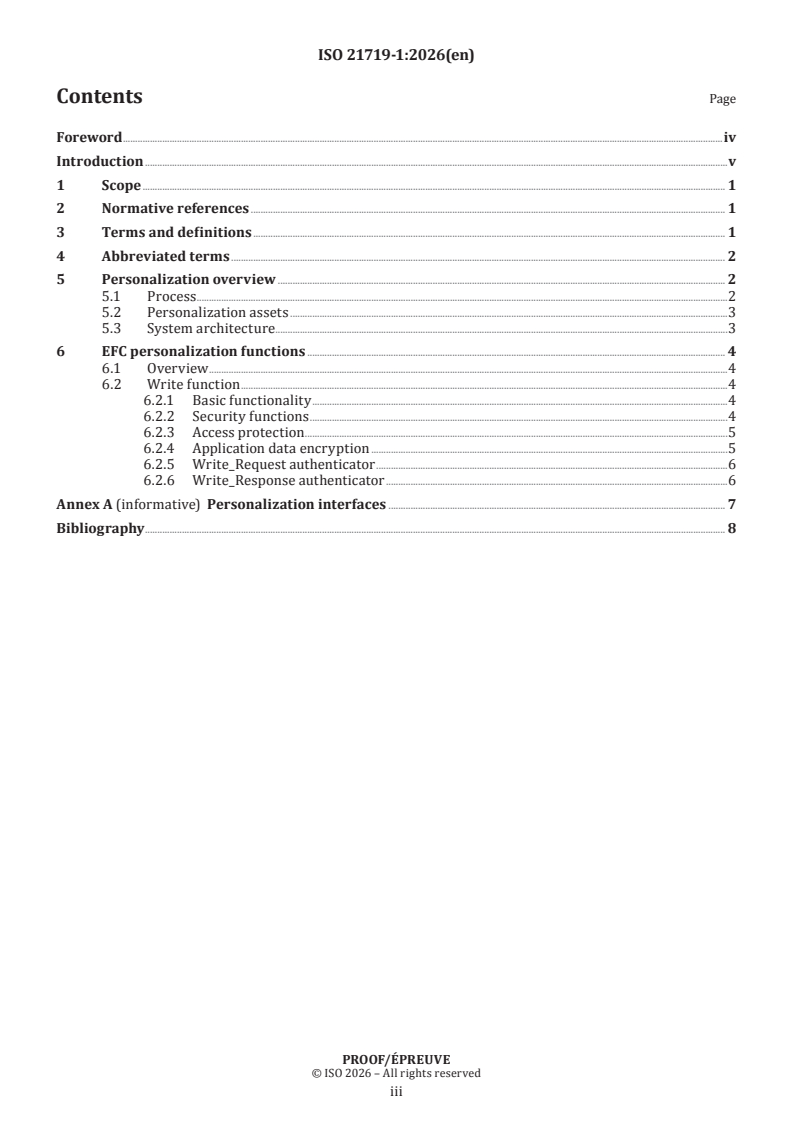
Contents Page
Foreword .iv
Introduction .v
1 Scope . 1
2 Normative references . 1
3 Terms and definitions . 1
4 Abbreviated terms . 2
5 Personalization overview . 2
5.1 Process .2
5.2 Personalization assets .3
5.3 System architecture . .3
6 EFC personalization functions . 4
6.1 Overview .4
6.2 Write function .4
6.2.1 Basic functionality .4
6.2.2 Security functions .4
6.2.3 Access protection .5
6.2.4 Application data encryption .5
6.2.5 Write_Request authenticator .6
6.2.6 Write_Response authenticator .6
Annex A (informative) Personalization interfaces . 7
Bibliography . 8
PROOF/ÉPREUVE
iii
ISO 21719-1:2026(en)
Foreword
ISO (the International Organization for Standardization) is a worldwide federation of national standards
bodies (ISO member bodies). The work of preparing International Standards is normally carried out through
ISO technical committees. Each member body interested in a subject for which a technical committee
has been established has the right to be represented on that committee. International organizations,
governmental and non-governmental, in liaison with ISO, also take part in the work. ISO collaborates closely
with the International Electrotechnical Commission (IEC) on all matters of electrotechnical standardization.
The procedures used to develop this document and those intended for its further maintenance are described
in the ISO/IEC Directives, Part 1. In particular, the different approval criteria needed for the different types
of ISO document should be noted. This document was drafted in accordance with the editorial rules of the
ISO/IEC Directives, Part 2 (see www.iso.org/directives).
ISO draws attention to the possibility that the implementation of this document may involve the use of (a)
patent(s). ISO takes no position concerning the evidence, validity or applicability of any claimed patent
rights in respect thereof. As of the date of publication of this document, ISO had not received notice of (a)
patent(s) which may be required to implement this document. However, implementers are cautioned that
this may not represent the latest information, which may be obtained from the patent database available at
www.iso.org/patents. ISO shall not be held responsible for identifying any or all such patent rights.
Any trade name used in this document is information given for the convenience of users and does not
constitute an endorsement.
For an explanation of the voluntary nature of standards, the meaning of ISO specific terms and expressions
related to conformity assessment, as well as information about ISO's adherence to the World Trade
Organization (WTO) principles in the Technical Barriers to Trade (TBT), see www.iso.org/iso/foreword.html.
This document was prepared by Technical Committee ISO/TC 204, Intelligent transport systems,in
collaboration with the European Committee for Standardization (CEN) Technical Committee CEN/TC 278,
Intelligent Transport Systems, in accordance with the Agreement on technical cooperation between ISO and
CEN (Vienna Agreement).
This first edition cancels and replaces the first edition of ISO/TS 21719-1:2018, which has been technically
revised.
The main changes are as follows:
— the terms and definitions have been updated;
— ISO 17573-2 has been included as the primary source for harmonized vocabulary across electronic fee
collection (EFC) standards.
A list of all parts in the ISO 21719 series can be found on the ISO website.
Any feedback or questions on this document should be directed to the user’s national standards body. A
complete listing of these bodies can be found at www.iso.org/members.html.
PROOF/ÉPREUVE
iv
ISO 21719-1:2026(en)
Introduction
On-board equipment (OBE) refers to an in-vehicle device that can contain one or more application instances
to support different intelligent transportation system (ITS) implementations, such as electronic fee
collection (EFC). Examples of EFC applications are road toll collection (also known as "road user charging"),
localization augmentation communication (LAC) and compliance check communication (CCC).
To assign the EFC application in the OBE to a certain user or vehicle, or both, personalization is performed.
This means that unique user and vehicle related data are transferred to the OBE. This document is applicable
to the EFC interface between the personalization equipment (PE) and OBE as shown in Figure 1
Figure 1 — Scope of this document (box delimited by the dotted line)
CEN/TR 16152 already assesses many aspects of the personalization process and it also defines the overall
personalization assets, i.e. application data, application keys and vehicle data.
Different communication media may be used for transferring these personalization assets to the OBE, but
for all media, common procedures may be applied, such as an overall message exchange framework and
necessary security functionality to ensure data protection and integrity.
By standardizing the personalization procedure, compatibility of personalization equipment is supported,
and the entity responsible for the personalization (e.g. a toll service provider) will be able to outsource parts
of, or a complete, personalization to a third party, e.g. another service provider or a personalization agent.
This document defines common functionality for personalization that is independent of the communication
media and personalization equipment (PE) used. Subsequent parts of the ISO 21719 series define in detail
how the functions are realized on different defined communication media and interfaces.
PROOF/ÉPREUVE
v
International Standard ISO 21719-1:2026(en)
Electronic fee collection — Personalization of on-board
equipment (OBE) —
Part 1:
Framework
1 Scope
This docum
...
Style Definition
...
Style Definition
...
Style Definition
...
Style Definition
...
Style Definition
...
ISO /PRF 21719-1:2025(en)
Style Definition
...
ISO/TC 204
Style Definition
...
Style Definition
...
Secretariat: ANSI
Style Definition
...
Date: 2025-112026-01-08
Style Definition
...
Style Definition
...
Style Definition
...
Style Definition
...
Style Definition
...
Style Definition
...
Electronic fee collection — Personalization of on-board equipment
Style Definition
...
(OBE) — —
Style Definition
...
Style Definition
...
Style Definition
...
Style Definition
...
Style Definition
...
Part 1: Style Definition
...
Style Definition
Framework
...
Style Definition
...
Perception de télépéage — Personnalisation des équipements embarqués — —
Style Definition
...
Partie 1: Cadre Style Definition
...
Style Definition
...
Style Definition
...
Style Definition
...
Style Definition
...
Style Definition
...
Style Definition
...
Style Definition
...
Style Definition
...
TTTTTThhhhhhiiiiiissssss d d d d d drrrrrraftaftaftaftaftaft i i i i i issssss s s s s s suuuuuubbbbbbmmmmmmiiiiiittttttttttttedededededed t t t t t toooooo a pa pa pa pa pa pararararararallel vallel vallel vallel vallel vallel vooooootttttte e e e e e iiiiiinnnnnn I I I I I ISSSSSSOOOOOO,,,,,, C C C C C CEEEEEENNNNNN.
Style Definition
...
Style Definition
...
Style Definition
...
Style Definition
...
Style Definition
...
Style Definition
...
Style Definition
...
Style Definition
...
Style Definition
...
Style Definition
...
Style Definition
...
Style Definition
...
Style Definition
...
Style Definition
...
Style Definition
...
Style Definition
...
Style Definition
...
Style Definition
...
Style Definition
...
Style Definition
...
Style Definition
...
Style Definition
...
Style Definition
...
St l D fi iti
PROOF
Formatted: Font: 11 pt
2 © ISO 2025 – All rights reserved
Formatted: HeaderCentered, Left
Formatted: Font color: Auto, English (United Kingdom)
All rights reserved. Unless otherwise specified, or required in the context of its implementation, no part of this publication
Formatted: Font color: Auto, English (United Kingdom)
may be reproduced or utilized otherwise in any form or by any means, electronic or mechanical, including photocopying,
or posting on the internet or an intranet, without prior written permission. Permission can be requested from either ISO
at the address below or ISO’s member body in the country of the requester.
ISO Copyright Office copyright office
Formatted: Font color: Auto, English (United Kingdom)
CP 401 • Ch. de Blandonnet 8
Formatted: zzCopyright address
CH-1214 Vernier, Geneva
Phone: + 41 22 749 01 11
Formatted: Font color: Auto, English (United Kingdom)
Formatted: Font color: Auto, English (United Kingdom)
Email: copyright@iso.org
E-mail: copyright@iso.org Formatted: zzCopyright address
Website: www.iso.orgwww.iso.org
Formatted: Font color: Auto, French (France)
Formatted: French (France)
Published in Switzerland.
Formatted: Font color: Auto, French (Switzerland)
Formatted: Font color: Auto, French (Switzerland)
Formatted: zzCopyright address
Formatted: Font color: Auto, English (United Kingdom)
Formatted: Font color: Auto, English (United Kingdom)
Formatted: Font: 10 pt
Formatted: Font: 10 pt
Formatted: FooterCentered, Left, Space Before: 0 pt,
Tab stops: Not at 17.2 cm
Formatted: Font: 11 pt
Formatted: FooterPageRomanNumber, Left, Space
After: 0 pt, Tab stops: Not at 17.2 cm
iii
Formatted: Font: Bold
Formatted: HeaderCentered
Contents
Foreword . vi
Introduction . vii
1 Scope . 1
2 Normative references . 1
3 Terms and definitions . 1
4 Abbreviated terms . 2
5 Personalization overview . 2
5.1 Process . 2
5.2 Personalization assets . 3
5.3 System architecture . 4
6 EFC personalization functions. 5
6.1 Overview . 5
6.2 Write function . 5
Annex A (informative) Personalization interfaces . 10
Bibliography . 13
Formatted: Font: 10 pt
Formatted: Font: 10 pt
Formatted: FooterCentered, Left, Space Before: 0 pt,
Tab stops: Not at 17.2 cm
Formatted: Font: 11 pt
Formatted: FooterPageRomanNumber, Left, Space
After: 0 pt, Tab stops: Not at 17.2 cm
iv
Formatted: HeaderCentered, Left
Foreword . iv
Introduction . v
1 Scope . 1
2 Normative references . 1
3 Terms and definitions . 1
4 Abbreviated terms . 1
5 Personalization overview . 2
5.1 Process . 2
5.2 Personalization assets . 3
5.3 System architecture . 3
6 EFC personalization functions. 3
6.1 Overview . 3
6.2 Write function . 4
6.2.1 Basic functionality . 4
6.2.2 Security functions . 4
6.2.3 Access protection . 4
6.2.4 Application data encryption . 5
6.2.5 Write_Request authenticator . 5
6.2.6 Write_Response authenticator . 6
Annex A (informative) Personalization interfaces . 7
Formatted: Font: 10 pt
Formatted: Font: 10 pt
Formatted: FooterCentered, Left, Space Before: 0 pt,
Tab stops: Not at 17.2 cm
Formatted: Font: 11 pt
Formatted: FooterPageRomanNumber, Left, Space
After: 0 pt, Tab stops: Not at 17.2 cm
v
Formatted: Font: Bold
Formatted: HeaderCentered
Foreword Formatted: Adjust space between Latin and Asian text,
Adjust space between Asian text and numbers
ISO (the International Organization for Standardization) is a worldwide federation of national standards
bodies (ISO member bodies). The work of preparing International Standards is normally carried out through
ISO technical committees. Each member body interested in a subject for which a technical committee has been
established has the right to be represented on that committee. International organizations, governmental and
non-governmental, in liaison with ISO, also take part in the work. ISO collaborates closely with the
International Electrotechnical Commission (IEC) on all matters of electrotechnical standardization.
The procedures used to develop this document and those intended for its further maintenance are described
Formatted: English (United Kingdom)
in the ISO/IEC Directives, Part 1. In particular, the different approval criteria needed for the different types of
Formatted: English (United Kingdom)
ISO document should be noted. This document was drafted in accordance with the editorial rules of the
ISO/IEC Directives, Part 2 (see www.iso.org/directives).
Formatted: Font color: Auto
Formatted: English (United Kingdom)
ISO draws attention to the possibility that the implementation of this document may involve the use of (a)
patent(s). ISO takes no position concerning the evidence, validity or applicability of any claimed patent rights Formatted: Adjust space between Latin and Asian text,
in respect thereof. As of the date of publication of this document, ISO had not received notice of (a) patent(s) Adjust space between Asian text and numbers
which may be required to implement this document. However, implementers are cautioned that this may not
Formatted: Font: Italic
represent the latest information, which may be obtained from the patent database available at
Formatted: Default Paragraph Font
www.iso.org/patents.www.iso.org/patents. ISO shall not be held responsible for identifying any or all such
patent rights. Formatted: Default Paragraph Font
Formatted: Default Paragraph Font
Any trade name used in this document is information given for the convenience of users and does not
Formatted: Default Paragraph Font
constitute an endorsement.
Formatted: Default Paragraph Font
For an explanation of the voluntary nature of standards, the meaning of ISO specific terms and expressions
Formatted: Adjust space between Latin and Asian text,
related to conformity assessment, as well as information about ISO’sISO's adherence to the World Trade
Adjust space between Asian text and numbers, Tab
Organization (WTO) principles in the Technical Barriers to Trade (TBT), see
stops: Not at 0.7 cm + 1.4 cm + 2.1 cm + 2.8 cm +
www.iso.org/iso/foreword.htmlwww.iso.org/iso/foreword.html.
3.5 cm + 4.2 cm + 4.9 cm + 5.6 cm + 6.3 cm + 7 cm
Formatted: Default Paragraph Font
This document was prepared by Technical Committee ISO/TC 204, Intelligent transport systems, in
collaboration with the European Committee for Standardization (CEN) Technical Committee CEN/TC 278, Formatted: Default Paragraph Font
Intelligent Transport Systems, in accordance with the Agreement on technical cooperation between ISO and
Formatted: Default Paragraph Font
CEN (Vienna Agreement).
Formatted: Default Paragraph Font
This first edition cancels and replaces the first edition of ISO/TS 21719-1:2018, which has been technically
Formatted: Default Paragraph Font
revised.
Formatted: Default Paragraph Font
Formatted: Adjust space between Latin and Asian text,
The main changes are as follows:
Adjust space between Asian text and numbers
— — the terms and definitions have been updated;
Formatted: English (United Kingdom)
Formatted: English (United Kingdom)
— — ISO 17573-2 has been included as the primary source for harmonized vocabulary across electronic fee
collection (EFC) standards. Formatted: English (United Kingdom)
Formatted: English (United Kingdom)
A list of all parts in the ISO 21719 series can be found on the ISO website.
Field Code Changed
Any feedback or questions on this document should be directed to the user’s national standards body. A
Formatted: Font: 10 pt
complete listing of these bodies can be found at www.iso.org/members.html.
Formatted: Font: 10 pt
Formatted: FooterCentered, Left, Space Before: 0 pt,
Tab stops: Not at 17.2 cm
Formatted: Font: 11 pt
Formatted: FooterPageRomanNumber, Left, Space
After: 0 pt, Tab stops: Not at 17.2 cm
vi
Formatted: HeaderCentered, Left
Formatted: Adjust space between Latin and Asian text,
Introduction
Adjust space between Asian text and numbers
On-board equipment (OBE) isrefers to an in-vehicle device that can contain one or more application instances
to support different intelligent transportation system (ITS) implementations, such as electronic fee collection
(EFC). Examples of EFC applications are road toll collection (aka also known as "road user charging),"),
localization augmentation communication (LAC) and compliance check communication (CCC).
To assign the EFC application in the OBE to a certain user or vehicle, or both, personalization is performed.
This means that unique user and vehicle related data are transferred to the OBE. This document is applicable
to the EFC interface between the personalization equipment (PE) and OBE as shown in Figure 1Figure 1
Figure 1 — Scope of this document (box delimited by the dotted line)
Formatted: None, Adjust space between Latin and
Asian text, Adjust space between Asian text and
numbers
CEN/TR 16152 already assesses many aspects of the personalization process and it also defines the overall
Formatted: Default Paragraph Font
personalization assets, i.e. application data, application keys and vehicle data.
Formatted: Default Paragraph Font
Different communication media may be used for transferring thethese personalization assets to the OBE;, but
Formatted: Default Paragraph Font
for all media, common procedures may be applied, such as an overall message exchange framework and
necessary security functionality to ensure data protection and integrity. Formatted: Adjust space between Latin and Asian text,
Adjust space between Asian text and numbers
By standardizing the personalization procedure, compatibility of personalization equipment is supported, and
the entity responsible for the personalization (e.g. a toll service provider) will be able to outsource parts of, or
a complete, personalization to a third party, e.g. another service provider or a personalization agent.
This document defines common functionality for personalization that is independent of the communication
media and personalization equipment (PE) used, while the subsequent. Subsequent parts of thisthe ISO 21719
Formatted: Font: 10 pt
series define in detail how the functions are realized on different defined communication media and interfaces.
Formatted: Font: 10 pt
Formatted: FooterCentered, Left, Space Before: 0 pt,
Tab stops: Not at 17.2 cm
Formatted: Font: 11 pt
Formatted: FooterPageRomanNumber, Left, Space
After: 0 pt, Tab stops: Not at 17.2 cm
vii
International Standard ISO 21719-1:2025(en)
Formatted: Left
Formatted: Main Title 1, None, Adjust space between
Electronic fee collection — Personalization of on-board equipment
Latin and Asian text, Adjust space between Asian text
(OBE) — Part 1: Framework
and numbers
Part 1:
Framework
1 Scope
Formatted: Adjust space between Latin and Asian text,
Adjust space between Asian text and numbers
This document establishes a framework and specifies EFCelectronic fee collection (EFC) functions for the
personalization process of on-board equipment (OBE) used for electronic fee collection (EFC).EFC.
The personalization process takes place within the domain of the entity that is responsible for the application
in the OBE.
This document is applicable to the EFC interface, e.g. using dedicated short-range communication or
integrated circuit(s) card, between the personalization equipment (PE) and OBE as shown in Figure 1.
Figure 1.
This document does not apply to definingcover the following:
— — whether the personalization functionality resides completely in the PE or whether this functionality
Formatted: Adjust space between Latin and Asian text,
instead resides in a central system, where the PE is more or less “transparent”; Adjust space between Asian text and numbers, Tab
stops: Not at 0.7 cm + 1.4 cm + 2.1 cm + 2.8 cm +
— — the exact application command or message structures for the EFC personalization functionality (these 3.5 cm + 4.2 cm + 4.9 cm + 5.6 cm + 6.3 cm + 7 cm
are dependent on the communication media and are described in subsequent parts of the ISO 21719
Formatted: Default Paragraph Font
series);
Formatted: Default Paragraph Font
— — the test procedures for evaluation of an implementation for conformity to the requirements in this Formatted: Default Paragraph Font
document;
Formatted: Adjust space between Latin and Asian text,
Adjust space between Asian text and numbers
— — setting-up of operating organizations (e.g. toll service provider, personalization agent, trusted third
party).
Formatted: Default Paragraph Font
Formatted: Default Paragraph Font
NOTE Some of the above issues listed above are subject to separate standardsdocuments prepared by ISO/TC 204,
CEN/TC 278 and the European Telecommunications Standards Institute – Electromagnetic compatibility and Radio
Formatted: Default Paragraph Font
Spectrum Matters (ETSI ERM).
Formatted: Default Paragraph Font
Formatted: Adjust space between Latin and Asian text,
2 Normative references
Adjust space between Asian text and numbers, Tab
stops: Not at 0.7 cm + 1.4 cm + 2.1 cm + 2.8 cm +
The following documen
...
Questions, Comments and Discussion
Ask us and Technical Secretary will try to provide an answer. You can facilitate discussion about the standard in here.
Loading comments...