


ISO 13500:2006
(Main)Petroleum and natural gas industries — Drilling fluid materials — Specifications and tests
Petroleum and natural gas industries — Drilling fluid materials — Specifications and tests
ISO 13500:2006 covers physical properties and test procedures for materials manufactured for use in oil-and gas-well drilling fluids. The materials covered are barite, haematite, bentonite, nontreated bentonite, OCMA grade bentonite, attapulgite, sepiolite, technical grade low-viscosity carboxymethylcellulose (CMC-LVT), technical grade high-viscosity carboxymethylcellulose (CMC-HVT), and starch. ISO 13500:2006 is intended for the use of manufacturers of named products.
Industries du pétrole et du gaz naturel — Produits pour fluides de forage — Spécifications et essais
General Information
- Status
- Withdrawn
- Publication Date
- 08-Feb-2006
- Withdrawal Date
- 08-Feb-2006
- Technical Committee
- ISO/TC 67/SC 3 - Drilling and completion fluids, well cements and treatment fluids
- Drafting Committee
- ISO/TC 67/SC 3/WG 1 - Drilling, completion and workover fluids
- Current Stage
- 9599 - Withdrawal of International Standard
- Start Date
- 22-Oct-2008
- Completion Date
- 12-Feb-2026
Relations
- Effective Date
- 12-Feb-2026
- Effective Date
- 06-Jun-2022
- Effective Date
- 15-Apr-2008
- Effective Date
- 15-Apr-2008
Get Certified
Connect with accredited certification bodies for this standard

ABS Quality Evaluations Inc.
American Bureau of Shipping quality certification.

Element Materials Technology
Materials testing and product certification.

ABS Group Brazil
ABS Group certification services in Brazil.
Sponsored listings
Frequently Asked Questions
ISO 13500:2006 is a standard published by the International Organization for Standardization (ISO). Its full title is "Petroleum and natural gas industries — Drilling fluid materials — Specifications and tests". This standard covers: ISO 13500:2006 covers physical properties and test procedures for materials manufactured for use in oil-and gas-well drilling fluids. The materials covered are barite, haematite, bentonite, nontreated bentonite, OCMA grade bentonite, attapulgite, sepiolite, technical grade low-viscosity carboxymethylcellulose (CMC-LVT), technical grade high-viscosity carboxymethylcellulose (CMC-HVT), and starch. ISO 13500:2006 is intended for the use of manufacturers of named products.
ISO 13500:2006 covers physical properties and test procedures for materials manufactured for use in oil-and gas-well drilling fluids. The materials covered are barite, haematite, bentonite, nontreated bentonite, OCMA grade bentonite, attapulgite, sepiolite, technical grade low-viscosity carboxymethylcellulose (CMC-LVT), technical grade high-viscosity carboxymethylcellulose (CMC-HVT), and starch. ISO 13500:2006 is intended for the use of manufacturers of named products.
ISO 13500:2006 is classified under the following ICS (International Classification for Standards) categories: 75.180.10 - Exploratory, drilling and extraction equipment. The ICS classification helps identify the subject area and facilitates finding related standards.
ISO 13500:2006 has the following relationships with other standards: It is inter standard links to EN ISO 13500:2006, ISO 2004:1997, ISO 13500:1998, ISO 13500:2008. Understanding these relationships helps ensure you are using the most current and applicable version of the standard.
ISO 13500:2006 is available in PDF format for immediate download after purchase. The document can be added to your cart and obtained through the secure checkout process. Digital delivery ensures instant access to the complete standard document.
Standards Content (Sample)
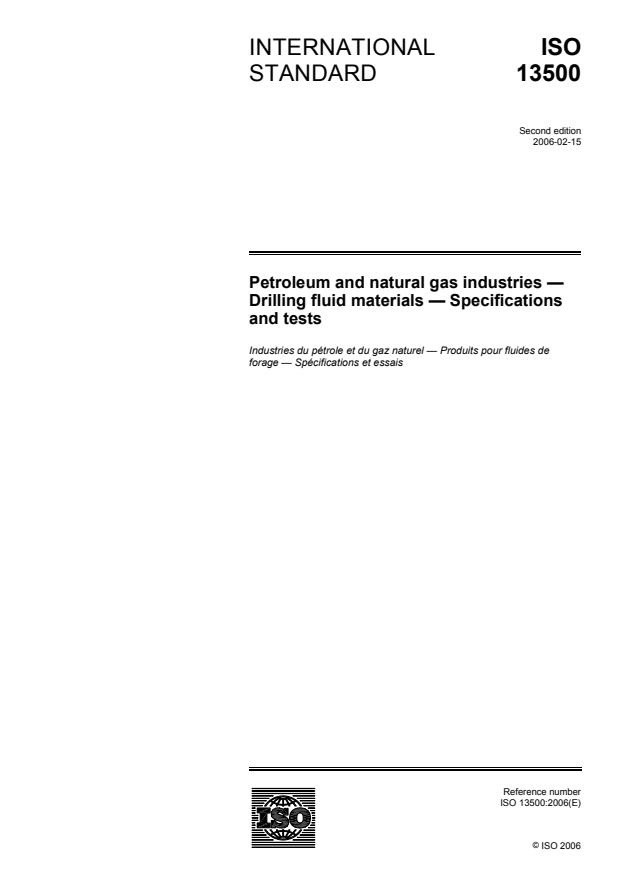
INTERNATIONAL ISO
STANDARD 13500
Second edition
2006-02-15
Petroleum and natural gas industries —
Drilling fluid materials — Specifications
and tests
Industries du pétrole et du gaz naturel — Produits pour fluides de
forage — Spécifications et essais
Reference number
©
ISO 2006
PDF disclaimer
This PDF file may contain embedded typefaces. In accordance with Adobe's licensing policy, this file may be printed or viewed but
shall not be edited unless the typefaces which are embedded are licensed to and installed on the computer performing the editing. In
downloading this file, parties accept therein the responsibility of not infringing Adobe's licensing policy. The ISO Central Secretariat
accepts no liability in this area.
Adobe is a trademark of Adobe Systems Incorporated.
Details of the software products used to create this PDF file can be found in the General Info relative to the file; the PDF-creation
parameters were optimized for printing. Every care has been taken to ensure that the file is suitable for use by ISO member bodies. In
the unlikely event that a problem relating to it is found, please inform the Central Secretariat at the address given below.
© ISO 2006
All rights reserved. Unless otherwise specified, no part of this publication may be reproduced or utilized in any form or by any means,
electronic or mechanical, including photocopying and microfilm, without permission in writing from either ISO at the address below or
ISO's member body in the country of the requester.
ISO copyright office
Case postale 56 • CH-1211 Geneva 20
Tel. + 41 22 749 01 11
Fax + 41 22 749 09 47
E-mail copyright@iso.org
Web www.iso.org
Published in Switzerland
ii © ISO 2006 – All rights reserved
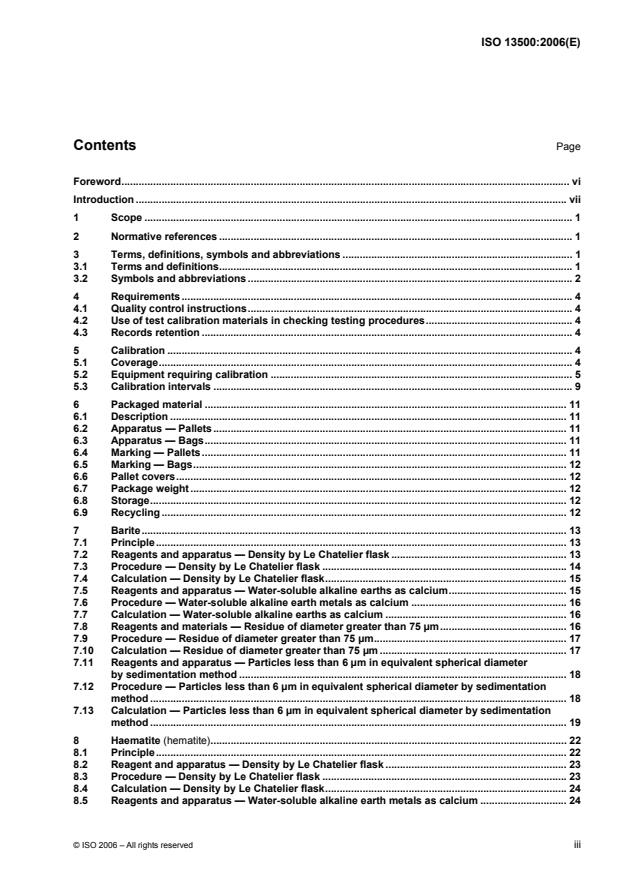
Contents Page
Foreword. vi
Introduction . vii
1 Scope . 1
2 Normative references . 1
3 Terms, definitions, symbols and abbreviations . 1
3.1 Terms and definitions. 1
3.2 Symbols and abbreviations . 2
4 Requirements . 4
4.1 Quality control instructions. 4
4.2 Use of test calibration materials in checking testing procedures. 4
4.3 Records retention . 4
5 Calibration . 4
5.1 Coverage. 4
5.2 Equipment requiring calibration . 5
5.3 Calibration intervals . 9
6 Packaged material . 11
6.1 Description . 11
6.2 Apparatus — Pallets. 11
6.3 Apparatus — Bags. 11
6.4 Marking — Pallets. 11
6.5 Marking — Bags. 12
6.6 Pallet covers. 12
6.7 Package weight. 12
6.8 Storage. 12
6.9 Recycling . 12
7 Barite. 13
7.1 Principle. 13
7.2 Reagents and apparatus — Density by Le Chatelier flask . 13
7.3 Procedure — Density by Le Chatelier flask . 14
7.4 Calculation — Density by Le Chatelier flask. 15
7.5 Reagents and apparatus — Water-soluble alkaline earths as calcium. 15
7.6 Procedure — Water-soluble alkaline earth metals as calcium . 16
7.7 Calculation — Water-soluble alkaline earths as calcium . 16
7.8 Reagents and materials — Residue of diameter greater than 75 µm. 16
7.9 Procedure — Residue of diameter greater than 75 µm. 17
7.10 Calculation — Residue of diameter greater than 75 µm . 17
7.11 Reagents and apparatus — Particles less than 6 µm in equivalent spherical diameter
by sedimentation method . 18
7.12 Procedure — Particles less than 6 µm in equivalent spherical diameter by sedimentation
method . 18
7.13 Calculation — Particles less than 6 µm in equivalent spherical diameter by sedimentation
method . 19
8 Haematite (hematite). 22
8.1 Principle. 22
8.2 Reagent and apparatus — Density by Le Chatelier flask . 23
8.3 Procedure — Density by Le Chatelier flask . 23
8.4 Calculation — Density by Le Chatelier flask. 24
8.5 Reagents and apparatus — Water-soluble alkaline earth metals as calcium . 24
8.6 Procedure — Water-soluble alkaline earth metals as calcium. 25
8.7 Calculation — Water-soluble alkaline earth metals as calcium . 25
8.8 Reagents and apparatus — Residues greater that 75 µm and 45 µm. 26
8.9 Procedure — Residues of diameter greater than 75 µm and 45 µm . 26
8.10 Calculation — Residues of diameter greater than 75 µm and 45 µm. 27
8.11 Reagents and apparatus — Particles less than 6 µm in equivalent spherical diameter
by sedimentation method. 27
8.12 Procedure — Particles less than 6 µm in equivalent spherical diameter by sedimentation
method . 28
8.13 Calculation — Particles less than 6 µm in equivalent spherical diameter by sedimentation
method . 28
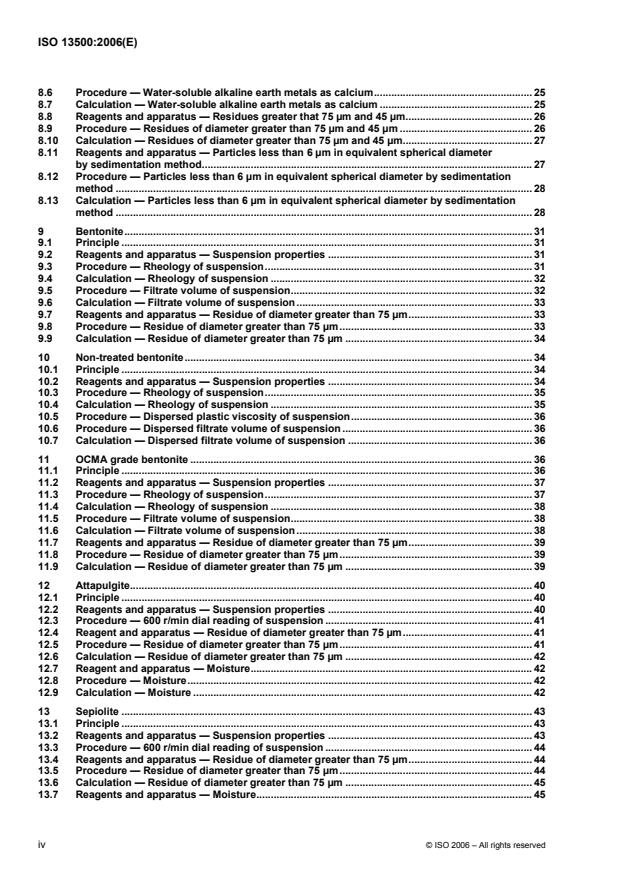
9 Bentonite. 31
9.1 Principle . 31
9.2 Reagents and apparatus — Suspension properties . 31
9.3 Procedure — Rheology of suspension. 31
9.4 Calculation — Rheology of suspension . 32
9.5 Procedure — Filtrate volume of suspension. 32
9.6 Calculation — Filtrate volume of suspension. 33
9.7 Reagents and apparatus — Residue of diameter greater than 75 µm. 33
9.8 Procedure — Residue of diameter greater than 75 µm. 33
9.9 Calculation — Residue of diameter greater than 75 µm . 34
10 Non-treated bentonite. 34
10.1 Principle . 34
10.2 Reagents and apparatus — Suspension properties . 34
10.3 Procedure — Rheology of suspension. 35
10.4 Calculation — Rheology of suspension . 35
10.5 Procedure — Dispersed plastic viscosity of suspension. 36
10.6 Procedure — Dispersed filtrate volume of suspension . 36
10.7 Calculation — Dispersed filtrate volume of suspension . 36
11 OCMA grade bentonite . 36
11.1 Principle . 36
11.2 Reagents and apparatus — Suspension properties . 37
11.3 Procedure — Rheology of suspension. 37
11.4 Calculation — Rheology of suspension . 38
11.5 Procedure — Filtrate volume of suspension. 38
11.6 Calculation — Filtrate volume of suspension. 38
11.7 Reagents and apparatus — Residue of diameter greater than 75 µm. 39
11.8 Procedure — Residue of diameter greater than 75 µm. 39
11.9 Calculation — Residue of diameter greater than 75 µm . 39
12 Attapulgite. 40
12.1 Principle . 40
12.2 Reagents and apparatus — Suspension properties . 40
12.3 Procedure — 600 r/min dial reading of suspension . 41
12.4 Reagent and apparatus — Residue of diameter greater than 75 µm. 41
12.5 Procedure — Residue of diameter greater than 75 µm. 41
12.6 Calculation — Residue of diameter greater than 75 µm . 42
12.7 Reagent and apparatus — Moisture. 42
12.8 Procedure — Moisture. 42
12.9 Calculation — Moisture . 42
13 Sepiolite . 43
13.1 Principle . 43
13.2 Reagents and apparatus — Suspension properties . 43
13.3 Procedure — 600 r/min dial reading of suspension . 44
13.4 Reagents and apparatus — Residue of diameter greater than 75 µm. 44
13.5 Procedure — Residue of diameter greater than 75 µm. 44
13.6 Calculation — Residue of diameter greater than 75 µm . 45
13.7 Reagents and apparatus — Moisture. 45
iv © ISO 2006 – All rights reserved
13.8 Procedure — Moisture. 45
13.9 Calculation — Moisture. 45
14 Technical grade low-viscosity CMC (CMC-LVT). 46
14.1 Principle. 46
14.2 Reagents and apparatus — Determination of starch and starch derivatives. 46
14.3 Procedure — Determination of starch and starch derivatives. 47
14.4 Interpretation — Determination of starch and starch derivatives . 47
14.5 Reagents and apparatus — Solution properties of water-soluble polymers . 48
14.6 Procedure — Viscometer reading in deionized water. 48
14.7 Procedure — Filtrate volume of solution .49
14.8 Calculation — Filtrate volume of solution. 50
15 Technical grade high-viscosity CMC (CMC-HVT). 50
15.1 Principle. 50
15.2 Reagents and apparatus — Determination of starch and starch derivatives. 50
15.3 Procedure — Determination of starch and starch derivatives. 51
15.4 Interpretation — Determination of starch and starch derivatives . 52
15.5 Reagents and apparatus — Solution properties of water-soluble polymers . 52
15.6 Procedure — Viscometer reading in deionized water. 53
15.7 Procedure — Viscometer reading in 40 g/l salt water. 53
15.8 Procedure — Viscometer reading in saturated salt water. 54
15.9 Procedure — Filtrate volume of solution .54
15.10 Calculation — Filtrate volume of solution. 55
16 Starch. 55
16.1 Principle. 55
16.2 Reagents and apparatus — Suspension properties . 56
16.3 Procedure — Viscometer reading in 40 g/l salt water. 56
16.4 Procedure — Filtrate volume of 40 g/l salt solution. 57
16.5 Calculation — Filtrate volume of 40 g/l salt solution . 57
16.6 Procedure — Viscometer reading in saturated salt solution . 57
16.7 Procedure — Filtrate volume of saturated salt solution. 58
16.8 Calculation — Filtrate volume of saturated salt solution . 58
16.9 Reagents and apparatus — Residue greater than 2 000 µm . 59
16.10 Procedure — Residue greater than 2 000 µm . 59
Annex A (informative) Mineral impurities in barite . 60
Annex B (informative) Test precision. 61
Annex C (informative) Examples of calculations . 66
Bibliography . 74
Foreword
ISO (the International Organization for Standardization) is a worldwide federation of national standards bodies
(ISO member bodies). The work of preparing International Standards is normally carried out through ISO
technical committees. Each member body interested in a subject for which a technical committee has been
established has the right to be represented on that committee. International organizations, governmental and
non-governmental, in liaison with ISO, also take part in the work. ISO collaborates closely with the
International Electrotechnical Commission (IEC) on all matters of electrotechnical standardization.
International Standards are drafted in accordance with the rules given in the ISO/IEC Directives, Part 2.
The main task of technical committees is to prepare International Standards. Draft International Standards
adopted by the technical committees are circulated to the member bodies for voting. Publication as an
International Standard requires approval by at least 75 % of the member bodies casting a vote.
Attention is drawn to the possibility that some of the elements of this document may be the subject of patent
rights. ISO shall not be held responsible for identifying any or all such patent rights.
ISO 13500 was prepared by Technical Committee ISO/TC 67, Materials, equipment and offshore structures
for petroleum, petrochemical and natural gas industries, Subcommittee SC 3, Drilling and completion fluids,
and well cements.
This second edition cancels and replaces the first edition (ISO 13500:1998), which has been technically
revised.
vi © ISO 2006 – All rights reserved
Introduction
This International Standard covers materials which are in common usage in petroleum and natural gas drilling
fluids. These materials are used in bulk quantities, can be purchased from multiple sources, and are available
as commodity products. No single-source or limited-source products are included, nor are speciality products.
International Standards are published to facilitate communication between purchasers and manufacturers, to
provide interchangeability between similar equipment and materials purchased from different manufacturers
and/or at different times, and to provide an adequate level of safety when the equipment or materials are
utilised in the manner and for the purposes intended. This International Standard provides minimum
requirements and is not intended to inhibit anyone from purchasing or producing materials to other standards.
This International Standard is substantially based on API Spec 13A, 16th Edition, December 1, 2003. The
purpose of this International Standard is to provide product specifications for barite, haematite, bentonite,
nontreated bentonite, Oil Companies Materials Association (OCMA) grade bentonite, attapulgite, sepiolite,
technical-grade low viscosity carboxymethylcellulose (CMC-LVT), technical-grade high viscosity
carboxymethylcellulose (CMC-HVT), and starch.
The intent of the document was to incorporate all International Standards for drilling fluid materials into an
ISO-formatted document. A survey of the industry found that only the American Petroleum Institute (API)
issued testing procedures and specification standards for these materials.
Reference to OCMA materials has been included in API work, as the OCMA and subsequent holding
committees were declared defunct, and all specifications were submitted to API in 1983.
Annex A (informative) lists the mineral impurities in barite, Annex B (informative) provides the test precision
and Annex C (informative) details examples of calculations.
INTERNATIONAL STANDARD ISO 13500:2006(E)
Petroleum and natural gas industries — Drilling fluid
materials — Specifications and tests
1 Scope
This International Standard covers physical properties and test procedures for materials manufactured for use
in oil- and gas-well drilling fluids. The materials covered are barite, haematite, bentonite, nontreated bentonite,
OCMA grade bentonite, attapulgite, sepiolite, technical grade low-viscosity carboxymethylcellulose
(CMC-LVT), technical grade high-viscosity carboxymethylcellulose (CMC-HVT), and starch. This International
Standard is intended for the use of manufacturers of named products.
2 Normative references
The following referenced documents are indispensable for the application of this document. For dated
references, only the edition cited applies. For undated references, the latest edition of the referenced
document (including any amendments) applies.
ISO 6780, Flat pallets for intercontinental materials handling — Principal dimensions and tolerances
ISO 10414-1, Petroleum and natural gas industries — Field testing of drilling fluids — Part 1: Water-based
fluids
ASTM D422, Standard Test Method for Particle-Size Analysis of Soils
ASTM E11, Standard Specification for Wire Cloth and Sieves for Testing Purposes
ASTM E161, Standard Specification for Precision Electroformed Sieves
ASTM E77, Standard Test Method for Inspection and Verification of Thermometers
ASTM E177, Standard Practice for Use of the Terms Precision and Bias in ASTM Test Methods
NIST (NBS) Monograph 150, Liquid-in-glass thermometry
3 Terms, definitions, symbols and abbreviations
3.1 Terms and definitions
For the purposes of this document, the following terms and definitions apply.
3.1.1
ACS reagent grade
chemicals which meet purity standards as specified by the American Chemical Society (ACS)
3.1.2
flash side
side containing residue (“flash”) from stamping, or the side with concave indentation
3.2 Symbols and abbreviations
ACS American Chemical Society
API American Petroleum Institute
APME Association of Plastic Manufacturers in Europe
ASTM American Society for Testing and Materials
EDTA Ethylenediaminetetraacetic acid
CAS Chemical Abstracts Service
CMC-HVT Carboxymethylcellulose — High viscosity technical grade
CMC-LVT Carboxymethylcellulose — Low viscosity technical grade
OCMA Oil Companies Materials Association
NBS National Bureau of Standards
NIST National Institute of Standards and Technology
TC To contain
TD To deliver
b point/plastic viscosity ratio;
B hydrometer correction intercept;
c
C calibration correction;
c
C 40 times the EDTA volume, expressed in centimetres;
m
d inner diameter;
D equivalent spherical diameter, expressed in micrometres;
e
D equivalent particle diameter immediately greater than 6 µm;
D equivalent particle diameter immediately less than 6 µm;
K sample constant;
s
L effective hydrometer depth, in centimetres (see Table 4);
m sample mass, expressed in grams;
m soluble alkaline earth metals as calcium, expressed in milligrams per kilogram;
m residue mass, expressed in grams;
M hydrometer correction curve slope;
c
R average hydrometer reading;
R average hydrometer reading at lower temperature;
2 © ISO 2006 – All rights reserved
R average hydrometer reading at higher temperature;
R hygrometer reading;
S corrected test value;
c
S sample test value;
s
t time;
V filtrate volume, in cubic centimetres, collected between 7,5 min and 30 min;
c
V initial volume, expressed in cubic centimetres;
V final volume, expressed in cubic centimetres;
V volume EDTA used, expressed in cubic centimetres;
V volume of filtrate used, expressed in cubic centimetres;
w cumulative percent finer than size;
a
w mass fraction residue of particles greater than 75 µm, expressed in percent;
w cumulative percent for point immediately greater than 6 µm;
w cumulative percent for point immediately less than 6 µm;
w cumulative percent of particles less than 6 µm;
w mass fraction of residue of particles greater than 45 µm, expressed in percent;
w cumulative percent less than 6 µm;
w mass fraction of moisture, expressed in percent;
η water viscosity, expressed in millipascals·seconds;
η plastic viscosity, in milllipascal·seconds;
P
η yield point, Pa (lb/100 ft );
Y
θ temperature reading;
θ average temperature reading at lower temperature;
θ average temperature reading at higher temperature;
ρ density, expressed in grams per cubic centimetre.
4 Requirements
4.1 Quality control instructions
All quality control work shall be controlled by manufacturer's documented instructions, which include
appropriate methodology and quantitative or qualitative acceptance criteria.
4.2 Use of test calibration materials in checking testing procedures
1)
4.2.1 Test Calibration Barite and Test Calibration Bentonite can be obtained by contacting the API . The
calibration test materials are shipped in a 7,6 l (2 gal) plastic container.
4.2.2 The API office will forward the request to the designated custodian for further handling. The test
calibration products is furnished with a certificate of calibration giving the established values for each property
and the confidence limits within which a laboratory's results shall fall.
4.2.3 The custodian shall furnish a certificate of analysis for each sample.
4.2.4 For calibration requirements of API test calibration materials, refer to 5.2.11 and 5.3.10.
4.2.5 API standard evaluation base clay (formerly OCMA base clay; not OCMA grade bentonite): stocks of
API standard evaluation base clay have been set aside and can be ordered through the API.
4.3 Records retention
All records specified in this International Standard shall be maintained for a minimum of five years from the
date of preparation.
5 Calibration
5.1 Coverage
5.1.1 Clause 5 covers calibration procedures and calibration intervals for laboratory equipment and
reagents specified. For laboratory items not listed, the manufacturer shall develop procedures where deemed
appropriate.
5.1.2 The manufacturer shall control, calibrate, verify, and maintain the laboratory equipment and reagents
used in this International Standard for measuring product conformance to International Standard requirements.
5.1.3 The manufacturer shall maintain and use laboratory equipment and reagents in a manner such that
measurement uncertainty is known and meets required measurement capability.
5.1.4 The manufacturer shall document and maintain calibration procedures, including details of laboratory
equipment and reagent type, identification number, frequency of checks, acceptance criteria, and corrective
action to be taken when results are unsatisfactory.
5.1.5 The manufacturer shall establish and document responsibility for administration of the calibration
program, and responsibility for corrective action.
5.1.6 The manufacturer shall document and maintain calibration records for laboratory equipment and
reagents; shall periodically review these records for trends, sudden shifts or other signals of approaching
malfunction; and shall identify each item with a suitable indicator or approved identification record to show
calibration status.
1) American Petroleum Institute, 1220 L Street NW, Washington, D.C. 20005-4070, USA.
4 © ISO 2006 – All rights reserved
5.2 Equipment requiring calibration
5.2.1 Volumetric glassware
Laboratory volumetric glassware used for final acceptance, including Le Chatelier flasks, pipettes, and
burettes, are usually calibrated by the supplier. Manufacturers of products to this International Standard shall
document evidence of glassware calibration prior to use. Supplier certification is acceptable. Calibration may
be checked gravimetrically. Periodic recalibration is not required.
5.2.2 Laboratory thermometers
5.2.2.1 The manufacturer shall calibrate all laboratory thermometers used in measuring product
conformance to standards against a secondary reference thermometer. The secondary reference
thermometer shall show evidence of calibration as performed against NIST certified master instruments, in
accordance with the procedures outlined by ASTM E77 and NBS (NIST) Monograph 150.
5.2.2.2 Calibration — Thermometers
5.2.2.2.1 Place thermometer to be calibrated side by side with secondary reference thermometer into a
constant-temperature water bath (or suitable container of 4 l or more, filled with water, on a counter in a
constant-temperature room) and allow to equilibrate for at least 1 h.
5.2.2.2.2 Read both thermometers and record readings.
5.2.2.2.3 Repeat readings throughout at least a 1-h interval to obtain a minimum of four readings.
5.2.2.2.4 Calculate the average and the range of readings for each thermometer. The difference between
the readings for each thermometer shall not exceed 0,1 °C, or the smallest scale division on the thermometer
being calibrated.
5.2.2.2.5 Calculate average deviation of thermometer reading from secondary reference thermometer
reading. Calculate and document correction for each thermometer.
5.2.3 Laboratory balances
5.2.3.1 The manufacturer shall calibrate laboratory balances periodically in the range of use with NIST
class P, grade 3, or better weights.
5.2.3.2 The manufacturer shall service and adjust balances whenever calibration indicates a problem.
5.2.4 Sieves conforming to ASTM E11 and ASTM E161
Approximate dimensions are 76 mm diameter and 69 mm from top of frame to wire cloth.
5.2.5 Hydrometer
5.2.5.1 The manufacturer shall calibrate each hydrometer with the dispersant solution used in the
sedimentation procedure.
5.2.5.2 Calibration — Hydrometer
5.2.5.2.1 Calibrate each hydrometer to be used using the same concentration dispersant solution as is
used in the test, at temperatures spanning the anticipated test temperatures, and by reading the top rather
than the bottom of the meniscus. Calibrate each hydrometer using the procedure below.
5.2.5.2.2 Prepare 1 l of dispersant solution, as follows.
3 3
a) Place 125 cm ± 2 cm (125 g ± 2 g) of dispersant solution from test procedure [7.11 a)] into a
1-l volumetric flask.
b) Dilute to the 1 000-cm mark with deionized water. Mix thoroughly.
5.2.5.2.3 Place the dispersant solution in a sedimentation cylinder. Then place the cylinder in a constant-
temperature bath. Set bath temperature to the lowest expected temperature for any actual test. Allow to reach
equilibrium ± 0,2 °C. Insert the hydrometer to be calibrated and wait at least 5 min for the hydrometer and
solution to reach bath temperature.
5.2.5.2.4 Take a hydrometer reading at the top of the meniscus formed by the stem and take a
thermometer reading. Repeat readings at least 5 min apart so as to obtain a minimum of four readings each.
5.2.5.2.5 Calculate the average hydrometer reading and designate as R . Calculate the average
temperature reading and designate as θ .
5.2.5.2.6 Repeat 5.2.5.2.3 through 5.2.5.2.4 except set bath temperature to highest expected test
temperature, calculate average hydrometer and temperature readings, and designate these readings as R
and θ .
5.2.5.2.7 Calculate the hydrometer correction curve slope, M , as given in Equation (1):
c
R − R
( )
M = 1000 (1)
c
()θ −θ
where
R is the average hydrometer reading at lower temperature;
R is the average hydrometer reading at higher temperature;
θ is the average temperature reading at lower temperature;
θ is the average temperature reading at higher temperature.
Temperature may be measured in either °C or °F, so long as all measurements and calculations are consistent
in units (including subsequent use of hydrometer in routine test situations).
5.2.5.2.8 Calculate the hydrometer correction curve intercept, B , as given in Equation (2):
c
⎡⎤
BM=×θ+ R− 1× 1000 (2)
()()
cc 1 1
⎣⎦
where
M is the hydrometer correction curve slope;
c
θ is the average thermometer reading at lower temperature;
R is the average hydrometer reading at lower temperature.
5.2.5.2.9 Record M , B and hydrometer serial number in permanent calibration record and on the data
c c
sheet used in the calculations in 7.13 and 8.13.
For “Hydrometer calibration. Example data sheet and calculation”, see C.1.
6 © ISO 2006 – All rights reserved
5.2.6 Motor-driven direct-indicating viscometer
5.2.6.1 The specifications for a direct-indicating viscometer are given in ISO 10414-1 and given here for
reference.
a) Rotor sleeve:
⎯ inside diameter: 36,83 mm (1,450 in),
⎯ total length: 87,0 mm (3,425 in),
⎯ scribed line: 58,4 mm (2,30 in) above the bottom of sleeve, with two rows of 3,18 mm
(0,125 in) holes spaced 120° (2,09 rad) apart, around rotor sleeve just below
scribed line;
b) bob, closed, with flat base and tapered top:
⎯ diameter: 34,49 mm (1,358 in),
⎯ cylinder length: 38,0 mm (1,496 in);
c) torsion spring constant:
⎯ 386 dyne-cm/degree deflection;
d) rotor sleeve speeds:
⎯ high speed: 600 r/min,
⎯ low speed: 300 r/min.
NOTE Other rotor speeds are available in viscometers from various manufacturers.
5.2.6.2 The manufacturer shall calibrate each meter with 20 mPa·s and 50 mPa·s, certified standard
silicone fluids.
5.2.6.3 Apparatus and materials.
a) Standard thermometer, with an accuracy of ± 0,1 °C, e.g. ASTM 90c or 91c grade.
b) Certified calibration fluid, of viscosity 20 mPa·s, with chart (viscosity vs. temperature).
c) Certified calibration fluid, of viscosity 50 mPa·s, with chart (viscosity vs. temperature).
d) Magnifying glass, approximately ×3 magnification.
5.2.6.4 Procedure.
5.2.6.4.1 Allow the viscometer and the calibration fluids to stand on counter-top a minimum of 2 h to
approach temperature equilibrium.
5.2.6.4.2 Operate viscometer without fluid a minimum of 2 min to loosen bearing and gears.
5.2.6.4.3 Clean and dry viscometer cup. Fill the viscometer cup to scribed line with 20 mPa·s calibration
fluid and place on meter stage. Raise stage until fluid level is to inscribed line on rotor sleeve.
5.2.6.4.4 Place thermometer into the fluid and hold or tape to the side of viscometer to prevent breakage.
5.2.6.4.5 Operate viscometer at 100 r/min setting until thermometer reading is stable to within ± 0,1 °C.
Record temperature reading.
5.2.6.4.6 Using magnifying glass, take dial readings at 300 r/min and 600 r/min settings. Estimate readings
to nearest 0,5 dial unit and record.
5.2.6.4.7 Compare 300 r/min dial reading to certified viscosity at test temperature from fluid calibration
chart. Record readings and deviation from certified calibration fluid viscosity as furnished by supplier. Divide
600 r/min reading by 1,98 to obtain viscosity value at 600 r/min. Compare this value to certified fluid.
5.2.6.4.8 Repeat 5.2.6.4.1, 5.2.6.4.2 through 5.2.6.4.7 using 50 mPa·s fluid.
5.2.6.4.9 Compare deviations to values in Table 1. Tolerances shall not exceed values in Table 1.
Table 1 — Dial reading tolerances with various calibration fluids,
F-1 spring (or equivalent) in motor-driven viscometer
Acceptable tolerance
Calibration fluid
300 r/min 600 r/min/1,98
20 mPa·s ± 1,5 ± 1,5
50 mPa·s ± 1,5 ± 1,5
5.2.7 Laboratory pressure-measuring device
5.2.7.1 The manufacturer shall document evidence of laboratory pressure-measuring device calibration
prior to use.
5.2.7.2 Calibration — Laboratory pressure-measuring device
5.2.7.2.1 Type and accuracy: Pressure-measuring devices shall be readable to at least 2,5 % of full-scale
range.
5.2.7.2.2 Pressure-measuring devices shall be calibrated to maintain ± 2,5 % accuracy of full-scale range.
5.2.7.2.3 Usable range: Pressure measurements shall be made at not less than 25 % nor more than 75 %
of the full-pressure span of pressure gauges.
5.2.7.2.4 Pressure-measuring devices shall be annually calibrated with a master pressure-measuring
device or a dead-weight tester to at least three equidistant points of full scale (excluding zero and full scale as
required points of calibration).
5.2.8 Mixer
2)
EXAMPLE Multimixer® Model 9B with 9B29X impeller blades or equivalent, mounted flash side up.
The manufacturer shall verify that all spindles rotate at 11 500 r/min ± 300 r/min under no load with one
spindle operating. Each spindle will be fitted with a single sine-wave impeller approximately 25 mm in
diameter mounted flash side up. New impellers shall be weighed prior to installation, with mass and date
recorded.
2) Multimixer® Model 9B is an example of a suitable product available commercially. This information is given for the
convenience of users of this International Standard and does not constitute an endorsement by ISO of this product.
8 © ISO 2006 – All rights reserved
5.2.9 Chemicals and solutions
5.2.9.1 These shall meet ACS or international equivalent reagent grade, if available.
5.2.9.2 Calibration — EDTA solution
5.2.9.2.1 Reagent
Standard calcium chloride solution, concentration c(CaCl ) = (0,010 0 ± 0,000 1) mol/l.
5.2.9.2.2 Procedure
3 3 3 3
a) To a suitable flask, add 50 cm ± 0,05 cm deionized water and 50 cm ± 0,05 cm of standard CaCl
solution.
b) Proceed as in 7.6.1 through 7.6.5, but without adding barite or additional water. (Use the 100 cm
solution prepared above in place of the 100 cm deionized water specified in 7.6.1.)
c) Calculate calibration correction, C , as given in Equation (3):
c
CC=− 200 (3)
cm
where C is 40 times the EDTA volume, expressed in cubic centimetres.
m
NOTE The calibration correction, as determined by this procedure, results in a number to be subtracted from the
sample test value, S .
s
EXAMPLE 1 Calibration correction determination:
EDTA volume for CaCl solution equal to 4,8 cm :
C = 40 × 4,8 = 192
m
C = 192 − 200
c
C = − 8
c
EXAMPLE 2 Calibration correction:
EDTA for sample equal to 6,1 cm :
Test value for sample, S = 244 mg/kg
s
Corrected test value, S = S − C = 244 − (− 8) = 252 mg/kg.
c s c
5.2.10 Deionized (or distilled) water
The manufacturer shall develop, document, and implement a method to determine hardness of water. The
water shall not be used if hardness is indicated.
5.2.11 API Test Calibration Materials
The manufacturer shall perform in-house verification of API Calibration Barite and/or (where applicable) API
Test Calibration Bentonite for properties listed with their Certificates of Analysis, as required by this
International Standard.
5.3 Calibration intervals
5.3.1 General
Any instrument subjected to movement which c
...
Questions, Comments and Discussion
Ask us and Technical Secretary will try to provide an answer. You can facilitate discussion about the standard in here.
Loading comments...