

ISO 8437-1:2019
(Main)Snow throwers — Safety requirements and test procedures — Part 1: Terminology and common tests
General Information
- Abstract
This document defines terms and definitions, and common test methods applicable to combustion engine powered pedestrian-controlled and ride-on snow throwers. The ISO 8437 series deals with significant hazards, hazardous situations and events relevant to snow throwers used as intended and under the conditions reasonably foreseeable by the manufacturer. It does not apply to the following: electrically powered and battery powered snow throwers; hand-held snow throwers; airport or highway snow removal machines and equipment; machines intended for use in potentially explosive atmospheres. It does not deal with hazards related to the following: battery circuits exceeding 42 V; mains connected starting motor; magneto grounding circuits; working environment; electromagnetic compatibility. The ISO 8437 series is not applicable to machines that were manufactured before the date of its
- Status
- Published
- Publication Date
- 29-Jul-2019
- Technical Committee
- ISO/TC 23/SC 13 - Powered lawn and garden equipment
- Drafting Committee
- ISO/TC 23/SC 13/WG 2 - Snow throwers
- Current Stage
- 9093 - International Standard confirmed
- Start Date
- 09-Dec-2024
- Completion Date
- 29-Aug-2026
Buy Documents

ISO 8437-1:2019 - Snow throwers -- Safety requirements and test procedures
ISO 8437-1:2019 - Snow throwers — Safety requirements and test procedures — Part 1: Terminology and common tests/30/2019

ISO 8437-1:2019 - Chasse-neige -- Exigences de sécurité et essais
ISO 8437-1:2019 - Chasse-neige — Exigences de sécurité et essais — Partie 1: Terminologie et essais communs/30/2019
Overview
ISO 8437-1:2019 - "Snow throwers - Safety requirements and test procedures - Part 1: Terminology and common tests" is a Type‑C machinery safety standard that defines terms, definitions and common test methods for combustion engine powered pedestrian‑controlled and ride‑on snow throwers. It is intended to be used together with ISO 8437-2, ISO 8437-3 and ISO 8437-4 to provide full safety requirements and means of verification for these machines. The standard addresses significant hazards and foreseeable use conditions but excludes electrically/battery powered units, hand‑held machines, airport/highway equipment and machines for potentially explosive atmospheres.
Key topics and technical requirements
Terminology and configurations
- Clear definitions for key components and machine types (impeller, collector, collector/impeller housings, pedestrian‑controlled, ride‑on, single‑stage and multi‑stage machines, etc.), enabling consistent application across parts 1–4.
Common test methods
- Structural integrity of non‑metallic discharge chutes and deflectors: impact test using a 50 mm ±2 mm steel sphere weighing 0.55 kg ±0.03 kg, dropped or pendulum‑struck with a vertical travel of at least 1.3 m; parts conditioned at −20 °C for a minimum of 7 h and tested immediately.
- Hot surface protection: temperature thresholds and guarding requirements - surfaces >90 °C (non‑metallic) or >80 °C (metallic) that can be contacted during normal operation must be guarded so specified test cones cannot contact an area ≥10 cm. Measurement verification requires instruments accurate to ±2 °C, testing in shade, wind ≤3 m/s, engine at maximum operating speed and a provided formula for corrected temperature.
- Fuel‑related tests: includes fuel tank overfill testing and fuel line axial pull tests (procedural details referenced in the standard).
- Markings, warnings and label durability: requirements for safety labels, warnings and their long‑term legibility/durability.
Scope and exclusions
- Explicit exclusions (battery/electric snow throwers, hand‑held units, certain environments) and items not covered (electromagnetic compatibility, mains‑connected starting motors, high‑voltage battery circuits >42 V, working environment hazards).
Practical applications and users
- Primary users: snow thrower manufacturers (design and verification), test laboratories, conformity assessors, and regulatory/market surveillance bodies.
- Use cases: design validation, pre‑production testing, quality assurance, risk assessment documentation, and establishing uniform lab test procedures for product safety.
- Benefits: harmonized terminology, reproducible test methods (impact, hot‑surface, fuel integrity), and clear label/marking rules to reduce operator hazards and support consistent safety verification across models.
Related standards
- ISO 8437-2, ISO 8437-3, ISO 8437-4 (complementary parts for full safety requirements)
- ISO 12100 - Safety of machinery - General principles for design, risk assessment and risk reduction
- ISO 17398 - Safety colours and safety signs
Keywords: ISO 8437-1, snow thrower safety, snow blower standard, safety requirements, test procedures, hot surface test, discharge chute impact test, pedestrian-controlled snow thrower, ride-on snow thrower.
Relations
- Effective Date
- 15-Apr-2026
- Effective Date
- 15-Apr-2026
- Effective Date
- 15-Apr-2026
- Effective Date
- 12-Feb-2026
- Effective Date
- 06-Jun-2022
- Revises
ISO 8437:1989/Amd 1:1997 - Snowthrowers — Safety requirements and test procedures — Amendment 1 - Effective Date
- 01-Mar-2014
- Effective Date
- 01-Mar-2014
Buy Documents
ISO 8437-1:2019 - Snow throwers -- Safety requirements and test procedures
ISO 8437-1:2019 - Snow throwers — Safety requirements and test procedures — Part 1: Terminology and common tests/30/2019
ISO 8437-1:2019 - Chasse-neige -- Exigences de sécurité et essais
ISO 8437-1:2019 - Chasse-neige — Exigences de sécurité et essais — Partie 1: Terminologie et essais communs/30/2019
Get Certified
Connect with accredited certification bodies for this standard

TÜV Rheinland
TÜV Rheinland is a leading international provider of technical services.

TÜV SÜD
TÜV SÜD is a trusted partner of choice for safety, security and sustainability solutions.

DEKRA Certification Inc.
DEKRA US certification services.
Sponsored listings
Frequently Asked Questions
ISO 8437-1:2019 is a standard published by the International Organization for Standardization (ISO). Its full title is "Snow throwers — Safety requirements and test procedures — Part 1: Terminology and common tests". This standard covers: This document defines terms and definitions, and common test methods applicable to combustion engine powered pedestrian-controlled and ride-on snow throwers. The ISO 8437 series deals with significant hazards, hazardous situations and events relevant to snow throwers used as intended and under the conditions reasonably foreseeable by the manufacturer. It does not apply to the following: electrically powered and battery powered snow throwers; hand-held snow throwers; airport or highway snow removal machines and equipment; machines intended for use in potentially explosive atmospheres. It does not deal with hazards related to the following: battery circuits exceeding 42 V; mains connected starting motor; magneto grounding circuits; working environment; electromagnetic compatibility. The ISO 8437 series is not applicable to machines that were manufactured before the date of its
This document defines terms and definitions, and common test methods applicable to combustion engine powered pedestrian-controlled and ride-on snow throwers. The ISO 8437 series deals with significant hazards, hazardous situations and events relevant to snow throwers used as intended and under the conditions reasonably foreseeable by the manufacturer. It does not apply to the following: electrically powered and battery powered snow throwers; hand-held snow throwers; airport or highway snow removal machines and equipment; machines intended for use in potentially explosive atmospheres. It does not deal with hazards related to the following: battery circuits exceeding 42 V; mains connected starting motor; magneto grounding circuits; working environment; electromagnetic compatibility. The ISO 8437 series is not applicable to machines that were manufactured before the date of its
ISO 8437-1:2019 is classified under the following ICS (International Classification for Standards) categories: 43.160 - Special purpose vehicles. The ICS classification helps identify the subject area and facilitates finding related standards.
ISO 8437-1:2019 has the following relationships with other standards: It is inter standard links to EN ISO 8437-3:2021, EN ISO 8437-2:2021, EN ISO 8437-4:2021, EN ISO 8437-1:2021, ISO 8437-1:2019/Amd 1:2026, ISO 8437:1989/Amd 1:1997, ISO 8437:1989. Understanding these relationships helps ensure you are using the most current and applicable version of the standard.
ISO 8437-1:2019 is available in PDF format for immediate download after purchase. The document can be added to your cart and obtained through the secure checkout process. Digital delivery ensures instant access to the complete standard document.
Standards Content (Sample)
INTERNATIONAL ISO
STANDARD 8437-1
First edition
2019-07
Snow throwers — Safety requirements
and test procedures —
Part 1:
Terminology and common tests
Chasse-neige — Exigences de sécurité et essais —
Partie 1: Terminologie et essais communs
Reference number
©
ISO 2019
© ISO 2019
All rights reserved. Unless otherwise specified, or required in the context of its implementation, no part of this publication may
be reproduced or utilized otherwise in any form or by any means, electronic or mechanical, including photocopying, or posting
on the internet or an intranet, without prior written permission. Permission can be requested from either ISO at the address
below or ISO’s member body in the country of the requester.
ISO copyright office
CP 401 • Ch. de Blandonnet 8
CH-1214 Vernier, Geneva
Phone: +41 22 749 01 11
Fax: +41 22 749 09 47
Email: copyright@iso.org
Website: www.iso.org
Published in Switzerland
ii © ISO 2019 – All rights reserved
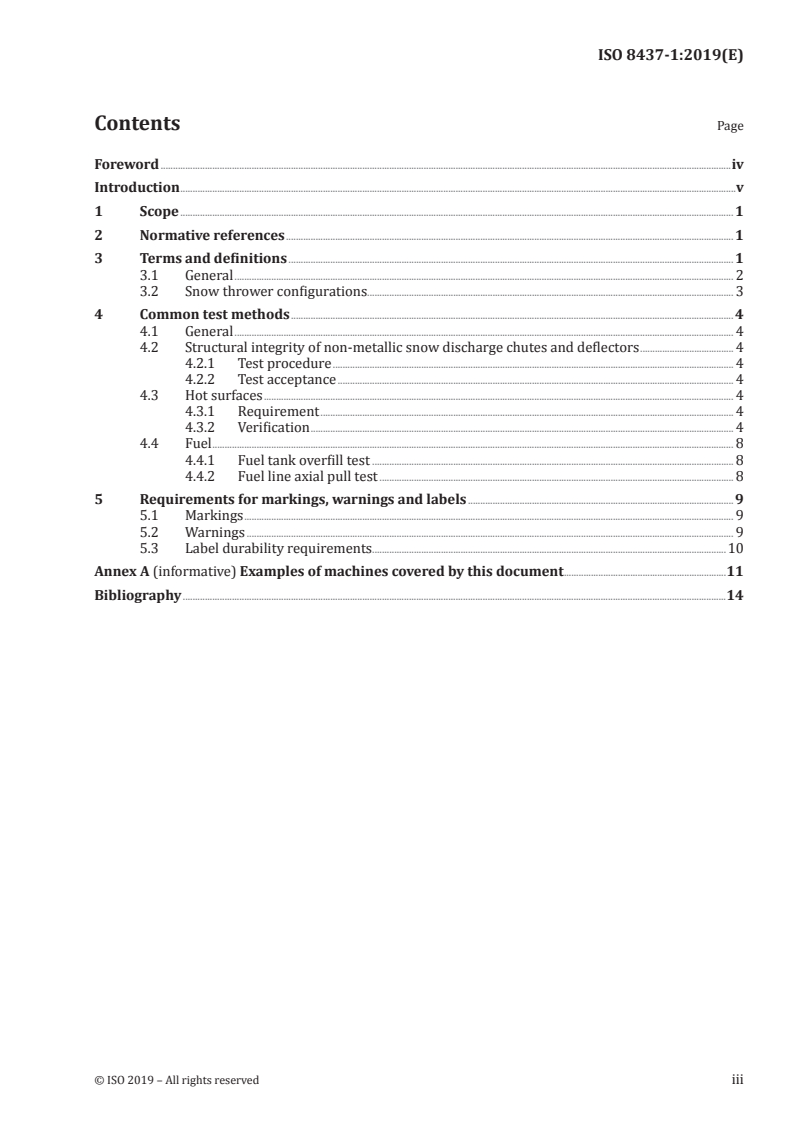
Contents Page
Foreword .iv
Introduction .v
1 Scope . 1
2 Normative references . 1
3 Terms and definitions . 1
3.1 General . 2
3.2 Snow thrower configurations. 3
4 Common test methods . 4
4.1 General . 4
4.2 Structural integrity of non-metallic snow discharge chutes and deflectors . 4
4.2.1 Test procedure . 4
4.2.2 Test acceptance . 4
4.3 Hot surfaces . 4
4.3.1 Requirement . 4
4.3.2 Verification . 4
4.4 Fuel . 8
4.4.1 Fuel tank overfill test . 8
4.4.2 Fuel line axial pull test . 8
5 Requirements for markings, warnings and labels . 9
5.1 Markings . 9
5.2 Warnings . 9
5.3 Label durability requirements.10
Annex A (informative) Examples of machines covered by this document .11
Bibliography .14
Foreword
ISO (the International Organization for Standardization) is a worldwide federation of national standards
bodies (ISO member bodies). The work of preparing International Standards is normally carried out
through ISO technical committees. Each member body interested in a subject for which a technical
committee has been established has the right to be represented on that committee. International
organizations, governmental and non-governmental, in liaison with ISO, also take part in the work.
ISO collaborates closely with the International Electrotechnical Commission (IEC) on all matters of
electrotechnical standardization.
The procedures used to develop this document and those intended for its further maintenance are
described in the ISO/IEC Directives, Part 1. In particular the different approval criteria needed for the
different types of ISO documents should be noted. This document was drafted in accordance with the
editorial rules of the ISO/IEC Directives, Part 2 (see www .iso .org/directives).
Attention is drawn to the possibility that some of the elements of this document may be the subject of
patent rights. ISO shall not be held responsible for identifying any or all such patent rights. Details of
any patent rights identified during the development of the document will be in the Introduction and/or
on the ISO list of patent declarations received (see www .iso .org/patents).
Any trade name used in this document is information given for the convenience of users and does not
constitute an endorsement.
For an explanation on the voluntary nature of standards, the meaning of ISO specific terms and
expressions related to conformity assessment, as well as information about ISO's adherence to the
World Trade Organization (WTO) principles in the Technical Barriers to Trade (TBT) see the following
URL: www .iso .org/iso/foreword .html.
This document was prepared by Technical Committee ISO/TC 23, Tractors and machinery for agriculture
and forestry, Subcommittee SC 13, Powered lawn and garden equipment.
This first edition of ISO 8437-1, together with ISO 8437-2, ISO 8437-3 and ISO 8437-4, cancels and
replaces ISO 8437:1989, which has been technically revised. It also incorporates the Amendment
ISO 8437:1989/Amd.1:1997.
A list of all parts in the ISO 8437 series can be found on the ISO website.
Any feedback or questions on this document should be directed to the user’s national standards body. A
complete listing of these bodies can be found at www .iso .org/members .html.
iv © ISO 2019 – All rights reserved
Introduction
The structure of safety standards in the field of machinery is as follows.
a) Type-A standards (basic standards) give basic concepts, principles for design and general aspects
that can be applied to machinery.
b) Type-B standards (generic safety standards) deal with one or more safety aspects or safeguards
that can be used across a wide range of machinery:
1) type-B1 standards on particular safety aspects (e.g. safety distances, surface temperature,
noise);
2) type-B2 standards on safeguards (e.g. two-handed controls, interlocking devices, pressure
sensitive devices, guards).
c) Type-C standards (machinery safety standards) deal with detailed safety requirements for a
particular machine or group of machines.
This document is a type-C standard as stated in ISO 12100.
This document is of relevance, in particular, for the following stakeholder groups representing the
market players with regard to machinery safety:
— machine manufacturers (small, medium and large enterprises);
— health and safety bodies (regulators, accident prevention organizations, market surveillance, etc.).
Others can be affected by the level of machinery safety achieved with the means of the document by the
above-mentioned stakeholder groups:
— machine users/employers (small, medium and large enterprises);
— machine users/employees (e.g. trade unions, organizations for people with special needs);
— service providers, e.g. for maintenance (small, medium and large enterprises);
— consumers (in case of machinery intended for use by consumers).
The above-mentioned stakeholder groups have been given the possibility to participate at the drafting
process of this document.
The machinery concerned and the extent to which hazards, hazardous situations or hazardous events
are covered are indicated in the Scope of this document.
When provisions of this type-C standard are different from those which are stated in type-A or type-B
standards, the provisions of this type-C standard shall take precedence over the provisions of the other
standards for machines that have been designed and built according to the provisions of this type-C
standard.
INTERNATIONAL STANDARD ISO 8437-1:2019(E)
Snow throwers — Safety requirements and test
procedures —
Part 1:
Terminology and common tests
1 Scope
This document defines terms and definitions and common test methods applicable to combustion
engine powered pedestrian-controlled and ride-on snow throwers. It is intended to be used with
ISO 8437-2, ISO 8437-3 and ISO 8437-4 to achieve the full requirements and means of verification for
pedestrian-controlled and ride-on snow throwers.
The ISO 8437 series deals with significant hazards, hazardous situations and events relevant to snow
throwers used as intended and under the conditions reasonably foreseeable by the manufacturer.
It does not apply to the following:
— electrically powered and battery powered snow throwers;
— hand-held snow throwers;
— airport or highway snow removal machines and equipment;
— machines intended for use in potentially explosive atmospheres.
It does not deal with hazards related to the following:
— battery circuits exceeding 42 V;
— mains connected starting motor;
— magneto grounding circuits;
— working environment;
— electromagnetic compatibility.
The ISO 8437 series is not applicable to machines that were manufactured before the date of its
publication.
2 Normative references
The following documents are referred to in the text in such a way that some or all of their content
constitutes requirements of this document. For dated references, only the edition cited applies. For
undated references, the latest edition of the referenced document (including any amendments) applies.
ISO 12100, Safety of machinery — General principles for design — Risk assessment and risk reduction
ISO 17398:2004, Safety colours and safety signs — Classification, performance and durability of safety signs
3 Terms and definitions
For the purposes of this document, the terms and definitions given in ISO 12100 and the following apply.
ISO and IEC maintain terminological databases for use in standardization at the following addresses:
— ISO Online browsing platform: available at https: //www .iso .org/obp
— IEC Electropedia: available at http: //www .electropedia .org/
3.1 General
3.1.1
barrier
vertical plane determined by an obstruction, such as a handle or steering wheel, that restrains the
operator
Note 1 to entry: See ISO 8437-2:2019, Figure 1.
3.1.2
braking distance
distance travelled between the point of the first application of the brake control and the point at which
the machine comes to rest
3.1.3
clutch
device used for engaging or disengaging the load from the power source
3.1.4
collector
auger or similar device used to gather snow
3.1.5
collector housing
structure, framework or integral shields that limit access to, and egress of, material from a collector (3.1.4)
3.1.6
hazard zone
three-dimensional space that might be hazardous for a person to occupy
Note 1 to entry: The hazard zone moves with the discharge chute and does not include the space behind the
discharge chute that is guarded by the discharge chute.
Note 2 to entry: See ISO 8437-2:2019, Figure 1 and ISO 8437-3:2019, Figure 1.
3.1.7
impeller
power-driven device that transfers energy to discharge the snow
Note 1 to entry: When the collecting function of a device is combined with the impelling function, this device will
be called an “impeller”.
3.1.8
impeller housing
structure, framework or integral shield
...
INTERNATIONAL ISO
STANDARD 8437-1
First edition
2019-07
Snow throwers — Safety requirements
and test procedures —
Part 1:
Terminology and common tests
Chasse-neige — Exigences de sécurité et essais —
Partie 1: Terminologie et essais communs
Reference number
©
ISO 2019
© ISO 2019
All rights reserved. Unless otherwise specified, or required in the context of its implementation, no part of this publication may
be reproduced or utilized otherwise in any form or by any means, electronic or mechanical, including photocopying, or posting
on the internet or an intranet, without prior written permission. Permission can be requested from either ISO at the address
below or ISO’s member body in the country of the requester.
ISO copyright office
CP 401 • Ch. de Blandonnet 8
CH-1214 Vernier, Geneva
Phone: +41 22 749 01 11
Fax: +41 22 749 09 47
Email: copyright@iso.org
Website: www.iso.org
Published in Switzerland
ii © ISO 2019 – All rights reserved
Contents Page
Foreword .iv
Introduction .v
1 Scope . 1
2 Normative references . 1
3 Terms and definitions . 1
3.1 General . 2
3.2 Snow thrower configurations. 3
4 Common test methods . 4
4.1 General . 4
4.2 Structural integrity of non-metallic snow discharge chutes and deflectors . 4
4.2.1 Test procedure . 4
4.2.2 Test acceptance . 4
4.3 Hot surfaces . 4
4.3.1 Requirement . 4
4.3.2 Verification . 4
4.4 Fuel . 8
4.4.1 Fuel tank overfill test . 8
4.4.2 Fuel line axial pull test . 8
5 Requirements for markings, warnings and labels . 9
5.1 Markings . 9
5.2 Warnings . 9
5.3 Label durability requirements.10
Annex A (informative) Examples of machines covered by this document .11
Bibliography .14
Foreword
ISO (the International Organization for Standardization) is a worldwide federation of national standards
bodies (ISO member bodies). The work of preparing International Standards is normally carried out
through ISO technical committees. Each member body interested in a subject for which a technical
committee has been established has the right to be represented on that committee. International
organizations, governmental and non-governmental, in liaison with ISO, also take part in the work.
ISO collaborates closely with the International Electrotechnical Commission (IEC) on all matters of
electrotechnical standardization.
The procedures used to develop this document and those intended for its further maintenance are
described in the ISO/IEC Directives, Part 1. In particular the different approval criteria needed for the
different types of ISO documents should be noted. This document was drafted in accordance with the
editorial rules of the ISO/IEC Directives, Part 2 (see www .iso .org/directives).
Attention is drawn to the possibility that some of the elements of this document may be the subject of
patent rights. ISO shall not be held responsible for identifying any or all such patent rights. Details of
any patent rights identified during the development of the document will be in the Introduction and/or
on the ISO list of patent declarations received (see www .iso .org/patents).
Any trade name used in this document is information given for the convenience of users and does not
constitute an endorsement.
For an explanation on the voluntary nature of standards, the meaning of ISO specific terms and
expressions related to conformity assessment, as well as information about ISO's adherence to the
World Trade Organization (WTO) principles in the Technical Barriers to Trade (TBT) see the following
URL: www .iso .org/iso/foreword .html.
This document was prepared by Technical Committee ISO/TC 23, Tractors and machinery for agriculture
and forestry, Subcommittee SC 13, Powered lawn and garden equipment.
This first edition of ISO 8437-1, together with ISO 8437-2, ISO 8437-3 and ISO 8437-4, cancels and
replaces ISO 8437:1989, which has been technically revised. It also incorporates the Amendment
ISO 8437:1989/Amd.1:1997.
A list of all parts in the ISO 8437 series can be found on the ISO website.
Any feedback or questions on this document should be directed to the user’s national standards body. A
complete listing of these bodies can be found at www .iso .org/members .html.
iv © ISO 2019 – All rights reserved
Introduction
The structure of safety standards in the field of machinery is as follows.
a) Type-A standards (basic standards) give basic concepts, principles for design and general aspects
that can be applied to machinery.
b) Type-B standards (generic safety standards) deal with one or more safety aspects or safeguards
that can be used across a wide range of machinery:
1) type-B1 standards on particular safety aspects (e.g. safety distances, surface temperature,
noise);
2) type-B2 standards on safeguards (e.g. two-handed controls, interlocking devices, pressure
sensitive devices, guards).
c) Type-C standards (machinery safety standards) deal with detailed safety requirements for a
particular machine or group of machines.
This document is a type-C standard as stated in ISO 12100.
This document is of relevance, in particular, for the following stakeholder groups representing the
market players with regard to machinery safety:
— machine manufacturers (small, medium and large enterprises);
— health and safety bodies (regulators, accident prevention organizations, market surveillance, etc.).
Others can be affected by the level of machinery safety achieved with the means of the document by the
above-mentioned stakeholder groups:
— machine users/employers (small, medium and large enterprises);
— machine users/employees (e.g. trade unions, organizations for people with special needs);
— service providers, e.g. for maintenance (small, medium and large enterprises);
— consumers (in case of machinery intended for use by consumers).
The above-mentioned stakeholder groups have been given the possibility to participate at the drafting
process of this document.
The machinery concerned and the extent to which hazards, hazardous situations or hazardous events
are covered are indicated in the Scope of this document.
When provisions of this type-C standard are different from those which are stated in type-A or type-B
standards, the provisions of this type-C standard shall take precedence over the provisions of the other
standards for machines that have been designed and built according to the provisions of this type-C
standard.
INTERNATIONAL STANDARD ISO 8437-1:2019(E)
Snow throwers — Safety requirements and test
procedures —
Part 1:
Terminology and common tests
1 Scope
This document defines terms and definitions and common test methods applicable to combustion
engine powered pedestrian-controlled and ride-on snow throwers. It is intended to be used with
ISO 8437-2, ISO 8437-3 and ISO 8437-4 to achieve the full requirements and means of verification for
pedestrian-controlled and ride-on snow throwers.
The ISO 8437 series deals with significant hazards, hazardous situations and events relevant to snow
throwers used as intended and under the conditions reasonably foreseeable by the manufacturer.
It does not apply to the following:
— electrically powered and battery powered snow throwers;
— hand-held snow throwers;
— airport or highway snow removal machines and equipment;
— machines intended for use in potentially explosive atmospheres.
It does not deal with hazards related to the following:
— battery circuits exceeding 42 V;
— mains connected starting motor;
— magneto grounding circuits;
— working environment;
— electromagnetic compatibility.
The ISO 8437 series is not applicable to machines that were manufactured before the date of its
publication.
2 Normative references
The following documents are referred to in the text in such a way that some or all of their content
constitutes requirements of this document. For dated references, only the edition cited applies. For
undated references, the latest edition of the referenced document (including any amendments) applies.
ISO 12100, Safety of machinery — General principles for design — Risk assessment and risk reduction
ISO 17398:2004, Safety colours and safety signs — Classification, performance and durability of safety signs
3 Terms and definitions
For the purposes of this document, the terms and definitions given in ISO 12100 and the following apply.
ISO and IEC maintain terminological databases for use in standardization at the following addresses:
— ISO Online browsing platform: available at https: //www .iso .org/obp
— IEC Electropedia: available at http: //www .electropedia .org/
3.1 General
3.1.1
barrier
vertical plane determined by an obstruction, such as a handle or steering wheel, that restrains the
operator
Note 1 to entry: See ISO 8437-2:2019, Figure 1.
3.1.2
braking distance
distance travelled between the point of the first application of the brake control and the point at which
the machine comes to rest
3.1.3
clutch
device used for engaging or disengaging the load from the power source
3.1.4
collector
auger or similar device used to gather snow
3.1.5
collector housing
structure, framework or integral shields that limit access to, and egress of, material from a collector (3.1.4)
3.1.6
hazard zone
three-dimensional space that might be hazardous for a person to occupy
Note 1 to entry: The hazard zone moves with the discharge chute and does not include the space behind the
discharge chute that is guarded by the discharge chute.
Note 2 to entry: See ISO 8437-2:2019, Figure 1 and ISO 8437-3:2019, Figure 1.
3.1.7
impeller
power-driven device that transfers energy to discharge the snow
Note 1 to entry: When the collecting function of a device is combined with the impelling function, this device will
be called an “impeller”.
3.1.8
impeller housing
structure, framework or integral shield
...
NORME ISO
INTERNATIONALE 8437-1
Première édition
2019-07
Chasse-neige — Exigences de sécurité
et essais —
Partie 1:
Terminologie et essais communs
Snow throwers — Safety requirements and test procedures —
Part 1: Terminology and common tests
Numéro de référence
©
ISO 2019
DOCUMENT PROTÉGÉ PAR COPYRIGHT
© ISO 2019
Tous droits réservés. Sauf prescription différente ou nécessité dans le contexte de sa mise en œuvre, aucune partie de cette
publication ne peut être reproduite ni utilisée sous quelque forme que ce soit et par aucun procédé, électronique ou mécanique,
y compris la photocopie, ou la diffusion sur l’internet ou sur un intranet, sans autorisation écrite préalable. Une autorisation peut
être demandée à l’ISO à l’adresse ci-après ou au comité membre de l’ISO dans le pays du demandeur.
ISO copyright office
Case postale 401 • Ch. de Blandonnet 8
CH-1214 Vernier, Genève
Tél.: +41 22 749 01 11
Fax: +41 22 749 09 47
E-mail: copyright@iso.org
Web: www.iso.org
Publié en Suisse
ii © ISO 2019 – Tous droits réservés
Sommaire Page
Avant-propos .iv
Introduction .v
1 Domaine d’application . 1
2 Références normatives . 1
3 Termes et définitions . 2
3.1 Généralités . 2
3.2 Configurations de chasse-neige . 3
4 Méthodes d’essai communes . 4
4.1 Généralités . 4
4.2 Intégrité structurelle de goulottes et déflecteurs d’évacuation de la neige non
métalliques . 4
4.2.1 Mode opératoire d’essai . 4
4.2.2 Acceptation de l’essai . . 4
4.3 Surfaces chaudes . 4
4.3.1 Exigence. 4
4.3.2 Vérification . 5
4.4 Carburant . 8
4.4.1 Essai de surremplissage du réservoir de carburant . 8
4.4.2 Essai de traction axiale de la conduite de carburant . 9
5 Exigences pour les marquages, les avertissements et les étiquettes .9
5.1 Marquages . 9
5.2 Avertissements .10
5.3 Exigences de durabilité des étiquettes .10
Annexe A (informative) Exemples de machines couvertes par le présent document .11
Bibliographie .14
Avant-propos
L’ISO (Organisation internationale de normalisation) est une fédération mondiale d’organismes
nationaux de normalisation (comités membres de l’ISO). L’élaboration des Normes internationales est
en général confiée aux comités techniques de l’ISO. Chaque comité membre intéressé par une étude
a le droit de faire partie du comité technique créé à cet effet. Les organisations internationales,
gouvernementales et non gouvernementales, en liaison avec l’ISO participent également aux travaux.
L’ISO collabore étroitement avec la Commission électrotechnique internationale (IEC) en ce qui
concerne la normalisation électrotechnique.
Les procédures utilisées pour élaborer le présent document et celles destinées à sa mise à jour sont
décrites dans les Directives ISO/IEC, Partie 1. Il convient, en particulier de prendre note des différents
critères d’approbation requis pour les différents types de documents ISO. Le présent document a été
rédigé conformément aux règles de rédaction données dans les Directives ISO/IEC, Partie 2 (voir www
.iso .org/directives).
L’attention est attirée sur le fait que certains des éléments du présent document peuvent faire l’objet de
droits de propriété intellectuelle ou de droits analogues. L’ISO ne saurait être tenue pour responsable
de ne pas avoir identifié de tels droits de propriété et averti de leur existence. Les détails concernant
les références aux droits de propriété intellectuelle ou autres droits analogues identifiés lors de
l’élaboration du document sont indiqués dans l’Introduction et/ou dans la liste des déclarations de
brevets reçues par l’ISO (voir www .iso .org/brevets).
Les appellations commerciales éventuellement mentionnées dans le présent document sont données
pour information, par souci de commodité, à l’intention des utilisateurs et ne sauraient constituer un
engagement.
Pour une explication de la nature volontaire des normes, la signification des termes et expressions
spécifiques de l’ISO liés à l’évaluation de la conformité, ou pour toute information au sujet de l’adhésion
de l’ISO aux principes de l’Organisation mondiale du commerce (OMC) concernant les obstacles
techniques au commerce (OTC), voir le lien suivant: www .iso .org/iso/fr/avant -propos.
Le présent document a été élaboré par le comité technique ISO/TC 23, Tracteurs et matériels agricoles et
forestiers, sous-comité SC 13, Matériel à moteur pour jardins et pelouses.
Cette première édition de l’ISO 8437-1, conjointement avec l’ISO 8437-2, l’ISO 8437-3 et l’ISO 8437-4,
annule et remplace l’ISO 8437:1989, qui a fait l’objet d’une révision technique. Elle intègre également
l’amendement ISO 8437:1989/Amd.1:1997.
Une liste de toutes les parties de la série ISO 8437 se trouve sur le site web de l’ISO.
Il convient que l’utilisateur adresse tout retour d’information ou toute question concernant le présent
document à l’organisme national de normalisation de son pays. Une liste exhaustive desdits organismes
se trouve à l’adresse www .iso .org/fr/members .html.
iv © ISO 2019 – Tous droits réservés
Introduction
La structure des normes de sécurité dans le domaine des machines est la suivante:
a) les normes de type A (normes fondamentales) contiennent des notions fondamentales, des principes
de conception et des aspects généraux relatifs aux machines;
b) les normes de type B (normes de sécurité génériques) traitent d’un ou de plusieurs aspects de la
sécurité ou de moyens de protection valables pour une large gamme de machines:
1) les normes de type B1 traitent d’aspects particuliers de la sécurité (par exemple distances de
sécurité, température superficielle, bruit);
2) les normes de type B2 traitent de moyens de protection (par exemple commandes bimanuelles,
dispositifs de verrouillage, dispositifs sensibles à la pression, protecteurs);
c) les normes de type C (normes de sécurité par catégorie de machines) traitent des exigences de
sécurité détaillées s’appliquant à une machine particulière ou à un groupe de machines particulier.
Le présent document est une norme de type C tel que mentionné dans l’ISO 12100.
Le présent document concerne, en particulier, les groupes de parties prenantes suivants représentant
les acteurs du marché en ce qui concerne la sécurité des machines:
— les fabricants de machines (petites, moyennes et grandes entreprises);
— les organismes de santé et de sécurité (régulateurs, organismes de prévention des accidents,
surveillance du marché, etc.).
D’autres partenaires peuvent être concernés par le niveau de sécurité des machines atteint à l’aide du
document par les groupes de parties prenantes mentionnés ci-dessus:
— les utilisateurs de machines/employeurs (petites, moyennes et grandes entreprises);
— les utilisateurs de machines/salariés (par exemple syndicats de salariés, organisations représentant
des personnes ayant des besoins particuliers);
— les prestataires de services, par exemple sociétés de maintenance (petites, moyennes et grandes
entreprises);
— les consommateurs (dans le cas des machines destinées à être utilisées par les consommateurs).
Les groupes de parties prenantes mentionnés ci-dessus ont eu la possibilité de participer au processus
d’élaboration du présent document.
Les machines concernées et l’étendue des phénomènes dangereux, des situations dangereuses et des
événements dangereux couverts sont indiquées dans le domaine d’application du présent document.
Lorsque les dispositions de la présente norme de type C sont différentes de celles des normes de type A
ou de type B, les dispositions de la présente norme de type C doivent prendre le pas sur les dispositions
des autres normes pour les machines qui ont été conçues et fabriquées conformément aux dispositions
de la présente norme de type C.
NORME INTERNATIONALE ISO 8437-1:2019(F)
Chasse-neige — Exigences de sécurité et essais —
Partie 1:
Terminologie et essais communs
1 Domaine d’application
Le présent document définit les termes, les définitions et les méthodes d’essai communes qui
s’appliquent aux chasse-neige à moteur à combustion à conducteur à pied et à conducteur porté. Il est
destiné à être utilisé avec l’ISO 8437-2, l’ISO 8437-3 et l’ISO 8437-4 afin de se conformer pleinement aux
exigences et mettre en œuvre tous les moyens de vérification pour les chasse-neige à conducteur à pied
et à conducteur porté.
La série ISO 8437 traite des phénomènes dangereux, des situations dangereuses et des événements
dangereux significatifs applicables aux chasse-neige lorsqu’ils sont utilisés comme prévu et dans des
conditions raisonnablement prévisibles par le fabricant.
Elle ne s’applique pas:
— aux chasse-neige électriques et à batterie;
— aux chasse-neige portatifs;
— aux machines et au matériel de déneigement pour aéroports ou autoroutes;
— aux machines destinées à être utilisées dans des atmosphères explosibles.
Elle ne traite pas des phénomènes dangereux associés:
— aux circuits de batterie dépassant 42 V;
— aux démarreurs raccordés à l’alimentation secteur;
— aux circuits de mise à la masse de la magnéto;
— à l’environnement de travail;
— à la compatibilité électromagnétique.
La série ISO 8437 ne s’applique pas aux machines fabriquées avant sa date de publication.
2 Références normatives
Les documents suivants cités dans le texte constituent, pour tout ou partie de leur contenu, des
exigences du présent document. Pour les références datées, seule l’édition citée s’applique. Pour les
références non datées, la dernière édition du document de référence s’applique (y compris les éventuels
amendements).
ISO 12100, Sécurité des machines — Principes généraux de conception — Appréciation du risque et
réduction du risque
ISO 17398:2004, Couleurs de sécurité et signaux de sécurité — Classification, performance et durabilité des
signaux de sécurité
3 Termes et définitions
Pour les besoins du présent document, les termes et définitions de l’ISO 12100, ainsi que les suivants,
s’appliquent.
L’ISO et l’IEC tiennent à jour des bases de données terminologiques destinées à être utilisées en
normalisation, consultables aux adresses suivantes:
— ISO Online browsing platform: disponible à l’adresse https: //www .iso .org/obp;
— IEC Electropedia: disponible à l’adresse http: //www .electropedia .org/.
3.1 Généralités
3.1.1
barrière
plan vertical délimité par un obstacle tel qu’une poignée ou un volant et qui réduit la liberté de
mouvement de l’opérateur
Note 1 à l'article: Voir l’ISO 8437-2:2019, Figure 1.
3.1.2
distance d’arrêt
distance parcourue entre le point de la première application de la commande de frein et le point d’arrêt
de la machine
3.1.3
embrayage
dispositif utilisé pour embrayer ou débrayer la charge de la source d’énergie
3.1.4
collecteur
vis sans fin ou dispositif semblable servant à ramasser la neige
3.1.5
enceinte de collecteur
structure, châssis ou carters intégraux limitant l’entrée et la sortie de matériaux du collecteur (3.1.4)
3.1.6
zone dangereuse
espace tridimensionnel qui peut présenter un danger pour la personne qui l’occupe
Note 1 à l'article: La zone dangereuse se déplace avec la goulotte d’évacuation et ne comprend pas l’espace situé
derrière la goulotte d’évacuation qui est protégé par celle-ci.
Note 2 à l'article: Voir l’ISO 8437-2:2019, Figure 1 et l’ISO 8437-3:2019, Figure 1.
3.1.7
turbine
dispositif d’entraînement qui fournit l’énergie nécessaire à l’évacuation de la neige
Note 1 à l'article: Ce dispositif est appelé «turbine» lorsque la fonction de ramassage d’un dispositif est associée
à la fonction turbine.
3.1.8
enceinte de turbine
structure, châssis ou carter intégral limitant l’entrée et la sortie de matériaux de la turbine (3.1.7)
2 © ISO 2019 – Tous droits réservés
3.1.9
utilisation normale
tout usage de la machine raisonnablement prévisible et consistant généralement en des activités telles
que le démarrage, l’arrêt, le remplissage du réservoir de carburant, le branchement à (ou débranchement
d’) une source d’énergie électrique et la montée et la descente des tracteurs à conduct
...
NORME ISO
INTERNATIONALE 8437-1
Première édition
2019-07
Chasse-neige — Exigences de sécurité
et essais —
Partie 1:
Terminologie et essais communs
Snow throwers — Safety requirements and test procedures —
Part 1: Terminology and common tests
Numéro de référence
©
ISO 2019
DOCUMENT PROTÉGÉ PAR COPYRIGHT
© ISO 2019
Tous droits réservés. Sauf prescription différente ou nécessité dans le contexte de sa mise en œuvre, aucune partie de cette
publication ne peut être reproduite ni utilisée sous quelque forme que ce soit et par aucun procédé, électronique ou mécanique,
y compris la photocopie, ou la diffusion sur l’internet ou sur un intranet, sans autorisation écrite préalable. Une autorisation peut
être demandée à l’ISO à l’adresse ci-après ou au comité membre de l’ISO dans le pays du demandeur.
ISO copyright office
Case postale 401 • Ch. de Blandonnet 8
CH-1214 Vernier, Genève
Tél.: +41 22 749 01 11
Fax: +41 22 749 09 47
E-mail: copyright@iso.org
Web: www.iso.org
Publié en Suisse
ii © ISO 2019 – Tous droits réservés
Sommaire Page
Avant-propos .iv
Introduction .v
1 Domaine d’application . 1
2 Références normatives . 1
3 Termes et définitions . 2
3.1 Généralités . 2
3.2 Configurations de chasse-neige . 3
4 Méthodes d’essai communes . 4
4.1 Généralités . 4
4.2 Intégrité structurelle de goulottes et déflecteurs d’évacuation de la neige non
métalliques . 4
4.2.1 Mode opératoire d’essai . 4
4.2.2 Acceptation de l’essai . . 4
4.3 Surfaces chaudes . 4
4.3.1 Exigence. 4
4.3.2 Vérification . 5
4.4 Carburant . 8
4.4.1 Essai de surremplissage du réservoir de carburant . 8
4.4.2 Essai de traction axiale de la conduite de carburant . 9
5 Exigences pour les marquages, les avertissements et les étiquettes .9
5.1 Marquages . 9
5.2 Avertissements .10
5.3 Exigences de durabilité des étiquettes .10
Annexe A (informative) Exemples de machines couvertes par le présent document .11
Bibliographie .14
Avant-propos
L’ISO (Organisation internationale de normalisation) est une fédération mondiale d’organismes
nationaux de normalisation (comités membres de l’ISO). L’élaboration des Normes internationales est
en général confiée aux comités techniques de l’ISO. Chaque comité membre intéressé par une étude
a le droit de faire partie du comité technique créé à cet effet. Les organisations internationales,
gouvernementales et non gouvernementales, en liaison avec l’ISO participent également aux travaux.
L’ISO collabore étroitement avec la Commission électrotechnique internationale (IEC) en ce qui
concerne la normalisation électrotechnique.
Les procédures utilisées pour élaborer le présent document et celles destinées à sa mise à jour sont
décrites dans les Directives ISO/IEC, Partie 1. Il convient, en particulier de prendre note des différents
critères d’approbation requis pour les différents types de documents ISO. Le présent document a été
rédigé conformément aux règles de rédaction données dans les Directives ISO/IEC, Partie 2 (voir www
.iso .org/directives).
L’attention est attirée sur le fait que certains des éléments du présent document peuvent faire l’objet de
droits de propriété intellectuelle ou de droits analogues. L’ISO ne saurait être tenue pour responsable
de ne pas avoir identifié de tels droits de propriété et averti de leur existence. Les détails concernant
les références aux droits de propriété intellectuelle ou autres droits analogues identifiés lors de
l’élaboration du document sont indiqués dans l’Introduction et/ou dans la liste des déclarations de
brevets reçues par l’ISO (voir www .iso .org/brevets).
Les appellations commerciales éventuellement mentionnées dans le présent document sont données
pour information, par souci de commodité, à l’intention des utilisateurs et ne sauraient constituer un
engagement.
Pour une explication de la nature volontaire des normes, la signification des termes et expressions
spécifiques de l’ISO liés à l’évaluation de la conformité, ou pour toute information au sujet de l’adhésion
de l’ISO aux principes de l’Organisation mondiale du commerce (OMC) concernant les obstacles
techniques au commerce (OTC), voir le lien suivant: www .iso .org/iso/fr/avant -propos.
Le présent document a été élaboré par le comité technique ISO/TC 23, Tracteurs et matériels agricoles et
forestiers, sous-comité SC 13, Matériel à moteur pour jardins et pelouses.
Cette première édition de l’ISO 8437-1, conjointement avec l’ISO 8437-2, l’ISO 8437-3 et l’ISO 8437-4,
annule et remplace l’ISO 8437:1989, qui a fait l’objet d’une révision technique. Elle intègre également
l’amendement ISO 8437:1989/Amd.1:1997.
Une liste de toutes les parties de la série ISO 8437 se trouve sur le site web de l’ISO.
Il convient que l’utilisateur adresse tout retour d’information ou toute question concernant le présent
document à l’organisme national de normalisation de son pays. Une liste exhaustive desdits organismes
se trouve à l’adresse www .iso .org/fr/members .html.
iv © ISO 2019 – Tous droits réservés
Introduction
La structure des normes de sécurité dans le domaine des machines est la suivante:
a) les normes de type A (normes fondamentales) contiennent des notions fondamentales, des principes
de conception et des aspects généraux relatifs aux machines;
b) les normes de type B (normes de sécurité génériques) traitent d’un ou de plusieurs aspects de la
sécurité ou de moyens de protection valables pour une large gamme de machines:
1) les normes de type B1 traitent d’aspects particuliers de la sécurité (par exemple distances de
sécurité, température superficielle, bruit);
2) les normes de type B2 traitent de moyens de protection (par exemple commandes bimanuelles,
dispositifs de verrouillage, dispositifs sensibles à la pression, protecteurs);
c) les normes de type C (normes de sécurité par catégorie de machines) traitent des exigences de
sécurité détaillées s’appliquant à une machine particulière ou à un groupe de machines particulier.
Le présent document est une norme de type C tel que mentionné dans l’ISO 12100.
Le présent document concerne, en particulier, les groupes de parties prenantes suivants représentant
les acteurs du marché en ce qui concerne la sécurité des machines:
— les fabricants de machines (petites, moyennes et grandes entreprises);
— les organismes de santé et de sécurité (régulateurs, organismes de prévention des accidents,
surveillance du marché, etc.).
D’autres partenaires peuvent être concernés par le niveau de sécurité des machines atteint à l’aide du
document par les groupes de parties prenantes mentionnés ci-dessus:
— les utilisateurs de machines/employeurs (petites, moyennes et grandes entreprises);
— les utilisateurs de machines/salariés (par exemple syndicats de salariés, organisations représentant
des personnes ayant des besoins particuliers);
— les prestataires de services, par exemple sociétés de maintenance (petites, moyennes et grandes
entreprises);
— les consommateurs (dans le cas des machines destinées à être utilisées par les consommateurs).
Les groupes de parties prenantes mentionnés ci-dessus ont eu la possibilité de participer au processus
d’élaboration du présent document.
Les machines concernées et l’étendue des phénomènes dangereux, des situations dangereuses et des
événements dangereux couverts sont indiquées dans le domaine d’application du présent document.
Lorsque les dispositions de la présente norme de type C sont différentes de celles des normes de type A
ou de type B, les dispositions de la présente norme de type C doivent prendre le pas sur les dispositions
des autres normes pour les machines qui ont été conçues et fabriquées conformément aux dispositions
de la présente norme de type C.
NORME INTERNATIONALE ISO 8437-1:2019(F)
Chasse-neige — Exigences de sécurité et essais —
Partie 1:
Terminologie et essais communs
1 Domaine d’application
Le présent document définit les termes, les définitions et les méthodes d’essai communes qui
s’appliquent aux chasse-neige à moteur à combustion à conducteur à pied et à conducteur porté. Il est
destiné à être utilisé avec l’ISO 8437-2, l’ISO 8437-3 et l’ISO 8437-4 afin de se conformer pleinement aux
exigences et mettre en œuvre tous les moyens de vérification pour les chasse-neige à conducteur à pied
et à conducteur porté.
La série ISO 8437 traite des phénomènes dangereux, des situations dangereuses et des événements
dangereux significatifs applicables aux chasse-neige lorsqu’ils sont utilisés comme prévu et dans des
conditions raisonnablement prévisibles par le fabricant.
Elle ne s’applique pas:
— aux chasse-neige électriques et à batterie;
— aux chasse-neige portatifs;
— aux machines et au matériel de déneigement pour aéroports ou autoroutes;
— aux machines destinées à être utilisées dans des atmosphères explosibles.
Elle ne traite pas des phénomènes dangereux associés:
— aux circuits de batterie dépassant 42 V;
— aux démarreurs raccordés à l’alimentation secteur;
— aux circuits de mise à la masse de la magnéto;
— à l’environnement de travail;
— à la compatibilité électromagnétique.
La série ISO 8437 ne s’applique pas aux machines fabriquées avant sa date de publication.
2 Références normatives
Les documents suivants cités dans le texte constituent, pour tout ou partie de leur contenu, des
exigences du présent document. Pour les références datées, seule l’édition citée s’applique. Pour les
références non datées, la dernière édition du document de référence s’applique (y compris les éventuels
amendements).
ISO 12100, Sécurité des machines — Principes généraux de conception — Appréciation du risque et
réduction du risque
ISO 17398:2004, Couleurs de sécurité et signaux de sécurité — Classification, performance et durabilité des
signaux de sécurité
3 Termes et définitions
Pour les besoins du présent document, les termes et définitions de l’ISO 12100, ainsi que les suivants,
s’appliquent.
L’ISO et l’IEC tiennent à jour des bases de données terminologiques destinées à être utilisées en
normalisation, consultables aux adresses suivantes:
— ISO Online browsing platform: disponible à l’adresse https: //www .iso .org/obp;
— IEC Electropedia: disponible à l’adresse http: //www .electropedia .org/.
3.1 Généralités
3.1.1
barrière
plan vertical délimité par un obstacle tel qu’une poignée ou un volant et qui réduit la liberté de
mouvement de l’opérateur
Note 1 à l'article: Voir l’ISO 8437-2:2019, Figure 1.
3.1.2
distance d’arrêt
distance parcourue entre le point de la première application de la commande de frein et le point d’arrêt
de la machine
3.1.3
embrayage
dispositif utilisé pour embrayer ou débrayer la charge de la source d’énergie
3.1.4
collecteur
vis sans fin ou dispositif semblable servant à ramasser la neige
3.1.5
enceinte de collecteur
structure, châssis ou carters intégraux limitant l’entrée et la sortie de matériaux du collecteur (3.1.4)
3.1.6
zone dangereuse
espace tridimensionnel qui peut présenter un danger pour la personne qui l’occupe
Note 1 à l'article: La zone dangereuse se déplace avec la goulotte d’évacuation et ne comprend pas l’espace situé
derrière la goulotte d’évacuation qui est protégé par celle-ci.
Note 2 à l'article: Voir l’ISO 8437-2:2019, Figure 1 et l’ISO 8437-3:2019, Figure 1.
3.1.7
turbine
dispositif d’entraînement qui fournit l’énergie nécessaire à l’évacuation de la neige
Note 1 à l'article: Ce dispositif est appelé «turbine» lorsque la fonction de ramassage d’un dispositif est associée
à la fonction turbine.
3.1.8
enceinte de turbine
structure, châssis ou carter intégral limitant l’entrée et la sortie de matériaux de la turbine (3.1.7)
2 © ISO 2019 – Tous droits réservés
3.1.9
utilisation normale
tout usage de la machine raisonnablement prévisible et consistant généralement en des activités telles
que le démarrage, l’arrêt, le remplissage du réservoir de carburant, le branchement à (ou débranchement
d’) une source d’énergie électrique et la montée et la descente des tracteurs à conduct
...