

ISO/TS 23483:2022
(Main)Carbon fibres — Determination of polyacrylonitrile-based (PAN-based) carbon fibre tow characteristics — Heat transfer parameter
General Information
- Abstract
This document specifies a method using a thermal imaging camera for measuring the heat transfer parameter of PAN-based 12 K carbon fibre tow with a filament diameter of 7 µm. This document is applicable to both sized and unsized carbon fibres. NOTE At the time of publication, the experience is on 12 K tow. Other tows will be included when the experience becomes available.
- Status
- Published
- Publication Date
- 03-Aug-2022
- Technical Committee
- ISO/TC 61/SC 13 - Composites and reinforcement fibres
- Drafting Committee
- ISO/TC 61/SC 13/WG 1 - Reinforcements and reinforcement products
- Current Stage
- 9093 - International Standard confirmed
- Start Date
- 04-Dec-2025
- Completion Date
- 29-Aug-2026

Overview
ISO/TS 23483:2022 specifies a non-contact method for measuring the heat transfer parameter of polyacrylonitrile-based (PAN-based) carbon fibre tow using a thermal imaging camera. The technical specification is focused on 12 K carbon fibre tow (≈12 000 filaments) with a filament diameter of about 7 µm, and applies to both sized and unsized fibres. The method quantifies heat transfer using thermography and Fourier’s thermal conductivity relation to provide reproducible thermal-characterization data for carbon fibre tows.
Key Topics and Requirements
- Scope: Measurement of PAN-based 12 K carbon fibre tow heat transfer parameter using a thermal imaging camera.
- Measurement principle: Thermographic recording of temperature difference (ΔT = T1 − T2) between two electrode positions across a 15 mm active tow length; apply Fourier’s law K = L·Q / (ΔT·A).
- Typical test parameters:
- Active length between electrodes: 15 mm (mounted within a total tow length of 100 mm).
- Cross-sectional area (document example): A = 4.89 × 10⁻⁷ m².
- Thermal imaging camera resolution: minimum 640 × 480.
- Emissivity: graphite/carbon emissivity at 298 K ≈ 0.97 (camera correction values for emissivity, distance, area required).
- Camera-sample distance: 200–300 mm.
- Power supply: DC, 50 V, 20 A, 1 000 W (constant).
- Environmental conditions: 296 ±2 K and 50 ±10 % RH; use an adiabatic black box chamber to avoid convection.
- Sampling & repeatability: Minimum five specimens, at least 15 measurement points per specimen; stop after 30 consecutive points and allow 30 s rest if needed.
- Calibration & traceability: Annual calibration of thermal camera per manufacturer and national metrology institute procedures.
- Reporting: Include test equipment, sample description, conditions, measured heat transfer parameter, date/time and other relevant influences.
Applications and Users
ISO/TS 23483:2022 is practical for:
- Materials laboratories and accredited test houses performing thermal characterization of carbon fibres.
- Composite manufacturers (aerospace, automotive, electronics, sporting goods) needing tow-level thermal data for thermal management, simulation, and process control.
- R&D teams optimizing fibre sizing, tow architecture, or thermal conductivity models.
- Quality control and incoming inspection processes where reproducible tow thermal properties are required.
Keywords: ISO/TS 23483:2022, carbon fibres, PAN-based, heat transfer parameter, thermal imaging camera, 12K tow, carbon fibre tow thermal measurement.
Related Standards
- ASTM D5470 - Thermal transmission properties (referenced).
- ASTM E1461 - Thermal diffusivity by the flash method (referenced). These provide complementary methods for thermal-property measurement and context for selecting a suitable test approach.
Get Certified
Connect with accredited certification bodies for this standard

Control Union Certifications
Global certification for agriculture and sustainability.

Hohenstein Institut
Textile testing and certification.

Bureau Veritas Bangladesh
Bureau Veritas certification services in Bangladesh.
Sponsored listings
Frequently Asked Questions
ISO/TS 23483:2022 is a technical specification published by the International Organization for Standardization (ISO). Its full title is "Carbon fibres — Determination of polyacrylonitrile-based (PAN-based) carbon fibre tow characteristics — Heat transfer parameter". This standard covers: This document specifies a method using a thermal imaging camera for measuring the heat transfer parameter of PAN-based 12 K carbon fibre tow with a filament diameter of 7 µm. This document is applicable to both sized and unsized carbon fibres. NOTE At the time of publication, the experience is on 12 K tow. Other tows will be included when the experience becomes available.
This document specifies a method using a thermal imaging camera for measuring the heat transfer parameter of PAN-based 12 K carbon fibre tow with a filament diameter of 7 µm. This document is applicable to both sized and unsized carbon fibres. NOTE At the time of publication, the experience is on 12 K tow. Other tows will be included when the experience becomes available.
ISO/TS 23483:2022 is classified under the following ICS (International Classification for Standards) categories: 59.100.20 - Carbon materials. The ICS classification helps identify the subject area and facilitates finding related standards.
ISO/TS 23483:2022 is available in PDF format for immediate download after purchase. The document can be added to your cart and obtained through the secure checkout process. Digital delivery ensures instant access to the complete standard document.
Standards Content (Sample)
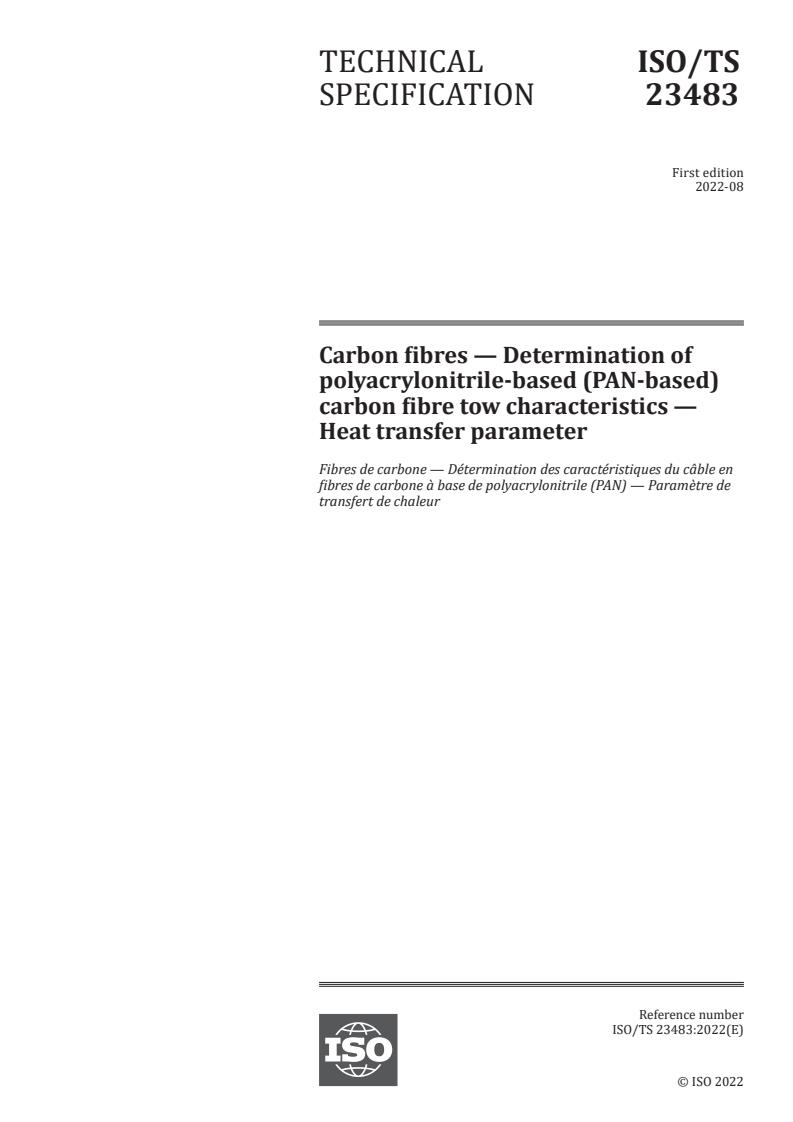
TECHNICAL ISO/TS
SPECIFICATION 23483
First edition
2022-08
Carbon fibres — Determination of
polyacrylonitrile-based (PAN-based)
carbon fibre tow characteristics —
Heat transfer parameter
Fibres de carbone — Détermination des caractéristiques du câble en
fibres de carbone à base de polyacrylonitrile (PAN) — Paramètre de
transfert de chaleur
Reference number
© ISO 2022
All rights reserved. Unless otherwise specified, or required in the context of its implementation, no part of this publication may
be reproduced or utilized otherwise in any form or by any means, electronic or mechanical, including photocopying, or posting on
the internet or an intranet, without prior written permission. Permission can be requested from either ISO at the address below
or ISO’s member body in the country of the requester.
ISO copyright office
CP 401 • Ch. de Blandonnet 8
CH-1214 Vernier, Geneva
Phone: +41 22 749 01 11
Email: copyright@iso.org
Website: www.iso.org
Published in Switzerland
ii
Contents Page
Foreword .iv
Introduction .v
1 Scope . 1
2 Normative references . 1
3 Terms and definitions . 1
4 Principle . 1
5 Test devices . 2
6 Test conditions on carbon fibre tow .3
7 Traceability — Calibration. 3
8 Test procedures . 3
8.1 Type . 3
8.2 Size . 3
8.3 Thermal imaging camera . 3
8.3.1 Working parameters of thermal imaging camera . 3
8.4 Thermal imaging camera scan range on a sample . 3
8.5 Sample preparations . 4
8.5.1 Mounting and handling . 4
8.6 No. of samples and no. of measurements . 4
8.7 Data . 4
9 Test report . 5
Annex A (informative) Typical set-up for heat transfer parameter measurement .6
Annex B (informative) Determination of 12 K carbon fibre tow heat transfer parameter .9
Bibliography .10
iii
Foreword
ISO (the International Organization for Standardization) is a worldwide federation of national standards
bodies (ISO member bodies). The work of preparing International Standards is normally carried out
through ISO technical committees. Each member body interested in a subject for which a technical
committee has been established has the right to be represented on that committee. International
organizations, governmental and non-governmental, in liaison with ISO, also take part in the work.
ISO collaborates closely with the International Electrotechnical Commission (IEC) on all matters of
electrotechnical standardization.
The procedures used to develop this document and those intended for its further maintenance are
described in the ISO/IEC Directives, Part 1. In particular, the different approval criteria needed for the
different types of ISO documents should be noted. This document was drafted in accordance with the
editorial rules of the ISO/IEC Directives, Part 2 (see www.iso.org/directives).
Attention is drawn to the possibility that some of the elements of this document may be the subject of
patent rights. ISO shall not be held responsible for identifying any or all such patent rights. Details of
any patent rights identified during the development of the document will be in the Introduction and/or
on the ISO list of patent declarations received (see www.iso.org/patents).
Any trade name used in this document is information given for the convenience of users and does not
constitute an endorsement.
For an explanation of the voluntary nature of standards, the meaning of ISO specific terms and
expressions related to conformity assessment, as well as information about ISO's adherence to the
World Trade Organization (WTO) principles in the Technical Barriers to Trade (TBT), see www.iso.org/
iso/foreword.html.
This document was prepared by Technical Committee ISO/TC 61, Plastics, Subcommittee SC 13,
Composites and reinforcement fibres.
Any feedback or questions on this document should be directed to the user’s national standards body. A
complete listing of these bodies can be found at www.iso.org/members.html.
iv
Introduction
Currently, contact-type (1) and noncontact-type thermal conductivity method (2) are used to measure
the thermal conductivity. The contact-type method exhibits measurement non-uniformity in the
carbon fibre thickness direction to unable uniform sampling, and the error occurrence rate is known to
be high. Also, the noncontact-type method, fibre porosity and tow gap can create lower accuracy, and
the error occurrence rate is similarly high. Therefore, this document is made to provide a quantitative
method for the measurement of carbon fibre thermal conductivity, using a thermal imaging camera,
that will alleviate problems observed in prior described methods.
v
TECHNICAL SPECIFICATION ISO/TS 23483:2022(E)
Carbon fibres — Determination of polyacrylonitrile-based
(PAN-based) carbon fibre tow characteristics — Heat
transfer parameter
1 Scope
This document specifies a method using a thermal imaging camera for measuring the heat transfer
parameter of PAN-based 12 K carbon fibre tow with a filament diameter of 7 µm. This document is
applicable to both sized and unsized carbon fibres.
NOTE At the time of publication, the experience is on 12 K tow. Other tows will be included when the
experience becomes available.
2 Normative references
There are normative references in this document.
3 Terms and definitions
For the purposes of this document, the following terms and definitions are apply.
ISO and IEC maintain terminological databases for use in standardization at the following addresses:
— ISO Online browsing platform: available at https://
...