


ISO 10618:2004
(Main)Carbon fibre — Determination of tensile properties of resin-impregnated yarn
Carbon fibre — Determination of tensile properties of resin-impregnated yarn
ISO 10618:2004 specifies a method of test for the determination of the tensile strength, tensile modulus of elasticity and strain at maximum load of a resin-impregnated yarn specimen. The method is applicable to yarns (continuous and staple-fibre yarns) of carbon fibre for use as reinforcements in composite materials.
Fibres de carbone — Détermination des propriétés en traction sur fils imprégnés de résine
L'ISO 10618:2004 spécifie une méthode d'essai pour la détermination de la résistance en traction, du module d'élasticité en traction et de la déformation à la charge maximale sur une éprouvette de fil imprégné de résine. La méthode s'applique à des fils (continus ou discontinus) de fibres de carbone utilisés pour le renforcement des matériaux composites.
General Information
- Status
- Published
- Publication Date
- 12-Aug-2004
- Technical Committee
- ISO/TC 61/SC 13 - Composites and reinforcement fibres
- Drafting Committee
- ISO/TC 61/SC 13/WG 1 - Reinforcements and reinforcement products
- Current Stage
- 9093 - International Standard confirmed
- Start Date
- 28-Jul-2022
- Completion Date
- 12-Feb-2026
Relations
- Effective Date
- 12-Feb-2026
- Consolidates
ISO 6103:1986 - Bonded abrasive products — Static balancing of grinding wheels — Testing - Effective Date
- 06-Jun-2022
- Revises
ISO 10618:1999 - Carbon fibre — Determination of tensile properties of resin-impregnated yarn - Effective Date
- 15-Apr-2008
Overview
ISO 10618:2004 specifies a standardized test method for determining the tensile properties of resin-impregnated carbon‑fibre yarn used as reinforcement in composite materials. The standard covers measurement of tensile strength, tensile modulus of elasticity (chord modulus), and strain at maximum load for both continuous and staple-fibre yarns after uniform resin impregnation and curing.
Key topics and requirements
- Scope: Applies to resin‑impregnated carbon fibre yarns intended for composite reinforcement.
- Measured properties: Tensile strength (σ), tensile modulus (Ef), and strain at maximum load.
- Specimen preparation:
- Uniform impregnation with a compatible resin (heat‑curable epoxy systems are recommended; viscosity preferably < 1 000 mPa·s during impregnation).
- Resin content minimum: 30% by mass (calculated from linear densities).
- Cure the resin per manufacturer instructions in a temperature‑controlled oven (fan circulation preferred).
- Test specimens:
- Prepare enough specimens to obtain four valid determinations; discard and repeat any test where failure occurs in grips, tabs, or due to extensometer damage.
- Specimen length options: with tabs - 150 ± 5 mm or 200 ± 5 mm between tabs; without tabs - total length 250 ± 5 mm or 300 ± 5 mm.
- Apparatus and instrumentation:
- Impregnation equipment (rollers, die, winding frame), curing oven, tensile‑testing machine with force and extension recording.
- Extensometer: gauge length ≥ 50 mm (preferably 100 mm), linearity deviation ≤ 0.1%.
- Balance readable to 0.1 g and ruler ≥ 500 mm (±1 mm).
- Test procedure:
- Condition specimens per ISO 291.
- Test at constant crosshead speed (maximum recommended 250 mm/min).
- Use appropriate grips or tabs to avoid slippage and premature failure.
- Calculations:
- Tensile strength calculated from maximum force divided by yarn cross‑sectional area (area derived from linear density and fibre density).
- Modulus can be determined by two chord methods (between strain levels - Method A, or between load levels - Method B).
Applications and users
ISO 10618:2004 is used by:
- Composite materials manufacturers and suppliers verifying reinforcement yarn mechanical performance.
- Quality assurance and R&D laboratories testing resin‑impregnated carbon yarn for prepregs, towpregs, and dry‑prep systems.
- Material engineers developing specifications for aerospace, automotive, sporting goods, and industrial composite parts.
Practically, the standard ensures repeatable, comparable tensile data for material selection, supplier qualification, and process control in composite manufacturing.
Related standards
Normative references include:
- ISO 291 - Conditioning and testing atmospheres
- ISO 527‑1 - Tensile properties - General principles
- ISO 1889 - Linear density of reinforcement yarns
- ISO 10119 - Carbon fibre density
- ISO 10548 - Size content of carbon fibre
Keywords: ISO 10618:2004, carbon fibre tensile test, resin‑impregnated yarn, tensile strength, tensile modulus, composite reinforcement.
ISO 10618:2004 - Carbon fibre -- Determination of tensile properties of resin-impregnated yarn
ISO 10618:2004 - Fibres de carbone -- Détermination des propriétés en traction sur fils imprégnés de résine
Get Certified
Connect with accredited certification bodies for this standard

Control Union Certifications
Global certification for agriculture and sustainability.

Bureau Veritas Bangladesh
Bureau Veritas certification services in Bangladesh.

ECOCERT France
Leader in organic and sustainability certification worldwide.
Sponsored listings
Frequently Asked Questions
ISO 10618:2004 is a standard published by the International Organization for Standardization (ISO). Its full title is "Carbon fibre — Determination of tensile properties of resin-impregnated yarn". This standard covers: ISO 10618:2004 specifies a method of test for the determination of the tensile strength, tensile modulus of elasticity and strain at maximum load of a resin-impregnated yarn specimen. The method is applicable to yarns (continuous and staple-fibre yarns) of carbon fibre for use as reinforcements in composite materials.
ISO 10618:2004 specifies a method of test for the determination of the tensile strength, tensile modulus of elasticity and strain at maximum load of a resin-impregnated yarn specimen. The method is applicable to yarns (continuous and staple-fibre yarns) of carbon fibre for use as reinforcements in composite materials.
ISO 10618:2004 is classified under the following ICS (International Classification for Standards) categories: 59.100.20 - Carbon materials. The ICS classification helps identify the subject area and facilitates finding related standards.
ISO 10618:2004 has the following relationships with other standards: It is inter standard links to EN ISO 10618:2004, ISO 6103:1986, ISO 10618:1999. Understanding these relationships helps ensure you are using the most current and applicable version of the standard.
ISO 10618:2004 is available in PDF format for immediate download after purchase. The document can be added to your cart and obtained through the secure checkout process. Digital delivery ensures instant access to the complete standard document.
Standards Content (Sample)
INTERNATIONAL ISO
STANDARD 10618
Second edition
2004-08-15
Carbon fibre — Determination of tensile
properties of resin-impregnated yarn
Fibres de carbone — Détermination des propriétés en traction sur fils
imprégnés de résine
Reference number
©
ISO 2004
PDF disclaimer
This PDF file may contain embedded typefaces. In accordance with Adobe's licensing policy, this file may be printed or viewed but
shall not be edited unless the typefaces which are embedded are licensed to and installed on the computer performing the editing. In
downloading this file, parties accept therein the responsibility of not infringing Adobe's licensing policy. The ISO Central Secretariat
accepts no liability in this area.
Adobe is a trademark of Adobe Systems Incorporated.
Details of the software products used to create this PDF file can be found in the General Info relative to the file; the PDF-creation
parameters were optimized for printing. Every care has been taken to ensure that the file is suitable for use by ISO member bodies. In
the unlikely event that a problem relating to it is found, please inform the Central Secretariat at the address given below.
© ISO 2004
All rights reserved. Unless otherwise specified, no part of this publication may be reproduced or utilized in any form or by any means,
electronic or mechanical, including photocopying and microfilm, without permission in writing from either ISO at the address below or
ISO's member body in the country of the requester.
ISO copyright office
Case postale 56 • CH-1211 Geneva 20
Tel. + 41 22 749 01 11
Fax + 41 22 749 09 47
E-mail copyright@iso.org
Web www.iso.org
Published in Switzerland
ii © ISO 2004 – All rights reserved
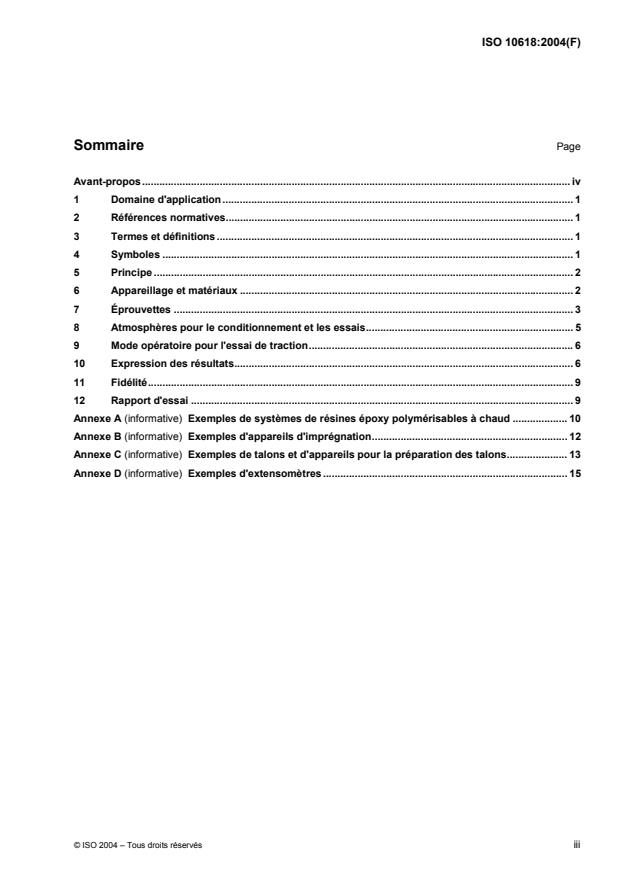
Contents Page
Foreword. iv
1 Scope. 1
2 Normative references . 1
3 Terms and definitions. 1
4 Symbols . 1
5 Principle . 2
6 Apparatus and materials . 2
7 Test specimens . 3
8 Atmosphere for conditioning and testing . 5
9 Procedure for tensile testing . 5
10 Expression of results. 6
11 Precision . 8
12 Test report. 8
Annex A (informative) Examples of heat-curable epoxy-resin systems. 10
Annex B (informative) Examples of impregnating apparatus . 12
Annex C (informative) Examples of tabs and tab-preparation apparatus . 13
Annex D (informative) Examples of extensometers. 15
Foreword
ISO (the International Organization for Standardization) is a worldwide federation of national standards bodies
(ISO member bodies). The work of preparing International Standards is normally carried out through ISO
technical committees. Each member body interested in a subject for which a technical committee has been
established has the right to be represented on that committee. International organizations, governmental and
non-governmental, in liaison with ISO, also take part in the work. ISO collaborates closely with the
International Electrotechnical Commission (IEC) on all matters of electrotechnical standardization.
International Standards are drafted in accordance with the rules given in the ISO/IEC Directives, Part 2.
The main task of technical committees is to prepare International Standards. Draft International Standards
adopted by the technical committees are circulated to the member bodies for voting. Publication as an
International Standard requires approval by at least 75 % of the member bodies casting a vote.
Attention is drawn to the possibility that some of the elements of this document may be the subject of patent
rights. ISO shall not be held responsible for identifying any or all such patent rights.
ISO 10618 was prepared by Technical Committee ISO/TC 61, Plastics, Subcommittee SC 13, Composites
and reinforcement fibres.
This second edition cancels and replaces the first edition (ISO 10618:1999), which has been technically
revised.
iv © ISO 2004 – All rights reserved
INTERNATIONAL STANDARD ISO 10618:2004(E)
Carbon fibre — Determination of tensile properties of
resin-impregnated yarn
1 Scope
This International Standard specifies a method of test for the determination of the tensile strength, tensile
modulus of elasticity and strain at maximum load of a resin-impregnated yarn specimen. The method is
applicable to yarns (continuous and staple-fibre yarns) of carbon fibre for use as reinforcements in composite
materials.
2 Normative references
The following referenced documents are indispensable for the application of this document. For dated
references, only the edition cited applies. For undated references, the latest edition of the referenced
document (including any amendments) applies.
ISO 291, Plastics — Standard atmospheres for conditioning and testing
ISO 527-1, Plastics — Determination of tensile properties — Part 1: General principles
ISO 1889, Reinforcement yarns — Determination of linear density
ISO 10119, Carbon fibre — Determination of density
ISO 10548, Carbon fibre — Determination of size content
3 Terms and definitions
For the purposes of this document, the terms and definitions given in ISO 527-1 and the following apply.
3.1
cross-sectional area of carbon-fibre yarn
A
f
the linear density of the yarn divided by the density of the carbon fibre
NOTE It is expressed in square millimetres.
4 Symbols
The symbols used in this International Standard are as follows:
σ tensile strength, in megapascals;
f
F maximum tensile force, in newtons;
f
A cross-sectional area of yarn, in square millimetres;
f
ρ density of yarn, in grams per cubic centimetre;
f
T linear density of yarn, in tex;
tf
T linear density of impregnated yarn, in tex;
ti
E tensile modulus of elasticity, in gigapascals;
f
L gauge length of extensometer, in millimetres;
∆L variation in the length, in millimetres, corresponding to the variation in the force, in newtons;
∆F variation in the force, in newtons, corresponding to the variation in the length, in millimetres.
5 Principle
A sample of yarn is uniformly impregnated with resin, then cured to provide test specimens. The specimens
are loaded in tension at a constant speed by a suitable mechanical testing machine until failure.
The tensile strength, the tensile modulus of elasticity and the strain at maximum load are calculated from the
force-extension relationship.
The tensile modulus is determined by dividing the variation in the stress by the corresponding variation in the
strain between two defined points. For carbon-fibre yarns, the relation between stress and strain is not linear,
hence a chord modulus must be defined. In method A, the modulus is defined between two strain levels and in
method B it is defined between two load levels. The linear density and the size content have to be determined
independently.
NOTE The precision of the values obtained is believed to be approximately the same for method A and for method B.
However, for the generally non-linear stress-strain response common to carbon fibres, the mean modulus values from
these two methods will be somewhat different and not necessarily statistically comparable. Method B, or other methods,
may be used in the purchase specification or for quality assurance by agreement between customer and supplier.
6 Apparatus and materials
6.1 Resin
The impregnating resin shall be compatible with the yarn and its size. The viscosity of the resin or resin
solution shall be such that sufficient resin pick-up is achieved to ensure uniform impregnation. The strain at
failure of the cured resin shall be at least twice that of the fibre, preferably three times. In this respect, heat-
curable epoxy-resin systems with a viscosity during impregnation of preferably less than 1 000 mPa⋅s are
suitable (see Annex A for example) as is any formulation capable of giving test specimens that fulfill the
requirements of this International Standard. The resin formulation, however, shall be specified in detail and
shall be agreed upon between the fibre manufacturer and the user.
6.2 Impregnation apparatus
Test specimens can be prepared by any method which produces a uniformly impregnated, smooth specimen.
These methods include both single- and multiple-specimen preparation techniques. A multiple-specimen
impregnation apparatus may consist of:
6.2.1 A holder for the sample yarn bobbin, with yarn-tensioning devices.
6.2.2 An impregnation bath, with temperature-control devices and impregnation rollers or yarn-tensioning
bars.
2 © ISO 2004 – All rights reserved
6.2.3 A unit to remove excess resin from the impregnated yarn by passing it over rollers covered with fabric,
paper or felt and/or through a die.
6.2.4 A frame to wind up the impregnated yarn, preferably made of wood or metal coated with rubber.
Examples of impregnation apparatus are given in Annex B.
6.3 Curing oven with temperature control
A fan circulation oven is preferable to ensure uniform curing of the resin.
6.4 Tensile-testing machine
6.4.1 Use a tensile-testing machine with a constant crosshead speed, equipped with force- and extension-
recording devices. The accuracy of the force indication shall be better than 1 % of the recorded value. The
specimen-gripping system shall ensure that the test specimen is aligned with the axis of the test machine.
6.4.2 The tensile-testing machine shall include an extensometer linked to a continuous-recording device
which automatically records the extension within the gauge length of the extensometer as a function of the
force on the test specimen. The extensometer should be sufficiently light to induce only negligible stresses in
the test specimen.
The gauge length of the extensometer shall be at least 50 mm but preferably 100 mm. The gauge length shall
be determined with a tolerance of ± 1 %.
The extensometer shall have a tolerance on deviation from linearity of not more than 0,1 % over the required
extension-measurement range.
Examples of suitable extensometers are given in Annex D. Other strain-measuring instruments, such as
optical or laser instruments, may be used, if suitable.
6.5 Balance
Use a balance readable to 0,1 g to weigh the test specimens to determine the linear density of the
impregnated yarn.
6.6 Ruler
Use a graduated ruler or other measuring device at least 500 mm long and accurate to ± 1 mm.
7 Test specimens
7.1 Number of test specimens
Prepare sufficient test specimens to enable four determinations to be made. If any of the specimens fails
within the grips or at the tabs, or because of damage caused by the extensometer, discard the result and carry
out a repeat determination on a fresh test specimen.
7.2 Length of test specimens
For test specimens with tabs, the length of the test specimen between the tabs shall be either (150 ± 5) mm or
(200 ± 5) mm. For test specimens without tabs, the total length of the test specimen shall be (250 ± 5) mm or
(300 ± 5) mm (at least the extensometer gauge length plus twice the grip length).
In cases of dispute, for test specimens with tabs, the length between the tabs shall be (150 ± 5) mm; for test
specimens without tabs, the length of the test specimen shall be (250 ± 5) mm.
7.3 Impregnation of test specimens
7.3.1 The procedure for using the impregnation apparatus described in 6.2 is as follows:
7.3.2 Place the yarn bobbin on the holder.
7.3.3 Pour the impregnating-resin mixture into the resin bath (6.2.2) and adjust the temperature and
viscosity to the desired values.
7.3.4 Draw the yarn through the resin bath and through the system designed to remove the excess resin
while ensuring adequate resin impregnation (see 6.2.3).
7.3.5 Adjust the unwinding tension. The unwinding tension used shall be at the discretion of the individual
test laboratory.
7.3.6 Wind the impregnated yarn onto the frame (6.2.4).
7.3.7 Place the frame in the oven (6.3).
7.3.8 Cure the resin in accordance with the resin manufacturer's instructions.
7.3.9 When the resin has been cured, remove the frame from the oven. After removal of the impregnated
yarn from the frame, cut off a sufficient number of test specimens.
7.3.10 Select the test specimens according to the criteria given in 7.5.
7.4 Determination of other fibre properties
7.4.1 General
In order to make the calculations of tensile strength and tensile modulus given in Clause 10, the properties
specified in 7.4.2 to 7.4.5 must be determined.
7.4.2 Linear density of the yarn
Determine the linear density of the yarn by the method given in ISO 1889.
7.4.3 Size content of the yarn
Determine the size content of the yarn by the method given in ISO 10548.
7.4.4 Density of the carbon fibre
Determine the density of the carbon fibre by one of the methods given in IS
...
NORME ISO
INTERNATIONALE 10618
Deuxième édition
2004-08-15
Version corrigée
2004-11-01
Fibres de carbone — Détermination des
propriétés en traction sur fils imprégnés
de résine
Carbon fibre — Determination of tensile properties of resin-impregnated
yarn
Numéro de référence
©
ISO 2004
PDF – Exonération de responsabilité
Le présent fichier PDF peut contenir des polices de caractères intégrées. Conformément aux conditions de licence d'Adobe, ce fichier
peut être imprimé ou visualisé, mais ne doit pas être modifié à moins que l'ordinateur employé à cet effet ne bénéficie d'une licence
autorisant l'utilisation de ces polices et que celles-ci y soient installées. Lors du téléchargement de ce fichier, les parties concernées
acceptent de fait la responsabilité de ne pas enfreindre les conditions de licence d'Adobe. Le Secrétariat central de l'ISO décline toute
responsabilité en la matière.
Adobe est une marque déposée d'Adobe Systems Incorporated.
Les détails relatifs aux produits logiciels utilisés pour la création du présent fichier PDF sont disponibles dans la rubrique General Info
du fichier; les paramètres de création PDF ont été optimisés pour l'impression. Toutes les mesures ont été prises pour garantir
l'exploitation de ce fichier par les comités membres de l'ISO. Dans le cas peu probable où surviendrait un problème d'utilisation,
veuillez en informer le Secrétariat central à l'adresse donnée ci-dessous.
© ISO 2004
Droits de reproduction réservés. Sauf prescription différente, aucune partie de cette publication ne peut être reproduite ni utilisée sous
quelque forme que ce soit et par aucun procédé, électronique ou mécanique, y compris la photocopie et les microfilms, sans l'accord écrit
de l'ISO à l'adresse ci-après ou du comité membre de l'ISO dans le pays du demandeur.
ISO copyright office
Case postale 56 • CH-1211 Geneva 20
Tel. + 41 22 749 01 11
Fax. + 41 22 749 09 47
E-mail copyright@iso.org
Web www.iso.org
Publié en Suisse
ii © ISO 2004 – Tous droits réservés
Sommaire Page
Avant-propos. iv
1 Domaine d'application. 1
2 Références normatives. 1
3 Termes et définitions . 1
4 Symboles . 1
5 Principe . 2
6 Appareillage et matériaux . 2
7 Éprouvettes . 3
8 Atmosphères pour le conditionnement et les essais. 5
9 Mode opératoire pour l'essai de traction. 6
10 Expression des résultats. 6
11 Fidélité. 9
12 Rapport d'essai . 9
Annexe A (informative) Exemples de systèmes de résines époxy polymérisables à chaud . 10
Annexe B (informative) Exemples d'appareils d'imprégnation. 12
Annexe C (informative) Exemples de talons et d'appareils pour la préparation des talons. 13
Annexe D (informative) Exemples d'extensomètres . 15
Avant-propos
L'ISO (Organisation internationale de normalisation) est une fédération mondiale d'organismes nationaux de
normalisation (comités membres de l'ISO). L'élaboration des Normes internationales est en général confiée
aux comités techniques de l'ISO. Chaque comité membre intéressé par une étude a le droit de faire partie du
comité technique créé à cet effet. Les organisations internationales, gouvernementales et non
gouvernementales, en liaison avec l'ISO participent également aux travaux. L'ISO collabore étroitement avec
la Commission électrotechnique internationale (CEI) en ce qui concerne la normalisation électrotechnique.
Les Normes internationales sont rédigées conformément aux règles données dans les Directives ISO/CEI,
Partie 2.
La tâche principale des comités techniques est d'élaborer les Normes internationales. Les projets de Normes
internationales adoptés par les comités techniques sont soumis aux comités membres pour vote. Leur
publication comme Normes internationales requiert l'approbation de 75 % au moins des comités membres
votants.
L'attention est appelée sur le fait que certains des éléments du présent document peuvent faire l'objet de
droits de propriété intellectuelle ou de droits analogues. L'ISO ne saurait être tenue pour responsable de ne
pas avoir identifié de tels droits de propriété et averti de leur existence.
L'ISO 10618 a été élaborée par le comité technique ISO/TC 61, Plastiques, sous-comité SC 13, Composites
et fibres de renforcement.
Cette deuxième édition annule et remplace la première édition (ISO 10618:1999), qui a fait l'objet d'une
révision technique.
Dans la présente version corrigée de l'ISO 10618:2004, la référence à la première édition (ISO 10618:1999) a
e
été corrigée dans le 6 alinéa de l'Avant-propos.
iv © ISO 2004 – Tous droits réservés
NORME INTERNATIONALE ISO 10618:2004(F)
Fibres de carbone — Détermination des propriétés en traction
sur fils imprégnés de résine
1 Domaine d'application
La présente Norme internationale spécifie une méthode d'essai pour la détermination de la résistance en
traction, du module d'élasticité en traction et de la déformation à la charge maximale sur une éprouvette de fil
imprégné de résine. La méthode s'applique à des fils (continus ou discontinus) de fibres de carbone utilisés
pour le renforcement des matériaux composites.
2 Références normatives
Les documents de référence suivants sont indispensables pour l'application du présent document. Pour les
références datées, seule l'édition citée s'applique. Pour les références non datées, la dernière édition du
document de référence s'applique (y compris les éventuels amendements).
ISO 291, Plastiques — Atmosphères normales de conditionnement et d'essai
ISO 527-1, Plastiques — Détermination des propriétés en traction — Partie 1: Principes généraux
ISO 1889, Fils de renfort — Détermination de la masse linéique
ISO 10119, Fibres de carbone — Détermination de la masse volumique
ISO 10548, Fibres de carbone — Détermination du taux d'ensimage
3 Termes et définitions
Pour les besoins du présent document, les termes et définitions donnés dans l'ISO 527-1 ainsi que les
suivants s'appliquent.
3.1
aire de la section du fil de fibre de carbone
A
f
masse linéique du fil divisée par la masse volumique de la fibre de carbone
NOTE Elle est exprimée en millimètres carrés.
4 Symboles
Les symboles utilisés dans la présente Norme internationale sont les suivants:
σ résistance en traction, en mégapascals;
f
F force maximale en traction, en newtons;
f
A aire de la section du fil, en millimètres carrés;
f
ρ masse volumique du fil, en grammes par centimètre cube;
f
T masse linéique du fil, en tex;
tf
T masse linéique du fil imprégné, en tex;
ti
E module d'élasticité en traction, en gigapascals;
f
L longueur de jauge de l'extensomètre, en millimètres;
∆L variation de longueur, en millimètres, correspondant à la variation de force, en newtons;
∆F variation de force, en newtons, correspondant à la variation de longueur, en millimètres.
5 Principe
Un échantillon de fil est uniformément imprégné de résine, puis polymérisé pour obtenir des éprouvettes. Les
éprouvettes sont sollicitées en traction, à vitesse constante sur un appareil d'essai mécanique adapté jusqu'à
la rupture.
La résistance en traction, le module d'élasticité en traction et la déformation à la charge maximale sont
calculés à partir de la relation force-allongement.
Le module d'élasticité en traction est déterminé en divisant la variation de la contrainte par la variation
correspondante de déformation entre deux points définis. Pour les fibres de carbone, la relation entre la
contrainte et la déformation n'est pas linéaire, en conséquence le module sécant doit être défini. Dans la
méthode A, le module est défini entre deux niveaux de déformation, tandis que dans la méthode B, il est défini
entre deux niveaux de charge. La masse linéique et le taux d'ensimage doivent être déterminés
indépendamment.
NOTE La précision des valeurs obtenues approximativement est la même par la méthode A ou la méthode B.
Cependant, pour la réponse, généralement non linéaire, contrainte-déformation à la rupture, commune aux fibres de
carbone, les valeurs moyennes du module à partir de ces deux méthodes seront sensiblement différentes et pas
nécessairement statistiquement comparables. La méthode B ou d'autres méthodes peuvent être utilisées par accord entre
clients et fournisseurs pour la rédaction de cahier des charges ou pour le contrôle qualité.
6 Appareillage et matériaux
6.1 Résine
La résine d'imprégnation doit être compatible avec le fil et son ensimage. La viscosité de la résine ou de la
résine en solution doit être telle qu'une absorption suffisante de résine conduise à une imprégnation uniforme.
La déformation à la rupture de la résine polymérisée doit être au moins deux fois supérieure à celle de la fibre
et de préférence trois fois. À cet égard, les systèmes de résines époxy polymérisant à la chaleur, avec une
viscosité pendant l'imprégnation inférieure de préférence à 1 000 mPa·s, sont adaptés (voir Annexe A pour
les exemples) ainsi que toute formulation qui permette d'obtenir des éprouvettes répondant aux exigences de
la présente Norme internationale. La formule de la résine doit néanmoins être spécifiée en détail et faire
l'objet d'un accord entre le fabricant de fibres et l'utilisateur.
6.2 Dispositif d'imprégnation
Les éprouvettes peuvent être préparées selon toute méthode qui permette d'obtenir des éprouvettes
régulières imprégnées uniformément.
2 © ISO 2004 – Tous droits réservés
Ces méthodes comprennent à la fois les techniques de préparation d'échantillon simple et multiple. Un
dispositif d'imprégnation d'échantillon multiple comprend les éléments suivants:
6.2.1 Un porte-bobine pour le fil échantillon, avec dispositifs de réglage de la tension du fil.
6.2.2 Un bain d'imprégnation, avec dispositifs de contrôle de température et rouleaux d'imprégnation ou
barres de tension des fils.
6.2.3 Une unité pour enlever l'excès de résine de la mèche imprégnée par passage sur des rouleaux
recouverts de tissu, de papier ou de feutre et/ou à travers une filière.
6.2.4 Un cadre pour enrouler le fil imprégné, de préférence en bois ou en métal recouvert de caoutchouc.
Des exemples d'appareils d'imprégnation sont donnés dans l'Annexe B.
6.3 Étuve de cuisson avec dispositif de contrôle de température
Une étuve ventilée est préférable pour assurer une cuisson uniforme de la résine.
6.4 Appareil d'essai de traction
6.4.1 Utiliser un appareil d'essai de traction à vitesse de déplacement de la traverse constante, équipé de
dispositifs d'enregistrement de la force et de l'allongement. La précision de l'indicateur de force doit être
inférieure à 1 % de la valeur de la force enregistrée. Le dispositif de fixation de l'éprouvette doit permettre
l'alignement avec l'axe de l'appareil d'essai.
6.4.2 L'appareil d'essai de traction doit inclure un extensomètre associé à un dispositif d'enregistrement en
continu qui enregistre automatiquement l'allongement de la longueur de jauge de l'extensomètre en fonction
de la force appliquée sur l'éprouvette. Il convient que l'extensomètre soit suffisamment léger pour n'introduire
sur l'éprouvette que des contraintes négligeables.
La longueur de la jauge de l'extensomètre doit être d'au moins 50 mm, mais de préférence de 100 mm. La
longueur de jauge doit être déterminée avec une tolérance de ± 1 %.
L'extensomètre ne doit pas avoir une tolérance de déviation de la linéarité de plus de 0,1 % dans la plage
prescrite de mesures d'allongement.
Des exemples d'extensomètres adaptés sont donnés dans l'Annexe D. D'autres instruments de mesure de
déformation tels que des instruments optiques ou lasers peuvent être utilisés, s'ils conviennent.
6.5 Balance
Utiliser une balance de résolution de 0,1 g près pour peser les éprouvettes et déterminer la masse linéique du
fil imprégné.
6.6 Règle
Utiliser une règle graduée ou tout autre moyen de mesure, d'au moins 500 mm de long et précis à ± 1 mm.
7 Éprouvettes
7.1 Nombre d'éprouvettes
Préparer un nombre suffisant d'éprouvettes de façon à pouvoir faire quatre déterminations. En cas de rupture
d'une éprouvette dans les mors ou dans les talons ou en cas de détérioration causée par l'extensomètre,
éliminer le résultat et répéter la détermination sur une nouvelle éprouvette.
7.2 Longueur des éprouvettes
Pour les éprouvettes avec talons, la longueur de l'éprouvette entre talons doit être soit de (150 ± 5) mm, soit
de (200 ± 5) mm. Pour les éprouvettes sans talons, la longueur totale de l'éprouvette doit être de
(250 ± 5) mm ou de (300 ± 5) mm (au moins la longueur de jauge de l'extensomètre plus deux fois la longueur
de prise en mors).
En cas de litige, la longueur entre talons pour les éprouvettes avec talons doit être de (150 ± 5) mm et pour
les éprouvettes sans talons la longueur de l'éprouvette doit être de (250 ± 5) mm.
7.3 Imprégnation des éprouvettes
7.3.1 Le mode opératoire pour utiliser l'appareillage d'imprégnation décrit au 6.2 est le suivant:
7.3.2 Placer la bobine sur le support.
7.3.3 Verser le mélange de résine d'imprégnation dans le bac (6.2.2) et ajuster sa température et sa
viscosité aux valeurs désirées.
7.3.4 Faire passer le fil dans le bain de résine et au travers du système servant à enlever la résine en
excès tout en s'assurant d'une imprégnation convenable (voir 6.2.3).
7.3.5 Ajuster la tension de dévidage. Celle-ci doit être laissée à la discrétion de chaque laboratoire d'essai.
7.3.6 Enrouler la mèche imprégnée sur le cadre (6.2.4).
7.3.7 Placer le cadre dans l'étuve (6.3).
7.3.8 Polymériser la résine conformément aux instructions du fabricant de la résine.
7.3.9 Après polymérisation de la résine, sortir le cadre de l'étuve. Après avoir enlevé le fil imprégné du
cadre, prélever une quantité suffisante d'éprouvettes.
7.3.10 Sélectionner les éprouvettes selon les critères donnés en 7.5.
7.4 Détermination des autres propriétés des fibres
7.4.1 Généralités
Pour pouvoir faire les calculs de la résistance en traction et du module d’élasticité en traction donnés dans
l’Article 10, les propriétés spécifiées de 7.4.2 à 7.4.5 doivent être déterminées.
7.4.2 Masse linéique du fil
Déterminer la masse linéique du fil selon la méthode indiquée dans l'ISO 1889.
7.4.3 Taux d'ensimage du fil
Déterminer le taux d'ensimage du fil selon la méthode indiquée dans l'ISO 10548.
7.4.4 Masse volumique de la fibre de carbone
Déter
...
Questions, Comments and Discussion
Ask us and Technical Secretary will try to provide an answer. You can facilitate discussion about the standard in here.
Loading comments...