

ISO 13196:2026
(Main)Soil quality — Screening soils for selected elements by energy-dispersive X-ray fluorescence spectrometry using a handheld or portable instrument
- Abstract
This document specifies the procedure for screening soils for selected elements using handheld or portable equipment for energy dispersive X-ray fluorescence spectrometry (ED-XRF). It covers the application of this screening method to obtain qualitative or semi-quantitative data to assist decisions on a sampling strategy for detailed assessment of soil quality employing laboratory analytical chemical methods. NOTE 1 Screening methods generally provide qualitative or semi-quantitative concentration values that are indicative of concentration values, although occasionally they can give quantitative results under specific or limited conditions. NOTE 2 The greater the effort applied to the pretreatment of soil samples, the better the analytical results that can be expected (see e.g. Reference [19]). This document does not explicitly specify elements for which it is applicable, since the applicability depends on the performance of the apparatus and the objective of the screening. The elements which can be determined are limited by the performance of the instrument used, the concentrations of particular elements present in the soil, and the requirements of the investigation in terms of the minimum concentrations of concern (e.g. guideline value). NOTE 3 The XRF measurements of As, Cd, Co, Cr, Cu, Hg, Mo, Ni, Pb, Sb, Sn, V and Zn were validated as described in Annex A. NOTE 4 Annex B provides examples of when screening with a handheld ED-XRF spectrometer and a portable ED-XRF spectrometer can be useful. This document does not provide guidance on how to use the equipment to provide quantitative data for use in detailed site assessments. This document does not cover how the results of multiple determinations are synthesized to address the objectives of an ED-XRF determination.
- Status
- Published
- Publication Date
- 27-May-2026
- Technical Committee
- ISO/TC 190/SC 3 - Chemical and physical characterization
- Drafting Committee
- ISO/TC 190/SC 3/WG 10 - Screening methods
- Current Stage
- 9092 - International Standard to be revised - 90 Review
- Start Date
- 05-Nov-2026
Buy Documents

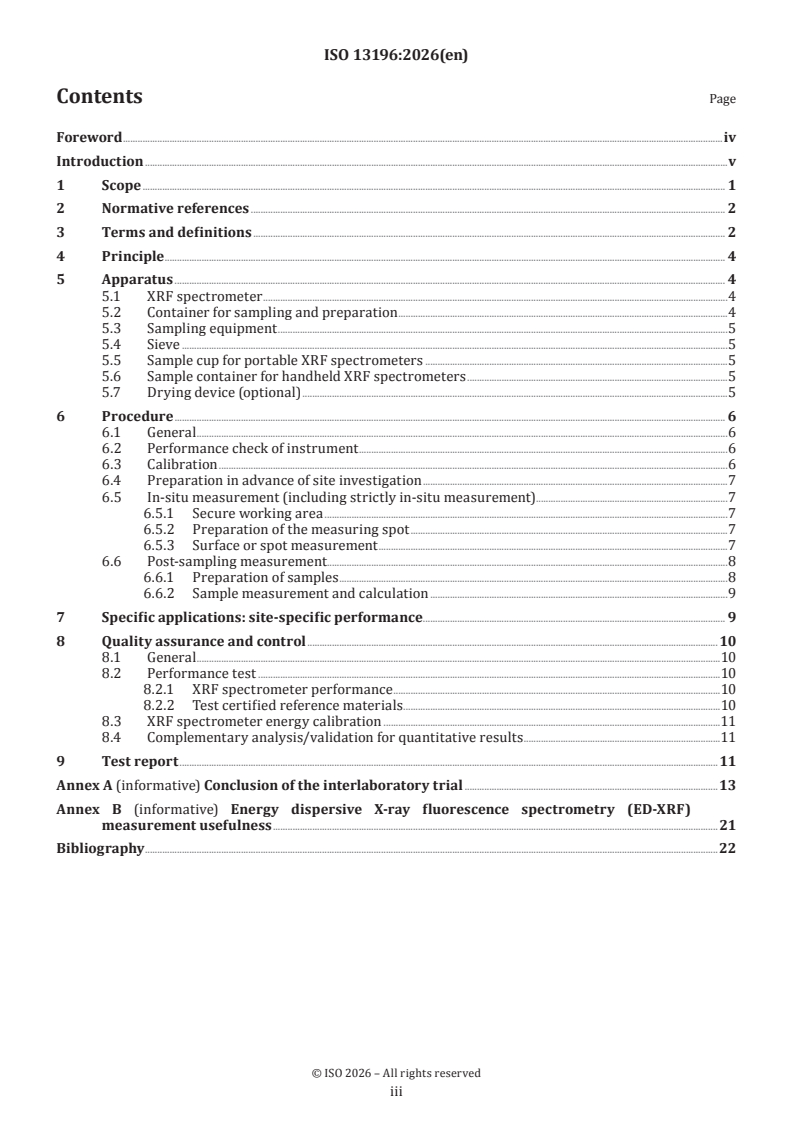

ISO 13196:2026 - Soil quality — Screening soils for selected elements by energy-dispersive X-ray fluorescence spectrometry using a handheld or portable instrument
ISO 13196:2026 - Qualité du sol — Diagnostic rapide d’une sélection d’éléments dans les sols à l’aide d’un spectromètre de fluorescence X à dispersion d’énergie de type mobile ou pistolet
ISO 13196:2026 is an International Standard published by ISO for screening soils for selected elements using handheld or portable energy-dispersive X-ray fluorescence spectrometry (ED-XRF). It specifies a field and site procedure that produces qualitative or semi-quantitative data to help decide on sampling and follow-up laboratory analysis.
The standard is aimed at people who need fast, structured screening of soil conditions, especially where the question is whether selected elements may be present at levels worth detailed investigation. It is not a guide for detailed quantitative site assessment, and it keeps the focus on screening, sampling decisions, and result validation.
What does ISO 13196:2026 specify?
ISO 13196:2026 specifies how to screen soils for selected elements with handheld or portable ED-XRF equipment. The method is used to obtain qualitative or semi-quantitative results that support decisions about sampling strategy for later laboratory chemical analysis.
The document covers the procedure, the apparatus, quality assurance, and the test report. It also gives informative annexes with validation evidence and examples of useful applications.
| Annex | What it covers |
|---|---|
| Annex A | Informative conclusion of an interlaboratory trial, including validation for As, Cd, Co, Cr, Cu, Hg, Mo, Ni, Pb, Sb, Sn, V and Zn |
| Annex B | Informative examples of when handheld or portable ED-XRF screening is useful |
Clause 1 also states what the standard leaves outside its scope: it does not give guidance for quantitative data intended for detailed site assessments, and it does not explain how to combine multiple determinations to meet an ED-XRF objective.
What are the key requirements of ISO 13196:2026?
ISO 13196:2026 is built around using ED-XRF as a screening tool, not as a substitute for full laboratory quantification. In practice, that means selecting the measurement mode, preparing the sample appropriately, controlling instrument performance, and documenting enough context to interpret the result later.
Use the right measurement mode for the task
Clause 6 distinguishes three measurement modes: strictly in-situ measurement, in-situ measurement, and post-sampling measurement. Strictly in-situ means direct observation of the ground surface; in-situ means measuring a sample immediately after collection at the sampling location; post-sampling means measuring a sample after it has been moved to another place.
This matters because the choice affects what the instrument is actually seeing. A field team deciding between surface readings and prepared samples needs to match the mode to the site question, the available equipment, and the level of representativeness needed.
Set up the instrument and verify it before use
Clauses 5.1, 6.2, 6.3, 8.2 and 8.3 require an appropriate handheld or portable ED-XRF instrument with sufficient energy, depth penetration and beam width for soil matrices. The instrument needs a security system in line with IEC 62495, and it needs a fail-safe function to prevent exposure to the X-ray beam.
The standard calls for performance checks, usually at least daily, and the use of certified reference materials (CRM) with soil-like composition. Factory calibration is often sufficient, but site-specific calibration may be used when it is performed under the same operating and sample conditions as the calibration itself. For large or unknown matrix effects, the fundamental parameter approach is recommended. In practice, this is what keeps field screening from drifting into unreliable numbers.
Prepare soil and equipment to avoid contamination and bias
Clauses 5.2 to 5.7 and 6.6 place strong emphasis on sample handling. Sampling tools, trays, sieves, cups and bags should not introduce target elements, and the standard specifically validates a 2 mm sieve size.
This is important because contamination from tools or containers can distort low-level results. The document also notes that moist samples tend to underestimate concentrations, so drying improves accuracy, and that coarse material should be recorded and treated carefully when it may contain significant metals.
Manage the field area and the measuring spot safely
Clause 6.5 requires a safe or controlled working area for in-situ work, with signs and barriers where needed. The measuring spot should be cleared of extraneous material and smoothed before measurement.
This matters both for safety and for data quality. The XRF head should stay on the target area during measurement, and the operator should avoid plants, insects, earthworms, voids or other non-soil material in the beam area.
Use screening results as screening results
Clause 4 and Clause 8.4 make clear that the method gives semi-quantitative results, and that quantitative use requires complementary analysis. When a predictive relationship is needed, the comparison should be based on the same spots at the same site or on soils with varying properties.
This matters because field XRF and laboratory methods can differ for reasons that are not errors in either method alone. The standard asks users to account for sampling variability, matrix effects, and the limits of wet chemical extraction when comparing results.
Report enough context to interpret the result
Clause 9 requires the test report to identify the standard used, the samples, the sampling locations, the measurement mode, the results, the date, and any factors that may have affected the outcome. It also asks for notes on homogeneity, sieving, coarse material, validation comparisons, unreliable results and any deviations from the procedure.
In practice, this allows another person to understand what was measured, how it was prepared, and how much confidence to place in the reading.
What terms does ISO 13196:2026 define?
- X-ray fluorescence spectrometer (XRF spectrometer) - In this standard, this means an energy-dispersive X-ray fluorescence spectrometer used to observe fluorescence emitted by elements for analysis.
- Handheld XRF spectrometer - An XRF spectrometer designed for handheld operation, including use for strictly in-situ, in-situ and post-sampling measurements.
- Portable XRF spectrometer - An XRF spectrometer used on samples taken out of a spot at a site and transported to the site, with use for in-situ and post-sampling measurements.
- Fundamental parameter approach - A calculation method that estimates element composition by successive approximation between theoretical and measured X-ray fluorescence intensities.
- Screening method - A quick analytical method for exploratory analysis of an area or set of samples, often used on site and not necessarily directly comparable with a reference method.
- Semi-quantitative analysis - An analysis that gives approximate and comparative measurements rather than absolute quantification.
- Strictly in-situ measurement - Direct observation of the ground surface with a handheld device.
- Certified reference material (CRM) - A reference material with metrologically valid characterization, certificate value, uncertainty and traceability.
Who uses ISO 13196:2026?
ISO 13196:2026 is used by environmental investigators, soil scientists, field technicians, consultants, and quality managers who need fast soil screening. It is especially relevant where the task is to locate potential hot spots, understand spatial variability, or decide where detailed sampling should go next.
Typical uses include:
- preliminary site reconnaissance and exploratory investigation
- delineating areas that may need detailed assessment
- checking variability around a sampling point
- assessing exported or imported material against agreed limits
- investigating contaminated soil, spills, tipped material, dust, or construction materials
What changed in ISO 13196:2026 from the previous edition?
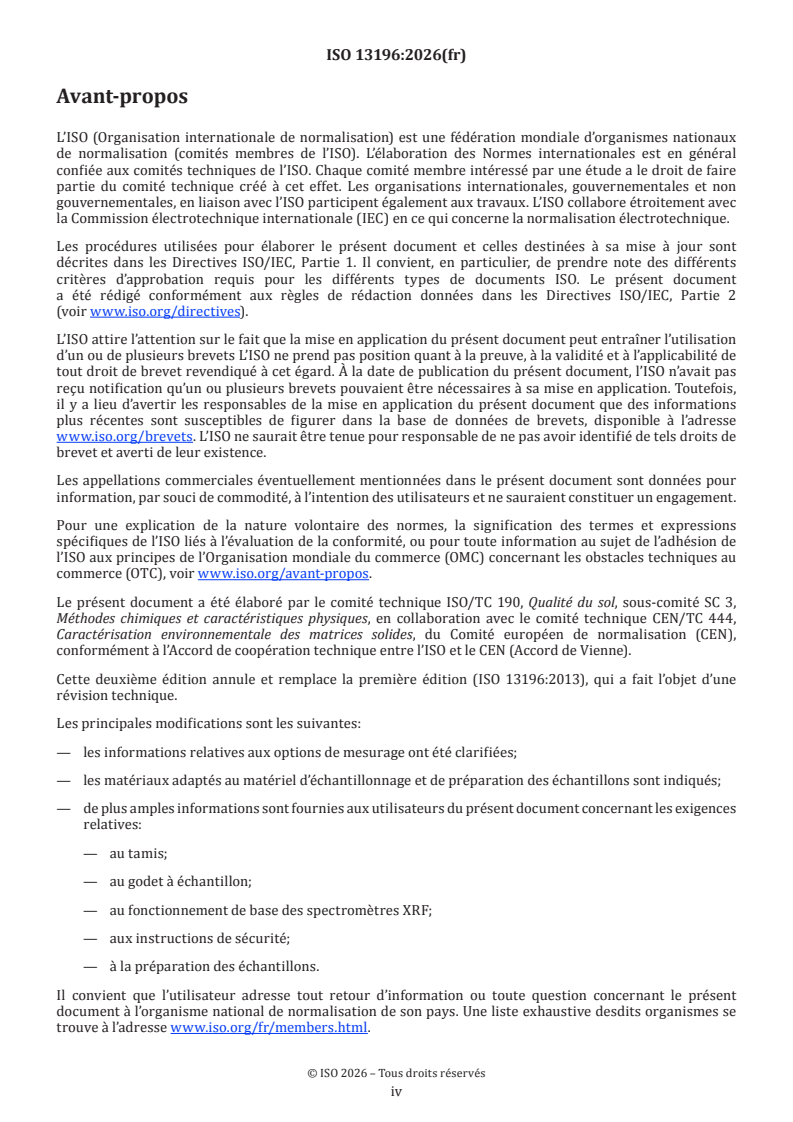
ISO 13196:2026 is the second edition and it cancels and replaces ISO 13196:2013. The foreword lists these main changes:
- clearer description of measurement options
- added guidance on suitable materials for sampling and sample-preparation equipment
- more user guidance on the sieve
- more user guidance on the sample cup
- more guidance on basic XRF spectrometer operation
- more safety instruction
- more guidance on sample preparation
Which standards are used with ISO 13196:2026?
| Standard | What it contributes |
|---|---|
| ISO 12404 | Guidance on selecting and applying screening methods |
| IEC 62495 | Safety and security features for portable X-ray fluorescence analysis equipment using a miniature X-ray tube |
| ISO 18400-101 | Framework for preparing and applying a sampling plan |
| ISO 18400-102 | Selection and application of sampling techniques |
| ISO 18400-104 | Sampling strategies |
| ISO 18400-106 | Quality control and quality assurance |
| ISO 18400-201 | Physical pretreatment in the field |
| ISO 18400-202 | Preliminary investigations |
| ISO 18400-203 | Investigation of potentially contaminated sites |
| ISO 18400-205 | Procedure for investigation of natural, near-natural and cultivated sites |
| ISO 18400-301 | Sampling and on-site semi-quantitative determinations of volatile organic compounds in field investigations |
| ISO 11464 | Pretreatment of samples for physico-chemical analysis |
| ISO 21365 | Conceptual site models for potentially contaminated sites |
| ISO 15176 | Guidance on true total and pseudo-total concentration in excavated soil and related materials |
| ISO 18227 | Laboratory X-ray fluorescence reference method for elemental composition |
| EN 15309 | X-ray fluorescence method for elemental composition of waste and soil |
What does the ISO 13196:2026 document contain?
ISO 13196:2026 contains the principle of the method, apparatus requirements, field and sample-preparation procedures, quality assurance and control measures, and the required test-report content. Clause 5 covers the instrument, sampling containers, sieves, sample cups and optional drying equipment, while Clause 6 covers calibration, field measurement, and post-sampling preparation and measurement.
Annex A contains interlaboratory-trial information and precision tables for the validated elements, and Annex B gives practical examples of when handheld or portable ED-XRF screening is useful. The bibliography then points to the related sampling, pretreatment, reference-method and validation standards used around the procedure.
Relations
- Effective Date
- 12-Feb-2026
- Effective Date
- 29-Oct-2022
Buy Documents
ISO 13196:2026 - Soil quality — Screening soils for selected elements by energy-dispersive X-ray fluorescence spectrometry using a handheld or portable instrument
ISO 13196:2026 - Qualité du sol — Diagnostic rapide d’une sélection d’éléments dans les sols à l’aide d’un spectromètre de fluorescence X à dispersion d’énergie de type mobile ou pistolet
Get Certified
Connect with accredited certification bodies for this standard

CIS Institut d.o.o.
Personal Protective Equipment (PPE) certification body. Notified Body NB-2890 for EU Regulation 2016/425 PPE.

Kiwa BDA Testing
Building and construction product certification.
Kmetijski inštitut Slovenije
Agricultural Institute of Slovenia. Soil testing, plant health, agricultural product analysis.
Sponsored listings
Frequently Asked Questions
ISO 13196:2026 is a standard published by the International Organization for Standardization (ISO). Its full title is "Soil quality — Screening soils for selected elements by energy-dispersive X-ray fluorescence spectrometry using a handheld or portable instrument". This standard covers: This document specifies the procedure for screening soils for selected elements using handheld or portable equipment for energy dispersive X-ray fluorescence spectrometry (ED-XRF). It covers the application of this screening method to obtain qualitative or semi-quantitative data to assist decisions on a sampling strategy for detailed assessment of soil quality employing laboratory analytical chemical methods. NOTE 1 Screening methods generally provide qualitative or semi-quantitative concentration values that are indicative of concentration values, although occasionally they can give quantitative results under specific or limited conditions. NOTE 2 The greater the effort applied to the pretreatment of soil samples, the better the analytical results that can be expected (see e.g. Reference [19]). This document does not explicitly specify elements for which it is applicable, since the applicability depends on the performance of the apparatus and the objective of the screening. The elements which can be determined are limited by the performance of the instrument used, the concentrations of particular elements present in the soil, and the requirements of the investigation in terms of the minimum concentrations of concern (e.g. guideline value). NOTE 3 The XRF measurements of As, Cd, Co, Cr, Cu, Hg, Mo, Ni, Pb, Sb, Sn, V and Zn were validated as described in Annex A. NOTE 4 Annex B provides examples of when screening with a handheld ED-XRF spectrometer and a portable ED-XRF spectrometer can be useful. This document does not provide guidance on how to use the equipment to provide quantitative data for use in detailed site assessments. This document does not cover how the results of multiple determinations are synthesized to address the objectives of an ED-XRF determination.
This document specifies the procedure for screening soils for selected elements using handheld or portable equipment for energy dispersive X-ray fluorescence spectrometry (ED-XRF). It covers the application of this screening method to obtain qualitative or semi-quantitative data to assist decisions on a sampling strategy for detailed assessment of soil quality employing laboratory analytical chemical methods. NOTE 1 Screening methods generally provide qualitative or semi-quantitative concentration values that are indicative of concentration values, although occasionally they can give quantitative results under specific or limited conditions. NOTE 2 The greater the effort applied to the pretreatment of soil samples, the better the analytical results that can be expected (see e.g. Reference [19]). This document does not explicitly specify elements for which it is applicable, since the applicability depends on the performance of the apparatus and the objective of the screening. The elements which can be determined are limited by the performance of the instrument used, the concentrations of particular elements present in the soil, and the requirements of the investigation in terms of the minimum concentrations of concern (e.g. guideline value). NOTE 3 The XRF measurements of As, Cd, Co, Cr, Cu, Hg, Mo, Ni, Pb, Sb, Sn, V and Zn were validated as described in Annex A. NOTE 4 Annex B provides examples of when screening with a handheld ED-XRF spectrometer and a portable ED-XRF spectrometer can be useful. This document does not provide guidance on how to use the equipment to provide quantitative data for use in detailed site assessments. This document does not cover how the results of multiple determinations are synthesized to address the objectives of an ED-XRF determination.
ISO 13196:2026 is classified under the following ICS (International Classification for Standards) categories: 13.080.10 - Chemical characteristics of soils. The ICS classification helps identify the subject area and facilitates finding related standards.
ISO 13196:2026 has the following relationships with other standards: It is inter standard links to EN ISO 13196:2026, ISO 13196:2013. Understanding these relationships helps ensure you are using the most current and applicable version of the standard.
ISO 13196:2026 is available in PDF format for immediate download after purchase. The document can be added to your cart and obtained through the secure checkout process. Digital delivery ensures instant access to the complete standard document.
Standards Content (Sample)
Contents
- Introduction
- 1 Scope
- 2 Normative references
- 3 Terms and definitions
- 3.1 X-ray fluorescence spectrometer
- 3.2 handheld XRF spectrometer
- 3.3 portable XRF spectrometer
- 3.4 fundamental parameter approach
- 3.5 screening
- 3.6 screening method
- 3.7 reference method
- 3.8 semi-quantitative
- 3.9 semi-quantitative analysis
- 3.10 qualitative analysis
- 3.11 strictly in-situ measurement
- 3.12 in-situ measurement
- 3.13 post-sampling measurement
- 3.14 certified reference material
- 4 Principle
- 5 Apparatus
- 5.1 XRF spectrometer
- 5.2 Container for sampling and preparation
- 5.3 Sampling equipment
- 5.4 Sieve
- 5.5 Sample cup for portable XRF spectrometers
- 5.6 Sample container for handheld XRF spectrometers
- 5.7 Drying device (optional)
- 6 Procedure
- 6.1 General
- 6.2 Performance check of instrument
- 6.3 Calibration
- 6.4 Preparation in advance of site investigation
- 6.5 In-situ measurement (including strictly in-situ measurement)
- 6.6 Post-sampling measurement
- 7 Specific applications: site-specific performance
- 8 Quality assurance and control
- 8.1 General
- 8.2 Performance test
- 8.3 XRF spectrometer energy calibration
- 8.4 Complementary analysis/validation for quantitative results
- 9 Test report
- Annex A
- Annex B
- Bibliography
Introduction
X-ray fluorescence spectrometry (XRF) using battery or active source-powered handheld or portable equipment is a quick method for the determination of total elemental compositions of soil samples. Unlike laboratory analyses by inductively coupled plasma optical emission spectroscopy (ICP-OES) and atomic absorption spectroscopy (AAS), XRF needs no digestion step to prepare a test solution to be analysed. Consequently, handheld or portable equipment of energy dispersive XRF (ED-XRF) is suitable for the rapid on-site determination of selected elements, mainly heavy metals, in screening processes. When performing analyses at a site, it can be important to have information on the presence of an element (qualitative analysis) and also to obtain results from semi-quantitative analysis. Typical elements that can be detected and measured are Cr, As, Se, Cd, Hg and Pb, depending on the instrument (the elements validated for XRF detection and measurement are listed in Note 3 in Clause 1). In these situations, factory pre-set calibrations are used. For quantitative results, complementary analysis by alternative means is needed. An ED-XRF exercise can comprise a single determination at one location, in accordance with the guidance in this document, several determinations, or a large number of determinations. Where XRF analysers are being used to assess concentrations of soil contaminants which are harmful to humans or the environment, or both, there can be applicable national regulations with frameworks of standards, guidance and codes of practice for such investigations. This document does not aim to provide a strategy, tactics or methodology for environmental investigations, or human health assessments of potentially contaminated land or soil, nor does it provide any such strategies for the assessment of mineral resources.
Adherence to this document does not demonstrate compliance with any national contaminated land investigation regulations.
International Standard ISO 13196:2026(en) Soil quality — Screening soils for selected elements by energy-dispersive X-ray fluorescence spectrometry using a handheld or portable instrument WARNING — Soil samples can contain toxic contaminants. Avoid direct contact of soil samples with exposed parts of the body. Appropriate measures shall be taken to avoid ingestion and inhalation. Exposure to X-rays can give rise to radiation damage throughout the body as well an increased risk of cancer. XRF spectrometers are usually required to comply with national regulations. Those using, managing or supervising the use of such equipment are usually required to be qualified to do so in accordance with national regulations.
The XRF spectrometer to be used in accordance with this document shall employ a fail-safe function to prevent the operator and the public from inadvertent exposure to the X-ray beams. XRF users should engage a radiation protection officer to look at their proposed activity with the XRF spectrometer and provide informed advice on the safety implications of those proposals. For in-situ (including strictly in-situ) analysis, a safe working area or controlled area should be established by signs and barriers, if necessary, in order to ensure bystanders are kept at a safe distance.
1 Scope
This document specifies the procedure for screening soils for selected elements using handheld or portable equipment for energy dispersive X-ray fluorescence spectrometry (ED-XRF). It covers the application of this screening method to obtain qualitative or semi-quantitative data to assist decisions on a sampling strategy for detailed assessment of soil quality employing laboratory analytical chemical methods. NOTE 1 Screening methods generally provide qualitative or semi-quantitative concentration values that are indicative of concentration values, although occasionally they can give quantitative results under specific or limited conditions.
NOTE 2 The greater the effort applied to the pretreatment of soil samples, the better the analytical results that can be expected (see e.g. Reference [19]).
This document does not explicitly specify elements for which it is applicable, since the applicability depends on the performance of the apparatus and the objective of the screening. The elements which can be determined are limited by the performance of the instrument used, the concentrations of particular elements present in the soil, and the requirements of the investigation in terms of the minimum concentrations of concern (e.g. guideline value).
NOTE 3 The XRF measurements of As, Cd, Co, Cr, Cu, Hg, Mo, Ni, Pb, Sb, Sn, V and Zn were validated as described in Annex A.
NOTE 4 Annex B provides examples of when screening with a handheld ED-XRF spectrometer and a portable ED- XRF spectrometer can be useful.
This document does not provide guidance on how to use the equipment to provide quantitative data for use in detailed site assessments. This document does not cover how the results of multiple determinations are synthesized to address the objectives of an ED-XRF determination.
ISO 13196:2026(en)
2 Normative references
The following documents are referred to in the text in such a way that some or all of their content constitutes requirements of this document. For dated references, only the edition cited applies. For undated references, the latest edition of the referenced document (including any amendments) applies. ISO 12404, Soil and waste — Guidance on the selection and application of screening methods IEC 62495, Nuclear instrumentation — Portable X-ray fluorescence analysis equipment utilizing a miniature X-ray tube
3 Terms and definitions
For the purposes of this document, the following terms and definitions apply. ISO and IEC maintain terminology databases for use in standardization at the following addresses:
- ISO Online browsing platform: available at https:// www .iso .org/ obp
- IEC Electropedia: available at https:// www .electropedia .org/
3.1 X-ray fluorescence spectrometer
XRF spectrometer spectrometer to observe X-ray fluorescence emitted from elements for analysis Note 1 to entry: In this document, X-ray fluorescence spectrometer (XRF spectrometer) means energy dispersive X-ray fluorescence spectrometer (ED-XRF spectrometer).
3.2 handheld XRF spectrometer
XRF spectrometer (3.1) which can be used for in-situ analysis (e.g. strictly in-situ measurement (3.11), in-situ measurement (3.12)) by handheld operation Note 1 to entry: Handheld XRF spectrometers are applicable to both in-situ measurements (including strictly insitu measurements) and measurements with sampling or post-sampling measurements (3.13) where post-sampling measurement means application of determination methods including XRF to samples which are collected and pretreated, if needed, at a site or in a laboratory. Note 2 to entry: When applying an XRF spectrometer to samples at a spot just after collecting them from the ground thereat, the operation is still in-situ measurement.
3.3 portable XRF spectrometer
XRF spectrometer for samples taken out of a spot at a site, which can be transported to the site Note 1 to entry: Portable XRF spectrometers are applicable to in-situ measurements (3.12) and to post-sampling measurements (3.13).
Note 2 to entry: Handheld XRF spectrometers (3.2) can be used at the bench top. However, the device works for handheld operation as designated in 3.2.
3.4 fundamental parameter approach
method to obtain element composition through successive approximation of the theoretical X-ray fluorescence intensities to the measured X-ray fluorescence intensities Note 1 to entry: The calculation of the theoretical X-ray fluorescence intensities is carried out based on assumed element composition, theoretical parameters and pre-determined sensitivity coefficients of the XRF spectrometer.
ISO 13196:2026(en)
3.5 screening
application of any analytical semi-quantitative (3.8) method for exploratory analysis [SOURCE: ISO 12404:2021, 3.1]
3.6 screening method
method which is used (often on site) to quickly explore a given area including target parameter distribution or to test a set of samples and obtain data on sample characteristics Note 1 to entry: It is not necessarily directly comparable with reference methods (3.7). [SOURCE: ISO 12404:2021, 3.2]
3.7 reference method
method which is performed in accordance with national or international standards [SOURCE: ISO 12404:2021, 3.3]
3.8 semi-quantitative
approximate and comparative rather than absolutely quantitative
3.9 semi-quantitative analysis
data analysis method that provides approximate and comparative measurements rather than absolute quantification within a single experiment Note 1 to entry: It combines elements of qualitative and quantitative analysis, allowing for the interpretation of numerical values that reflect the degree or extent of a particular characteristic within a sample. Unlike fully quantitative methods, which yield results that can be directly compared across different experiments, semiquantitative (3.8) methods provide information that is meaningful primarily within the context of a single experiment or study.
3.10 qualitative analysis
data analysis method that focuses on detecting or identifying constituent elements without providing specific concentrations
3.11 strictly in-situ measurement
directly observing the ground surface with a handheld device
3.12 in-situ measurement
observing at the sampling location samples collected from the ground, with a handheld or portable device
3.13 post-sampling measurement
observing, with a handheld or portable device, samples which are collected from the ground and then taken to another place (e.g. sampling stations or laboratories) after collection Note 1 to entry: On-site measurement includes strictly in-situ measurements (3.11) and in-situ measurements (3.12) as well as post-sampling measurement when the measurement is carried out at the site but at a place different from the sample collection spot after collection (e.g. sampling stations at a site). Note 2 to entry: As strictly in-situ and in-situ measurements are carried out applying an XRF device to the surface of a target ground spot and to a sample collected therefrom immediately after collection, they are in other words surface measurement and spot measurement, respectively.
ISO 13196:2026(en)
3.14 certified reference material
CRM reference material (RM) characterized by a metrologically valid procedure for one or more specified properties, accompanied by an RM certificate that provides the value for the specified property, its associated uncertainty and a statement of metrological traceability [SOURCE: ISO 17034:2016, 3.2, modified — Notes 1 to 4 to entry were removed.]
4 Principle
The concentrations of selected elements in soil are determined using a handheld or portable XRF spectrometer in the field. Element concentrations are measured after sampling and limited pretreatment (in-situ measurement), or directly in-situ (strictly in-situ measurement). Whilst use of a handheld or portable ED-XRF spectrometer lends itself to making determinations at adhoc locations based on on-site observations, it should be used in a structured way commensurate with the intended purpose of the study for which it is being used.
NOTE 1 Guidance on sampling strategies in various contexts is provided in ISO 18400-104, ISO 18400-203 and ISO 18400-205.
The test locations should be recorded together with background information such as site-observations and photographs taken as necessary. The use of GPS to accurately record locations can be particularly useful when test locations are selected on an ad-hoc basis rather than based on a predetermined plan. The procedure described in this document, to screen soils for selected elements using handheld or portable ED-XRF devices, gives semi-quantitative results. When desiring to know the relationship between the results obtained and those from laboratory reference methods, compare them carefully selecting the alternative laboratory methods bearing in mind their particular performance characteristics (see 8.2.2, Notes 1 and 2) and recognize that any method (e.g. screening and laboratory reference methods) has errors originating from its specific sampling and analytical principles (see 7.1 and 8.4). NOTE 2 Examples of situations when screening with a handheld or portable ED-XRF spectrometer can be useful are provided in Annex B.
5 Apparatus
5.1 XRF spectrometer
An appropriate battery or active source-powered handheld or portable ED-XRF device. Typical ED-XRF devices are described in References [20] and [21].
Instruments shall have sufficient energy and depth penetration as well as suitable beam width to work for use in soil matrices and to achieve suitable detection limits. These details are available from the manufacturer or supplier.
A security system for the spectrometer shall be installed as designated in IEC 62495 where only the permitted operators and supervisors of the spectrometer can activate it with a password given by the supervisors. Automatic X-ray irradiation block mechanisms shall also work when no samples are found by the spectrometer or human bodies are detected by an IR sensor fitted to the XRF device.
5.2 Container for sampling and preparation
A tray that can accommodate a sufficient amount of soil sample for the XRF measurement. The tray should be of a suitable material, the wear of which will not introduce into the sample metal grains or grains of coloured plastics which can contain metallic pigments. When it is decided to crush any aggregates or to disaggregate lumps of soil, a mortar with a pestle made of a ceramic or other solid inert material such
ISO 13196:2026(en) as agate or chalcedony should be used. The XRF spectrometer can be used to test trays as well as mortars and pestles for metals which can interfere with XRF.
5.3 Sampling equipment
Sampling equipment (such as sampling spoons, trowels, picks, spades, or post-hole spades) used to prepare for sampling (e.g. at in-situ measurement locations) and to take samples should be in good conditions and shall not contaminate the sample.
Use of stainless steel tools can be appropriate given the tiny amounts of a hard tool that can be introduced into the soil during sampling. Where the slightest interference from the wear of sampling equipment is possible, plastic trowels and spoons should be used. When carrying out in-situ tests on machine excavated exposures, the use of steel digger buckets or bulldozer blades is unavoidable in the absence of plastic buckets and blades for such machinery.
NOTE 1 Painted or zinc- or chrome-plated tools can introduce flakes of metals or paints with metallic pigments that can influence sample analysis by XRF which is carried out by on-site and post-sampling measurements. NOTE 2 Further guidance on the recovery of samples for chemical analysis is given in ISO 18400-102.
5.4 Sieve
A sieve of size 2 mm, for example as described in ISO 3310-1. Clean the sieve between samples. The procedure described in this document is only validated for material passing a 2 mm sieve. The user may choose to use a different sieve size (sieves are available with apertures less than, and greater than, 2 mm) but the results obtained could be different from those obtained when using a 2 mm size sieve. NOTE Reasons for choosing a smaller sieve size might be to obtain results likely to be more relevant to the potential for inhalation, ingestion, or contact with contaminated material. Where the slightest interference from the wear of the sieves is possible, the use of plastic sieves should be considered. The sieves themselves can be tested with the XRF spectrometer to ensure that any potential contamination of samples can be assessed properly.
5.5 Sample cup for portable XRF spectrometers
A plastic cup, which is suitable for the XRF spectrometer to be used, having a window at its bottom made of polypropylene, polyethylene terephthalate or graphene. Alternatively, a plastic bag (e.g. clear polyethylene one) can be used. The concentration of target elements in the cup or plastic bag material should be negligible. This should be checked by testing stacks of cups or bags using the XRF spectrometer to confirm that only ‘light elements’ are detectable or that no elements are detected.
5.6 Sample container for handheld XRF spectrometers
Plastic containers or bags suitable for simple sample pretreatment and in-situ XRF measurement (for strictly in-situ measurement, they are not used). The concentration of target elements in the container or bag should be negligible. This can be confirmed by testing stacks of cups or bags using the XRF spectrometer.
5.7 Drying device (optional)
A portable electric drying oven, hot plate or similar powered by batteries, or a portable generator, or a heater driven by exothermic chemical reactions, e.g. hydration of calcium oxide.
ISO 13196:2026(en)
6 Procedure
6.1 General
Three measuring ways are available for analysis using XRF spectrometers, namely strictly in-situ, in-situ and post-sampling measurements (where strictly in-situ and in-situ measurements are on-site measurements). Note 1 to entry 3.13 explains the meaning of on-site measurement. As Note 2 to entry 3.13 mentions, strictly in-situ and in-situ measurements can be said to be surface and spot measurements from the viewpoint of operation characteristics. Handheld and portable XRF spectrometers can be used depending on the measurement method used. See 6.5 for the procedures for strictly in-situ and in-situ measurements and 6.6 for post-sampling measurement.
Handheld XRF spectrometers can be used for strictly in-situ soil measurements as described in 6.5 or to make measurements on soil samples extracted from the site, as described in 6.6 (post-sampling measurement), subjected to appropriate pretreatment (e.g. sieving to obtain particles smaller than 2 mm). Portable XRF spectrometers can be used for in-situ and post-sampling measurements. If more highly quantitative results are needed, samples should be homogenized (see EN 15309) and complementary analysis should be carried out using other quantitative methods, to confirm the performance of the portable or handheld XRF spectrometer (see 8.4).
The parameters to be determined should be defined before starting calibration and measurements. It should be checked that the concentrations of each element to be determined, which is thought likely or possibly to be present, are within the working range of the instrument. Follow the manufacturer’s instructions and perform tests with certified reference materials to calibrate the instrument. Test duration should be determined by the time taken until error values fall stable for each element. This is usually displayed by the analyser against each element and falls with time as the XRF test progresses. Once this value has stopped falling or stabilised, for the element or elements under consideration, the test may be ended.
The concepts and goals of screening measurement in this document shall be as designated in ISO 12404. For sampling processes and pretreatment procedures, see e.g. ISO 18400-201 and ISO 11464. When a portable XRF spectrometer is used, a work station should be established along the lines of the one described in ISO 18400-301 so that the instrument and personnel have a sheltered working environment.
6.2 Performance check of instrument
Before analysis, follow the instrument manufacturer’s instructions for setup, conditioning, preparation and maintenance. The performance control of the instrument should be carried out at least once a day to ensure the stability of the instrument.
...
Contents
- Introduction
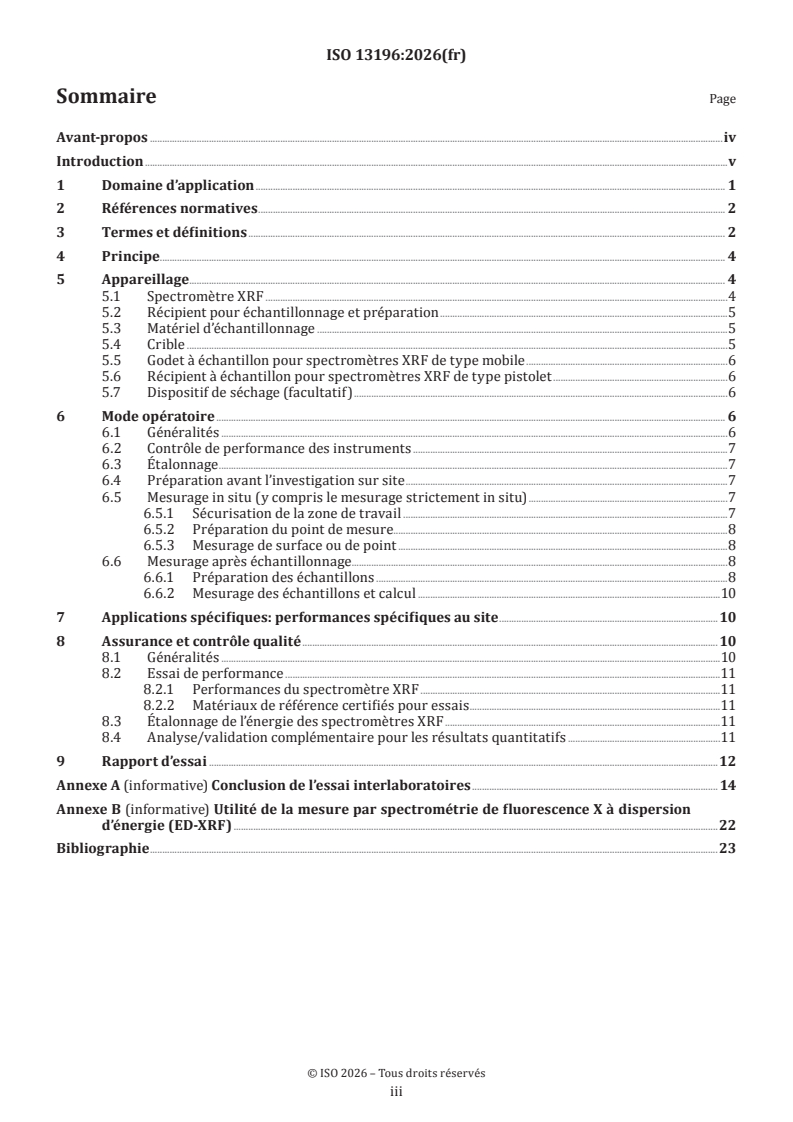
- 1 Domaine d’application
- 2 Références normatives
- 3 Termes et définitions
- 3.1 spectromètre de fluorescence X
- 3.2 spectromètre XRF de type pistolet
- 3.3 spectromètre XRF de type mobile
- 3.4 approche des paramètres fondamentaux
- 3.5 diagnostic rapide
- 3.6 méthode de diagnostic rapide
- 3.7 méthode de référence
- 3.8 semi-quantitatif
- 3.9 analyse semi-quantitative
- 3.10 analyse qualitative
- 3.11 mesurage strictement in situ
- 3.12 mesurage in situ
- 3.13 mesurage après échantillonnage
- 3.14 matériau de référence certifié
- 4 Principe
- 5 Appareillage
- 5.1 Spectromètre XRF
- 5.2 Récipient pour échantillonnage et préparation
- 5.3 Matériel d’échantillonnage
- 5.4 Crible
- 5.5 Godet à échantillon pour spectromètres XRF de type mobile
- 5.6 Récipient à échantillon pour spectromètres XRF de type pistolet
- 5.7 Dispositif de séchage (facultatif)
- 6 Mode opératoire
- 6.1 Généralités
- 6.2 Contrôle de performance des instruments
- 6.3 Étalonnage
- 6.4 Préparation avant l’investigation sur site
- 6.5 Mesurage in situ (y compris le mesurage strictement in situ)
- 6.6 Mesurage après échantillonnage
- 7 Applications spécifiques: performances spécifiques au site
- 8 Assurance et contrôle qualité
- 8.1 Généralités
- 8.2 Essai de performance
- 8.3 Étalonnage de l’énergie des spectromètres XRF
- 8.4 Analyse/validation complémentaire pour les résultats quantitatifs
- 9 Rapport d’essai
- Annexe A
- Annexe B
- Bibliographie
Introduction
La spectrométrie de fluorescence X (XRF) à l’aide d’un équipement de type mobile ou pistolet alimenté par batterie ou source active est une méthode de détermination rapide des compositions élémentaires totales des échantillons de sol. Contrairement aux analyses en laboratoire par spectroscopie d’émission optique à plasma à couplage inductif (ICP-OES) et spectroscopie d’absorption atomique (AAS), la spectrométrie XRF à l’aide d’un équipement ne nécessite aucune étape de digestion pour préparer la solution d’essai à analyser. De ce fait, un équipement XRF à dispersion d’énergie (ED-XRF) de type mobile ou pistolet convient à la détermination rapide sur site d’une sélection d’éléments, principalement les métaux lourds dans les démarches de diagnostic rapide. Lors de la réalisation d’une analyse sur un site, il peut être important de disposer d’informations sur la présence d’un élément (analyse qualitative) et également d’obtenir des résultats issus d’une analyse semi-quantitative. Les éléments typiques qu’il est possible de détecter et de mesurer sont Cr, As, Se, Cd, Hg et Pb, selon l’instrument (les éléments validés pour la détection et le mesurage par XRF sont énumérés dans la Note 3 de l’Article 1). Dans ce type de situation, les étalonnages prédéfinis en usine sont utilisés. Concernant les résultats quantitatifs, une analyse complémentaire est nécessaire à l’aide de moyens alternatifs.
Un exercice ED-XRF peut comporter une seule détermination en un seul lieu, conformément aux recommandations du présent document, plusieurs déterminations ou un grand nombre de déterminations. Lorsque des analyseurs XRF sont utilisés pour évaluer les concentrations des contaminants du sol toxiques pour l’homme et/ou l’environnement, des réglementations nationales peuvent être applicables avec des cadres de normes, de recommandations et de codes de bonne pratique pour de telles investigations. Le présent document ne vise pas à définir une stratégie, une tactique ou une méthodologie pour réaliser des investigations environnementales, des évaluations de l’impact des terres ou des sols potentiellement contaminés sur la santé humaine ou une évaluation des ressources minérales. L’adhésion au présent document ne démontre pas la conformité aux réglementations nationales relatives aux investigations des terres contaminées.
Norme internationale ISO 13196:2026(fr) Qualité du sol — Diagnostic rapide d’une sélection d’éléments dans les sols à l’aide d’un spectromètre de fluorescence X à dispersion d’énergie de type mobile ou pistolet AVERTISSEMENT — Les échantillons de sol peuvent contenir des contaminants toxiques. Éviter le contact direct des échantillons de sol avec les parties exposées du corps humain. Des mesures appropriées doivent être prises pour éviter l’ingestion et l’inhalation. L’exposition aux rayons X peut entraîner des blessures par irradiation dans tout le corps, ainsi qu’un risque accru de cancer. Les spectromètres XRF doivent généralement satisfaire aux réglementations nationales. Les personnes qui utilisent, gèrent ou supervisent l’utilisation de tels équipements doivent généralement être qualifiées pour le faire conformément aux réglementations nationales. Le spectromètre XRF à utiliser conformément au présent document doit présenter une fonction de sécurité intégrée afin d’empêcher l’opérateur et le public d’être exposés par inadvertance aux faisceaux de rayons X. Les mécanismes de blocage automatique de l’irradiation aux rayons X doivent également fonctionner lorsqu’aucun échantillon n’est trouvé par le spectromètre ou que des corps humains sont détectés par un capteur infrarouge dont il est équipé. Il convient que les utilisateurs de spectromètres XRF fassent appel à un responsable en radioprotection afin qu’il examine leurs propositions d’activité avec le spectromètre XRF et leur fournisse un avis éclairé sur les implications de ces propositions en termes de sécurité.
Pour les analyses in situ (y compris uniquement in situ), il convient d’établir une zone de travail sécurisée ou une zone contrôlée à l’aide de panneaux et de barrières, si nécessaire, afin de s’assurer que les personnes présentes sont tenues à distance.
1 Domaine d’application
Le présent document spécifie la procédure de diagnostic rapide d’une sélection d’éléments dans les sols à l’aide d’un équipement de type mobile ou pistolet pour la spectrométrie de fluorescence X à dispersion d’énergie (ED-XRF). Il couvre l’application de cette méthode de diagnostic pour obtenir des données qualitatives ou semi-quantitatives qui aident à décider d’une stratégie d’échantillonnage pour l’évaluation détaillée de la qualité du sol employant des méthodes d’analyse chimique en laboratoire. NOTE 1 Les méthodes de diagnostic fournissent généralement des valeurs de concentration qualitatives ou semiquantitatives qui sont indicatives des valeurs de concentration, bien qu’elles puissent parfois donner des résultats quantitatifs dans des conditions spécifiques ou limitées.
NOTE 2 Plus les efforts appliqués au traitement préalable des échantillons de sol sont importants, plus on peut s’attendre à des résultats d’analyse de qualité (voir, par exemple, la Référence [19]). Le présent document ne spécifie pas de façon explicite les éléments pour lesquels il est applicable dans la mesure où ses possibilités d’application dépendent des performances de l’appareil et des objectifs du diagnostic rapide. Les éléments qui peuvent être déterminés sont limités par les performances de l’instrument utilisé, les concentrations des éléments particuliers présents dans le sol, et les exigences de l’investigation concernant les concentrations minimales préoccupantes (par exemple, la valeur de référence). NOTE 3 Les mesurages XRF de As, Cd, Co, Cr, Cu, Hg, Mo, Ni, Pb, Sb, Sn, V et Zn ont été validées tel que décrit à l’Annexe A.
NOTE 4 L’Annexe B fournit des exemples de cas où il peut être utile d’effectuer un diagnostic rapide à l’aide d’un spectromètre ED-XRF de type mobile ou pistolet.
Le présent document ne fournit pas de recommandations relatives à la manière d’utiliser l’équipement pour obtenir des données quantitatives en vue de les utiliser dans les évaluations détaillées des sites. Le présent
ISO 13196:2026(fr) document ne couvre pas la manière dont les résultats de plusieurs déterminations sont synthétisés pour répondre aux objectifs d’une détermination par ED-XRF.
2 Références normatives
Les documents suivants sont cités dans le texte de sorte qu’ils constituent, pour tout ou partie de leur contenu, des exigences du présent document. Pour les références datées, seule l’édition citée s’applique. Pour les références non datées, la dernière édition du document de référence s’applique (y compris les éventuels amendements).
ISO 12404, Sol et déchets — Recommandations relatives à la sélection et à l'application des méthodes de diagnostic rapide IEC 62495, Nuclear instrumentation — Portable X-ray fluorescence analysis equipment utilizing a miniature X-ray tube (disponible en anglais seulement)
3 Termes et définitions
Pour les besoins du présent document, les termes et définitions suivants s’appliquent. L’ISO et l’IEC tiennent à jour des bases de données terminologiques destinées à être utilisées en normalisation, consultables aux adresses suivantes:
- ISO Online browsing platform: disponible à l’adresse https:// www .iso .org/ obp
- IEC Electropedia: disponible à l’adresse https:// www .electropedia .org/
3.1 spectromètre de fluorescence X
spectromètre XRF spectromètre permettant d’observer la fluorescence X émise par les éléments pour analyse Note 1 à l'article: Dans le présent document, spectromètre de fluorescence X (spectromètre XRF) désigne un spectromètre de fluorescence X à dispersion d’énergie (spectromètre ED-XRF).
3.2 spectromètre XRF de type pistolet
spectromètre XRF (3.1) qui peut être utilisé pour une analyse in situ (par exemple, mesurage strictement in situ (3.11), mesurage in situ (3.12)) à la main Note 1 à l'article: Les spectromètres XRF de type pistolet peuvent être utilisés à la fois pour les mesurages in situ (comprenant les mesurages strictement in situ) et les mesurages avec échantillonnage ou les mesurages après échantillonnage (3.13). Par mesurage après échantillonnage, on entend l’application de méthodes de détermination, y compris la spectrométrie XRF, à des échantillons prélevés et, si nécessaire, préalablement traités, sur un site ou dans un laboratoire.
Note 2 à l'article: Lors de l’application d’un spectromètre XRF à des échantillons en un point juste après les avoir collectés du sol, l’opération consiste toujours en un mesurage in situ.
3.3 spectromètre XRF de type mobile
spectromètre XRF qui peut être transporté jusqu’à un site pour analyser les échantillons qui ont été prélevés à un point de celui-ci Note 1 à l'article: Les spectromètres XRF de type mobile sont applicables aux mesurages in situ (3.12) et aux mesurages après échantillonnage (3.13).
Note 2 à l'article: Des spectromètres XRF de type pistolet (3.2) peuvent être utilisés sur le plan de travail. Cependant, le dispositif fonctionne à la main tel que décrit en 3.2.
ISO 13196:2026(fr)
3.4 approche des paramètres fondamentaux
méthode permettant d’obtenir la composition élémentaire par le biais d’une approximation successive des intensités théoriques de fluorescence X par rapport aux intensités mesurées de fluorescence X Note 1 à l'article: Le calcul des intensités théoriques de fluorescence X est réalisé à partir de la composition élémentaire présumée, de paramètres théoriques et de coefficients de sensibilité prédéterminés du spectromètre XRF.
3.5 diagnostic rapide
application d’une méthode d’analyse semi-quantitative (3.8) à des fins exploratoires [SOURCE: ISO 12404:2021, 3.1]
3.6 méthode de diagnostic rapide
méthode utilisée (souvent sur site) pour explorer rapidement une zone donnée, y compris la répartition de paramètres cibles, ou pour soumettre à essai un ensemble d’échantillons et obtenir des données sur les caractéristiques des échantillons Note 1 à l'article: Une méthode de diagnostic rapide n’est pas toujours directement comparable à des méthodes de référence (3.7).
[SOURCE: ISO 12404:2021, 3.2]
3.7 méthode de référence
méthode mise en œuvre conformément à des normes nationales ou internationales [SOURCE: ISO 12404:2021, 3.3]
3.8 semi-quantitatif
approximatif et comparatif plutôt qu’absolument quantitatif
3.9 analyse semi-quantitative
méthode d’analyse des données qui fournit des mesurages approximatives et comparatives plutôt qu’une quantification absolue dans le cadre d’une seule expérimentation Note 1 à l'article: Elle combine des éléments d’analyse qualitative et quantitative, permettant l’interprétation de valeurs numériques qui reflètent le degré ou l’étendue d’une caractéristique particulière dans un échantillon. Contrairement aux méthodes entièrement quantitatives, qui donnent des résultats pouvant être directement comparés entre différentes expérimentations, les méthodes semi-quantitatives (3.8) fournissent des informations qui sont principalement significatives dans le contexte d’une seule expérimentation ou étude.
3.10 analyse qualitative
méthode d’analyse des données qui se concentre sur la détection ou l’identification des éléments constituants sans fournir de concentrations spécifiques
3.11 mesurage strictement in situ
observation directe de la surface du sol à l’aide d’un dispositif de type pistolet
3.12 mesurage in situ
observation à l’emplacement d’échantillonnage des échantillons prélevés dans le sol, à l’aide d’un dispositif de type mobile ou pistolet
ISO 13196:2026(fr)
3.13 mesurage après échantillonnage
observation, à l’aide d’un dispositif de type mobile ou pistolet, des échantillons qui sont prélevés dans le sol, puis transportés à un autre endroit (par exemple, stations de prélèvement ou laboratoires) après prélèvement Note 1 à l'article: Le mesurage sur site comprend les mesurages strictement in situ (3.11) et les mesurages in situ (3.12) ainsi que le mesurage post-échantillonnage lorsque le mesurage est effectué sur le site mais à un endroit différent du point de prélèvement des échantillons après prélèvement (par exemple, stations de prélèvement sur un site). Note 2 à l'article: Étant donné que des mesurages strictement in situ et in situ sont effectués en appliquant un dispositif XRF à la surface d’un point cible au sol et à un échantillon prélevé à partir de celui-ci immédiatement après le prélèvement, il s’agit en d’autres termes de mesurage d’une surface et de mesurage d’un point, respectivement.
3.14 matériau de référence certifié
MRC MR caractérisé par une procédure métrologiquement valide applicable à une ou plusieurs propriétés spécifiées et accompagné d’un certificat de MR qui indique la valeur pour la propriété spécifiée, son incertitude associée, et une expression de la traçabilité métrologique [SOURCE: ISO 17034:2016, 3.2, modifié — Les Notes 1 à 4 à l’article ont été supprimées.]
4 Principe
Les concentrations d’une sélection d’éléments dans le sol sont déterminées à l’aide d’un spectromètre XRF de type mobile ou pistolet. Les concentrations des éléments sont mesurées après échantillonnage et traitement préalable limité (mesurage in situ), ou directement dans le sol en place (mesurage strictement in situ). Bien que l’utilisation d’un spectromètre ED-XRF de type mobile ou pistolet se prête à la réalisation de déterminations en des lieux ad hoc en fonction des observations effectuées sur site, il convient de l’utiliser de manière structurée et proportionnée à l’objectif de l’étude pour laquelle il est utilisé. NOTE 1 Des recommandations relatives aux stratégies d’échantillonnage dans différents contextes sont fournies dans l’ISO 18400-104, l’ISO 18400-203 et l’ISO 18400-205.
Il convient d’enregistrer les lieux d’essai, de même que les informations contextuelles telles que les observations effectuées sur site et les photographies prises le cas échéant. L’emploi d’un GPS peut être particulièrement utile pour enregistrer les lieux d’essai avec précision lorsqu’ils sont choisis sur une base ad hoc plutôt que sur la base d’un plan prédéterminé.
Le mode opératoire décrit dans le présent document, qui permet de dépister des sols pour des éléments sélectionnés à l’aide de dispositifs ED-XRF de type mobile ou pistolet, donne des résultats semiquantitatifs. Lorsqu’on souhaite connaître la relation entre les résultats obtenus et ceux obtenus à partir des méthodes de laboratoire de référence, les comparer soigneusement en sélectionnant les méthodes de laboratoire alternatives en tenant compte de leurs caractéristiques de performance particulières (voir 8.2.2, Notes 1 et 2) et reconnaître que toute méthode (par exemple, méthodes de diagnostic et méthodes de référence de laboratoire) comporte des erreurs provenant de ses principes spécifiques d’échantillonnage et d’analyse (voir 7.1 et 8.4).
NOTE 2 Des exemples de situations où il peut être utile d’effectuer un diagnostic rapide à l’aide d’un spectromètre ED-XRF de type mobile ou pistolet sont fournis à l’Annexe B.
5 Appareillage
5.1 Spectromètre XRF
Un dispositif ED-XRF approprié, de type mobile ou pistolet alimenté par batterie ou source active. Des dispositifs ED-XRF typiques sont décrits dans les Références [20] et [21].
ISO 13196:2026(fr) Les instruments doivent être dotés d’une énergie et d’une pénétration en profondeur suffisantes ainsi que d’une largeur de faisceau adaptée pour pouvoir être utilisés dans les matrices du sol et atteindre des limites de détection appropriées. Ces informations sont disponibles auprès du fabricant ou du fournisseur. Un système de sécurité pour le spectromètre doit être installé tel que décrit dans l’IEC 62495 où seuls les opérateurs et superviseurs autorisés du spectromètre peuvent l’activer avec un mot de passe donné par les superviseurs. Les mécanismes de blocage automatique des rayonnements X doivent également fonctionner lorsqu’aucun échantillon n’est détecté par le spectromètre ou lorsque des corps humains sont détectés par un capteur IR installé sur le dispositif XRF.
5.2 Récipient pour échantillonnage et préparation
Un plateau qui peut contenir une quantité suffisante d’échantillons de sol pour la mesure XRF. Il convient que le plateau soit fait d’un matériau approprié dont l’usure ne risque pas d’introduire dans l’échantillon des grains métalliques ou des grains de plastiques colorés pouvant contenir des pigments métalliques. Lorsqu’il s’agit de concasser des agrégats ou de désagréger des mottes de terre, il convient d’utiliser un mortier muni d’un pilon en céramique ou en un autre matériau inerte solide tel que l’agate ou la calcédoine. Le spectromètre XRF peut être utilisé pour soumettre à essai les plateaux ainsi que les mortiers et pilons afin de détecter les métaux qui peuvent interférer avec la XRF.
5.3 Matériel d’échantillonnage
Il convient que le matériel d’échantillonnage (tel que les cuillères, les truelles, les pioches, les bêches ou les bêches à trous) utilisé pour préparer l’échantillonnage (par exemple, sur des lieux de mesure in situ) et pour prélever les échantillons soit en bon état et il ne doit pas contaminer l’échantillon. L’utilisation d’outils en acier inoxydable peut s’avérer appropriée compte tenu des quantités infimes d’un outil dur qui peuvent être introduites dans le sol au cours de l’échantillonnage. Lorsque la moindre interférence due à l’usure du matériel d’échantillonnage est possible, il convient d’utiliser des truelles et des cuillères en plastique. Lors de la réalisation d’essais in situ sur des expositions excavées à la machine, l’utilisation de godets de pelle ou de lames de bulldozer en acier est inévitable en l’absence de godets et de lames en plastique pour de telles machines.
NOTE 1 Les outils peints, zingués ou chromés peuvent introduire des paillettes de métaux ou de peintures contenant des pigments métalliques susceptibles d’influencer l’analyse des échantillons par XRF, qui est effectuée par des mesurages sur site et après l’échantillonnage.
NOTE 2 L’ISO 18400-102 donne des recommandations supplémentaires relatives à la récupération des échantillons pour analyse chimique.
5.4 Crible
Un tamis d’une taille de maille de 2 mm, par exemple, tel que décrit dans l’ISO 3310-1. Nettoyer le tamis entre chaque échantillon.
La procédure décrite dans le présent document n’est validée que pour les matériaux passant au tamis de 2 mm. L’utilisateur peut choisir d’utiliser une taille de maille différente (il existe des tamis dont les mailles sont inférieures ou supérieures à 2 mm), mais les résultats obtenus peuvent être différents de ceux obtenus avec un tamis d’une taille de maille de 2 mm.
NOTE Le choix d’une taille de maille plus petite peut être motivé par la volonté d’obtenir des résultats susceptibles d’être plus en rapport avec la possibilité d’inhalation, d’ingestion ou de contact avec des matériaux contaminés. Lorsque la moindre interférence due à l’usure des tamis est possible, il convient d’envisager d’utiliser des tamis en plastique. Les tamis eux-mêmes peuvent être soumis à essai avec le spectromètre XRF afin de s’assurer que toute contamination potentielle des échantillons peut être correctement évaluée.
ISO 13196:2026(fr)
...