

ISO 21927-9:2012
(Main)Smoke and heat control systems — Part 9: Specification for control equipment
General Information
- Abstract
ISO 21927-9:2011 specifies the product performance requirements, classifications and test methods for control equipment designed for use in smoke- and heat-control systems (SHCS) in buildings.
- Status
- Published
- Publication Date
- 23-Feb-2012
- Technical Committee
- ISO/TC 21/SC 11 - Smoke and heat control systems and components
- Drafting Committee
- ISO/TC 21/SC 11 - Smoke and heat control systems and components
- Current Stage
- 9093 - International Standard confirmed
- Start Date
- 22-Mar-2024
- Completion Date
- 29-Aug-2026
Overview
ISO 21927-9:2012 - "Smoke and heat control systems - Part 9: Specification for control equipment" defines product performance requirements, classifications and test methods for control equipment used in smoke- and heat-control systems (SHCS) in buildings. The standard covers the expected behavior, indications, reliability and documentation for control equipment that manages smoke extraction, pressurization, ventilators and other SHCS assets. It establishes a common technical baseline for manufacturers, designers, test laboratories and authorities responsible for fire safety systems.
Key Topics
The standard addresses a broad set of technical requirements and test regimes, including:
- Scope and definitions - terminology and abbreviated terms specific to SHCS control equipment.
- Types of control equipment - electrical control panels, electrical basic control panels, pneumatic systems, mechanical control panels and manual control points.
- Operational modes and indications - requirements for standby, fire, fault, disablement and test conditions and the associated visual/audible indications.
- Design, documentation and marking - user and design documentation, mechanical and electrical design criteria, labeling and accessibility of controls.
- Software and networked systems - additional requirements for software-controlled panels, program monitoring, storage and integrity, plus rules for networked/bus-connected systems.
- Integrity of transmission paths - reliability of command and feedback paths used in SHCS.
- Testing and classification - functional and reliability tests, environmental tests (cold, damp heat, impact, vibration), thermal initiation tests, and requirements for specimen selection and test conditions.
- Performance and durability - operational reliability, priority handling and optional/additional functions allowed by manufacturers.
Applications
ISO 21927-9 is used to:
- Specify and select control equipment for smoke and heat control systems in commercial, industrial and public buildings.
- Guide manufacturers in designing, testing and documenting control panels (electrical, pneumatic, mechanical) and software-based systems to meet recognized performance classes.
- Support test laboratories conducting functional, environmental and reliability tests for certification and compliance.
- Assist consulting engineers, system integrators and installers to ensure interoperability, correct installation, and compliance with building fire safety requirements.
- Inform facility managers and authorities having jurisdiction about expected behavior and maintenance/testing regimes for SHCS control equipment.
Keywords: ISO 21927-9, smoke and heat control systems, SHCS, control equipment, control panels, testing, performance requirements, pneumatic control, electrical control.
Related Standards
- Other parts of the ISO 21927 series (smoke and heat control systems) - consult the series for complementary specifications.
- National building codes and fire safety standards that reference SHCS performance and certification requirements.
Relations
- Effective Date
- 09-Feb-2026
Get Certified
Connect with accredited certification bodies for this standard

CIS Institut d.o.o.
Personal Protective Equipment (PPE) certification body. Notified Body NB-2890 for EU Regulation 2016/425 PPE.

Kiwa BDA Testing
Building and construction product certification.
Kmetijski inštitut Slovenije
Agricultural Institute of Slovenia. Soil testing, plant health, agricultural product analysis.
Sponsored listings
Frequently Asked Questions
ISO 21927-9:2012 is a standard published by the International Organization for Standardization (ISO). Its full title is "Smoke and heat control systems — Part 9: Specification for control equipment". This standard covers: ISO 21927-9:2011 specifies the product performance requirements, classifications and test methods for control equipment designed for use in smoke- and heat-control systems (SHCS) in buildings.
ISO 21927-9:2011 specifies the product performance requirements, classifications and test methods for control equipment designed for use in smoke- and heat-control systems (SHCS) in buildings.
ISO 21927-9:2012 is classified under the following ICS (International Classification for Standards) categories: 13.220.20 - Fire protection. The ICS classification helps identify the subject area and facilitates finding related standards.
ISO 21927-9:2012 has the following relationships with other standards: It is inter standard links to EN 12101-13:2022. Understanding these relationships helps ensure you are using the most current and applicable version of the standard.
ISO 21927-9:2012 is available in PDF format for immediate download after purchase. The document can be added to your cart and obtained through the secure checkout process. Digital delivery ensures instant access to the complete standard document.
Standards Content (Sample)
INTERNATIONAL ISO
STANDARD 21927-9
First edition
2012-03-01
Smoke and heat control systems —
Part 9:
Specification for control equipment
Systèmes pour le contrôle des fumées et de la chaleur —
Partie 9: Spécifications pour les équipements de commande
Reference number
©
ISO 2012
© ISO 2012
All rights reserved. Unless otherwise specified, no part of this publication may be reproduced or utilized in any form or by any means,
electronic or mechanical, including photocopying and microfilm, without permission in writing from either ISO at the address below or
ISO's member body in the country of the requester.
ISO copyright office
Case postale 56 CH-1211 Geneva 20
Tel. + 41 22 749 01 11
Fax + 41 22 749 09 47
E-mail copyright@iso.org
Web www.iso.org
Published in Switzerland
ii © ISO 2012 – All rights reserved
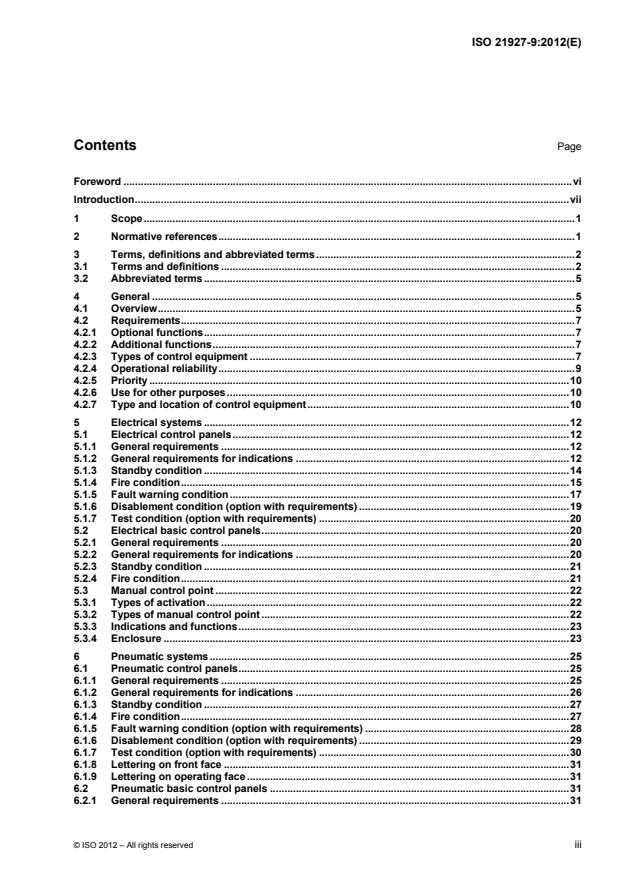
Contents Page
Foreword . vi
Introduction . vii
1 Scope . 1
2 Normative references . 1
3 Terms, definitions and abbreviated terms . 2
3.1 Terms and definitions . 2
3.2 Abbreviated terms . 5
4 General . 5
4.1 Overview . 5
4.2 Requirements . 7
4.2.1 Optional functions . 7
4.2.2 Additional functions . 7
4.2.3 Types of control equipment . 7
4.2.4 Operational reliability . 9
4.2.5 Priority . 10
4.2.6 Use for other purposes . 10
4.2.7 Type and location of control equipment . 10
5 Electrical systems . 12
5.1 Electrical control panels . 12
5.1.1 General requirements . 12
5.1.2 General requirements for indications . 12
5.1.3 Standby condition . 14
5.1.4 Fire condition . 15
5.1.5 Fault warning condition . 17
5.1.6 Disablement condition (option with requirements) . 19
5.1.7 Test condition (option with requirements) . 20
5.2 Electrical basic control panels . 20
5.2.1 General requirements . 20
5.2.2 General requirements for indications . 20
5.2.3 Standby condition . 21
5.2.4 Fire condition . 21
5.3 Manual control point . 22
5.3.1 Types of activation . 22
5.3.2 Types of manual control point . 22
5.3.3 Indications and functions . 23
5.3.4 Enclosure . 23
6 Pneumatic systems . 25
6.1 Pneumatic control panels . 25
6.1.1 General requirements . 25
6.1.2 General requirements for indications . 26
6.1.3 Standby condition . 27
6.1.4 Fire condition . 27
6.1.5 Fault warning condition (option with requirements) . 28
6.1.6 Disablement condition (option with requirements) . 29
6.1.7 Test condition (option with requirements) . 30
6.1.8 Lettering on front face . 31
6.1.9 Lettering on operating face . 31
6.2 Pneumatic basic control panels . 31
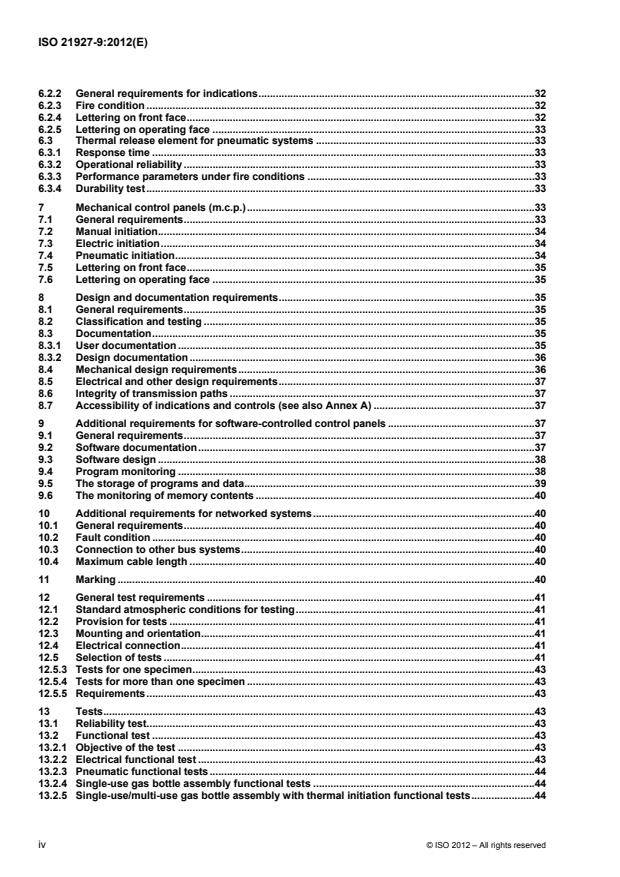
6.2.1 General requirements . 31
6.2.2 General requirements for indications .32
6.2.3 Fire condition .32
6.2.4 Lettering on front face .32
6.2.5 Lettering on operating face .33
6.3 Thermal release element for pneumatic systems .33
6.3.1 Response time .33
6.3.2 Operational reliability .33
6.3.3 Performance parameters under fire conditions .33
6.3.4 Durability test .33
7 Mechanical control panels (m.c.p.) .33
7.1 General requirements .33
7.2 Manual initiation .34
7.3 Electric initiation .34
7.4 Pneumatic initiation .34
7.5 Lettering on front face .35
7.6 Lettering on operating face .35
8 Design and documentation requirements .35
8.1 General requirements .35
8.2 Classification and testing .35
8.3 Documentation .35
8.3.1 User documentation .35
8.3.2 Design documentation .36
8.4 Mechanical design requirements .36
8.5 Electrical and other design requirements .37
8.6 Integrity of transmission paths .37
8.7 Accessibility of indications and controls (see also Annex A) .37
9 Additional requirements for software-controlled control panels .37
9.1 General requirements .37
9.2 Software documentation .37
9.3 Software design .38
9.4 Program monitoring .38
9.5 The storage of programs and data .39
9.6 The monitoring of memory contents .40
10 Additional requirements for networked systems .40
10.1 General requirements .40
10.2 Fault condition .40
10.3 Connection to other bus systems .40
10.4 Maximum cable length .40
11 Marking .40
12 General test requirements .41
12.1 Standard atmospheric conditions for testing .41
12.2 Provision for tests .41
12.3 Mounting and orientation .41
12.4 Electrical connection .41
12.5 Selection of tests .41
12.5.3 Tests for one specimen .43
12.5.4 Tests for more than one specimen .43
12.5.5 Requirements .43
13 Tests .43
13.1 Reliability test .43
13.2 Functional test .43
13.2.1 Objective of the test .43
13.2.2 Electrical functional test .43
13.2.3 Pneumatic functional tests .44
13.2.4 Single-use gas bottle assembly functional tests .44
13.2.5 Single-use/multi-use gas bottle assembly with thermal initiation functional tests .44
iv © ISO 2012 – All rights reserved
13.2.6 Single-use/multi-use gas bottle assembly with manual-initiation functional tests . 45
13.2.7 Mechanical control panel functional tests . 46
13.2.8 Thermal release elements functional tests . 47
13.3 Cold (operational) . 48
13.3.1 Object of the test . 48
13.3.2 Test procedure . 48
13.4 Damp heat, steady state (operational) . 49
13.4.1 Object of the test . 49
13.4.2 Procedure . 49
13.5 Impact (operational) . 50
13.5.1 Object of the test . 50
13.5.2 Test procedure . 50
13.6 Vibration, sinusoidal (operational) . 51
13.6.1 Object of the test . 51
13.6.2 Test procedure . 51
13.6.3 Final measurements . 52
13.7 Damp heat, steady state (endurance) . 52
13.7.1 Object of the test . 52
13.7.2 Procedure . 52
13.8 Vibration, sinusoidal (endurance) . 53
13.8.1 Object of the test . 53
13.8.2 Test procedure . 53
13.9 Dry heat (operational) . 54
13.9.1 Object of the test . 54
13.9.2 Test procedure . 54
13.10 SO corrosion . 55
13.10.1 Object of the test . 55
13.10.2 Test procedure . 55
13.11 Salt spray testing . 56
13.11.1 Object of the test . 56
13.11.2 Test procedure . 56
13.12 Protection against water (IP rating) . 57
13.12.1 Object of the test . 57
13.12.2 Test procedure . 57
13.13 Protection against substances (IP rating) . 57
13.13.1 Object of the test . 57
13.13.2 Test procedure . 58
13.14 EMC immunity tests (operational) . 58
14 Conformity assessment . 59
14.1 General . 59
14.2 Type testing . 59
14.3 Factory production control (FPC) . 59
Annex A (normative) Explanation of access levels . 60
Annex B (informative) Summary of functions . 62
Bibliography . 63
Foreword
ISO (the International Organization for Standardization) is a worldwide federation of national standards bodies
(ISO member bodies). The work of preparing International Standards is normally carried out through ISO
technical committees. Each member body interested in a subject for which a technical committee has been
established has the right to be represented on that committee. International organizations, governmental and
non-governmental, in liaison with ISO, also take part in the work. ISO collaborates closely with the
International Electrotechnical Commission (IEC) on all matters of electrotechnical standardization.
International Standards are drafted in accordance with the rules given in the ISO/IEC Directives, Part 2.
The main task of technical committees is to prepare International Standards. Draft International Standards
adopted by the technical committees are circulated to the member bodies for voting. Publication as an
International Standard requires approval by at least 75 % of the member bodies casting a vote.
Attention is drawn to the possibility that some of the elements of this document may be the subject of patent
rights. ISO shall not be held responsible for identifying any or all such patent rights.
ISO 21927-9 was prepared by Technical Committee ISO/TC 21, Equipment for fire protection and fire fighting,
Subcommittee SC 11, Smoke and heat control systems and components.
ISO 21927 consists of the following parts, under the general title Smoke and heat control systems:
Part 1: Specification for smoke barriers
Part 2: Specification for natural smoke and heat exhaust ventilators
Part 3: Specification for powered smoke and heat exhaust ventilators
Part 9: Specification for control equipment
Part 10: Specification for power output devices
vi © ISO 2012 – All rights reserved
Introduction
Smoke- and heat-control systems (SHCS) create and maintain smoke-free areas in a construction works by
controlling smoke flow, thus improving the conditions for the safe escape and/or rescue of people and animals
and the protection of property, and permit fire-fighting in the early stages of the fire. The use of smoke and
heat exhaust ventilation systems (SHEVS) to create smoke-free areas beneath a buoyant smoke layer has
become widespread. Their value in assisting in the evacuation of people from construction works, reducing
fire damage and financial loss by preventing smoke logging, facilitating fire fighting, reducing roof
temperatures and retarding the lateral spread of fire, is firmly established. For these benefits to be obtained, it
is essential that smoke and heat exhaust ventilators operate fully and reliably whenever called upon to do so
during their installed life. A heat and smoke exhaust ventilation system is a scheme of safety equipment
intended to perform a positive role in a fire emergency.
Components for any smoke and heat control system are installed as part of a properly designed system.
Smoke and heat control systems help to:
keep the escape and access routes free from smoke;
facilitate fire fighting operations;
delay and/or prevent flashover and thus full development of the fire;
protect equipment and furnishings;
reduce thermal effects on structural components during a fire;
reduce damage caused by thermal decomposition products and hot gases.
Pressure differential systems are used to either positively pressurize spaces separated from the fire or to
depressurize the space containing the fire in order to limit or prevent the flow of smoke and heat into adjacent
spaces. A typical use would be to pressurize an escape stairwell in order to protect vertical means of escape.
Depending on the design of the system, natural or powered smoke and heat ventilators can be used in a
smoke and heat control system.
Control equipment (c.e.) is required to control all components in a SHCS, such as:
natural ventilators;
powered ventilators;
smoke barriers;
smoke dampers;
air inlets.
SHCS control equipment may also provide control for day-to-day ventilation and signals to other fire safety
equipment under fire conditions.
SHCS control equipment may be for extra-low-voltage or low-voltage electrical systems or pneumatic systems
or any combination of these.
Power output devices for control equipment are dealt with in ISO 21927-10.
INTERNATIONAL STANDARD ISO 21927-9:2012(E)
Smoke and heat control systems —
Part 9:
Specification for control equipment
1 Scope
This part of ISO 21927 specifies the product performance requirements, classifications and test methods for
control equipment designed for use in smoke- and heat-control systems (SHCS) in buildings.
2 Normative references
The following referenced documents are indispensable for the application of this document. For dated
references, only the edition cited applies. For undated references, the latest edition of the referenced
document (including any amendments) applies.
ISO 3098-2, Technical product documentation — Lettering — Part 2: Latin alphabet, numerals and marks
ISO 6988, Metallic and other non-organic coatings — Sulfur dioxide test with general condensation of
moisture
ISO 7240-5:2003, Fire detection and alarm systems — Part 5: Point-type heat detectors
ISO 7240-6, Fire detection and alarm systems — Part 6: Carbon monoxide fire detectors using electro-
chemical cells
ISO 7240-7, Fire detection and alarm systems — Part 7: Point-type smoke detectors using scattered light,
transmitted light or ionization
ISO 7240-8, Fire detection and alarm systems — Part 8: Carbon monoxide fire detectors using an electro-
chemical cell in combination with a heat sensor
ISO 7240-10, Fire detection and alarm systems — Part 10: Point-type flame detectors
ISO 7240-11:2005, Fire detection and alarm systems — Part 11: Manual call points
ISO 7240-12, Fire detection and alarm systems — Part 12: Line type smoke detectors using a transmitted
optical beam
ISO 7240-15, Fire detection and alarm systems — Part 15: Point type fire detectors using scattered light,
transmitted light or ionization sensors in combination with a heat sensor
ISO 7240-20, Fire detection and alarm systems — Part 20: Aspirating smoke detectors
ISO 7240-27, Fire detection and alarm systems — Part 27: Point-type fire detectors using a scattered-light,
transmitted-light or ionization smoke sensor, an electrochemical-cell carbon-monoxide sensor and a heat
sensor
ISO/IEC 17000, Conformity assessment — Vocabulary and general principles
ISO/IEC 17050-1, Conformity assessment — Supplier's declaration of conformity — Part 1: General
requirements
ISO/IEC 17050-2, Conformity assessment — Supplier's declaration of conformity — Part 2: Supporting
documentation
ISO 21927-3, Smoke and heat control systems — Part 3: Specification for powered smoke and heat exhaust
ventilators
ISO 21927-10, Smoke and heat control systems — Part 10: Specification for power output devices
EN 50130-4, Alarm systems — Electromagnetic compatibility — Product family standard: Immunity
requirements for components of fire, intruder and social alarm systems
IEC 60068-1:1994, Environmental testing — Part 1: General and guidance
IEC 60068-2-1 Environmental testing — Part 2-1: Tests — Tests A: Cold
IEC 60068-2-6, Environmental testing — Part 2-6: Tests — Test Fc: Vibration (sinusoidal)
IEC 60068-2-47, Environmental testing — Part 2-47: Test — Mounting of specimens for vibration, impact and
similar dynamic tests
IEC 60068-2-52:1996, Environmental testing — Part 2: Tests — Test Kb: Salt mist, cyclic (sodium chloride
solution)
IEC 60068-2-75, Environmental testing — Part 2-75: Tests — Test Eh: Hammer tests
IEC 60068-2-78, Environmental testing — Part 2-78: Tests — Test Cab: Damp heat, steady state
IEC 60529:1992, Degrees of protection provided by enclosures (IP Code)
3 Terms, definitions and abbreviated terms
For the purposes of this document, the following terms, definitions and abbreviations apply.
3.1 Terms and definitions
3.1.1
access level
one of several states of control equipment in which selected:
controls can be operated
manual operations can be carried out
indications are visible
information can be obtained
NOTE Further information is given in Annex A.
3.1.2
addressable point
point which can be individually identified at the control panel
2 © ISO 2012 – All rights reserved
3.1.3
basic control panel
b.c.p.
single-operation initiating device for a smoke and heat control system component, e.g. manual control point or
single-use gas bottle assembly
NOTE A b.c.p. may be regarded as an emergency control panel.
3.1.4
compulsory indication
visual or audible indications (e.g. light-emitting indicator, label, alphanumeric display, sounder) required by this
International Standard
NOTE If options with requirements are chosen, then indications required within those options are compulsory.
3.1.5
control equipment
c.e.
initiating device for a smoke and heat control system component, e.g. control panel, basic control panel,
mechanical control panel
3.1.6
control panel
c.p.
multi-operation initiating device for a smoke and heat control system
3.1.7
fire condition
when a fire signal has been received and processed by the control equipment and the intended outputs and
indications have been given
3.1.8
fire position
configuration of a smoke and heat control system component to be achieved and sustained while the system
is venting smoke and heat
3.1.9
frangible element
component which, after receiving a blow or pressure, is physically broken or is visibly displaced by change of
position and remains in that condition until replaced or reset
3.1.10
hierarchical system
networked system with one control panel designated as the main control panel which fulfils at least the
following tasks:
receives and transmit signals from/to other networked control equipment;
displays the status of the networked control equipment.
3.1.11
manual control point
initiation device for a smoke and heat control system provided for use in an emergency by building occupants
or fire fighters
3.1.12
mechanical control panel
m.c.p.
operation initiation device for a smoke and heat control system component where the initiation is provided
through a mechanical linkage (e.g. by release of tension in a cable) between the control equipment and the
component
3.1.13
networked system
system where control panels are interconnected and able to exchange information electronically
3.1.14
response time
period between the signal to operate being received by the control equipment and the achievement of the fire
condition
3.1.15
site-specific data
information that the software uses and that is specific to an installation
NOTE This may include information such as allocation of devices to specific zones, time settings and sensitivity
levels.
3.1.16
smoke- and heat-control system
SHCS
arrangement of components installed in a construction works to limit the effects of smoke and heat from a fire
3.1.17
smoke- and heat-exhaust ventilator
SHEV
device specially designed to move smoke and hot gases out of the construction works under conditions of fire
3.1.18
standby condition
quiescent condition when the control equipment is fully operational and waiting to receive a fire signal
3.1.19
transmission path
physical connection, external to the cabinet of the control equipment for the transmission of information and/or
power between the control equipment and other components of a SHCS, and/or between parts of a control
equipment contained in different cabinets
3.1.20
ventilator
device for enabling the movement of gases into or out of a construction works
3.1.21
zone
individual input or output, usually relating to a geographical sub-division of the protected premises
3.1.22
thermal release element
temperature-sensitive device which responds to initiate a subsequent action
4 © ISO 2012 – All rights reserved
3.2 Abbreviated terms
b.c.p. basic control panel
c.e. control equipment
c.i.e. control and indicating equipment (as specified in ISO 7240-2)
c.p. control panel
DP dual purpose
m.c.p. mechanical control panel
p.o.d. power output device
p.s.e. power supply equipment
SHCS smoke- and heat-control system
SHEV smoke- and heat-exhaust ventilator
SHEVS smoke- and heat-exhaust ventilation system
BMS Building Management System
4 General
4.1 Overview
Figure 1 illustrates the structure of this part of ISO 21927 and shows how and where the requirements for
each type of control equipment are distributed.
Figure 1 — Overview of the structure of this part of ISO 21927
6 © ISO 2012 – All rights reserved
4.2 Requirements
4.2.1 Optional functions
If an optional function with requirements is included in the control equipment, then it shall conform to all the
corresponding requirements of this part of ISO 21927.
4.2.2 Additional functions
If functions additional to those specified in this part of ISO 21927 are provided (for example to control the
additional use of a SHEVS for day-to-day comfort ventilation), they shall not jeopardize any of the
requirements of this part of ISO 21927.
4.2.3 Types of control equipment
For the purposes of this part of ISO 21927, control equipment shall be typified as follows:
Type A: mechanical control panels (m.c.p.);
Type B: basic control panels (b.c.p.) and pneumatic-only control panels;
Type C: control panels (c.p.) without direct connection for detectors (see Figure 2);
Type D: control panels with direct connection for detectors (see Figure 3).
See Annex B for a summary of the functions relevant to each type.
NOTE 1 When a type D panel is used without detectors, it may also be considered a type C panel.
NOTE 2 Manual control points are not classified as types A to D except for indoor or outdoor use according to
ISO 7240-11.
NOTE 3 Thermal release elements are not classified as types A to D except for the nominal release temperature.
Key
1 sounder/lamp
2 potential free contact
3 SHCS component
4 wind/rain detector
5 230 V/400 VAC main power supply
6 detector (ISO 7240)
7 manual control point
8 vent button
9 c.i.e. (ISO 7240)
Figure 2 — Example of a type C control panel
8 © ISO 2012 – All rights reserved
Key
1 sounder/lamp
2 potential free contact
3 SHCS component
4 wind/rain detector
5 230 V/400 VAC main power supply
6 detector (ISO 7240)
7 manual control point
8 vent button
Figure 3 — Example of a type D control panel
4.2.4 Operational reliability
4.2.4.1 For the purposes of this part of ISO 21927, control equipment shall be classified in one of the
following reliability classes (Re):
Re A: as declared by the manufacturer (A > 50);
Re 50;
Re 1000.
The designations A, 50, and 1000 will represent the number of operating cycles in the fire condition.
This test shall not be applied for manual control points.
4.2.4.2 When control equipment, intended for smoke control purposes only, is tested in accordance with
13.1, the number of operating cycles in the fire condition shall conform to 4.2.4.1.
4.2.4.3 Control equipment that is also intended to provide additional control when in the standby
condition (e.g. to use dual-purpose ventilators for day-to-day comfort ventilation) shall be cycled an additional
10 000 times in the standby condition prior to performing the operating cycles in the fire condition in
accordance with 4.2.4.2. Such equipment shall be identified by the addition of DP to the reliability class, e.g.
Re 1000DP.
4.2.5 Priority
The fire condition shall have the highest priority. Any fire signal shall switch the control equipment into the fire
condition regardless of the condition at the time, unless the fire signal has been disabled. Priority between fire
signals shall be declared in the user documentation.
4.2.6 Use for other purposes
Smoke- and heat-control systems (SHCS) may be used for functions other than smoke control (e.g. to provide
comfort ventilation); however, the primary purpose of the system should always be for the control of smoke
and heat. These additional functions may be signalled by sensors or switches directly connected to, and
controlled by the control equipment. The control equipment may be linked to other systems such as a Building
Management System (BMS) to facilitate these functions. Failure of sensors or switches or connection to other
systems not controlling smoke and heat shall not affect the operation of the control equipment in the fire
condition. Any control equipment used in an SHCS shall conform to the requirements of this part of
ISO 21927. All input signals to the control equipment that initiate the fire condition shall come directly from the
detection source (e.g. c.i.e., manual control point) and be monitored in accordance with Table 1.
4.2.7 Type and location of control equipment
For the purposes of this part of ISO 21927, the control equipment shall comprise at least one enclosure.
Several components with their own enclosures (e.g. manual control points for different zones) may be
electrically and/or pneumatically connected to the primary enclosure (see Figure 4).
10 © ISO 2012 – All rights reserved
a) Electrical
b) Pneumatic
NOTE A pneumatic p.o.d. may be a compressor set, air receiver or gas bottle, as appropriate.
Key
1 main supply 4 actuator, motor, solenoid, etc.
2 power output devices (p.o.d.) 5 b.c.p.
3 control panel
Electrical requirement
Electrical option
Pneumatic
Figure 4 — Examples showing typical locations and interrelationships of the c.p.
with other components of a smoke and heat control system
5 Electrical systems
5.1 Electrical control panels
5.1.1 General requirements
5.1.1.1 It shall be possible for the c.p. to be in any combination of the following functional conditions
simultaneously:
fire condition;
fault warning condition;
disablement condition (if provided);
test condition (if provided).
5.1.1.2 A single short-circuit or interruption in any individual electrical transmission path to or from the
c.p. shall not prevent the correct operation, as specified by the manufacturer, of more than one of the following
functions:
automatic detection of fire (type D);
operation of basic control panels;
transmission or reception of signals to or from input/output devices;
initiation of operation of ancillary equipment.
and
all devices rendered inoperative by the fault shall be intended to operate together; and
all devices rendered inoperative by the fault shall fulfil the same function.
5.1.2 General requirements for indications
5.1.2.1 Display of functional conditions
The c.p. shall be capable of unambiguously indicating the following functional conditions, as described in 5.1.3
to 5.1.7:
standby condition;
fire condition;
fault warning condition;
disablement condition (if provided);
test condition (if provided).
5.1.2.2 Incorrect operation indication (option with requirements)
The control equipment shall provide indication of incorrect operation of all SHCS components including
dampers as well as fault indication according to ISO 21927-3.
12 © ISO 2012 – All rights reserved
In standby condition, incorr
...