

ISO 21927-8:2017
(Main)Smoke and heat control systems — Part 8: Smoke control dampers
General Information
- Abstract
ISO 21927-8:2017 applies to smoke control dampers, placed on the market and intended to operate as part of a pressure differential system or smoke and heat control system. This document specifies requirements and gives reference to the test methods defined for smoke control dampers and their associated components, such as actuators which are intended to be installed in such systems in buildings. Furthermore, provision on marking and information on installation and maintenance of these products are also given. ISO 21927-8:2017 distinguishes between two categories of smoke control dampers, i.e. single-compartment smoke control dampers and multi‑compartment fire-resisting smoke control dampers. Smoke control dampers covered by this document can be installed into smoke control system ducts or onto the ducts' surface. They can be installed also into a wall, floor or ceiling/roof elements or onto the surface of these elements. NOTE To avoid duplication, reference is made to a variety of other standards. To this end, this document can be read in conjunction with EN 13501‑4, EN 1366‑10 and ISO 10294‑1 for details of the furnace testing. ISO 21927-8:2017 does not consider in detail the detrimental and/or corrosive effects that can be caused by process chemicals present in the atmosphere, which are drawn through the system intentionally or inadvertently.
- Status
- Published
- Publication Date
- 01-May-2017
- Technical Committee
- ISO/TC 21/SC 11 - Smoke and heat control systems and components
- Drafting Committee
- ISO/TC 21/SC 11 - Smoke and heat control systems and components
- Current Stage
- 9093 - International Standard confirmed
- Start Date
- 22-Mar-2024
- Completion Date
- 29-Aug-2026
Buy Documents
ISO 21927-8:2017 - Smoke and heat control systems
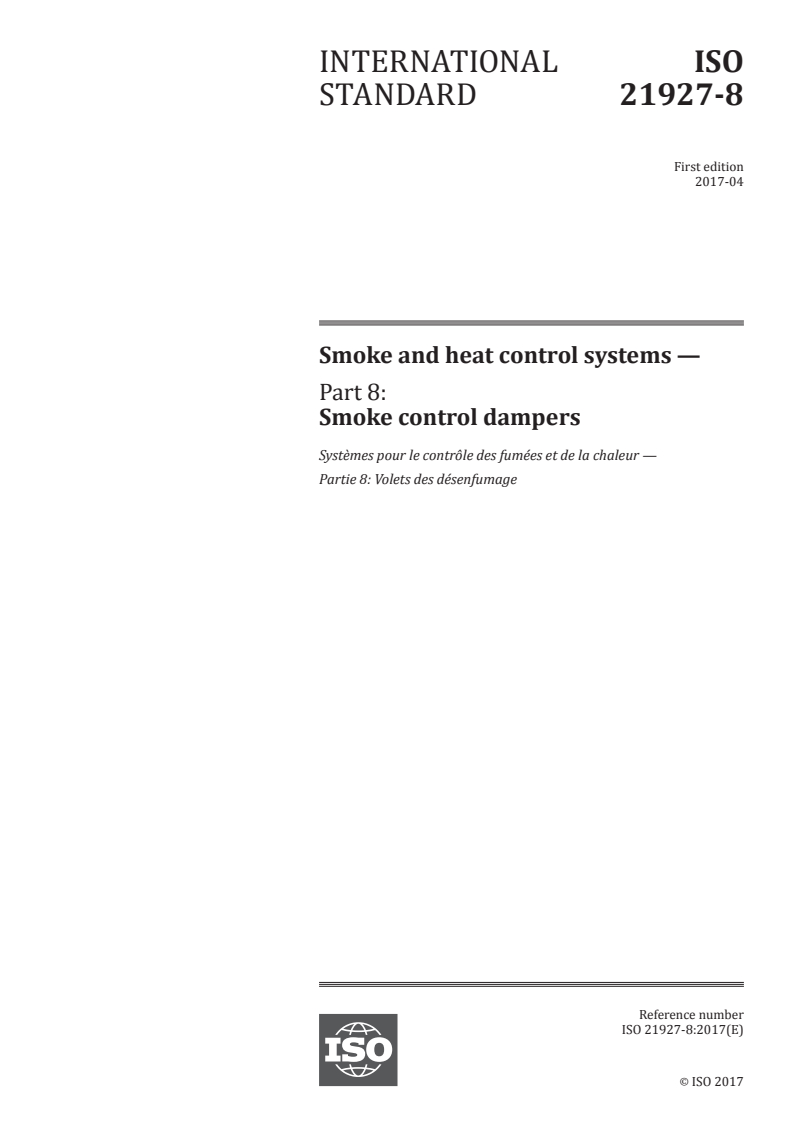

ISO 21927-8:2017 - Smoke and heat control systems — Part 8: Smoke control dampers/2/2017
Overview
ISO 21927-8:2017 specifies requirements and test references for smoke control dampers used in smoke and heat control systems and pressure differential systems. The standard covers products placed on the market and intended to operate as part of building smoke control installations, addressing construction, fire‑resistance performance, marking, installation and maintenance information. It distinguishes two categories of dampers: single‑compartment and multi‑compartment fire‑resisting smoke control dampers, and allows installation in or on ducts, walls, floors or ceilings.
Key topics and technical requirements
- Scope and product categories: Defines single‑compartment and multi‑compartment smoke control dampers and their intended system roles (pressurization, pressure relief, extraction, inerting).
- Construction and components: Requirements for damper construction, actuators and associated components (e.g., interface control units), and corrosion protection where applicable.
- Fire resistance performance:
- Criteria include integrity, insulation, leakage and the HOT400/30 condition referenced for high temperature exposure.
- Durability, classification and designation rules for both damper categories.
- Specific performance expectations for single‑ and multi‑compartment applications.
- Test methods: References and prescribes tests such as ambient leakage, fire resistance (furnace tests), response delay, salt spray exposure, cycling and aerodynamic performance tests.
- Marking and documentation: Requirements for product marking and mandatory documentation covering product specification, installation and maintenance instructions.
- Limitations: The standard does not address detailed effects of corrosive/process chemicals drawn through systems.
Practical applications and users
ISO 21927-8:2017 is used to ensure reliable operation of smoke control dampers within smoke and heat exhaust ventilation (SHEVS), pressurization and smoke extraction systems in buildings. Typical applications:
- Commercial premises, shopping centres, hospitals, multi‑residential buildings
- Ductwork serving multiple fire compartments where dampers limit smoke spread
- Systems combining environmental ventilation with smoke extraction
Primary users:
- Manufacturers of smoke control dampers and actuators
- Fire safety engineers and system designers specifying smoke and heat control systems
- Test laboratories performing fire resistance and leakage testing
- Installation contractors and maintenance teams who follow documentation and marking for correct fitting and servicing
- Building owners and code authorities assessing compliance with fire safety strategies
Related standards
ISO 21927-8:2017 is intended to be read with and referenced alongside:
- EN 1366-10 (smoke control damper furnace testing)
- EN 13501‑4 (fire classification from smoke control component tests)
- ISO 10294‑1 and other EN/ISO test methods for dampers and fans
- ISO 21927 series (control equipment and power output devices)
Keywords: ISO 21927-8:2017, smoke control dampers, smoke and heat control systems, fire resistance, test methods, installation and maintenance.
Relations
- Effective Date
- 12-Feb-2026
Buy Documents
ISO 21927-8:2017 - Smoke and heat control systems
ISO 21927-8:2017 - Smoke and heat control systems — Part 8: Smoke control dampers/2/2017
Get Certified
Connect with accredited certification bodies for this standard

CIS Institut d.o.o.
Personal Protective Equipment (PPE) certification body. Notified Body NB-2890 for EU Regulation 2016/425 PPE.

Kiwa BDA Testing
Building and construction product certification.
Kmetijski inštitut Slovenije
Agricultural Institute of Slovenia. Soil testing, plant health, agricultural product analysis.
Sponsored listings
Frequently Asked Questions
ISO 21927-8:2017 is a standard published by the International Organization for Standardization (ISO). Its full title is "Smoke and heat control systems — Part 8: Smoke control dampers". This standard covers: ISO 21927-8:2017 applies to smoke control dampers, placed on the market and intended to operate as part of a pressure differential system or smoke and heat control system. This document specifies requirements and gives reference to the test methods defined for smoke control dampers and their associated components, such as actuators which are intended to be installed in such systems in buildings. Furthermore, provision on marking and information on installation and maintenance of these products are also given. ISO 21927-8:2017 distinguishes between two categories of smoke control dampers, i.e. single-compartment smoke control dampers and multi‑compartment fire-resisting smoke control dampers. Smoke control dampers covered by this document can be installed into smoke control system ducts or onto the ducts' surface. They can be installed also into a wall, floor or ceiling/roof elements or onto the surface of these elements. NOTE To avoid duplication, reference is made to a variety of other standards. To this end, this document can be read in conjunction with EN 13501‑4, EN 1366‑10 and ISO 10294‑1 for details of the furnace testing. ISO 21927-8:2017 does not consider in detail the detrimental and/or corrosive effects that can be caused by process chemicals present in the atmosphere, which are drawn through the system intentionally or inadvertently.
ISO 21927-8:2017 applies to smoke control dampers, placed on the market and intended to operate as part of a pressure differential system or smoke and heat control system. This document specifies requirements and gives reference to the test methods defined for smoke control dampers and their associated components, such as actuators which are intended to be installed in such systems in buildings. Furthermore, provision on marking and information on installation and maintenance of these products are also given. ISO 21927-8:2017 distinguishes between two categories of smoke control dampers, i.e. single-compartment smoke control dampers and multi‑compartment fire-resisting smoke control dampers. Smoke control dampers covered by this document can be installed into smoke control system ducts or onto the ducts' surface. They can be installed also into a wall, floor or ceiling/roof elements or onto the surface of these elements. NOTE To avoid duplication, reference is made to a variety of other standards. To this end, this document can be read in conjunction with EN 13501‑4, EN 1366‑10 and ISO 10294‑1 for details of the furnace testing. ISO 21927-8:2017 does not consider in detail the detrimental and/or corrosive effects that can be caused by process chemicals present in the atmosphere, which are drawn through the system intentionally or inadvertently.
ISO 21927-8:2017 is classified under the following ICS (International Classification for Standards) categories: 13.220.20 - Fire protection. The ICS classification helps identify the subject area and facilitates finding related standards.
ISO 21927-8:2017 has the following relationships with other standards: It is inter standard links to EN 12101-8:2011. Understanding these relationships helps ensure you are using the most current and applicable version of the standard.
ISO 21927-8:2017 is available in PDF format for immediate download after purchase. The document can be added to your cart and obtained through the secure checkout process. Digital delivery ensures instant access to the complete standard document.
Standards Content (Sample)
INTERNATIONAL ISO
STANDARD 21927-8
First edition
2017-04
Smoke and heat control systems —
Part 8:
Smoke control dampers
Systèmes pour le contrôle des fumées et de la chaleur —
Partie 8: Volets des désenfumage
Reference number
©
ISO 2017
© ISO 2017, Published in Switzerland
All rights reserved. Unless otherwise specified, no part of this publication may be reproduced or utilized otherwise in any form
or by any means, electronic or mechanical, including photocopying, or posting on the internet or an intranet, without prior
written permission. Permission can be requested from either ISO at the address below or ISO’s member body in the country of
the requester.
ISO copyright office
Ch. de Blandonnet 8 • CP 401
CH-1214 Vernier, Geneva, Switzerland
Tel. +41 22 749 01 11
Fax +41 22 749 09 47
copyright@iso.org
www.iso.org
ii © ISO 2017 – All rights reserved
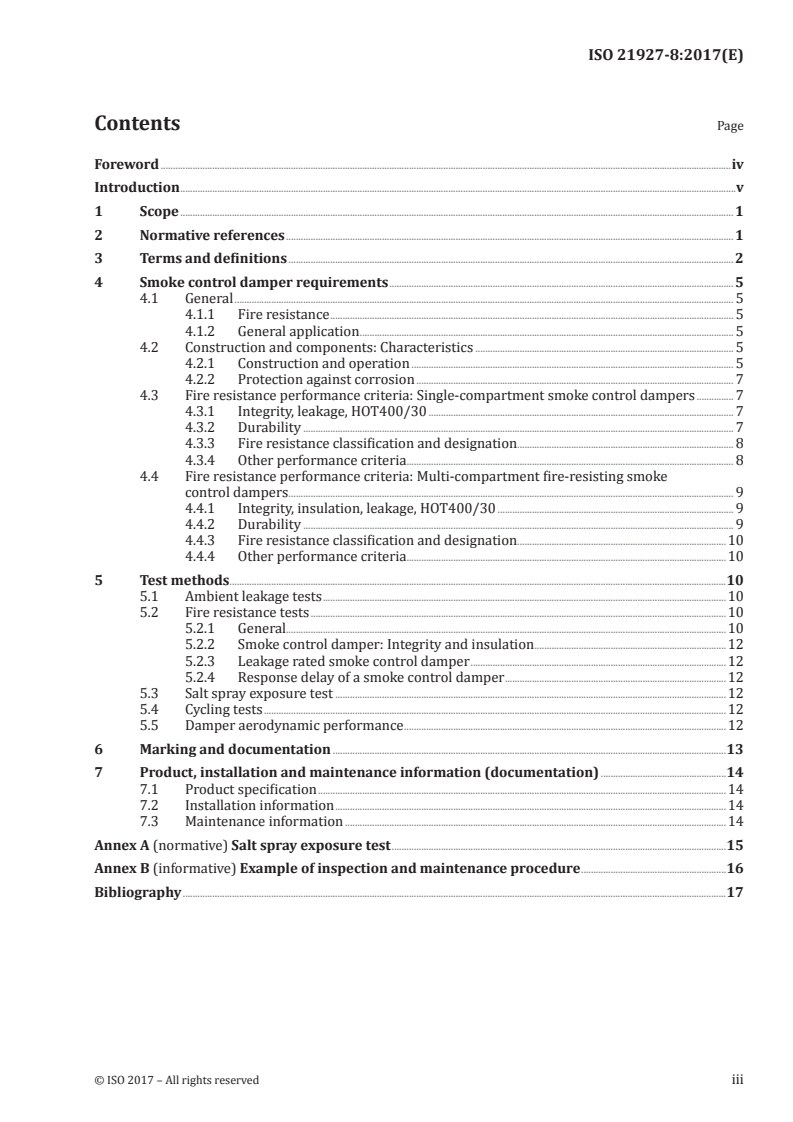
Contents Page
Foreword .iv
Introduction .v
1 Scope . 1
2 Normative references . 1
3 Terms and definitions . 2
4 Smoke control damper requirements . 5
4.1 General . 5
4.1.1 Fire resistance . 5
4.1.2 General application . 5
4.2 Construction and components: Characteristics . 5
4.2.1 Construction and operation . 5
4.2.2 Protection against corrosion . 7
4.3 Fire resistance performance criteria: Single-compartment smoke control dampers . 7
4.3.1 Integrity, leakage, HOT400/30 . 7
4.3.2 Durability . 7
4.3.3 Fire resistance classification and designation. 8
4.3.4 Other performance criteria . 8
4.4 Fire resistance performance criteria: Multi-compartment fire-resisting smoke
control dampers . 9
4.4.1 Integrity, insulation, leakage, HOT400/30 . 9
4.4.2 Durability . 9
4.4.3 Fire resistance classification and designation.10
4.4.4 Other performance criteria .10
5 Test methods .10
5.1 Ambient leakage tests .10
5.2 Fire resistance tests .10
5.2.1 General.10
5.2.2 Smoke control damper: Integrity and insulation .12
5.2.3 Leakage rated smoke control damper .12
5.2.4 Response delay of a smoke control damper .12
5.3 Salt spray exposure test .12
5.4 Cycling tests .12
5.5 Damper aerodynamic performance .12
6 Marking and documentation .13
7 Product, installation and maintenance information (documentation) .14
7.1 Product specification .14
7.2 Installation information .14
7.3 Maintenance information .14
Annex A (normative) Salt spray exposure test .15
Annex B (informative) Example of inspection and maintenance procedure .16
Bibliography .17
Foreword
ISO (the International Organization for Standardization) is a worldwide federation of national standards
bodies (ISO member bodies). The work of preparing International Standards is normally carried out
through ISO technical committees. Each member body interested in a subject for which a technical
committee has been established has the right to be represented on that committee. International
organizations, governmental and non-governmental, in liaison with ISO, also take part in the work.
ISO collaborates closely with the International Electrotechnical Commission (IEC) on all matters of
electrotechnical standardization.
The procedures used to develop this document and those intended for its further maintenance are
described in the ISO/IEC Directives, Part 1. In particular the different approval criteria needed for the
different types of ISO documents should be noted. This document was drafted in accordance with the
editorial rules of the ISO/IEC Directives, Part 2 (see www .iso .org/ directives).
Attention is drawn to the possibility that some of the elements of this document may be the subject of
patent rights. ISO shall not be held responsible for identifying any or all such patent rights. Details of
any patent rights identified during the development of the document will be in the Introduction and/or
on the ISO list of patent declarations received (see www .iso .org/ patents).
Any trade name used in this document is information given for the convenience of users and does not
constitute an endorsement.
For an explanation on the voluntary nature of standards, the meaning of ISO specific terms and
expressions related to conformity assessment, as well as information about ISO’s adherence to the
World Trade Organization (WTO) principles in the Technical Barriers to Trade (TBT) see the following
URL: w w w . i s o .org/ iso/ foreword .html.
This document was prepared by Technical Committee ISO/TC 21, Equipment for fire protection and fire
fighting, Subcommittee SC 11, Smoke and heat control systems and components.
A list of all the parts in the ISO 21927 series can be found on the ISO website.
iv © ISO 2017 – All rights reserved
Introduction
This document contains the basic performance and requirements for smoke control dampers that are
to be used in conjunction with pressure differential systems and smoke and heat control systems. They
can also be used to pressurize when gas extinguishing systems are used.
Particular reference is made to EN 1366-10, which defines the furnace testing associated with these
products and EN 13501-4, which provides details on their fire resistance classification.
In addition to the prevention of transmission of smoke and combustion products from a fire zone, smoke
control dampers are utilized to contain the spillage of otherwise harmful and toxic extinguishing gases
from the affected area and for the control of pressurizing and excess air relief within pressurization
systems.
Smoke control systems are designed to fulfil the following basic functions.
a) The extraction of smoke from a single fire compartment to the outside of the building.
b) The extraction of smoke from fire compartments of a building, using a SHEVS connected to one
or more fire compartments. The smoke control system duct may or may not pass through other
compartments of the building to reach the outside of the building.
c) The use of pressurization to maintain smoke-free clear areas.
Smoke control dampers are commonly used in smoke and heat control systems as a means of limiting
the number of ducts and high temperature fan units. The ducts into which such smoke control dampers
are fitted generally serve a number of different fire compartments. The systems can be dedicated
smoke extraction or possibly a combined environmental ventilation/smoke extraction.
The smoke and heat control system can remove smoke using either high temperature fans (in
accordance with ISO 21927-3) or natural ventilators (in accordance with ISO 21927-2).
It may be necessary for a number of reasons (fire growth, smoke release, etc.) that the open smoke
control damper(s) is (are) required to close and that the damper(s) previously closed is (are) required
to open.
The tests defined in this document are based on the assumption that when smoke is detected within a
building, all smoke control dampers other than those serving the fire compartment/smoke reservoir
(where the fire has initiated) remain closed or move to the closed position. All smoke control dampers
serving the smoke-affected fire compartment/smoke reservoir remain open or move to the open
position, and the fan(s) started/natural vents opened.
NOTE Figure 1 gives examples of installation positions, but these are not the only positions where dampers
can be fitted.
Key
1 fire compartment
2 smoke reservoir
3 air inlet
4 smoke barrier
5 powered smoke and heat exhaust ventilator (fan)
6 smoke control dampers for single-compartments
7 smoke control ducts for single-compartments
8 smoke control ducts for multi-compartments
9 smoke control dampers for multi-compartments mounted inside or outside of wall or floor
10 smoke control dampers for multi-compartments mounted on the surface of the duct
11 electrical equipment
Figure 1 — Example of powered smoke and heat exhaust ventilation
Further guidance on the application of smoke control dampers can be found within the rest of the
EN 12101 series and technical reports.
The areas for which products supplied to this document are considered applicable including, for
example:
a) commercial premises;
b) shopping and retail centres;
c) hospitals;
vi © ISO 2017 – All rights reserved
d) multi-residential buildings.
Smoke control dampers are intended for use in the following types of systems, including:
1) pressurization;
2) pressure relief;
3) extraction systems;
4) ductwork systems;
5) inerting fire suppression systems.
It is realized that all the above systems do not address smoke directly, but similar properties are
required of such smoke control dampers to limit leakage in a fire and smoke control situation.
INTERNATIONAL STANDARD ISO 21927-8:2017(E)
Smoke and heat control systems —
Part 8:
Smoke control dampers
1 Scope
This document applies to smoke control dampers, placed on the market and intended to operate as
part of a pressure differential system or smoke and heat control system. This document specifies
requirements and gives reference to the test methods defined for smoke control dampers and their
associated components, such as actuators which are intended to be installed in such systems in
buildings. Furthermore, provision on marking and information on installation and maintenance of
these products are also given.
This document distinguishes between two categories of smoke control dampers, i.e. single-compartment
smoke control dampers and multi-compartment fire-resisting smoke control dampers.
Smoke control dampers covered by this document can be installed into smoke control system ducts or
onto the ducts’ surface. They can be installed also into a wall, floor or ceiling/roof elements or onto the
surface of these elements.
NOTE To avoid duplication, reference is made to a variety of other standards. To this end, this document
can be read in conjunction with EN 13501-4, EN 1366-10 and ISO 10294-1 for details of the furnace testing.
This document does not consider in detail the detrimental and/or corrosive effects that can be caused
by process chemicals present in the atmosphere, which are drawn through the system intentionally or
inadvertently.
2 Normative references
The following documents are referred to in the text in such a way that some or all of their content
constitutes requirements of this document. For dated references, only the edition cited applies. For
undated references, the latest edition of the referenced document (including any amendments) applies.
ISO 5135, Acoustics — Determination of sound power levels of noise from air-terminal devices, air-terminal
units, dampers and valves by measurement in a reverberation room
ISO 7244, Air distribution and air diffusion — Aerodynamic testing of dampers and valves
ISO 10294-1, Fire resistance tests — Fire dampers for air distribution systems — Part 1: Test method
ISO 13943, Fire safety — Vocabulary
ISO 21927-9, Smoke and heat control systems — Part 9: Specification for control equipment
ISO 21927-10, Smoke and heat control systems — Part 10: Specification for power output devices
EN 1366-10, Fire resistance tests for service installations — Part 10: Smoke control dampers
EN 13501-4, Fire classification of construction products and building elements — Part 4: Classification
using data from fire resistance tests on components of smoke control systems
IEC 60068-2-52:1996, Environmental testing — Part 2: Tests — Test Kb: Salt mist, cyclic (sodium chloride
solution)
3 Terms and definitions
For the purposes of this document, the terms and definitions given in ISO 13943 and the following apply.
ISO and IEC maintain terminological databases for use in standardization at the following addresses:
— IEC Electropedia: available at http:// www .electropedia .org/
— ISO Online browsing platform: available at http:// www .iso .org/ obp
3.1
air inlet
device connected to outside air to allow the inlet of air from outside the building
3.2
attended control room
room with people, who have the duty to control the smoke exhaust system permanently (24 hours per
day, seven days per week), monitor the incoming signals from the smoke control systems and put the
smoke control system into operation in case of smoke alarm
Note 1 to entry: This ensures that the smoke control system is running and items such as dampers are in position
within the system response time.
3.3
elevated temperature
temperature in excess of normal ambient air, below those necessary for fire resistance testing, to which
smoke and heat exhaust ducts for single-compartments are tested, to gain classification
3.4
fire compartment
enclosed space, comprising one or more separate spaces, bounded by elements of construction having
a specified fire resistance and intended to prevent the spread of fire (in either direction) for a given
period of time
3.5
interface control unit
device which controls the operation of the actuator located at the damper or within the same fire zone
as the damper
3.6
multi-compartment smoke control damper
smoke control dampers, which are fire-resisting, for use in multi-compartment areas, which may be
associated with multi- or single-compartment smoke control ductwork and/or may be installed in a fire
compartment structure
3.7
multi-compartment fire-resisting smoke control duct
fire-resisting smoke control ducts, built from more than one smoke control duct section, for use in
multi-compartment applications designed to transport smoke and/or hot gases away from the source
of a fire
Note 1 to entry: May also have a dual function as a normal air conditioning duct.
Note 2 to entry: For more details, see ISO 21927-7.
3.8
natural smoke and heat control system
smoke and heat ventilation system which uses natural ventilation
Note 1 to entry: Natural ventilation is caused by buoyancy forces due to differences in density of the gases
because of temperature differences.
2 © ISO 2017 – All rights reserved
3.9
penetration seal
product tested for use between the smoke control duct/damper and the fire compartment structure
to maintain the fire resistance, at the position where a smoke control system duct passes through the
element, or a damper is mounted in the element
3.10
powered smoke and heat exhaust system
smoke and heat ventilation system, which utilizes a number of hot gas fans that are suitable for handling
hot gases for a limited period of time, which causes the positive displacement of gases
3.11
pressure differential system
system of fans, ducts, vents and other features provided for the purposes of creating a lower pressure
in the fire zone than in the protected space
3.12
remote signalling
device located away from the damper which will indicate the damper position, open or closed
3.13
safety position
position (open or closed) into which specific projects may require certain dampers to move, depending
upon the fire location within the building
3.14
single-compartment smoke control damper
smoke control damper for use in single-compartment areas, which may be associated with single-
compartment smoke control ductwork and/or may be installed in an external wall or roof
3.15
single-compartment smoke control duct
smoke control duct, built from more than one smoke control duct section, for use within single fire
compartment application designed to transport smoke and/or hot gases away from the source of a fire
Note 1 to entry: May also have a dual function as a normal air conditioning duct.
Note 2 to entry: For more details, see ISO 21927-7.
3.16
smoke and heat exhaust ventilation system
SHEVS
system consisting of products and/or components jointly selected to exhaust smoke and heat
Note 1 to entry: The products and/or components form a system in order to establish a buoyant layer of warm
gases above cooler cleaner air.
3.17
smoke and heat exhaust ventilator
SHEV
device specially designed to move smoke and hot gases out of a construction works under conditions of
fire
3.18
smoke barrier
barrier to restrict the spread of smoke and hot gases from a fire, forming part of the boundary of a
smoke reservoir or used as a channelling screen or used as a void edge boundary
3.19
smoke control damper
device automatically or manually activated, which may be open or closed in its operational position, to
control the flow of smoke and hot gases into, from or within a duct
3.20
smoke control damper
smoke control damper (3.19) fitted in-line across a vertical duct, or on the top
and bottom surface of a horizontal duct
3.21
smoke control damper
smoke control damper (3.19) fitted in-line across a horizontal duct, or on the
sides of a horizontal duct, or on any surface of a vertical duct
3.22
smoke control duct
Note 1 to entry: For more details, see ISO 21927-7.
3.23
smoke control system with automatic activation
smoke control system that operates automatically on receipt of a smoke or fire alarm without any
manual action/intervention
Note 1 to entry: A system with an attended control room can also be accepted as an automatic system. Once
initiated, the system will not cause the damper position to be changed.
Note 2 to entry: This system can be smoke and heat exhaust ventilation type or pressure differential type.
3.24
smoke control system with automatic activation and with manual override
smoke control system that can be put into operation as 3.23 on receipt of a smoke or fire alarm, but
once initiated, the system will allow the damper position to be changed by external input or fireman’s
override
Note 1 to entry: This system can be smoke and heat exhaust ventilation type or pressure differential type.
3.25
smoke control system with manual initiation
smoke control system that has to be put into operation, on detection of smoke or fire, by human
intervention (e.g. by pressing a button, or pulling a handle), leading to a sequence of automatic actions
in the operation of the smoke control system
Note 1 to entry: Once initiated, the system may allow the damper position to be changed by external input or
fireman’s override.
Note 2 to entry: This system can be smoke and heat exhaust ventilation type or pressurization type.
3.26
smoke-free clear area
volume of air which is unpolluted by smoke
3.27
smoke layer
layer of smoke that stabilizes underneath the roof due to the effect of temperature gradient
3.28
smoke reservoir
region within a building limited or bordered by smoke barriers or structural elements and which will,
in the event of a fire, retain a thermally buoyant smoke layer
4 © ISO 2017 – All rights reserved
3.29
system response time
time from the initiation of the smoke control system to it being fully operational
3.30
triggering device
device such as a fire detector system, smoke detector or pushbutton, which sends an activating signal
to the initiation device(s)
4 Smoke control damper requirements
4.1 General
4.1.1 Fire resistance
The smoke control damper shall demonstrate the following and shall be classified in accordance with
EN 13501-4:
a) integrity: this shall be tested in accordance with the test method in 5.2 and the integrity
classification (E) declared;
b) insulation: this shall be tested in accordance with the test method in 5.2 and the insulation
classification (I) declared;
c) leakage: this shall be tested in accordance with the test method in 5.2 and the leakage classification
(S) declared;
d) mechanical stability: this shall be tested in accordance with the test method in 5.2 and forms part
of the integrity classification (E) declared;
e) maintenance of cross section: this shall be tested in accordance with the test method in 5.2 and
forms part of the integrity classification (E) declared;
f) high operational temperature: this shall be tested in accordance with the test method in 5.2 and
the classification (HOT400/30) declared.
4.1.2 General application
Where the manufacturer intends to provide information regarding aerodynamic characteristics, this
shall be done according to ISO 7244; see 5.5.
4.2 Construction and components: Characteristics
4.2.1 Construction and operation
4.2.1.1 General
Smoke control dampers shall be required to have two safety positions, i.e. fully open and fully closed.
In the case of a single fire compartment, this safety position shall generally be open, unless separate
smoke reservoirs are designated along a duct run. For multi-compartment fire-resisting smoke control
dampers, the safety position shall be either open or closed, depending on the source and path of the
smoke and heat to be extracted.
The purpose of this is to maintain a fixed extraction path through the ductwork (open dampers),
whilst also maintaining the fire compartmentation to the compartment and the duct (closed dampers).
Depending on the position of the fire source, any smoke control damper shall be required to perform
both functions.
Where a smoke control damper is required to maintain fire compartmentation, it shall be fire-resisting
(i.e. a multi-compartment fire-resisting smoke control damper).
Smoke control dampers that are designed to function automatically on smoke detection shall travel to,
or remain in, the correct position to exhaust smoke from the fire compartment.
Smoke control dampers that are initiated manually by switches, or actuated automatically at higher
temperatures, shall be capable of operating at the appropriate higher temperatures.
Smoke control damper construction shall contain no device that is able to change the position of the
damper once the safety position has been reached, i.e. it shall not change position unless required by
direct instruction from a triggering device.
It is assumed that, as specified, power should be maintained throughout a building where a smoke
control damper referred to in this document is installed.
Consequently, smoke control damper assemblies shall have no thermal devices to cause uncontrolled
operation and no automatic return mechanisms that can, for instance, operate on loss of power.
The smoke control damper construction shall contain a method for the remote signalling of both open
and closed positions.
The smoke control damper shall move from one end position to the other within 60 s of the receipt of
a signal.
4.2.1.2 Actuators
Actuators shall be constructed and assembled to have the strength and rigidity necessary to perform
the design operations to which they may be subjected, without loosening or displacement of parts, or
other serious defects, when subjected to the test in EN 1366-10.
Actuator construction shall contain no device that is able to change the positio
...
INTERNATIONAL ISO
STANDARD 21927-8
First edition
2017-04
Smoke and heat control systems —
Part 8:
Smoke control dampers
Systèmes pour le contrôle des fumées et de la chaleur —
Partie 8: Volets des désenfumage
Reference number
©
ISO 2017
© ISO 2017, Published in Switzerland
All rights reserved. Unless otherwise specified, no part of this publication may be reproduced or utilized otherwise in any form
or by any means, electronic or mechanical, including photocopying, or posting on the internet or an intranet, without prior
written permission. Permission can be requested from either ISO at the address below or ISO’s member body in the country of
the requester.
ISO copyright office
Ch. de Blandonnet 8 • CP 401
CH-1214 Vernier, Geneva, Switzerland
Tel. +41 22 749 01 11
Fax +41 22 749 09 47
copyright@iso.org
www.iso.org
ii © ISO 2017 – All rights reserved
Contents Page
Foreword .iv
Introduction .v
1 Scope . 1
2 Normative references . 1
3 Terms and definitions . 2
4 Smoke control damper requirements . 5
4.1 General . 5
4.1.1 Fire resistance . 5
4.1.2 General application . 5
4.2 Construction and components: Characteristics . 5
4.2.1 Construction and operation . 5
4.2.2 Protection against corrosion . 7
4.3 Fire resistance performance criteria: Single-compartment smoke control dampers . 7
4.3.1 Integrity, leakage, HOT400/30 . 7
4.3.2 Durability . 7
4.3.3 Fire resistance classification and designation. 8
4.3.4 Other performance criteria . 8
4.4 Fire resistance performance criteria: Multi-compartment fire-resisting smoke
control dampers . 9
4.4.1 Integrity, insulation, leakage, HOT400/30 . 9
4.4.2 Durability . 9
4.4.3 Fire resistance classification and designation.10
4.4.4 Other performance criteria .10
5 Test methods .10
5.1 Ambient leakage tests .10
5.2 Fire resistance tests .10
5.2.1 General.10
5.2.2 Smoke control damper: Integrity and insulation .12
5.2.3 Leakage rated smoke control damper .12
5.2.4 Response delay of a smoke control damper .12
5.3 Salt spray exposure test .12
5.4 Cycling tests .12
5.5 Damper aerodynamic performance .12
6 Marking and documentation .13
7 Product, installation and maintenance information (documentation) .14
7.1 Product specification .14
7.2 Installation information .14
7.3 Maintenance information .14
Annex A (normative) Salt spray exposure test .15
Annex B (informative) Example of inspection and maintenance procedure .16
Bibliography .17
Foreword
ISO (the International Organization for Standardization) is a worldwide federation of national standards
bodies (ISO member bodies). The work of preparing International Standards is normally carried out
through ISO technical committees. Each member body interested in a subject for which a technical
committee has been established has the right to be represented on that committee. International
organizations, governmental and non-governmental, in liaison with ISO, also take part in the work.
ISO collaborates closely with the International Electrotechnical Commission (IEC) on all matters of
electrotechnical standardization.
The procedures used to develop this document and those intended for its further maintenance are
described in the ISO/IEC Directives, Part 1. In particular the different approval criteria needed for the
different types of ISO documents should be noted. This document was drafted in accordance with the
editorial rules of the ISO/IEC Directives, Part 2 (see www .iso .org/ directives).
Attention is drawn to the possibility that some of the elements of this document may be the subject of
patent rights. ISO shall not be held responsible for identifying any or all such patent rights. Details of
any patent rights identified during the development of the document will be in the Introduction and/or
on the ISO list of patent declarations received (see www .iso .org/ patents).
Any trade name used in this document is information given for the convenience of users and does not
constitute an endorsement.
For an explanation on the voluntary nature of standards, the meaning of ISO specific terms and
expressions related to conformity assessment, as well as information about ISO’s adherence to the
World Trade Organization (WTO) principles in the Technical Barriers to Trade (TBT) see the following
URL: w w w . i s o .org/ iso/ foreword .html.
This document was prepared by Technical Committee ISO/TC 21, Equipment for fire protection and fire
fighting, Subcommittee SC 11, Smoke and heat control systems and components.
A list of all the parts in the ISO 21927 series can be found on the ISO website.
iv © ISO 2017 – All rights reserved
Introduction
This document contains the basic performance and requirements for smoke control dampers that are
to be used in conjunction with pressure differential systems and smoke and heat control systems. They
can also be used to pressurize when gas extinguishing systems are used.
Particular reference is made to EN 1366-10, which defines the furnace testing associated with these
products and EN 13501-4, which provides details on their fire resistance classification.
In addition to the prevention of transmission of smoke and combustion products from a fire zone, smoke
control dampers are utilized to contain the spillage of otherwise harmful and toxic extinguishing gases
from the affected area and for the control of pressurizing and excess air relief within pressurization
systems.
Smoke control systems are designed to fulfil the following basic functions.
a) The extraction of smoke from a single fire compartment to the outside of the building.
b) The extraction of smoke from fire compartments of a building, using a SHEVS connected to one
or more fire compartments. The smoke control system duct may or may not pass through other
compartments of the building to reach the outside of the building.
c) The use of pressurization to maintain smoke-free clear areas.
Smoke control dampers are commonly used in smoke and heat control systems as a means of limiting
the number of ducts and high temperature fan units. The ducts into which such smoke control dampers
are fitted generally serve a number of different fire compartments. The systems can be dedicated
smoke extraction or possibly a combined environmental ventilation/smoke extraction.
The smoke and heat control system can remove smoke using either high temperature fans (in
accordance with ISO 21927-3) or natural ventilators (in accordance with ISO 21927-2).
It may be necessary for a number of reasons (fire growth, smoke release, etc.) that the open smoke
control damper(s) is (are) required to close and that the damper(s) previously closed is (are) required
to open.
The tests defined in this document are based on the assumption that when smoke is detected within a
building, all smoke control dampers other than those serving the fire compartment/smoke reservoir
(where the fire has initiated) remain closed or move to the closed position. All smoke control dampers
serving the smoke-affected fire compartment/smoke reservoir remain open or move to the open
position, and the fan(s) started/natural vents opened.
NOTE Figure 1 gives examples of installation positions, but these are not the only positions where dampers
can be fitted.
Key
1 fire compartment
2 smoke reservoir
3 air inlet
4 smoke barrier
5 powered smoke and heat exhaust ventilator (fan)
6 smoke control dampers for single-compartments
7 smoke control ducts for single-compartments
8 smoke control ducts for multi-compartments
9 smoke control dampers for multi-compartments mounted inside or outside of wall or floor
10 smoke control dampers for multi-compartments mounted on the surface of the duct
11 electrical equipment
Figure 1 — Example of powered smoke and heat exhaust ventilation
Further guidance on the application of smoke control dampers can be found within the rest of the
EN 12101 series and technical reports.
The areas for which products supplied to this document are considered applicable including, for
example:
a) commercial premises;
b) shopping and retail centres;
c) hospitals;
vi © ISO 2017 – All rights reserved
d) multi-residential buildings.
Smoke control dampers are intended for use in the following types of systems, including:
1) pressurization;
2) pressure relief;
3) extraction systems;
4) ductwork systems;
5) inerting fire suppression systems.
It is realized that all the above systems do not address smoke directly, but similar properties are
required of such smoke control dampers to limit leakage in a fire and smoke control situation.
INTERNATIONAL STANDARD ISO 21927-8:2017(E)
Smoke and heat control systems —
Part 8:
Smoke control dampers
1 Scope
This document applies to smoke control dampers, placed on the market and intended to operate as
part of a pressure differential system or smoke and heat control system. This document specifies
requirements and gives reference to the test methods defined for smoke control dampers and their
associated components, such as actuators which are intended to be installed in such systems in
buildings. Furthermore, provision on marking and information on installation and maintenance of
these products are also given.
This document distinguishes between two categories of smoke control dampers, i.e. single-compartment
smoke control dampers and multi-compartment fire-resisting smoke control dampers.
Smoke control dampers covered by this document can be installed into smoke control system ducts or
onto the ducts’ surface. They can be installed also into a wall, floor or ceiling/roof elements or onto the
surface of these elements.
NOTE To avoid duplication, reference is made to a variety of other standards. To this end, this document
can be read in conjunction with EN 13501-4, EN 1366-10 and ISO 10294-1 for details of the furnace testing.
This document does not consider in detail the detrimental and/or corrosive effects that can be caused
by process chemicals present in the atmosphere, which are drawn through the system intentionally or
inadvertently.
2 Normative references
The following documents are referred to in the text in such a way that some or all of their content
constitutes requirements of this document. For dated references, only the edition cited applies. For
undated references, the latest edition of the referenced document (including any amendments) applies.
ISO 5135, Acoustics — Determination of sound power levels of noise from air-terminal devices, air-terminal
units, dampers and valves by measurement in a reverberation room
ISO 7244, Air distribution and air diffusion — Aerodynamic testing of dampers and valves
ISO 10294-1, Fire resistance tests — Fire dampers for air distribution systems — Part 1: Test method
ISO 13943, Fire safety — Vocabulary
ISO 21927-9, Smoke and heat control systems — Part 9: Specification for control equipment
ISO 21927-10, Smoke and heat control systems — Part 10: Specification for power output devices
EN 1366-10, Fire resistance tests for service installations — Part 10: Smoke control dampers
EN 13501-4, Fire classification of construction products and building elements — Part 4: Classification
using data from fire resistance tests on components of smoke control systems
IEC 60068-2-52:1996, Environmental testing — Part 2: Tests — Test Kb: Salt mist, cyclic (sodium chloride
solution)
3 Terms and definitions
For the purposes of this document, the terms and definitions given in ISO 13943 and the following apply.
ISO and IEC maintain terminological databases for use in standardization at the following addresses:
— IEC Electropedia: available at http:// www .electropedia .org/
— ISO Online browsing platform: available at http:// www .iso .org/ obp
3.1
air inlet
device connected to outside air to allow the inlet of air from outside the building
3.2
attended control room
room with people, who have the duty to control the smoke exhaust system permanently (24 hours per
day, seven days per week), monitor the incoming signals from the smoke control systems and put the
smoke control system into operation in case of smoke alarm
Note 1 to entry: This ensures that the smoke control system is running and items such as dampers are in position
within the system response time.
3.3
elevated temperature
temperature in excess of normal ambient air, below those necessary for fire resistance testing, to which
smoke and heat exhaust ducts for single-compartments are tested, to gain classification
3.4
fire compartment
enclosed space, comprising one or more separate spaces, bounded by elements of construction having
a specified fire resistance and intended to prevent the spread of fire (in either direction) for a given
period of time
3.5
interface control unit
device which controls the operation of the actuator located at the damper or within the same fire zone
as the damper
3.6
multi-compartment smoke control damper
smoke control dampers, which are fire-resisting, for use in multi-compartment areas, which may be
associated with multi- or single-compartment smoke control ductwork and/or may be installed in a fire
compartment structure
3.7
multi-compartment fire-resisting smoke control duct
fire-resisting smoke control ducts, built from more than one smoke control duct section, for use in
multi-compartment applications designed to transport smoke and/or hot gases away from the source
of a fire
Note 1 to entry: May also have a dual function as a normal air conditioning duct.
Note 2 to entry: For more details, see ISO 21927-7.
3.8
natural smoke and heat control system
smoke and heat ventilation system which uses natural ventilation
Note 1 to entry: Natural ventilation is caused by buoyancy forces due to differences in density of the gases
because of temperature differences.
2 © ISO 2017 – All rights reserved
3.9
penetration seal
product tested for use between the smoke control duct/damper and the fire compartment structure
to maintain the fire resistance, at the position where a smoke control system duct passes through the
element, or a damper is mounted in the element
3.10
powered smoke and heat exhaust system
smoke and heat ventilation system, which utilizes a number of hot gas fans that are suitable for handling
hot gases for a limited period of time, which causes the positive displacement of gases
3.11
pressure differential system
system of fans, ducts, vents and other features provided for the purposes of creating a lower pressure
in the fire zone than in the protected space
3.12
remote signalling
device located away from the damper which will indicate the damper position, open or closed
3.13
safety position
position (open or closed) into which specific projects may require certain dampers to move, depending
upon the fire location within the building
3.14
single-compartment smoke control damper
smoke control damper for use in single-compartment areas, which may be associated with single-
compartment smoke control ductwork and/or may be installed in an external wall or roof
3.15
single-compartment smoke control duct
smoke control duct, built from more than one smoke control duct section, for use within single fire
compartment application designed to transport smoke and/or hot gases away from the source of a fire
Note 1 to entry: May also have a dual function as a normal air conditioning duct.
Note 2 to entry: For more details, see ISO 21927-7.
3.16
smoke and heat exhaust ventilation system
SHEVS
system consisting of products and/or components jointly selected to exhaust smoke and heat
Note 1 to entry: The products and/or components form a system in order to establish a buoyant layer of warm
gases above cooler cleaner air.
3.17
smoke and heat exhaust ventilator
SHEV
device specially designed to move smoke and hot gases out of a construction works under conditions of
fire
3.18
smoke barrier
barrier to restrict the spread of smoke and hot gases from a fire, forming part of the boundary of a
smoke reservoir or used as a channelling screen or used as a void edge boundary
3.19
smoke control damper
device automatically or manually activated, which may be open or closed in its operational position, to
control the flow of smoke and hot gases into, from or within a duct
3.20
smoke control damper
smoke control damper (3.19) fitted in-line across a vertical duct, or on the top
and bottom surface of a horizontal duct
3.21
smoke control damper
smoke control damper (3.19) fitted in-line across a horizontal duct, or on the
sides of a horizontal duct, or on any surface of a vertical duct
3.22
smoke control duct
Note 1 to entry: For more details, see ISO 21927-7.
3.23
smoke control system with automatic activation
smoke control system that operates automatically on receipt of a smoke or fire alarm without any
manual action/intervention
Note 1 to entry: A system with an attended control room can also be accepted as an automatic system. Once
initiated, the system will not cause the damper position to be changed.
Note 2 to entry: This system can be smoke and heat exhaust ventilation type or pressure differential type.
3.24
smoke control system with automatic activation and with manual override
smoke control system that can be put into operation as 3.23 on receipt of a smoke or fire alarm, but
once initiated, the system will allow the damper position to be changed by external input or fireman’s
override
Note 1 to entry: This system can be smoke and heat exhaust ventilation type or pressure differential type.
3.25
smoke control system with manual initiation
smoke control system that has to be put into operation, on detection of smoke or fire, by human
intervention (e.g. by pressing a button, or pulling a handle), leading to a sequence of automatic actions
in the operation of the smoke control system
Note 1 to entry: Once initiated, the system may allow the damper position to be changed by external input or
fireman’s override.
Note 2 to entry: This system can be smoke and heat exhaust ventilation type or pressurization type.
3.26
smoke-free clear area
volume of air which is unpolluted by smoke
3.27
smoke layer
layer of smoke that stabilizes underneath the roof due to the effect of temperature gradient
3.28
smoke reservoir
region within a building limited or bordered by smoke barriers or structural elements and which will,
in the event of a fire, retain a thermally buoyant smoke layer
4 © ISO 2017 – All rights reserved
3.29
system response time
time from the initiation of the smoke control system to it being fully operational
3.30
triggering device
device such as a fire detector system, smoke detector or pushbutton, which sends an activating signal
to the initiation device(s)
4 Smoke control damper requirements
4.1 General
4.1.1 Fire resistance
The smoke control damper shall demonstrate the following and shall be classified in accordance with
EN 13501-4:
a) integrity: this shall be tested in accordance with the test method in 5.2 and the integrity
classification (E) declared;
b) insulation: this shall be tested in accordance with the test method in 5.2 and the insulation
classification (I) declared;
c) leakage: this shall be tested in accordance with the test method in 5.2 and the leakage classification
(S) declared;
d) mechanical stability: this shall be tested in accordance with the test method in 5.2 and forms part
of the integrity classification (E) declared;
e) maintenance of cross section: this shall be tested in accordance with the test method in 5.2 and
forms part of the integrity classification (E) declared;
f) high operational temperature: this shall be tested in accordance with the test method in 5.2 and
the classification (HOT400/30) declared.
4.1.2 General application
Where the manufacturer intends to provide information regarding aerodynamic characteristics, this
shall be done according to ISO 7244; see 5.5.
4.2 Construction and components: Characteristics
4.2.1 Construction and operation
4.2.1.1 General
Smoke control dampers shall be required to have two safety positions, i.e. fully open and fully closed.
In the case of a single fire compartment, this safety position shall generally be open, unless separate
smoke reservoirs are designated along a duct run. For multi-compartment fire-resisting smoke control
dampers, the safety position shall be either open or closed, depending on the source and path of the
smoke and heat to be extracted.
The purpose of this is to maintain a fixed extraction path through the ductwork (open dampers),
whilst also maintaining the fire compartmentation to the compartment and the duct (closed dampers).
Depending on the position of the fire source, any smoke control damper shall be required to perform
both functions.
Where a smoke control damper is required to maintain fire compartmentation, it shall be fire-resisting
(i.e. a multi-compartment fire-resisting smoke control damper).
Smoke control dampers that are designed to function automatically on smoke detection shall travel to,
or remain in, the correct position to exhaust smoke from the fire compartment.
Smoke control dampers that are initiated manually by switches, or actuated automatically at higher
temperatures, shall be capable of operating at the appropriate higher temperatures.
Smoke control damper construction shall contain no device that is able to change the position of the
damper once the safety position has been reached, i.e. it shall not change position unless required by
direct instruction from a triggering device.
It is assumed that, as specified, power should be maintained throughout a building where a smoke
control damper referred to in this document is installed.
Consequently, smoke control damper assemblies shall have no thermal devices to cause uncontrolled
operation and no automatic return mechanisms that can, for instance, operate on loss of power.
The smoke control damper construction shall contain a method for the remote signalling of both open
and closed positions.
The smoke control damper shall move from one end position to the other within 60 s of the receipt of
a signal.
4.2.1.2 Actuators
Actuators shall be constructed and assembled to have the strength and rigidity necessary to perform
the design operations to which they may be subjected, without loosening or displacement of parts, or
other serious defects, when subjected to the test in EN 1366-10.
Actuator construction shall contain no device that is able to change the positio
...