

ISO 21927-10:2011
(Main)Smoke and heat control systems — Part 10: Specification for power output devices
General Information
- Abstract
ISO 21927-10:2011 specifies requirements and gives test methods for primary and secondary electrical and pneumatic power output devices, designed for use in smoke and heat control systems in buildings. A summary of functions is given.
- Status
- Published
- Publication Date
- 12-Jul-2011
- Technical Committee
- ISO/TC 21/SC 11 - Smoke and heat control systems and components
- Drafting Committee
- ISO/TC 21/SC 11 - Smoke and heat control systems and components
- Current Stage
- 9093 - International Standard confirmed
- Start Date
- 22-Mar-2024
- Completion Date
- 29-Aug-2026
Overview
ISO 21927-10:2011 - "Smoke and heat control systems - Part 10: Specification for power output devices" defines requirements and test methods for primary and secondary electrical and pneumatic power output devices used in smoke and heat control systems (SHCS). The standard applies to devices that supply and control power for smoke and heat exhaust ventilators (SHEVS) and associated actuators, and it provides a summary of required functions, performance verification and conformity procedures.
Key topics and technical requirements
- Scope and definitions: clarification of terms, abbreviations and the intended application within SHCS.
- Electrical requirements: general design, battery systems, generator sets, charger and secondary power source testing.
- Pneumatic requirements: compressors, air receivers, multi‑use and single‑use gas bottles, and replenishing methods.
- Functional requirements: power supply behaviors from primary and secondary sources, fault recognition and indication, and operational continuity.
- Materials, design and manufacture: mechanical and electrical construction requirements to ensure reliability under fire‑related conditions.
- Classification and testing: type testing, factory production control, and selection of tests for conformity assessment.
- Environmental and durability tests: cold, dry heat, damp heat (operational and endurance), impact, vibration, salt spray and sulphur dioxide (SO) corrosion tests.
- Protection and EMC: tests for protection against water and solid foreign objects and electromagnetic compatibility (EMC) immunity testing (operational).
- Documentation and marking: user and design documentation requirements, and marking (including requirements specific to gas bottles).
Practical applications - who uses ISO 21927-10
- Manufacturers of electrical and pneumatic power output devices for SHEVS, to design and certify products that meet internationally recognized performance and safety criteria.
- Test laboratories and certification bodies performing type testing, environmental conditioning and EMC immunity tests.
- Fire safety engineers and system designers specifying power solutions (battery backup, generator integration, pneumatic supplies) for smoke and heat control systems in buildings.
- Installers, commissioning teams and facility managers responsible for implementing, maintaining and documenting SHCS power systems to ensure reliable operation during fire events.
- Regulatory authorities and building code officials referencing standardized requirements for conformity assessment and product acceptance.
Related standards
ISO 21927 is a multipart series for smoke and heat control systems. Relevant parts include:
- ISO 21927-1 - Specification for smoke barriers
- ISO 21927-2 - Specification for natural smoke and heat exhaust ventilators
- ISO 21927-3 - Specification for powered smoke and heat exhaust ventilators
- ISO 21927-9 - Specification for control equipment
ISO 21927-10 is essential when specifying or assessing reliable power output devices for SHEVS, ensuring they perform under environmental stress and during emergency operation while providing the required documentation and tests for conformity.
Get Certified
Connect with accredited certification bodies for this standard

CIS Institut d.o.o.
Personal Protective Equipment (PPE) certification body. Notified Body NB-2890 for EU Regulation 2016/425 PPE.

Kiwa BDA Testing
Building and construction product certification.
Kmetijski inštitut Slovenije
Agricultural Institute of Slovenia. Soil testing, plant health, agricultural product analysis.
Sponsored listings
Frequently Asked Questions
ISO 21927-10:2011 is a standard published by the International Organization for Standardization (ISO). Its full title is "Smoke and heat control systems — Part 10: Specification for power output devices". This standard covers: ISO 21927-10:2011 specifies requirements and gives test methods for primary and secondary electrical and pneumatic power output devices, designed for use in smoke and heat control systems in buildings. A summary of functions is given.
ISO 21927-10:2011 specifies requirements and gives test methods for primary and secondary electrical and pneumatic power output devices, designed for use in smoke and heat control systems in buildings. A summary of functions is given.
ISO 21927-10:2011 is classified under the following ICS (International Classification for Standards) categories: 13.220.20 - Fire protection. The ICS classification helps identify the subject area and facilitates finding related standards.
ISO 21927-10:2011 is available in PDF format for immediate download after purchase. The document can be added to your cart and obtained through the secure checkout process. Digital delivery ensures instant access to the complete standard document.
Standards Content (Sample)
INTERNATIONAL ISO
STANDARD 21927-10
First edition
2011-07-15
Smoke and heat control systems —
Part 10:
Specification for power output devices
Systèmes pour le contrôle des fumées et de la chaleur —
Partie 10: Spécifications pour les sources d'alimentation
Reference number
©
ISO 2011
© ISO 2011
All rights reserved. Unless otherwise specified, no part of this publication may be reproduced or utilized in any form or by any means,
electronic or mechanical, including photocopying and microfilm, without permission in writing from either ISO at the address below or
ISO's member body in the country of the requester.
ISO copyright office
Case postale 56 CH-1211 Geneva 20
Tel. + 41 22 749 01 11
Fax + 41 22 749 09 47
E-mail copyright@iso.org
Web www.iso.org
Published in Switzerland
ii © ISO 2011 – All rights reserved
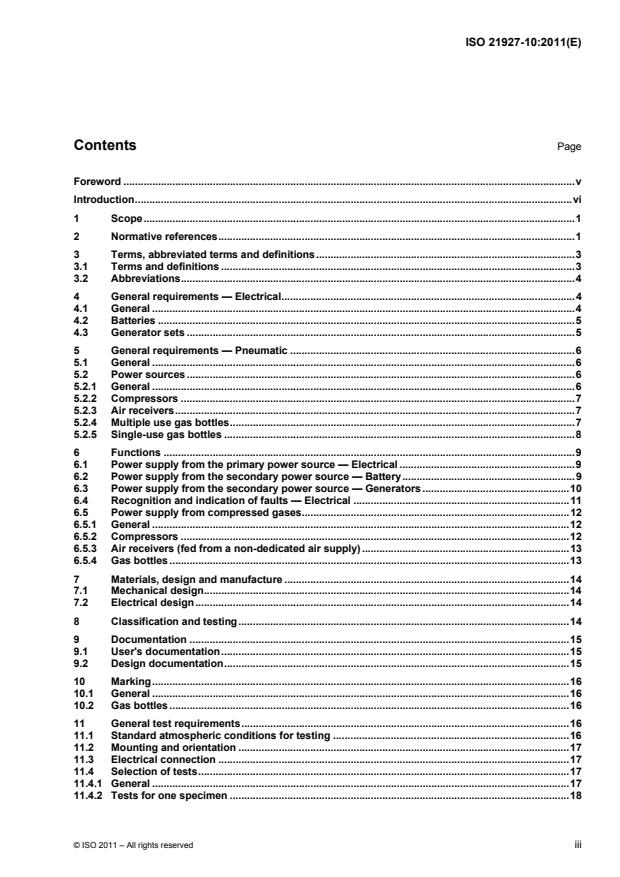
Contents Page
Foreword . v
Introduction . vi
1 Scope . 1
2 Normative references . 1
3 Terms, abbreviated terms and definitions . 3
3.1 Terms and definitions . 3
3.2 Abbreviations . 4
4 General requirements — Electrical . 4
4.1 General . 4
4.2 Batteries . 5
4.3 Generator sets . 5
5 General requirements — Pneumatic . 6
5.1 General . 6
5.2 Power sources . 6
5.2.1 General . 6
5.2.2 Compressors . 7
5.2.3 Air receivers . 7
5.2.4 Multiple use gas bottles . 7
5.2.5 Single-use gas bottles . 8
6 Functions . 9
6.1 Power supply from the primary power source — Electrical . 9
6.2 Power supply from the secondary power source — Battery . 9
6.3 Power supply from the secondary power source — Generators . 10
6.4 Recognition and indication of faults — Electrical . 11
6.5 Power supply from compressed gases . 12
6.5.1 General . 12
6.5.2 Compressors . 12
6.5.3 Air receivers (fed from a non-dedicated air supply) . 13
6.5.4 Gas bottles . 13
7 Materials, design and manufacture . 14
7.1 Mechanical design . 14
7.2 Electrical design . 14
8 Classification and testing . 14
9 Documentation . 15
9.1 User's documentation . 15
9.2 Design documentation . 15
10 Marking . 16
10.1 General . 16
10.2 Gas bottles . 16
11 General test requirements . 16
11.1 Standard atmospheric conditions for testing . 16
11.2 Mounting and orientation . 17
11.3 Electrical connection . 17
11.4 Selection of tests . 17
11.4.1 General . 17
11.4.2 Tests for one specimen . 18
11.4.3 Tests for more than one specimen .18
11.4.4 Selection of functional tests .18
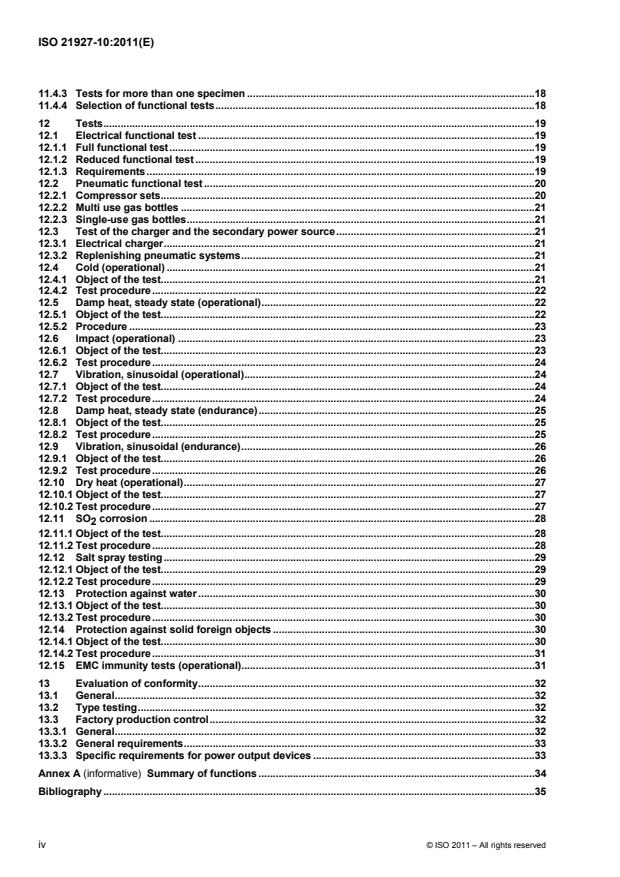
12 Tests .19
12.1 Electrical functional test .19
12.1.1 Full functional test .19
12.1.2 Reduced functional test .19
12.1.3 Requirements .19
12.2 Pneumatic functional test .20
12.2.1 Compressor sets.20
12.2.2 Multi use gas bottles .21
12.2.3 Single-use gas bottles .21
12.3 Test of the charger and the secondary power source .21
12.3.1 Electrical charger .21
12.3.2 Replenishing pneumatic systems .21
12.4 Cold (operational) .21
12.4.1 Object of the test.21
12.4.2 Test procedure .22
12.5 Damp heat, steady state (operational) .22
12.5.1 Object of the test.22
12.5.2 Procedure .23
12.6 Impact (operational) .23
12.6.1 Object of the test.23
12.6.2 Test procedure .24
12.7 Vibration, sinusoidal (operational) .24
12.7.1 Object of the test.24
12.7.2 Test procedure .24
12.8 Damp heat, steady state (endurance) .25
12.8.1 Object of the test.25
12.8.2 Test procedure .25
12.9 Vibration, sinusoidal (endurance) .26
12.9.1 Object of the test.26
12.9.2 Test procedure .26
12.10 Dry heat (operational) .27
12.10.1 Object of the test.27
12.10.2 Test procedure .27
12.11 SO corrosion .28
12.11.1 Object of the test.28
12.11.2 Test procedure .28
12.12 Salt spray testing .29
12.12.1 Object of the test.29
12.12.2 Test procedure .29
12.13 Protection against water .30
12.13.1 Object of the test.30
12.13.2 Test procedure .30
12.14 Protection against solid foreign objects .30
12.14.1 Object of the test.30
12.14.2 Test procedure .31
12.15 EMC immunity tests (operational) .31
13 Evaluation of conformity .32
13.1 General .32
13.2 Type testing .32
13.3 Factory production control .32
13.3.1 General .32
13.3.2 General requirements .33
13.3.3 Specific requirements for power output devices .33
Annex A (informative) Summary of functions .34
Bibliography .35
iv © ISO 2011 – All rights reserved
Foreword
ISO (the International Organization for Standardization) is a worldwide federation of national standards bodies
(ISO member bodies). The work of preparing International Standards is normally carried out through ISO
technical committees. Each member body interested in a subject for which a technical committee has been
established has the right to be represented on that committee. International organizations, governmental and
non-governmental, in liaison with ISO, also take part in the work. ISO collaborates closely with the
International Electrotechnical Commission (IEC) on all matters of electrotechnical standardization.
International Standards are drafted in accordance with the rules given in the ISO/IEC Directives, Part 2.
The main task of technical committees is to prepare International Standards. Draft International Standards
adopted by the technical committees are circulated to the member bodies for voting. Publication as an
International Standard requires approval by at least 75 % of the member bodies casting a vote.
Attention is drawn to the possibility that some of the elements of this document may be the subject of patent
rights. ISO shall not be held responsible for identifying any or all such patent rights.
ISO 21927-10 was prepared by Technical Committee ISO/TC 21, Equipment for fire protection and fire
fighting, Subcommittee SC 11, Smoke and heat control systems and components.
ISO 21927 consists of the following parts, under the general title Smoke and heat control systems:
Part 1: Specification for smoke barriers
Part 2: Specification for natural smoke and heat exhaust ventilators
Part 3: Specification for powered smoke and heat exhaust ventilators
1)
Part 9: Specification for control equipment
Part 10: Specification for power output devices
1) To be published.
Introduction
Smoke and heat control systems (SHCS) create and maintain smoke-free areas in a construction works by
controlling smoke flow and thus improve the conditions for the safe escape and/or rescue of people and
animals and the protection of property. They also permit fighting a fire while it is still in its early stages. The
use of smoke and heat exhaust ventilation systems (SHEVS) to create smoke-free areas beneath a buoyant
smoke layer has become widespread. Their value in assisting in the evacuation of people from construction
works, reducing fire damage and financial loss by preventing smoke logging, facilitating fire fighting, reducing
roof temperatures and retarding the lateral spread of fire is firmly established. To obtain these benefits, it is
essential that smoke and heat exhaust ventilators operate fully and reliably whenever called upon to do so
during their installed life. A heat and smoke exhaust ventilation system is a composite of safety equipment
intended to perform a positive role in a fire emergency.
It is expected that components for any smoke and heat control system will be installed as part of a properly
designed system.
Smoke and heat control systems help to
keep the escape and access routes free from smoke,
facilitate fire fighting operations,
delay and/or prevent flashover and, thus, full development of the fire,
protect equipment and furnishings,
reduce thermal effects on structural components during a fire,
reduce damage caused by thermal decomposition products and hot gases.
Depending on the design of the system, natural or powered smoke and heat ventilators can be used in a
smoke and heat control system.
Control equipment is required to control all components in an SHCS, such as
natural ventilators,
powered ventilators,
smoke barriers,
smoke dampers,
air inlets.
Control equipment is dealt with in ISO 21927-9.
Pressure differential systems are used to either positively pressurize spaces separated from the fire or to
depressurize the space containing the fire in order to limit or prevent the flow of smoke and heat into adjacent
spaces. A typical use is to pressurize an escape stairwell in order to protect vertical means of escape.
Depending on the design of the system, natural or powered smoke and heat ventilation can be used in a
smoke and heat control system.
vi © ISO 2011 – All rights reserved
Power output devices for a smoke and heat control system can be for pneumatic systems, low-voltage or
extra-low-voltage electrical systems, or a combination of any of these.
Smoke and heat control system power output devices can also provide power for day-to-day ventilation and
for other fire safety equipment under fire conditions.
INTERNATIONAL STANDARD ISO 21927-10:2011(E)
Smoke and heat control systems —
Part 10:
Specification for power output devices
1 Scope
This part of ISO 21927 specifies requirements and gives test methods for primary and secondary electrical
and pneumatic power output devices, designed for use in smoke and heat control systems in buildings.
NOTE A summary of functions is given in Annex A.
2 Normative references
The following referenced documents are indispensable for the application of this document. For dated
references, only the edition cited applies. For undated references, the latest edition of the referenced
document (including any amendments) applies.
ISO 6988, Metallic and other non organic coatings — Sulfur dioxide test with general condensation of
moisture
ISO 8528-1, Reciprocating internal combustion engine driven alternating current generating sets — Part 1:
Application, ratings and performance
ISO 8528-2, Reciprocating internal combustion engine driven alternating current generating sets — Part 2:
Engines
ISO 8528-3, Reciprocating internal combustion engine driven alternating current generating sets — Part 3:
Alternating current generators for generating sets
ISO 8528-4, Reciprocating internal combustion engine driven alternating current generating sets — Part 4:
Controlgear and switchgear
ISO 8528-5:2005, Reciprocating internal combustion engine driven alternating current generating sets —
Part 5: Generating sets
ISO 8528-6, Reciprocating internal combustion engine driven alternating current generating sets — Part 6:
Test methods
ISO 8528-7, Reciprocating internal combustion engine driven alternating current generating sets — Part 7:
Technical declarations for specification and design
ISO 8528-10, Reciprocating internal combustion engine driven alternating current generating sets — Part 10:
Measurement of airborne noise by the enveloping surface method
ISO 8528-12:1997, Reciprocating internal combustion engine driven alternating current generating sets —
Part 12: Emergency power supply to safety devices
ISO 8573-1, Compressed air — Part 1: Contaminants and purity classes
ISO 9809-1:2010, Gas cylinders — Refillable seamless steel gas cylinders — Design, construction and
testing — Part 1: Quenched and tempered steel cylinders with tensile strength less than 1 100 MPa
ISO 9809-2:2010, Gas cylinders — Refillable seamless steel gas cylinders — Design, construction and
testing — Part 2: Quenched and tempered steel cylinders with tensile strength greater than or equal to
1 100 MPa
ISO 9809-3:2010, Gas cylinders — Refillable seamless steel gas cylinders — Design, construction and
testing — Part 3: Normalized steel cylinders
ISO 12100-1, Safety of machinery — Basic concepts, general principles for design — Part 1: Basic
terminology, methodology
ISO 12100-2, Safety of machinery — Basic concepts, general principles for design — Part 2: Technical
principles
2)
ISO 21927-9 , Smoke and heat control systems — Part 9: Specification for control equipment
EN 286-1, Simple unfired pressure vessels designed to contain air or nitrogen — Part 1: Pressure vessels for
general purposes
EN 1964-1, Transportable gas cylinders — Specification for the design and construction of refillable
transportable seamless steel gas cylinders of water capacities from 0,5 litre up to and including 150 litres —
Part 1: Cylinders made of seamless steel with an R value of less than 1 100 MPa
m
EN 13293, Transportable gas cylinders — Specification for the design and construction of refillable
transportable seamless normalized carbon manganese steel gas cylinders of water capacity up to 0,5 litre for
compressed, liquefied and dissolved gases and up to 1 litre for carbon dioxide
EN 50130-4, Alarm systems — Part 4: Electromagnetic compatibility — Product family standard: Immunity
requirements for components of fire, intruder and social alarm systems
IEC 60068-1, Environmental testing — Part 1: General and guidance
IEC 60068-2-1, Environmental testing — Part 2-1: Tests — Test A: Cold
IEC 60068-2-6, Environmental testing — Part 2-6: Tests — Test Fc: Vibration (sinusoidal)
IEC 60068-2-47, Environmental testing — Part 2-47: Tests — Mounting of specimens for vibration, impact and
similar dynamic tests
IEC 60068-2-52:1996, Environmental testing — Part 2-52 — Tests — Test Kb: Salt mist, cyclic (sodium
chloride solution)
IEC 60068-2-75, Environmental testing — Part 2-75: Tests — Test Eh: Hammer tests
IEC 60068-2-78, Environmental testing — Part 2-78: Tests — Test Cab: Damp heat, steady state
IEC 60204-1, Safety of machinery — Electrical equipment of machines — Part 1: General requirements
IEC 60529, Degrees of protection provided by enclosures (IP code)
Guideline 84/525/EWG of the advice from 17 September 1984 for the adjustment of the legislation of the
member states over smooth gas bottles from unalloyed aluminium and aluminium alloys
2) To be published.
2 © ISO 2011 – All rights reserved
3 Terms and definitions and abbreviated terms
For the purposes of this document, the following terms, definitions and abbreviations apply.
3.1 Terms and definitions
3.1.1
final voltage
lowest recommended voltage to which a battery should be discharged
NOTE The final voltage is specified by the battery manufacturer.
3.1.2
I
max a
maximum standby current
3.1.3
I
max b
maximum short duration current
3.1.4
multiple-use gas bottle
gas bottle that is held open to the system and can operate the system a number of times before it is
necessary that it be replaced or refilled
3.1.5
power output device
source or store of power or a means of automatically switching between separate power sources
3.1.6
primary power source
power supply that is used whenever it is available
3.1.7
secondary power source
power supply that automatically replaces the primary power source in the event of its failure
3.1.8
single-use gas bottle
gas bottle that remains sealed until pierced for once-only emergency use
3.1.9
smoke and heat control system
arrangement of components installed in a building to limit the effects of smoke and heat from a fire
3.1.10
smoke and heat exhaust ventilation system
SHEVS
system comprised of components that together exhaust smoke and heat to establish a buoyant layer of warm
gases above cooler, cleaner air
3.1.11
smoke and heat exhaust ventilator
SHEV
device specially designed to move smoke and hot gases out of the building under conditions of fire
3.2 Abbreviated terms
p.o.d.: power output device
c.p.: control panel
FPC: factory production control
4 General requirements — Electrical
4.1 General
If a smoke and heat control system fails to the “fire operational” position on loss of power, only one power
source shall be required. For non-fail safe smoke and heat control systems, there shall be at least two power
sources: the primary power source and the secondary power source. The primary power source shall be
designed to operate from the public electricity supply or an equivalent system. The secondary power source,
for example batteries or a generator, shall be permanently available, tested and maintained.
Each power source, on its own, shall be capable of operating those parts of the smoke and heat control
system for which it is intended.
If the primary power source fails, then the p.o.d. shall be automatically switched over to a secondary power
source. When the primary power source is restored, the p.o.d. shall be automatically switched back.
If the switching from one power source to the other causes an interruption in supply of power, the duration of
the interruption shall be specified in the manufacturer's data (see Clause 9).
Where there are two or more power sources, failure of one of the power sources shall not cause the failure of
any other power source or the failure of the supply of power to the system.
The p.o.d. shall be classified as either
class A: suitable for use with all systems, or
class B: suitable for use with fail safe systems only.
Monitoring of transmission paths, if required, shall be by the c.p., not the p.o.d.; see ISO 21927-9.
When subjected to the functional test in 12.1, the p.o.d. shall satisfy the requirements of 12.1.3.
The secondary power source may also be used for other functions, e.g. day-to-day comfort ventilation. When
used in this way, the p.o.d. shall ensure that sufficient power is retained for emergency use as specified in
Clause 6, e.g. by preventing further use for the other functions.
The compatibility of a separate p.o.d. with other equipment, for example the c.p., should be taken into account
by the system designer.
NOTE The use of frequency converters for day-to-day ventilation within smoke control systems is dealt with in
ISO 21927-9.
4 © ISO 2011 – All rights reserved
Key
1 mains in
2 power output devices (p.o.d.)
3 control panel (c.p.)
4 actuator or motor
Electrical requirement
Electrical optional
Figure 1 — Typical locations and interrelationships of electrical p.o.d.
with other components of a smoke control system
4.2 Batteries
If a rechargeable battery is used as a power supply, the p.o.d. shall include equipment to charge and monitor
the battery and maintain it in a fully charged state.
4.3 Generator sets
Generator sets used for the supply of power to a smoke and heat control system shall conform to ISO 8528,
Parts 1 to 7, Part 10 and Part 12, and shall be diesel driven. Therefore, the test requirements in this part of
ISO 21927 do not apply to generators; see 11.4.1. The generating set and the electrical arrangements for the
supply from the generator shall be fully independent of the normal electrical supply for the smoke control
system.
5 General requirements — Pneumatic
5.1 General
Pneumatic p.o.d. shall supply primary power, secondary power or both.
The p.o.d. shall be comprised of one of the following:
compressor set and air receiver;
air receiver set (fed from a separate non-specific air supply);
gas bottle set (multiple use);
gas bottle set (single-use).
When subjected to the functional test in 12.2, the p.o.d. shall satisfy the requirements of 12.2.1.4.
5.2 Power sources
5.2.1 General
If a smoke and heat control system fails to the “fire operational” position on loss of power, only one power
source shall be required. For non-fail safe smoke and heat control systems, there shall be at least two power
sources: the primary power source and the secondary power source, for example two compressors with a
receiver or a compressor with a receiver plus a single-use CO gas bottle. The secondary power source may
be incorporated within the ventilator or other SHEVS component. Both power sources shall be readily
available and maintained.
Each power source, on its own, shall be capable of operating those parts of the smoke and heat control
system for which it is intended.
If the secondary power source is not independently initiated (e.g. a fusible bulb-operated single-use CO
bottle), and if the primary power source fails, then the p.o.d. shall automatically switch over to a secondary
power source. When the primary power source is restored, the p.o.d. shall automatically switch back.
Where there are two or more power sources, failure of one of the power sources shall not cause the failure of
any other power source or the failure of the supply of power to the system.
If the switching from one power source to the other causes an interruption in supply of power, the duration of
the interruption shall be specified in the manufacturer's data (see Clause 9).
The p.o.d. shall be classified as either
class A: suitable for use with all systems, or
class B: suitable for use with fail safe systems only.
The secondary power source may also be used for other functions, e.g. day-to-day comfort ventilation. When
used in this way, the p.o.d. shall ensure that sufficient power is retained for emergency use as specified in
Clause 6, e.g. by preventing further use for the other functions.
The compatibility of a separate p.o.d. with other equipment, for example the c.p., should be taken into account
by the system designer.
6 © ISO 2011 – All rights reserved
Key
1 mains in
2 power output devices (p.o.d.)
3 control panel (c.p.)
4 actuator
Pneumatic
Electrical requirement
Electrical optional
NOTE Pneumatic p.o.d. can be a compressor set, an air receiver or a gas bottle, as appropriate.
Figure 2 — Typical locations and interrelationships of pneumatic p.o.d.
with other components of a smoke control system
5.2.2 Compressors
Compressors used for supply of power to a smoke and heat control system shall conform to IEC 60204-1,
ISO 12100-1 and ISO 12100-2.
5.2.3 Air receivers
Air receivers used as a supply of power to a smoke and heat control system shall conform to EN 286-1.
5.2.4 Multiple-use gas bottles
5.2.4.1 General
Multiple-use gas bottles used for supply of power to a smoke and heat control system shall conform to
EN 13293 or EN 1964-1 and Guideline 84/525/EWG.
Multiple-use gas bottles shall contain air, CO or N .
2 2
5.2.4.2 Multiple-use CO bottles
The filling factor for multiple-use CO bottles shall be as follows, depending upon the maximum ambient
temperature:
filling factor equal to 0,75 kg/l at a maximum ambient temperature of 50 °C;
filling factor equal to 0,71 kg/l at a maximum ambient temperature of 68 °C;
filling factor equal to 0,58 kg/l at a maximum ambient temperature of 93 °C.
The maximum operating pressure when the bottle is filled with CO shall not exceed the maximum rated
pressure for the bottle.
The maximum filling shall not exceed 30 kg.
5.2.4.3 Construction
The valve shall be designed to empty the gas charge in the bottle completely. Back-pressure valves or valves
allowing negative operating conditions are not permitted.
The bottle shall be equipped with a pressure relief valve or a burst cap. The relief pressure shall exceed
35 MPa (350 bar) and shall be less than the burst pressure of the bottle. The pressure relief device shall have
sufficient capacity to prevent rupture of the bottle.
5.2.5 Single-use gas bottles
5.2.5.1 General
Refillable and non-refillable single-use gas bottles used for supply of power to a smoke and heat control
system shall conform to the relevant part of ISO 9809.
Single-use gas bottles shall contain CO or N .
2 2
5.2.5.2 Single-use CO bottles
5.2.5.2.1 The filling factor for single-use CO bottles shall be as follows, depending upon the maximum
ambient temperature:
filling factor equal to 0,75 kg/l at a maximum ambient temperature of 50 °C;
filling factor equal to 0,71 kg/l at a maximum ambient temperature of 68 °C;
filling factor equal to 0,58 kg/l at a maximum ambient temperature of 93 °C.
The maximum operating pressure when the bottle is filled with CO shall not exceed the test pressure.
5.2.5.2.2 The maximum filling shall not exceed
500 g at 50 °C maximum ambient temperature,
150 g at 68 °C maximum ambient temperature,
120 g at 93 °C maximum ambient temperature.
5.2.5.3 Single-use N bottles
5.2.5.3.1 The filling pressure at 15 °C shall be as follows, depending upon the maximum ambient
temperature:
50 °C: 150 bar for a maximum ambient temperature of 50 °C;
68 °C: 135 bar for a maximum ambient temperature of 68 °C;
8 © ISO 2011 – All rights reserved
93 °C: 125 bar for a maximum ambient temperature of 93 °C.
The maximum operating pressure when the bottle is filled with N shall not exceed 2/3 of the test pressure.
5.2.5.3.2 The maximum bottle volume shall be:
1,0 l at 50 °C nominal temperature;
0,3 l at 68 °C nominal temperature;
0,3 l at 93 °C nominal temperature.
5.2.5.4 Construction
The cap or disc shall be designed to serve as a pressure-relief device. The relief pressure shall exceed
35 MPa (350 bar) and shall be less than the burst pressure of the bottle. The pressure-relief device shall have
sufficient capacity to prevent rupture of the bottle.
The bottle shall be protected from corrosion by zinc plating or grey paint.
6 Functions
6.1 Power supply from the primary power source — Electrical
When operated from the primary power source, the p.o.d.
a) shall be capable of operating in accordance with the specification given in the manufacturer's data,
irrespective of the condition of the secondary power source, and
b) shall, if batteries are used as the secondary power source, be capable of continuously supplying the
maximum standby current, I , and simultaneously charging and monitoring a battery discharged to its
max a
final voltage.
NOTE When operated from the primary power source, the p.o.d. can allow battery charging to be limited or
interrupted when the p.o.d. is delivering a short duration maximum output current, I ; see note to Table 5.
max b
6.2 Power supply from the secondary power source — Battery
6.2.1 When operated from the secondary power source, the p.o.d. shall be capable of operating in
accordance with the specification given in the manufacturer's data, irrespective of the condition of the primary
power source.
6.2.2 At the end of the maximum standby period supplying the maximum standby current, I , the battery
max a
shall be capable of supplying the maximum short duration current, I , for a period of 180 s with the output
max b
voltage within the range specified by the manufacturer. To allow for possible failures of equipment or of the
incoming mains supply, the secondary supply should be capable of maintaining the system in operation for at
least 72 h, unless provision is made for immediate notification of failure, either by local or remote supervision
of the system, and a repair contract is in force giving a maximum repair period of less than 24 h, in which case
the minimum standby capacity may be reduced from 72 h to 30 h or may be further reduced to 4 h if spares,
repair personnel and a standby generator are available on site at all times.
At the end of the maximum standby period, if deadlock is required, the residual power should be capable of
operating the system (including deadlock) in accordance with the requirements of ISO 21927-9.
6.2.3 The battery shall be
a) rechargeable;
b) suitable for staying in a fully charged state;
c) constructed for stationary use;
d) marked with type designation and date of manufacture.
If the battery is mounted in a housing that houses other smoke and heat control system equipment, then the
battery shall be of the sealed type and shall be mounted in accordance with the manufacturer's data.
6.2.4 The charger shall be designed and rated so that
a) the battery can be charged automatically,
b) a battery discharged to its final voltage can be recharged to at least 80 % of its rated capacity within 24 h
and to its rated capacity within another 48 h,
c) the charging characteristics are within the battery manufacturer's specification over the ambient
temperature range of the battery.
Except for currents associated with battery monitoring, the battery shall not discharge through the charger
when the charging voltage is below the battery voltage.
6.3 Power supply from the secondary power source — Generators
6.3.1 The generator set shall automatically provide full output power within 15 s of failure of the primary
power supply in accordance with ISO 8528-5:1993, Figure 6.
If the generator set is dedicated to the building life safety systems, starts only in case of fire signal and
provides a fault indication to a permanently manned control room, the generator set should incorporate a fuel
supply capable of supplying the generator set for a minimum of 4 h at full output. If the generator set operates
whenever the primary power source fails and provides fault indication to a permanently manned control room,
the generator set should incorporate a fuel supply capable of supplying the generator set for a minimum of 8 h
at full output. Otherwise, it should have a 72 h supply at full output.
If the c.p. requires that an external power supply be maintained at all times, the generator should operate
immediately on loss of the primary power supply, regardless of fire or standby condition.
6.3.2 Indication of the operational state of the generating set shall be provided. This shall include a visible
indication of whether it is in standby condition (mains on), whether it is running (generator on) and any
monitored fault condition. A voltmeter and ammeter indicating the total load on the generator shall also be
provided.
6.3.4 The generator set shall have operating threshold values of at least class G2 in accordance with
ISO 8528-5:1993, Table 3 and shall be at least class 1, 2 or 3 in accordance with ISO 8528-12:1997, Tables 1
and 2.
6.3.5 The control system of the generator set shall provide at least the following conditions:
automatic operation;
test condition for the testing of all automatic operations, which can be divided into test condition with load
acceptance and test condition without load acceptance; in case of power failure during the test, the load
acceptance shall take place automatically;
10 © ISO 2011 – All rights reserved
full manual operation for
start,
stop,
generator ON-OFF;
net ON-OFF;
disablement of any generator condition, e.g. during maintenance services;
emergency OFF.
6.4 Recognition and indication of faults — Electrical
6.4.1 Class A p.o.d. shall be capable of recognizing and signalling the following faults:
a) loss of the primary power source, within 30 min of the occurrence;
b) loss of the secondary power source, within 15 min of the occurrence
6.4.2 Class A battery systems, in addition, shall recognize:
a) reduction of the battery voltage
...