


ISO/TS 5341
(Main)Nanotechnologies — Nomenclature — Part 1: General nomenclature
Nanotechnologies — Nomenclature — Part 1: General nomenclature
This document gives guidance and a uniform system for the use of the prefix “nano” and core terms as descriptive modifiers for the field of nanotechnologies, to reduce the need for new term definitions.
Nanotechnologies — Nomenclature — Partie 1: Nomenclature générale
General Information
- Status
- Not Published
- Technical Committee
- ISO/TC 229 - Nanotechnologies
- Drafting Committee
- ISO/TC 229 - Nanotechnologies
- Current Stage
- 6000 - International Standard under publication
- Start Date
- 16-Dec-2025
- Completion Date
- 12-Feb-2026
Relations
- Consolidated By
ISO/PRF 1183-2 - Plastics — Methods for determining the density of non-cellular plastics — Part 2: Density gradient column method - Effective Date
- 07-Jan-2025
Overview
ISO/TS 5341:2025, titled Nanotechnologies - Nomenclature - Part 1: General Nomenclature, is an essential technical specification published by the International Organization for Standardization (ISO). This standard provides a unified and consistent system for using the prefix “nano” and core descriptive terms within the field of nanotechnologies. Its primary aim is to harmonize terminology related to nanomaterials, nano-objects, and nanostructures to facilitate clear communication, reduce ambiguity, and minimize the proliferation of new, potentially inconsistent terminology.
Developed by ISO Technical Committee ISO/TC 229 (Nanotechnologies), this document updates and consolidates key principles derived from the ISO/TS 80004 series, which has been evolving over the past 15 years. It offers normative guidance for naming nanotechnology-related materials, objects, and phenomena within the nanoscale range (approximately 1 nm to 100 nm). ISO/TS 5341 is vital for stakeholders across scientific, industrial, regulatory, and academic sectors engaged in nanotechnology research and development.
Key Topics
ISO/TS 5341:2025 covers foundational concepts and a comprehensive set of terms and definitions essential for nanotechnology nomenclature, including:
- General Nomenclature Principles: Guidance on naming conventions that use qualifiers to describe nanoscale features and materials consistently.
- Core Definitions:
- Nanoscale: Dimensions ranging approximately from 1 nanometer to 100 nanometers.
- Nanomaterial: Any material with external dimensions or internal/surface structures within the nanoscale.
- Nano-object: Discrete pieces of material with one to three nanoscale external dimensions.
- Nanostructure: Surface or internal features possessing nanoscale dimensions.
- Specific Nanomaterial Types:
- Nanoparticles, nanoplates, nanofibres, nanotubes, nanorods, and nanowires - differentiated based on their dimensional characteristics.
- Nano-enhanced and nano-enabled materials - materials exhibiting functions or performance attributable to nanotechnology.
- Complex Structures and Composites: Terms like nanocomposites, nanoporous materials, and nanofoams describe advanced engineered nanoscale architectures.
- Descriptors for Surface Features: Including nanocoatings, nanolayers, and nanopores.
Importantly, the document offers instructions on combining qualifiers to describe various nanomaterials accurately. It serves as a foundation for maintaining a standardized vocabulary that supports collaboration and regulatory compliance in nanotechnology.
Applications
ISO/TS 5341 is instrumental for a broad range of practical applications and users:
- Industrial Innovation: Manufacturers utilize the standard to precisely describe novel nanomaterials and coatings, facilitating product development, quality control, and marketing claims built on consistent terminology.
- Research and Academia: Researchers leverage this nomenclature for clear reporting and comparison of nano-related findings across scientific literature and international projects.
- Regulatory and Safety Compliance: Regulatory agencies depend on standardized terms to develop guidelines, assess risks, and enforce regulations related to nanomaterials and nano-enabled products.
- Supply Chain Communication: Ensures all stakeholders-including suppliers, clients, and certification bodies-employ a common language for nanoscale materials, reducing interpretation errors.
- Standard Harmonization: Supports coherent integration with other ISO standards and technical specifications within nanotechnology and related sectors.
Related Standards
ISO/TS 5341 complements and builds upon the following key standards and technical specifications:
- ISO/TS 80004 Series: The foundational vocabulary series for nanotechnologies, particularly ISO 80004-1:2023, which consolidates core nanotechnology terminology and definitions.
- ISO 4618:2023: Provides terms related to surface coatings and layers, referenced when defining nanocoatings and related terms.
- ISO/IEC Directives Part 2: Defines rules for drafting ISO standards and nomenclature conventions.
- Other ISO standards related to specific nanostructures, testing methods, and safety assessment practices within nanotechnology.
These interconnected standards ensure a robust, scalable framework for the evolving field of nanoscience and nanotechnology.
Keywords: ISO/TS 5341, nanotechnologies, nomenclature, nanoscale, nanomaterial, nano-object, nanostructure, nanocoating, nanocomposite, nanotechnology terminology, ISO nanotechnology standards, nanotech naming conventions, nano vocabulary, international standards nanotechnology.
ISO/DTS 5341 - Nanotechnologies — Nomenclature — Part 1: General nomenclature Released:10/6/2025
REDLINE ISO/DTS 5341 - Nanotechnologies — Nomenclature — Part 1: General nomenclature Released:10/6/2025
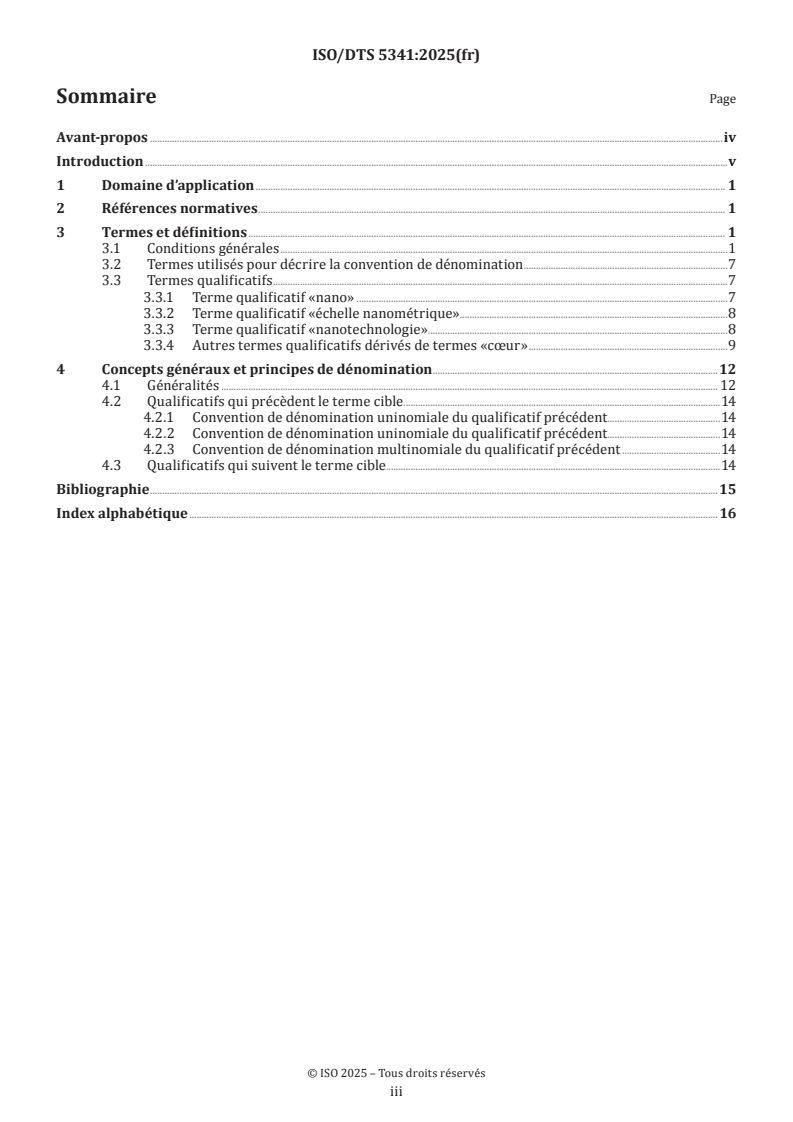
ISO/DTS 5341 - Nanotechnologies — Nomenclature — Partie 1: Nomenclature générale Released:8. 12. 2025
Frequently Asked Questions
ISO/TS 5341 is a draft published by the International Organization for Standardization (ISO). Its full title is "Nanotechnologies — Nomenclature — Part 1: General nomenclature". This standard covers: This document gives guidance and a uniform system for the use of the prefix “nano” and core terms as descriptive modifiers for the field of nanotechnologies, to reduce the need for new term definitions.
This document gives guidance and a uniform system for the use of the prefix “nano” and core terms as descriptive modifiers for the field of nanotechnologies, to reduce the need for new term definitions.
ISO/TS 5341 is classified under the following ICS (International Classification for Standards) categories: 07.120 - Nanotechnologies. The ICS classification helps identify the subject area and facilitates finding related standards.
ISO/TS 5341 has the following relationships with other standards: It is inter standard links to ISO/PRF 1183-2. Understanding these relationships helps ensure you are using the most current and applicable version of the standard.
ISO/TS 5341 is available in PDF format for immediate download after purchase. The document can be added to your cart and obtained through the secure checkout process. Digital delivery ensures instant access to the complete standard document.
Standards Content (Sample)
FINAL DRAFT
Technical
Specification
ISO/DTS 5341
ISO/TC 229
Nanotechnologies — Nomenclature
Secretariat: BSI
— Part 1: General nomenclature
Voting begins on:
Nanotechnologies — Nomenclature — Partie 1: Nomenclature 2025-10-20
générale
Voting terminates on:
2025-12-15
RECIPIENTS OF THIS DRAFT ARE INVITED TO SUBMIT,
WITH THEIR COMMENTS, NOTIFICATION OF ANY
RELEVANT PATENT RIGHTS OF WHICH THEY ARE AWARE
AND TO PROVIDE SUPPOR TING DOCUMENTATION.
IN ADDITION TO THEIR EVALUATION AS
BEING ACCEPTABLE FOR INDUSTRIAL, TECHNO
LOGICAL, COMMERCIAL AND USER PURPOSES, DRAFT
INTERNATIONAL STANDARDS MAY ON OCCASION HAVE
TO BE CONSIDERED IN THE LIGHT OF THEIR POTENTIAL
TO BECOME STAN DARDS TO WHICH REFERENCE MAY BE
MADE IN NATIONAL REGULATIONS.
Reference number
ISO/DTS 5341:2025(en) © ISO 2025
FINAL DRAFT
ISO/DTS 5341:2025(en)
Technical
Specification
ISO/DTS 5341
ISO/TC 229
Nanotechnologies — Nomenclature
Secretariat: BSI
— Part 1: General nomenclature
Voting begins on:
Nanotechnologies — Nomenclature — Partie 1: Nomenclature
générale
Voting terminates on:
RECIPIENTS OF THIS DRAFT ARE INVITED TO SUBMIT,
WITH THEIR COMMENTS, NOTIFICATION OF ANY
RELEVANT PATENT RIGHTS OF WHICH THEY ARE AWARE
AND TO PROVIDE SUPPOR TING DOCUMENTATION.
© ISO 2025
IN ADDITION TO THEIR EVALUATION AS
All rights reserved. Unless otherwise specified, or required in the context of its implementation, no part of this publication may
BEING ACCEPTABLE FOR INDUSTRIAL, TECHNO
LOGICAL, COMMERCIAL AND USER PURPOSES, DRAFT
be reproduced or utilized otherwise in any form or by any means, electronic or mechanical, including photocopying, or posting on
INTERNATIONAL STANDARDS MAY ON OCCASION HAVE
the internet or an intranet, without prior written permission. Permission can be requested from either ISO at the address below
TO BE CONSIDERED IN THE LIGHT OF THEIR POTENTIAL
or ISO’s member body in the country of the requester.
TO BECOME STAN DARDS TO WHICH REFERENCE MAY BE
MADE IN NATIONAL REGULATIONS.
ISO copyright office
CP 401 • Ch. de Blandonnet 8
CH-1214 Vernier, Geneva
Phone: +41 22 749 01 11
Email: copyright@iso.org
Website: www.iso.org
Published in Switzerland Reference number
ISO/DTS 5341:2025(en) © ISO 2025
ii
ISO/DTS 5341:2025(en)
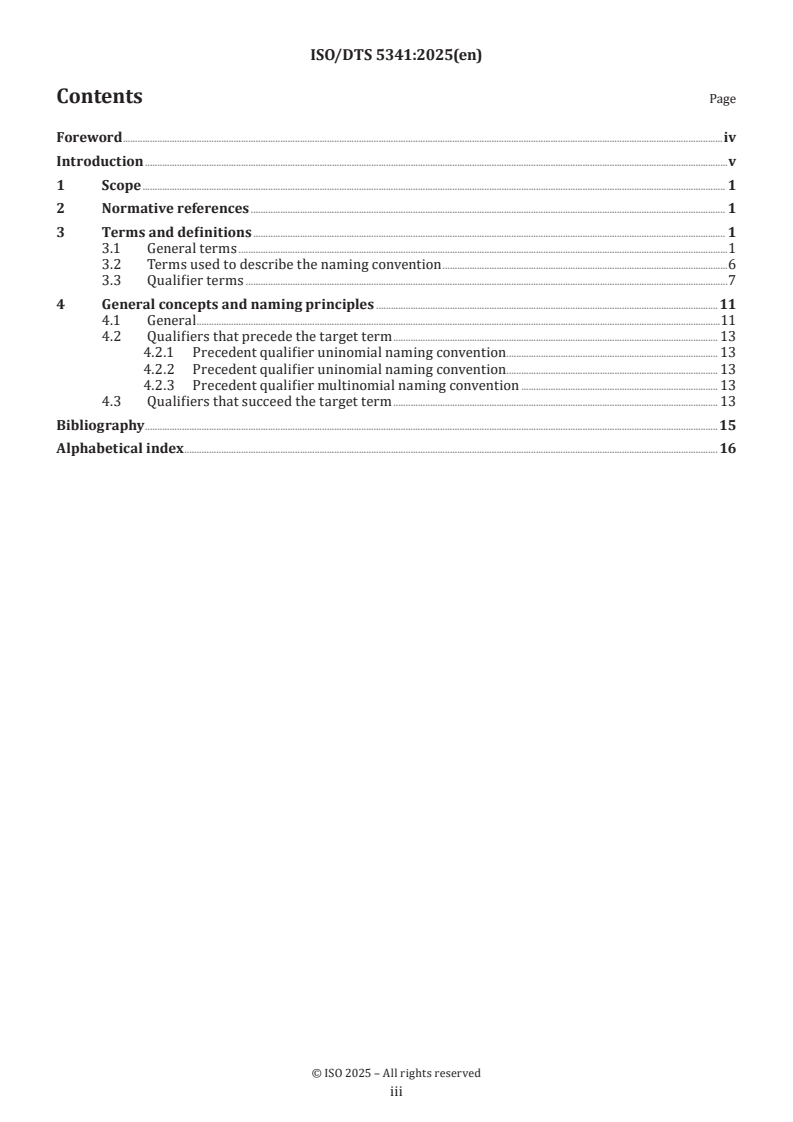
Contents Page
Foreword .iv
Introduction .v
1 Scope . 1
2 Normative references . 1
3 Terms and definitions . 1
3.1 General terms .1
3.2 Terms used to describe the naming convention .6
3.3 Qualifier terms .7
4 General concepts and naming principles .11
4.1 General .11
4.2 Qualifiers that precede the target term . 13
4.2.1 Precedent qualifier uninomial naming convention . 13
4.2.2 Precedent qualifier uninomial naming convention . 13
4.2.3 Precedent qualifier multinomial naming convention . 13
4.3 Qualifiers that succeed the target term . 13
Bibliography .15
Alphabetical index .16
iii
ISO/DTS 5341:2025(en)
Foreword
ISO (the International Organization for Standardization) is a worldwide federation of national standards
bodies (ISO member bodies). The work of preparing International Standards is normally carried out through
ISO technical committees. Each member body interested in a subject for which a technical committee
has been established has the right to be represented on that committee. International organizations,
governmental and non-governmental, in liaison with ISO, also take part in the work. ISO collaborates closely
with the International Electrotechnical Commission (IEC) on all matters of electrotechnical standardization.
The procedures used to develop this document and those intended for its further maintenance are described
in the ISO/IEC Directives, Part 1. In particular, the different approval criteria needed for the different types
of ISO document should be noted. This document was drafted in accordance with the editorial rules of the
ISO/IEC Directives, Part 2 (see www.iso.org/directives).
ISO draws attention to the possibility that the implementation of this document may involve the use of (a)
patent(s). ISO takes no position concerning the evidence, validity or applicability of any claimed patent
rights in respect thereof. As of the date of publication of this document, ISO had not received notice of (a)
patent(s) which may be required to implement this document. However, implementers are cautioned that
this may not represent the latest information, which may be obtained from the patent database available at
www.iso.org/patents. ISO shall not be held responsible for identifying any or all such patent rights.
Any trade name used in this document is information given for the convenience of users and does not
constitute an endorsement.
For an explanation of the voluntary nature of standards, the meaning of ISO specific terms and expressions
related to conformity assessment, as well as information about ISO's adherence to the World Trade
Organization (WTO) principles in the Technical Barriers to Trade (TBT), see www.iso.org/iso/foreword.html.
This document was prepared by Technical Committee ISO/TC 229, Nanotechnologies.
Any feedback or questions on this document should be directed to the user’s national standards body. A
complete listing of these bodies can be found at www.iso.org/members.html.
iv
ISO/DTS 5341:2025(en)
Introduction
The main purpose of this document is to provide a general terminology naming system for the use in the
field of nanotechnologies for commonly used descriptors such as “nano”, “nanostructured”, “nanomaterial”
and “nanotechnology”. The system of principles and rules described within gives rise to a nomenclature
convention for naming nanomaterials and nanotechnology-related items to promote communication and
consistency in vocabularies. This nomenclature convention has been derived from the ISO/TS 80004 series
that has been developed over the last 15 years and is intended to reduce the need for new term creation,
while providing guidance intended to improve communication of social and technically relevant terms.
Much of the terminology in nanotechnologies includes the use of a common group of descriptors. Many of
these descriptors have been reduced and defined as qualifiers with identified usage conventions in this
document to be consistent with essence of the original vocabulary in the ISO/TS 80004 series. The naming
conventions provided in this document allow for the reduction of required defined terms in the ISO/TS 80004
series documents while maintaining consistency in communication. A list of all parts of the ISO 80004 series
can be found on the ISO website.
In 2023, ISO/TS 80004-1:2015, ISO/TS 80004-2:2015, ISO/TS 80004-4:2011, and ISO/TS 80004-11:2017
were combined into ISO 80004-1:2023Nanotechnologies – Vocabulary – Part 1: Core Vocabulary. Unless
terms are specifically defined as otherwise within relevant International Standards, the naming convention
provided in this document apply for the field of nanotechnologies.
This document is deliberately intended to capture the essence of the naming convention that has implicitly
emerged through the development of terminology in standardization and in the broader nanotechnology
community. ISO 80004-1:2023 complements this document by providing consolidated terms and definitions
for the nanotechnologies field. Naming convention details for more complex particles, systems and
structures are planned for future nomenclature documents.
The naming convention is constructed through the inclusion of defined qualifier terms that are used to
modify a target term. Instructions for and examples of the naming convention used are provided in Clause 4,
while definitions of the qualifier terms are provided in Clause 3 of this document.
v
FINAL DRAFT Technical Specification ISO/DTS 5341:2025(en)
Nanotechnologies — Nomenclature — Part 1: General
nomenclature
1 Scope
This document provides the principles and rules for the naming of general terms in the field of
nanotechnologies. This document gives guidance for the naming of a range of concepts, materials, objects,
items and phenomena using a series of identified qualifiers, following the convention described within this
document.
NOTE Additional terms and definitions that relate to nanotechnologies are provided in ISO 80004-1:2023.
2 Normative references
There are no normative references in this document.
3 Terms and definitions
ISO and IEC maintain terminology databases for use in standardization at the following addresses:
— ISO Online browsing platform: available at https:// www .iso .org/ obp
— IEC Electropedia: available at https:// www .electropedia .org/
3.1 General terms
3.1.1
nanoscale
length range approximately from 1 nm to 100 nm
[SOURCE: ISO 80004-1:2023, 3.1.1]
3.1.2
nanomaterial
material with any external dimension in the nanoscale (3.1.1) or having internal structure or surface
structure in the nanoscale
Note 1 to entry: This generic term is inclusive of nano‐object (3.1.3) and nanostructured material (3.1.5).
3.1.3
nano-object
discrete piece of material with one, two or three external dimensions in the nanoscale (3.1.1)
[SOURCE: ISO 80004-1:2023, 3.1.5]
3.1.4
nanostructure
surface or internal feature with one or more dimensions in the nanoscale (3.1.1)
Note 1 to entry: A feature includes but is not limited to nano‐objects (3.1.3), structures, morphologies or other
identifiable areas of nanoscale dimensions. For example, the nanostructure can be a nanopore (3.1.22) or a solid
feature on an object.
[SOURCE: ISO 80004-1:2023, 3.1.6]
ISO/DTS 5341:2025(en)
3.1.5
nanostructured material
material having internal nanostructure (3.1.4) or surface nanostructure
Note 1 to entry: This definition does not exclude the possibility for a nano‐object (3.1.3) to have internal structure or
surface structure. If external dimension(s) are in the nanoscale (3.1.1), the term nano-object is recommended.
[SOURCE: ISO 80004-1:2023, 3.1.7]
3.1.6
nanoparticle
nano‐object (3.1.3) with all external dimensions in the nanoscale (3.1.1)
Note 1 to entry: If the dimensions differ significantly (typically by more than 3 times), terms such as nanofibre (3.1.8)
or nanoplate (3.1.7) are preferable to the term nanoparticle.
[SOURCE: ISO 80004-1:2023, 3.3.4]
3.1.7
nanoplate
nano‐object (3.1.3) with one external dimension in the nanoscale (3.1.1) and the other two external
dimensions significantly larger
Note 1 to entry: The larger external dimensions are not necessarily in the nanoscale.
[SOURCE: ISO 80004-1:2023, 3.3.6]
3.1.7.1
nanoflake
nanoplate (3.1.7) with limited lateral dimensions
[SOURCE: ISO 80004-1:2023, 3.3.6.1]
3.1.7.2
nanofoil
nanosheet
nanoplate (3.1.7) with extended lateral dimensions
Note 1 to entry: Nanofoil and nanosheet are used synonymously in specific industries.
Note 2 to entry: Nanofoil and nanosheet extend further with respect to their length and width compared to nanoplate
(3.1.7) or nanoflake (3.1.7.1).
[SOURCE: ISO 80004-1:2023, 3.3.6.2]
3.1.7.3
nanoribbon
nanotape
nanoplate (3.1.7) with the two larger dimensions significantly different from each other
[SOURCE: ISO 80004-1:2023, 3.3.10]
3.1.8
nanofibre
nano‐object (3.1.3) with two external dimensions in the nanoscale (3.1.1) and the third dimension
significantly larger
Note 1 to entry: The largest external dimension is not necessarily in the nanoscale.
[SOURCE: ISO 80004-1:2023, 3.3.5]
ISO/DTS 5341:2025(en)
3.1.8.1
nanotube
hollow nanofibre (3.1.8)
[SOURCE: ISO 80004-1:2023, 3.3.8]
3.1.8.2
nanorod
solid nanofibre (3.1.8)
[SOURCE: ISO 80004-1:2023, 3.3.7]
3.1.8.3
nanowire
electrically conducting or semi-conducting nanofibre (3.1.8)
[SOURCE: ISO 80004-1:2023, 3.3.9]
3.1.9
nanocone
cone-shaped nanofibre (3.1.8) or nanoparticle (3.1.6)
[SOURCE: ISO 80004-1:2023, 3.3.14]
3.1.10
nanophase
physically or chemically distinct region or collective term for physically distinct regions of the same kind in
a material with the discrete regions having one, two or three dimensions in the nanoscale (3.1.1)
Note 1 to entry: Nano‐objects (3.1.3) embedded in another phase constitute a nanophase.
[SOURCE: ISO 80004-1:2023, 3.4.2]
3.1.11
nanotechnology
application of scientific knowledge to manipulate and control matter predominantly in the nanoscale (3.1.1)
to make use of size- and structure-dependent properties and phenomena distinct from those associated
with individual atoms or molecules, or extrapolation from larger sizes of the same material
Note 1 to entry: Manipulation and control include, for example, material synthesis and processing.
[SOURCE: ISO 80004-1:2023, 3.1.3]
3.1.12
nano-enabled
exhibiting function or performance only possible with nanotechnology (3.1.11)
[SOURCE: ISO 80004-1:2023, 3.1.14]
3.1.13
nano-enhanced
exhibiting function or performance intensified or improved by nanotechnology (3.1.11)
[SOURCE: ISO 80004-1:2023, 3.1.15]
3.1.14
coating
adherent surface layer (3.1.19)
Note 1 to entry: A coating can consist of multiple layers.
Note 2 to entry: A coating is always attached to a substrate (see ISO 4618:2023, 3.245).
[SOURCE: ISO 80004-1:2023, 3.6.6]
ISO/DTS 5341:2025(en)
3.1.15
nanocoating
coating (3.1.14) with thickness in the nanoscale (3.1.1)
[SOURCE: ISO 80004-1:2023, 3.1.16]
3.1.16
nanodispersion
material in which nano‐objects (3.1.3) or a nanophase (3.1.10) are dispersed in a continuous phase of a
different composition
[SOURCE: ISO 80004-1:2023, 3.1.18]
3.1.16.1
fluid nanodispersion
heterogeneous material in which nano‐objects (3.1.3) or a nanophase (3.1.10) are dispersed in a continuous
fluid phase of a different composition
[SOURCE: ISO 80004-1:2023, 3.8.2]
3.1.16.2
nano-emulsion
fluid nanodispersion (3.1.16.1) with at least one liquid phase
[SOURCE: ISO 80004-1:2023, 3.1.18.1]
3.1.16.3
nanosuspension
fluid nanodispersion (3.1.16.1) where the dispersed phase is a solid
[SOURCE: ISO 80004-1:2023, 3.1.18.2]
3.1.17
nanosphere
spherical nano‐object (3.1.3)
[SOURCE: ISO 80004-1:2023, 3.3.11]
3.1.18
nanocrystal
nano‐object (3.1.3) with a crystalline structure
[SOURCE: ISO 80004-1:2023, 3.3.15]
3.1.19
layer
monolayer
discrete material restricted in one dimension, within or at the surface of a condensed phase
[SOURCE: ISO 80004-1:2023, 3.6.2]
3.1.20
nanolayer
layer (3.1.19) of material with thickness in the nanoscale (3.1.1)
[SOURCE: ISO 80004-1:2023, 3.7.2]
3.1.21
membrane
structure, having lateral dimensions much greater than its thickness, through which transfer can occur
under a variety of driving forces
[SOURCE: ISO 80004-1:2023, 3.6.5]
ISO/DTS 5341:2025(en)
3.1.22
nanopore
cavity with at least one dimension in the nanoscale (3.1.1), which can contain gas or liquid
[SOURCE: ISO 80004-1:2023, 3.4.3]
3.1.23
nanoporous material
solid material with nanopores (3.1.22)
[SOURCE: ISO 80004-1:2023, 3.5.1]
3.1.23.1
nanoporous membrane
membrane (3.1.21) having nanopores (3.1.22)
[SOURCE: ISO 80004-1:2023, 3.7.6]
3.1.24
nanocomposite
solid comprising a mixture of two or more phase-separated materials, one or more being nanophase (3.1.10)
Note 1 to entry: Gaseous nanophases are excluded [they are covered by nanoporous material (3.1.23)] from
nanocomposites.
Note 2 to entry: Materials with nanoscale (3.1.1) phases formed by precipitation alone are not considered to be
nanocomposite materials.
[SOURCE: ISO 80004-1:2023, 3.1.17]
3.1.25
particle
minute piece of matter with defined physical boundaries
Note 1 to entry: A physical boundary can also be described as an interface.
Note 2 to entry: This general particle definition applies to nano‐objects (3.1.3).
[SOURCE: ISO 80004-1:2023, 3.2.1]
3.1.26
agglomerate
collection of weakly or medium strongly bound particles (3.1.25) where the resulting external surface area
is similar to the sum of the surface areas of the individual components
Note 1 to entry: The forces holding an agglomerate together are weak forces, for example, van der Waals forces or
simple physical entanglement.
Note 2 to entry: Agglomerates are also termed secondary particles and the original source particles are termed
primary particles.
[SOURCE: ISO 80004-1:2023, 3.2.4]
3.1.27
aggregate
particle (3.1.25) comprising strongly bonded or fused particles where the resulting external surface area is
significantly smaller than the sum of surface areas of the individual components
Note 1 to entry: The forces holding an aggregate together are strong forces, for example, covalent or ionic bonds, or
those resulting from sintering or complex physical entanglement.
Note 2 to entry: Aggregates are also termed secondary particles and the original source particles are termed primary
particles.
ISO/DTS 5341:2025(en)
[SOURCE: ISO 80004-1:2023, 3.2.5]
3.1.28
NOAA
nano-objects and their aggregates and agglomerates
material comprising nano‐objects (3.1.3), and their aggregates (3.1.27) and agglomerates (3.1.26)
Note 1 to entry: NOAA include structures with one, two or three external dimensions in the nanoscale (3.1.1), which
can be spheres, fibres, tubes and others as primary structures. NOAA can consist of individual primary structures in
the nanoscale and aggregated or agglomerated structures, including those with sizes larger than 100 nm.
[SOURCE: ISO 80004-1:2023, 3.2.6]
3.1.29
nanofoam
liquid or solid matrix, filled with a second, gaseous phase having nanoscale (3.1.1) struts and walls, or a
gaseous nanophase (3.1.10) consisting of nanoscale bubbles, or both
[SOURCE: ISO 80004-1:2023, 3.5.2]
3.1.30
film
supported or unsupported thin material that is laterally continuously connected
Note 1 to entry: The attribute “thin” is used to emphasize that the thickness of the film is much smaller than the other
two dimensions.
Note 2 to entry: A film can be freestanding.
Note 3 to entry: A film can be made of solids or liquids (e.g. liquid film).
Note 4 to entry: A film can be composed of a monomolecular layer (3.1.19) (e.g. Langmuir-Blodgett film).
[SOURCE: ISO 80004-1:2023, 3.6.1]
3.1.31
nanofilm
film (3.1.30) with thickness in the nanoscale (3.1.1)
Note 1 to entry: A nanofilm is a nanolayer (3.1.20) which can be freestanding.
Note 2 to entry: A nanofilm can be made of solids or liquids (e.g. liquid film).
Note 3 to entry: A nanofilm can be composed of a monomolecular layer (3.1.19) (e.g. Langmuir-Blodgett film).
[SOURCE: ISO 80004-1:2023, 3.7.1]
3.2 Terms used to describe the naming convention
3.2.1
target term
term that is modified using a qualifier (3.2.2)
Note 1 to entry: When the resulting definition of the target term depends its domain (subject area or delimitation), a
domain is provide in angled brackets.
3.2.2
qualifier
descriptive term or prefix applied to narrow the definition of a target term (3.2.1).
Note 1 to entry: The qualifier may result in different definition modification depending on the domain (subject area or
delimitation) of the target term. The do
...
ISO/DTS 5341
ISO/TC 229
Secretariat: BSI
Date:
Nanotechnologies — Nomenclature — Part 1: General nomenclature
Nanotechnologies — Nomenclature — Partie 1: Nomenclature générale
ISO/DTS 5341:(en)
All rights reserved. Unless otherwise specified, or required in the context of its implementation, no part of this publication
may be reproduced or utilized otherwise in any form or by any means, electronic or mechanical, including photocopying,
or posting on the internet or an intranet, without prior written permission. Permission can be requested from either ISO
at the address below or ISO’s member body in the country of the requester.
ISO copyright office
CP 401 • Ch. de Blandonnet 8
CH-1214 Vernier, Geneva
Phone: + 41 22 749 01 11
E-mail: copyright@iso.org
Published in Switzerland
ii
ISO/DTS 5341:(en)
Contents
Foreword . iv
Introduction . v
1 Scope . 1
2 Normative references . 1
3 Terms and definitions . 1
4 General concepts and naming principles . 15
Bibliography . 20
Alphabetical index . 21
iii
ISO/DTS 5341:(en)
Foreword
ISO (the International Organization for Standardization) is a worldwide federation of national standards
bodies (ISO member bodies). The work of preparing International Standards is normally carried out through
ISO technical committees. Each member body interested in a subject for which a technical committee has been
established has the right to be represented on that committee. International organizations, governmental and
non-governmental, in liaison with ISO, also take part in the work. ISO collaborates closely with the
International Electrotechnical Commission (IEC) on all matters of electrotechnical standardization.
The procedures used to develop this document and those intended for its further maintenance are described
in the ISO/IEC Directives, Part 1. In particular, the different approval criteria needed for the different types of
ISO document should be noted. This document was drafted in accordance with the editorial rules of the
ISO/IEC Directives, Part 2 (see www.iso.org/directives).
ISO draws attention to the possibility that the implementation of this document may involve the use of (a)
patent(s). ISO takes no position concerning the evidence, validity or applicability of any claimed patent rights
in respect thereof. As of the date of publication of this document, ISO had not received notice of (a) patent(s)
which may be required to implement this document. However, implementers are cautioned that this may not
represent the latest information, which may be obtained from the patent database available
at www.iso.org/patents. ISO shall not be held responsible for identifying any or all such patent rights.
Any trade name used in this document is information given for the convenience of users and does not
constitute an endorsement.
For an explanation of the voluntary nature of standards, the meaning of ISO specific terms and expressions
related to conformity assessment, as well as information about ISO's adherence to the World Trade
Organization (WTO) principles in the Technical Barriers to Trade (TBT), see www.iso.org/iso/foreword.html.
This document was prepared by Technical Committee ISO/TC 229, Nanotechnologies.
Any feedback or questions on this document should be directed to the user’s national standards body. A
complete listing of these bodies can be found at www.iso.org/members.html.
Field Code Changed
iv
ISO/DTS 5341:(en)
Introduction
The main purpose of this technical specificationdocument is to provide a general terminology naming system
for the use in the field of nanotechnologies for commonly used descriptors such as “nano”, “nanostructured”,
“nanomaterial” and “nanotechnology”. The system of principles and rules described within gives rise to a
nomenclature convention for naming nanomaterials and nanotechnology-related items to promote
communication and consistency in vocabularies. This nomenclature convention has been derived from the
the ISO/TS 80004 series of documents that havehas been developed over the last 15 years and is intended to
reduce the need for new term creation, while providing guidance intended to improve communication of social
and technically relevant terms.
Much of the terminology in nanotechnologies includes the use of a common group of descriptors. Many of
these descriptors have been reduced and defined as qualifiers with identified usage conventions in this
document to be consistent with essence of the original vocabulary in the ISO/TS 80004 series. The naming
conventions provided in this document allow for the reduction of required defined terms in the ISO/TS 80004
series documents while maintaining consistency in communication. A list of all parts of the ISO 80004 series
can be found on the ISO website.
In 2023, ISO/TS 80004-1:2015, ISO/TS 80004-2:2015, ISO/TS 80004-4:2011, and ISO/TS 80004-11:2017
were combined into ISO 80004-1:2023 Nanotechnologies2023Nanotechnologies – Vocabulary – Part 1: Core
Vocabulary. Unless terms are specifically defined as otherwise within ISO TC 229relevant International
Standards, the naming convention provided in this technical specification is recommendeddocument apply
for the field of nanotechnologies.
implicitly emerged through the development of terminology in ISO TC 229standardization and in the broader
nanotechnology community. ISO 80004-1:2023 Nanotechnologies -Vocabulary – Part 1: Core Vocabulary
further complements this document by providing consolidated terms and definitions for Nanotechnologies.
the nanotechnologies field. Naming convention details for more complex particles, systems and structures will
be provided inare planned for future nomenclature documents.
The naming convention is constructed through the inclusion of defined qualifier terms that are used to modify
a target term. Instructions for and examples of the used naming convention used are provided in
Clause 4Section 4,, while definitions of the qualifier terms are provided in Clause 3Section 3 of this document
in accordance with the ISO/IEC Directives Part 2. .
v
ISO/DTS 5341:(en)
Nanotechnologies — Nomenclature — Part 1: General nomenclature
1 Scope
This document containsprovides the principles and rules for the naming of general terms in the field of
nanotechnologies. This document providesgives guidance for the naming of a range of concepts, materials,
objects, items and phenomena using a series of identified qualifiers, following the convention described within
this technical specificationdocument.
NOTE Additional terms and definitions that relate to nanotechnologies are provided in ISO 80004-1:2023.
2 Normative references
There are no normative references in this document.
3 Terms and definitions
ISO and IEC maintain terminology databases for use in standardization at the following addresses:
— — ISO Online browsing platform: available at https://www.iso.org/obphttps://www.iso.org/obp
— — IEC Electropedia: available at https://www.electropedia.org/https://www.electropedia.org/
3.1 General terms
3.1.1 3.1.1
nanoscale
length range approximately from 1 nm to 100 nm
[SOURCE: ISO 80004-1:2023, definition 3.1.1]
3.1.2 3.1.2
nanomaterial
material with any external dimension in the nanoscale (3.1.1(3.1.1)) or having internal structure or surface
structure in the nanoscale
Note 1 to entry: This generic term is inclusive of nano‐object (3.1.3(3.1.3)) and nanostructured material (3.1.5(3.1.4).).
Note 2 to entry: See also engineered nanomaterial, manufactured nanomaterial and incidental nanomaterial
3.1.43.1.3 3.1.3
nano-object
discrete piece of material with one, two or three external dimensions in the nanoscale (3.1.1(3.1.1))
[SOURCE: ISO 80004-1:2023, definition 3.1.5]
3.1.53.1.4 3.1.4
nanostructure
surface or internal feature with one or more dimensions in the nanoscale (3.1.1(3.1.1))
Note 1 to entry: A feature includes but is not limited to nano‐objects (3.1.3(3.1.3),), structures, morphologies or other
identifiable areas of nanoscale dimensions. For example, the nanostructure can be a nanopore (3.1.22) or a solid feature
on an object.
ISO/DTS 5341:(en)
[SOURCE: ISO 80004-1:2023, definition 3.1.6]
3.1.63.1.5 3.1.5
nanostructured material
Materialmaterial having internal nanostructure (3.1.4(3.1.4)) or surface nanostructure
Note 1 to entry: This definition does not exclude the possibility for a nano‐object (3.1.3(3.1.3)) to have internal
structure or surface structure. If external dimension(s) are in the nanoscale (3.1.1(3.1.1),), the term nano-object is
recommended.
[SOURCE: ISO 80004-1:2023, definition 3.1.7]
3.1.73.1.6 3.1.6
nanoparticle
nano‐object (3.1.3(3.1.3)) with all external dimensions in the nanoscale (3.1.1(3.1.1) )
Note 1 to entry: If the dimensions differ significantly (typically by more than 3 times), terms such as nanofibre
(3.1.8(3.1.8)) or nanoplate (3.1.7(3.1.7)) are preferable to the term nanoparticle.
[SOURCE: ISO 80004-1:2023, definition 3.3.4]
3.1.83.1.7 3.1.7
nanoplate
nano‐object (3.1.3(3.1.3)) with one external dimension in the nanoscale (3.1.1(3.1.1)) and the other two
external dimensions significantly larger
Note 1 to entry: The larger external dimensions are not necessarily in the nanoscale.
[SOURCE: ISO 80004-1:2023, definition 3.3.6]
3.1.8.13.1.7.1 3.1.7.1
nanoflake
nanoplate (3.1.7(3.1.7)) with limited lateral dimensions
[SOURCE: ISO 80004-1:2023, definition 3.3.6.1]
3.1.8.23.1.7.2 3.1.7.2
nanofoil
nanosheet
nanoplate (3.1.7(3.1.7)) with extended lateral dimensions
Note 1 to entry: Nanofoil and nanosheet are used synonymously in specific industries.
Note 2 to entry: Nanofoil and nanosheet extend further with respect to their length and width compared to nanoplate
(3.1.7(3.1.7)) or nanoflake (3.1.7.1(3.1.7.1).).
[SOURCE: ISO 80004-1:2023, definition 3.3.6.2]
3.1.8.33.1.7.3 3.1.7.3
nanoribbon
nanotape
nanoplate (3.1.7(31.7)) with the two larger dimensions significantly different from each other
[SOURCE: ISO/TS 80004-1:2023, definition 3.3.10]
ISO/DTS 5341:(en)
3.1.93.1.8 3.1.8
nanofibre
nano‐object (3.1.3(3.1.3)) with two external dimensions in the nanoscale (3.1.1(3.1.1)) and the third dimension
significantly larger
Note 1 to entry: The largest external dimension is not necessarily in the nanoscale (3.1.1).
[SOURCE: ISO 80004-1:2023, definition 3.3.5]
3.1.9.13.1.8.1 3.1.8.1
nanotube
hollow nanofibre (3.1.8(3.1.8))
[SOURCE: ISO 80004-1:2023, definition 3.3.8]
3.13.8.2]
3.1.8.2
nanorod
solid nanofibre (3.1.8(3.1.8))
[SOURCE: ISO 80004-1:2023, definition 3.3.7]
3.1.9.23.1.8.3 3.1.8.3
nanowire
electrically conducting or semi-conducting nanofibre (3.1.8(3.1.8))
[SOURCE: ISO 80004-1:2023, definition 3.3.9]
3.1.103.1.9 3.1.9
nanocone
cone-shaped nanofibre (3.1.8(3.1.8)) or nanoparticle (3.1.6(3.1.6))
[SOURCE: ISO 80004-1:2023, definition 3.3.14]
3.1.113.1.10 3.1.10
nanophase
physically or chemically distinct region or collective term for physically distinct regions of the same kind in a
material with the discrete regions having one, two or three dimensions in the nanoscale (3.1.1(3.1.1).)
Note 1 to entry: Nano‐objects (3.1.3) embedded in another phase constitute a nanophase.
[SOURCE: ISO 80004-1:2023, definition 3.4.2]
3.1.123.1.11 3.1.11
nanotechnology
application of scientific knowledge to manipulate and control matter predominantly in the nanoscale
(3.1.1(3.1.1)) to make use of size- and structure-dependent properties and phenomena distinct from those
associated with individual atoms or molecules, or extrapolation from larger sizes of the same material
Note 1 to entry: Manipulation and control include, for example, material synthesis and processing.
[SOURCE: ISO 80004-1:2023, definition 3.1.3]
3.1.133.1.12 3.1.12
nano-enabled
exhibiting function or performance only possible with nanotechnology (3.1.11(3.1.11))
ISO/DTS 5341:(en)
[SOURCE: ISO 80004-1:2023, definition 3.1.14]
3.1.143.1.13 3.1.13
nano-enhanced
exhibiting function or performance intensified or improved by nanotechnology (3.1.11(3.1.11))
[SOURCE: ISO 80004-1:2023, definition 3.1.15]
3.1.153.1.14 3.1.14
coating
adherent surface layer (3.1.19. )
Note 1 to entry: A coating can consist of multiple layers.
Note 1 2 to entry: A coating is always attached to a substrate (see ISO 4618:2023, 3.245).
Field Code Changed
[SOURCE: ISO 80004-1:2023, definition 3.6.6]
3.1.163.1.15 3.1.15
nanocoating
coating (3.1.14(3.1.14)) with thickness in the nanoscale (3.1.1(3.1.1))
[SOURCE: ISO 80004-1:2023, definition 3.1.16]
3.1.173.1.16 3.1.16
nanodispersion
material in which nano‐objects (3.1.3(3.1.3)) or a nanophase (3.1.10(3.1.10)) are dispersed in a continuous
phase of a different composition
[SOURCE: ISO 80004-1:2023, definition 3.1.18]
3.1.17.13.1.16.1 3.1.16.1
fluid nanodispersion
heterogeneous material in which nano‐objects (3.1.3(3.1.3)) or a nanophase (3.1.10(3.1.10)) are dispersed in
a continuous fluid phase of a different composition
[SOURCE: ISO 80004-1:2023, definition 3.8.2]
3.1.17.23.1.16.2 3.1.16.2
nano-emulsion
fluid nanodispersion (3.1.16.1(3.1.16.1)) with at least one liquid phase
[SOURCE: ISO 80004-1:2023, definition 3.1.18.1]
3.1.17.33.1.16.3 3.1.16.3
nanosuspension
fluid nanodispersion (3.1.16.1(3.1.16.1)) where the dispersed phase is a solid
[SOURCE: ISO 80004-1:2023, definition 3.1.18.2]
3.1.183.1.17 3.1.17
nanosphere
spherical nano‐object (3.1.3(3.1.3))
[SOURCE: ISO 80004-1:2023, definition 3.3.11]
ISO/DTS 5341:(en)
3.1.193.1.18 3.1.18
nanocrystal
nano‐object (3.1.3(3.1.3)) with a crystalline structure
[SOURCE: ISO 80004-1:2023, definition 3.3.15]
3.1.203.1.19 3.1.19
layer
monolayer
discrete material restricted in one dimension, within or at the surface of a condensed phase
[SOURCE: ISO 80004-1:2023, definition 3.6.2]
3.1.213.1.20 3.1.20
nanolayer
layer (3.1.19(3.1.19)) of material with thickness in the nanoscale (3.1.1(3.1.1))
[SOURCE: ISO 80004-1:2023, definition 3.7.2]
3.1.223.1.21 3.1.21
membrane
structure, having lateral dimensions much greater than its thickness, through which transfer can occur under
a variety of driving forces
[SOURCE: ISO 80004-1:2023, definition 3.6.5]
3.1.233.1.22 3.1.22
nanopore
cavity with at least one dimension in the nanoscale (3.1.1(3.1.1),), which can contain gas or liquid
[SOURCE: ISO 80004-1:2023, definition 3.4.3]
3.1.243.1.23 3.1.23
nanoporous material
solid material with nanopores (3.1.22(3.1.22))
[SOURCE: ISO 80004-1:2023, definition 3.5.1]
3.1.24.13.1.23.1 3.1.23.1
nanoporous membrane
membrane (3.1.21(3.1.21)) having nanopores (3.1.22(3.1.22))
[SOURCE: ISO 80004-1:2023, definition 3.7.6]
3.1.253.1.24 3.1.24
nanocomposite
solid comprising a mixture of two or more phase-separated materials, one or more being nanophase
(3.1.10(3.1.10))
Note 1 to entry: Gaseous nanophases are excluded [they are covered by nanoporous material (3.1.23(3.1.23)])] from
nanocomposites.
Note 2 to entry: Materials with nanoscale (3.1.1(3.1.1)) phases formed by precipitation alone are not considered to be
nanocomposite materials.
[SOURCE: ISO 80004-1:2023, definition 3.1.17]
ISO/DTS 5341:(en)
3.1.263.1.25 3.1.25
particle
minute piece of matter with defined physical boundaries
Note 1 to entry: A physical boundary can also be described as an interface.
Note 2 to entry: This general particle definition applies to nano‐objects (3.1.3(3.1.3).).
[SOURCE: ISO 80004-1:2023, definition 3.2.1]
3.1.273.1.26 3.1.26
agglomerate
collection of weakly or medium strongly bound particles (3.1.25) where the resulting external surface area is
similar to the sum of the surface areas of the individual components
Note 1 to entry: The forces holding an agglomerate together are weak forces, for example, van der Waals forces or
simple physical entanglement.
Note 2 to entry: Agglomerates are also termed secondary particles and the original source particles are termed
primary particles.
[SOURCE: ISO 80004-1:2023, definition 3.2.4]
3.1.283.1.27 3.1.27
aggregate
particle (3.1.25(3.2.1)) comprising strongly bonded or fused particles where the resulting external surface
area is significantly smaller than the sum of surface areas of the individual components
Note 1 to entry: The forces holding an aggregate together are strong forces, for example, covalent or ionic bonds, or
those resulting from sintering or complex physical entanglement.
Note 2 to entry: Aggregates are also termed secondary particles and the original source particles are termed primary
particles.
[SOURCE: ISO 80004-1:2023, definition 3.2.5]
3.1.293.1.28 3.1.28
NOAA
nano-objects and their aggregates and agglomerates
material comprising nano‐objects (3.1.3(3.1.3),), and their aggregates (3.1.27(3.1.27)) and agglomerates
(3.1.26(3.1.26))
Note 1 to entry: NOAA include structures with one, two or three external dimensions in the nanoscale (3.1.1(3.1.1),),
which can be spheres, fibres, tubes and others as primary structures. NOAA can consist of individual primary structures
in the nanoscale (3.1.1) and aggregated or agglomerated structures, including those with sizes larger than 100 nm.
[SOURCE: ISO 80004-1:2023, definition 3.2.6]
3.1.303.1.29 3.1.29
nanofoam
liquid or solid matrix, filled with a second, gaseous phase having nanoscale (3.1.1(3.1.1)) struts and walls, or
a gaseous nanophase (3.1.10(3.1.10)) consisting of nanoscale bubbles, or both
[SOURCE: ISO 80004-1:2023, definition 3.5.2]
ISO/DTS 5341:(en)
3.1.313.1.30 3.1.30
film
supported or unsupported thin material that is laterally continuously connected
Note 1 to entry: The attribute “thin” is used to emphasize that the thickness of the film is much smaller than the other
two dimensions.
Note 2 to entry: A film can be freestanding.
Note 3 to entry: A film can be made of solids or liquids (e.g. liquid film).
Note 4 to entry: A film can be composed of a monomolecular layer (3.1.19) (e.g. Langmuir-Blodgett film).
[SOURCE: ISO 80004-1:2023, definition 3.6.1]
3.1.31
Nanofilm
3.1.31
nanofilm
film (3.1.30(3.1.30)) with thickness in the nanoscale (3.1.1(3.1.1))
Note 1 to entry: A nanofilm is a nanolayer (3.1.20(3.1.20)) which can be freestanding.
Note 2 to entry: A nanofilm can be made of solids or liquids (e.g. liquid film).
Note 3 to entry: A nanofilm can be composed of a monomolecular layer (3.1.19) (e.g. Langmuir-Blodgett film).
[SOURCE: ISO 80004-1:2023, definition 3.7.1]
3.2 Terms used to describe the naming convention
3.2.1 3.2.1
target term
term that is modified using a qualifier (3.2.2(3.2.2))
Note 1 1 to Entry: entry: When the resulting definition of the target term depends its domain (subject area or
delimitation), a domain is provide in angled brackets.
3.2.2 3.2.2
qualifier
descriptive term or prefix applied to narrow the definition of a target term (3.2.1(3.2.1).).
Note 1 to Entry: entry: The qualifier may result in different definition modification depending on the domain (subject
area or delimitation) of the target term. The domain of the target term (3.2.1) is provided in angled brackets.
3.3 Qualifier Termsterms
3.3.1 “Nano” qualifier terms
3.3.1.1 3.3.1.1
nano
preceding qualifier (3.2.2(3.2.2)) forming a uninomial specifying that the target
term (3.2.1(3.2.1)) exists with at least one discrete dimension in the nanoscale (3.1.1(3.1.1))
Note 1 to Entry: entry: This qualifier refers to the qualities of discrete phases and objects. To specify, surface or internal
structure the qualifier (3.2.2) nanostructure (3.1.4(3.3.3)) is preferred. For more general identification of a material as a
nanomaterial (3.1.2), then the qualifier (3.2.2) nanomaterial (3.2.4) is preferred.
ISO/DTS 5341:(en)
Note 2 to Entry: entry: Definitions resulting from the use of nanoscale (3.3.2.1(3.3.2.1)) and nano for the same material
are synonymous.
Note 3 to Entry: entry: Terms defined in ISO 80004-1 consistent with this convention include nanowire
(3.1.8.3(3.1.16),), nanopore (3.1.22(3.1.22),), nanocoating (3.1.15(3.1.15),), and nanocrystal (3.1.18(3.1.18).).
3.3.1.2 3.3.1.2
nano
preceding qualifier (3.2.2(3.2.2)) forming a uninomial specifying that the
target term (3.2.1(3.2.1)) exists as objects with at least one dimension in the nanoscale
Note 1 to Entry: entry: Terms defined in ISO 80004-1 consistent with this convention include nanoparticle
(3.1.6(3.1.6),), nanosphere (3.1.17(3.1.17),), nanoplate (3.1.7(3.1.7),), nanoflake (3.1.7.1(3.1.7.1),), nanofoil
(3.1.7.2(3.1.7.2),), nanoribbon (3.1.7.3(3.1.7.3),), nanofibre (3.1.8(3.1.8),), nanotube (3.1.8.1(3.1.8.1),), nanorod
(3.1.8.2(3.1.8.2),), nanocone (3.1.9(3.1.9),), nanolayer (3.1.20(3.1.20),), and nanofilm (3.1.31(3.1.31). ).
3.3.1.3 3.3.1.3
nano
preceding qualifier (3.2.2(3.2.2)) forming a uninomial specifying an area of the
target term (3.2.1(3.2.1)) discipline involving the useduse of nanomaterials or nanoscience or
nanotechnologies
3.3.1.4 3.3.1.4
nano
preceding qualifier (3.2.2(3.2.2)) forming a uninomial specifying that
the target term (3.2.1(3.2.1)) consists of a system or collection of nano‐objects (3.1.3(3.1.3)) or nanophases
(3.1.10(3.1.10). )
EXAMPLE Dispersions fall in the domain of multiphase systems. The combination of "nano" and "dispersion"
according to the syntax results in the compound term “nanodispersion” (3.1.16”.). The specified definition of
nanodispersion as specified is: “dispersion consisting of a system or collection of nano-objects (3.1.3) or nanophases
(3.1.10). This is consistent with the definition of nanodispersion (3.1.16(3.1.16)) as defined in ISO 80004-1:2023, 3.1.18.
Note 1 to Entry: entry: Where a term has been defined in ISO 80004-1:2023, the definition in ISO 80004-1:2023 is
preferred.
Note 2 to Entry: entry: Terms defined in ISO 80004-1 consistent with this convention include nanodispersion (3.1.16),,
nanofoam (3.1.29(3.1.29),), nano‐aerosol, nanocomposite (3.1.24(3.1.24),), and nano‐emulsion (3.1.16.2(3.1.16.2)) and
nanosuspension (3.1.16.3(3.1.16.1).).
...
PROJET FINAL
Spécification
technique
ISO/DTS 5341
ISO/TC 229
Nanotechnologies — Nomenclature
Secrétariat: BSI
— Partie 1: Nomenclature générale
Début de vote:
Nanotechnologies — Nomenclature — Part 1: General 2025-10-20
nomenclature
Vote clos le:
2025-12-15
LES DESTINATAIRES DU PRÉSENT PROJET SONT
INVITÉS À PRÉSENTER, AVEC LEURS OBSERVATIONS,
NOTIFICATION DES DROITS DE PROPRIÉTÉ DONT ILS
AURAIENT ÉVENTUELLEMENT CONNAISSANCE ET À
FOURNIR UNE DOCUMENTATION EXPLICATIVE.
OUTRE LE FAIT D’ÊTRE EXAMINÉS POUR
ÉTABLIR S’ILS SONT ACCEPTABLES À DES FINS
INDUSTRIELLES, TECHNOLOGIQUES ET COM-MERCIALES,
AINSI QUE DU POINT DE VUE DES UTILISATEURS, LES
PROJETS DE NORMES
INTERNATIONALES DOIVENT PARFOIS ÊTRE CONSIDÉRÉS
DU POINT DE VUE DE LEUR POSSI BILITÉ DE DEVENIR DES
NORMES POUVANT
SERVIR DE RÉFÉRENCE DANS LA RÉGLEMENTATION
NATIONALE.
Numéro de référence
ISO/DTS 5341:2025(fr) © ISO 2025
PROJET FINAL
ISO/DTS 5341:2025(fr)
Spécification
technique
ISO/DTS 5341
ISO/TC 229
Nanotechnologies — Nomenclature
Secrétariat: BSI
— Partie 1: Nomenclature générale
Début de vote:
Nanotechnologies — Nomenclature — Part 1: General
2025-10-20
nomenclature
Vote clos le:
2025-12-15
LES DESTINATAIRES DU PRÉSENT PROJET SONT
INVITÉS À PRÉSENTER, AVEC LEURS OBSERVATIONS,
NOTIFICATION DES DROITS DE PROPRIÉTÉ DONT ILS
AURAIENT ÉVENTUELLEMENT CONNAISSANCE ET À
FOURNIR UNE DOCUMENTATION EXPLICATIVE.
DOCUMENT PROTÉGÉ PAR COPYRIGHT
OUTRE LE FAIT D’ÊTRE EXAMINÉS POUR
ÉTABLIR S’ILS SONT ACCEPTABLES À DES FINS
© ISO 2025 INDUSTRIELLES, TECHNOLOGIQUES ET COM-MERCIALES,
AINSI QUE DU POINT DE VUE DES UTILISATEURS, LES
Tous droits réservés. Sauf prescription différente ou nécessité dans le contexte de sa mise en œuvre, aucune partie de cette
PROJETS DE NORMES
INTERNATIONALES DOIVENT PARFOIS ÊTRE CONSIDÉRÉS
publication ne peut être reproduite ni utilisée sous quelque forme que ce soit et par aucun procédé, électronique ou mécanique,
DU POINT DE VUE DE LEUR POSSI BILITÉ DE DEVENIR DES
y compris la photocopie, ou la diffusion sur l’internet ou sur un intranet, sans autorisation écrite préalable. Une autorisation peut
NORMES POUVANT
être demandée à l’ISO à l’adresse ci-après ou au comité membre de l’ISO dans le pays du demandeur.
SERVIR DE RÉFÉRENCE DANS LA RÉGLEMENTATION
NATIONALE.
ISO copyright office
Case postale 401 • Ch. de Blandonnet 8
CH-1214 Vernier, Genève
Tél.: +41 22 749 01 11
E-mail: copyright@iso.org
Web: www.iso.org
Publié en Suisse Numéro de référence
ISO/DTS 5341:2025(fr) © ISO 2025
ii
ISO/DTS 5341:2025(fr)
Sommaire Page
Avant-propos .iv
Introduction .v
1 Domaine d’application . 1
2 Références normatives . 1
3 Termes et définitions . 1
3.1 Conditions générales .1
3.2 Termes utilisés pour décrire la convention de dénomination .7
3.3 Termes qualificatifs .7
3.3.1 Terme qualificatif «nano» .7
3.3.2 Terme qualificatif «échelle nanométrique» .8
3.3.3 Terme qualificatif «nanotechnologie».8
3.3.4 Autres termes qualificatifs dérivés de termes «cœur» .9
4 Concepts généraux et principes de dénomination .12
4.1 Généralités . 12
4.2 Qualificatifs qui précèdent le terme cible.14
4.2.1 Convention de dénomination uninomiale du qualificatif précédent . .14
4.2.2 Convention de dénomination uninomiale du qualificatif précédent . .14
4.2.3 Convention de dénomination multinomiale du qualificatif précédent .14
4.3 Qualificatifs qui suivent le terme cible.14
Bibliographie .15
Index alphabétique . 16
iii
ISO/DTS 5341:2025(fr)
Avant-propos
L’ISO (Organisation internationale de normalisation) est une fédération mondiale d’organismes nationaux
de normalisation (comités membres de l’ISO). L’élaboration des Normes internationales est en général
confiée aux comités techniques de l’ISO. Chaque comité membre intéressé par une étude a le droit de faire
partie du comité technique créé à cet effet. Les organisations internationales, gouvernementales et non
gouvernementales, en liaison avec l’ISO participent également aux travaux. L’ISO collabore étroitement avec
la Commission électrotechnique internationale (IEC) en ce qui concerne la normalisation électrotechnique.
Les procédures utilisées pour élaborer le présent document et celles destinées à sa mise à jour sont
décrites dans les Directives ISO/IEC, Partie 1. Il convient, en particulier, de prendre note des différents
critères d’approbation requis pour les différents types de documents ISO. Le présent document
a été rédigé conformément aux règles de rédaction données dans les Directives ISO/IEC, Partie 2
(voir www.iso.org/directives).
L’ISO attire l’attention sur le fait que la mise en application du présent document peut entraîner l’utilisation
d’un ou de plusieurs brevets. L’ISO ne prend pas position quant à la preuve, à la validité et à l’applicabilité de
tout droit de brevet revendiqué à cet égard. À la date de publication du présent document, l’ISO n’avait pas
reçu notification qu’un ou plusieurs brevets pouvaient être nécessaires à sa mise en application. Toutefois,
il y a lieu d’avertir les responsables de la mise en application du présent document que des informations
plus récentes sont susceptibles de figurer dans la base de données de brevets, disponible à l’adresse
www.iso.org/brevets. L’ISO ne saurait être tenue pour responsable de ne pas avoir identifié de tels droits de
brevet et averti de leur existence.
Les appellations commerciales éventuellement mentionnées dans le présent document sont données pour
information, par souci de commodité, à l’intention des utilisateurs et ne sauraient constituer un engagement.
Pour une explication de la nature volontaire des normes, la signification des termes et expressions
spécifiques de l’ISO liés à l’évaluation de la conformité, ou pour toute information au sujet de l’adhésion de
l’ISO aux principes de l’Organisation mondiale du commerce (OMC) concernant les obstacles techniques au
commerce (OTC), voir www.iso.org/avant-propos.
Le présent document a été élaboré par le comité technique ISO/TC 229, Nanotechnologies.
Il convient que l’utilisateur adresse tout retour d’information ou toute question concernant le présent
document à l’organisme national de normalisation de son pays. Une liste exhaustive desdits organismes se
trouve à l’adresse www.iso.org/fr/members.html.
iv
ISO/DTS 5341:2025(fr)
Introduction
L’objectif premier du présent document est de fournir un système de dénomination terminologique générale
destiné au domaine des nanotechnologies consacré aux descripteurs couramment utilisés tels que «nano»,
«nanostructuré», «nanomatériau» et «nanotechnologie». Le système de principes et de règles décrit ici
donne lieu à une convention de nomenclature servant à nommer les nanomatériaux et les éléments relatifs
aux nanotechnologies afin de promouvoir la communication et la cohérence du vocabulaire. La présente
convention de nomenclature est dérivée de la série ISO/TS 80004 qui a été développée depuis les 15 dernières
années et est destinée à réduire la nécessité de création de nouveaux termes tout en proposant des
recommandations d’amélioration de la communication de termes pertinents socialement et techniquement.
Une grande partie de la terminologie des nanotechnologies inclut l’utilisation d’un groupe de descripteurs
commun. Dans le présent document, beaucoup de ces descripteurs ont été réduits et définis en tant que
qualificatifs, avec des conventions d’utilisation identifiées à des fins de cohérence avec le vocabulaire original
de la série ISO/TS 80004. Les conventions de dénomination proposées dans le présent document permettent
de réduire les termes définis exigés dans les documents de la série ISO/TS 80004, tout en maintenant la
cohérence de la communication. Une liste de toutes les parties de la série ISO 80004 se trouve sur le site Web
de l’ISO.
En 2023, l’ISO/TS 80004-1:2015, l’ISO/TS 80004-2:2015, l’ISO/TS 80004-4:2011 et l’ISO/TS 80004-11:2017
ont été regroupées dans la norme ISO 80004-1:2023, Nanotechnologies — Vocabulaire — Partie 1: Vocabulaire
«cœur». Sauf en cas de définition différente spécifique des termes dans les Normes internationales
pertinentes, la convention de dénomination proposée dans le présent document s’applique au domaine des
nanotechnologies.
Le présent document est délibérément destiné à saisir l’essence de la convention de dénomination qui a
émergé de façon implicite par le biais du développement de la terminologie dans la normalisation et dans
la communauté plus étendue des nanotechnologies. L’ISO 80004-1:2023 complète le présent document en
proposant des termes et définitions consolidés pour le domaine des nanotechnologies. La définition des
détails de la convention de dénomination concernant les particules, systèmes et structures plus complexes
est prévue pour les documents de nomenclature futurs.
La convention de dénomination est construite sur l’inclusion de termes qualificatifs définis utilisés pour
modifier un terme cible. Des instructions et des exemples de la convention de dénomination utilisée sont
fournis à l’Article 4, tandis que les définitions des termes qualificatifs sont fournies à l’Article 3 du présent
document.
v
PROJET FINAL Spécification technique ISO/DTS 5341:2025(fr)
Nanotechnologies — Nomenclature — Partie 1: Nomenclature
générale
1 Domaine d’application
Le présent document présente les principes et les règles de dénomination de termes généraux dans le
domaine des nanotechnologies. Le présent document donne des recommandations pour la dénomination
d’une gamme de concepts, matériaux, objets, éléments et phénomènes à l’aide d’une série de qualificatifs
identifiés, suivant la convention décrite dans le présent document.
NOTE Des termes et définitions supplémentaires relatifs aux nanotechnologies sont donnés dans
l’ISO 80004-1:2023.
2 Références normatives
Le présent document ne contient aucune référence normative.
3 Termes et définitions
L’ISO et l’IEC tiennent à jour des bases de données terminologiques destinées à être utilisées en normalisation,
consultables aux adresses suivantes:
— ISO Online browsing platform: disponible à l’adresse https:// www .iso .org/ obp
— IEC Electropedia: disponible à l’adresse https:// www .electropedia .org/
3.1 Conditions générales
3.1.1
échelle nanométrique
échelle de longueur s’étendant approximativement de 1 nm à 100 nm
[SOURCE: ISO 80004-1:2023, 3.1.1]
3.1.2
nanomatériau
matériau ayant une dimension extérieure à l’échelle nanométrique (3.1.1) ou ayant une structure interne ou
une structure de surface à l’échelle nanométrique
Note 1 à l'article: Ce terme générique englobe les nano-objets (3.1.3) et les matériaux nanostructurés (3.1.5).
3.1.3
nano-objet
portion discrète de matériau dont une, deux ou les trois dimensions externes sont à l’échelle nanométrique
(3.1.1)
[SOURCE: ISO 80004-1:2023, 3.1.5]
ISO/DTS 5341:2025(fr)
3.1.4
nanostructure
élément de surface ou interne dont une ou plusieurs dimensions sont à l’échelle nanométrique (3.1.1)
Note 1 à l'article: Les éléments incluent, sans toutefois s’y limiter, les nano-objets (3.1.3), les structures, les morphologies
ou autres zones identifiables avec des dimensions à l’échelle nanométrique. La nanostructure peut, par exemple, être
un nanopore (3.1.22) ou un élément solide sur un objet.
[SOURCE: ISO 80004-1:2023, 3.1.6]
3.1.5
matériau nanostructuré
matériau ayant une nanostructure (3.1.4) interne ou une nanostructure de surface
Note 1 à l'article: Cette définition n’exclut pas la possibilité qu’un nano-objet (3.1.3) ait une structure interne ou une
structure de surface. Si la ou les dimensions externes sont à l’échelle nanométrique (3.1.1), il est recommandé d’utiliser
le terme «nano-objet».
[SOURCE: ISO 80004-1:2023, 3.1.7]
3.1.6
nanoparticule
NP
nano-objet (3.1.3) dont toutes les dimensions externes sont à l’échelle nanométrique (3.1.1)
Note 1 à l'article: Si les dimensions diffèrent de façon significative (généralement d’un facteur supérieur à trois),
des termes tels que nanofibre (3.1.8) ou nanoplaque (3.1.7) sont préférables au terme nanoparticule.
[SOURCE: ISO 80004-1:2023, 3.3.4]
3.1.7
nanoplaque
nano-objet (3.1.3) ayant une dimension externe à l’échelle nanométrique (3.1.1) et les deux autres dimensions
externes significativement plus grandes
Note 1 à l'article: Les dimensions externes les plus grandes ne sont pas nécessairement à l’échelle nanométrique.
[SOURCE: ISO 80004-1:2023, 3.3.6]
3.1.7.1
nanoflocon
nanoplaque (3.1.7) dont les dimensions latérales sont limitées
[SOURCE: ISO 80004-1:2023, 3.3.6.1]
3.1.7.2
nanofeuillet
nanofeuille
nanoplaque (3.1.7) dont les dimensions latérales sont étendues
Note 1 à l'article: Les termes «nanofeuillet» et «nanofeuille» sont utilisés comme des synonymes dans certaines
industries.
Note 2 à l'article: Par rapport à une nanoplaque (3.1.7) ou à un nanoflocon (3.1.7.1), un nanofeuillet et une nanofeuille
sont plus étendus en termes de longueur et de largeur.
[SOURCE: ISO 80004-1:2023, 3.3.6.2]
3.1.7.3
nanoruban
nanobande
nanoplaque (3.1.7) dont les deux plus grandes dimensions sont significativement différentes l’une de l’autre
[SOURCE: ISO 80004-1:2023, 3.3.10]
ISO/DTS 5341:2025(fr)
3.1.8
nanofibre
nano-objet (3.1.3) ayant deux dimensions externes à l’échelle nanométrique (3.1.1) et la troisième dimension
externe significativement plus grande
Note 1 à l'article: La plus grande des dimensions externes n’est pas nécessairement à l’échelle nanométrique.
[SOURCE: ISO 80004-1:2023, 3.3.5]
3.1.8.1
nanotube
nanofibre (3.1.8) creuse
[SOURCE: ISO 80004-1:2023, 3.3.8]
3.1.8.2
nanobâtonnet
nanotige
nanofibre (3.1.8) solide
[SOURCE: ISO 80004-1:2023, 3.3.7]
3.1.8.3
nanofil
nanofibre (3.1.8) électriquement conductrice ou semi-conductrice
[SOURCE: ISO 80004-1:2023, 3.3.9]
3.1.9
nanocône
nanofibre (3.1.8) ou nanoparticule (3.1.6) de forme conique
[SOURCE: ISO 80004-1:2023, 3.3.14]
3.1.10
nanophase
région physiquement ou chimiquement distincte, ou terme collectif désignant un ensemble de régions de
même nature et physiquement distinctes dans un matériau, cette ou ces régions discrètes ayant une, deux
ou trois dimensions à l’échelle nanométrique (3.1.1)
Note 1 à l'article: Les nano-objets (3.1.3) incorporés dans une autre phase constituent une nanophase.
[SOURCE: ISO 80004-1:2023, 3.4.2]
3.1.11
nanotechnologie
application de connaissances scientifiques à des fins de manipulation et de contrôle de la matière
principalement à l’échelle nanométrique (3.1.1) afin d’utiliser les propriétés et phénomènes dépendant
de la taille et de la structure, différents de ceux associés aux atomes ou molécules individuels, ou aux
extrapolations par rapport à des dimensions plus grandes du même matériau
Note 1 à l'article: La synthèse et le traitement des matériaux sont compris dans la manipulation et le contrôle.
[SOURCE: ISO 80004-1:2023, 3.1.3]
3.1.12
nanotechnologique
présentant une fonction ou une performance possible uniquement avec les nanotechnologies (3.1.11)
[SOURCE: ISO 80004-1:2023, 3.1.14]
ISO/DTS 5341:2025(fr)
3.1.13
nano-amélioré
présentant une fonction ou une performance intensifiée ou améliorée par les nanotechnologies (3.1.11)
[SOURCE: ISO 80004-1:2023, 3.1.15]
3.1.14
revêtement
couche (3.1.19) de surface adhérente
Note 1 à l'article: Un revêtement peut être composé de plusieurs couches.
Note 2 à l'article: Un revêtement est toujours lié à un substrat (voir l’ISO 4618:2023, 3.245).
[SOURCE: ISO 80004-1:2023, 3.6.6]
3.1.15
nanorevêtement
revêtement (3.1.14) dont l’épaisseur est à l’échelle nanométrique (3.1.1)
[SOURCE: ISO 80004-1:2023, 3.1.16]
3.1.16
nanodispersion
matériau dans lequel des nano-objets (3.1.3) ou une nanophase (3.1.10) sont dispersés dans une phase
continue de composition différente
[SOURCE: ISO 80004-1:2023, 3.1.18]
3.1.16.1
nanodispersion fluide
matériau hétérogène dans lequel des nano-objets (3.1.3) ou une nanophase (3.1.10) sont dispersés dans une
phase fluide continue de composition différente
[SOURCE: ISO 80004-1:2023, 3.8.2]
3.1.16.2
nano-émulsion
nanodispersion fluide (3.1.16.1) contenant au moins une phase liquide
[SOURCE: ISO 80004-1:2023, 3.1.18.1]
3.1.16.3
nanosuspension
nanodispersion fluide (3.1.16.1) dont la phase dispersée est solide
[SOURCE: ISO 80004-1:2023, 3.1.18.2]
3.1.17
nanosphère
nano-objet (3.1.3) sphérique
[SOURCE: ISO 80004-1:2023, 3.3.11]
3.1.18
nanocristal
nano-objet (3.1.3) ayant une structure cristalline
[SOURCE: ISO 80004-1:2023, 3.3.15]
ISO/DTS 5341:2025(fr)
3.1.19
couche
monocouche
matériau discret limité dans une seule dimension, au sein ou à la surface d’une phase condensée
[SOURCE: ISO 80004-1:2023, 3.6.2]
3.1.20
nanocouche
couche (3.1.19) de matériau dont l’épaisseur est à l’échelle nanométrique (3.1.1)
[SOURCE: ISO 80004-1:2023, 3.7.2]
3.1.21
membrane
structure dont les dimensions latérales sont beaucoup plus grandes que son épaisseur et au travers de
laquelle un transfert peut avoir lieu sous l’effet de diverses forces motrices
[SOURCE: ISO 80004-1:2023, 3.6.5]
3.1.22
nanopore
cavité dont au moins une dimension est à l’échelle nanométrique (3.1.1) et qui peut contenir un gaz ou un
liquide
[SOURCE: ISO 80004-1:2023, 3.4.3]
3.1.23
matériau nanoporeux
matériau solide contenant des nanopores (3.1.22)
[SOURCE: ISO 80004-1:2023, 3.5.1]
3.1.23.1
membrane nanoporeuse
membrane (3.1.21) ayant des nanopores (3.1.22)
[SOURCE: ISO 80004-1:2023, 3.7.6]
3.1.24
nanocomposite
solide composé d’un mélange de deux ou plusieurs matériaux de phases distinctes, dont une ou plusieurs
sont des nanophases (3.1.10)
Note 1 à l'article: Les nanophases gazeuses sont exclues des nanocomposites (elles sont traitées dans la catégorie des
matériaux nanoporeux (3.1.23)).
Note 2 à l'article: Les matériaux composés de phases à l’échelle nanométrique (3.1.1) formées uniquement par
précipitation ne sont pas considérés comme des nanocomposites.
[SOURCE: ISO 80004-1:2023, 3.1.17]
3.1.25
particule
minuscule portion de matière avec des limites physiques bien définies
Note 1 à l'article: Une limite physique peut également être décrite sous la forme d’une interface.
Note 2 à l'article: Cette définition générale de «particule» s’applique aux nano-objets (3.1.3).
[SOURCE: ISO 80004-1:2023, 3.2.1]
ISO/DTS 5341:2025(fr)
3.1.26
agglomérat
ensemble de particules (3.1.25) faiblement ou moyennement liées, dont l’aire de la surface externe résultante
est similaire à la somme des aires de surface de chacun des composants individuels
Note 1 à l'article: Les forces assurant la cohésion d’un agglomérat sont faibles, par exemple des forces de Van der Waals
ou des forces résultant d’un simple enchevêtrement physique.
Note 2 à l'article: Les agglomérats sont également appelés particules secondaires et les particules sources initiales
sont appelées particules primaires.
[SOURCE: ISO 80004-1:2023, 3.2.4]
3.1.27
agrégat
particule (3.1.25) composée de particules fortement liées ou fusionnées, dont l’aire de la surface externe
résultante est significativement plus petite que la somme des aires de surface de chacun des composants
individuels
Note 1 à l'article: Les forces assurant la cohésion d’un agrégat sont puissantes, par exemple des liaisons covalentes ou
ioniques, ou des forces résultant d’un frittage ou d’un enchevêtrement physique complexe.
Note 2 à l'article: Les agrégats sont également appelés particules secondaires et les particules sources initiales sont
appelées particules primaires.
[SOURCE: ISO 80004-1:2023, 3.2.5]
3.1.28
NOAA
nano-objets et leurs agrégats et agglomérats
matériau composé de nano-objets (3.1.3) et de leurs agrégats (3.1.27) et agglomérats (3.1.26)
Note 1 à l'article: Les NOAA comprennent des structures présentant une, deux ou trois dimensions externes à
l’échelle nanométrique (3.1.1), qui peuvent être des sphères, des fibres, des tubes et autres en tant que structures
primaires. Les NOAA peuvent être constitués de structures primaires individuelles à l’échelle nanométrique et de
structures agrégées ou agglomérées, y compris de tailles supérieures à 100 nm.
[SOURCE: ISO 80004-1:2023, 3.2.6]
3.1.29
nanomousse
matrice liquide ou solide remplie d’une seconde phase, gazeuse dont les parois et les supports sont à
l’échelle nanométrique (3.1.1), ou d’une nanophase (3.1.10) gazeuse formée de bulles à l’échelle nanométrique,
ou des deux à la fois
[SOURCE: ISO 80004-1:2023, 3.5.2]
3.1.30
film
matériau fin avec ou sans support, connecté latéralement de manière continue
Note 1 à l'article: L’attribut «fin» est utilisé pour insister sur le fait que l’épaisseur du film est bien inférieure à ses deux
autres dimensions.
Note 2 à l'article: Un film peut être libre.
Note 3 à l'article: Un film peut être constitué de solides ou liquides (par exemple, film liquide).
Note 4 à l'article: Un film peut être composé d’une couche (3.1.19) monomoléculaire (par exemple, films de Langmuir-
Blodgett).
[SOURCE: ISO 80004-1:2023, 3.6.1]
ISO/DTS 5341:2025(fr)
3.1.31
nanofilm
film (3.1.30) dont l’épaisseur est à l’échelle nanométrique (3.1.1)
Note 1 à l'article: Un nanofilm est une nanocouche (3.1.20) qui peut être libre.
Note 2 à l'article: Un nanofilm peut être constitué de solides ou liquides (par exemple, film liquide).
Note 3 à l'article: Un nanofilm peut être composé d’une couche (3.1.19) monomoléculaire (par exemple,
...
Questions, Comments and Discussion
Ask us and Technical Secretary will try to provide an answer. You can facilitate discussion about the standard in here.
Loading comments...